EP0702994A1 - Filtervlies für Gas - Google Patents
Filtervlies für Gas Download PDFInfo
- Publication number
- EP0702994A1 EP0702994A1 EP95113260A EP95113260A EP0702994A1 EP 0702994 A1 EP0702994 A1 EP 0702994A1 EP 95113260 A EP95113260 A EP 95113260A EP 95113260 A EP95113260 A EP 95113260A EP 0702994 A1 EP0702994 A1 EP 0702994A1
- Authority
- EP
- European Patent Office
- Prior art keywords
- filter medium
- fibers
- web
- nonwoven web
- thermoplastic polymers
- Prior art date
- Legal status (The legal status is an assumption and is not a legal conclusion. Google has not performed a legal analysis and makes no representation as to the accuracy of the status listed.)
- Granted
Links
- 239000000835 fiber Substances 0.000 claims abstract description 207
- 230000035699 permeability Effects 0.000 claims abstract description 27
- -1 polypropylene Polymers 0.000 claims description 42
- 238000002844 melting Methods 0.000 claims description 41
- 230000008018 melting Effects 0.000 claims description 41
- 229920001169 thermoplastic Polymers 0.000 claims description 18
- 239000004743 Polypropylene Substances 0.000 claims description 15
- 229920001155 polypropylene Polymers 0.000 claims description 15
- 239000004698 Polyethylene Substances 0.000 claims description 10
- 239000000203 mixture Substances 0.000 claims description 10
- 229920000573 polyethylene Polymers 0.000 claims description 10
- 230000001965 increasing effect Effects 0.000 claims description 9
- 239000012530 fluid Substances 0.000 claims description 8
- 238000002425 crystallisation Methods 0.000 claims description 7
- 230000008025 crystallization Effects 0.000 claims description 7
- 229920001577 copolymer Polymers 0.000 claims description 6
- 229920000098 polyolefin Polymers 0.000 claims description 5
- 229920000092 linear low density polyethylene Polymers 0.000 claims description 4
- 239000004707 linear low-density polyethylene Substances 0.000 claims description 4
- 229920002725 thermoplastic elastomer Polymers 0.000 claims description 4
- 239000004952 Polyamide Substances 0.000 claims description 3
- 239000004700 high-density polyethylene Substances 0.000 claims description 3
- 229920002647 polyamide Polymers 0.000 claims description 3
- 239000004793 Polystyrene Substances 0.000 claims description 2
- 239000004811 fluoropolymer Substances 0.000 claims description 2
- 229920002313 fluoropolymer Polymers 0.000 claims description 2
- 229920004889 linear high-density polyethylene Polymers 0.000 claims description 2
- 239000004417 polycarbonate Substances 0.000 claims description 2
- 229920000515 polycarbonate Polymers 0.000 claims description 2
- 229920000728 polyester Polymers 0.000 claims description 2
- 229920002223 polystyrene Polymers 0.000 claims description 2
- 229920002635 polyurethane Polymers 0.000 claims description 2
- 239000004814 polyurethane Substances 0.000 claims description 2
- 229920002554 vinyl polymer Polymers 0.000 claims description 2
- 238000000034 method Methods 0.000 description 57
- 229920000642 polymer Polymers 0.000 description 54
- 230000008569 process Effects 0.000 description 53
- 239000003570 air Substances 0.000 description 34
- 239000002245 particle Substances 0.000 description 31
- FAPWRFPIFSIZLT-UHFFFAOYSA-M Sodium chloride Chemical compound [Na+].[Cl-] FAPWRFPIFSIZLT-UHFFFAOYSA-M 0.000 description 30
- 238000012360 testing method Methods 0.000 description 24
- 229920001410 Microfiber Polymers 0.000 description 22
- 239000003658 microfiber Substances 0.000 description 22
- 239000011148 porous material Substances 0.000 description 17
- 239000011780 sodium chloride Substances 0.000 description 15
- 238000009987 spinning Methods 0.000 description 12
- 238000001914 filtration Methods 0.000 description 10
- 239000010410 layer Substances 0.000 description 10
- 208000012886 Vertigo Diseases 0.000 description 9
- 239000000356 contaminant Substances 0.000 description 8
- 229910001868 water Inorganic materials 0.000 description 8
- 238000010438 heat treatment Methods 0.000 description 7
- GWEVSGVZZGPLCZ-UHFFFAOYSA-N Titan oxide Chemical compound O=[Ti]=O GWEVSGVZZGPLCZ-UHFFFAOYSA-N 0.000 description 6
- 239000000428 dust Substances 0.000 description 6
- 238000010791 quenching Methods 0.000 description 6
- 230000000171 quenching effect Effects 0.000 description 6
- 239000000654 additive Substances 0.000 description 5
- 238000002788 crimping Methods 0.000 description 5
- 238000010998 test method Methods 0.000 description 5
- PPBRXRYQALVLMV-UHFFFAOYSA-N Styrene Chemical compound C=CC1=CC=CC=C1 PPBRXRYQALVLMV-UHFFFAOYSA-N 0.000 description 4
- 239000000853 adhesive Substances 0.000 description 4
- 230000001070 adhesive effect Effects 0.000 description 4
- 238000009826 distribution Methods 0.000 description 4
- 239000010419 fine particle Substances 0.000 description 4
- 238000005259 measurement Methods 0.000 description 4
- 230000008859 change Effects 0.000 description 3
- 238000005056 compaction Methods 0.000 description 3
- 238000001816 cooling Methods 0.000 description 3
- 230000003247 decreasing effect Effects 0.000 description 3
- 229920006240 drawn fiber Polymers 0.000 description 3
- 230000000694 effects Effects 0.000 description 3
- 230000005684 electric field Effects 0.000 description 3
- 238000004519 manufacturing process Methods 0.000 description 3
- 229920001748 polybutylene Polymers 0.000 description 3
- 239000000523 sample Substances 0.000 description 3
- 238000011144 upstream manufacturing Methods 0.000 description 3
- OKTJSMMVPCPJKN-UHFFFAOYSA-N Carbon Chemical compound [C] OKTJSMMVPCPJKN-UHFFFAOYSA-N 0.000 description 2
- VGGSQFUCUMXWEO-UHFFFAOYSA-N Ethene Chemical compound C=C VGGSQFUCUMXWEO-UHFFFAOYSA-N 0.000 description 2
- 239000005977 Ethylene Substances 0.000 description 2
- 239000004831 Hot glue Substances 0.000 description 2
- 229920002292 Nylon 6 Polymers 0.000 description 2
- 230000000996 additive effect Effects 0.000 description 2
- 239000000443 aerosol Substances 0.000 description 2
- 229920001400 block copolymer Polymers 0.000 description 2
- 239000012141 concentrate Substances 0.000 description 2
- 238000000151 deposition Methods 0.000 description 2
- 238000010586 diagram Methods 0.000 description 2
- 230000002708 enhancing effect Effects 0.000 description 2
- 239000000945 filler Substances 0.000 description 2
- 239000007788 liquid Substances 0.000 description 2
- 230000014759 maintenance of location Effects 0.000 description 2
- 230000000704 physical effect Effects 0.000 description 2
- 239000000049 pigment Substances 0.000 description 2
- 239000000843 powder Substances 0.000 description 2
- 238000007493 shaping process Methods 0.000 description 2
- 238000007711 solidification Methods 0.000 description 2
- 230000008023 solidification Effects 0.000 description 2
- 239000000126 substance Substances 0.000 description 2
- 238000003856 thermoforming Methods 0.000 description 2
- XLYOFNOQVPJJNP-UHFFFAOYSA-N water Substances O XLYOFNOQVPJJNP-UHFFFAOYSA-N 0.000 description 2
- 230000004584 weight gain Effects 0.000 description 2
- 235000019786 weight gain Nutrition 0.000 description 2
- QLZJUIZVJLSNDD-UHFFFAOYSA-N 2-(2-methylidenebutanoyloxy)ethyl 2-methylidenebutanoate Chemical compound CCC(=C)C(=O)OCCOC(=O)C(=C)CC QLZJUIZVJLSNDD-UHFFFAOYSA-N 0.000 description 1
- MJBPUQUGJNAPAZ-AWEZNQCLSA-N Butin Natural products C1([C@@H]2CC(=O)C3=CC=C(C=C3O2)O)=CC=C(O)C(O)=C1 MJBPUQUGJNAPAZ-AWEZNQCLSA-N 0.000 description 1
- MJBPUQUGJNAPAZ-UHFFFAOYSA-N Butine Natural products O1C2=CC(O)=CC=C2C(=O)CC1C1=CC=C(O)C(O)=C1 MJBPUQUGJNAPAZ-UHFFFAOYSA-N 0.000 description 1
- 229920000181 Ethylene propylene rubber Polymers 0.000 description 1
- 229920002633 Kraton (polymer) Polymers 0.000 description 1
- JHWNWJKBPDFINM-UHFFFAOYSA-N Laurolactam Chemical compound O=C1CCCCCCCCCCCN1 JHWNWJKBPDFINM-UHFFFAOYSA-N 0.000 description 1
- 239000004677 Nylon Substances 0.000 description 1
- 229920000299 Nylon 12 Polymers 0.000 description 1
- 229920005830 Polyurethane Foam Polymers 0.000 description 1
- BQCADISMDOOEFD-UHFFFAOYSA-N Silver Chemical compound [Ag] BQCADISMDOOEFD-UHFFFAOYSA-N 0.000 description 1
- 229910000831 Steel Inorganic materials 0.000 description 1
- 239000012963 UV stabilizer Substances 0.000 description 1
- 238000005299 abrasion Methods 0.000 description 1
- 230000002745 absorbent Effects 0.000 description 1
- 239000002250 absorbent Substances 0.000 description 1
- 229920000800 acrylic rubber Polymers 0.000 description 1
- 238000004026 adhesive bonding Methods 0.000 description 1
- 230000002411 adverse Effects 0.000 description 1
- 239000012080 ambient air Substances 0.000 description 1
- QYMGIIIPAFAFRX-UHFFFAOYSA-N butyl prop-2-enoate;ethene Chemical compound C=C.CCCCOC(=O)C=C QYMGIIIPAFAFRX-UHFFFAOYSA-N 0.000 description 1
- 239000003086 colorant Substances 0.000 description 1
- 239000002131 composite material Substances 0.000 description 1
- 230000006835 compression Effects 0.000 description 1
- 238000007906 compression Methods 0.000 description 1
- 230000001276 controlling effect Effects 0.000 description 1
- 229920006236 copolyester elastomer Polymers 0.000 description 1
- 238000005520 cutting process Methods 0.000 description 1
- 238000000280 densification Methods 0.000 description 1
- 239000000645 desinfectant Substances 0.000 description 1
- 229920001971 elastomer Polymers 0.000 description 1
- 239000000806 elastomer Substances 0.000 description 1
- 238000010894 electron beam technology Methods 0.000 description 1
- 238000005516 engineering process Methods 0.000 description 1
- HGVPOWOAHALJHA-UHFFFAOYSA-N ethene;methyl prop-2-enoate Chemical compound C=C.COC(=O)C=C HGVPOWOAHALJHA-UHFFFAOYSA-N 0.000 description 1
- 229920006245 ethylene-butyl acrylate Polymers 0.000 description 1
- 229920006244 ethylene-ethyl acrylate Polymers 0.000 description 1
- 239000005042 ethylene-ethyl acrylate Substances 0.000 description 1
- 229920006225 ethylene-methyl acrylate Polymers 0.000 description 1
- 239000005043 ethylene-methyl acrylate Substances 0.000 description 1
- 239000004744 fabric Substances 0.000 description 1
- 239000011152 fibreglass Substances 0.000 description 1
- 239000000706 filtrate Substances 0.000 description 1
- 230000002070 germicidal effect Effects 0.000 description 1
- 239000003365 glass fiber Substances 0.000 description 1
- 239000012760 heat stabilizer Substances 0.000 description 1
- 229920001903 high density polyethylene Polymers 0.000 description 1
- 230000006872 improvement Effects 0.000 description 1
- 229920001684 low density polyethylene Polymers 0.000 description 1
- 239000004702 low-density polyethylene Substances 0.000 description 1
- 239000011159 matrix material Substances 0.000 description 1
- 230000007246 mechanism Effects 0.000 description 1
- 229920001179 medium density polyethylene Polymers 0.000 description 1
- 239000004701 medium-density polyethylene Substances 0.000 description 1
- 238000002074 melt spinning Methods 0.000 description 1
- 239000011859 microparticle Substances 0.000 description 1
- 229920001778 nylon Polymers 0.000 description 1
- 229920001707 polybutylene terephthalate Polymers 0.000 description 1
- 229920000139 polyethylene terephthalate Polymers 0.000 description 1
- 239000005020 polyethylene terephthalate Substances 0.000 description 1
- 229920001343 polytetrafluoroethylene Polymers 0.000 description 1
- 239000004810 polytetrafluoroethylene Substances 0.000 description 1
- 239000011496 polyurethane foam Substances 0.000 description 1
- 239000004800 polyvinyl chloride Substances 0.000 description 1
- 229920000915 polyvinyl chloride Polymers 0.000 description 1
- 238000011045 prefiltration Methods 0.000 description 1
- 239000000047 product Substances 0.000 description 1
- 230000001105 regulatory effect Effects 0.000 description 1
- 238000012216 screening Methods 0.000 description 1
- 238000004904 shortening Methods 0.000 description 1
- 229910052709 silver Inorganic materials 0.000 description 1
- 239000004332 silver Substances 0.000 description 1
- 239000002356 single layer Substances 0.000 description 1
- 230000002269 spontaneous effect Effects 0.000 description 1
- 229910001220 stainless steel Inorganic materials 0.000 description 1
- 239000010935 stainless steel Substances 0.000 description 1
- 239000010959 steel Substances 0.000 description 1
- 229920006132 styrene block copolymer Polymers 0.000 description 1
- 238000012956 testing procedure Methods 0.000 description 1
Images

Classifications
-
- D—TEXTILES; PAPER
- D04—BRAIDING; LACE-MAKING; KNITTING; TRIMMINGS; NON-WOVEN FABRICS
- D04H—MAKING TEXTILE FABRICS, e.g. FROM FIBRES OR FILAMENTARY MATERIAL; FABRICS MADE BY SUCH PROCESSES OR APPARATUS, e.g. FELTS, NON-WOVEN FABRICS; COTTON-WOOL; WADDING ; NON-WOVEN FABRICS FROM STAPLE FIBRES, FILAMENTS OR YARNS, BONDED WITH AT LEAST ONE WEB-LIKE MATERIAL DURING THEIR CONSOLIDATION
- D04H3/00—Non-woven fabrics formed wholly or mainly of yarns or like filamentary material of substantial length
- D04H3/08—Non-woven fabrics formed wholly or mainly of yarns or like filamentary material of substantial length characterised by the method of strengthening or consolidating
- D04H3/16—Non-woven fabrics formed wholly or mainly of yarns or like filamentary material of substantial length characterised by the method of strengthening or consolidating with bonds between thermoplastic filaments produced in association with filament formation, e.g. immediately following extrusion
-
- B—PERFORMING OPERATIONS; TRANSPORTING
- B01—PHYSICAL OR CHEMICAL PROCESSES OR APPARATUS IN GENERAL
- B01D—SEPARATION
- B01D39/00—Filtering material for liquid or gaseous fluids
- B01D39/14—Other self-supporting filtering material ; Other filtering material
- B01D39/16—Other self-supporting filtering material ; Other filtering material of organic material, e.g. synthetic fibres
- B01D39/1607—Other self-supporting filtering material ; Other filtering material of organic material, e.g. synthetic fibres the material being fibrous
- B01D39/1623—Other self-supporting filtering material ; Other filtering material of organic material, e.g. synthetic fibres the material being fibrous of synthetic origin
-
- D—TEXTILES; PAPER
- D01—NATURAL OR MAN-MADE THREADS OR FIBRES; SPINNING
- D01F—CHEMICAL FEATURES IN THE MANUFACTURE OF ARTIFICIAL FILAMENTS, THREADS, FIBRES, BRISTLES OR RIBBONS; APPARATUS SPECIALLY ADAPTED FOR THE MANUFACTURE OF CARBON FILAMENTS
- D01F8/00—Conjugated, i.e. bi- or multicomponent, artificial filaments or the like; Manufacture thereof
- D01F8/04—Conjugated, i.e. bi- or multicomponent, artificial filaments or the like; Manufacture thereof from synthetic polymers
- D01F8/06—Conjugated, i.e. bi- or multicomponent, artificial filaments or the like; Manufacture thereof from synthetic polymers with at least one polyolefin as constituent
-
- B—PERFORMING OPERATIONS; TRANSPORTING
- B01—PHYSICAL OR CHEMICAL PROCESSES OR APPARATUS IN GENERAL
- B01D—SEPARATION
- B01D2239/00—Aspects relating to filtering material for liquid or gaseous fluids
- B01D2239/02—Types of fibres, filaments or particles, self-supporting or supported materials
- B01D2239/0208—Single-component fibres
-
- B—PERFORMING OPERATIONS; TRANSPORTING
- B01—PHYSICAL OR CHEMICAL PROCESSES OR APPARATUS IN GENERAL
- B01D—SEPARATION
- B01D2239/00—Aspects relating to filtering material for liquid or gaseous fluids
- B01D2239/02—Types of fibres, filaments or particles, self-supporting or supported materials
- B01D2239/0216—Bicomponent or multicomponent fibres
- B01D2239/0225—Side-by-side
-
- B—PERFORMING OPERATIONS; TRANSPORTING
- B01—PHYSICAL OR CHEMICAL PROCESSES OR APPARATUS IN GENERAL
- B01D—SEPARATION
- B01D2239/00—Aspects relating to filtering material for liquid or gaseous fluids
- B01D2239/02—Types of fibres, filaments or particles, self-supporting or supported materials
- B01D2239/0216—Bicomponent or multicomponent fibres
- B01D2239/0233—Island-in-sea
-
- B—PERFORMING OPERATIONS; TRANSPORTING
- B01—PHYSICAL OR CHEMICAL PROCESSES OR APPARATUS IN GENERAL
- B01D—SEPARATION
- B01D2239/00—Aspects relating to filtering material for liquid or gaseous fluids
- B01D2239/04—Additives and treatments of the filtering material
-
- B—PERFORMING OPERATIONS; TRANSPORTING
- B01—PHYSICAL OR CHEMICAL PROCESSES OR APPARATUS IN GENERAL
- B01D—SEPARATION
- B01D2239/00—Aspects relating to filtering material for liquid or gaseous fluids
- B01D2239/04—Additives and treatments of the filtering material
- B01D2239/0407—Additives and treatments of the filtering material comprising particulate additives, e.g. adsorbents
-
- B—PERFORMING OPERATIONS; TRANSPORTING
- B01—PHYSICAL OR CHEMICAL PROCESSES OR APPARATUS IN GENERAL
- B01D—SEPARATION
- B01D2239/00—Aspects relating to filtering material for liquid or gaseous fluids
- B01D2239/04—Additives and treatments of the filtering material
- B01D2239/0435—Electret
-
- B—PERFORMING OPERATIONS; TRANSPORTING
- B01—PHYSICAL OR CHEMICAL PROCESSES OR APPARATUS IN GENERAL
- B01D—SEPARATION
- B01D2239/00—Aspects relating to filtering material for liquid or gaseous fluids
- B01D2239/06—Filter cloth, e.g. knitted, woven non-woven; self-supported material
- B01D2239/0604—Arrangement of the fibres in the filtering material
- B01D2239/0627—Spun-bonded
-
- B—PERFORMING OPERATIONS; TRANSPORTING
- B01—PHYSICAL OR CHEMICAL PROCESSES OR APPARATUS IN GENERAL
- B01D—SEPARATION
- B01D2239/00—Aspects relating to filtering material for liquid or gaseous fluids
- B01D2239/06—Filter cloth, e.g. knitted, woven non-woven; self-supported material
- B01D2239/0604—Arrangement of the fibres in the filtering material
- B01D2239/064—The fibres being mixed
-
- B—PERFORMING OPERATIONS; TRANSPORTING
- B01—PHYSICAL OR CHEMICAL PROCESSES OR APPARATUS IN GENERAL
- B01D—SEPARATION
- B01D2239/00—Aspects relating to filtering material for liquid or gaseous fluids
- B01D2239/06—Filter cloth, e.g. knitted, woven non-woven; self-supported material
- B01D2239/065—More than one layer present in the filtering material
-
- B—PERFORMING OPERATIONS; TRANSPORTING
- B01—PHYSICAL OR CHEMICAL PROCESSES OR APPARATUS IN GENERAL
- B01D—SEPARATION
- B01D2239/00—Aspects relating to filtering material for liquid or gaseous fluids
- B01D2239/12—Special parameters characterising the filtering material
- B01D2239/1291—Other parameters
-
- Y—GENERAL TAGGING OF NEW TECHNOLOGICAL DEVELOPMENTS; GENERAL TAGGING OF CROSS-SECTIONAL TECHNOLOGIES SPANNING OVER SEVERAL SECTIONS OF THE IPC; TECHNICAL SUBJECTS COVERED BY FORMER USPC CROSS-REFERENCE ART COLLECTIONS [XRACs] AND DIGESTS
- Y10—TECHNICAL SUBJECTS COVERED BY FORMER USPC
- Y10S—TECHNICAL SUBJECTS COVERED BY FORMER USPC CROSS-REFERENCE ART COLLECTIONS [XRACs] AND DIGESTS
- Y10S55/00—Gas separation
- Y10S55/39—Electrets separator
-
- Y—GENERAL TAGGING OF NEW TECHNOLOGICAL DEVELOPMENTS; GENERAL TAGGING OF CROSS-SECTIONAL TECHNOLOGIES SPANNING OVER SEVERAL SECTIONS OF THE IPC; TECHNICAL SUBJECTS COVERED BY FORMER USPC CROSS-REFERENCE ART COLLECTIONS [XRACs] AND DIGESTS
- Y10—TECHNICAL SUBJECTS COVERED BY FORMER USPC
- Y10T—TECHNICAL SUBJECTS COVERED BY FORMER US CLASSIFICATION
- Y10T428/00—Stock material or miscellaneous articles
- Y10T428/29—Coated or structually defined flake, particle, cell, strand, strand portion, rod, filament, macroscopic fiber or mass thereof
- Y10T428/2904—Staple length fiber
- Y10T428/2909—Nonlinear [e.g., crimped, coiled, etc.]
-
- Y—GENERAL TAGGING OF NEW TECHNOLOGICAL DEVELOPMENTS; GENERAL TAGGING OF CROSS-SECTIONAL TECHNOLOGIES SPANNING OVER SEVERAL SECTIONS OF THE IPC; TECHNICAL SUBJECTS COVERED BY FORMER USPC CROSS-REFERENCE ART COLLECTIONS [XRACs] AND DIGESTS
- Y10—TECHNICAL SUBJECTS COVERED BY FORMER USPC
- Y10T—TECHNICAL SUBJECTS COVERED BY FORMER US CLASSIFICATION
- Y10T442/00—Fabric [woven, knitted, or nonwoven textile or cloth, etc.]
- Y10T442/60—Nonwoven fabric [i.e., nonwoven strand or fiber material]
- Y10T442/608—Including strand or fiber material which is of specific structural definition
- Y10T442/609—Cross-sectional configuration of strand or fiber material is specified
- Y10T442/611—Cross-sectional configuration of strand or fiber material is other than circular
-
- Y—GENERAL TAGGING OF NEW TECHNOLOGICAL DEVELOPMENTS; GENERAL TAGGING OF CROSS-SECTIONAL TECHNOLOGIES SPANNING OVER SEVERAL SECTIONS OF THE IPC; TECHNICAL SUBJECTS COVERED BY FORMER USPC CROSS-REFERENCE ART COLLECTIONS [XRACs] AND DIGESTS
- Y10—TECHNICAL SUBJECTS COVERED BY FORMER USPC
- Y10T—TECHNICAL SUBJECTS COVERED BY FORMER US CLASSIFICATION
- Y10T442/00—Fabric [woven, knitted, or nonwoven textile or cloth, etc.]
- Y10T442/60—Nonwoven fabric [i.e., nonwoven strand or fiber material]
- Y10T442/608—Including strand or fiber material which is of specific structural definition
- Y10T442/627—Strand or fiber material is specified as non-linear [e.g., crimped, coiled, etc.]
- Y10T442/635—Synthetic polymeric strand or fiber material
-
- Y—GENERAL TAGGING OF NEW TECHNOLOGICAL DEVELOPMENTS; GENERAL TAGGING OF CROSS-SECTIONAL TECHNOLOGIES SPANNING OVER SEVERAL SECTIONS OF THE IPC; TECHNICAL SUBJECTS COVERED BY FORMER USPC CROSS-REFERENCE ART COLLECTIONS [XRACs] AND DIGESTS
- Y10—TECHNICAL SUBJECTS COVERED BY FORMER USPC
- Y10T—TECHNICAL SUBJECTS COVERED BY FORMER US CLASSIFICATION
- Y10T442/00—Fabric [woven, knitted, or nonwoven textile or cloth, etc.]
- Y10T442/60—Nonwoven fabric [i.e., nonwoven strand or fiber material]
- Y10T442/637—Including strand or fiber material which is a monofilament composed of two or more polymeric materials in physically distinct relationship [e.g., sheath-core, side-by-side, islands-in-sea, fibrils-in-matrix, etc.] or composed of physical blend of chemically different polymeric materials or a physical blend of a polymeric material and a filler material
-
- Y—GENERAL TAGGING OF NEW TECHNOLOGICAL DEVELOPMENTS; GENERAL TAGGING OF CROSS-SECTIONAL TECHNOLOGIES SPANNING OVER SEVERAL SECTIONS OF THE IPC; TECHNICAL SUBJECTS COVERED BY FORMER USPC CROSS-REFERENCE ART COLLECTIONS [XRACs] AND DIGESTS
- Y10—TECHNICAL SUBJECTS COVERED BY FORMER USPC
- Y10T—TECHNICAL SUBJECTS COVERED BY FORMER US CLASSIFICATION
- Y10T442/00—Fabric [woven, knitted, or nonwoven textile or cloth, etc.]
- Y10T442/60—Nonwoven fabric [i.e., nonwoven strand or fiber material]
- Y10T442/637—Including strand or fiber material which is a monofilament composed of two or more polymeric materials in physically distinct relationship [e.g., sheath-core, side-by-side, islands-in-sea, fibrils-in-matrix, etc.] or composed of physical blend of chemically different polymeric materials or a physical blend of a polymeric material and a filler material
- Y10T442/638—Side-by-side multicomponent strand or fiber material
-
- Y—GENERAL TAGGING OF NEW TECHNOLOGICAL DEVELOPMENTS; GENERAL TAGGING OF CROSS-SECTIONAL TECHNOLOGIES SPANNING OVER SEVERAL SECTIONS OF THE IPC; TECHNICAL SUBJECTS COVERED BY FORMER USPC CROSS-REFERENCE ART COLLECTIONS [XRACs] AND DIGESTS
- Y10—TECHNICAL SUBJECTS COVERED BY FORMER USPC
- Y10T—TECHNICAL SUBJECTS COVERED BY FORMER US CLASSIFICATION
- Y10T442/00—Fabric [woven, knitted, or nonwoven textile or cloth, etc.]
- Y10T442/60—Nonwoven fabric [i.e., nonwoven strand or fiber material]
- Y10T442/681—Spun-bonded nonwoven fabric
Definitions
- the present invention is related to a filter medium for gaseous fluids, and more particularly related to a nonwoven web highly suitable for gaseous fluid filter media.
- nonwoven webs have been used as filter media for various liquid and gas filtration applications, and such nonwoven webs include meltblown fiber webs, solution spun fiber webs, wet-laid fiber webs, carded fiber webs, air-laid fiber webs and spunbond fiber webs.
- meltblown fiber webs such as meltblown fiber webs
- microfiber nonwoven webs have been widely employed as fine particle filter media since the densely packed fine fibers of these webs provide fine interfiber pore structures that are highly suitable for mechanically trapping or screening fine particles and therefore are conducive for providing a high filter efficiency.
- the fine pore structure of meltblown fiber webs and other similar webs having densely packed fine fibers results in a low permeability, creating a high pressure drop across the webs. Consequently, the low permeability of fine fiber filter media requires the application of a high driving pressure to establish an adequate throughput rate across the filter media. Furthermore, as contaminants accumulate on or in the surface of the filter media, the contaminants guickly clog the small interfiber pores, further reducing the permeability of the media, increasing the pressure drop across the media and rapidly shortening their service-life. In contrast, filter media with large interfiber pores and thus a high permeability, which contain sparsely packed and typically thick fibers, require a relatively low driving pressure to provide an adequate throughput rate and extended service-life. However, highly permeable filter media, e.g., fiberglass HVAC filters, suffer from a low filter efficiency in that the large interfiber pore structures of the media do not provide interstitial configurations that are suitable for entrapping fine contaminant particles.
- microfiber filter media are laminated to at least one separate self-supporting layer, e.g., a spunbond fiber web, adding cost and complexity to the manufacturing process.
- a separate self-supporting layer e.g., a spunbond fiber web
- U.S. Patent 4,589,894 to Gin et al. discloses a vacuum cleaner filter bag that is produced from a laminate of a fine fiber nonwoven layer and two highly porous nonwoven support layers.
- filter media produced from nonwoven webs of coarser fibers such as spunbond fiber webs and commonly-available staple fiber webs
- filtration applications such as stove hood filters
- they have not been used as filter media for fine particles. This is because, as mentioned above, the thickness of these coarse fibers causes the nonwoven webs to have larger interfiber pores than those of microfiber webs at a given basis weight, and consequently, nonwoven webs of spunbond fibers and staple fibers have not been used in fine particles filtration applications.
- the present invention provides a nonwoven filter medium.
- the filter medium contains an electretized nonwoven web of crimped fibers selected from the group consisting of spunbond filaments and staple fibers, wherein the nonwoven web has a Frazier permeability equal to or greater than about 100 ft3/min/ft2 and a density between about 0.01 g/cm3 and about 0.095 g/cm3.
- Particularly desirable crimped fibers for the present invention are conjugate spunbond filaments and conjugate staple fibers, and more particularly desirable crimped fibers are conjugate spunbond filaments.
- the present filter media provide a high filter efficiency that is comparable to the efficiencies of microfiber nonwoven web filters.
- the crimped-fiber filter media provide significantly extended service life, improved capacity, high physical integrity and low pressure drop across the media when compared to microfiber filter media.
- fibers refers both to staple fibers and to filaments, which are continuous fibers, unless otherwise indicated.
- spunbond fiber web refers to a nonwoven fiber web of small diameter filaments that are formed by extruding a molten thermoplastic polymer as filaments from a plurality of capillaries of a spinneret. The extruded filaments are cooled while being drawn by an eductive or other well-known drawing mechanism. The drawn filaments are deposited or laid onto a forming surface in a random, isotropic manner to form a loosely entangled fiber web, and then the laid fiber web is subjected to a bonding process to impart physical integrity and dimensional stability.
- spunbond fibers have an average diameter in excess of 10 ⁇ m and up to about 55 ⁇ m or higher, although finer spunbond fibers can be produced.
- staple fibers refers to discontinuous fibers, which typically have an average diameter similar to or somewhat smaller than that of spunbond fibers. Staple fibers are produced with a conventional fiber spinning process and then cut to a staple length, from about 1 inch to about 8 inches. Such staple fibers are subsequently carded or air-laid and thermally bonded to form a nonwoven web.
- meltblown fibers indicates fibers formed by extruding a molten thermoplastic polymer through a plurality of fine, usually circular, die capillaries as molten threads or filaments into a high velocity gas stream which attenuate the filaments of molten thermoplastic polymer to reduce their diameter.
- meltblown fibers are microfibers that have an average fiber diameter of up to about 10 ⁇ m. After the fibers are formed, they are carried by the high velocity gas stream and are deposited on a collecting surface to form a web of randomly dispersed and autogenously bonded meltblown fibers.
- electrostatic charges Such a process is disclosed, for example, in U.S. Patent 3,849,241 to Butin et al.
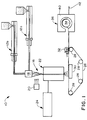
- Figure 1 is a schematic diagram of a bicomponent spunbond web forming process which can be used to produce a nonwoven web suitable for the present filter media.
- Figure 2 is a schematic diagram of an electretizing process suitable for the present invention.
- the filter media are electretized nonwoven webs of crimped spunbond or staple fibers, more desirably, of crimped spunbond or staple conjugate fibers.
- the present crimped-fiber filter media provide a high filter efficiency that is comparable to the efficiencies of microfiber nonwoven web filters while providing a significantly extended service-life, improved capacity and high physical integrity. Moreover, the pressure drop across the present filter media is significantly lower than that of microfiber web filter media.
- the present filter media 's physical properties, including uniform thickness, high porosity, high loft, low density and uniform fiber coverage, in conjunction with the media's capacity for holding high and durable electrostatic charges make the filter media highly efficient without the high pressure drop of prior art microfiber filter media.
- the physical properties of the present filter media allow the media to exhibit a desired combination of high filtrate throughput rate, high capacity and extended service-life.
- the low-density and porous structure of the filter media provides numerous but tortuous paths for contaminated fluids to travel through and thus provides highly suitable means to mechanically and electrostatically trap particulates or contaminants from the fluids, thereby providing a high efficiency without a high pressure drop across the media.
- Suitable crimped-fiber filter media of the present invention have a density between about 0.01 g/cm3 and about 0.095 g/cm3, desirably between about 0.015 g/cm3 and about 0.09 g/cm3, and more desirably between about 0.02 g/cm3 and about 0.08 g/cm3.
- suitable filter media have a Frazier permeability at least about 100 ft3/minute/ft2 (cfm/sf), desirably between about 100 cfm/sf and about 2500 cfm/sf, more desirably between about 150 cfm/sf and about 2000 cfm/sf, as measured in accordance with Federal Test Method 5450, Standard No. 191A.
- the basis weight of suitable filter media may vary widely. However, particularly suitable filter media have a basis weight from about 0.25 to about 15 ounce per square yard (osy), more particularly from about 0.4 to about 13 osy, and most particularly from about 0.5 to about 10 osy.
- Fibers suitable for the present filter media include spunbond filaments and staple fibers containing one or more suitable polymer components. More particularly suitable fibers are conjugate spunbond fibers and conjugate staple fibers, and conjugate fibers and filaments suitable for the filter media contain at least two component polymers that have different melting points and occupy distinct cross sections along substantially the entire length of the fibers. Suitable conjugate fibers and filaments have a side-by-side or sheath-core configuration, including eccentric configurations and concentric configurations. Of the sheath-core configurations, particularly suitable are eccentric configurations in that they are more amenable to crimp imparting processes, as further described below.
- the filter media are produced from a nonwoven web of crimped spunbond conjugate filaments.
- the crimp level and, thus, the interfiber pore structure of spunbond conjugate filament nonwoven webs can be conveniently controlled during the spunbonding process, providing a flexible on-line process to conveniently produce customized or particularized filter media for various filter application needs.
- spunbond nonwoven processes unlike staple fiber web forming processes, do not have separate filament cutting, i.e., staple fiber forming, and web-forming steps, thereby making the processes more economical than staple fiber web forming processes.
- the continuous filaments of spunbond nonwoven webs tend to provide higher strength nonwoven webs than staple fiber webs and do not produce lint, i.e., loose fibers, that may interfere with the performance of the filter media.
- two component conjugate fibers, bicomponent fibers are particularly useful for the invention, and suitable bicomponent fibers have from about 20% to about 80%, preferably from about 40% to about 60%, by weight of a low melting polymer and from about 80% to about 20%, preferably about 60% to about 40%, by weight of a high melting polymer.
- the component polymers of suitable conjugate fibers desirably are selected to have a melting point difference between the highest melting component polymer and the lowest melting component polymer of at least about 5°C, more desirably at least about 10°C, most desirably at least about 30°C, such that the lowest melting polymer can be melted without melting the higher melting component polymers of the fibers.
- the difference in the melting points can be used advantageously to bond nonwoven webs containing the conjugate fibers.
- the component polymers are selected additionally to have different crystallization and/or solidification properties to impart heat activatable latent crimpability in the fibers.
- the component polymers of conjugate fibers having different crystallization properties, and thus different shrinkage properties are solidified before they are fully crystallized or solidified while containing residual stress, the resulting fibers possess a potential or latent crimpability that can be heat activated.
- the shrinkage disparity among the component polymers of the conjugate fibers which results from further crystallization and densification or from relaxation of residual stress, causes the fibers to crimp when the fibers are heated to allow further crystallization or relaxation of the component polymers.
- Exemplary processes for producing highly suitable conjugate fibers having such latent crimpability and nonwoven webs therefrom are disclosed in commonly assigned U.S. Patent Application 08/933,444, filed August 21, 1993, which in its entirety is herein incorporated by reference.
- crimps in fibers can be imparted during the fiber spinning process by asymmetrically cooling the fibers across the cross-section while the spun fibers are being drawn and solidified, even if the fibers are monocomponent fibers or the fibers are conjugate fibers that are not highly amenable to the above-described spontaneous crimping process. Such asymmetric cooling process generates a solidification gradient within the cross-section, causing crimps in the fibers.
- Yet another group of alternative processes for crimping conjugate and monocomponent fibers are mechanical crimping processes. As is known in the art, mechanical crimping devices, including, gear crimpers and stuffer boxes, can be used to impart crimps in fibers.
- Suitable fibers for the present filter media have at least about 2 crimps per extended inch, desirably between about 2 and about 50 crimps per extended inch, more desirably between about 3 and about 30 crimps per extended inch, as measured in accordance with ASTM D-3937-82.
- Crimps in suitable fibers can be imparted during or after the fiber spinning step, or after the fibers are laid to form a nonwoven web.
- Nonwoven webs suitable for the present filter media are produced by isotropically depositing suitable fibers onto a forming surface to form a low-density, uniform nonwoven web with any known nonwoven web forming process, e.g., staple fibers are carded, air-laid or wet-laid and spunbond filaments are directly deposited, and then the unbonded nonwoven web is subjected to a bonding process.
- suitable bonding processes for the present invention effect interfiber bonds without significantly compacting the nonwoven web in order to preserve the low-density, even-caliper structure of the unbonded nonwoven.
- a modified compaction bonding process such as a point or calender bonding process that utilizes elongated bonding pins to minimize compaction of the regions that do not make direct contact with the bonding pins, can be supplementally applied to further improve the physical strength of a nonwoven filter medium without significantly affecting its overall loft.
- unbonded conjugate fiber nonwoven webs containing component polymers of different melting points can be bonded by heating the web to a temperature sufficiently high enough to melt the lowest melting component polymer but below the melting point of the higher melting structural component polymers of the fiber web.
- a through-air bonding, oven bonding, or infrared bonding process that effects interfiber bonds without applying significant compacting pressures can advantageously be used.
- Particularly suitable of these are through-air bonding processes which effect interfiber bonds by thoroughly and evenly heating the nonwoven web with a transverse flow of forced, heated air.
- nonwoven webs can be bonded adhesively by applying an external liquid or powder adhesive or admixing adhesive fibers in the nonwoven webs.
- an external adhesive Even monocomponent fibers webs and conjugate fiber webs containing polymer components of similar melting points can be bonded without applying compacting pressure.
- adhesive bonding processes can be disadvantageous in that they introduce additional manufacturing steps and components into the nonwoven web forming process.
- Illustrative adhesives suitable for the present invention are hot-melt adhesives, including polyester-type and polyethylene-type hot-melt adhesives.
- Monocomponent and conjugate fibers suitable for the present invention can be produced from a wide variety of thermoplastic polymers that are known to form fibers and desirably have a resistivity greater than about 1013 ohms-cm, more desirably greater than about 1014 ohms-cm, as measured in accordance with ASTM 257-61. Desirably, when conjugate fibers are utilized, the component polymers are selected in accordance with the above-described selection criteria.
- Suitable polymers for the present invention include, but are not limited to, polyolefins, e.g., polyethylene, polypropylene, polybutylene and the like; polyamides, e.g., nylon 6, nylon 6/6, nylon 10, nylon 12 and the like; polyesters, e.g., polyethylene terephthalate, polybutylene terephthalate and the like; polycarbonates; polystyrenes; thermoplastic elastomers, e.g., ethylene-propylene rubbers, styrenic block copolymers, copolyester elastomers and polyamide elastomers and the like; fluoropolymers, e.g., polytetrafluoroethylene and polytrifluorochloroethylene; vinyl polymers, e.g., polyvinyl chloride; polyurethanes; and blends and copolymers thereof.
- polyolefins e.g., polyethylene, polypropylene, poly
- Particularly suitable polymers for the present invention are polyolefins, including polyethylene, e.g., linear low density polyethylene, low density polyethylene, medium density polyethylene, high density polyethylene and blends thereof; polypropylene; polybutylene; and copolymers as well as blends thereof.
- particularly suitable polymers for the high melting component of conjugate fibers include polypropylene, copolymers of polypropylene and ethylene and blends thereof, more particularly polypropylene
- particularly suitable polymers for the low melting component include polyethylenes, more particularly linear low density polyethylene, high density polyethylene and blends thereof; and most particularly suitable component polymers for conjugate fibers are polyethylene and polypropylene.
- Suitable fiber forming polymers may additionally have thermoplastic elastomers blended therein.
- the polymer components may contain additives for enhancing the crimpability and/or lowering the bonding temperature of the fibers, and enhancing the abrasion resistance, strength and softness of the resulting webs.
- the low melting polymer component may contain about 5 to about 20% by weight of a thermoplastic elastomer such as an ABA' block copolymer of styrene, ethylene-butylene and styrene.
- a thermoplastic elastomer such as an ABA' block copolymer of styrene, ethylene-butylene and styrene.
- Such copolymers are commercially available and some of which are identified in U.S. Patent 4,663,220 to Wisneski et al.
- elastomeric block copolymers is KRATON G-2740.
- Another group of suitable additive polymers is ethylene alkyl acrylate copolymers, such as ethylene butyl acrylate, ethylene methyl acrylate and ethylene ethyl acrylate, and the suitable amount to produce the desired properties is from about 2 wt% to about 50 wt%, based on the total weight of the low melting polymer component.
- Yet other suitable additive polymers include polybutylene copolymers and ethylene-propylene copolymers.
- the process line 10 includes a pair of extruders 12a and 12b for separately supplying extruded polymer components, a high melting polymer and a low melting polymer, to a bicomponent spinneret 18.
- the spinneret 18 has openings arranged in one or more rows, and the openings form a downwardly extending curtain of fibers when the polymers are extruded through the spinneret.
- the line 10 further includes a quenching gas outlet 20 adjacently positioned to the curtain of fibers 16 extending from the spinneret 18, and the gas from the outlet 20 at least partially quenches, i.e., the polymer forming the fibers is no longer able to freely flow, and develops a latent helical crimp in the extending fibers 16.
- a quenching gas outlet 20 adjacently positioned to the curtain of fibers 16 extending from the spinneret 18, and the gas from the outlet 20 at least partially quenches, i.e., the polymer forming the fibers is no longer able to freely flow, and develops a latent helical crimp in the extending fibers 16.
- an air stream of a temperature between about 45°F and about 90°F which is directed substantially perpendicular to the length of the fibers at a velocity from about 100 to about 400 feet minute can be effectively used as a quenching gas.
- the quenching process is illustrated with a one-outlet quenching
- a fiber draw unit or an aspirator 22 is positioned below the quenching gas outlet and receives the quenched fibers.
- Fiber draw units or aspirators for use in melt spinning polymers are known in the art, and exemplary fiber draw units suitable for the present invention include a linear fiber aspirator of the type shown in U.S. patent 3,802,817 to Matsuki et al. and eductive guns of the type shown in U.S. patents 3,692,618 to Dorshner et al. and 3,423,266 to Davies et al.
- the fiber draw unit 22, in general, has an elongated passage through which the fibers are drawn by aspirating gas.
- the aspirating gas may be any gas, such as air, that does not adversely interact with the polymers of the fibers.
- the aspirating gas is heated using, for example, a temperature adjustable heater 24.
- the heated aspirating gas draws the quenched fibers and heats the fibers to a temperature that is required to activate the latent crimps thereon.
- the temperature required to activate the latent crimp on the fibers ranges from about 110°F to a maximum of less than the melting point of the low melting component polymer. Generally, a higher air temperature produces a higher number of crimps.
- the crimp density i.e., the number of crimps per unit length of a fiber, of the fibers and thus the density and pore size distribution of the resulting webs can be controlled by controlling the temperature of the aspirating gas, providing a convenient way to engineer nonwoven webs to accommodate different needs of different filter applications.
- the crimp density can also be controlled to some degree by regulating the amount of potential latent crimps that can be heat activated, and the amount of potential latent crimps can be controlled by varying the spinning conditions, e.g., melt temperature and aspirating gas velocity. For example, higher amounts of potential latent crimps can be imparted on bicomponent conjugate fibers of polyethylene/ polypropylene by supplying lower velocities of aspirating gas.
- the drawn crimped fibers are then deposited in a random manner onto a continuous forming surface 26, which is driven by drive rollers 28.
- the fiber depositing process desirably is assisted by a vacuum device 30 placed underneath the forming surface.
- the vacuum force largely eliminates the undesirable scattering of the fibers and guides the fibers onto the forming surface to form a uniform unbonded web of continuous fibers.
- the resulting web can be lightly compressed by a compression roller 32, if a light compaction of the web is desired to provide enhanced integrity to the unbonded web before the web is subjected to a bonding process.
- the unbonded web is then bonded in a bonder, such as a through-air bonder 36, to provide coherency and physical strength.
- a bonder such as a through-air bonder 36
- a flow of heated air is applied through the web, e.g., from a hood 40 to a perforated roller 38, to heat the web to a temperature above the melting point of the low melting component polymer but below the melting point of the high melting component polymer.
- the bonding process may be assisted by a vacuum device that is placed underneath the perforated roller 38.
- the through-air bonding process turns the unbonded web into a cohesive nonwoven fiber web 42 without significantly changing its originally engineered web dimensions, density, porosity and crimp density.
- the bonding air temperature may vary widely to accommodate different melting points of different component polymers and to accommodate the temperature and speed limitations of different bonders.
- basis weight of the web must be considered in choosing the air temperature. It is to be noted that the duration of the bonding process should not be too long as to induce significant shrinkage of the web.
- the air flowing through the through-air bonder may have a temperature between about 230°F and about 280°F at a velocity from about 100 to about 500 feet per minute, and the dwell time of the web in the bonder is desirably less than about 6 seconds.
- the through-air bonding process can be utilized to impart a pore size gradient in the direction of thickness of the nonwoven web.
- a decreasing pore size gradient in a filter medium in the direction of fluid flow improves its filter efficiency and service life by systemically entrapping particulates according to their size.
- the upper layer of such a filter medium acts as a prefilter that systemically entraps larger particles and preserves small pores for small particles.
- the heated air flow rate and the vacuum flow rate can be adjusted to apply a gradually increasing, lightly compacting pressure on the nonwoven web while the web is being bonded, thereby forming an increasing fiber density gradient and a decreasing pore size gradient in the direction of thickness of the web.
- the nonwoven filter media are electretized to further improve the filter efficiency.
- Electret treating processes suitable for the present invention are known in the art. These methods include thermal, plasma-contact, electron beam and corona discharge methods, and electretizing processes can be applied during the fiber spinning stage of the nonwoven web forming process or after the nonwoven web is fully formed.
- U.S. Patent 4,215,682 to Kubik et al. discloses an electretizing process for meltblown fibers that imparts a permanent electrostatic charge during the fiber spinning process
- a suitable nonwoven web can be conveniently charged or electretized by sequentially subjecting the web to a series of electric fields such that adjacent electric fields have substantially opposite polarities with respect to each other. For example, one side of web is initially subjected to a positive charge while the other side is subjected to a negative charge, and then the first side of the web is subjected to a negative charge and the other side of the web is subjected to a positive charge, imparting permanent electrostatic charges in the web.
- a suitable apparatus for electretizing the nonwoven web is illustrated in Figure 2.
- An electretizing apparatus 50 receives a nonwoven web 42 having a first side 52 and a second side 54. The web 42 passes into the apparatus 50 with the second side 54 in contact with guiding roller 56.
- first side 52 of the web comes in contact with a first charging drum 58 which rotates with the web 42 and brings the web 42 into a position between the first charging drum 58 having a negative electrical potential and a first charging electrode 60 having a positive electrical potential.
- electrostatic charges are developed in the web 42.
- a relative positive charge is developed in the first side and a relative negative charge is developed in the second side.
- the web 42 is then passed between a negatively charged second drum 62 and a positively charged second electrode 64, reversing the polarities of the electrostatic charge previously imparted in the web and permanently imparting the newly developed electrostatic charge in the web.
- the electretized web 65 is then passed on to another guiding roller 66 and removed from the electretizing apparatus 50.
- the charging drums are illustrated to have negative electrical potentials and the charging electrodes are illustrated to have positive electrical potentials.
- the polarities of the drums and the electrodes can be reversed and the negative potential can be replaced with ground.
- the charging potentials useful for electretizing processes may vary with the field geometry of electretizing processes.
- the electric fields for the above-described electretizing process can be effectively operated between about 1 KVDC/cm and about 30 KVDC/cm, desirably between about 4 KVDC/cm and about 20 KVDC/cm, when the gap between the drum and the electrodes is about 0.9 inches.
- the above-described suitable electretizing process is further disclosed in above-mentioned U.S. Patent Application 07/958,958, which is herein incorporated by reference.
- the nonwoven web forming process and the electretizing process are conducted in a continuous in-line process, although the two processes can be conducted separately in sequence.
- the filter efficiency of the filter media can be even further improved by utilizing shaped fibers that have a higher fiber surface area than conventional round fibers and/or a cross-sectional shape that allows the fibers to form a filter medium which has slender interfiber pore configurations.
- Such filter media having a higher fiber surface area and improved pore configurations provide higher filter efficiencies.
- Particularly useful cross-sectional shapes suitable for the present conjugate fibers include rectangular, oblong, triangular, trilobal and other multilobal shapes.
- the present filter media provide a high filter efficiency that is comparable to that of microfiber filter media without the high pressure drop of microfiber filter media.
- the present crimped fiber filter media provide highly improved service life, filter capacity and self-supporting physical integrity and strength.
- the filter media, especially the media produced from conjugate fibers are highly thermoformable. When the filter media are heated to a temperature within the above-described bonding range, in which only the lowest melting component polymer is melted, the media can be easily thermoformed without applying any significant compacting pressure and thus preserving the advantageous loft of the media.
- the filter media can be thermoformed to a pleat to enhance physical strength and to increase the effective filtration area.
- a thermoforming processes suitable for the nonwoven web for the filter media is disclosed in commonly assigned U.S.
- thermoforming process contains the steps of heating a fully formed conjugate fiber web to melt the lowest component polymer of the web, e.g., using a through-air heating process; applying a minimal pneumatic or mechanical shaping pressure on the heated web to make the web conform to the contour of a mold; cooling the web to a temperature below the melting temperature of the lowest melting polymer while maintaining the shaping pressure.
- the nonwoven web for the present filter media may contain additives and other fibers known to enhance the performance of filter media.
- the nonwoven web may contain within its fiber matrix particulates of odor and/or chemical absorbent particles, e.g., activated carbon; filler and bulking fibers; germicides; disinfectants and the like.
- the fibers forming the filter media may contain conventional additives, such as, heat-stabilizers, fillers, UV-stabilizers, pigments and the like.
- crimped fiber layers having different crimp densities can be sequentially deposited and then bonded to form a filter medium which contains sublayers of different interfiber pore structures.
- crimped fiber layers of decreasing crimp densities can be sequentially deposited to produce a filter medium having an increasing interfiber pore-size gradient structure.
- the crimped fiber filter media of different interfiber pore structures can be laminated to form a composite filter medium.
- a filter medium having more than one layer When a filter medium having more than one layer is produced, it is highly desirable to add a pigment or colorant to the polymer composition of one of the outer layers, i.e., the bottom or top layer, so that the direction of the gradient or pore structure arrangement of the multi-layer filter medium can be readily designated and visually ascertained.
- Sodium Chloride Filter Efficiency Test This test method determines filter retention of NaCl particles in an apparatus that sends a flow of NaCl aerosol particles suspended in air at a rate of 5 ft/min. into a 0.5 ft2 filter medium.
- the NaCl particles were generated into an aerosol from a 1% NaCl solution by a Laskin nozzle type atomizer and were in the range between approximately 0.1 ⁇ m and 3 ⁇ m.
- the efficiency of the filter medium was determined by measuring the particle size distribution and number of particles at positions upstream and downstream of the test filter medium. The efficiency was defined as 100 * (1-(downstream particle counts/upstream particle counts)).
- the particle sizes and counts were measured using an automatic particle counter and sensor, HIAC/ROYCO Model 5109/1230, which are available from Pacific Scientific Co., Silver Spring, MD.
- Modified ASHRAE Test This test measures the efficiency of a filter medium with a standardized Arizona Dust Contaminant. The test procedure was similar to the NaCl test, except test dust particles were injected into the air stream and a HIAC/ROYCO Model 8000 automatic particle counter was used.
- the Arizona Dust Contaminant used was a coarse grade, which is available from Powder Technology, Inc., Burnsville, MN, and had the following particle size distribution: Particle Size ( ⁇ ⁇ m) Volume % 5 12 10 24 20 38 40 61 80 91 200 100
- the Modified ASHRAE test was conducted at a higher air flow rate than the NaCl test, and the air flow rate used was 150 ft/min or 60 ft/min.
- This test determines the particle retention capacity of a filter medium over a range of pressure drops across the medium.
- the testing procedure was the same as the Modified ASHRAE test, except the pressure drop across the filter medium and the weight of the test dust injected were monitored, and the test particles were continuously injected until a specified terminal pressure was achieved.
- the capacity was obtained by the difference between the amount of particles injected in the upstream of the filter medium and the amount of particles collected in the downstream.
- the pressure drop across the medium was measured in inches of water (H2O).
- Frazier Permeability The Frazier permeability, which expresses the permeability of a fabric in terms of cubic feet per minute of air per square foot of medium at a pressure drop of 0.5 inch of water, was determined utilizing a Frazier Air Permeability Tester available from the Frazier Precision Instrument Company and measured in accordance with Federal Test Method 5450, Standard No. 191A.
- Density The density of each filter medium was calculated from the caliper and basis weight of each test specimen, which was measured at 0.5 psi with a Starret-type bulk tester.
- the charge potential was measured with a Monroe model 244 Isoprobe Electrostatic Voltmeter with a 1017E Probe having a 0.07 inch opening.
- the probe was connected to a Velmex system which allows webs with dimensions up to 20 x 38 inches to be scanned with the probe.
- a low density filter medium was produced with a process illustrated in Figure 1.
- the extruded polymers were spun into round bicomponent fibers having a side-by-side configuration and a 1:1 weight ratio of the two polymers using a bicomponent spinning die, which had a 0.6 mm spinhole diameter and a 6:1 L/D ratio.
- the temperatures of the molten polymers fed into the spinning die were kept at 450°F, and the spinhole throughput rate was 0.5 gram/hole/minute.
- the bicomponent fibers exiting the spinning die were quenched by a flow of air having a flow rate of 45 SCFM/inch spinneret width and a temperature of 65°F.
- the aspirator was equipped with a temperature controlled aspirating air source, and the feed air temperature was kept at about 350°F.
- the fibers for each test specimen entering the aspirator were drawn with the heated feed air at a flow rate as indicated in Table 1.
- the weight-per-unit-length measurement of the drawn fibers was about 2.5 denier per filament.
- the drawn fibers were then deposited on a foraminous forming surface with the assist of a vacuum flow to form an unbonded fiber web.
- the unbonded fiber web was bonded by passing the web on a foraminous supporting surface through a through-air bonder that applied a flow of heated air at a temperature of 272°F and a velocity of 200 feet/min.
- the residence time for each web specimen in the bonder was about 2-4 seconds.
- the resulting nonwoven webs were uniformly bonded and had an increasing fiber density gradient toward the surface that was placed adjacent to the foraminous supporting surface.
- Table 1 Example Heated Air Flow Rate (ft3/minute/inch width) Ex 1 19 Ex 2 19 Ex 3 19 Ex 4 20.5 Ex 5 19 Ex 6 19
- the bonded nonwoven webs were charged by passing the web at a speed of 100 ft/min through an electretizing apparatus that contained three sections.
- the first section of the electretizing apparatus had a bar electrode, which was placed above the web and had a positive potential of about 16 KV, and a roller, which was placed below the web and was grounded;
- the second section had a charging roller, which was placed above the web and had a negative potential of about 7.5 KV, and a bar electrode, which was placed below the web and had a positive potential of about 25 KV;
- the third section had an idler roller which was grounded.
- the gap between the charging electrode and the roller was kept at about 0.875 inch.
- the filter medium is believed to be a self-charging electrostatic laminate of a nonwoven web and an open-cell polyurethane foam.
- a 0.75 osy meltblown microfiber web was formed from polypropylene, PC973 manufactured by Himont, in accordance with the process described in U.S. Patent 3,978,185 to Buntin et al.
- the fibers of the meltblown web had diameters in the range from about 3 ⁇ m to about 8 ⁇ m.
- the meltblown web was electretized in accordance with the electretizing process described in Example 1.
- a 3 osy point bonded spunbond nonwoven web and a 6 osy point bonded spunbond nonwoven web were produced and electretized.
- Unbonded nonwoven webs were produced using polypropylene, PD3443, in accordance with the fiber spinning procedure outlined in Example 1, except only one extruder was operated, a monocomponent fiber spinning die was utilized and the aspirating unit was operated with unheated ambient air.
- the drawn fibers had a weight-per-unit-length measurement of about 3 denier per filament.
- the unbonded nonwoven web was fed into the nip formed by a calender roll and an anvil roll.
- the calender roll was a steel roll having a patterned configuration of raised points on its surface and a diameter of about 24 inches.
- the calender roll was equipped with a heating means and regularly spaced, raised bonding pins on its surface.
- the bonding pattern contained a pin density of about 34 pins per cm2 and each of the pins had a bonding area of about 0.0074 cm2.
- the anvil roll was a smooth stainless steel 24 inch diameter roll with a heating means. Both of the rolls were heated at about 305°F and the pressure applied on the webs was 500 lbs/linear inch of width.
- the bonded nonwoven webs were electretized in accordance with Example 1.
- a 3 osy spunbond nonwoven web produced in accordance with Example 3 was produced but was not electretized.
- a 0.6 osy meltblown microfiber web was produced and electretized in accordance with the process outlined in Control 3.
- Example 1-6 and Control 1-6 were tested for their filter efficiency using the Arizona Dust Contaminant. The results are shown in Table 2.
- Table 2 Example Basis Weight (osy) Denier (dpf) Density (g/cm3) Frazier Permeability (cfm/sf) Test Air Flow Rate (ft/min) Efficiency (%) Particle size ( ⁇ m) 1-2 2-5 >25 Ex 1 0.6 2.5 0.047 1,060 60 30.1 53.3 90.9 Ex 2 1 2.5 0.03 700 60 56.2 75.0 95.2 Ex 3 3 2.5 0.024 360 60 77.6 89.8 99.9 Ex 4 6 2.4 0.04 144 150 93.6 98.2 99.8 Ex 5 6 2.5 0.026 240 150 90.0 94.8 99.8 Ex 6 3 2.5 0.025 360 150 77.4 89.8 94.0 C1 3 4.0 0.025 1,530 150 19.2 31.3 42.4 C2 8 4.0 0.019 670 150 39.2 62.4 67.9 C3 0.75 0.06 0.10 74 150 9
- Example 1 and 2 compared to Controls 1 and 2 demonstrate that the present nonwoven filter media provide a significantly higher filter efficiency without sacrificing the Frazier permeability, showing that the present nonwoven filter media provide a significantly improved filter efficiency than prior art filter media having similar Frazier permeabilities.
- Examples 1-2 and Controls 1-2 were tested at different air flow rates, the similar efficiency results of Examples 3 and 6, which were virtually the same filter media, indicate that there is no significant difference in the filtration performance within the range of these air flow rates and that the results of Examples 1-2 and Controls 1-2 can be compared to arrive at the above-indicated conclusion.
- Control 3 which is an example of microfiber filter webs clearly shows that the high efficiency off the microfiber filter medium is accompanied by a low permeability, indicating that a large driving pressure is needed to properly operate the filter medium.
- the lofty filter medium of Example 5 provides the same filter efficiency at a Frazier permeability that is about 320% higher, demonstrating that the present filter media provide a high filter efficiency without the high pressure drop of microfiber filter media.
- the filter media off Controls 4 and 5 which are fabricated with filaments having a fiber size similar to the filaments of the present lofty filter media, when compared to the present filter media provide similar efficiencies at significantly lower Frazier permeabilities.
- the low-density structure of the present filter media does not diminish the filter efficiency while providing a highly improved Frazier permeability.
- the present filter media are high efficiency, high throughput filter media.
- Example 3 Example Basis Weight (osy) Denier (dpf) Frazier Permeability (cfm/sf) Efficiency (%) Particle size ( ⁇ m) 0.09-0.1 0.1-0.2 0.5-1.0 Ex 3 3 2.5 360 88.8 88.6 90.3 C 3 0.75 0.06 74 92.0 - - C 7 0.6 0.06 110 89.0 - -
- Example 3 and Controls 3 and 7 demonstrate that the filter efficiency of the present nonwoven filter media is essentially the same as the filter efficiency of prior art microfiber filter media, but have a significantly higher permeability.
- the test specimens for Examples 3-5 and Controls 3-5 were tested for their filter capacity.
- the capacity test was run to a pressure drop across the media of 0.5 inches H20, 5 inches H20, or until a significant amount of the dust particles was deposited in the filter medium.
- the results are shown in Table 4.
- the number for the Unit Basis Weight Gain indicates the weight gained by each filter medium per unit change in pressure drop in inch H2O assuming a linear relationship between the pressure drop and the gained weight.
- the filter capacity test results indicate that the present filter media exhibit an excellent filter capacity.
- the capacity of the present filter media is markedly higher at a given pressure drop and for a given increase in pressure drop than prior art filter media, indicating a long service-life.
- the magnitude of the filter capacity improvement of the present filter media was highly unexpected.
- the results of Example 5 and Control 3 demonstrate that the present filter media can provide a filtration capacity at a much lower pressure drop than microfiber filter media. Consequently, the present filter media are highly suitable for filter applications where a high filter capacity without a high pressure drop is required.
- a 3 osy nonwoven web was produced and electretized in accordance with the procedure outlined in Example 1.
- a 3 osy nonwoven web with trilobal shaped side-by-side bicomponent fibers was produced in accordance with the process outlined in Example 1, except the fiber spinning die had trilobal die openings.
- Control 8 is an unelectretized nonwoven web produced in Example 7.
- the durability of the imparted electret charge in the present filter media was tested as follows.
- Example 9 A test specimen of the nonwoven filter medium off Example 3 was tested for its NaCl filter efficiency for particles having an average size of about 0.1 ⁇ m soon after the medium was prepared (Example 9).
- the filter medium was stored for about 10 weeks in ambient environment and was tested again for its NaCl filter efficiency (Example 10).
- the NaCl filter efficiency was tested on an automated filter tester, CertitestTM Model # 8110, which is available from TSI Inc., St. Paul, MN.
- the automated filter tester conducts the above-described NaCl filter efficiency test. However, the tester does not actually count the number of particles but calculates the number by measuring the particle distribution profile. The results are shown in Table 6.
- Table 6 Example NaCl Particle Filter Efficiency (%) Ex 9 61 Ex 10 59
- the nonwoven filter media of the present invention have a high efficiency that is comparable to the filter media of microfibers and provide a long service life. Moreover, the present nonwoven filter media provide a high filter efficiency without the high pressure drop of microfiber filter media.
- the nonwoven crimped fiber filter media are highly suitable for gaseous filter applications, such as, HVAC filters, automobile air filters, respirator filters, face-mask filters and the like.
Landscapes
- Chemical & Material Sciences (AREA)
- Chemical Kinetics & Catalysis (AREA)
- Engineering & Computer Science (AREA)
- Textile Engineering (AREA)
- General Chemical & Material Sciences (AREA)
- Filtering Materials (AREA)
- Nonwoven Fabrics (AREA)
Applications Claiming Priority (2)
| Application Number | Priority Date | Filing Date | Title |
|---|---|---|---|
| US08/298,000 US5597645A (en) | 1994-08-30 | 1994-08-30 | Nonwoven filter media for gas |
| US298000 | 1994-08-30 |
Publications (2)
| Publication Number | Publication Date |
|---|---|
| EP0702994A1 true EP0702994A1 (de) | 1996-03-27 |
| EP0702994B1 EP0702994B1 (de) | 1999-05-12 |
Family
ID=23148570
Family Applications (1)
| Application Number | Title | Priority Date | Filing Date |
|---|---|---|---|
| EP95113260A Expired - Lifetime EP0702994B1 (de) | 1994-08-30 | 1995-08-23 | Filtervlies für Gas |
Country Status (5)
| Country | Link |
|---|---|
| US (1) | US5597645A (de) |
| EP (1) | EP0702994B1 (de) |
| CA (1) | CA2154093C (de) |
| DE (1) | DE69509610T2 (de) |
| ES (1) | ES2133631T3 (de) |
Cited By (10)
| Publication number | Priority date | Publication date | Assignee | Title |
|---|---|---|---|---|
| WO1997000717A1 (en) * | 1995-06-20 | 1997-01-09 | Donaldson Company, Inc. | Filter and method for making a filter |
| WO1997014495A1 (en) * | 1995-10-20 | 1997-04-24 | Kimberly-Clark Worldwide, Inc. | High stiffness nonwoven filter medium |
| WO1997039817A1 (en) * | 1996-04-19 | 1997-10-30 | Kimberly-Clark Worldwide, Inc. | Spunbond vacuum cleaner webs |
| WO1998022952A1 (en) * | 1996-11-18 | 1998-05-28 | Nuclear Filter Technology, Inc. | Vent assemblies |
| EP0950744A1 (de) * | 1998-04-17 | 1999-10-20 | Polymer Group, Inc. | Verbesserungen zum Herstellen van Vliesstoffen mit einem elektrostatischen geladenen Transportband |
| US6133173A (en) * | 1997-12-01 | 2000-10-17 | 3M Innovative Properties Company | Nonwoven cohesive wrap |
| WO2001090464A3 (en) * | 2000-05-24 | 2002-05-23 | Kimberly Clark Co | Filtration medium with enhanced particle holding characteristics |
| WO2005108665A1 (de) * | 2004-04-06 | 2005-11-17 | Corovin Gmbh | Spunbond-vlies aus polymerfasern und deren verwendung |
| US7070884B2 (en) | 2001-10-09 | 2006-07-04 | Polymer Group, Inc. | Separator with improved barrier performance |
| CN106661789A (zh) * | 2014-09-02 | 2017-05-10 | 康明斯滤清系统知识产权公司 | 具有双峰纤维分布的非织造网 |
Families Citing this family (93)
| Publication number | Priority date | Publication date | Assignee | Title |
|---|---|---|---|---|
| US6169045B1 (en) * | 1993-11-16 | 2001-01-02 | Kimberly-Clark Worldwide, Inc. | Nonwoven filter media |
| US5695376A (en) * | 1994-09-09 | 1997-12-09 | Kimberly-Clark Worldwide, Inc. | Thermoformable barrier nonwoven laminate |
| EP0789612B1 (de) * | 1994-10-31 | 2002-09-04 | Kimberly-Clark Worldwide, Inc. | Hochdichte faservliesfiltermedien |
| US5759394A (en) * | 1996-11-27 | 1998-06-02 | Alliedsignal Inc. | Elongate fiber filter mechanically securing solid adsorbent particles between adjacent multilobes |
| US6162535A (en) | 1996-05-24 | 2000-12-19 | Kimberly-Clark Worldwide, Inc. | Ferroelectric fibers and applications therefor |
| US5874160A (en) * | 1996-12-20 | 1999-02-23 | Kimberly-Clark Worldwide, Inc. | Macrofiber nonwoven bundle |
| JP3566477B2 (ja) * | 1996-12-26 | 2004-09-15 | 興研株式会社 | 静電フィルター |
| US5989320A (en) * | 1997-05-05 | 1999-11-23 | Rutkowski; Timothy C. | Frameless electrostatic air filter with internal support grill |
| US5820645A (en) * | 1997-05-23 | 1998-10-13 | Reemay, Inc. | Pleatable nonwoven composite article for gas filter media |
| US6410138B2 (en) | 1997-09-30 | 2002-06-25 | Kimberly-Clark Worldwide, Inc. | Crimped multicomponent filaments and spunbond webs made therefrom |
| US6759356B1 (en) | 1998-06-30 | 2004-07-06 | Kimberly-Clark Worldwide, Inc. | Fibrous electret polymeric articles |
| EP1144075B1 (de) | 1998-06-30 | 2011-03-30 | Kimberly-Clark Worldwide, Inc. | Stabile polymerelektret-materialien |
| GB9816118D0 (en) * | 1998-07-23 | 1998-09-23 | Pall Corp | Filter assemblies |
| US6584976B2 (en) * | 1998-07-24 | 2003-07-01 | 3M Innovative Properties Company | Face mask that has a filtered exhalation valve |
| US6573205B1 (en) | 1999-01-30 | 2003-06-03 | Kimberly-Clark Worldwide, Inc. | Stable electret polymeric articles |
| US6103181A (en) * | 1999-02-17 | 2000-08-15 | Filtrona International Limited | Method and apparatus for spinning a web of mixed fibers, and products produced therefrom |
| US6521011B1 (en) | 1999-07-15 | 2003-02-18 | 3M Innovative Properties Company | Self-supporting pleated filter and method of making same |
| US6461729B1 (en) | 1999-08-10 | 2002-10-08 | Fiber Innovation Technology, Inc. | Splittable multicomponent polyolefin fibers |
| US6254653B1 (en) | 1999-10-08 | 2001-07-03 | Aaf International | Pleated fluid filter medium blend |
| US6444312B1 (en) | 1999-12-08 | 2002-09-03 | Fiber Innovation Technology, Inc. | Splittable multicomponent fibers containing a polyacrylonitrile polymer component |
| DE10016182B4 (de) * | 2000-03-31 | 2004-07-29 | Carl Freudenberg Kg | Verfahren zur Herstellung eines plissierfähigen Filtermaterials aus einem Vliesstoff |
| US6419871B1 (en) | 2000-05-25 | 2002-07-16 | Transweb, Llc. | Plasma treatment of filter media |
| US6419839B1 (en) * | 2000-08-15 | 2002-07-16 | Hollingsworth & Vose Company | Pool and spa filter media |
| USD449100S1 (en) | 2000-08-25 | 2001-10-09 | 3M Innovative Properties Company | HVAC filter |
| US6743273B2 (en) * | 2000-09-05 | 2004-06-01 | Donaldson Company, Inc. | Polymer, polymer microfiber, polymer nanofiber and applications including filter structures |
| US6746517B2 (en) * | 2000-09-05 | 2004-06-08 | Donaldson Company, Inc. | Filter structure with two or more layers of fine fiber having extended useful service life |
| US7115150B2 (en) * | 2000-09-05 | 2006-10-03 | Donaldson Company, Inc. | Mist filtration arrangement utilizing fine fiber layer in contact with media having a pleated construction and floor filter method |
| US7270693B2 (en) * | 2000-09-05 | 2007-09-18 | Donaldson Company, Inc. | Polymer, polymer microfiber, polymer nanofiber and applications including filter structures |
| EP1339477A4 (de) * | 2000-11-14 | 2007-07-04 | Lydall Inc | Luftgelegte/nassgelegte glasfiltrationsmedien |
| RU2300543C2 (ru) * | 2001-05-31 | 2007-06-10 | Дональдсон Компани, Инк. | Составы тонкого волокна, способы их получения, способ изготовления тонковолокнистого материала |
| US6926862B2 (en) | 2001-06-01 | 2005-08-09 | Kimberly-Clark Worldwide, Inc. | Container, shelf and drawer liners providing absorbency and odor control |
| US20040116025A1 (en) * | 2002-12-17 | 2004-06-17 | Gogins Mark A. | Air permeable garment and fabric with integral aerosol filtration |
| US20040203309A1 (en) * | 2003-04-14 | 2004-10-14 | Nordson Corporation | High-loft spunbond non-woven webs and method of forming same |
| US7045211B2 (en) * | 2003-07-31 | 2006-05-16 | Kimberly-Clark Worldwide, Inc. | Crimped thermoplastic multicomponent fiber and fiber webs and method of making |
| US20050129914A1 (en) * | 2003-11-20 | 2005-06-16 | Rim Peter B. | Protective fabrics |
| US20050148266A1 (en) * | 2003-12-30 | 2005-07-07 | Myers David L. | Self-supporting pleated electret filter media |
| US20050204714A1 (en) * | 2004-03-22 | 2005-09-22 | 3M Innovative Properties Company | Self-supporting pleated filter and method of making same |
| US7407701B2 (en) * | 2004-07-30 | 2008-08-05 | Kx Technologies Llc | Lofted composite with enhanced air permeability |
| US7156891B2 (en) * | 2004-09-10 | 2007-01-02 | Filtration Group Incorporated | Forced air system air filter |
| USD544949S1 (en) | 2004-09-10 | 2007-06-19 | Filtration Group Incorporated | Air filter |
| US8021457B2 (en) * | 2004-11-05 | 2011-09-20 | Donaldson Company, Inc. | Filter media and structure |
| US8057567B2 (en) * | 2004-11-05 | 2011-11-15 | Donaldson Company, Inc. | Filter medium and breather filter structure |
| DE502004009664D1 (de) * | 2004-11-23 | 2009-08-06 | Reifenhaeuser Gmbh & Co Kg | Laminat aus zumindest drei Schichten und Verfahren zur Herstellung eines zumindest dreischichtigen Laminates |
| US7325699B2 (en) * | 2004-12-17 | 2008-02-05 | Kimberly-Clark Worldwide, Inc. | Lint-reducing container |
| US7615109B2 (en) * | 2005-06-10 | 2009-11-10 | Electrolux Home Care Products, Inc. | Sodium bicarbonate vacuum bag inserts |
| CN102814080A (zh) | 2006-02-13 | 2012-12-12 | 唐纳森公司 | 包括细纤维和反应、吸附或吸收颗粒的过滤网 |
| DE102006007182A1 (de) * | 2006-02-15 | 2007-08-23 | Carl Freudenberg Kg | Filterelement und Anordnung |
| US7601192B2 (en) * | 2006-06-07 | 2009-10-13 | Gore Enterprise Holdings, Inc. | Recirculation filter |
| US7807591B2 (en) * | 2006-07-31 | 2010-10-05 | 3M Innovative Properties Company | Fibrous web comprising microfibers dispersed among bonded meltspun fibers |
| US7905973B2 (en) * | 2006-07-31 | 2011-03-15 | 3M Innovative Properties Company | Molded monocomponent monolayer respirator |
| US9770058B2 (en) * | 2006-07-17 | 2017-09-26 | 3M Innovative Properties Company | Flat-fold respirator with monocomponent filtration/stiffening monolayer |
| US7754041B2 (en) * | 2006-07-31 | 2010-07-13 | 3M Innovative Properties Company | Pleated filter with bimodal monolayer monocomponent media |
| US7942947B2 (en) * | 2006-09-26 | 2011-05-17 | Aisan Kogyo Kabushiki Kaisha | Dust filter |
| US7642208B2 (en) * | 2006-12-14 | 2010-01-05 | Kimberly-Clark Worldwide, Inc. | Abrasion resistant material for use in various media |
| JP5037964B2 (ja) * | 2007-02-13 | 2012-10-03 | Esファイバービジョンズ株式会社 | 湿式不織布用繊維 |
| EP2117674A1 (de) * | 2007-02-22 | 2009-11-18 | Donaldson Company, Inc. | Filterelement und verfahren |
| WO2008103821A2 (en) * | 2007-02-23 | 2008-08-28 | Donaldson Company, Inc. | Formed filter element |
| US20080217241A1 (en) * | 2007-03-05 | 2008-09-11 | Alan Smithies | Composite filter media and methods of manufacture |
| JP5670206B2 (ja) * | 2008-02-27 | 2015-02-18 | ビーエーエスエフ ソシエタス・ヨーロピアBasf Se | セルロース含有層を有する多層複合材料とその製造方法及び用途 |
| TR201816001T4 (tr) * | 2008-02-27 | 2018-11-21 | Basf Se | Bir plastik veya metal folyo içeren çok tabakalı bileşik malzemeler, üretimleri için yöntem ve kullanımları. |
| US8267681B2 (en) | 2009-01-28 | 2012-09-18 | Donaldson Company, Inc. | Method and apparatus for forming a fibrous media |
| US8162153B2 (en) * | 2009-07-02 | 2012-04-24 | 3M Innovative Properties Company | High loft spunbonded web |
| CA2860535A1 (en) * | 2012-01-04 | 2013-07-11 | North Carolina State University | Elastomeric depth filter |
| US20130341290A1 (en) * | 2012-06-20 | 2013-12-26 | Hollingsworth & Vose Company | Fibrillated fibers for liquid filtration media |
| US9511330B2 (en) | 2012-06-20 | 2016-12-06 | Hollingsworth & Vose Company | Fibrillated fibers for liquid filtration media |
| US10137392B2 (en) | 2012-12-14 | 2018-11-27 | Hollingsworth & Vose Company | Fiber webs coated with fiber-containing resins |
| CN105828908B (zh) | 2013-12-17 | 2017-11-03 | 3M创新有限公司 | 空气质量指示器 |
| US10328371B2 (en) | 2014-03-21 | 2019-06-25 | 3M Innovative Properties Company | Refillable air filter assembly |
| US11013819B2 (en) | 2014-08-27 | 2021-05-25 | Controlled Performance with Gases, LLC | Chlorine dioxide decontamination system and methods |
| WO2016105606A2 (en) * | 2014-08-27 | 2016-06-30 | Controlled Performance with Gases, LLC | Chlorine dioxide decontamination system and methods |
| US10596284B2 (en) | 2014-08-27 | 2020-03-24 | Controlled Performance with Gases, LLC | Chlorine dioxide decontamination system and methods |
| WO2016073727A1 (en) | 2014-11-06 | 2016-05-12 | The Procter & Gamble Company | Absorbent articles comprising garment-facing laminates |
| US20160167334A1 (en) | 2014-11-06 | 2016-06-16 | The Procter & Gamble Company | Crimped Fiber Spunbond Nonwoven Webs/Laminates |
| US10406472B2 (en) | 2015-03-12 | 2019-09-10 | 3M Innovative Properties Company | Collapsible air filter |
| US10427131B2 (en) | 2015-03-19 | 2019-10-01 | 3M Innovative Properties Company | Guanidine-functionalized perlite particles, articles containing the particles, and methods of using the particles and articles |
| EP3271472A1 (de) | 2015-03-19 | 2018-01-24 | 3M Innovative Properties Company | Vorrichtungen, verfahren, kits und systeme zum nachweis von mikroorganismusstämmen oder zellulären zielanalyten in einer flüssigkeitsprobe |
| CN107429285B (zh) | 2015-03-19 | 2021-10-15 | 3M创新有限公司 | 流体样品中微生物的检测方法、装置和套件 |
| JP6838815B2 (ja) | 2015-03-19 | 2021-03-03 | スリーエム イノベイティブ プロパティズ カンパニー | 流体試料中の微生物を検出するための不織布物品及び当該不織布物品の使用方法 |
| US10940416B2 (en) | 2015-09-24 | 2021-03-09 | 3M Innovative Properties Company | Air filter devices with gap sealing unit |
| US10981099B2 (en) | 2015-09-24 | 2021-04-20 | 3M Innovative Properties Company | Expandable air filters |
| CA2928138A1 (en) | 2015-11-10 | 2017-05-10 | 3M Innovative Properties Company | Air filter use indicators |
| JP6685589B2 (ja) * | 2015-12-21 | 2020-04-22 | タイガースポリマー株式会社 | 不織布濾過材及びエアクリーナエレメント |
| WO2018152272A1 (en) | 2017-02-16 | 2018-08-23 | The Procter & Gamble Company | Absorbent articles with substrates having repeating patterns of apertures comprising a plurality of repeat units |
| DE102017002957A1 (de) | 2017-03-28 | 2018-10-04 | Mann+Hummel Gmbh | Spinnvliesstoff, Filtermedium, Filterelement und deren Verwendung und Filteranordnung |
| EP3601655B1 (de) | 2017-03-28 | 2022-01-05 | MANN+HUMMEL GmbH | Spinnvliesmaterial, gegenstand umfassend ein spinnvliesmaterial, filterelement und deren verwendung |
| US10981096B2 (en) | 2017-03-29 | 2021-04-20 | Knowlton Technologies, Llc | Process for making high efficiency synthetic filter media |
| US12127925B2 (en) | 2018-04-17 | 2024-10-29 | The Procter & Gamble Company | Webs for absorbent articles and methods of making the same |
| US20210388550A1 (en) * | 2018-09-26 | 2021-12-16 | Kimberly-Clark Worldwide, Inc. | Nonwoven loop |
| EP3721965A1 (de) * | 2019-04-10 | 2020-10-14 | Carl Freudenberg KG | Filtermedium mit vliesstoff als einlagiger faserverbund und verfahren zur herstellung eines solchen filtermediums |
| FR3097036B1 (fr) * | 2019-06-04 | 2021-05-14 | Psa Automobiles Sa | Dispositif et système d’essai de dispositifs de traitement d’allergènes, tels que des filtres à air de système de climatisation de véhicules automobiles |
| FR3097035B1 (fr) * | 2019-06-04 | 2021-05-07 | Psa Automobiles Sa | Procédé d’essai d’un dispositif permettant la captation ou l’élimination de substances allergènes, tel qu’un filtre à air de système de climatisation d’un véhicule automobile |
| CN111117213B (zh) * | 2019-12-31 | 2022-03-11 | 合肥科天水性科技有限责任公司 | 一种超疏水轻质聚氨酯微纳米纤维海绵及其制备方法和用途 |
| CN120936426A (zh) | 2023-04-13 | 2025-11-11 | 3M创新有限公司 | 用于过滤装置的过滤介质及其制备和使用方法 |
Citations (11)
| Publication number | Priority date | Publication date | Assignee | Title |
|---|---|---|---|---|
| US3423266A (en) | 1964-01-10 | 1969-01-21 | British Nylon Spinners Ltd | Process for the production of a nonwoven web of a continuous filament yarn |
| US3692618A (en) | 1969-10-08 | 1972-09-19 | Metallgesellschaft Ag | Continuous filament nonwoven web |
| US3802817A (en) | 1969-10-01 | 1974-04-09 | Asahi Chemical Ind | Apparatus for producing non-woven fleeces |
| US3849241A (en) | 1968-12-23 | 1974-11-19 | Exxon Research Engineering Co | Non-woven mats by melt blowing |
| US4215682A (en) | 1978-02-06 | 1980-08-05 | Minnesota Mining And Manufacturing Company | Melt-blown fibrous electrets |
| US4340563A (en) | 1980-05-05 | 1982-07-20 | Kimberly-Clark Corporation | Method for forming nonwoven webs |
| US4375718A (en) | 1981-03-12 | 1983-03-08 | Surgikos, Inc. | Method of making fibrous electrets |
| US4589894A (en) | 1984-04-11 | 1986-05-20 | Minnesota Mining And Manufacturing Co. | Disposable filter for a vacuum cleaner |
| US4663220A (en) | 1985-07-30 | 1987-05-05 | Kimberly-Clark Corporation | Polyolefin-containing extrudable compositions and methods for their formation into elastomeric products including microfibers |
| EP0325854A1 (de) * | 1988-01-25 | 1989-08-02 | Minnesota Mining And Manufacturing Company | Elektretfilter aus Polypropylen und Poly(4-methyl-1-penten) enthaltende Fasern |
| EP0594123A1 (de) * | 1992-10-19 | 1994-04-27 | Mitsui Petrochemical Industries, Ltd. | Elektret-Vliesstoff und Verfahren zu seiner Herstellung |
Family Cites Families (35)
| Publication number | Priority date | Publication date | Assignee | Title |
|---|---|---|---|---|
| US1094420A (en) * | 1912-06-14 | 1914-04-28 | Charley G Bergren | Sled-runner attachment. |
| GB1073183A (en) * | 1963-02-05 | 1967-06-21 | Ici Ltd | Leather-like materials |
| GB1094933A (en) * | 1965-04-20 | 1967-12-13 | Ici Ltd | Self-crimping filaments |
| US3780149A (en) * | 1966-02-07 | 1973-12-18 | Celanese Corp | Conjugate spinning process |
| JPS5212830B2 (de) * | 1972-11-25 | 1977-04-09 | ||
| US4189338A (en) * | 1972-11-25 | 1980-02-19 | Chisso Corporation | Method of forming autogenously bonded non-woven fabric comprising bi-component fibers |
| US4211661A (en) * | 1979-01-08 | 1980-07-08 | Chave & Earley, Inc. | Filter medium |
| US4280860A (en) * | 1979-11-02 | 1981-07-28 | Monsanto Company | Process for manufacturing nonwoven fabrics composed of crimped filaments |
| US4414276A (en) * | 1980-07-29 | 1983-11-08 | Teijin Limited | Novel assembly of composite fibers |
| US4511378A (en) * | 1981-06-30 | 1985-04-16 | Greene George J | Liquid-gas contacting apparatus and pump therefor |
| JPS5823951A (ja) * | 1981-07-31 | 1983-02-12 | チッソ株式会社 | 嵩高不織布の製造方法 |
| US4774124A (en) * | 1982-09-30 | 1988-09-27 | Chicopee | Pattern densified fabric comprising conjugate fibers |
| AU565762B2 (en) * | 1983-02-04 | 1987-09-24 | Minnesota Mining And Manufacturing Company | Method and apparatus for manufacturing an electret filter medium |
| US4508113A (en) * | 1984-03-09 | 1985-04-02 | Chicopee | Microfine fiber laminate |
| US4657804A (en) * | 1985-08-15 | 1987-04-14 | Chicopee | Fusible fiber/microfine fiber laminate |
| EP0248598B1 (de) * | 1986-05-31 | 1992-10-21 | Unitika Ltd. | Vliesstoff aus Polyolefin und Verfahren zur Herstellung desselben |
| US5133917A (en) * | 1986-09-19 | 1992-07-28 | The Dow Chemical Company | Biconstituent polypropylene/polyethylene fibers |
| US4839228A (en) * | 1987-02-04 | 1989-06-13 | The Dow Chemical Company | Biconstituent polypropylene/polyethylene fibers |
| US4818587A (en) * | 1986-10-17 | 1989-04-04 | Chisso Corporation | Nonwoven fabrics and method for producing them |
| JPS63135549A (ja) * | 1986-11-28 | 1988-06-07 | チッソ株式会社 | 不織布の製造方法 |
| EP0277707B1 (de) * | 1987-01-12 | 1994-04-06 | Unitika Ltd. | Bikomponentfaser aus Polyolefin und aus dieser Faser hergestellter Vliesstoff |
| US4842739A (en) * | 1987-08-20 | 1989-06-27 | Minnesota Mining And Manufacturing Company | High surface area filter cartridge |
| JPH01168364A (ja) * | 1987-12-24 | 1989-07-03 | Toray Ind Inc | 濾過方法 |
| JP2545265B2 (ja) * | 1988-03-22 | 1996-10-16 | チッソ株式会社 | 複合繊維を用いたフィルターエレメント |
| US4883707A (en) * | 1988-04-21 | 1989-11-28 | James River Corporation | High loft nonwoven fabric |
| DK245488D0 (da) * | 1988-05-05 | 1988-05-05 | Danaklon As | Syntetisk fiber samt fremgangsmaade til fremstilling deraf |
| US5082720A (en) * | 1988-05-06 | 1992-01-21 | Minnesota Mining And Manufacturing Company | Melt-bondable fibers for use in nonwoven web |
| US5198057A (en) * | 1988-12-23 | 1993-03-30 | Fiberweb North America, Inc. | Rebulkable nonwoven fabric |
| JP2682130B2 (ja) * | 1989-04-25 | 1997-11-26 | 三井石油化学工業株式会社 | 柔軟な長繊維不織布 |
| JP2754262B2 (ja) * | 1989-10-02 | 1998-05-20 | チッソ株式会社 | 易加工性繊維およびこれを用いた成形体 |
| JP2581994B2 (ja) * | 1990-07-02 | 1997-02-19 | チッソ株式会社 | 高精密カートリッジフィルターおよびその製造方法 |
| US5167765A (en) * | 1990-07-02 | 1992-12-01 | Hoechst Celanese Corporation | Wet laid bonded fibrous web containing bicomponent fibers including lldpe |
| DK132191D0 (da) * | 1991-07-05 | 1991-07-05 | Danaklon As | Fibre og fremstilling deraf |
| US5382400A (en) * | 1992-08-21 | 1995-01-17 | Kimberly-Clark Corporation | Nonwoven multicomponent polymeric fabric and method for making same |
| US5401446A (en) * | 1992-10-09 | 1995-03-28 | The University Of Tennessee Research Corporation | Method and apparatus for the electrostatic charging of a web or film |
-
1994
- 1994-08-30 US US08/298,000 patent/US5597645A/en not_active Expired - Lifetime
-
1995
- 1995-07-18 CA CA002154093A patent/CA2154093C/en not_active Expired - Fee Related
- 1995-08-23 DE DE69509610T patent/DE69509610T2/de not_active Expired - Lifetime
- 1995-08-23 ES ES95113260T patent/ES2133631T3/es not_active Expired - Lifetime
- 1995-08-23 EP EP95113260A patent/EP0702994B1/de not_active Expired - Lifetime
Patent Citations (11)
| Publication number | Priority date | Publication date | Assignee | Title |
|---|---|---|---|---|
| US3423266A (en) | 1964-01-10 | 1969-01-21 | British Nylon Spinners Ltd | Process for the production of a nonwoven web of a continuous filament yarn |
| US3849241A (en) | 1968-12-23 | 1974-11-19 | Exxon Research Engineering Co | Non-woven mats by melt blowing |
| US3802817A (en) | 1969-10-01 | 1974-04-09 | Asahi Chemical Ind | Apparatus for producing non-woven fleeces |
| US3692618A (en) | 1969-10-08 | 1972-09-19 | Metallgesellschaft Ag | Continuous filament nonwoven web |
| US4215682A (en) | 1978-02-06 | 1980-08-05 | Minnesota Mining And Manufacturing Company | Melt-blown fibrous electrets |
| US4340563A (en) | 1980-05-05 | 1982-07-20 | Kimberly-Clark Corporation | Method for forming nonwoven webs |
| US4375718A (en) | 1981-03-12 | 1983-03-08 | Surgikos, Inc. | Method of making fibrous electrets |
| US4589894A (en) | 1984-04-11 | 1986-05-20 | Minnesota Mining And Manufacturing Co. | Disposable filter for a vacuum cleaner |
| US4663220A (en) | 1985-07-30 | 1987-05-05 | Kimberly-Clark Corporation | Polyolefin-containing extrudable compositions and methods for their formation into elastomeric products including microfibers |
| EP0325854A1 (de) * | 1988-01-25 | 1989-08-02 | Minnesota Mining And Manufacturing Company | Elektretfilter aus Polypropylen und Poly(4-methyl-1-penten) enthaltende Fasern |
| EP0594123A1 (de) * | 1992-10-19 | 1994-04-27 | Mitsui Petrochemical Industries, Ltd. | Elektret-Vliesstoff und Verfahren zu seiner Herstellung |
Cited By (17)
| Publication number | Priority date | Publication date | Assignee | Title |
|---|---|---|---|---|
| US6077335A (en) * | 1995-06-20 | 2000-06-20 | Donaldson Company, Inc. | Filter and method for making a filter |
| WO1997000717A1 (en) * | 1995-06-20 | 1997-01-09 | Donaldson Company, Inc. | Filter and method for making a filter |
| US5997618A (en) * | 1995-06-20 | 1999-12-07 | Donaldson Company, Inc. | Filter and method for making a filter |
| WO1997014495A1 (en) * | 1995-10-20 | 1997-04-24 | Kimberly-Clark Worldwide, Inc. | High stiffness nonwoven filter medium |
| US5709735A (en) * | 1995-10-20 | 1998-01-20 | Kimberly-Clark Worldwide, Inc. | High stiffness nonwoven filter medium |
| WO1997039817A1 (en) * | 1996-04-19 | 1997-10-30 | Kimberly-Clark Worldwide, Inc. | Spunbond vacuum cleaner webs |
| WO1998022952A1 (en) * | 1996-11-18 | 1998-05-28 | Nuclear Filter Technology, Inc. | Vent assemblies |
| US6133173A (en) * | 1997-12-01 | 2000-10-17 | 3M Innovative Properties Company | Nonwoven cohesive wrap |
| EP0950744A1 (de) * | 1998-04-17 | 1999-10-20 | Polymer Group, Inc. | Verbesserungen zum Herstellen van Vliesstoffen mit einem elektrostatischen geladenen Transportband |
| WO2001090464A3 (en) * | 2000-05-24 | 2002-05-23 | Kimberly Clark Co | Filtration medium with enhanced particle holding characteristics |
| US6815383B1 (en) | 2000-05-24 | 2004-11-09 | Kimberly-Clark Worldwide, Inc. | Filtration medium with enhanced particle holding characteristics |
| US7070884B2 (en) | 2001-10-09 | 2006-07-04 | Polymer Group, Inc. | Separator with improved barrier performance |
| WO2005108665A1 (de) * | 2004-04-06 | 2005-11-17 | Corovin Gmbh | Spunbond-vlies aus polymerfasern und deren verwendung |
| CN1930339B (zh) * | 2004-04-06 | 2012-05-02 | 卡罗文有限公司 | 由聚合物纤维制造的纺粘非织造布及其应用 |
| CN106661789A (zh) * | 2014-09-02 | 2017-05-10 | 康明斯滤清系统知识产权公司 | 具有双峰纤维分布的非织造网 |
| CN106661789B (zh) * | 2014-09-02 | 2019-02-15 | 康明斯滤清系统知识产权公司 | 具有双峰纤维分布的非织造网 |
| US11739451B2 (en) | 2014-09-02 | 2023-08-29 | Cummins Filtration Ip, Inc. | Nonwoven web with bimodal fiber distribution |
Also Published As
| Publication number | Publication date |
|---|---|
| EP0702994B1 (de) | 1999-05-12 |
| US5597645A (en) | 1997-01-28 |
| CA2154093C (en) | 2005-09-13 |
| DE69509610D1 (de) | 1999-06-17 |
| DE69509610T2 (de) | 1999-09-02 |
| CA2154093A1 (en) | 1996-03-01 |
| ES2133631T3 (es) | 1999-09-16 |
Similar Documents
| Publication | Publication Date | Title |
|---|---|---|
| EP0702994B1 (de) | Filtervlies für Gas | |
| US5873968A (en) | Laminate filter media | |
| CA2124389C (en) | Nonwoven filter media | |
| EP1236494B1 (de) | Mehrschichtiger Filter und Verfahren zu dessen Herstellung | |
| US6169045B1 (en) | Nonwoven filter media | |
| AU699795B2 (en) | High efficiency breathing mask fabrics | |
| EP0873172B1 (de) | Ungewebtes filtermedium hoher steifheit | |
| JP5362560B2 (ja) | 単層単成分メルトスパン媒体を有するひだ付け加工フィルタ | |
| AU2002240938A1 (en) | Composite filter and method of making the same | |
| MX2009000989A (es) | Mascarilla de respiracion de monocapa monocomponente moldeada. | |
| MXPA05000745A (es) | Elemento de filtro moldeado que contiene fibras cortadas termicamente unidas y microfibras electricamente cargadas. | |
| AU2009332586A1 (en) | Nonwoven web and filter media containing partially split multicomponent fibers | |
| KR19990087272A (ko) | 정전기 섬유상 필터 웨브 | |
| AU2001285468A1 (en) | Integrated nonwoven laminate material | |
| EP1313538A2 (de) | Verbundvliesstoff | |
| WO2003020401A1 (en) | Rigidified nonwoven and method of producing same | |
| MXPA98005068A (en) | Film media film | |
| CA2231507C (en) | High stiffness nonwoven filter medium | |
| CA2249317A1 (en) | Spunbond vacuum cleaner webs |
Legal Events
| Date | Code | Title | Description |
|---|---|---|---|
| PUAI | Public reference made under article 153(3) epc to a published international application that has entered the european phase |
Free format text: ORIGINAL CODE: 0009012 |
|
| AK | Designated contracting states |
Kind code of ref document: A1 Designated state(s): DE ES FR GB IT |
|
| 17P | Request for examination filed |
Effective date: 19960913 |
|
| RAP1 | Party data changed (applicant data changed or rights of an application transferred) |
Owner name: KIMBERLY-CLARK WORLDWIDE, INC. |
|
| 17Q | First examination report despatched |
Effective date: 19971203 |
|
| GRAG | Despatch of communication of intention to grant |
Free format text: ORIGINAL CODE: EPIDOS AGRA |
|
| GRAG | Despatch of communication of intention to grant |
Free format text: ORIGINAL CODE: EPIDOS AGRA |
|
| GRAH | Despatch of communication of intention to grant a patent |
Free format text: ORIGINAL CODE: EPIDOS IGRA |
|
| GRAH | Despatch of communication of intention to grant a patent |
Free format text: ORIGINAL CODE: EPIDOS IGRA |
|
| GRAA | (expected) grant |
Free format text: ORIGINAL CODE: 0009210 |
|
| AK | Designated contracting states |
Kind code of ref document: B1 Designated state(s): DE ES FR GB IT |
|
| REF | Corresponds to: |
Ref document number: 69509610 Country of ref document: DE Date of ref document: 19990617 |
|
| ET | Fr: translation filed | ||
| REG | Reference to a national code |
Ref country code: ES Ref legal event code: FG2A Ref document number: 2133631 Country of ref document: ES Kind code of ref document: T3 |
|
| PLBE | No opposition filed within time limit |
Free format text: ORIGINAL CODE: 0009261 |
|
| STAA | Information on the status of an ep patent application or granted ep patent |
Free format text: STATUS: NO OPPOSITION FILED WITHIN TIME LIMIT |
|
| 26N | No opposition filed | ||
| REG | Reference to a national code |
Ref country code: GB Ref legal event code: IF02 |
|
| PGFP | Annual fee paid to national office [announced via postgrant information from national office to epo] |
Ref country code: ES Payment date: 20080826 Year of fee payment: 14 |
|
| PGFP | Annual fee paid to national office [announced via postgrant information from national office to epo] |
Ref country code: IT Payment date: 20080827 Year of fee payment: 14 |
|
| PGFP | Annual fee paid to national office [announced via postgrant information from national office to epo] |
Ref country code: FR Payment date: 20090817 Year of fee payment: 15 |
|
| REG | Reference to a national code |
Ref country code: ES Ref legal event code: FD2A Effective date: 20090824 |
|
| PGFP | Annual fee paid to national office [announced via postgrant information from national office to epo] |
Ref country code: DE Payment date: 20100827 Year of fee payment: 16 |
|
| PGFP | Annual fee paid to national office [announced via postgrant information from national office to epo] |
Ref country code: GB Payment date: 20100825 Year of fee payment: 16 |
|
| PG25 | Lapsed in a contracting state [announced via postgrant information from national office to epo] |
Ref country code: IT Free format text: LAPSE BECAUSE OF NON-PAYMENT OF DUE FEES Effective date: 20090823 |
|
| REG | Reference to a national code |
Ref country code: FR Ref legal event code: ST Effective date: 20110502 |
|
| PG25 | Lapsed in a contracting state [announced via postgrant information from national office to epo] |
Ref country code: FR Free format text: LAPSE BECAUSE OF NON-PAYMENT OF DUE FEES Effective date: 20100831 |
|
| PG25 | Lapsed in a contracting state [announced via postgrant information from national office to epo] |
Ref country code: ES Free format text: LAPSE BECAUSE OF NON-PAYMENT OF DUE FEES Effective date: 20090824 |
|
| GBPC | Gb: european patent ceased through non-payment of renewal fee |
Effective date: 20110823 |
|
| REG | Reference to a national code |
Ref country code: DE Ref legal event code: R119 Ref document number: 69509610 Country of ref document: DE Effective date: 20120301 |
|
| PG25 | Lapsed in a contracting state [announced via postgrant information from national office to epo] |
Ref country code: GB Free format text: LAPSE BECAUSE OF NON-PAYMENT OF DUE FEES Effective date: 20110823 |
|
| PG25 | Lapsed in a contracting state [announced via postgrant information from national office to epo] |
Ref country code: DE Free format text: LAPSE BECAUSE OF NON-PAYMENT OF DUE FEES Effective date: 20120301 |