EP0703203A1 - Procédé de fabrication de 1,1,1-trihaloéthanes - Google Patents
Procédé de fabrication de 1,1,1-trihaloéthanes Download PDFInfo
- Publication number
- EP0703203A1 EP0703203A1 EP95202517A EP95202517A EP0703203A1 EP 0703203 A1 EP0703203 A1 EP 0703203A1 EP 95202517 A EP95202517 A EP 95202517A EP 95202517 A EP95202517 A EP 95202517A EP 0703203 A1 EP0703203 A1 EP 0703203A1
- Authority
- EP
- European Patent Office
- Prior art keywords
- hcfc
- reaction
- process according
- carried out
- hfc
- Prior art date
- Legal status (The legal status is an assumption and is not a legal conclusion. Google has not performed a legal analysis and makes no representation as to the accuracy of the status listed.)
- Granted
Links
- 238000000034 method Methods 0.000 title claims description 41
- 238000002360 preparation method Methods 0.000 title description 2
- UJPMYEOUBPIPHQ-UHFFFAOYSA-N 1,1,1-trifluoroethane Chemical compound CC(F)(F)F UJPMYEOUBPIPHQ-UHFFFAOYSA-N 0.000 claims abstract description 34
- BQCIDUSAKPWEOX-UHFFFAOYSA-N 1,1-Difluoroethene Chemical compound FC(F)=C BQCIDUSAKPWEOX-UHFFFAOYSA-N 0.000 claims abstract description 32
- FRCHKSNAZZFGCA-UHFFFAOYSA-N 1,1-dichloro-1-fluoroethane Chemical compound CC(F)(Cl)Cl FRCHKSNAZZFGCA-UHFFFAOYSA-N 0.000 claims abstract description 32
- BHNZEZWIUMJCGF-UHFFFAOYSA-N 1-chloro-1,1-difluoroethane Chemical compound CC(F)(F)Cl BHNZEZWIUMJCGF-UHFFFAOYSA-N 0.000 claims abstract description 28
- 238000006243 chemical reaction Methods 0.000 claims abstract description 22
- UOCLXMDMGBRAIB-UHFFFAOYSA-N 1,1,1-trichloroethane Chemical compound CC(Cl)(Cl)Cl UOCLXMDMGBRAIB-UHFFFAOYSA-N 0.000 claims abstract description 4
- OEPOKWHJYJXUGD-UHFFFAOYSA-N 2-(3-phenylmethoxyphenyl)-1,3-thiazole-4-carbaldehyde Chemical compound O=CC1=CSC(C=2C=C(OCC=3C=CC=CC=3)C=CC=2)=N1 OEPOKWHJYJXUGD-UHFFFAOYSA-N 0.000 claims abstract description 4
- 150000001875 compounds Chemical class 0.000 claims description 24
- KRHYYFGTRYWZRS-UHFFFAOYSA-N Fluorane Chemical compound F KRHYYFGTRYWZRS-UHFFFAOYSA-N 0.000 claims description 23
- 239000003054 catalyst Substances 0.000 claims description 22
- 229910000040 hydrogen fluoride Inorganic materials 0.000 claims description 22
- 239000007791 liquid phase Substances 0.000 claims description 10
- 239000007788 liquid Substances 0.000 claims description 8
- 238000004519 manufacturing process Methods 0.000 claims description 8
- 150000001805 chlorine compounds Chemical class 0.000 claims description 5
- 230000000737 periodic effect Effects 0.000 claims description 2
- 239000012429 reaction media Substances 0.000 description 15
- IKSIYRPSHTUWIX-XVMARJQXSA-N (3s,5s,7ar)-2,2-dimethyl-5-(sulfanylmethyl)-3,5,7,7a-tetrahydro-[1,3]thiazolo[4,3-b][1,3]thiazole-3-carboxylic acid Chemical compound C1S[C@@H](CS)N2[C@@H](C(O)=O)C(C)(C)S[C@@H]21 IKSIYRPSHTUWIX-XVMARJQXSA-N 0.000 description 12
- 239000007789 gas Substances 0.000 description 11
- 239000000047 product Substances 0.000 description 8
- VEXZGXHMUGYJMC-UHFFFAOYSA-N Hydrochloric acid Chemical compound Cl VEXZGXHMUGYJMC-UHFFFAOYSA-N 0.000 description 5
- ATJFFYVFTNAWJD-UHFFFAOYSA-N Tin Chemical compound [Sn] ATJFFYVFTNAWJD-UHFFFAOYSA-N 0.000 description 5
- 239000007795 chemical reaction product Substances 0.000 description 4
- IXCSERBJSXMMFS-UHFFFAOYSA-N hydrogen chloride Substances Cl.Cl IXCSERBJSXMMFS-UHFFFAOYSA-N 0.000 description 4
- 229910000041 hydrogen chloride Inorganic materials 0.000 description 4
- 229910052787 antimony Inorganic materials 0.000 description 3
- WATWJIUSRGPENY-UHFFFAOYSA-N antimony atom Chemical compound [Sb] WATWJIUSRGPENY-UHFFFAOYSA-N 0.000 description 3
- 230000015572 biosynthetic process Effects 0.000 description 3
- 239000006227 byproduct Substances 0.000 description 3
- 239000003153 chemical reaction reagent Substances 0.000 description 3
- 238000009826 distribution Methods 0.000 description 3
- 239000000203 mixture Substances 0.000 description 3
- 239000012071 phase Substances 0.000 description 3
- 238000004064 recycling Methods 0.000 description 3
- 229910021630 Antimony pentafluoride Inorganic materials 0.000 description 2
- IJGRMHOSHXDMSA-UHFFFAOYSA-N Atomic nitrogen Chemical compound N#N IJGRMHOSHXDMSA-UHFFFAOYSA-N 0.000 description 2
- 229910021627 Tin(IV) chloride Inorganic materials 0.000 description 2
- VBVBHWZYQGJZLR-UHFFFAOYSA-I antimony pentafluoride Chemical compound F[Sb](F)(F)(F)F VBVBHWZYQGJZLR-UHFFFAOYSA-I 0.000 description 2
- 239000003795 chemical substances by application Substances 0.000 description 2
- 239000006260 foam Substances 0.000 description 2
- 150000004820 halides Chemical class 0.000 description 2
- 230000000717 retained effect Effects 0.000 description 2
- 230000008961 swelling Effects 0.000 description 2
- HPGGPRDJHPYFRM-UHFFFAOYSA-J tin(iv) chloride Chemical compound Cl[Sn](Cl)(Cl)Cl HPGGPRDJHPYFRM-UHFFFAOYSA-J 0.000 description 2
- WSLDOOZREJYCGB-UHFFFAOYSA-N 1,2-Dichloroethane Chemical compound ClCCCl WSLDOOZREJYCGB-UHFFFAOYSA-N 0.000 description 1
- ODNBVEIAQAZNNM-UHFFFAOYSA-N 1-(6-chloroimidazo[1,2-b]pyridazin-3-yl)ethanone Chemical compound C1=CC(Cl)=NN2C(C(=O)C)=CN=C21 ODNBVEIAQAZNNM-UHFFFAOYSA-N 0.000 description 1
- GUNJVIDCYZYFGV-UHFFFAOYSA-K Antimony trifluoride Inorganic materials F[Sb](F)F GUNJVIDCYZYFGV-UHFFFAOYSA-K 0.000 description 1
- ZOXJGFHDIHLPTG-UHFFFAOYSA-N Boron Chemical compound [B] ZOXJGFHDIHLPTG-UHFFFAOYSA-N 0.000 description 1
- VEXZGXHMUGYJMC-UHFFFAOYSA-M Chloride anion Chemical compound [Cl-] VEXZGXHMUGYJMC-UHFFFAOYSA-M 0.000 description 1
- 101000693728 Homo sapiens S-acyl fatty acid synthase thioesterase, medium chain Proteins 0.000 description 1
- ZOKXTWBITQBERF-UHFFFAOYSA-N Molybdenum Chemical compound [Mo] ZOKXTWBITQBERF-UHFFFAOYSA-N 0.000 description 1
- CBENFWSGALASAD-UHFFFAOYSA-N Ozone Chemical compound [O-][O+]=O CBENFWSGALASAD-UHFFFAOYSA-N 0.000 description 1
- 102100025541 S-acyl fatty acid synthase thioesterase, medium chain Human genes 0.000 description 1
- RTAQQCXQSZGOHL-UHFFFAOYSA-N Titanium Chemical compound [Ti] RTAQQCXQSZGOHL-UHFFFAOYSA-N 0.000 description 1
- 150000001462 antimony Chemical class 0.000 description 1
- 229940058905 antimony compound for treatment of leishmaniasis and trypanosomiasis Drugs 0.000 description 1
- 150000001463 antimony compounds Chemical class 0.000 description 1
- 229910052796 boron Inorganic materials 0.000 description 1
- 238000007865 diluting Methods 0.000 description 1
- 238000007599 discharging Methods 0.000 description 1
- 238000004821 distillation Methods 0.000 description 1
- OMRRUNXAWXNVFW-UHFFFAOYSA-N fluoridochlorine Chemical class ClF OMRRUNXAWXNVFW-UHFFFAOYSA-N 0.000 description 1
- 238000003682 fluorination reaction Methods 0.000 description 1
- 150000002222 fluorine compounds Chemical class 0.000 description 1
- 230000009931 harmful effect Effects 0.000 description 1
- 239000011261 inert gas Substances 0.000 description 1
- 238000002347 injection Methods 0.000 description 1
- 239000007924 injection Substances 0.000 description 1
- 238000009434 installation Methods 0.000 description 1
- 239000013067 intermediate product Substances 0.000 description 1
- 239000000463 material Substances 0.000 description 1
- 239000007769 metal material Substances 0.000 description 1
- 229910052750 molybdenum Inorganic materials 0.000 description 1
- 239000011733 molybdenum Substances 0.000 description 1
- 229910052757 nitrogen Inorganic materials 0.000 description 1
- 239000003960 organic solvent Substances 0.000 description 1
- 239000002994 raw material Substances 0.000 description 1
- 239000000376 reactant Substances 0.000 description 1
- 238000010992 reflux Methods 0.000 description 1
- 239000003507 refrigerant Substances 0.000 description 1
- 150000003839 salts Chemical class 0.000 description 1
- 238000000926 separation method Methods 0.000 description 1
- 239000002904 solvent Substances 0.000 description 1
- 238000003786 synthesis reaction Methods 0.000 description 1
- 229910052715 tantalum Inorganic materials 0.000 description 1
- GUVRBAGPIYLISA-UHFFFAOYSA-N tantalum atom Chemical compound [Ta] GUVRBAGPIYLISA-UHFFFAOYSA-N 0.000 description 1
- 229910052718 tin Inorganic materials 0.000 description 1
- 229910052719 titanium Inorganic materials 0.000 description 1
- 239000010936 titanium Substances 0.000 description 1
Images
Classifications
-
- C—CHEMISTRY; METALLURGY
- C07—ORGANIC CHEMISTRY
- C07C—ACYCLIC OR CARBOCYCLIC COMPOUNDS
- C07C17/00—Preparation of halogenated hydrocarbons
- C07C17/07—Preparation of halogenated hydrocarbons by addition of hydrogen halides
- C07C17/087—Preparation of halogenated hydrocarbons by addition of hydrogen halides to unsaturated halogenated hydrocarbons
-
- Y—GENERAL TAGGING OF NEW TECHNOLOGICAL DEVELOPMENTS; GENERAL TAGGING OF CROSS-SECTIONAL TECHNOLOGIES SPANNING OVER SEVERAL SECTIONS OF THE IPC; TECHNICAL SUBJECTS COVERED BY FORMER USPC CROSS-REFERENCE ART COLLECTIONS [XRACs] AND DIGESTS
- Y02—TECHNOLOGIES OR APPLICATIONS FOR MITIGATION OR ADAPTATION AGAINST CLIMATE CHANGE
- Y02P—CLIMATE CHANGE MITIGATION TECHNOLOGIES IN THE PRODUCTION OR PROCESSING OF GOODS
- Y02P20/00—Technologies relating to chemical industry
- Y02P20/50—Improvements relating to the production of bulk chemicals
- Y02P20/582—Recycling of unreacted starting or intermediate materials
Definitions
- the present invention relates to a process for the production of 1,1,1-trihaloethanes, in particular a process for the production of 1,1,1-trifluoroethane, together with 1,1-dichloro-1-fluoroethane and / or 1- chloro-1,1-difluoroethane.
- HFC-143a 1,1,1-Trifluoroethane appears to be usable in particular as a refrigerant, replacing fully halogenated chlorofluorocarbons (CFCs), which are progressively prohibited because of their possible harmful action against stratospheric ozone.
- HCFC-141b 1,1-Dichloro-1-fluoroethane
- HCFC-141b 1,1-Dichloro-1-fluoroethane
- HCFC-142b 1-chloro-1,1-difluoroethane
- HCFC-142b can also be used to replace certain CFCs, mainly as a swelling agent for polymeric foams. It is also an intermediate product of the synthesis of vinylidene fluoride.
- HFC-143a From the same reagents, in the liquid phase, at a temperature of -50 ° C., in the presence of antimony pentafluoride as catalyst (OLAH GA and MO YK; Journal of Organic Chemistry , (1972), Vol. 37, No. 7).
- the antimony pentafluoride used in this process is however gradually transformed into antimony trifluoride inactive as a catalyst and particularly corrosive against metallic materials.
- the present invention therefore aims to provide a process for the preparation of HFC-143a which no longer has the disadvantages of the processes mentioned above and which can be easily implemented industrially.
- the present invention also aims to provide a process for manufacturing HFC-143a and, jointly, HCFC-141b and / or HCFC-142b, in which the desired products are formed in widely modifiable proportions, according to their respective needs. .
- the present invention also aims to provide a method making it possible to increase the proportion of HFC-143a co-produced with HCFC-141b and / or HCFC-142b in existing methods for hydrofluorination of VC2 or T111 in the liquid phase, without generating simultaneously the formation of large quantities of heavy by-products.
- the invention therefore relates to a process for the production of 1,1,1-trifluoroethane (HFC-143a) and, jointly, of 1,1-dichloro-1-fluoroethane (HCFC-141b) and / or 1-chloro- 1,1-dthuoroethane (HCFC-142b), according to which hydrogen fluoride (HF), vinylidene fluoride (VF2) and at least one chlorinated compound chosen from vinylidene chloride are reacted in the liquid phase VC2) and 1,1,1-trichloroethane (T111).
- HFC-143a 1,1,1-trifluoroethane
- HCFC-141b 1,1-dichloro-1-fluoroethane
- HCFC-142b 1-chloro- 1,1-dthuoroethane
- HF hydrogen fluoride
- VF2 vinylidene fluoride
- T111 1,1,1-trichloroethane
- the reaction is carried out between the HF, the VF2 and the chlorinated compound in the liquid phase in a liquid reaction medium containing HCFC-141b.
- the HCFC-141b of the reaction medium is advantageously that which is co-produced with the HFC-143a.
- the HCFC-141b weight content in the reaction medium is preferably greater than 40%. In a particularly preferred manner, it is more than 50% by weight. Generally, the content of HCFC-141b in the reaction medium does not exceed 80%.
- the reaction medium advantageously also contains heavy by-products, mainly chlorofluorinated oligomers of VC2.
- the composition of the reaction medium can be adjusted by a controlled evacuation of the reaction products in two forms: an evacuation in gaseous form and an evacuation in liquid form.
- the reaction of HF, VF2 and the chlorinated compound can be carried out in the presence or in the absence of a hydrofluorination catalyst.
- the above reaction is carried out in the presence of a hydrofluorination catalyst selected from the compounds of the elements of groups IIIa, IVa and b, Va and b and VIb of the Periodic Table of the Elements.
- a hydrofluorination catalyst selected from the compounds of the elements of groups IIIa, IVa and b, Va and b and VIb of the Periodic Table of the Elements.
- the compounds of titanium, boron, tin, antimony, tantalum and molybdenum are more particularly retained.
- the tin or antimony compounds are very suitable, those of tin being more particularly preferred when the chlorinated compound is VC2 and those of antimony when the chlorinated compound is T111.
- the salts and more particularly the halides Preferably, one chooses from chlorides, fluorides and chlorofluorides. Tin tetrachloride has been found to be particularly interesting.
- Such a compound can be obtained by treatment, preferably before contacting with VF2 and the chlorinated compound, of SnCl4 with hydrogen fluoride.
- the amount of catalyst used can vary within wide limits. Usually, the catalyst is used in an amount of at least 0.001 mol per kg of reactive medium, preferably at least 0.01 mol / kg. In general, no more than about 2 moles of catalyst are used per kg of reaction medium. Most often, about 1 mole of catalyst is not exceeded per kg of reaction medium.
- the process according to the invention is generally carried out at a temperature reaction at least equal to 20 ° C.
- the reaction temperature is at least 40 ° C. In a particularly preferred manner, it is at least equal to 60 ° C.
- the reaction temperature does not exceed 150 ° C.
- it does not exceed 130 ° C.
- a temperature not exceeding 120 ° C is preferred.
- the pressure at which the reaction is carried out is not critical in itself, since it allows it to be carried out in the liquid phase, that is to say that it is sufficient to maintain the medium. reaction essentially in liquid form. It varies according to the temperature at which the reaction medium is maintained.
- This pressure can be the autogenous pressure, a higher pressure generated by the introduction of an inert gas, such as for example nitrogen, or a lower pressure obtained by diluting the reaction medium with an inert organic solvent, such as for example 1,2-dichloroethane.
- the reaction is carried out at a pressure at least equal to 2 bar, preferably at least equal to 5 bar. Most often, the pressure does not exceed 30 bar. Advantageously, it does not exceed 20 bar.
- the proportion between the amount of HFC-143a formed and the amount of HCFC-141b and / or HCFC-142b formed can be adjusted as desired, by an appropriate adjustment of the molar ratio of VF2 to the sum of the VF2 and the chlorine compound used.
- the molar ratio between the VF2 used and the sum of VF2 and the chlorine compound used is at least 0.01. Most often it is at least 0.05. Generally, this molar ratio does not exceed 0.75. Advantageously, it does not exceed 0.5.
- the process according to the invention mainly results in the formation of HFC-143a and HCFC-141b, the amount of HCFC-142b formed being small.
- HFC-143a and HCFC-142b are mainly formed, the amount of HCFC-141b formed being less than that obtained in the absence of catalyst.
- the hydrogen fluoride is advantageously introduced in a molar ratio of HF to the sum of VF2 and of the chlorinated compound at least equal to 1. Most often, this molar ratio does not exceed 20. preferably works with a molar ratio of 1.5 to 15.
- the HF and the VF2 can be used. contact prior to contacting with the chlorinated compound. It is possible in particular to inject the VF2 into unreacted HF separated from the reaction products and which is recycled to the hydrofluorination reactor of the chlorinated compound. Conversely, the HF and the chlorinated compound can also be brought into contact before being brought into contact with the VF2. It is thus possible, for example, to introduce VF2 at the stage of separation of the products obtained by hydrofluorination of the chlorinated compound, in particular by injection into a distillation column used to separate the reaction products.
- the HF, the VF2 and the chlorinated compound are introduced into the same reaction zone in which the HF reacts simultaneously with the VF2 and the chlorinated compound.
- HCl hydrogen chloride
- reaction can be carried out batchwise or continuously. It is advantageously carried out continuously.
- the reaction can be carried out in conventional apparatus, well known to those skilled in the art. It can be several reactors connected in series or, preferably, a single reactor, fed by raw materials (VC2 or T111, VF2, HF) and recycled materials, in gaseous or liquid form and heated or cooled adequately.
- the mode of introduction as well as the flow rates of the reagents and any recycling in the reactor are adjusted so as to maintain within the reaction medium the appropriate proportions leading to a production of HFC-143a and, jointly, of HCFC-141b and / or HCFC-142b in the desired proportions.
- the reactor is generally equipped with a device for drawing off a gas stream.
- the reactor can be surmounted for example by a column and a reflux condenser.
- This device makes it possible to avoid entrainment, in the gas stream leaving the reactor, of the catalyst or catalysts possibly used and to adjust the composition of this gas stream.
- the reactor is advantageously also equipped with means for drawing off a liquid stream.
- the withdrawal means are generally adjusted so as to make it possible to withdraw, in the gas phase, essentially all of the HCl produced.
- the gas phase withdrawal device is advantageously adjusted so as to allow it to be withdrawn in gaseous form.
- the process according to the invention has the appreciable advantage of a productivity of HFC-143a which is much higher than that achieved by existing processes for hydrofluorination of VC2 or T111 in the liquid phase. It makes it possible to convert existing HCFC-141b or HCFC-142b production facilities inexpensively into joint and modular production units for these products and HFC-143a. According to the operating conditions adopted, the method according to the invention makes it possible to vary over a wide range the distribution of the desired products, that is to say HFC-143a, HCFC-141b and HCFC-142b.
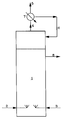
- the installation shown diagrammatically in the figure comprises a reactor 1, a channel 2 for the admission of HF into the reactor 1, a channel 3 for the admission of a mixture of VC2 or T111 and VF2 into the reactor 1, a channel 8 for drawing off a liquid stream from the reactor 1 and a track 4 for drawing off a gas stream from the reactor.
- the reactor 1 is surmounted by a condenser 7 which is in communication with the track 4, with a track 6 for recycling a condensate to the reactor 1 and with a track 5 for discharging a gas.
- the HF, the VF2 and the chlorinated compound are brought into contact in the reactor 1 in the absence of any catalyst, preferably at a temperature of 70 to 110 ° C.
- the temperature of the condenser is adjusted so that the gas withdrawn by way 5 contains HFC-143a, HCFC-142b and HCl and part of the reaction medium in the liquid phase is drawn off by way 8 HCFC-141b and HCFC-142b are separated in a conventional manner.
- At least a fraction of the co-produced HCFC-142b can be recycled to reactor 1. Under these conditions, HFC-143a and HCFC-141b are mainly produced.
- This embodiment of the method according to the invention is preferred.
- the HF, the VF2 and the chlorinated compound are brought into contact in the reactor 1, preferably at a temperature of 60 to 120 ° C, in the presence of a catalyst hydrofluorination, the latter being advantageously a halide of tin or antimony, the temperature of the condenser is adjusted so that the gas drawn off via route 5 mainly contains HCFC-141b, HCFC-142b, HFC-143a and HCl, from which HCFC-141b, HCFC-142b and HFC-143a are separated in a conventional manner. A fraction of the co-produced HCFC-141b can be recycled to reactor 1. Under these conditions, HFC-143a and HCFC-142b are mainly produced.
- the distribution of the desired products that is to say the ratio between the quantity formed of each of these products and the sum of the quantities formed of HCFC-141b, HCFC-142b and HFC-143a, expressed in molar percentage, was 39.6% of HCFC-141b, 54.3% of HCFC-142b and 6.1% of HFC-143a.
- Example 1 The test of Example 1 was repeated without introducing VF2 into the reactor.
- the distribution of the products sought was 41.6% of HCFC-141b, 57.2% of HCFC-142b and 1.2% of HFC-143a.
Landscapes
- Chemical & Material Sciences (AREA)
- Organic Chemistry (AREA)
- Organic Low-Molecular-Weight Compounds And Preparation Thereof (AREA)
- Low-Molecular Organic Synthesis Reactions Using Catalysts (AREA)
- Crystals, And After-Treatments Of Crystals (AREA)
Abstract
Description
- La présente invention concerne un procédé de fabrication de 1,1,1-trihaloéthanes, en particulier un procédé de fabrication de 1,1,1-trifluoroéthane, conjointement à du 1,1-dichloro-1-fluoroéthane et/ou du 1-chloro-1,1-difluoroéthane.
- Le 1,1,1-trifluoroéthane (ci-après dénommé HFC-143a) apparaît utilisable en particulier comme réfrigérant, en remplacement de chlorofluorocarbures totalement halogénés (CFC), progressivement interdits en raison de leur possible action néfaste à l'encontre de l'ozone stratosphérique.
- Le 1,1-dichloro-1-fluoroéthane (ci-après dénommé HCFC-141b) est également utilisable en remplacement de certains CFC, principalement comme agent gonflant de mousses polymériques et comme solvant.
- Le 1-chloro-1,1-difluoroéthane (ci-après dénommé HCFC-142b) est également utilisable en remplacement de certains CFC, principalement comme agent gonflant de mousses polymériques. Il est aussi un produit intermédiaire de la synthèse du fluorure de vinylidène.
- Il est connu, notamment par le brevet US-2669590, de préparer du HFC-143a par réaction de fluorure de vinylidène (VF2) avec du fluorure d'hydrogène en phase gazeuse, en présence d'un catalyseur. La productivité d'un tel procédé par unité volumique de réacteur est cependant très faible.
- Il est par ailleurs connu de préparer du HFC-143a au départ des mêmes réactifs, en phase liquide, à une température de -50 °C, en présence de pentafluorure d'antimoine comme catalyseur (OLAH G.A. et MO Y.K.; Journal of Organic Chemistry, (1972), Vol. 37, No. 7). Le pentafluorure d'antimoine utilisé dans ce procédé est toutefois transformé progressivement en trifluorure d'antimoine inactif en tant que catalyseur et particulièrement corrosif à l'encontre des matériaux métalliques.
- Les procédés connus d'hydrofluoration en phase liquide du chlorure de vinylidène (ci-après dénommé VC2) ou du 1,1,1-trichloroéthane (ci-après dénommé T111) ne permettent pas d'obtenir des rendements élevés en HFC-143a. Ces procédés connus produisent en effet essentiellement du HCFC-141b et du HCFC-142b. Dans des conditions telles que celles retenues dans le procédé décrit dans la demande internationale W0 91/18852 où on réalise l'hydrofluoration du VC2 en phase liquide en absence de catalyseur et à une température de 75 à 130 °C, la fraction molaire du HFC-143a formé ne dépasse pas environ 4 % de l'ensemble des produits formés. Dans des conditions favorisant une fluoration plus importante des réactifs halogénés en C2, par exemple à une température plus élevée et en présence de catalyseurs d'hydrofluoration très actifs, tel des sels d'antimoine, du HCFC-142b est principalement formé, le recyclage de celui-ci au réacteur ne permettant pas d'atteindre une productivité en HFC-143a satisfaisante d'un point de vue industriel. En outre, dans ces conditions, on risque de former une quantité importante de sous-produits lourds non souhaités, principalement des oligomères.
- La présente invention vise dès lors à fournir un procédé de préparation du HFC-143a qui ne présente plus les inconvénients des procédés mentionnés ci-dessus et qui puisse être facilement mis en oeuvre industriellement.
- La présente invention vise également à fournir un procédé de fabrication de HFC-143a et, conjointement, de HCFC-141b et/ou de HCFC-142b, dans lequel les produits recherchés sont formés dans des proportions largement modifiables, en fonction de leurs besoins respectifs.
- La présente invention vise également à fournir un procédé permettant d'accroître la proportion du HFC-143a coproduit avec le HCFC-141b et/ou le HCFC-142b dans les procédés existants d'hydrofluoration du VC2 ou du T111 en phase liquide, sans engendrer simultanément la formation de quantités importantes de sous-produits lourds.
- L'invention concerne dès lors un procédé de fabrication de 1,1,1-trifluoroéthane (HFC-143a) et, conjointement, de 1,1-dichloro-1-fluoroéthane (HCFC-141b) et/ou de 1-chloro-1,1-dthuoroéthane (HCFC-142b), selon lequel on fait réagir, en phase liquide, du fluorure d'hydrogène (HF), du fluorure de vinylidène (VF2) et au moins un composé chloré choisi parmi le chlorure de vinylidène (VC2) et le 1,1,1-trichloroéthane (T111).
- Généralement, on effectue la réaction entre le HF, le VF2 et le composé chloré en phase liquide dans un milieu réactionnel liquide contenant du HCFC-141b. Dans cette forme de réalisation du procédé selon l'invention, le HCFC-141b du milieu réactionnel est avantageusement celui coproduit avec le HFC-143a. La teneur pondérale en HCFC-141b dans le milieu réactionnel est de préférence supérieure à 40 %. De manière particulièrement préférée, elle est de plus de 50 % en poids. Généralement, la teneur en HCFC-141b dans le milieu réactionnel ne dépasse pas 80 %. Outre les réactifs (HF, VC2 ou T111, et VF2) et les produits recherchés de la réaction (HFC-143a, HCFC-141b et HCFC-142b), le milieu réactionnel contient avantageusement également des sous-produits lourds, principalement des oligomères chlorofluorés du VC2. La composition du milieu réactionnel peut être ajustée par une évacuation réglée des produits de la réaction sous deux formes : une évacuation sous forme gazeuse et une évacuation sous forme liquide.
- Dans le procédé selon l'invention, la réaction du HF, du VF2 et du composé chloré peut être effectuée en présence ou en absence d'un catalyseur d'hydrofluoration. Dans une forme d'exécution particulière du procédé, la réaction précitée est effectuée en présence d'un catalyseur d'hydrofluoration sélectionné parmi les composés des éléments des groupes IIIa, IVa et b, Va et b et VIb du Tableau périodique des éléments. On retient plus particulièrement les composés de titane, de bore, d'étain, d'antimoine, de tantale et de molybdène. Les composés d'étain ou d'antimoine conviennent très bien, ceux d'étain étant plus particulièrement préférés lorsque le composé chloré est le VC2 et ceux d'antimoine lorsque le composé chloré est le T111. Comme composés utilisables comme catalyseurs, on peut citer les sels et plus particulièrement les halogénures. De préférence, on choisit parmi les chlorures, les fluorures et les chlorofluorures. Le tétrachlorure d'étain s'est révélé particulièrement intéressant. Un composé de formule SnCl4-xFx, avec x compris entre 0 et 4, est tout particulièrement préféré. Un tel composé peut être obtenu par un traitement, de préférence préalablement à la mise en contact avec le VF2 et le composé chloré, du SnCl₄ par du fluorure d'hydrogène. Lorsqu'un catalyseur est utilisé dans le procédé selon l'invention, la quantité de catalyseur mise en oeuvre peut varier dans de larges limites. Habituellement, le catalyseur est utilisé à raison d'au moins 0,001 mole par kg de milieu réactiomel, de préférence, d'au moins 0,01 mole/kg. En général, on n'utilise pas plus d'environ 2 moles de catalyseur par kg de milieu réactionnel. Le plus souvent, on ne dépasse pas environ 1 mole de catalyseur par kg de milieu réactionnel.
- Le procédé selon l'invention est généralement effectué à une température de réaction au moins égale à 20 °C. De préférence, la température de réaction est au moins de 40 °C. De manière particulièrement préférée, elle est au moins égale à 60 °C. Habituellement, la température de réaction ne dépasse pas 150 °C. De manière avantageuse, elle ne dépasse pas 130 °C. Une température ne dépassant pas 120 °C est préférée.
- La pression à laquelle on exécute la réaction n'est pas critique en elle-même, dès lors qu'elle permet d'effectuer celle-ci en phase liquide, c'est-à-dire qu'elle est suffisante pour maintenir le milieu réactionnel essentiellement sous forme liquide. Elle varie en fonction de la température à laquelle on maintient le milieu réactionnel. Cette pression peut être la pression autogène, une pression supérieure générée par l'introduction d'un gaz inerte, tel que par exemple l'azote, ou une pression inférieure obtenue par dilution du milieu réactionnel avec un solvant organique inerte, tel que par exemple le 1,2-dichloroéthane. Généralement, la réaction est effectuée à une pression au moins égale à 2 bar, de préférence au moins égale à 5 bar. Le plus souvent, la pression ne dépasse pas 30 bar. De manière avantageuse, elle ne dépasse pas 20 bar.
- Dans le procédé selon l'invention, la proportion entre la quantité de HFC-143a formé et la quantité de HCFC-141b et/ou de HCFC-142b formés peut être réglée à volonté, par un réglage approprié du rapport molaire du VF2 à la somme du VF2 et du composé chloré mis en oeuvre. En général, le rapport molaire entre le VF2 mis en oeuvre et la somme du VF2 et du composé chloré mis en oeuvre est au moins de 0,01. Le plus souvent, il est au moins égal à 0,05. Généralement, ce rapport molaire ne dépasse pas 0,75. Avantageusement, il ne dépasse pas 0,5.
- En absence de catalyseur, le procédé selon l'invention conduit principalement à la formation de HFC-143a et de HCFC-141b, la quantité de HCFC-142b formé étant faible. Par contre, en présence d'un catalyseur, du HFC-143a et du HCFC-142b sont majoritairement formés, la quantité de HCFC-141b formé étant inférieure à celle obtenue en absence de catalyseur.
- Dans le procédé selon l'invention, on introduit avantageusement le fluorure d'hydrogène dans un rapport molaire du HF à la somme du VF2 et du composé chloré au moins égal à 1. Le plus souvent, ce rapport molaire ne dépasse pas 20. On travaille de préférence avec un rapport molaire de 1,5 à 15.
- Dans le procédé selon l'invention, le HF et le VF2 peuvent être mis en contact préalablement à la mise en contact avec le composé chloré. On peut notamment injecter le VF2 dans du HF non réagi séparé des produits de réaction et qui est recyclé au réacteur d'hydrofluoration du composé chloré. Inversement, le HF et le composé chloré peuvent aussi être mis en contact préalablement à la mise en contact avec le VF2. On peut ainsi par exemple introduire le VF2 au stade de la séparation des produits obtenus par hydrofluoration du composé chloré, notamment par injection dans une colonne de distillation utilisée pour séparer les produits de réaction. De préférence, le HF, le VF2 et le composé chloré sont introduits dans une même zone réactionnelle dans laquelle le HF réagit simultanément avec le VF2 et le composé chloré. Malgré la présence de chlorure d'hydrogène (HCl) dans le milieu réactionnel, généré par la réaction entre le HF et le composé chloré, on a observé que le VF2 réagit très majoritairement avec le HF pour former du HFC-143a plutôt qu'avec le HCl pour former du HCFC-142b.
- Dans les conditions décrites ci-dessus, la réaction peut être réalisée en discontinu ou en continu. Elle est avantageusement effectuée en continu.
- La réaction peut être réalisée dans un appareillage classique, bien connu de l'homme de l'art. Il peut s'agir de plusieurs réacteurs montés en série ou, de préférence, d'un réacteur unique, alimenté par les matières premières (VC2 ou T111, VF2, HF) et les matières recyclées, sous forme gazeuse ou liquide et chauffé ou refroidi de manière adéquate. Le mode d'introduction ainsi que les débits des réactifs et des recyclages éventuels dans le réacteur sont réglés de façon à maintenir au sein du milieu réactionnel les proportions adéquates conduisant à une production de HFC-143a et, conjointement, de HCFC-141b et/ou de HCFC-142b dans les proportions désirées. Le réacteur est généralement équipé d'un dispositif de soutirage d'un courant gazeux. Le réacteur peut être surmonté par exemple d'une colonne et d'un condenseur de reflux. Ce dispositif permet d'éviter un entraînement, dans le courant gazeux sortant du réacteur, du ou des catalyseurs éventuellement utilisés et d'ajuster la composition de ce courant gazeux. Le réacteur est avantageusement également équipé d'un moyen de soutirage d'un courant liquide. Les moyens de soutirage sont généralement réglés de façon à permettre de soutirer en phase gazeuse essentiellement tout le HCl produit. Lorsqu'une proportion élevée de HCFC-142b est souhaitée, le dispositif de soutirage en phase gazeuse est avantageusement réglé de façon à permettre un soutirage de celui-ci sous forme gazeuse.
- Le procédé selon l'invention présente l'avantage appréciable d'une productivité en HFC-143a largement supérieure à celle atteinte par les procédés existants d'hydrofluoration de VC2 ou de T111 en phase liquide. Il permet de convertir à peu de frais les installations existantes de production de HCFC-141b ou de HCFC-142b en unités de production conjointe et modulable de ces produits et de HFC-143a. Selon les conditions opératoires retenues, le procédé selon l'invention permet de varier dans une large gamme la distribution des produits recherchés, c'est-à-dire le HFC-143a, le HCFC-141b et le HCFC-142b.
- La figure unique du dessin annexé représente schématiquement un mode de réalisation intéressant du procédé selon l'invention.
- L'installation schématisée à la figure comprend un réacteur 1, une voie 2 pour l'admission de HF dans le réacteur 1, une voie 3 pour l'admission d'un mélange de VC2 ou de T111 et de VF2 dans le réacteur 1, une voie 8 pour le soutirage d'un courant liquide du réacteur 1 et une voie 4 pour le soutirage d'un courant gazeux du réacteur. Le réacteur 1 est surmonté d'un condenseur 7 qui est en communication avec la voie 4, avec une voie 6 de recyclage d'un condensat au réacteur 1 et avec une voie 5 d'évacuation d'un gaz.
- Selon un premier mode particulier de réalisation du procédé selon l'invention, on met en contact le HF, le VF2 et le composé chloré dans le réacteur 1 en l'absence de tout catalyseur, de préférence à une température de 70 à 110 °C, on règle la température du condenseur de manière à ce que le gaz soutiré par la voie 5 contienne le HFC-143a, le HCFC-142b et l'HCl et on soutire par la voie 8 une partie du milieu réactionnel en phase liquide, dont on sépare le HCFC-141b et le HCFC-142b de manière conventionnelle. Une fraction au moins du HCFC-142b co-produit peut être recyclée au réacteur 1. Dans ces conditions, du HFC-143a et du HCFC-141b sont principalement produits. Ce mode de réalisation du procédé selon l'invention est préféré.
- Selon un deuxième mode particulier de réalisation du procédé selon l'invention, on met en contact le HF, le VF2 et le composé chloré dans le réacteur 1, de préférence à une température de 60 à 120 °C, en présence d'un catalyseur d'hydrofluoration, celui-ci étant avantageusement un halogénure d'étain ou d'antimoine, on règle la température du condenseur de manière à ce que le gaz soutiré par la voie 5 contienne principalement du HCFC-141b, du HCFC-142b, du HFC-143a et de l'HCl, dont on sépare le HCFC-141b, le HCFC-142b et le HFC-143a de manière conventionnelle. Une fraction du HCFC-141b co-produit peut être recyclée au réacteur 1. Dans ces conditions, du HFC-143a et du HCFC-142b sont principalement produits.
- Les exemples suivants illustrent l'invention de manière non limitative.
- On a injecté de manière continue dans un réacteur tel que schématisé à la figure 1, maintenu à une température de 88 °C et à une pression de 11 bar, contenant un milieu réactionnel liquide constitué principalement de HCFC-141b et contenant 1 g de chlorure d'étain par kilo de milieu réactionnel, du HF, du VC2 et du VF2 dans un rapport molaire 23,5 / 13,9 / 1. Le courant gazeux récupéré à la sortie du condenseur maintenu à 65 °C a été analysé. 99,9 % du VF2 et 99,7 % du VC2 mis en oeuvre ont été transformés. La distribution des produits recherchés, c'est-à-dire le rapport entre la quantité formée de chacun de ces produits et la somme des quantités formées de HCFC-141b, HCFC-142b et HFC-143a, exprimée en pourcentage molaire, était de 39,6 % de HCFC-141b, 54,3 % de HCFC-142b et 6,1 % de HFC-143a.
- On a répété l'essai de l'exemple 1 sans introduire de VF2 dans le réacteur. La distribution des produits recherchés était de 41,6 % de HCFC-141b, 57,2 % de HCFC-142b et 1,2 % de HFC-143a.
- Sur base des résultats des exemples 1 et 2, on a calculé que, dans le procédé de l'exemple 1 conforme à l'invention, au moins 84 % du VF2 introduit dans le réacteur a été converti en HFC-143a.
Claims (10)
- Procédé de fabrication de 1,1,1-trifluoroéthane et, conjointement, de 1,1-dichloro-1-fluoroéthane et/ou de 1-chloro-1,1-difluoroéthane par réaction en phase liquide de fluorure d'hydrogène, de fluorure de vinylidène et d'au moins un composé chloré choisi parmi le chlorure de vinylidène et le 1,1,1-trichloroéthane.
- Procédé selon la revendication 1, dans lequel on effectue la réaction dans un milieu liquide contenant de 40 % à 80 % en poids de HCFC-141b.
- Procédé selon la revendication 1 ou 2, dans lequel on fait réagir le fluorure d'hydrogène simultanément avec le fluorure de vinylidène et avec le composé chloré.
- Procédé selon une quelconque des revendications 1 à 3, dans lequel on effectue la réaction à une température de 20 à 150 °C.
- Procédé selon la revendication 4, dans lequel on effectue la réaction à une température de 40 à 130 °C.
- Procédé selon une quelconque des revendications 1 à 5, dans lequel on effectue la réaction en absence de catalyseur.
- Procédé selon une quelconque des revendications 1 à 5, dans lequel on effectue la réaction en présence d'un catalyseur d'hydrofluoration sélectionné parmi les composés des éléments des groupes IIIa, IVa et b, Va et b et VIb du Tableau périodique des éléments.
- Procédé selon une quelconque des revendications 1 à 7, dans lequel le rapport molaire du VF2 à la somme du VF2 et du composé chloré mis en oeuvre est de 0,01 à 0,75.
- Procédé selon une quelconque des revendications 1 à 8, dans lequel le rapport molaire du fluorure d'hydrogène à la somme du VF2 et du composé chloré mis en oeuvre est de 1 à 20.
- Procédé selon une quelconque des revendications 1 à 9, dans lequel la réaction est exécutée en continu.
Applications Claiming Priority (2)
| Application Number | Priority Date | Filing Date | Title |
|---|---|---|---|
| FR9411564A FR2724929B1 (fr) | 1994-09-26 | 1994-09-26 | Procede de fabrication de 1,1,1-trihaloethanes |
| FR9411564 | 1994-09-26 |
Publications (2)
| Publication Number | Publication Date |
|---|---|
| EP0703203A1 true EP0703203A1 (fr) | 1996-03-27 |
| EP0703203B1 EP0703203B1 (fr) | 1999-06-09 |
Family
ID=9467351
Family Applications (1)
| Application Number | Title | Priority Date | Filing Date |
|---|---|---|---|
| EP95202517A Expired - Lifetime EP0703203B1 (fr) | 1994-09-26 | 1995-09-18 | Procédé de fabrication de 1,1,1-trihaloéthanes |
Country Status (12)
| Country | Link |
|---|---|
| US (1) | US5574191A (fr) |
| EP (1) | EP0703203B1 (fr) |
| JP (1) | JP3801241B2 (fr) |
| CN (1) | CN1061025C (fr) |
| AT (1) | ATE181046T1 (fr) |
| AU (1) | AU689938B2 (fr) |
| BR (1) | BR9504165A (fr) |
| CA (1) | CA2159067A1 (fr) |
| DE (1) | DE69510145T2 (fr) |
| ES (1) | ES2135000T3 (fr) |
| FR (1) | FR2724929B1 (fr) |
| TW (1) | TW282448B (fr) |
Families Citing this family (4)
| Publication number | Priority date | Publication date | Assignee | Title |
|---|---|---|---|---|
| US7071368B1 (en) * | 2005-02-09 | 2006-07-04 | Honeywell International Inc. | Method of making 1,1,1-trifluoroethane |
| US7608574B2 (en) * | 2006-08-17 | 2009-10-27 | Honeywell International Inc. | Azeotropic or azeotropic-like compositions of 1,1,1-trifuoroethane and 1-chloro-2,2,2-trifluoroethane |
| WO2014172592A1 (fr) * | 2013-04-18 | 2014-10-23 | Honeywell International Inc. | Système réactionnel et procédé de production de composés organiques fluorés |
| CN115417744B (zh) * | 2022-08-29 | 2023-09-08 | 西安近代化学研究所 | 一种制备1-氯-1,1-二氟乙烷的方法 |
Citations (4)
| Publication number | Priority date | Publication date | Assignee | Title |
|---|---|---|---|---|
| FR2124239A1 (fr) * | 1971-02-08 | 1972-09-22 | Kali Chemie Ag | |
| FR2365542A1 (fr) * | 1976-09-22 | 1978-04-21 | Solvay | Procede pour la fabrication du 1-chloro-1,1-difluorethane |
| EP0391102A1 (fr) * | 1989-04-05 | 1990-10-10 | Atochem North America, Inc. | Procédé pour la production en phase vapeur de 1,1-dichloro-1-fluoroéthane et/ou 1-chloro-1,1-difluoroéthane à partir de chlorure de vinylidène |
| WO1991018852A1 (fr) * | 1990-06-08 | 1991-12-12 | Solvay & Cie | Procede de preparation de 1,1-dichloro-1-fluoroethane |
Family Cites Families (3)
| Publication number | Priority date | Publication date | Assignee | Title |
|---|---|---|---|---|
| US2669590A (en) * | 1951-08-03 | 1954-02-16 | Allied Chem & Dye Corp | Production of fluorine compounds |
| US5051538A (en) * | 1988-07-29 | 1991-09-24 | E. I. Dupont De Nemours And Company | Process for 1,1-dichloro-1-fluoroethane |
| BE1005983A3 (fr) * | 1992-06-09 | 1994-04-12 | Solvay | Procede pour la preparation du 1,1,1,2-tetrafluoroethane. |
-
1994
- 1994-09-26 FR FR9411564A patent/FR2724929B1/fr not_active Expired - Fee Related
-
1995
- 1995-09-18 DE DE69510145T patent/DE69510145T2/de not_active Expired - Fee Related
- 1995-09-18 AT AT95202517T patent/ATE181046T1/de not_active IP Right Cessation
- 1995-09-18 ES ES95202517T patent/ES2135000T3/es not_active Expired - Lifetime
- 1995-09-18 EP EP95202517A patent/EP0703203B1/fr not_active Expired - Lifetime
- 1995-09-19 TW TW084109841A patent/TW282448B/zh active
- 1995-09-20 AU AU31751/95A patent/AU689938B2/en not_active Ceased
- 1995-09-25 CA CA002159067A patent/CA2159067A1/fr not_active Abandoned
- 1995-09-25 US US08/533,453 patent/US5574191A/en not_active Expired - Fee Related
- 1995-09-25 BR BR9504165A patent/BR9504165A/pt active Search and Examination
- 1995-09-26 CN CN95102593A patent/CN1061025C/zh not_active Expired - Fee Related
- 1995-09-26 JP JP24735995A patent/JP3801241B2/ja not_active Expired - Fee Related
Patent Citations (4)
| Publication number | Priority date | Publication date | Assignee | Title |
|---|---|---|---|---|
| FR2124239A1 (fr) * | 1971-02-08 | 1972-09-22 | Kali Chemie Ag | |
| FR2365542A1 (fr) * | 1976-09-22 | 1978-04-21 | Solvay | Procede pour la fabrication du 1-chloro-1,1-difluorethane |
| EP0391102A1 (fr) * | 1989-04-05 | 1990-10-10 | Atochem North America, Inc. | Procédé pour la production en phase vapeur de 1,1-dichloro-1-fluoroéthane et/ou 1-chloro-1,1-difluoroéthane à partir de chlorure de vinylidène |
| WO1991018852A1 (fr) * | 1990-06-08 | 1991-12-12 | Solvay & Cie | Procede de preparation de 1,1-dichloro-1-fluoroethane |
Also Published As
| Publication number | Publication date |
|---|---|
| FR2724929A1 (fr) | 1996-03-29 |
| FR2724929B1 (fr) | 1996-11-29 |
| ATE181046T1 (de) | 1999-06-15 |
| CN1061025C (zh) | 2001-01-24 |
| DE69510145T2 (de) | 1999-12-23 |
| EP0703203B1 (fr) | 1999-06-09 |
| AU3175195A (en) | 1996-04-04 |
| ES2135000T3 (es) | 1999-10-16 |
| JP3801241B2 (ja) | 2006-07-26 |
| CN1125710A (zh) | 1996-07-03 |
| AU689938B2 (en) | 1998-04-09 |
| CA2159067A1 (fr) | 1996-03-27 |
| TW282448B (fr) | 1996-08-01 |
| US5574191A (en) | 1996-11-12 |
| BR9504165A (pt) | 1996-08-06 |
| DE69510145D1 (de) | 1999-07-15 |
| JPH08176031A (ja) | 1996-07-09 |
Similar Documents
| Publication | Publication Date | Title |
|---|---|---|
| EP0522639B1 (fr) | Procédé pour la préparation de 1-chloro-1,1,3,3,3-pentafluoropropane et de 1,1,1,3,3,3-hexafluoropropane | |
| EP1140747B1 (fr) | Procede de separation d'un melange comprenant au moins un hydrofluoroalcane et du fluorure d'hydrogene, et procede de preparation d'un hydrofluroalcane | |
| EP1281699B1 (fr) | Nouveau procédé pour la fabrication du 1,1,1-trifluoro-2,2-dichloroéthane | |
| EP0699649B1 (fr) | Procédé pour l'hydrofluoration de chloro(fluoro)butane | |
| EP0421830B1 (fr) | Procédé de fabrication du 1,1,1-chlorodifluoroéthane | |
| CA2239763C (fr) | Procede de fabrication d'hydrofluoroalcanes | |
| FR2724930A1 (fr) | Procede de preparation du 1,1,1-trifluoroethane | |
| EP3793967A1 (fr) | Procédé de production du 1-chloro-3,3,3-trifluoropropène | |
| EP0703203B1 (fr) | Procédé de fabrication de 1,1,1-trihaloéthanes | |
| EP0637579B1 (fr) | Procédé pour la préparation de 1-chloro-1-fluoroéthane et/ou de 1,1-difluoroéthane | |
| EP0532540B1 (fr) | Procede de preparation de 1,1-dichloro-1-fluoroethane | |
| EP0739875B1 (fr) | Procédé pour la préparation de 1,1-difluoroéthane | |
| CA2209968C (fr) | Synthese du 1,1,1-trifluoroethane par fluoration du 1-chloro-1,1-difluoroethane | |
| EP0574077B1 (fr) | Procédé pour la préparation du 1,1,1,2-tétrafluoroéthane | |
| EP1130010B1 (fr) | Procédé de préparation du 1,1,1- trifluoro-2,2-dichloroéthane | |
| EP0926116A1 (fr) | Procédés de production et d'épuration de 1,1-difluoroéthane et produit ainsi obtenu | |
| EP0378942B1 (fr) | Procédé de préparation du 1,1-dichloro-1-fluoroéthane | |
| EP0732314A1 (fr) | Procédé pour la préparation de difluorométhane | |
| EP0551680B1 (fr) | Procédé pour l'épuration de 1,1-dichloro-1-fluoroéthane | |
| FR2695123A1 (fr) | Procédé pour la préparation de composés éthaniques fluorés. |
Legal Events
| Date | Code | Title | Description |
|---|---|---|---|
| PUAI | Public reference made under article 153(3) epc to a published international application that has entered the european phase |
Free format text: ORIGINAL CODE: 0009012 |
|
| AK | Designated contracting states |
Kind code of ref document: A1 Designated state(s): AT BE CH DE ES FR GB IT LI NL SE |
|
| 17P | Request for examination filed |
Effective date: 19960927 |
|
| 17Q | First examination report despatched |
Effective date: 19970811 |
|
| GRAG | Despatch of communication of intention to grant |
Free format text: ORIGINAL CODE: EPIDOS AGRA |
|
| GRAG | Despatch of communication of intention to grant |
Free format text: ORIGINAL CODE: EPIDOS AGRA |
|
| GRAH | Despatch of communication of intention to grant a patent |
Free format text: ORIGINAL CODE: EPIDOS IGRA |
|
| GRAH | Despatch of communication of intention to grant a patent |
Free format text: ORIGINAL CODE: EPIDOS IGRA |
|
| GRAA | (expected) grant |
Free format text: ORIGINAL CODE: 0009210 |
|
| AK | Designated contracting states |
Kind code of ref document: B1 Designated state(s): AT BE CH DE ES FR GB IT LI NL SE |
|
| PG25 | Lapsed in a contracting state [announced via postgrant information from national office to epo] |
Ref country code: SE Free format text: THE PATENT HAS BEEN ANNULLED BY A DECISION OF A NATIONAL AUTHORITY Effective date: 19990609 Ref country code: AT Free format text: LAPSE BECAUSE OF FAILURE TO SUBMIT A TRANSLATION OF THE DESCRIPTION OR TO PAY THE FEE WITHIN THE PRESCRIBED TIME-LIMIT Effective date: 19990609 |
|
| REF | Corresponds to: |
Ref document number: 181046 Country of ref document: AT Date of ref document: 19990615 Kind code of ref document: T |
|
| REG | Reference to a national code |
Ref country code: CH Ref legal event code: EP |
|
| REF | Corresponds to: |
Ref document number: 69510145 Country of ref document: DE Date of ref document: 19990715 |
|
| ITF | It: translation for a ep patent filed | ||
| GBT | Gb: translation of ep patent filed (gb section 77(6)(a)/1977) |
Effective date: 19990908 |
|
| PG25 | Lapsed in a contracting state [announced via postgrant information from national office to epo] |
Ref country code: LI Free format text: LAPSE BECAUSE OF NON-PAYMENT OF DUE FEES Effective date: 19990930 Ref country code: CH Free format text: LAPSE BECAUSE OF NON-PAYMENT OF DUE FEES Effective date: 19990930 Ref country code: BE Free format text: LAPSE BECAUSE OF NON-PAYMENT OF DUE FEES Effective date: 19990930 |
|
| REG | Reference to a national code |
Ref country code: ES Ref legal event code: FG2A Ref document number: 2135000 Country of ref document: ES Kind code of ref document: T3 |
|
| BERE | Be: lapsed |
Owner name: S.A. SOLVAY Effective date: 19990930 |
|
| PLBE | No opposition filed within time limit |
Free format text: ORIGINAL CODE: 0009261 |
|
| STAA | Information on the status of an ep patent application or granted ep patent |
Free format text: STATUS: NO OPPOSITION FILED WITHIN TIME LIMIT |
|
| REG | Reference to a national code |
Ref country code: CH Ref legal event code: PL |
|
| 26N | No opposition filed | ||
| REG | Reference to a national code |
Ref country code: GB Ref legal event code: IF02 |
|
| PGFP | Annual fee paid to national office [announced via postgrant information from national office to epo] |
Ref country code: GB Payment date: 20020918 Year of fee payment: 8 |
|
| PGFP | Annual fee paid to national office [announced via postgrant information from national office to epo] |
Ref country code: DE Payment date: 20020925 Year of fee payment: 8 |
|
| PGFP | Annual fee paid to national office [announced via postgrant information from national office to epo] |
Ref country code: NL Payment date: 20020930 Year of fee payment: 8 |
|
| PG25 | Lapsed in a contracting state [announced via postgrant information from national office to epo] |
Ref country code: GB Free format text: LAPSE BECAUSE OF NON-PAYMENT OF DUE FEES Effective date: 20030918 |
|
| PG25 | Lapsed in a contracting state [announced via postgrant information from national office to epo] |
Ref country code: NL Free format text: LAPSE BECAUSE OF NON-PAYMENT OF DUE FEES Effective date: 20040401 Ref country code: DE Free format text: LAPSE BECAUSE OF NON-PAYMENT OF DUE FEES Effective date: 20040401 |
|
| GBPC | Gb: european patent ceased through non-payment of renewal fee |
Effective date: 20030918 |
|
| NLV4 | Nl: lapsed or anulled due to non-payment of the annual fee |
Effective date: 20040401 |
|
| PG25 | Lapsed in a contracting state [announced via postgrant information from national office to epo] |
Ref country code: IT Free format text: LAPSE BECAUSE OF NON-PAYMENT OF DUE FEES;WARNING: LAPSES OF ITALIAN PATENTS WITH EFFECTIVE DATE BEFORE 2007 MAY HAVE OCCURRED AT ANY TIME BEFORE 2007. THE CORRECT EFFECTIVE DATE MAY BE DIFFERENT FROM THE ONE RECORDED. Effective date: 20050918 |
|
| PGFP | Annual fee paid to national office [announced via postgrant information from national office to epo] |
Ref country code: ES Payment date: 20071024 Year of fee payment: 13 |
|
| PGFP | Annual fee paid to national office [announced via postgrant information from national office to epo] |
Ref country code: FR Payment date: 20070914 Year of fee payment: 13 |
|
| REG | Reference to a national code |
Ref country code: FR Ref legal event code: ST Effective date: 20090529 |
|
| PG25 | Lapsed in a contracting state [announced via postgrant information from national office to epo] |
Ref country code: FR Free format text: LAPSE BECAUSE OF NON-PAYMENT OF DUE FEES Effective date: 20080930 |
|
| REG | Reference to a national code |
Ref country code: ES Ref legal event code: FD2A Effective date: 20080919 |
|
| PG25 | Lapsed in a contracting state [announced via postgrant information from national office to epo] |
Ref country code: ES Free format text: LAPSE BECAUSE OF NON-PAYMENT OF DUE FEES Effective date: 20080919 |