EP0703225A1 - Verfahren zur Herstellung von Alkoxytriazolinonen - Google Patents
Verfahren zur Herstellung von Alkoxytriazolinonen Download PDFInfo
- Publication number
- EP0703225A1 EP0703225A1 EP95114214A EP95114214A EP0703225A1 EP 0703225 A1 EP0703225 A1 EP 0703225A1 EP 95114214 A EP95114214 A EP 95114214A EP 95114214 A EP95114214 A EP 95114214A EP 0703225 A1 EP0703225 A1 EP 0703225A1
- Authority
- EP
- European Patent Office
- Prior art keywords
- alkyl
- optionally
- carbon atoms
- aryl
- process according
- Prior art date
- Legal status (The legal status is an assumption and is not a legal conclusion. Google has not performed a legal analysis and makes no representation as to the accuracy of the status listed.)
- Granted
Links
- 238000000034 method Methods 0.000 title claims description 36
- 238000002360 preparation method Methods 0.000 title claims description 10
- -1 iminocarbonate diester Chemical class 0.000 claims abstract description 28
- 238000006243 chemical reaction Methods 0.000 claims abstract description 25
- 125000003118 aryl group Chemical group 0.000 claims abstract description 21
- 125000003710 aryl alkyl group Chemical group 0.000 claims abstract description 20
- 125000000217 alkyl group Chemical group 0.000 claims abstract description 18
- 125000000753 cycloalkyl group Chemical group 0.000 claims abstract description 15
- 125000003342 alkenyl group Chemical group 0.000 claims abstract description 13
- 125000001316 cycloalkyl alkyl group Chemical group 0.000 claims abstract description 13
- 239000003085 diluting agent Substances 0.000 claims abstract description 12
- 125000000304 alkynyl group Chemical group 0.000 claims abstract description 9
- 238000002955 isolation Methods 0.000 claims abstract description 5
- OKKJLVBELUTLKV-UHFFFAOYSA-N Methanol Chemical compound OC OKKJLVBELUTLKV-UHFFFAOYSA-N 0.000 claims description 69
- XLYOFNOQVPJJNP-UHFFFAOYSA-N water Substances O XLYOFNOQVPJJNP-UHFFFAOYSA-N 0.000 claims description 38
- VEXZGXHMUGYJMC-UHFFFAOYSA-N Hydrochloric acid Chemical compound Cl VEXZGXHMUGYJMC-UHFFFAOYSA-N 0.000 claims description 34
- 125000004432 carbon atom Chemical group C* 0.000 claims description 20
- 229910052736 halogen Inorganic materials 0.000 claims description 18
- 150000002367 halogens Chemical group 0.000 claims description 18
- BDERNNFJNOPAEC-UHFFFAOYSA-N propan-1-ol Chemical compound CCCO BDERNNFJNOPAEC-UHFFFAOYSA-N 0.000 claims description 17
- QTBSBXVTEAMEQO-UHFFFAOYSA-N Acetic acid Chemical compound CC(O)=O QTBSBXVTEAMEQO-UHFFFAOYSA-N 0.000 claims description 15
- 239000002253 acid Substances 0.000 claims description 15
- RTZKZFJDLAIYFH-UHFFFAOYSA-N Diethyl ether Chemical compound CCOCC RTZKZFJDLAIYFH-UHFFFAOYSA-N 0.000 claims description 14
- VYSYZMNJHYOXGN-UHFFFAOYSA-N ethyl n-aminocarbamate Chemical compound CCOC(=O)NN VYSYZMNJHYOXGN-UHFFFAOYSA-N 0.000 claims description 14
- LFQSCWFLJHTTHZ-UHFFFAOYSA-N Ethanol Chemical compound CCO LFQSCWFLJHTTHZ-UHFFFAOYSA-N 0.000 claims description 13
- 125000004178 (C1-C4) alkyl group Chemical group 0.000 claims description 12
- 125000000229 (C1-C4)alkoxy group Chemical group 0.000 claims description 12
- IUGYQRQAERSCNH-UHFFFAOYSA-N pivalic acid Chemical compound CC(C)(C)C(O)=O IUGYQRQAERSCNH-UHFFFAOYSA-N 0.000 claims description 11
- 150000001875 compounds Chemical class 0.000 claims description 10
- 125000003178 carboxy group Chemical group [H]OC(*)=O 0.000 claims description 8
- 125000000547 substituted alkyl group Chemical group 0.000 claims description 8
- 239000002585 base Substances 0.000 claims description 7
- 125000004093 cyano group Chemical group *C#N 0.000 claims description 6
- 125000004767 (C1-C4) haloalkoxy group Chemical group 0.000 claims description 4
- 125000004765 (C1-C4) haloalkyl group Chemical group 0.000 claims description 4
- 125000000449 nitro group Chemical group [O-][N+](*)=O 0.000 claims description 4
- KFZMGEQAYNKOFK-UHFFFAOYSA-N Isopropanol Chemical compound CC(C)O KFZMGEQAYNKOFK-UHFFFAOYSA-N 0.000 claims description 3
- 150000001298 alcohols Chemical class 0.000 claims description 3
- 229910052799 carbon Inorganic materials 0.000 claims description 3
- 150000005690 diesters Chemical class 0.000 claims description 3
- 229910052783 alkali metal Inorganic materials 0.000 claims description 2
- 150000001340 alkali metals Chemical class 0.000 claims description 2
- 125000001841 imino group Chemical group [H]N=* 0.000 claims description 2
- 150000007529 inorganic bases Chemical class 0.000 claims description 2
- 150000007530 organic bases Chemical class 0.000 claims description 2
- 150000003349 semicarbazides Chemical class 0.000 claims description 2
- XLYOFNOQVPJJNP-UHFFFAOYSA-M hydroxide Chemical compound [OH-] XLYOFNOQVPJJNP-UHFFFAOYSA-M 0.000 claims 1
- OJURWUUOVGOHJZ-UHFFFAOYSA-N methyl 2-[(2-acetyloxyphenyl)methyl-[2-[(2-acetyloxyphenyl)methyl-(2-methoxy-2-oxoethyl)amino]ethyl]amino]acetate Chemical compound C=1C=CC=C(OC(C)=O)C=1CN(CC(=O)OC)CCN(CC(=O)OC)CC1=CC=CC=C1OC(C)=O OJURWUUOVGOHJZ-UHFFFAOYSA-N 0.000 claims 1
- OWIUPIRUAQMTTK-UHFFFAOYSA-M n-aminocarbamate Chemical compound NNC([O-])=O OWIUPIRUAQMTTK-UHFFFAOYSA-M 0.000 claims 1
- 238000009833 condensation Methods 0.000 abstract description 2
- 230000005494 condensation Effects 0.000 abstract description 2
- DUIOPKIIICUYRZ-UHFFFAOYSA-N semicarbazide Chemical compound NNC(N)=O DUIOPKIIICUYRZ-UHFFFAOYSA-N 0.000 abstract 1
- WQDUMFSSJAZKTM-UHFFFAOYSA-N Sodium methoxide Chemical compound [Na+].[O-]C WQDUMFSSJAZKTM-UHFFFAOYSA-N 0.000 description 34
- 239000000203 mixture Substances 0.000 description 20
- FAPWRFPIFSIZLT-UHFFFAOYSA-M Sodium chloride Chemical compound [Na+].[Cl-] FAPWRFPIFSIZLT-UHFFFAOYSA-M 0.000 description 19
- HEMHJVSKTPXQMS-UHFFFAOYSA-M Sodium hydroxide Chemical compound [OH-].[Na+] HEMHJVSKTPXQMS-UHFFFAOYSA-M 0.000 description 17
- CSCPPACGZOOCGX-UHFFFAOYSA-N Acetone Chemical compound CC(C)=O CSCPPACGZOOCGX-UHFFFAOYSA-N 0.000 description 15
- YXFVVABEGXRONW-UHFFFAOYSA-N Toluene Chemical compound CC1=CC=CC=C1 YXFVVABEGXRONW-UHFFFAOYSA-N 0.000 description 15
- 125000001495 ethyl group Chemical group [H]C([H])([H])C([H])([H])* 0.000 description 15
- 238000001816 cooling Methods 0.000 description 14
- 238000002844 melting Methods 0.000 description 13
- 230000008018 melting Effects 0.000 description 13
- 239000000047 product Substances 0.000 description 13
- ZAMOUSCENKQFHK-UHFFFAOYSA-N Chlorine atom Chemical compound [Cl] ZAMOUSCENKQFHK-UHFFFAOYSA-N 0.000 description 12
- 125000002496 methyl group Chemical group [H]C([H])([H])* 0.000 description 11
- WKBOTKDWSSQWDR-UHFFFAOYSA-N Bromine atom Chemical compound [Br] WKBOTKDWSSQWDR-UHFFFAOYSA-N 0.000 description 10
- 235000002639 sodium chloride Nutrition 0.000 description 10
- 239000011780 sodium chloride Substances 0.000 description 10
- XEKOWRVHYACXOJ-UHFFFAOYSA-N Ethyl acetate Chemical compound CCOC(C)=O XEKOWRVHYACXOJ-UHFFFAOYSA-N 0.000 description 9
- PXGOKWXKJXAPGV-UHFFFAOYSA-N Fluorine Chemical compound FF PXGOKWXKJXAPGV-UHFFFAOYSA-N 0.000 description 8
- 239000000460 chlorine Chemical group 0.000 description 8
- 229910052801 chlorine Inorganic materials 0.000 description 8
- 239000000543 intermediate Substances 0.000 description 8
- 125000001997 phenyl group Chemical group [H]C1=C([H])C([H])=C(*)C([H])=C1[H] 0.000 description 8
- 239000007858 starting material Substances 0.000 description 8
- 125000001797 benzyl group Chemical group [H]C1=C([H])C([H])=C(C([H])=C1[H])C([H])([H])* 0.000 description 7
- 239000012043 crude product Substances 0.000 description 7
- 125000000118 dimethyl group Chemical group [H]C([H])([H])* 0.000 description 7
- AMHDHUVBOKXALL-UHFFFAOYSA-N 3-methoxy-4-methyl-1h-1,2,4-triazol-5-one Chemical compound COC1=NNC(=O)N1C AMHDHUVBOKXALL-UHFFFAOYSA-N 0.000 description 6
- HSOFIFZZCZLBFE-UHFFFAOYSA-N 4-methyl-3-propoxy-1h-1,2,4-triazol-5-one Chemical compound CCCOC1=NNC(=O)N1C HSOFIFZZCZLBFE-UHFFFAOYSA-N 0.000 description 6
- ZMXDDKWLCZADIW-UHFFFAOYSA-N N,N-Dimethylformamide Chemical compound CN(C)C=O ZMXDDKWLCZADIW-UHFFFAOYSA-N 0.000 description 6
- KWYUFKZDYYNOTN-UHFFFAOYSA-M Potassium hydroxide Chemical compound [OH-].[K+] KWYUFKZDYYNOTN-UHFFFAOYSA-M 0.000 description 6
- GDTBXPJZTBHREO-UHFFFAOYSA-N bromine Substances BrBr GDTBXPJZTBHREO-UHFFFAOYSA-N 0.000 description 6
- 229910052794 bromium Inorganic materials 0.000 description 6
- 229910052731 fluorine Inorganic materials 0.000 description 6
- 239000011737 fluorine Substances 0.000 description 6
- 125000001559 cyclopropyl group Chemical group [H]C1([H])C([H])([H])C1([H])* 0.000 description 5
- 239000011541 reaction mixture Substances 0.000 description 5
- 235000011121 sodium hydroxide Nutrition 0.000 description 5
- 238000005292 vacuum distillation Methods 0.000 description 5
- ZNQVEEAIQZEUHB-UHFFFAOYSA-N 2-ethoxyethanol Chemical compound CCOCCO ZNQVEEAIQZEUHB-UHFFFAOYSA-N 0.000 description 4
- CSNNHWWHGAXBCP-UHFFFAOYSA-L Magnesium sulfate Chemical compound [Mg+2].[O-][S+2]([O-])([O-])[O-] CSNNHWWHGAXBCP-UHFFFAOYSA-L 0.000 description 4
- ISWSIDIOOBJBQZ-UHFFFAOYSA-N Phenol Chemical compound OC1=CC=CC=C1 ISWSIDIOOBJBQZ-UHFFFAOYSA-N 0.000 description 4
- 125000006193 alkinyl group Chemical group 0.000 description 4
- 125000004369 butenyl group Chemical group C(=CCC)* 0.000 description 4
- 125000001995 cyclobutyl group Chemical group [H]C1([H])C([H])([H])C([H])(*)C1([H])[H] 0.000 description 4
- 125000004186 cyclopropylmethyl group Chemical group [H]C([H])(*)C1([H])C([H])([H])C1([H])[H] 0.000 description 4
- 125000001301 ethoxy group Chemical group [H]C([H])([H])C([H])([H])O* 0.000 description 4
- 125000003754 ethoxycarbonyl group Chemical group C(=O)(OCC)* 0.000 description 4
- 239000000706 filtrate Substances 0.000 description 4
- 125000001153 fluoro group Chemical group F* 0.000 description 4
- 125000001449 isopropyl group Chemical group [H]C([H])([H])C([H])(*)C([H])([H])[H] 0.000 description 4
- 125000000956 methoxy group Chemical group [H]C([H])([H])O* 0.000 description 4
- VLKZOEOYAKHREP-UHFFFAOYSA-N n-Hexane Chemical compound CCCCCC VLKZOEOYAKHREP-UHFFFAOYSA-N 0.000 description 4
- 239000003960 organic solvent Substances 0.000 description 4
- 125000004368 propenyl group Chemical group C(=CC)* 0.000 description 4
- 125000000999 tert-butyl group Chemical group [H]C([H])([H])C(*)(C([H])([H])[H])C([H])([H])[H] 0.000 description 4
- 125000002023 trifluoromethyl group Chemical group FC(F)(F)* 0.000 description 4
- WEVYAHXRMPXWCK-UHFFFAOYSA-N Acetonitrile Chemical compound CC#N WEVYAHXRMPXWCK-UHFFFAOYSA-N 0.000 description 3
- UHOVQNZJYSORNB-UHFFFAOYSA-N Benzene Chemical compound C1=CC=CC=C1 UHOVQNZJYSORNB-UHFFFAOYSA-N 0.000 description 3
- XDTMQSROBMDMFD-UHFFFAOYSA-N Cyclohexane Chemical compound C1CCCCC1 XDTMQSROBMDMFD-UHFFFAOYSA-N 0.000 description 3
- YMWUJEATGCHHMB-UHFFFAOYSA-N Dichloromethane Chemical compound ClCCl YMWUJEATGCHHMB-UHFFFAOYSA-N 0.000 description 3
- ZMANZCXQSJIPKH-UHFFFAOYSA-N Triethylamine Chemical compound CCN(CC)CC ZMANZCXQSJIPKH-UHFFFAOYSA-N 0.000 description 3
- JFDZBHWFFUWGJE-UHFFFAOYSA-N benzonitrile Chemical compound N#CC1=CC=CC=C1 JFDZBHWFFUWGJE-UHFFFAOYSA-N 0.000 description 3
- 125000005448 ethoxyethyl group Chemical group [H]C([H])([H])C([H])([H])OC([H])([H])C([H])([H])* 0.000 description 3
- 239000002904 solvent Substances 0.000 description 3
- NFDXQGNDWIPXQL-UHFFFAOYSA-N 1-cyclooctyldiazocane Chemical compound C1CCCCCCC1N1NCCCCCC1 NFDXQGNDWIPXQL-UHFFFAOYSA-N 0.000 description 2
- PAMIQIKDUOTOBW-UHFFFAOYSA-N 1-methylpiperidine Chemical compound CN1CCCCC1 PAMIQIKDUOTOBW-UHFFFAOYSA-N 0.000 description 2
- ZWEHNKRNPOVVGH-UHFFFAOYSA-N 2-Butanone Chemical compound CCC(C)=O ZWEHNKRNPOVVGH-UHFFFAOYSA-N 0.000 description 2
- WADSJYLPJPTMLN-UHFFFAOYSA-N 3-(cycloundecen-1-yl)-1,2-diazacycloundec-2-ene Chemical compound C1CCCCCCCCC=C1C1=NNCCCCCCCC1 WADSJYLPJPTMLN-UHFFFAOYSA-N 0.000 description 2
- FECDBOBCTIGXDI-UHFFFAOYSA-N CCOC(=O)NN=COC(CC)NC Chemical compound CCOC(=O)NN=COC(CC)NC FECDBOBCTIGXDI-UHFFFAOYSA-N 0.000 description 2
- HEDRZPFGACZZDS-UHFFFAOYSA-N Chloroform Chemical compound ClC(Cl)Cl HEDRZPFGACZZDS-UHFFFAOYSA-N 0.000 description 2
- YXHKONLOYHBTNS-UHFFFAOYSA-N Diazomethane Chemical compound C=[N+]=[N-] YXHKONLOYHBTNS-UHFFFAOYSA-N 0.000 description 2
- XTHFKEDIFFGKHM-UHFFFAOYSA-N Dimethoxyethane Chemical group COCCOC XTHFKEDIFFGKHM-UHFFFAOYSA-N 0.000 description 2
- IAZDPXIOMUYVGZ-UHFFFAOYSA-N Dimethylsulphoxide Chemical compound CS(C)=O IAZDPXIOMUYVGZ-UHFFFAOYSA-N 0.000 description 2
- OAKJQQAXSVQMHS-UHFFFAOYSA-N Hydrazine Chemical compound NN OAKJQQAXSVQMHS-UHFFFAOYSA-N 0.000 description 2
- AFVFQIVMOAPDHO-UHFFFAOYSA-N Methanesulfonic acid Chemical compound CS(O)(=O)=O AFVFQIVMOAPDHO-UHFFFAOYSA-N 0.000 description 2
- BZLVMXJERCGZMT-UHFFFAOYSA-N Methyl tert-butyl ether Chemical compound COC(C)(C)C BZLVMXJERCGZMT-UHFFFAOYSA-N 0.000 description 2
- JLTDJTHDQAWBAV-UHFFFAOYSA-N N,N-dimethylaniline Chemical compound CN(C)C1=CC=CC=C1 JLTDJTHDQAWBAV-UHFFFAOYSA-N 0.000 description 2
- JCXJVPUVTGWSNB-UHFFFAOYSA-N Nitrogen dioxide Chemical class O=[N]=O JCXJVPUVTGWSNB-UHFFFAOYSA-N 0.000 description 2
- NBIIXXVUZAFLBC-UHFFFAOYSA-N Phosphoric acid Chemical compound OP(O)(O)=O NBIIXXVUZAFLBC-UHFFFAOYSA-N 0.000 description 2
- JUJWROOIHBZHMG-UHFFFAOYSA-N Pyridine Chemical compound C1=CC=NC=C1 JUJWROOIHBZHMG-UHFFFAOYSA-N 0.000 description 2
- CDBYLPFSWZWCQE-UHFFFAOYSA-L Sodium Carbonate Chemical compound [Na+].[Na+].[O-]C([O-])=O CDBYLPFSWZWCQE-UHFFFAOYSA-L 0.000 description 2
- UIIMBOGNXHQVGW-UHFFFAOYSA-M Sodium bicarbonate Chemical compound [Na+].OC([O-])=O UIIMBOGNXHQVGW-UHFFFAOYSA-M 0.000 description 2
- QAOWNCQODCNURD-UHFFFAOYSA-N Sulfuric acid Chemical compound OS(O)(=O)=O QAOWNCQODCNURD-UHFFFAOYSA-N 0.000 description 2
- DKGAVHZHDRPRBM-UHFFFAOYSA-N Tert-Butanol Chemical compound CC(C)(C)O DKGAVHZHDRPRBM-UHFFFAOYSA-N 0.000 description 2
- WYURNTSHIVDZCO-UHFFFAOYSA-N Tetrahydrofuran Chemical compound C1CCOC1 WYURNTSHIVDZCO-UHFFFAOYSA-N 0.000 description 2
- 150000007513 acids Chemical class 0.000 description 2
- 150000001408 amides Chemical class 0.000 description 2
- WPYMKLBDIGXBTP-UHFFFAOYSA-N benzoic acid Chemical compound OC(=O)C1=CC=CC=C1 WPYMKLBDIGXBTP-UHFFFAOYSA-N 0.000 description 2
- 125000000051 benzyloxy group Chemical group [H]C1=C([H])C([H])=C(C([H])=C1[H])C([H])([H])O* 0.000 description 2
- 125000000480 butynyl group Chemical class [*]C#CC([H])([H])C([H])([H])[H] 0.000 description 2
- BVKZGUZCCUSVTD-UHFFFAOYSA-N carbonic acid Chemical compound OC(O)=O BVKZGUZCCUSVTD-UHFFFAOYSA-N 0.000 description 2
- MVPPADPHJFYWMZ-UHFFFAOYSA-N chlorobenzene Chemical compound ClC1=CC=CC=C1 MVPPADPHJFYWMZ-UHFFFAOYSA-N 0.000 description 2
- CPPKAGUPTKIMNP-UHFFFAOYSA-N cyanogen fluoride Chemical group FC#N CPPKAGUPTKIMNP-UHFFFAOYSA-N 0.000 description 2
- 239000012973 diazabicyclooctane Substances 0.000 description 2
- XBDQKXXYIPTUBI-UHFFFAOYSA-N dimethylselenoniopropionate Natural products CCC(O)=O XBDQKXXYIPTUBI-UHFFFAOYSA-N 0.000 description 2
- 125000000959 isobutyl group Chemical group [H]C([H])([H])C([H])(C([H])([H])[H])C([H])([H])* 0.000 description 2
- 229910052943 magnesium sulfate Inorganic materials 0.000 description 2
- 235000019341 magnesium sulphate Nutrition 0.000 description 2
- 238000004519 manufacturing process Methods 0.000 description 2
- 125000004108 n-butyl group Chemical group [H]C([H])([H])C([H])([H])C([H])([H])C([H])([H])* 0.000 description 2
- 125000004123 n-propyl group Chemical group [H]C([H])([H])C([H])([H])C([H])([H])* 0.000 description 2
- 239000003208 petroleum Substances 0.000 description 2
- 125000000951 phenoxy group Chemical group [H]C1=C([H])C([H])=C(O*)C([H])=C1[H] 0.000 description 2
- SCVFZCLFOSHCOH-UHFFFAOYSA-M potassium acetate Chemical compound [K+].CC([O-])=O SCVFZCLFOSHCOH-UHFFFAOYSA-M 0.000 description 2
- BWHMMNNQKKPAPP-UHFFFAOYSA-L potassium carbonate Chemical compound [K+].[K+].[O-]C([O-])=O BWHMMNNQKKPAPP-UHFFFAOYSA-L 0.000 description 2
- 235000011118 potassium hydroxide Nutrition 0.000 description 2
- 125000001436 propyl group Chemical group [H]C([*])([H])C([H])([H])C([H])([H])[H] 0.000 description 2
- 125000002568 propynyl group Chemical class [*]C#CC([H])([H])[H] 0.000 description 2
- 238000001953 recrystallisation Methods 0.000 description 2
- 229920006395 saturated elastomer Polymers 0.000 description 2
- 125000002914 sec-butyl group Chemical group [H]C([H])([H])C([H])([H])C([H])(*)C([H])([H])[H] 0.000 description 2
- QDRKDTQENPPHOJ-UHFFFAOYSA-N sodium ethoxide Chemical compound [Na+].CC[O-] QDRKDTQENPPHOJ-UHFFFAOYSA-N 0.000 description 2
- 238000003756 stirring Methods 0.000 description 2
- VZGDMQKNWNREIO-UHFFFAOYSA-N tetrachloromethane Chemical compound ClC(Cl)(Cl)Cl VZGDMQKNWNREIO-UHFFFAOYSA-N 0.000 description 2
- JOXIMZWYDAKGHI-UHFFFAOYSA-N toluene-4-sulfonic acid Chemical compound CC1=CC=C(S(O)(=O)=O)C=C1 JOXIMZWYDAKGHI-UHFFFAOYSA-N 0.000 description 2
- GETQZCLCWQTVFV-UHFFFAOYSA-N trimethylamine Chemical compound CN(C)C GETQZCLCWQTVFV-UHFFFAOYSA-N 0.000 description 2
- NWZSZGALRFJKBT-KNIFDHDWSA-N (2s)-2,6-diaminohexanoic acid;(2s)-2-hydroxybutanedioic acid Chemical compound OC(=O)[C@@H](O)CC(O)=O.NCCCC[C@H](N)C(O)=O NWZSZGALRFJKBT-KNIFDHDWSA-N 0.000 description 1
- UDATXMIGEVPXTR-UHFFFAOYSA-N 1,2,4-triazolidine-3,5-dione Chemical compound O=C1NNC(=O)N1 UDATXMIGEVPXTR-UHFFFAOYSA-N 0.000 description 1
- RYHBNJHYFVUHQT-UHFFFAOYSA-N 1,4-Dioxane Chemical compound C1COCCO1 RYHBNJHYFVUHQT-UHFFFAOYSA-N 0.000 description 1
- OCJBOOLMMGQPQU-UHFFFAOYSA-N 1,4-dichlorobenzene Chemical compound ClC1=CC=C(Cl)C=C1 OCJBOOLMMGQPQU-UHFFFAOYSA-N 0.000 description 1
- WNWOTMKHOLCHRJ-UHFFFAOYSA-N 1,4-dihydrotriazol-5-one Chemical compound O=C1CN=NN1 WNWOTMKHOLCHRJ-UHFFFAOYSA-N 0.000 description 1
- SBASXUCJHJRPEV-UHFFFAOYSA-N 2-(2-methoxyethoxy)ethanol Chemical compound COCCOCCO SBASXUCJHJRPEV-UHFFFAOYSA-N 0.000 description 1
- XNWFRZJHXBZDAG-UHFFFAOYSA-N 2-METHOXYETHANOL Chemical compound COCCO XNWFRZJHXBZDAG-UHFFFAOYSA-N 0.000 description 1
- CXQGRRDCXIKQLN-UHFFFAOYSA-N 3-ethoxy-4-methyl-1h-1,2,4-triazol-5-one Chemical compound CCOC1=NNC(=O)N1C CXQGRRDCXIKQLN-UHFFFAOYSA-N 0.000 description 1
- OAUJUJRYKWVVQX-UHFFFAOYSA-N 4-cyclopropyl-3-propoxy-1h-1,2,4-triazol-5-one Chemical compound CCCOC1=NNC(=O)N1C1CC1 OAUJUJRYKWVVQX-UHFFFAOYSA-N 0.000 description 1
- AKBLJPROAMZZDR-UHFFFAOYSA-N 4-ethyl-3-methoxy-1h-1,2,4-triazol-5-one Chemical compound CCN1C(OC)=NNC1=O AKBLJPROAMZZDR-UHFFFAOYSA-N 0.000 description 1
- XJOOWWMZMXBLAO-UHFFFAOYSA-N 4-methyl-1,2,4-triazolidine-3,5-dione Chemical compound CN1C(=O)NNC1=O XJOOWWMZMXBLAO-UHFFFAOYSA-N 0.000 description 1
- NTSLROIKFLNUIJ-UHFFFAOYSA-N 5-Ethyl-2-methylpyridine Chemical compound CCC1=CC=C(C)N=C1 NTSLROIKFLNUIJ-UHFFFAOYSA-N 0.000 description 1
- KNCHDRLWPAKSII-UHFFFAOYSA-N 5-ethyl-2-methylpyridine Natural products CCC1=CC=NC(C)=C1 KNCHDRLWPAKSII-UHFFFAOYSA-N 0.000 description 1
- USFZMSVCRYTOJT-UHFFFAOYSA-N Ammonium acetate Chemical compound N.CC(O)=O USFZMSVCRYTOJT-UHFFFAOYSA-N 0.000 description 1
- 239000005695 Ammonium acetate Substances 0.000 description 1
- ATRRKUHOCOJYRX-UHFFFAOYSA-N Ammonium bicarbonate Chemical compound [NH4+].OC([O-])=O ATRRKUHOCOJYRX-UHFFFAOYSA-N 0.000 description 1
- VHUUQVKOLVNVRT-UHFFFAOYSA-N Ammonium hydroxide Chemical compound [NH4+].[OH-] VHUUQVKOLVNVRT-UHFFFAOYSA-N 0.000 description 1
- 239000005711 Benzoic acid Substances 0.000 description 1
- BHZVHNYOWLJVHT-UHFFFAOYSA-N CCOC(N/N=C(\N)/OC)=O Chemical compound CCOC(N/N=C(\N)/OC)=O BHZVHNYOWLJVHT-UHFFFAOYSA-N 0.000 description 1
- KXDHJXZQYSOELW-UHFFFAOYSA-N Carbamic acid Chemical compound NC(O)=O KXDHJXZQYSOELW-UHFFFAOYSA-N 0.000 description 1
- ZAFNJMIOTHYJRJ-UHFFFAOYSA-N Diisopropyl ether Chemical compound CC(C)OC(C)C ZAFNJMIOTHYJRJ-UHFFFAOYSA-N 0.000 description 1
- DGAQECJNVWCQMB-PUAWFVPOSA-M Ilexoside XXIX Chemical compound C[C@@H]1CC[C@@]2(CC[C@@]3(C(=CC[C@H]4[C@]3(CC[C@@H]5[C@@]4(CC[C@@H](C5(C)C)OS(=O)(=O)[O-])C)C)[C@@H]2[C@]1(C)O)C)C(=O)O[C@H]6[C@@H]([C@H]([C@@H]([C@H](O6)CO)O)O)O.[Na+] DGAQECJNVWCQMB-PUAWFVPOSA-M 0.000 description 1
- NTIZESTWPVYFNL-UHFFFAOYSA-N Methyl isobutyl ketone Chemical compound CC(C)CC(C)=O NTIZESTWPVYFNL-UHFFFAOYSA-N 0.000 description 1
- UIHCLUNTQKBZGK-UHFFFAOYSA-N Methyl isobutyl ketone Natural products CCC(C)C(C)=O UIHCLUNTQKBZGK-UHFFFAOYSA-N 0.000 description 1
- FXHOOIRPVKKKFG-UHFFFAOYSA-N N,N-Dimethylacetamide Chemical compound CN(C)C(C)=O FXHOOIRPVKKKFG-UHFFFAOYSA-N 0.000 description 1
- LRHPLDYGYMQRHN-UHFFFAOYSA-N N-Butanol Chemical compound CCCCO LRHPLDYGYMQRHN-UHFFFAOYSA-N 0.000 description 1
- SECXISVLQFMRJM-UHFFFAOYSA-N N-Methylpyrrolidone Chemical compound CN1CCCC1=O SECXISVLQFMRJM-UHFFFAOYSA-N 0.000 description 1
- CTQNGGLPUBDAKN-UHFFFAOYSA-N O-Xylene Chemical compound CC1=CC=CC=C1C CTQNGGLPUBDAKN-UHFFFAOYSA-N 0.000 description 1
- XBDQKXXYIPTUBI-UHFFFAOYSA-M Propionate Chemical compound CCC([O-])=O XBDQKXXYIPTUBI-UHFFFAOYSA-M 0.000 description 1
- KEAYESYHFKHZAL-UHFFFAOYSA-N Sodium Chemical compound [Na] KEAYESYHFKHZAL-UHFFFAOYSA-N 0.000 description 1
- VMHLLURERBWHNL-UHFFFAOYSA-M Sodium acetate Chemical compound [Na+].CC([O-])=O VMHLLURERBWHNL-UHFFFAOYSA-M 0.000 description 1
- 150000001242 acetic acid derivatives Chemical class 0.000 description 1
- KXKVLQRXCPHEJC-UHFFFAOYSA-N acetic acid trimethyl ester Natural products COC(C)=O KXKVLQRXCPHEJC-UHFFFAOYSA-N 0.000 description 1
- 230000002378 acidificating effect Effects 0.000 description 1
- 239000013543 active substance Substances 0.000 description 1
- 239000003905 agrochemical Substances 0.000 description 1
- 125000002723 alicyclic group Chemical group 0.000 description 1
- 125000001931 aliphatic group Chemical group 0.000 description 1
- 229910000102 alkali metal hydride Inorganic materials 0.000 description 1
- 150000008046 alkali metal hydrides Chemical class 0.000 description 1
- 150000008044 alkali metal hydroxides Chemical class 0.000 description 1
- 229910052784 alkaline earth metal Inorganic materials 0.000 description 1
- 150000001342 alkaline earth metals Chemical class 0.000 description 1
- 229910000147 aluminium phosphate Inorganic materials 0.000 description 1
- 235000019257 ammonium acetate Nutrition 0.000 description 1
- 229940043376 ammonium acetate Drugs 0.000 description 1
- 239000001099 ammonium carbonate Substances 0.000 description 1
- 235000012501 ammonium carbonate Nutrition 0.000 description 1
- 239000000908 ammonium hydroxide Substances 0.000 description 1
- 235000011114 ammonium hydroxide Nutrition 0.000 description 1
- 238000010533 azeotropic distillation Methods 0.000 description 1
- SRSXLGNVWSONIS-UHFFFAOYSA-N benzenesulfonic acid Chemical compound OS(=O)(=O)C1=CC=CC=C1 SRSXLGNVWSONIS-UHFFFAOYSA-N 0.000 description 1
- 229940092714 benzenesulfonic acid Drugs 0.000 description 1
- 235000010233 benzoic acid Nutrition 0.000 description 1
- 229960004365 benzoic acid Drugs 0.000 description 1
- BLWNPYNZLCQESL-UHFFFAOYSA-N bis(2-ethoxyethyl) carbonate Chemical compound CCOCCOC(=O)OCCOCC BLWNPYNZLCQESL-UHFFFAOYSA-N 0.000 description 1
- BTANRVKWQNVYAZ-UHFFFAOYSA-N butan-2-ol Chemical compound CCC(C)O BTANRVKWQNVYAZ-UHFFFAOYSA-N 0.000 description 1
- 239000006227 byproduct Substances 0.000 description 1
- VSGNNIFQASZAOI-UHFFFAOYSA-L calcium acetate Chemical compound [Ca+2].CC([O-])=O.CC([O-])=O VSGNNIFQASZAOI-UHFFFAOYSA-L 0.000 description 1
- 239000001639 calcium acetate Substances 0.000 description 1
- 235000011092 calcium acetate Nutrition 0.000 description 1
- 229960005147 calcium acetate Drugs 0.000 description 1
- 150000004649 carbonic acid derivatives Chemical class 0.000 description 1
- 230000003197 catalytic effect Effects 0.000 description 1
- 238000004140 cleaning Methods 0.000 description 1
- 239000000470 constituent Substances 0.000 description 1
- 229940117389 dichlorobenzene Drugs 0.000 description 1
- 125000004177 diethyl group Chemical group [H]C([H])([H])C([H])([H])* 0.000 description 1
- XXJWXESWEXIICW-UHFFFAOYSA-N diethylene glycol monoethyl ether Chemical compound CCOCCOCCO XXJWXESWEXIICW-UHFFFAOYSA-N 0.000 description 1
- 229940075557 diethylene glycol monoethyl ether Drugs 0.000 description 1
- XXBDWLFCJWSEKW-UHFFFAOYSA-N dimethylbenzylamine Chemical compound CN(C)CC1=CC=CC=C1 XXBDWLFCJWSEKW-UHFFFAOYSA-N 0.000 description 1
- 238000004821 distillation Methods 0.000 description 1
- 150000002148 esters Chemical class 0.000 description 1
- 150000002170 ethers Chemical class 0.000 description 1
- 229960005437 etoperidone Drugs 0.000 description 1
- 238000000605 extraction Methods 0.000 description 1
- 239000003502 gasoline Substances 0.000 description 1
- 150000008282 halocarbons Chemical class 0.000 description 1
- 238000010438 heat treatment Methods 0.000 description 1
- GNOIPBMMFNIUFM-UHFFFAOYSA-N hexamethylphosphoric triamide Chemical compound CN(C)P(=O)(N(C)C)N(C)C GNOIPBMMFNIUFM-UHFFFAOYSA-N 0.000 description 1
- 239000008240 homogeneous mixture Substances 0.000 description 1
- 230000036571 hydration Effects 0.000 description 1
- 238000006703 hydration reaction Methods 0.000 description 1
- IKDUDTNKRLTJSI-UHFFFAOYSA-N hydrazine monohydrate Substances O.NN IKDUDTNKRLTJSI-UHFFFAOYSA-N 0.000 description 1
- 150000004679 hydroxides Chemical class 0.000 description 1
- 239000005457 ice water Substances 0.000 description 1
- 239000012535 impurity Substances 0.000 description 1
- 150000002500 ions Chemical class 0.000 description 1
- ZXEKIIBDNHEJCQ-UHFFFAOYSA-N isobutanol Chemical compound CC(C)CO ZXEKIIBDNHEJCQ-UHFFFAOYSA-N 0.000 description 1
- 150000002576 ketones Chemical class 0.000 description 1
- 229940098779 methanesulfonic acid Drugs 0.000 description 1
- 230000011987 methylation Effects 0.000 description 1
- 238000007069 methylation reaction Methods 0.000 description 1
- PSHKMPUSSFXUIA-UHFFFAOYSA-N n,n-dimethylpyridin-2-amine Chemical compound CN(C)C1=CC=CC=N1 PSHKMPUSSFXUIA-UHFFFAOYSA-N 0.000 description 1
- JIKUXBYRTXDNIY-UHFFFAOYSA-N n-methyl-n-phenylformamide Chemical compound O=CN(C)C1=CC=CC=C1 JIKUXBYRTXDNIY-UHFFFAOYSA-N 0.000 description 1
- 150000002825 nitriles Chemical class 0.000 description 1
- 150000002897 organic nitrogen compounds Chemical class 0.000 description 1
- 239000012074 organic phase Substances 0.000 description 1
- 235000011056 potassium acetate Nutrition 0.000 description 1
- 239000011736 potassium bicarbonate Substances 0.000 description 1
- 235000015497 potassium bicarbonate Nutrition 0.000 description 1
- 229910000028 potassium bicarbonate Inorganic materials 0.000 description 1
- 229910000027 potassium carbonate Inorganic materials 0.000 description 1
- 235000011181 potassium carbonates Nutrition 0.000 description 1
- TYJJADVDDVDEDZ-UHFFFAOYSA-M potassium hydrogencarbonate Chemical compound [K+].OC([O-])=O TYJJADVDDVDEDZ-UHFFFAOYSA-M 0.000 description 1
- 229940086066 potassium hydrogencarbonate Drugs 0.000 description 1
- LPNYRYFBWFDTMA-UHFFFAOYSA-N potassium tert-butoxide Chemical compound [K+].CC(C)(C)[O-] LPNYRYFBWFDTMA-UHFFFAOYSA-N 0.000 description 1
- 235000019260 propionic acid Nutrition 0.000 description 1
- FVSKHRXBFJPNKK-UHFFFAOYSA-N propionitrile Chemical compound CCC#N FVSKHRXBFJPNKK-UHFFFAOYSA-N 0.000 description 1
- UMJSCPRVCHMLSP-UHFFFAOYSA-N pyridine Natural products COC1=CC=CN=C1 UMJSCPRVCHMLSP-UHFFFAOYSA-N 0.000 description 1
- IUVKMZGDUIUOCP-BTNSXGMBSA-N quinbolone Chemical compound O([C@H]1CC[C@H]2[C@H]3[C@@H]([C@]4(C=CC(=O)C=C4CC3)C)CC[C@@]21C)C1=CCCC1 IUVKMZGDUIUOCP-BTNSXGMBSA-N 0.000 description 1
- 239000011833 salt mixture Substances 0.000 description 1
- 235000015424 sodium Nutrition 0.000 description 1
- 239000001632 sodium acetate Substances 0.000 description 1
- 235000017281 sodium acetate Nutrition 0.000 description 1
- ODZPKZBBUMBTMG-UHFFFAOYSA-N sodium amide Chemical compound [NH2-].[Na+] ODZPKZBBUMBTMG-UHFFFAOYSA-N 0.000 description 1
- 235000017557 sodium bicarbonate Nutrition 0.000 description 1
- 229910000030 sodium bicarbonate Inorganic materials 0.000 description 1
- 229910000029 sodium carbonate Inorganic materials 0.000 description 1
- 235000017550 sodium carbonate Nutrition 0.000 description 1
- 239000012312 sodium hydride Substances 0.000 description 1
- 229910000104 sodium hydride Inorganic materials 0.000 description 1
- 238000007711 solidification Methods 0.000 description 1
- 230000008023 solidification Effects 0.000 description 1
- 239000000126 substance Substances 0.000 description 1
- 150000003462 sulfoxides Chemical class 0.000 description 1
- 238000001308 synthesis method Methods 0.000 description 1
- 238000010189 synthetic method Methods 0.000 description 1
- YLQBMQCUIZJEEH-UHFFFAOYSA-N tetrahydrofuran Natural products C=1C=COC=1 YLQBMQCUIZJEEH-UHFFFAOYSA-N 0.000 description 1
- IMFACGCPASFAPR-UHFFFAOYSA-N tributylamine Chemical compound CCCCN(CCCC)CCCC IMFACGCPASFAPR-UHFFFAOYSA-N 0.000 description 1
- 238000010626 work up procedure Methods 0.000 description 1
- 239000008096 xylene Substances 0.000 description 1
Classifications
-
- C—CHEMISTRY; METALLURGY
- C07—ORGANIC CHEMISTRY
- C07D—HETEROCYCLIC COMPOUNDS
- C07D249/00—Heterocyclic compounds containing five-membered rings having three nitrogen atoms as the only ring hetero atoms
- C07D249/02—Heterocyclic compounds containing five-membered rings having three nitrogen atoms as the only ring hetero atoms not condensed with other rings
- C07D249/08—1,2,4-Triazoles; Hydrogenated 1,2,4-triazoles
- C07D249/10—1,2,4-Triazoles; Hydrogenated 1,2,4-triazoles with hetero atoms or with carbon atoms having three bonds to hetero atoms with at the most one bond to halogen, e.g. ester or nitrile radicals, directly attached to ring carbon atoms
- C07D249/12—Oxygen or sulfur atoms
-
- C—CHEMISTRY; METALLURGY
- C07—ORGANIC CHEMISTRY
- C07C—ACYCLIC OR CARBOCYCLIC COMPOUNDS
- C07C281/00—Derivatives of carbonic acid containing functional groups covered by groups C07C269/00 - C07C279/00 in which at least one nitrogen atom of these functional groups is further bound to another nitrogen atom not being part of a nitro or nitroso group
- C07C281/06—Compounds containing any of the groups, e.g. semicarbazides
Definitions
- the invention relates to a new, also technically feasible process for the preparation of largely known alkoxytriazolinones which can be used as intermediates for the production of agrochemical active substances.
- alkoxytriazolinones and several methods for their preparation are already known (cf. J. Indian Chem. Soc. 6 (1929), 565-575; J. Chem. Soc. Perkin I 1973, 2644-2646; Arch. Pharm. 307 (1974 ), 889-891; EP-A 477646; EP-A 507171). According to these known synthetic methods, alkoxytriazolinones are only obtained in very unsatisfactory yields.
- alkoxytriazolinones of the general formula (I) can be obtained in considerably higher yields by the process according to the invention than by most known synthesis methods.
- the process according to the invention has the decisive advantage that it can also be carried out industrially.
- R2 and R3 are a better leaving group than OR2
- R3 in the leaving groups OR3 include methyl, ethyl, phenyl, benzyl, methoxyethyl and ethoxyethyl.
- the method according to the invention thus represents a valuable enrichment of the prior art.
- Formula (II) provides a general definition of the imino carbonic diesters to be used as starting materials in the process according to the invention for the preparation of the compounds of the general formula (I).
- R 1 and R 2 preferably or in particular have those meanings which have already been given above in connection with the description of the compounds of the formula (I) as preferred or as particularly preferred for R 1 and R 2;
- R3 preferably represents in each case optionally by C1-C4 alkoxy, phenoxy or Benzyloxy substituted C1-C4 alkyl, phenyl or benzyl, especially for methyl, ethyl, propyl, cyclopropyl, methoxyethyl or ethoxyethyl.
- the starting materials of the formula (II) are known and / or can be prepared by processes known per se (cf. Chem. Ber. 120 (1987), 339-344; preparation examples).
- Formula (III) provides a general definition of the carbazinates to be used further as starting materials in the process according to the invention.
- R4 is preferably C1-C4-alkyl, phenyl or benzyl, in each case optionally substituted by C1-C4-alkoxy, phenoxy or benzyloxy, in particular methyl, ethyl, propyl, methoxyethyl or ethoxyethyl.
- the starting materials of formula (III) are known organic synthetic chemicals.
- organic solvents are suitable as diluents for carrying out the process according to the invention (in the two reaction stages).
- These include in particular aliphatic, alicyclic or aromatic, optionally halogenated hydrocarbons, such as, for example, gasoline, benzene, toluene, xylene, chlorobenzene, dichlorobenzene, petroleum ether, hexane, cyclohexane, dichloromethane, chloroform, carbon tetrachloride; Ethers, such as diethyl ether, diisopropyl ether, dioxane, tetrahydrofuran or ethylene glycol dimethyl or diethyl ether; Ketones, such as acetone, butanone or methyl isobutyl ketone; Nitriles such as acetonitrile, propionitrile or benzonitrile; Amides such as N, N-dimethylformamide, N, N-dimethylacetamide,
- Alcohols such as methanol, ethanol, n- or i-propanol are particularly preferred as diluents.
- reactions according to the invention can, if appropriate, also be carried out without using diluents.
- the process according to the invention is preferably carried out in the first stage in the presence of a suitable reaction auxiliary.
- a suitable reaction auxiliary such as protonic acids such as e.g. Hydrochloric acid, sulfuric acid, phosphoric acid, carbonic acid, acetic acid, propionic acid, pivalic acid, methanesulfonic acid, benzoic acid, benzenesulfonic acid and p-toluenesulfonic acid - optionally also polymeric acids or acidic ion exchangers.
- Pivalic acid, acetic acid and (aqueous) hydrochloric acid are particularly preferred as reaction aids in the first stage of the process according to the invention.
- the process according to the invention is carried out in the second stage in the presence of a base.
- bases include, for example, alkaline earth metal or alkali metal hydrides, hydroxides, amides, alcoholates, acetates, carbonates or hydrogen carbonates, such as sodium hydride, sodium amide, sodium methylate, sodium ethylate, potassium tert-butoxide, sodium hydroxide, potassium hydroxide, ammonium hydroxide, sodium acetate , Potassium acetate, calcium acetate, ammonium acetate, sodium carbonate, potassium carbonate, potassium hydrogen carbonate, sodium hydrogen carbonate or ammonium carbonate and basic organic nitrogen compounds, such as trimethylamine, triethylamine, tributylamine, N, N-dimethylaniline, N, N-dimethyl-benzylamine, pyridine, N-methylpiperidine, N, N-dimethylaminopyridine, 5-ethyl-2-methyl
- Alkali metal alcoholates such as sodium methylate or sodium ethylate
- alkali metal hydroxides such as sodium or potassium hydroxide - in each case optionally dissolved in the corresponding alcohol or in water - are particularly preferred as bases in the second stage of the process according to the invention.
- reaction temperatures can be varied within a substantial range when carrying out the first stage of the process according to the invention. In general, temperatures between -20 ° C and 120 ° C, preferably at temperatures between 0 ° C and 100 ° C, especially at temperatures between 20 ° C and 80 ° C.
- reaction temperatures can be varied within a substantial range when carrying out the second stage of the process according to the invention. In general one works at temperatures between 20 ° C and 100 ° C, preferably at temperatures between 30 ° C and 90 ° C, in particular at temperatures between 40 ° C and 80 ° C.
- the process according to the invention is generally carried out under normal pressure in both stages. However, it is also possible to work under increased or reduced pressure - generally between 0.1 bar and 10 bar.
- the starting materials of the formula (II) and the formula (III) and, if appropriate, a reaction auxiliary are mixed in a suitable diluent and stirred at the required temperature until practically no starting material is present.
- the isolation of the intermediate of formula (IV) can then be carried out in a conventional manner, for example by concentrating, digesting the residue with an organic solvent, e.g. Methyl t-butyl ether, and suction is carried out.
- the intermediate of formula (IV) can also be mixed with a base, if appropriate dissolved in one of the diluents given above, without intermediate isolation and stirred at the temperature required for the cyclizing condensation until the end of the reaction.
- the crude products thus obtainable can be recrystallized, stirred with a suitable organic solvent, e.g. Petroleum ether, or can be purified by distillation.
- a suitable organic solvent e.g. Petroleum ether
- the compounds of the formula (I) to be prepared by the process according to the invention can be used as intermediates for the preparation of herbicidally active compounds (cf. EP-A 477646 and EP-A 507171).
- a mixture of 208 g (2.0 mol) of ethyl carbazate, 206 g (2.0 mol) of dimethyl methyliminocarbonic acid and 500 ml of methanol is stirred for 12 hours at 50 ° C. and for a further 3 hours at 70 ° C. Then at 40 ° C 360 g of a 30% solution of sodium methoxide in methanol (2.0 mol NaOCH3) are added and the reaction mixture is stirred at 50 ° C for 3 hours. With ice cooling, the mixture is then neutralized with 20% aqueous hydrochloric acid, then the methanol is largely distilled off and the remaining amount is made up to about 500 ml with water.
- the crude product (243 g) obtained in crystalline form is isolated by suction. In addition to 6.7% water, it also contains some table salt and organic impurities. For cleaning, it is taken up in 750 ml of toluene, dewatered by azeotropic distillation and filtered hot. The filtrate is cooled and the crystalline product isolated by suction.
- a mixture of 208 g (2.0 mol) of ethyl carbazate, 206 g (2.0 mol) of dimethyl methyliminocarbonic acid, 4.0 g (0.04 mol) of pivalic acid and 1250 ml of methanol is stirred at 20 ° C. for 3 days .
- 40 ° C 360 g of a 30% solution of sodium methoxide in methanol (2.0 mol NaOCH3) are added and the reaction mixture is stirred at 50 ° C for 3 hours.
- the mixture is then neutralized with 20% hydrochloric acid and the further workup is carried out as described in Example 1.
- a mixture of 1740 g (16.56 mol) of ethyl carbazate, 2169 g (16.56 mol) of diethyl methyliminocarbonate and 2 liters of ethanol is stirred at 50 ° C. for 16 hours and at 80 ° C. for a further 8 hours.
- 2982 g of a 30% solution of sodium methoxide in methanol (16.56 mol NaOCH3) are added dropwise at 50 ° C. and the reaction mixture is stirred at 50 ° C. for 3 hours. With ice cooling, the mixture is then neutralized with 30% aqueous hydrochloric acid and then concentrated under reduced pressure.
- the residue is taken up in 2.5 liters of N, N-dimethylformamide heated to 80 ° C. and freed of the common salt by suction.
- the filtrate is concentrated, the crude product obtained as a residue is purified by vacuum distillation and, after solidification, recrystallized from toluene.
- a mixture of 630 g (6.0 mol) of carbazinate, 954 g (6.0 mol) of methyliminocarbonic acid dipropylester and 600 ml of n-propanol is cooled at 0 ° C. with an ice-salt mixture with a solution of 612 g (6.0 mol) of pivalic acid in 200 ml of n-propanol are added dropwise and the complete mixture is stirred at 0 ° C. to 10 ° C. for 30 minutes. Then 2169 g of a 30% solution of sodium methoxide in methanol (12 mol NaOCH3) are added and the reaction mixture is stirred at 50 ° C for 3 hours. Under ice cooling is then with conc. Neutralized hydrochloric acid, then freed of sodium chloride by suction and the filtrate concentrated. The crude product obtained as a residue is purified by vacuum distillation.
- a mixture of 104 g (1.0 mol) of ethyl carbazate, 159 g (1.0 mol) of dipropyl methyliminocarbonate and 200 ml of n-propanol is cooled with ice with a solution of 20.4 g (0.2 mol) of pivalic acid added dropwise in 10 ml of n-propanol and the complete mixture is stirred for 30 minutes without cooling. Then 108 g of a 30% solution of sodium methoxide in Methanol (0.6 mol NaOCH3) added and the reaction mixture is stirred for 3 hours at 50 ° C and for a further 4 hours at 60 ° C to 80 ° C. Under ice cooling is then with conc. Neutralized hydrochloric acid and then concentrated under reduced pressure. The crude product remaining in the residue is purified by vacuum distillation.
- a mixture of 147.4 g (1.4 mol) of ethyl carbazate, 265 g (1.4 mol) of methyliminocarbonic acid O- (2-ethoxyethyl ester) -on-propyl ester and 150 ml of propanol is at 80 ° C for 10 hours heated to 100 ° C for a further 2 hours. After cooling to 50 ° C 252 g of a 30% solution of sodium methoxide in methanol (1.4 mol NaOCH3) are metered in within 30 minutes. After 3 hours of stirring at 50 ° C is concentrated with cooling with ice / sodium chloride by adding 138 g. Hydrochloric acid (1.4 mol HCl) neutralized.
- a mixture of 147.4 g (1.4 mol) of ethyl carbazate, 265 g (1.4 mol) of methyliminocarbonic acid O- (2-ethoxyethyl ester) -on-propyl ester and 200 ml of propanol is cooled with 3.6 g of ice Pivalic acid added and one hour stirred at 20 ° C. Then another 3.6 g of pivalic acid are added and the stirrer is switched off. After a further 2 hours at 20 ° C., the batch has completely crystallized. Heating to 50 ° C creates a homogeneous mixture again.
- 238.5 g (1.5 mol) of methylimino-carbonic acid dipropyl ester and a catalytic amount (1.5 g) of pivalic acid are stirred in with cold water cooling; after 2 hours the same amount (1.5 g) of pivalic acid is added.
Landscapes
- Chemical & Material Sciences (AREA)
- Organic Chemistry (AREA)
- Organic Low-Molecular-Weight Compounds And Preparation Thereof (AREA)
- Heterocyclic Carbon Compounds Containing A Hetero Ring Having Nitrogen And Oxygen As The Only Ring Hetero Atoms (AREA)
- Agricultural Chemicals And Associated Chemicals (AREA)
Abstract
Description
- Die Erfindung betrifft ein neues, auch technisch durchführbares Verfahren zur Herstellung von weitgehend bekannten Alkoxytriazolinonen, welche als Zwischenprodukte zur Herstellung von agrochemischen Wirkstoffen verwendet werden können.
- Alkoxytriazolinone und mehrere Methoden zu ihrer Herstellung sind bereits bekannt (vgl. J. Indian Chem. Soc. 6 (1929), 565-575; J. Chem. Soc. Perkin I 1973, 2644-2646; Arch. Pharm. 307 (1974), 889-891; EP-A 477646; EP-A 507171). Nach diesen bekannten Synthesemethoden werden Alkoxytriazolinone jedoch nur in sehr unbefriedigenden Ausbeuten erhalten.
- Ferner ist bekannt, daß durch Methylierung von Urazol oder 4-Methylurazol mit Diazomethan (CH₂N₂) 5-Methoxy-4-methyl-2,4-dihydro-3H-1,2,4-triazol-3-on gebildet wird [vergl. F. Arndt et al, Rev. Fac. Sci. Istanbul 13A, S. 127 bis 144 (1948)]; diese Methode liefert zwar das Triazolinon in hoher Ausbeute, kann aber technisch nicht durchgeführt werden.
- Es wurde nun gefunden, daß man Alkoxytriazolinone der allgemeinen Formel (I)

in welcher - R¹
- für jeweils gegebenenfalls substituiertes Alkyl, Alkenyl, Alkinyl, Cycloalkyl, Cycloalkylalkyl, Aryl oder Arylalkyl steht und
- R²
- für jeweils gegebenenfalls substituiertes Alkyl, Alkenyl, Alkinyl, Cycloalkyl, Cycloalkylalkyl, Aryl oder Arylalkyl steht,
- R¹ und R²
- die oben angegebenen Bedeutungen haben und
- R³
- für jeweils gegebenenfalls substituiertes Alkyl, Aryl oder Arylalkyl steht,
- R⁴
- für jeweils gegebenenfalls substituiertes Alkyl, Aryl oder Arylalkyl steht,
- R¹, R² und R⁴
- die oben angegebenen Bedeutungen haben,
- Überraschenderweise können die Alkoxytriazolinone der allgemeinen Formel (I) nach dem erfindungsgemäßen Verfahren in erheblich höheren Ausbeuten als nach den meisten bekannten Synthesemethoden erhalten werden.
- Gegenüber der "Diazomethan-Methode" (F. Arndt et al, l. c.) hat das erfindungsgemäße Verfahren den entscheidenden Vorteil, daß es auch technisch durchführbar ist.
- Im Gegensatz zum bekannten Verfahren, welches bei höheren Temperaturen durchzuführen ist und bei welchem Phenol als Koppelprodukt entsteht - R⁴ steht für Phenyl (vgl. EP-A 507171, Beispiele II-1 und II-2) - kann das erfindungsgemäße Verfahren auch problemlos unter Abspaltung von einfachen Alkanolen durchgeführt werden, die wesentlich einfacher und mit geringerem Energieaufwand als Phenol zurückgewonnen werden können.
- In vielen Fällen können vorteilhaft im Gegensatz zum bekannten Stand der Technik (vgl. EP-A 507171) auch "unsymmetrische" Iminokohlensäure-diester (R² und R³ haben dann verschiedene Bedeutung, wobei OR³ eine bessere Abgangsgruppe als OR² ist) als Ausgangsstoffe eingesetzt werden. Als sehr gute Komponenten R³ in den Abgangsgruppen OR³ seinen beispielsweise Methyl, Ethyl, Phenyl, Benzyl, Methoxyethyl und Ethoxyethyl genannt.
- Das erfindungsgemäße Verfahren stellt somit eine wertvolle Bereicherung des Standes der Technik dar.
- Die Erfindung betrifft vorzugsweise die Herstellung von Verbindungen der Formel (I), in welcher
- R¹
- für jeweils gegebenenfalls durch Halogen oder C₁-C₄-Alkoxy substituiertes Alkyl, Alkenyl oder Alkinyl mit jeweils bis zu 6 Kohlenstoffatomen, für jeweils gegebenenfalls durch Halogen oder C₁-C₄-Alkyl substituiertes Cycloalkyl oder Cycloalkylalkyl mit jeweils 3 bis 6 Kohlenstoffatomen im Cycloalkylteil und gegebenenfalls 1 bis 4 Kohlenstoffatomen im Alkylteil, oder für jeweils gegebenenfalls durch Carboxy, Cyano, Nitro, Halogen, C₁-C₄-Alkyl, C₁-C₄-Halogenalkyl, C₁-C₄-Alkoxy, C₁-C₄-Halogenalkoxy oder C₁-C₄-Alkoxy-carbonyl substituiertes Aryl oder Arylalkyl mit jeweils 6 oder 10 Kohlenstoffatomen im Arylteil und gegebenenfalls 1 bis 4 Kohlenstoffatomen im Alkylteil steht und
- R²
- für jeweils gegebenenfalls durch Halogen oder C₁-C₄-Alkoxy substituiertes Alkyl, Alkenyl oder Alkinyl mit jeweils bis zu 6 Kohlenstoffatomen, für jeweils gegebenenfalls durch Halogen oder C₁-C₄-Alkyl substituiertes Cycloalkyl oder Cycloalkylalkyl mit jeweils 3 bis 6 Kohlenstoffatomen im Cycloalkylteil und gegebenenfalls 1 bis 4 Kohlenstoffatomen im Alkylteil, oder für jeweils gegebenenfalls durch Carboxy, Cyano, Nitro, Halogen, C₁-C₄-Alkyl, C₁-C₄-Halogenalkyl, C₁-C₄-Alkoxy, C₁-C₄-Halogenalkoxy oder C₁-C₄-Alkoxy-carbonyl substituiertes Aryl oder Arylalkyl mit jeweils 6 oder 10 Kohlenstoffatomen im Arylteil und gegebenenfalls 1 bis 4 Kohlenstoffatomen im Alkylteil steht.
- Die Erfindung betrifft insbesondere die Herstellung von Verbindungen der Formel (I), in welcher
- R¹
- für jeweils gegebenenfalls durch Fluor, Chlor und/oder Brom, Methoxy oder Ethoxy substituiertes Methyl, Ethyl, n- oder i-Propyl, n-, i-, s- oder t-Butyl, für jeweils gegebenenfalls durch Fluor, Chlor und/oder Brom substituiertes Propenyl, Butenyl, Propinyl oder Butinyl, für jeweils gegebenenfalls durch Fluor, Chlor, Brom, Methyl oder Ethyl substituiertes Cyclopropyl, Cyclobutyl oder Cyclopropylmethyl, oder für jeweils gegebenenfalls durch Carboxy, Cyano, Fluor, Chlor, Brom, Methyl, Ethyl, Trifluormethyl, Methoxy, Ethoxy, Difluormethoxy, Trifluormethoxy, Methoxycarbonyl oder Ethoxycarbonyl substituiertes Phenyl oder Benzyl steht und
- R²
- für jeweils gegebenenfalls durch Fluor, Chlor und/oder Brom, Methoxy oder Ethoxy substituiertes Methyl, Ethyl, n- oder i-Propyl, n-, i-, s- oder t-Butyl, für jeweils gegebenenfalls durch Fluor, Chlor und/oder Brom substituiertes Propenyl, Butenyl, Propinyl oder Butinyl, für jeweils gegebenenfalls durch Fluor, Chlor, Brom, Methyl oder Ethyl substituiertes Cyclopropyl, Cyclobutyl oder Cyclopropylmethyl, oder für jeweils gegebenenfalls durch Carboxy, Cyano, Fluor, Chlor, Brom, Methyl, Ethyl, Trifluormethyl, Methoxy, Ethoxy, Difluormethoxy, Trifluormethoxy, Methoxycarbonyl oder Ethoxycarbonyl substituiertes Phenyl oder Benzyl steht.
- Verwendet man beispielsweise Methylimino-kohlensäure-O-(2-ethoxy-ethylester)-O-n-propylester und Carbazinsäure-ethylester als Ausgangsstoffe, so kann der Reaktionsablauf beim erfindungsgemäßen Verfahren durch das folgende Formelschema skizziert werden:

Die beim erfindungsgemäßen Verfahren zur Herstellung der Verbindungen der allgemeinen Formel (I) als Ausgangsstoffe zu verwendenden Iminokohlensäurediester sind durch die Formel (II) allgemein definiert. In der Formel (II) haben R¹ und R² vorzugsweise bzw. insbesondere diejenigen Bedeutungen, die bereits oben im Zusammenhang mit der Beschreibung der Verbindungen der Formel (I) als bevorzugt bzw. als insbesondere bevorzugt für R¹ und R² angegeben wurden; R³ steht vorzugsweise für jeweils gegebenenfalls durch C₁-C₄-Alkoxy, Phenoxy oder Benzyloxy substituiertes C₁-C₄-Alkyl, Phenyl oder Benzyl, insbesondere für Methyl, Ethyl, Propyl, Cyclopropyl, Methoxyethyl oder Ethoxyethyl. - Die Ausgangsstoffe der Formel (II) sind bekannt und/oder können nach an sich bekannten Verfahren hergestellt werden (vgl. Chem. Ber. 120 (1987), 339-344; Herstellungsbeispiele).
- Die beim erfindungsgemäßen Verfahren weiter als Ausgangsstoffe zu verwendenden Carbazinsäureester sind durch die Formel (III) allgemein definiert. In der Formel (III) steht R⁴ vorzugsweise für jeweils gegebenenfalls durch C₁-C₄-Alkoxy, Phenoxy oder Benzyloxy substituiertes C₁-C₄-Alkyl, Phenyl oder Benzyl, insbesondere für Methyl, Ethyl, Propyl, Methoxyethyl oder Ethoxyethyl.
- Die Ausgangsstoffe der Formel (III) sind bekannte organische Synthesechemikalien.
- Als Verdünnungsmittel zur Durchführung des erfindungsgemäßen Verfahrens kommen (in den beiden Umsetzungsstufen) die üblichen organischen Lösungsmittel in Betracht. Hierzu gehören insbesondere aliphatische, alicyclische oder aromatische, gegebenenfalls halogenierte Kohlenwasserstoffe, wie beispielsweise Benzin, Benzol, Toluol, Xylol, Chlorbenzol, Dichlorbenzol, Petrolether, Hexan, Cyclohexan, Dichlormethan, Chloroform, Tetrachlormethan; Ether, wie Diethylether, Diisopropylether, Dioxan, Tetrahydrofuran oder Ethylenglykoldimethyl- oder -diethylether; Ketone, wie Aceton, Butanon oder Methyl-isobutyl-keton; Nitrile, wie Acetonitril, Propionitril oder Benzonitril; Amide, wie N,N-Dimethylformamid, N,N-Dimethylacetamid, N-Methylformanilid, N-Methyl-pyrrolidon oder Hexamethylphosphorsäuretriamid; Ester wie Essigsäuremethylester oder Essigsäureethylester; Sulfoxide, wie Dimethylsulfoxid; Alkohole, wie Methanol, Ethanol, n- oder i-Propanol, n-, i-, s- oder t-Butanol, Ethylenglykolmonomethylether, Ethylenglykolmonoethylether, Diethylenglykolmonomethylether, Diethylenglykolmonoethylether; deren Gemische mit Wasser oder reines Wasser.
- Alkohole, wie Methanol, Ethanol, n- oder i-Propanol werden als Verdünnungsmittel besonders bevorzugt.
- Die erfindungsgemäßen Umsetzungen können jedoch gegebenenfalls auch ohne Verwendung von Verdünnungsmitteln durchgeführt werden.
- Das erfindungsgemäße Verfahren wird in der ersten Stufe vorzugsweise in Gegenwart eines geeigneten Reaktionshilfsmittels durchgeführt. Als solche kommen vorzugsweise Protonensäuren, wie z.B. Salzsäure, Schwefelsäure, Phosphorsäure, Kohlensäure, Essigsäure, Propionsäure, Pivalinsäure, Methansulfonsäure, Benzoesäure, Benzolsulfonsäure und p-Toluolsulfonsäure - gegebenenfalls auch polymere Säuren oder saure Ionenaustauscher - in Betracht.
- Pivalinsäure, Essigsäure und (wässrige) Salzsäure werden als Reaktionshilfsmittel bei der ersten Stufe des erfindungsgemäßen Verfahrens besonders bevorzugt.
- Das erfindungsgemäße Verfahren wird in der zweiten Stufe in Gegenwart einer Base durchgeführt. Es kommen hierbei alle üblichen anorganischen oder organischen Basen in Betracht. Hierzu gehören beispielsweise Erdalkali- oder Alkalimetallhydride, -hydroxide, -amide, -alkoholate, -acetate, -carbonate oder -hydrogencarbonate, wie beispielsweise Natriumhydrid, Natriumamid, Natriummethylat, Natriumethylat, Kalium-tert.-butylat, Natriumhydroxid, Kaliumhydroxid, Ammoniumhydroxid, Natriumacetat, Kaliumacetat, Calciumacetat, Ammoniumacetat, Natriumcarbonat, Kaliumcarbonat, Kaliumhydrogencarbonat, Natriumhydrogencarbonat oder Ammoniumcarbonat sowie basische organische Stickstoffverbindungen, wie Trimethylamin, Triethylamin, Tributylamin, N,N-Dimethylanilin, N,N-Dimethyl-benzylamin, Pyridin, N-Methylpiperidin, N,N-Dimethylaminopyridin, 5-Ethyl-2-methyl-pyridin, Diazabicyclooctan (DABCO), Diazabicyclononen (DBN) oder Diazabicycloundecen (DBU).
- Alkalimetallalkoholate, wie Natriummethylat oder Natriumethylat, und Alkalimetallhydroxide, wie Natrium- oder Kaliumhydroxid - jeweils gegebenenfalls im entsprechenden Alkohol bzw. in Wasser gelöst - werden als Basen bei der zweiten Stufe des erfindungsgemäßen Verfahrens besonders bevorzugt.
- Die Reaktionstemperaturen können bei der Durchführung der ersten Stufe des erfindungsgemäßen Verfahrens in einem größeren Bereich variiert werden. Im allgemeinen arbeitet man bei Temperaturen zwischen -20°C und 120°C, vorzugsweise bei Temperaturen zwischen 0°C und 100°C, insbesondere bei Temperaturen zwischen 20°C und 80°C.
- Die Reaktionstemperaturen können bei der Durchführung der zweiten Stufe des erfindungsgemäßen Verfahrens in einem größeren Bereich variiert werden. Im allgemeinen arbeitet man bei Temperaturen zwischen 20°C und 100°C, vorzugsweise bei Temperaturen zwischen 30°C und 90°C, insbesondere bei Temperaturen zwischen 40°C und 80°C.
- Das erfindungsgemäße Verfahren wird in beiden Stufen im allgemeinen unter Normaldruck durchgeführt. Es ist jedoch auch möglich, unter erhöhtem oder vermindertem Druck - im allgemeinen zwischen 0,1 bar und 10 bar - zu arbeiten.
- Zur Durchführung des erfindungsgemäßen Verfahrens zur Herstellung der Verbindungen der Formel (I) setzt man pro Mol Iminokohlensäurediester der Formel (II) im allgemeinen 0,5 bis 1,2 Mol, vorzugsweise 0,8 bis 1,1 Mol Carbazinsäureester der Formel (III) und gegebenenfalls 0,001 bis 2,0 Mol, vorzugsweise 0,01 bis 1,0 Mol Reaktionshilfsmittel ein.
- In einer bevorzugten Ausführungsform des erfindungsgemäßen Verfahrens werden die Ausgangsstoffe der Formel (II) und der Formel (III) sowie gegebenenfalls ein Reaktionshilfsmittel in einem geeigneten Verdünnungsmittel vermischt und bei der erforderlichen Temperatur gerührt, bis praktisch kein Ausgangsmaterial mehr vorhanden ist. Die Isolierung des Zwischenproduktes der Formel (IV) kann dann auf übliche Weise, beispielsweise durch Einengen, Digerieren des Rückstandes mit einem organischen Lösungsmittel, wie z.B. Methyl-t-butylether, und Absaugen durchgeführt werden. Das Zwischenprodukt der Formel (IV) kann aber auch ohne Zwischenisolierung mit einer Base - gegebenenfalls in einem der oben angegebenen Verdünnungsmittel gelöst - versetzt und bei der zur cyclisierenden Kondensation erforderlichen Temperatur bis zum Ende der Umsetzung gerührt werden.
- Die Aufarbeitung zur Isolierung der Produkte der Formel (I) kann nach üblichen Methoden durchgeführt werden. Beispielsweise wird eingeengt, in Wasser aufgenommen und - z.B. mit Salzsäure - neutralisiert oder angesäuert. Sofern das Produkt hierbei kristallin anfällt, wird es durch Absaugen isoliert. Andernfalls wird mit einem mit Wasser praktisch nicht mischbaren organischen Lösungsmittel, wie z.B. Essigsäureethylester, geschüttelt, die organische Phase - z.B. mit Magnesiumsulfat - getrocknet und filtriert. Nach sorgfältigem Abdestillieren des Lösungsmittels unter vermindertem Druck wird dann das Produkt der Formel (I) als Rückstand erhalten.
- Die so erhältlichen Rohprodukte können durch Umkristallisation, Verrühren mit einem geeigneten organischen Lösungsmittel, wie z.B. Petrolether, oder durch Destillation gereinigt werden.
- Die nach dem erfindungsgemäßen Verfahren herzustellenden Verbindungen der Formel (I) können als Zwischenprodukte zur Herstellung von herbizid wirksamen Verbindungen verwendet werden (vgl. EP-A 477646 und EP-A 507171).
-

- Eine Mischung aus 208 g (2,0 Mol) Carbazinsäure-ethylester, 206 g (2,0 Mol) Methyliminokohlensäure-dimethylester und 500 ml Methanol wird 12 Stunden bei 50°C und weitere 3 Stunden bei 70°C gerührt. Dann werden bei 40°C 360 g einer 30%igen Lösung von Natriummethanolat in Methanol (2,0 Mol NaOCH₃) dazu gegeben und die Reaktionsmischung wird 3 Stunden bei 50°C gerührt. Unter Eiskühlung wird dann mit 20%iger wässriger Salzsäure neutralisiert, anschließend das Methanol weitgehend abdestilliert und die Restmenge mit Wasser auf ca. 500 ml aufgefüllt. Nach mehrstündigem Stehenlassen bei 5°C wird das kristallin angefallene Rohprodukt (243 g) durch Absaugen isoliert. Es enthält neben 6,7% Wasser noch etwas Kochsalz und organische Verunreinigungen. Zur Reinigung wird es in 750 ml Toluol aufgenommen, durch azeotrope Destillation entwässert und heiß filtriert. Das Filtrat wird abgekühlt und das kristalline Produkt durch Absaugen isoliert.
- Man erhält 207 g (80% der Theorie) 5-Methoxy-4-methyl-2,4-dihydro-3H-1,2,4-triazol-3-on vom Schmelzpunkt 148°C.
-

- Eine Mischung aus 208 g (2,0 Mol) Carbazinsäure-ethylester, 206 g (2,0 Mol) Methyliminokohlensäure-dimethylester, 4,0 g (0,04 Mol) Pivalinsäure und 1250 ml Methanol wird 3 Tage bei 20°C gerührt. Dann werden bei 40°C 360 g einer 30%igen Lösung von Natriummethanolat in Methanol (2,0 Mol NaOCH₃) dazu gegeben und die Reaktionsmischung wird 3 Stunden bei 50°C gerührt. Anschließend wird mit 20%iger Salzsäure neutralisiert und die weitere Aufarbeitung wie bei Beispiel 1 beschrieben durchgeführt.
- Man erhält 220 g (85% der Theorie) 5-Methoxy-4-methyl-2,4-dihydro-3H-1,2,4-triazol-3-on vom Schmelzpunkt 148°C.
-

- Eine Mischung aus 1740 g (16,56 Mol) Carbazinsäure-ethylester, 2169 g (16,56 Mol) Methyliminokohlensäure-diethylester und 2 Liter Ethanol wird 16 Stunden bei 50°C und weitere 8 Stunden bei 80°C gerührt. Dann werden bei 50°C 2982 g einer 30%igen Lösung von Natriummethanolat in Methanol (16,56 Mol NaOCH₃) tropfenweise dazu gegeben und die Reaktionsmischung wird 3 Stunden bei 50°C gerührt. Unter Eiskühlung wird dann mit 30%iger wässriger Salzsäure neutralisiert und anschließend unter vermindertem Druck eingeengt. Der Rückstand wird in 2,5 Liter auf 80°C erwärmtem N,N-Dimethyl-formamid aufgenommen und durch Absaugen vom Kochsalz befreit. Das Filtrat wird eingeengt, das als Rückstand erhaltene Rohprodukt durch Vakuumdestillation gereinigt und nach Erstarren aus Toluol umkristallisiert.
- Man erhält 2019 g (89% der Theorie) 5-Ethoxy-4-methyl-2,4-dihydro-3H-1,2,4-triazol-3-on vom Schmelzpunkt 126°C.
-

- Eine Mischung aus 630 g (6,0 Mol) Carbazinsäure-ethylester, 954 g (6,0 Mol) Methyliminokohlensäure-dipropylester und 600 ml n-Propanol wird bei 0°C unter Kühlen mit einer Eis-Kochsalz-Mischung mit einer Lösung von 612 g (6,0 Mol) Pivalinsäure in 200 ml n-Propanol tropfenweise versetzt und die komplette Mischung wird 30 Minuten bei 0°C bis 10°C gerührt. Dann werden 2169 g einer 30%igen Lösung von Natriummethanolat in Methanol (12 Mol NaOCH₃) dazu gegeben und die Reaktionsmischung wird 3 Stunden bei 50°C gerührt. Unter Eiskühlung wird dann mit konz. Salzsäure neutralisiert, anschließend durch Absaugen vom Kochsalz befreit und das Filtrat eingeengt. Das als Rückstand erhaltene Rohprodukt wird durch Vakuumdestillation gereinigt.
- Man erhält 808 g (83% der Theorie) 4-Methyl-5-propoxy-2,4-dihydro-3H-1,2,4-triazol-3-on als wachsartiges Produkt.
- Schmelzpunkt: 74°C (aus Aceton).
-

- Eine Mischung aus 104 g (1,0 Mol) Carbazinsäure-ethylester, 159 g (1,0 Mol) Methyliminokohlensäure-dipropylester und 200 ml n-Propanol wird unter Eiskühlung mit einer Lösung von 20,4 g (0,2 Mol) Pivalinsäure in 10 ml n-Propanol tropfenweise versetzt und die komplette Mischung wird ohne Kühlung 30 Minuten gerührt. Dann werden 108 g einer 30%igen Lösung von Natriummethanolat in Methanol (0,6 Mol NaOCH₃) dazu gegeben und die Reaktionsmischung wird 3 Stunden bei 50°C und weitere 4 Stunden bei 60°C bis 80°C gerührt. Unter Eiskühlung wird dann mit konz. Salzsäure neutralisiert und anschließend unter vermindertem Druck eingeengt. Das im Rückstand verbliebene Rohprodukt wird durch Vakuumdestillation gereinigt.
- Man erhält 137 g (82,5% der Theorie) 4-Methyl-5-propoxy-2,4-dihydro-3H-1,2,4-triazol-3-on als wachsartiges Produkt.
- Schmelzpunkt: 74°C (aus Aceton).
-

- 25 g (123 mMol) N'-(α-Methylamino-α-propoxy-methylen)-hydrazin-N-carbonsäure-ethylester werden in 200 ml Methanol vorgelegt und bei 5°C bis 10°C werden 23,2 g einer Lösung von Natriummethanolat (127 mMol NaOCH₃) in Methanol tropfenweise dazu gegeben. Die Mischung wird 6 Stunden bei 50°C gerührt und dann im Wasserstrahlvakuum eingeengt. Der Rückstand wird in 100 ml Wasser aufgenommen und unter Eiskühlung mit konz. Salzsäure angesäuert. Nach Sättigen der Lösung mit Kochsalz wird fünfmal mit Essigsäureethylester extrahiert. Die vereinigten Extraktionslösungen werden mit Magnesiumsulfat getrocknet und filtriert. Vom Filtrat wird das Lösungsmittel unter vermindertem Druck sorgfältig abdestilliert.
- Man erhält 17,75 g (88,5% der Theorie) 4-Methyl-5-propoxy-2,4-dihydro-3H-1,2,4-triazol-3-on als wachsartiges Produkt.
- Schmelzpunkt: 74°C (aus Aceton).
-

- 14 g (80 mMol) N'-(α-Methylamino-α-methoxy-methylen)-hydrazin-N-carbonsäure-ethylester werden in 120 ml Methanol vorgelegt, dann werden 7,6 g einer Lösung von Natriumhydroxid (86 mMol NaOH) in Wasser tropfenweise dazu gegeben. Die Mischung wird 5 Stunden bei 50°C gerührt und dann im Wasserstrahlvakuum eingeengt. Der Rückstand wird mit 20%iger wässriger Salzsäure angesäuert und das hierbei kristallin angefallene Produkt durch Absaugen isoliert.
- Man erhält 11,3 g 5-Methoxy-4-methyl-2,4-dihydro-3H-1,2,4-triazol-3-on (73%ig, Rest: Natriumchlorid); Ausbeute: 80% der Theorie.
-

- 14 g (80 mMol) N'-(α-Methylamino-α-methoxy-methylen)-hydrazin-N-carbonsäure-ethylester werden in 120 ml Methanol vorgelegt und bei 10°C werden 15,2 g einer Lösung von Natriummethanolat (84 mMol NaOCH₃) in Methanol tropfenweise dazu gegeben. Die Mischung wird 6 Stunden bei 50°C gerührt und dann im Wasserstrahlvakuum eingeengt. Der Rückstand wird in 50 ml einer gesättigten wässrigen Kochsalzlösung aufgenommen und unter Eiskühlung mit 12%iger Salzsäure angesäuert. Das hierbei kristallin angefallenene Produkt wird durch Absaugen isoliert.
- Man erhält 11,2 g 5-Methoxy-4-methyl-2,4-dihydro-3H-1,2,4-triazol-3-on (91%ig, Rest: Natriumchlorid); Ausbeute: 99% der Theorie.
-

- 83,8 g (0,794 Mol) Carbazinsäure-ethylester werden in 500 ml Methanol vorgelegt, dann werden 88 g (0,833 Mol) Methyliminokohlensäure-dimethylester zugetropft und 0,95 g (0,016 Mol) Essigsäure dazu gegeben. Die Mischung wird 15 Stunden und nach Zugabe von weiteren 4,2 g (0,04 Mol) Methyliminokohlensäuredimethylester und 0,48 g (0,008 Mol) Essigsäure weitere 6 Stunden bei 20°C gerührt. Dann läßt man 74,7 g 45%ige wässrige Natronlauge (0,84 Mol NaOH) zulaufen und erhitzt die Mischung 6 Stunden auf 55°C bis 58°C. Anschließend wird das Lösungsmittel im Wasserstrahlvakuum entfernt, der Rückstand in 220 ml Eiswasser aufgenommen und unter Eiskühlung durch Zugabe von konz. Salzsäure der pH-Wert auf ca. 6 eingestellt. Das hierbei kristallin angefallene Produkt wird durch Absaugen isoliert.
- Man erhält 104 g (85% der Theorie) 5-Methoxy-4-methyl-2,4-dihydro-3H-1,2,4-triazol-3-on (86,8%ig, Rest: Natriumchlorid und Wasser).
-
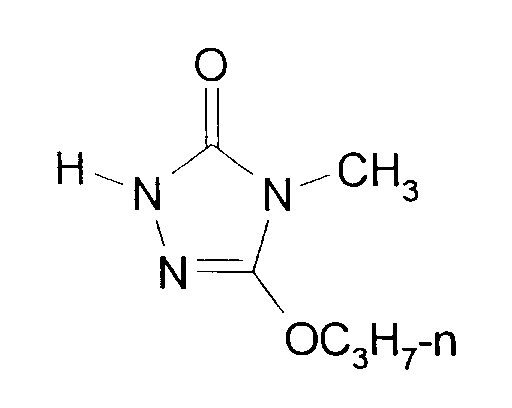
- Eine Mischung aus 147,4 g (1,4 Mol) Carbazinsäure-ethylester, 265 g (1,4 Mol) Methyliminokohlensäure-O-(2-ethoxyethylester)-O-n-propylester und 150 ml Propanol wird 10 Stunden auf 80°C und weitere 2 Stunden auf 100°C erhitzt. Nach Abkühlen auf 50°C werden innerhalb von 30 Minuten 252 g einer 30%igen Lösung von Natriummethanolat in Methanol (1,4 Mol NaOCH₃) eindosiert. Nach 3 Stunden Rühren bei 50°C wird unter Kühlen mit Eis/Kochsalz durch Zugabe von 138 g konz. Salzsäure (1,4 Mol HCl) neutralisiert. Dann werden im Wasserstrahlvakuum bei einer Sumpftemperatur von 80°C Methanol, Propanol, Ethoxyethanol und Wasser weitgehend abdestilliert. Das als Rückstand verbliebene Rohprodukt wird durch Vakuumdestillation über eine auf 80°C aufgeheizte Brücke isoliert.
- Man erhält 208 g 4-Methyl-5-propoxy-2,4-dihydro-3H-1,2,4-triazol-3-on (90,1%ig, Ausbeute: 85,5% der Theorie), welches durch Umkristallisation aus Toluol/Cyclohexan (1:1) rein erhalten werden kann.
- Schmelzpunkt: 74°C.
-
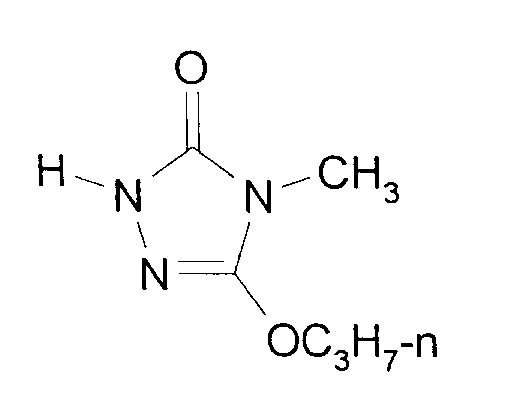
- Eine Mischung aus 147,4 g (1,4 Mol) Carbazinsäure-ethylester, 265 g (1,4 Mol) Methyliminokohlensäure-O-(2-ethoxyethylester)-O-n-propylester und 200 ml Propanol wird unter Eiskühlung mit 3,6 g Pivalinsäure versetzt und eine Stunde bei 20°C gerührt. Dann werden weitere 3,6 g Pivalinsäure dazu gegeben und der Rührer wird abgestellt. Nach weiteren 2 Stunden bei 20°C ist der Ansatz durchkristallisiert. Durch Erwärmen auf 50°C entsteht wieder eine homogene Mischung. Innerhalb von 30 Minuten werden dann 252 g einer 30%igen Lösung von Natriummethanolat in Methanol (1,4 Mol NaOCH₃) eindosiert. Nach 3 Stunden Rühren bei 50°C wird unter Kühlen mit Eis/Kochsalz durch Zugabe von 138 g konz. Salzsäure (1,4 Mol HCl) neutralisiert. Dann werden im Wasserstrahlvakuum bei einer Sumpftemperatur von 80°C Methanol, Propanol, Ethoxyethanol und Wasser weitgehend abdestilliert. Das als Rückstand verbliebene Rohprodukt wird durch Vakuumdestillation über eine auf 80°C aufgeheizte Brücke isoliert.
- Man erhält 216 g 4-Methyl-5-propoxy-2,4-dihydro-3H-1,2,4-triazol-3-on (90,35%ig, Ausbeute: 90% der Theorie), welches durch Umkristallisation aus Toluol/Cyclohexan (1:1) rein erhalten werden kann.
- Schmelzpunkt: 74°C.
-

- 309 g (1,5 Mol) Bis-(2-ethoxyethyl)-carbonat werden unter Kühlung mit einem Wasserbad mit 78,75 g (1,575 Mol) Hydrazinhydrat vermischt und 16 Stunden bei Raumtemperatur gerührt. Nach einer weiteren Stunde bei 50°C werden Hydratwasser, Hydrazinüberschuß und ein Teil des gebildeten Ethoxyethanols bei 15 mbar abgezogen (zusammen 91 g).
- Als Rückstand erhält man Carbazinsäure-(2-ethoxyethylester) der Formel H₅C₂O-CH₂CH₂-O-CO-NH-NH₂. Nun werden darin unter Kaltwasser-Kühlung 238,5 g (1,5 Mol) Methylimino-kohlensäure-dipropylester und eine katalytische Menge (1,5 g) Pivalinsäure eingerührt; nach 2 Stunden wird nochmals die gleiche Menge (1,5 g) Pivalinsäure zugegeben. Nach 12 Stunden bei Raumtemperatur wird noch 1 Stunde bei 70°C gerührt, dann mit 58,4 g einer 30 %igen Lösung von Natriummethanolat in Methanol (0,325 Mol NaOCH₃) versetzt und 7 Stunden bei 70°C gerührt.
- Anschließend wird durch Zugabe von 32 g konz. Salzsäure (37 %ig) unter Eiskühlung neutralisiert (pH-Kontrolle). Nach dem Abdestillieren aller flüchtigen Bestandteile bis 130°C / 15 mbar wird das gewünschte Produkt aus dem Rückstand unter weiter vermindertem Druck (mittels Ölpumpe) abdestilliert und hierdurch vom gebildeten Natriumchlorid abgetrennt.
- Man erhält 221 g Destillat mit einem Gehalt von 95,8 % an 4-Methyl-5-propoxy-2,4-dihydro-3H-1,2,4-triazol-3-on. Unter Berücksichtigung der Analysenproben entspricht dies einer Ausbeute von 93 % der Theorie.
-

- Analog zu Beispiel 2 erhält man durch Umsetzung von äquimolaren Mengen von Carbazinsäure-ethylester und Cyclopropyliminokohlensäure-0,0-diethylester in Gegenwart von Pivalinsäure (2 Mol-%) und anschließende Umsetzung des gebildeten Zwischenproduktes mit einer äquimolaren Menge NaOCH₃ 4-Cyclopropyl-5-ethoxy-2,4-dihydro-3H-1,2,4,-triazol-3-on (Ausbeute: 79 % d.Th.) vom Schmelzpunkt 144-145°C (umkristallisiert aus Wasser).
-

- Analog zu den Beispielen 2 und 13, wobei jedoch anstelle des Carbazinsäureethylesters der Carbazinsäure-(2-ethoxyethylester) [vgl. Beispiel 12] eingesetzt wurde, erhält man 4-Cyclopropyl-5-propoxy-2,4-dihydro-3H-1,2,4-triazol-3-on (Ausbeute: 72 % d.Th.) vom Schmelzpunkt 105-106°C (aus Wasser).
-

- Analog zu den Beispielen 2 und 14 erhält man 4-Ethyl-5-methoxy-2,4-dihydro-3H-1,2,4-triazol-3-on (Ausbeute: 81 % d.Th.) vom Schmelzpunkt 130°C (aus Aceton).
-

- 52 g (0,50 Mol) Carbazinsäure-ethylester werden in 400 ml Methanol vorgelegt und nach Zutropfen von 56,6 g (0,50 Mol) Methyliminokohlensäure-dimethylester (95%ig) wird die Mischung 16 Stunden bei 50°C und nach Zugabe von weiteren 8,2 g (0,08 Mol) Methyliminokohlensäure-dimethylester weitere 10 Stunden bei 50°C gerührt. Dann wird im Wasserstrahlvakuum eingeengt, der Rückstand mit Diethylether verrührt und das kristalline Produkt durch Absaugen isoliert.
- Man erhält 75 g (86% der Theorie) N'-(α-Methylamino-α-methoxy-methylen)hydrazin-N-carbonsäure-ethylester vom Schmelzpunkt 128°C.
-

- 15,6 g (0,15 Mol) Carbazinsäure-ethylester werden in 100 ml n-Propanol vorgelegt und nach Zutropfen von 25,25 g (0,16 Mol) Methyliminokohlensäure-dipropylester wird die Mischung 16 Stunden bei 55°C bis 60°C und nach Zugabe von weiteren 4,7 g (0,03 Mol) Methyliminokohlensäure-dimethylester weitere 12 Stunden bei ca. 55°C gerührt. Dann wird im Wasserstrahlvakuum eingeengt, der Rückstand mit Methyl-t-butylether verrührt und das kristalline Produkt durch Absaugen isoliert.
- Man erhält 24,65 g (81% der Theorie) N'-(α-Methylamino-α-propoxy-methylen)hydrazin-N-carbonsäure-ethylester vom Schmelzpunkt 104°C.
Iminokohlensäurediester der allgemeinen Formel (II)

in welcher

in welcher

in welcher
gegebenenfalls nach Zwischenisolierung, in Gegenwart einer Base und gegebenenfalls in Gegenwart eines Verdünnungsmittels bei Temperaturen zwischen 20°C und 100°C cyclisierend kondensiert ("zweite Umsetzungsstufe").
Claims (9)
- Verfahren zur Herstellung von Alkoxytriazolinonen der allgemeinen Formel (I)
 R¹ für jeweils gegebenenfalls substituiertes Alkyl, Alkenyl, Alkinyl, Cycloalkyl, Cycloalkylalkyl, Aryl oder Arylalkyl steht undR² für jeweils gegebenenfalls substituiertes Alkyl, Alkenyl, Alkinyl, Cycloalkyl, Cycloalkylalkyl, Aryl oder Arylalkyl steht,dadurch gekennzeichnet, daß man Iminokohlensäurediester der allgemeinen Formel (II)
 R¹ und R² die oben angegebenen Bedeutungen haben undR³ für jeweils gegebenenfalls substituiertes Alkyl, Aryl oder Arylalkyl steht,mit Carbazinsäureestern der allgemeinen Formel (III),
 R⁴ für jeweils gegebenenfalls substituiertes Alkyl, Aryl oder Arylalkyl steht,gegebenenfalls in Gegenwart eines Reaktionshilfsmittels und gegebenenfalls in Gegenwart eines Verdünnungsmittels bei Temperaturen zwischen -20°C und +120°C umsetzt ("erste Umsetzungsstufe") und die hierbei gebildeten Semicarbazid-Derivate der allgemeinen Formel (IV),
 R¹, R² und R⁴ die oben angegebenen Bedeutungen haben,- und/oder die entsprechenden hierzu tautomeren Verbindungen -,
gegebenenfalls nach Zwischenisolierung, in Gegenwart einer Base und gegebenenfalls in Gegenwart eines Verdünnungsmittels bei Temperaturen zwischen 20°C und 100°C cyclisierend kondensiert ("zweite Umsetzungsstufe"). - Verfahren nach Anspruch 1, dadurch gekennzeichnet, daß man die erste Umsetzungsstufe bei Temperaturen zwischen 0°C und 100°C, insbesondere zwischen 20°C und 80°C durchführt.
- Verfahren nach Anspruch 1, dadurch gekennzeichnet, daß man die zweite Umsetzungsstufe bei Temperaturen zwischen 30°C und 90°C, insbesondere zwischen 40°C und 80°C durchführt.
- Verfahren nach Anspruch 1, dadurch gekennzeichnet, daß Verbindungen der Formel (I) hergestellt werden, in welchenR¹ für jeweils gegebenenfalls durch Halogen oder C₁-C₄-Alkoxy substituiertes Alkyl, Alkenyl oder Alkinyl mit jeweils bis zu 6 Kohlenstoffatomen, für jeweils gegebenenfalls durch Halogen oder C₁-C₄-Alkyl substituiertes Cycloalkyl oder Cycloalkylalkyl mit jeweils 3 bis 6 Kohlenstoffatomen im Cycloalkylteil und gegebenenfalls 1 bis 4 Kohlenstoffatomen im Alkylteil, oder für jeweils gegebenenfalls durch Carboxy, Cyano, Nitro, Halogen, C₁-C₄-Alkyl, C₁-C₄-Halogenalkyl, C₁-C₄-Alkoxy, C₁-C₄-Halogenalkoxy oder C₁-C₄-Alkoxy-carbonyl substituiertes Aryl oder Arylalkyl mit jeweils 6 oder 10 Kohlenstoffatomen im Arylteil und gegebenenfalls 1 bis 4 Kohlenstoffatomen im Alkylteil steht undR² für jeweils gegebenenfalls durch Halogen oder C₁-C₄-Alkoxy substituiertes Alkyl, Alkenyl oder Alkinyl mit jeweils bis zu 6 Kohlenstoffatomen, für jeweils gegebenenfalls durch Halogen oder C₁-C₄-Alkyl substituiertes Cycloalkyl oder Cycloalkylalkyl mit jeweils 3 bis 6 Kohlenstoffatomen im Cycloalkylteil und gegebenenfalls 1 bis 4 Kohlenstoffatomen im Alkylteil, oder für jeweils gegebenenfalls durch Carboxy, Cyano, Nitro, Halogen, C₁-C₄-Alkyl, C₁-C₄-Halogenalkyl, C₁-C₄-Alkoxy, C₁-C₄-Halogenalkoxy oder C₁-C₄-Alkoxy-carbonyl substituiertes Aryl oder Arylalkyl mit jeweils 6 oder 10 Kohlenstoffatomen im Arylteil und gegebenenfalls 1 bis 4 Kohlenstoffatomen im Alkylteil steht.
- Verfahren nach Anspruch 1, dadurch gekennzeichnet, daß als Iminokohlensäurediester der Formel (II) Methyliminokohlensäure-dimethylester, -diethylester, -dipropylester oder -O-(2-ethoxyethylester)-O-n-propylester eingesetzt wird.
- Verfahren nach Anspruch 1, dadurch gekennzeichnet, daß als Carbazinsäureester der Formel (III) Carbazinsäure-ethylester eingesetzt wird.
- Verfahren nach Anspruch 1, dadurch gekennzeichnet, daß als Verdünnungsmittel (in beiden Umsetzungsstufen) Alkohole, insbesondere Methanol, Ethanol, n- oder i-Propanol verwendet werden.
- Verfahren nach Anspruch 1, dadurch gekennzeichnet, daß in der ersten Umsetzungsstufe als Reaktionshilfsmittel eine Protonensäure, insbesondere Pivalinsäure, Essigsäure oder (wäßrige) Salzsäure eingesetzt wird.
- Verfahren nach Anspruch 1, dadurch gekennzeichnet, daß in der zweiten Umsetzungsstufe als Base eine organische oder anorganische Base, insbesondere ein Alkalimetallalkoholat oder -hydroxid - jeweils gegebenenfalls im entsprechenden Alkohol bzw. in Wasser gelöst - eingesetzt wird.
Applications Claiming Priority (2)
| Application Number | Priority Date | Filing Date | Title |
|---|---|---|---|
| DE4433969A DE4433969A1 (de) | 1994-09-23 | 1994-09-23 | Verfahren zur Herstellung von Alkoxytriazolinonen |
| DE4433969 | 1994-09-23 |
Publications (2)
| Publication Number | Publication Date |
|---|---|
| EP0703225A1 true EP0703225A1 (de) | 1996-03-27 |
| EP0703225B1 EP0703225B1 (de) | 1997-09-03 |
Family
ID=6528980
Family Applications (1)
| Application Number | Title | Priority Date | Filing Date |
|---|---|---|---|
| EP95114214A Expired - Lifetime EP0703225B1 (de) | 1994-09-23 | 1995-09-11 | Verfahren zur Herstellung von Alkoxytriazolinonen |
Country Status (8)
| Country | Link |
|---|---|
| US (1) | US5594148A (de) |
| EP (1) | EP0703225B1 (de) |
| JP (1) | JP3910655B2 (de) |
| AT (1) | ATE157658T1 (de) |
| CA (1) | CA2158691C (de) |
| DE (2) | DE4433969A1 (de) |
| DK (1) | DK0703225T3 (de) |
| ES (1) | ES2108531T3 (de) |
Cited By (1)
| Publication number | Priority date | Publication date | Assignee | Title |
|---|---|---|---|---|
| WO1999018089A1 (de) * | 1997-10-08 | 1999-04-15 | Lonza Ag | Verfahren zur herstellung von alkoxytriazolinonen |
Families Citing this family (4)
| Publication number | Priority date | Publication date | Assignee | Title |
|---|---|---|---|---|
| US6197971B1 (en) | 1999-12-27 | 2001-03-06 | Bayer Corporation | Process for the manufacture of substituted triazolinones |
| DE10024624A1 (de) * | 2000-05-18 | 2001-11-22 | Bayer Ag | Modifizierte Polyisocyanate |
| US6222045B1 (en) | 2000-09-20 | 2001-04-24 | Bayer Corporation | Process for manufacturing substituted triazolinones |
| CN103265499B (zh) * | 2013-06-04 | 2014-10-22 | 江苏省农用激素工程技术研究中心有限公司 | 5-甲氧基-4-甲基-2,4-二氢-3h-1,2,4-三唑-3-酮的精制方法 |
Citations (2)
| Publication number | Priority date | Publication date | Assignee | Title |
|---|---|---|---|---|
| EP0477646A1 (de) | 1990-09-22 | 1992-04-01 | Bayer Ag | Substituierte 5-Alkoxy-1,2,4-triazol-3-(thi)one |
| EP0507171A1 (de) | 1991-04-04 | 1992-10-07 | Bayer Ag | Sulfonylaminocarbonyltriazolinone mit über Sauerstoff gebundenen Substituenten |
Family Cites Families (2)
| Publication number | Priority date | Publication date | Assignee | Title |
|---|---|---|---|---|
| US5300480A (en) * | 1989-04-13 | 1994-04-05 | Bayer Aktiengesellschaft | Herbicidal sulphonylaminocarbonyltriazolinones having two substituents bonded via oxygen |
| US5356865A (en) * | 1990-09-22 | 1994-10-18 | Bayer Aktiengesellschaft | Substituted 5-alkoxy-1,2,4-triazol-3-(thi)ones |
-
1994
- 1994-09-23 DE DE4433969A patent/DE4433969A1/de not_active Withdrawn
-
1995
- 1995-09-11 AT AT95114214T patent/ATE157658T1/de active
- 1995-09-11 ES ES95114214T patent/ES2108531T3/es not_active Expired - Lifetime
- 1995-09-11 DK DK95114214.0T patent/DK0703225T3/da active
- 1995-09-11 EP EP95114214A patent/EP0703225B1/de not_active Expired - Lifetime
- 1995-09-11 DE DE59500598T patent/DE59500598D1/de not_active Expired - Lifetime
- 1995-09-15 US US08/529,185 patent/US5594148A/en not_active Expired - Lifetime
- 1995-09-20 CA CA002158691A patent/CA2158691C/en not_active Expired - Lifetime
- 1995-09-21 JP JP26775895A patent/JP3910655B2/ja not_active Expired - Lifetime
Patent Citations (2)
| Publication number | Priority date | Publication date | Assignee | Title |
|---|---|---|---|---|
| EP0477646A1 (de) | 1990-09-22 | 1992-04-01 | Bayer Ag | Substituierte 5-Alkoxy-1,2,4-triazol-3-(thi)one |
| EP0507171A1 (de) | 1991-04-04 | 1992-10-07 | Bayer Ag | Sulfonylaminocarbonyltriazolinone mit über Sauerstoff gebundenen Substituenten |
Non-Patent Citations (5)
| Title |
|---|
| ARCH. PHARM., vol. 307, 1974, pages 889 - 891 |
| CHEM. BER., vol. 120, 1987, pages 339 - 344 |
| F. ARNDT ET AL., REV. FAC. SCI. ISTANBUL, vol. 13A, 1948, pages 127 - 144 |
| J. CHEM. SOC. PERKIN I, 1973, pages 2644 - 2646 |
| J. INDIAN CHEM. SOC., vol. 6, 1929, pages 565 - 575 |
Cited By (3)
| Publication number | Priority date | Publication date | Assignee | Title |
|---|---|---|---|---|
| US6248900B1 (en) | 1997-08-10 | 2001-06-19 | Lonza Group | Process for preparing alkoxytriazolinones |
| US6376699B1 (en) | 1997-08-10 | 2002-04-23 | Lonza Ag | Process for preparing alkoxytriazolinones |
| WO1999018089A1 (de) * | 1997-10-08 | 1999-04-15 | Lonza Ag | Verfahren zur herstellung von alkoxytriazolinonen |
Also Published As
| Publication number | Publication date |
|---|---|
| DE4433969A1 (de) | 1996-03-28 |
| US5594148A (en) | 1997-01-14 |
| JPH0899963A (ja) | 1996-04-16 |
| DK0703225T3 (da) | 1998-05-04 |
| ATE157658T1 (de) | 1997-09-15 |
| DE59500598D1 (de) | 1997-10-09 |
| CA2158691C (en) | 2006-03-21 |
| ES2108531T3 (es) | 1997-12-16 |
| CA2158691A1 (en) | 1996-03-24 |
| EP0703225B1 (de) | 1997-09-03 |
| JP3910655B2 (ja) | 2007-04-25 |
Similar Documents
| Publication | Publication Date | Title |
|---|---|---|
| EP0595130B1 (de) | N-Phenylacetaminonitrile und ihre Verwendung als Zwischenprodukte zur Synthese von Insektiziden und Herbiziden 3-Aryl-pyrrolidin-2,4-dionen | |
| DE3015587A1 (de) | Verfahren zur herstellung von acylcyaniden | |
| EP1644314B1 (de) | Verfahren zum herstellen von difluoracetessigs urealkylestern | |
| EP0703224B1 (de) | Verfahren zur Herstellung von Alkoxytriazolinonen | |
| EP0708095B1 (de) | Verfahren zur Herstellung von alkoxytriazolinonen | |
| EP0703225B1 (de) | Verfahren zur Herstellung von Alkoxytriazolinonen | |
| EP0661277B1 (de) | Verfahren und neue Zwischenprodukte zur Herstellung von Triazolinonen | |
| EP0726258A1 (de) | Verfahren und neue Zwischenprodukte zur Herstellung von Triazolinonen | |
| EP0321833B1 (de) | Verfahren zur Herstellung von 4-Amino-1,2,4-triazol-5-onen | |
| DE2708189C2 (de) | Verfahren zur Herstellung von Phenylglyoxylsäureestern | |
| EP0505742A2 (de) | Verfahren zur Herstellung von in 3-Stellung substituierten 4-Cyano-pyrrolverbindungen | |
| EP0657437B1 (de) | Verfahren und neue Zwischenprodukte zur Herstellung von Triazolinonen | |
| DE68922289T2 (de) | Herstellung von 5-Amino-1,2,4-triazol-3-sulfonamiden und Zwischenverbindungen. | |
| EP0653423B1 (de) | Verfahren zur Herstellung von substituierten Chinazolin-2,4-dionen | |
| DE2614241A1 (de) | Verfahren zur herstellung von acylcyaniden | |
| EP0703226B1 (de) | Verfahren zur Herstellung von Alkoxytriazolinonen | |
| EP0726259A1 (de) | Verfahren zur Herstellung von substituierten N-Carbamoyl-tetrazolinonen | |
| EP0056938B1 (de) | Verfahren zur Herstellung von 3,6-disubstituierten 4-Amino-1,2,4-triazin-5-onen | |
| EP0005484B1 (de) | Verfahren zur Herstellung von Acylcyaniden | |
| DE69902886T2 (de) | Verfahren zur herstellung von aryloxy- oder alkoxytriazolinonen | |
| EP0403889B1 (de) | Verfahren zur Herstellung von 4-Amino-1,2,4-triazol-5-onen | |
| EP0759430A1 (de) | Verfahren zur Herstellung von substituierten Aminotriazolinonen | |
| EP0624570A2 (de) | Verfahren zur Herstellung von 2-Oximinoessigsäurederivaten | |
| DE3004695A1 (de) | Verfahren zur herstellung von trifluormethylphenyl-oxyphenyl-ethern | |
| WO1996012707A1 (de) | 2-chlor-n-[1-(2,6-dichlor-4-difluormethyl-phenyl)-1h-pyrazol-5-yl]-propanamid und ein verfahren zu seiner herstellung |
Legal Events
| Date | Code | Title | Description |
|---|---|---|---|
| PUAI | Public reference made under article 153(3) epc to a published international application that has entered the european phase |
Free format text: ORIGINAL CODE: 0009012 |
|
| AK | Designated contracting states |
Kind code of ref document: A1 Designated state(s): AT BE CH DE DK ES FR GB IT LI NL |
|
| 17P | Request for examination filed |
Effective date: 19960826 |
|
| GRAG | Despatch of communication of intention to grant |
Free format text: ORIGINAL CODE: EPIDOS AGRA |
|
| 17Q | First examination report despatched |
Effective date: 19961113 |
|
| GRAH | Despatch of communication of intention to grant a patent |
Free format text: ORIGINAL CODE: EPIDOS IGRA |
|
| GRAH | Despatch of communication of intention to grant a patent |
Free format text: ORIGINAL CODE: EPIDOS IGRA |
|
| GRAA | (expected) grant |
Free format text: ORIGINAL CODE: 0009210 |
|
| AK | Designated contracting states |
Kind code of ref document: B1 Designated state(s): AT BE CH DE DK ES FR GB IT LI NL |
|
| REF | Corresponds to: |
Ref document number: 157658 Country of ref document: AT Date of ref document: 19970915 Kind code of ref document: T |
|
| REG | Reference to a national code |
Ref country code: CH Ref legal event code: NV Representative=s name: E. BLUM & CO. PATENTANWAELTE Ref country code: CH Ref legal event code: EP |
|
| GBT | Gb: translation of ep patent filed (gb section 77(6)(a)/1977) |
Effective date: 19970905 |
|
| ITF | It: translation for a ep patent filed | ||
| REF | Corresponds to: |
Ref document number: 59500598 Country of ref document: DE Date of ref document: 19971009 |
|
| ET | Fr: translation filed | ||
| REG | Reference to a national code |
Ref country code: ES Ref legal event code: FG2A Ref document number: 2108531 Country of ref document: ES Kind code of ref document: T3 |
|
| REG | Reference to a national code |
Ref country code: DK Ref legal event code: T3 |
|
| PLBE | No opposition filed within time limit |
Free format text: ORIGINAL CODE: 0009261 |
|
| STAA | Information on the status of an ep patent application or granted ep patent |
Free format text: STATUS: NO OPPOSITION FILED WITHIN TIME LIMIT |
|
| 26N | No opposition filed | ||
| REG | Reference to a national code |
Ref country code: GB Ref legal event code: IF02 |
|
| REG | Reference to a national code |
Ref country code: CH Ref legal event code: PFA Owner name: BAYER AG Free format text: BAYER AG# #51368 LEVERKUSEN (DE) -TRANSFER TO- BAYER AG# #51368 LEVERKUSEN (DE) |
|
| REG | Reference to a national code |
Ref country code: NL Ref legal event code: SD Effective date: 20110224 |
|
| BECA | Be: change of holder's address |
Owner name: 15401 WESTON PARKWAY, CARY NC 27513 Effective date: 20110330 Owner name: ARYSTA LIFESCIENCE NORTH AMERICA LLC Effective date: 20110330 |
|
| BECH | Be: change of holder |
Owner name: ARYSTA LIFESCIENCE NORTH AMERICA LLC Effective date: 20110330 |
|
| REG | Reference to a national code |
Ref country code: FR Ref legal event code: TP Owner name: ARYSTA LIFESCIENCE NORTH AMERICA LLC, US Effective date: 20111003 |
|
| PGFP | Annual fee paid to national office [announced via postgrant information from national office to epo] |
Ref country code: CH Payment date: 20140915 Year of fee payment: 20 Ref country code: DK Payment date: 20140910 Year of fee payment: 20 Ref country code: DE Payment date: 20140903 Year of fee payment: 20 |
|
| PGFP | Annual fee paid to national office [announced via postgrant information from national office to epo] |
Ref country code: FR Payment date: 20140917 Year of fee payment: 20 Ref country code: GB Payment date: 20140910 Year of fee payment: 20 Ref country code: AT Payment date: 20140827 Year of fee payment: 20 Ref country code: ES Payment date: 20140827 Year of fee payment: 20 |
|
| REG | Reference to a national code |
Ref country code: DE Ref legal event code: R081 Ref document number: 59500598 Country of ref document: DE Owner name: BAYER INTELLECTUAL PROPERTY GMBH, DE Free format text: FORMER OWNER: BAYER CROPSCIENCE AG, 40789 MONHEIM, DE Effective date: 20141023 |
|
| PGFP | Annual fee paid to national office [announced via postgrant information from national office to epo] |
Ref country code: IT Payment date: 20140912 Year of fee payment: 20 |
|
| PGFP | Annual fee paid to national office [announced via postgrant information from national office to epo] |
Ref country code: NL Payment date: 20140926 Year of fee payment: 20 |
|
| REG | Reference to a national code |
Ref country code: ES Ref legal event code: PC2A Owner name: BAYER INTELLECTUAL PROPERTY GMBH Effective date: 20150303 |
|
| PGFP | Annual fee paid to national office [announced via postgrant information from national office to epo] |
Ref country code: BE Payment date: 20140929 Year of fee payment: 20 |
|
| REG | Reference to a national code |
Ref country code: GB Ref legal event code: 732E Free format text: REGISTERED BETWEEN 20150423 AND 20150430 |
|
| REG | Reference to a national code |
Ref country code: DE Ref legal event code: R071 Ref document number: 59500598 Country of ref document: DE |
|
| REG | Reference to a national code |
Ref country code: DK Ref legal event code: EUP Effective date: 20150911 |
|
| REG | Reference to a national code |
Ref country code: CH Ref legal event code: PL |
|
| REG | Reference to a national code |
Ref country code: GB Ref legal event code: PE20 Expiry date: 20150910 Ref country code: NL Ref legal event code: MK Effective date: 20150910 |
|
| PG25 | Lapsed in a contracting state [announced via postgrant information from national office to epo] |
Ref country code: GB Free format text: LAPSE BECAUSE OF EXPIRATION OF PROTECTION Effective date: 20150910 |
|
| REG | Reference to a national code |
Ref country code: AT Ref legal event code: MK07 Ref document number: 157658 Country of ref document: AT Kind code of ref document: T Effective date: 20150911 |
|
| REG | Reference to a national code |
Ref country code: ES Ref legal event code: FD2A Effective date: 20151229 |
|
| PG25 | Lapsed in a contracting state [announced via postgrant information from national office to epo] |
Ref country code: ES Free format text: LAPSE BECAUSE OF EXPIRATION OF PROTECTION Effective date: 20150912 |
|
| REG | Reference to a national code |
Ref country code: AT Ref legal event code: PC Ref document number: 157658 Country of ref document: AT Kind code of ref document: T Owner name: BAYER INTELLECTUAL PROPERTY GMBH, DE Effective date: 20160912 |