EP0703270A2 - Massefärben von Kunststoffen - Google Patents
Massefärben von Kunststoffen Download PDFInfo
- Publication number
- EP0703270A2 EP0703270A2 EP95114013A EP95114013A EP0703270A2 EP 0703270 A2 EP0703270 A2 EP 0703270A2 EP 95114013 A EP95114013 A EP 95114013A EP 95114013 A EP95114013 A EP 95114013A EP 0703270 A2 EP0703270 A2 EP 0703270A2
- Authority
- EP
- European Patent Office
- Prior art keywords
- ring
- substituted
- alkyl
- formula
- unsubstituted
- Prior art date
- Legal status (The legal status is an assumption and is not a legal conclusion. Google has not performed a legal analysis and makes no representation as to the accuracy of the status listed.)
- Withdrawn
Links
- 229920003023 plastic Polymers 0.000 title claims abstract description 23
- 239000004033 plastic Substances 0.000 title claims abstract description 23
- 238000004040 coloring Methods 0.000 title claims description 9
- 239000000975 dye Substances 0.000 claims abstract description 62
- 125000002496 methyl group Chemical group [H]C([H])([H])* 0.000 claims abstract description 16
- 125000003118 aryl group Chemical group 0.000 claims abstract description 15
- 229910052801 chlorine Inorganic materials 0.000 claims abstract description 12
- 229910052794 bromium Inorganic materials 0.000 claims abstract description 11
- 229910052736 halogen Inorganic materials 0.000 claims abstract description 10
- 150000002367 halogens Chemical class 0.000 claims abstract description 9
- 125000000217 alkyl group Chemical group 0.000 claims abstract description 4
- 125000000732 arylene group Chemical group 0.000 claims abstract description 3
- -1 C5-C8-cycloalkyl Chemical group 0.000 claims description 33
- 238000000034 method Methods 0.000 claims description 30
- 239000000460 chlorine Substances 0.000 claims description 21
- 125000000041 C6-C10 aryl group Chemical group 0.000 claims description 19
- 125000001997 phenyl group Chemical group [H]C1=C([H])C([H])=C(*)C([H])=C1[H] 0.000 claims description 19
- 125000004178 (C1-C4) alkyl group Chemical group 0.000 claims description 17
- 125000004423 acyloxy group Chemical group 0.000 claims description 13
- 125000000623 heterocyclic group Chemical group 0.000 claims description 13
- 125000004432 carbon atom Chemical group C* 0.000 claims description 12
- RAXXELZNTBOGNW-UHFFFAOYSA-N imidazole Natural products C1=CNC=N1 RAXXELZNTBOGNW-UHFFFAOYSA-N 0.000 claims description 11
- 125000000229 (C1-C4)alkoxy group Chemical group 0.000 claims description 10
- 125000004169 (C1-C6) alkyl group Chemical group 0.000 claims description 10
- 125000004191 (C1-C6) alkoxy group Chemical group 0.000 claims description 8
- 125000004454 (C1-C6) alkoxycarbonyl group Chemical group 0.000 claims description 7
- JUJWROOIHBZHMG-UHFFFAOYSA-N Pyridine Chemical compound C1=CC=NC=C1 JUJWROOIHBZHMG-UHFFFAOYSA-N 0.000 claims description 7
- KAESVJOAVNADME-UHFFFAOYSA-N Pyrrole Chemical compound C=1C=CNC=1 KAESVJOAVNADME-UHFFFAOYSA-N 0.000 claims description 7
- UHOVQNZJYSORNB-UHFFFAOYSA-N monobenzene Natural products C1=CC=CC=C1 UHOVQNZJYSORNB-UHFFFAOYSA-N 0.000 claims description 7
- 125000001424 substituent group Chemical group 0.000 claims description 7
- YLQBMQCUIZJEEH-UHFFFAOYSA-N Furan Chemical compound C=1C=COC=1 YLQBMQCUIZJEEH-UHFFFAOYSA-N 0.000 claims description 6
- 125000004442 acylamino group Chemical group 0.000 claims description 6
- 125000006700 (C1-C6) alkylthio group Chemical group 0.000 claims description 5
- YTPLMLYBLZKORZ-UHFFFAOYSA-N Thiophene Chemical compound C=1C=CSC=1 YTPLMLYBLZKORZ-UHFFFAOYSA-N 0.000 claims description 5
- 150000001412 amines Chemical class 0.000 claims description 5
- 125000001072 heteroaryl group Chemical group 0.000 claims description 5
- 125000001624 naphthyl group Chemical group 0.000 claims description 5
- ZCQWOFVYLHDMMC-UHFFFAOYSA-N Oxazole Chemical compound C1=COC=N1 ZCQWOFVYLHDMMC-UHFFFAOYSA-N 0.000 claims description 4
- FZWLAAWBMGSTSO-UHFFFAOYSA-N Thiazole Chemical compound C1=CSC=N1 FZWLAAWBMGSTSO-UHFFFAOYSA-N 0.000 claims description 4
- 125000003282 alkyl amino group Chemical group 0.000 claims description 4
- 229910052799 carbon Inorganic materials 0.000 claims description 4
- 125000004769 (C1-C4) alkylsulfonyl group Chemical group 0.000 claims description 3
- MGADZUXDNSDTHW-UHFFFAOYSA-N 2H-pyran Chemical compound C1OC=CC=C1 MGADZUXDNSDTHW-UHFFFAOYSA-N 0.000 claims description 3
- WKBOTKDWSSQWDR-UHFFFAOYSA-N Bromine atom Chemical compound [Br] WKBOTKDWSSQWDR-UHFFFAOYSA-N 0.000 claims description 3
- ZAMOUSCENKQFHK-UHFFFAOYSA-N Chlorine atom Chemical compound [Cl] ZAMOUSCENKQFHK-UHFFFAOYSA-N 0.000 claims description 3
- 125000005110 aryl thio group Chemical group 0.000 claims description 3
- 125000004093 cyano group Chemical group *C#N 0.000 claims description 3
- 125000002924 primary amino group Chemical group [H]N([H])* 0.000 claims description 3
- UMJSCPRVCHMLSP-UHFFFAOYSA-N pyridine Natural products COC1=CC=CN=C1 UMJSCPRVCHMLSP-UHFFFAOYSA-N 0.000 claims description 3
- 150000003254 radicals Chemical class 0.000 claims description 3
- 229920001169 thermoplastic Polymers 0.000 claims description 3
- 239000004416 thermosoftening plastic Substances 0.000 claims description 3
- 229920002554 vinyl polymer Polymers 0.000 claims description 3
- 125000001140 1,4-phenylene group Chemical group [H]C1=C([H])C([*:2])=C([H])C([H])=C1[*:1] 0.000 claims description 2
- 239000004952 Polyamide Substances 0.000 claims description 2
- 125000001931 aliphatic group Chemical group 0.000 claims description 2
- GDTBXPJZTBHREO-UHFFFAOYSA-N bromine Substances BrBr GDTBXPJZTBHREO-UHFFFAOYSA-N 0.000 claims description 2
- 125000002837 carbocyclic group Chemical group 0.000 claims description 2
- 229910052731 fluorine Inorganic materials 0.000 claims description 2
- 125000004957 naphthylene group Chemical group 0.000 claims description 2
- 125000004817 pentamethylene group Chemical group [H]C([H])([*:2])C([H])([H])C([H])([H])C([H])([H])C([H])([H])[*:1] 0.000 claims description 2
- 125000000843 phenylene group Chemical group C1(=C(C=CC=C1)*)* 0.000 claims description 2
- 229920002647 polyamide Polymers 0.000 claims description 2
- 125000000714 pyrimidinyl group Chemical group 0.000 claims description 2
- 229930192474 thiophene Natural products 0.000 claims description 2
- 229920006149 polyester-amide block copolymer Polymers 0.000 claims 1
- 125000000383 tetramethylene group Chemical group [H]C([H])([*:1])C([H])([H])C([H])([H])C([H])([H])[*:2] 0.000 claims 1
- 125000003545 alkoxy group Chemical group 0.000 abstract description 3
- 125000004104 aryloxy group Chemical group 0.000 abstract description 2
- 238000012505 colouration Methods 0.000 abstract description 2
- 125000004390 alkyl sulfonyl group Chemical group 0.000 abstract 1
- 125000001769 aryl amino group Chemical group 0.000 abstract 1
- 125000000753 cycloalkyl group Chemical group 0.000 abstract 1
- QTBSBXVTEAMEQO-UHFFFAOYSA-N Acetic acid Chemical compound CC(O)=O QTBSBXVTEAMEQO-UHFFFAOYSA-N 0.000 description 48
- WFDIJRYMOXRFFG-UHFFFAOYSA-N Acetic anhydride Chemical compound CC(=O)OC(C)=O WFDIJRYMOXRFFG-UHFFFAOYSA-N 0.000 description 40
- OKKJLVBELUTLKV-UHFFFAOYSA-N Methanol Chemical compound OC OKKJLVBELUTLKV-UHFFFAOYSA-N 0.000 description 39
- YMWUJEATGCHHMB-UHFFFAOYSA-N Dichloromethane Chemical compound ClCCl YMWUJEATGCHHMB-UHFFFAOYSA-N 0.000 description 32
- 229960000583 acetic acid Drugs 0.000 description 18
- 239000000203 mixture Substances 0.000 description 18
- PPBRXRYQALVLMV-UHFFFAOYSA-N Styrene Natural products C=CC1=CC=CC=C1 PPBRXRYQALVLMV-UHFFFAOYSA-N 0.000 description 15
- 229920000642 polymer Polymers 0.000 description 14
- 238000004043 dyeing Methods 0.000 description 13
- GWEVSGVZZGPLCZ-UHFFFAOYSA-N Titan oxide Chemical compound O=[Ti]=O GWEVSGVZZGPLCZ-UHFFFAOYSA-N 0.000 description 12
- 235000011054 acetic acid Nutrition 0.000 description 12
- 239000000243 solution Substances 0.000 description 11
- 239000000047 product Substances 0.000 description 10
- UYNVBLJQBCTRKV-UHFFFAOYSA-N 2-(1h-benzimidazol-1-ium-2-ylsulfanyl)acetate Chemical compound C1=CC=C2NC(SCC(=O)O)=NC2=C1 UYNVBLJQBCTRKV-UHFFFAOYSA-N 0.000 description 9
- 150000001875 compounds Chemical class 0.000 description 9
- 239000008187 granular material Substances 0.000 description 8
- 238000006116 polymerization reaction Methods 0.000 description 8
- XLYOFNOQVPJJNP-UHFFFAOYSA-N water Chemical compound O XLYOFNOQVPJJNP-UHFFFAOYSA-N 0.000 description 8
- ZMXDDKWLCZADIW-UHFFFAOYSA-N N,N-Dimethylformamide Chemical compound CN(C)C=O ZMXDDKWLCZADIW-UHFFFAOYSA-N 0.000 description 7
- QGZKDVFQNNGYKY-UHFFFAOYSA-N Ammonia Chemical compound N QGZKDVFQNNGYKY-UHFFFAOYSA-N 0.000 description 6
- 239000004793 Polystyrene Substances 0.000 description 6
- HEMHJVSKTPXQMS-UHFFFAOYSA-M Sodium hydroxide Chemical compound [OH-].[Na+] HEMHJVSKTPXQMS-UHFFFAOYSA-M 0.000 description 6
- YXFVVABEGXRONW-UHFFFAOYSA-N Toluene Chemical compound CC1=CC=CC=C1 YXFVVABEGXRONW-UHFFFAOYSA-N 0.000 description 6
- 239000003054 catalyst Substances 0.000 description 6
- 239000012362 glacial acetic acid Substances 0.000 description 6
- 239000000155 melt Substances 0.000 description 6
- 229920002223 polystyrene Polymers 0.000 description 6
- 239000002244 precipitate Substances 0.000 description 6
- 239000004408 titanium dioxide Substances 0.000 description 6
- 229910001868 water Inorganic materials 0.000 description 6
- 150000001299 aldehydes Chemical class 0.000 description 4
- MDFFNEOEWAXZRQ-UHFFFAOYSA-N aminyl Chemical compound [NH2] MDFFNEOEWAXZRQ-UHFFFAOYSA-N 0.000 description 4
- XBDQKXXYIPTUBI-UHFFFAOYSA-N dimethylselenoniopropionate Natural products CCC(O)=O XBDQKXXYIPTUBI-UHFFFAOYSA-N 0.000 description 4
- 238000004519 manufacturing process Methods 0.000 description 4
- 229920000515 polycarbonate Polymers 0.000 description 4
- 239000004417 polycarbonate Substances 0.000 description 4
- 238000010992 reflux Methods 0.000 description 4
- 239000001632 sodium acetate Substances 0.000 description 4
- 235000017281 sodium acetate Nutrition 0.000 description 4
- 238000003756 stirring Methods 0.000 description 4
- NLHHRLWOUZZQLW-UHFFFAOYSA-N Acrylonitrile Chemical compound C=CC#N NLHHRLWOUZZQLW-UHFFFAOYSA-N 0.000 description 3
- OMPJBNCRMGITSC-UHFFFAOYSA-N Benzoylperoxide Chemical compound C=1C=CC=CC=1C(=O)OOC(=O)C1=CC=CC=C1 OMPJBNCRMGITSC-UHFFFAOYSA-N 0.000 description 3
- NLZUEZXRPGMBCV-UHFFFAOYSA-N Butylhydroxytoluene Chemical compound CC1=CC(C(C)(C)C)=C(O)C(C(C)(C)C)=C1 NLZUEZXRPGMBCV-UHFFFAOYSA-N 0.000 description 3
- LFQSCWFLJHTTHZ-UHFFFAOYSA-N Ethanol Chemical compound CCO LFQSCWFLJHTTHZ-UHFFFAOYSA-N 0.000 description 3
- XEKOWRVHYACXOJ-UHFFFAOYSA-N Ethyl acetate Chemical compound CCOC(C)=O XEKOWRVHYACXOJ-UHFFFAOYSA-N 0.000 description 3
- WSFSSNUMVMOOMR-UHFFFAOYSA-N Formaldehyde Chemical compound O=C WSFSSNUMVMOOMR-UHFFFAOYSA-N 0.000 description 3
- KWYUFKZDYYNOTN-UHFFFAOYSA-M Potassium hydroxide Chemical compound [OH-].[K+] KWYUFKZDYYNOTN-UHFFFAOYSA-M 0.000 description 3
- DNIAPMSPPWPWGF-UHFFFAOYSA-N Propylene glycol Chemical compound CC(O)CO DNIAPMSPPWPWGF-UHFFFAOYSA-N 0.000 description 3
- RWRDLPDLKQPQOW-UHFFFAOYSA-N Pyrrolidine Chemical compound C1CCNC1 RWRDLPDLKQPQOW-UHFFFAOYSA-N 0.000 description 3
- VMHLLURERBWHNL-UHFFFAOYSA-M Sodium acetate Chemical compound [Na+].CC([O-])=O VMHLLURERBWHNL-UHFFFAOYSA-M 0.000 description 3
- ZMANZCXQSJIPKH-UHFFFAOYSA-N Triethylamine Chemical compound CCN(CC)CC ZMANZCXQSJIPKH-UHFFFAOYSA-N 0.000 description 3
- 235000019400 benzoyl peroxide Nutrition 0.000 description 3
- 239000003086 colorant Substances 0.000 description 3
- 229920001577 copolymer Polymers 0.000 description 3
- 238000001746 injection moulding Methods 0.000 description 3
- 239000002904 solvent Substances 0.000 description 3
- YKPQUSLRUFLVDA-UHFFFAOYSA-N $l^{2}-azanylmethane Chemical compound [NH]C YKPQUSLRUFLVDA-UHFFFAOYSA-N 0.000 description 2
- 125000006527 (C1-C5) alkyl group Chemical group 0.000 description 2
- MAUMSNABMVEOGP-UHFFFAOYSA-N (methyl-$l^{2}-azanyl)methane Chemical compound C[N]C MAUMSNABMVEOGP-UHFFFAOYSA-N 0.000 description 2
- YAJYJWXEWKRTPO-UHFFFAOYSA-N 2,3,3,4,4,5-hexamethylhexane-2-thiol Chemical compound CC(C)C(C)(C)C(C)(C)C(C)(C)S YAJYJWXEWKRTPO-UHFFFAOYSA-N 0.000 description 2
- KCZRCYBAYWJVGD-UHFFFAOYSA-N 4-(diethylamino)-2-methylbenzaldehyde Chemical compound CCN(CC)C1=CC=C(C=O)C(C)=C1 KCZRCYBAYWJVGD-UHFFFAOYSA-N 0.000 description 2
- MNFZZNNFORDXSV-UHFFFAOYSA-N 4-(diethylamino)benzaldehyde Chemical compound CCN(CC)C1=CC=C(C=O)C=C1 MNFZZNNFORDXSV-UHFFFAOYSA-N 0.000 description 2
- BGNGWHSBYQYVRX-UHFFFAOYSA-N 4-(dimethylamino)benzaldehyde Chemical compound CN(C)C1=CC=C(C=O)C=C1 BGNGWHSBYQYVRX-UHFFFAOYSA-N 0.000 description 2
- YVBIDCBDRUUGEA-UHFFFAOYSA-N 4-[benzyl(ethyl)amino]benzaldehyde Chemical compound C=1C=C(C=O)C=CC=1N(CC)CC1=CC=CC=C1 YVBIDCBDRUUGEA-UHFFFAOYSA-N 0.000 description 2
- KAKZBPTYRLMSJV-UHFFFAOYSA-N Butadiene Chemical compound C=CC=C KAKZBPTYRLMSJV-UHFFFAOYSA-N 0.000 description 2
- 0 Cc(cc1)ccc1S* Chemical compound Cc(cc1)ccc1S* 0.000 description 2
- HEDRZPFGACZZDS-UHFFFAOYSA-N Chloroform Chemical compound ClC(Cl)Cl HEDRZPFGACZZDS-UHFFFAOYSA-N 0.000 description 2
- IAZDPXIOMUYVGZ-UHFFFAOYSA-N Dimethylsulphoxide Chemical compound CS(C)=O IAZDPXIOMUYVGZ-UHFFFAOYSA-N 0.000 description 2
- VEXZGXHMUGYJMC-UHFFFAOYSA-N Hydrochloric acid Chemical compound Cl VEXZGXHMUGYJMC-UHFFFAOYSA-N 0.000 description 2
- DGAQECJNVWCQMB-PUAWFVPOSA-M Ilexoside XXIX Chemical compound C[C@@H]1CC[C@@]2(CC[C@@]3(C(=CC[C@H]4[C@]3(CC[C@@H]5[C@@]4(CC[C@@H](C5(C)C)OS(=O)(=O)[O-])C)C)[C@@H]2[C@]1(C)O)C)C(=O)O[C@H]6[C@@H]([C@H]([C@@H]([C@H](O6)CO)O)O)O.[Na+] DGAQECJNVWCQMB-PUAWFVPOSA-M 0.000 description 2
- AFVFQIVMOAPDHO-UHFFFAOYSA-N Methanesulfonic acid Chemical compound CS(O)(=O)=O AFVFQIVMOAPDHO-UHFFFAOYSA-N 0.000 description 2
- VVQNEPGJFQJSBK-UHFFFAOYSA-N Methyl methacrylate Chemical compound COC(=O)C(C)=C VVQNEPGJFQJSBK-UHFFFAOYSA-N 0.000 description 2
- YNAVUWVOSKDBBP-UHFFFAOYSA-N Morpholine Chemical compound C1COCCN1 YNAVUWVOSKDBBP-UHFFFAOYSA-N 0.000 description 2
- JLTDJTHDQAWBAV-UHFFFAOYSA-N N,N-dimethylaniline Chemical compound CN(C)C1=CC=CC=C1 JLTDJTHDQAWBAV-UHFFFAOYSA-N 0.000 description 2
- NQRYJNQNLNOLGT-UHFFFAOYSA-N Piperidine Chemical compound C1CCNCC1 NQRYJNQNLNOLGT-UHFFFAOYSA-N 0.000 description 2
- CDBYLPFSWZWCQE-UHFFFAOYSA-L Sodium Carbonate Chemical compound [Na+].[Na+].[O-]C([O-])=O CDBYLPFSWZWCQE-UHFFFAOYSA-L 0.000 description 2
- UIIMBOGNXHQVGW-UHFFFAOYSA-M Sodium bicarbonate Chemical compound [Na+].OC([O-])=O UIIMBOGNXHQVGW-UHFFFAOYSA-M 0.000 description 2
- WQDUMFSSJAZKTM-UHFFFAOYSA-N Sodium methoxide Chemical compound [Na+].[O-]C WQDUMFSSJAZKTM-UHFFFAOYSA-N 0.000 description 2
- WYURNTSHIVDZCO-UHFFFAOYSA-N Tetrahydrofuran Chemical compound C1CCOC1 WYURNTSHIVDZCO-UHFFFAOYSA-N 0.000 description 2
- TUCNEACPLKLKNU-UHFFFAOYSA-N acetyl Chemical compound C[C]=O TUCNEACPLKLKNU-UHFFFAOYSA-N 0.000 description 2
- 230000002378 acidificating effect Effects 0.000 description 2
- 229910000287 alkaline earth metal oxide Inorganic materials 0.000 description 2
- VSCWAEJMTAWNJL-UHFFFAOYSA-K aluminium trichloride Chemical compound Cl[Al](Cl)Cl VSCWAEJMTAWNJL-UHFFFAOYSA-K 0.000 description 2
- QVGXLLKOCUKJST-UHFFFAOYSA-N atomic oxygen Chemical compound [O] QVGXLLKOCUKJST-UHFFFAOYSA-N 0.000 description 2
- 125000005605 benzo group Chemical group 0.000 description 2
- WPYMKLBDIGXBTP-UHFFFAOYSA-N benzoic acid Chemical compound OC(=O)C1=CC=CC=C1 WPYMKLBDIGXBTP-UHFFFAOYSA-N 0.000 description 2
- 238000009835 boiling Methods 0.000 description 2
- WTEOIRVLGSZEPR-UHFFFAOYSA-N boron trifluoride Chemical compound FB(F)F WTEOIRVLGSZEPR-UHFFFAOYSA-N 0.000 description 2
- 150000001735 carboxylic acids Chemical class 0.000 description 2
- 239000003795 chemical substances by application Substances 0.000 description 2
- FOCAUTSVDIKZOP-UHFFFAOYSA-N chloroacetic acid Chemical compound OC(=O)CCl FOCAUTSVDIKZOP-UHFFFAOYSA-N 0.000 description 2
- 229940106681 chloroacetic acid Drugs 0.000 description 2
- 238000004140 cleaning Methods 0.000 description 2
- 239000008367 deionised water Substances 0.000 description 2
- 229910021641 deionized water Inorganic materials 0.000 description 2
- LSXWFXONGKSEMY-UHFFFAOYSA-N di-tert-butyl peroxide Chemical compound CC(C)(C)OOC(C)(C)C LSXWFXONGKSEMY-UHFFFAOYSA-N 0.000 description 2
- 125000005265 dialkylamine group Chemical group 0.000 description 2
- 239000006185 dispersion Substances 0.000 description 2
- 238000001035 drying Methods 0.000 description 2
- 230000008030 elimination Effects 0.000 description 2
- 238000003379 elimination reaction Methods 0.000 description 2
- JBKVHLHDHHXQEQ-UHFFFAOYSA-N epsilon-caprolactam Chemical compound O=C1CCCCCN1 JBKVHLHDHHXQEQ-UHFFFAOYSA-N 0.000 description 2
- 150000002170 ethers Chemical class 0.000 description 2
- 125000001495 ethyl group Chemical group [H]C([H])([H])C([H])([H])* 0.000 description 2
- 238000001914 filtration Methods 0.000 description 2
- 125000005842 heteroatom Chemical group 0.000 description 2
- 239000000463 material Substances 0.000 description 2
- BDAGIHXWWSANSR-UHFFFAOYSA-N methanoic acid Natural products OC=O BDAGIHXWWSANSR-UHFFFAOYSA-N 0.000 description 2
- 125000000956 methoxy group Chemical group [H]C([H])([H])O* 0.000 description 2
- 238000002156 mixing Methods 0.000 description 2
- LQNUZADURLCDLV-UHFFFAOYSA-N nitrobenzene Chemical compound [O-][N+](=O)C1=CC=CC=C1 LQNUZADURLCDLV-UHFFFAOYSA-N 0.000 description 2
- 229910052757 nitrogen Inorganic materials 0.000 description 2
- 125000004433 nitrogen atom Chemical group N* 0.000 description 2
- 229910000069 nitrogen hydride Inorganic materials 0.000 description 2
- 239000003921 oil Substances 0.000 description 2
- 229910052760 oxygen Inorganic materials 0.000 description 2
- 239000001301 oxygen Substances 0.000 description 2
- XHXFXVLFKHQFAL-UHFFFAOYSA-N phosphoryl trichloride Chemical compound ClP(Cl)(Cl)=O XHXFXVLFKHQFAL-UHFFFAOYSA-N 0.000 description 2
- 229920003229 poly(methyl methacrylate) Polymers 0.000 description 2
- 229920002285 poly(styrene-co-acrylonitrile) Polymers 0.000 description 2
- 229920000728 polyester Polymers 0.000 description 2
- 229920000139 polyethylene terephthalate Polymers 0.000 description 2
- 239000002685 polymerization catalyst Substances 0.000 description 2
- 229920000193 polymethacrylate Polymers 0.000 description 2
- 239000004926 polymethyl methacrylate Substances 0.000 description 2
- SCVFZCLFOSHCOH-UHFFFAOYSA-M potassium acetate Chemical compound [K+].CC([O-])=O SCVFZCLFOSHCOH-UHFFFAOYSA-M 0.000 description 2
- BWHMMNNQKKPAPP-UHFFFAOYSA-L potassium carbonate Chemical compound [K+].[K+].[O-]C([O-])=O BWHMMNNQKKPAPP-UHFFFAOYSA-L 0.000 description 2
- 238000002360 preparation method Methods 0.000 description 2
- 235000019260 propionic acid Nutrition 0.000 description 2
- IUVKMZGDUIUOCP-BTNSXGMBSA-N quinbolone Chemical compound O([C@H]1CC[C@H]2[C@H]3[C@@H]([C@]4(C=CC(=O)C=C4CC3)C)CC[C@@]21C)C1=CCCC1 IUVKMZGDUIUOCP-BTNSXGMBSA-N 0.000 description 2
- 238000001953 recrystallisation Methods 0.000 description 2
- 229910052708 sodium Inorganic materials 0.000 description 2
- 125000004434 sulfur atom Chemical group 0.000 description 2
- VDZOOKBUILJEDG-UHFFFAOYSA-M tetrabutylammonium hydroxide Chemical compound [OH-].CCCC[N+](CCCC)(CCCC)CCCC VDZOOKBUILJEDG-UHFFFAOYSA-M 0.000 description 2
- 239000012815 thermoplastic material Substances 0.000 description 2
- 238000009757 thermoplastic moulding Methods 0.000 description 2
- 238000005406 washing Methods 0.000 description 2
- JIAARYAFYJHUJI-UHFFFAOYSA-L zinc dichloride Chemical compound [Cl-].[Cl-].[Zn+2] JIAARYAFYJHUJI-UHFFFAOYSA-L 0.000 description 2
- XOOUIPVCVHRTMJ-UHFFFAOYSA-L zinc stearate Chemical compound [Zn+2].CCCCCCCCCCCCCCCCCC([O-])=O.CCCCCCCCCCCCCCCCCC([O-])=O XOOUIPVCVHRTMJ-UHFFFAOYSA-L 0.000 description 2
- SCYULBFZEHDVBN-UHFFFAOYSA-N 1,1-Dichloroethane Chemical compound CC(Cl)Cl SCYULBFZEHDVBN-UHFFFAOYSA-N 0.000 description 1
- RELMFMZEBKVZJC-UHFFFAOYSA-N 1,2,3-trichlorobenzene Chemical compound ClC1=CC=CC(Cl)=C1Cl RELMFMZEBKVZJC-UHFFFAOYSA-N 0.000 description 1
- RYHBNJHYFVUHQT-UHFFFAOYSA-N 1,4-Dioxane Chemical compound C1COCCO1 RYHBNJHYFVUHQT-UHFFFAOYSA-N 0.000 description 1
- KBPLFHHGFOOTCA-UHFFFAOYSA-N 1-Octanol Chemical compound CCCCCCCCO KBPLFHHGFOOTCA-UHFFFAOYSA-N 0.000 description 1
- DURPTKYDGMDSBL-UHFFFAOYSA-N 1-butoxybutane Chemical compound CCCCOCCCC DURPTKYDGMDSBL-UHFFFAOYSA-N 0.000 description 1
- VBICKXHEKHSIBG-UHFFFAOYSA-N 1-monostearoylglycerol Chemical compound CCCCCCCCCCCCCCCCCC(=O)OCC(O)CO VBICKXHEKHSIBG-UHFFFAOYSA-N 0.000 description 1
- LBLYYCQCTBFVLH-UHFFFAOYSA-N 2-Methylbenzenesulfonic acid Chemical compound CC1=CC=CC=C1S(O)(=O)=O LBLYYCQCTBFVLH-UHFFFAOYSA-N 0.000 description 1
- DNRTTXXWWAKULZ-UHFFFAOYSA-N 3-(4-formyl-n-methylanilino)propanenitrile Chemical compound N#CCCN(C)C1=CC=C(C=O)C=C1 DNRTTXXWWAKULZ-UHFFFAOYSA-N 0.000 description 1
- OSWFIVFLDKOXQC-UHFFFAOYSA-N 4-(3-methoxyphenyl)aniline Chemical compound COC1=CC=CC(C=2C=CC(N)=CC=2)=C1 OSWFIVFLDKOXQC-UHFFFAOYSA-N 0.000 description 1
- XCQFZIFIUMBSAO-UHFFFAOYSA-N 4-(dimethylamino)naphthalene-1-carbaldehyde Chemical compound C1=CC=C2C(N(C)C)=CC=C(C=O)C2=C1 XCQFZIFIUMBSAO-UHFFFAOYSA-N 0.000 description 1
- 229910015900 BF3 Inorganic materials 0.000 description 1
- 239000005711 Benzoic acid Substances 0.000 description 1
- UHPVHQSFKVKNMW-VIKLMOFRSA-N CCN(C(C)(C)CC1C)c2c1cc(/C=C(/C(N1/C3=C/C=C/C)=O)\SC1=N/C3=C/CNC)cc2 Chemical compound CCN(C(C)(C)CC1C)c2c1cc(/C=C(/C(N1/C3=C/C=C/C)=O)\SC1=N/C3=C/CNC)cc2 UHPVHQSFKVKNMW-VIKLMOFRSA-N 0.000 description 1
- 239000004641 Diallyl-phthalate Substances 0.000 description 1
- DCXXMTOCNZCJGO-UHFFFAOYSA-N Glycerol trioctadecanoate Natural products CCCCCCCCCCCCCCCCCC(=O)OCC(OC(=O)CCCCCCCCCCCCCCCCC)COC(=O)CCCCCCCCCCCCCCCCC DCXXMTOCNZCJGO-UHFFFAOYSA-N 0.000 description 1
- 229920000877 Melamine resin Polymers 0.000 description 1
- BZLVMXJERCGZMT-UHFFFAOYSA-N Methyl tert-butyl ether Chemical compound COC(C)(C)C BZLVMXJERCGZMT-UHFFFAOYSA-N 0.000 description 1
- GYCMBHHDWRMZGG-UHFFFAOYSA-N Methylacrylonitrile Chemical compound CC(=C)C#N GYCMBHHDWRMZGG-UHFFFAOYSA-N 0.000 description 1
- 229920000426 Microplastic Polymers 0.000 description 1
- FXHOOIRPVKKKFG-UHFFFAOYSA-N N,N-Dimethylacetamide Chemical compound CN(C)C(C)=O FXHOOIRPVKKKFG-UHFFFAOYSA-N 0.000 description 1
- LRHPLDYGYMQRHN-UHFFFAOYSA-N N-Butanol Chemical class CCCCO LRHPLDYGYMQRHN-UHFFFAOYSA-N 0.000 description 1
- SECXISVLQFMRJM-UHFFFAOYSA-N N-Methylpyrrolidone Chemical compound CN1CCCC1=O SECXISVLQFMRJM-UHFFFAOYSA-N 0.000 description 1
- 229920002292 Nylon 6 Polymers 0.000 description 1
- CZPWVGJYEJSRLH-UHFFFAOYSA-N Pyrimidine Chemical class C1=CN=CN=C1 CZPWVGJYEJSRLH-UHFFFAOYSA-N 0.000 description 1
- VYPSYNLAJGMNEJ-UHFFFAOYSA-N Silicium dioxide Chemical compound O=[Si]=O VYPSYNLAJGMNEJ-UHFFFAOYSA-N 0.000 description 1
- UWHCKJMYHZGTIT-UHFFFAOYSA-N Tetraethylene glycol, Natural products OCCOCCOCCOCCO UWHCKJMYHZGTIT-UHFFFAOYSA-N 0.000 description 1
- 229920001807 Urea-formaldehyde Polymers 0.000 description 1
- 125000002777 acetyl group Chemical group [H]C([H])([H])C(*)=O 0.000 description 1
- 239000002253 acid Substances 0.000 description 1
- 150000008065 acid anhydrides Chemical class 0.000 description 1
- XECAHXYUAAWDEL-UHFFFAOYSA-N acrylonitrile butadiene styrene Chemical compound C=CC=C.C=CC#N.C=CC1=CC=CC=C1 XECAHXYUAAWDEL-UHFFFAOYSA-N 0.000 description 1
- 125000002252 acyl group Chemical group 0.000 description 1
- 150000001298 alcohols Chemical class 0.000 description 1
- 239000003513 alkali Substances 0.000 description 1
- 125000004453 alkoxycarbonyl group Chemical group 0.000 description 1
- 125000004414 alkyl thio group Chemical group 0.000 description 1
- 229910021529 ammonia Inorganic materials 0.000 description 1
- 230000003712 anti-aging effect Effects 0.000 description 1
- 239000011324 bead Substances 0.000 description 1
- 150000001555 benzenes Chemical class 0.000 description 1
- 235000010233 benzoic acid Nutrition 0.000 description 1
- 229960004365 benzoic acid Drugs 0.000 description 1
- 239000011230 binding agent Substances 0.000 description 1
- QUDWYFHPNIMBFC-UHFFFAOYSA-N bis(prop-2-enyl) benzene-1,2-dicarboxylate Chemical compound C=CCOC(=O)C1=CC=CC=C1C(=O)OCC=C QUDWYFHPNIMBFC-UHFFFAOYSA-N 0.000 description 1
- BRPQOXSCLDDYGP-UHFFFAOYSA-N calcium oxide Chemical compound [O-2].[Ca+2] BRPQOXSCLDDYGP-UHFFFAOYSA-N 0.000 description 1
- 239000000292 calcium oxide Substances 0.000 description 1
- ODINCKMPIJJUCX-UHFFFAOYSA-N calcium oxide Inorganic materials [Ca]=O ODINCKMPIJJUCX-UHFFFAOYSA-N 0.000 description 1
- 150000004649 carbonic acid derivatives Chemical class 0.000 description 1
- 150000001734 carboxylic acid salts Chemical class 0.000 description 1
- 229920002678 cellulose Polymers 0.000 description 1
- 238000006243 chemical reaction Methods 0.000 description 1
- 150000001805 chlorine compounds Chemical class 0.000 description 1
- 125000001309 chloro group Chemical group Cl* 0.000 description 1
- 238000001816 cooling Methods 0.000 description 1
- 239000006071 cream Substances 0.000 description 1
- 150000001896 cresols Chemical class 0.000 description 1
- 239000012043 crude product Substances 0.000 description 1
- 125000003963 dichloro group Chemical group Cl* 0.000 description 1
- 239000002270 dispersing agent Substances 0.000 description 1
- 238000004821 distillation Methods 0.000 description 1
- YRIUSKIDOIARQF-UHFFFAOYSA-N dodecyl benzenesulfonate Chemical compound CCCCCCCCCCCCOS(=O)(=O)C1=CC=CC=C1 YRIUSKIDOIARQF-UHFFFAOYSA-N 0.000 description 1
- 229940071161 dodecylbenzenesulfonate Drugs 0.000 description 1
- 239000003822 epoxy resin Substances 0.000 description 1
- 150000002148 esters Chemical class 0.000 description 1
- 238000001125 extrusion Methods 0.000 description 1
- 239000003925 fat Substances 0.000 description 1
- 239000000706 filtrate Substances 0.000 description 1
- 235000019253 formic acid Nutrition 0.000 description 1
- 239000000446 fuel Substances 0.000 description 1
- 239000011521 glass Substances 0.000 description 1
- 150000002334 glycols Chemical class 0.000 description 1
- 238000005469 granulation Methods 0.000 description 1
- 230000003179 granulation Effects 0.000 description 1
- 125000005843 halogen group Chemical group 0.000 description 1
- LNEPOXFFQSENCJ-UHFFFAOYSA-N haloperidol Chemical compound C1CC(O)(C=2C=CC(Cl)=CC=2)CCN1CCCC(=O)C1=CC=C(F)C=C1 LNEPOXFFQSENCJ-UHFFFAOYSA-N 0.000 description 1
- 238000010438 heat treatment Methods 0.000 description 1
- 229930195733 hydrocarbon Natural products 0.000 description 1
- 150000002430 hydrocarbons Chemical class 0.000 description 1
- 150000004679 hydroxides Chemical class 0.000 description 1
- 125000002887 hydroxy group Chemical group [H]O* 0.000 description 1
- 239000000976 ink Substances 0.000 description 1
- 239000001023 inorganic pigment Substances 0.000 description 1
- 239000004922 lacquer Substances 0.000 description 1
- 239000000314 lubricant Substances 0.000 description 1
- 230000001050 lubricating effect Effects 0.000 description 1
- 239000000395 magnesium oxide Substances 0.000 description 1
- CPLXHLVBOLITMK-UHFFFAOYSA-N magnesium oxide Inorganic materials [Mg]=O CPLXHLVBOLITMK-UHFFFAOYSA-N 0.000 description 1
- AXZKOIWUVFPNLO-UHFFFAOYSA-N magnesium;oxygen(2-) Chemical compound [O-2].[Mg+2] AXZKOIWUVFPNLO-UHFFFAOYSA-N 0.000 description 1
- FPYJFEHAWHCUMM-UHFFFAOYSA-N maleic anhydride Chemical compound O=C1OC(=O)C=C1 FPYJFEHAWHCUMM-UHFFFAOYSA-N 0.000 description 1
- 238000002844 melting Methods 0.000 description 1
- 230000008018 melting Effects 0.000 description 1
- 229940098779 methanesulfonic acid Drugs 0.000 description 1
- 150000007522 mineralic acids Chemical class 0.000 description 1
- 239000000178 monomer Substances 0.000 description 1
- 238000000465 moulding Methods 0.000 description 1
- 125000000449 nitro group Chemical class [O-][N+](*)=O 0.000 description 1
- 150000007530 organic bases Chemical class 0.000 description 1
- 239000012860 organic pigment Substances 0.000 description 1
- 125000002971 oxazolyl group Chemical class 0.000 description 1
- 150000004880 oxines Chemical class 0.000 description 1
- 238000004806 packaging method and process Methods 0.000 description 1
- 239000003973 paint Substances 0.000 description 1
- 239000012188 paraffin wax Substances 0.000 description 1
- 150000002978 peroxides Chemical class 0.000 description 1
- 229920001568 phenolic resin Polymers 0.000 description 1
- 239000005011 phenolic resin Substances 0.000 description 1
- 150000002989 phenols Chemical class 0.000 description 1
- 238000000053 physical method Methods 0.000 description 1
- 239000000049 pigment Substances 0.000 description 1
- 239000003880 polar aprotic solvent Substances 0.000 description 1
- 229920000647 polyepoxide Polymers 0.000 description 1
- 239000005020 polyethylene terephthalate Substances 0.000 description 1
- 230000000379 polymerizing effect Effects 0.000 description 1
- 239000011118 polyvinyl acetate Substances 0.000 description 1
- 229920002689 polyvinyl acetate Polymers 0.000 description 1
- 229920002451 polyvinyl alcohol Polymers 0.000 description 1
- 235000011056 potassium acetate Nutrition 0.000 description 1
- 229910000027 potassium carbonate Inorganic materials 0.000 description 1
- LPNYRYFBWFDTMA-UHFFFAOYSA-N potassium tert-butoxide Chemical compound [K+].CC(C)(C)[O-] LPNYRYFBWFDTMA-UHFFFAOYSA-N 0.000 description 1
- BDERNNFJNOPAEC-UHFFFAOYSA-N propan-1-ol Chemical class CCCO BDERNNFJNOPAEC-UHFFFAOYSA-N 0.000 description 1
- 229940095574 propionic acid Drugs 0.000 description 1
- WYVAMUWZEOHJOQ-UHFFFAOYSA-N propionic anhydride Chemical compound CCC(=O)OC(=O)CC WYVAMUWZEOHJOQ-UHFFFAOYSA-N 0.000 description 1
- 125000001501 propionyl group Chemical group O=C([*])C([H])([H])C([H])([H])[H] 0.000 description 1
- 150000003233 pyrroles Chemical class 0.000 description 1
- 229920005989 resin Polymers 0.000 description 1
- 239000011347 resin Substances 0.000 description 1
- 210000002966 serum Anatomy 0.000 description 1
- 239000000741 silica gel Substances 0.000 description 1
- 229910002027 silica gel Inorganic materials 0.000 description 1
- 239000000779 smoke Substances 0.000 description 1
- 239000000344 soap Substances 0.000 description 1
- 239000011734 sodium Substances 0.000 description 1
- 229910000030 sodium bicarbonate Inorganic materials 0.000 description 1
- 235000017557 sodium bicarbonate Nutrition 0.000 description 1
- 229910000029 sodium carbonate Inorganic materials 0.000 description 1
- 239000007787 solid Substances 0.000 description 1
- 238000009987 spinning Methods 0.000 description 1
- 239000007858 starting material Substances 0.000 description 1
- 229920003048 styrene butadiene rubber Polymers 0.000 description 1
- 238000006467 substitution reaction Methods 0.000 description 1
- 150000003460 sulfonic acids Chemical class 0.000 description 1
- 229920001897 terpolymer Polymers 0.000 description 1
- 229920001187 thermosetting polymer Polymers 0.000 description 1
- 229920006337 unsaturated polyester resin Polymers 0.000 description 1
- 239000002966 varnish Substances 0.000 description 1
- 239000001993 wax Substances 0.000 description 1
- 238000010626 work up procedure Methods 0.000 description 1
- 239000008096 xylene Substances 0.000 description 1
- 150000003738 xylenes Chemical class 0.000 description 1
- 239000011592 zinc chloride Substances 0.000 description 1
- 235000005074 zinc chloride Nutrition 0.000 description 1
Classifications
-
- C—CHEMISTRY; METALLURGY
- C09—DYES; PAINTS; POLISHES; NATURAL RESINS; ADHESIVES; COMPOSITIONS NOT OTHERWISE PROVIDED FOR; APPLICATIONS OF MATERIALS NOT OTHERWISE PROVIDED FOR
- C09B—ORGANIC DYES OR CLOSELY-RELATED COMPOUNDS FOR PRODUCING DYES, e.g. PIGMENTS; MORDANTS; LAKES
- C09B23/00—Methine or polymethine dyes, e.g. cyanine dyes
- C09B23/0066—Methine or polymethine dyes, e.g. cyanine dyes the polymethine chain being part of a carbocyclic ring,(e.g. benzene, naphtalene, cyclohexene, cyclobutenene-quadratic acid)
-
- C—CHEMISTRY; METALLURGY
- C08—ORGANIC MACROMOLECULAR COMPOUNDS; THEIR PREPARATION OR CHEMICAL WORKING-UP; COMPOSITIONS BASED THEREON
- C08F—MACROMOLECULAR COMPOUNDS OBTAINED BY REACTIONS ONLY INVOLVING CARBON-TO-CARBON UNSATURATED BONDS
- C08F2/00—Processes of polymerisation
- C08F2/44—Polymerisation in the presence of compounding ingredients, e.g. plasticisers, dyestuffs, fillers
-
- C—CHEMISTRY; METALLURGY
- C08—ORGANIC MACROMOLECULAR COMPOUNDS; THEIR PREPARATION OR CHEMICAL WORKING-UP; COMPOSITIONS BASED THEREON
- C08K—Use of inorganic or non-macromolecular organic substances as compounding ingredients
- C08K5/00—Use of organic ingredients
- C08K5/0008—Organic ingredients according to more than one of the "one dot" groups of C08K5/01 - C08K5/59
- C08K5/0041—Optical brightening agents, organic pigments
-
- C—CHEMISTRY; METALLURGY
- C09—DYES; PAINTS; POLISHES; NATURAL RESINS; ADHESIVES; COMPOSITIONS NOT OTHERWISE PROVIDED FOR; APPLICATIONS OF MATERIALS NOT OTHERWISE PROVIDED FOR
- C09B—ORGANIC DYES OR CLOSELY-RELATED COMPOUNDS FOR PRODUCING DYES, e.g. PIGMENTS; MORDANTS; LAKES
- C09B23/00—Methine or polymethine dyes, e.g. cyanine dyes
- C09B23/0091—Methine or polymethine dyes, e.g. cyanine dyes having only one heterocyclic ring at one end of the methine chain, e.g. hemicyamines, hemioxonol
-
- C—CHEMISTRY; METALLURGY
- C09—DYES; PAINTS; POLISHES; NATURAL RESINS; ADHESIVES; COMPOSITIONS NOT OTHERWISE PROVIDED FOR; APPLICATIONS OF MATERIALS NOT OTHERWISE PROVIDED FOR
- C09B—ORGANIC DYES OR CLOSELY-RELATED COMPOUNDS FOR PRODUCING DYES, e.g. PIGMENTS; MORDANTS; LAKES
- C09B23/00—Methine or polymethine dyes, e.g. cyanine dyes
- C09B23/02—Methine or polymethine dyes, e.g. cyanine dyes the polymethine chain containing an odd number of >CH- or >C[alkyl]- groups
- C09B23/04—Methine or polymethine dyes, e.g. cyanine dyes the polymethine chain containing an odd number of >CH- or >C[alkyl]- groups one >CH- group, e.g. cyanines, isocyanines, pseudocyanines
-
- C—CHEMISTRY; METALLURGY
- C09—DYES; PAINTS; POLISHES; NATURAL RESINS; ADHESIVES; COMPOSITIONS NOT OTHERWISE PROVIDED FOR; APPLICATIONS OF MATERIALS NOT OTHERWISE PROVIDED FOR
- C09B—ORGANIC DYES OR CLOSELY-RELATED COMPOUNDS FOR PRODUCING DYES, e.g. PIGMENTS; MORDANTS; LAKES
- C09B23/00—Methine or polymethine dyes, e.g. cyanine dyes
- C09B23/10—The polymethine chain containing an even number of >CH- groups
- C09B23/105—The polymethine chain containing an even number of >CH- groups two >CH- groups
Definitions
- the present invention relates to a process for the mass coloring of plastics, partly still new dyes and a process for their production.
- the mass coloring of plastics for example thermoplastics, is known for example from GB-A-1 386 846 and US-A-3 655 670.
- a disadvantage of the known processes is that the dyes used give only weak yellow (cf. GB-A-1 386 846, US-A-3 655 670) shades.
- Acyl is preferably understood to mean (C1-C6-alkyl) -CO-, (C6-C10-aryl) -CO-, (C1-C6-alkyl) -SO2- or (C6-C10-aryl) -SO2-.
- the two alkyl groups of the dialkylamine can have independent meanings and, if appropriate, can be independently substituted.
- dyes of the formula (III) used in which the ring A can be substituted in the manner mentioned above, and the ring E is unsubstituted or with C1-C6-alkyl, halogen, in particular F, Cl and Br, OH, C1-C6-alkoxy, C6-C10-aryloxy, C5-C8-cycloalkyl, acyloxy, di-C1-C6- alkylamino, heterocyclic 5- to 7-membered amine, acylamino, C1-C6-alkylthio or arylthio is substituted or contains a fused aromatic, heterocyclic or aliphatic 5- to 7-membered ring.
- Dyes of the formula (III) are preferably used, in which the ring E carries one to three mutually independent C1-C4-alkoxy radicals which are optionally substituted by Cl, CN, OH, C1-C6-alkoxycarbonyl, C1-C6-alkoxy or acyloxy or two of the C1-C6 alkoxy radicals are connected to one another via a methylene bridge or a C6-C10 aryloxy radical, in particular a phenyloxy or naphthyloxy radical, which is optionally substituted by C1-C6-alkyl, Cl, Br, C1-C4-alkoxy or alkoxycarbonyl, or carries a di (C1-C4) alkylamino radical which is unsubstituted or substituted by Cl, phenyl, CN, OH, C1-C4alkoxy, di- (C1-C4) alkylamino, C1-C6alkoxycarbonyl and
- the para position of the ring E is substituted by one of the abovementioned alkoxy, aryloxy, alkylthio, arylthio or dialkylamino radicals.
- dyes of the formula (III) are used in which the ring E bears a di- (C1-C4) alkylamino radical which is unsubstituted or by Cl, phenyl, CN, OH, C1-C4-alkoxy, Di - (C1-C4) alkylamino, C1-C6 alkoxycarbonyl and / or acyloxy is substituted and / or optionally linked to one or both ortho positions of the E ring to form a heterocyclic, preferably 5- or 6-membered ring or a heterocyclic, preferably 5- or 6-membered amino radical which preferably contains one or two nitrogen atoms and 0 to 1 oxygen or sulfur atoms as heteroatoms.
- Suitable radicals of the formula are for example:
- the dyes of the formula (I) are obtained in isomerically pure form or in the form of isomer mixtures and can in any case be used for the process for mass dyeing according to the invention.
- the process according to production variant a) is preferably carried out using compound (E1) or (E2).
- alcohols such as e.g. Ethanol, methanol, propanols, butanols etc.
- carboxylic acids such as e.g. Formic acid, acetic acid, propionic acid, etc.
- esters e.g. Ethyl acetate
- polar aprotic solvents e.g. Dimethylformamide, N-methylpyrrolidone, dimethylacetamide, dimethyl sulfoxide, etc.
- aromatics e.g. Benzene, toluene, xylenes, chloro-, dichloro-, trichlorobenzene etc.
- ethers e.g.
- Acidic and basic catalysts are suitable as catalysts.
- acidic catalysts carboxylic acids, e.g. Acetic acid, propionic acid, chloroacetic acid, benzoic acid etc., sulfonic acids e.g. Toluenesulfonic acid, methanesulfonic acid, etc., inorganic acids such as e.g. Sulfuric, hydrochloric, phosphoric, hydrobromic, etc., zinc chloride, aluminum chloride, boron trifluoride, etc.
- carboxylic acids e.g. Acetic acid, propionic acid, chloroacetic acid, benzoic acid etc.
- sulfonic acids e.g. Toluenesulfonic acid, methanesulfonic acid, etc.
- inorganic acids such as e.g. Sulfuric, hydrochloric, phosphoric, hydrobromic, etc., zinc chloride, aluminum chloride, boron trifluoride, etc.
- Basic suitable catalysts are, for example: organic bases, e.g. Amines such as triethylamine, dialkylamines, piperidine, pyrrolidine, morpholine, N, N-dimethylaniline, etc., alcoholates, e.g. Sodium methylate, potassium t-butoxide, etc., carboxylic acid salts, e.g. Sodium or potassium acetate, etc., alkali or alkaline earth oxides, hydroxides or carbonates e.g. Sodium, potassium hydroxide, calcium oxide, magnesium oxide, sodium carbonate, potassium carbonate, sodium hydrogen carbonate, ammonia, tetrabutylammonium hydroxide etc.
- organic bases e.g. Amines such as triethylamine, dialkylamines, piperidine, pyrrolidine, morpholine, N, N-dimethylaniline, etc.
- alcoholates e.g. Sodium methylate, potassium t-butoxide, etc.
- Suitable condensing agents are, for example, acid anhydrides such as acetic anhydride, propionic anhydride etc., acid chlorides such as acetyl, propionyl or phosphoryl chloride etc.
- reaction temperature for the production processes described under a) or b) is the range from 0 to 250 ° C., preferably between 15 and 220 ° C.
- Bulk dyeing here means in particular processes in which the dye is incorporated into the molten plastic mass, e.g. with the help of an extruder, or in which the dye is already the starting components for the production of the plastic, e.g. Monomers before the polymerization is added.
- thermoplastics for example vinyl polymers, polyesters and polyamides.
- Suitable vinyl polymers are polystyrene, styrene-acrylonitrile copolymers, styrene-butadiene copolymers, styrene-butadiene-acrylonitrile terpolymers, polymethacrylate and others.
- polyesters are: polyethylene terephthalates, polycarbonates and cellulose esters.
- Polystyrene, styrene copolymers, polycarbonates and polymethacrylate are preferred. Polystyrene is particularly preferred.
- the dyes according to the invention are also suitable for dyeing thermosets such as Phenolic resins, urea resins, melamine resins, formaldehyde resins, epoxy resins, unsaturated polyester resins, diallyl phthalate, etc., of paints e.g. Nitro lacquers as well as for coloring oils, fats, waxes, hydrocarbons and similar, natural or synthetic origin.
- thermosets such as Phenolic resins, urea resins, melamine resins, formaldehyde resins, epoxy resins, unsaturated polyester resins, diallyl phthalate, etc.
- paints e.g. Nitro lacquers as well as for coloring oils, fats, waxes, hydrocarbons and similar, natural or synthetic origin.
- the main areas of application in addition to plastic coloring can thus be, for example, shoe creams, floor masses, candles, soaps, fuels, lubricating and heating oils, printing inks and varnishes, office supplies, smoke dyes, etc.
- the high-molecular compounds mentioned can be present individually or in mixtures, as plastic masses or melts.
- the dyes according to the invention are used in finely divided form, but dispersants can not be used.
- the dyes (I) are used after the polymerization, they are dry-mixed or ground with the plastic granules and this mixture e.g. plasticized and homogenized on mixing rollers or in screws. However, the dyes can also be added to the molten mass and homogeneously distributed by stirring. The material thus pre-colored is then, as usual, e.g. further processed by spinning to bristles, threads etc. or by extrusion or by injection molding to give molded parts.
- the dyes of the formula (I) are resistant to polymerization catalysts, in particular peroxides, it is also possible to add the dyes to the monomeric starting materials for the plastics and then to polymerize in the presence of polymerization catalysts.
- the dyes are preferably dissolved in the monomeric components or intimately mixed with them.
- the dyes of the formula (I) are preferably used for dyeing the polymers mentioned in amounts of 0.0001 to 1% by weight, in particular 0.01 to 0.5% by weight, based on the amount of polymer.
- pigments that are insoluble in the polymers e.g. Titanium dioxide
- corresponding valuable muted colors can be obtained.
- Titanium dioxide can be used in an amount of 0.01 to 10% by weight, preferably 0.1 to 5% by weight, based on the amount of polymer.
- the process according to the invention gives transparent or covered brilliant, greenish yellow to violet colorations with good heat resistance and good light and weather fastness.
- Parts are to be understood as parts by weight unless otherwise stated.
- 100 parts of a commercially available polycarbonate are dry-mixed in the form of granules with 0.03 part of the dye from Example A).
- the granules dusted in this way are homogenized on a twin-screw extruder at 290 ° C. A transparent yellow color with good light fastness is obtained.
- the colored polycarbonate is discharged as a strand from the extruder and processed into granules.
- the granules can be processed by the usual methods of packaging thermoplastic materials.
- the dye from example A 0.025 part of the dye from example A is mixed with 100 parts of polyethylene terephthalate of a transparent type and homogenized in a 2-screw extruder at 280 ° C. A transparent, yellow color with good light fastness is obtained. After subsequent granulation, the colored plastic can be processed using the usual methods of thermoplastic molding. If you work with the addition of 1% titanium dioxide, you get a muted color.
- 0.05 part of tert-dodecyl mercaptan and 0.05 part of the dye from Example A) are dissolved in 98.9 parts of styrene.
- This solution is dispersed in a solution of 200 parts of deionized water, 0.3 part of partially saponified polyvinyl acetate (e.g. Mowiol® 50/88 from Hoechst) and 0.05 part of dodecylbenzenesulfonate.
- the dispersion is heated to 80 ° C. with vigorous stirring and the polymerization is started.
- the polymer When using the following polymerization conditions: 4 h at 80 ° C, 2 h at 90 ° C, 3 h at 110 ° C, 2 h at 130 ° C, the polymer is obtained in a yield of 98% of theory.
- the polymer is obtained in the form of beads which, depending on the stirring conditions, have a diameter of 0.1 to 1.5 mm (D50 value).
- the polymer is separated from the serum by filtration and dried at 110 ° C. to a residual moisture of 0.5%. After melting in a mixing unit (hot roller), 0.5% zinc stearate and 0.2% ionol are mixed in and the polymer is granulated.
- the polymer can be prepared by the usual methods of thermoplastic molding, e.g. can be processed into yellow, transparent molded parts using the injection molding process.
- a solution of 99.95 parts of styrene, 0.04 part of the dye from Example A) and 0.01 part of di-tert-butyl peroxide is run into a continuously operating, flooded prereactor and polymerized at a temperature of 75.degree.
- the polymerized solution emerging from the pre-reactor (polystyrene content 20%) is introduced into a 2-shaft screw unit.
- the two shafts run in opposite directions at 20 rpm.
- the four heatable and coolable segments of the screw machine are kept in the order of product entry - product outlet at 110 ° C, 130 ° C, 160 ° C, 180 ° C.
- the polymer leaves the screw reactor with a solids concentration of 80%.
- Example h 0.02 part of the dye from Example A) is dissolved in 74.97 parts of styrene and 25 parts of acrylonitrile or methacrylonitrile. After adding 0.01 parts of di-tert-butyl peroxide, the solution thus obtained is run into a continuously operating, flooded prereactor. The polymerization and working up are carried out as indicated in Example h).
- the transparent, yellow granulate can be further processed into profiles and sheets using the usual methods of processing thermoplastic materials.
- the residence time in the extruder can be up to 30 minutes without affecting the color.
- melts can be obtained which can be used for the dip coloring of candles.
Landscapes
- Chemical & Material Sciences (AREA)
- Organic Chemistry (AREA)
- Health & Medical Sciences (AREA)
- Chemical Kinetics & Catalysis (AREA)
- Medicinal Chemistry (AREA)
- Polymers & Plastics (AREA)
- Compositions Of Macromolecular Compounds (AREA)
- Coloring (AREA)
- Processes Of Treating Macromolecular Substances (AREA)
- Cosmetics (AREA)
Abstract
Massefärben von Kunststoffen mit Farbstoffen der Formel (I) <IMAGE> worin n: 1 oder 2, vorzugsweise 1 bedeutet, Ro: für n = 1, Aryl, Hetaryl oder Heterocyclylidenmethyl, für n = 2, eine direkte Bindung oder Arylen bedeutet und; der Ring A: unsubstituiert oder durch C1-C4-Alkyl, C5-C8-Cycloalkyl, C6-C10-Aryl, C1-C4-Alkyloxy, C6-C10-Aryloxy, C6-C10-Aryl- oder C1-C4-Alkylsulfonyl, Cyano, Halogen, insbesondere Chlor oder Brom, einen Rest der Formel - COR1, worin R1 für C1-C4-Alkoxy, Amino, C1-C4-Alkylamino, Di-C1-C4-alkylamino, C6-C10-Arylamino, C1-C4-Alkyl oder C6-C10-Aryl steht, substituiert ist oder einen ankondensierten aromatischen oder cycloaliphatischen Ring enthält, wobei als Kunststoffe insbesondere Thermoplasten, vorzugsweise Vinylpolymere, Polyester oder Polyamide verwendet werden.
Description
- Die vorliegende Erfindung betrifft ein Verfahren zum Massefärben von Kunststoffen, teilweise noch neue Farbstoffe sowie ein Verfahren zu deren Herstellung. Die Massefärbung von Kunststoffen, beispielsweise von Thermoplasten, ist beispielsweise bekannt aus GB-A-1 386 846 und US-A-3 655 670.
- Nachteilig bei den bekannten Verfahren ist, daß die zur Verwendung kommenden Farbstoffe nur farbschwache gelbe (vgl. GB-A-1 386 846, US-A-3 655 670) Farbtöne liefern.
- Die vorliegende Erfindung betrifft ein Verfahren zum Massefärben von Kunststoffen mit Farbstoffen der Formel (I)

worin - n
- 1 oder 2, vorzugsweise 1 bedeutet,
- Ro
- für n = 1, Aryl, Hetaryl oder Heterocyclylidenmethyl,
für n = 2, eine direkte Bindung oder Arylen bedeutet und - der Ring A
- unsubstituiert oder durch C₁-C₄-Alkyl, C₅-C₈-Cycloalkyl, C₆-C₁₀-Aryl, C₁-C₄-Alkyloxy, C₆-C₁₀-Aryloxy, C₆-C₁₀-Aryl- oder C₁-C₄-Alkylsulfonyl, Cyano, Halogen, insbesondere Chlor oder Brom, einen Rest der Formel -COR₁, worin R₁ für C₁-C₄-Alkoxy, Amino, C₁-C₄-Alkylamino, Di-C₁-C₄-alkylamino, C₆-C₁₀-Arylamino, C₁-C₄-Alkyl oder C₆-C₁₀-Aryl steht, substituiert ist oder einen ankondensierten aromatischen oder cycloaliphatischen Ring enthält.
- In einer bevorzugten Ausführungsform des Verfahrens kommen Farbstoffe der Formel (II)

zum Einsatz, worin - R₂ und R₄
- zusammen mit den C-Atomen, an die sie gebunden sind, einen unsubstituierten oder substituierten C₆-C₁₀-aromatischen, insbesondere Phenyl- oder Naphthyl-, oder heteroaromatischen, insbesondere einen gegebenenfalls ein- oder zweifach benzanellierten Thiophen-, Furan-, Pyrrol-, Thiazol-, Oxazol-, Imidazol-, Pyridin-, Pyran- oder Pyrimidin-Rest bilden und
- R₃
- für H, C₁-C₄-Alkyl, Halogen, insbesondere Cl und Br, OH, C₁-C₆-Alkoxy, Acyloxy, C₆-C₁₀-Aryloxy, C₁-C₆-Alkylthio, heterocyclisches 5- bis 7-gliedriges Amin, C₆-C₁₀-Arylthio, Di-C₁-C₆-alkylamino oder Acylamino steht, wobei die möglichen Substituenten an dem durch R₂ und R₄ gebildeten Ring vorzugsweise die Bedeutung von R₃ besitzen, oder
- R₃ und R₄
- zusammen mit dem C-Atom, an das sie gebunden sind, den Rest eines unsubstituierten oder substituierten heterocyclischen Rings bilden, wobei die möglichen Substituenten vorzugsweise die Bedeutung von R₃ besitzen oder denen des Ringes A entsprechen,
- R₂
- für H oder C₁-C₆-Alkyl steht und
- Unter Acyl wird dabei vorzugsweise (C₁-C₆-Alkyl)-CO-, (C₆-C₁₀-Aryl)-CO-, (C₁-C₆-Alkyl)-SO₂- oder (C₆-C₁₀-Aryl)-SO₂- verstanden.
- Die beiden Alkylgruppen des Dialkylamins können voneinander unabhängige Bedeutungen haben und gegebenenfalls unabhängig voneinander substituiert sein.
- In einer besonders bevorzugten Ausführungsform des Verfahrens kommen Farbstoffe der Formel (III)

zum Einsatz, worin
der Ring A in der obengenannten Weise substituiert sein kann,
und der Ring E unsubstituiert oder mit C₁-C₆-Alkyl, Halogen, insbesondere F, Cl und Br, OH, C₁-C₆-Alkoxy, C₆-C₁₀-Aryloxy, C₅-C₈-Cycloalkyl, Acyloxy, Di-C₁-C₆-alkylamino, heterocyclisches 5- bis 7-gliedriges Amin, Acylamino, C₁-C₆-Alkylthio oder Arylthio substituiert ist oder einen ankondensierten aromatischen, heterocyclischen oder aliphatischen 5- bis 7-gliedrigen Ring enthält. - Bevorzugt werden Farbstoffe der Formel (III) eingesetzt, worin der Ring E ein bis drei voneinander unabhängige C₁-C₄-Alkoxyreste trägt, die gegebenenfalls durch Cl, CN, OH, C₁-C₆-Alkoxycarbonyl, C₁-C₆-Alkoxy oder Acyloxy substituiert sind oder zwei der C₁-C₆-Alkoxyreste über eine Methylenbrücke miteinander verbunden sind oder
einen C₆-C₁₀-Aryloxyrest, insbesondere einen Phenyloxy- oder Naphthyloxyrest trägt, der gegebenenfalls durch C₁-C₆-Alkyl, Cl, Br, C₁-C₄-Alkoxy oder Alkoxycarbonyl substituiert ist, oder
einen Di-(C₁-C₄)-alkylaminorest trägt, der unsubstituiert oder durch Cl, Phenyl, CN, OH, C₁-C₄-Alkoxy, Di-(C₁-C₄)-alkylamino, C₁-C₆-Alkoxycarbonyl und/oder Acyloxy substituiert ist und/oder gegebenenfalls mit einer oder beiden ortho-Positionen des E-Ringes unter Bildung eines heterocyclischen, vorzugsweise 5- oder 6-gliedrigen Rings verknüpft ist oder einen heterocyclischen, vorzugsweise 5- oder 6-gliedrigen Aminorest, der vorzugsweise ein oder zwei Stickstoffatome und 0 bis 1 Sauerstoff- oder Schwefelatome als Heteroatome enthält, trägt,
einen C₁-C₆-Alkylthiorest trägt, der gegebenenfalls durch Phenyl, OH, Acyloxy oder C₁-C₄-Alkoxycarbonyl substituiert ist oder
einen Phenyl- oder Naphthylthiorest trägt, der gegebenenfalls durch Cl, C₁-C₆-Alkyl oder C₁-C₆-Alkoxycarbonyl substituiert ist und
der Ring E gegebenenfalls weiter substituiert ist mit
bis zu zwei voneinander unabhängigen C₁-C₄-Alkylgruppen, Halogenatomen, insbesondere Cl oder Br und/oder
einer Acylamino-, Acyloxy- oder Hydroxy-Gruppe. - In einer besonders bevorzugten Ausführungsform ist die para-Position des Ringes E durch einen der obengenannten Alkoxy-, Aryloxy-, Alkylthio-, Arylthio oder Dialkylaminoreste substituiert.
- In einer ganz besonders bevorzugten Verfahrensweise werden Farbstoffe der Formel (III) eingesetzt, worin der Ring E einen Di-(C₁-C₄)-alkylaminorest trägt, der unsubstituiert oder durch Cl, Phenyl, CN, OH, C₁-C₄-Alkoxy, Di-(C₁-C₄)-alkylamino, C₁-C₆-Alkoxycarbonyl und/oder Acyloxy substituiert ist und/oder gegebenenfalls mit einer oder beiden ortho-Positionen des E-Ringes unter Bildung eines heterocyclischen, vorzugsweise 5- oder 6-gliedrigen Rings verknüpft ist oder einen heterocyclischen, vorzugsweise 5- oder 6-gliedrigen Aminorest, der vorzugsweise ein oder zwei Stickstoffatome und 0 bis 1 Sauerstoff- oder Schwefelatome als Heteroatome enthält, trägt.
- Besonders geeignete Ringe E sind beispielsweise wie folgt substituiert:
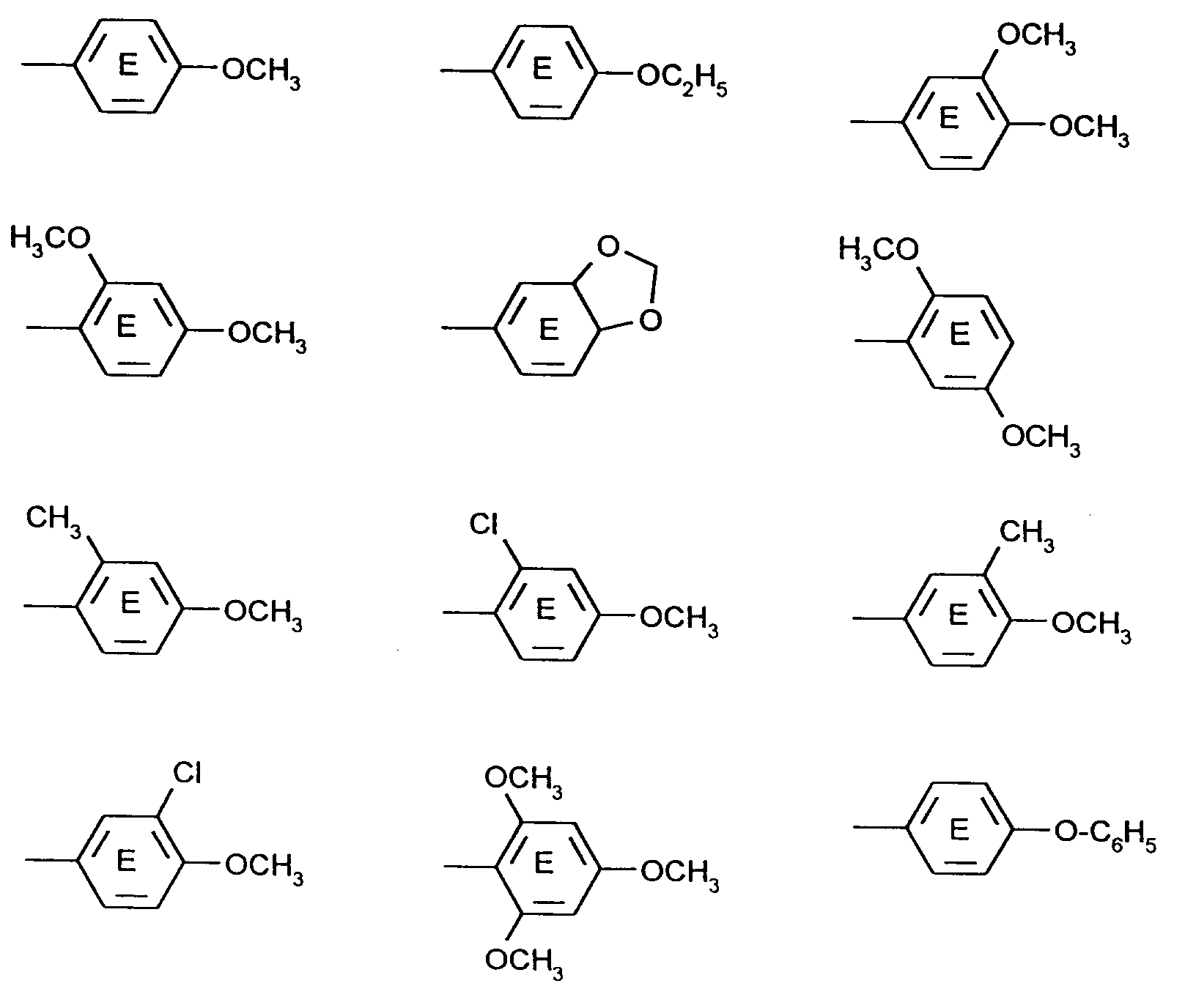


In einer weiterhin besonders bevorzugten Ausführungsform kommen Farbstoffe der Formel (II) zum Einsatz, worin - R₃ und R₄
- zusammen mit dem C-Atom, an das sie gebunden sind, den Rest eines gegebenenfalls ein- oder zweifach benzanellierten und/oder weitersubstituierten Pyrrols, Thiazols, Oxazols, Imidazols, Pyridins, Pyrans oder Pyrimidins bilden, und der Ring A wie oben substituiert sein kann und R₂ die obige Bedeutung besitzt.
- Ebenfalls ganz besonders bevorzugt werden dabei Farbstoffe der Formel (IV) eingesetzt,

worin
der Ring A in der obige Weise substituiert sein kann, - R₂
- die obige Bedeutung hat, vorzugsweise für H steht,
- R₅, R₆
- unabhängig voneinander für C₁-C₄-Alkyl, vorzugsweise für CH₃, C₂H₅ oder C₃H₇ stehen oder gemeinsam zusammen mit dem C-Atom, an das sie gebunden sind, einen gegebenenfalls substituierten carbocyclischen 5- oder 6-Ring bilden, vorzugsweise zusammen eine Tetra- oder Penta-Methylengruppe bilden,
- R₇
- eine unsubstituierte oder durch Phenyl, Cl, OH, CN, C₁-C₆-Alkoxycarbonyl, C₁-C₆-Alkoxy, Di-(C₁-C₄)-alkylamino oder Acyloxy substituierte C₁-C₄-Alkylgruppe bedeutet und
- R₈, R₉
- gemeinsam zusammen mit den C-Atomen, an die sie gebunden sind, einen unsubstituierten oder substituierten Benzol- oder Naphthalinring bilden, wobei als bevorzugte Substituenten Cl, C₁-C₄-Alkyl, C₁-C₄-Alkoxycarbonyl und C₁-C₄-Alkoxy zu nennen sind.
- Geeignete Reste der Formel

sind beispielsweise:
In einer anderen Ausführungsform des Verfahrens werden Farbstoffe der Formel (I) verwendet, worin n = 2 bedeutet und
R₀ für eine direkte Bindung oder einen unsubstituierten oder substituierten C₆-C₁₀-Arylenrest, vorzugsweise Phenylen oder Naphthylen, insbesondere 1,4-Phenylen, steht, wobei als mögliche Substituenten vorzugsweise die unter R₃ genannten Bedeutungen in Frage kommen, der Arylenrest jedoch insbesondere unsubstituiert ist, und
der Ring A in der oben angegebenen Weise substituiert sein kann. - In einer weiteren Ausführungsform des Verfahrens werden die oben beschriebenen Farbstoffe, insbesondere die der Formel (III) und (IV), bevorzugt verwendet, worin
- der Ring A
- einen in 3,4- oder 4,5-Stellung ankondensierten unsubstituierten oder substituierten Benzoring enthält, und/oder durch
- 0 bis 2
- voneinander unabhängigen C₁-C₆-Alkylgruppen oder Chloratome und/oder
- 0 bis 1
- C₁-C₄-Alkoxy- oder C₁-C₄-Alkoxycarbonylreste substituiert ist.
- Beispielhaft werden die nachfolgenden geeigneten Substitutionen an Ring A dargestellt:


Farbstoffe der Formel (I) sind zum Teil schon bekannt, z.B. aus US 4 304 908; GB 1 392 499; Zh. Obshchei khimi, Vol. 35, No. 7 (1965), engl. Transl. S. 1282-1285; Heterocycles 21, S. 719 (1984). - Weiterer Gegenstand der Erfindung ist ein Verfahren zur Herstellung der Farbstoffe der Formel (I), dadurch gekennzeichnet, daß man
- a) Verbindungen der Formel

mit Verbindungen der Formel
Ro-CH=Y (E5),
in welcher- Ro
- für n = 1 oder 2 die obigen Bedeutungen besitzt und
- Y
- für O, (C₆-C₁₀-Aryl)N, insbesondere Phenyl-N, (C₁-C₄-Alkyl)₂N⊕, insbesondere (CH₃)₂N⊕, (C₆-C₁₀-Aryl)(C₁-C₅-Acyl)N⊕, insbesondere (Phenyl)(CH₃CO)N⊕ oder (C₆-C₁₀-Aryl)(C₁-C₅-Alkyl)N⊕, insbesondere (Phenyl)(CH₃)N⊕ steht,
- b) Verbindungen der Formel

- Z
- für OH, O(C₁-C₄-Alkyl), insbesondere -OCH₃, O(C₁-C₅-Acyl), insbesondere O-CO-CH₃, Cl, Br, (C₁-C₄-Alkyl)₂N, insbesondere (CH₃)₂N, (C₆-C₁₀-Aryl)NH, insbesondere Phenyl-NH, (C₆-C₁₀-Aryl)(C₁-C₄-Alkyl)N, insbesondere (Phenyl)(CH₃)N, (C₆-C₁₀-Aryl)(C₁-C₅-Acyl)N, insbesondere (Phenyl)(COCH₃)N, NH₂ oder (C₁-C₄-Alkyl)NH, insbesondere CH₃NH steht, und R₂ und R₃ die unter a) genannte Bedeutung haben,
Ro-H (E7)
unter Abspaltung von ZH gegebenenfalls in einem Lösungsmittel oder einer Schmelze bei einer Temperatur von 0 bis 250°C umsetzt. Vorteilhaft ist es auch hier, einen Katalysator zuzusetzen und ZH zu binden. - Die Farbstoffe der Formel (I) fallen isomerenrein oder in Form von Isomerenmischungen an und können in jedem Falle für das erfindungsgemäße Verfahren zum Massefärben verwendet werden.
- Bevorzugt wird nach der Herstellungsvariante a) unter Verwendung der Verbindung (E1) oder (E2) verfahren.
- Allgemein als Lösungsmittel für die beiden genannten Verfahrensvarianten eignen sich Alkohole wie z.B. Ethanol, Methanol, Propanole, Butanole usw., Carbonsäuren wie z.B. Ameisensäure, Essigsäure, Propionsäure usw., Ester, z.B. Ethylacetat, polare aprotische Lösungsmittel, z.B. Dimethylformamid, N-Methylpyrrolidon, Dimethylacetamid, Dimethylsulfoxid usw., Aromaten, z.B. Benzol, Toluol, Xylole, Chlor-, Dichlor-, Trichlorbenzol usw., Ether, z.B. Tetrahydrofuran, Dioxan, Methyl-t-butylether usw., Glykole und deren Ether, z.B. Mono-, Di-, Tri-, Tetraethylenglykol, Propylenglykol, deren Methyl-, Ethyl-, Butyl-ether usw., Halogenaliphaten, z.B. Dichlormethan, Dichlorethan, Chloroform, Phenole, Kresole, Nitrobenzol u.a.
- Als Katalysatoren kommen saure wie basische in Frage.
- Als saure Katalysatoren seien genannt: Carbonsäuren, z.B. Essigsäure, Propionsäure, Chloressigsäure, Benzoesäure usw., Sulfonsäuren, z.B. Toluolsulfonsäure, Methansulfonsäure usw., anorganische Säuren wie z.B. Schwefel-, Salz-, Phosphor-, Bromwasserstoffsäure usw., Zinkchlorid, Aluminiumchlorid, Bortrifluorid usw.
- Basische geeignete Katalysatoren sind beispielsweise: organische Basen, z.B. Amine wie Triethylamin, Dialkylamine, Piperidin, Pyrrolidin, Morpholin, N,N-Dimethylanilin usw., Alkoholate, z.B. Natriummethylat, Kalium-t-butylat usw., Carbonsäuresalze, z.B. Natrium- oder Kaliumacetat usw., Alkali- oder Erdalkalioxide, -hydroxide oder -carbonate z.B. Natrium-, Kaliumhydroxid, Calciumoxid, Magnesiumoxid, Natriumcarbonat, Kaliumcarbonat, Natriumhydrogencarbonat, Ammoniak, Tetrabutylammoniumhydroxid usw.
- Geeignete Kondensationsmittel sind z.B. Säureanhydride wie Acetanhydrid, Propionsäureanhydrid usw., Säurechloride wie Acetyl-, Propionyl- oder Phosphorylchlorid usw.
- Als Umsetzungstemperatur für die unter a) bzw. b) beschriebenen Herstellungsverfahren kommt der Bereich von 0 bis 250°C in Frage, vorzugsweise zwischen 15 und 220°C.
- Die bereits bekannten Farbstoffe der Formel (I) können in Analogie zum erfindungsgemäßen Verfahren hergestellt werden.
- Unter Massefärben werden hierbei insbesondere Verfahren verstanden, bei denen der Farbstoff in die geschmolzene Kunststoffmasse eingearbeitet wird, z.B. unter Zuhilfenahme eines Extruders, oder bei dem der Farbstoff bereits Ausgangskomponenten zur Herstellung des Kunststoffes, z.B. Monomeren vor der Polymerisation, zugesetzt wird.
- Besonders bevorzugte Kunststoffe sind Thermoplaste, beispielsweise Vinylpolymere, Polyester und Polyamide.
- Geeignete Vinylpolymere sind Polystyrol, Styrol-Acrylnitril-Copolymere, Styrol-Butadien-Copolymere, Styrol-Butadien-Acrylnitril-Terpolymere, Polymethacrylat u.a..
- Weiterhin geeignete Polyester sind: Polyethylenterephthalate, Polycarbonate und Celluloseester.
- Bevorzugt sind Polystyrol, Styrol-Mischpolymere, Polycarbonate und Polymethacrylat. Besonders bevorzugt ist Polystyrol.
- Ebenfalls eignen sich die erfindungsgemäßen Farbstoffe zum Färben von Duroplasten wie z.B. Phenolharzen, Harnstoffharzen, Melaminharzen, Formaldehydharzen, Epoxyharzen, Harzen aus ungesättigten Polyestern, Diallylphthalat u.a., von Lacken z.B. Nitrolacken sowie zum Färben von Ölen, Fetten, Wachsen, Kohlenwasserstoffen und ähnlichem, natürlicher oder synthetischer Herkunft.
- Hauptanwendungsgebiete neben der Kunststoffeinfärbung können somit z.B. Schuhcremes, Bohnermassen, Kerzen, Seifen, Treibstoffe, Schmier- und Heizöle, Druckfarben und Lacke, Bürobedarf, Rauchfarbstoffe usw. sein.
- Die erwähnten hochmolekularen Verbindungen können einzeln oder in Gemischen, als plastische Massen oder Schmelzen vorliegen.
- Die erfindungsgemäßen Farbstoffe werden in feinverteilter Form zur Anwendung gebracht, wobei Dispergiermittel mitverwendet werden können aber nicht müssen.
- Werden die Farbstoffe (I) nach der Polymerisation eingesetzt, so werden sie mit dem Kunststoffgranulat trocken vermischt oder vermahlen und dieses Gemisch z.B. auf Mischwalzen oder in Schnecken plastifiziert und homogenisiert. Man kann die Farbstoffe aber auch der schmelzflüssigen Masse zugeben und diese durch Rühren homogen verteilen. Das derart vorgefärbte Material wird dann wie üblich z.B. durch Verspinnen zu Borsten, Fäden usw. oder durch Extrusion oder im Spritzguß-Verfahren zu Formteilen weiterverarbeitet.
- Da die Farbstoffe der Formel (I) gegenüber Polymerisationskatalysatoren, insbesondere Peroxiden, beständig sind, ist es auch möglich, die Farbstoffe den monomeren Ausgangsmaterialien für die Kunststoffe zuzusetzen und dann in Gegenwart von Polymerisationskatalysatoren zu polymerisieren. Dazu werden die Farbstoffe vorzugsweise in den monomeren Komponenten gelöst oder mit ihnen innig vermischt.
- Die Farbstoffe der Formel (I) werden vorzugsweise zum Färben der genannten Polymeren in Mengen von 0,0001 bis 1 Gew.-%, insbesondere 0,01 bis 0,5 Gew.-%, bezogen auf die Polymermenge, eingesetzt.
- Durch Zusatz von in den Polymeren unlöslichen Pigmenten, wie z.B. Titandioxid, können entsprechende wertvolle gedeckte Färbungen erhalten werden.
- Titandioxid kann in einer Menge von 0,01 bis 10 Gew.-%, vorzugsweise 0,1 bis 5 Gew.-%, bezogen auf die Polymermenge, verwendet werden.
- Nach dem erfindungsgemäßen Verfahren erhält man transparente bzw. gedeckte brillante, grünstichig gelbe bis violette Färbungen mit guter Hitzebeständigkeit sowie guter Licht- und Wetterechtheit.
- In das erfindungsgemäße Verfahren können auch Mischungen verschiedener Farbstoffe der Formel (I) und/oder Mischungen von Farbstoffen der Formel (I) mit anderen Farbstoffen und/oder anorganischen bzw. organischen Pigmenten eingesetzt werden.
- Die folgenden Beispiele dienen zur Erläuterung der vorliegenden Erfindung, ohne sie jedoch einzuschränken.
- "Teile" sind als Gewichtsteile zu verstehen, soweit nicht anders angegeben.
- Die in den Beispielen verwendeten Abkürzungen bedeuten:
Me = Methyl
Et = Ethyl
Ph = Phenyl -

- Eine Mischung aus 2,0 g (2-Benzimidazolylmercapto)essigsäure der Formel

und 1,5 g 4-Dimethylaminobenzaldehyd wird in 18,5 ml Acetanhydrid und 15 ml Essigsäure für 30 Minuten auf 90°C erhitzt. Anschließend saugt man den gebildeten Niederschlag warm ab und wäscht mit Methanol nach. Nach dem Trocknen erhält man 2,4 g des Produktes der obigen Formel. λmax = 442 nm (ε = 52.000) [CH₂Cl₂] - 100 Teile Polystyrol-Granulat und 0,02 Teile eines Farbstoffes der obigen Formel werden im Trommelmischer während 15 Minuten intensiv vermischt. Das trocken angefärbte Granulat wird bei 240°C auf einer Schneckenspritzgießmaschine verarbeitet. Man erhält transparente, gelbe Platten von sehr guter Lichtechtheit. Anstelle von Polystyrol-Polymerisat können auch Mischpolymerisate mit Butadien und Acrylnitril verwendet werden. Setzt man zusätzlich 0,5 Teile Titandioxid zu, so erhält man farbstarke gedeckte Färbungen.
- 0,015 Teile des Farbstoffes aus Beispiel A) und 100 Teile Polymethylmethacrylat werden trocken vermischt und auf einem 1-Wellenextruder bei 230°C homogenisiert. Das als Strang aus dem Extruder austretende Material wird granuliert. Es kann anschließend zu Formen verpreßt werden. Man erhält einen transparent gelb gefärbten Kunststoff mit guter Licht- und Wetterechtheit.
- 100 Teile eines handelsüblichen Polycarbonats werden in Form von Granulat mit 0,03 Teilen des Farbstoffes aus Beispiel A) trocken gemischt. Das so bestäubte Granulat wird auf einem 2-Wellenextruder bei 290°C homogenisiert. Man erhält eine transparente gelbe Färbung von guter Lichtechtheit. Das gefärbte Polycarbonat wird als Strang aus dem Extruder ausgetragen und zu Granulat verarbeitet. Das Granulat kann nach den üblichen Methoden der Konfektionierung thermoplastischer Massen verarbeitet werden.
- Arbeitet man wie oben beschrieben, aber unter Zusatz von 1 % Titandioxid, so erhält man eine gelbe gedeckte Färbung.
- Mit 100 Teilen Styrol-Acrylnitril-Copolymerisat werden 0,04 Teile des Farbstoffes aus Beispiel A) trocken vermischt und in einem 2-Wellenextruder bei 190°C homogenisiert, granuliert und dann zu Formen auf übliche Weise verpreßt. Man erhält einen transparentgelben Kunststoff von guter Lichtechtheit.
- 0,025 Teile des Farbstoffes aus Beispiel A) werden mit 100 Teilen Polyethylenterephthalat einer transparenten Type vermischt und in einem 2-Wellenextruder bei 280°C homogenisiert. Man erhält eine transparente, gelbe Färbung mit guter Lichtechtheit. Nach anschließender Granulierung kann der eingefärbte Kunststoff nach den üblichen Methoden der thermoplastischen Verformung verarbeitet werden. Arbeitet man unter Zusatz von 1 % Titandioxid, so erhält man eine gedeckte Färbung.
- In 98,9 Teilen Styrol werden 0,05 Teile tert.-Dodecylmercaptan sowie 0,05 Teile des Farbstoffes aus Beispiel A) gelöst. Diese Lösung dispergiert man in einer Lösung aus 200 Teilen entsalztem Wasser, 0,3 Teilen teilverseiftem Polyvinylacetat (z.B. Mowiol® 50/88 der Fa. Hoechst) und 0,05 Teilen Dodecylbenzolsulfonat. Nach Zugabe von 0,1 Teilen Dibenzoylperoxid in 1 Teil Styrol wird die Dispersion unter kräftigem Rühren auf 80°C erhitzt und die Polymerisation gestartet. Bei Anwendung folgender Polymerisationsbedingungen: 4 h bei 80°C, 2 h bei 90°C, 3 h bei 110°C, 2 h bei 130°C, erhält man das Polymerisat in einer Ausbeute von 98 % der Theorie. Das Polymerisat fällt in Form von Perlen an, die je nach Rührbedingungen einen Durchmesser von 0,1 bis 1,5 mm (D₅₀-Wert) aufweisen. Das Polymerisat wird durch Filtration von Serum getrennt, bei 110°C auf eine Restfeuchte von 0,5 % getrocknet. Nach dem Aufschmelzen in einem Mischaggregat (Heißwalze) werden 0,5 % Zinkstearat und 0,2 % Ionol zugemischt und das Polymerisat granuliert.
- Das Polymerisat kann nach den üblichen Methoden der thermoplastischen Verformung, z.B. im Spritzguß-Verfahren, zu gelben, transparenten Formteilen verarbeitet werden.
- In 74,8 Teilen Styrol und 25 Teilen Acrylnitril werden 0,2 Teile tert.-Dodecylmercaptan sowie 0,01 Teile des Farbstoffes aus Beispiel A) gelöst, welche anschließend in einer Lösung aus 200 Teilen vollentsalztem Wasser und 0,2 Teilen eines mit Natriumhydroxid neutralisierten Copolymerisats von Styrol und Maleinsäureanhydrid dispergiert wird. Nach Zusatz von 0,1 Teilen Dibenzoylperoxid, gelöst in einem Teil Styrol, wird die Dispersion unter kräftigem Rühren auf 80°C erhitzt und die Polymerisation gestartet. Nach der Polymerisation wie im Beispiel f) wird auch in gleicher Weise, wie im Beispiel angegeben, aufgearbeitet. Als Schmiermittel wird 0,5 % Zinkstearat und als Alterungsschutzmittel 0,5 % Ionol auf der Heißwalze eingearbeitet. Das granulierte Polymerisat läßt sich zu transparenten gelben Formteilen verspritzt.
- In einem kontinuierlich arbeitenden, überflutet gefahrenen Vorreaktor wird eine Lösung aus 99,95 Teilen Styrol, 0,04 Teilen des Farbstoffes aus Beispiel A) und 0,01 Teilen Di-tert.-butylperoxid eingefahren und bei einer Temperatur von 75°C anpolymerisiert. Die aus dem Vorreaktor austretende, anpolymerisierte Lösung (Polystyrol-Gehalt 20 %) wird in einem 2-Wellenschneckenaggregat eingeführt. Die beiden Wellen laufen mit 20 Upm gegenläufig. Die vier heiz- bzw. kühlbaren Segmente der Schneckenmaschine werden in der Reihenfolge Produkteintritt - Produktaustritt auf 110°C, 130°C, 160°C, 180°C gehalten. Das Polymerisat verläßt den Schneckenreaktor mit einer Feststoffkonzentration von 80 %. In einem nachgeschalteten Extruder werden 3 Gew.-Teile Ionol und 5 Gew.-Teile Octylalkohol pro 1000 Gew.-Teile Polymerlösung zudosiert, das Polymerisat entgast und anschließend granuliert. Das gelb gefärbte Granulat kann zu Formteilen verarbeitet werden.
- 0,02 Teile des Farbstoffes aus Beispiel A) werden in 74,97 Teilen Styrol und 25 Teilen Acrylnitril bzw. Methacrylnitril gelöst. Nach Zugabe von 0,01 Teilen Di-tert.-butylperoxid wird die so erhaltene Lösung in einem kontinuierlich arbeitenden, überflutet gefahrenen Vorreaktor eingefahren. Die Polymerisation und Aufarbeitung erfolgt wie im Beispiel h) angegeben. Das transparente, gelbe Granulat kann nach den üblichen Methoden der Verarbeitung thermoplastischer Massen zu Profilen und Platten weiterverarbeitet werden.
- In 99,97 Teilen Methylmethacrylat werden 0,03 Teile des Farbstoffes aus Beispiel A) gelöst. Nach Zugabe von 0,1 Teilen Dibenzoylperoxid wird die Lösung auf 120°C erhitzt und die Polymerisation gestartet. Nach 30 Minuten wird das anpolymerisierte Methylmethacrylat zwischen zwei Glasplatten bei 80°C während 10 Stunden auspolymerisiert. Man erhält gelbe, transparente Polymethylmethacrylat-Platten.
- 100 Teile Polyamid-6-Schnitzel, erhalten durch Polymerisation von ε-Caprolactam, werden mit 0,05 Teilen des Farbstoffes aus Beispiel A) in einer Schüttelmaschine innig vermischt. Die so erhaltenen gepuderten Schnitzel werden bei 260°C in einem Extruder aufgeschmolzen, die erhaltene Schmelze durch eine Einloch-Düse vom Durchmesser 0,5 mm gepreßt und der austretende Faden mit einer Geschwindigkeit von ca. 25 m/Min. abgezogen. Der Faden läßt sich in heißem Wasser auf das 4-fache verstrecken. Erhalten wird ein transparent gelb gefärbter Faden von ausgezeichneter Lichtechtheit. Will man eine gedeckte Färbung erhalten, so gibt man zusätzlich 0,5 Teile Titandioxid zu.
- Die Verweilzeit im Extruder kann ohne Beeinträchtigung des Farbtons bis zu 30 Minuten betragen.
- In eine Schmelze von 90 Teilen Paraffin und 10 Teilen Stearin werden bei 150°C 0,015 Teile des Farbstoffes der obigen Formel eingetragen und 1 Stunde verrührt. Aus der Masse lassen sich nach üblichen Verfahren Kerzen gießen, die intensiv gelb gefärbt sind.
- Analog zu dieser Methode, aber unter Verwendung von 0,1 Teilen Farbstoff, lassen sich Schmelzen erhalten, die für die Tauchfärbung von Kerzen verwendbar sind.
-

- Eine Mischung aus 2,0 g (2-Benzimidazolylmercapto)essigsäure, 1,9 g 4-Diethylamino-2-methylbenzaldehyd, 12,5 ml Acetanhydrid und 10,0 ml Essigsäure wird 45 Minuten auf 100°C erhitzt. Anschließend kühlt man ab, saugt den gebildeten Niederschlag ab, wäscht mit Eisessig und Methanol nach und trocknet bei 50°C im Vakuum. Ausbeute: 2,7 g.
λmax = 459 nm (ε = 47.600) [CH₂Cl₂]
Der Farbstoff ergibt, analog zu den Färbebeispielen 1B) gefärbt, kräftige Gelbtöne mit gutem Echtheitsniveau. -
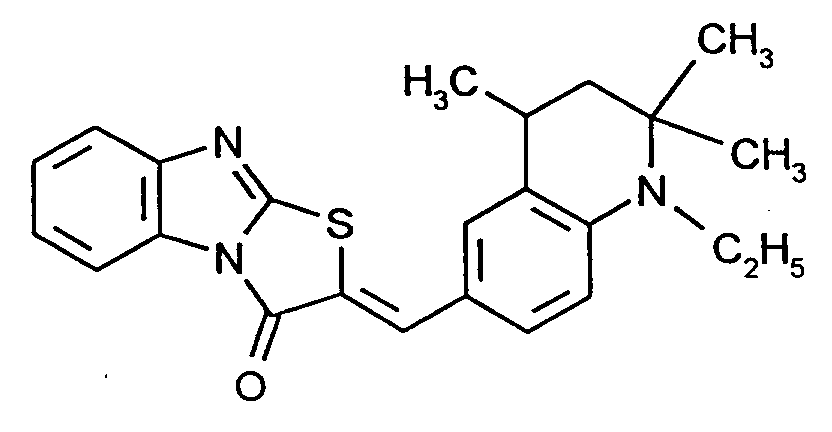
- 2,0 g (2-Benzimidazolylmercapto)essigsäure, 2,3 g eines Aldehydes der Formel
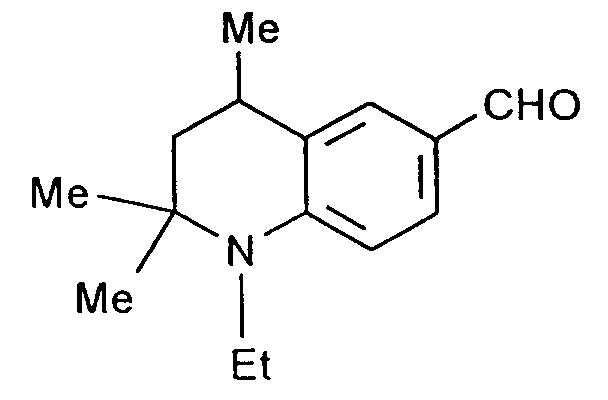
12,5 ml Acetanhydrid und 10 ml Essigsäure werden analog zu Beispiel 2 umgesetzt. Ausbeute: 3,0 g.
λmax = 461 nm (ε = 56.700) [CH₂Cl₂]
Analog zu den Färbebeispielen 1B) gefärbt erhält man intensive gelbe Ausfärbungen. - Beispiel 4

- Eine Mischung aus 2,0 g (2-Benzimidazolylmercapto)essigsäure, 3,7 g eines Aldehydes der Formel

12,5 ml Acetanhydrid und 10 ml Essigsäure wird 1 Stunde unter Rückfluß erhitzt. Nach dem Abkühlen wird der Niederschlag abgesaugt, mit Eisessig und Methanol gewaschen und getrocknet. Nach Umkristallisierung aus Toluol erhält man 3,1 g des Farbstoffes der obigen Formel, der gemäß den Färbebeispielen 1B) intensive Gelbtöne liefert.
λmax = 447 nm (ε = 44.600) [CH₂Cl₂] -

- 2,0 g (2-Benzimidazolylmercapto)essigsäure und 2,9 g 4-Dimethylaminonaphthalin-1-aldehyd werden in 12,5 ml Acetanhydrid und 10 ml Essigsäure 1 Stunde unter Rückfluß erhitzt. Der Niederschlag wird abgesaugt und mit Eisessig und Methanol gewaschen. Ausbeute: 2,3 g.
λmax = 434 nm (ε = 25.200) [CH₂Cl₂]
Der Farbstoff liefert entsprechend den Bespielen 1B) gefärbt Gelbtöne mit guten Echtheiten. -

- 21 g (2-Benzimidazolylmercapto)essigsäure, 17,7 g 4-Diethylaminobenzaldehyd, 10 g Natriumacetat und 200 ml Acetanhydrid werden 2 Stunden unter Rückfluß erhitzt, auf 70°C abgekühlt, dann 500 ml Methanol zugetropft und die Mischung anschließend auf 25°C abgekühlt. Das Produkt wird abgesaugt, mit Methanol gewaschen und getrocknet. Ausbeute: 10,6 g
λmax = 448 nm (ε = 52.900) [CH₂Cl₂]
Entsprechend der Färbebeispiele 1B) gefärbt liefert der Farbstoff intensive Gelbtöne. -

- Eine Mischung aus 21 g (2-Benzimidazolylmercapto)essigsäure, 6,7 g 1,4-Formylbenzol, 10 g Natriumacetat und 200 ml Acetanhydrid wird 2 Stunden unter Rückfluß erhitzt. Anschließend kühlt man ab und verdünnt langsam mit 500 ml Methanol. Der Niederschlag wird abgesaugt, mit Methanol gewaschen und getrocknet. Ausbeute: 16,4 g. Die Reinigung kann durch Auskochen mit DMF erfolgen. Analog zu den Färbebeispielen 1B) gefärbt erhält man intensive, gelbe Ausfärbungen.
-

- Eine Mischung aus 21 g (2-Benzimidazolylmercapto)essigsäure, 20 g 4-(N-β-Cyanethyl-N-methylamino)benzaldehyd, 10 g Natriumacetat und 150 ml Essigsäureanhydrid wird 4 Stunden zum Sieden erhitzt. Anschließend tropft man 400 ml Methanol zu, kühlt ab und isoliert das Produkt durch Filtration. Nach dem Umkristallisieren aus DMF erhält man 13,2 g.
λmax = 432 nm (ε = 43.000)
Gemäß den Färbebeispielen 1B) ausgefärbt führt der Farbstoff zu gelben Produkten. -

- Eine Mischung aus 2,0 g (2-Benzimidazolylmercapto)essigsäure, 3,0 g eines Aldehydes der Formel
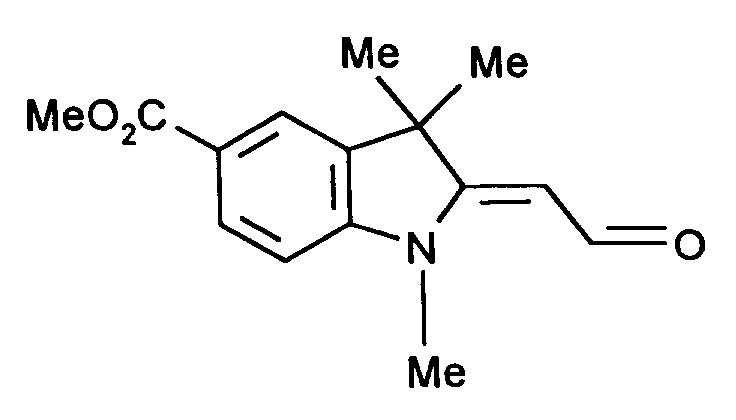
12,5 ml Acetanhydrid und 10 ml Essigsäure wird 30 Minuten auf 90°C erhitzt. Der gebildete Niederschlag wird bei 70°C abgesaugt, mit Eisessig und Methanol gewaschen und getrocknet. Ausbeute 2,8 g
λmax = 468 nm (ε = 68.800) [CH₂Cl₂]
Entsprechend den Färbebeispielen 1B) gefärbt liefert der Farbstoff kräftige Gelbtöne. -

- Eine Lösung aus 2,0 g (2-Benzimidazolyl-mercapto-)essigsäure, 2,4 g 4-(N-Benzyl-N-Ethyl-amino)benzaldehyd, 12,5 ml Essigsäureanhydrid und 10 ml Essigsäure wird 30 min auf 90°C erhitzt, wobei das Produkt ausfällt. Man verdünnt mit weiteren 10 ml Essigsäure und saugt den Farbstoff bei Raumtemperatur ab. Nach dem Waschen mit Essigsäure und Methanol erhält man 2,7 g des Farbstoffes der obigen Formel, der in Kunststoffen analog zu den Beispielen 1B) eingearbeitet, intensive Gelbtöne liefert.
λmax = 443 nm (ε = 53.500) [CH₂Cl₂] -
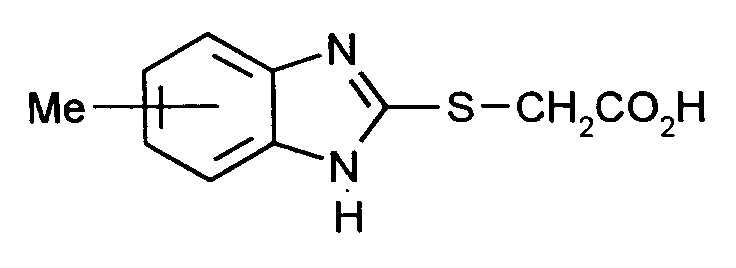
- Zu einer Lösung von 94 g Natriumhydroxid in 11 Wasser werden bei 50°C 16 kg x-Methyl-2-mercaptobenzimidazol, das eine Mischung der Verbindungen der Formeln

darstellt, gegeben und danach langsam (exotherm!) 100 g Chloressigsäure. Anschließend erhitzt man 30 min unter Rückfluß, kühlt auf Raumtemperatur ab und fällt das Produkt mit 150 ml konzentrierter Salzsäure. Man verdünnt mit 500 ml Wasser und saugt das Produkt ab. Nach der Wäsche mit Wasser und Trocknung im Vakuum bei 80°C erhält man 172 g des Zwischenprodukts der obigen Formel. -

- 4,44 g der Verbindung aus Beispiel 11 und 2,98 g 4-Dimethylaminobenzaldehyd werden 30 min bei 90°C in einer Eisessig/Acetanhydrid-Mischung (20 ml/25 ml) kondensiert. Der Farbstoff wird bei 80°C abgesaugt und mit Eisessig und Methanol gewaschen. Zur Reinigung kann man das Rohprodukt in 400 ml Methylenchlorid lösen, die Lösung mit 4 g Kieselgel verrühren, filtrieren und das Filtrat am Rotavapor eindampfen.
Ausbeute: 9,0 g.
λmax = 441 nm (ε = 48.200) [CH₂Cl₂]
Entsprechend den Färbebeispielen 1B) liefert dieses Produkt intensive brillante gelbe Färbungen in den angegebenen Medien. -

- Analog zu Beispiel 13 erhält man unter Einsatz von 3,5 kg 4-Diethylaminobenzaldehyd 3,1 g des Farbstoffes der obigen Formel.
λmax = 450 nm (ε = 55.100) [CH₂Cl₂].
Der Farbstoff färbt Kunststoffe analog zu den Beispielen 1B) kräftig gelb und besitzt ein gutes Echtheitsniveau. -

- Entsprechend der Darstellungsmethode aus Beispiel 12 erhält man unter Verwendung von 3,8 g 4-(N,N-Diethylamino)2-methylbenzaldehyd 2,1 g der Verbindung der obigen Formel, welche in Kunststoffen analog zu den Beispielen 1B) intensive Gelbtöne liefert.
λmax = 457 nm (ε = 48.400) [CH₂Cl₂] -

- Analog zu Beispiel 12) unter Einsatz von 4,78 g 4-(N-Ethyl-N-benzylamino)benzaldehyd erhält man 4,7 g von diesem Farbstoff.
λmax = 443 nm (ε = 52.100) [CH₂Cl₂]
In Kunststoffen eingearbeitet nach den Methoden der Beispiele 1B) liefert der Farbstoff Gelbtöne mit hoher Farbstärke und guten Echtheiten. -

- Die Darstellung erfolgt analog zu Beispiel 12), wobei 3,62 g des Aldehydes aus Beispiel 3) eingesetzt werden.
Ausbeute: 3,3 g.
λmax = 460 nm (ε = 56.800) [CH₂Cl₂]
Der Farbstoff färbt Kunststoffe in echten Gelbtönen mit hoher Farbstärke und Brillanz.
Claims (7)
- Verfahren zum Massefärben von Kunststoffen mit Farbstoffen der Formel (I)
 n 1 oder 2, vorzugsweise 1 bedeutet,Ro für n = 1, Aryl, Hetaryl oder Heterocyclylidenmethyl,
für n = 2, eine direkte Bindung oder Arylen bedeutet undder Ring A unsubstituiert oder durch C₁-C₄-Alkyl, C₅-C₈-Cycloalkyl, C₆-C₁₀-Aryl, C₁-C₄-Alkyloxy, C₆-C₁₀-Aryloxy, C₆-C₁₀-Aryl- oder C₁-C₄-Alkylsulfonyl, Cyano, Halogen, insbesondere Chlor oder Brom, einen Rest der Formel -COR₁, worin R₁ für C₁-C₄-Alkoxy, Amino, C₁-C₄-Alkylamino, Di-C₁-C₄-alkylamino, C₆-C₁₀-Arylamino, C₁-C₄-Alkyl oder C₆-C₁₀-Aryl steht, substituiert ist oder einen ankondensierten aromatischen oder cycloaliphatischen Ring enthält. - Verfahren gemäß Anspruch 1 mit Farbstoffen der Formel (I), die der Formel (II) entsprechen
 R₂ und R₄ zusammen mit den C-Atomen, an die sie gebunden sind, einen unsubstituierten oder substituierten C₆-C₁₀-aromatischen, insbesondere Phenyl- oder Naphthyl-, oder heteroaromatischen, insbesondere einen gegebenenfalls ein- oder zweifach benzanellierten Thiophen-, Furan-, Pyrrol-, Thiazol-, Oxazol-, Imidazol-, Pyridin-, Pyran- oder Pyrimidin-Rest bilden undR₃ für H, C₁-C₄-Alkyl, Halogen, insbesondere Cl und Br, OH, C₁-C₆-Alkoxy, Acyloxy, C₆-C₁₀-Aryloxy, C₁-C₆-Alkylthio, heterocyclisches 5- bis 7-gliedriges Amin, C₆-C₁₀-Arylthio, Di-C₁-C₆-alkylamino oder Acylamino steht, wobei die möglichen Substituenten an dem durch R₂ und R₄ gebildeten Ring vorzugsweise die Bedeutung von R₃ besitzen oderR₃ und R₄ zusammen mit dem C-Atom, an das sie gebunden sind, den Rest eines unsubstituierten oder substituierten heterocyclischen Rings bilden, wobei die möglichen Substituenten vorzugsweise die Bedeutung von R₃ besitzen oder denen des Rings A entsprechen,R₂ für H oder C₁-C₆-Alkyl steht undder Ring A unsubstituiert oder in der nach Anspruch 1 angegebenen Weise substituiert ist.
 - Verfahren gemäß Anspruch 1 mit Farbstoffen der Formel (I), die der Formel (III) entsprechen

der Ring A unsubstituiert oder in der nach Anspruch 1 genannten Weise substituiert ist,
und der Ring E unsubstituiert oder mit C₁-C₆-Alkyl, Halogen, insbesondere F, Cl und Br, OH, C₁-C₆-Alkoxy, C₆-C₁₀-Aryloxy, C₅-C₈-Cycloalkyl, Acyloxy, Di-C₁-C₆-alkylamino, heterocyclisches 5- bis 7-gliedriges Amin, Acylamino, C₁-C₆-Alkylthio oder Arylthio substituiert ist oder einen ankondensierten aromatischen, heterocyclischen oder aliphatischen 5- bis 7-gliedrigen Ring enthält. - Verfahren gemäß Anspruch 1 mit Farbstoffen der Formel (I), die der Formel (IV) entsprechen

der Ring A unsubstituiert oder in der nach Anspruch 1 genannten Weise substituiert ist,R₂ die obige Bedeutung vorzugsweise für H steht,R₅, R₆ unabhängig voneinander für C₁-C₄-Alkyl, vorzugsweise für CH₃, C₂H₅ oder C₃H₇ stehen oder gemeinsam zusammen mit dem C-Atom, an das sie gebunden sind, einen gegebenenfalls substituierten carbocyclischen 5- oder 6-Ring bilden, vorzugsweise zusammen eine Tetra- oder Penta-Methylengruppe bilden,R₇ eine unsubstituierte oder durch Phenyl, Cl, OH, CN, C₁-C₆-Alkoxycarbonyl, C₁-C₆-Alkoxy, Di-(C₁-C₄)-alkylamino oder Acyloxy substituierte C₁-C₄-Alkylgruppe bedeutet undR₈, R₉ zusammen mit den C-Atomen, an die sie gebunden sind, einen unsubstituierten oder substituierten Benzol- oder Naphthalinring bilden, wobei als bevorzugte Substituenten Cl, C₁-C₄-Alkyl, C₁-C₄-Alkoxycarbonyl und C₁-C₄-Alkoxy zu nennen sind. - Verfahren gemäß Anspruch 1 mit Farbstoffen der Formel (I), worin n = 2 bedeutet und R₀ für eine direkte Bindung oder einen unsubstituierten oder substituierten C₆-C₁₀-Arylenrest, vorzugsweise Phenylen oder Naphthylen, insbesondere 1,4-Phenylen steht.
- Verfahren gemäß Anspruch 1, dadurch gekennzeichnet, daß der Kunststoff ein Thermoplast ist, insbesondere ein Vinylpolymer, Polyester oder Polyamid.
- Kunststoffe, gefärbt nach wenigstens einem der Verfahren 1 bis 6.
Applications Claiming Priority (2)
| Application Number | Priority Date | Filing Date | Title |
|---|---|---|---|
| DE4433438A DE4433438A1 (de) | 1994-09-20 | 1994-09-20 | Massefärben von Kunststoffen |
| DE4433438 | 1994-09-20 |
Publications (1)
| Publication Number | Publication Date |
|---|---|
| EP0703270A2 true EP0703270A2 (de) | 1996-03-27 |
Family
ID=6528655
Family Applications (1)
| Application Number | Title | Priority Date | Filing Date |
|---|---|---|---|
| EP95114013A Withdrawn EP0703270A2 (de) | 1994-09-20 | 1995-09-07 | Massefärben von Kunststoffen |
Country Status (4)
| Country | Link |
|---|---|
| US (1) | US5582621A (de) |
| EP (1) | EP0703270A2 (de) |
| JP (1) | JPH08100376A (de) |
| DE (1) | DE4433438A1 (de) |
Families Citing this family (3)
| Publication number | Priority date | Publication date | Assignee | Title |
|---|---|---|---|---|
| US6200355B1 (en) | 1999-12-21 | 2001-03-13 | Basf Corporation | Methods for deep shade dyeing of textile articles containing melamine fibers |
| WO2010019746A2 (en) * | 2008-08-15 | 2010-02-18 | Invista Technologies S. Ar. L. | Flame retardant polymer composites, fibers, carpets, and methods of making each |
| EP3470469A1 (de) * | 2017-10-13 | 2019-04-17 | LANXESS Deutschland GmbH | Methinfarbstoffe |
Family Cites Families (4)
| Publication number | Priority date | Publication date | Assignee | Title |
|---|---|---|---|---|
| US3655670A (en) * | 1968-05-24 | 1972-04-11 | Hoechst Ag | 3-hydroxy - 4 - sulfone quinophthalone dyestuffs and process for making them |
| US3852683A (en) * | 1971-10-18 | 1974-12-03 | Eastman Kodak Co | Arylidene dye lasers |
| GB1392499A (en) * | 1972-07-26 | 1975-04-30 | Ilford Ltd | Merocyanine dyes |
| US4304908A (en) * | 1980-06-23 | 1981-12-08 | Eastman Kodak Company | Methine colorant materials and the use thereof in electrophoretic migration imaging layers and processes |
-
1994
- 1994-09-20 DE DE4433438A patent/DE4433438A1/de not_active Withdrawn
-
1995
- 1995-09-07 EP EP95114013A patent/EP0703270A2/de not_active Withdrawn
- 1995-09-13 US US08/527,473 patent/US5582621A/en not_active Expired - Fee Related
- 1995-09-18 JP JP7262005A patent/JPH08100376A/ja active Pending
Also Published As
| Publication number | Publication date |
|---|---|
| DE4433438A1 (de) | 1996-03-21 |
| JPH08100376A (ja) | 1996-04-16 |
| US5582621A (en) | 1996-12-10 |
Similar Documents
| Publication | Publication Date | Title |
|---|---|---|
| EP0632102B1 (de) | Massefärben von Kunststoffen | |
| EP0224445B1 (de) | Pyrrolo-pyrrol Pigmentpräparate, Verfahren zu deren Herstellung sowie ihre Verwendung | |
| EP0133156B1 (de) | Neue 1,4-Diketopyrrolo-(3,4-c)-pyrrole | |
| EP3470471B1 (de) | Methinfarbstoffe | |
| EP3508536B1 (de) | Methinfarbstoffe zum massefärben von synthetischen polyamiden | |
| EP3470467B1 (de) | Methinfarbstoffe zum färben von kunststoffen | |
| EP0683212A1 (de) | Neue Farbstoffe zum Massefärben von Kunststoffen | |
| JP2008239992A (ja) | 非対称のメチン染料を含有する混合物、およびこの混合物の使用 | |
| EP3470472A1 (de) | Neue methinfarbstoffe | |
| EP0639624A1 (de) | Phthaloperinonfarbstoffe | |
| EP0570800B1 (de) | Neue Perinonfarbstoffe zum Massefärben von Kunststoffen | |
| EP0673979A1 (de) | Cyaniminogruppen enthaltende Fluorreszenzfarbstoffe | |
| EP0703270A2 (de) | Massefärben von Kunststoffen | |
| US5922904A (en) | Bulk dyeing using quinophthalone dyestuffs | |
| EP0527383A2 (de) | Massefärben von Kunststoffen | |
| DE4340560A1 (de) | Massefärben von Kunststoffen | |
| EP2039728A2 (de) | Rote Farbstoffmischung | |
| EP0163609A2 (de) | Verfahren zum Färben von hochmolekularem organischem Material, neue polycyclische Verbindungen sowie deren Herstellung | |
| DE4321420A1 (de) | Massefärben von Kunststoffen | |
| DE4327855A1 (de) | Phthaloperinonfarbstoffe | |
| EP0477528B1 (de) | Piperazin-2,5-dion und Piperazin-2-on Derivate | |
| DE19641689A1 (de) | Verfahren zur Herstellung von 1,8-Diaminonaphthalinen und ihrer Derivate der 2,3-Dihydroperimidine | |
| WO2024110327A2 (de) | Thermostabile methinfarbstoffe | |
| DE102007044743A1 (de) | Rote Farbstoffmischung | |
| DE2315955A1 (de) | Neue benzoxazolylstilbene als optische aufhellmittel |
Legal Events
| Date | Code | Title | Description |
|---|---|---|---|
| PUAI | Public reference made under article 153(3) epc to a published international application that has entered the european phase |
Free format text: ORIGINAL CODE: 0009012 |
|
| AK | Designated contracting states |
Kind code of ref document: A2 Designated state(s): CH DE FR GB LI |
|
| STAA | Information on the status of an ep patent application or granted ep patent |
Free format text: STATUS: THE APPLICATION HAS BEEN WITHDRAWN |
|
| 18W | Application withdrawn |
Withdrawal date: 19970131 |