EP0703390B1 - Verfahren und Vorrichtung zur Trennung von Gaskomponenten durch Adsorption - Google Patents
Verfahren und Vorrichtung zur Trennung von Gaskomponenten durch Adsorption Download PDFInfo
- Publication number
- EP0703390B1 EP0703390B1 EP95870105A EP95870105A EP0703390B1 EP 0703390 B1 EP0703390 B1 EP 0703390B1 EP 95870105 A EP95870105 A EP 95870105A EP 95870105 A EP95870105 A EP 95870105A EP 0703390 B1 EP0703390 B1 EP 0703390B1
- Authority
- EP
- European Patent Office
- Prior art keywords
- adsorption
- belt
- desorption
- valve
- gases
- Prior art date
- Legal status (The legal status is an assumption and is not a legal conclusion. Google has not performed a legal analysis and makes no representation as to the accuracy of the status listed.)
- Expired - Lifetime
Links
- 238000001179 sorption measurement Methods 0.000 title claims abstract description 42
- 238000000034 method Methods 0.000 title claims description 16
- 238000003795 desorption Methods 0.000 claims abstract description 25
- 239000007789 gas Substances 0.000 claims description 36
- 239000000463 material Substances 0.000 claims description 27
- 239000003463 adsorbent Substances 0.000 claims description 11
- 238000010926 purge Methods 0.000 claims description 11
- 239000012528 membrane Substances 0.000 claims description 7
- 239000000203 mixture Substances 0.000 claims description 6
- 150000001875 compounds Chemical class 0.000 claims description 4
- 238000013022 venting Methods 0.000 claims 4
- QVGXLLKOCUKJST-UHFFFAOYSA-N atomic oxygen Chemical compound [O] QVGXLLKOCUKJST-UHFFFAOYSA-N 0.000 description 21
- 239000001301 oxygen Substances 0.000 description 21
- 229910052760 oxygen Inorganic materials 0.000 description 21
- IJGRMHOSHXDMSA-UHFFFAOYSA-N Atomic nitrogen Chemical compound N#N IJGRMHOSHXDMSA-UHFFFAOYSA-N 0.000 description 15
- 239000012530 fluid Substances 0.000 description 15
- 238000000926 separation method Methods 0.000 description 13
- 229910052757 nitrogen Inorganic materials 0.000 description 7
- 229910021536 Zeolite Inorganic materials 0.000 description 6
- HNPSIPDUKPIQMN-UHFFFAOYSA-N dioxosilane;oxo(oxoalumanyloxy)alumane Chemical compound O=[Si]=O.O=[Al]O[Al]=O HNPSIPDUKPIQMN-UHFFFAOYSA-N 0.000 description 6
- 239000010457 zeolite Substances 0.000 description 6
- 238000010586 diagram Methods 0.000 description 5
- 238000009434 installation Methods 0.000 description 5
- 238000004519 manufacturing process Methods 0.000 description 5
- 238000003860 storage Methods 0.000 description 5
- 238000013461 design Methods 0.000 description 4
- 238000007789 sealing Methods 0.000 description 4
- 239000004480 active ingredient Substances 0.000 description 3
- 238000011010 flushing procedure Methods 0.000 description 3
- 238000011084 recovery Methods 0.000 description 3
- CURLTUGMZLYLDI-UHFFFAOYSA-N Carbon dioxide Chemical compound O=C=O CURLTUGMZLYLDI-UHFFFAOYSA-N 0.000 description 2
- 230000007423 decrease Effects 0.000 description 2
- 238000001514 detection method Methods 0.000 description 2
- 238000009826 distribution Methods 0.000 description 2
- 238000002347 injection Methods 0.000 description 2
- 239000007924 injection Substances 0.000 description 2
- VNWKTOKETHGBQD-UHFFFAOYSA-N methane Chemical compound C VNWKTOKETHGBQD-UHFFFAOYSA-N 0.000 description 2
- 239000007787 solid Substances 0.000 description 2
- 239000000243 solution Substances 0.000 description 2
- 238000002336 sorption--desorption measurement Methods 0.000 description 2
- 229910001220 stainless steel Inorganic materials 0.000 description 2
- 239000010935 stainless steel Substances 0.000 description 2
- UFHFLCQGNIYNRP-UHFFFAOYSA-N Hydrogen Chemical compound [H][H] UFHFLCQGNIYNRP-UHFFFAOYSA-N 0.000 description 1
- 229920000271 Kevlar® Polymers 0.000 description 1
- 229910000831 Steel Inorganic materials 0.000 description 1
- 239000004809 Teflon Substances 0.000 description 1
- 229920006362 Teflon® Polymers 0.000 description 1
- 230000033228 biological regulation Effects 0.000 description 1
- 229910002092 carbon dioxide Inorganic materials 0.000 description 1
- 239000001569 carbon dioxide Substances 0.000 description 1
- 239000002131 composite material Substances 0.000 description 1
- 230000006835 compression Effects 0.000 description 1
- 238000007906 compression Methods 0.000 description 1
- 239000002826 coolant Substances 0.000 description 1
- 230000032798 delamination Effects 0.000 description 1
- 230000006866 deterioration Effects 0.000 description 1
- 238000011161 development Methods 0.000 description 1
- 229910001873 dinitrogen Inorganic materials 0.000 description 1
- 239000000428 dust Substances 0.000 description 1
- 238000005265 energy consumption Methods 0.000 description 1
- 239000004744 fabric Substances 0.000 description 1
- 210000001061 forehead Anatomy 0.000 description 1
- 239000004519 grease Substances 0.000 description 1
- 239000001257 hydrogen Substances 0.000 description 1
- 229910052739 hydrogen Inorganic materials 0.000 description 1
- 239000004761 kevlar Substances 0.000 description 1
- 239000007788 liquid Substances 0.000 description 1
- 239000000314 lubricant Substances 0.000 description 1
- 238000003754 machining Methods 0.000 description 1
- 238000012423 maintenance Methods 0.000 description 1
- 238000005259 measurement Methods 0.000 description 1
- 229910052751 metal Inorganic materials 0.000 description 1
- 239000002184 metal Substances 0.000 description 1
- 150000002739 metals Chemical class 0.000 description 1
- 238000012544 monitoring process Methods 0.000 description 1
- 239000003345 natural gas Substances 0.000 description 1
- 239000002245 particle Substances 0.000 description 1
- 229920000642 polymer Polymers 0.000 description 1
- 230000002040 relaxant effect Effects 0.000 description 1
- 229920005989 resin Polymers 0.000 description 1
- 239000011347 resin Substances 0.000 description 1
- 238000004088 simulation Methods 0.000 description 1
- 239000010959 steel Substances 0.000 description 1
- 239000000126 substance Substances 0.000 description 1
- 238000012546 transfer Methods 0.000 description 1
- 230000007704 transition Effects 0.000 description 1
- XLYOFNOQVPJJNP-UHFFFAOYSA-N water Substances O XLYOFNOQVPJJNP-UHFFFAOYSA-N 0.000 description 1
Images


Classifications
-
- F—MECHANICAL ENGINEERING; LIGHTING; HEATING; WEAPONS; BLASTING
- F16—ENGINEERING ELEMENTS AND UNITS; GENERAL MEASURES FOR PRODUCING AND MAINTAINING EFFECTIVE FUNCTIONING OF MACHINES OR INSTALLATIONS; THERMAL INSULATION IN GENERAL
- F16K—VALVES; TAPS; COCKS; ACTUATING-FLOATS; DEVICES FOR VENTING OR AERATING
- F16K11/00—Multiple-way valves, e.g. mixing valves; Pipe fittings incorporating such valves
- F16K11/02—Multiple-way valves, e.g. mixing valves; Pipe fittings incorporating such valves with all movable sealing faces moving as one unit
- F16K11/022—Multiple-way valves, e.g. mixing valves; Pipe fittings incorporating such valves with all movable sealing faces moving as one unit comprising a deformable member
-
- F—MECHANICAL ENGINEERING; LIGHTING; HEATING; WEAPONS; BLASTING
- F16—ENGINEERING ELEMENTS AND UNITS; GENERAL MEASURES FOR PRODUCING AND MAINTAINING EFFECTIVE FUNCTIONING OF MACHINES OR INSTALLATIONS; THERMAL INSULATION IN GENERAL
- F16K—VALVES; TAPS; COCKS; ACTUATING-FLOATS; DEVICES FOR VENTING OR AERATING
- F16K7/00—Diaphragm valves or cut-off apparatus, e.g. with a member deformed, but not moved bodily, to close the passage ; Pinch valves
- F16K7/18—Diaphragm valves or cut-off apparatus, e.g. with a member deformed, but not moved bodily, to close the passage ; Pinch valves with diaphragm secured at one side only, e.g. to be laid on the seat by rolling action
Definitions
- the present invention relates to a method and a device based on the selective adsorption of gas from this type.
- a method of separation in an enclosure divided into the same compartments separate, watertight, each lined with a material adsorbent chosen according to the gas to be treated and which are each arranged to temporarily authorize the admission of gas to be treated and the evacuation of at least one of the components chosen from this gas while the other component (s) of the latter are adsorbed by the above-mentioned material, consists of admit the gas to be treated in one of the compartments until a certain pressure is reached while in the following compartments, and in order, from the one closest to said compartment where the bet under gas pressure is carried out, operations are carried out following: gas is allowed in at least one compartment to be processed and the selected component is allowed to escape above, we let the next compartment drop the pressure to naturally carry out desorption partial or non chosen components of the gas, we injects a rinsing fluid into the last compartment to ensure the final desorption of the aforementioned material.
- compartments double bottom, which are separate, watertight, and each lined at least one adsorbent on the bottom upper and which are each provided with two orifices made in a wall of the compartment and intended selectively at the passage of the gas to be treated, of its components and flushing fluid, one of the ports being disposed between the two funds and the other at the material level adsorbent, a passage being provided between the upper bottom and communicating with a space in the same compartment located at the opposite of the aforesaid orifices and delimited by a grid extending transversely to the upper bottom, one second grid being arranged substantially parallel to the wall having the two aforementioned orifices and being disposed at proximity of the latter in the compartment, the material adsorbent being maintained between these two grids, said compartments being fixed and regularly distributed around distribution means comprising a distributor cylinder arranged to be able to rotate about its axis in order to cooperate in turn with the aforementioned orifice
- the durations of the different stages taking place in each of the compartments are necessarily identical, that the operation taking place in each compartment concerned either an adsorption, desorption or other stage, for example rinsing.
- the method of the invention is based on observation that the times required for the different stages of the phases adsorption and desorption are not necessarily identical.
- the invention relates to a method for separating components of a gas mixture by selective adsorption on adsorbent material in reactors operating in sequential adsorption and desorption cycles, including successive stages of admission of the gases to be treated and pressurization to achieve adsorption selective, a preferential escape of the component less adsorbed and at least partial desorption at pressure reduced preferentially adsorbed compound, followed by preferably a final desorption purge, characterized in what the adsorption and desorption phases are controlled using scroll valves mounted in connected pipes or circuit portions at the reactor and who individually control the admissions and the gas escapes necessary for the operation of the reactor.
- the adsorption and / or desorption are controlled according to the adsorption front in the reactor.
- the invention also relates to a device for separation of components of a gas mixture by adsorption selective on an adsorbent material in reactors operating in adsorption and desorption cycles sequential, comprising successive stages of a admission of gases to be treated and pressurization in view to carry out a selective adsorption, an exhaust preferential of the less adsorbed component and desorption at less partial at reduced pressure of the adsorbed compound preferably followed preferably by a final desorption purge, characterized in that the gas intakes and exhausts necessary for its operation, individually controlled by a valve mounted in a pipe or part of a circuit.
- This valve consists of a perforated wall, preferably a grid with fine openings, and by a removable membrane made of a flexible material, arranged in the form of a belt mounted on pulleys, rollers or cylinders or all elements similar, which is arranged so that one of the strands of said belt can cover the entire wall perforated, the belt can be mounted either freely, either by being driven by a control device, by rotation on the pulleys and the entire belt and its pulleys being able to carry out a translational movement from a position of maximum opening totally freeing perforations to a fully closed position completely covering the perforations.
- This device comprises, according to a first form execution, a single-way valve with a grid with fine opening arranged in a conduit and one or more removable membranes that can pivot on an axis.
- This device can also include, according to a second embodiment, a multi-way valve comprising several fine-opening grids and at least one removable and rotatable membrane for cover different grids.
- the reactor consists of a tank fitted with a air inlet at the top and filled with material active adsorption, as well as a forehead capture zone saturation of said material.
- valves of the type qualified as “valve” meets the requirements presented and allows greatly increase the profitability of gas separation by adsorption.
- the drop-down valve by the lightness of its mobile equipment, particularly suitable because it can respond in fractions of a second while a classic butterfly valve, piloted by cylinders, puts from 3 to 5 seconds to open and close.
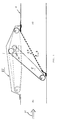
- Each closure element 5 is in fact constituted by a belt 11 looped on the pulleys of reference 13, 15.
- a perforated wall 3 which is preferably inclined by relative to the longitudinal axis of the pipe at an angle about 45 °.
- This perforated wall 3 could also be perpendicular to this axis or appear at an angle different.
- the element bearing the general reference 5 constituted by the belt 11 mounted on pulleys 13 and 15 can be brought in the position shown in solid lines in Figure 1.
- the pressure difference P> P2 prevailing in the duct as a result of the circulation of the fluid indicated by the arrow is enough to apply the membrane constituting the stopper strap.
- This closure device may, with a view to the opening, be raised as indicated, essentially by pivoting with respect to an axis coincident with that of the pulley 13 for bringing the closure element 5 into a housing covered with a cover 21 formed on the wall of the conduit 1 (which in this case has a section rectangular).
- the advantage of the embodiment according to the invention is the fact that the closure element 5 is constituted by a belt 11 mounted (in this case freely) on the pulleys 13 and 15 and the fact that this device is first easy to maneuver and then by design shown, the actuation under the action of a command whose axis bears the mark 19, first causes a release of the lower holes of the perforated sheet 3 accompanied by a slight movement of movement of the belt 11.
- the movement of the belt means that the belt application area on the perforations is not always the same, which helps to prolong the belt life and avoid "marking" on the wall perforation strap 3.
- the belts can of course be made in any suitable material with resistance sufficient mechanical. Particularly suitable, when corrosive gases are for example present in the transported fluid, fluorinated resins of the "Teflon" ® type.
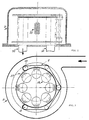
- Figures 2 and 3 is based on a principle similar to what has been described for the figure 1, but applied to a multi-way valve system.
- the valve body is in the form of a cylindrical body closed by a bottom at one end. In the mass of this cylindrical body are found (in the case shown) conduits 32 having perforated walls 33.
- the incoming fluid can enter the eight conduits 32 and is distributed to eight outlets 35 arranged at the bottom of the body cylindrical.
- the fluid is admitted laterally into the direction represented by the arrow.
- a belt 5, of shape and size suitable, is mounted on pulleys 13 and 15 and basically works as in Figure 1, except that the belt is positioned here by a cage rotating around the central core, this cage unrolls the belt and positions it opposite the conduits to shut off.
- conduits can be used to create one, three, five, six, ... tracks. It is also possible to have, for example in the embodiment shown comprising eight tracks, several belts which allows to admit successively the fluid to one of the outlet openings 35 of your choice, closing the remaining outlet openings.
- This type of valve is suitable for many types of separation such as O 2 / N 2 separation from air, separation of hydrogen from different mixtures containing it, separation of carbon dioxide from natural gas, etc.
- the stages E1 and E2 of the adsorption phase are consisting of the atmospheric air intake (E1) and the compression of this air and production of oxygen (E2). These steps E1 and E2 covering adsorption can also be divided into a time zone 37 and 38 for filling the tank and a production time zone 39.
- the desorption phase (E3 to E5) includes a step E3 of putting to the atmosphere, a stage E4 of preferential escape of the least adsorbed gas and a step E5 of exhausting the gas more adsorbed and purge, in this case oxygen purge.
- the emptying of the tank is represented in time zones 40, 41 and 42, and the purge time at 43.
- Oxygen production is represented in the Figure 5 by the hatched area.
- the installation shown schematically in the Figure 6 has several independent tanks 46 containing the zeolite and in which take place successively the adsorption / desorption stages of the gases.
- This structure allows energy recoveries, either by intake of filtered and possibly dried atmospheric air while other tanks are in operation, either by direct or indirect recovery of relaxing energies during the desorption of gases occluded in the materials active.
- This trigger can be used to compress, in an energy receiving machine, the fluids entering in another tank which is obviously not in the same sequence phase.
- Each reservoir 46 passes cyclically through the following phases. After being emptied at the vacuum pump (zones 40, 41, 42 and 43), the tank remains filled with atmospheric or compressed air (zone 37). He is then inflated to the pressure of the oxygen tank (zone 38). When the internal pressure becomes higher than the pressure storage, an automatic or piloted valve allows pump oxygen into the storage tank until moment when the arrival of the saturation front is detected by physical value sensors, for example pressure and / or temperature whose function gives the order to close the compressor air intake valve.
- Zones 41 and 42 correspond to the setting vacuum of the tank by the vacuum pumps in order to desorb the active ingredient as much as possible.
- Zone 43 corresponds to the injection of oxygen at counter-current allowing to push back out of the tank the nitrogen molecules possibly still present in the intergranular space of the active ingredient.
- zones 39 to 40, 40 to 41 and 41 to 42 is done by a scroll valve of the type described, of which the intake corresponds to an outlet from the tank. She is therefore positioned, in relation to the tank, in the direction unlike those that distribute air to the tank atmospheric or compressor air, either on passing zone 43 to 37 and from 37 to 38.
- the intake of purge oxygen (zone 43) can be carried out by a solenoid valve (low flow) which allows an injection of oxygen previously manufactured and stored in the storage tank.
- Compressed air is partially dried and stored in a tank 52.
- a second scrolling inlet valve 53 allows to supply in zone 38 the reservoir containing the material active, in this case zeolite.
- zone 39 which is the zone of oxygen production which has seen the passage of oxygen produced through the valve 59 towards the storage tank, oxygen passes through filters 60 which make it possible to collect possibly the active ingredient dust as the filters 56 protect the vacuum pumps.
- valve 53 As soon as valve 53 is closed, the pressure in the tank decreases and the valve 59 closes automatically.
- valve 53 closes after detection of the arrival of the adsorption front, it is possible, via the valve drop-down 54 fitted to each tank 46, put the successively tanks to the atmosphere, whether or not via a turbine 55, then to vacuum pumps 57 and 58 via filters 56.
- each drop-down valve can be controlled separately.
- Figures 7 and 8 illustrate the details of realization of a self-piloting installation of a reactor.
- the reactor 46 provided with an air inlet in its upper part in volute, lateral or not, is filled with active adsorption material, such as zeolite by example, which is under grid 62 and has a adsorption front passage capture zone, such as a dip tube 64, the upper part of which is provided with a grid 63.
- active adsorption material such as zeolite by example
- a dip tube 64 the adsorption front 65 first develops in the area annular around the dip tube 64, it descends at the bottom from tank 46 and then go back up into the dip tube 66 where pressure and / or pressure sensors are present temperature. These sensors are positioned at a certain distance from the upper part of the dip tube.
- the adsorption front is the transfer zone of mass that separates the areas where there is oxygen and nitrogen from that where there is only oxygen, this front is moving towards the tank outlet.
- This front is the place of a rise in temperature corresponding to the passage of nitrogen gas towards a phase pseudo-liquid, and is also the site of variations in pressure.
- Measuring these temperature changes and / or pressure allows by simulation, for example of a depending on their variation, to control the device and to activate the rotation of the unrolling valve by one step. This which automatically cuts off the air intake, without pollution oxygen produced by nitrogen molecules present in the adsorption front.
- the value of the function resulting from this measurement allows self-control of the process by using the valve drop-down that responds extremely quickly (less than a half second) while ensuring a maximum backflow of the oxygen separated in the storage tank.
- the device of the invention operates in the absence of any grease or lubricant, especially for the valves, thus allowing the implementation, even in presence of high oxygen concentrations.
Landscapes
- Engineering & Computer Science (AREA)
- General Engineering & Computer Science (AREA)
- Mechanical Engineering (AREA)
- Separation Of Gases By Adsorption (AREA)
- Sliding Valves (AREA)
Claims (7)
- Verfahren zur Trennung von Komponenten einer Gasmischung durch selektive Adsorption auf einem adsorbierenden Material in Reaktoren, die in sequentiellen Adsorptions- und Desorptionszyklen funktionieren, welche aufeinanderfolgende Vorgänge umfassen für die Zufuhr der zu behandelnden Gase sowie für das Unterdrucksetzen derselben zur Durchführung einer selektiven Adsorption, für ein bevorzugtes Ablassen der weniger stark adsorbierten Komponente und für eine mindestens teilweise Desorption unter vermindertem Druck der bevorzugt adsorbierten Verbindung, die vorzugsweise von einem Säuberungsvorgang durch Desorption abgeschlossen wird, dadurch gekennzeichnet, dass die Adsorptions- und Desorptionsvorgänge über Drehschieberabsperrarmaturen(53, 54) gesteuert werden, die in Leitungen (1, 32) oder in Abschnitten des Kreislaufs eingebaut sind, die am Reaktor angeschlossen sind und die individuell die Zufuhr und das Ablassen der zur Funktion des Reaktors notwendigen Gase regeln.
- Verfahren gemäß Patentanspruch 1, dadurch gekennzeichnet, dass die Adsorptions- und/oder Desorptionsvorgänge in Abhängigkeit von der Adsorptionsfront im Reaktor gesteuert werden.
- Verfahren gemäß Patentanspruch 2, dadurch gekennzeichnet, dass die Adsorptionsfront durch Temperatur- und/oder Druckveränderungen im Reaktor ausfindig gemacht wird.
- Vorrichtung zur Trennung von Komponenten einer Gasmischung durch selektive Adsorption auf einem adsorbierenden Material in Reaktoren, die in sequentiellen Adsorptions- (E1, E2) und Desorptionszyklen (E3, E4, E5) ablaufen, welche aufeinanderfolgende Stufen umfassen für die Zufuhr der zu behandelnden Gase und für das Unterdrucksetzen derselben zur Durchführung einer selektiven Adsorption, für ein bevorzugtes Ablassen der weniger stark adsorbierten Komponente und für eine mindestens teilweise Desorption unter vermindertem Druck der bevorzugt adsorbierten Verbindung, die vorzugsweise von einem Säuberungsvorgang durch Desorption abgeschlossen wird, dadurch gekennzeichnet, dass die funktionsnotwendige Zufuhr und das Ablassen der Gase individuell durch eine Drehschieberabsperrarmatur (53, 54) gesteuert werden, die in eine Leitung (1, 32) oder in einen Abschnitt eines Kreislaufes eingebaut ist und die aus einer perforierten Wand besteht, vorzugsweise aus einem Gitter mit kleinen Öffnungen (3), und einer abnehmbaren, aus einem geschmeidigen Material bestehenden Membrane (5), welche in der Form eines Riemens ausgelegt ist, der auf Rollen (13, 15), Walzen oder Zylindern oder auf anderen ähnlichen Elementen aufmontiert ist, und der so angeordnet ist, dass einer der Stränge des Riemens (5) in der Lage ist die perforierte Wand (3) völlig abzudecken, wobei der Riemen (5) entweder frei aufmontiert sein kann oder angetrieben wird durch eine Steuervorrichtung in einer Rotation auf den Rollen (13, 15), wobei der aus dem Riemen (5) und seinen Rollen (13, 15) bestehende Komplex sich, ausgehend von einer maximalen Öffnungsposition, die die Löcher vollkommen freigibt, bis hin zu einer totalen Schließposition, die die Löcher vollkommen überdeckt, bewegen kann.
- Vorrichtung gemäß Patentanspruch 4, dadurch gekennzeichnet, dass sie ein Einwegventil umfaßt, welches ein Gitter mit kleinen Öffnungen (3) aufweist und in einer Leitung angeordnet ist, während eine oder mehrere abnehmbare Membranen (5) um eine Achse (19) drehen können.
- Vorrichtung gemäß Patentanspruch 4, dadurch gekennzeichnet, dass sie ein Mehrwegventil umfaßt, welches mehrere Gitter mit kleinen Öffnung (33) aufweist und mindestens eine abnehmbare Membrane (5), die durch Rotation verstellt werden kann, um verschiedene Gitter (33) abzudecken.
- Vorrichtung gemäß irgendeinem der Patentansprüche 4 bis 6, dadurch gekennzeichnet, dass der Reaktor sich zusammensetzt aus einem Behälter (46), der mit einer Luftzufuhr, vorzugsweise in seinem oberen Teil, ausgestattet ist und der mit aktivem Adsorptionsmaterial gefüllt ist sowie eine Aufnahmezone der Adsorptionsfront in dem besagten Material aufweist.
Applications Claiming Priority (2)
| Application Number | Priority Date | Filing Date | Title |
|---|---|---|---|
| BE9400853A BE1008700A3 (fr) | 1994-09-21 | 1994-09-21 | Vanne. |
| BE9400853 | 1994-09-21 |
Publications (2)
| Publication Number | Publication Date |
|---|---|
| EP0703390A1 EP0703390A1 (de) | 1996-03-27 |
| EP0703390B1 true EP0703390B1 (de) | 2001-11-14 |
Family
ID=3888367
Family Applications (1)
| Application Number | Title | Priority Date | Filing Date |
|---|---|---|---|
| EP95870105A Expired - Lifetime EP0703390B1 (de) | 1994-09-21 | 1995-09-20 | Verfahren und Vorrichtung zur Trennung von Gaskomponenten durch Adsorption |
Country Status (4)
| Country | Link |
|---|---|
| EP (1) | EP0703390B1 (de) |
| AT (1) | ATE208865T1 (de) |
| BE (1) | BE1008700A3 (de) |
| DE (1) | DE69523850T2 (de) |
Families Citing this family (1)
| Publication number | Priority date | Publication date | Assignee | Title |
|---|---|---|---|---|
| CN110296230B (zh) * | 2019-06-28 | 2020-06-16 | 珠海格力电器股份有限公司 | 风阀及设有其的除霾机 |
Family Cites Families (3)
| Publication number | Priority date | Publication date | Assignee | Title |
|---|---|---|---|---|
| DE895303C (de) * | 1951-11-15 | 1953-11-02 | Herm J Hellmers G M B H | Sprengbrause mit Drehschieberabsperr- und Regelorgan fuer mit Verunreinigungen durchsetzte Fluessigkeiten, wie z. B. im Sprengwagenbetrieb |
| DE1650394A1 (de) * | 1967-12-15 | 1970-08-27 | Wilhelm Gathmann | Absperrarmatur fuer gasfoermige und fluessige Medien |
| LU88160A1 (fr) | 1992-08-18 | 1993-10-27 | Fernande Schartz | Procede et dispositif de separation de gaz par adsorption selective a pression variable |
-
1994
- 1994-09-21 BE BE9400853A patent/BE1008700A3/fr not_active IP Right Cessation
-
1995
- 1995-09-20 AT AT95870105T patent/ATE208865T1/de not_active IP Right Cessation
- 1995-09-20 DE DE69523850T patent/DE69523850T2/de not_active Expired - Fee Related
- 1995-09-20 EP EP95870105A patent/EP0703390B1/de not_active Expired - Lifetime
Also Published As
| Publication number | Publication date |
|---|---|
| ATE208865T1 (de) | 2001-11-15 |
| DE69523850D1 (de) | 2001-12-20 |
| BE1008700A3 (fr) | 1996-07-02 |
| DE69523850T2 (de) | 2002-06-27 |
| EP0703390A1 (de) | 1996-03-27 |
Similar Documents
| Publication | Publication Date | Title |
|---|---|---|
| CA2830130C (fr) | Dispositif pompe de transfert a pistons, procede de transfert de matiere solide granulaire utilisant un tel dispositif, application du procede a l'alimentation d'un reacteur de gazeification | |
| EP2240756B1 (de) | Vorrichtung zum trocknen eines gases, insbesondere luft, verbringen davon zu einer vorrichtung und verfahren zum sammeln einer gasprobe | |
| EP0655941A1 (de) | Verfahren und vorrichtung zur trennung von gaskomponenten durch adsorption | |
| EP2035766B1 (de) | Verfahren und vorrichtung zur reinigung der wasserrieselungsfläche in einem wärmetauscher luft/wasser | |
| CA2741213C (fr) | Dispositif d'extraction des gateaux issus de la filtration a disques sous pression et procede d'extraction associe | |
| EP2897714B1 (de) | Verfahren zur unterwasserüberprüfung eines filtrations-systems | |
| EP1361442B1 (de) | Vorrichtung und Verfahren zur Ausgabe von flüssigen Produkten | |
| EP0703390B1 (de) | Verfahren und Vorrichtung zur Trennung von Gaskomponenten durch Adsorption | |
| EP3864673B1 (de) | Verfahren und vorrichtung zur uberführung von uranhexafluorid in urandioxyd | |
| EP2983884B1 (de) | Vorrichtung zur behandlung eines festen verbundstoffes durch solvolyse zur gewinnung von fasern aus dem behandelten stoff | |
| EP0631103B1 (de) | Vorrichtung zur Reinigung von Rohren mit verformbaren Schwammkugeln | |
| CA2171993A1 (fr) | Procede et dispositif de separation de gaz par adsorption | |
| EP1033172B1 (de) | Zentrifuge mit Pneumatikantrieb und Filtration ihrer Gehäuseatmosphäre | |
| WO2015135921A1 (fr) | Dispositif de séparation de constituants gazeux contenus dans un mélange gazeux, et son utilisation pour la séparation de méthane et de dioxyde de carbone d'un biogaz | |
| FR3026043A1 (fr) | Dispositif de vulcanisation pour pneumatique | |
| EP1802389A1 (de) | Vorrichtung und installation zum einspeisen von partikelmaterialien in eine kammer und dazugehöriges verfahren | |
| EP2164808B1 (de) | Autonome meerwasserreinigungsvorrichtung mit alternierend untergetauchten filterungsmodulen mit mehrkolben-unterdruckkammern | |
| EP2674230B1 (de) | Verfahren und Anlage zur Aufbereitung von Erde, die mindestens einen zu extrahierenden Schadstoff enthält | |
| FR3030318B1 (fr) | Dispositif de pretraitement de sediments preleves sur un fond d'un milieu liquide comprenant des etages de tamisage successifs | |
| FR2632726A1 (fr) | Pompe de dosage et/ou d'echantillonnage pneumatique et/ou a depression, pour effluents liquides, et echantillonneur automatique la comportant | |
| WO2018060755A1 (fr) | Installation de traitement de fluides par osmose inverse | |
| EP1877176A1 (de) | Grosser chemischer und/oder biologischer reaktor zum zusammenführen von zwei flüssigkeiten und bearbeitungsanlage mit einem solchen reaktor | |
| BE1010028A6 (fr) | Procede et dispositif de separation selective d'au moins un composant d'un melange gazeux. | |
| FR2981956A1 (fr) | Dispositif de remontee de sediments situes dans les fonds marins | |
| FR2918363A1 (fr) | Dispositif autonome d'epuration d'eau de mer a modules de filtration immerges alternatifs a chambres basse pression reliees entre elles |
Legal Events
| Date | Code | Title | Description |
|---|---|---|---|
| PUAI | Public reference made under article 153(3) epc to a published international application that has entered the european phase |
Free format text: ORIGINAL CODE: 0009012 |
|
| 17P | Request for examination filed |
Effective date: 19951006 |
|
| AK | Designated contracting states |
Kind code of ref document: A1 Designated state(s): AT BE CH DE DK ES FR GB IT LI LU NL SE |
|
| 17Q | First examination report despatched |
Effective date: 19990907 |
|
| GRAG | Despatch of communication of intention to grant |
Free format text: ORIGINAL CODE: EPIDOS AGRA |
|
| GRAG | Despatch of communication of intention to grant |
Free format text: ORIGINAL CODE: EPIDOS AGRA |
|
| GRAH | Despatch of communication of intention to grant a patent |
Free format text: ORIGINAL CODE: EPIDOS IGRA |
|
| GRAH | Despatch of communication of intention to grant a patent |
Free format text: ORIGINAL CODE: EPIDOS IGRA |
|
| GRAA | (expected) grant |
Free format text: ORIGINAL CODE: 0009210 |
|
| AK | Designated contracting states |
Kind code of ref document: B1 Designated state(s): AT BE CH DE DK ES FR GB IT LI LU NL SE |
|
| PG25 | Lapsed in a contracting state [announced via postgrant information from national office to epo] |
Ref country code: NL Free format text: LAPSE BECAUSE OF FAILURE TO SUBMIT A TRANSLATION OF THE DESCRIPTION OR TO PAY THE FEE WITHIN THE PRESCRIBED TIME-LIMIT Effective date: 20011114 Ref country code: IT Free format text: LAPSE BECAUSE OF FAILURE TO SUBMIT A TRANSLATION OF THE DESCRIPTION OR TO PAY THE FEE WITHIN THE PRESCRIBED TIME-LIMIT;WARNING: LAPSES OF ITALIAN PATENTS WITH EFFECTIVE DATE BEFORE 2007 MAY HAVE OCCURRED AT ANY TIME BEFORE 2007. THE CORRECT EFFECTIVE DATE MAY BE DIFFERENT FROM THE ONE RECORDED. Effective date: 20011114 Ref country code: AT Free format text: LAPSE BECAUSE OF FAILURE TO SUBMIT A TRANSLATION OF THE DESCRIPTION OR TO PAY THE FEE WITHIN THE PRESCRIBED TIME-LIMIT Effective date: 20011114 |
|
| REF | Corresponds to: |
Ref document number: 208865 Country of ref document: AT Date of ref document: 20011115 Kind code of ref document: T |
|
| REG | Reference to a national code |
Ref country code: CH Ref legal event code: EP |
|
| REF | Corresponds to: |
Ref document number: 69523850 Country of ref document: DE Date of ref document: 20011220 |
|
| REG | Reference to a national code |
Ref country code: CH Ref legal event code: NV Representative=s name: ABREMA AGENCE BREVETS ET MARQUES GANGUILLET & HUMP |
|
| REG | Reference to a national code |
Ref country code: GB Ref legal event code: IF02 |
|
| PG25 | Lapsed in a contracting state [announced via postgrant information from national office to epo] |
Ref country code: SE Free format text: LAPSE BECAUSE OF FAILURE TO SUBMIT A TRANSLATION OF THE DESCRIPTION OR TO PAY THE FEE WITHIN THE PRESCRIBED TIME-LIMIT Effective date: 20020214 Ref country code: DK Free format text: LAPSE BECAUSE OF FAILURE TO SUBMIT A TRANSLATION OF THE DESCRIPTION OR TO PAY THE FEE WITHIN THE PRESCRIBED TIME-LIMIT Effective date: 20020214 |
|
| GBT | Gb: translation of ep patent filed (gb section 77(6)(a)/1977) |
Effective date: 20020205 |
|
| NLV1 | Nl: lapsed or annulled due to failure to fulfill the requirements of art. 29p and 29m of the patents act | ||
| PG25 | Lapsed in a contracting state [announced via postgrant information from national office to epo] |
Ref country code: ES Free format text: LAPSE BECAUSE OF FAILURE TO SUBMIT A TRANSLATION OF THE DESCRIPTION OR TO PAY THE FEE WITHIN THE PRESCRIBED TIME-LIMIT Effective date: 20020530 |
|
| PLBE | No opposition filed within time limit |
Free format text: ORIGINAL CODE: 0009261 |
|
| STAA | Information on the status of an ep patent application or granted ep patent |
Free format text: STATUS: NO OPPOSITION FILED WITHIN TIME LIMIT |
|
| 26N | No opposition filed | ||
| PGFP | Annual fee paid to national office [announced via postgrant information from national office to epo] |
Ref country code: GB Payment date: 20040917 Year of fee payment: 10 |
|
| PGFP | Annual fee paid to national office [announced via postgrant information from national office to epo] |
Ref country code: DE Payment date: 20040924 Year of fee payment: 10 Ref country code: CH Payment date: 20040924 Year of fee payment: 10 |
|
| PGFP | Annual fee paid to national office [announced via postgrant information from national office to epo] |
Ref country code: LU Payment date: 20041014 Year of fee payment: 10 |
|
| PG25 | Lapsed in a contracting state [announced via postgrant information from national office to epo] |
Ref country code: GB Free format text: LAPSE BECAUSE OF NON-PAYMENT OF DUE FEES Effective date: 20050920 |
|
| PG25 | Lapsed in a contracting state [announced via postgrant information from national office to epo] |
Ref country code: LU Free format text: LAPSE BECAUSE OF NON-PAYMENT OF DUE FEES Effective date: 20050930 Ref country code: LI Free format text: LAPSE BECAUSE OF NON-PAYMENT OF DUE FEES Effective date: 20050930 Ref country code: CH Free format text: LAPSE BECAUSE OF NON-PAYMENT OF DUE FEES Effective date: 20050930 |
|
| PG25 | Lapsed in a contracting state [announced via postgrant information from national office to epo] |
Ref country code: DE Free format text: LAPSE BECAUSE OF NON-PAYMENT OF DUE FEES Effective date: 20060401 |
|
| REG | Reference to a national code |
Ref country code: CH Ref legal event code: PL |
|
| GBPC | Gb: european patent ceased through non-payment of renewal fee |
Effective date: 20050920 |
|
| REG | Reference to a national code |
Ref country code: FR Ref legal event code: ST Effective date: 20080531 |
|
| PG25 | Lapsed in a contracting state [announced via postgrant information from national office to epo] |
Ref country code: FR Free format text: LAPSE BECAUSE OF NON-PAYMENT OF DUE FEES Effective date: 20071001 |
|
| PGFP | Annual fee paid to national office [announced via postgrant information from national office to epo] |
Ref country code: FR Payment date: 20060928 Year of fee payment: 12 |
|
| PGFP | Annual fee paid to national office [announced via postgrant information from national office to epo] |
Ref country code: BE Payment date: 20090825 Year of fee payment: 15 |
|
| BERE | Be: lapsed |
Owner name: S.A. *SYNERGAL Effective date: 20100930 |
|
| PG25 | Lapsed in a contracting state [announced via postgrant information from national office to epo] |
Ref country code: BE Free format text: LAPSE BECAUSE OF NON-PAYMENT OF DUE FEES Effective date: 20100930 |