EP0703604A1 - Dispositif pour le refroidissement contrÔlé de cuves chimique - Google Patents
Dispositif pour le refroidissement contrÔlé de cuves chimique Download PDFInfo
- Publication number
- EP0703604A1 EP0703604A1 EP94830440A EP94830440A EP0703604A1 EP 0703604 A1 EP0703604 A1 EP 0703604A1 EP 94830440 A EP94830440 A EP 94830440A EP 94830440 A EP94830440 A EP 94830440A EP 0703604 A1 EP0703604 A1 EP 0703604A1
- Authority
- EP
- European Patent Office
- Prior art keywords
- temperature
- inert gas
- chemical solution
- prescribed temperature
- prescribed
- Prior art date
- Legal status (The legal status is an assumption and is not a legal conclusion. Google has not performed a legal analysis and makes no representation as to the accuracy of the status listed.)
- Granted
Links
Images

Classifications
-
- H—ELECTRICITY
- H10—SEMICONDUCTOR DEVICES; ELECTRIC SOLID-STATE DEVICES NOT OTHERWISE PROVIDED FOR
- H10P—GENERIC PROCESSES OR APPARATUS FOR THE MANUFACTURE OR TREATMENT OF DEVICES COVERED BY CLASS H10
- H10P72/00—Handling or holding of wafers, substrates or devices during manufacture or treatment thereof
- H10P72/04—Apparatus for manufacture or treatment
- H10P72/0431—Apparatus for thermal treatment
- H10P72/0434—Apparatus for thermal treatment mainly by convection
-
- H—ELECTRICITY
- H10—SEMICONDUCTOR DEVICES; ELECTRIC SOLID-STATE DEVICES NOT OTHERWISE PROVIDED FOR
- H10P—GENERIC PROCESSES OR APPARATUS FOR THE MANUFACTURE OR TREATMENT OF DEVICES COVERED BY CLASS H10
- H10P72/00—Handling or holding of wafers, substrates or devices during manufacture or treatment thereof
- H10P72/04—Apparatus for manufacture or treatment
- H10P72/0402—Apparatus for fluid treatment
- H10P72/0418—Apparatus for fluid treatment for etching
- H10P72/0422—Apparatus for fluid treatment for etching for wet etching
- H10P72/0426—Apparatus for fluid treatment for etching for wet etching with the semiconductor substrates being dipped in baths or vessels
Definitions
- the present invention relates to an apparatus for the controlled cooling of chemical tanks.
- the manufacturing of integrated circuits involves several steps of liquid-based or "wet” etching: the silicon wafers are immersed in rather capacious tanks (to allow the simultaneous processing of several wafers) containing a chemical solution whose composition and temperature depend on the particular material to be etched.
- the etching process is carried out at temperatures higher than the room temperature (21 °C): the etching solution must be maintained within a temperature range from 28 °C to 38 °C, for which purpose means for heating the etching solution are necessary.
- cooling means are necessary when the etching process is carried out at temperatures lower than the room temperature.
- said cooling means comprise teflon coils which are immersed in the etching solution and through which water is made to flow.
- the coils are connected to an external tank to which a refrigerating system is associated.
- a temperature sensor immersed in the etching solution controls the refrigerating system to maintain the etching solution in the desired temperature range.
- the problem is that, with use and handling due to cleaning, microfractures are created in the teflon coils, through which the water leaks out contaminating the etching solution with ions present in the water. Such ions deposit on the silicon wafers and give rise to defects that cause the wafers to be rejected.
- a device for heating chemical tanks which comprises a pair of heat-exchanger teflon coils, immersed in the etching solution, through which an inert gas such as pure nitrogen is made to flow.
- the coils are connected to respective heating units which are fed with the inert gas from a main supply line.
- the use of an inert gas as the heating element instead of water assures that, even in presence of microfractures in the teflon coils through which the gas can leak, the etching solution is not contaminated.
- an apparatus for the controlled cooling of chemical tanks containing a chemical solution which must be kept at a first prescribed temperature comprising at least one heat-exchanger coil immersed inside of a chemical tank and through which there is made to circulate a flow of an inert gas, characterized by comprising storage means for storing and cooling a prescribed volume of inert gas at a second prescribed temperature lower than said first prescribed temperature, feeding means for feeding the storage means with inert gas coming from a main supply line, and valve means interposed between said storage means and an inlet of said at least one heat-exchanger coil for controlling the supply of cooled inert gas to the heat-exchanger coil.
- the apparatus according to the present invention does not pose any problem of contamination of the solution, since it uses an inert gas as cooling element. Furthermore, thanks to the fact that storage means of cool inert gas are provided, the cooling apparatus of the present invention is capable of rapidly compensating any undesired temperature increase in the chemical solution, due for example to the heat generated by the etching reaction: to this purpose, it is sufficient to properly dimension the storage means to store a sufficient volume of cool inert gas.
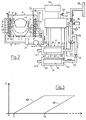
- a first and a second heat-exchanger coils 1, 2 are arranged and intercalated one to the other in the proximity of the walls of a chemical tank 3 containing a chemical solution 4 suitable for etching silicon wafers 5 (only one shown in the drawing) in turn contained in corresponding containers 6.
- the tank 3 has a typical volume of about 24 l, and the solution is for example a mixture of hydrofluoric acid and ammonium fluoride in the proportion of one to seven by volume.
- the tank 3 is provided with a pump 19 having a corresponding filter 21 for the filtered recirculation of the solution 4, and with an associated level control 20 connected to an input of a main control unit 13 and suitable for stopping the recirculation pump 19 in case of an excessive lowering of the level of the solution 4 in the tank 3.
- the coils 1, 2 are made of teflon and are both traversed by a flow of an inert gas 23, such as pure nitrogen, that enters into the coils 1, 2 through respective inlets I1, I2 and leave the coils 1, 2 from respective discharge outlets U1, U2.
- an inert gas 23 such as pure nitrogen
- the cooling apparatus comprises a cilindrical container 50 made of stainless steel having a volume of about 25 l, inside which there is arranged a heat-exchanger coil 51 also made of stainless steel, in a position adjacent to the walls of the container 50.
- the coil 51 is the expansion coil of a per-se known refrigerating machine 52.
- the container 50 has a coating 59 of thermal insulator material.
- the container 50 has an inlet 60 at its top end which is fed with the inert gas 23 coming from a main supply line 55 through a pressure regulator 56 and a nonreturn valve 57; a pressure gauge 58 measures the pressure of the inert gas 23 downstream from the nonreturn valve 57 and just upstream of the inlet 60.
- the container 50 has an outlet 61 at its bottom end through which the cooled inert gas 23 is fed to the coils 1, 2 respectively through a first linearly-operating solenoid valve 62 and a second linearly-operating solenoid valve 63, which are individually controlled by a peripheral control unit 64.
- the first and second linearly-operating valves 62 and 63 are respectively connected to the inlets I1, I2 of the coils 1, 2 through respective nonreturn valves 65 and 66.
- a relief valve 67 Just downstream from the outlet 61 of the container 50 there is provided a relief valve 67 which discharges the inert gas 23 from the container 50 in case of overpressure.
- the activation of the refrigerating machine 52 is controlled by a thermostat 53 externally attached to the wall of the container 50.
- the temperature of the inert gas 23 inside the container 50 is measured by means of a sensor 54 which is connected to the peripheral control unit 64.
- the peripheral control unit 64 communicates with the main control unit 13, which is also connected to a temperature controller 14 suitable for receiving from a thermocouple 15 signals related to the temperature of the solution 4 and for sending to the main control unit 13 a signal E equal to the deviation between the detected temperature and the preset temperature.
- the main control unit 13 is further provided with an alarm device 22 suitable for providing an operator with an acoustical signal in case of malfunctions in the apparatus.
- the cooling apparatus also comprises a heating device schematically shown in Figure 1 by a block 70 and substantially of the type described in the already mentioned European Patent Application No. 507387.
- the heating device shown in detail in Figure 2, comprises a first and a second inert gas heating units 11, 12 each consisting of a shell 31, 32 having a cylindrical shape which houses a respective electrical resistance 41, 42 inside it.
- the heating units 11, 12 have respective inlets I11, I12 fed with the inert gas coming from the main supply line 55 through a common pressure regulator 7 and respective solenoid valves 9, 10, which are individually controlled by the main control unit 13.
- a safety pressure switch 18 is inserted in the line feeding the inert gas 23 to the solenoid valves 9, 10 and is suitable for transmitting to the main control unit 13 a signal for automatically switching the heating units 11, 12 off in the case of a pressure fall of the inert gas 23 in the main supply line 55 so as not to damage the heating elements 11, 12 themselves.
- the heating units 11, 12 are driven by the main control unit 13 are further provided with safety control means 16, 17 of excess temperature, which intervene in case of anomalies in the heating units 11, 12.
- One of the two solenoid valves 9 and 10, e.g. the valve 9, is controlled by the main control unit 13 in an implulsive manner, while the other valve 10 is controlled in a linear manner.
- the heating units 11, 12 have respective outlets U11 and U12 which are respectively connected, through respective nonreturn valves 68 and 69, to the inlets I1 and I2 of the coils 1 and 2.
- the inert gas 23 coming from the main supply line 55 is fed to the container 50 through the pressure regulator 56 and the nonreturn valve 57; the pressure regulator 56 limits the pressure downstream from it to a value of about 7-8 bar, lower than the pressure of the inert gas 23 in the main supply line 55 (typically 10-12 bar).
- the inert gas 23 is progressively cooled to the temperature set by the thermostat 53 (2-4 °C). As the inert gas cools, the pressure inside the container 50 lowers, and more gas is intaken from the main supply line 55, till the pressure inside the container 50 reaches the value set by the pressure regulator 56.
- the container 50 works as a reservoir of cool gas for refrigerating the etching solution 4, the volume of the container 50 and the temperature at which it is kept being chosen so as to store a number of refrigerating units at least sufficient to rapidly compensate the heat that can be generated by the chemical reaction of etching of the silicon wafers.
- the container 6 of silicon wafers 5 is introduced into the tank 3 containing the etching solution 4.
- the etching solution 4 reacts with the material to be etched; the chemical reaction that takes place is, in some cases, exothermic: thus, the heat generated by the reaction causes the temperature of the solution 4 to rise.
- the temperature of the solution 4 is detected by the temperature controller 14, which supplies the main control unit 13 with the signal E corresponding to the deviation of the detected temperature with respect to the preset temperature, for example 21 °C for a room temperature etching process. If the value of said deviation is positive, the main control unit 13 sends to the peripheral control unit 64 a command for the opening of the linearly-operating valves 62, 63.
- valves 62, 63 are progressively closed, again according to the characteristic of Figure 3.
- the main control unit 13 determines the activation of the heating units 11, 12. As long as the deviation of the detected temperature from the preset temperature is small (i.e. the detected temperature is in the allowed range 20.5 °C - 21 °C), the main control unit 13 impulsively drive the valve 9 with a pulsed signal having a duty cycle depending on the amount of the temperature deviation; the other valve 10 is kept closed.
- the hot gas at the outlet U11 of the heating unit 11 is fed, via the nonreturn valve 68, to the inlet I1 of the coil 1.
- the temperature deviation is large (i.e.
- valve 9 when the detected temperature falls outside the allowed range 20.5 °C - 21 °C), the valve 9 is kept open, and the valve 10 is linearly controlled in a manner proportional to the difference between the detected temperature and the minimum allowed temperature (20.5 °C).
- the hot gas is fed both the coils 1, 2, so that the temperature of the solution can quickly return in the allowed temperature range.
Landscapes
- ing And Chemical Polishing (AREA)
- Control Of Temperature (AREA)
Priority Applications (3)
| Application Number | Priority Date | Filing Date | Title |
|---|---|---|---|
| DE69429347T DE69429347T2 (de) | 1994-09-20 | 1994-09-20 | Anlage zum kontrollierten Abkühlen von chemischen Behältern |
| EP94830440A EP0703604B1 (fr) | 1994-09-20 | 1994-09-20 | Dispositif pour le refroidissement contrôlé de cuves chimique |
| US08/527,408 US5878811A (en) | 1994-09-20 | 1995-09-13 | Apparatus and method for the controlled cooling of chemical tanks |
Applications Claiming Priority (1)
| Application Number | Priority Date | Filing Date | Title |
|---|---|---|---|
| EP94830440A EP0703604B1 (fr) | 1994-09-20 | 1994-09-20 | Dispositif pour le refroidissement contrôlé de cuves chimique |
Publications (2)
| Publication Number | Publication Date |
|---|---|
| EP0703604A1 true EP0703604A1 (fr) | 1996-03-27 |
| EP0703604B1 EP0703604B1 (fr) | 2001-12-05 |
Family
ID=8218525
Family Applications (1)
| Application Number | Title | Priority Date | Filing Date |
|---|---|---|---|
| EP94830440A Expired - Lifetime EP0703604B1 (fr) | 1994-09-20 | 1994-09-20 | Dispositif pour le refroidissement contrôlé de cuves chimique |
Country Status (3)
| Country | Link |
|---|---|
| US (1) | US5878811A (fr) |
| EP (1) | EP0703604B1 (fr) |
| DE (1) | DE69429347T2 (fr) |
Cited By (2)
| Publication number | Priority date | Publication date | Assignee | Title |
|---|---|---|---|---|
| EP1539371A4 (fr) * | 2002-07-16 | 2010-11-17 | Semitool Inc | Appareil et procede de traitement thermiquement commande de pieces d'usinage micro-electronique |
| CN107316825A (zh) * | 2016-04-27 | 2017-11-03 | 盟立自动化股份有限公司 | 湿式蚀刻装置 |
Families Citing this family (8)
| Publication number | Priority date | Publication date | Assignee | Title |
|---|---|---|---|---|
| US6471778B1 (en) | 2000-06-09 | 2002-10-29 | Illinois Tool Works Inc. | Electrostatic coating system with coating material chiller and method therefor |
| EP1193493A1 (fr) | 2000-09-29 | 2002-04-03 | Infineon Technologies SC300 GmbH & Co. KG | Procédé et dispositif pour mesurer et contrôler la teneur en eau dans une solution aqueuse |
| AUPR400901A0 (en) * | 2001-03-28 | 2001-04-26 | Focus Thermal Technologies (International) Limited | Thermal storage device |
| TWI235425B (en) * | 2004-05-26 | 2005-07-01 | Promos Technologies Inc | Etching system and method for treating the etching solution thereof |
| TWI255864B (en) * | 2005-06-30 | 2006-06-01 | Chunghwa Picture Tubes Ltd | Etching apparatus and etching process |
| CN100524651C (zh) * | 2005-07-04 | 2009-08-05 | 中华映管股份有限公司 | 蚀刻设备 |
| US8720370B2 (en) * | 2011-04-07 | 2014-05-13 | Dynamic Micro System Semiconductor Equipment GmbH | Methods and apparatuses for roll-on coating |
| CN113793819B (zh) * | 2021-09-16 | 2024-06-18 | 长江存储科技有限责任公司 | 化学槽及其温度控制方法 |
Citations (2)
| Publication number | Priority date | Publication date | Assignee | Title |
|---|---|---|---|---|
| JPS6381932A (ja) * | 1986-09-26 | 1988-04-12 | Hitachi Ltd | エツチング装置 |
| EP0507387A1 (fr) * | 1991-04-05 | 1992-10-07 | STMicroelectronics S.r.l. | Dispositif de chauffe pour cuves chimiques |
Family Cites Families (11)
| Publication number | Priority date | Publication date | Assignee | Title |
|---|---|---|---|---|
| US2645461A (en) * | 1948-08-26 | 1953-07-14 | Socony Vacuum Oil Co Inc | Thermoregulator |
| US2835477A (en) * | 1955-05-02 | 1958-05-20 | Tovrog Theodore | Temperature control apparatus and method |
| US2943842A (en) * | 1959-06-26 | 1960-07-05 | Alfred W Bettigole | Heating and/or cooling system |
| US3156101A (en) * | 1963-03-04 | 1964-11-10 | Tranter Mfg Inc | Truck refrigeration system |
| US3393729A (en) * | 1966-08-01 | 1968-07-23 | Bell Telephone Labor Inc | Heat exchange mantle with interchangeable cartridge means |
| US3729948A (en) * | 1970-11-05 | 1973-05-01 | Ovitron Res Corp | Method for preserving comestibles |
| DE2245966A1 (de) * | 1971-11-04 | 1973-05-10 | Luft U Kaeltetechnik Veb K | Klimaanlage, vorzugsweise fuer grossvolumige begehbare pruefkammern |
| DE2216714C2 (de) * | 1972-04-07 | 1984-08-09 | Interatom Internationale Atomreaktorbau Gmbh, 5060 Bergisch Gladbach | Anschlußelement für einen Wärmetauscher in Tauchrohrbauweise |
| US4246955A (en) * | 1972-10-04 | 1981-01-27 | Skala Stephen F | Pressure cooking appliance with thermal exchange fluid |
| JPS5431890A (en) * | 1977-08-15 | 1979-03-08 | Matsushita Electric Works Ltd | Temperature controller |
| US4370192A (en) * | 1980-10-20 | 1983-01-25 | American Microsystems, Inc. | Apparatus for chemical etching of silicon |
-
1994
- 1994-09-20 EP EP94830440A patent/EP0703604B1/fr not_active Expired - Lifetime
- 1994-09-20 DE DE69429347T patent/DE69429347T2/de not_active Expired - Fee Related
-
1995
- 1995-09-13 US US08/527,408 patent/US5878811A/en not_active Expired - Lifetime
Patent Citations (2)
| Publication number | Priority date | Publication date | Assignee | Title |
|---|---|---|---|---|
| JPS6381932A (ja) * | 1986-09-26 | 1988-04-12 | Hitachi Ltd | エツチング装置 |
| EP0507387A1 (fr) * | 1991-04-05 | 1992-10-07 | STMicroelectronics S.r.l. | Dispositif de chauffe pour cuves chimiques |
Non-Patent Citations (1)
| Title |
|---|
| PATENT ABSTRACTS OF JAPAN vol. 12, no. 318 (E - 650) 29 August 1988 (1988-08-29) * |
Cited By (2)
| Publication number | Priority date | Publication date | Assignee | Title |
|---|---|---|---|---|
| EP1539371A4 (fr) * | 2002-07-16 | 2010-11-17 | Semitool Inc | Appareil et procede de traitement thermiquement commande de pieces d'usinage micro-electronique |
| CN107316825A (zh) * | 2016-04-27 | 2017-11-03 | 盟立自动化股份有限公司 | 湿式蚀刻装置 |
Also Published As
| Publication number | Publication date |
|---|---|
| DE69429347T2 (de) | 2002-08-14 |
| US5878811A (en) | 1999-03-09 |
| DE69429347D1 (de) | 2002-01-17 |
| EP0703604B1 (fr) | 2001-12-05 |
Similar Documents
| Publication | Publication Date | Title |
|---|---|---|
| EP0703604B1 (fr) | Dispositif pour le refroidissement contrôlé de cuves chimique | |
| EP0454123B1 (fr) | Appareil de refroidissement | |
| US5123477A (en) | Thermal reactor for biotechnological processes | |
| TWI418398B (zh) | 在處理環境中之液體環式泵送及回收系統 | |
| KR100683011B1 (ko) | 제어 특성을 포함하는 액화 가스의 제어 공급용 시스템 및방법 | |
| US12258662B2 (en) | Precursor delivery systems, precursor supply packages, and related methods | |
| US4295339A (en) | Cryostat system utilizing a liquefied gas | |
| US5353369A (en) | Device for heating a chemical tank with an inert heat exchange fluid using linear and impulsive control | |
| KR20170123226A (ko) | 열처리 장치 | |
| JP5594597B2 (ja) | 冷却装置 | |
| CN113427902B (zh) | 墨水温度调整系统及墨水温度调整方法 | |
| JP2931641B2 (ja) | 熱処理装置 | |
| KR20230134563A (ko) | 반도체 챔버 컴포넌트들을 세정하기 위한 고압 세정 방법 및 장치 | |
| KR102882175B1 (ko) | 칠러 냉매 자동 보충 장치 | |
| KR100270444B1 (ko) | 반도체장치 제조설비의 열교환시스템 | |
| US20240128101A1 (en) | Substrate processing apparatus and substrate processing method | |
| JP2684288B2 (ja) | 減圧冷却装置 | |
| JP2000094296A (ja) | ワイヤソーの熱交換装置 | |
| JP2684271B2 (ja) | 減圧気化冷却装置 | |
| JPH08219548A (ja) | 恒温装置 | |
| SU1634659A1 (ru) | Устройство дл автоматического управлени процессом нитровани в установке полунепрерывного действи | |
| JPH0666402A (ja) | 蒸気加熱装置 | |
| JP6586038B2 (ja) | 処理液冷却装置および基板処理装置 | |
| HU183650B (en) | Heat exchanger unit particularly for annealing devices usable for plastic processing machines | |
| JP2016079429A (ja) | 基板処理設備および基板処理方法 |
Legal Events
| Date | Code | Title | Description |
|---|---|---|---|
| PUAI | Public reference made under article 153(3) epc to a published international application that has entered the european phase |
Free format text: ORIGINAL CODE: 0009012 |
|
| AK | Designated contracting states |
Kind code of ref document: A1 Designated state(s): DE FR GB IT |
|
| 17P | Request for examination filed |
Effective date: 19960704 |
|
| 17Q | First examination report despatched |
Effective date: 19980612 |
|
| RAP1 | Party data changed (applicant data changed or rights of an application transferred) |
Owner name: CONSORZIO PER LA RICERCA SULLA MICROELETTRONICA NE |
|
| GRAG | Despatch of communication of intention to grant |
Free format text: ORIGINAL CODE: EPIDOS AGRA |
|
| GRAG | Despatch of communication of intention to grant |
Free format text: ORIGINAL CODE: EPIDOS AGRA |
|
| GRAH | Despatch of communication of intention to grant a patent |
Free format text: ORIGINAL CODE: EPIDOS IGRA |
|
| GRAH | Despatch of communication of intention to grant a patent |
Free format text: ORIGINAL CODE: EPIDOS IGRA |
|
| GRAA | (expected) grant |
Free format text: ORIGINAL CODE: 0009210 |
|
| AK | Designated contracting states |
Kind code of ref document: B1 Designated state(s): DE FR GB IT |
|
| REG | Reference to a national code |
Ref country code: GB Ref legal event code: IF02 |
|
| REF | Corresponds to: |
Ref document number: 69429347 Country of ref document: DE Date of ref document: 20020117 |
|
| ET | Fr: translation filed | ||
| PLBE | No opposition filed within time limit |
Free format text: ORIGINAL CODE: 0009261 |
|
| STAA | Information on the status of an ep patent application or granted ep patent |
Free format text: STATUS: NO OPPOSITION FILED WITHIN TIME LIMIT |
|
| 26N | No opposition filed | ||
| PGFP | Annual fee paid to national office [announced via postgrant information from national office to epo] |
Ref country code: DE Payment date: 20030909 Year of fee payment: 10 |
|
| PGFP | Annual fee paid to national office [announced via postgrant information from national office to epo] |
Ref country code: GB Payment date: 20040826 Year of fee payment: 11 |
|
| PGFP | Annual fee paid to national office [announced via postgrant information from national office to epo] |
Ref country code: FR Payment date: 20040923 Year of fee payment: 11 |
|
| PG25 | Lapsed in a contracting state [announced via postgrant information from national office to epo] |
Ref country code: DE Free format text: LAPSE BECAUSE OF NON-PAYMENT OF DUE FEES Effective date: 20050401 |
|
| PG25 | Lapsed in a contracting state [announced via postgrant information from national office to epo] |
Ref country code: IT Free format text: LAPSE BECAUSE OF NON-PAYMENT OF DUE FEES;WARNING: LAPSES OF ITALIAN PATENTS WITH EFFECTIVE DATE BEFORE 2007 MAY HAVE OCCURRED AT ANY TIME BEFORE 2007. THE CORRECT EFFECTIVE DATE MAY BE DIFFERENT FROM THE ONE RECORDED. Effective date: 20050920 Ref country code: GB Free format text: LAPSE BECAUSE OF NON-PAYMENT OF DUE FEES Effective date: 20050920 |
|
| GBPC | Gb: european patent ceased through non-payment of renewal fee |
Effective date: 20050920 |
|
| PG25 | Lapsed in a contracting state [announced via postgrant information from national office to epo] |
Ref country code: FR Free format text: LAPSE BECAUSE OF NON-PAYMENT OF DUE FEES Effective date: 20060531 |
|
| REG | Reference to a national code |
Ref country code: FR Ref legal event code: ST Effective date: 20060531 |