EP0703690A1 - Telefonschaltung - Google Patents
Telefonschaltung Download PDFInfo
- Publication number
- EP0703690A1 EP0703690A1 EP95114643A EP95114643A EP0703690A1 EP 0703690 A1 EP0703690 A1 EP 0703690A1 EP 95114643 A EP95114643 A EP 95114643A EP 95114643 A EP95114643 A EP 95114643A EP 0703690 A1 EP0703690 A1 EP 0703690A1
- Authority
- EP
- European Patent Office
- Prior art keywords
- signals
- circuit
- parameter value
- telephone
- control
- Prior art date
- Legal status (The legal status is an assumption and is not a legal conclusion. Google has not performed a legal analysis and makes no representation as to the accuracy of the status listed.)
- Withdrawn
Links
- 238000000034 method Methods 0.000 claims abstract description 4
- 238000013139 quantization Methods 0.000 claims description 9
- 238000005070 sampling Methods 0.000 claims description 4
- 230000005540 biological transmission Effects 0.000 description 13
- 230000004075 alteration Effects 0.000 description 2
- 230000003321 amplification Effects 0.000 description 2
- 238000003199 nucleic acid amplification method Methods 0.000 description 2
- 230000003068 static effect Effects 0.000 description 2
- 239000004065 semiconductor Substances 0.000 description 1
- 230000001960 triggered effect Effects 0.000 description 1
Images
Classifications
-
- H—ELECTRICITY
- H04—ELECTRIC COMMUNICATION TECHNIQUE
- H04M—TELEPHONIC COMMUNICATION
- H04M1/00—Substation equipment, e.g. for use by subscribers
- H04M1/60—Substation equipment, e.g. for use by subscribers including speech amplifiers
- H04M1/6025—Substation equipment, e.g. for use by subscribers including speech amplifiers implemented as integrated speech networks
Definitions
- This invention relates to telephone circuits.
- Many telephones contain electronic telephone circuits which generally use a microprocessor to manage the dialling function of the telephone and to define the characteristics of a speech circuit within the telephone.
- the dialling function is typically performed only when a key is pressed by a user, and the characteristics of the speech circuit are established during the initial set up of communication and remain unaltered for the duration of the communication.
- the speech circuit is arranged to alter dynamic characteristics such as microphone and loudspeaker gain.
- microprocessor is idle during the time the speech circuit is active, thus full use is not made of its capabilities.
- This invention seeks to provide a telephone circuit in which the above mentioned disadvantages are mitigated.
- a telephone circuit for connection to a telephone line, comprising, a line interface circuit for sending and receiving communication signals to and from the line and including at least one variable parameter value; control means coupled to receive parameter value signals from the line interface circuit and for sending control signals to control the parameter value of the line interface circuit; wherein the control means processes the received parameter value signals to derive the control signals in order to achieve a desired value of the at least one parameter.
- the line interface circuit is arranged to derive the at least one parameter value from the communication signals.
- the at least one parameter value is preferably derived from an amplitude of the communication signals.
- the at least one parameter value is preferably derived from an instantaneous value of the communication signals.
- the line interface circuit further comprises storing means for storing the control signals.
- the storing means preferably comprises a register for storing the control signals and a D/A converter for deriving analogue signals from the control signals.
- the line interface circuit further comprises sensing means coupled to sense the parameter values and to derive the parameter value signals therefrom.
- the sensing means preferably comprises quantization means and a flag register.
- the sensing means preferably comprises sampling means and a flag register.
- control means is a microprocessor.
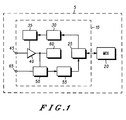
- FIG.1 shows a preferred embodiment of a telephone circuit in accordance with the invention.
- a telephone circuit 5 comprising a speech circuit 10 coupled to an MCU (microcontroller unit) 20.
- the telephone circuit 5 may be fabricated on a single semiconductor device, incorporating the speech circuit 10 and the MCU 20.
- the speech circuit 10 comprises a bi- directional interface 25, which may be a serial interface or a parallel interface.
- a transmit gain register 30 is coupled to receive a transmit gain signal from the interface 25, for storing a transmit gain register value indicative of the received transmit gain signal.
- the transmit gain register 30 is a 5-bit register, allowing a value range of 31 steps, each step corresponding to a 1dB per interval.
- Other components and elements of the speech circuit 10, such as an interface to a telephone line, are not shown in FIG.1.
- a digital to analogue (D/A) converter 35 is coupled to receive the transmit gain register value from the transmit gain register 30, for providing an analogue control signal in response to the transmit gain register value.
- a microphone amplifier 40 receives an input signal from a microphone 45 and the analogue control signal from the D/A converter 35.
- the analogue control signal controls the gain of the microphone amplifier 40.
- An amplified output from the microphone amplifier 40 conveys an amplified transmission signal to a line amplifier 60.
- the line amplifier 60 provides a final stage of amplification before the amplified transmission signal is transmitted down the telephone line (not shown).
- the amplifier transmission signal is also coupled to a quantization circuit 50 which is arranged to compare instantaneous peak values of the amplified transmission signal with a reference voltage signal VRef, from a reference voltage signal input 65.
- VRef corresponds to the maximum amplitude acceptable for the amplified transmission signal.
- the transmission sensing circuit 50 produces a digital output signal in dependence upon the compared signals.
- a flag register 55 is coupled to receive the digital output signal from the quantization circuit 50. An output from the flag register 55 is also coupled to the interface 25.
- any further dynamic change in the characteristics is made from within the speech circuit, using automatic gain control techniques and components such as timers, peak detectors and comparators.
- the microprocessor controls the speech circuit 10 and other elements (not shown) of the telephone circuit 5 via the interface 25.
- characteristics of the speech circuit 10 including transmit gain are set initially by the microprocessor, by sending control signals to the speech circuit 10 via the interface 25.
- the control signals include the transmit gain signal, which is used to store an appropriate transmit gain register value in the transmit gain register 30.
- the D/A converter 35 provides an analogue control signal in dependence upon the transmit gain register value, to control the gain of the microphone amplifier 40. In this way amplification of the input signal from the microphone 45 is set by the analogue control signal, to provide the amplified transmission signal.
- the above operation represents a static set up of the transmit gain characteristic only.
- a signal is required to be fed back to the microprocessor 20. This is achieved by the quantization circuit 50, the flag register 55 and the interface 25 as follows.
- the quantization circuit 50 senses the amplified transmission signal, and compares instantaneous peak values of the amplified transmission signal with the reference voltage signal VRef from the reference voltage signal input 65. The quantization circuit 50 generates the digital output signal if the amplified transmission signal is greater than VRef.
- the digital output signal then sets the flag within the flag register 55 to high, which causes an interrupt to be sent via the interface 25 to the microprocessor 20.
- the microprocessor sends a new transmit gain register signal to set the transmit gain register value to give rise to a lower gain from the microphone amplifier 40.
- the flag register 55 is then reset and the quantization circuit 50 senses the new peak value of the amplified transmission signal, performs the comparison and sends the digital output signal to the flag register if the amplified transmission signal is greater than VRef.
- the microprocessor 20 sends a transmit gain signal to increase the gain. In this way the microprocessor 20 dynamically controls the transmit gain characteristic, by striving for the maximum gain possible which does not result in the instantaneous peak values of the amplified transmission signal exceeding the reference voltage signal VRef.
- the flag register 55 may be used for more than one characteristic. Such an arrangement would involve multiple flags within the register, one flag for each controlled characteristic. When one of the flags is set high, an interrupt is triggered and sent to the microprocessor 20 which then looks at the flag register 55 to determine which flag is set high and therefore which characteristic requires an adjustment to be made.
- a sampling circuit may be used in place of the quantization circuit 50.
- the sampling circuit would be arranged to sample the amplitude of the appropriate communication signal.
- the transmit gain register 30 could have a different number of bits than the 5-bit register described above. If a 6-bit register is provided, a 63 step value range is possible, allowing smaller dB per interval steps, or greater dynamic range.
Landscapes
- Engineering & Computer Science (AREA)
- Signal Processing (AREA)
- Analogue/Digital Conversion (AREA)
- Interface Circuits In Exchanges (AREA)
Applications Claiming Priority (2)
| Application Number | Priority Date | Filing Date | Title |
|---|---|---|---|
| GB9419127A GB2293520A (en) | 1994-09-22 | 1994-09-22 | Telephone circuit |
| GB9419127 | 1994-09-22 |
Publications (1)
| Publication Number | Publication Date |
|---|---|
| EP0703690A1 true EP0703690A1 (de) | 1996-03-27 |
Family
ID=10761754
Family Applications (1)
| Application Number | Title | Priority Date | Filing Date |
|---|---|---|---|
| EP95114643A Withdrawn EP0703690A1 (de) | 1994-09-22 | 1995-09-18 | Telefonschaltung |
Country Status (2)
| Country | Link |
|---|---|
| EP (1) | EP0703690A1 (de) |
| GB (1) | GB2293520A (de) |
Cited By (1)
| Publication number | Priority date | Publication date | Assignee | Title |
|---|---|---|---|---|
| DE10050041A1 (de) * | 2000-10-10 | 2002-04-18 | Infineon Technologies Ag | Fernsprechgerät zum Anschluß an ein Fernsprechnetz |
Families Citing this family (1)
| Publication number | Priority date | Publication date | Assignee | Title |
|---|---|---|---|---|
| GB2330961B (en) * | 1997-11-04 | 2002-04-24 | Nokia Mobile Phones Ltd | Automatic Gain Control |
Citations (3)
| Publication number | Priority date | Publication date | Assignee | Title |
|---|---|---|---|---|
| GB2120044A (en) * | 1982-04-22 | 1983-11-23 | Int Standard Electric Corp | Auto adjustment of transmission parameters |
| DE3409879A1 (de) * | 1984-03-17 | 1985-09-19 | Neumann Elektronik GmbH, 4330 Mülheim | Verfahren zur anpassung einer gabelschaltung an eine fernmeldeleitung sowie anwendung des verfahrens und einrichtung zur durchfuehrung des verfahrens |
| EP0376582A2 (de) * | 1988-12-28 | 1990-07-04 | AT&T Corp. | Rechnergesteuerter anpassungsfähiger Lautfernsprecher |
Family Cites Families (5)
| Publication number | Priority date | Publication date | Assignee | Title |
|---|---|---|---|---|
| GB2126046A (en) * | 1982-08-25 | 1984-03-14 | Philips Electronic Associated | Telephone circuit |
| GB8317706D0 (en) * | 1983-06-29 | 1983-08-03 | Standard Telephones Cables Ltd | Telephone subsets |
| CA1233925A (en) * | 1985-05-10 | 1988-03-08 | Gordon J. Reesor | Digital loudspeaking telephone |
| EP0264018A1 (de) * | 1986-09-30 | 1988-04-20 | Siemens Aktiengesellschaft | Verfahren zur Verstärkungsregelung in Fernsprechapparaten mit elektronischer Sprechschaltung und Vorrichtung zur Durchführung des Verfahrens |
| US5199064A (en) * | 1990-12-03 | 1993-03-30 | Advanced Micro Devices, Inc. | Fully-integrated telephone unit |
-
1994
- 1994-09-22 GB GB9419127A patent/GB2293520A/en not_active Withdrawn
-
1995
- 1995-09-18 EP EP95114643A patent/EP0703690A1/de not_active Withdrawn
Patent Citations (3)
| Publication number | Priority date | Publication date | Assignee | Title |
|---|---|---|---|---|
| GB2120044A (en) * | 1982-04-22 | 1983-11-23 | Int Standard Electric Corp | Auto adjustment of transmission parameters |
| DE3409879A1 (de) * | 1984-03-17 | 1985-09-19 | Neumann Elektronik GmbH, 4330 Mülheim | Verfahren zur anpassung einer gabelschaltung an eine fernmeldeleitung sowie anwendung des verfahrens und einrichtung zur durchfuehrung des verfahrens |
| EP0376582A2 (de) * | 1988-12-28 | 1990-07-04 | AT&T Corp. | Rechnergesteuerter anpassungsfähiger Lautfernsprecher |
Cited By (2)
| Publication number | Priority date | Publication date | Assignee | Title |
|---|---|---|---|---|
| DE10050041A1 (de) * | 2000-10-10 | 2002-04-18 | Infineon Technologies Ag | Fernsprechgerät zum Anschluß an ein Fernsprechnetz |
| US6928159B2 (en) | 2000-10-10 | 2005-08-09 | Infineon Technologies Ag | Telephone for connection to a public telephone network |
Also Published As
| Publication number | Publication date |
|---|---|
| GB2293520A (en) | 1996-03-27 |
| GB9419127D0 (en) | 1994-11-09 |
Similar Documents
| Publication | Publication Date | Title |
|---|---|---|
| US5946391A (en) | Telephones with talker sidetone | |
| EP0385782B1 (de) | Zeitabhängige und amplitudenveränderliche Schwellenausgangsschaltung zur frequenzabhängigen und frequenzunabhängigen Signaldiskriminierung | |
| EP0478129B1 (de) | Gerät zur Erleichterung von Kommunikationen | |
| US4560840A (en) | Digital handsfree telephone | |
| EP0218870B1 (de) | Automatischer Pegelregler in einer digitalen Datenverarbeitungsanlage | |
| US5058153A (en) | Noise mitigation and mode switching in communications terminals such as telephones | |
| US5734987A (en) | Noise-controlled communication apparatus | |
| KR0173402B1 (ko) | 전화기의 링음량 제어방법 | |
| US5507022A (en) | Electric field level detecting apparatus | |
| EP0500356B1 (de) | Lautsprech-Fernsprechgerät mit Rauschunterdrückungsschaltung | |
| EP0478125B1 (de) | Unterscheidung zwischen Information und Geräusch in einem Kommunikationssignal | |
| US5701352A (en) | Tone suppression automatic gain control for a headset | |
| WO1999005840A1 (en) | Method and apparatus for automatically adjusting speaker and microphone gains within a mobile telephone | |
| EP0703690A1 (de) | Telefonschaltung | |
| US5606625A (en) | Digital circuit to regulate the gain of an amplifier stage | |
| US4359602A (en) | Multiple input audio program system | |
| US5128991A (en) | Dialing confirmation tone output apparatus | |
| EP0361884B1 (de) | Rauschverminderung in Sprachübertragungsschaltungen | |
| WO2001052409A1 (en) | Soft mute circuit | |
| KR20000056077A (ko) | 음성 증폭기의 자동 이득 제어 장치 및 방법 | |
| US6754336B1 (en) | Telephone apparatus with hearing assistance | |
| JPH06252987A (ja) | 音声通信装置 | |
| KR100207819B1 (ko) | 난청자용 전화기 | |
| KR940007129Y1 (ko) | 키폰 전화기 | |
| JPH0256155A (ja) | ハウリング防止装置 |
Legal Events
| Date | Code | Title | Description |
|---|---|---|---|
| PUAI | Public reference made under article 153(3) epc to a published international application that has entered the european phase |
Free format text: ORIGINAL CODE: 0009012 |
|
| AK | Designated contracting states |
Kind code of ref document: A1 Designated state(s): DE FR IT |
|
| 17P | Request for examination filed |
Effective date: 19960927 |
|
| 17Q | First examination report despatched |
Effective date: 19980114 |
|
| STAA | Information on the status of an ep patent application or granted ep patent |
Free format text: STATUS: THE APPLICATION IS DEEMED TO BE WITHDRAWN |
|
| 18D | Application deemed to be withdrawn |
Effective date: 19980725 |