EP0703964B1 - Procede pour humecter des lentilles de contact, avec une solution contenant un glycoside cationique - Google Patents
Procede pour humecter des lentilles de contact, avec une solution contenant un glycoside cationique Download PDFInfo
- Publication number
- EP0703964B1 EP0703964B1 EP94920226A EP94920226A EP0703964B1 EP 0703964 B1 EP0703964 B1 EP 0703964B1 EP 94920226 A EP94920226 A EP 94920226A EP 94920226 A EP94920226 A EP 94920226A EP 0703964 B1 EP0703964 B1 EP 0703964B1
- Authority
- EP
- European Patent Office
- Prior art keywords
- contact lens
- lens
- quaternary nitrogen
- solutions
- wetting
- Prior art date
- Legal status (The legal status is an assumption and is not a legal conclusion. Google has not performed a legal analysis and makes no representation as to the accuracy of the status listed.)
- Expired - Lifetime
Links
- -1 cationic glycoside Chemical class 0.000 title claims description 21
- 238000000034 method Methods 0.000 title claims description 17
- 238000009736 wetting Methods 0.000 title claims description 13
- 229930182470 glycoside Natural products 0.000 title 1
- 239000000203 mixture Substances 0.000 claims description 34
- 229930182478 glucoside Natural products 0.000 claims description 16
- 238000004140 cleaning Methods 0.000 claims description 12
- QJGQUHMNIGDVPM-UHFFFAOYSA-N nitrogen group Chemical group [N] QJGQUHMNIGDVPM-UHFFFAOYSA-N 0.000 claims description 9
- 239000004599 antimicrobial Substances 0.000 claims description 7
- 239000003795 chemical substances by application Substances 0.000 claims description 7
- 239000004094 surface-active agent Substances 0.000 claims description 6
- 125000000217 alkyl group Chemical group 0.000 claims description 5
- 239000006172 buffering agent Substances 0.000 claims description 5
- 150000001875 compounds Chemical class 0.000 claims description 5
- 239000007789 gas Substances 0.000 claims description 5
- 239000001257 hydrogen Substances 0.000 claims description 5
- 229910052739 hydrogen Inorganic materials 0.000 claims description 5
- 230000000694 effects Effects 0.000 claims description 4
- 229920002011 Lauryl methyl gluceth-10 hydroxypropyl dimonium chloride Polymers 0.000 claims description 3
- 239000000080 wetting agent Substances 0.000 claims description 3
- UFHFLCQGNIYNRP-UHFFFAOYSA-N Hydrogen Chemical compound [H][H] UFHFLCQGNIYNRP-UHFFFAOYSA-N 0.000 claims description 2
- 150000001450 anions Chemical group 0.000 claims description 2
- 230000000249 desinfective effect Effects 0.000 claims description 2
- 125000004435 hydrogen atom Chemical group [H]* 0.000 claims description 2
- 239000000243 solution Substances 0.000 description 76
- XLYOFNOQVPJJNP-UHFFFAOYSA-N water Substances O XLYOFNOQVPJJNP-UHFFFAOYSA-N 0.000 description 23
- WCUXLLCKKVVCTQ-UHFFFAOYSA-M Potassium chloride Chemical compound [Cl-].[K+] WCUXLLCKKVVCTQ-UHFFFAOYSA-M 0.000 description 22
- FAPWRFPIFSIZLT-UHFFFAOYSA-M sodium chloride Inorganic materials [Na+].[Cl-] FAPWRFPIFSIZLT-UHFFFAOYSA-M 0.000 description 19
- 239000008367 deionised water Substances 0.000 description 17
- 229910021641 deionized water Inorganic materials 0.000 description 17
- 239000004615 ingredient Substances 0.000 description 14
- KCXVZYZYPLLWCC-UHFFFAOYSA-N EDTA Chemical compound OC(=O)CN(CC(O)=O)CCN(CC(O)=O)CC(O)=O KCXVZYZYPLLWCC-UHFFFAOYSA-N 0.000 description 13
- 229920000642 polymer Polymers 0.000 description 13
- 235000002639 sodium chloride Nutrition 0.000 description 13
- 239000000463 material Substances 0.000 description 12
- 239000012085 test solution Substances 0.000 description 12
- 239000001103 potassium chloride Substances 0.000 description 11
- 235000011164 potassium chloride Nutrition 0.000 description 11
- 230000001143 conditioned effect Effects 0.000 description 10
- 239000011780 sodium chloride Substances 0.000 description 10
- 229920003088 hydroxypropyl methyl cellulose Polymers 0.000 description 9
- 239000001866 hydroxypropyl methyl cellulose Substances 0.000 description 9
- 235000010979 hydroxypropyl methyl cellulose Nutrition 0.000 description 9
- VAZJLPXFVQHDFB-UHFFFAOYSA-N 1-(diaminomethylidene)-2-hexylguanidine Polymers CCCCCCN=C(N)N=C(N)N VAZJLPXFVQHDFB-UHFFFAOYSA-N 0.000 description 8
- 229920002413 Polyhexanide Polymers 0.000 description 8
- UFVKGYZPFZQRLF-UHFFFAOYSA-N hydroxypropyl methyl cellulose Chemical compound OC1C(O)C(OC)OC(CO)C1OC1C(O)C(O)C(OC2C(C(O)C(OC3C(C(O)C(O)C(CO)O3)O)C(CO)O2)O)C(CO)O1 UFVKGYZPFZQRLF-UHFFFAOYSA-N 0.000 description 8
- 238000012360 testing method Methods 0.000 description 8
- 125000002091 cationic group Chemical group 0.000 description 7
- 238000009472 formulation Methods 0.000 description 7
- 230000000704 physical effect Effects 0.000 description 7
- 229920002451 polyvinyl alcohol Polymers 0.000 description 7
- 238000010186 staining Methods 0.000 description 7
- 229920000663 Hydroxyethyl cellulose Polymers 0.000 description 6
- 239000004372 Polyvinyl alcohol Substances 0.000 description 6
- 235000019447 hydroxyethyl cellulose Nutrition 0.000 description 6
- 239000004354 Hydroxyethyl cellulose Substances 0.000 description 5
- RVGRUAULSDPKGF-UHFFFAOYSA-N Poloxamer Chemical compound C1CO1.CC1CO1 RVGRUAULSDPKGF-UHFFFAOYSA-N 0.000 description 5
- 230000003750 conditioning effect Effects 0.000 description 5
- 235000012431 wafers Nutrition 0.000 description 5
- 229920003171 Poly (ethylene oxide) Polymers 0.000 description 4
- 235000010338 boric acid Nutrition 0.000 description 4
- 229940061607 dibasic sodium phosphate Drugs 0.000 description 4
- BNIILDVGGAEEIG-UHFFFAOYSA-L disodium hydrogen phosphate Chemical compound [Na+].[Na+].OP([O-])([O-])=O BNIILDVGGAEEIG-UHFFFAOYSA-L 0.000 description 4
- 239000000178 monomer Substances 0.000 description 4
- GNSKLFRGEWLPPA-UHFFFAOYSA-M potassium dihydrogen phosphate Chemical compound [K+].OP(O)([O-])=O GNSKLFRGEWLPPA-UHFFFAOYSA-M 0.000 description 4
- BTBUEUYNUDRHOZ-UHFFFAOYSA-N Borate Chemical compound [O-]B([O-])[O-] BTBUEUYNUDRHOZ-UHFFFAOYSA-N 0.000 description 3
- DGAQECJNVWCQMB-PUAWFVPOSA-M Ilexoside XXIX Chemical compound C[C@@H]1CC[C@@]2(CC[C@@]3(C(=CC[C@H]4[C@]3(CC[C@@H]5[C@@]4(CC[C@@H](C5(C)C)OS(=O)(=O)[O-])C)C)[C@@H]2[C@]1(C)O)C)C(=O)O[C@H]6[C@@H]([C@H]([C@@H]([C@H](O6)CO)O)O)O.[Na+] DGAQECJNVWCQMB-PUAWFVPOSA-M 0.000 description 3
- KFZMGEQAYNKOFK-UHFFFAOYSA-N Isopropanol Chemical compound CC(C)O KFZMGEQAYNKOFK-UHFFFAOYSA-N 0.000 description 3
- 229920001213 Polysorbate 20 Polymers 0.000 description 3
- 238000004458 analytical method Methods 0.000 description 3
- 229910021538 borax Inorganic materials 0.000 description 3
- KGBXLFKZBHKPEV-UHFFFAOYSA-N boric acid Chemical compound OB(O)O KGBXLFKZBHKPEV-UHFFFAOYSA-N 0.000 description 3
- 239000004327 boric acid Substances 0.000 description 3
- 239000000872 buffer Substances 0.000 description 3
- 239000000882 contact lens solution Substances 0.000 description 3
- 239000002537 cosmetic Substances 0.000 description 3
- 238000011156 evaluation Methods 0.000 description 3
- GNBHRKFJIUUOQI-UHFFFAOYSA-N fluorescein Chemical compound O1C(=O)C2=CC=CC=C2C21C1=CC=C(O)C=C1OC1=CC(O)=CC=C21 GNBHRKFJIUUOQI-UHFFFAOYSA-N 0.000 description 3
- 210000005224 forefinger Anatomy 0.000 description 3
- 239000011521 glass Substances 0.000 description 3
- 150000002303 glucose derivatives Chemical class 0.000 description 3
- 150000008131 glucosides Chemical class 0.000 description 3
- 229920001992 poloxamer 407 Polymers 0.000 description 3
- 239000000256 polyoxyethylene sorbitan monolaurate Substances 0.000 description 3
- 235000010486 polyoxyethylene sorbitan monolaurate Nutrition 0.000 description 3
- 150000003839 salts Chemical class 0.000 description 3
- 238000002791 soaking Methods 0.000 description 3
- 235000010339 sodium tetraborate Nutrition 0.000 description 3
- 230000001954 sterilising effect Effects 0.000 description 3
- 239000000126 substance Substances 0.000 description 3
- BSVBQGMMJUBVOD-UHFFFAOYSA-N trisodium borate Chemical compound [Na+].[Na+].[Na+].[O-]B([O-])[O-] BSVBQGMMJUBVOD-UHFFFAOYSA-N 0.000 description 3
- GHXZTYHSJHQHIJ-UHFFFAOYSA-N Chlorhexidine Chemical compound C=1C=C(Cl)C=CC=1NC(N)=NC(N)=NCCCCCCN=C(N)N=C(N)NC1=CC=C(Cl)C=C1 GHXZTYHSJHQHIJ-UHFFFAOYSA-N 0.000 description 2
- RTZKZFJDLAIYFH-UHFFFAOYSA-N Diethyl ether Chemical compound CCOCC RTZKZFJDLAIYFH-UHFFFAOYSA-N 0.000 description 2
- LFQSCWFLJHTTHZ-UHFFFAOYSA-N Ethanol Chemical compound CCO LFQSCWFLJHTTHZ-UHFFFAOYSA-N 0.000 description 2
- PEDCQBHIVMGVHV-UHFFFAOYSA-N Glycerine Chemical compound OCC(O)CO PEDCQBHIVMGVHV-UHFFFAOYSA-N 0.000 description 2
- 239000013504 Triton X-100 Substances 0.000 description 2
- 229920004890 Triton X-100 Polymers 0.000 description 2
- 125000000129 anionic group Chemical group 0.000 description 2
- 229960000686 benzalkonium chloride Drugs 0.000 description 2
- CADWTSSKOVRVJC-UHFFFAOYSA-N benzyl(dimethyl)azanium;chloride Chemical compound [Cl-].C[NH+](C)CC1=CC=CC=C1 CADWTSSKOVRVJC-UHFFFAOYSA-N 0.000 description 2
- 239000003093 cationic surfactant Substances 0.000 description 2
- 229920002678 cellulose Polymers 0.000 description 2
- 239000001913 cellulose Substances 0.000 description 2
- 239000012530 fluid Substances 0.000 description 2
- 239000003205 fragrance Substances 0.000 description 2
- 150000002314 glycerols Chemical class 0.000 description 2
- 230000002209 hydrophobic effect Effects 0.000 description 2
- 230000003993 interaction Effects 0.000 description 2
- 230000003287 optical effect Effects 0.000 description 2
- 229920001451 polypropylene glycol Polymers 0.000 description 2
- 239000003352 sequestering agent Substances 0.000 description 2
- 229910052708 sodium Inorganic materials 0.000 description 2
- 239000011734 sodium Substances 0.000 description 2
- CDBYLPFSWZWCQE-UHFFFAOYSA-L sodium carbonate Substances [Na+].[Na+].[O-]C([O-])=O CDBYLPFSWZWCQE-UHFFFAOYSA-L 0.000 description 2
- KLYDBHUQNXKACI-UHFFFAOYSA-M sodium;2-[2-(2-tridecoxyethoxy)ethoxy]ethyl sulfate Chemical compound [Na+].CCCCCCCCCCCCCOCCOCCOCCOS([O-])(=O)=O KLYDBHUQNXKACI-UHFFFAOYSA-M 0.000 description 2
- HVFAVOFILADWEZ-UHFFFAOYSA-M sodium;2-[2-(dodecanoylamino)ethyl-(2-hydroxyethyl)amino]acetate Chemical compound [Na+].CCCCCCCCCCCC(=O)NCCN(CCO)CC([O-])=O HVFAVOFILADWEZ-UHFFFAOYSA-M 0.000 description 2
- 238000004659 sterilization and disinfection Methods 0.000 description 2
- 238000003860 storage Methods 0.000 description 2
- 230000000153 supplemental effect Effects 0.000 description 2
- 210000003813 thumb Anatomy 0.000 description 2
- HOVAGTYPODGVJG-UVSYOFPXSA-N (3s,5r)-2-(hydroxymethyl)-6-methoxyoxane-3,4,5-triol Chemical compound COC1OC(CO)[C@@H](O)C(O)[C@H]1O HOVAGTYPODGVJG-UVSYOFPXSA-N 0.000 description 1
- 125000006702 (C1-C18) alkyl group Chemical group 0.000 description 1
- HNLXNOZHXNSSPN-UHFFFAOYSA-N 2-[2-[2-[2-[2-[2-[2-[4-(2,4,4-trimethylpentan-2-yl)phenoxy]ethoxy]ethoxy]ethoxy]ethoxy]ethoxy]ethoxy]ethanol Chemical compound CC(C)(C)CC(C)(C)C1=CC=C(OCCOCCOCCOCCOCCOCCOCCO)C=C1 HNLXNOZHXNSSPN-UHFFFAOYSA-N 0.000 description 1
- RXGSAYBOEDPICZ-UHFFFAOYSA-N 2-[6-[[amino-(diaminomethylideneamino)methylidene]amino]hexyl]-1-(diaminomethylidene)guanidine Chemical compound NC(N)=NC(N)=NCCCCCCN=C(N)N=C(N)N RXGSAYBOEDPICZ-UHFFFAOYSA-N 0.000 description 1
- YKMVRPDTLUUGNB-UHFFFAOYSA-N 3-[3-(2-hydroxyethyl)-2-(15-methylhexadecyl)-4,5-dihydroimidazol-3-ium-1-yl]propanoate Chemical compound CC(C)CCCCCCCCCCCCCCC1=[N+](CCO)CCN1CCC([O-])=O YKMVRPDTLUUGNB-UHFFFAOYSA-N 0.000 description 1
- QGZKDVFQNNGYKY-UHFFFAOYSA-O Ammonium Chemical compound [NH4+] QGZKDVFQNNGYKY-UHFFFAOYSA-O 0.000 description 1
- FBPFZTCFMRRESA-FSIIMWSLSA-N D-Glucitol Natural products OC[C@H](O)[C@H](O)[C@@H](O)[C@H](O)CO FBPFZTCFMRRESA-FSIIMWSLSA-N 0.000 description 1
- QXNVGIXVLWOKEQ-UHFFFAOYSA-N Disodium Chemical class [Na][Na] QXNVGIXVLWOKEQ-UHFFFAOYSA-N 0.000 description 1
- IMROMDMJAWUWLK-UHFFFAOYSA-N Ethenol Chemical compound OC=C IMROMDMJAWUWLK-UHFFFAOYSA-N 0.000 description 1
- 229920002153 Hydroxypropyl cellulose Polymers 0.000 description 1
- 229920003102 Methocel™ E4M Polymers 0.000 description 1
- 229910019142 PO4 Inorganic materials 0.000 description 1
- 229920001090 Polyaminopropyl biguanide Polymers 0.000 description 1
- 239000004721 Polyphenylene oxide Substances 0.000 description 1
- ZLMJMSJWJFRBEC-UHFFFAOYSA-N Potassium Chemical compound [K] ZLMJMSJWJFRBEC-UHFFFAOYSA-N 0.000 description 1
- 206010042618 Surgical procedure repeated Diseases 0.000 description 1
- 235000011054 acetic acid Nutrition 0.000 description 1
- 150000001242 acetic acid derivatives Chemical class 0.000 description 1
- 239000002253 acid Substances 0.000 description 1
- 150000007513 acids Chemical class 0.000 description 1
- 239000000654 additive Substances 0.000 description 1
- 229910052783 alkali metal Inorganic materials 0.000 description 1
- 125000002877 alkyl aryl group Chemical group 0.000 description 1
- 239000002280 amphoteric surfactant Substances 0.000 description 1
- 239000003945 anionic surfactant Substances 0.000 description 1
- 238000013459 approach Methods 0.000 description 1
- 150000001642 boronic acid derivatives Chemical class 0.000 description 1
- 230000003139 buffering effect Effects 0.000 description 1
- 239000002738 chelating agent Substances 0.000 description 1
- 238000006243 chemical reaction Methods 0.000 description 1
- 229960003260 chlorhexidine Drugs 0.000 description 1
- 229960003333 chlorhexidine gluconate Drugs 0.000 description 1
- YZIYKJHYYHPJIB-UUPCJSQJSA-N chlorhexidine gluconate Chemical compound OC[C@@H](O)[C@@H](O)[C@H](O)[C@@H](O)C(O)=O.OC[C@@H](O)[C@@H](O)[C@H](O)[C@@H](O)C(O)=O.C1=CC(Cl)=CC=C1NC(=N)NC(=N)NCCCCCCNC(=N)NC(=N)NC1=CC=C(Cl)C=C1 YZIYKJHYYHPJIB-UUPCJSQJSA-N 0.000 description 1
- 150000001860 citric acid derivatives Chemical class 0.000 description 1
- 239000012459 cleaning agent Substances 0.000 description 1
- 238000000576 coating method Methods 0.000 description 1
- MRUAUOIMASANKQ-UHFFFAOYSA-N cocamidopropyl betaine Chemical compound CCCCCCCCCCCC(=O)NCCC[N+](C)(C)CC([O-])=O MRUAUOIMASANKQ-UHFFFAOYSA-N 0.000 description 1
- 229940073507 cocamidopropyl betaine Drugs 0.000 description 1
- 229940047642 disodium cocoamphodiacetate Drugs 0.000 description 1
- 229960001484 edetic acid Drugs 0.000 description 1
- 238000005516 engineering process Methods 0.000 description 1
- 235000011187 glycerol Nutrition 0.000 description 1
- 150000004820 halides Chemical class 0.000 description 1
- WIWXVPHATMUPGK-UHFFFAOYSA-N hexadecyl 3-(trimethylazaniumyl)propyl phosphate Chemical compound CCCCCCCCCCCCCCCCOP([O-])(=O)OCCC[N+](C)(C)C WIWXVPHATMUPGK-UHFFFAOYSA-N 0.000 description 1
- 230000036571 hydration Effects 0.000 description 1
- 238000006703 hydration reaction Methods 0.000 description 1
- 239000000017 hydrogel Substances 0.000 description 1
- 150000002431 hydrogen Chemical class 0.000 description 1
- 229920001477 hydrophilic polymer Polymers 0.000 description 1
- 230000005661 hydrophobic surface Effects 0.000 description 1
- 150000004679 hydroxides Chemical class 0.000 description 1
- 239000001863 hydroxypropyl cellulose Substances 0.000 description 1
- 235000010977 hydroxypropyl cellulose Nutrition 0.000 description 1
- 229920000831 ionic polymer Polymers 0.000 description 1
- 230000001050 lubricating effect Effects 0.000 description 1
- 238000004519 manufacturing process Methods 0.000 description 1
- 238000005259 measurement Methods 0.000 description 1
- HOVAGTYPODGVJG-UHFFFAOYSA-N methyl beta-galactoside Natural products COC1OC(CO)C(O)C(O)C1O HOVAGTYPODGVJG-UHFFFAOYSA-N 0.000 description 1
- 229940031722 methyl gluceth-20 Drugs 0.000 description 1
- 125000002496 methyl group Chemical group [H]C([H])([H])* 0.000 description 1
- 244000005700 microbiome Species 0.000 description 1
- 231100000989 no adverse effect Toxicity 0.000 description 1
- 239000002736 nonionic surfactant Substances 0.000 description 1
- 229920002114 octoxynol-9 Polymers 0.000 description 1
- 229940098514 octoxynol-9 Drugs 0.000 description 1
- 230000003204 osmotic effect Effects 0.000 description 1
- 235000021317 phosphate Nutrition 0.000 description 1
- 235000011007 phosphoric acid Nutrition 0.000 description 1
- 150000003013 phosphoric acid derivatives Chemical class 0.000 description 1
- 150000003016 phosphoric acids Chemical class 0.000 description 1
- 238000009832 plasma treatment Methods 0.000 description 1
- 238000005498 polishing Methods 0.000 description 1
- 229920001983 poloxamer Polymers 0.000 description 1
- 229960000502 poloxamer Drugs 0.000 description 1
- 229940044476 poloxamer 407 Drugs 0.000 description 1
- 229940093424 polyaminopropyl biguanide Drugs 0.000 description 1
- 229920000867 polyelectrolyte Polymers 0.000 description 1
- 229920000570 polyether Polymers 0.000 description 1
- 238000006116 polymerization reaction Methods 0.000 description 1
- 229940068977 polysorbate 20 Drugs 0.000 description 1
- 229920002689 polyvinyl acetate Polymers 0.000 description 1
- 239000011118 polyvinyl acetate Substances 0.000 description 1
- 235000019422 polyvinyl alcohol Nutrition 0.000 description 1
- 229920000036 polyvinylpyrrolidone Polymers 0.000 description 1
- 239000001267 polyvinylpyrrolidone Substances 0.000 description 1
- 235000013855 polyvinylpyrrolidone Nutrition 0.000 description 1
- 229910052700 potassium Inorganic materials 0.000 description 1
- BWHMMNNQKKPAPP-UHFFFAOYSA-L potassium carbonate Substances [K+].[K+].[O-]C([O-])=O BWHMMNNQKKPAPP-UHFFFAOYSA-L 0.000 description 1
- 235000011181 potassium carbonates Nutrition 0.000 description 1
- 239000000843 powder Substances 0.000 description 1
- 150000003242 quaternary ammonium salts Chemical class 0.000 description 1
- 235000011182 sodium carbonates Nutrition 0.000 description 1
- 229940102541 sodium trideceth sulfate Drugs 0.000 description 1
- 239000000600 sorbitol Substances 0.000 description 1
- 238000001179 sorption measurement Methods 0.000 description 1
- 229920003169 water-soluble polymer Polymers 0.000 description 1
Classifications
-
- C—CHEMISTRY; METALLURGY
- C11—ANIMAL OR VEGETABLE OILS, FATS, FATTY SUBSTANCES OR WAXES; FATTY ACIDS THEREFROM; DETERGENTS; CANDLES
- C11D—DETERGENT COMPOSITIONS; USE OF SINGLE SUBSTANCES AS DETERGENTS; SOAP OR SOAP-MAKING; RESIN SOAPS; RECOVERY OF GLYCEROL
- C11D3/00—Other compounding ingredients of detergent compositions covered in group C11D1/00
- C11D3/0005—Other compounding ingredients characterised by their effect
- C11D3/0078—Compositions for cleaning contact lenses, spectacles or lenses
-
- C—CHEMISTRY; METALLURGY
- C11—ANIMAL OR VEGETABLE OILS, FATS, FATTY SUBSTANCES OR WAXES; FATTY ACIDS THEREFROM; DETERGENTS; CANDLES
- C11D—DETERGENT COMPOSITIONS; USE OF SINGLE SUBSTANCES AS DETERGENTS; SOAP OR SOAP-MAKING; RESIN SOAPS; RECOVERY OF GLYCEROL
- C11D3/00—Other compounding ingredients of detergent compositions covered in group C11D1/00
- C11D3/16—Organic compounds
- C11D3/20—Organic compounds containing oxygen
- C11D3/22—Carbohydrates or derivatives thereof
- C11D3/221—Mono, di- or trisaccharides or derivatives thereof
-
- C—CHEMISTRY; METALLURGY
- C11—ANIMAL OR VEGETABLE OILS, FATS, FATTY SUBSTANCES OR WAXES; FATTY ACIDS THEREFROM; DETERGENTS; CANDLES
- C11D—DETERGENT COMPOSITIONS; USE OF SINGLE SUBSTANCES AS DETERGENTS; SOAP OR SOAP-MAKING; RESIN SOAPS; RECOVERY OF GLYCEROL
- C11D1/00—Detergent compositions based essentially on surface-active compounds; Use of these compounds as a detergent
- C11D1/38—Cationic compounds
- C11D1/62—Quaternary ammonium compounds
Definitions
- This invention relates to a method for treating contact lenses, especially rigid, gas permeable contact lenses, in order to met the lenses.
- the surfaces of contact lenses must have a certain degree of hydrophilicity to be wet by tears. Tear wettability is in turn necessary to provide the lens wearer with comfort and good vision.
- hydrophilic monomers One way to impart wettability to contact lens surfaces is to add hydrophilic monomers to the mixture of comonomers used to form the contact lens material.
- the relative amount of hydrophilic monomer added affects physical properties other than wettability.
- the hydrophilic monomer content of rigid gas permeable lens materials is much less than that of soft, hydrogel lenses.
- the rigid lenses accordingly contain only a few percent water of hydration whereas soft lenses contain amounts varying from 10 to 90 %.
- hydrophilic monomer addition does increase wettability, the technique is limited by the influence that it has on other properties.
- Another way to impart wettability to lens surfaces is to modify the surface after polymerization.
- surface coatings of hydrophilic polymers have been grafted onto the surface.
- Plasma treatment has also been used to increase the hydrophilicity of hydrophobic surfaces.
- United States Patent Nos. 4,168,112 and 4,321,261 disclose a method to overcome this drawback by immersing the lens in a solution of an oppositely charged ionic polymer to form a thin polyelectrolyte complex on the lens surface.
- the complex increases the hydrophilic character of the surface for a greater period of time relative to an untreated surface.
- cellulosic polymers bearing a cationic charge said polymers forming a strongly adhered hydrophilic layer on the contact lens surface.
- Cationic surfactants greatly lower the surface tension of water and will accumulate on surfaces which have hydrophobic character.
- cationic surfactants are often not biocompatible with the eye.
- Some i.e. benzalkonium chloride
- Some are known to cause severe ocular reactions.
- US-A-5138043 discloses quaternary nitrogen-containing ethoxylated alkyl glucosides which possess cationic functionality combined with mildness and low irritancy to the eye and skin. Hair and cosmetic formulations containing MG10HDACl, a preferred glucoside for use in the present invention, are disclosed.
- a method of wetting a contact lens comprising contacting said contact lens with an aqueous composition which comprises a quaternary nitrogen-containing ethoxylated alkyl glucoside.
- the present invention also provides a method of disinfecting and wetting a contact lens comprising contacting said contact lens with an aqueous composition which comprises a quaternary nitrogen-containing ethoxylated alkyl glucoside and an antimicrobially effective amount of an antimicrobial agent.
- R 1 is alkyl, preferably C 1 -C 18 alkyl; the average sum of w, x, y, and z per mole of compound is within the range of about 4 to about 200, and preferably within the range of about 4 to about 20; n is 0 or 1; and R 2 , R 3 , R 4 , and R 5 are individually hydrogen or quaternary nitrogen-containing groups; provided that at least one R 2 , R 3 , R 4 , or R 5 is a quaternary nitrogen-containing group and that at least one R 2 , R 3 , R 4 , or R 5 is hydrogen.
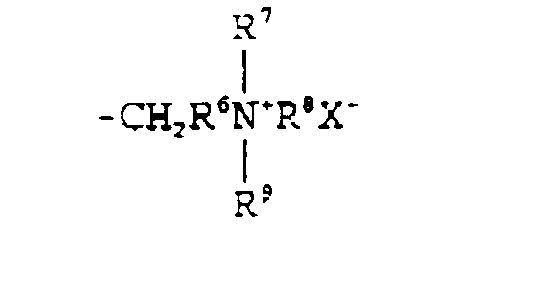
- R 2 , R 3 , R 4 , or R 5 are represented by Formula (II): wherein R 6 is C 1-4 hydroxyalkylene; R 7 , R 8 , and R 9 are individually or combined as C 1-16 alkyl; and X is an anion, preferably a halide.
- Especially preferred compounds of Formula (I) include compounds wherein R 1 is methyl, each of R 2 , R 3 and R 4 , is hydrogen, and R 5 is a quaternary nitrogen-containing group of Formula (II).
- quaternary nitrogen-containing ethoxylated glucosides are commercially available or can be prepared by methods known in the art, such as the methods described in U.S. Patent No. 5,138,043, supra.
- An especially preferred material is quaternary nitrogen-containing ethoxylated glucose derivatives available under the CTFA (Cosmetic, Toiletry and Fragrance Association) designation lauryl methyl gluceth-10 hydroxypropyldimonium chloride, including the product commercially available under the trade name GLUCQUAT-100 (Amerchol Corp., Edison, New Jersey).
- GLUCQUAT-100 consists of a 10-mole ethoxylate of methyl glucoside and an ether-linked quaternized structure.
- aqueous compositions of quaternary nitrogen-containing ethoxylated alkyl glucosides are very effective at wetting the surfaces of contact lenses, especially rigid, gas permeable (RGP) contact lenses.
- the quaternary nitrogen-containing ethoxylated alkyl glucosides contain, in one portion of the molecule, a hydrophilic polyethoxylated alkyl glucoside derivative, and on another portion, a cationic, hydrophobic moiety attached to an ammonium ion. Due to the presence of the cationic moiety, the material can associate with negatively charged lens surfaces, whereby the hydrophilic moiety extends from the lens surface to maintain moisture on the surface. Additionally, this interaction with the lens imparts a "cushioning" effect to the lens surface to increase wearing comfort of lenses treated with the compositions.
- the quaternary nitrogen-containing ethoxylated alkyl glucoside may be employed in the compositions at about 0.001 to about 10 weight percent of the composition, preferably at about 0.001 to about 5 weight percent, with about 0.005 to about 2 weight percent being especially preferred.
- compositions for use in this invention include buffering agents for buffering or adjusting pH of the composition, and/or tonicity adjusting agents for adjusting the tonicity of the composition.
- Representative buffering agents include: alkali metal salts such as potassium or sodium carbonates, acetates, borates, phosphates, citrates and hydroxides; and weak acids such as acetic, boric and phosphoric acids.
- Representative tonicity adjusting agents include: sodium and potassium chloride, and those materials listed as buffering agents.
- the tonicity agents may be employed in an amount effective to adjust the osmotic value of the final composition to a desired value.
- the buffering agents and/or tonicity adjusting agents may be included up to about 10 weight percent.
- an antimicrobial agent is included in the composition in an antimicrobially effective amount, i.e., an amount which is effective to at least inhibit growth of microorganisms in the composition.
- the composition can be used to disinfect as well as met a contact lens treated therewith.
- antimicrobial agents are known in the art as useful in contact lens solutions, including: chlorhexidine (1,1'-hexamethylene-bis[5-(p-chlorophenyl) biguanide]) or water soluble salts thereof, such as chlorhexidine gluconate; polyhexamethylene biguanide (a polymer of hexamethylene biguanide, also referred to as polyaminopropyl biguanide) or water-soluble salts thereof, such as the polyhexamethylene biguanide hydrochloride available under the trade name Cosmocil CQ (ICI Americas Inc.); benzalkonium chloride; and polymeric quaternary ammonium salts.
- the antimicrobial agent may be included at 0.00001 to about 5 weight percent, depending on the specific agent.
- compositions may further include a sequestering agent (or chelating agent) which can be present up to about 2.0 weight percent.
- sequestering agents include ethylenediaminetetraacetic acid (EDTA) and its salts, with the disodium salt (disodium edetate) being especially preferred.
- the quaternary nitrogen-containing ethoxylated alkyl glucoside is very effective at providing the compositions with the ability to wet surfaces of contact lenses treated therewith.
- the composition may include as necessary a supplemental wetting agent.
- Representative supplemental wetting agents include: polyethylene oxide-containing materials; cellulosic materials such as cationic cellulosic polymers, hydroxypropyl methylcellulose, hydroxyethyl cellulose, hydroxypropyl cellulose and methylcellulose; polyvinyl alcohol; and polyvinyl pyrrolidone.
- Such additives when present, may be used in a wide range of concentrations, generally about 0.1 to about 10 weight percent.
- Contact lenses are treated with the compositions by contacting the lenses with the compositions.
- a contact lens can be stored in the solution, or soaked in the solution, for sufficient time to wet the surfaces thereof.
- the treated lens can be inserted directly in the eye, or alternately, the lens can be rinsed. Alternately, drops of solution can be placed on the lens surface and the treated lens inserted in the eye.
- the specific lens care regimen used will depend on the other compounds present in the solution, as is well known in the art.
- the contact lens is preferably soaked in the composition for sufficient time to disinfect the lens and wet the surface thereof.
- the compositions may include at least one surface active agent having cleaning activity for contact lens deposits in order to provide contact lens solutions useful for cleaning as well as wetting contact lenses.
- surface active agents are known in the art as a primary cleaning agent, including anionic, cationic, nonionic and amphoteric surface active agents. Representative surface active agents are included in the Examples, infra.
- the surface active agents having cleaning activity for contact lens deposits may be employed at about 0.001 to about 5 weight percent of the composition, preferably at about 0.005 to about 2 weight percent, with about 0.01 to about 0.1 weight percent being especially preferred.
- CTFA Cosmetic, Toiletry, and Fragrance Association
- CFA Cocamidopropyl Betaine
- CFA Cocamidopropyl Betaine
- Monateric CAB Mona Industries Inc., Paterson, New Jersey
- Monateric LM-M30® Mona Industries Inc., Paterson, New Jersey
- Monateric CSH-32® Mona Industries Inc.,Paterson, New Jersey
- Isostearoanphopropionate Sodium Isostearoamphopropionate
- CFA Monateric ISA-35®
- Mona Industries Inc., Paterson, New Jersey Cocoamphopropylsulfonate Sodium Cocoamphohydroxypropylsulfonate (CTFA) Miranol CS® Conc.
- Sample materials for surface analyses in the Examples were prepared from standard contact lens blanks. Wafers with a diameter of 12.7mm and a thickness of 0.25mm were cut from the blanks and both surfaces polished to an optical finish using a polishing powder dispersed in deionized water. Polished samples were rinsed thoroughly with deionized water and stored in a clean glass vial under deionized water until use.
- Dynamic contact angle measurements were made with hydrated, polished wafers utilizing a Cahn Instruments DCA 322. Wafers were dipped in the test solution 7 times at an average rate of 225 microns per second. All tests were run at room temperature. A computer assisted mathematical analysis of the data yields a graph of contact angle plotted against the vertical position on the wafer. The average Advancing and Receding contact angles were obtained from the graph.
- the surface tension of solution samples is determined with a Cahn Instruments DCA 322. Glass slides measuring 25mm X 30mm X 0.14mm are flame cleaned and then dipped into the test solution 7 times at an average rate of 225 microns per second. All tests were run at room temperature. A computer assisted mathematical analysis of the data yields a graph of force versus position on the glass slide. The surface tension is obtained from this graph.
- Solution A the control produced no corneal staining and was perceived as "comfortable” by the test subjects.
- Solutions B through F produced the same results as the control, namely, no staining and no adverse effect on comfort.
- RGP fluorosilicone rigid gas permeable
- BOSTON RXD® Polymer Technology Corporation, Boston, Massachusetts
- DCA Dynamic contact angles
- formulations of this example are representative of conditioning solutions for contact lenses which provide disinfection and cushioning of the lens surface.
- HPMC hydroxypropyl methylcellulose
- sodium chloride sodium chloride
- potassium chloride sodium edetate
- disodium edetate disodium edetate
- formulations of this example are representative of conditioning solutions containing a polyethylene oxide-containing polymer for increased biocompatibility.
- HPMC HPMC
- polyvinyl alcohol sodium chloride
- potassium chloride sodium chloride
- disodium edetate disodium edetate
- the HPMC, polyvinyl alcohol, sodium chloride, potassium chloride and disodium edetate were dissolved in deionized water, then autoclaved at 121°C for 30-40 minutes.
- the solution was then transferred to a clean room where the remaining ingredients, dissolved in deionized water, were added to the solution through a 0.22 micron filter.
- the final solution was mixed and dispensed to sterile bottles.
- the conditioning solutions described in EXAMPLE 5 were evaluated on eye to assess clinical performance. Clean BOSTON RXD lenses for two adapted RGP lens wearers were soaked in the solutions overnight. Each subject installed the lenses directly from the solution (no rinse step) and was examined immediately by a clinician who evaluated a number of parameters using a biomicroscope. The compiled results of the clinical evaluation of solutions A through D are presented below.
- formulations of this example are representative of conditioning solutions for contact lenses which provide disinfection and cushioning of the lens surface.
- HPMC hydroxyethylcellulose
- HEC hydroxyethylcellulose
- polyvinyl alcohol sodium chloride
- potassium chloride sodium chloride
- disodium edetate disodium edetate
- Solution Ingredients A B C D Glucquat 100, % 0.100 0.100 0.100 0.100 0.100 0.100 HPMC E4M 0.500 0.500 HEC 250MR, % 0.500 0.500 PVA, 107 % 0.300 0.300 Pluronic F-127 % 0.300 0.300 Sodium Phosphate, dibasic % 0.280 0.280 0.280 0.280 Potassium Phosphate, monobasic % 0.055 0.055 0.055 Sodium Chloride % 0.780 0.780 0.780 0.780 Potassium Chloride % 0.170 0.170 0.170 0.170 Disodium Edetate % 0.050 0.050 0.050 0.050 0.050 0.050 Polyhexamethylene Biguanide, ppm 15 15 15 15 15 Deionized Water Q.S.
- EXAMPLE 7 The solutions described in EXAMPLE 7 were evaluated on eye to assess the clinical performance. Clean BOSTON RXD lenses for two adapted RGP lens wearers were soaked in the solutions overnight. Each subject installed the lenses directly from the solution (no rinse step) and was examined immediately by a clinician who evaluated a number of parameters using a biomicroscope.
- formulations of this example are representative of multipurpose contact lens solutions which clean, disinfect and condition the surfaces of contact lenses in one step.
- Solutions containing the following ingredients were prepared and passed through a 0.22 micron sterilizing filter in a clean room environment. The solutions were then packaged in sterile bottles.
- EXAMPLE 9 The solutions described in EXAMPLE 9 were evaluated in-eye to assess the clinical impact of various concentrations of GLUCQUAT 100 and PLURONIC P-85 in borate buffer. Eyes were examined using fluorescein instillation and biomicroscopy at baseline and immediately after instillation of two drops of test solution. The FDA classification of slit lamp findings was utilized to classify any corneal staining. Additionally, the individuals were asked to comment on the comfort of the test solutions.
- BOSTON RXD lenses were worn by adapted RGP lens wearers for 12 to 16 hours. At that time lenses were removed from the eyes and placed in contact lens cases. The lenses were kept dry until use in the cleaning efficacy test.
- formulations of this example are representative of multipurpose solutions which clean, disinfect, and condition the surfaces of contact lenses in one step.
- Solutions containing the following ingredients were prepared and passed through a 0.22 micron sterilizing filter in a clean room environment. The solutions were then packaged in sterile bottles. Solutions Ingredients A B C D E Glucquat 100 % 0.100 0.100 0.100 0.100 0.100 0.100 Glycerin-U.S.P % 2.000 2.000 2.000 2.000 Tween 20 % 0.100 0.100 0.100 0.100 0.100 0.100 Sipex EST-30 % 0.100 Monateric CSH-32 % 0.100 0.100 Monateric ISA-35 % 0.100 0.100 Sodium Borate % 0.070 0.070 0.070 0.070 Boric Acid % 0.450 0.450 0.450 0.450 Sodium Chloride % 0.700 0.700 0.700 0.700 0.700 Potassium Chloride % 0.150 0.150 0.150 0.150 Disodium Edetate % 0.050 0.050 0.050 0.050 0.050 0.050 Polyhexamethylene Biguanide, ppm 15 15 15 15 15 15 15 15 Deionized Water Q
- EXAMPLE 12 The solutions described in EXAMPLE 12 were evaluated in-eye to assess the clinical impact of GLUCQUAT 100 with various non-ionic, anionic and amphoteric surfactants in borate buffer. Eyes were examined using fluorescein instillation and biomicroscopy at baseline and immediately after instillation of two drops of test solution. The FDA classification of slit lamp findings was utilized to classify any corneal staining. Additionally, the individuals were asked to comment on the comfort of the test solutions.
- EXAMPLE 12 The solutions of EXAMPLE 12 were evaluated to determine their cleaning efficacy in removing contact lens deposits during the soaking period.
- BOSTON RXD lenses were worn by adapted RGP lens wearers for 12 to 16 hours. At that time lenses were removed from the eyes and placed in contact lens cases. The lenses were kept dry until use in the cleaning efficacy test.
- the worn lenses were examined using a microscope at 20X magnification and the deposit pattern was noted.
- a lens was then placed in a contact lens storage case and about 1 ml of the test solution added to cover the lens completely with the fluid.
- the case was closed and allowed to stand at ambient conditions for 12 hours. At that time the lens was removed and rubbed between the forefinger and the thumb for about 20 seconds.
- the lens was then rinsed thoroughly with water and dried with compressed air. The dried lens was again examined at 20X magnification to identify the extent of deposit removal.
- formulations of this example are representative of alcohol-containing cleaning solutions for contact lenses.
- BOSTON RXD lenses were worn by adapted RGP lens wearers for 12 to 15 hours. At that time lenses were removed from the eyes and placed in contact lens cases. The lenses were kept dry until use in the cleaning efficacy test.
- the worn lenses were examined using a microscope at 20X magnification and the deposit pattern noted. A lens was then placed in the palm of the hand and several drops of test solution were added. Using the forefinger, the lens was then rubbed in the palm of the hand for 20 seconds. A few more drops of test solution were added and the procedure repeated. The lens was then rinsed thoroughly with water and dried with compressed air. The dried lens was again examined at 20X magnification to identify the extent of deposit removal.
Landscapes
- Chemical & Material Sciences (AREA)
- Life Sciences & Earth Sciences (AREA)
- Organic Chemistry (AREA)
- Chemical Kinetics & Catalysis (AREA)
- Oil, Petroleum & Natural Gas (AREA)
- Wood Science & Technology (AREA)
- Engineering & Computer Science (AREA)
- Health & Medical Sciences (AREA)
- Molecular Biology (AREA)
- Emergency Medicine (AREA)
- Eyeglasses (AREA)
- Detergent Compositions (AREA)
- Apparatus For Disinfection Or Sterilisation (AREA)
Claims (8)
- Procédé de mouillage d'une lentille de contact comprenant la mise en contact de ladite lentille de contact avec une composition aqueuse qui comprend un alkyl glucoside éthoxylé contenant de l'azote quaternaire.
- Procédé suivant la revendication 1, dans lequel l'alkyl glucoside éthoxylé contenant de l'azote quaternaire est représenté par la formule :dans laquelle R1 est un alkyle, la somme moyenne de w, x, y et z par mole de composé se situe dans la gamme d'environ 1 à environ 200, n est égal à 0 ou 1, R2, R3, R4 et R5 représentent individuellement de l'hydrogène ou des groupes contenant de l'azote quaternaire, pour autant qu'au moins l'un des R2, R3, R4 et R5 soit un groupe contenant de l'azote quaternaire et qu'au moins l'un des R2, R3, R4, et R5 soit de l'hydrogène.

- Procédé suivant la revendication 2, dans lequel le groupe contenant de l'azote quaternaire est représenté par la formule structurale :dans laquelle R6 est un groupe hydroxyalkyléne en C1-4, R7, R8 et R9 représentent individuellement ou sous une forme combinée un groupe alkyle en C1-16 et X est un anion.
- Procédé suivant la revendication 3, dans lequel l'alkyl glucoside éthoxylé contenant de l'azote quaternaire est le chlorure de lauryl méthyl gluceth-10 hydroxypropyldimonium.
- Procédé suivant l'une quelconque des revendications précédentes, dans lequel la composition comprend de plus au moins un membre choisi parmi les agents tampons, les agents d'ajustement de la tonicité, les agents antimicrobiens, les agents mouillants et les agents tensioactifs ayant une activité de nettoyage pour les dépôts de lentilles de contact.
- Procédé de désinfection et de mouillage d'une lentille de contact comprenant la mise en contact de ladite lentille de contact avec une composition aqueuse qui comprend un alkyl glucoside éthoxylé contenant de l'azote quaternaire et une quantité antimicrobiennement efficace d'un agent antimicrobien.
- Procédé suivant l'une quelconque des revendications précédentes, dans lequel la lentille de contact est une lentille de contact perméable aux gaz, rigide.
- Procédé suivant l'une quelconque des revendications précédentes, dans lequel, après la mise en contact de la lentille de contact avec la composition aqueuse, la lentille de contact est introduite directement dans l'oeil.
Applications Claiming Priority (3)
| Application Number | Priority Date | Filing Date | Title |
|---|---|---|---|
| US08/080,423 US5405878A (en) | 1993-06-18 | 1993-06-18 | Contact lens solution containing cationic glycoside |
| US80423 | 1993-06-18 | ||
| PCT/US1994/006786 WO1995000615A1 (fr) | 1993-06-18 | 1994-06-15 | Solution pour lentilles de contact contenant un glycoside cationique |
Publications (2)
| Publication Number | Publication Date |
|---|---|
| EP0703964A1 EP0703964A1 (fr) | 1996-04-03 |
| EP0703964B1 true EP0703964B1 (fr) | 1998-08-19 |
Family
ID=22157275
Family Applications (1)
| Application Number | Title | Priority Date | Filing Date |
|---|---|---|---|
| EP94920226A Expired - Lifetime EP0703964B1 (fr) | 1993-06-18 | 1994-06-15 | Procede pour humecter des lentilles de contact, avec une solution contenant un glycoside cationique |
Country Status (8)
| Country | Link |
|---|---|
| US (1) | US5405878A (fr) |
| EP (1) | EP0703964B1 (fr) |
| JP (1) | JPH09502028A (fr) |
| AU (1) | AU7109594A (fr) |
| CA (1) | CA2165161C (fr) |
| DE (1) | DE69412615T2 (fr) |
| ES (1) | ES2123143T3 (fr) |
| WO (1) | WO1995000615A1 (fr) |
Families Citing this family (35)
| Publication number | Priority date | Publication date | Assignee | Title |
|---|---|---|---|---|
| US5401327A (en) * | 1993-06-18 | 1995-03-28 | Wilmington Partners L.P. | Method of treating contact lenses |
| US5871758A (en) * | 1996-12-11 | 1999-02-16 | E-L Management Corp. | Dual phase cosmetic composition |
| FR2762849B1 (fr) * | 1997-05-05 | 1999-06-18 | Essilor Int | Solution aqueuse d'entretien des lentilles de contact |
| US6277365B1 (en) * | 1997-09-18 | 2001-08-21 | Bausch & Lomb Incorporated | Ophthalmic composition including a cationic glycoside and an anionic therapeutic agent |
| EP1049763B1 (fr) * | 1997-11-12 | 2007-05-23 | Bausch & Lomb Incorporated | Nettoyage et desinfection des lentilles de contact avec un biguanide et un tampon de phosphate-borate |
| US20030129083A1 (en) * | 1997-11-26 | 2003-07-10 | Advanced Medical Optics, Inc. | Multi purpose contact lens care compositions including propylene glycol or glycerin |
| CN1769411A (zh) | 1997-11-26 | 2006-05-10 | 先进医用光学公司 | 护理接触镜片的多用途溶液 |
| US6063745A (en) * | 1997-11-26 | 2000-05-16 | Allergan | Mutli-purpose contact lens care compositions |
| US6649174B2 (en) * | 1998-05-07 | 2003-11-18 | E-L Management Corp. | Dual phase cosmetic composition |
| IT1306123B1 (it) * | 1999-04-02 | 2001-05-30 | Technopharma Sa | Soluzione oftalmica viscosizzata con azione detergente sulle lenti acontatto. |
| JP2004517653A (ja) * | 2000-10-24 | 2004-06-17 | ボシュ・アンド・ロム・インコーポレイテッド | カチオン性多糖による、生体材料への細菌付着の予防 |
| US6703039B2 (en) * | 2000-12-06 | 2004-03-09 | Bausch & Lomb Incorporated | Reversible gelling system for ocular drug delivery |
| JP2002182166A (ja) * | 2000-12-11 | 2002-06-26 | Toray Ind Inc | プラスチック成形品およびそれからなるコンタクトレンズ |
| US20030100465A1 (en) * | 2000-12-14 | 2003-05-29 | The Clorox Company, A Delaware Corporation | Cleaning composition |
| US20020183233A1 (en) | 2000-12-14 | 2002-12-05 | The Clorox Company, Delaware Corporation | Bactericidal cleaning wipe |
| US7799751B2 (en) * | 2000-12-14 | 2010-09-21 | The Clorox Company | Cleaning composition |
| US6805836B2 (en) * | 2000-12-15 | 2004-10-19 | Bausch & Lomb Incorporated | Prevention of preservative uptake into biomaterials |
| US6702983B2 (en) | 2001-05-15 | 2004-03-09 | Bausch & Lomb Incorporated | Low ionic strength method and composition for reducing bacterial attachment to biomaterials |
| US6998372B2 (en) * | 2001-08-16 | 2006-02-14 | J&J Consumer Companies, Inc. | Moisturizing detergent compositions |
| US6849586B2 (en) | 2001-10-26 | 2005-02-01 | S. C. Johnson & Son, Inc. | Hard surface cleaners containing chitosan |
| CN1684722A (zh) * | 2002-09-30 | 2005-10-19 | 博士伦公司 | 减少细菌在生物材料和生物医学装置上的粘附 |
| TWI322828B (en) * | 2002-12-23 | 2010-04-01 | Alcon Inc | Use of multifunctional surface active agents to clean contact lenses |
| US20050118132A1 (en) * | 2003-12-01 | 2005-06-02 | Erning Xia | Nonionic surfactant containing compositions for cleaning contact lenses |
| US7223737B1 (en) | 2004-08-13 | 2007-05-29 | Alcon, Inc. | Method of treating dry eye disorders using glycosides |
| US7858000B2 (en) * | 2006-06-08 | 2010-12-28 | Novartis Ag | Method of making silicone hydrogel contact lenses |
| DK2038310T3 (da) * | 2006-07-12 | 2010-09-27 | Novartis Ag | Aktinisk tværbindelige copolymerer til fremstilling af kontaktlinser |
| AR064286A1 (es) | 2006-12-13 | 2009-03-25 | Quiceno Gomez Alexandra Lorena | Produccion de dispositivos oftalmicos basados en la polimerizacion por crecimiento escalonado fotoinducida |
| US20080214421A1 (en) * | 2007-02-19 | 2008-09-04 | Fang Zhao | Contact lens care composition |
| TWI551305B (zh) * | 2007-08-31 | 2016-10-01 | 諾華公司 | 相對黏稠封裝溶液之用途 |
| WO2009032122A1 (fr) | 2007-08-31 | 2009-03-12 | Novartis Ag | Solutions de conditionnement de lentilles de contact |
| US20100075919A1 (en) * | 2008-09-22 | 2010-03-25 | Erning Xia | Compositions comprising alkyldimonium hydroxypropyl alkylglucosides |
| US7632794B1 (en) | 2008-09-22 | 2009-12-15 | Bausch & Lomb Incorporated | Lens care solutions comprising alkyldimonium hydroxypropyl alkylglucosides |
| US20110142786A1 (en) * | 2009-09-16 | 2011-06-16 | Erning Xia | Lens care solutions functionalized alkyldimonium hydroxypropyl alkylglucosides |
| CN102612378B (zh) * | 2009-11-17 | 2014-11-26 | 诺华股份有限公司 | 用于接触透镜清毒的过氧化氢溶液和套件 |
| KR102648671B1 (ko) | 2015-12-03 | 2024-03-19 | 알콘 인코포레이티드 | 콘택트 렌즈 포장 용액 |
Family Cites Families (6)
| Publication number | Priority date | Publication date | Assignee | Title |
|---|---|---|---|---|
| US4168112A (en) * | 1978-01-05 | 1979-09-18 | Polymer Technology Corporation | Contact lens with a hydrophilic, polyelectrolyte complex coating and method for forming same |
| US4436730A (en) * | 1979-06-25 | 1984-03-13 | Polymer Technology Corporation | Ionic opthalmic cellulose polymer solutions |
| DE3626082A1 (de) * | 1986-07-31 | 1988-02-11 | Henkel Kgaa | Desinfektions- und reinigungsmittelsystem fuer kontaktlinsen |
| JPH01158412A (ja) * | 1986-12-26 | 1989-06-21 | Daicel Chem Ind Ltd | コンタクトレンズ用洗浄保存液 |
| JP2578127B2 (ja) * | 1987-08-20 | 1997-02-05 | ト−メ−産業株式会社 | コンタクトレンズ用溶液 |
| US5138043A (en) * | 1989-12-07 | 1992-08-11 | Union Carbide Chemicals & Plastics Technology Corporation | Alkoxylated alkyl glucoside ether quaternaries useful in personal care |
-
1993
- 1993-06-18 US US08/080,423 patent/US5405878A/en not_active Expired - Lifetime
-
1994
- 1994-06-15 AU AU71095/94A patent/AU7109594A/en not_active Abandoned
- 1994-06-15 CA CA002165161A patent/CA2165161C/fr not_active Expired - Fee Related
- 1994-06-15 ES ES94920226T patent/ES2123143T3/es not_active Expired - Lifetime
- 1994-06-15 DE DE69412615T patent/DE69412615T2/de not_active Expired - Fee Related
- 1994-06-15 JP JP7502936A patent/JPH09502028A/ja not_active Ceased
- 1994-06-15 EP EP94920226A patent/EP0703964B1/fr not_active Expired - Lifetime
- 1994-06-15 WO PCT/US1994/006786 patent/WO1995000615A1/fr not_active Ceased
Also Published As
| Publication number | Publication date |
|---|---|
| WO1995000615A1 (fr) | 1995-01-05 |
| US5405878A (en) | 1995-04-11 |
| DE69412615D1 (de) | 1998-09-24 |
| EP0703964A1 (fr) | 1996-04-03 |
| AU7109594A (en) | 1995-01-17 |
| DE69412615T2 (de) | 1999-03-18 |
| ES2123143T3 (es) | 1999-01-01 |
| CA2165161A1 (fr) | 1995-01-05 |
| JPH09502028A (ja) | 1997-02-25 |
| CA2165161C (fr) | 1999-10-19 |
Similar Documents
| Publication | Publication Date | Title |
|---|---|---|
| US5405878A (en) | Contact lens solution containing cationic glycoside | |
| EP0703966B1 (fr) | Composition de mouillage pour lentilles de contact | |
| US6037328A (en) | Method and composition for rewetting and preventing deposits on contact lens | |
| US4820352A (en) | Cleaning and conditioning solutions for contact lenses and methods of use | |
| KR100342089B1 (ko) | 콘택트렌즈 세정 및 습윤화용 조성물 | |
| KR100341671B1 (ko) | 콘택트렌즈세정용및습윤화용조성물 | |
| JP2002504399A (ja) | アルカリ炭酸塩を含有する水溶液を用いたコンタクトレンズの処理 | |
| US7105473B2 (en) | Compositions and methods using sub-PPM combinations of polyquaternium-1 and high molecular weight PHMB | |
| AU5992594A (en) | Preservative system for contact lens solutions | |
| JP4064625B2 (ja) | コンタクトレンズ洗浄組成物 | |
| US4908147A (en) | Aqueous self preserving soft contact lens solution and method | |
| US20030119684A1 (en) | Conditioning solution for contact lenses and a method of using the same | |
| US20060241001A1 (en) | Composition for treating contact lenses | |
| US20030133905A1 (en) | Composition for treating contact lenses in the eye | |
| JP2747354B2 (ja) | コンタクトレンズ用溶液及びそれを用いたコンタクトレンズの親水性化処理法 | |
| EP0115619A1 (fr) | Solutions pour le nettoyage et le traitement de verres de contact et procédé pour leur utilisation | |
| JPH0641581A (ja) | コンタクトレンズ用親水性洗浄剤 | |
| HK1011704B (en) | Composition for wetting contact lenses | |
| JPH09159975A (ja) | コンタクトレンズ用水性溶液 | |
| AU2006202392A1 (en) | Composition for treating contact lenses |
Legal Events
| Date | Code | Title | Description |
|---|---|---|---|
| PUAI | Public reference made under article 153(3) epc to a published international application that has entered the european phase |
Free format text: ORIGINAL CODE: 0009012 |
|
| 17P | Request for examination filed |
Effective date: 19951205 |
|
| AK | Designated contracting states |
Kind code of ref document: A1 Designated state(s): DE ES FR GB IT |
|
| 17Q | First examination report despatched |
Effective date: 19960423 |
|
| GRAG | Despatch of communication of intention to grant |
Free format text: ORIGINAL CODE: EPIDOS AGRA |
|
| GRAG | Despatch of communication of intention to grant |
Free format text: ORIGINAL CODE: EPIDOS AGRA |
|
| GRAH | Despatch of communication of intention to grant a patent |
Free format text: ORIGINAL CODE: EPIDOS IGRA |
|
| GRAH | Despatch of communication of intention to grant a patent |
Free format text: ORIGINAL CODE: EPIDOS IGRA |
|
| GRAA | (expected) grant |
Free format text: ORIGINAL CODE: 0009210 |
|
| AK | Designated contracting states |
Kind code of ref document: B1 Designated state(s): DE ES FR GB IT |
|
| ITF | It: translation for a ep patent filed | ||
| REF | Corresponds to: |
Ref document number: 69412615 Country of ref document: DE Date of ref document: 19980924 |
|
| ET | Fr: translation filed | ||
| REG | Reference to a national code |
Ref country code: ES Ref legal event code: FG2A Ref document number: 2123143 Country of ref document: ES Kind code of ref document: T3 |
|
| PLBE | No opposition filed within time limit |
Free format text: ORIGINAL CODE: 0009261 |
|
| STAA | Information on the status of an ep patent application or granted ep patent |
Free format text: STATUS: NO OPPOSITION FILED WITHIN TIME LIMIT |
|
| 26N | No opposition filed | ||
| PGFP | Annual fee paid to national office [announced via postgrant information from national office to epo] |
Ref country code: GB Payment date: 20010502 Year of fee payment: 8 |
|
| PGFP | Annual fee paid to national office [announced via postgrant information from national office to epo] |
Ref country code: FR Payment date: 20010531 Year of fee payment: 8 |
|
| PGFP | Annual fee paid to national office [announced via postgrant information from national office to epo] |
Ref country code: ES Payment date: 20010613 Year of fee payment: 8 |
|
| PGFP | Annual fee paid to national office [announced via postgrant information from national office to epo] |
Ref country code: DE Payment date: 20010627 Year of fee payment: 8 |
|
| REG | Reference to a national code |
Ref country code: GB Ref legal event code: IF02 |
|
| PG25 | Lapsed in a contracting state [announced via postgrant information from national office to epo] |
Ref country code: GB Free format text: LAPSE BECAUSE OF NON-PAYMENT OF DUE FEES Effective date: 20020615 |
|
| PG25 | Lapsed in a contracting state [announced via postgrant information from national office to epo] |
Ref country code: ES Free format text: LAPSE BECAUSE OF NON-PAYMENT OF DUE FEES Effective date: 20020616 |
|
| PG25 | Lapsed in a contracting state [announced via postgrant information from national office to epo] |
Ref country code: DE Free format text: LAPSE BECAUSE OF NON-PAYMENT OF DUE FEES Effective date: 20030101 |
|
| GBPC | Gb: european patent ceased through non-payment of renewal fee |
Effective date: 20020615 |
|
| PG25 | Lapsed in a contracting state [announced via postgrant information from national office to epo] |
Ref country code: FR Free format text: LAPSE BECAUSE OF NON-PAYMENT OF DUE FEES Effective date: 20030228 |
|
| REG | Reference to a national code |
Ref country code: FR Ref legal event code: ST |
|
| REG | Reference to a national code |
Ref country code: ES Ref legal event code: FD2A Effective date: 20030711 |
|
| PG25 | Lapsed in a contracting state [announced via postgrant information from national office to epo] |
Ref country code: IT Free format text: LAPSE BECAUSE OF NON-PAYMENT OF DUE FEES;WARNING: LAPSES OF ITALIAN PATENTS WITH EFFECTIVE DATE BEFORE 2007 MAY HAVE OCCURRED AT ANY TIME BEFORE 2007. THE CORRECT EFFECTIVE DATE MAY BE DIFFERENT FROM THE ONE RECORDED. Effective date: 20050615 |