EP0704183A2 - Porte-bébé - Google Patents
Porte-bébé Download PDFInfo
- Publication number
- EP0704183A2 EP0704183A2 EP95306836A EP95306836A EP0704183A2 EP 0704183 A2 EP0704183 A2 EP 0704183A2 EP 95306836 A EP95306836 A EP 95306836A EP 95306836 A EP95306836 A EP 95306836A EP 0704183 A2 EP0704183 A2 EP 0704183A2
- Authority
- EP
- European Patent Office
- Prior art keywords
- baby
- cover portion
- touch buckles
- touch
- baby carrier
- Prior art date
- Legal status (The legal status is an assumption and is not a legal conclusion. Google has not performed a legal analysis and makes no representation as to the accuracy of the status listed.)
- Withdrawn
Links
- 230000000474 nursing effect Effects 0.000 claims description 38
- 239000000463 material Substances 0.000 claims description 20
- 230000003449 preventive effect Effects 0.000 claims description 17
- 210000001015 abdomen Anatomy 0.000 claims description 5
- 230000001681 protective effect Effects 0.000 description 18
- 239000004744 fabric Substances 0.000 description 17
- 238000000034 method Methods 0.000 description 7
- 230000008859 change Effects 0.000 description 5
- 230000004048 modification Effects 0.000 description 5
- 238000012986 modification Methods 0.000 description 5
- 239000004698 Polyethylene Substances 0.000 description 3
- 238000010276 construction Methods 0.000 description 3
- 239000011162 core material Substances 0.000 description 3
- 230000000694 effects Effects 0.000 description 3
- -1 polyethylene Polymers 0.000 description 3
- 229920000573 polyethylene Polymers 0.000 description 3
- 229920000742 Cotton Polymers 0.000 description 2
- JOYRKODLDBILNP-UHFFFAOYSA-N Ethyl urethane Chemical compound CCOC(N)=O JOYRKODLDBILNP-UHFFFAOYSA-N 0.000 description 2
- 239000000853 adhesive Substances 0.000 description 2
- 230000001070 adhesive effect Effects 0.000 description 2
- 230000008901 benefit Effects 0.000 description 2
- 239000000969 carrier Substances 0.000 description 2
- 238000005259 measurement Methods 0.000 description 2
- 230000008569 process Effects 0.000 description 2
- 230000035939 shock Effects 0.000 description 2
- 206010036437 Posturing Diseases 0.000 description 1
- 230000008602 contraction Effects 0.000 description 1
- 230000005489 elastic deformation Effects 0.000 description 1
- 238000003780 insertion Methods 0.000 description 1
- 230000037431 insertion Effects 0.000 description 1
- 230000007246 mechanism Effects 0.000 description 1
- 238000009423 ventilation Methods 0.000 description 1
Images













Classifications
-
- A—HUMAN NECESSITIES
- A47—FURNITURE; DOMESTIC ARTICLES OR APPLIANCES; COFFEE MILLS; SPICE MILLS; SUCTION CLEANERS IN GENERAL
- A47D—FURNITURE SPECIALLY ADAPTED FOR CHILDREN
- A47D13/00—Other nursery furniture
- A47D13/02—Baby-carriers; Carry-cots
- A47D13/025—Baby-carriers; Carry-cots for carrying children in seated position
-
- A—HUMAN NECESSITIES
- A44—HABERDASHERY; JEWELLERY
- A44B—BUTTONS, PINS, BUCKLES, SLIDE FASTENERS, OR THE LIKE
- A44B11/00—Buckles; Similar fasteners for interconnecting straps or the like, e.g. for safety belts
-
- A—HUMAN NECESSITIES
- A47—FURNITURE; DOMESTIC ARTICLES OR APPLIANCES; COFFEE MILLS; SPICE MILLS; SUCTION CLEANERS IN GENERAL
- A47D—FURNITURE SPECIALLY ADAPTED FOR CHILDREN
- A47D13/00—Other nursery furniture
- A47D13/08—Devices for use in guiding or supporting children, e.g. safety harness
-
- A—HUMAN NECESSITIES
- A47—FURNITURE; DOMESTIC ARTICLES OR APPLIANCES; COFFEE MILLS; SPICE MILLS; SUCTION CLEANERS IN GENERAL
- A47D—FURNITURE SPECIALLY ADAPTED FOR CHILDREN
- A47D15/00—Accessories for children's furniture, e.g. safety belts or baby-bottle holders
Definitions
- the present invention relates to a baby carrier or baby nursing supporter for use in carrying a baby as supported therein.
- a band-type baby carrier as described in, for example, Japanese Utility Model Application Laid-Open No. 2-71359, is comprised of a plurality of bands provided in combination and includes a crotch portion for supporting the crotch of the baby, a back portion for supporting the back of the baby, and shoulder strings for the baby nursing person.
- a bag-type baby carrier as described in, for example, Japanese Utility Model Publication No. 4-17064, includes a bag-like nursing supporter body comprising a crotch cover portion, a back cover portion, and a front cover portion for supporting the baby, and shoulder strings for the baby nursing person.
- the baby carrier of the conventional band type permits easy entry and egress of the baby relative to the nursing supporter body, but has a drawback that the baby is not supported at sides so that the baby may become inclined toward one side. This presents the problem of lack of stability in the support of the baby. Especially in the case of a baby who is not well steady in posture, such inclined posturing may often occur.
- the conventional bag-type baby carrier provides good support stability not only in forward and rearward directions, but also in lateral directions, thus enabling the baby to be stably supported.
- the baby carrier of this type has a disadvantage that the bag-like configuration of the nursing supporter body is inconvenient for entry and egress of the baby relative to the nursing supporter body.
- a baby carrier having a carrier body comprising a front cover portion, a crotch cover portion, and a back cover portion for supporting the baby which are integrally formed in continuation (see Japanese Utility Model Publication No. 61-25400).
- this kind of baby carrier in use, involves opening and closing of the carrier body by means of a pair of tightening belts, which operation is rather cumbersome.
- Another problem is that the carrier body may sometimes be irregularly tightened depending upon the manner in which the tightening belts are manipulated in closing the carrier body. This leads to the lack of stability in the support of the baby.
- the present invention has been developed in order to solve aforementioned problems with the prior art, and accordingly it is an object of the invention to provide a baby carrier which permits easy entry and egress of the baby relative to the baby carrier and which can support the baby in a stable and accurate manner.
- the baby carrier 1 includes a carrier body 2.
- the carrier body 2 comprises a front cover portion 3, a narrow crotch cover portion 4, and a back cover portion 5 which are integrally formed in continuation to respectively support the abdomen, crotch and back portions of the baby.
- upper and lower portions in Figs. 1 and 2 are hereinafter respectively referred to as the upper portion and the lower portion, of the baby carrier.
- a pair of downwardly extending shoulder belts 6, 6' are provided below the front cover portion 3.
- the shoulder belts 6, 6' have respective wider portions 6a, 6'a formed therein whereby the load applied to the nursing person may be reduced.
- the shoulder belts 6, 6' are provided at respective upper portions thereof with one-touch buckles 10, 10' which constitute a fastening device.
- the shoulder belts 6, 6' are further provided at respective lower ends with length-adjustable belt members 11, 11' and the belt members 11, 11' have one-touch buckles 12, 12' mounted at their forward ends.
- the shoulder belts 6, 6' at their upper ends, are interconnected by a connecting band 13.
- This connecting band 13 serves to prevent the shoulder belts 6, 6' from slipping off or becoming disengaged from the shoulder of the nursing person.
- buckle covers 14, 14' for respectively covering the one-touch buckles 10, 10' after the baby carrier 1 having been assembled.
- the buckle covers 14, 14' are fitted respectively with locking hooks 17, 17'.
- the shoulder belts 6, 6' are fitted at upper portions thereof with locking hooks 18, 18', as well as 19, 19', so that the locking hooks 18, 18' are releasably engageable with the locking hooks 17, 17' of the buckle covers 14, 14'.
- belt members 15, 15' extending therefrom in opposite lateral direction. These belt members 15, 15' are fitted at their respective distal ends with one-touch buckles 16, 16' which are removably engageable with one-touch buckles 12, 12' disposed at the lower ends of the shoulder belts 6, 6'.
- side supports 25, 25' Projecting obliquely upward from upper opposite ends (shoulder portions) of the back cover portion 5 are side supports 25, 25' for supporting sides of the baby's torso.
- the side supports 25, 25' are provided at their respective upper ends with obliquely upwardly extending belt members 20, 20' which are longitudinally adjustable.
- the belt members 20, 20' are respectively fitted with one-touch buckles 21, 21' which constitute a fastening device, the one-touch buckles 21, 21' being releasably engageable with the one-touch buckles 10, 10' of the shoulder belts 6, 6' respectively.
- the side supports 25, 25' are provided with locking hooks 26, 26' which are releasably engageable with locking hooks 27, 27' attached to the front cover portion 3 at opposite sides thereof.
- a head support 30 for supporting the baby's head from behind is provided on the top of the back cover portion 5.
- Opposite side portions 32, 32' of the head support 30 are fitted with locking hooks 33, 33' at their respective distal ends. These locking hooks 33, 33' are releasably engageable with the locking hooks 19, 19' affixed to respective upper portions of the shoulder belts 6, 6'.
- the head support 30, as Fig. 3 shows, comprises a surface cloth having a pad 40 of three-layer structure therein.
- the side designated by character A is the back side of the baby's head (rear side of the baby carrier 1)
- the side designated by character B is the outer side (front side of the baby carrier 1).
- the three-layer structure of the pad 40 comprises, sequentially from the A side, perspiration absorbent cotton (first cushioning material) 41 as soft cushioning material, medium cushioning material (third cushioning material) 42, such as urethane material, and hard cushioning material (second cushioning material) 43 , such as expanded polyethylene.
- first cushioning material 41 as soft cushioning material
- medium cushioning material (third cushioning material) 42 such as urethane material
- hard cushioning material (second cushioning material) 43 such as expanded polyethylene.
- a hard plate-like core material 44 is fitted at the exterior side of the expanded polyethylene material 43.
- the three-layer pad 40 in the head support 30, it is possible to obtain an advantage such that the cotton 41 can softly hold the back of the baby's head and can alleviate any external impact of comparatively low level (any load involving a comparatively long time period until a peak is reached).
- the expanded polyethylene material 43 can lessen any external impact of comparatively high level.
- the urethane material 42 can lessen any external medium impact.
- the head support 30 is removably attached to the back cover portion 5 by using adhesive cloth means, locking hooks, or the like. Such removable arrangement of the head support 30 permits the baby carrier 1 to be folded without being bulky.
- a width adjuster device 50 for adjusting the width of the carrier body 2 is provided at a lower median portion of the front cover portion 3.
- the width adjuster device 50 comprises a pocket cloth 52 and a pair of strings 53, respective ends of the strings 53 being sewn, together with the pocket cloth 52, to face cloth 51 of the front cover portion 3.
- the face cloth 51 is contracted widthwise so that the widthwise dimension H of the carrier body 2 can be made smaller (see Fig. 5).
- size adjustment can be effected according to the chest measurements of the baby.
- the baby carrier 1 can be employed in nursing babies of different physical constitutions. Further, the baby carrier 1 may be used for a comparatively long period of time with respect to one baby from babyhood to infancy.
- the crotch cover portion 4 is provided with a belt loop 55 which is adapted to be removably fitted with a waist belt 60, as shown in Fig. 6, through openings at opposite ends of the belt loop 55 (see Fig. 1).
- the waist belt 60 comprises an elongate belt portion 61, length-adjustable string members 62, 62' affixed to the belt portion 61 at opposite ends thereof, and one-touch buckles 63, 63' fitted to the string members.
- the shoulder belts 6, 6' When receiving a baby into the baby carrier 1, necessary procedure is that with the front side of the baby carrier 1 (Fig. 1) directed toward the nursing person, the shoulder belts 6, 6' are first placed on the shoulders of the nursing person so that the one-touch buckles 12, 12' at the distal ends of the shoulder belts are respectively brought into engagement with the one-touch buckles 16, 16' of the belt members 15, 15' (as indicated by chain lines in Figs. 1 and 2).
- the shoulder belts 6, 6' are suitably adjusted in length by means of the belt members 11, 11'. In this case, the rear side of the baby carrier 1 (Fig. 2) is exposed to the outside.
- the nursing person will hold the baby in arm and, while raising the back cover portion 5 of the carrier body 2 by one arm, the nursing person will draw the baby, together with the back cover portion 5, closer to him or her. Then, using one hand the nursing person will fit the one-touch buckle 21' of the side support 25' to the one-touch buckle 10' into engagement. Likewise, one-touch buckle 21 is fitted to one-touch buckle 10 into engagement. Thus, the baby is received into the baby carrier 1. In this way, assembling of a baby carrier is performed by means of one-touch buckles. This permits easy assembling, and easy, uniform side tightening of the baby carrier 1, thus making it possible to support the baby in a stable manner.
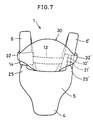
- buckle covers 14, 14' are wrapped around respective one-touch buckles, being then fastened by locking hooks 17, 18 and 17', 18' (see Fig. 7). By so doing it is possible to prevent one-touch buckles 10, 10' from being exposed on the baby side. In Fig. 7, buckle cover 14 only is shown.
- the baby carrier 1 may be previously adjusted in size by using belt members 20, 20' and/or width adjuster 50 according to the body size of the baby under nursing, in order to ensure more accurate support of the baby within the baby carrier 1.
- respective locking hooks 26, 26' of side supports 25, 25' are caused to engage locking hooks 27, 27' of the front cover portion 3.
- respective locking hooks 33, 33' of side portions 32, 32' of the head support 30 are caused to engage locking hooks 19, 19' at upper portions of the shoulder belts 6, 6'.
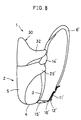
- a baby carrier 1 is assembled (see Figs. 7 and 8), and the baby is accommodated in the baby carrier 1 (see Fig. 9).
- sides of the baby's body are supported by the pair of side supports 25, 25'. Therefore, the baby can be stably and accurately supported within the baby carrier 1.
- the carrier body 2 can assume a bag-like configuration, and this provides for easy entry and egress of the baby.
- Fig. 10 It may be arranged that side portions 32, 32' of the head support 30 are received into pockets provided at the head support 30 as illustrated in Fig. 10. This arrangement provides right and left fields of view for the baby. Further, in summer hot climate condition in particular, such arrangement provides good ventilation for the head of the baby.
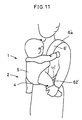
- head support 30 When the baby has grown so that he or she can hold his or her head steady, head support 30 is no longer required. In that case, the head support 30 may be removed, as shown in Fig. 11.
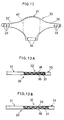
- Figs. 12 and 13 For the head support 30 in the above described embodiment, one of the type shown in Figs. 12 and 13 may be employed.
- the head support 30 shown in Fig. 12 differs from the one used in the previous embodiment in that projections 32, 32' which project from the head support body 31 in opposite lateral directions are larger in length than those in the previous embodiment, and in that locking hooks 33, 33' are provided in pluralities (three each in the present embodiment).
- Locking hooks to be engaged by the locking hooks 19, 19' of the baby carrier 1 are suitably selected from these sets of locking hooks 33, 33', whereby the size of the space for housing the baby's head can be varied.
- size adjustment according to the difference between individual babies in head size (physical difference) or the degree of growth of one particular baby in respect of head size.
- the head support body 31 is fitted at a lower portion thereof with locking hooks 34 for fastening the head support body 31 to the carrier body 2 of the baby carrier 1.
- the back cover portion 5 of the carrier body 2 is provided with locking hooks for engagement by the locking hooks 34.
- a baby carrier having no head support can provide accurate support of a baby's head by using a separate head support.
- the one shown in Fig. 12 has a head support body 31 incorporating a three-layer pad 40.
- this pad 40 therefore, it is possible to effectively protect the head of the baby from various external shocks.
- the head support 30 shown in Fig. 13 is identical with that of the previous embodiment in that projections 32, 32' (projection 32 only shown in Fig. 13) are each provided with one locking hook 33, 33'. However, it is different from the head support of the previous embodiment in that the projections 32, 32' are each partially comprised of an elastic bag-like rubber cloth 36.
- the rubber cloth 36 has a core material 37 incorporated therein.
- respective projections 32, 32' vary in length through expansion and contraction of the rubber cloth 36 (see Fig. 13A, 13B) and accordingly the space for accommodating a baby's head can be varied in size.
- the elastic coefficient of the rubber cloth 36 is preferably of such a small order that the rubber cloth easily expands under the weight of the baby's head leaning against the head support 30.
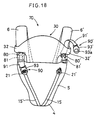
- Figs. 14 to 18 illustrate a baby carrier representing another embodiment of the invention.
- reference numerals or characters identical with those in the previous embodiment designate like or corresponding parts.
- baby carrier 70 as in the previous embodiment, includes a front cover portion 3, a crotch cover portion 4, and a back cover portion 5 which are integrally formed in continuation.
- Respective shoulder belts 6, 6' are fitted at their upper portions with generally D-shaped ring members 80, 80' operative as fastening means.
- These ring members 80, 80' are respectively fitted at their base portions with belt members 91, 91' extending in the direction in which the shoulder belts 6, 6' extend.
- the belt members 91, 91' are fitted at their distal ends with protective cover-equipped buckles 90, 90' operative as fastening means for respective shoulder belts 6, 6'.
- Protective cover-equipped buckle 90 as Fig. 16 shows, comprises a one-touch buckle 92 to which a distal end portion of the belt member 91 is affixed, and a protective cover 93 for covering a manipulator portion 92a of the one-touch buckle 92.
- the protective cover 93 is pivotally supported on a pin 94 which is inserted into the one-touch buckle 92, and is adapted to assume a closed position (position shown by solid line) for covering the manipulator portion 92a and an open position (position shown by chain line) such that the cover is pivotally moved away from the manipulator portion 92a.
- the protective cover 93 has an opening 93a which is adapted to receive one-touch buckle 21.
- Fig. 16 illustrates only protective cover-equipped buckle 90 at the belt member 91 side.
- the protective cover-equipped buckle 90' at the belt member 91' side is of similar construction, of which description is therefore omitted.
- One-touch buckles 12, 12' fitted to the distal ends of belt members 11, 11' at lower ends of respective shoulder belts 6, 6' are releasably engageable with respective one-touch buckles 16, 16' at lower ends of obliquely downwardly extending belt members 15, 15' provided at lower sites of the crotch cover portion 4.
- the belt members 15, 15' extend obliquely upward from the crotch cover portion 4 to the back cover portion 5 and affixed to the crotch cover portion 4 and back cover portion 5.
- the belt members 15, 15' are fitted at their upper ends with one-touch buckles 21, 21' which are releasably engageable by one-touch buckles 92, 92' of protective cover-equipped buckles 90, 90'.
- These one-touch buckles 21, 21' are disposed slightly inward from the upper end of the back cover portion 5.
- hook members 81, 81' which are releasably engageable by ring members 80, 80'.
- hook portion 81a of hook member 81 has an engagement clearance s which is slightly smaller than diameter d of the corresponding ring member 80.
- the hook portion 81a is subjected to slight elastic deformation to enable the hook member 81 to engage the ring member 80.
- the ring member 80 is not easily disengageable from the hook member 81.
- the hook portion 81a is disposed on the nursing person's side (righthand side in Fig. 17) so that lift of the lower end of the ring member 80 is unlikely to occur which may otherwise be a cause of disengagement of the ring member 80.
- a head support 30 provided on the top of the back cover portion 5 incorporates a three-layer pad 40 of the same construction as that of the previous embodiment so that the head of the baby can be effectively protected from various external shocks.
- the head support 30 is removably attached to the back cover portion 5 by means of locking hooks, adhesive cloth or the like.
- the shoulder belts 6, 6' are first placed on the shoulders of the nursing person so that the one-touch buckles 12, 12' at the distal ends of the shoulder belts 6, 6' are respectively brought into engagement with the one-touch buckles 16, 16' of the belt members 15, 15'.
- the nursing person will hold the baby in arm and, while raising the back cover portion 5 of the carrier body 2 by one arm, the nursing person will draw the baby, together with the back cover portion 5, closer to him or her.
- the hook members 81, 81' of the back cover portion 5 are brought into engagement with the ring members 80, 80' of the shoulder belts 6, 6' (see Fig. 17).
- the carrier body 2 assumes a bag-like configuration so that the baby is accommodated in the carrier body 2.
- the carrier body 2 is assembled into a bag-like configuration by causing the hook members 81, 81' to engage (or hook) ring members 80, 80'. Therefore, the baby carrier 70 is easy to assemble.
- respective one-touch buckles 92, 92' of protective cover-equipped buckles 90, 90' are caused to engage respective one-touch buckles 21, 21' of the back cover portion 5 (see Fig. 18).
- protective covers 93, 93' held in opened position (as depicted by chain line in Fig. 16)
- one-touch buckle to one-touch buckle engagement is effected and upon completion of all engagement operation the protective cover is returned to closed position (as depicted by solid line in Fig. 16).
- Fig. 18 only protective cover-equipped buckle 90 only is shown as being engaged.
- manipulator elements 92a, 92'a of the one-touch buckles 92, 92' are respectively covered with protective covers 93, 93', and this prevents the nursing person or the baby from accidentally manipulating the manipulator elements 92a, 92'a.
- one-touch buckles 92, 92' By causing one-touch buckles 92, 92' to engage one-touch buckles 21, 21', it is possible to have the baby drawn closer to the nursing person so that the baby is stably and accurately supported in the carrier body 2. Further, by arranging for such double lock condition, that is, engagement between hook members 81, 81' and ring members 80, 80' and engagement by protective cover-equipped buckles 90, 90', it is possible to ensure that the back cover portion 5 will not easily disengage from the shoulder belts 6, 6' when the baby carrier 70 is assembled.
- the hook members 81, 81' and ring members 80, 80' are covered by the belt members 91, 91' from above (see Fig. 18). Through this arrangement it is possible to prevent the hook members 81, 81' and ring members 80, 80' from being exposed to outside for possible direct contact with the skin of the baby.
- respective locking hooks 26, 26' of the side supports 25, 25' are caused to engage respective locking hooks 27, 27' of the front cover portion 3 to thereby complete assembling of baby carrier 70.
- these side supports 25, 25' it is possible to ensure that the baby is stably and accurately supported in the baby carrier 70.
- the foregoing procedure may be reversed. That is, the side supports 25, 25' are first disengaged from the locking hooks 27, 27'; then, while holding the baby in one arm placed on the back cover portion 5, the nursing person will, by using the other hand of his or her own, remove the engagement through protective cover-equipped buckles 90, 90' between the shoulder belts 6, 6' and the back cover portion 5, and the engagement between the hook members 81, 81' and the ring members 80, 80'. In this way, the baby may be allowed to have easy exit from the carrier body 2.
- the ring members 80, 80' are provided on the shoulder belt 6, 6' side, and the hook members 81, 81' are provided on the back cover portion 5 side. Conversely, it may be arranged that the hook members 81, 81' are provided on the shoulder belt 6, 6' side, and the ring members 80, 80' are provided on the back cover portion 5 side.
- protective cover-equipped buckles 90, 90' and ring members 80, 80' are both provided as fastening components of the shoulder belts 6, 6'.
- buckles 90, 90' or members 80, 80' it is possible to omit one of these two types of components, that is, buckles 90, 90' or members 80, 80'.
- one of the two kinds of fastening components of the back cover portion 5, that is, one-touch buckles 21, 21' or hook members 81, 81' is to be omitted accordingly.
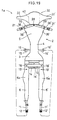
- Figs. 19 to 26 illustrate a baby carrier representing still another embodiment of the invention.
- the baby carrier la includes a carrier body 2 having a front cover portion 3, a narrow crotch cover portion 4, and a back cover portion 5 which are integrally formed in continuation.
- a pair of downwardly extending shoulder belts 6, 6' having larger-width portions 6a, 6'a are provided at opposite sides of a lower portion of the front cover portion 3.
- Each of the shoulder belts 6, 6' is fitted at an upper portion thereof with a one-touch buckle 10, 10' and, at the lower end thereof, with a one-touch buckle 12, 12' through a length-adjustable belt member 11, 11'.
- the top portions of the respective shoulder belts 6, 6' are interconnected by a connector band 13.
- buckle covers 14, 14' which are respectively fitted with locking hooks 17, 17'. Further, the shoulder belts 6, 6' are fitted at their respective top portions with locking hooks 18, 18', as well as 19, 19', such that the locking hooks 18, 18' are releasably engageable with the locking hooks 17, 17' of the buckle covers 14, 14'.
- belt members 15, 15' extending in opposite lateral directions which are fitted with one-touch buckles 16, 16' releasably engageable with the one-touch buckles 12, 12'.
- the locking belts 20, 20' At a top portion of the back cover portion 5 are disposed length-adjustable locking belts 20, 20' which extend in opposite lateral directions.
- the locking belts 20, 20' at respective one end thereof, intersect each other at an upper median spot of the back cover portion 5, and at this intersecting point a fixing pin 28 is affixed to the back cover portion 5 and extends through the locking belts. Accordingly, the locking belts 20, 20' are pivotable about the fixing pin 28.
- Respective locking belts 20, 20' are fitted with one-touch buckles 21, 21' which are releasably engageable with one-touch buckles 10, 10' of the shoulder belts 6, 6'.
- a plurality of belt loops 38, 38' and 39, 39' (two pairs, right and left, in the present embodiment) for passage of locking belts 20, 20' therethrough are provided at opposite sides, right and left, of the back cover portion 5 in vertically spaced relation.
- a head support 30 for supporting the head of the baby from behind is removably mounted on the top of the back cover portion 5.
- the head support 30 incorporates a core material 40.
- the head support 30 is fitted at lateral extremities of its opposite side portions with locking hooks 33, 33'.
- the locking hooks 33, 33' are releasably engageable with respective locking hooks 19, 19' provided at upper portions of the shoulder belts 6, 6'.
- the shoulder belts 6, 6' When receiving a baby into the baby carrier la, necessary procedure is that with the front side of the baby carrier la (Fig. 19) directed toward the nursing person, the shoulder belts 6, 6' are first placed on the shoulders of the nursing person so that the one-touch buckles 12, 12' at the distal ends of the shoulder belts 6, 6' are respectively brought into engagement with the one-touch buckles 16, 16' of the belt members 15, 15' (as indicated by chain lines in Figs. 19 and 20).
- the shoulder belts 6, 6' are suitably adjusted in length by means of the belt members 11, 11'. In this case, the rear side of the baby carrier la (Fig. 2) is exposed to the outside.
- the nursing person will hold the baby in arm and, while raising the back cover portion 5 of the carrier body 2 by one arm, the nursing person will draw the baby, together with the back cover portion 5, closer to him or her.
- the one touch buckle 21 of the locking belt 20 is fitted to the one-touch buckle 10, and the one-touch buckle 21' of the locking belt 20' to the one-touch buckle 10'.
- the baby is received into a bag-shaped baby carrier 1a.
- assembling of a baby carrier la is performed by means of one-touch buckles. This affords ease of assembling.
- buckle covers 14, 14' are wrapped around respective one-touch buckles, being then fastened by locking hooks 17, 18 and 17', 18' (see Fig. 21). By so doing it is possible to prevent one-touch buckles 10, 10' from being exposed on the baby side. In Fig. 21, buckle cover 14 only is shown.
- respective locking hooks 33, 33' of head support sides 32, 32' are caused to engage locking hooks 19, 19' at upper portions of the shoulder belts.
- a baby carrier 1a is assembled (see Figs. 21 and 22), and the baby is accommodated in the baby carrier la (see Fig. 25).
- head support 30 When the baby has grown so that he or she can hold his or her head steady, head support 30 is not always needed. In that case, the head support 30 may be removed, as shown in Fig. 26. By removing the head support 30 in this way the baby carrier la can be made foldable without being bulky.
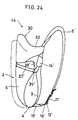
- the carrier body 2 is formed into a bag-like configuration while being lifted upward.
- the chain line indicates the contour line of the baby carrier la in the case where upper belt loops 38, 38' are utilized. In this way, it is possible to reduce the size of space for accommodating a baby while reducing the size of the space thicknesswise of the baby's torso (as viewed in lateral directions in Fig. 24). By so arranging it is possible to support a smaller baby in a stable condition.
- Figs. 21 and 22 illustrate, the locking belts 20, 20' are passed through upper belt loops 38, 38' of the back cover portion 5, and respective one-touch buckles 21, 21' of the locking belts 20,20' are fastened to the one-touch buckles 10, 10' of the shoulder belts.
- the locking belts 20, 20' are adjustable in length. Therefore, by suitably adjusting the length of the locking belts, in combination with selective use of belt loops, the size of space for accommodating the baby can be effectively adjusted.
- the size of available space for accommodating the baby can be further increased thicknesswise of the baby's torso.
- the size of available space may be further reduced.
- the size of available space is subject to a heightwise change (in vertical direction in Figs. 21 to 24) in corresponding relation to the dimensional change in the thicknesswise direction of the baby's torso (see the solid line and chain line in Fig. 24).
- the head support 30 may be suitably used. Especially where the available heightwise space is made reduced, the use of the head support 30 ensures positive support of the baby with respect to shoulders and head in particular.
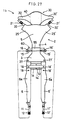
- Figs. 27 to 31 illustrate another embodiment of the invention.
- the baby carrier 1b includes a carrier body 2 having a front cover portion 3, a narrow crotch cover portion 4, and a back cover portion 5 which are integrally formed in continuation.
- a pair of vertically extending shoulder belts 6, 6 which have relatively wide portions 6a, 6'a.
- the shoulder belts 6, 6' are fitted at their distal ends with one-touch buckles 12, 12' through length-adjustable belt members 11, 11'.
- One-touch buckles 10, 10' are provided at the front cover portion side of the shoulder belts 6, 6'.
- the shoulder belts 6, 6' are interconnected by a connecting band 13.
- the shoulder belts 6, 6' are provided with buckle covers 14, 14' which are intended to cover the one-touch buckles 10, 10' after the baby carrier 1b is assembled.
- the buckle covers 14, 14' are respectively fitted with locking hooks 17, 17'.
- the shoulder belts 6, 6' are also fitted with locking hooks 18, 18', as well as 19, 19', such that the locking hooks 18, 18' are releasably engageable with the locking hooks 17, 17' of the buckle covers 14, 14'.
- belt members 15, 15' extending laterally therefrom in opposite directions, the belt members 15, 15' being fitted at their distal ends with one-touch buckles 16, 16' which are releasably engageable with the one-touch buckles 12, 12'.
- side supports 25, 25' for supporting sides of the baby's torso, the side supports 25, 25' projecting obliquely upward from the shoulder portions.
- Length-adjustable belt members 20, 20' extend from respective ends of the side supports 25, 25'.
- the belt members 20, 20' are fitted with one-touch buckles 21, 21' which are releasably engageable with the one-touch buckles 10, 10' of the shoulder belts 6, 6'.
- the side supports 25, 25' are provided with locking hooks 26, 26' which are releasably engageable with locking hooks 27, 27' attached to opposite sides of the front cover portion 3.
- a head support 30 for supporting the head of the baby from behind is provided on the top of the back cover portion 5. Side portions 32, 32' of the head support 30 are fitted at their respective distal ends with locking hooks 33, 33'. These locking hooks 33, 33' are releasably engageable with locking hooks 19, 19' attached to the shoulder belts 6, 6'.
- the head support 30 may be arranged to be removably attached to the back cover portion 5. Such removable arrangement of the head support 30 permits the baby carrier 1b to be folded without being bulky.
- a width adjuster device 50 for adjusting the widthwise dimension of the carrier body 2 is provided at a median portion of the front cover portion 3.
- the width adjuster device 50 comprises a pocket cloth 51 and a pair of strings 52, respective ends of the strings 52 being sewn, together with the pocket cloth 51, to face cloth of the front cover portion 3.
- the strings 52 are pulled in a flaring direction, the pocket cloth 51 and the face cloth are contracted widthwise so that the widthwise dimension of the carrier body 2 can be made smaller.
- size adjustment can be effected according to the chest measurements of the baby.
- the baby carrier 1b can be employed in nursing babies of different physical constitutions. Further, the baby carrier 1b may be used for a comparatively long period of time with respect to one baby from babyhood to infancy.
- the crotch cover portion 4 is provided with a belt loop 55 which is adapted to be removably fitted with a waist belt through openings at opposite ends of the belt loop 55.
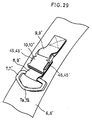
- the shoulder belts 6, 6' are provided with slip-off preventive devices 7, 7' for preventing the one-touch buckles 21, 21' of the side supports 25, 25' from slipping off the one-touch buckles 10, 10' of the shoulder belts 6, 6'.
- the slip-off preventive devices 7, 7' as shown in Fig. 29, are annular members having a generally D-shaped contour and have annular holes 7a, 7'a engageable by the one-touch buckles 21, 21'.
- the slip-off preventive devices 7, 7' are supported by belt pieces 8, 8' attached to the shoulder belts 6, 6'.
- the one-touch buckles 10, 10' are supported by belt pieces 9, 9' attached to the shoulder belts 6, 6'. Shown by 45, 45' are manipulators for the one-touch buckles 10, 10'.
- the shoulder belts 6, 6' are first placed on the shoulders of the nursing person so that the one-touch buckles 12, 12' at the distal ends of the shoulder belts are respectively brought into engagement with the one-touch buckles 16, 16' of the belt members 15, 15' (as indicated by chain lines in Figs. 27 and 28).
- the shoulder belts 6, 6' are suitably adjusted in length by means of the belt members 11, 11'. In this case, the rear side of the baby carrier 1b (Fig. 28) is exposed to the outside.
- the nursing person will hold the baby in arm and, while raising the back cover portion 5 of the carrier body 2 by one arm, the nursing person will draw the baby, together with the back cover portion 5, closer to him or her. Then, using one hand the nursing person will place the one touch buckle 21' of the side support 25' into annular hole 7'a of the slip-off preventive device 7' affixed to the shoulder belt 6' (see Fig. 31), then fit the same to the one touch-buckle 10' into engagement. Likewise, one-touch buckle 21 is passed through the slip-off preventive device 7 before it is fitted to one-touch buckle 10 into engagement.
- the carrier body 2 is assembled into a bag-like shape (see Fig. 30), and the baby is accommodated in the carrier body 2.
- Fig. 30 depicts only one buckle cover 14.
- the baby carrier 1b is previously adjusted in size by using the belt members 20, 20' and/or the width adjuster 50 according to the size of the body of the baby to be accommodated, the baby can be held in the baby carrier 1b with more reliability.
- the locking hooks 26, 26' of the right and left side supports 25, 25' are fitted to the locking hooks 27, 27' of the front cover portion, in which state the sides of the baby's body are supported by the side supports 25, 25'.
- the locking hooks 33, 33' of the head support side portions 32, 32' are fitted to the locking hooks 19, 19' of the upper portion of the shoulder belt, whereby the head of the baby is supported by the head support 30. In this way, the baby can be supported stably in the baby carrier 1b with high reliability.
- the slip-off preventing devices 7, 7' are supported by belt pieces 8, 8' attached to the shoulder belts 6, 6' as an example.
- the present invention is not limited to the slip-off preventing devices as shown above, but may also be applied similarly to such slip-off preventing devices as shown in Figs. 32 and 33.
- slip-off preventing devices each have a configuration that a generally U-shaped support 29 is attached integrally to the annular portions 7, 7' corresponding to the slip-off preventing devices of the foregoing embodiment. Further, the support 29 is attached directly to the one-touch buckles 10, 10' in the case of Fig. 32, whereas the support 29 is held by the belt pieces 9, 9', respectively, together with the one-touch buckles 10, 10' in the case of Fig. 33.
- the one-touch buckles 21, 21' can be prevented from slipping off, by the annular portions 7, 7' so that the back cover portion 5 can be inhibited from being easily removed from the shoulder belts 6, 6'.
- This slip-off preventing device 65 is generally a box-shaped member having an opening on its bottom surface side (a side of contact with the shoulder belts 6, 6').
- the slip-off preventing device 65 has side plates 71, 71 arranged on the right and left sides of the one-touch buckles 10, 10', respectively, and a cover 72 connecting the side plates 71, 71 to each other and covering from above the one-touch buckles 10, 10'.
- a cutout 73 is formed at a lower portion of the cover 72, and the side plates 71, 71 are connected at their lower portions to each other by a connecting plate 74. Also, at inner surfaces of the side plates 71, 71, a pivot 75 inserted through the one-touch buckles 10, 10' is fixed by its both ends, whereby the slip-off preventing device 65 is pivotable about the center axis of the pivot 75.
- the one-touch buckles 21, 21' are fitted with the slip-off preventing device 65 pivoted upward, and thereafter the slip-off preventing device 65 is pivoted downward so as to be restored to the original position.
- the pivot 75 has been attached directly to the one-touch buckles 10, 10'.
- the pivot 75 may alternatively be held by the belt pieces 9, 9' in the same way as the slip-off preventing device shown in Fig. 33 is attached.
- Figs. 35 to 37 show a cover-equipped buckle which is a modification of Fig. 34.
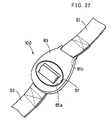
- This cover-equipped buckle 100 comprises a one-touch buckle 83 attached at an end of a belt 82, a one-touch buckle 96 attached at an end of a belt 95 and removably fittable to the one-touch buckle 83, and a cover 85 which is openable and closable and which covers a manipulator 84 of the one-touch buckle 83.
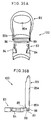
- the cover 85 as shown in Fig. 36, has a pivot 86 on its base end side.
- the one-touch buckle 83 has on its base end side a fitting recess 87 to which the pivot 86 can be removably fitted.
- the cover 85 is pivoted about the center line of the pivot 86, so that it can be positioned into either a closed position to cover the manipulator 84 of the one-touch buckle 83 (a position shown by solid line in Fig. 35) or an open position to which the cover 85 comes through an upward pivoting (a position shown by one-dot chain line in Fig. 35).
- the pivot 86 is fitted into the fitting recess 87 by a base-end-side end portion 88 of the one-touch buckle 83 being elastically deformed.
- the cover 85 is prevented from being easily removed from the one-touch buckle 83 after having been attached thereto.
- the cover 85 has an oval-shaped opening 85a formed therein.
- a circular base portion 97 of the one-touch buckle 96 will be fitted into the opening 85a as shown in Fig. 37.
- the cover 85 also has a rectangular opening 85b formed on its base end side. This opening 85b will be located above a slit 89 (Fig. 36) provided in the one-touch buckle 83 for the insertion of the belt 82, when the cover 85 is brought into the closed position. Thus, with the one-touch buckle 83 attached to the belt 82, the cover 85 can be moved to the closed position smoothly.
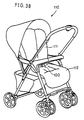
- Such a cover-equipped buckle 100 may also be applied to not only the above-described slip-off preventing device of the baby carrier but also, for example, the safety belt of a baby carriage as shown in Fig. 38.
- this baby carriage 110 has the cover-equipped buckle 100 incorporated as a safety belt at a place where a back pad 111 and a seat pad 112 of the seat interconnect each other.
- the cover-equipped buckle 100 as such a safety belt for baby carriages, the baby can be prevented from mis-removing the safety belt, with a simple mechanism.
- the cover-equipped buckle 100 may be applied also to belt-equipped products such as bags, similarly.
Landscapes
- Health & Medical Sciences (AREA)
- General Health & Medical Sciences (AREA)
- Pediatric Medicine (AREA)
- Buckles (AREA)
Applications Claiming Priority (12)
| Application Number | Priority Date | Filing Date | Title |
|---|---|---|---|
| JP259302/94 | 1994-09-28 | ||
| JP25930294 | 1994-09-28 | ||
| JP283002/94 | 1994-10-21 | ||
| JP6283002A JPH08117067A (ja) | 1994-10-21 | 1994-10-21 | 乳幼児キャリア |
| JP2137295 | 1995-01-13 | ||
| JP21372/95 | 1995-01-13 | ||
| JP63305/95 | 1995-02-27 | ||
| JP6330595 | 1995-02-27 | ||
| JP209013/95 | 1995-07-24 | ||
| JP7209013A JPH08150051A (ja) | 1994-09-28 | 1995-07-24 | 乳幼児キャリア |
| JP21284095A JP3523385B2 (ja) | 1995-01-13 | 1995-07-28 | 乳幼児キャリアおよびカバー付バックル |
| JP212840/95 | 1995-07-28 |
Publications (2)
| Publication Number | Publication Date |
|---|---|
| EP0704183A2 true EP0704183A2 (fr) | 1996-04-03 |
| EP0704183A3 EP0704183A3 (fr) | 1996-07-24 |
Family
ID=27548971
Family Applications (1)
| Application Number | Title | Priority Date | Filing Date |
|---|---|---|---|
| EP95306836A Withdrawn EP0704183A3 (fr) | 1994-09-28 | 1995-09-27 | Porte-bébé |
Country Status (5)
| Country | Link |
|---|---|
| EP (1) | EP0704183A3 (fr) |
| KR (1) | KR960009918A (fr) |
| CN (1) | CN1128116A (fr) |
| AU (2) | AU681538B2 (fr) |
| CA (1) | CA2159241A1 (fr) |
Cited By (6)
| Publication number | Priority date | Publication date | Assignee | Title |
|---|---|---|---|---|
| EP0860127A3 (fr) * | 1997-02-17 | 2000-01-05 | Aprica Kassai Kabushikikaisha | Porte-bébé |
| EP1175858A3 (fr) * | 2000-07-27 | 2002-11-06 | HTS HANS TORGERSEN & SONN A/S | Dispositif pour le transport des enfants |
| EP1591045A1 (fr) * | 2004-04-30 | 2005-11-02 | YKK Corporation | Boucle et porte-bébé utilisant ce boucle |
| US7040946B2 (en) | 2001-11-05 | 2006-05-09 | Lg Electronics Inc. | Plasma display panel and manufacturing method thereof |
| WO2015127514A1 (fr) * | 2014-02-27 | 2015-09-03 | Lj Mila Pty Ltd | Accessoire d'allaitement |
| KR20200123120A (ko) * | 2018-02-21 | 2020-10-28 | 베이비비욘 에이비 | 유아 캐리어 |
Families Citing this family (13)
| Publication number | Priority date | Publication date | Assignee | Title |
|---|---|---|---|---|
| KR100545606B1 (ko) * | 1998-10-09 | 2006-03-23 | 유티스타콤코리아 유한회사 | 전전자교환기에서의 ipc 통신 기능 시험 방법 |
| US7766199B1 (en) * | 2009-07-24 | 2010-08-03 | Gabriela Caperon | Baby carrier |
| CN105377085B (zh) | 2013-03-13 | 2018-06-19 | 爱歌宝宝背带有限公司 | 儿童载具 |
| CN103799766A (zh) * | 2014-01-02 | 2014-05-21 | 广东乐美达集团有限公司 | 一种多用儿童背巾 |
| DE202014100614U1 (de) * | 2014-02-12 | 2014-05-20 | Cybex Gmbh | Tragevorrichtung für ein Baby oder Kleinkind |
| JP6871247B2 (ja) | 2015-10-30 | 2021-05-12 | ザ エルゴ ベビー キャリア, インコーポレイテッド | 調節可能チャイルドキャリア |
| CN110035677B (zh) | 2016-10-28 | 2022-12-23 | 爱歌宝宝背带有限公司 | 具有多个承载取向的可调整儿童载具 |
| US10905253B2 (en) | 2018-04-19 | 2021-02-02 | Wonderland Switzerland Ag | Child carrier |
| EP3886653B1 (fr) | 2018-11-26 | 2024-08-28 | The Ergo Baby Carrier, Inc. | Porte-bébé réglable à liberté de mouvement améliorée |
| USD1041875S1 (en) | 2020-06-19 | 2024-09-17 | The ERGO Baby Corrier Inc. | Child carrier |
| JP7752491B2 (ja) | 2020-06-19 | 2025-10-10 | ザ エルゴ ベビー キャリア, インコーポレイテッド | 複数の担持向きを有する調節可能チャイルドキャリア |
| USD1024541S1 (en) | 2020-06-19 | 2024-04-30 | The Ergo Baby Carrier, Inc. | Child carrier |
| USD1010305S1 (en) | 2020-12-18 | 2024-01-09 | The Ergo Baby Carrier, Inc. | Child carrier |
Citations (3)
| Publication number | Priority date | Publication date | Assignee | Title |
|---|---|---|---|---|
| JPS6125400U (ja) | 1984-07-19 | 1986-02-15 | 日産自動車株式会社 | フオ−クの移動装置 |
| JPH0271359U (fr) | 1988-11-21 | 1990-05-30 | ||
| JPH0417064U (fr) | 1990-05-30 | 1992-02-12 |
Family Cites Families (12)
| Publication number | Priority date | Publication date | Assignee | Title |
|---|---|---|---|---|
| FR1545820A (fr) * | 1967-09-27 | 1968-11-15 | Sac de portage pour bébés | |
| US4436233A (en) * | 1981-12-30 | 1984-03-13 | Hill James B | Baby carrier |
| US4434920A (en) * | 1982-02-22 | 1984-03-06 | Snugli, Inc. | Soft orthopedic pouch-type infant carrier |
| US4731912A (en) * | 1986-09-19 | 1988-03-22 | Ashlar Products, Incorporated | Seat belt buckle guard |
| US4825515A (en) * | 1988-02-25 | 1989-05-02 | Wolterstorff Jr Donald A | Safety buckle |
| GB2236794A (en) * | 1989-09-27 | 1991-04-17 | Kerrie Lorraine Flight | Vehicle seat belt release mechanism cover |
| JP2521160Y2 (ja) * | 1990-10-08 | 1996-12-25 | すみ子 山口 | ウエストバッグ兼用幼児抱き具 |
| SE500164C2 (sv) * | 1991-01-18 | 1994-05-02 | Baby Bjoern Ab | Bärsele för spädbarn |
| NZ241918A (en) * | 1991-03-18 | 1995-05-26 | Lucy Isobelle Ormsby | Infant carrying pouch: webbing harness in cross formation |
| KR940004657Y1 (ko) * | 1992-01-27 | 1994-07-16 | 시삼암 | 고정편을 결합한 가방 괘정구 |
| US5246152A (en) * | 1992-07-10 | 1993-09-21 | Dotseth Junice A | Baby carrier with head support |
| FR2701367B1 (fr) * | 1993-02-11 | 1995-03-31 | Allegre Puericulture Sa | Porte-bébé. |
-
1995
- 1995-09-27 AU AU32880/95A patent/AU681538B2/en not_active Ceased
- 1995-09-27 KR KR1019950032009A patent/KR960009918A/ko not_active Abandoned
- 1995-09-27 CA CA002159241A patent/CA2159241A1/fr not_active Abandoned
- 1995-09-27 EP EP95306836A patent/EP0704183A3/fr not_active Withdrawn
- 1995-09-28 CN CN95116042A patent/CN1128116A/zh active Pending
-
1997
- 1997-06-02 AU AU24647/97A patent/AU2464797A/en not_active Abandoned
Patent Citations (3)
| Publication number | Priority date | Publication date | Assignee | Title |
|---|---|---|---|---|
| JPS6125400U (ja) | 1984-07-19 | 1986-02-15 | 日産自動車株式会社 | フオ−クの移動装置 |
| JPH0271359U (fr) | 1988-11-21 | 1990-05-30 | ||
| JPH0417064U (fr) | 1990-05-30 | 1992-02-12 |
Cited By (7)
| Publication number | Priority date | Publication date | Assignee | Title |
|---|---|---|---|---|
| EP0860127A3 (fr) * | 1997-02-17 | 2000-01-05 | Aprica Kassai Kabushikikaisha | Porte-bébé |
| EP1175858A3 (fr) * | 2000-07-27 | 2002-11-06 | HTS HANS TORGERSEN & SONN A/S | Dispositif pour le transport des enfants |
| US7040946B2 (en) | 2001-11-05 | 2006-05-09 | Lg Electronics Inc. | Plasma display panel and manufacturing method thereof |
| EP1591045A1 (fr) * | 2004-04-30 | 2005-11-02 | YKK Corporation | Boucle et porte-bébé utilisant ce boucle |
| US7204002B2 (en) | 2004-04-30 | 2007-04-17 | Ykk Corporation | Buckle and baby carrier using the same |
| WO2015127514A1 (fr) * | 2014-02-27 | 2015-09-03 | Lj Mila Pty Ltd | Accessoire d'allaitement |
| KR20200123120A (ko) * | 2018-02-21 | 2020-10-28 | 베이비비욘 에이비 | 유아 캐리어 |
Also Published As
| Publication number | Publication date |
|---|---|
| CA2159241A1 (fr) | 1996-03-29 |
| AU2464797A (en) | 1997-09-18 |
| AU681538B2 (en) | 1997-08-28 |
| KR960009918A (ko) | 1996-04-20 |
| EP0704183A3 (fr) | 1996-07-24 |
| AU3288095A (en) | 1996-05-02 |
| CN1128116A (zh) | 1996-08-07 |
Similar Documents
| Publication | Publication Date | Title |
|---|---|---|
| EP0704183A2 (fr) | Porte-bébé | |
| JP2001070107A (ja) | パッド付ベビーキャリア | |
| CA2184323C (fr) | Porte-bebe | |
| US5246152A (en) | Baby carrier with head support | |
| US7886946B2 (en) | Baby carrier | |
| US5178309A (en) | Infant carrier and harness combination | |
| US5927235A (en) | Kid-keeper child harness and detachable tether | |
| US5678739A (en) | Infant carrier with harness and detachable shell | |
| US8028871B2 (en) | Baby carrier | |
| US6045018A (en) | Baby carrier | |
| US6112960A (en) | Combination sling carrier and cushion | |
| US6247755B1 (en) | Child carrier harness | |
| US6186381B1 (en) | Child carrier | |
| US5001791A (en) | Back support with integral carrying case and strap loop connector | |
| US20050279785A1 (en) | Child carrier | |
| CN117223992A (zh) | 儿童载具 | |
| US10716411B2 (en) | Adaptable child carrier system | |
| WO2004093608A1 (fr) | Siege pour equipement de puericulture | |
| CA1123796A (fr) | Porte-bebe sans chassis rigide | |
| JPH0727870Y2 (ja) | 抱き具の機能を具えたリュックサック | |
| JP3077992U (ja) | 乳児用パッドおよび縦抱き・横抱き兼用ベビーキャリア | |
| JP3130476B2 (ja) | 乳幼児保持具 | |
| JP3523386B2 (ja) | 乳幼児キャリア用ヘッドサポートおよび乳幼児キャリア | |
| JP2000070079A (ja) | 子守帯 | |
| JPH08150051A (ja) | 乳幼児キャリア |
Legal Events
| Date | Code | Title | Description |
|---|---|---|---|
| PUAI | Public reference made under article 153(3) epc to a published international application that has entered the european phase |
Free format text: ORIGINAL CODE: 0009012 |
|
| AK | Designated contracting states |
Kind code of ref document: A2 Designated state(s): DE ES FR GB IT |
|
| PUAL | Search report despatched |
Free format text: ORIGINAL CODE: 0009013 |
|
| AK | Designated contracting states |
Kind code of ref document: A3 Designated state(s): DE ES FR GB IT |
|
| 17P | Request for examination filed |
Effective date: 19960925 |
|
| STAA | Information on the status of an ep patent application or granted ep patent |
Free format text: STATUS: THE APPLICATION HAS BEEN WITHDRAWN |
|
| 18W | Application withdrawn |
Withdrawal date: 19971010 |