EP0704576A1 - Asphaltstrassendeckenbehandlungsvorrichtung - Google Patents
Asphaltstrassendeckenbehandlungsvorrichtung Download PDFInfo
- Publication number
- EP0704576A1 EP0704576A1 EP95202627A EP95202627A EP0704576A1 EP 0704576 A1 EP0704576 A1 EP 0704576A1 EP 95202627 A EP95202627 A EP 95202627A EP 95202627 A EP95202627 A EP 95202627A EP 0704576 A1 EP0704576 A1 EP 0704576A1
- Authority
- EP
- European Patent Office
- Prior art keywords
- sub
- road
- treatment
- elements
- treatment apparatus
- Prior art date
- Legal status (The legal status is an assumption and is not a legal conclusion. Google has not performed a legal analysis and makes no representation as to the accuracy of the status listed.)
- Withdrawn
Links
- 239000010426 asphalt Substances 0.000 title claims abstract description 17
- 239000011148 porous material Substances 0.000 claims description 8
- 230000003993 interaction Effects 0.000 claims description 3
- 238000000034 method Methods 0.000 claims description 3
- 238000007789 sealing Methods 0.000 claims description 3
- 239000011384 asphalt concrete Substances 0.000 claims description 2
- 238000002347 injection Methods 0.000 claims description 2
- 239000007924 injection Substances 0.000 claims description 2
- 239000000463 material Substances 0.000 description 5
- 238000010276 construction Methods 0.000 description 4
- 230000000694 effects Effects 0.000 description 4
- 238000010793 Steam injection (oil industry) Methods 0.000 description 3
- 230000035515 penetration Effects 0.000 description 3
- 239000007789 gas Substances 0.000 description 2
- 230000002093 peripheral effect Effects 0.000 description 2
- 239000004576 sand Substances 0.000 description 2
- IJGRMHOSHXDMSA-UHFFFAOYSA-N Atomic nitrogen Chemical compound N#N IJGRMHOSHXDMSA-UHFFFAOYSA-N 0.000 description 1
- 230000006978 adaptation Effects 0.000 description 1
- 239000000853 adhesive Substances 0.000 description 1
- 230000001070 adhesive effect Effects 0.000 description 1
- 229910001873 dinitrogen Inorganic materials 0.000 description 1
- 238000003780 insertion Methods 0.000 description 1
- 230000037431 insertion Effects 0.000 description 1
- 239000007788 liquid Substances 0.000 description 1
- 239000007791 liquid phase Substances 0.000 description 1
- 230000001629 suppression Effects 0.000 description 1
- 239000000725 suspension Substances 0.000 description 1
- 230000007704 transition Effects 0.000 description 1
Images


Classifications
-
- E—FIXED CONSTRUCTIONS
- E01—CONSTRUCTION OF ROADS, RAILWAYS, OR BRIDGES
- E01C—CONSTRUCTION OF, OR SURFACES FOR, ROADS, SPORTS GROUNDS, OR THE LIKE; MACHINES OR AUXILIARY TOOLS FOR CONSTRUCTION OR REPAIR
- E01C23/00—Auxiliary devices or arrangements for constructing, repairing, reconditioning, or taking-up road or like surfaces
- E01C23/06—Devices or arrangements for working the finished surface; Devices for repairing or reconditioning the surface of damaged paving; Recycling in place or on the road
- E01C23/08—Devices or arrangements for working the finished surface; Devices for repairing or reconditioning the surface of damaged paving; Recycling in place or on the road for roughening or patterning; for removing the surface down to a predetermined depth high spots or material bonded to the surface, e.g. markings; for maintaining earth roads, clay courts or like surfaces by means of surface working tools, e.g. scarifiers, levelling blades
- E01C23/081—Devices or arrangements for working the finished surface; Devices for repairing or reconditioning the surface of damaged paving; Recycling in place or on the road for roughening or patterning; for removing the surface down to a predetermined depth high spots or material bonded to the surface, e.g. markings; for maintaining earth roads, clay courts or like surfaces by means of surface working tools, e.g. scarifiers, levelling blades by thermal or cryogenic treatment, excluding heating to facilitate mechanical working
-
- E—FIXED CONSTRUCTIONS
- E01—CONSTRUCTION OF ROADS, RAILWAYS, OR BRIDGES
- E01H—STREET CLEANING; CLEANING OF PERMANENT WAYS; CLEANING BEACHES; DISPERSING OR PREVENTING FOG IN GENERAL CLEANING STREET OR RAILWAY FURNITURE OR TUNNEL WALLS
- E01H1/00—Removing undesirable matter from roads or like surfaces, with or without moistening of the surface
- E01H1/08—Pneumatically dislodging or taking-up undesirable matter or small objects; Drying by heat only or by streams of gas; Cleaning by projecting abrasive particles
- E01H1/0863—Apparatus loosening or removing the dirt by blowing and subsequently dislodging it at least partially by suction ; Combined suction and blowing nozzles
-
- E—FIXED CONSTRUCTIONS
- E01—CONSTRUCTION OF ROADS, RAILWAYS, OR BRIDGES
- E01H—STREET CLEANING; CLEANING OF PERMANENT WAYS; CLEANING BEACHES; DISPERSING OR PREVENTING FOG IN GENERAL CLEANING STREET OR RAILWAY FURNITURE OR TUNNEL WALLS
- E01H1/00—Removing undesirable matter from roads or like surfaces, with or without moistening of the surface
- E01H1/10—Hydraulically loosening or dislodging undesirable matter; Raking or scraping apparatus ; Removing liquids or semi-liquids e.g., absorbing water, sliding-off mud
- E01H1/101—Hydraulic loosening or dislodging, combined or not with mechanical loosening or dislodging, e.g. road washing machines with brushes or wipers
- E01H1/103—Hydraulic loosening or dislodging, combined or not with mechanical loosening or dislodging, e.g. road washing machines with brushes or wipers in which the soiled loosening or washing liquid is removed, e.g. by suction
Definitions
- the invention relates to an asphalt road treatment apparatus in accordance with the preamble of Claim 1.
- the invention relates to the treatment of so-called very open asphalt concrete (VOAC).
- VOAC very open asphalt concrete
- Said VOAC is nowadays increasingly being used as the top layer of a asphalted road. Good drainage of rainwater and noise suppression are achieved as a result of its open pore structure.
- An example of VOAC is given in FR-A 2 688 808.
- German Offenlegungsschrift (3 142 264) describes a hood which is open on its underside and is placed with its lower edge tightly against a road surface.
- the feed line for a pressurised medium opens inside said hood.
- the pressurised medium is able to leave the hood via a discharge duct which opens into said hood at the top.
- This known device is intended for treating materials, such as residues of adhesive, adhering to the road deck.
- EP-A 0 556 921 deals with a road deck treatment method and device with which there is no question of a pressure chamber subdivided into sub-pressure chambers in order thus to introduce a treatment medium by this means into the road surface, with the result that the effect envisaged with the present invention is not achieved.
- the aim of the present invention is to provide an apparatus with which a relatively large road surface area can be treated in a single operation, intimate contact between the treatment medium and the road surface and also reliable penetration of the treatment medium into a porous road surface being guaranteed.
- the invention is based on the insight that the efficacy of the treatment medium is increased by allowing said treatment medium to escape at the periphery of the treatment element, in particular in the vicinity of the transition between the treatment element and the road surface, said efficacy being further increased by deliberately increasing the size of the relevant peripheral surface of the treatment element, around which the treatment medium escapes, by subdividing the treatment element into sub-elements between which the treatment medium is able to escape.
- the use of individual sub-elements permits better adaptation to the inevitable unevenness in the road deck. Trials have shown that the effect according to the invention is greatest if a treatment element is surrounded by removal elements on all sides.
- a further improvement is achieved according to Claim 3, by making the gap between a sub-element and the respective removal element, within the design limits, as large as possible by insertion of a sealing element which locally covers the road surface and at this location interacts therewith to provide an essentially medium-tight seal.
- the invention is based on the further insight that the depth to which the treatment medium penetrates into the road deck becomes greater as the treatment medium is forced to travel a greater path through the road deck between the treatment element and the removal element.
- a further aim of the invention is a road deck treatment method, to which end treatment medium is injected into the sub-pressure chambers in order, via the porous top layer of the road deck, to reach the removal elements.
- the treatment medium used can be, for example, compressed air in order to clean the pores of the porous road surface, such as VOAC.
- the treatment medium can be steam or another hot gas, or nitrogen gas adiabatically expanded from the liquid phase, or another cryogenic gas, in order to achieve a softening or embrittlement for the purpose of removal of the top layer.
- a gaseous treatment medium it is also possible to use a liquid.
- the sub-elements can sealingly abut the road surface located below them, with the result that the treatment medium escapes sideways via the pores in said road surface at the periphery of the sub-elements. By this means yet a further additional effective flow through the pores in the road surface is achieved.
- the sub-elements can also be produced by constructing an integral treatment element with, for example, slits.
- FIG 1 shows an asphalt road treatment apparatus 1.
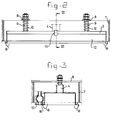
- Said apparatus essentially consists of various pressure boxes 2 ( Figure 3) which are arranged alongside and one behind the other, a gap 3 being maintained between every two boxes.
- the term pressure box is used to define a chamber which, with the exception of the underside facing towards the road deck, is closed on all sides and which can be supplied, via a feed, with a medium under pressure.
- a feed duct 4 for pressurised medium opens into the pressure box 2 at its top.
- a pressurised medium is supplied via a central feed duct 5, which feed duct 5 runs centrally in the longitudinal direction of the apparatus 1.
- Branch ducts 6 run transversely from said central feed duct 5, the respective stub ducts 4 to the individual pressure boxes being connected to said branch ducts 6.
- baffles 7 are arranged between the pressure boxes 2.
- Strips 8 run in the longitudinal direction of the apparatus 1 over the top of the baffles 7; there are two strips 8 for every row of pressure boxes 2.
- the suspension pins 9 for the pressure boxes 2 extend through said strips 8.
- Said pressure boxes 2 are prestressed in the downward direction by means of helical springs 10, so that they are held pressed firmly against a road surface (not shown) located beneath the pressure boxes. In Figures 2 and 3, the unstressed state of the springs 10 is shown.
- the springs 10 will be compressed, in such a way that the bottom edge of the pressure boxes 2 is essentially in line with the bottom edge of the baffles 7. Sufficient gap is maintained between the baffles 7 and the bottom edge of the respective pressure box 2 to permit unimpeded escape of pressurised medium from the chamber in the pressure box 2.
- Both the baffles 7 and the strips 8 are coupled to a surrounding frame 11, so that the apparatus 1 forms a whole.
- a suction duct 12 is located immediately behind each pressure box 2.
- materials which, for example, have become detached from the road surface, sand removed from any pores in the road deck, and the like, can be removed by suction.
- any condensate formed can also be removed via the suction duct 12.
- the suction duct 12 runs virtually over the full width of the pressure box 2 and has a central connecting stub 13 for connection to a suction apparatus (not shown).
- a central suction duct 14 runs parallel to and a short distance away from the feed duct 5 ( Figure 1).
- Branch ducts 15 which run transversely are connected to said central suction duct 14.
- the stubs 13 are connected to said respective ducts 15.
- a slit 16 which optionally can be omitted, is located between the pressure box 2 and the suction duct 12.
- Pressurised medium present in the pressure box 2 is now able, as is shown by the arrows B, to escape beneath the bottom edge of the pressure box 2, if applicable through the porous road surface, into the surroundings.
- a hood (not shown), in which the treatment medium which has escaped from the pressure boxes 2 is collected, can, for example, be arranged over the apparatus 1. The important feature in this context is that the pressure in said collection hood is lower than the pressure prevailing in the pressure boxes 2.
- the apparatus 1 Because the relatively large surface area of the apparatus 1 is subdivided into individual part surface areas, defined by the pressure boxes 2, said pressure boxes 2 being individually mounted in a frame 11, the apparatus 1 is better able to adapt to unevenness in the road deck, with the result that reliable interaction between the pressure boxes 2 and the road surface is ensured.
- the frame 11 can, for example, be of mobile construction.
- the frame 11 can also be fixed to a boom on a further mobile vehicle.
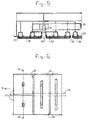
- FIG 4 shows the alternative asphalt road treatment apparatus 1.
- the latter essentially consists of various pressure plates 22 ( Figure 6) which are arranged alongside and one behind the other, a gap 23 being maintained between every two pressure plates.
- this construction can be regarded as a series of essentially uniform elements of essentially equal size.
- Each pressure plate 22 has a resilient elastic underlayer 28 of, for example, rubber or rubber-like material. For steam injection, said underlayer 28 is able to withstand temperatures of at least 100 °C.
- each underlayer has an edge cut-out in which an angle section 27 welded to the pressure plate 22 engages.
- Each pressure plate 22, with the underlayer 28, lies with its full surface on the road deck 26, with the exception of a central feed cavity 29 for the treatment medium.
- a feed duct 24 for compressed treatment medium opens into the central feed cavity 29 of the pressure plate 22 at its top.
- the treatment medium is supplied via a central feed duct 25, which feed duct 25 runs centrally in the longitudinal direction of the apparatus 1.
- Branch ducts (not visible), to which the respective stump ducts 24 to the individual pressure plates 22 are connected, run transversely from said central feed duct 25.
- Baffles (not shown) can be arranged in the gap 23 between the pressure plates 22, in order to keep the operation of the individual pressure plates 22 separate from one another as well as possible.
- the pressure plates 22 can be prestressed in the downward direction by means of (helical) springs or equivalent pretensioning elements, in order to maintain intimate contact with the road deck 26.
- a surrounding frame 11 connects all components to one another, so that the apparatus 1 forms a whole.
- a suction duct (not shown), for example constructed in the same way as in the alternative embodiment according to Figs 1-3, can be located immediately behind each pressure plate 22.
- a suction duct can be located immediately behind each pressure plate 22.
- Said optional suction duct can run over virtually the full width of the pressure plate 22 and can have a central connecting stub for connection to a suction apparatus (not shown).
- Treatment medium now passes from the feed duct 24 into the cavity 29. From here said medium is forced beneath the pressure plate 22 and into the road deck 26 and flows in the direction of the arrows B towards the side of the apparatus 1 and towards the gaps 23 which are in open connection with the surroundings.
- the shape of the cavity 29 is matched to the shape of the pressure plate 22. However, this is not a requirement.
- the important feature is that the distance between the boundary of the cavity 29 and the boundary of the pressure plate 22 is as large as possible. Furthermore, it is preferable that the distance is approximately the same at each point along the periphery of the pressure plate 22. In the case of rectangular pressure plates 22, the distance over the diagonal will always be greater.
- the surrounding skirt 30 By arranging for the surrounding skirt 30 to abut the road surface such that it is medium-tight, it is possible, for example, also to collect and to remove the medium which escapes at the outermost sides of the apparatus 1, as in the case of the removal cavity 3.
- the apparatus 1 is better able to adapt to unevenness in the road deck, with the result that reliable interaction between the pressure plates 22 and the road surface 26 is ensured.
- the peripheral surface along which the treatment medium is able to escape beneath the pressure plates 22 into the surroundings is increased by means of the various pressure plates 22 of the apparatus 1 arranged with gaps 23 between them, which makes the injection pressure in the cavity 29 not too high in order, nevertheless, to achieve sufficiently deep penetration into the road deck 26.
- the frame 11 can be, for example, of mobile construction.
- the frame 11 can also be fixed to a boom on a further mobile vehicle.
- the apparatus 1 can, of course, have only one pressure plate 22 of a relatively large surface area.
- the rearmost pressure plate 22 is the shortest.
- other combinations and shapes are also conceivable, for example with at least three pressure plates both alongside and one behind the other, or with, for example, five pressure plates alongside one another and seven pressure plates one behind the other, as in the case of the embodiment according to Figs 1-3.
- the cavity 29 is likewise elongated, and in each case a duct 24 opens at both ends into a cavity 29.
- Said cavity 29 can, of course, also be subdivided over its length.
Landscapes
- Engineering & Computer Science (AREA)
- Architecture (AREA)
- Civil Engineering (AREA)
- Structural Engineering (AREA)
- Mining & Mineral Resources (AREA)
- Road Repair (AREA)
Applications Claiming Priority (4)
| Application Number | Priority Date | Filing Date | Title |
|---|---|---|---|
| NL9401612 | 1994-09-30 | ||
| NL9401612A NL9401612A (nl) | 1994-09-30 | 1994-09-30 | Asfaltwegbehandelapparaat. |
| NL9500295 | 1995-02-16 | ||
| NL9500295 | 1995-02-16 |
Publications (1)
| Publication Number | Publication Date |
|---|---|
| EP0704576A1 true EP0704576A1 (de) | 1996-04-03 |
Family
ID=26647262
Family Applications (1)
| Application Number | Title | Priority Date | Filing Date |
|---|---|---|---|
| EP95202627A Withdrawn EP0704576A1 (de) | 1994-09-30 | 1995-09-29 | Asphaltstrassendeckenbehandlungsvorrichtung |
Country Status (1)
| Country | Link |
|---|---|
| EP (1) | EP0704576A1 (de) |
Cited By (2)
| Publication number | Priority date | Publication date | Assignee | Title |
|---|---|---|---|---|
| NL1005691C2 (nl) * | 1997-04-01 | 1998-10-19 | Menno Sappe Beheer B V | Werkwijze en inrichting voor het reinigen van een poreuze bodemverharding. |
| EP1124015A3 (de) * | 2000-02-09 | 2003-07-16 | Sakai Heavy Industries, Ltd. | Verfahren und Vorrichtung zum Behandeln von Strassendecken |
Citations (4)
| Publication number | Priority date | Publication date | Assignee | Title |
|---|---|---|---|---|
| GB978382A (en) * | 1962-07-13 | 1964-12-23 | Ernest Simms Parkin | Improvements in and relating to road heating and planing machines |
| EP0279729A1 (de) * | 1987-02-05 | 1988-08-24 | Commissariat A L'energie Atomique | Fahrzeug zum Reinigen durch Spritzen und Saugen von Flüssigkeit |
| WO1992010613A1 (en) * | 1990-12-04 | 1992-06-25 | Hollandsche Beton Groep N.V. | Method for removing old asphalt concrete from a road |
| EP0556921A1 (de) * | 1992-02-19 | 1993-08-25 | Wegenbouwmaatschappij J. Heijmans B.V. | Verfahren und Vorrichtung zum Reinigen von sehr porösen Asphalt-Strassenbelägen |
-
1995
- 1995-09-29 EP EP95202627A patent/EP0704576A1/de not_active Withdrawn
Patent Citations (4)
| Publication number | Priority date | Publication date | Assignee | Title |
|---|---|---|---|---|
| GB978382A (en) * | 1962-07-13 | 1964-12-23 | Ernest Simms Parkin | Improvements in and relating to road heating and planing machines |
| EP0279729A1 (de) * | 1987-02-05 | 1988-08-24 | Commissariat A L'energie Atomique | Fahrzeug zum Reinigen durch Spritzen und Saugen von Flüssigkeit |
| WO1992010613A1 (en) * | 1990-12-04 | 1992-06-25 | Hollandsche Beton Groep N.V. | Method for removing old asphalt concrete from a road |
| EP0556921A1 (de) * | 1992-02-19 | 1993-08-25 | Wegenbouwmaatschappij J. Heijmans B.V. | Verfahren und Vorrichtung zum Reinigen von sehr porösen Asphalt-Strassenbelägen |
Cited By (2)
| Publication number | Priority date | Publication date | Assignee | Title |
|---|---|---|---|---|
| NL1005691C2 (nl) * | 1997-04-01 | 1998-10-19 | Menno Sappe Beheer B V | Werkwijze en inrichting voor het reinigen van een poreuze bodemverharding. |
| EP1124015A3 (de) * | 2000-02-09 | 2003-07-16 | Sakai Heavy Industries, Ltd. | Verfahren und Vorrichtung zum Behandeln von Strassendecken |
Similar Documents
| Publication | Publication Date | Title |
|---|---|---|
| DE852936T1 (de) | Ostomiebeutel mit Entlüftung und geschütztem Gasfilter | |
| DE4329330A1 (de) | Vorrichtung zum Reinigen der in den Fahrgastraum eines Motorfahrzeuges eingeführten Umgebungsluft | |
| EP1290332A1 (de) | Luftfiltersystem | |
| EP0150588A1 (de) | Spritzschutz für Kraftfahrzeuge | |
| JPH02197402A (ja) | 自動車用タイヤのトレッド構造 | |
| KR20150093960A (ko) | 노면 제설차량 | |
| FI88600B (fi) | Staenkskydd foer motorfordon | |
| KR102131658B1 (ko) | 습건식 탈취 장치 | |
| US9976268B2 (en) | Blade for removing snow | |
| US6061913A (en) | Plastic filler spatula/plane | |
| CA2185476C (en) | Drainage unit | |
| US4456144A (en) | Tank having a floating roof and seal | |
| EP1518963B1 (de) | Rillenschiene mit Dämpfungsprofil | |
| US20060088689A1 (en) | Floor mat for automobile and other places | |
| JP4243891B2 (ja) | 舗装の目詰まり物の除去装置 | |
| DE19944530C1 (de) | Luftzuführeinrichtung für die Fahrgastzelle eines Kraftfahrzeugs | |
| EP0556733A1 (de) | Schmutzfänger für Kraftfahrzeuge | |
| JP3687752B2 (ja) | 舗装の目詰まり物の除去装置 | |
| GB2320046A (en) | Drainage unit | |
| EP0556921B1 (de) | Verfahren und Vorrichtung zum Reinigen von sehr porösen Asphalt-Strassenbelägen | |
| NL9401612A (nl) | Asfaltwegbehandelapparaat. | |
| EP0607270A1 (de) | Vorrichtung zur regulierung des luftstroms unter einem bewegenden fahrzeug. | |
| KR102456111B1 (ko) | 흡착배수판 및 이를 이용한 교면 침투수 배수 시스템 | |
| JP3675902B2 (ja) | 舗装の目詰まり物の除去装置 | |
| DE19829665B4 (de) | Einrichtung zur Kurbelgehäuseentlüftung bei Verbrennungsmotoren |
Legal Events
| Date | Code | Title | Description |
|---|---|---|---|
| PUAI | Public reference made under article 153(3) epc to a published international application that has entered the european phase |
Free format text: ORIGINAL CODE: 0009012 |
|
| AK | Designated contracting states |
Kind code of ref document: A1 Designated state(s): AT BE DE ES FR GB LU NL SE |
|
| 17P | Request for examination filed |
Effective date: 19961002 |
|
| 17Q | First examination report despatched |
Effective date: 19980331 |
|
| STAA | Information on the status of an ep patent application or granted ep patent |
Free format text: STATUS: THE APPLICATION IS DEEMED TO BE WITHDRAWN |
|
| 18D | Application deemed to be withdrawn |
Effective date: 20000401 |