EP0704677B1 - Leitsteuerungsanzeige für TCAS III - Google Patents
Leitsteuerungsanzeige für TCAS III Download PDFInfo
- Publication number
- EP0704677B1 EP0704677B1 EP94202847A EP94202847A EP0704677B1 EP 0704677 B1 EP0704677 B1 EP 0704677B1 EP 94202847 A EP94202847 A EP 94202847A EP 94202847 A EP94202847 A EP 94202847A EP 0704677 B1 EP0704677 B1 EP 0704677B1
- Authority
- EP
- European Patent Office
- Prior art keywords
- symbol
- roll
- aircraft
- roll angle
- scale
- Prior art date
- Legal status (The legal status is an assumption and is not a legal conclusion. Google has not performed a legal analysis and makes no representation as to the accuracy of the status listed.)
- Expired - Lifetime
Links
- WBWWGRHZICKQGZ-HZAMXZRMSA-M taurocholate Chemical compound C([C@H]1C[C@H]2O)[C@H](O)CC[C@]1(C)[C@@H]1[C@@H]2[C@@H]2CC[C@H]([C@@H](CCC(=O)NCCS([O-])(=O)=O)C)[C@@]2(C)[C@@H](O)C1 WBWWGRHZICKQGZ-HZAMXZRMSA-M 0.000 title 1
- 230000000063 preceeding effect Effects 0.000 claims 2
- 230000003449 preventive effect Effects 0.000 description 9
- 230000000977 initiatory effect Effects 0.000 description 4
- 238000000926 separation method Methods 0.000 description 4
- 230000000694 effects Effects 0.000 description 3
- 230000012447 hatching Effects 0.000 description 2
- RZVHIXYEVGDQDX-UHFFFAOYSA-N 9,10-anthraquinone Chemical compound C1=CC=C2C(=O)C3=CC=CC=C3C(=O)C2=C1 RZVHIXYEVGDQDX-UHFFFAOYSA-N 0.000 description 1
- 230000003416 augmentation Effects 0.000 description 1
- 238000006243 chemical reaction Methods 0.000 description 1
- 230000009194 climbing Effects 0.000 description 1
- 239000003086 colorant Substances 0.000 description 1
- 238000001514 detection method Methods 0.000 description 1
- 238000011161 development Methods 0.000 description 1
- 230000018109 developmental process Effects 0.000 description 1
- 238000011156 evaluation Methods 0.000 description 1
- 239000004973 liquid crystal related substance Substances 0.000 description 1
- 238000012545 processing Methods 0.000 description 1
- 238000011160 research Methods 0.000 description 1
- 238000012360 testing method Methods 0.000 description 1
- 238000012549 training Methods 0.000 description 1
Images


Classifications
-
- G—PHYSICS
- G01—MEASURING; TESTING
- G01C—MEASURING DISTANCES, LEVELS OR BEARINGS; SURVEYING; NAVIGATION; GYROSCOPIC INSTRUMENTS; PHOTOGRAMMETRY OR VIDEOGRAMMETRY
- G01C23/00—Combined instruments indicating more than one navigational value, e.g. for aircraft; Combined measuring devices for measuring two or more variables of movement, e.g. distance, speed or acceleration
- G01C23/005—Flight directors
-
- G—PHYSICS
- G01—MEASURING; TESTING
- G01S—RADIO DIRECTION-FINDING; RADIO NAVIGATION; DETERMINING DISTANCE OR VELOCITY BY USE OF RADIO WAVES; LOCATING OR PRESENCE-DETECTING BY USE OF THE REFLECTION OR RERADIATION OF RADIO WAVES; ANALOGOUS ARRANGEMENTS USING OTHER WAVES
- G01S13/00—Systems using the reflection or reradiation of radio waves, e.g. radar systems; Analogous systems using reflection or reradiation of waves whose nature or wavelength is irrelevant or unspecified
- G01S13/88—Radar or analogous systems specially adapted for specific applications
- G01S13/93—Radar or analogous systems specially adapted for specific applications for anti-collision purposes
- G01S13/933—Radar or analogous systems specially adapted for specific applications for anti-collision purposes of aircraft or spacecraft
Definitions
- This invention relates to avionics systems and, more particularly, air traffic alert and collision avoidance systems (TCAS).
- TCAS air traffic alert and collision avoidance systems
- TCAS air Traffic alert and Collision Avoidance System
- the hardware required to implement TCAS equipment onboard of an aircraft consists of a mode-S transponder, a TCAS computer, related antennas, a control panel and display devices.
- the TCAS equipment transmits interrogation signals to transponder equipped aircraft within its immediate vicinity and receives reply signals from said aircraft. By measuring the time intervals between the interrogation and the reply the TCAS computer can determine a potential threat and will if necessary generate Resolution Advisory information.
- TCAS II systems provide collision avoidance Resolution Advisories, only in the vertical plane, by means of vertical speed commands.
- TCAS II vertical speed Resolution Advisory display possibilities is described in WO89/04003 of Allied-Signal Inc, titled “Traffic Advisory Vertical Speed and Radar Display", where the TCAS II resolution advisory is displayed on the Instantaneous Vertical Speed Indicator (IVSI) round dial display.
- Vertical Speed Indicators on the Primary Flight Display (PFD) may also be used, as is described in Aviation Week & Space Technology, February 23, 1987, pages 43 to 46, Paper 89-3361 of the AIAA Atmospheric Flight Mechanics Conference of August 14-16, 1989 in Boston, and Boeing Airliner April/June 1987, pages 8-12.
- US 5,248,968 assigned to Boeing and US 5,185,606 assigned to Fokker Aircraft BV Resolution Advisory pitch cues are displayed on the PFD by processing the TCAS II vertical speed output.
- the third generation TCAS computer provides collision avoidance Resolution Advisory's (RA commands) in the vertical and horizontal planes.
- the TCASIII RA commands are fly-from commands. They indicate a portion of airspace to get out when a corrective RA is issued or to stay out when a preventive RA is issued. TCASIII has the ability to predict horizontal separation and to recommend horizontal escape manoeuvres in situations where vertical escape manoeuvres may not be fully reliable.
- Another way of describing TCAS RA commands is that a RA command is either positive (DO's) or negative (DON'Ts). For example CLIMB or DON'T CLIMB, TURN LEFT or DON'T TURN LEFT.
- TCASIII preferably chooses an escape manoeuvre in either vertical or horizontal plane. Combinations of RA commands, so-called double-dimension RA commands are also possible, e.g. turn right and lower vertical airspeed (descend). In addition to its ability to choose the more reliable resolution plane, TCASIII can reduce the number of instances in which the pilot will be asked to depart from his intended flight path because it can predict horizontal separation.
- TCASIII can eliminate those alerts for which safe passage is predicted in the horizontal dimension, when the same situation would produce a TCASII alert. Also the added horizontal separation information of TCASIII, will allow more often to issue a preventive RA, an RA which tells the pilot to maintain present roll and vertical speed or not to climb or roll. In this case also TCASII would often have to give a corrective vertical speed RA, because it has no information concerning horizontal separation between the aircraft en the intruder aircraft.
- the enhanced threat detection from TCASIII includes a horizontal miss-distance filter, which uses bearing information to reduce the number of unnecessary alert, and it uses a so-called "variable threshold" concept to delay the issuance of an RA in cases where it is safe to do so.
- This invention pertains to the integrated display of TCAS III RA commands on the Primary Flight Display (PFD). It is an object of this invention to provide TCAS III RA command symbology on a Primary Flight Display which can be flown intuitively without mistakes.
- the invention provides an apparatus for presenting symbolic information on an electronic attitude display device of an aircraft in response to data generated by a Traffic alert and Collision Avoidance (TCAS) computer aboard said aircraft, said symbolic information being intended to instruct the flight deck crew of the aircraft how to avoid collision with other aircraft intruding the airspace quarded by the TCAS computer, said apparatus comprising:
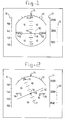
- FIG 1 is illustrative of a conventional primary flight display which can be electronically presented on a screen of a cathode-ray tube or liquid crystal device.
- the display field shows a centre display area, a right hand side display area and left hand side display area.
- the left hand side display area shows an airspeed scale 10.
- At the right hand side an altitude scale 11 and a vertical speed scale 12 are displayed.
- the central display area looks like a gyroscopic artificial horizon indicator but is electronically displayed instead of mechanically functioning. It includes a fixed arcuate roll scale 13 having a fixed roll scale centre pointer (roll index) 14 and a moving roll attitude indicator (pointer) 15.
- the pointer 15 moves along the fixed roll scale 13 when the aircraft rotates along its longitudinal axis, when flying a turn, indicating the degree of turn in relation to the roll index 14.
- the artificial horizon 16 divides the display in two portions, and is perpendicularly crossed by the pitch scale ladder 17.
- the display also comprises an aircraft reference symbol 50, in this example emboddied as a three part aircraft reference symbol is shown with a boresight 19 and left and right wings 18 and 20.
- the PFD When flying a right turn, as shown in FIG 2, the PFD shows this by rotation of the pointer 15 to the left along the fixed roll scale 13, also the artificial horizon 16 "tilts" to the left, while the aircraft reference symbol 50 and the roll index 14 stay fixed. This is because the PFD is based on the roll, pitch and yaw axes of the aircraft as opposed to earth-based axes. This means that the aircraft reference symbol 50 is always in line with the pilots line of view. From the pilots point of view when he rolls the aircraft to fly a turn, the horizon tilts to the opposite side.
- the TCAS computer scans the airspace around the aircraft and in case an intruder aircraft is detected, it determines if evasive action is necessary, and if so what kind of evasive action has to be taken.
- the TCASIII computer can issue vertical, horizontal or double-dimension Resolution Advisory commands.
- the vertical RA command is given by a vertical speed output, the horizontal RA command by a roll command output.
- a TCASII display for the RA vertical speed command conventionally shows a red line segment along the vertical speed scale indicating vertical airspeeds to be avoided and a green line segment indicating vertical airspeeds required to attain in order to avoid collision or collision risk.
- Fokker evaluated a display of TCASIII RA commands on the same PFD.
- TCASIII RA command information for roll and vertical airspeed were displayed using red "keep out” and green "fly-to" line segments along roll scale and vertical speed scale.
- FIG 3A shows a first PFD of an aircraft in level flight with a TCASIII corrective RA roll command, which the aircraft has to follow in order to eliminate the by the TCASIII system detected threat of collision with an intruder aircraft in the airspace surrounding the aircraft.
- the corrective RA roll command is shown on the fixed roll scale 13 with a two part line segment consisting of a first part red line segment 21 delineating the keep-out portion of the roll-scale, and a second part green line segment 22 delineating the fly-to portion of the roll scale.
- the pilot has to fly pointer 15 out of the red area 21 into the green area 22. This is the RA roll command TURN RIGHT.
- FIG 3B shows the PFD after the pilot has reacted to this roll-cue RA.
- Testpilots reacted to the corrective RA roll command by intuitively moving the steering column away from red zone 21 and initiating a left turn instead of the commanded right turn, causing the aircraft to fly into red zone 21.
- Pointer 15 has moved deeper into on roll scale 13 delineated red keep out area 21.
- a second PFD was devised on which the position of the RA roll command at the display was changed. Additionally to the change of position the RA roll command symbol was changed from a fixed RA roll command symbol into a sliding symbol.
- FIG 3A which shows the positive RA roll command TURN RIGHT by delineating red keep out area 21 on the roll scale on the right hand side of green fly to area 22
- FIG 4A the same positive RA roll command symbol TURN RIGHT is shown by a similar two part line segment but line segment 30 delineating red keep out area 30 on the fixed roll scale is positioned on the left hand side of green fly to area 29.
- the pilot is encouraged to intuitively move the aircraft away from the red area by moving the steering column physically away from the red area, thereby initiating the commanded TURN RIGHT.
- the pilot has in effect fly the green fly-to area 29 to the centre of the roll scale and get pointer 14 inside the green area 29 and out of keep out area 30. Test showed that although the display was intellectually understood when explained it was dynamically incorrectly flown. Testpilots initially reacted intuitively correct by moving the steering column away from the red zone, and initiating the right turn.
- a third PFD was devised on which pointer 15 conventionally is locked to the pitch scale perpendicular to the artificial horizon, is now inversely locked into fixed position on the intersection between an imaginary vertical line segment originating in the bore sight of the aircraft reference symbol and positioned perpendicular to the horizontal axis of the aircraft reference symbol and the arcuate line symbol delineating boundary of the gyroscopic centre section of the PFD.
- conventionally fixed roll scale 13 is not longer fixed, but moves relative to pointer 15 when a turn is flown. Line segments delineating keep out area 30 and fly to area 29 are fixed on the sliding roll scale 13.
- Pointer 15 is fixed on the centre of roll scale 13, and is as a result of the moving roll scale always perpendicular to the artificial horizon 16 and centrally above pitch scale ladder 17.
- FIG 5A and 5B shows the PFD accordingly, when an aircraft changes its attitude from level flight as shown in FIG 5A into right roll as shown in FIG 5B when no TCASIII RA commands are given.
- FIG 5A shows the PFD of the aircraft in level flight
- FIG 5B demonstrates that roll scale 13 has moved to the left of pointer 15, as is shown by the position of roll index 14 and roll angle indicators 13a and 13b.
- the artificial horizon 16 and pitch scale ladder 17 assembly have tilted to the left.
- FIG 6A shows the RA roll command symbol as displayed on the PFD according to the preferred embodiment of this invention.
- the PFD of an aircraft in a level flight is shown, with corrective RA roll command .
- the roll-cue RA comprises the corrective red keep-out area 29 and the green fly to area 30 as indicated.
- the pilot has to fly out of red area 29 and will move the aircraft steering column towards green area 30. So the roll-cue RA of FIG.6A tells the pilot to TURN RIGHT in order to avoid collision.
- FIG 6B shows the PFD after the pilot has nearly executed the commanded right turn. Red keep out area 29 is moving with the roll scale towards the left as is the neighbouring green fly to area 30, indicating the aircraft is moving towards the fly-to zone in a right turn.
- Pointer 15 is now nearing the green fly-to area 30, indicating to the pilot that he is nearing the green fly-to area and that the threat of collision is almost over. After pointer 15 has entered green fly-to area 30, the pilot is no longer required to correct his flight path in order to avoid the threat of collision. This TCASIII RA was flown without any difficulty. The display appeared to be very intuitive.
- FIG 7A shows the RA roll command symbol as displayed on the PFD according to the preferred embodiment of this invention.
- the PFD of an aircraft in a right turn is shown with a preventive RA roll command .
- the RA roll command is preventive because only a red keep out 29 is shown.
- Pointer 15 is outside of the keep out area 29, which indicates that the aircraft is not within the keep out area.
- the pilot is warned but not urged to change his present flight path. So the RA roll command FIG.7A is preventive and tell the pilot DO NOT TURN RIGHT.
- FIG 7A shows the RA roll command symbol as displayed on the PFD according to the preferred embodiment of this invention.
- the PFD of an aircraft in level flight is shown with a preventive RA roll command.
- the RA roll command is preventive because two keep out area's 29A and 29B are delineated on the roll scale, but no fly to area is displayed. Pointer 15 is outside of the keep out areas 29A and 29B, it is in effect positioned between them. This indicates that the aircraft is not within the keep out areas. The pilot is warned but will not have to change his present flight path. So the RA roll command FIG.7B is preventive and tells the pilot DO NOT TURN RIGHT AND DO NOT TURN LEFT.
- TCASIII RA is used integrated in the aircrafts Automatic Flight Control and Augmentation System (AFCAS). This enables the crew to fly TCASIII collision avoidance manoeuvres automatically by Autopilot (AP) or to fly it manually with guidance of the Flight Director.
- AFCAS Automatic Flight Control and Augmentation System
- the Flight Director 31 is used in combination with the TCASIII roll and vertical speed RA commands, as a guidance to fly the aircraft manually to the area with the greatest safety and with a minimum of aircraft manoeuvring.
- the PFD of an aircraft flying a right turn is displayed, with a corrective RA roll command and a corrective vertical speed RA.
- Flight Director 31 is displayed in the centre of the PFD.
- the cross-hairs of FD 31 indicate that the aircraft has to pitch up and level out of the right turn and turn right.
- the pilot will fly pointer 15 to the green fly-to area 30 and the vertical speed indicator 12 to the green fly-to area 28.
- the appropriate collision avoidance flight mode When supported by AFCAS and if the RA is corrective, then the appropriate collision avoidance flight mode is automatically armed. So when a corrective RA vertical speed command is issued by TCASIII, "V/S" is annunciated in the vertical path window of the Flight Mode Annunciator at the top of the PFD. When a corrective RA roll command is issued by TCASIII, "TURN” is annunciated in the lateral path window of the Flight Mode Annunciator at the top of the PFD.
- the collision avoidance flight mode is engaged by manual selection. This enables the crew to evaluate the threat situation in connection with the issued RA before any deviation from the original flight path is initiated. When armed the Flight Mode Annunciations are depicted in a different colour than when engaged.
- a dedicated pushbutton is provided on the Flight Mode Panel (FMP). This switch only effects the flight mode in the RA planes and leaves the AutoPilot (AP) and AutoThrottle (AT) engage status unchanged.
- Fig. 8 also shows these Flight Mode Annunciations at the top of the display. Coloured FMA's "V/S” and “TURN” indicate that the collision avoidance flight modes for both vertical and lateral paths are engaged.
- the RA roll command symbol is depicted as a line segment which may be a single red line segment in case of a preventive RA roll command and a two part red/green line segment in case of a corrective RA roll command. It is within the scope of this invention to use other symbols to mark the keep out and fly to areas on roll scale 13, such as hatching, double-stroked line segments, other types of hatching symbols (stars, bullets) and different colours. Also the pointers used in the figures are triangular but may be of different shape and/or colour.
Landscapes
- Engineering & Computer Science (AREA)
- Radar, Positioning & Navigation (AREA)
- Remote Sensing (AREA)
- Physics & Mathematics (AREA)
- Aviation & Aerospace Engineering (AREA)
- General Physics & Mathematics (AREA)
- Electromagnetism (AREA)
- Computer Networks & Wireless Communication (AREA)
- Traffic Control Systems (AREA)
Claims (12)
- Vorrichtung zur Darstellung symbolischer Informationen auf einer elektronischen Fluglagenanzeigeeinrichtung eines Flugzeugs als Reaktion auf Daten, die von einem Computer für Verkehrswarnung und Kollisionsvermeidung (TCAS) an Bord des besagten Flugzeugs erzeugt werden, wobei die besagten symbolischen Informationen die Cockpitcrew des Flugzeugs anleiten sollen, wie eine Kollision mit anderen Flugzeugen, die in den durch den TCAS-Computer überwachten Luftraum eindringen, vermieden werden kann, wobei die besagte Vorrichtung folgendes umfaßt:Mittel zum Anzeigen einer Rollwinkelskala (13) auf der besagten Fluglagenanzeigeeinrichtung,Mittel zum Empfangen von Daten aus dem Flugzeug, die den Rollwinkel des Flugzeugs darstellen, und zum Anzeigen eines entsprechenden Rollwinkelsymbols entlang der besagten Rollwinkelskala;Mittel zumEmpfangen von Daten aus dem TCAS-Computer, die die Luftraumbereiche betreffen, die von anderen Flugzeugen eingenommen werdenAnzeigen eines entsprechenden Abweissymbols (30) entlang eines Abschnitts der Rollwinkelskala (13), das der Cockpitcrew mitteilt, nicht in diesen Abschnitt einzutreten, undAnzeigen eines Go-To-Symbols (29) entlang der besagten Rollwinkelskala (13), das auf einen Abschnitt der Skala zeigt, der nicht durch ein Abweissymbol markiert ist, wenn das Rollwinkelsymbol mit dem Abweissymbol (30) zusammenfällt, wodurch die Cockpitcrew angeleitet wird, das Flugzeug so zu drehen, daß sich das Rollwinkelsymbol aus dem durch das Abweissymbol (30) markierten Abschnitt herausbewegt.
- Vorrichtung nach Anspruch 1, die weiterhin Mittel zum Anzeigen eines Flugzeug-Bezugssymbols auf der Anzeigeeinrichtung und Mittel zum Herstellen eines Zusammenhangs zwischen dem besagten Rollwinkelsymbol und dem besagten Flugzeug-Bezugssymbol umfaßt, so daß beide Symbole an festen vorbestimmten Positionen angezeigt werden, wodurch jegliche Änderung des Rollwinkels durch eine Bewegung der Rollwinkelskala entlang dem besagten Rollwinkelsymbol angezeigt wird.
- Vorrichtung nach Anspruch 1 oder 2, wobei die Rollwinkelskala als eine Linie angezeigt wird, die auf einer Seite Skalenmarkierungen trägt, wobei das Rollwinkelsymbol als Zeiger ausgeführt ist, der auf der anderen Seite der besagten Linie positioniert ist und auf die besagte Linie zeigt.
- Vorrichtung nach einem der vorangehenden Ansprüche, wobei das besagte Abweissymbol als Liniensegment ausgeführt ist, das parallel zu der besagten Rollwinkelskala angezeigt wird oder die besagte Rollwinkelskala überlappt.
- Vorrichtung nach Anspruch 4, wobei das Abweissymbol in einer Farbe angezeigt wird, die für die Cockpitcrew intuitiv mit Gefahr in Zusammenhang steht, z.B. in einer roten Farbe.
- Vorrichtung nach einem der vorangehenden Ansprüche, wobei das Go-To-Symbol als Liniensegment ausgeführt ist, das das Abweissymbol begrenzt.
- Vorrichtung nach Anspruch 6, wobei das Go-To-Symbol in einer Farbe angezeigt wird, die für die Cockpitcrew intuitiv mit Sicherheit in Zusammenhang steht, z.B. in einer grünen Farbe.
- Vorrichtung, um einem Piloten eines Flugzeugs Entscheidungshilfeinformationen (RA-Informationen) darzustellen, die durch einen Computer eines Verkehrswarnungs- und Kollisionsvermeidungssystems (TCAS) an Bord des besagten Flugzeugs entwickelt werden, wobei die besagte Vorrichtung folgendes umfaßt:(a) Mittel zum:Empfangen von Daten, die die horizontale Ausweichaktion der Kollisionsvermeidung darstellen, um die Gefahr einer Kollision zu beseitigen,Empfangen von Daten aus dem Flugzeug, die den Rollwinkel des Flugzeugs darstellen,Bestimmen der potentiellen Gefahr, um unnötige Warnungen zu verringern,Erzeugen einer Entscheidungshilfe (Resolution Advisory, RA) für den Rollwinkel, und(b)ein elektronisches Anzeigemittel mit einem Flugzeug-Bezugssymbol (18, 19, 20) und einer Rollachsenskala (13),ein RA-Roll-Führungssymbol, das entlang der besagten Rollachsenskala zwischen einem äußeren Ende dieser Skala (51 oder 52) und einem Rollwinkelwert (54) vorsteht und einen Abweisbereich (29) definiert,den Zeiger (15), der auf das besagte Roll-Führungssymbol zeigt, wobei, während der Zeiger (15) in den Abweisbereich (29) des Roll-Führungssymbols zeigt, die Richtung der von dem Piloten auszuführenden Ausweich-Rollaktion gleich der Richtung von dem Abweisbereich (29) zu dem besagten Rollwinkelwert (54) ist.
- Vorrichtung nach Anspruch 8, dadurch gekennzeichnet, daß die Position des besagten Zeigers (15) entlang der besagten Skala mit der Position des besagten Flugzeug-Bezugssymbols fest verbunden ist, und daß sich während der Ausführung der besagten Rollaktion die Rollachsenskala in einer solchen Richtung bewegt, daß sich der Zeiger (15) aus dem Abweisbereich heraus bewegt.
- Vorrichtung nach Anspruch 9, dadurch gekennzeichnet, daß der Abweisbereich einen schattierten Bereich, einen (kreuz-)schraffierten Bereich oder einen Bereich mit einer von der Hintergrundfarbe verschiedenen Farbe umfaßt.
- Vorrichtung nach Anspruch 9, dadurch gekennzeichnet, daß mindestens der dem Abweisbereich entlang der Rollachsenskala benachbarte Teil der Rollachsenskala einen schattierten Bereich, einen (kreuz-)schraffierten Bereich oder einen Bereich mit einer von der Hintergrundfarbe verschiedenen Farbe umfaßt.
- Vorrichtung nach Anspruch 10 oder 11, dadurch gekennzeichnet, daß der Abweisbereich rot und der dem Abweisbereich benachbarte Teil grün ist.
Priority Applications (2)
| Application Number | Priority Date | Filing Date | Title |
|---|---|---|---|
| EP94202847A EP0704677B1 (de) | 1994-10-02 | 1994-10-02 | Leitsteuerungsanzeige für TCAS III |
| HK98105384.6A HK1006352B (en) | 1998-06-16 | Tcas iii guidance control display |
Applications Claiming Priority (2)
| Application Number | Priority Date | Filing Date | Title |
|---|---|---|---|
| EP94202847A EP0704677B1 (de) | 1994-10-02 | 1994-10-02 | Leitsteuerungsanzeige für TCAS III |
| HK98105384.6A HK1006352B (en) | 1998-06-16 | Tcas iii guidance control display |
Publications (2)
| Publication Number | Publication Date |
|---|---|
| EP0704677A1 EP0704677A1 (de) | 1996-04-03 |
| EP0704677B1 true EP0704677B1 (de) | 1998-04-15 |
Family
ID=26136628
Family Applications (1)
| Application Number | Title | Priority Date | Filing Date |
|---|---|---|---|
| EP94202847A Expired - Lifetime EP0704677B1 (de) | 1994-10-02 | 1994-10-02 | Leitsteuerungsanzeige für TCAS III |
Country Status (1)
| Country | Link |
|---|---|
| EP (1) | EP0704677B1 (de) |
Families Citing this family (7)
| Publication number | Priority date | Publication date | Assignee | Title |
|---|---|---|---|---|
| DE102004045094B4 (de) | 2004-09-17 | 2012-05-03 | Deutsches Zentrum für Luft- und Raumfahrt e.V. | Verfahren zum automatischen Generieren von grafisch dargestellten Anzeigeinstrumenten |
| WO2007115359A1 (en) * | 2006-04-10 | 2007-10-18 | Windbidco Pty Ltd | Display system for controlling aircraft traffic and method |
| US10885798B2 (en) | 2016-07-13 | 2021-01-05 | Honeywell International Inc. | Aircraft traffic alert and collision avoidance system with autoflight system mode protection |
| US10192453B2 (en) * | 2016-07-13 | 2019-01-29 | Honeywell International Inc. | Aircraft traffic alert and collision avoidance system with autoflight system mode protection |
| US10216471B1 (en) | 2017-08-17 | 2019-02-26 | Honeywell International Inc. | Aircraft systems and methods for unusual attitude recovery |
| EP3671698A1 (de) * | 2018-12-19 | 2020-06-24 | Honeywell International Inc. | Flugzeugverkehrswarn- und kollisionsvermeidungssystem mit schutz des automatischen flugsteuerungssystemmodus |
| US11830368B2 (en) * | 2020-08-31 | 2023-11-28 | Honeywell International Inc. | Horizontal evasion guidance display methods and systems |
Family Cites Families (4)
| Publication number | Priority date | Publication date | Assignee | Title |
|---|---|---|---|---|
| US4914733A (en) * | 1987-10-30 | 1990-04-03 | Allied-Signal, Inc. | Traffic advisory-instantaneous vertical speed display |
| EP0396071A3 (de) * | 1989-05-02 | 1991-10-30 | Honeywell Inc. | Gerät und Methode für eine Flugzeuganzeige, die Hinweise gibt bezüglich vertikaler Geschwindigkeit, Verkehrslage und Kollisionsauflösung |
| US5185606A (en) * | 1990-05-08 | 1993-02-09 | Fokker Aircraft B.V. | Primary flight display presenting resolution advisory information provided by a traffic alert and collision avoidance system |
| US5248968A (en) * | 1991-12-06 | 1993-09-28 | The Boeing Company | Tcas ii pitch guidance control law and display symbol |
-
1994
- 1994-10-02 EP EP94202847A patent/EP0704677B1/de not_active Expired - Lifetime
Also Published As
| Publication number | Publication date |
|---|---|
| HK1006352A1 (en) | 1999-02-19 |
| EP0704677A1 (de) | 1996-04-03 |
Similar Documents
| Publication | Publication Date | Title |
|---|---|---|
| US11164471B1 (en) | System for previewing vertical speed guidance following an air traffic conflict alert | |
| EP3961603B1 (de) | Verfahren und systeme zur anzeige der horizontalen ausweichführung | |
| EP0456329B1 (de) | Primäre Fluganzeige zum Darstellen von Entscheidungsvorschlagsinformation, die von einem Verkehrswarn- und Koalisionsschutzsystem geliefert wird | |
| EP3012590B1 (de) | System und verfahren zur anzeige von landebahnanfluginformationen | |
| EP2827104B1 (de) | Anzeigesysteme und Verfahren zur Bereitstellung von Anzeigen mit integrierter Autopilotfunktionalität | |
| US5248968A (en) | Tcas ii pitch guidance control law and display symbol | |
| US7280896B2 (en) | Process and device for constructing a synthetic image of the environment of an aircraft and presenting it on a screen of said aircraft | |
| US7312725B2 (en) | Display system for operating a device with reduced out-the-window visibility | |
| US9273964B2 (en) | System and display element for displaying waypoint markers with integrated altitude constraint information | |
| EP1896797B1 (de) | Primäre fluganzeige mit perspektivenansicht mit geländeverfolgungslinien | |
| US20070027588A1 (en) | Aircraft flight safety device and method which are intended for an aircraft flying in instrument meteorological conditions and which are used independently of instrument flight infrastructure | |
| US6255965B1 (en) | Device for aiding the piloting of an aircraft, especially a rotary-wing aircraft and in particular a helicopter | |
| EP3270366B1 (de) | Flugzeugverkehrswarn- und kollisionsvermeidungssystem mit schutz des automatischen flugsteuerungssystemmodus | |
| US7161500B2 (en) | Display device for aircraft and method for displaying detected threats | |
| US5675328A (en) | Optoelectronic device for assistance in the piloting of an aircraft under conditions of poor visibility | |
| EP0704677B1 (de) | Leitsteuerungsanzeige für TCAS III | |
| US20030222794A1 (en) | Device for aiding the visual spotting of an aircraft in flight from another aircraft, also in flight | |
| US11450219B2 (en) | Aircraft system and method for assisting a pilot during flight | |
| Keller et al. | Cognitive task analysis of commercial jet aircraft pilots during instrument approaches for baseline and synthetic vision displays | |
| HK1006352B (en) | Tcas iii guidance control display | |
| RU2729891C1 (ru) | Интеллектуальный человеко-машинный интерфейс экипажа вертолета по высотно-скоростным параметрам и параметрам воздушной среды, окружающей вертолет | |
| EP3671698A1 (de) | Flugzeugverkehrswarn- und kollisionsvermeidungssystem mit schutz des automatischen flugsteuerungssystemmodus | |
| Leiden et al. | Information to support the human performance modeling of a B757 flight crew during approach and landing | |
| Siddiqi et al. | Redefining efficiency of TCAS for improved sight through image processing | |
| Selier et al. | National technology project'outcast’on UAS sense and avoid |
Legal Events
| Date | Code | Title | Description |
|---|---|---|---|
| PUAI | Public reference made under article 153(3) epc to a published international application that has entered the european phase |
Free format text: ORIGINAL CODE: 0009012 |
|
| AK | Designated contracting states |
Kind code of ref document: A1 Designated state(s): GB |
|
| RBV | Designated contracting states (corrected) |
Designated state(s): GB |
|
| REG | Reference to a national code |
Ref country code: DE Ref legal event code: 8566 |
|
| 17P | Request for examination filed |
Effective date: 19961002 |
|
| GRAG | Despatch of communication of intention to grant |
Free format text: ORIGINAL CODE: EPIDOS AGRA |
|
| 17Q | First examination report despatched |
Effective date: 19970612 |
|
| GRAG | Despatch of communication of intention to grant |
Free format text: ORIGINAL CODE: EPIDOS AGRA |
|
| GRAH | Despatch of communication of intention to grant a patent |
Free format text: ORIGINAL CODE: EPIDOS IGRA |
|
| GRAH | Despatch of communication of intention to grant a patent |
Free format text: ORIGINAL CODE: EPIDOS IGRA |
|
| GRAA | (expected) grant |
Free format text: ORIGINAL CODE: 0009210 |
|
| RAP1 | Party data changed (applicant data changed or rights of an application transferred) |
Owner name: FOKKER TECHNOLOGY B.V. |
|
| AK | Designated contracting states |
Kind code of ref document: B1 Designated state(s): GB |
|
| PLBE | No opposition filed within time limit |
Free format text: ORIGINAL CODE: 0009261 |
|
| STAA | Information on the status of an ep patent application or granted ep patent |
Free format text: STATUS: NO OPPOSITION FILED WITHIN TIME LIMIT |
|
| 26N | No opposition filed | ||
| REG | Reference to a national code |
Ref country code: GB Ref legal event code: IF02 |
|
| PGFP | Annual fee paid to national office [announced via postgrant information from national office to epo] |
Ref country code: GB Payment date: 20040831 Year of fee payment: 11 |
|
| PG25 | Lapsed in a contracting state [announced via postgrant information from national office to epo] |
Ref country code: GB Free format text: LAPSE BECAUSE OF NON-PAYMENT OF DUE FEES Effective date: 20051002 |
|
| GBPC | Gb: european patent ceased through non-payment of renewal fee |
Effective date: 20051002 |