EP0704944A1 - Laser à fibre à puissance améliorée avec faiseau de sortie contrÔlable - Google Patents
Laser à fibre à puissance améliorée avec faiseau de sortie contrÔlable Download PDFInfo
- Publication number
- EP0704944A1 EP0704944A1 EP95201515A EP95201515A EP0704944A1 EP 0704944 A1 EP0704944 A1 EP 0704944A1 EP 95201515 A EP95201515 A EP 95201515A EP 95201515 A EP95201515 A EP 95201515A EP 0704944 A1 EP0704944 A1 EP 0704944A1
- Authority
- EP
- European Patent Office
- Prior art keywords
- fiber
- active
- parameter
- axis
- laser
- Prior art date
- Legal status (The legal status is an assumption and is not a legal conclusion. Google has not performed a legal analysis and makes no representation as to the accuracy of the status listed.)
- Withdrawn
Links
- 239000000835 fiber Substances 0.000 title claims abstract description 191
- 230000000737 periodic effect Effects 0.000 claims abstract description 15
- 230000003321 amplification Effects 0.000 claims abstract description 11
- 238000003199 nucleic acid amplification method Methods 0.000 claims abstract description 11
- 230000010355 oscillation Effects 0.000 claims abstract description 8
- 239000013307 optical fiber Substances 0.000 claims description 12
- 238000005086 pumping Methods 0.000 claims description 11
- 238000005253 cladding Methods 0.000 claims description 9
- 238000009826 distribution Methods 0.000 claims description 7
- 230000008878 coupling Effects 0.000 claims description 6
- 238000010168 coupling process Methods 0.000 claims description 6
- 238000005859 coupling reaction Methods 0.000 claims description 6
- 101100234408 Danio rerio kif7 gene Proteins 0.000 claims description 3
- 101100221620 Drosophila melanogaster cos gene Proteins 0.000 claims description 3
- 101100398237 Xenopus tropicalis kif11 gene Proteins 0.000 claims description 3
- 238000005315 distribution function Methods 0.000 claims 1
- 229910052761 rare earth metal Inorganic materials 0.000 description 6
- 150000002910 rare earth metals Chemical class 0.000 description 5
- VYPSYNLAJGMNEJ-UHFFFAOYSA-N Silicium dioxide Chemical compound O=[Si]=O VYPSYNLAJGMNEJ-UHFFFAOYSA-N 0.000 description 4
- 230000008901 benefit Effects 0.000 description 4
- 238000004891 communication Methods 0.000 description 4
- 239000002019 doping agent Substances 0.000 description 4
- 230000003287 optical effect Effects 0.000 description 4
- 239000004065 semiconductor Substances 0.000 description 4
- 238000000576 coating method Methods 0.000 description 3
- 230000001902 propagating effect Effects 0.000 description 3
- XUIMIQQOPSSXEZ-UHFFFAOYSA-N Silicon Chemical compound [Si] XUIMIQQOPSSXEZ-UHFFFAOYSA-N 0.000 description 2
- 238000003491 array Methods 0.000 description 2
- 239000011248 coating agent Substances 0.000 description 2
- 238000001816 cooling Methods 0.000 description 2
- 101150118300 cos gene Proteins 0.000 description 2
- 230000008713 feedback mechanism Effects 0.000 description 2
- 239000011521 glass Substances 0.000 description 2
- 238000000034 method Methods 0.000 description 2
- 230000005855 radiation Effects 0.000 description 2
- 229910052710 silicon Inorganic materials 0.000 description 2
- 239000010703 silicon Substances 0.000 description 2
- 239000000377 silicon dioxide Substances 0.000 description 2
- KRHYYFGTRYWZRS-UHFFFAOYSA-M Fluoride anion Chemical compound [F-] KRHYYFGTRYWZRS-UHFFFAOYSA-M 0.000 description 1
- 238000005229 chemical vapour deposition Methods 0.000 description 1
- 230000001427 coherent effect Effects 0.000 description 1
- 230000007547 defect Effects 0.000 description 1
- 238000005516 engineering process Methods 0.000 description 1
- 238000012681 fiber drawing Methods 0.000 description 1
- 239000002657 fibrous material Substances 0.000 description 1
- 239000003365 glass fiber Substances 0.000 description 1
- 239000000463 material Substances 0.000 description 1
- 238000012986 modification Methods 0.000 description 1
- 230000004048 modification Effects 0.000 description 1
- 238000005498 polishing Methods 0.000 description 1
- 230000008569 process Effects 0.000 description 1
- 230000003595 spectral effect Effects 0.000 description 1
- 238000009827 uniform distribution Methods 0.000 description 1
Images


Classifications
-
- H—ELECTRICITY
- H01—ELECTRIC ELEMENTS
- H01S—DEVICES USING THE PROCESS OF LIGHT AMPLIFICATION BY STIMULATED EMISSION OF RADIATION [LASER] TO AMPLIFY OR GENERATE LIGHT; DEVICES USING STIMULATED EMISSION OF ELECTROMAGNETIC RADIATION IN WAVE RANGES OTHER THAN OPTICAL
- H01S3/00—Lasers, i.e. devices using stimulated emission of electromagnetic radiation in the infrared, visible or ultraviolet wave range
- H01S3/05—Construction or shape of optical resonators; Accommodation of active medium therein; Shape of active medium
- H01S3/06—Construction or shape of active medium
- H01S3/063—Waveguide lasers, i.e. whereby the dimensions of the waveguide are of the order of the light wavelength
- H01S3/067—Fibre lasers
- H01S3/06708—Constructional details of the fibre, e.g. compositions, cross-section, shape or tapering
-
- H—ELECTRICITY
- H01—ELECTRIC ELEMENTS
- H01S—DEVICES USING THE PROCESS OF LIGHT AMPLIFICATION BY STIMULATED EMISSION OF RADIATION [LASER] TO AMPLIFY OR GENERATE LIGHT; DEVICES USING STIMULATED EMISSION OF ELECTROMAGNETIC RADIATION IN WAVE RANGES OTHER THAN OPTICAL
- H01S2301/00—Functional characteristics
- H01S2301/20—Lasers with a special output beam profile or cross-section, e.g. non-Gaussian
-
- H—ELECTRICITY
- H01—ELECTRIC ELEMENTS
- H01S—DEVICES USING THE PROCESS OF LIGHT AMPLIFICATION BY STIMULATED EMISSION OF RADIATION [LASER] TO AMPLIFY OR GENERATE LIGHT; DEVICES USING STIMULATED EMISSION OF ELECTROMAGNETIC RADIATION IN WAVE RANGES OTHER THAN OPTICAL
- H01S3/00—Lasers, i.e. devices using stimulated emission of electromagnetic radiation in the infrared, visible or ultraviolet wave range
- H01S3/05—Construction or shape of optical resonators; Accommodation of active medium therein; Shape of active medium
- H01S3/06—Construction or shape of active medium
- H01S3/063—Waveguide lasers, i.e. whereby the dimensions of the waveguide are of the order of the light wavelength
- H01S3/067—Fibre lasers
- H01S3/06708—Constructional details of the fibre, e.g. compositions, cross-section, shape or tapering
- H01S3/0672—Non-uniform radial doping
-
- H—ELECTRICITY
- H01—ELECTRIC ELEMENTS
- H01S—DEVICES USING THE PROCESS OF LIGHT AMPLIFICATION BY STIMULATED EMISSION OF RADIATION [LASER] TO AMPLIFY OR GENERATE LIGHT; DEVICES USING STIMULATED EMISSION OF ELECTROMAGNETIC RADIATION IN WAVE RANGES OTHER THAN OPTICAL
- H01S3/00—Lasers, i.e. devices using stimulated emission of electromagnetic radiation in the infrared, visible or ultraviolet wave range
- H01S3/05—Construction or shape of optical resonators; Accommodation of active medium therein; Shape of active medium
- H01S3/06—Construction or shape of active medium
- H01S3/063—Waveguide lasers, i.e. whereby the dimensions of the waveguide are of the order of the light wavelength
- H01S3/067—Fibre lasers
- H01S3/06708—Constructional details of the fibre, e.g. compositions, cross-section, shape or tapering
- H01S3/06729—Peculiar transverse fibre profile
-
- H—ELECTRICITY
- H01—ELECTRIC ELEMENTS
- H01S—DEVICES USING THE PROCESS OF LIGHT AMPLIFICATION BY STIMULATED EMISSION OF RADIATION [LASER] TO AMPLIFY OR GENERATE LIGHT; DEVICES USING STIMULATED EMISSION OF ELECTROMAGNETIC RADIATION IN WAVE RANGES OTHER THAN OPTICAL
- H01S3/00—Lasers, i.e. devices using stimulated emission of electromagnetic radiation in the infrared, visible or ultraviolet wave range
- H01S3/05—Construction or shape of optical resonators; Accommodation of active medium therein; Shape of active medium
- H01S3/06—Construction or shape of active medium
- H01S3/063—Waveguide lasers, i.e. whereby the dimensions of the waveguide are of the order of the light wavelength
- H01S3/067—Fibre lasers
- H01S3/06708—Constructional details of the fibre, e.g. compositions, cross-section, shape or tapering
- H01S3/06745—Tapering of the fibre, core or active region
-
- H—ELECTRICITY
- H01—ELECTRIC ELEMENTS
- H01S—DEVICES USING THE PROCESS OF LIGHT AMPLIFICATION BY STIMULATED EMISSION OF RADIATION [LASER] TO AMPLIFY OR GENERATE LIGHT; DEVICES USING STIMULATED EMISSION OF ELECTROMAGNETIC RADIATION IN WAVE RANGES OTHER THAN OPTICAL
- H01S3/00—Lasers, i.e. devices using stimulated emission of electromagnetic radiation in the infrared, visible or ultraviolet wave range
- H01S3/05—Construction or shape of optical resonators; Accommodation of active medium therein; Shape of active medium
- H01S3/06—Construction or shape of active medium
- H01S3/063—Waveguide lasers, i.e. whereby the dimensions of the waveguide are of the order of the light wavelength
- H01S3/067—Fibre lasers
- H01S3/06754—Fibre amplifiers
-
- H—ELECTRICITY
- H01—ELECTRIC ELEMENTS
- H01S—DEVICES USING THE PROCESS OF LIGHT AMPLIFICATION BY STIMULATED EMISSION OF RADIATION [LASER] TO AMPLIFY OR GENERATE LIGHT; DEVICES USING STIMULATED EMISSION OF ELECTROMAGNETIC RADIATION IN WAVE RANGES OTHER THAN OPTICAL
- H01S3/00—Lasers, i.e. devices using stimulated emission of electromagnetic radiation in the infrared, visible or ultraviolet wave range
- H01S3/05—Construction or shape of optical resonators; Accommodation of active medium therein; Shape of active medium
- H01S3/08—Construction or shape of optical resonators or components thereof
- H01S3/08018—Mode suppression
- H01S3/0804—Transverse or lateral modes
- H01S3/08045—Single-mode emission
-
- H—ELECTRICITY
- H01—ELECTRIC ELEMENTS
- H01S—DEVICES USING THE PROCESS OF LIGHT AMPLIFICATION BY STIMULATED EMISSION OF RADIATION [LASER] TO AMPLIFY OR GENERATE LIGHT; DEVICES USING STIMULATED EMISSION OF ELECTROMAGNETIC RADIATION IN WAVE RANGES OTHER THAN OPTICAL
- H01S3/00—Lasers, i.e. devices using stimulated emission of electromagnetic radiation in the infrared, visible or ultraviolet wave range
- H01S3/09—Processes or apparatus for excitation, e.g. pumping
- H01S3/091—Processes or apparatus for excitation, e.g. pumping using optical pumping
- H01S3/094—Processes or apparatus for excitation, e.g. pumping using optical pumping by coherent light
-
- H—ELECTRICITY
- H01—ELECTRIC ELEMENTS
- H01S—DEVICES USING THE PROCESS OF LIGHT AMPLIFICATION BY STIMULATED EMISSION OF RADIATION [LASER] TO AMPLIFY OR GENERATE LIGHT; DEVICES USING STIMULATED EMISSION OF ELECTROMAGNETIC RADIATION IN WAVE RANGES OTHER THAN OPTICAL
- H01S3/00—Lasers, i.e. devices using stimulated emission of electromagnetic radiation in the infrared, visible or ultraviolet wave range
- H01S3/23—Arrangements of two or more lasers not provided for in groups H01S3/02 - H01S3/22, e.g. tandem arrangements of separate active media
- H01S3/2308—Amplifier arrangements, e.g. MOPA
- H01S3/2325—Multi-pass amplifiers, e.g. regenerative amplifiers
- H01S3/2333—Double-pass amplifiers
Definitions
- the invention relates generally to an optical fiber coherent radiation source, and more specifically to an active multimode graded-index fiber laser used to generate an optical signal in optical fiber communication systems, sensors and other optical fiber devices for technical and medical applications.
- Optical fiber lasers are becoming more important components of optical fiber communication systems, sensors, fiber gyros and other optical fiber devices for different technical and medical applications. These lasers essentially consist of a rare-earth-doped optical fiber pumped with an external light source such as a single-mode semiconductor laser or diode-laser array. Mirrors can be used to provide the system with the necessary feedback.
- fiber lasers are based on conventional high-purity silica-based optical fibers produced by chemical-vapor-deposition and are doped, for example, with such rare-earth elements as Nd3+, Er3+, Tm3+, Ho3+, Yb3+, Sm3+, and Pr3+ via gas-phase or solution-doping processes.
- Other types of fiber lasers include multicomponent high-gain glass fiber lasers fabricated by the rodintube method or fiber lasers in fluoride based glasses.
- a single-mode optical fiber with rare-earth doped active core having a diameter between 3 and 8 ⁇ m is typically used in fiber lasers because it can easily be integrated into single-mode fiber-communication and sensor networks.
- the pump light from high-power semiconductor sources couples into a highly multimode undoped cladding region which guides the pump radiation by virtue of its lower refractive index. Amplification of the light takes place only in a single-mode rare-earth-doped core while a portion of the mode field propagates in the passive cladding region.
- Different types of fiber laser cavity configurations may be used including a fiber directly coupled to dichroic mirrors (such as bulk optical elements or coatings deposited directly on the fiber end face) and an all-fiber laser cavity design employing fiber-loop mirrors.
- Fiber lasers offer several advantages over traditional lasers. These advantages include the high pumping intensity available as a consequence of the good field confinement over a large length in the fiber. Additionally, because these lasers comprise a fiber, they have good compatibility with fiber-communication and sensor networks. The nature of rare-earth doping levels also allows output tunability over a broad range and a wide choice of pump wavelength. Wide gain bandwidth makes rare-earth-doped fibers very attractive for use as optical amplifiers, especially for wavelength-division multiplexing applications. Moreover, spectral output of the fiber lasers is relatively insensitive to temperature changes compared to semiconductor-based sources and the small fiber cross section allows operation without special cooling.
- the primary disadvantage of single-mode fiber lasers is the difficulty of coupling the pump light from diode laser arrays into the fiber. Even using a diffraction-limited semiconductor lasers as the pump source fails to alleviate the problem due to the laser's low output power.
- the problem of coupling pump light into an active fiber can be solved, however, by using larger core diameters, i.e. multimode fiber lasers. Such multimode fiber lasers are much more powerful because of the more efficient pumping of the active core and more efficient utilization of the pump power.
- the mirror-coating-damage problem can be solved as well by using larger core diameters as found in multimode active fibers.
- the present invention is directed at an all-fiber amplifier and laser which use an active multimode graded-index fiber.
- the active fiber is a multimode graded-index fiber having an axis and a length L .
- the length L is longer than the distance an input beam (from an input fiber) requires to relax into a Stationary state of propagation along the axis of the active fiber.
- the active fiber is optically connected to an input and an output fibers such that the input beam couples to the active fiber at a certain distance from the axis and that the axis of the output fiber coincides with the axis of active fiber.
- the gradient parameter has a period of modulation ⁇ equal to ⁇ / g r , i.e. to one half of the oscillation period of the beam.
- the parameter h is chosen to guide only one oscillating mode configuration (quasimode) in active fiber.
- a multimode active fiber is the principal element of a fiber laser.
- the core radius of the active fiber should be maximized.
- the core radius must be restricted to enable the fiber laser to operate without additional cooling.
- the intensity Q of the heat energy generation in the fiber core of radius a is proportional to a 2.
- Intensity Q is represented in Figure 1 as curve 1.
- Curve 2 in Figure 1 shows the heat intensity conducted and irradiated from the fiber surface as a function of a . These curves depend on the specific fiber material the fiber's geometry and the maximum permitted fiber temperature. Once these curves are known, the maximum possible core radius is determined by the intersection of the two curves.
- the active fiber must be selected such that a phasing of all amplified guided modes occurs.
- Maltimode graded-index fibers are known to exist as described in German Patent No. 0 438 653 A2. This patent is incorporated as referenced herein but is not intended to limit the grading of the fiber of the present invention.
- the active graded-index fibers may be similarly manufactured using various materials depending on the specific applications.
- the present invention may be a silica-based fiber in which the real index gradient is produced using an appropriate dopant (e.g., Ge-doped fibers) and the amplification in the fiber is produced using rare-earth dopants.
- n 2 ( r ) n 02 - ⁇ 2 r 2 , 0 ⁇ r ⁇ a
- r is a transverse coordinate
- n cl is the refractive index of the fiber cladding
- gradient parameter ⁇ characterizes the gradient of the index profile.
- the refractive index n and the gradient parameter ⁇ are complex numbers. The real parts of these numbers describe index guiding properties of the fiber, and the imaginary parts characterize the amplification on the fiber.
- the amplification of each Gauss-Laguerre mode guided in the active waveguide of profile (1) is characterized by the imaginary part of the complex mode propagation constant.
- the magnitude of the amplification is referred to as the gain factor.
- the imaginary part on the refractive index n 0 characterizes the gain factor common for all the guided modes. Because of the more efficient coupling of the pump beam to the fiber core the gain factor can be much larger in a multimode active fiber than in a single-mode fiber.
- the imaginary part of the parameter g characterizes the gain guiding properties of the fiber. The gain guiding properties for various modes are different, and the lower order modes exhibit larger gain than the higher order modes. As a result, any incoming beam after propagating a sufficiently large distance z ( z > 1/ g i ) in the active fiber relaxes to some stationary state of propagation along the axis of the fiber.
- the beam can be coupled with high efficiency to a single-mode fiber using an appropriate gradient lens or taper.
- the imaginary part of gradient ⁇ i depends on both a distribution of the rare-earth dopant and a distribution of the intensity of a pump beam over the cross section of the fiber core. If an active graded-index fiber is pumped through its end face with a diffused Lambertian source (light emitting diode, flashlamp etc.) the intensity distribution of the pumping beam in the fiber core describes the transverse variation of the real part of the refractive index distribution. Therefore, the gradient of gain ⁇ i usually appears in a graded-index waveguide, even in the case when the waveguide has a uniform distribution of the rare-earth dopant over its cross section.
- a diffused Lambertian source light emitting diode, flashlamp etc.
- the parameter g i responsible for this property is equal to ⁇ r n 0i /
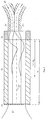
- a fiber amplifier is represented schematically in Figure 2.
- An input beam 28 from an input single-mode fiber 21 is coupled to an active multimode graded-index fiber 22 .
- the active fiber 22 is pumped by a diode laser beam 23 through its end face an/or side surface.
- the input beam 28 shifts with respect to axis 27 of active fiber 22 and thereby excites a large number of modes in the active fiber which amplifies input beam 28 .
- the input beam 28 relaxes to a Gaussian beam, which propagates in a stationary state along the fiber axis 27 .
- the input beam reflects from a dichroic mirror coating 24 deposited on the fiber end face, and couples to an output single-mode fiber 25 using an appropriate graded-index lens 26 .
- Lens 26 can be fabricated as a section of another graded-index fiber of appropriate length.
- An optical connection of the input and output single-mode fibers 21 and 25 with the active multimode fiber 22 through the gradient lens 26 can be conveniently realized by attaching them to a silicon block using well developed silicon V-groove technology.
- An active multimode graded-index fiber is created by using two mirrors in the fiber as feedback.
- Such a fiber laser is more powerful than a standard single-mode fiber laser and generates a large number of modes.
- the superposition of these modes creates a complicated spatial pattern (speckle pattern) which lowers the coupling efficiency of the beam to a single-mode output fiber. Therefore, to benefit from the active multimode graded-index fiber laser, all the modes generated must be phased such that the superposition of their fields forms an output beam with good spatial quality. To this end, phasing of all modes can be realized in an active fiber with large-scale periodic inhomogeneity relative to wavelength.
- quasimodes New types of oscillating Gauss-Laguerre mode configurations, herein referred to as quasimodes, occur in the periodic fiber of profile (4) rather than the standard modes that propagate in a uniform fiber of profile (1).
- the fields of quasimodes also depend on the period and functional form of the longitudinal periodicity. This dependency allows the quasimodes to be controlled.
- both the width of the output Gaussian laser beam, which corresponds to this quasimode, and the directional pattern of the laser beam can be controlled by varying parameter h .
- the width and the directional pattern can be matched to a particular single-mode output fiber.
- a periodic variation (4) of the parameter g ( z ) in the active fiber can be produced by modulating the fiber radius during fiber drawing.
- the relation between a fiber's core radius and its gradient parameter is given by expression (2).
- the period of such a modulation ⁇ depends on the fiber gradient parameter which is about 1-2 mm for a typical graded-index fiber.
- the modulation parameter h can be further varied either by using an acoustic wave propagating along the fiber or by using an array of laser diodes spaced at a distance of ⁇ along the length of the active fiber.
- the array of laser diodes periodically pump the fiber perpendicular to its axis to create a modulation in amplification having a period ⁇ .
- the width and directional pattern of the output laser beam can be controlled to match the output laser beam to an output fiber mode.
- a laser for generating only a single quasimode is shown schematically in Figure 3.
- a periodic active multimode graded-index fiber 31 has a length L which equals m ⁇ /2 wherein m is an integer much greater than one.
- a diode laser beam 32 pumps fiber 31 through its end face.
- a periodic array of laser diodes 33 with a spacing ⁇ creates a spatially periodic variation of the gain in fiber 31 .
- Feedback in the system is provided using multiple reflections from mirrors 34 and 35 which are deposited on the end faces of fiber 31 .
- the generated quasimode beam is coupled either directly to the output single-mode fiber 36 or through a fiber taper or gradient lens 37 .
- the all-fiber mirror may be more convenient to use an all-fiber mirror fabricated in the core of output fiber 36 instead of the mirror coating 35 .
- the all-fiber mirror has several preferred embodiments such as a fiber-loop mirror 38 or a Braggs gratings 39 .
- the Braggs grating 39 can be formed several ways. For example, it can be optically written directly in the fiber core by holographically writing periodic Ge-O defects in the glass with a UV laser beam. Alternatively, grating 39 can be produced on the surface of the fiber core after polishing the fiber cladding down to the core in a fiber block. For the effective control and an automatic adjustment of the system, a feedback mechanism may be employed.
- a preferred embodiment of the feedback mechanism is based on the known correlation between the output beam parameters and the pump current (i.e.. the electrical current used to energize the array of pumping laser diodes). This correlation can be determined, for example, by measuring the output pattern as a function of pump current. Using this correlation, it is possible to automatically adjust the output beam width and the beam directional pattern via the pumping current.
Landscapes
- Physics & Mathematics (AREA)
- Electromagnetism (AREA)
- Engineering & Computer Science (AREA)
- Plasma & Fusion (AREA)
- Optics & Photonics (AREA)
- Lasers (AREA)
- Optical Couplings Of Light Guides (AREA)
Applications Claiming Priority (2)
| Application Number | Priority Date | Filing Date | Title |
|---|---|---|---|
| US08/257,547 US5488506A (en) | 1994-06-09 | 1994-06-09 | Enhanced power fiber laser with controllable output beam |
| US257547 | 1994-06-09 |
Publications (1)
| Publication Number | Publication Date |
|---|---|
| EP0704944A1 true EP0704944A1 (fr) | 1996-04-03 |
Family
ID=22976731
Family Applications (1)
| Application Number | Title | Priority Date | Filing Date |
|---|---|---|---|
| EP95201515A Withdrawn EP0704944A1 (fr) | 1994-06-09 | 1995-06-08 | Laser à fibre à puissance améliorée avec faiseau de sortie contrÔlable |
Country Status (2)
| Country | Link |
|---|---|
| US (1) | US5488506A (fr) |
| EP (1) | EP0704944A1 (fr) |
Cited By (4)
| Publication number | Priority date | Publication date | Assignee | Title |
|---|---|---|---|---|
| US7576909B2 (en) | 1998-07-16 | 2009-08-18 | Imra America, Inc. | Multimode amplifier for amplifying single mode light |
| US7656578B2 (en) | 1997-03-21 | 2010-02-02 | Imra America, Inc. | Microchip-Yb fiber hybrid optical amplifier for micro-machining and marking |
| DE19956739B4 (de) * | 1998-11-25 | 2010-02-18 | IMRA America, Inc., Ann Arbor | Modenverkoppelte Multimoden-Faserlaserimpulsquelle und Verfahren |
| DE19861429B4 (de) * | 1997-06-25 | 2010-06-10 | IMRA America, Inc., Ann Arbor | Auf Multimodefasern basierende Lasersysteme |
Families Citing this family (5)
| Publication number | Priority date | Publication date | Assignee | Title |
|---|---|---|---|---|
| DE19620159C2 (de) * | 1996-05-07 | 2002-08-08 | Inst Physikalische Hochtech Ev | Faserlaser oder Faserverstärker mit neuartiger Brechzahlstruktur |
| FR2752623B1 (fr) * | 1996-08-21 | 1998-10-30 | Thual Monique | Procede de fabrication d'un dispositif de couplage optique collectif et dispositif obtenu par un tel procede |
| US20050063712A1 (en) * | 2003-09-22 | 2005-03-24 | Rice Robert R. | High speed large core multimode fiber optic transmission system and method therefore |
| US7403681B2 (en) * | 2006-03-08 | 2008-07-22 | Nippon Sheet Glass Company, Ltd. | Wavelength selective optical device and method of tuning wavelength characteristics |
| RU2654987C1 (ru) * | 2017-04-10 | 2018-05-23 | Федеральное государственное бюджетное учреждение науки Институт автоматики и электрометрии Сибирского отделения Российской академии наук (ИАиЭ СО РАН) | Способ селекции поперечных мод многомодового волоконного лазера |
Citations (3)
| Publication number | Priority date | Publication date | Assignee | Title |
|---|---|---|---|---|
| EP0438653A2 (fr) | 1990-01-23 | 1991-07-31 | Schott Glaswerke | Fibre optique flexible à profil graduel pour la transmission de radiation laser à haute puissance permettant de maintenir essentiellement la structure de mode |
| US5187759A (en) * | 1991-11-07 | 1993-02-16 | At&T Bell Laboratories | High gain multi-mode optical amplifier |
| EP0586713A1 (fr) * | 1992-03-26 | 1994-03-16 | Nippon Petrochemicals Co., Ltd. | Amplificateur a fibre optique polymere |
Family Cites Families (2)
| Publication number | Priority date | Publication date | Assignee | Title |
|---|---|---|---|---|
| US4815079A (en) * | 1987-12-17 | 1989-03-21 | Polaroid Corporation | Optical fiber lasers and amplifiers |
| JPH02216111A (ja) * | 1989-02-17 | 1990-08-29 | Nec Corp | 半導体レーザモジュール |
-
1994
- 1994-06-09 US US08/257,547 patent/US5488506A/en not_active Expired - Fee Related
-
1995
- 1995-06-08 EP EP95201515A patent/EP0704944A1/fr not_active Withdrawn
Patent Citations (4)
| Publication number | Priority date | Publication date | Assignee | Title |
|---|---|---|---|---|
| EP0438653A2 (fr) | 1990-01-23 | 1991-07-31 | Schott Glaswerke | Fibre optique flexible à profil graduel pour la transmission de radiation laser à haute puissance permettant de maintenir essentiellement la structure de mode |
| US5115486A (en) * | 1990-01-23 | 1992-05-19 | Schott Glaswerke | Flexible optical graded-index profile fiber for transmission of laser radiation with high output with substantial preservation of the mode structure |
| US5187759A (en) * | 1991-11-07 | 1993-02-16 | At&T Bell Laboratories | High gain multi-mode optical amplifier |
| EP0586713A1 (fr) * | 1992-03-26 | 1994-03-16 | Nippon Petrochemicals Co., Ltd. | Amplificateur a fibre optique polymere |
Non-Patent Citations (4)
| Title |
|---|
| G.NYKOLAK ET AL.: "An Erbium-doped multimode optical fiber amplifier", IEEE PHOTONICS TECHNOLOGY LETTERS, vol. 3, no. 12, NEW YORK US, pages 1079 - 1081, XP000242138 * |
| PETROV M P ET AL: "LIGHT AMPLIFICATION IN A MULTIMODE QUARTZ FIBER ACTIVATED WITH ND3+ AND PUMPED WITH A SEMICONDUCTOR LASER", SOVIET TECHNICAL PHYSICS LETTERS, vol. 17, no. 2, 1 February 1991 (1991-02-01), pages 123 - 124, XP000235385 * |
| S.G.KRIVOSHLYKOV ET AL.: "Control of mode structure in active or passive graded-index waveguides with large-scale periodic longitudinal inhomogeneities", JOURNAL OF MODERN OPTICS, vol. 40, no. 2, pages 255 - 268 * |
| S.G.KRIVOSHLYKOV ET AL.: "Correlated coherent states and propagation of arbitrary Gaussian beams in longitudinally homogeneous quadratic media exhibiting absorption or amplification", SOVIET JOURNAL OF QUANTUM ELECTRONICS, vol. 16, no. 7, WOODBURY, NEW YORK US, pages 933 - 941 * |
Cited By (9)
| Publication number | Priority date | Publication date | Assignee | Title |
|---|---|---|---|---|
| US7656578B2 (en) | 1997-03-21 | 2010-02-02 | Imra America, Inc. | Microchip-Yb fiber hybrid optical amplifier for micro-machining and marking |
| DE19861429B4 (de) * | 1997-06-25 | 2010-06-10 | IMRA America, Inc., Ann Arbor | Auf Multimodefasern basierende Lasersysteme |
| US7576909B2 (en) | 1998-07-16 | 2009-08-18 | Imra America, Inc. | Multimode amplifier for amplifying single mode light |
| DE19956739B4 (de) * | 1998-11-25 | 2010-02-18 | IMRA America, Inc., Ann Arbor | Modenverkoppelte Multimoden-Faserlaserimpulsquelle und Verfahren |
| US8761211B2 (en) | 1998-11-25 | 2014-06-24 | Imra America, Inc. | Multi-mode fiber amplifier |
| US9153929B2 (en) | 1998-11-25 | 2015-10-06 | Imra America, Inc. | Mode-locked multi-mode fiber laser pulse source |
| US9450371B2 (en) | 1998-11-25 | 2016-09-20 | Imra America, Inc. | Mode-locked multi-mode fiber laser pulse source |
| US9570880B2 (en) | 1998-11-25 | 2017-02-14 | Imra America, Inc. | Multi-mode fiber amplifier |
| US9595802B2 (en) | 1998-11-25 | 2017-03-14 | Imra America, Inc. | Multi-mode fiber amplifier |
Also Published As
| Publication number | Publication date |
|---|---|
| US5488506A (en) | 1996-01-30 |
Similar Documents
| Publication | Publication Date | Title |
|---|---|---|
| JP3296562B2 (ja) | ファイバ回折格子安定化ダイオードレーザ | |
| US8958145B2 (en) | Fiber amplifier system including tapered fiber bundle and combined lens and sampling grating | |
| US8184361B2 (en) | Integrated spectral and all-fiber coherent beam combination | |
| US20110069725A1 (en) | Method and apparatus for generation and amplification of light in a semi-guiding high aspect ratio core fiber | |
| Glas et al. | The multicore fiber–a novel design for a diode pumped fiber laser | |
| US20110032602A1 (en) | All-fiber integrated high power coherent beam combination | |
| EP3058628B1 (fr) | Procédé et appareil pour produire une lumière laser à puissance élevée | |
| EP1073170A2 (fr) | Source laser à longueur d'onde stabilisée | |
| US20090074014A1 (en) | Mode selection for single frequency fiber laser | |
| US6188712B1 (en) | Asymmetrical distributed feedback fiber laser | |
| US8665514B2 (en) | Multi-core optical amplification fiber wound with decreasing radius of curvature | |
| US5488506A (en) | Enhanced power fiber laser with controllable output beam | |
| IL269881A (en) | Index-rated composite fiber mode adapter for fiber optics with a core with a high aspect ratio | |
| US7106928B2 (en) | Coupling high power optical sources to small diameter fibers | |
| CN110663146B (zh) | 大功率包层泵浦单模光纤拉曼激光器 | |
| US8654800B2 (en) | Method and apparatus for controlling mode coupling in high power laser system | |
| US6337874B1 (en) | Optical component with polarization-maintaining fiber pigtail splice to regular fiber with grating | |
| JP2960674B2 (ja) | 増幅用光ファイバ | |
| US20040175074A1 (en) | Device for coupling light into the fiber | |
| EP2451031B1 (fr) | Procédé et appareil de génération et d'amplification de lumirère dans une fibre à semi-guidage à coeur à rapport de forme élevé | |
| JP3380749B2 (ja) | ファイバ回折格子安定化ダイオードレーザ | |
| Wolf et al. | 7-core Yb-doped fiber laser with femtosecond pulse inscribed fiber Bragg gratings | |
| JP7575490B2 (ja) | アクティブ光ボルテックスファイバ | |
| JP3833882B2 (ja) | 半導体レーザモジュール | |
| Skvortsov et al. | Seven-core fiber Raman laser with fs-inscribed random structures |
Legal Events
| Date | Code | Title | Description |
|---|---|---|---|
| PUAI | Public reference made under article 153(3) epc to a published international application that has entered the european phase |
Free format text: ORIGINAL CODE: 0009012 |
|
| AK | Designated contracting states |
Kind code of ref document: A1 Designated state(s): DE GB |
|
| 17P | Request for examination filed |
Effective date: 19961004 |
|
| 17Q | First examination report despatched |
Effective date: 19970513 |
|
| STAA | Information on the status of an ep patent application or granted ep patent |
Free format text: STATUS: THE APPLICATION IS DEEMED TO BE WITHDRAWN |
|
| 18D | Application deemed to be withdrawn |
Effective date: 19980909 |