EP0705005A2 - Procédé et dispositif de chiffrage à clé secrête permettant la prévention d'une acquisition non-équitable d'une information - Google Patents
Procédé et dispositif de chiffrage à clé secrête permettant la prévention d'une acquisition non-équitable d'une information Download PDFInfo
- Publication number
- EP0705005A2 EP0705005A2 EP95115139A EP95115139A EP0705005A2 EP 0705005 A2 EP0705005 A2 EP 0705005A2 EP 95115139 A EP95115139 A EP 95115139A EP 95115139 A EP95115139 A EP 95115139A EP 0705005 A2 EP0705005 A2 EP 0705005A2
- Authority
- EP
- European Patent Office
- Prior art keywords
- transformation
- bit
- bits
- order
- elt
- Prior art date
- Legal status (The legal status is an assumption and is not a legal conclusion. Google has not performed a legal analysis and makes no representation as to the accuracy of the status listed.)
- Ceased
Links
Images


Classifications
-
- H—ELECTRICITY
- H04—ELECTRIC COMMUNICATION TECHNIQUE
- H04L—TRANSMISSION OF DIGITAL INFORMATION, e.g. TELEGRAPHIC COMMUNICATION
- H04L9/00—Cryptographic mechanisms or cryptographic arrangements for secret or secure communications; Network security protocols
- H04L9/06—Cryptographic mechanisms or cryptographic arrangements for secret or secure communications; Network security protocols the encryption apparatus using shift registers or memories for block-wise or stream coding, e.g. DES systems or RC4; Hash functions; Pseudorandom sequence generators
- H04L9/0618—Block ciphers, i.e. encrypting groups of characters of a plain text message using fixed encryption transformation
- H04L9/0625—Block ciphers, i.e. encrypting groups of characters of a plain text message using fixed encryption transformation with splitting of the data block into left and right halves, e.g. Feistel based algorithms, DES, FEAL, IDEA or KASUMI
-
- H—ELECTRICITY
- H04—ELECTRIC COMMUNICATION TECHNIQUE
- H04L—TRANSMISSION OF DIGITAL INFORMATION, e.g. TELEGRAPHIC COMMUNICATION
- H04L2209/00—Additional information or applications relating to cryptographic mechanisms or cryptographic arrangements for secret or secure communication H04L9/00
- H04L2209/12—Details relating to cryptographic hardware or logic circuitry
- H04L2209/122—Hardware reduction or efficient architectures
Definitions
- a process of transforming the original information into the cipher is called encipherment while a process of reversing the cipher into the original information is called a decipherment.
- the original information before encipherment is called a plaintext.
- the cipher obtained by subjecting the information to the encipherment process is called a ciphertext.
- a linear transformation cipher As a method of enciphering the information, a linear transformation cipher has widely been used.
- This cipher transforms an integer expression M of the plaintext into an integer expression C of the ciphertext through a process represented by the following equation.
- C aM + b (mod p)
- a, b, and p are predetermined integers and X (mod Y) implies a remainder when X is divided by Y.
- Y in X (mod Y) is called a modulo.
- the remainder when X is divided by Y is called a residue.
- the ciphertext can be reversed into the plaintext through a process represented by the following equation.
- M (C - b)/a (mod p)
- a method of calculating the division is described, for example, in a book entitled "Cryptography and Data Security" written by Dorothy Elizabeth Robling Denning, published by Addison-Wesley Publishing Company, Inc., 1982, pp. 43-45.
- the primitive multiple-modulus cipher it is necessary to select a cryptographic key satisfying p1 ⁇ p2 ⁇ ... ⁇ p m in order to correctly reverse the plaintext from the ciphertext. Otherwise, for several ciphertexts, a plurality of plaintexts may correspond to one ciphertext. In this connection, the ciphertext inevitably has a bit length longer than that of the plaintext in the primitive multiple-modulus cipher.
- a transformation f[a i , b i , p i ] is a process of producing an output a i x + b i (mod p i ) when an input x has a value smaller than p i and of producing an output equivalent to x when the input x is not smaller than p i while a transformation g is a process of producing an output obtained by inverting a most significant bit of an input.
- a cipher using the enciphering process represented by the above-mentioned equations is called a multiple-modulus cipher.
- Encipherment of the multiple-modulus cipher is generally carried out in the manner described above.
- the transformation g may comprise, instead of the process of inverting the most significant bit of the input, a process of inverting the most significant bit and carrying out an exclusive-OR operation between a plurality of high-order bits following the most significant bit and a plurality of bits determined in dependence upon low-order bits than those bits.
- the transformation g may be carried out between a transformation ELT (Expanded Linear Transformation) and another transformation ELT.
- ELT Exanded Linear Transformation
- encipherment is carried out in accordance with the following equations.
- encipherment is carried out in accordance with the following equations.
- JP-A Japanese Patent Publication
- Japanese Patent Application No. 128409/1992 Japanese Patent Application No. 128409/1992
- the multiple-modulus cipher used in the conventional secret-key enciphering method and the arrangement therefor has a disadvantage that the scrambling effect is not sufficient.
- the relationship M ⁇ 2 n-1 is kept in the plaintext M
- the relationship C ⁇ 2 n-1 is kept also in the ciphertext C at a high probability.
- the secret-key enciphering method comprises the steps of; subjecting an n-bit input to ELT transformation composed of the first, the second, and the first transformations in this order to produce an n-bit transformation result; enciphering, in accordance with a predetermined cryptosystem, low-order n/2 bits of the n-bit transformation result of the ELT transformation to obtain an n/2-bit ciphertext; carrying out an exclusive-OR operation between the n/2-bit ciphertext and high-order n/2 bits of the n-bit transformation result of the ELT transformation for every corresponding bits to produce an exclusive-OR operation result; carrying out the above-mentioned ELT transformation upon an n-bit input composed of the exclusive-OR operation result and the low-order n/2 bits of the n-bit transformation result of the ELT transformation as high-order n/2 bits and low-order n/2 bits, respectively; repeating the above-mentioned steps m-1 times (m being a predetermined integer not
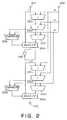
- Each of the ELT transformation circuits 1011 to 101 m is responsive to an n-bit input (n being a multiple of four and generally equal to "64" in data communication) and carries out a transformation ELT to produce a transformation result.
- each of the ELT transformation circuits comprises multipliers 2011 and 2012, adders 2021 and 2022, dividers 2031 and 2032, selectors 2041 and 2042, comparators 2051 and 2052, and a NOT circuit 206.
- Each of the dividers 2031 and 2032 is for producing a remainder when one of the two inputs is divided by the other.
- Each of the enciphering circuits 1021 to 102 m-1 in Fig. 1 is for enciphering an n/2-bit input to produce a ciphertext.
- each of the enciphering circuits comprises ELT transformation circuits 3011 and 3012, an exclusive-OR circuit 302, an input terminal 303, a cryptographic key input terminal 304, and an output terminal 305.
- the multiplier 2011 calculates a product between the parameter a i and the integer x to produce a calculation result a i x which is supplied to the adder 2021.
- the adder 2021 adds the calculation result a i x and the parameter b i supplied via the input terminal 208 to produce an addition result (a i x + b i ) which is supplied to the divider 2031.
- the divider 2031 divides the addition result (a i x + b i ) by the parameter p i supplied via the input terminal 208 to produce a residue a i x + b i (mod p i ) which is supplied to the selector 2041.
- the enciphering circuits 1021 to 102 m-1 are supplied with the cryptographic key K i through the input terminals 1061 to 106 m-1 (corresponding to the input terminal 304 in Fig. 3).
- the ELT transformation circuit 1011 is supplied via the input terminal 104 (corresponding to the input terminal 207 in Fig. 2) with a plaintext of n bits long.
- the ELT transformation circuit 1011 carries out ELT transformation on the plaintext by the use of the ELT transformation parameters a1, b1, and p1 supplied via the input terminal 1051 to produce an n-bit transformation result.
- the n-bit transformation result low-order n/2 bits are supplied to the enciphering circuit 1021 and the ELT transformation circuit 1012 while high-order n/2 bits are supplied to one input terminal of the exclusive-OR circuit 1031.
- the ELT transformation circuit 1012 receives an n/bit input composed of the n/2 bits supplied from the exclusive-OR circuit 1031 and the n/2 bits supplied from the ELT transformation circuit 1011 as high-order n/2 bits and low-order n/2 bits, respectively.
- the input of the n bits in total is subjected to ELT transformation by the use of the ELT transformation parameters a2, b2, and p2 supplied via the input terminal 1052 to produce an n-bit transformation result.
- the n-bit transformation result low-order n/2 bits are supplied to the enciphering circuit 1022 and the ELT transformation circuit 1013 (both of them being not illustrated in the figure) at the next stage while high-order n/2 bits are supplied to the exclusive-OR circuit 1032 at the next stage.
- the ELT transformation circuit 101 m at the final stage produces a ciphertext to be delivered to the output terminal 107 (corresponding to the output terminal 209 in Fig. 2).
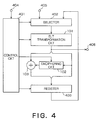
- the control circuit 401 supplies a control signal to the register 403 to make the register hold the n/2 bits supplied from the exclusive-OR circuit 103 and the n/2 bits supplied from the ELT transformation circuit 101 as high-order n/2 bits and low-order n/2 bits in an n-bit memory.
- the n-bit value held in the register 403 is supplied to the selector 402.
- the control circuit 401 controls the selector 402 to make the selector select the output of the register 403.
- the control circuit 401 supplies a control signal to make the selector 402 select the output of the register 403, supplies the parameters a2, b2, and p2 to the ELT transformation circuit 101, and supplies the cryptographic key K2 to the enciphering circuit 102.
- the operation similar to that described above is carried out and a new value is held in the register 403. Subsequently, the similar operation is repeated m-1 times in total.
- the control circuit 401 supplies a control signal to make the selector 402 select the output of the register 403 and supplies the parameters a m , b m , and p m to the ELT transformation circuit 101.
- the low-order n/2 bits of the output of the ELT transformation circuit is enciphered.
- the exclusive-OR operation is carried out between the enciphered n/2 bits and the high-order n/2 bits of the n-bit transformation result produced by the ELT transformation circuit for every corresponding bits.
- Another ELT transformation is repeatedly carried out upon the n-bit input composed of the exclusive-OR operation result and the low-order n/2 bits of the n-bit transformation result produced by the ELT transformation circuit as the high-order n/2 bits and the low-order n/2 bits, respectively. In this manner, the transformation result of the ELT transformation is uniformly scrambled over a range between 0 and 2 n - 1.
Landscapes
- Engineering & Computer Science (AREA)
- Computer Security & Cryptography (AREA)
- Computer Networks & Wireless Communication (AREA)
- Signal Processing (AREA)
- Storage Device Security (AREA)
- Facsimile Transmission Control (AREA)
Applications Claiming Priority (2)
| Application Number | Priority Date | Filing Date | Title |
|---|---|---|---|
| JP6230952A JP2725610B2 (ja) | 1994-09-27 | 1994-09-27 | 秘密鍵暗号方法及び装置 |
| JP230952/94 | 1994-09-27 |
Publications (2)
| Publication Number | Publication Date |
|---|---|
| EP0705005A2 true EP0705005A2 (fr) | 1996-04-03 |
| EP0705005A3 EP0705005A3 (fr) | 1999-05-06 |
Family
ID=16915896
Family Applications (1)
| Application Number | Title | Priority Date | Filing Date |
|---|---|---|---|
| EP95115139A Ceased EP0705005A3 (fr) | 1994-09-27 | 1995-09-26 | Procédé et dispositif de chiffrage à clé secrête permettant la prévention d'une acquisition non-équitable d'une information |
Country Status (5)
| Country | Link |
|---|---|
| US (1) | US5640455A (fr) |
| EP (1) | EP0705005A3 (fr) |
| JP (1) | JP2725610B2 (fr) |
| AU (1) | AU688569B2 (fr) |
| CA (1) | CA2159159C (fr) |
Families Citing this family (6)
| Publication number | Priority date | Publication date | Assignee | Title |
|---|---|---|---|---|
| GB9421552D0 (en) * | 1994-10-26 | 1994-12-14 | Philips Electronics Uk Ltd | Improvements in or relating to data communication |
| FR2739994B1 (fr) * | 1995-10-17 | 1997-11-14 | Henri Gilbert | Procede cryptographique de protection contre la fraude |
| JPH1153173A (ja) * | 1997-08-07 | 1999-02-26 | Nec Corp | 擬似乱数発生方法及び装置 |
| EP1056015A4 (fr) | 1998-01-21 | 2005-01-05 | Tokyo Electron Ltd | Dispositif de stockage, dispositif de cryptage/decryptage et procede permettant d'acceder a une memoire remanente |
| US6321247B1 (en) * | 1998-12-28 | 2001-11-20 | Compaq Computer Corporation | System and method for multiplication modulo (2N+1) |
| ES2244639T3 (es) * | 2000-08-03 | 2005-12-16 | Koninklijke Philips Electronics N.V. | Transformacion lineal para cifrado de claves simetricas. |
Family Cites Families (1)
| Publication number | Priority date | Publication date | Assignee | Title |
|---|---|---|---|---|
| JP3180836B2 (ja) * | 1992-05-21 | 2001-06-25 | 日本電気株式会社 | 暗号通信装置 |
-
1994
- 1994-09-27 JP JP6230952A patent/JP2725610B2/ja not_active Expired - Lifetime
-
1995
- 1995-09-26 CA CA002159159A patent/CA2159159C/fr not_active Expired - Fee Related
- 1995-09-26 EP EP95115139A patent/EP0705005A3/fr not_active Ceased
- 1995-09-26 AU AU32885/95A patent/AU688569B2/en not_active Ceased
- 1995-09-27 US US08/534,816 patent/US5640455A/en not_active Expired - Fee Related
Also Published As
| Publication number | Publication date |
|---|---|
| JP2725610B2 (ja) | 1998-03-11 |
| AU3288595A (en) | 1996-04-18 |
| CA2159159C (fr) | 2000-07-25 |
| EP0705005A3 (fr) | 1999-05-06 |
| CA2159159A1 (fr) | 1996-03-28 |
| US5640455A (en) | 1997-06-17 |
| AU688569B2 (en) | 1998-03-12 |
| JPH0895490A (ja) | 1996-04-12 |
Similar Documents
| Publication | Publication Date | Title |
|---|---|---|
| EP1686722B1 (fr) | Dispositif et procédé de chiffrage par blocs contenant un schéma de clés rotatif | |
| EP0839418B1 (fr) | Procede et appareil cryptographiques de fusion non lineaire d'un bloc de donnees et d'un code | |
| US5351299A (en) | Apparatus and method for data encryption with block selection keys and data encryption keys | |
| EP0489742B1 (fr) | Methode de chiffrement | |
| US6201869B1 (en) | Data transformation apparatus and data transformation method | |
| EP2460310B1 (fr) | Procédé de chiffrement à clé symétrique et système cryptographique employant le procédé | |
| US7949128B2 (en) | Method and device for the encryption and decryption of data | |
| EP0570983B1 (fr) | Dispositif de chiffrement utilisant plusieurs transformations linéaires | |
| EP0896451B1 (fr) | Dispositif de chiffrage et support d'enrégistrement lisible par ordinateur comportant un programme de réalisation | |
| US5640455A (en) | Secret-key enciphering method and arrangement therefor capable of preventing unfair acquirement of information | |
| JP3658004B2 (ja) | 通信システム | |
| CA2141997C (fr) | Appareil cryptographique a cle revelee pouvant traiter les textes chiffres au moyen d'une cle revelee | |
| EP1043863B1 (fr) | Procédé de transformation cryptographique de blocs d'entrée de données numériques à L-bits en blocs de sortie à L-bits | |
| KR100200531B1 (ko) | 암호화 방법 및 시스템 | |
| JPH09311627A (ja) | 循環演算にもとづく暗号の暗号鍵生成方法及び装置 |
Legal Events
| Date | Code | Title | Description |
|---|---|---|---|
| PUAI | Public reference made under article 153(3) epc to a published international application that has entered the european phase |
Free format text: ORIGINAL CODE: 0009012 |
|
| AK | Designated contracting states |
Kind code of ref document: A2 Designated state(s): DE FR GB SE |
|
| PUAL | Search report despatched |
Free format text: ORIGINAL CODE: 0009013 |
|
| AK | Designated contracting states |
Kind code of ref document: A3 Designated state(s): DE FR GB SE |
|
| 17P | Request for examination filed |
Effective date: 19990323 |
|
| GRAG | Despatch of communication of intention to grant |
Free format text: ORIGINAL CODE: EPIDOS AGRA |
|
| 17Q | First examination report despatched |
Effective date: 19990816 |
|
| STAA | Information on the status of an ep patent application or granted ep patent |
Free format text: STATUS: THE APPLICATION HAS BEEN REFUSED |
|
| 18R | Application refused |
Effective date: 20000406 |