EP0705153B1 - Outils de brasage - Google Patents
Outils de brasage Download PDFInfo
- Publication number
- EP0705153B1 EP0705153B1 EP94917782A EP94917782A EP0705153B1 EP 0705153 B1 EP0705153 B1 EP 0705153B1 EP 94917782 A EP94917782 A EP 94917782A EP 94917782 A EP94917782 A EP 94917782A EP 0705153 B1 EP0705153 B1 EP 0705153B1
- Authority
- EP
- European Patent Office
- Prior art keywords
- gas
- heat
- fuel
- switch
- tool according
- Prior art date
- Legal status (The legal status is an assumption and is not a legal conclusion. Google has not performed a legal analysis and makes no representation as to the accuracy of the status listed.)
- Expired - Lifetime
Links
Images






Classifications
-
- B—PERFORMING OPERATIONS; TRANSPORTING
- B23—MACHINE TOOLS; METAL-WORKING NOT OTHERWISE PROVIDED FOR
- B23K—SOLDERING OR UNSOLDERING; WELDING; CLADDING OR PLATING BY SOLDERING OR WELDING; CUTTING BY APPLYING HEAT LOCALLY, e.g. FLAME CUTTING; WORKING BY LASER BEAM
- B23K3/00—Tools, devices or special appurtenances for soldering, e.g. brazing, or unsoldering, not specially adapted for particular methods
- B23K3/02—Soldering irons; Bits
- B23K3/021—Flame-heated soldering irons
- B23K3/022—Flame-heated soldering irons using a gaseous fuel
Definitions
- This invention relates to handheld heat-generating tools, such as soldering tools.
- the invention is especially directed to gas-powered, catalyst-heated portable soldering tools, in particular, soldering irons.
- US 4,133,301 discloses a gas-powered soldering tool having various different constructions of soldering tip.
- An older construction of gas-powered soldering iron is described in US 2,807,317, in which heating is effected by gas combustion rather than by a combustion catalyst.
- a further flame combustion type soldering tool is disclosed in US 4,119,088.
- Yet another flame-heated soldering tool is described in DE 9602, while DE 1,253,020 is also directed to a combustion-based soldering tool.
- EP-A-0,118,282 and corresponding US 4,785,793 are directed to a soldering tool having a soldering tip with a tip portion and a housing to the rear of the tip portion.
- a catalytic element is located in a combustion chamber of the tool and arrangements are provided for supplying fuel to the catalytic element to heat the soldering tip.
- a particular feature of the arrangement is that the tip is carried solely by an internal support which extends from the tip through the combustion chamber to the fuel supply portion of the structure. This internal support serves to distribute fuel to the catalytic element and to conduct heat from the combustion chamber into the soldering tip portion.
- a particular feature of catalytically-heated devices is the necessity for an initial flame-heating or thermal combustion phase and the concomitant need to terminate this phase when the catalyst is sufficiently hot to sustain continuing catalytic heating.
- a diversity of techniques are known for addressing this problem.
- GB 2,156,964A describes a soldering iron using liquefied gas as a heat source, in which the gas from the liquefied gas tank is mixed with air and then directed to a combustion chamber for complete and flameless catalytic combustion.
- a shutter mechanism opens ignition ports at the inlet of the combustion chamber upon ignition of the mixture, for initial flame heating of the catalyst. These ports are closed after ignition of the gas mixture.
- US 4,552,124 is another example of a flameless combustion heating unit in which catalytic action is initially engendered by flame heating, and a shutter mechanism closes ports after completion of the ignition phase.
- US 5,215,456 is directed to an alternative manner of flame extinction from those previously described, in this instance by providing an actuating mechanism in the form of a bimetallic strip to bring a diffusion member into and away from the entrance of the combustion chamber.
- the diffusion member is initially placed in the flow of gas to establish flame combustion, and according as the bimetallic strip bearing the diffusion member heats up, the diffuser is then displaced out of the gas flow and flame combustion is terminated.
- Disadvantages of this arrangement are the relatively slow speed of operation of the bimetallic strip and the likelihood of its rusting or otherwise corroding with the passage of time. According as corrosion develops, which is likely because of the adverse conditions under which it operates, the bimetallic strip will cease to function.
- a further disadvantage is that when the unit is switched off, the bimetallic strip will take some time to cool and therefore a certain amount of time will pass before the diffuser is restored to the initial flame combustion position. While the strip is moving back to this initial or rest position, the unit will be unusable and must be set aside until such time as it is cooled down.
- a non-catalytic unit is described in US 4,815,441, in which two nozzles are provided for quick initial heating.
- a bimetallic strip terminates the heating action of one of the two nozzles, when the level of heat is sufficient, with the flame from the second nozzle continuing to heat the active portion of the unit.
- the flame is accommodated within a gauze enclosure, in the manner of a Davy lamp, thereby preventing ignition of combustible material to the exterior of the gauze.
- EP-A1-0,100,060 also provides an alternative arrangement for terminating flame heating, in which initial forward movement of the operator member opens a gas release valve for flow of gas from the gas reservoir of the unit through a nozzle to a combustion region, where the gas is ignited. Flame combustion is supported while the operator member is in this forward position. It is terminated by a reverse movement of the operator member to a disposition of use, during which a cam arrangement on an ignition lever provides for a brief period of closure of the valve member. Flame combustion is thus terminated.
- the gas flow recommences, which is achieved by further movement of the ignition lever into a position corresponding to the position of use of the operating member, combustion continues in a catalytic manner.
- the present invention is directed to further novel constructions of heat-generating tool, such as a soldering tool, in which heating of the tip is effected by catalytic action. It is one objective of the invention to provide an improved manner of flame extinction in heat-generating tools such as soldering tools. It is a particular objective of the invention to provide for flame extinction in a heat-generating tool by mechanical interruption of a jet of gaseous fuel supporting the flame during the combustion phase. It is a still further objective of the present invention to provide an improved manner of transition of the initially liquid gas to the vapour or gaseous phase in tools of the kind to which the invention is directed.
- a handheld heat-generating tool comprising:
- said means for termination of the initial flame heating preferably comprises a flame extinction member arranged to traverse said stream of gas released from said nozzle immediately adjacent to said nozzle in said region downstream from the nozzle.
- a handheld heat-generating tool comprising a duct for flow of said stream of gas released from said nozzle to said combustion region of the heat evolution and application section of the tool, the entry to the duct is suitably separated from the nozzle by said region downstream from the nozzle.
- the handheld heat-generating tool according to the invention preferably also comprises a manually-operable switch member displaceable between at least two positions, said traverse of said stream of gas by said flame extinction member being effected by displacement of said switch member between said at least two positions.
- said flame extinction member may be defined by a free end region of a resilient spring portion mounted for displacement between a first stressed configuration and a second stressed configuration by displacement of said switch member between said at least two positions said traverse of said stream of gas by said flame extinction member being effected by displacement of said resilient spring portion from said second to said first stressed configuration.
- the handheld heat-generating tool may comprise a switch housing portion said switch member being slideably mounted in said switch housing portion and cooperating with a rocker member pivotably mounted within the switch housing portion for activation of a piezo-electric device pivoting movement of the rocker member being effected by sliding displacement of said switch member characterised in that said resilient spring portion being mounted on the rocker member and said displacement of said resilient spring portion between said first and second stressed configurations being effected by said pivoting movement of said rocker member.
- said switch member may be displaceable between an off position and an ignition position through an intermediate fuel-flow position said traverse of said stream of gas by the flame extinction member being effected during displacement of the switch member from the ignition position to the fuel-flow position.
- the handheld heat-generating tool according to the invention may further comprise a retarding member mounted on a moving part of the piezo-electric device and having an end for engagement with a portion of the flame extinction member during said traverse of said stream of gas by the flame extinction member from said second to said first stressed configuration of said resilient spring portion during reverse movement of said part into an expanded configuration of the piezo-electric device to hold said flame extinction member within said stream of gas for a period representing said substantially momentary mechanical interruption of the flow of said stream of gas.
- a retarding member mounted on a moving part of the piezo-electric device and having an end for engagement with a portion of the flame extinction member during said traverse of said stream of gas by the flame extinction member from said second to said first stressed configuration of said resilient spring portion during reverse movement of said part into an expanded configuration of the piezo-electric device to hold said flame extinction member within said stream of gas for a period representing said substantially momentary mechanical interruption of the flow of said stream of gas.
- the valve means for controlling flow of fuel from the fuel reservoir to the heat evolution and application section may comprise a valve assembly, said valve assembly being accommodated within a valve housing structure formed from a heat conductive material to assist evaporation of fuel by means of hand heat originating from a user of the tool by holding the tool in the hand.
- Said valve housing structure may have an external hand-engageable surface.
- the valve assembly may also comprise a flow control member displaceable between a closed position and an open position, and may in addition comprise a flow regulation feature for varying the rate of release of fuel from thereservoir when the flow control member is open.
- the flow regulation feature in a favoured arrangement, comprises a compressible fuel-permeable assembly accommodated within the valve housing structure and manually operable adjustment means for varying the degree of compression of the fuel-permeable assembly.
- the fuel-permeable assembly may comrpise a spongiform arrangement
- the adjustment means may comprise a sectorally displaceable manually-engageable member linked to a screw-thread type structure for translating rotational displacement of the manually-engageable member into axial compressive action on the spongiform arrangement.
- valve housing structure is formed from aluminium.
- the unit may comprise a switch housing portion said valve housing structure interconnecting the switch housing portion to the fuel reservoir, the forward region of the heat evolution and application section comprising a tip portion the tip portion being an independent component separable from the remainder of the tool, a first chamber for accommodating the catalytic element being defined within a counter-bore region of the tip for accommodating a catalyst assembly, to provide for independent interchange or replacement of said catalytic element, and the rearward region of the heat evolution and application section within which heat generation takes place by means of fuel interaction with a catalytic element comprising a second, flame combustion chamber to the rear of said first chamber, said second, flame combustion chamber defining said combustion region and said tip first chamber and second chamber being detachably associated with said switch housing portion.
- a cap may be provided for occluding the exterior of the heat evolution and application section, the cap engaging a switch member of the tool when in its occluding position to maintain the switch member in an off position.
- the switch member may be shaped to provide an externally-directed flat face to enable the tool to be laid on a flat surface in a stable disposition substantially resistant to inadvertent lateral displacement.
- the invention also extends to a handleheld heat-generating tool substantially as described herein with reference to and as shown in any one or more of the accompanying drawings.
- a gas-powered, catalytic, hand-held soldering tool has a tip or element 1, which is heated in use of the tool by reaction of gas released from a reservoir or tank 10 with the catalyst material of a catalyst assembly housed within an outer tip tube 12. Tube 12 and the catalyst assembly within it are held in position on a substantially cylindrical main or switch housing portion 5 of the device by means of a screw-threaded collet 4.
- the housing 5 consists of an axially-divided two-part structure for ease of assembly and contains various operating features of the tool, subsequently described.
- Housing 5 has an external finish consisting of a longitudinally ribbed or serrated or knurled surface, for ease of holding in use of the invention.
- Switch-on of the device and control of gas flow is effected by means of a single sliding thumb switch 18, readily operated by the user when the device as a whole is held in the hand.
- Switch 18 is displaceable between a forward position in which ignition of gas is effected for initial heating, and a rearward disposition in which gas flow is fully cut off. In an intermediate or mid position of switch 18, continuous gas flow is enabled for the required catalytic heating of the tip 1.
- Switch 18 fulfils purely an on-off function in regard to gas flow.
- the actual level of flow of gas to the catalytic element within tube 12, in other words the rate of gas release from the storage tank 10 of the unit, is regulated by an adjuster assembly, which has a portion 8 accessible for engagement by the finger and laterally displaceable in a sectoral manner within a part-circumferential slot 31 in the exterior surface or wall of housing 5.
- an adjuster or valve assembly housing portion 21 suitably formed from aluminium, which also serves as a mounting portion for the gas tank 10.
- the active end namely the tip 1 and the catalytic assembly within tube 12
- the cap 32 When the device is not in use, the active end, namely the tip 1 and the catalytic assembly within tube 12, is covered by a cap 32, the tapering leading end 33 of which fits over the tip 1 and tube 12, while the larger diameter rear portion 34 engages in a gripping manner over the front end of housing 5.
- the cap When the cap is in position, its rear edge 35 pushes against the sliding switch 18 to force the switch into the gas-off disposition during placement of the cap on the tool and to retain it in the off configuration while the unit is capped.
- the entire device takes up a quiescent or inactive status, which provides an advantageous safety aspect of the invention.
- gas contained in liquid form in the storage tank or chamber 10 of the soldering tool of the invention is released in gaseous form through an evaporative valve mechanism incorporated in the aluminium support structure 21 for the tank 10 and housing 5 by means of the manually-operated switch 18.
- Gas flow takes place to a combustion chamber of the device, located within tube 12, which is provided with a piezo-electric ignition device for igniting the gas at start-up. Extinction of the flame after an appropriate initial warm-up period is achieved by a mechanism to be described, which is a particular feature of the invention, the gas flow being then maintained without combustion for continued heating of the catalyst during use of the soldering tool, at a rate determined by adjustment of sectoral adjuster or gas flow regulator 8.
- a gas tank or chamber 10 is provided to hold liquid butane gas, which is the fuel for the soldering tool.
- Tank 10 is suitably formed from an opaque but translucent plastics material of dark coloration, suitably black, which appears opaque, but which is sufficiently translucent to allow the level of the gas within the tank to be checked by holding the unit against the light.
- the chamber 10 is rechargeable as required through a filling valve 11, and, because of the translucent nature of the material of the tank 10, the quantity of gas remaining within the tank or chamber 10 may be checked at any time.
- a matt finish is applied to the tank 10, which forms an integral component of the unit or structure.
- the gas tank 10 may be of clear see-through construction, so that the liquefied gas within it is actually visible to the user at all times.
- the gas tank 10 is not interchangeable and further supplies of gas are provided by charging the tank through the filling valve 11 at the axial end of the tank 10 remote from the remainder of the soldering tool.
- the other or forward end of the tank is received in the aluminium housing 21, which also accommodates a valve structure to be described for release of the liquefied butane gas from the tank 10 into the operating portions of the tool, and in addition serves as a support for the forward end structures of the tool.
- Aluminium is preferred for this portion 21 of the structure, as compared with a plastics moulding, because of its heat-conductive capabilities. A modest degree of warming of the liquid butane gas is necessary in order that it may evaporate from the liquid phase into the gaseous phase, which is required for proper functioning of the tool of the invention.
- the heat-conductive capabilities of aluminium enable hand heat originating with the user of the invention to assist this evaporative activity.
- the aluminium of housing 21 may optionally be anodised, depending on the nature of external finish required, and this portion of the unit is preferably also black in colour, for advantageous absorption of heat.
- a wick 22 is fed in by a wick 22 to a gas valve assembly 9.
- the wick extends longitudinally along the axial length or extent of tank 10, substantially coaxially with the generally cylindrical, slightly conical tank, which tapers outwardly or in an enlarging cross-sectional manner from fill valve 10 towards release valve assembly 9. The gas then undergoes an evaporative process and is released to the active end of the device.
- main or switch housing structure 5 which may also be defined as a tubular gripping portion of the device, along with the ignition components of the unit, in which connection reference may now also be made to Figures 4 to 7 and 8.
- Air is entrained with the gas as it enters the Venturi tube.
- the spacing between the exit nozzle of tube 41 and the inlet end 42 of the Venturi is selected, in conjunction with the profile or shape or configuration of the Venturi, to provide a requisite level of performance, although this does not entail high precision assembly, and, in this region of the device, as in other aspects of the invention, relatively low tolerances may apply.
- the gas enters a combustion chamber portion of the device, to be described.
- lever 20 which takes place about a substantially transverse axis 45 offset laterally from the longitudinal axis of the unit as a whole, is controlled by a camming portion 51 of the user on-off switch 18.
- This camming portion has a sloping surface, which rises as shown in the sectional view of Figure 2 and in greater detail in Figures 4 to 7 and 8, in a radially inward direction within the housing 5 relative to the main sliding body of the switch 18, to slope upwards in a direction away from the tip of the unit.
- an igniter rocker switch or member 17 is mounted for pivotal displacement, again about an axis 67 transverse to the longitudinal axis of the unit and defined by two laterally projecting axle or spigot portions of the rocker 17.
- the axis of pivoting 67 is in the case of the rocker switch substantially diametral, as compared with the offset location of the axis 45 of pivoting for the lever 20.
- Rocker switch 17 is provided with two camming or lug portions 61 and 62, one of which (61) is engaged by a co-operating camming or lug portion 55 located at the forward or leading end of switch 18, i.e.
- the on/off switch unit 18 is a sliding assembly mounted for forward and rearward displacement in an axial direction within a longitudinal slot in the wall of the housing 5.
- the switch has internal and external sliding portions 56 and 57 respectively, linked by a bridge portion 58 extending through the housing slot. These details are shown in the enlarged views of Figures 4 to 7.
- the camming portions 51 and 55 are located at opposite axial ends of the internal sliding switch portion 56.
- the switch 18 terminates in a thumb-engagement portion 59.
- the soldering iron may be placed during use on a table or other level surface with this flat portion engaged on the surface, so that it will not roll sideways, while the hot tip remains raised above the surface and cannot contact and damage the surface.
- the thumb-grip portion 59 also essentially defines a transverse rib or foot portion. This arrangement represents an important safety feature of the invention.
- the housing 5 is suitably formed from two axially-divided half-portions, which may be substantially mirror images of one another, thereby facilitating the insertion and placement of the internal moving parts, lever, rocker, switch portions, etc.
- the housing, switch components, rocker, etc. are preferably also of a suitable plastics material, e.g. nylon.
- the device Forward of the housing 5, the device terminates in the combustion chamber and tip portion, also shown in greater detail in the enlarged representation of Figure 3.
- the combustion chamber and tip portions of the device are mounted on the housing by means of support portion 15, which extends from the forward end of the housing 5 and is provided with apertures for passage of the Venturi tube 16 and an electrode 75 leading from the piezo-electric igniter to the combustion chamber region 81.
- the combustion chamber 81 is defined within stainless steel igniter tube 14, within which the igniter assembly or electrode tip 3 is suitably supported by an apertured or perforated collar structure 82. Igniter tube 14 extends from and is held within the igniter housing extension 15.
- a sheathing or gripping outer tube 12 which is inwardly flanged at its forward end, so as to retainingly engage a circumferential lip 85 on the tip 1, and outwardly flanged at its rear end, so as to be in turn engaged by the securing collet 4 at this rearward end, the collet being screwed on to the housing extension 15 to hold the tip and combustion chamber assembly securely in place.
- a replaceable catalyst assembly is defined by an elongate inner element tube 13, within which the catalyst material 2 is mounted by means of a support 83.
- Tube 13 extends over the majority of the length of the gripping tube or sheath 12, so that its rearward end slides axially into the annular space between the combustion chamber wall defined by ignition tube 14 and the outer sheath 12.
- the catalyst material itself is mounted on the support 83 of the assembly, and extends axially in a forwards direction into and within the counter-bore of the tip or element 1 of the tool.
- the support 83 is in the form of a perforated disc or collar structure to facilitate gas flow to both the inside and outside of the catalyst material.
- An electrically conductive contact strip 6 runs from the aluminium igniter housing 15 to the rear of the piezo unit 7, to provide a return path for current sparking over from electrode 3 to tube 14 during ignition.
- the assembly 2 comprising the catalyst and the tip 1 itself are, in the unit of the invention, separable and separate components.
- the tip 1 suitably consists of iron-plated copper, suitably formed by sintering to provide for long or extended tip life, and has an exit hole 86 for outflow of exhaust gas.
- the separation of the tip 1 from the element assembly 2 provides for better life and better economy in the system, as tips tend to wear out more quickly than catalyst and may require replacement at more frequent intervals.
- the facility for independent replacement of tip or catalyst fully decouples the life of these components from one another so that each only needs replaced when required by its own condition or deterioration, and premature replacement occasioned by the condition or deterioration of the other is substantially avoided.
- Alternative end attachments may also be provided, such as a hot-blow device, in which a small stainless steel tube replaces the heating element to direct hot gas to a location of use, for heat sealing or the like, or for the removal of solder.
- a hot-blow device in which a small stainless steel tube replaces the heating element to direct hot gas to a location of use, for heat sealing or the like, or for the removal of solder.
- the continued operation of the catalyst provides hot gas at up to 400° Centigrade, which is of advantage for desoldering, in that there is no oxidisation, because of the absence of oxygen from the heating gas.
- Operation of the device takes place therefore, in summary, as follows.
- initial forward movement of the switch 18 releases gas for flow through the Venturi into the combustion chamber 81 and then operates the piezo-electric igniter.
- the electrode 3 in the centre of the stainless steel tube 14 defining the combustion region 81 serves to ignite the gas at this stage, by sparkover to tube 14.
- a single ignition operation is sufficient to trigger operation of the device, as the gas mixture in the chamber is suitable for immediate combustion in the presence of the spark.
- the housing region 5 of the device also contains a flame-off or extinction spring 19, mounted on the rocker member 17, so that during rocking movement of the rocker switch 17, a flame extinction tip 91 of the spring 19 transits through or traverses the stream of gas exiting from the nozzle tube 41, to momentarily interrupt the flow of gas.
- This momentary break in gas flow extinguishes the flame, in the combustion region, at the end of the initial combustion or warm-up period, and takes place during reverse movement of the rocker from an ignition configuration to a gas flow or non-active disposition.
- the spring 19 consists of a generally elongate, tonguelike structure, having a laterally extending flange or plate portion 91, 92 at each end, flange 91 defining the extinguishing tip portion of the spring, this essentially consisting of a solid sideways extending plate portion for effecting the required break in gas flow desired to kill the flame at the appropriate stage of unit start-up.
- the spring is mounted on the rocker switch 17 by means of a rivet 93 passing through the spring end flange portion 92, to hold the flange 92 against the substantially planar forward or tip-end face 64 of the rocker.
- the elongate tongue portion of the spring is split axially to provide a tongue portion 94, 95 to each side of the Venturi tube 16.
- a longitudinally-slotted structure spring 19 is thus provided, which straddles the Venturi and passes over the Venturi during movement between its ignition and gas-on dispositions.
- the flange or tip 91 bridges across between the strip portions 94, 95 at this laterally-located free end portion of spring 19, and also has a scalloped or dipped portion 96 on the upper edge of the flange, between the laterally-extending end portions of the strips 94, 95 at this location, to provide for passage of flowing gas in a deflected ignition configuration of the spring, to be described.
- the initial portions of the strips 94, 95 pass for a short distance through a Vee-shaped notch 65 extending in diverging manner from the planar front face 64 of the rocker 17 through an enlarged, rearwardly-oriented, generally dome-shaped, boss portion 66 of the rocker.
- the upper face of this Vee-shaped notch 65 applies a constraining force to the strips 94, 95 of the tongue of the spring when the rocker is urged towards and into its ignition disposition, so that the tip 91 of the spring presses against the heel 52 of valve operating lever 20 to maintain it in close engagement with the camming portion 51 of the switch 18, and the spring 19 is curved or flexed along its length into the configuration shown in Figures 7 and 8.
- FIG 4 shows the device of the invention in an "off" condition, with the switch 18 in its rearmost disposition, so that camming portion 51 allows spring 20 to be biassed by its own spring (not shown in this drawing, see Figures 9 and 10) into its gas valve closed orientation.
- the piezo device is also in an expanded condition, so that rocker 17 is in its most anti-clockwise pivoted disposition and the tip of spring 19 is located above nozzle tube 41 and clear of the gas flow path.
- the switch 18 is pushed forward into a gas flow or gas-on disposition as shown in Figure 5.
- camming portion 51 has caused lever 20 to pivot forwardly and open the gas valve for flow of gas through the nozzle and Venturi to the combustion chamber, but ignition has not yet taken place.
- Switch lug portion 55 is about to come in contact with rocker lug 61, but ignition action has not yet been initiated.
- Spring 19 remains in the same configuration as that of Figure 4, in which tip 91 is out of the gas flow.
- switch 18 Further forward movement of switch 18 brings the various components into the configuration shown in Figure 6, which is the disposition of the device immediately prior to ignition.
- This configuration may also be referred to as a "mid" position of the unit.
- Lug 55 of switch 18 has engaged lug 61 of rocker 17 to initiate pivoting movement of the rocker in a clockwise direction and cause lug 62 to start to depress piezo movable element 71.
- Spring 19 has been pivoted downwardly and tip 91 is crossing over through the flowing gas to engage limb 52 of lever 20.
- the preferred procedure is for gas flow to be allowed to continue without ignition for a short initial period, and to then move the switch forward into the ignition position shown in Figure 7 and pictorially in Figure 8.
- Action of the piezo-electric device then generates a spark, which causes the gas to ignite in the combustion chamber.
- the upper face of Vee-notch 65 causes spring 19 to take up the curved disposition of Figures 7 and 8, with tip 91 pressing down on heel 52 of lever 20, as previously described.
- the switch is held in the forward or ignition disposition for a further brief period, typically about one second, to allow combustion to continue for a short time, and then slid back again into the gas flow disposition of Figure 5. This reverse movement is aided by the spring within the piezo device.
- gas flow from the nozzle tube 41 to the Venturi passes through the cut-out or recessed central portion 96 of the upper edge of the tip flange 91, in uninterrupted manner.
- the transversely mounted rocker switch 17 comprising a disc supported transversely within the head end structure 5 of the device, is rotated in a clockwise direction, so that the tail spring 19 attached to it flicks back across the face of the nozzle tube 41.
- This return displacement of the rocker 17 is engendered by the combined effects of the piezo return spring and the flexed extinction spring 19 so that spring 19 passes speedily across the front of the nozzle.
- the end 91 of the spring 19 in the vicinity of the nozzle tube 41 cuts off the flow of gas momentarily as it moves through the gas stream in this reverse displacement.
- the flow of gas is therefore briefly interrupted, so that the supply of gas to the combustion chamber is broken for a short period and the flame in the combustion chamber is extinguished.
- the initial burst of flame typically heats the catalyst up to approximately 100° to 150° Centigrade, and when gas flow is restored, as further movement of spring 19 again clears the end of the nozzle 41 for outflow of gas, a heat-generating reaction is now initiated in the catalyst and continues by direct impingement of gas onto the catalyst material, without combustion or flame heating.
- a diversity of suitable catalyst materials may be employed. Typically a metallic catalyst material is used.
- the tail spring 19 on the rocker plate 17 serves not only to interrupt the flow of gas, but in the ignition position of Figure 7, the free end 91 of this spring also holds the lever arm 20 in the gas flow position.
- the deformation of the spring 19 also assists in holding the rocker disc 17 itself in the ignition or piezo-electric device activating configuration of the rocker. During subsequent use of the tool, following flame extinction, the unit remains in the "gas-on" disposition of Figure 5.
- gas drawn forward from the tank 10 by the wick 22 accumulates on a number of sponge type layers or structures 101 accommodated within an axial bore in an adjuster bush 102 of the valve assembly 9, for evaporation and subsequent onward feed in the gaseous phase to the combustion chamber and catalyst assembly when released by operation of the valve assembly.
- This adjuster bush 102 is screwed 103 into the aluminium adjuster housing 9.
- An axially movable structure 104 termed a stem bush, is displaceable within the internal axial bore of the adjuster bush 102 and has a maximum axial movement of the order of approximately 0.1 of a millimetre to compress and release the sponges 101 in the compression region or bore of bush 102.
- the stem bush 104 is sealed against gas flow along its external periphery, where it is slidingly engaged within the adjuster bush 102, by suitable O-ring seals 111 received in annular grooves 112 extending around the periphery of the stem bush.
- Axial displacement of this stem bush 104 is achieved by rotary movement of the adjuster member 8 of the unit, and serves to regulate the flow of gas from the tank 10 by varying the degree of compression and decompression of the sponges 101 on a fully adjustable basis between the limits of rotation, typically 110° sectoral displacement of adjuster 8, this in turn governing axial travel.
- the stem bush 104 is received as a force fit within an adjuster member 105 of the structure, to which it is also crimped, following assembly, as shown in Figure 10.
- Adjuster 105 is mounted in screwthread manner 106 within the adjuster bush 102.
- Adjuster member 105 is gripped around its external periphery 107, which is suitably serrated or likewise treated, by a sectorally displaceable portion of the adjuster assembly 8 terminating in the finger-engageable portion which extends through the the slot 31 in the casing 5.
- rotation of the adjuster portion 8 results in axial displacement of member 105, by virtue of its screwthread engagement 106 in the adjuster bush 102, and consequently also effects axial displacement of the stem bush 104 secured to member 105 to in turn bring about the variable compression of the gas-absorbent sponges 101.
- rotation of the adjuster 105 is effected by the rotary member 8 of the assembly, which engages with the adjuster 105 by means of the splines or serrations 107 and has a portion projecting or protruding to the exterior of the device, for engagement by the hand in use of the invention.
- the rotation of the adjuster 105 by the hand-engageable protruding portion 8 suitably extends through 110°, to give the required axial displacement of the stem bush 104 and therefore the required variation in the degree of compression of the sponges 101.
- the nozzle structure comprises an elongate axial shaft which defines the nozzle tube 41 and has a hollow interior 121 extending axially from the closure plug 109 along and within the stem bush 104 to terminate axially outwardly of the bush 104 at a jewel type exit nozzle 122, typically of sapphire, with a central bore of 62 to 65 microns diameter.
- the sapphire 122 provides extreme precision of bore or aperture in that laser drilling can be used to achieve close control on the diameter of the nozzle, as compared with the drilling of a metal material such as stainless steel, where the periphery of a nozzle hole may be less well defined.
- Displacement of the sealing plug 109 away from the exit end of the bore 108 of the stem bush 104 is achieved by pulling the elongate member 41 of the nozzle structure forwards by means of the lever arm 20, which engages under or behind a collar 123 engaged in a peripheral groove of the elongate nozzle portion 41.
- gas percolates down the wall 124 of the axial nozzle tube, through a peripheral or annular gap external of the plug end of the nozzle tube 41 and defined on the outer side by the inner periphery 125 of a portion of the stem bush 104.
- the gas then passes into the axial central bore 121 of the elongate nozzle member 41 by means of transverse bores 126 extending radially through the wall of the nozzle tube 41 in the vicinity of its inner or plug valve end.
- the nozzle tube is biassed towards a valve or plug closed condition, with no gas flow, by a coil spring 127, effective between annular steps or flange portions on the adjuster 105 and nozzle tube 41 respectively.
- a coil spring 127 effective between annular steps or flange portions on the adjuster 105 and nozzle tube 41 respectively.
- gas flow is controlled by opening and closing valve 109, but the actual quantity of gas flowing is then regulated by adjustment of the degree of compression of the sponges 101.
- the spring 127 is also effective to urge lever 20 towards its anti-clockwise or valve closed orientation.
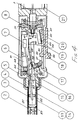
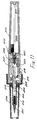
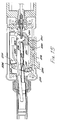
- Figures 11 to 16 inclusive relate to a further embodiment of the invention, largely similar to that of Figures 1 to 10, but incorporating a number of design refinements, in addition to a modification of the flame extinction arrangement.
- Figure 11 is a longitudinal sectional view of the invention in this embodiment, corresponding to the longitudinal section of Figure 2, similar components in Figure 11 to those of Figure 2 having the same reference numerals as those of Figure 2, but with the addition of 200. All of the components identified or designated in Figure 11 correspond to those already discussed in regard to Figures 1 and 2, and no further detailed discussion is now required.
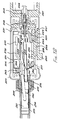
- Figures 12 to 15 inclusive correspond to Figures 4 to 7 inclusive, in showing successive stages of operation of the device of the invention, when undertaking an ignition operation.
- Figure 12 shows an off position
- Figure 13 an "on” or “gas-on” position
- Figure 14 a so-called “mid” position
- Figure 15 the ignition position.
- All of the features shown in these drawings equate to those of Figures 4 to 7 and Figure 8 with the addition of 200 to the original reference numerals.
- This second embodiment contains however the following additional features and modifications now discussed.
- the flame extinction tip 291 of the flame-out or extinction spring 219 has a different profile or configuration from the arrangement shown in Figures 4 to 8.
- the tip 291 extends obliquely relative to the longitudinal axis of the device and is connected to the tongue portions of the spring 219 by a curved or camming portion 298, defining a part circular profile in side view of the spring member in this region, the outer curve of the part circular portion or camming portion 298 being directed radially outward of the unit relative to its central longitudinal axis.
- This camming portion of tip 291 cooperates in use with an active end 227 of a flame spring retarding member 225, which is mounted on the displaceable or moving part 271 of the piezoelectric device by means of a mounting end 226.
- Member 225 is thus formed by appropriately bending a piece of strip material so as to define a clip at end 226, which can be snapped over the sliding part 271 of the piezo device in a straightforward assembly operation for engagement in use by lug portion 262 of rocker 217.
- the mounting end or clip portion 226 is thus interposed between lug 262 and the end of part 271 against which the lug engages.
- the active end 227 is curved in a generally matching manner to the camming portion 298 of spring member 291, so as to define a part circular portion.
- the convex surface of the part circular portion 227 is however in this instance directed radially inward with respect to the longitudinal axes of the tool, so that during axial displacement of member 225, which travels with part 271 during displacement or activation of the piezo device, active end 227 comes into camming engagement with camming portion 298 of tip 291 when certain positional relationships prevail between the member 225 and the spring 219.
- spring 219 In the off position of Figure 12 and also in the initial or on position of Figure 13, spring 219 is deformed into its outermost or first stressed disposition, substantially equivalent to that of Figures 4 and 5, with active end 227 of flame spring retarding member 225 then engaging the free end region of the tongue parts of member 219 axially inward of the camming portion 298 of tip 291.
- active end 227 moves forwardly, but at the same time, spring 219 is traversed across through the gas flow path to take up its oppositely curved or second stressed disposition in the ignition configuration of Figure 15.
- the purpose of the cooperating camming portion 298 and active end 227 is to delay the passage of the tip 291 through the gas stream or jet exiting from the nozzle tube 241 during reverse movement of the spring 219 from its second or active disposition in the ignition configuration of Figure 15 back into the configuration which it occupies in the gas on disposition of Figure 12.
- the relationship between the two members is such that during this reverse movement, spring 219 reverses its deflection and snaps over to traverse tip 291 through the gas stream at a moment when the axial location of member 225 is such that the camming portion 229 of tip 291 on its outer convex region strikes against the inwardly directed likewise convex region of active end 227.
- active end 227 serves to hold tip 291 within the jet of gas for a slightly longer period than applies in the construction of Figure 4 et al, where there is no obstruction in the return path of the spring tip 91.
- This retarding action of active end 227 of member 225 leads to greater reliability in flame extinction by holding the tip 291 within the gas path for a slightly longer period than applies in the case of the first embodiment, this holding period nonetheless still representing substantially momentary mechanical interruption of the gas flow or jet exiting from the nozzle in a region immediately adjacent to the nozzle but slightly downstream from it.
- Enhanced reliability in flame extinction is therefore achieved by this adaptation or variant of the invention, which is thus especially proof against user abuse or incorrect user operation.
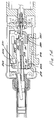
- FIG 16 there is depicted a further representation of the fuel valve assembly of Figures 9 and 10, in which the various items are identified by the same reference numerals as those of these previous Figures, but with the addition of 200 or 300 as appropriate.
- the sponge layers occupy the region 301 and reference 309 designates a shut-off pad or plug, as also shown in Figures 9 and 10.
- Reference 323 designates a circlip or like collar arrangement, while additional references 328, 329 and 331 designate O-rings and washers not specifically identified in Figures 9 and 10. All of the features of this drawing equate to those of the Figures previously discussed.
- the extinction spring arrangement of the present invention is especially effective in achieving flame extinction. It also facilitates an optimised gas flow control arrangement enabling efficient use of gas with minimum waste. Any failure of the catalyst to heat following extinction indicates that the catalyst is starting to be consumed and requires replacement.
- a further especially advantageous feature of the invention is the provision of the aluminium support structure for the transition portion between the tank and the remainder of the invention. This means that there is warming of the evaporation region and chamber of the device simply by holding it in the hand. Despite the greater cost of using aluminium for this portion of the structure, the technical advantage gained is considerable.
- the unit of the invention can be rapidly brought to a state of readiness for use by hand-heat only, even if it has become chilled during storage or a period of non-use.
- a further especial advantage of the assembly structure described is that it is put together by screwing components into one another and no welding is involved, while the manner of mounting the flame extinction components further facilitates manufacturing assembly.
- a further particular feature of the invention is the use of a separable tip and element, as compared with certain known constructions.
Landscapes
- Engineering & Computer Science (AREA)
- Mechanical Engineering (AREA)
- Lighters Containing Fuel (AREA)
- Gas Burners (AREA)
Abstract
Claims (17)
- Outil portatif producteur de chaleur comprenant :(a) un réservoir de combustible (10, 210) ;(b) une section de dégagement et d'application de la chaleur (1, 12 ; 201, 212) comportant une région avant (1; 201) pour application de la chaleur produite par l'outil, une région arrière (12 ; 212) à l'intérieur de laquelle la production de chaleur a lieu au moyen de l'interaction du combustible avec un élément catalytique (2 ; 202), et une région de combustion (81 ; 281) à l'arrière de l'élément catalytique (2 ; 202) pour chauffage initial par flamme de l'élément catalytique (2 ; 202),(c) un moyen de soupape (9 ; 209) pour commander l'écoulement du combustible à partir du réservoir de combustible (10 ; 210) vers la section de dégagement et d'application de la chaleur (1, 12 ; 201, 212),(d) une buse (41 ; 241) pour émettre un jet de gaz délivré par ledit moyen de soupape (9 ; 209) pour écoulement dudit jet de gaz vers ladite région de combustion (81 ; 281) de la section de dégagement et d'application de la chaleur (1, 12 ; 201, 212) de l'outil,(e) un moyen pour allumer le combustible dans ladite région de combustion (81 ; 281) pour ledit chauffage par flamme initial de l'élément catalytique, et(f) un moyen (17, 18, 19, 61, 91 ; 217, 218, 219, 261, 291) pour terminer le chauffage initial par flamme dans ladite région de combustion (81 ; 281) par l'interruption sensiblement momentanée de l'écoulement du combustible à partir du réservoir de combustible (10 ; 210) vers la section de dégagement et d'application de la chaleur (1, 12 ; 201, 212),caractérisé en ce que
ledit moyen (17, 18, 19, 61, 91 ; 217, 218, 219, 261, 291) pour terminer le chauffage initial par flamme est disposé pour une interruption mécanique sensiblement momentanée dudit jet de gaz émis à partir de ladite buse (41 ; 241) dans une région (41à 42 ; 241 à 242) en aval de la buse. - Outil portatif producteur de chaleur selon la revendication 1, dans lequel ledit moyen (17, 18, 19, 61, 91 ; 217, 218, 219, 261, 291) pour terminer le chauffage initial par flamme comprend un élément d'extinction de flamme (91 ; 291) prévu pour traverser ledit jet de gaz émis à partir de ladite buse (41 ; 241) immédiatement adjacent à ladite buse (41 ; 241) dans ladite région (41 à 42 ; 241 à 242) en aval de la buse.
- Outil portatif producteur de chaleur selon la revendication 2, comprenant un conduit (16 ; 216) pour l'écoulement dudit jet de gaz émis à partir de ladite buse vers ladite région de combustion (81 ; 281) de la section de dégagement et d'application de la chaleur (1, 12 ; 201, 212) de l'outil, l'entrée (42 ; 242) du conduit (16 ; 216) étant séparée de la buse (41 ; 241) par ladite région (41 à 42 ; 241 à 242) en aval de la buse.
- Outil portatif producteur de chaleur selon la revendication 2 ou la revendication 3, comprenant un élément de commutation actionnable manuellement (18, 218) déplacable entre au moins deux positions (figures 4, 7 ; figures 12, 15) caractérisé en ce que ladite traversée dudit jet de gaz par ledit élément d'extinction de flamme (91 ; 291) est effectué par le déplacement dudit élément de commutation (18 ; 218) entre lesdites au moins deux positions (figures 4, 7 ; figures 12, 15).
- Outil portatif producteur de chaleur selon la revendication 4, dans lequel ledit élément d'extinction de flamme (91 ; 291) est défini par une région d'extrémité libre (91 ; 291) d'une partie de ressort élastique (19 ; 219) montée pour déplacement entre une première configuration sollicitée (figures 4, 5 ; figures 12, 13) et une seconde configuration sollicitée (figure 7 ; figure 15) par le déplacement dudit élément de commutation (18 ; 218) entre lesdites au moins deux positions (figures 4, 7 ; figures 12, 15) ladite traversée (figure 14) dudit jet de gaz par ledit élément d'extinction de flamme (91 ; 291) étant effectué par le déplacement de ladite partie de ressort élastique (19 ; 219) de ladite seconde configuration sollicitée (figure 7 ; figure 15) à ladite première configuration sollicitée (figures 4, 5 ; figures 12, 13).
- Outil portatif producteur de chaleur selon la revendication 5, comprenant une partie de logement de commutateur (5 ; 205), ledit élément de commutation étant monté de manière coulissante dans ladite partie de logement de commutateur (5 ; 205) et coopérant avec un élément de bouton à bascule (17 ; 217) monté à pivoter à l'intérieur de la partie de logement de commutateur (5 ; 205) pour activation d'un dispositif piézo-électrique (7 ; 207), le mouvement pivotant de l'élément de bouton à bascule (17 ; 217) étant effectué par le déplacement coulissant dudit élément de commutation (18 ; 218), caractérisé en ce que ladite partie de ressort élastique (19 ; 219) est montée sur l'élément de bouton à bascule (17 ; 217) et ledit déplacement de ladite partie de ressort élastique (19 ; 219) entre lesdites première (figures 4, 5 ; figures 12, 13) et seconde (figure 7 ; figure 15) configurations sollicitées est effectué par ledit mouvement pivotant dudit élément de bouton à bascule (17 ; 217).
- Outil portatif producteur de chaleur selon la revendication 6, dans lequel ledit élément de commutation (17 ; 217) est déplaçable entre une position arrêt (figure 4 ; figure 12) et une position allumage (figure 7 ; figure 15) en passant par une position intermédiaire d'écoulement de combustible (figure 5 ; figure 13), caractérisé en ce que ladite traversée dudit jet de gaz par ledit élément d'extinction de flamme (91 ; 291) est effectué pendant le déplacement de l'élément de commutation (17 ; 217) de la position d'allumage (figure 7 ; figure 15) à la position d'écoulement de combustible (figure 5 ; figure 13).
- Outil portatif producteur de chaleur selon la revendication 7, comprenant un élément à retard (225), monté sur une partie mobile (271) du dispositif piézo-électrique (207) et comportant une extrémité (227) pour engagement avec une partie (290) de l'élément d'extinction de flamme (291) pendant ladite traversée dudit jet de gaz par ledit élément d'extinction de flamme (291) de ladite seconde configuration sollicitée (figure 15) et à ladite première configuration sollicitée (figures 12, 13) de ladite partie de ressort élastique (219) pendant le déplacement inverse de ladite partie (217) en une configuration dilatée du dispositif piézo-électrique (207) pour maintenir ledit élément d'extinction de flamme (291) à l'intérieur dudit jet de gaz pendant une durée représentant ladite interruption mécanique sensiblement momentanée de l'écoulement dudit jet de gaz.
- Outil portatif producteur de chaleur selon l'une quelconque des revendications précédentes, dans lequel le moyen de soupape (9 ; 209) pour commander l'écoulement du combustible à partir du réservoir de combustible (10 ; 210) vers la section de dégagement et d'application de la chaleur (1, 12 ; 201, 212) comprend un ensemble de soupape (9 ; 209), caractérisé en ce que ledit ensemble de soupape (9 ; 209) est reçu à l'intérieur d'une structure de logement de soupape (21 ; 221) formée à partir d'un matériau thermiquement conducteur pour aider à l'évaporation du combustible au moyen de la chaleur de la main provenant d'un utilisateur de l'outil qui maintient l'outil manuellement.
- Outil portatif producteur de chaleur selon la revendication 9, dans lequel ladite structure de logement de soupape (21 ; 221) comporte une surface externe qui peut être saisie par la main.
- Outil portatif producteur de chaleur selon la revendication 9, ou la revendication 10, dans lequel l'ensemble de soupape comprend un élément de commande d'écoulement (109, 309) déplacable entre une position fermée et une position ouverte, caractérisé en ce que l'ensemble de soupape (9 ; 209) comprend de plus une fonction de régulation d'écoulement (101, 105, 107 ; 301, 305, 307) pour faire varier le débit du combustible hors du réservoir (10 ; 210) lorsque l'élément de commande d'écoulement (109 ; 309) est ouvert.
- Outil portatif producteur de chaleur selon la revendication 11, dans lequel la fonction de régulation d'écoulement (101, 105, 107 ; 301, 305, 307) comprend un ensemble compressible perméable au combustible (101 ; 301) reçu à l'intérieur de la structure de logement de soupape (21 ; 221) et un moyen d'ajustement actionnable manuellement (105, 107 ; 305, 307) pour faire varier le degré de compression de l'ensemble perméable au combustible (101 ; 301).
- Outil portatif producteur de chaleur selon la revendication 12, dans lequel l'ensemble perméable au combustible (101 ; 301) comprend une disposition spongiforme (101 ; 301) et le moyen d'ajustement comprend un élément engageable manuellement déplaçable par secteur (105 ; 305) relié à une structure du type tige filetée (106 ; 306) pour transformer le déplacement rotationnel de l'élément engageable manuellement (105 ; 305) en action compressive axiale (104 ; 304) sur la disposition spongiforme (101 ; 301).
- Outil portatif producteur de chaleur selon l'une quelconque des revendications 9 à 13, dans lequel la structure du logement de soupape (21 ; 221) est formée d'aluminium.
- Outil portatif producteur de chaleur selon l'une quelconque des revendications 9 à 14, comprenant une partie de logement de commutateur (5 ; 205), ladite structure de logement de soupape (21 ; 221) interconnectant la partie de logement de commutateur (5 ; 205) avec le réservoir de combustible (10 ; 210), caractérisé en ce que la région avant de la section de dégagement et d'application de chaleur (1, 12 ; 201, 212) comprend une partie de pointe (1 ; 201), la partie de pointe (1 ; 201) étant un composant indépendant séparable du restant de l'outil, une première chambre pour recevoir l'élément catalytique (2 ; 202) est définie à l'intérieur d'une région de logement cylindrique de la pointe (1 ; 201) pour recevoir un ensemble catalytique, pour assurer un échange ou remplacement indépendant dudit élément catalytique et la région arrière de la section de dégagement et d'application de la chaleur (1, 112 ; 201, 212) à l'intérieur de laquelle la production de chaleur a lieu au moyen d'une interaction du combustible avec un élément catalytique (2 ; 202) comprend une seconde chambre de combustion par flamme (81 ; 281) à l'arrière de ladite première chambre, ladite seconde chambre de combustion par flamme (81 ; 281) définissant ladite région de combustion (81 ; 281) et ladite pointe (1 ; 201), la première chambre et la seconde chambre (81 ; 281) étant associées de manière enlevable à ladite partie de logement de commutateur (5 ; 205).
- Outil portatif producteur de chaleur selon l'une quelconque des revendications précédentes, dans lequel un bouchon (32 ; 232) est prévu pour obstruer l'extérieur de la section de dégagement et d'application de la chaleur (1, 12 ; 201, 212) caractérisé en ce que le bouchon (32 ; 232) engage un élément de commutation (18 ; 218) de l'outil lorsqu'il est dans sa position d'obstruction afin de maintenir l'élément de commutation (18 ; 218) dans une position d'arrêt.
- Outil portatif producteur de chaleur selon l'une quelconque des revendications, comprenant une élément de commutation (18 ; 218) caractérisé en ce que l'élément de commutation (18 ; 218) est formé pour procurer une face plate dirigée vers l'extérieur afin de permettre à l'outil d'être placé sur une surface plate dans une disposition stable nettement résistante à un déplacement latéral accidentel.
Applications Claiming Priority (3)
| Application Number | Priority Date | Filing Date | Title |
|---|---|---|---|
| IE93480 | 1993-06-25 | ||
| IE048093A IES930480A2 (en) | 1993-06-25 | 1993-06-25 | Soldering tools |
| PCT/IE1994/000032 WO1995000280A1 (fr) | 1993-06-25 | 1994-06-17 | Outils de brasage |
Publications (2)
| Publication Number | Publication Date |
|---|---|
| EP0705153A1 EP0705153A1 (fr) | 1996-04-10 |
| EP0705153B1 true EP0705153B1 (fr) | 1997-05-21 |
Family
ID=11039999
Family Applications (1)
| Application Number | Title | Priority Date | Filing Date |
|---|---|---|---|
| EP94917782A Expired - Lifetime EP0705153B1 (fr) | 1993-06-25 | 1994-06-17 | Outils de brasage |
Country Status (6)
| Country | Link |
|---|---|
| US (1) | US5921231A (fr) |
| EP (1) | EP0705153B1 (fr) |
| AU (1) | AU6936094A (fr) |
| DE (1) | DE69403337T2 (fr) |
| IE (1) | IES930480A2 (fr) |
| WO (1) | WO1995000280A1 (fr) |
Families Citing this family (18)
| Publication number | Priority date | Publication date | Assignee | Title |
|---|---|---|---|---|
| NL9401366A (nl) * | 1994-08-24 | 1996-04-01 | Brp De Bilt Bv | Werkwijze voor de bereiding van een puzzolaan materiaal uit papierresidu en werkwijze voor het daaruit vervaardigen van cement. |
| EP1324852A1 (fr) * | 2000-10-13 | 2003-07-09 | OGLESBY & BUTLER, RESEARCH & DEVELOPMENT LIMITED | Outil de soudage a gaz |
| US6457628B1 (en) * | 2001-01-08 | 2002-10-01 | Arlo H. T. Lin | Safety switch device for gas jet soldering gun |
| JP3582833B2 (ja) * | 2002-03-06 | 2004-10-27 | 中島銅工株式会社 | 半田ごて |
| US6880552B1 (en) * | 2004-06-04 | 2005-04-19 | Victoria Veret | Variable wood burning tool |
| US20050272457A1 (en) * | 2004-06-07 | 2005-12-08 | Nokia Corporation | Handling transmissions via a radio link |
| US20060011600A1 (en) * | 2004-07-15 | 2006-01-19 | Mitsuhiko Miyazaki | Soldering device with cartridge type battery pack |
| WO2007048886A1 (fr) * | 2005-10-28 | 2007-05-03 | Sefmat | Bruleur/generateur d'air chaud a allumage interne |
| AU2006336980A1 (en) * | 2006-01-26 | 2007-08-02 | Heatgear Professional Aps | Portable catalytic heating system for off grid application |
| FR2979973B1 (fr) * | 2011-09-09 | 2018-05-04 | Guilbert Express Sa | Lance pour outil a main chauffant sans remontees de temperature le long de la tuyere |
| US10730279B2 (en) * | 2015-04-23 | 2020-08-04 | Pacific Coast Building Products, Inc. | Hand held circular heating elements |
| DK3619001T3 (da) * | 2017-05-05 | 2022-03-14 | Oglesby&Butler Research&Development Ltd | Gasdrevet værktøj og fremgangsmåde til at holde en afspærringsventil i et gasdrevet værktøj i en afspærringstilstand |
| TWI660807B (zh) | 2018-07-24 | 2019-06-01 | 愛烙達股份有限公司 | 開關具有支撐功能之工具 |
| USD865014S1 (en) * | 2019-08-14 | 2019-10-29 | Xinning Xu | Digital display soldering iron |
| USD879169S1 (en) * | 2019-10-28 | 2020-03-24 | Qiuxian Xu | Electric soldering iron |
| USD935500S1 (en) * | 2020-11-30 | 2021-11-09 | Qing Li | Digital display soldering iron |
| USD951317S1 (en) * | 2021-06-14 | 2022-05-10 | Junqiang Li | Soldering iron |
| USD1006080S1 (en) * | 2022-09-15 | 2023-11-28 | Chengming Ding | Digital soldering iron |
Family Cites Families (13)
| Publication number | Priority date | Publication date | Assignee | Title |
|---|---|---|---|---|
| DD121289A5 (fr) * | 1974-08-14 | 1976-07-20 | ||
| US4133301A (en) * | 1976-07-29 | 1979-01-09 | Akinobu Fujiwara | Gas heating method and apparatus |
| DE3374651D1 (en) * | 1982-07-22 | 1988-01-07 | Prince Industrial Dev | Catalyst combustion curling device |
| US4785793A (en) * | 1983-03-02 | 1988-11-22 | Oglesby & Butler Technology Limited | A soldering tool |
| US4552124A (en) * | 1984-02-20 | 1985-11-12 | Nakajima Dokosho Co. Ltd. | Heat processing apparatus |
| JPS6137370A (ja) * | 1984-07-30 | 1986-02-22 | Nakajima Doukoushiyo:Kk | 液化ガスを用いた熱ごて |
| US4920952A (en) * | 1987-08-05 | 1990-05-01 | Masahiko Nakajima | Heat processing apparatus using liquified gas |
| JPH07122494B2 (ja) * | 1990-06-20 | 1995-12-25 | 株式会社東海 | 流量調節機構およびその製造方法 |
| IE65429B1 (en) * | 1990-10-26 | 1995-11-01 | Oglesby & Butler Res & Dev | A gas powered heating tool |
| JPH0830567B2 (ja) * | 1991-06-29 | 1996-03-27 | 中島銅工株式会社 | ガス燃焼方法およびその装置 |
| JPH05141653A (ja) * | 1991-11-19 | 1993-06-08 | Yuuka Sangyo Kk | ガス燃焼方法およびその装置 |
| AU3093892A (en) * | 1991-12-17 | 1993-07-19 | Oglesby & Butler Research & Development Limited | A heating tool and a heating tool element |
| EP0561020B1 (fr) * | 1992-03-18 | 1995-05-03 | Thai Merry Co., Ltd. | Briquet à gaz pour cigarettes |
-
1993
- 1993-06-25 IE IE048093A patent/IES930480A2/en not_active IP Right Cessation
-
1994
- 1994-06-17 EP EP94917782A patent/EP0705153B1/fr not_active Expired - Lifetime
- 1994-06-17 AU AU69360/94A patent/AU6936094A/en not_active Abandoned
- 1994-06-17 WO PCT/IE1994/000032 patent/WO1995000280A1/fr not_active Ceased
- 1994-06-17 DE DE69403337T patent/DE69403337T2/de not_active Expired - Fee Related
- 1994-06-17 US US08/571,835 patent/US5921231A/en not_active Expired - Fee Related
Also Published As
| Publication number | Publication date |
|---|---|
| IES59618B2 (en) | 1994-03-09 |
| US5921231A (en) | 1999-07-13 |
| EP0705153A1 (fr) | 1996-04-10 |
| IES930480A2 (en) | 1994-03-09 |
| WO1995000280A1 (fr) | 1995-01-05 |
| AU6936094A (en) | 1995-01-17 |
| DE69403337D1 (de) | 1997-06-26 |
| DE69403337T2 (de) | 1998-01-02 |
Similar Documents
| Publication | Publication Date | Title |
|---|---|---|
| EP0705153B1 (fr) | Outils de brasage | |
| US4538983A (en) | Foldable safety lighter | |
| EP0245306B1 (fr) | Appareil de chauffage portatif | |
| US4243017A (en) | Catalytically heated curling device with improved ignition system | |
| US20090098494A1 (en) | Torch having a continuous-flame mode | |
| US4248208A (en) | Catalytically heated curling device with automatic temperature control | |
| US5960996A (en) | Gas-burned glue gun | |
| US5803061A (en) | Gas-burned soldering tool | |
| US4920952A (en) | Heat processing apparatus using liquified gas | |
| CA1215271A (fr) | Fer a souder a gaz | |
| US5771881A (en) | Ignition apparatus and a heating tool | |
| US4025288A (en) | Gas lamp igniter device | |
| EP1013999B1 (fr) | Allume-cigares | |
| JPH0581801B2 (fr) | ||
| US4395227A (en) | Flame thrower attachment | |
| US3275060A (en) | Combined propane torch and igniter assembly | |
| US6461146B1 (en) | Adjustable jet flame utility lighter | |
| US20040029060A1 (en) | Operating mechanism for sequentially operating a fuel gas valve and an ignition means, and a gas powered appliance incorporating the operating mechanism | |
| JP3670435B2 (ja) | 予混合燃焼点火棒 | |
| JPH0531380Y2 (fr) | ||
| AU585671C (en) | Portable heating appliance | |
| IES63988B2 (en) | An ignition apparatus and a heating tool | |
| JP2001349541A (ja) | 火口部を出入自在に備えたガスライター | |
| IE20030771U1 (en) | A gas powered heating tool |
Legal Events
| Date | Code | Title | Description |
|---|---|---|---|
| PUAI | Public reference made under article 153(3) epc to a published international application that has entered the european phase |
Free format text: ORIGINAL CODE: 0009012 |
|
| 17P | Request for examination filed |
Effective date: 19951222 |
|
| AK | Designated contracting states |
Kind code of ref document: A1 Designated state(s): BE CH DE GB IE LI |
|
| GRAG | Despatch of communication of intention to grant |
Free format text: ORIGINAL CODE: EPIDOS AGRA |
|
| 17Q | First examination report despatched |
Effective date: 19960510 |
|
| GRAH | Despatch of communication of intention to grant a patent |
Free format text: ORIGINAL CODE: EPIDOS IGRA |
|
| GRAH | Despatch of communication of intention to grant a patent |
Free format text: ORIGINAL CODE: EPIDOS IGRA |
|
| GRAA | (expected) grant |
Free format text: ORIGINAL CODE: 0009210 |
|
| AK | Designated contracting states |
Kind code of ref document: B1 Designated state(s): BE CH DE GB IE LI |
|
| PG25 | Lapsed in a contracting state [announced via postgrant information from national office to epo] |
Ref country code: LI Free format text: LAPSE BECAUSE OF FAILURE TO SUBMIT A TRANSLATION OF THE DESCRIPTION OR TO PAY THE FEE WITHIN THE PRESCRIBED TIME-LIMIT Effective date: 19970521 Ref country code: CH Free format text: LAPSE BECAUSE OF FAILURE TO SUBMIT A TRANSLATION OF THE DESCRIPTION OR TO PAY THE FEE WITHIN THE PRESCRIBED TIME-LIMIT Effective date: 19970521 Ref country code: BE Effective date: 19970521 |
|
| REG | Reference to a national code |
Ref country code: CH Ref legal event code: EP |
|
| REF | Corresponds to: |
Ref document number: 69403337 Country of ref document: DE Date of ref document: 19970626 |
|
| REG | Reference to a national code |
Ref country code: CH Ref legal event code: PL |
|
| PLBE | No opposition filed within time limit |
Free format text: ORIGINAL CODE: 0009261 |
|
| STAA | Information on the status of an ep patent application or granted ep patent |
Free format text: STATUS: NO OPPOSITION FILED WITHIN TIME LIMIT |
|
| 26N | No opposition filed | ||
| REG | Reference to a national code |
Ref country code: GB Ref legal event code: IF02 |
|
| PGFP | Annual fee paid to national office [announced via postgrant information from national office to epo] |
Ref country code: GB Payment date: 20020621 Year of fee payment: 9 |
|
| PGFP | Annual fee paid to national office [announced via postgrant information from national office to epo] |
Ref country code: DE Payment date: 20020627 Year of fee payment: 9 |
|
| PG25 | Lapsed in a contracting state [announced via postgrant information from national office to epo] |
Ref country code: GB Free format text: LAPSE BECAUSE OF NON-PAYMENT OF DUE FEES Effective date: 20030617 |
|
| PGFP | Annual fee paid to national office [announced via postgrant information from national office to epo] |
Ref country code: IE Payment date: 20030630 Year of fee payment: 10 |
|
| PG25 | Lapsed in a contracting state [announced via postgrant information from national office to epo] |
Ref country code: DE Free format text: LAPSE BECAUSE OF NON-PAYMENT OF DUE FEES Effective date: 20040101 |
|
| GBPC | Gb: european patent ceased through non-payment of renewal fee |
Effective date: 20030617 |
|
| PG25 | Lapsed in a contracting state [announced via postgrant information from national office to epo] |
Ref country code: IE Free format text: LAPSE BECAUSE OF NON-PAYMENT OF DUE FEES Effective date: 20040617 |
|
| REG | Reference to a national code |
Ref country code: IE Ref legal event code: MM4A |