EP0705839B1 - Imidobisphosphorsäuren, Verfahren zu ihrer Herstellung und Verwendung derselben - Google Patents
Imidobisphosphorsäuren, Verfahren zu ihrer Herstellung und Verwendung derselben Download PDFInfo
- Publication number
- EP0705839B1 EP0705839B1 EP95115276A EP95115276A EP0705839B1 EP 0705839 B1 EP0705839 B1 EP 0705839B1 EP 95115276 A EP95115276 A EP 95115276A EP 95115276 A EP95115276 A EP 95115276A EP 0705839 B1 EP0705839 B1 EP 0705839B1
- Authority
- EP
- European Patent Office
- Prior art keywords
- ethyl
- alkyl
- butyl
- isopropyl
- formula
- Prior art date
- Legal status (The legal status is an assumption and is not a legal conclusion. Google has not performed a legal analysis and makes no representation as to the accuracy of the status listed.)
- Expired - Lifetime
Links
Classifications
-
- C—CHEMISTRY; METALLURGY
- C07—ORGANIC CHEMISTRY
- C07F—ACYCLIC, CARBOCYCLIC OR HETEROCYCLIC COMPOUNDS CONTAINING ELEMENTS OTHER THAN CARBON, HYDROGEN, HALOGEN, OXYGEN, NITROGEN, SULFUR, SELENIUM OR TELLURIUM
- C07F9/00—Compounds containing elements of Groups 5 or 15 of the Periodic Table
- C07F9/02—Phosphorus compounds
- C07F9/06—Phosphorus compounds without P—C bonds
- C07F9/22—Amides of acids of phosphorus
- C07F9/222—Amides of phosphoric acids
-
- A—HUMAN NECESSITIES
- A61—MEDICAL OR VETERINARY SCIENCE; HYGIENE
- A61K—PREPARATIONS FOR MEDICAL, DENTAL OR TOILETRY PURPOSES
- A61K31/00—Medicinal preparations containing organic active ingredients
- A61K31/66—Phosphorus compounds
- A61K31/664—Amides of phosphorus acids
-
- A—HUMAN NECESSITIES
- A61—MEDICAL OR VETERINARY SCIENCE; HYGIENE
- A61P—SPECIFIC THERAPEUTIC ACTIVITY OF CHEMICAL COMPOUNDS OR MEDICINAL PREPARATIONS
- A61P19/00—Drugs for skeletal disorders
- A61P19/08—Drugs for skeletal disorders for bone diseases, e.g. rachitism, Paget's disease
- A61P19/10—Drugs for skeletal disorders for bone diseases, e.g. rachitism, Paget's disease for osteoporosis
-
- A—HUMAN NECESSITIES
- A61—MEDICAL OR VETERINARY SCIENCE; HYGIENE
- A61P—SPECIFIC THERAPEUTIC ACTIVITY OF CHEMICAL COMPOUNDS OR MEDICINAL PREPARATIONS
- A61P3/00—Drugs for disorders of the metabolism
-
- A—HUMAN NECESSITIES
- A61—MEDICAL OR VETERINARY SCIENCE; HYGIENE
- A61P—SPECIFIC THERAPEUTIC ACTIVITY OF CHEMICAL COMPOUNDS OR MEDICINAL PREPARATIONS
- A61P3/00—Drugs for disorders of the metabolism
- A61P3/12—Drugs for disorders of the metabolism for electrolyte homeostasis
- A61P3/14—Drugs for disorders of the metabolism for electrolyte homeostasis for calcium homeostasis
-
- A—HUMAN NECESSITIES
- A61—MEDICAL OR VETERINARY SCIENCE; HYGIENE
- A61P—SPECIFIC THERAPEUTIC ACTIVITY OF CHEMICAL COMPOUNDS OR MEDICINAL PREPARATIONS
- A61P43/00—Drugs for specific purposes, not provided for in groups A61P1/00-A61P41/00
-
- C—CHEMISTRY; METALLURGY
- C07—ORGANIC CHEMISTRY
- C07F—ACYCLIC, CARBOCYCLIC OR HETEROCYCLIC COMPOUNDS CONTAINING ELEMENTS OTHER THAN CARBON, HYDROGEN, HALOGEN, OXYGEN, NITROGEN, SULFUR, SELENIUM OR TELLURIUM
- C07F9/00—Compounds containing elements of Groups 5 or 15 of the Periodic Table
- C07F9/02—Phosphorus compounds
- C07F9/06—Phosphorus compounds without P—C bonds
- C07F9/22—Amides of acids of phosphorus
- C07F9/24—Esteramides
- C07F9/2454—Esteramides the amide moiety containing a substituent or a structure which is considered as characteristic
- C07F9/2479—Compounds containing the structure P(=X)n-N-acyl, P(=X)n-N-heteroatom, P(=X)n-N-CN (X = O, S, Se; n = 0, 1)
- C07F9/2495—Compounds containing the structure P(=X)n-N-acyl, P(=X)n-N-heteroatom, P(=X)n-N-CN (X = O, S, Se; n = 0, 1) containing the structure P(=X)n-N-P (X = O, S, Se; n = 0, 1)
-
- C—CHEMISTRY; METALLURGY
- C07—ORGANIC CHEMISTRY
- C07F—ACYCLIC, CARBOCYCLIC OR HETEROCYCLIC COMPOUNDS CONTAINING ELEMENTS OTHER THAN CARBON, HYDROGEN, HALOGEN, OXYGEN, NITROGEN, SULFUR, SELENIUM OR TELLURIUM
- C07F9/00—Compounds containing elements of Groups 5 or 15 of the Periodic Table
- C07F9/02—Phosphorus compounds
- C07F9/547—Heterocyclic compounds, e.g. containing phosphorus as a ring hetero atom
- C07F9/553—Heterocyclic compounds, e.g. containing phosphorus as a ring hetero atom having one nitrogen atom as the only ring hetero atom
- C07F9/576—Six-membered rings
- C07F9/58—Pyridine rings
-
- C—CHEMISTRY; METALLURGY
- C07—ORGANIC CHEMISTRY
- C07F—ACYCLIC, CARBOCYCLIC OR HETEROCYCLIC COMPOUNDS CONTAINING ELEMENTS OTHER THAN CARBON, HYDROGEN, HALOGEN, OXYGEN, NITROGEN, SULFUR, SELENIUM OR TELLURIUM
- C07F9/00—Compounds containing elements of Groups 5 or 15 of the Periodic Table
- C07F9/02—Phosphorus compounds
- C07F9/547—Heterocyclic compounds, e.g. containing phosphorus as a ring hetero atom
- C07F9/6527—Heterocyclic compounds, e.g. containing phosphorus as a ring hetero atom having nitrogen and oxygen atoms as the only ring hetero atoms
- C07F9/6533—Six-membered rings
Definitions
- Osteoporosis is a common bone disease. Both Various forms of osteoporosis lead to a severe loss Bone tissue, so that finally the mechanical stability of the bone get lost. In healthy people, the rate of osteoclasts and Osteoplasts are formed so that bone formation and Bone resorption is in balance. With osteoporosis it is Balance disturbed, so that bone is broken down.
- the rest of the formula II are radicals such as, for example, cyclopropyl, Cyclobutyl, Cyclopentyl, Cyclohexyl, Cycloheptyl, Cyclooctyl, Cyclononyl or Cyclodecyl understood, optionally by one or more alkyl radicals can be substituted with 1 to 6 carbon atoms.
- Het monocyclic 5- to 6-membered or bicyclic 8 to 10-membered saturated, unsaturated or partially unsaturated heterocyclic Residues with 1 to 3 identical or different heteroatoms from the series Understand nitrogen, oxygen and sulfur. Het preferably contains 1 to 2 Nitrogen atoms.
- Monocyclic heterocyclic radicals are e.g. Pyrrole, pyrroline, pyrrolidine, Pyridine, tetrahydropyridine, piperidine, pyrazole, imidazole, pyrazoline, imidazoline, Pyrazolidine, imidazolidine, pyridazine, pyrimidine, pyrazine, piperazine, oxazole, Oxazoline, oxazolidine, isoxazole, isoxazoline, isoxazolidine, morpholine, thiazole, Isothiazole, thiazoline, isothiazoline, thiazine, furan, tetrahydrofuran, thiophene, Thiolan, dioxane, pyran, thiopyran, 1,3-dioxole, 1,2-oxathiolane, 1,2.3-triazole, 1.2.4-triazole, 1.2.4-thiadiazole, 1.3.4.-
- Bicyclic heterocyclic radicals are e.g. Benzothiophene, benzofuran, indole, Isoindole, indolizine, indazole, benzimidazole, quinoline, isoquinoline, phthalazine, Quinoxaline, quinazoline, cinnolin, chroman, 4H-chromene, coumarone, Thionaphthene, pyrrolo [1.5-a] pyrimidine, imidazo [2.1-b] oxazole, purine and pteridine.
- Alkyl can be straight-chain or branched. The same applies to it derived residues such as Alkanoyl.
- halogen represents chlorine, bromine, iodine or fluorine, preferred for fluorine, chlorine or bromine.
- Suitable physiologically acceptable salts of the compounds of formula I. are, for example, alkali, alkaline earth or ammonium salts, and those of physiologically compatible, organic ammonium or triethylamine bases.
- reaction step a) it is best to proceed in such a way that the compound of the formula III in equimolar amounts or with an up to 70% Excess hydrogen peroxide (35%) in alcohols such as methanol, ethanol, n-propanol, i-propanol, n-butanol or i-butanol to the corresponding N-substituted Imidobisphosphorklatraalkylestern of formula I implemented.
- the Reaction temperatures are between -50 ° C and +70 ° C, especially at 30 ° C, the reaction times are between 15 minutes and 4 Hours, preferably between 1 and 3 hours.
- the raw products obtained can either be by distillation, crystallization or preparative Column chromatography can be cleaned.
- reaction step b) it is best to proceed in such a way that the after Reaction step a) compounds obtained with a four to six times Excess of an alkyl silane such as chlorine, bromine or Brings iodotrimethylsilane to the reaction.
- Suitable solvents for this are Toluene, o-, m- or p-xylene, chorbenzene or acetonitrile, preference is given to acetonitrile, the solvents can be used dry.
- the Reaction temperatures are between 0 ° C and 70 ° C, preferably 20 ° C to 30 ° C.
- the response times are between 1 hour and 24 Hours, preferably between 4 hours and 18 hours. Then be the respective solvent and the excess of silane removed in vacuo.
- the desired product of the formula I is obtained as a residue.
- reaction step c) it is best to proceed in such a way that the after Reaction step b) compounds obtained in a solvent such as for example an alcohol, preferably methanol, ethanol, n-propanol, i-propanol, n-butanol or i-butanol, particularly preferably methanol, ethanol or i-propano dissolves and until the compound of formula I crystallizes at a temperature from 10 ° C to 30 ° C, preferably at 25 ° C, or 4 Mol equivalents up to 100 mol equivalents, preferably 4 mol equivalents up to 20 Molar equivalents of water to the solution at a temperature of 10 ° C to 30 ° C, preferably at 25 ° C and leaves until the compound crystallizes stand.
- a solvent such as for example an alcohol, preferably methanol, ethanol, n-propanol, i-propanol, n-butanol or i-butanol, particularly preferably methanol
- the compounds thus obtained are then in an inert Solvents such as n-hexane, n-heptane, methylcyclohexane, Petroleum ether (40 - 60 ° C), preferably n-hexane or petroleum ether (40 - 60 ° C) slurried and filtered or dissolved after reaction step b) compounds obtained directly in a solvent such as n-hexane, n-heptane, methylcyclohexane or petroleum ether (40 - 60 ° C), preferably n Hexane or petroleum ether (40 - 60 ° C).
- Solvents such as n-hexane, n-heptane, methylcyclohexane, Petroleum ether (40 - 60 ° C)
- the invention also relates to medicaments which have at least one Compound of formula I and / or at least one of their physiological compatible salts contain, in addition to pharmaceutically suitable and physiologically compatible auxiliaries and carriers, diluents and / or other active ingredients.
- Another object of the invention is the use of the compounds dei Formula I and their physiologically tolerable salts for prophylaxis and Treatment of osteoporosis and hypercalcemia, preferably osteoporosis.
- the medicaments according to the invention can be administered intravenously, intramuscularly, administered intraperitoneally, subcutaneously, intra-articularly, peri-articularly, rectally or orally become.
- Degenerative joint disease is done by connecting at least one of formula I and / or one of their physiologically acceptable salts if appropriate with other auxiliaries and / or carriers in a suitable Dosage form is brought.
- the auxiliaries and carriers come from the Group of carriers, preservatives and other common auxiliary substances.
- auxiliary substances such as starches, e.g. Potato, corn or wheat starch, cellulose or their derivatives, especially microcrystalline cellulose, silicon dioxide, various sugars such as Milk sugar, magnesium carbonate and / or calcium phosphates are used become.
- starches e.g. Potato, corn or wheat starch
- cellulose or their derivatives especially microcrystalline cellulose, silicon dioxide
- various sugars such as Milk sugar, magnesium carbonate and / or calcium phosphates
- it is advantageous to use the oral dosage forms to add which improve the tolerability of the medication, e.g. Slime formers and resins.
- Medications are also administered in the form of gastric insoluble capsules become.
- a retardant if necessary in the form of permeable membranes, e.g. those based on cellulose or polystyrene resin or ion exchangers.
- the dosage to be used of the pharmaceuticals according to the invention is dependent of various factors such as dosage form of the drug and Condition, weight and severity of the patient's illness.
- a daily dose of approximately 5000 mg of the pharmaceuticals according to the invention should, however, only exceeded for a short time. About 10 to 2500 mg are preferred as Daily dose for a person of about 70 kg body weight.
- the Administration of the daily dose of the medicament according to the invention can be in the form a single administration or in multiple small doses. Administration in 3 to 8 doses per day is preferred.
- connection Calcium concentration [mg / dl] control 0.663 ⁇ 0.008 Methane diphosphonic acid 0.537 ⁇ 0.010
- Example 18 0.603 ⁇ 0.006
- Example 20 0.607 ⁇ 0.006
- Example 21 0.553 ⁇ 0.010
- Example 22 0.513 ⁇ 0.010
- the residue from a) is taken up in 15 ml of petroleum ether (40-60 ° C) and Chilled to 0 ° C. 0.4 g of lithium methylate dissolved in 3 is added to this solution ml of methanol, stirred for a further hour at 0 ° C. and then for 12 hours at 25 ° C. A gel-like precipitate forms.
- the petroleum ether is at 0.06 mbar / 25 ° C distilled off, the residue taken up in 15 ml of methanol and stirred for a further hour at 25 ° C. After filtering the precipitate another 15 ml of petroleum ether (40-60 ° C.) are added, the mixture is stirred and filtered again.
- the implementation takes place as described under 17b).
- the product becomes Crystallization taken up in 15 ml of methanol, filtered and at 0.06 mbar / 25 ° C. dried.
Landscapes
- Chemical & Material Sciences (AREA)
- Health & Medical Sciences (AREA)
- Organic Chemistry (AREA)
- General Health & Medical Sciences (AREA)
- Life Sciences & Earth Sciences (AREA)
- Molecular Biology (AREA)
- Biochemistry (AREA)
- Crystallography & Structural Chemistry (AREA)
- Public Health (AREA)
- Pharmacology & Pharmacy (AREA)
- Medicinal Chemistry (AREA)
- Animal Behavior & Ethology (AREA)
- Veterinary Medicine (AREA)
- Chemical Kinetics & Catalysis (AREA)
- Nuclear Medicine, Radiotherapy & Molecular Imaging (AREA)
- Engineering & Computer Science (AREA)
- Bioinformatics & Cheminformatics (AREA)
- General Chemical & Material Sciences (AREA)
- Rheumatology (AREA)
- Physical Education & Sports Medicine (AREA)
- Obesity (AREA)
- Orthopedic Medicine & Surgery (AREA)
- Diabetes (AREA)
- Hematology (AREA)
- Endocrinology (AREA)
- Epidemiology (AREA)
- Pharmaceuticals Containing Other Organic And Inorganic Compounds (AREA)
- Glass Compositions (AREA)
- Low-Molecular Organic Synthesis Reactions Using Catalysts (AREA)
- Polymers With Sulfur, Phosphorus Or Metals In The Main Chain (AREA)
- Saccharide Compounds (AREA)
- Macromolecular Compounds Obtained By Forming Nitrogen-Containing Linkages In General (AREA)
- Medicines That Contain Protein Lipid Enzymes And Other Medicines (AREA)
- Dental Preparations (AREA)
- Fuel Cell (AREA)
Description
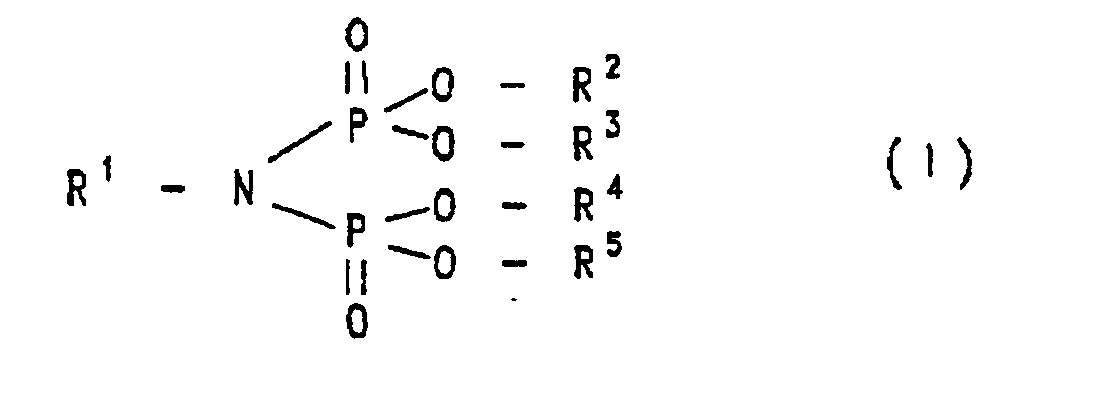
- R1
- (C1-C10)-Alkyl, (C1-C8)-Alkanoyl, (C6-C10)-Aryl oder Het bedeutet, die ein-
bis sechsfach substituiert sein können durch
Halogen, -OH, -NH2, -NH-CO-R7, -O-CO-R7 und -N-(R8)2,
wobei R7 (C1-C6)-Alkyl und R8 unabhängig voneinander Wasserstoff oder (C1-C3)-Alkyl ist, oder
für den Rest der Formel II stehtworin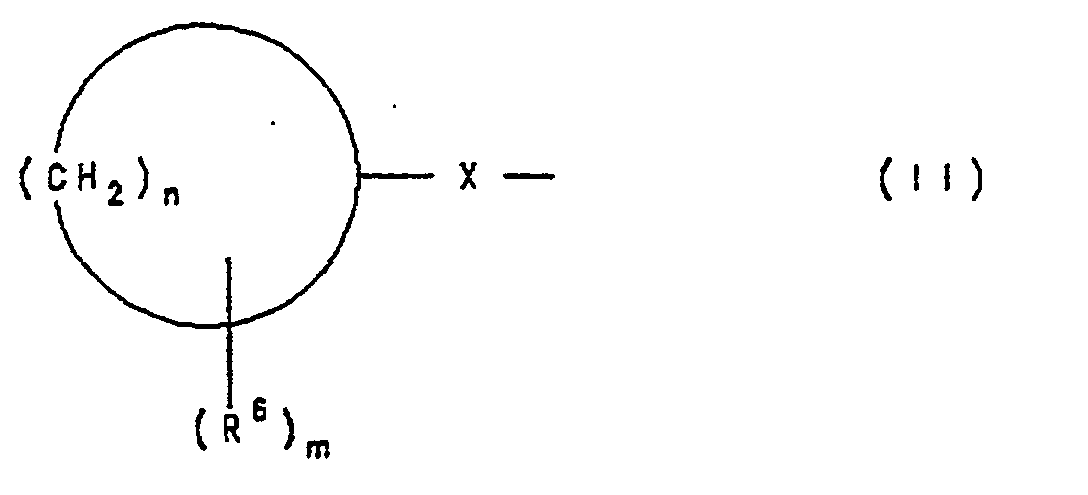
- n
- eine ganze Zahl von 3 bis 10,
- m
- Null bis 3,
- R6
- unabhängig voneinander (C1-C6)-Alkyl, das gegebenenfalls ein- bis sechsfach substituiert ist durch Halogen oder -NH-CO-R7 mit R7 = (C1-C6)-Alkyl bedeuten und
- X
- abwesend ist oder (C1-C10)-Alkyl bedeutet, und
dabei ausgenommen sind Verbindungen der Formel I mit
- R1 = Methyl und R2 - R5 gleichzeitig = Methyl, Ethyl, Propyl, Isopropyl, Butyl oder Isobutyl oder R2 und R3 = Ethyl oder Isopropyl und R4 und R5 = Methyl,
- R1 = Ethyl und R2 - R5 gleichzeitig = Ethyl, Propyl, Isopropyl, Butyl oder Isobutyl oder R2 und R3 = Ethyl und R4 und R5 = Methyl,
- R1 = Isopropyl und R2 und R3 = Isopropyl und R4 und R5 = Methyl,
- R1 = Butyl und R2 - R5 gleichzeitig = Ethyl, Isopropyl oder Butyl,
- R1 = Isobutyl und R2 - R5 gleichzeitig = Ethyl,
- R1 = Pentyl und R2 - R5 gleichzeitig = Ethyl, Propyl oder Butyl,
- R1 = 1-tert. Butyl-1,1'-dimethyl-propyl und R2 - R5 gleichzeitig = Ethyl,
- R1 = Dodecyl und R2 - R5 gleichzeitig = Butyl,
- R1 = Phenyl und R2 - R5 gleichzeitig = Propyl, und
- R1 = Cyclohexyl und R2 - R5 gleichzeitig = Ethyl.
- R1
- (C1-C10)-Alkyl, (C1-C8)-Alkanoyl, (C6-C10)-Aryl oder Het mit 1 oder 2
Stickstoffatomen bedeutet, die ein- bis sechsfach substituiert sein können
durch
Halogen, -OH, -NH2, -NH-CO-R7, -O-CO-R7 und -N-(R8)2,
wobei R7 (C1-C6)-Alkyl und R8 unabhängig voneinander Wasserstoff oder (C1-C3)-Alkyl ist, oder
für den Rest der Formel II stehtworin
- n
- eine ganze Zahl von 3 bis 10,
- m
- 1,
- R6
- (C1-C6)-Alkyl, das gegebenenfalls ein- bis sechsfach substituiert ist durch Halogen oder -NH-CO-R7 mit R7 = (C1-C6)-Alkyl bedeuten und
- X
- abwesend ist oder (C1-C10)-Alkyl bedeutet, und
dabei ausgenommen sind Verbindungen der Formel I mit
- R1 = Methyl und R2 - R5 gleichzeitig = Methyl, Ethyl, Propyl, Isopropyl, Butyl oder Isobutyl oder R2 und R3 = Ethyl oder Isopropyl und R4 und R5 = Methyl,
- R1 = Ethyl und R2 - R5 gleichzeitig = Ethyl, Propyl, Isopropyl, Butyl oder Isobutyl oder R2 und R3 = Ethyl und R4 und R5 = Methyl,
- R1 = Isopropyl und R2 und R3 = Isopropyl und R4 und R5 = Methyl,
- R1 = Butyl und R2 - R5 gleichzeitig = Ethyl, Isopropyl oder Butyl,
- R1 = Isobutyl und R2 - R5 gleichzeitig = Ethyl,
- R1 = Pentyl und R2 - R5 gleichzeitig = Ethyl, Propyl oder Butyl,
- R1 = 1-tert. Butyl-1,1'-dimethyl-propyl und R2 - R5 gleichzeitig = Ethyl,
- R1 = Phenyl und R2 - R5 gleichzeitig = Propyl, und
- R1 = Cyclohexyl und R2 - R5 gleichzeitig = Ethyl.
- n
- für eine ganze Zahl 7, 8, 9 oder 10 steht,
- m
- 1 bedeutet,
- R1
- für (C1-C5)-Alkyl, Phenyl, Naphthyl oder einen Rest aus der Gruppe Piperidinyl, Pyrolidinyl, Piperazinyl, Pyridinyl, Morpholinyl, Imidazol und Pyrazol steht,
- R2, R3, R4 und R5
- gleichzeitig für Wasserstoff, Natrium oder Lithium stehen.
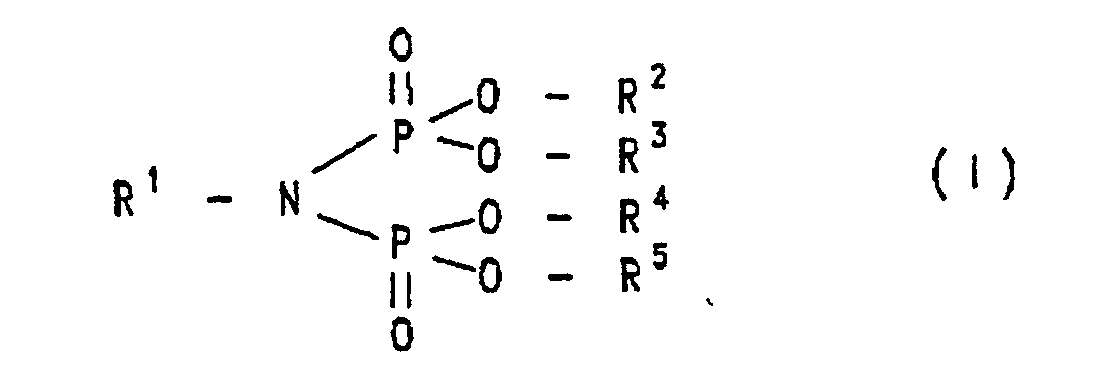
- R1
- (C1-C10)-Alkyl, (C1-C8)-Alkanoyl, (C6-C10)-Aryl oder Het bedeutet, die ein-
bis sechsfach substituiert sein können durch
Halogen, -OH, -NH2, -NH-CO-R7, -O-CO-R7 und -N-(R8)2,
wobei R7 (C1-C6)-Alkyl und R8 unabhängig voneinander Wasserstoff oder (C1-C3)-Alkyl ist, oder
für den Rest der Formel II stehtworin
- n
- eine ganze Zahl von 3 bis 10,
- m
- Null bis 3,
- R6
- unabhängig voneinander (C1-C6)-Alkyl, das gegebenenfalls ein- bis sechsfach substituiert ist durch Halogen oder -NH-CO-R7 mit R7 = (C1-C6)-Alkyl bedeuten und
- X
- abwesend ist oder (C1-C10)-Alkyl bedeutet, und
- a) Imidobisphosphorigsäurealkylester der Formel III, zugänglich nach dem
von L.K. Nikonorova et al., J. Gen. Chem. USSR 46, 1976, 1012 - 1014
beschriebenen Verfahren,
worin

- R1 die obengenannte Bedeutung hat und
- R2, R3, R4 und R5 für (C1-C5)-Alkyl stehen,
| Verbindung | Calcium-Konzentration [mg/dl] |
| Kontrolle | 0,663 ± 0,008 |
| Methandiphosphonsäure | 0,537 ± 0,010 |
| Beispiel 18 | 0,603 ± 0,006 |
| Beispiel 20 | 0,607 ± 0,006 |
| Beispiel 21 | 0,553 ± 0,010 |
| Beispiel 22 | 0,513 ± 0,010 |
C14H32N2O7P2 (402.4), Ausbeute: 11.3 g (40.1 %); MS (FAB): 402 (70) M+; 1H-NMR (CDCl3): δ = 1.36 (t, 3JHH = 7.0 Hz, 12H), 2.52 (m, 4H), 2.63 (m, 2H), 3.48 (m, 2H), 3.68 (m, 4H), 4.16 (m, 8H) ppm; 31P-NMR (CDCl3): δ = 4.54 ppm.
C15H28N2O6P2 (394.4), Ausbeute: 14.7 g (53.3 %); 1H-NMR (CDCl3): δ = 1.37 (t, 3JHH = 7.0 Hz, 12H), 3.22 (m, 2H), 3.73 (m, 2H), 4.18 (m, 8H), 7.12 (m, 1H), 7.23 (m, 1H), 7.59 (m, 1H), 8.52 (m, 1H) ppm; 31P-NMR (CDCl3): δ = 4.24 ppm.
C15H34N2O7P2 (416.4), Ausbeute: 14.9 g (54.5 %); 1 H-NMR (CDCl3): δ = 1.35 (t, 3JHH = 7.0 Hz,12H), 1.91 (m, 2H), 2.35 (t, 2H), 2.43 (m, 4H), 3.39 (m, 2H), 3.70 (m, 4H), 4.14 (m, 8H) ppm; 31P-NMR (CDCl3): δ = 4.46 ppm.
Claims (10)
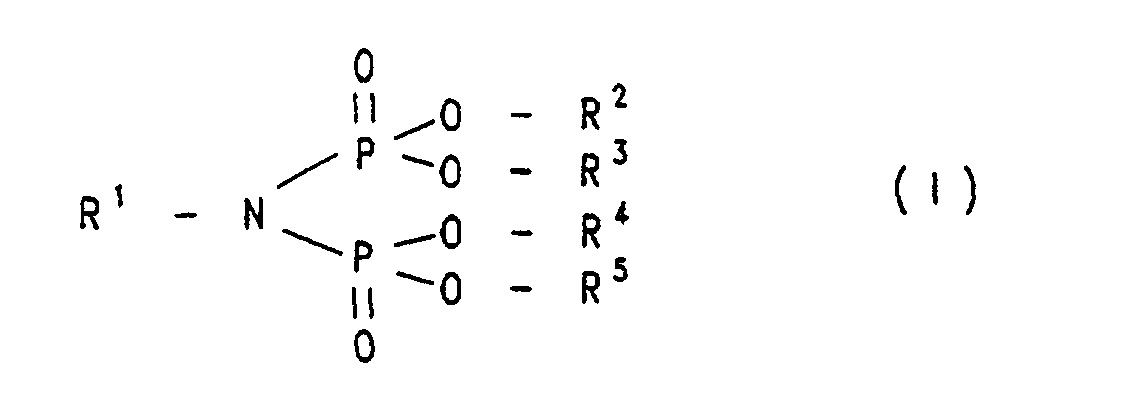
- Verbindungen der Formel I,sowie deren physiologisch verträgliche Salze, worin

- R1
- für (C1-C10)-Alkyl, (C1-C8)-Alkanoyl, (C6-C10)-Aryl oder Het steht, die
einfach bis sechsfach substituiert sein können durch Halogen, -OH, -NH2,
-NH-CO-R7, -O-CO-R7 und -N(R8)2,
worin R7 für (C1-C6)-Alkyl und R8 unabhängig voneinander für Wasserstoff oder (C1-C3)-Alkyl steht, und
Het für einen monocyclischen 5- bis 6-gliedrigen oder bicyclischen 8- bis 10-gliedrigen gesättigten, ungesättigten oder teilweise ungesättigten heterocyclischen Rest mit 1 bis 3 gleichen oder verschiedenen Heteroatomen aus der Reihe Stickstoff, Sauerstoff und Schwefel steht,
oder für den Rest der Formel IIsteht, worin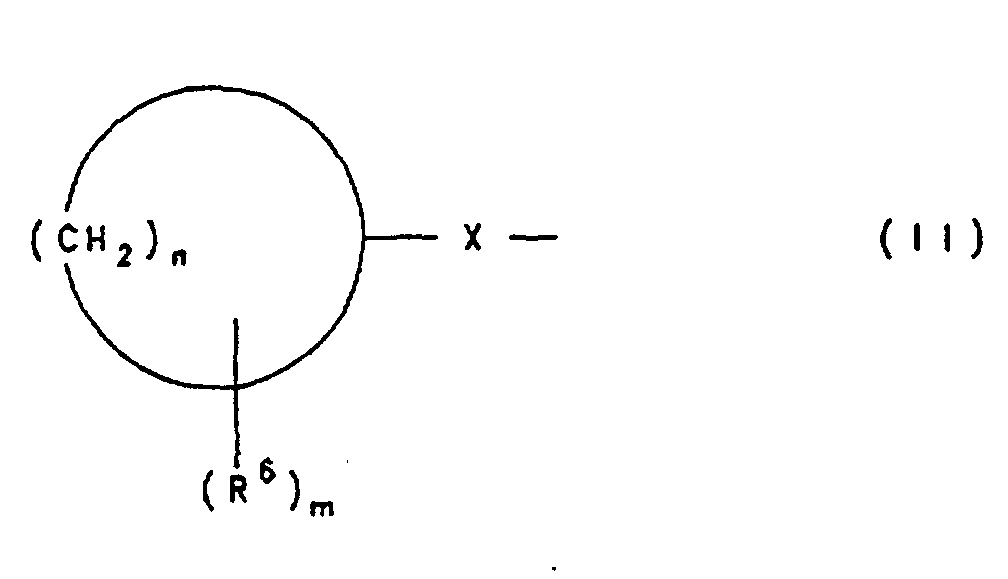
- n
- eine ganze Zahl von 3 bis 10,
- m
- Null bis 3,
- R8
- unabhängig voneinander (C1-C6)-Alkyl, das einfach bis sechsfach substituiert sein kann durch Halogen oder -NH-CO-R7, mit R7 = (C1-C6)-Alkyl, bedeuten, und
- X
- abwesend ist oder (C1-C10)-Alkyl bedeutet, und
wobei ausgeschlossen sind die Verbindungen der Formel I mitR1 = Methyl und R2 - R5 gleichzeitig = Methyl, Ethyl, Propyl, Isopropyl, Butyl oder Isobutyl oder R2 und R3 = Ethyl oder Isopropyl und R4 und R5 = Methyl;R1 = Ethyl und R2 - R5 gleichzeitig = Ethyl, Propyl, Isopropyl, Butyl oder Isobutyl oder R2 und R3 = Ethyl und R4 und R5 = Methyl;R1 = Isopropyl und R2 und R3 = Isopropyl und R4 und R5 = Methyl;R1 = Butyl und R2 - R5 gleichzeitig = Ethyl, Isopropyl oder Butyl;R1 = Isobutyl und R2 - R5 gleichzeitig = Ethyl;R1 = Pentyl und R2 - R5 gleichzeitig = Ethyl, Propyl oder Butyl;R1 = 1-tert. Butyl-1,1'-dimethyl-propyl und R2 - R5 gleichzeitig = Ethyl;R1 = Dodecyl und R2 - R5 gleichzeitig = Butyl;R1 = Phenyl und R2 - R5 gleichzeitig = Propyl; undR1 = Cyclohexyl und R2 - R5 gleichzeitig = Ethyl. - Verbindungen der Formel I gemäß Anspruch 1 sowie deren physiologisch verträgliche Salze, dadurch gekennzeichnet, daß
- R1
- für (C1-C10)-Alkyl, (C1-C8)-Alkanoyl, (C6-C10)-Aryl oder Het steht, die
einfach bis sechsfach substituiert sein können durch Halogen, -OH, -NH2,
-NH-CO-R7, -O-CO-R7 und -N(R8)2,
worin R7 für (C1-C6)-Alkyl und R8 unabhängig voneinander für Wasserstoff oder (C1-C3)-Alkyl steht, und
Het ein oder zwei Stickstoffatome enthält,
oder für den Rest der Formel IIsteht, worin
- n
- eine ganze Zahl von 3 bis 10,
- m
- 1,
- R6
- (C1-C6)-Alkyl, das einfach bis sechsfach substituiert sein kann durch Halogen oder -NH-CO-R7, mit R7 = (C1-C6)-Alkyl, bedeuten, und
- X
- abwesend ist oder (C1-C10)-Alkyl bedeutet, und
wobei ausgeschlossen sind Verbindungen der Formel I mitR1 = Methyl und R2 - R5 gleichzeitig = Methyl, Ethyl, Propyl, Isopropyl, Butyl oder Isobutyl oder R2 und R3 = Ethyl oder Isopropyl und R4 und R5 = Methyl;R1 = Ethyl und R2 - R5 gleichzeitig = Ethyl, Propyl, Isopropyl, Butyl oder Isobutyl oder R2 und R3 = Ethyl und R4 und R5 = Methyl;R1 = Isopropyl und R2 und R3 = Isopropyl und R4 und R5 = Methyl;R1 = Butyl und R2 - R5 gleichzeitig = Ethyl, Isopropyl oder Butyl;R1 = Isobutyl und R2 - R5 gleichzeitig = Ethyl;R1 = Pentyl und R2 - R5 gleichzeitig = Ethyl, Propyl oder Butyl;R1 = 1-tert. Butyl-1,1'-dimethyl-propyl und R2 - R5 gleichzeitig = Ethyl;R1 = Phenyl und R2 - R5 gleichzeitig = Propyl; undR1 = Cyclohexyl und R2 - R5 gleichzeitig = Ethyl. - Verbindungen der Formel I gemäß Anspruch 1 und/oder 2 sowie deren physiologisch verträgliche Salze, dadurch gekennzeichnet, daß
- n
- für eine ganze Zahl 7, 8, 9 oder 10 steht,
- m
- 1 bedeutet,
- R1
- für (C1-C5)-Alkyl, Phenyl, Naphthyl oder einen Rest aus der Gruppe Piperidinyl, Pyrrolidinyl, Piperazinyl, Pyridinyl, Morpholinyl, Imidazolyl und Pyrazolyl steht,
- R2, R3, R4 und R5
- xgleichzeitig für Wasserstoff, Natrium oder Lithium stehen.
- Verbindungen der Formel Iaus der Gruppe der Verbindungen
 sowie deren physiologisch verträgliche Salze.N-Cycloheptyl-imidobisphosphorsäuretetraethylester,N-[2-(N',N'-Diisopropylamino)-ethyl]-imidobisphosphorsäuretetraethylester,N-[2-(N'-Morpholino)-ethyl]-imidobisphosphorsäuretetraethylester,N-[2-(2-Pyridyl)-ethyl]-imidobisphosphorsäuretetraethylester,N-[3-(N'-Morpholino)-propyl-imidobisphosphorsäuretetraethylester,N-[1-(Cyclohexyl)-ethyl]-imidobisphosphorsäuretetraethylester,N-Heptyl-imidobisphosphorsäuretetraethylester,N-Benzyl-imidobisphosphorsäuretetraethylester,N-Benzyl-imidobisphosphorsäure,N-[2-(N',N'-Diisopropylamino)-ethyl]-imidobisphosphorsäure,N-[2-(N'-Morpholino)-ethyl]-imidobisphosphorsäure,N-[2-(2-Pyridyl)-ethyl]-imidobisphosphorsäure,N-[3-(N'-Morpholino)-propyl]-imidobisphosphorsäure,N-Cycloheptyl-imidobisphosphorsäure-tetralithium,N-Cyclohexyl-imidobisphosphorsäure-tetralithium,N-[1-(Cyclohexyl)-ethyl]-imidobisphosphorsäure-tetralithium,N-Heptyl-imidobisphosphorsäure-tetralithium,N-Benzyl-imidobisphosphorsäure-tetralithium,N-[2-(N',N'-Diisopropylamino)-ethyl]-imidobisphosphorsäure-tetratithium, undN-[2-(N',N'-Dibutylamino)-ethyl]-imidobisphosphorsäure-tetralithium,
 - Verfahren zur Herstellung von Verbindungen der Formel I gemäß einem oder mehreren der Ansprüche 1 bis 4, dadurch gekennzeichnet, daß mana) Imidobisphosphorigsäurealkylester der Formel III,worin
 mit einem sauerstoffübertragenden Agenz zu Verbindungen der Formel I umsetzt,R1 die in den Ansprüchen 1 bis 4 angegebenen Bedeutungen haben undR2, R3, R4 und R5 für (C1-C5)-Alkyl stehen,b) gegebenenfalls die so erhaltenen Verbindungen in einem inerten Lösungsmittel mit Hilfe eines Alkyl-halo-silans zu Imidobisphosphorsäuretetratrimethylsilylestern umsetzt, undc) anschließend gegebenenfalls hydrolysiert oder mit Hilfe eines basischen Salzes in die entsprechenden Salze überführt.
 - Arzneimittel, enthaltend eine wirksame Menge mindestens einer Verbindung der Formel I gemäß einem oder mehreren der Ansprüche 1 bis 4 oder mindestens eines physiologisch verträglichen Salzes einer solchen Verbindung, neben pharmazeutisch geeigneten und physiologisch verträglichen Hilfsstoffen und/oder Trägerstoffen und/oder Verdünnungsmitteln und/oder anderen Wirkstoffen.
- Verfahren zur Herstellung eines Arzneimittel gemäß Anspruch 6, dadurch gekennzeichnet, daß man mindestens eine Verbindung der Formel I gemäß einem oder mehreren der Ansprüche 1 bis 4 und/oder mindestes ein physiologisch verträgliches Salz einer solchen Verbindung gegebenenfalls mit weiteren Hilfsstoffen und/oder Trägerstoffen in eine geeignete Darreichungsform bringt.
- Verwendung der Verbindungen der Formel I gemäß einem oder mehreren der Ansprüche 1 bis 4 und/oder deren physiologisch verträglichen Salzen zur Herstellung eines Medikaments zur Prophylaxe oder Behandlung von Osteoporose oder Hypercalcemia.
- Arzneimittel, enthaltend eine wirksame Menge mindestens einer Verbindung der Formel I,worin bedeuten:
 neben pharmazeutisch geeigneten und physiologisch verträglichen Hilfsstoffen und/oder Trägerstoffen und/oder Verdünnungsmitteln und/oder anderen Wirkstoffen.R1 = Methyl und R2 - R5 gleichzeitig = Methyl, Ethyl, Propyl, Isopropyl, Butyl oder Isobutyl oder R2 und R3 = Ethyl oder Isopropyl und R4 und R5 = Methyl;R1 = Ethyl und R2 - R5 gleichzeitig = Ethyl, Propyl, Isopropyl, Butyl oder Isobutyl oder R2 und R3 = Ethyl und R4 und R5 = Methyl;R1 = Isopropyl und R2 und R3 = Isopropyl und R4 und R5 = Methyl;R1 = Butyl und R2 - R5 gleichzeitig = Ethyl, Isopropyl oder Butyl;R1 = Isobutyl und R2 - R5 gleichzeitig = Ethyl;R1 = Pentyl und R2 - R5 gleichzeitig = Ethyl, Propyl oder Butyl;R1 = 1-tert. Butyl-1,1'-dimethyl-propyl und R2 - R5 gleichzeitig = Ethyl;R1 = Phenyl und R2 - R5 gleichzeitig = Propyl; oderR1 = Cyclohexyl und R2 - R5 gleichzeitig = Ethyl,
 - Verwendung der Verbindungen der Formel I gemäß Anspruch 9 zur Herstellung eines Medikaments zur Prophylaxe oder Behandlung von Osteoporose oder Hypercalcemia.
Applications Claiming Priority (2)
| Application Number | Priority Date | Filing Date | Title |
|---|---|---|---|
| DE4435496 | 1994-10-04 | ||
| DE4435496A DE4435496A1 (de) | 1994-10-04 | 1994-10-04 | Imidobisphosphorsäuren, Verfahren zu ihrer Herstellung und Verwendung derselben |
Publications (2)
| Publication Number | Publication Date |
|---|---|
| EP0705839A1 EP0705839A1 (de) | 1996-04-10 |
| EP0705839B1 true EP0705839B1 (de) | 2001-12-05 |
Family
ID=6529953
Family Applications (1)
| Application Number | Title | Priority Date | Filing Date |
|---|---|---|---|
| EP95115276A Expired - Lifetime EP0705839B1 (de) | 1994-10-04 | 1995-09-28 | Imidobisphosphorsäuren, Verfahren zu ihrer Herstellung und Verwendung derselben |
Country Status (17)
| Country | Link |
|---|---|
| US (2) | US5733897A (de) |
| EP (1) | EP0705839B1 (de) |
| JP (1) | JP3927252B2 (de) |
| KR (1) | KR960014146A (de) |
| AT (1) | ATE210137T1 (de) |
| AU (1) | AU703109B2 (de) |
| CA (1) | CA2159776C (de) |
| DE (2) | DE4435496A1 (de) |
| DK (1) | DK0705839T3 (de) |
| ES (1) | ES2168326T3 (de) |
| FI (1) | FI954684L (de) |
| HU (1) | HUT73660A (de) |
| IL (1) | IL115480A0 (de) |
| NO (1) | NO307258B1 (de) |
| NZ (1) | NZ280149A (de) |
| PT (1) | PT705839E (de) |
| ZA (1) | ZA958292B (de) |
Families Citing this family (2)
| Publication number | Priority date | Publication date | Assignee | Title |
|---|---|---|---|---|
| US20040181078A1 (en) * | 1997-10-10 | 2004-09-16 | Pharmasset, Ltd. | Tetraphosphonate bicyclic trisanhydrides |
| KR101761830B1 (ko) | 2015-10-21 | 2017-07-26 | 주식회사 엘지화학 | 리간드 화합물, 올레핀 올리고머화용 촉매계, 및 이를 이용한 올레핀 올리고머화 방법 |
Family Cites Families (4)
| Publication number | Priority date | Publication date | Assignee | Title |
|---|---|---|---|---|
| US2798086A (en) * | 1956-02-14 | 1957-07-02 | Eastman Kodak Co | Amides and esters of iminodiphosphoric acid and nitrilotriphosphoric acid |
| DE1041044B (de) * | 1957-07-05 | 1958-10-16 | Benckiser Gmbh Joh A | Verfahren zur Herstellung von N-substituierten Derivaten der Imidodiphosphorsaeure |
| FI89366C (fi) * | 1990-12-20 | 1993-09-27 | Leiras Oy | Foerfarande foer framstaellning av nya farmakologiskt anvaendbara metylenbisfosfonsyraderivat |
| JPH06298779A (ja) * | 1993-04-15 | 1994-10-25 | Hoechst Japan Ltd | ヘテロ環イミノビスメチレンビスホスホン酸誘導体 |
-
1994
- 1994-10-04 DE DE4435496A patent/DE4435496A1/de not_active Withdrawn
-
1995
- 1995-09-08 US US08/525,104 patent/US5733897A/en not_active Expired - Lifetime
- 1995-09-28 DE DE59509904T patent/DE59509904D1/de not_active Expired - Lifetime
- 1995-09-28 PT PT95115276T patent/PT705839E/pt unknown
- 1995-09-28 ES ES95115276T patent/ES2168326T3/es not_active Expired - Lifetime
- 1995-09-28 AT AT95115276T patent/ATE210137T1/de not_active IP Right Cessation
- 1995-09-28 DK DK95115276T patent/DK0705839T3/da active
- 1995-09-28 EP EP95115276A patent/EP0705839B1/de not_active Expired - Lifetime
- 1995-10-02 NZ NZ280149A patent/NZ280149A/en unknown
- 1995-10-02 IL IL11548095A patent/IL115480A0/xx unknown
- 1995-10-02 AU AU33006/95A patent/AU703109B2/en not_active Ceased
- 1995-10-02 FI FI954684A patent/FI954684L/fi unknown
- 1995-10-03 NO NO953929A patent/NO307258B1/no not_active IP Right Cessation
- 1995-10-03 JP JP25607595A patent/JP3927252B2/ja not_active Expired - Fee Related
- 1995-10-03 ZA ZA958292A patent/ZA958292B/xx unknown
- 1995-10-03 CA CA002159776A patent/CA2159776C/en not_active Expired - Fee Related
- 1995-10-04 HU HU9502901A patent/HUT73660A/hu unknown
- 1995-10-04 KR KR1019950033776A patent/KR960014146A/ko not_active Abandoned
-
1997
- 1997-12-12 US US08/989,797 patent/US5935947A/en not_active Expired - Lifetime
Also Published As
| Publication number | Publication date |
|---|---|
| DE59509904D1 (de) | 2002-01-17 |
| US5733897A (en) | 1998-03-31 |
| NO953929D0 (no) | 1995-10-03 |
| JP3927252B2 (ja) | 2007-06-06 |
| PT705839E (pt) | 2002-05-31 |
| NO307258B1 (no) | 2000-03-06 |
| CA2159776A1 (en) | 1996-04-05 |
| CA2159776C (en) | 2007-04-24 |
| NZ280149A (en) | 1997-05-26 |
| FI954684A7 (fi) | 1996-04-05 |
| HU9502901D0 (en) | 1995-11-28 |
| FI954684A0 (fi) | 1995-10-02 |
| ES2168326T3 (es) | 2002-06-16 |
| AU3300695A (en) | 1996-04-18 |
| DK0705839T3 (da) | 2002-04-02 |
| NO953929L (no) | 1996-04-09 |
| KR960014146A (ko) | 1996-05-22 |
| HUT73660A (en) | 1996-09-30 |
| US5935947A (en) | 1999-08-10 |
| DE4435496A1 (de) | 1996-04-11 |
| ZA958292B (en) | 1996-04-24 |
| JPH08119981A (ja) | 1996-05-14 |
| FI954684L (fi) | 1996-04-05 |
| ATE210137T1 (de) | 2001-12-15 |
| IL115480A0 (en) | 1996-01-19 |
| AU703109B2 (en) | 1999-03-18 |
| EP0705839A1 (de) | 1996-04-10 |
Similar Documents
| Publication | Publication Date | Title |
|---|---|---|
| EP0258618B1 (de) | Neue Diphosphonsäurederivate, Verfahren zu deren Herstellung und diese Verbindungen enthaltende Arzneimittel | |
| EP0170228B1 (de) | Neue Diphosphonsäurederivate, Verfahren zu deren Herstellung und diese Verbindungen enthaltende Arzneimittel | |
| DE69426904T2 (de) | Phosphonat-Nukleotid Ester-Derivate | |
| SU1333240A3 (ru) | Способ получени производных метилендифосфоновой кислоты | |
| EP0618920B1 (de) | Neue phosphonobernsteinsäurederivate, verfahren zu deren herstellung und diese verbindungen enthaltende arzneimittel | |
| DE69811930T2 (de) | Tricyclische triazolobenzazepinderivate, verfahren zu ihrer herstellung und antiallergische mittel | |
| EP0273190A1 (de) | Neue Diphosphonsäurederivate, Verfahren zu deren Herstellung und diese Verbindung enthaltende Arzneimittel | |
| DE10010067A1 (de) | Neue Imidazotriazinone und ihre Verwendung | |
| EP0191313A1 (de) | 6-Thioxanthinderivate | |
| EP0282320B1 (de) | Bisphosphonsäure-Derivate und sie enthaltende Arzneimittel | |
| CA1297102C (en) | Phospholipid derivatives, their production and use | |
| EP0546548B1 (de) | Guanidinalkyl-1,1-bisphosphonsäurederivate, Verfahren zu ihrer Herstellung und ihre Verwendung | |
| EP0569333B1 (de) | Neue N-Aralkyl- und N-Heteroaralkylaminoalkanphosphinsäuren | |
| US6492407B2 (en) | Pharmaceutical compositions containing triazolones and methods of treating neurodegenerative disease using triazolones | |
| DE2364735A1 (de) | Cephalosporinantibiotika | |
| EP0705839B1 (de) | Imidobisphosphorsäuren, Verfahren zu ihrer Herstellung und Verwendung derselben | |
| DE19540798A1 (de) | Alkylxanthinphosphonate und Alkylxanthinphosphinoxide und deren Verwendung als Arzneimittel | |
| EP0317505A1 (de) | Neue Azacycloalkylalkandiphosphonsäuren | |
| EP0473626B1 (de) | Neue diphosphonsäurederivate, verfahren zu deren herstellung und diese verbindungen enthaltende arzneimittel | |
| EP0522576A2 (de) | Substituierte Aminoethan-1,1-bisphosphonsäuren und Aminoethan-1,1-alkylphosphinphosphonsäuren, Verfahren zu ihrer Herstellung und Verwendung derselben | |
| TW202132302A (zh) | 氮氧化物供與的pde-5及/或pde-6抑制劑化合物 | |
| DE68904909T2 (de) | N-heterocyclische propyliden-1,1-biphosphonsaeuren, ihre herstellung und eine pharmazeutische verbindung. | |
| EP0752999B1 (de) | Neue 2.4-diphosphonoglutarsäurederivate, verfahren zu deren herstellung und diese verbindungen enthaltende arzneimittel | |
| EP0313997A2 (de) | Arzneimittel, darin enthaltene phosphorhaltige 2-Isoxazoline und Isoxazole, sowie Herstellungsverfahren für diese heterocyclischen Verbindungen | |
| DK169677B1 (da) | N-heterocykliske propyliden-1,1-bisphosphonsyrer og salte deraf, deres fremstilling, farmaceutisk præparat indeholdende disse, og deres anvendelse |
Legal Events
| Date | Code | Title | Description |
|---|---|---|---|
| PUAI | Public reference made under article 153(3) epc to a published international application that has entered the european phase |
Free format text: ORIGINAL CODE: 0009012 |
|
| AK | Designated contracting states |
Kind code of ref document: A1 Designated state(s): AT BE CH DE DK ES FR GB GR IE IT LI LU NL PT SE |
|
| RIN1 | Information on inventor provided before grant (corrected) |
Inventor name: INAZU, MIZUHO Inventor name: KITAMURA, KAZUYUKI Inventor name: YOSHIKAWA, KATSUHIRO Inventor name: NAUMANN, CHRISTOPH, DR. |
|
| 17P | Request for examination filed |
Effective date: 19961010 |
|
| 17Q | First examination report despatched |
Effective date: 19990303 |
|
| GRAG | Despatch of communication of intention to grant |
Free format text: ORIGINAL CODE: EPIDOS AGRA |
|
| GRAG | Despatch of communication of intention to grant |
Free format text: ORIGINAL CODE: EPIDOS AGRA |
|
| GRAG | Despatch of communication of intention to grant |
Free format text: ORIGINAL CODE: EPIDOS AGRA |
|
| GRAH | Despatch of communication of intention to grant a patent |
Free format text: ORIGINAL CODE: EPIDOS IGRA |
|
| GRAH | Despatch of communication of intention to grant a patent |
Free format text: ORIGINAL CODE: EPIDOS IGRA |
|
| GRAA | (expected) grant |
Free format text: ORIGINAL CODE: 0009210 |
|
| AK | Designated contracting states |
Kind code of ref document: B1 Designated state(s): AT BE CH DE DK ES FR GB GR IE IT LI LU NL PT SE |
|
| REF | Corresponds to: |
Ref document number: 210137 Country of ref document: AT Date of ref document: 20011215 Kind code of ref document: T |
|
| REG | Reference to a national code |
Ref country code: CH Ref legal event code: EP |
|
| REG | Reference to a national code |
Ref country code: GB Ref legal event code: IF02 |
|
| REG | Reference to a national code |
Ref country code: IE Ref legal event code: FG4D Free format text: GERMAN |
|
| REF | Corresponds to: |
Ref document number: 59509904 Country of ref document: DE Date of ref document: 20020117 |
|
| GBT | Gb: translation of ep patent filed (gb section 77(6)(a)/1977) |
Effective date: 20020220 |
|
| REG | Reference to a national code |
Ref country code: DK Ref legal event code: T3 |
|
| ET | Fr: translation filed | ||
| REG | Reference to a national code |
Ref country code: PT Ref legal event code: SC4A Free format text: AVAILABILITY OF NATIONAL TRANSLATION Effective date: 20020304 |
|
| REG | Reference to a national code |
Ref country code: ES Ref legal event code: FG2A Ref document number: 2168326 Country of ref document: ES Kind code of ref document: T3 |
|
| REG | Reference to a national code |
Ref country code: GR Ref legal event code: EP Ref document number: 20020400885 Country of ref document: GR |
|
| PG25 | Lapsed in a contracting state [announced via postgrant information from national office to epo] |
Ref country code: LU Free format text: LAPSE BECAUSE OF NON-PAYMENT OF DUE FEES Effective date: 20020928 Ref country code: AT Free format text: LAPSE BECAUSE OF NON-PAYMENT OF DUE FEES Effective date: 20020928 |
|
| PG25 | Lapsed in a contracting state [announced via postgrant information from national office to epo] |
Ref country code: SE Free format text: LAPSE BECAUSE OF NON-PAYMENT OF DUE FEES Effective date: 20020929 |
|
| PG25 | Lapsed in a contracting state [announced via postgrant information from national office to epo] |
Ref country code: LI Free format text: LAPSE BECAUSE OF NON-PAYMENT OF DUE FEES Effective date: 20020930 Ref country code: IE Free format text: LAPSE BECAUSE OF NON-PAYMENT OF DUE FEES Effective date: 20020930 Ref country code: DK Free format text: LAPSE BECAUSE OF NON-PAYMENT OF DUE FEES Effective date: 20020930 Ref country code: CH Free format text: LAPSE BECAUSE OF NON-PAYMENT OF DUE FEES Effective date: 20020930 Ref country code: BE Free format text: LAPSE BECAUSE OF NON-PAYMENT OF DUE FEES Effective date: 20020930 |
|
| PLBE | No opposition filed within time limit |
Free format text: ORIGINAL CODE: 0009261 |
|
| STAA | Information on the status of an ep patent application or granted ep patent |
Free format text: STATUS: NO OPPOSITION FILED WITHIN TIME LIMIT |
|
| 26N | No opposition filed | ||
| BERE | Be: lapsed |
Owner name: *HOECHST A.G. Effective date: 20020930 |
|
| PG25 | Lapsed in a contracting state [announced via postgrant information from national office to epo] |
Ref country code: PT Free format text: LAPSE BECAUSE OF NON-PAYMENT OF DUE FEES Effective date: 20030331 |
|
| PG25 | Lapsed in a contracting state [announced via postgrant information from national office to epo] |
Ref country code: NL Free format text: LAPSE BECAUSE OF NON-PAYMENT OF DUE FEES Effective date: 20030401 |
|
| PG25 | Lapsed in a contracting state [announced via postgrant information from national office to epo] |
Ref country code: GR Free format text: LAPSE BECAUSE OF NON-PAYMENT OF DUE FEES Effective date: 20030408 |
|
| REG | Reference to a national code |
Ref country code: DK Ref legal event code: EBP |
|
| EUG | Se: european patent has lapsed | ||
| REG | Reference to a national code |
Ref country code: CH Ref legal event code: PL |
|
| REG | Reference to a national code |
Ref country code: PT Ref legal event code: MM4A Free format text: LAPSE DUE TO NON-PAYMENT OF FEES Effective date: 20030331 |
|
| REG | Reference to a national code |
Ref country code: IE Ref legal event code: MM4A |
|
| PGFP | Annual fee paid to national office [announced via postgrant information from national office to epo] |
Ref country code: ES Payment date: 20130813 Year of fee payment: 19 Ref country code: DE Payment date: 20130925 Year of fee payment: 19 |
|
| PGFP | Annual fee paid to national office [announced via postgrant information from national office to epo] |
Ref country code: FR Payment date: 20130910 Year of fee payment: 19 Ref country code: GB Payment date: 20130925 Year of fee payment: 19 |
|
| PGFP | Annual fee paid to national office [announced via postgrant information from national office to epo] |
Ref country code: IT Payment date: 20130916 Year of fee payment: 19 |
|
| REG | Reference to a national code |
Ref country code: DE Ref legal event code: R119 Ref document number: 59509904 Country of ref document: DE |
|
| GBPC | Gb: european patent ceased through non-payment of renewal fee |
Effective date: 20140928 |
|
| REG | Reference to a national code |
Ref country code: DE Ref legal event code: R119 Ref document number: 59509904 Country of ref document: DE Effective date: 20150401 |
|
| REG | Reference to a national code |
Ref country code: FR Ref legal event code: ST Effective date: 20150529 |
|
| PG25 | Lapsed in a contracting state [announced via postgrant information from national office to epo] |
Ref country code: GB Free format text: LAPSE BECAUSE OF NON-PAYMENT OF DUE FEES Effective date: 20140928 Ref country code: DE Free format text: LAPSE BECAUSE OF NON-PAYMENT OF DUE FEES Effective date: 20150401 |
|
| PG25 | Lapsed in a contracting state [announced via postgrant information from national office to epo] |
Ref country code: IT Free format text: LAPSE BECAUSE OF NON-PAYMENT OF DUE FEES Effective date: 20140928 Ref country code: FR Free format text: LAPSE BECAUSE OF NON-PAYMENT OF DUE FEES Effective date: 20140930 |
|
| REG | Reference to a national code |
Ref country code: ES Ref legal event code: FD2A Effective date: 20151026 |
|
| PG25 | Lapsed in a contracting state [announced via postgrant information from national office to epo] |
Ref country code: ES Free format text: LAPSE BECAUSE OF NON-PAYMENT OF DUE FEES Effective date: 20140929 |