EP0705900B1 - Blockkopolymere für verbesserte Viskositätsstabilität in konzentrierten Weichspülmitteln - Google Patents
Blockkopolymere für verbesserte Viskositätsstabilität in konzentrierten Weichspülmitteln Download PDFInfo
- Publication number
- EP0705900B1 EP0705900B1 EP94870155A EP94870155A EP0705900B1 EP 0705900 B1 EP0705900 B1 EP 0705900B1 EP 94870155 A EP94870155 A EP 94870155A EP 94870155 A EP94870155 A EP 94870155A EP 0705900 B1 EP0705900 B1 EP 0705900B1
- Authority
- EP
- European Patent Office
- Prior art keywords
- pyridine
- cationic
- polymer
- block copolymer
- water
- Prior art date
- Legal status (The legal status is an assumption and is not a legal conclusion. Google has not performed a legal analysis and makes no representation as to the accuracy of the status listed.)
- Expired - Lifetime
Links
Classifications
-
- C—CHEMISTRY; METALLURGY
- C11—ANIMAL OR VEGETABLE OILS, FATS, FATTY SUBSTANCES OR WAXES; FATTY ACIDS THEREFROM; DETERGENTS; CANDLES
- C11D—DETERGENT COMPOSITIONS; USE OF SINGLE SUBSTANCES AS DETERGENTS; SOAP OR SOAP-MAKING; RESIN SOAPS; RECOVERY OF GLYCEROL
- C11D3/00—Other compounding ingredients of detergent compositions covered in group C11D1/00
- C11D3/16—Organic compounds
- C11D3/37—Polymers
- C11D3/3792—Amine oxide containing polymers
-
- C—CHEMISTRY; METALLURGY
- C11—ANIMAL OR VEGETABLE OILS, FATS, FATTY SUBSTANCES OR WAXES; FATTY ACIDS THEREFROM; DETERGENTS; CANDLES
- C11D—DETERGENT COMPOSITIONS; USE OF SINGLE SUBSTANCES AS DETERGENTS; SOAP OR SOAP-MAKING; RESIN SOAPS; RECOVERY OF GLYCEROL
- C11D17/00—Detergent materials or soaps characterised by their shape or physical properties
- C11D17/0008—Detergent materials or soaps characterised by their shape or physical properties aqueous liquid non soap compositions
- C11D17/0026—Structured liquid compositions, e.g. liquid crystalline phases or network containing non-Newtonian phase
-
- C—CHEMISTRY; METALLURGY
- C11—ANIMAL OR VEGETABLE OILS, FATS, FATTY SUBSTANCES OR WAXES; FATTY ACIDS THEREFROM; DETERGENTS; CANDLES
- C11D—DETERGENT COMPOSITIONS; USE OF SINGLE SUBSTANCES AS DETERGENTS; SOAP OR SOAP-MAKING; RESIN SOAPS; RECOVERY OF GLYCEROL
- C11D3/00—Other compounding ingredients of detergent compositions covered in group C11D1/00
- C11D3/0005—Other compounding ingredients characterised by their effect
- C11D3/001—Softening compositions
- C11D3/0015—Softening compositions liquid
-
- C—CHEMISTRY; METALLURGY
- C11—ANIMAL OR VEGETABLE OILS, FATS, FATTY SUBSTANCES OR WAXES; FATTY ACIDS THEREFROM; DETERGENTS; CANDLES
- C11D—DETERGENT COMPOSITIONS; USE OF SINGLE SUBSTANCES AS DETERGENTS; SOAP OR SOAP-MAKING; RESIN SOAPS; RECOVERY OF GLYCEROL
- C11D3/00—Other compounding ingredients of detergent compositions covered in group C11D1/00
- C11D3/16—Organic compounds
- C11D3/37—Polymers
- C11D3/3703—Macromolecular compounds obtained otherwise than by reactions only involving carbon-to-carbon unsaturated bonds
- C11D3/3707—Polyethers, e.g. polyalkyleneoxides
-
- C—CHEMISTRY; METALLURGY
- C11—ANIMAL OR VEGETABLE OILS, FATS, FATTY SUBSTANCES OR WAXES; FATTY ACIDS THEREFROM; DETERGENTS; CANDLES
- C11D—DETERGENT COMPOSITIONS; USE OF SINGLE SUBSTANCES AS DETERGENTS; SOAP OR SOAP-MAKING; RESIN SOAPS; RECOVERY OF GLYCEROL
- C11D3/00—Other compounding ingredients of detergent compositions covered in group C11D1/00
- C11D3/16—Organic compounds
- C11D3/37—Polymers
- C11D3/3746—Macromolecular compounds obtained by reactions only involving carbon-to-carbon unsaturated bonds
- C11D3/3753—Polyvinylalcohol; Ethers or esters thereof
-
- C—CHEMISTRY; METALLURGY
- C11—ANIMAL OR VEGETABLE OILS, FATS, FATTY SUBSTANCES OR WAXES; FATTY ACIDS THEREFROM; DETERGENTS; CANDLES
- C11D—DETERGENT COMPOSITIONS; USE OF SINGLE SUBSTANCES AS DETERGENTS; SOAP OR SOAP-MAKING; RESIN SOAPS; RECOVERY OF GLYCEROL
- C11D3/00—Other compounding ingredients of detergent compositions covered in group C11D1/00
- C11D3/16—Organic compounds
- C11D3/37—Polymers
- C11D3/3746—Macromolecular compounds obtained by reactions only involving carbon-to-carbon unsaturated bonds
- C11D3/3769—(Co)polymerised monomers containing nitrogen, e.g. carbonamides, nitriles or amines
- C11D3/3776—Heterocyclic compounds, e.g. lactam
Definitions
- the present invention relates to fabric softener compositions to be used during the rinse cycle of a textile laundering operation to provide fabric softening/static control benefits.
- the fabric softening compositions comprise beyond the conventional softener ingredients one or more polymers having a hydrophobic backbone with one or more hydrophilic side chains and are characterized by excellent storage stability and viscosity characteristics.
- Fabric softener compositions are dispersions of positively charged vesicles containing the softener active. These vesicles are believed to be comprised of alternating concentric layers of water and lamellar cationic bilayers, so-called lamellar droplets.
- lamellar droplets The presence of lamellar droplets in a fabric-softening composition can be detected by methods known to persons skilled in the art like optical techniques, rheometrical measurements, X-ray diffraction and electron microscopy.
- the droplets consist of an onion-like configuration of, as pointed out above, concentric bilayers of molecules of fabric-softening material with entrapped water or electrolyte solution, the so-called aqueous phase.
- a well-appreciated fabric softener product exists of physical stability and desirable flow properties combined in one system.
- the dispersions above-mentioned are thickening and eventually gelling.
- the reason for this phenomenon is not yet clear.
- the lamellar vesicles are increasingly interconnecting with time and eventually (1) form an infinitely inter-connected vesicle network or gel, or (2) change from a lamellar vesicle to a two-phase lamellar phase in which gelation may occur. Regardless of the mechanism, gelation probably will be avoided as long as the vesicles are kept separated from each other.
- WO 94/20597 discloses fabric softener compositions comprising di (higher alkyl) cyclic amine and a soil release agent.
- a fabric softening composition having conventional cationic softener ingredients of formula defined in claim 1 can be surprisingly favourable influenced by incorporating a block copolymer comprising a hydrophobic backbone with one or more hydrophilic side chains defined in claim 1 in the presence of a non-ionic water soluble polymer.
- These polymeric materials reduce the viscosity of concentrated dispersions of cationic softener actives in lamellar vesicles and improves unexpected the stabilizing properties of the fabric softening compositions. As such, they prevent these types of formulations from gelling or solidifying. Another practical benefit of these materials is that they prevent skin formation and dispenser residue upon use.
- the objective of polymer stabilization in concentrated fabric softener formulations is to maintain low viscosity upon storage at low (0°C) and high (50°C) temperatures without affecting the softening performance. It appears that so-called di- and tri-block copolymers of the types A-B and A-B-A, respectively, and preferably tri-block copolymers with highly water-soluble blocks (A) and an insoluble or partially water-soluble blocks (B) as claimed in combination with a very water-soluble polymer (cloud point larger than 90°C) as claimed provides excellent viscosity stabilization of concentrated compositions.
- the block copolymers as described in claim 1 are defined as : (a) separated polymer blocks of the same kind separated by, at least, one monomer of another kind, (b) is different kinds of polymer blocks that are chemically connected. Probably a mixed depletion/steric stabilization phenomenon is likely to be responsible for this behavior. Key parameters in the structure of these materials are (1) the chain lengths of the blocks, (2) the water-solubility of the blocks, and (3) the specific interactions of the B blocks with the lamellar vesicles. In addition, we have also found that said di- or tri-block copolymers without the water-soluble polymer provide excellent viscosity stabilization especially at high elevated temperature. The following five general polymer structures (I-V) provide above-mentioned viscosity stabilization :
- a fabric treatment composition comprising an aqueous base, one or more, fabric-softening materials and an emulsion component.
- the composition has a structure of lamellar droplets of the fabric-softening material in combination with an emulsion, said composition also comprises a deflocculating polymer of a hydrophilic backbone and one or more hydrophobic sidechains.
- block copolymers block copolymers
- This steric stabilization mechanism requires that the polymer chains, which are soluble in the continuous phase, are physically or chemically grafted onto the particle surface.
- the remaining part of the polymer (the stabilizing polymer chain) is, ideally, pointing away from the particle surface.
- these stabilizing polymer chains are rejecting each others presence in the continuous phase.
- the following mechanism is generally accepted for steric stabilization.
- the polymer-water (continuous phase) and water-water molecular interactions are much higher than the polymer-polymer interactions (water solubility requirements) there occurs some kind of microphase separation. Of course, there are not two separate phases present, but at the molecular level the polymer molecules remain separated.
- the level of these types of polymers ranges typically from 0.1-10%, preferably 0.1-5%, and even more preferable 0.5-2%.
- EP 0 185 427 Gosselink
- these polymers are described in the context of soil release polymer in fabric softening composition.
- We have found a new use of these polymers viz. the reduction of viscosity of the composition at low and elevated temperature.
- the compositions remain stable with respect to the viscosity as well.
- these polymers prevent skin formation. This occurs through specific complexation of water molecules with the water-soluble polymer blocks. This complexation with water reduces the vapour pressure of water, which slows down or even prevents skin formation.
- Examples of such cases are block copolymers with poly ethoxylate, polyvinyl pyrrolidone, and polyvinyl pyridine-N-oxide (ethoxylated and/or partially cationic) blocks.
- the best molecular weight range of the water-soluble blocks for minimum skin formation ranges from 100-20000, preferably from 2000-8000.
- the polymers may be added at any point in the process. However, this is dependent on the formulation matrix. Three points of addition are preferred : (1) to the water seat, (2) on top of the formulation before or after the perfume addition (hot or cold), (3) a combination of (1) and (2).
- Preferred is the point of addition (1) which, probably assists the incorporation of the polymer in the vesicle structure.
- the best ways of addition are via the water seat or afterwards while hot (40-90°C) or ambient.
- the polymers of type I likely to adhere to the positively charged vesicle surface have the general formula (1) C-(A)x-(B)y-D and formula (2) C-(A)x-(B)y-(A)z-D respectively viz. so-called di- and triblock copolymers.
- the monomers A and B are water soluble and partially water insoluble groups, respectively.
- the degrees of polymerization x and z are preferably of the same order of magnitude.
- the structural parameters x and z are from 1-200, preferably 30-60; y ranges from 1-70, preferably from 3-40.
- C and D are end groups and may be selected form the same series of groups. However, some situations require them to be different.
- Monomers for A water-soluble as polymers are:
- Poly(alkylene terephthalate) where the alkylene group may be C1-C10, preferably C2-C4.
- Polybutadiene Hydroxylated polybutadiene Straight saturated and unsaturated aliphatic chains, carbon chain length C4-50, preferably C4-20.
- Cationic end groups such as -CH2-CO-N + (CH3)3 X-, where X is a halide ion, methyl, sulphate or acetate.
- X is a halide ion, methyl, sulphate or acetate.
- -O-CO-(CH2)n-CH3, where n 2-30, preferably 2-20.
- P is a glycerol or other polyalcohol unit such as poly (vinyl)alcohol or polysaccharides or the one shown below.
- the hydroxyl end groups may be replaced by the end groups C and D, as defined in the previous polymer types.
- the viscosity stabilizing properties of di-and tri-block copolymers of the types I and II, or polymers mentioned in EP 0 185 427 (E.P. Gosselink), or mixtures thereof, can be improved by addition of small amounts of completely water-soluble polymers (cloud point larger than 90°C), such as poly vinyl pyrrolidone, polyvinyl pyridine-N-oxide, polyethylene glycol, substituted poly glycerols.
- the weight % of di-or tri-block copolymers in the formulation ranges from 0.1-10%, preferably from 0.2-6%.
- the weight % of completely water-soluble non-ionic polymers in the formulation ranges from 0.1-10%, preferably from 0.2-6%.
- Fabric conditioning compositions in particular fabric softening compositions to be used in the rinse cycle of laundry washing processes, are well known.
- the fabric softening materials are described in claim 1.
- compositions of the present invention preferably comprise from 1 to 80% by weight of fabric softening active, more preferably from 2 to 70% by weight, most preferably from 5 to 50% by weight of the composition.
- compositions typically contain a water-insoluble quaternary-ammonium fabric . softening active, the most commonly used having been di-long alkyl chain ammonium chloride.
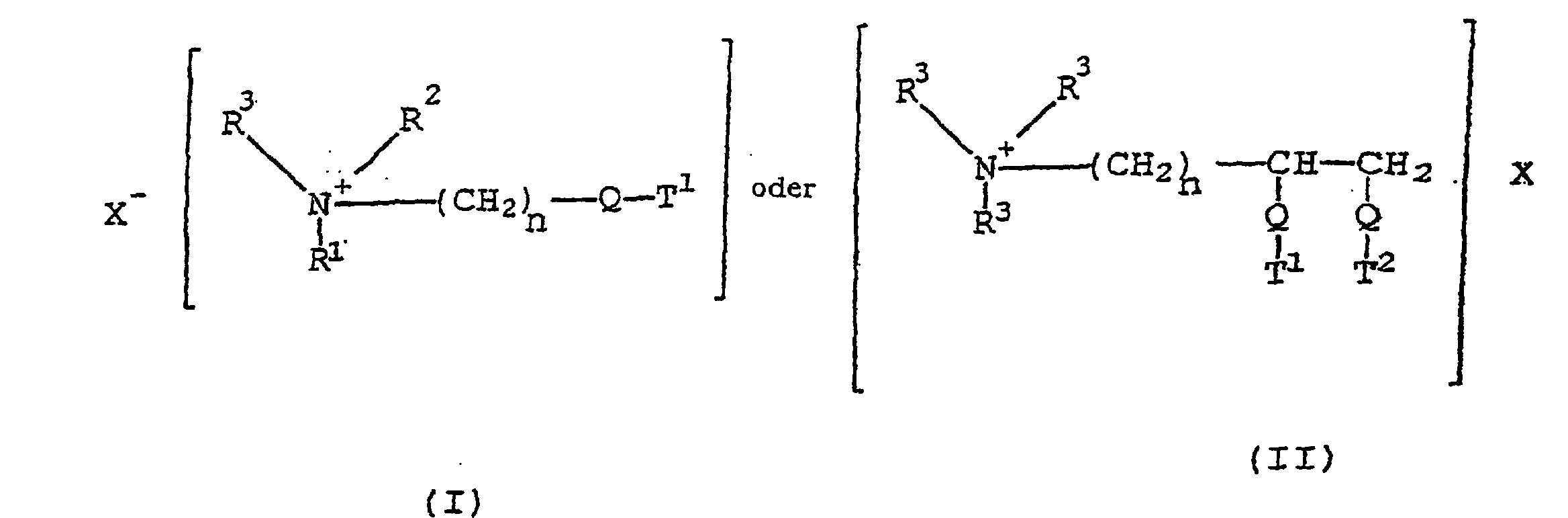
- the quaternary ammonium compounds and amine precursors herein have the formula (I) or (II), below :
- the alkyl, or alkenyl, chain T 1 , T 2 , T 3 , T 4 , T 5 must contain at least 11 carbon atoms, preferably at least 16 carbon atoms.
- the chain may be straight or branched.
- Tallow is a convenient and inexpensive source of long chain alkyl and alkenyl material.
- the compounds wherein T 1 , T 2 , T 3 , T 4 , T 5 represents the mixture of long chain materials typical for tallow are particularly preferred.
- quaternary ammonium compounds suitable for use in the aqueous fabric softening compositions herein include :
- compounds 1-7 are examples of compounds of Formula (I); compound 8 is a compound of Formula (II).
- N,N-di(tallowoyl-oxy-ethyl)-N,N-dimethyl ammonium chloride where the tallow chains are at least partially unsaturated.
- the level of unsaturation of the tallow chain can be measured by the Iodine Value (IV) of the corresponding fatty acid, which in the present case should preferably be in the range of from 5 to 100 with two categories of compounds being distinguished, having a IV below or above 25.
- IV Iodine Value
- the anion is merely present as a counterion of the positively charged quaternary ammonium compounds.
- the nature of the counterion is not critical at all to the practice of the present invention. The scope of this invention is not considered limited to any particular anion.
- amine precursors thereof is meant the secondary or tertiary amines corresponding to the above quaternary ammonium compounds, said amines being substantially protonated in the present compositions due to the claimed pH values.
- the quaternary ammonium or amine precursors compounds herein are typically present at levels of from 1% to 80% of compositions herein, depending on the composition execution which can be dilute with a preferred level of active from 5% to 15%, or concentrated, with a preferred level of active from 15% to 50%, most preferably 15% to 35%.
- Fully formulated fabric softening compositions preferably contain, in addition to the compounds of Formula I or II herein, one or more of the following ingredients:
- polymer having a partial or net cationic charge can be useful to further increase the cellulase stability in the compositions herein.
- Such polymers can be used at levels of from 0.001% to 10%, preferably 0.01% to 2% by weight of the compositions.
- Such polymers having a partial cationic charge can be polyamine N-oxide containing polymers which contain units having the following structure formula (A): wherein P is a polymerisable unit, whereto the R-N ⁇ O group can be attached to or wherein the R-N ⁇ O group forms part of the polymerisable unit or a combination of both.
- the N ⁇ O group can be represented by the following general structures : wherein R 1 , R 2 , and R 3 are aliphatic groups, aromatic, heterocyclic or alicyclic groups or combinations thereof, x or/and y or/and z is 0 or 1 and wherein the nitrogen of the N ⁇ O group can be attached or wherein the nitrogen of the N ⁇ O group forms part of these groups.
- the N ⁇ O group can be part of the polymerisable unit (P) or can be attached to the polymeric backbone or a combination of both.
- Suitable polyamine N-oxides wherein the N ⁇ O group forms part of the polymerisable unit comprise polyamine N-oxides wherein R is selected from aliphatic, aromatic, alicyclic or heterocyclic groups.
- polyamine N-oxides comprises the group of polyamine N-oxides wherein the nitrogen of the N ⁇ O group forms part of the R-group.
- Preferred polyamine N-oxides are those wherein R is a heterocyclic group such as pyrridine, pyrrole, imidazole, pyrrolidine, piperidine, quinoline, acridine and derivatives thereof.
- Another class of said polyamine N-oxides comprises the group of polyamine N-oxides wherein the nitrogen of the N ⁇ O group is attached to the R-group.
- polyamine N-oxides are the polyamine oxides whereto the N ⁇ O group is attached to the polymerisable unit.
- Preferred class of these polyamine N-oxides are the polyamine N-oxides having the general formula (A) wherein R is an aromatic, heterocyclic or alicyclic groups wherein the nitrogen of the N ⁇ O functional group is part of said R group.
- polyamine N-oxides are the polyamine oxides having the general formula (A) wherein R are aromatic, heterocyclic or alicyclic groups wherein the nitrogen of the N ⁇ O functional group is attached to said R groups.
- polyamine oxides wherein R groups can be aromatic such as phenyl.
- Any polymer backbone can be used as long as the amine oxide polymer formed is water-soluble and has dye transfer inhibiting properties.
- suitable polymeric backbones are polyvinyls, polyalkylenes, polyesters, polyethers, polyamide, polyimides, polyacrylates and mixtures thereof.
- the amine N-oxide polymers useful herein typically have a ratio of amine to the amine N-oxide of about 10:1 to about 1:1000000.
- the amount of amine oxide groups present in the polyamine N-oxide containing polymer can be varied by appropriate copolymerization or by appropriate degree of N-oxidation.
- the ratio of amine to amine N-oxide is from about 2:3 to about 1:1000000. More preferably from about 1:4 to about 1:1000000, most preferably from about 1:7 to about 1:1000000.
- the polymers of the present invention actually encompass random or block copolymers where one monomer type is an amine N-oxide and the other monomer type is either an amine N-oxide or not.
- the amine oxide unit of the polyamine N-oxides has a PKa ⁇ 10, preferably PKa ⁇ 7, more preferred PKa ⁇ 6.
- the polyamine N-oxide containing polymer can be obtained in almost any degree of polymerisation.
- the degree of polymerisation is not critical provided the material has the desired water-solubility and dye-suspending power.
- the average molecular weight of the polyamine N-oxide containing polymer is within the range of about 500 to about 1000,000; preferably from about 1,000 to about 50,000, more preferably from about 2,000 to about 30,000, most preferably from about 3,000 to about 20,000.
- Such polymers having a net cationic charge include polyvinylpyrrolidone (PVP) as well as copolymers of N-vinylimidazole N-vinyl pyrrolidone, having an average molecular weight range in the range about 5,000 to about 100,000,preferably about 5,000 to about 50,000; said copolymers having a molar ratio of N-vinylimidazole to N-vinylpyrrolidone from about 1 to about 0.2, preferably from about 0.8 to about 0.3.
- PVP polyvinylpyrrolidone
- copolymers of N-vinylimidazole N-vinyl pyrrolidone having an average molecular weight range in the range about 5,000 to about 100,000,preferably about 5,000 to about 50,000; said copolymers having a molar ratio of N-vinylimidazole to N-vinylpyrrolidone from about 1 to about 0.2, preferably from about 0.8 to about 0.3.
- Additional softening agents which are nonionic fabric softener materials.
- nonionic fabric softener materials typically have a HLB of from about 2 to about 9, more typically from about 3 to about 7.
- Such nonionic fabric softener materials tend to be readily dispersed either by themselves, or when combined with other materials such as single-long-chain alkyl cationic surfactant described in detail hereinafter. Dispersibility can be improved by using more single-long-chain alkyl cationic surfactant, mixture with other materials as set forth hereinafter, use of hotter water, and/or more agitation.
- the materials selected should be relatively crystalline, higher melting, (e.g. >40°C) and relatively water-insoluble.
- the level of optional nonionic softener in the compositions herein is typically from 0.1% to 10%, preferably from 1% to 5%.
- Preferred nonionic softeners are fatty acid partial esters of polyhydric alcohols, or anhydrides thereof, wherein the alcohol, or anhydride, contains from 2 to 18, preferably from 2 to 8, carbon atoms, and each fatty acid moiety contains from 12 to 30, preferably from 16 to 20, carbon atoms.
- such softeners contain from one to 3, preferably 2 fatty acid groups per molecule.
- the polyhydric alcohol portion of the ester can be ethylene glycol, glycerol, poly (e.g., di-, tri-, tetra, penta-, and/or hexa-) glycerol, xylitol, sucrose, erythritol, pentaerythritol, sorbitol or sorbitan. Sorbitan esters and polyglycerol monostearate are particularly preferred.
- the fatty acid portion of the ester is normally derived from fatty acids having from 12 to 30, preferably from 16 to 20, carbon atoms, typical examples of said fatty acids being lauric acid, myristic acid, palmitic acid, stearic acid and behenic acid.
- Highly preferred optional nonionic softening agents for use in the present invention are the sorbitan esters, which are esterified dehydration products of sorbitol, and the glycerol esters.
- sorbitan monostearate is a suitable material. Mixtures of sorbitan stearate and sorbitan palmitate having stearate/palmitate weigt ratios varying between about 10:1 and about 1:10, and 1,5-sorbitan esters are also useful.
- Glycerol and polyglycerol esters especially glycerol, diglycerol, triglycerol, and polyglycerol mono- and/or diesters, preferably mono-, are preferred herein (e.g. polyglycerol monostearate with a trade name of Radiasurf 7248).
- Useful glycerol and polyglycerol esters include mono-esters with stearic, oleic, palmitic, lauric, isostearic, myristic, and/or behenic acids and the diesters of stearic, oleic, palmitic, lauric, isostearic, behenic, and/or myristic acids. It is understood that the typical mono-ester contains some di-and tri-ester.
- the "glycerol esters” also include the polyglycerol, e.g., diglycerol through octaglycerol esters.
- the polyglycerol polyols are formed by condensing glycerin or epichlorohydrin together to link the glycerol moieties via ether linkages.
- the mono- and/or diesters of the polyglycerol polyols are preferred, the fatty acyl groups typically being those described hereinbefore for the sorbitan and glycerol esters.
- compositions of the unsaturated material of Formula (I) and (II) above can be prepared that are stable without the addition of concentration aids
- the concentrated compositions of the present invention may require organic and/or inorganic concentration aids to go to even higher concentrations and/or to meet higher stability standards depending on the other ingredients.
- Surfactant concentration aids are typically selected from the group consisting of single long chain alkyl cationic surfactants; nonionic surfactants; amine oxides; fatty acids; or mixtures thereof, typically used at a level of from 0 to 15% of the composition.
- Such mono-long-chain-alkyl cationic surfactants useful in the present invention are, preferably, quaternary ammonium salts of the general formula : [R 2 N + R 3 ] X - wherein the R 2 group is C 10 -C 22 hydrocarbon group, preferably C 12 -C 18 alkyl group of the corresponding ester linkage interrupted group with a short alkylene (C 1 -C 4 ) group between the ester linkage and the N, and having a similar hydrocarbon group, e.g., a fatty acid ester of choline, preferably C 12 -C 14 (coco) choline ester and/or C 16 -C 18 tallow choline ester at from about 0.1% to about 20% by weight of the softener active.
- R 2 group is C 10 -C 22 hydrocarbon group, preferably C 12 -C 18 alkyl group of the corresponding ester linkage interrupted group with a short alkylene (C 1 -C 4 ) group between
- Each R is a C 1 -C 4 alkyl or substituted (e.g., hydroxy) alkyl, or hydrogen, preferably methyl, and the counterion X - is a softener compatible anion, for example, chloride, bromide, methyl sulfate.
- cationic materials with ring structures such as alkyl imidazoline, imidazolinium, pyridine, and pyridinium salts having a single C 12 -C 30 alkyl chain can also be used. Very low pH is required to stabilize, e.g., imidazoline ring structures.
- alkyl imidazolinium salts and their imidazoline precursors useful in the present invention have the general formula : wherein Y 2 is -C(O)-O-, -O-(O)C-, -C(O)-N(R 5 )-, or -N(R 5 )-C(O)- in which R 5 is hydrogen or a C 1 -C 4 alkyl radical; R 6 is a C 1 -C 4 alkyl radical or H (for imidazoline precursors); R 7 and R 8 are each independently selected from R and R 2 as defined hereinbefore for the single-long-chain cationic surfactant with only one being R 2 .
- alkyl pyridinium salts useful in the present invention have the general formula : wherein R 2 and X- are as defined above.
- a typical material of this type is cetyl pyridinium chloride.
- Nonionic Surfactant Alkoxylated Materials
- Suitable nonionic surfactants for use herein include addition products of ethylene oxide and, optionally, propylene oxide, with fatty alcohols, fatty acids, fatty amines.
- Suitable compounds are substantially water-soluble surfactants of the general formula : R 2 - Y - (C 2 H 4 O) z - C 2 H 4 OH wherein R 2 is selected from the group consisting of primary, secondary and branched chain alkyl and/or acyl hydrocarbyl groups; primary, secondary and branched chain alkenyl hydrocarbyl groups; and primary, secondary and branched chain alkyl- and alkenyl-substituted phenolic hydrocarbyl groups; said hydrocarbyl groups having a hydrocarbyl chain length of from 8 to 20, preferably from 10 to 18 carbon atoms.
- Y is typically -O-, -C(O)O-, -C(O)N(R)-, or -C(O)N(R)R-, in which R 2 and R, when present, have the meanings given hereinbefore, and/or R can be hydrogen, and z is at least 8, preferably at least 10-11.
- nonionic surfactants herein are characterized by an HLB (hydrophilic-lipophilic balance) of from 7 to 20, preferably from 8 to 15.
- HLB hydrophilic-lipophilic balance
- nonionic surfactants examples include buthionic surfactants
- Suitable amine oxides include those with one alkyl or hydroxyalkyl moiety of 8 to 28 carbon atoms, preferably from 8 to 16 carbon atoms, and two alkyl moieties selected from the group consisting of alkyl groups and hydroxyalkyl groups with 1 to 3 carbon atoms.
- Examples include dimethyloctylamine oxide, diethyldecylamine oxide, bis-(2-hydroxyethyl)dodecylamine oxide, dimethyldodecyl-amine oxide, dipropyltetradecylamineoxide, methylethylhexadecylamine oxide, dimethyl-2-hydroxyoctadecylamine oxide, and coconut fatty alkyl dimethylamine oxide.
- Suitable fatty acids include those containing from 12 to 25, preferably from 16 to 20 total carbon atoms, with the fatty moiety containing from 10 to 22, preferably from 10 to 14 (mid cut), carbon atoms.
- the shorter moiety contains from 1 to 4, preferably from 1 to 2 carbon atoms.
- Inorganic viscosity control agents which can also act like or augment the effect of the surfactant concentration aids, include water-soluble, ionizable salts which can also optionally be incorporated into the compositions of the present invention.
- ionizable salts can be used. Examples of suitable salts are the halides of the Group IA and IIA metals of the Periodic Table of the Elements, e.g., calcium chloride, magnesium chloride, sodium chloride, potassium bromide, and lithium chloride.
- the ionizable salts are particularly useful during the process of mixing the ingredients to make the compositions herein, and later to obtiain the desired viscosity.
- the amount of ionizable salts used depends on the amount of active ingredients used in the compositions and can be adjusted according to the desires of the formulator. Typical levels of salts used to control the composition viscosity are from 20 to 20,000 parts per million (ppm), preferably from 20 to 11,000 ppm, by weight of the composition.
- Alkylene polyammonium salts can be incorporated into the composition to give viscosity control in addition to or in place of the water-soluble, ionizable salts above.
- these agents can act as scavengers, forming ion pairs with anionic detergent carried over from the main wash, in the rinse, and on the fabrics, and may improve softness performance. These agents may stabilize the viscosity over a broader range of temperature, especially at low temperatures, compared to the inorganic electrolytes.
- alkylene polyammonium salts include 1-lysine monohydrochloride and 1,5-diammonium 2-methyl pentane dihydrochloride.
- the liquid carrier employed in the instant compositions is preferably at least primarily water due to its low cost relative availability, safety, and environmental compatibility.
- the level of water in the liquid carrier is preferably at least 50%, most preferably at least 60%, by weight of the carrier.
- Mixtures of water and low molecular weight, e.g., ⁇ about 200, organic solvent, e.g., lower alcohol such as ethanol, propanol, isopropanol or butanol are useful as the carrier liquid.
- Low molecular weight alcohols include monohydric, dihydric (glycol) trihydric (glycerol), and higher polyhydric (polyols) alcohols.
- antioxidants such as well known antioxidants and reductive agents, Soil Release Polymers, bacteriocides, colorants, perfumes, preservatives, optical brighteners, anti ionisation agents, antifoam agents and enzymes.
- a typical formulation in above-mentioned examples for use as a rinse conditioner to which the different polymers were added, according to the invention comprises weight % Softener active 24.5 PGMS 2.0 TEA 25 1.5 HCl 0.12 Antifoam agent 0.019 Blue dye 80 ppm CaCl2 0.35 Perfume 0.90
Landscapes
- Chemical & Material Sciences (AREA)
- Life Sciences & Earth Sciences (AREA)
- Engineering & Computer Science (AREA)
- Chemical Kinetics & Catalysis (AREA)
- Oil, Petroleum & Natural Gas (AREA)
- Wood Science & Technology (AREA)
- Organic Chemistry (AREA)
- Crystallography & Structural Chemistry (AREA)
- Treatments For Attaching Organic Compounds To Fibrous Goods (AREA)
- Detergent Compositions (AREA)
- Compositions Of Macromolecular Compounds (AREA)
Claims (7)
- Textilweichmacherzusammensetzung, umfassendwobei das Blockcopolymer die allgemeine Formeln (1), (2) oder (3) und Mischungen hiervon aufweist:a.) ein Blockcopolymer mit einem hydrophoben Grundgerüst und einer oder mehreren hydrophilen Seitenketten, undb.) ein nichtionisches wasserlösliches Polymer, undc.) eine kationische Weichmacherkomponente, wobei die Weichmacherkomponente eine quaternäre Ammoniumverbindung und ein Aminvorläufer der nachfolgenden Formel (I) oder (II) ist:
 Q bedeutet
 R1 bedeutet (CH2)n-Q-T2 oder T3;R2 bedeutet (CH2)m-Q-T4 oder T5 oder R3;R3 bedeutet C1-C4-Alkyl oder C1-C4-Hydroxyalkyl oder H;R4 bedeutet H oder C1-C4-Alkyl oder C1-C4-Hydroxyalkyl;T1, T2, T3, T4, T5 sind (gleiche oder verschiedene) C11-C12-Alkyl oder -Alkenyl;n ist eine ganze Zahl von 1 bis 4; undX- ist ein Weichmacher-verträgliches Anion.B unlösliche oder teilweise wasserlösliche Monomere sind; C und D Endgruppen oder ein Wasserstoffatom sind; R ein Polymer aus B-Monomeren oder ein unlösliches oder teilweise wasserlösliches Monomer oder ein Fettalkohol oder eine Fettsäure ist, worin ein Kohlenstoff mit Polymerblocks substituiert ist; x, y und z ganze Zahlen von 1-200 sind, und worin das Blockcopolymer einen Trübungspunkt von 40°C und höher aufweist.Ethylenoxid;Vinylpyrrolidon;Vinyl-2- und 4-pyridin;Vinyl-2- und 4-pyridin-N-oxid;
- kationisches 2- und 4-Vinylpyridin:
- R1 = Alkoxylat - (CrH2O)q-, worin r = 1-6, vorzugsweise 1-3; und q = 1-80, vorzugsweise 2-60; wobei dies ethoxyliertes 2- und 4-Vinylpyridin beinhaltet; das Gegenion Halogenidionen, Methylsulfat, Acetate, Sulfate sein kann;
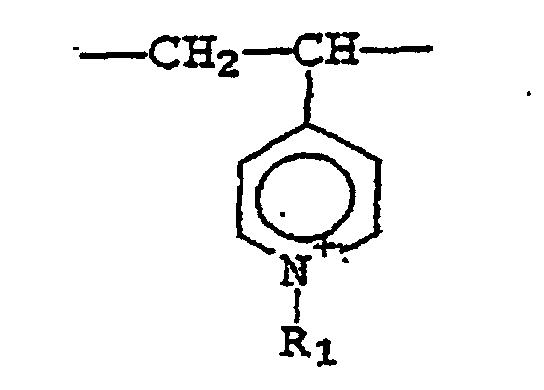
Vinylalkohol;Acrylamiden;kationischen Acrylamiden;- - CHR- (CH2) n-O-
- worin R= -(CH2) m-CH3, -OH, Pyrrolidon, 2- und 4-Pyridin-N-oxid, kationisches 2-und 4-Pyridin, ethoxyliertes 2- und 4-Pyridin:
Saccharide;Aminosäuren- -(CH2)n-Z (AA)-
- worin AA irgendeine Aminosäure ist, welche über die Carbonsäuregruppe gebunden ist: wobei die Aminosäure kationisch oder aminoxidiert gemacht werden kann, wenn ein Stickstoffatom in einer Ringstruktur verwendet wird (beispielsweise Tryptophan und Histidin); Z kann sein eine =CH, =CH-COO oder =CH-O- Gruppe. n = 1-10, vorzugsweise 1-4;
- Textilweichmacherzusammensetzung nach Anspruch 1, wobei das Verhältnis a/b im Bereich von 0,01 bis 100 liegt.
- Textilweichmacherzusammensetzung nach Anspruch 1 oder 2, wobei das nichtionische wasserlösliche Polymer aus der Gruppe Polyvinylpyrrolidon, Polyvinylpyridin-N-oxid, Polyethylenglykol und substituiertem Polyalkohol gewählt ist.
- Textilweichmacherzusammensetzung nach Anspruch 1, wobei die ganzen Zahlen x und z im Bereich von 30-60 liegen und y im Bereich von 3-50, vorzugsweise 40-50, liegt.
- Textilweichmacherzusammensetzung nach mindestens einem der vorangehenden Ansprüche, wobei der Gewichts%-Anteil des Blockcopolymeren 0,1-10 % beträgt.
- Verwendung eines Blockcopolymeren mit einem hydrophoben Grundgerüst und einer oder mehreren hydrophilen Seitenketten in einer Textilweichmacherzusammensetzung. um die Viskosität der Zusammensetzung sowohl bei niedriger als auch erhöhter Temperatur zu reduzieren, wobei die Textilweichmacherzusammensetzung umfaßtwobei das Blockcopolymer die allgemeine Formeln (1), (2) oder (3) und Mischungen hiervon aufweist:a.) ein Blockcopolymer mit einem hydrophoben Grundgerüst und einer oder mehreren hydrophilen Seitenketten, undb.) ein nichtionisches wasserlösliches Polymer, undc.) eine kationische Weichmacherkomponente, wobei die Weichmacherkomponente eine quaternäre Ammoniumverbindung und ein Aminvorläufer der nachfolgenden Formel (I) oder (II) ist:
 Q bedeutet
 R1 bedeutet (CH2)n-Q-T2 oder T3;R2 bedeutet (CH2)m-Q-T4 oder T5 oder R3;R3 bedeutet C1-C4-Alkyl oder C1-C4-Hydroxyalkyl oder H;R4 bedeutet H oder C1-C4-Alkyl oder C1-C4-Hydroxyalkyl;T1, T2, T3, T4, T5 sind (gleiche oder verschiedene) C11-C12-Alkyl oder -Alkenyl;n ist eine ganze Zahl von 1 bis 4; undX- ist ein Weichmacher-verträgliches Anion,B unlösliche oder teilweise wasserlösliche Monomere sind; C und D Endgruppen oder ein Wasserstoffatom sind; R ein Polymer aus B-Monomeren oder ein unlösliches oder teilweise wasserlösliches Monomer oder ein Fettalkohol oder eine Fettsäure ist, worin ein Kohlenstoff mit Polymerblocks substituiert ist; x, y und z ganze Zahlen von 1-200 sind, und worin das Blockcopolymer einen Trübungspunkt von 40°C und höher aufweist.Ethylenoxid;Vinylpyrrolidon;Vinyl-2- und 4-pyridin;Vinyl-2- und 4-pyridin-N-oxid;
- kationisches 2- und 4-Vinylpyridin:
- R1 = Alkoxylat - (CrH2O)q-, worin r = 1-6, vorzugsweise 1-3; und q = 1-80, vorzugsweise 2-60; wobei dies ethoxyliertes 2- und 4-Vinylpyridin beinhaltet; das Gegenion Halogenidionen, Methylsulfat, Acetate, Sulfate sein kann;
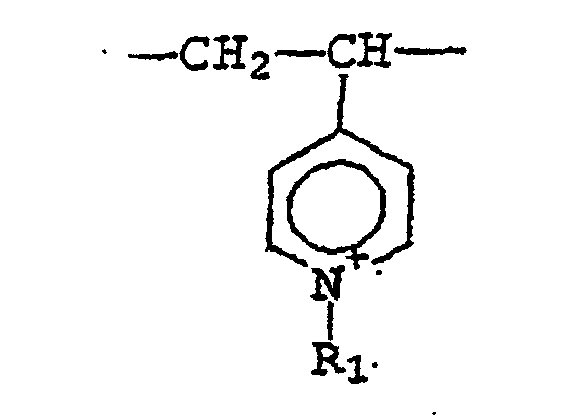
Vinylalkohol;Acrylamiden;kationischen Acrylamiden;- - CHR- (CH2) n-0-
- worin R= -(CH2) m-CH3, -OH, Pyrrolidon, 2- und 4-Pyridin-N-oxid, kationisches 2-und 4-Pyridin, ethoxyliertes 2- und 4-Pyridin;
Saccharide;Aminosäuren- - (CH2) n-Z (AA)-
- worin AA irgendeine Aminosäure ist. welche über die Carbonsäuregruppe gebunden ist; wobei die Aminosäure kationisch oder aminoxidiert gemacht werden kann, wenn ein Stickstoffatom in einer Ringstruktur verwendet wird (beispielsweise Tryptophan und Histidin); Z kann sein eine =CH, =CH-COO oder =CH- Gruppe. n = 1-10, vorzugsweise 1-4:
- Verwendung eines Blockcopolymeren gemäß Anspruch 6, worin der Gewichts%-Anteil des Blockcopolymeren 0,1-10 % beträgt.
Priority Applications (11)
| Application Number | Priority Date | Filing Date | Title |
|---|---|---|---|
| EP94870155A EP0705900B1 (de) | 1994-09-30 | 1994-09-30 | Blockkopolymere für verbesserte Viskositätsstabilität in konzentrierten Weichspülmitteln |
| DE69431841T DE69431841D1 (de) | 1994-09-30 | 1994-09-30 | Blockkopolymere für verbesserte Viskositätsstabilität in konzentrierten Weichspülmitteln |
| AT94870155T ATE229064T1 (de) | 1994-09-30 | 1994-09-30 | Blockkopolymere für verbesserte viskositätsstabilität in konzentrierten weichspülmitteln |
| BR9509182A BR9509182A (pt) | 1994-09-30 | 1995-09-01 | Copolímeros de bloco de estabilidade de viscosidade aperfeiçoada em amaciantes de tecido concentrados |
| PCT/US1995/011172 WO1996010671A1 (en) | 1994-09-30 | 1995-09-01 | Block copolymers for improved viscosity stability in concentrated fabric softeners |
| CA002201329A CA2201329C (en) | 1994-09-30 | 1995-09-01 | Block copolymers for improved viscosity stability in concentrated fabric softeners |
| US08/809,683 US6008184A (en) | 1994-09-30 | 1995-09-01 | Block copolymers for improved viscosity stability in concentrated fabric softeners |
| JP8511773A JPH10506689A (ja) | 1994-09-30 | 1995-09-01 | 濃縮布帛柔軟剤中での改善された粘度安定性のためのブロック共重合体 |
| HUP9702285A HU216015B (hu) | 1994-09-30 | 1995-09-01 | Blokk-kopolimereket tartalmazó, javított stabilitású és viszkozitású koncentrált textílialágyító készítmények, és alkalmazása |
| AU35441/95A AU3544195A (en) | 1994-09-30 | 1995-09-01 | Block copolymers for improved viscosity stability in concentrated fabric softeners |
| MXPA/A/1997/002390A MXPA97002390A (en) | 1994-09-30 | 1997-03-31 | Block copolymers for improved viscosity stability in concentrated software for tea |
Applications Claiming Priority (1)
| Application Number | Priority Date | Filing Date | Title |
|---|---|---|---|
| EP94870155A EP0705900B1 (de) | 1994-09-30 | 1994-09-30 | Blockkopolymere für verbesserte Viskositätsstabilität in konzentrierten Weichspülmitteln |
Publications (2)
| Publication Number | Publication Date |
|---|---|
| EP0705900A1 EP0705900A1 (de) | 1996-04-10 |
| EP0705900B1 true EP0705900B1 (de) | 2002-12-04 |
Family
ID=8218674
Family Applications (1)
| Application Number | Title | Priority Date | Filing Date |
|---|---|---|---|
| EP94870155A Expired - Lifetime EP0705900B1 (de) | 1994-09-30 | 1994-09-30 | Blockkopolymere für verbesserte Viskositätsstabilität in konzentrierten Weichspülmitteln |
Country Status (9)
| Country | Link |
|---|---|
| EP (1) | EP0705900B1 (de) |
| JP (1) | JPH10506689A (de) |
| AT (1) | ATE229064T1 (de) |
| AU (1) | AU3544195A (de) |
| BR (1) | BR9509182A (de) |
| CA (1) | CA2201329C (de) |
| DE (1) | DE69431841D1 (de) |
| HU (1) | HU216015B (de) |
| WO (1) | WO1996010671A1 (de) |
Families Citing this family (9)
| Publication number | Priority date | Publication date | Assignee | Title |
|---|---|---|---|---|
| GB0130499D0 (en) | 2001-12-20 | 2002-02-06 | Unilever Plc | Polymers for laundry cleaning compositions |
| GB0207742D0 (en) * | 2002-04-03 | 2002-05-15 | Unilever Plc | Fabric care composition |
| EP2166073A1 (de) * | 2008-09-23 | 2010-03-24 | The Procter & Gamble Company | Reinigungszusammensetzung |
| US20110166370A1 (en) | 2010-01-12 | 2011-07-07 | Charles Winston Saunders | Scattered Branched-Chain Fatty Acids And Biological Production Thereof |
| US20110243874A1 (en) * | 2010-04-01 | 2011-10-06 | Rajan Keshav Panandiker | Care polymers |
| WO2012138423A1 (en) | 2011-02-17 | 2012-10-11 | The Procter & Gamble Company | Compositions comprising mixtures of c10-c13 alkylphenyl sulfonates |
| CN103380107B (zh) | 2011-02-17 | 2015-06-10 | 宝洁公司 | 生物基直链烷基苯基磺酸盐 |
| CA2902279C (en) | 2013-03-05 | 2019-05-28 | The Procter & Gamble Company | Mixed sugar amine or sugar amide surfactant compositions |
| WO2024250142A1 (en) * | 2023-06-05 | 2024-12-12 | The Procter & Gamble Company | Laundry detergent composition containing cellulase and graft copolymer |
Citations (2)
| Publication number | Priority date | Publication date | Assignee | Title |
|---|---|---|---|---|
| EP0185427A2 (de) * | 1984-12-21 | 1986-06-25 | The Procter & Gamble Company | Blockpolyester und ähnliche Verbindungen, verwendbar als Verschmutzungsentferner in Waschmittelzusammensetzungen |
| EP0458599A2 (de) * | 1990-05-25 | 1991-11-27 | Unilever Plc | Textilbehandlungsmittel |
Family Cites Families (13)
| Publication number | Priority date | Publication date | Assignee | Title |
|---|---|---|---|---|
| GR67665B (de) * | 1979-05-21 | 1981-09-02 | Unilever Nv | |
| FR2482636A1 (fr) * | 1980-05-14 | 1981-11-20 | Lesieur Cotelle Et Associes Sa | Composition adoucissante concentree pour fibres textiles |
| US4702857A (en) * | 1984-12-21 | 1987-10-27 | The Procter & Gamble Company | Block polyesters and like compounds useful as soil release agents in detergent compositions |
| US4661267A (en) * | 1985-10-18 | 1987-04-28 | The Procter & Gamble Company | Fabric softener composition |
| GB2188653A (en) * | 1986-04-02 | 1987-10-07 | Procter & Gamble | Biodegradable fabric softeners |
| US4738787A (en) * | 1987-05-26 | 1988-04-19 | Alkaril Chemicals Inc. | Cationic soil release polymers |
| GB8718217D0 (en) * | 1987-07-31 | 1987-09-09 | Unilever Plc | Liquid detergent compositions |
| GB2237813A (en) * | 1989-10-31 | 1991-05-15 | Unilever Plc | Liquid detergent |
| GB8924479D0 (en) * | 1989-10-31 | 1989-12-20 | Unilever Plc | Detergent compositions |
| GB8924478D0 (en) * | 1989-10-31 | 1989-12-20 | Unilever Plc | Detergent compositions |
| GB8927361D0 (en) * | 1989-12-04 | 1990-01-31 | Unilever Plc | Liquid detergents |
| CZ184693A3 (en) * | 1991-03-08 | 1994-03-16 | Procter & Gamble | Concentrated textile plasticizing mixtures |
| US5281355A (en) * | 1992-04-29 | 1994-01-25 | Lever Brothers Company, Division Of Conopco, Inc. | Heavy duty liquid detergent compositions containing a capsule which comprises a component subject to degradation and a composite polymer |
-
1994
- 1994-09-30 AT AT94870155T patent/ATE229064T1/de not_active IP Right Cessation
- 1994-09-30 DE DE69431841T patent/DE69431841D1/de not_active Expired - Lifetime
- 1994-09-30 EP EP94870155A patent/EP0705900B1/de not_active Expired - Lifetime
-
1995
- 1995-09-01 WO PCT/US1995/011172 patent/WO1996010671A1/en not_active Ceased
- 1995-09-01 CA CA002201329A patent/CA2201329C/en not_active Expired - Fee Related
- 1995-09-01 BR BR9509182A patent/BR9509182A/pt not_active Application Discontinuation
- 1995-09-01 JP JP8511773A patent/JPH10506689A/ja active Pending
- 1995-09-01 AU AU35441/95A patent/AU3544195A/en not_active Abandoned
- 1995-09-01 HU HUP9702285A patent/HU216015B/hu not_active IP Right Cessation
Patent Citations (2)
| Publication number | Priority date | Publication date | Assignee | Title |
|---|---|---|---|---|
| EP0185427A2 (de) * | 1984-12-21 | 1986-06-25 | The Procter & Gamble Company | Blockpolyester und ähnliche Verbindungen, verwendbar als Verschmutzungsentferner in Waschmittelzusammensetzungen |
| EP0458599A2 (de) * | 1990-05-25 | 1991-11-27 | Unilever Plc | Textilbehandlungsmittel |
Also Published As
| Publication number | Publication date |
|---|---|
| HU216015B (hu) | 1999-04-28 |
| AU3544195A (en) | 1996-04-26 |
| JPH10506689A (ja) | 1998-06-30 |
| HUT77325A (hu) | 1998-03-30 |
| DE69431841D1 (de) | 2003-01-16 |
| ATE229064T1 (de) | 2002-12-15 |
| CA2201329C (en) | 2001-07-31 |
| CA2201329A1 (en) | 1996-04-11 |
| MX9702390A (es) | 1997-07-31 |
| BR9509182A (pt) | 1997-12-23 |
| EP0705900A1 (de) | 1996-04-10 |
| WO1996010671A1 (en) | 1996-04-11 |
Similar Documents
| Publication | Publication Date | Title |
|---|---|---|
| CA2250909C (en) | Fabric softener compositions | |
| US6008184A (en) | Block copolymers for improved viscosity stability in concentrated fabric softeners | |
| JP2635205B2 (ja) | 布柔軟組成物 | |
| MXPA98008114A (en) | Softening compositions of te | |
| JPH09509455A (ja) | セルラーゼ布帛コンディショニング組成物 | |
| EP0907701B1 (de) | Textilweichmacherzusammensetzungen | |
| EP0705900B1 (de) | Blockkopolymere für verbesserte Viskositätsstabilität in konzentrierten Weichspülmitteln | |
| US6020304A (en) | Fabric softener compositions | |
| EP0713522B1 (de) | Wäscheweichmachenzusammensetzungen | |
| EP0763592B1 (de) | Stabilisierte Textilweichmacherzusammensetzungen | |
| EP0831144B1 (de) | Weichmacherzusammensetzungen für Textilien | |
| US5929025A (en) | Stabilized fabric softening compositions comprising a fabric softening compound, fatty acid, and perfume | |
| EP0754749A1 (de) | Textilweichmacher, die wasserlösliche Farbstoffe für verringerte Verfärbung enthalten | |
| WO1997046652A1 (en) | Fabric softening compositions | |
| EP0839899B1 (de) | Gewebeweichmacherzusammensetzungen | |
| MXPA98000572A (en) | Fabric softeners containing soluble colorants in water for stain reduction | |
| MXPA97002390A (en) | Block copolymers for improved viscosity stability in concentrated software for tea |
Legal Events
| Date | Code | Title | Description |
|---|---|---|---|
| PUAI | Public reference made under article 153(3) epc to a published international application that has entered the european phase |
Free format text: ORIGINAL CODE: 0009012 |
|
| AK | Designated contracting states |
Kind code of ref document: A1 Designated state(s): AT BE CH DE DK ES FR GB GR IE IT LI LU NL PT SE |
|
| 17P | Request for examination filed |
Effective date: 19960930 |
|
| 17Q | First examination report despatched |
Effective date: 19991220 |
|
| GRAG | Despatch of communication of intention to grant |
Free format text: ORIGINAL CODE: EPIDOS AGRA |
|
| GRAG | Despatch of communication of intention to grant |
Free format text: ORIGINAL CODE: EPIDOS AGRA |
|
| GRAH | Despatch of communication of intention to grant a patent |
Free format text: ORIGINAL CODE: EPIDOS IGRA |
|
| GRAH | Despatch of communication of intention to grant a patent |
Free format text: ORIGINAL CODE: EPIDOS IGRA |
|
| GRAA | (expected) grant |
Free format text: ORIGINAL CODE: 0009210 |
|
| AK | Designated contracting states |
Kind code of ref document: B1 Designated state(s): AT BE CH DE DK ES FR GB GR IE IT LI LU NL PT SE |
|
| PG25 | Lapsed in a contracting state [announced via postgrant information from national office to epo] |
Ref country code: NL Free format text: LAPSE BECAUSE OF FAILURE TO SUBMIT A TRANSLATION OF THE DESCRIPTION OR TO PAY THE FEE WITHIN THE PRESCRIBED TIME-LIMIT Effective date: 20021204 Ref country code: LI Free format text: LAPSE BECAUSE OF FAILURE TO SUBMIT A TRANSLATION OF THE DESCRIPTION OR TO PAY THE FEE WITHIN THE PRESCRIBED TIME-LIMIT Effective date: 20021204 Ref country code: IT Free format text: LAPSE BECAUSE OF FAILURE TO SUBMIT A TRANSLATION OF THE DESCRIPTION OR TO PAY THE FEE WITHIN THE PRE;WARNING: LAPSES OF ITALIAN PATENTS WITH EFFECTIVE DATE BEFORE 2007 MAY HAVE OCCURRED AT ANY TIME BEFORE 2007. THE CORRECT EFFECTIVE DATE MAY BE DIFFERENT FROM THE ONE RECORDED.SCRIBED TIME-LIMIT Effective date: 20021204 Ref country code: GR Free format text: LAPSE BECAUSE OF FAILURE TO SUBMIT A TRANSLATION OF THE DESCRIPTION OR TO PAY THE FEE WITHIN THE PRESCRIBED TIME-LIMIT Effective date: 20021204 Ref country code: FR Free format text: LAPSE BECAUSE OF FAILURE TO SUBMIT A TRANSLATION OF THE DESCRIPTION OR TO PAY THE FEE WITHIN THE PRESCRIBED TIME-LIMIT Effective date: 20021204 Ref country code: CH Free format text: LAPSE BECAUSE OF FAILURE TO SUBMIT A TRANSLATION OF THE DESCRIPTION OR TO PAY THE FEE WITHIN THE PRESCRIBED TIME-LIMIT Effective date: 20021204 Ref country code: BE Free format text: LAPSE BECAUSE OF FAILURE TO SUBMIT A TRANSLATION OF THE DESCRIPTION OR TO PAY THE FEE WITHIN THE PRESCRIBED TIME-LIMIT Effective date: 20021204 Ref country code: AT Free format text: LAPSE BECAUSE OF FAILURE TO SUBMIT A TRANSLATION OF THE DESCRIPTION OR TO PAY THE FEE WITHIN THE PRESCRIBED TIME-LIMIT Effective date: 20021204 |
|
| REF | Corresponds to: |
Ref document number: 229064 Country of ref document: AT Date of ref document: 20021215 Kind code of ref document: T |
|
| REG | Reference to a national code |
Ref country code: GB Ref legal event code: FG4D |
|
| REG | Reference to a national code |
Ref country code: CH Ref legal event code: EP |
|
| REG | Reference to a national code |
Ref country code: IE Ref legal event code: FG4D |
|
| REF | Corresponds to: |
Ref document number: 69431841 Country of ref document: DE Date of ref document: 20030116 |
|
| PG25 | Lapsed in a contracting state [announced via postgrant information from national office to epo] |
Ref country code: SE Free format text: LAPSE BECAUSE OF FAILURE TO SUBMIT A TRANSLATION OF THE DESCRIPTION OR TO PAY THE FEE WITHIN THE PRESCRIBED TIME-LIMIT Effective date: 20030304 Ref country code: DK Free format text: LAPSE BECAUSE OF FAILURE TO SUBMIT A TRANSLATION OF THE DESCRIPTION OR TO PAY THE FEE WITHIN THE PRESCRIBED TIME-LIMIT Effective date: 20030304 |
|
| PG25 | Lapsed in a contracting state [announced via postgrant information from national office to epo] |
Ref country code: PT Free format text: LAPSE BECAUSE OF FAILURE TO SUBMIT A TRANSLATION OF THE DESCRIPTION OR TO PAY THE FEE WITHIN THE PRESCRIBED TIME-LIMIT Effective date: 20030305 Ref country code: DE Free format text: LAPSE BECAUSE OF FAILURE TO SUBMIT A TRANSLATION OF THE DESCRIPTION OR TO PAY THE FEE WITHIN THE PRESCRIBED TIME-LIMIT Effective date: 20030305 |
|
| NLV1 | Nl: lapsed or annulled due to failure to fulfill the requirements of art. 29p and 29m of the patents act | ||
| REG | Reference to a national code |
Ref country code: CH Ref legal event code: PL |
|
| PG25 | Lapsed in a contracting state [announced via postgrant information from national office to epo] |
Ref country code: ES Free format text: LAPSE BECAUSE OF FAILURE TO SUBMIT A TRANSLATION OF THE DESCRIPTION OR TO PAY THE FEE WITHIN THE PRESCRIBED TIME-LIMIT Effective date: 20030627 |
|
| PG25 | Lapsed in a contracting state [announced via postgrant information from national office to epo] |
Ref country code: LU Free format text: LAPSE BECAUSE OF NON-PAYMENT OF DUE FEES Effective date: 20030930 Ref country code: IE Free format text: LAPSE BECAUSE OF NON-PAYMENT OF DUE FEES Effective date: 20030930 Ref country code: GB Free format text: LAPSE BECAUSE OF NON-PAYMENT OF DUE FEES Effective date: 20030930 |
|
| PLBE | No opposition filed within time limit |
Free format text: ORIGINAL CODE: 0009261 |
|
| STAA | Information on the status of an ep patent application or granted ep patent |
Free format text: STATUS: NO OPPOSITION FILED WITHIN TIME LIMIT |
|
| EN | Fr: translation not filed | ||
| 26N | No opposition filed |
Effective date: 20030905 |
|
| GBPC | Gb: european patent ceased through non-payment of renewal fee |
Effective date: 20030930 |
|
| REG | Reference to a national code |
Ref country code: IE Ref legal event code: MM4A |