EP0705909A1 - Ferritischer Stahl mit hohem Chromgehalt und mit ausgezeichneten Dehnbarkeits- und Festigkeitseigenschaften bei hohen Temperaturen - Google Patents
Ferritischer Stahl mit hohem Chromgehalt und mit ausgezeichneten Dehnbarkeits- und Festigkeitseigenschaften bei hohen Temperaturen Download PDFInfo
- Publication number
- EP0705909A1 EP0705909A1 EP94115892A EP94115892A EP0705909A1 EP 0705909 A1 EP0705909 A1 EP 0705909A1 EP 94115892 A EP94115892 A EP 94115892A EP 94115892 A EP94115892 A EP 94115892A EP 0705909 A1 EP0705909 A1 EP 0705909A1
- Authority
- EP
- European Patent Office
- Prior art keywords
- steel
- content
- strength
- creep
- ductility
- Prior art date
- Legal status (The legal status is an assumption and is not a legal conclusion. Google has not performed a legal analysis and makes no representation as to the accuracy of the status listed.)
- Withdrawn
Links
Images


Classifications
-
- C—CHEMISTRY; METALLURGY
- C22—METALLURGY; FERROUS OR NON-FERROUS ALLOYS; TREATMENT OF ALLOYS OR NON-FERROUS METALS
- C22C—ALLOYS
- C22C38/00—Ferrous alloys, e.g. steel alloys
- C22C38/18—Ferrous alloys, e.g. steel alloys containing chromium
- C22C38/30—Ferrous alloys, e.g. steel alloys containing chromium with cobalt
-
- C—CHEMISTRY; METALLURGY
- C22—METALLURGY; FERROUS OR NON-FERROUS ALLOYS; TREATMENT OF ALLOYS OR NON-FERROUS METALS
- C22C—ALLOYS
- C22C38/00—Ferrous alloys, e.g. steel alloys
- C22C38/18—Ferrous alloys, e.g. steel alloys containing chromium
- C22C38/32—Ferrous alloys, e.g. steel alloys containing chromium with boron
Definitions
- This invention relates to a high Cr ferritic heat resistant steel excellent in creep rupture strength and creep rupture ductility (elongation, reduction of area).
- the steel of this invention is particularly useful for heat resistant and high pressure resistant articles in boilers and chemical plants.
- Heat resistant steels for use heat exchanger tubes, heat and high pressure resistant pipings or such equipment in boilers, chemical plants etc. are required to be excellent in high temperature strength, corrosion and oxidation resistance, toughness workability and weldability, as well. These heat resistant steels are also required to be economically produced and to be low cost.
- the conventional materials for use in the above-mentioned applications there are certain austenitic stainless steels, 2 ⁇ 1/4Cr-1Mo steel and similar low alloyed steels and high Cr ferritic steels containing 9 to 12% Cr.
- the high Cr ferritic steels are better from the point of view of tensile strength, corrosion resistance and oxidation resistance at temperatures between 500 and 650 °C when compared to ordinary low alloyed steels.
- the high Cr ferritic steels are also excellent for thermal fatigue resistance and stress corrosion cracking resistance due to their low thermal expansion coefficient and they can be produced more cheaply than austenitic stainless steels.
- Known high Cr ferritic steels include 9Cr-1Mo steel (JIS STBA 26), modified 9Cr-1Mo steel (ASTM SA 213 T91) and 12Cr-1Mo steel (DIN X20CrMoV121).
- Such Cu containing high Cr steels exhibit not only the above-mentioned high oxidation resistance but also the following three kinds of excellent physical properties, i.e.,
- the purpose of this invention is to provide a high Cr ferritic steel with both improved creep rupture ductility and creep rupture strength sustainable, in conditions of long-sustained creep rupture, without diminishing the effect of Cu addition to the steel.
- the high Cr ferritic steel according to this invention is excellent in ductility and strength at elevated temperatures and consists essentially of, by weight, 0.02 to 0.15% C, up to 0.5% Si, 0.1 to 1.5% Mn, up to 0.025% P, up to 0.015% S, up to 0.005% O (oxygen), 8 to 14% Cr, 0.1 to 0.3% V, 0.01 to 0.2% Nb, 0.01 to 0.1% N, up to 0.05% Al, 0.001 to 0.02% B, 0.05 to 3.0% Cu, 1.0 to 5.0% Co, one or both of 0.01 to 1.2% Mo and 0.8 to 3.5% W, the balance being Fe and incidental impurities, wherein the relationship between Cu and Co contents is defined so as to satisfy the following formula (1).
- the above-mentioned high Cr ferritic steel may additionally contain, 0.1 to 1.5% Ni by weight, and the relationship between the Ni, Cu and Co contents needs to be defined so as to satisfy the following formula (2).
- Cu / (Co + Ni) ⁇ 2.0 The following (1) and (2) have been discovered by replacing a part or whole of Ni with Co content in the high Cr ferritic steel:
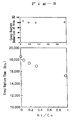
- Figure 1 shows the relationship between the Co/Cu ratio or the [Cu/(Co + Ni)] ratio and the creep rupture reduction of area (%) in the creep rupture test conducted at 600 °C under 16kgf/mm2 applied stress.
- Figure 2 shows the relationship between the Co/Cu ratio or the [Cu/(Co + Ni)] ratio and creep rupture time (in hours) in the creep rupture test conducted at 600 °C under 16kgf/mm2 applied stress.
- Figure 3 shows both the relationship between the Ni/Co ratio and creep rupture time (in hours) in the creep rupture test conducted at 600°C under 16kgf/mm2 applied stress, and the relationship between the Ni/Co ratio and the creep rupture reduction of area (%) in the same creep rupture test.
- each alloying element in the steel of this invention will be described in more detail as well as the technical reason for defining the content of each alloying element, wherein any " % " represents "weight percent".
- C 0.02 to 0.15% Part of the C combines with any alloying element of Cr, Fe, Mo, W, V and Nb to form a carbide thereof, and consequently increasing the resultant steel's high temperature strength. The remainder of the C forms a solid solution in a matrix of the steel and serves to stabilize an austenite in the matrix. If the C content is not more than 0.02%, precipitation of the carbide is not enough and an amount of ⁇ ferrite unfavorably increases in the matrix, resulting in a lowering of the strength and toughness of the steel.
- the C content exceeds 0.15%, excess amounts of the carbides will be precipitated in the matrix, and the resultant steel will be too hard, which will result in a lowering of weldability and the workability thereof.
- the C content is therefore restricted to a range of 0.02 to 0.15%.
- Si up to 0.5% Si serves as a deoxidizing agent in molten steel and increases the resistance of the steel to an attack of oxidizing water vapor. If the Si content exceeds 0.5%, the toughness of the resultant steel is markedly reduced. An excessive amount of Si is also detrimental to the creep rupture strength of steel.
- the Si content should be suppressed to a lower level. Accordingly, the Si content is restricted so that it does not exceed 0.5%.
- Mn 0.1 to 1.5% Mn serves to improve the hot workability of steel and also to stabilize the structure. The addition of less than 0.1% Mn cannot fully produce these effects on steel. On the other hand, the addition of more than 1.5% Mn needlessly hardens steel and results in a decrease in workability and weldability. Accordingly, the Mn content is defined to a range of 0.1 to 1.5%. Cr ; 8 to 14% Cr is one of the indispensable elements for maintaining oxidation and corrosion resistance at high temperatures.
- the Cr content is not more than 8%, the desired degree of oxidation and high temperature corrosion resistance is not obtained. On the other hand, if the Cr content exceeds 14%, the amount of ⁇ ferrite increases to such an extent that the strength, workability and toughness of steel is lowered. In view of the circumstances, the Cr content is defined to a range of 8 to 14%.
- V 0.1 to 0.3% V combines with the C and N to form fine precipitates of V(C,N), which contribute to increase the creep strength at a high temperature and under long sustained applied stress. If the V content is less than 0.1%, these effects will not be fully obtained. On the other hand, if the V content is higher than 0.3%, the V will tend to form a solid solution in the matrix resulting in diminished strength.
- the V content is therefore defined to a range of 0.1 to 0.3%.
- Nb 0.01 to 0.2%
- Nb also combines with the C and N to form fine precipitates of the Nb(C,N) which contribute to heighten the creep strength of the resultant steel.
- the fine precipitate of Nb(C,N) is also effective in improving the toughness of the steel.
- Less than 0.01% of Nb cannot achieve the above-mentioned effects, while more than 0.2% of Nb increases NbC in the unsolved or precipitated state, resulting in a reduction of strength, ductility and weldability. Accordingly, the Nb content is restricted to a range of 0.01 to 0.2%.
- N nitrogen
- 0.01 to 0.1% N combines with the V and Nb to form a carbonitride thereof, which increases the creep strength of the steel. If the N content is less than 0.01%, the above-mentioned effects will not result. On the other hand, an addition of more than 0.1% N markedly decreases the creep ductility, weldability and workability. The N content is therefore restricted to a range of 0.01 to 0.1%.
- Al up to 0.05% Al is added to the molten steel as a deoxidizing agent. If the Al exceeds 0.05%, the creep strength is reduced. The Al content is therefore restricted to a range of not more than 0.05%.
- B (boron); 0.001 to 0.2%
- An additional very small amount of B improves the hardenability of the resultant steel and serves to strengthen the grain boundaries of the structure of the steel due to the B carbide which is precipitated uniformly along the grain boundaries, thus enabling the steel to have a high tensile strength at elevated temperatures for long periods of time.
- Less than 0.001% of B cannot achieve the above-mentioned effects, while more than 0.2% of B decreases workability and weldability.
- Cu 0.05 to 3.0%
- Cu is a characteristic element of this steel. It exhibits the following effects:
- Ni Cr
- Ni Cr
- Ni is an optional element and added to the steel of Claim 2 of this invention.
- Ni is also a characteristic element of steel, which suppresses the diffusion of Cu in the steel matrix while steel is exposed to a creep forming circumstance, thereby preventing a decrease in creep ductility.
- Ni is one of the austenite stabilizing elements and suppresses the formation of ⁇ ferrite and stabilizes the martensitic structure. These effects cannot be obtained when the Ni content is less than 0.1%, whereas more than 1.5% Ni undesirably lowers the Ac1 transformation point, which makes the resultant steel incapable of being fully tempered and produces a precipitation of coarse carbide, resulting in a lowering of the creep strength.
- the Ni content is therefore restricted to a range of 0.1 to 1.5%.
- Cu/Co ⁇ 2.0 ; [Cu/(Co + Ni)] ⁇ 2.0 The contents of Cu, Ni or Co must be in accordance with the above-mentioned two relationships, and the contents must be within the restricted ranges. All these three elements are concerned with creep ductility.
- the Cu is exclusively added to steel without adding the other two elements, the Cu will precipitate along the grain boundaries of the steel while it is exposed to creep forming conditions, and the ductility of the resultant steel will be markedly reduced.
- the precipitation of the Cu along the grain boundaries of the steel which is detrimental to the ductility, can be controlled. If the Co content or Co plus Ni content is suppressed to a low level and the above-mentioned relationships are not satisfied by these alloying elements, the precipitation of Cu along the grain boundaries will not be suppressed even by adding Co + Ni. The content of these three elements is therefore restricted to satisfy the above-mentioned relationships.
- Co which is almost incapable of lowering the Ac1 point but capable of accelerating the precipitation of fine carbide, makes it possible to apply a tempering treatment to the resultant steel at higher temperatures and also improves the creep strength, whereas Ni cannot exhibit such behavior and can not have the same effect on steel. Therefore, if Co and Ni are both added to steel, in order to improve the creep strength and keep the creep strength as it is, the Co content should be much higher than the Ni content.
- Mo 0.01 to 1.2%
- the steel of this invention further contains either or both Mo and W. Mo improves the creep strength of steel by strengthening the matrix with a solid solution of Mo therein and by dispersing the precipitates of the fine carbide in the matrix. These effects are not obtained with less than 0.01% Mo content.
- Mo content exceeds 1.2%, the ⁇ ferrite is produced excessively and the steel hardens which diminishes toughness, ductility and workability. Mo content is therefore restricted to a range of 0.01 to 1.2%.
- W 0.8 to 3.5% W is also effective in increasing the creep strength of steel by strengthening the matrix with a solid solution of W therein and by dispersing the precipitates of the fine W carbide in the matrix.
- the W content usually needs to be twice as high as the Mo content. If the W content exceeds 3.5%, the toughness of the resultant steel will be significantly decreased due to the formation of ⁇ ferrite. On the other hand, less than 0.8% of W content cannot fully produce the above-mentioned properties.
- the W content is confined to a range of 0.8 to 3.5%.
- the combined addition of Mo and W is much more effective in exhibiting such properties than the sole addition of Mo or W.
- P up to 0.025% P is a detrimental impurity in steel, and the toughness, workability and weldability of steel can be maintained at a desired level by maintaining the P content at or below 0.025%.
- S up to 0.015% S is also a detrimental impurity in steel, and the toughness, workability and weldability of the steel can be maintained at a desired level by suppressing the S content to not more than 0.015%.
- O (oxygen) up to 0.005% O is also a detrimental impurity in steel, and the toughness, workability and weldability of steel can be maintained at a desired level by suppressing the O content to not more than 0.005%.
- Test Specimens A to Q and 1 to 11 were normalized by heating them at a temperature of 1050 °C for 1 hour and they were then air cooled, and tempered at 750°C to 830 °C for 3 hours.
- each test specimen of 6mm diameter and 30mm gauge length was shaved off from the steel plates, and subjected to a creep rupture test wherein the test specimen was kept at 600°C under 16kgf/mm2 applied stress for 250,000 hours at the longest.
- the Cu, Co and Ni content of Specimens 1 to 4 of the comparative examples do not satisfy the relationship between the Cu, Co and Ni content, i.e., [Cu/(Co + Ni)] > 2.0 Since the content of these three elements is not well balanced, Specimens 1 to 4 show high creep strength but undesirably low creep ductility.
- Test Specimens 5 and 6 satisfy the relationship between Cu, Co and Ni, but the Ni and Co contents are outside the ranges defined in the claims of this invention. Accordingly, the carbides are unfavorably coarsened in creep causing conditions, resulting in a lowering of the creep rupture strength of test specimens 5 and 6.
- Specimen 7 has a Cu content which exceeds the upper limit of the range defined in the claims of this invention, and the ductility is therefore not satisfactory. Since Specimen 8 does not contain B which is essential for increasing both creep rupture strength and the hardenability of steel, the creep rupture strength of Specimen 8 is not satisfactory.
- Test Specimens 9 to 11 in the comparative example do not satisfy the relationship between Cu and Co, i.e., (Cu/Co) > 2.0, and since the contents of these elements are not well balanced, the creep strength and ductility of Test Specimens 9 to 11 are decreased.
- the resultant high Cr ferritic steel is able to exhibit excellent creep rupture ductility and creep rupture strength for long periods of time at elevated temperatures.
- the steel of this invention can be widely used for equipments in boilers or chemical plants such as pipes, sheets and forgings, all of which operate at high temperatures and at high pressures.
Landscapes
- Chemical & Material Sciences (AREA)
- Engineering & Computer Science (AREA)
- Materials Engineering (AREA)
- Mechanical Engineering (AREA)
- Metallurgy (AREA)
- Organic Chemistry (AREA)
- Heat Treatment Of Steel (AREA)
Priority Applications (2)
| Application Number | Priority Date | Filing Date | Title |
|---|---|---|---|
| JP08168093A JP3387145B2 (ja) | 1993-04-08 | 1993-04-08 | 高温延性および高温強度に優れた高Crフェライト鋼 |
| EP94115892A EP0705909A1 (de) | 1993-04-08 | 1994-10-07 | Ferritischer Stahl mit hohem Chromgehalt und mit ausgezeichneten Dehnbarkeits- und Festigkeitseigenschaften bei hohen Temperaturen |
Applications Claiming Priority (2)
| Application Number | Priority Date | Filing Date | Title |
|---|---|---|---|
| JP08168093A JP3387145B2 (ja) | 1993-04-08 | 1993-04-08 | 高温延性および高温強度に優れた高Crフェライト鋼 |
| EP94115892A EP0705909A1 (de) | 1993-04-08 | 1994-10-07 | Ferritischer Stahl mit hohem Chromgehalt und mit ausgezeichneten Dehnbarkeits- und Festigkeitseigenschaften bei hohen Temperaturen |
Publications (1)
| Publication Number | Publication Date |
|---|---|
| EP0705909A1 true EP0705909A1 (de) | 1996-04-10 |
Family
ID=26135867
Family Applications (1)
| Application Number | Title | Priority Date | Filing Date |
|---|---|---|---|
| EP94115892A Withdrawn EP0705909A1 (de) | 1993-04-08 | 1994-10-07 | Ferritischer Stahl mit hohem Chromgehalt und mit ausgezeichneten Dehnbarkeits- und Festigkeitseigenschaften bei hohen Temperaturen |
Country Status (2)
| Country | Link |
|---|---|
| EP (1) | EP0705909A1 (de) |
| JP (1) | JP3387145B2 (de) |
Cited By (2)
| Publication number | Priority date | Publication date | Assignee | Title |
|---|---|---|---|---|
| US20120070329A1 (en) * | 2009-05-22 | 2012-03-22 | Torsten-Ulf Kern | Ferritic martensitic iron based alloy, a component and a process |
| CN117004879A (zh) * | 2022-04-29 | 2023-11-07 | 宝山钢铁股份有限公司 | 一种抗氧化耐热钢管及其制造方法 |
Families Citing this family (3)
| Publication number | Priority date | Publication date | Assignee | Title |
|---|---|---|---|---|
| JP3480061B2 (ja) * | 1994-09-20 | 2003-12-15 | 住友金属工業株式会社 | 高Crフェライト系耐熱鋼 |
| JP3354832B2 (ja) * | 1997-03-18 | 2002-12-09 | 三菱重工業株式会社 | 高靭性フェライト系耐熱鋼 |
| CN104975230B (zh) * | 2015-06-29 | 2017-03-15 | 无锡市诚天诺执行器制造有限公司 | 一种阀门驱动装置用弹簧材料及其制备方法 |
Citations (7)
| Publication number | Priority date | Publication date | Assignee | Title |
|---|---|---|---|---|
| GB678616A (en) * | 1948-08-23 | 1952-09-03 | Alloy Res Corp | High temperature stainless steel |
| EP0411931A1 (de) * | 1989-08-04 | 1991-02-06 | Crs Holdings, Inc. | Einsatzhärtbare, korrosionsbeständige Stahllegierung und daraus hergestellter Gegenstand |
| JPH05311345A (ja) * | 1992-05-14 | 1993-11-22 | Nippon Steel Corp | 高温強度ならびに靱性に優れたフェライト系耐熱鋼 |
| JPH05311346A (ja) * | 1992-05-14 | 1993-11-22 | Nippon Steel Corp | 高クリープ強度を有するフェライト系耐熱鋼 |
| JPH05311344A (ja) * | 1992-05-14 | 1993-11-22 | Nippon Steel Corp | 高温強度ならびに靱性に優れたフェライト系耐熱鋼 |
| JPH05311342A (ja) * | 1992-05-14 | 1993-11-22 | Nippon Steel Corp | クリープ強度に優れたフェライト系耐熱鋼 |
| WO1994008063A1 (en) * | 1992-10-07 | 1994-04-14 | Buck Robert F | Creep resistant, precipitation-dispersion-strengthened, martensitic stainless steel and method thereof |
-
1993
- 1993-04-08 JP JP08168093A patent/JP3387145B2/ja not_active Expired - Fee Related
-
1994
- 1994-10-07 EP EP94115892A patent/EP0705909A1/de not_active Withdrawn
Patent Citations (7)
| Publication number | Priority date | Publication date | Assignee | Title |
|---|---|---|---|---|
| GB678616A (en) * | 1948-08-23 | 1952-09-03 | Alloy Res Corp | High temperature stainless steel |
| EP0411931A1 (de) * | 1989-08-04 | 1991-02-06 | Crs Holdings, Inc. | Einsatzhärtbare, korrosionsbeständige Stahllegierung und daraus hergestellter Gegenstand |
| JPH05311345A (ja) * | 1992-05-14 | 1993-11-22 | Nippon Steel Corp | 高温強度ならびに靱性に優れたフェライト系耐熱鋼 |
| JPH05311346A (ja) * | 1992-05-14 | 1993-11-22 | Nippon Steel Corp | 高クリープ強度を有するフェライト系耐熱鋼 |
| JPH05311344A (ja) * | 1992-05-14 | 1993-11-22 | Nippon Steel Corp | 高温強度ならびに靱性に優れたフェライト系耐熱鋼 |
| JPH05311342A (ja) * | 1992-05-14 | 1993-11-22 | Nippon Steel Corp | クリープ強度に優れたフェライト系耐熱鋼 |
| WO1994008063A1 (en) * | 1992-10-07 | 1994-04-14 | Buck Robert F | Creep resistant, precipitation-dispersion-strengthened, martensitic stainless steel and method thereof |
Non-Patent Citations (1)
| Title |
|---|
| PATENT ABSTRACTS OF JAPAN vol. 18, no. 128 (C - 1174) 2 March 1994 (1994-03-02) * |
Cited By (3)
| Publication number | Priority date | Publication date | Assignee | Title |
|---|---|---|---|---|
| US20120070329A1 (en) * | 2009-05-22 | 2012-03-22 | Torsten-Ulf Kern | Ferritic martensitic iron based alloy, a component and a process |
| CN117004879A (zh) * | 2022-04-29 | 2023-11-07 | 宝山钢铁股份有限公司 | 一种抗氧化耐热钢管及其制造方法 |
| CN117004879B (zh) * | 2022-04-29 | 2025-11-14 | 宝山钢铁股份有限公司 | 一种抗氧化耐热钢管及其制造方法 |
Also Published As
| Publication number | Publication date |
|---|---|
| JP3387145B2 (ja) | 2003-03-17 |
| JPH06293940A (ja) | 1994-10-21 |
Similar Documents
| Publication | Publication Date | Title |
|---|---|---|
| US4957701A (en) | High-strength high-Cr ferritic heat-resistant steel | |
| EP0386673B1 (de) | Hochfester Stahl mit hohem Chromgehalt und mit sehr guten Zähigkeits- und Oxidationsbeständigkeitseigenschaften | |
| EP2199420B1 (de) | Austenitischer edelstahl | |
| EP0787813B1 (de) | Hitzebeständiger, ferritischer Stahl mit niedrigem Cr- und Mn-Gehalt und mit ausgezeichneter Festigkeit bei hohen Temperaturen | |
| US5496421A (en) | High-strength martensitic stainless steel and method for making the same | |
| EP1081245B1 (de) | Wärmebeständiges Chrom-Molybdän Stahl | |
| EP0381121A1 (de) | Hochfester hitzebeständiger Stahl mit verbesserter Bearbeitbarkeit | |
| US5591391A (en) | High chromium ferritic heat-resistant steel | |
| EP0565117B1 (de) | Martensitischer rostfreier Stahl für Petroleumquelle | |
| EP1442148B1 (de) | Duplexedelstahl | |
| EP1873270B1 (de) | Niedrig legierter stahl | |
| EP0525331B1 (de) | Hitzebeständiges ferritisches Stahl mit hohem Chromgehalt und mit höhere Beständigkeit gegen Versprödung durch intergranuläre Ausscheidung von Kupfer | |
| EP0438992B1 (de) | Austenitischer rostfreier Stahl | |
| EP0159119A1 (de) | Niedriglegierte Stähle für Druckgefässe | |
| EP0705909A1 (de) | Ferritischer Stahl mit hohem Chromgehalt und mit ausgezeichneten Dehnbarkeits- und Festigkeitseigenschaften bei hohen Temperaturen | |
| JP2000204434A (ja) | 高温強度に優れたフェライト系耐熱鋼およびその製造方法 | |
| US5814274A (en) | Low-Cr ferritic steels and low-Cr ferritic cast steels having excellent high teperature strength and weldability | |
| EP4606924A1 (de) | Austenitischer edelstahl mit verbesserter wasserstoffversprödungsbeständigkeit und tieftemperaturschlagzähigkeit und herstellungsverfahren dafür | |
| JPH1161342A (ja) | 高Crフェライト鋼 | |
| EP0445519A1 (de) | Verschleissfester Stahl zur Verwendung bei mittelhohen Temperaturen und bei Raumtemperatur | |
| JP3355711B2 (ja) | 高温強度と靱性の優れた高Crフェライト系耐熱鋼 | |
| JP3396372B2 (ja) | 高温強度と溶接性に優れた低Crフェライト鋼 | |
| JP3565155B2 (ja) | 高強度低合金耐熱鋼 | |
| JP3525843B2 (ja) | 高強度低合金耐熱鋼 | |
| JP3392639B2 (ja) | 溶接性及び高温強度に優れた低Crフェライト鋼 |
Legal Events
| Date | Code | Title | Description |
|---|---|---|---|
| PUAI | Public reference made under article 153(3) epc to a published international application that has entered the european phase |
Free format text: ORIGINAL CODE: 0009012 |
|
| AK | Designated contracting states |
Kind code of ref document: A1 Designated state(s): DE FR GB |
|
| STAA | Information on the status of an ep patent application or granted ep patent |
Free format text: STATUS: THE APPLICATION IS DEEMED TO BE WITHDRAWN |
|
| 18D | Application deemed to be withdrawn |
Effective date: 19961011 |