EP0706030A1 - Richtungs- und Abstandssensor - Google Patents
Richtungs- und Abstandssensor Download PDFInfo
- Publication number
- EP0706030A1 EP0706030A1 EP95115652A EP95115652A EP0706030A1 EP 0706030 A1 EP0706030 A1 EP 0706030A1 EP 95115652 A EP95115652 A EP 95115652A EP 95115652 A EP95115652 A EP 95115652A EP 0706030 A1 EP0706030 A1 EP 0706030A1
- Authority
- EP
- European Patent Office
- Prior art keywords
- bearing
- output signal
- acceleration
- acceleration sensor
- sensor
- Prior art date
- Legal status (The legal status is an assumption and is not a legal conclusion. Google has not performed a legal analysis and makes no representation as to the accuracy of the status listed.)
- Granted
Links
- 230000001133 acceleration Effects 0.000 claims abstract description 124
- 239000000919 ceramic Substances 0.000 description 5
- 239000000853 adhesive Substances 0.000 description 4
- 230000001070 adhesive effect Effects 0.000 description 4
- 238000010586 diagram Methods 0.000 description 4
- VYPSYNLAJGMNEJ-UHFFFAOYSA-N Silicium dioxide Chemical compound O=[Si]=O VYPSYNLAJGMNEJ-UHFFFAOYSA-N 0.000 description 3
- 230000035945 sensitivity Effects 0.000 description 3
- XEEYBQQBJWHFJM-UHFFFAOYSA-N Iron Chemical compound [Fe] XEEYBQQBJWHFJM-UHFFFAOYSA-N 0.000 description 2
- PXHVJJICTQNCMI-UHFFFAOYSA-N Nickel Chemical compound [Ni] PXHVJJICTQNCMI-UHFFFAOYSA-N 0.000 description 2
- 230000008602 contraction Effects 0.000 description 2
- 229910052751 metal Inorganic materials 0.000 description 2
- 239000002184 metal Substances 0.000 description 2
- VYZAMTAEIAYCRO-UHFFFAOYSA-N Chromium Chemical compound [Cr] VYZAMTAEIAYCRO-UHFFFAOYSA-N 0.000 description 1
- 229910001030 Iron–nickel alloy Inorganic materials 0.000 description 1
- RTAQQCXQSZGOHL-UHFFFAOYSA-N Titanium Chemical compound [Ti] RTAQQCXQSZGOHL-UHFFFAOYSA-N 0.000 description 1
- 229910045601 alloy Inorganic materials 0.000 description 1
- 239000000956 alloy Substances 0.000 description 1
- 230000003247 decreasing effect Effects 0.000 description 1
- 239000011521 glass Substances 0.000 description 1
- 229910052742 iron Inorganic materials 0.000 description 1
- 239000000463 material Substances 0.000 description 1
- 150000002739 metals Chemical class 0.000 description 1
- 229910052759 nickel Inorganic materials 0.000 description 1
- 239000010453 quartz Substances 0.000 description 1
- 239000000377 silicon dioxide Substances 0.000 description 1
- 238000005476 soldering Methods 0.000 description 1
- 239000010936 titanium Substances 0.000 description 1
- 229910052719 titanium Inorganic materials 0.000 description 1
- 238000003466 welding Methods 0.000 description 1
Images



Classifications
-
- G—PHYSICS
- G01—MEASURING; TESTING
- G01C—MEASURING DISTANCES, LEVELS OR BEARINGS; SURVEYING; NAVIGATION; GYROSCOPIC INSTRUMENTS; PHOTOGRAMMETRY OR VIDEOGRAMMETRY
- G01C21/00—Navigation; Navigational instruments not provided for in groups G01C1/00 - G01C19/00
- G01C21/10—Navigation; Navigational instruments not provided for in groups G01C1/00 - G01C19/00 by using measurements of speed or acceleration
- G01C21/12—Navigation; Navigational instruments not provided for in groups G01C1/00 - G01C19/00 by using measurements of speed or acceleration executed aboard the object being navigated; Dead reckoning
- G01C21/16—Navigation; Navigational instruments not provided for in groups G01C1/00 - G01C19/00 by using measurements of speed or acceleration executed aboard the object being navigated; Dead reckoning by integrating acceleration or speed, i.e. inertial navigation
-
- G—PHYSICS
- G01—MEASURING; TESTING
- G01C—MEASURING DISTANCES, LEVELS OR BEARINGS; SURVEYING; NAVIGATION; GYROSCOPIC INSTRUMENTS; PHOTOGRAMMETRY OR VIDEOGRAMMETRY
- G01C21/00—Navigation; Navigational instruments not provided for in groups G01C1/00 - G01C19/00
- G01C21/10—Navigation; Navigational instruments not provided for in groups G01C1/00 - G01C19/00 by using measurements of speed or acceleration
-
- G—PHYSICS
- G01—MEASURING; TESTING
- G01C—MEASURING DISTANCES, LEVELS OR BEARINGS; SURVEYING; NAVIGATION; GYROSCOPIC INSTRUMENTS; PHOTOGRAMMETRY OR VIDEOGRAMMETRY
- G01C21/00—Navigation; Navigational instruments not provided for in groups G01C1/00 - G01C19/00
- G01C21/10—Navigation; Navigational instruments not provided for in groups G01C1/00 - G01C19/00 by using measurements of speed or acceleration
- G01C21/12—Navigation; Navigational instruments not provided for in groups G01C1/00 - G01C19/00 by using measurements of speed or acceleration executed aboard the object being navigated; Dead reckoning
- G01C21/16—Navigation; Navigational instruments not provided for in groups G01C1/00 - G01C19/00 by using measurements of speed or acceleration executed aboard the object being navigated; Dead reckoning by integrating acceleration or speed, i.e. inertial navigation
- G01C21/166—Mechanical, construction or arrangement details of inertial navigation systems
-
- G—PHYSICS
- G01—MEASURING; TESTING
- G01C—MEASURING DISTANCES, LEVELS OR BEARINGS; SURVEYING; NAVIGATION; GYROSCOPIC INSTRUMENTS; PHOTOGRAMMETRY OR VIDEOGRAMMETRY
- G01C21/00—Navigation; Navigational instruments not provided for in groups G01C1/00 - G01C19/00
- G01C21/26—Navigation; Navigational instruments not provided for in groups G01C1/00 - G01C19/00 specially adapted for navigation in a road network
Definitions
- the present invention relates generally to a bearing sensor and a bearing-distance sensor and more particularly to a bearing sensor and a bearing-distance sensor used for a car navigation system for example and capable of detecting a travel bearing of a vehicle and of detecting a travel bearing and a travel distance of the vehicle, respectively.
- a car navigation system using a bearing sensor for detecting travel bearing and a distance sensor for detecting travel distance.
- bearing sensors There are also two types of bearing sensors; one using a vibratory gyroscope and another wherein two acceleration sensors are disposed horizontally with a wide space therebetween.
- the bearing sensor using the vibratory gyroscope detects an angular velocity of rotation by the vibratory gyroscope and finds a travel bearing from the angular velocity of rotation.
- the bearing sensor in which two acceleration sensors are disposed horizontally detects accelerations of two parts by those two acceleration sensors and finds a travel bearing from a difference of those accelerations.
- a size of the navigation system having the bearing sensor in which two acceleration sensors are disposed horizontally becomes large because those two acceleration sensors have to be disposed horizontally with an adequate space within the system.
- a bearing sensor of the present invention comprises a first acceleration sensor for detecting an acceleration in one direction to obtain a signal related to the acceleration in said one direction and a second acceleration sensor for detecting a force applied in a direction perpendicular to said one direction to obtain a signal related to the force applied in the direction perpendicular to said one direction and finds a travel bearing of a vehicle from the output signals of the first and second acceleration sensors.
- the travel bearing of the vehicle is found from the output signals of the first and second acceleration sensors by using a first integrating circuit for integrating the output signal of the first acceleration sensor over time to obtain a signal related to a velocity in one direction; a first arithmetic circuit for obtaining a signal related to a radius of curvature from the output signal of the second acceleration sensor and the output signal of the first integrating circuit; a second arithmetic circuit for obtaining a signal related to an angular velocity from the output signal of the first arithmetic circuit and the output signal of the first integrating circuit; and another integrating circuit for integrating the output signal of the second arithmetic circuit over time to obtain a signal related to the travel bearing of the vehicle.
- the first integrating circuit for integrating the output signal of the first acceleration sensor over time to obtain the signal related to the velocity in one direction; an arithmetic circuit for obtaining a signal related to an angular velocity from the output signal of the second acceleration sensor and the output signal of the first integrating circuit; and another integrating circuit for integrating the output signal of the arithmetic circuit over time to obtain a signal related to the travel bearing of the vehicle.
- a bearing-distance sensor of the present invention comprises a first acceleration sensor for detecting an acceleration in one direction to obtain a signal related to the acceleration in said one direction and a second acceleration sensor for detecting a force applied in a direction perpendicular to said one direction to obtain a signal related to the force applied in the direction perpendicular to said one direction.
- the sensor finds a travel distance of a vehicle from the output signal of the first acceleration sensor and finds a travel bearing of the vehicle from the output signals of the first and second acceleration sensors.
- the travel distance of the vehicle is found from the output signal of the first acceleration sensor by using a first integrating circuit for integrating the output signal of the first acceleration sensor over time to obtain a signal related to a velocity in one direction and a second integrating circuit for integrating the output signal of the first integrating circuit over time to obtain a signal related to the travel distance of the vehicle.
- the travel bearing of the vehicle is found from the output signals of the first and second acceleration sensors by using the first integrating circuit for integrating the output signal of the first acceleration sensor over time to obtain the signal related to the velocity in one direction; a first arithmetic circuit for obtaining a signal related to a radius of curvature from the output signal of the second acceleration sensor and the output signal of the first integrating circuit; a second arithmetic circuit for obtaining a signal related to an angular velocity from the output signal of the first arithmetic circuit and the output signal of the first integrating circuit; and a third integrating circuit for integrating the output signal of the second arithmetic circuit over time to obtain a signal related to the travel bearing of the vehicle.
- the first integrating circuit for integrating the output signal of the first acceleration sensor over time to obtain the signal related to the velocity in one direction; the arithmetic circuit for obtaining the signal related to the angular velocity from the output signal of the second acceleration sensor and the output signal of the first integrating circuit; and the third integrating circuit for integrating the output signal of the arithmetic circuit over time to obtain the signal related to the travel bearing of the vehicle.
- an acceleration in one direction is detected and a signal related to the acceleration in said one direction is obtained by the first acceleration sensor.
- a force applied in a direction perpendicular to said one direction is detected and a signal related to the force applied in the direction perpendicular to said one direction is obtained by the second acceleration sensor.
- a travel bearing of the vehicle is found from the output signals of the first and second acceleration sensors.
- a travel distance of the vehicle is found from the output signal of the first acceleration sensor and a travel bearing of the vehicle is found from the output signals of the first and second acceleration sensors.
- the present invention can realize a small and inexpensive bearing sensor capable of detecting the travel bearing of the vehicle because no expensive vibratory gyroscope needs to be used and two acceleration sensors need not to be disposed with a wide space therebetween to detect the travel bearing of the vehicle.
- the present invention can realize a small and inexpensive bearing-distance sensor capable of detecting the travel bearing and travel distance of the vehicle because no expensive vibratory gyroscope needs to be used and two acceleration sensors need not to be disposed with a wide space therebetween to detect the travel bearing and the travel distance of the vehicle.
- the present invention allows a miniaturization and reduction of cost of a system such as a navigation system which requires the bearing sensor and the distance sensor.
- FIG. 1 is a diagrammatic plan view illustrating one embodiment of the present invention and FIG. 2 is a block diagram of the embodiment shown in FIG. 1.
- a bearing-distance sensor 1 includes a rectangular parallelepiped case 2 for example.
- a first acceleration sensor 10a and a second acceleration sensor 10b are mounted within the case 2.
- the first acceleration sensor 10a detects an acceleration in one direction, e.g. a longitudinal direction of the case 2, to obtain a signal related to that acceleration.
- the second acceleration sensor 10b detects a force applied in a width direction of the case 2, which is perpendicular to said one direction, to obtain a signal related to that force.
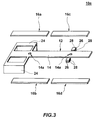
- first acceleration sensor 10a and the second acceleration sensor 10b have the same structure, they have a special structure. Then, the first acceleration sensor 10a will be explained in detail with reference to FIGs. 3 and 4.
- the first acceleration sensor 10a includes a vibrator 12 which vibrates in the longitudinal direction and which includes a strip vibrating member 14 which is created by an elastic invariable metal such as nickel, iron, chrome and titanium or an alloy of them such as an elinver and an iron-nickel alloy.
- the vibrating member 14 may be created by a material such as silica, glass, quartz and ceramic, other than metals which generally generate mechanical vibration.
- Two piezoelectric elements 16a and 16b are formed so as to face from each other on both main surfaces of a part on the side of one end from the center in the longitudinal direction of the vibrating member 14.
- One piezoelectric element 16a includes a piezoelectric layer 18a composed of ceramic for example and electrodes 20a and 22a are formed respectively on both main surfaces of the piezoelectric layer 18a.
- the electrode 20a is adhered on one main surface of the vibrating member 14 by an adhesive for example.
- the other piezoelectric element 16b includes a piezoelectric layer 18b composed of ceramic for example and electrodes 20b and 22b are formed respectively on both main surfaces of the piezoelectric layer 18b.
- the electrode 20b is adhered on the other main surface of the vibrating member 14 by an adhesive for example.
- the piezoelectric layers 18a and 18b of those piezoelectric elements 16a and 16b are polarized from the electrodes 22a and 22b to the electrodes 20a and 20b, i.e. in a thickness direction toward the vibrating member 14 from the outside thereof.
- two piezoelectric elements 16c and 16d are formed so as to face from each other on both main surfaces of a part on the side of the other end from the center in the longitudinal direction of the vibrating member 14.
- One piezoelectric element 16c includes a piezoelectric layer 18c composed of ceramic for example and electrodes 20c and 22c are formed respectively on both main surfaces of the piezoelectric layer 18c.
- the electrode 20c is adhered on one main surface of the vibrating member 14 by an adhesive for example.
- the other piezoelectric element 16d includes a piezoelectric layer 18d composed of ceramic for example and electrodes 20d and 22d are formed respectively on both main surfaces of the piezoelectric layer 18d.
- the electrode 20d is adhered on the other main surface of the vibrating member 14 by an adhesive for example.
- the piezoelectric layers 18c and 18d of those piezoelectric elements 16c and 16d are polarized from the electrodes 20c and 20d to the electrodes 22c and 22d, i.e. in a thickness direction from the vibrating member 14 toward the outside thereof.
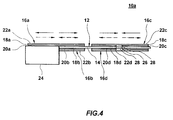
- the vibrator 12 vibrates in the longitudinal direction thereof when driving signals having a same phase are applied to the piezoelectric elements 16a through 16d.
- the piezoelectric elements 16a and 16b and the piezoelectric elements 16c and 16d are polarized in the opposite direction each other, they are displaced in the opposite direction each other. Due to that, when a part on the side of one end from the middle of the vibrating member 14 expands in the longitudinal direction, a part on the side of the other end from the middle of the vibrating member 14 in the longitudinal direction contracts as shown by solid line arrows in FIG. 4.
- the vibrating member 14 vibrates at the middle portion of the piezoelectric elements 16a and 16b and the middle portion of the piezoelectric elements 16c and 16d as its nodal portions.
- the vibrating member 14 also vibrates at the both ends in the longitudinal direction as its antinodes.
- Two circular holes 14a for example are created at the two nodal portions of the vibrating member 14 of the vibrator 12. Those two holes 14a increases a deflection of the vibrating member 14 caused by an acceleration and stabilizes the vibration of the vibrating member 14 in the longitudinal direction.
- Two supporting members 24 are formed on the side of one end in the longitudinal direction of the vibrator 12.
- those two supporting members 24 are formed in one body with the vibrating member 14 extending in the width direction from the circumference of the nodal portion on the side of one end of the vibrating member 14 in the longitudinal direction and that extending from the end portion thereof.
- Those supporting members 24 support the portion of the vibrator 12 on the side of one end thereof.
- two mounting members 26 are formed projecting from a distal half of the vibrating member 14.
- the mounting members 26 extend in the width direction from the circumference of the nodal portion on the side of the other end of the vibrating member 14 and are formed in one body with the vibrating member 14.
- Weights 28 are mounted on the both main surfaces of those mounting members 26 by welding or soldering. Those weights 28 increase a deflection of the vibrating member 14 caused by an acceleration.
- the vibrator 12 vibrates in the longitudinal direction as shown by the solid line arrows and the dashed line arrows in FIG. 4 when the side of the one end of the vibrator 12 is supported by fixing the two supporting members 24 and when driving signals having a same phase are applied to the four piezoelectric elements 16a through 16d.
- the vibrating member 14 deflects together with the piezoelectric elements 16a through 16d corresponding to the acceleration and voltages which correspond with the deflection are generated in the piezoelectric elements 16a through 16d. Due to that, the acceleration may be detected by measuring any of the voltages generated in the piezoelectric elements 16a through 16d.
- holes 14a are created respectively at the two nodal portions of the vibrating member 14 in the first acceleration sensor 10a, the deflection of the vibrating member 14 caused by the acceleration is increased and the vibration of the vibrating member 14 in the longitudinal direction is stabilized by keeping the balance of the vibration of the vibrating member 14 in the longitudinal direction. Due to that, an acceleration detecting sensitivity of the first acceleration sensor 10a is improved.
- the weights 28 are mounted to the mounting members 26 near the nodal portion of the vibrator 12 in the first acceleration sensor 10a, the deflection of the vibrating member 14 is increased, the acceleration detecting sensitivity is increased and the vibration of the vibrator 12 is not interfered by the weights 28 since almost no vibration of the vibrator 12 is transmitted to the weights 28.
- each of the circular holes 14a are created respectively at those two nodal portions of the vibrating member 14 in the first acceleration sensor 10a
- the holes created at the nodal portion may have another shape such as a rectangular shape instead of the circular shape and the number of holes created at one nodal portion is not confined to be only one and may be more than two.
- the first acceleration sensor 10a can detect the acceleration also by detecting a difference of voltages generated by the piezoelectric elements 16a and 16b and a difference of voltages generated by the piezoelectric elements 16c and 16d.
- the polarizing direction of the piezoelectric layer of more than one piezoelectric element may be reversed and the phase of driving signal applied to the piezoelectric element whose polarizing direction is reversed may be reversed in the first acceleration sensor 10a.
- the reason why the vibrator is vibrated in the longitudinal direction in the first acceleration sensor 10a is because the vibrator deflects significantly when an acceleration is applied to the vibrator when the vibrator vibrates in the longitudinal direction, thus improving the acceleration detecting sensitivity.
- the supporting member 24 of this first acceleration sensor 10a is fixed within the case 2 so that the main surface of the vibrating member 14 crosses at right angles with the longitudinal direction of the case 2. Accordingly, an acceleration in the longitudinal direction of the case 2 is detected and a signal related to the acceleration is obtained by the first acceleration sensor 10a.
- the supporting member 24 of the second acceleration sensor 10b having the same structure with the first acceleration sensor 10a is also fixed within the case 2 so that the main surface of the vibrating member 14 thereof crosses at right angles with the width direction of the case 2. Accordingly, a force F applied in the width direction of the case 2 is detected and a signal related to the force F is obtained by the second acceleration sensor 10b.
- An output terminal of the first acceleration sensor 10a is connected to an input terminal of a first integrating circuit 30a as shown in FIG. 2.
- the first integrating circuit 30a integrates the output signal of the first acceleration sensor 10a related to the acceleration in the longitudinal direction of the case 2 over time to obtain a signal related to a velocity V in the longitudinal direction of the case 2.
- An output terminal of the first integrating circuit 30a is connected to an input terminal of a second integrating circuit 30b.
- the second integrating circuit 30b integrates the output signal of the first integrating circuit 30a related to the velocity V in the longitudinal direction of the case 2 over time to obtain a signal related to a travel distance L of the vehicle.
- An output terminal of the second acceleration sensor 10b and the output terminal of the first integrating circuit 30a are connected respectively to two input terminals of a first arithmetic circuit 32a.
- the first arithmetic circuit 32a obtains a signal related to a radius of curvature r from the output signal of the second acceleration sensor 10b related to a centrifugal force F applied in the width direction of the case 2 and the output signal of the first integrating circuit 30a related to the velocity V in the longitudinal direction of the case 2.
- An output terminal of the first arithmetic circuit 32a and the output terminal of the first integrating circuit 30a are connected respectively to two input terminals of a second arithmetic circuit 32b.
- An output terminal of the second arithmetic circuit 32b is connected to an input terminal of a third integrating circuit 30c.
- the third integrating circuit 30c integrates the output signal of the second arithmetic circuit 32b related to the angular velocity ⁇ over time to obtain a signal related to a travel bearing ⁇ of the vehicle.
- FIG. 5 shows a relationship among the velocity V at the moving part of the mass m, the radius of curvature r, the angular velocity ⁇ , the centrifugal force F and the travel bearing ⁇ .
- the bearing-distance sensor 1 is mounted in a automobile 40 so that the longitudinal direction and the width direction of the case 2 run parallel respectively with the longitudinal direction and the width direction of the automobile 40 as shown in FIG. 1. Accordingly, the acceleration ⁇ in the longitudinal direction of the automobile 40 is detected and the signal related to the acceleration ⁇ is obtained by the first acceleration sensor 10a. The centrifugal force F applied in the width direction of the automobile 40 is detected and the signal related to the centrifugal force F is obtained by the second acceleration sensor 10b.
- the output signal of the first acceleration sensor 10a related to the acceleration ⁇ in the longitudinal direction of the automobile 40 is integrated over time and the signal related to the velocity V in the longitudinal direction of the automobile 40 is obtained by the first integrating circuit 30a.
- the output signal of the first integrating circuit 30a related to the velocity V in the longitudinal direction of the automobile 40 is integrated over time and the signal related to the travel distance L in the longitudinal direction of the automobile 40 is obtained by the second integrating circuit 30b.
- the signal related to the radius of curvature r is obtained from the output signal of the second acceleration sensor 10b related to the centrifugal force F applied in the width direction of the automobile 40 and the output signal of the first integrating circuit 30a related to the velocity V in the longitudinal direction of the automobile 40.
- the signal related to the angular velocity ⁇ is obtained from the output signal of the first arithmetic circuit 32a related to the radius of curvature r and the output signal of the first integrating circuit 30a related to the velocity V in the longitudinal direction of the automobile 40.
- the output signal of the second arithmetic circuit 32b related to the angular velocity ⁇ is integrated over time and the signal related to the travel bearing ⁇ of the automobile 40 is obtained by the third integrating circuit 30c.
- this bearing-distance sensor 1 can detect the travel bearing ⁇ and the travel distance L of the automobile 40.
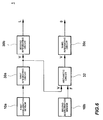
- FIG. 6 is a block diagram showing another embodiment of the present invention.
- one arithmetic circuit 32 is provided instead of the first arithmetic circuit 32a and the second arithmetic circuit 32b provided in the embodiment shown in FIGs. 1 and 2.
- the output terminals of the second acceleration sensor 10b and the first integrating circuit 30a are connected respectively to two input terminals of the arithmetic circuit 32.
- An output terminal of the arithmetic circuit 32 is connected to the input terminal of the third integrating circuit 30c as another integrating circuit.
- the arithmetic circuit 32 obtains a signal related to the angular velocity ⁇ from the output signal of the second acceleration sensor 10b related to the centrifugal force F applied in the width direction of the case 2 and the output signal of the first integrating circuit 30a related to the velocity V in the longitudinal direction of the case 2.
- the embodiment shown in FIG. 6 can detect a travel bearing and a travel distance of a vehicle such as an automobile and can be small and inexpensive, similarly to the embodiment shown in FIGs. 1 and 2. Note that the circuit structure of the embodiment shown in FIG. 6 may be simplified as compared to the embodiment shown in FIGs. 1 and 2 because one arithmetic circuit is decreased.
- angular velocity sensors having special structures respectively as the first acceleration sensor and the second acceleration sensor are used in each embodiment described above, an angular velocity sensor having another structure may be used in the present invention.
- a bearing sensor which can detect only the travel bearing ⁇ of the vehicle may be constructed if the second integrating circuit 30b is removed in each embodiment shown in FIGs. 2 and 6.
- the bearing sensor can be small and inexpensive because no expensive vibratory gyroscope is used and two acceleration sensors need not be disposed with a wide space therebetween.
- the travel bearing ⁇ of the vehicle may be readily detected by just adding one acceleration sensor having the simple structure as shown in each embodiment described above if a signal (which corresponds to the velocity V output from the first integrating circuit 30a) obtained from a speed sensor conventionally mounted in a vehicle such as an automobile.
- a signal which corresponds to the velocity V output from the first integrating circuit 30a
- a speed sensor conventionally mounted in a vehicle such as an automobile.
Landscapes
- Engineering & Computer Science (AREA)
- Radar, Positioning & Navigation (AREA)
- Remote Sensing (AREA)
- Automation & Control Theory (AREA)
- Physics & Mathematics (AREA)
- General Physics & Mathematics (AREA)
- Gyroscopes (AREA)
- Navigation (AREA)
- Measurement Of Distances Traversed On The Ground (AREA)
Applications Claiming Priority (6)
| Application Number | Priority Date | Filing Date | Title |
|---|---|---|---|
| JP26636794 | 1994-10-04 | ||
| JP266367/94 | 1994-10-04 | ||
| JP26636794 | 1994-10-04 | ||
| JP6309993A JPH08159806A (ja) | 1994-10-04 | 1994-11-17 | 方位センサおよび方位距離センサ |
| JP309993/94 | 1994-11-17 | ||
| JP30999394 | 1994-11-17 |
Publications (2)
| Publication Number | Publication Date |
|---|---|
| EP0706030A1 true EP0706030A1 (de) | 1996-04-10 |
| EP0706030B1 EP0706030B1 (de) | 2000-07-05 |
Family
ID=26547406
Family Applications (1)
| Application Number | Title | Priority Date | Filing Date |
|---|---|---|---|
| EP95115652A Expired - Lifetime EP0706030B1 (de) | 1994-10-04 | 1995-10-04 | Richtungs-Sensor und Richtungs-Entfernungs-Sensor |
Country Status (4)
| Country | Link |
|---|---|
| US (1) | US5597954A (de) |
| EP (1) | EP0706030B1 (de) |
| JP (1) | JPH08159806A (de) |
| DE (1) | DE69517766T2 (de) |
Families Citing this family (12)
| Publication number | Priority date | Publication date | Assignee | Title |
|---|---|---|---|---|
| KR0154271B1 (ko) * | 1995-11-07 | 1998-12-01 | 정몽원 | 차량의 거동 감지장치 |
| JPH10132843A (ja) * | 1996-10-25 | 1998-05-22 | Murata Mfg Co Ltd | 速度演算装置 |
| US6629462B2 (en) * | 2000-07-24 | 2003-10-07 | Matsushita Electric Industrial Co., Ltd. | Acceleration sensor, an acceleration detection apparatus, and a positioning device |
| US6575031B2 (en) * | 2001-01-26 | 2003-06-10 | Mts Systems Corporation | Transducer for measuring displacement of a vehicle spindle |
| US20040078446A1 (en) * | 2002-09-17 | 2004-04-22 | Daniell W. Todd | Options associated with instant messaging (IM) chat transcripts of IM chat sessions |
| WO2004036377A2 (en) | 2002-10-15 | 2004-04-29 | Medtronic Inc. | Configuring and testing treatment therapy parameters for a medical device system |
| WO2004036376A2 (en) * | 2002-10-15 | 2004-04-29 | Medtronic Inc. | Multi-modal operation of a medical device system |
| WO2004034885A2 (en) * | 2002-10-15 | 2004-04-29 | Medtronic Inc. | Signal quality monitoring and control for a medical device system |
| US7933646B2 (en) | 2002-10-15 | 2011-04-26 | Medtronic, Inc. | Clustering of recorded patient neurological activity to determine length of a neurological event |
| AU2003287166A1 (en) * | 2002-10-15 | 2004-05-04 | Medtronic Inc. | Phase shifting of neurological signals in a medical device system |
| JP2008089517A (ja) * | 2006-10-04 | 2008-04-17 | Sony Corp | 方位判別装置、方位判別方法及び方位判別プログラム |
| JP2009288022A (ja) * | 2008-05-28 | 2009-12-10 | Sumitomo Electric Ind Ltd | 地磁気センサの異常判定装置、移動方位特定装置、コンピュータプログラム及び地磁気センサの異常判定方法 |
Citations (1)
| Publication number | Priority date | Publication date | Assignee | Title |
|---|---|---|---|---|
| US4393709A (en) * | 1980-11-13 | 1983-07-19 | Alps Electric Co., Ltd. | Direction detection apparatus |
Family Cites Families (6)
| Publication number | Priority date | Publication date | Assignee | Title |
|---|---|---|---|---|
| DE2818202C2 (de) * | 1978-04-26 | 1987-03-26 | Bodenseewerk Gerätetechnik GmbH, 7770 Überlingen | Navigationsgerät für Land-, Luft- oder Seefahrzeuge |
| US4590801A (en) * | 1983-09-02 | 1986-05-27 | Sundstrand Data Control, Inc. | Apparatus for measuring inertial specific force and angular rate of a moving body |
| GB2146776B (en) * | 1983-09-16 | 1986-07-30 | Ferranti Plc | Accelerometer systems |
| US4711125A (en) * | 1985-11-06 | 1987-12-08 | Morrison Melvin M | Inertial measurement unit |
| JP2657581B2 (ja) * | 1990-11-28 | 1997-09-24 | 本田技研工業株式会社 | 移動体の現在位置表示装置 |
| EP0514887B1 (de) * | 1991-05-21 | 1997-04-16 | Matsushita Electric Industrial Co., Ltd. | Fahrzeugpositionsbestimmungsvorrichtung |
-
1994
- 1994-11-17 JP JP6309993A patent/JPH08159806A/ja active Pending
-
1995
- 1995-10-04 EP EP95115652A patent/EP0706030B1/de not_active Expired - Lifetime
- 1995-10-04 DE DE69517766T patent/DE69517766T2/de not_active Expired - Fee Related
- 1995-10-04 US US08/539,133 patent/US5597954A/en not_active Expired - Fee Related
Patent Citations (1)
| Publication number | Priority date | Publication date | Assignee | Title |
|---|---|---|---|---|
| US4393709A (en) * | 1980-11-13 | 1983-07-19 | Alps Electric Co., Ltd. | Direction detection apparatus |
Also Published As
| Publication number | Publication date |
|---|---|
| DE69517766D1 (de) | 2000-08-10 |
| US5597954A (en) | 1997-01-28 |
| JPH08159806A (ja) | 1996-06-21 |
| DE69517766T2 (de) | 2001-03-01 |
| EP0706030B1 (de) | 2000-07-05 |
Similar Documents
| Publication | Publication Date | Title |
|---|---|---|
| US4750364A (en) | Angular velocity and acceleration sensor | |
| EP0614087B1 (de) | Piezoelektrischer Vibrator und diesen verwendenden Beschleunigungssensor | |
| JP3151927B2 (ja) | 加速度センサ | |
| US6046531A (en) | Vibrator, vibratory gyroscope, and linear accelerometer | |
| EP0706030A1 (de) | Richtungs- und Abstandssensor | |
| EP0936440B1 (de) | Vibratoren, Vibrationskreisel, ein Verfahren zum detektieren einer Winkelgeschwindigkeit und ein linearer Beschleunigungsmesser | |
| JPH07306048A (ja) | 圧電振動子 | |
| JP3741041B2 (ja) | 振動ジャイロおよびそれを用いた電子装置 | |
| JP3166522B2 (ja) | 加速度センサ | |
| US5578754A (en) | Vibration-type angular-velocity sensor | |
| JP3139205B2 (ja) | 加速度センサ | |
| EP0732566B1 (de) | Schwingkreisel | |
| EP0684450B1 (de) | Halterungsaufbau eines Schwingers | |
| JP3139204B2 (ja) | 加速度センサ | |
| JP3129116B2 (ja) | 加速度センサ | |
| JP3139212B2 (ja) | 加速度センサ | |
| US6092417A (en) | Gyrosensor | |
| EP0664439A1 (de) | Schwingkreisel | |
| JP3129117B2 (ja) | 加速度センサ | |
| EP0563762B1 (de) | Schwingkreisel mit Piezoelementen in Schwingungsknotennähe | |
| JP3129022B2 (ja) | 加速度センサ | |
| JP3139211B2 (ja) | 加速度センサ | |
| JPS6246266A (ja) | 振動センサ | |
| JPH0695098B2 (ja) | 振動ジャイロ | |
| JP3304722B2 (ja) | 振動ジャイロ |
Legal Events
| Date | Code | Title | Description |
|---|---|---|---|
| PUAI | Public reference made under article 153(3) epc to a published international application that has entered the european phase |
Free format text: ORIGINAL CODE: 0009012 |
|
| 17P | Request for examination filed |
Effective date: 19951004 |
|
| AK | Designated contracting states |
Kind code of ref document: A1 Designated state(s): DE FR GB IT SE |
|
| 17Q | First examination report despatched |
Effective date: 19980324 |
|
| GRAG | Despatch of communication of intention to grant |
Free format text: ORIGINAL CODE: EPIDOS AGRA |
|
| RTI1 | Title (correction) |
Free format text: BEARING SENSOR AND BEARING-DISTANCE SENSOR |
|
| GRAG | Despatch of communication of intention to grant |
Free format text: ORIGINAL CODE: EPIDOS AGRA |
|
| GRAG | Despatch of communication of intention to grant |
Free format text: ORIGINAL CODE: EPIDOS AGRA |
|
| GRAH | Despatch of communication of intention to grant a patent |
Free format text: ORIGINAL CODE: EPIDOS IGRA |
|
| GRAH | Despatch of communication of intention to grant a patent |
Free format text: ORIGINAL CODE: EPIDOS IGRA |
|
| GRAA | (expected) grant |
Free format text: ORIGINAL CODE: 0009210 |
|
| AK | Designated contracting states |
Kind code of ref document: B1 Designated state(s): DE FR GB IT SE |
|
| ITF | It: translation for a ep patent filed | ||
| REF | Corresponds to: |
Ref document number: 69517766 Country of ref document: DE Date of ref document: 20000810 |
|
| ET | Fr: translation filed | ||
| PLBE | No opposition filed within time limit |
Free format text: ORIGINAL CODE: 0009261 |
|
| STAA | Information on the status of an ep patent application or granted ep patent |
Free format text: STATUS: NO OPPOSITION FILED WITHIN TIME LIMIT |
|
| 26N | No opposition filed | ||
| REG | Reference to a national code |
Ref country code: GB Ref legal event code: IF02 |
|
| PGFP | Annual fee paid to national office [announced via postgrant information from national office to epo] |
Ref country code: DE Payment date: 20070927 Year of fee payment: 13 |
|
| PGFP | Annual fee paid to national office [announced via postgrant information from national office to epo] |
Ref country code: IT Payment date: 20071026 Year of fee payment: 13 |
|
| PGFP | Annual fee paid to national office [announced via postgrant information from national office to epo] |
Ref country code: SE Payment date: 20071004 Year of fee payment: 13 |
|
| PGFP | Annual fee paid to national office [announced via postgrant information from national office to epo] |
Ref country code: GB Payment date: 20071003 Year of fee payment: 13 Ref country code: FR Payment date: 20071009 Year of fee payment: 13 |
|
| EUG | Se: european patent has lapsed | ||
| GBPC | Gb: european patent ceased through non-payment of renewal fee |
Effective date: 20081004 |
|
| REG | Reference to a national code |
Ref country code: FR Ref legal event code: ST Effective date: 20090630 |
|
| PG25 | Lapsed in a contracting state [announced via postgrant information from national office to epo] |
Ref country code: IT Free format text: LAPSE BECAUSE OF NON-PAYMENT OF DUE FEES Effective date: 20081004 Ref country code: DE Free format text: LAPSE BECAUSE OF NON-PAYMENT OF DUE FEES Effective date: 20090501 |
|
| PG25 | Lapsed in a contracting state [announced via postgrant information from national office to epo] |
Ref country code: FR Free format text: LAPSE BECAUSE OF NON-PAYMENT OF DUE FEES Effective date: 20081031 |
|
| PG25 | Lapsed in a contracting state [announced via postgrant information from national office to epo] |
Ref country code: GB Free format text: LAPSE BECAUSE OF NON-PAYMENT OF DUE FEES Effective date: 20081004 |
|
| PG25 | Lapsed in a contracting state [announced via postgrant information from national office to epo] |
Ref country code: SE Free format text: LAPSE BECAUSE OF NON-PAYMENT OF DUE FEES Effective date: 20081005 |