EP0706362B1 - Procede et appareil servant a attacher un element de fixation sur un article absorbant profile - Google Patents
Procede et appareil servant a attacher un element de fixation sur un article absorbant profile Download PDFInfo
- Publication number
- EP0706362B1 EP0706362B1 EP94920130A EP94920130A EP0706362B1 EP 0706362 B1 EP0706362 B1 EP 0706362B1 EP 94920130 A EP94920130 A EP 94920130A EP 94920130 A EP94920130 A EP 94920130A EP 0706362 B1 EP0706362 B1 EP 0706362B1
- Authority
- EP
- European Patent Office
- Prior art keywords
- article
- fastener
- component
- absorbent article
- compressible
- Prior art date
- Legal status (The legal status is an assumption and is not a legal conclusion. Google has not performed a legal analysis and makes no representation as to the accuracy of the status listed.)
- Expired - Lifetime
Links
Images

Classifications
-
- A—HUMAN NECESSITIES
- A61—MEDICAL OR VETERINARY SCIENCE; HYGIENE
- A61F—FILTERS IMPLANTABLE INTO BLOOD VESSELS; PROSTHESES; DEVICES PROVIDING PATENCY TO, OR PREVENTING COLLAPSING OF, TUBULAR STRUCTURES OF THE BODY, e.g. STENTS; ORTHOPAEDIC, NURSING OR CONTRACEPTIVE DEVICES; FOMENTATION; TREATMENT OR PROTECTION OF EYES OR EARS; BANDAGES, DRESSINGS OR ABSORBENT PADS; FIRST-AID KITS
- A61F13/00—Bandages or dressings; Absorbent pads
- A61F13/15—Absorbent pads, e.g. sanitary towels, swabs or tampons for external or internal application to the body; Supporting or fastening means therefor; Tampon applicators
- A61F13/56—Supporting or fastening means
- A61F13/5605—Supporting or fastening means specially adapted for sanitary napkins or the like
- A61F13/5611—Supporting or fastening means specially adapted for sanitary napkins or the like using fastening strips, e.g. adhesive, on the undergarment-facing side
-
- A—HUMAN NECESSITIES
- A61—MEDICAL OR VETERINARY SCIENCE; HYGIENE
- A61F—FILTERS IMPLANTABLE INTO BLOOD VESSELS; PROSTHESES; DEVICES PROVIDING PATENCY TO, OR PREVENTING COLLAPSING OF, TUBULAR STRUCTURES OF THE BODY, e.g. STENTS; ORTHOPAEDIC, NURSING OR CONTRACEPTIVE DEVICES; FOMENTATION; TREATMENT OR PROTECTION OF EYES OR EARS; BANDAGES, DRESSINGS OR ABSORBENT PADS; FIRST-AID KITS
- A61F13/00—Bandages or dressings; Absorbent pads
- A61F13/15—Absorbent pads, e.g. sanitary towels, swabs or tampons for external or internal application to the body; Supporting or fastening means therefor; Tampon applicators
- A61F13/15577—Apparatus or processes for manufacturing
- A61F13/15756—Applying tabs, strips, tapes, loops; Knotting the ends of pads
-
- Y—GENERAL TAGGING OF NEW TECHNOLOGICAL DEVELOPMENTS; GENERAL TAGGING OF CROSS-SECTIONAL TECHNOLOGIES SPANNING OVER SEVERAL SECTIONS OF THE IPC; TECHNICAL SUBJECTS COVERED BY FORMER USPC CROSS-REFERENCE ART COLLECTIONS [XRACs] AND DIGESTS
- Y10—TECHNICAL SUBJECTS COVERED BY FORMER USPC
- Y10T—TECHNICAL SUBJECTS COVERED BY FORMER US CLASSIFICATION
- Y10T156/00—Adhesive bonding and miscellaneous chemical manufacture
- Y10T156/10—Methods of surface bonding and/or assembly therefor
- Y10T156/1052—Methods of surface bonding and/or assembly therefor with cutting, punching, tearing or severing
- Y10T156/1062—Prior to assembly
- Y10T156/1075—Prior to assembly of plural laminae from single stock and assembling to each other or to additional lamina
Definitions
- the present invention is directed to a method of making an absorbent article such as a sanitary napkin, panty liner, or incontinence pad. More particularly, the present invention is directed to a method and apparatus for attaching a fastener, such as a pressure sensitive adhesive fastener, to the garment side of an absorbent article that is "profiled" (e.g., thicker in the center than at the ends).
- a fastener such as a pressure sensitive adhesive fastener
- absorbent articles include pad type articles such as sanitary napkins, panty liners, and adult incontinence products.
- Such articles include a liquid pervious topsheet, in absorbent core, a liquid impervious backsheet, and some type of fastener.
- the fastener often comprises a pressure sensitive adhesive fastener situated on the garment side of the article.
- the fastener is used for attaching the absorbent article to the crotch region of an undergarment (such as the wearer's panties in the case of a sanitary napkin).
- the pressure sensitive adhesive fastener is generally covered with a cover strip (or releasable strip) to prevent the adhesive from unintentionally sticking to surfaces other than the wearer's undergarment prior to use.
- Absorbent articles having a profiled shape have regions of different caliper that are typically in their absorbent core. Generally, such absorbent articles are thicker in the center than at the ends. These profiled absorbent articles present special problems for attachment of a pressure sensitive adhesive fastener to the garment side of the article during manufacture. The problems become serious when the caliper differences from the leading edge of the core to the center of the core and from center of the core to the trailing edge are so large that it is difficult to supply sufficient pressure over the entire core to adhere the pressure sensitive adhesive fastener properly to the absorbent article.
- the adhesive If the pressure sensitive adhesive is not adhered properly to the garment surface of the absorbent article, when the release paper is peeled off, the adhesive will either be removed from the garment side of the absorbent article with the release paper, or even worse, will stay in the wearer's undergarment when the absorbent article is removed from the undergarment. This problem was previously solved by imparting such high pressures to adhere the fastener to the garment side of the absorbent article so as to risk damaging the absorbent core of the article.
- United States patent specification number US-A-5 133 821 discloses a method for making a contoured wound dressing in which substantially eliminates any and all air pockets between laminated layers of the dressing. Having thus removed all of the air, further pressure is applied at a downstream laminating station to marry the adhesive carrier or layer to the adhesive.
- the present invention relates to a method and apparatus for attaching a fastener to a profiled absorbent article.
- the method and apparatus essentially involve using a compressible component during the process of applying pressure to attach the fastener to the garment side of the absorbent article.
- the compressible component compresses or yields more in those places where it is aligned with the portions of the absorbent article having a greater caliper. This equalizes the pressure applied to the pressure sensitive adhesive surface of the fastener to allow for better adherence of the fastener to the garment side of the absorbent article.
- the method of the present invention comprises the steps of:
- the apparatus comprises:
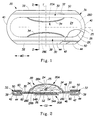
- Figure 1 is a plan view of a preferred type of profiled sanitary napkin 20 that can have its fastener attached by the method and apparatus of the present invention.
- the sanitary napkin is shown in its flat-out state with portions of its structure being cut-away to more clearly show the construction of the sanitary napkin 20.
- the sanitary napkin is shown with the portion of the sanitary napkin 20 which faces the wearer body surface 20A, facing the viewer.
- the sanitary napkin 20 comprises a liquid pervious topsheet 24, a liquid impervious backsheet 26 joined with the topsheet 24, an absorbent core 28 positioned between the topsheet 24 and the backsheet 26, a side flap (or "side margin") 30 extending outwardly from and along the side edges 28C of the absorbent core 28, elastic members 32 joined to the side flaps 30, and embossed channels 34.
- Figure 1 shows a preferred embodiment of the sanitary napkin 20 in which the topsheet 24 and the backsheet 26 have length and width dimensions generally larger than those of the absorbent core 28.
- the topsheet 24 and the backsheet 26 extend beyond the edges of the absorbent core 28 to thereby form not only the side flaps 30 but also portions of the periphery 36 of the sanitary napkin 20.
- the periphery 36 defines the outer perimeter or, in other words, the edges of the sanitary napkin 20.
- the periphery 36 comprises the longitudinal side edges 38 and the end edges 40.
- absorbent article is shown in the form of a sanitary napkin, the method described herein can also be used to attach a fastener to other types of absorbent articles such as panty liners, incontinence pads, and the like.
- the sanitary napkin 20 has a longitudinal centerline and a transverse centerline, designated L and T, respectively, in Fig. 1.
- transverse or “lateral” as used herein, are interchangeable, and refer to a line, axis or direction which lies within the plane of the sanitary napkin 20 that is generally perpendicular to the longitudinal direction.
- machine direction refers to the direction of product flow through the process of making the sanitary napkin.
- the sanitary napkin preferably goes through the process with its longitudinal centerline oriented in the machine direction.
- cross-machine direction refers to a direction perpendicular to the direction of product flow in the process of making the sanitary napkin.
- Figure 2 is a cross-sectional view of the sanitary napkin 20 taken along section line 2-2 of Figure 1.
- Figure 2 shows the topsheet 24 and the backsheet 26 extending laterally across the entire cross-section to form each side flap 30.
- the absorbent core 28 is positioned between the topsheet 24 and the backsheet 26 such that the topsheet 24 and the backsheet 26 encase the absorbent core 28.
- the absorbent core 28 has a body-facing side 28A, a garment-facing side 28B, a pair of longitudinal side edges 28C, and a pair of end edges 28D.
- the embossed channels 34 are shown in Figure 2 as being a region of the sanitary napkin 20 wherein preferably both the topsheet 24 and the absorbent core 28 are compressed.
- the absorbent core 28 is typically made out of a material that is compressible.
- the absorbent core 28 is generally shown in Figure 2 as being thicker in the center than at its edges (i.e., it is profiled in the lateral direction).
- the absorbent core 28 is also profiled so that it is thicker in the center than at its ends (i.e., it is profiled in the longitudinal direction).
- the differences in caliper in the longitudinal direction vary in a somewhat more gradual fashion along the length of the sanitary napkin, however, than across the width shown in drawing Fig. 2.
- Figure 2 also shows that the garment surface 20B of the sanitary napkin 20 is provided with a fastener, such as a pressure sensitive adhesive fastener 52 for attaching the sanitary napkin 20 to the wearer's panties.
- the adhesive fastener 52 is preferably covered with a release paper 54 to keep the adhesive from sticking to surfaces other than the panties prior to use of the sanitary napkin.
- Figure 2 shows that the elastic members 32 comprise an elastomeric laminate comprising in elastomeric layer 42 and a coverstock layer 44.
- the elastic members 32 each have a pair of longitudinal edges 60.
- One portion of the elastic member 32 is secured to the outer surface 46 of the side flap 30 (i.e., the backsheet 26) with the other portion secured to the inner surface 48 of the side flap 30 (i.e. the topsheet 24).
- the elastic members 32 have been folded about the distal edges 50 of the side flaps 30 such that the elastic members 32 form the longitudinal edges 38 of the sanitary napkin 20.
- the contraction of the elastic members 32 causes the side flaps 30 to stand-up (fold upwardly toward the topsheet 24) to form a wall that acts as a lateral barrier to the flow of menstrual fluids.
- the sanitary napkin 20 is, thus, provided with elasticized side flaps by operatively associating an elastic member on both the upper surface and the lower surface of the side flaps. Since the coverstock layer is on the outside of the product, the sanitary napkin is provided with soft side edges which contact the wearer during use.
- the elastomeric laminate provides relatively low tension that while being sufficient for raising the side flaps of the product to be a barrier against lateral leakage, also maintains the product in a shape which discourages fluid run-off or leakage at the ends of the pad as well as providing a bunching benefit.
- the sanitary napkin 20 shown in Figs. 1 and 2 is described in greater detail in U.S. Patent Specification No. US-A-5,234,422.
- Figure 3 is a schematic perspective view of a preferred process and apparatus used to attach a fastener to the sanitary napkin shown in FIGS. 1 and 2.
- the overall apparatus is designated by reference number 100.
- the panty fastener attaching apparatus 100 preferably generally comprises: a conveyor 101 for bringing in a supply or web 20' of profiled sanitary napkins that are ready to have a fastener added to their garment sides 20B; a source for supplying release paper 102 (or release paper unwind roll, which is out of the picture in Fig. 3); an adhesive applying mechanism 106; a knife 116; a release paper applying mechanism such as a cut and slip vacuum roll 118; a release paper applying anvil roll 122; a fastener applying anvil surface, such as conveyor 124; and a compressible component in the form of an endless belt 126 with a plurality of resilient fingers 130 extending outwardly therefrom.
- the sanitary napkins 20 to which the panty fastening adhesive is to be attached come into the process in the form of a continuous web 20' shown in the lower right hand corner of Fig. 3 with the individual napkins having their garment sides 20B facing upward.
- the release paper is brought into the process in the form of a continuous web 54'.
- the release paper is a 11.3kg - 13.6kg (25-30 lb.) sheet of paper that has an inwardly-facing side 54A that will be applied against the panty fastener and an outwardly-facing side 54B that will be exposed to the consumer.
- the inwardly-facing side 54A of the release paper 54 is silicone-coated to permit the panty fastening adhesive 52 to release therefrom.
- the release paper web 54' passes under an adhesive applying mechanism, such as glue gun 106, with the inwardly-facing side of the web facing upward.
- a glue collection plate 108 is under the glue gun 106.
- the glue gun 106 has a slot extrusion head (that is not visible in Fig. 3) having a slot with an opening with a height of about 0.18mm (about 0.007 inch) for applying the panty fastening adhesive to the release paper web 54'.
- the panty fastening adhesive comes in from a standard supply source (not shown) and is slot extruded onto the release paper web 54' through the slot in the head of the glue gun 106.
- the release paper web 54' is in intimate contact with the slot extrusion head during this portion of the process.
- the extrusion head forces the adhesive out under pressure onto the release paper.
- the application of the adhesive is intermittent and in the form of the desired pattern (such as a singe patch of adhesive, two parallel strips of adhesive, etc.).
- the release paper with the panty fastening adhesive 52 coated thereon then travels on to the cut and slip vacuum roll 118.
- the purpose of the cut and slip vacuum roll is to cut the adhesive coated release paper web 54' into individual release paper sheets and properly space the sheets for application to the individual sanitary napkins in the continuous web 20'.
- the cut and slip vacuum roll 118 is a roll that is provided with a plurality of vacuum holes 120 through which a vacuum is drawn from a standard vacuum source (the vacuum source is not visible in Fig. 3).
- the cut and slip vacuum roll 118 allows the release paper web 54' to slip on its surface before the web is cut (that is, the cut and slip vacuum roll 118 will rotate faster than the release paper web 54') so that the continuous release paper web can be spaced apart for application to the garment sides 20B of the individual sanitary napkins.
- the release paper web 54' will slip on the cut and slip vacuum roll 118 (that is, the release paper web 54' will not rotate with the vacuum roll 118) until such time as the knife blade 116 passes through and cuts the release paper web 54'.
- FIG. 3 shows that the knife blade 116 is coated with mineral oil to facilitate cutting and to extend the life of the knife.
- the sanitary napkin with the individual release paper against its garment side 20B then passes through a nip between the cut and slip vacuum roll 118 and an anvil roll 122. Although some pressure is applied in the nip between the vacuum roll 118 and the anvil roll 122, the sheet of release paper 54 is not subjected to sufficient pressure to adhere it to the garment side of the sanitary napkin until it goes through the apparatus described below for attaching the fastener to the absorbent article.
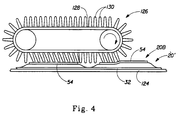
- the apparatus for attaching the fastener to the absorbent article comprises a compressible component 126 and an anvil surface 124.
- the compressible component 126 is a continuous belt that has pyramid or cylindrical-type fingers 130 that stick out and protrude from the surface 128 of the belt as much as 25.4mm to 38.1mm (1 inch to 1.5 inches). There are several thousand of these fingers very tightly spaced over the length of the belt.
- the sanitary napkins as noted above, have a profiled shape with regions of different caliper that are typically in their absorbent core. Generally, such absorbent articles are thicker in the center than at the ends. These profiled sanitary napkins present special problems for attachment of a pressure sensitive adhesive fastener to the garment side of the napkin during manufacture. The problems become serious when the caliper differences between the leading and trailing edges of the core and the center of the core are so large that it is difficult to supply sufficient pressure over the entire core to adhere the panty fastening adhesive properly.
- the pressure sensitive adhesive is not combined properly with the garment surface of the sanitary napkin, when the release paper is peeled off, the adhesive will either be removed from the garment side of the sanitary napkin with the release paper, or even worse stay in the panties when the napkin is removed from the panties. This problem was previously solved by imparting such high pressures to adhere the fastener to the garment side of the sanitary napkin so as to risk damaging the absorbent core of the napkin.
- the purpose of the fingers on the belt 126 is to allow this belt to supply pressure on the pad and panty fastening adhesive that is in proportion to the caliper of the core.
- the fingers will bend where the caliper of the core is higher and will not bend as much where the caliper of the core is lower.
- the belt 126 supplies an equal force across the entire pad in order to keep the transfer problems described above from occurring.
- any other means can be used to apply the panty fastening adhesive to the release paper web.
- the panty fastening adhesive can be applied directly to the garment side 20B of the sanitary napkin, rather than to the inwardly-facing side of the release paper and the inwardly-facing side of the release paper subsequently adhered to the garment side of the sanitary napkin.
- the fastener need not be a strip of pressure sensitive adhesive.
- the fastener instead, can be a mechanical fastener with a pressure sensitive adhesive backing.
- the method and apparatus of the present invention can be used to attach other components of the absorbent article together in addition to, or alternatively to using the same for applying the fastener to the garment side of the article.
- the same problems described herein may be presented when attaching the topsheet or the backsheet to a profiled absorbent core.
- the method and apparatus of the present invention are, thus, suitable for attaching any components together where there is a need to equalize pressure over a given area due to caliper (and/or compressibility) differences of one or more of the components.
- the present method and appartus are also not limited to being used with pressure sensitive adhesives.
- the present method and apparatus are suitable for attaching any components where pressure is required during the attachment process.
- the method and apparatus of the present invention can also be used to attach components of absorbent articles that are profiled in many other possible manners (such as absorbent articles that are thicker at the ends than in the center).
- the compressible component is not limited to being in the form of an endless belt with pyramid or cylindrical-type fingers.
- the compressible component can, by way of example, comprise a roll or a flat surface with fingers protruding therefrom.
- the fingers can be of other suitable shapes.
- the compressible component is not limited to a structure with protruding finger-like elements.
- the compressible component can comprise any type of component that is compressible.
- the compressible component can comprise a compressible rubber or foam layer, a compressible rubber or foam covered roll or belt, or the like.
Landscapes
- Health & Medical Sciences (AREA)
- Epidemiology (AREA)
- Engineering & Computer Science (AREA)
- Vascular Medicine (AREA)
- Biomedical Technology (AREA)
- Heart & Thoracic Surgery (AREA)
- Life Sciences & Earth Sciences (AREA)
- Animal Behavior & Ethology (AREA)
- General Health & Medical Sciences (AREA)
- Public Health (AREA)
- Veterinary Medicine (AREA)
- Manufacturing & Machinery (AREA)
- Absorbent Articles And Supports Therefor (AREA)
- Orthopedics, Nursing, And Contraception (AREA)
Claims (6)
- Appareil (100) pour fixer une bande d'adhésif sensible à la pression (52) sur un article (20), qui comprend :une surface primaire (124) qui joue le rôle d'une enclume (124) contre laquelle ledit article (20) peut être placé ;un mécanisme d'application d'élément de fixation à adhésif sensible à la pression ;un composant (126) ;un mécanisme pour amener l'article entre ledit composant (126) et ladite surface primaire (124)
caractérisé en ce quel'article (20) est un article absorbant compressible (20) qui a une épaisseur maximale et des régions d'épaisseurs différentes, ainsi qu'une certaine compressibilité ; ledit composant (126) est un composant compressible (126) comprenant une surface avec une pluralité d'éléments résilients et compressibles (130), qui font saillie de cette dernière en direction de ladite surface formant enclume (124) ; ladite surface primaire (124) et les éléments (130) dont est constitué ledit composant compressible (126) étant espacés d'une certaine distance ;la distance entre les éléments (130) disposés sur ledit composant compressible (126) et ladite surface primaire (124) est inférieure à l'épaisseur maximale de l'article absorbant (20). - Appareil (100) selon la revendication 1, dans lequell'article (20) a une face côté corps et une face côté vêtement ;un adhésif sensible à la pression est déposé sur une surface de l'élément (54) ; le mécanisme possède des moyens pour amener ladite surface près de la face côté vêtement de l'article (20) ; lequel composant (126), en utilisation, permet à l'élément (54) d'être fixé à l'article (20).
- Appareil (100) selon la revendication 1 ou la revendication 2, dans lequel, en utilisation, les éléments résilients (121) et l'article (20) se déplacent dans la même direction.
- Appareil (100) selon l'une quelconque des revendications 1 à 3, dans lequel ledit composant (126) comprend une courroie sans fin (126).
- Procédé pour fixer, sur la face côté vêtement d'un article (20), un élément de fixation (52) ayant une surface revêtue d'un adhésif sensible à la pression, comprenant les étapes qui consistent à :(a) prévoir un article (20) ayant une face côté corps et une face côté vêtement ;(b) prévoir un élément de fixation (52) ayant deux surfaces, dont au moins une est une surface revêtue d'un adhésif sensible à la pression ;(c) prévoir un composant (126) ;(d) prévoir une surface formant enclume (124) ;(e) placer l'élément de fixation (52) avec sa surface revêtue d'un adhésif sensible à la pression près de la face côté vêtement de l'article (20) ; et(f) appliquer une pression faire adhérer ladite surface revêtue d'un adhésif sensible à la pression sur la face côté vêtement de l'article (20) pendant que ledit article (20) et l'élément de fixation (52) se trouvent entre ledit composant (126) et ladite enclume (124)
caractérisé en ce que
l'article (20) est un article absorbant (20) ayant des régions d'épaisseurs différentes; et le composant (126) est un composant compressible. - Procédé selon la revendication 5, dans lequel l'étape (f) est obtenue par l'action dudit composant (126), lequel composant comprend, de préférence, une surface avec une pluralité d'éléments résilients et compressibles (130), qui font saillie de cette dernière en direction de ladite surface formant enclume (124) ; ladite surface primaire (124) et les éléments (130) dont est constitué ledit composant compressible (126) étant espacés d'une certaine distance ;la distance entre les éléments (130) disposés sur ledit composant compressible (126) et ladite surface primaire (124) est inférieure à l'épaisseur maximale de l'article absorbant (20).
Applications Claiming Priority (3)
| Application Number | Priority Date | Filing Date | Title |
|---|---|---|---|
| US8404793A | 1993-06-28 | 1993-06-28 | |
| US84047 | 1993-06-28 | ||
| PCT/US1994/006513 WO1995000094A1 (fr) | 1993-06-28 | 1994-06-08 | Procede et appareil servant a attacher un element de fixation sur un article absorbant profile |
Publications (2)
| Publication Number | Publication Date |
|---|---|
| EP0706362A1 EP0706362A1 (fr) | 1996-04-17 |
| EP0706362B1 true EP0706362B1 (fr) | 1999-09-08 |
Family
ID=22182555
Family Applications (1)
| Application Number | Title | Priority Date | Filing Date |
|---|---|---|---|
| EP94920130A Expired - Lifetime EP0706362B1 (fr) | 1993-06-28 | 1994-06-08 | Procede et appareil servant a attacher un element de fixation sur un article absorbant profile |
Country Status (11)
| Country | Link |
|---|---|
| US (2) | US5484505A (fr) |
| EP (1) | EP0706362B1 (fr) |
| JP (1) | JPH08511707A (fr) |
| KR (1) | KR100368785B1 (fr) |
| AT (1) | ATE184182T1 (fr) |
| AU (1) | AU7103494A (fr) |
| CA (1) | CA2165313C (fr) |
| DE (1) | DE69420562T2 (fr) |
| ES (1) | ES2135587T3 (fr) |
| GR (1) | GR3031191T3 (fr) |
| WO (1) | WO1995000094A1 (fr) |
Families Citing this family (30)
| Publication number | Priority date | Publication date | Assignee | Title |
|---|---|---|---|---|
| NZ250875A (en) * | 1993-02-22 | 1997-10-24 | Mcneil Ppc Inc | Absorbent pad comprising an adhesive layer which contacts and follows the contour of recess(s) in the garment side surface of the pad |
| US5830296A (en) * | 1993-09-16 | 1998-11-03 | The Procter & Gamble Company | Method for simultaneously embossing and forming a perimeter seal on an absorbent article |
| US9855732B2 (en) | 1999-01-25 | 2018-01-02 | 3M Innovative Properties Company | Method of applying adhesive coated film |
| AU2857400A (en) | 1999-01-25 | 2000-08-07 | 3M Innovative Properties Company | Method of applying adhesive coated film |
| US20020148557A1 (en) * | 2001-04-13 | 2002-10-17 | Kimberly-Clark Worlwide, Inc. | Method of assembling personal care absorbent article |
| US6712922B2 (en) | 2001-04-13 | 2004-03-30 | Kimberly-Clark Worldwide, Inc. | Method of fabricating a multiple component web |
| CN1231196C (zh) | 2001-05-22 | 2005-12-14 | 尤妮佳股份有限公司 | 阴唇间吸湿垫及其包装体 |
| WO2002094148A1 (fr) | 2001-05-22 | 2002-11-28 | Uni-Charm Corporation | Tampon interlabial |
| KR100779470B1 (ko) | 2001-05-22 | 2007-11-27 | 유니챰 가부시키가이샤 | 음순간 패드 개별 포장용 포장 용기 |
| JP4230780B2 (ja) | 2001-05-22 | 2009-02-25 | ユニ・チャーム株式会社 | 陰唇間パッド |
| ATE454872T1 (de) | 2001-05-22 | 2010-01-15 | Uni Charm Corp | Interlabial-polster |
| CN1231198C (zh) | 2001-05-22 | 2005-12-14 | 尤妮佳股份有限公司 | 阴唇间吸湿垫 |
| EP1407744B9 (fr) | 2001-05-22 | 2012-02-08 | Uni-Charm Corporation | Tampon interlabial et emballage associe |
| JP4566522B2 (ja) | 2002-08-30 | 2010-10-20 | ユニ・チャーム株式会社 | 吸収体の製造装置 |
| JP4012042B2 (ja) | 2002-11-01 | 2007-11-21 | 株式会社瑞光 | 着用物品の製造装置 |
| JP3886451B2 (ja) * | 2002-12-26 | 2007-02-28 | 花王株式会社 | 吸収性物品 |
| US20040166260A1 (en) * | 2003-02-21 | 2004-08-26 | Charles Phillips | Method of and arrangement for manufacturing printed objects such as foil balloons |
| CA2519909C (fr) * | 2003-03-31 | 2009-10-20 | Uni-Charm Corporation | Couteau, procede de decoupe, appareil pour la fabrication de serviettes hygieniques et methode de fabrication connexe |
| US8097110B2 (en) * | 2004-06-30 | 2012-01-17 | Delta Industrial Services, Inc. | Island placement technology |
| US7293593B2 (en) * | 2004-06-30 | 2007-11-13 | Delta Industrial Services, In. | Island placement technology |
| US7437984B2 (en) | 2004-12-10 | 2008-10-21 | Boeckeler Instruments Inc. | Microtome and ultramicrotome with improved carrier arm |
| US8778122B2 (en) | 2006-06-29 | 2014-07-15 | 3M Innovative Properties Company | Adhering graphic films on irregular substrates |
| JP4318708B2 (ja) * | 2006-10-10 | 2009-08-26 | 花王株式会社 | 吸収性物品の製造方法及び粘着剤の塗工装置 |
| US7954208B2 (en) * | 2007-10-31 | 2011-06-07 | Avery Dennison Corporation | Fastening member for a molded article |
| IT1399147B1 (it) * | 2009-03-09 | 2013-04-11 | Gdm Spa | Dispositivo e metodo per la realizzazione di imbottiture assorbenti per articoli igienici intimi ed impianto per la realizzazione di articoli igienici intimi comprendente detto dispositivo. |
| JP5383553B2 (ja) * | 2010-02-26 | 2014-01-08 | ユニ・チャーム株式会社 | 吸収体製造装置 |
| US8394316B2 (en) | 2010-08-12 | 2013-03-12 | Johnson & Johnson Do Brasil Industria E Comercio Produtos Para Saude Ltda. Rodovia | Method for making a fibrous article |
| US8388329B2 (en) | 2010-08-12 | 2013-03-05 | Johnson & Johnson Do Brasil Industria E Comercio Produtos Para Saude Ltda. Rodovia | Apparatus for making a fibrous article |
| US8398915B2 (en) | 2010-08-12 | 2013-03-19 | Johnson & Johnson do Brasil Industria e Comercio Produtos Paral Saude Ltda. Rodovia | Method for making a fibrous article |
| US8480387B2 (en) | 2010-08-12 | 2013-07-09 | Johnson & Johnson Do Brasil Industria E Comercio Produtos Para Saude Ltda. | Apparatus for making a fibrous article having a three dimensional profile |
Family Cites Families (21)
| Publication number | Priority date | Publication date | Assignee | Title |
|---|---|---|---|---|
| US2371847A (en) * | 1942-12-18 | 1945-03-20 | Chrysler Corp | Apparatus and method for bonding composite articles |
| US2601617A (en) * | 1948-04-01 | 1952-06-24 | Int Cellucotton Products | Method and apparatus for forming sanitary napkin attachment loops |
| US2525980A (en) * | 1948-11-19 | 1950-10-17 | Libbey Owens Ford Glass Co | Press for laminating safety glass |
| US2640517A (en) * | 1950-11-13 | 1953-06-02 | Mello Ruben De | Apparatus for manufacture of corrugated plywood |
| US2584002A (en) * | 1950-11-28 | 1952-01-29 | Owens Illinois Glass Co | Method and apparatus for bonding closure materials |
| US2759441A (en) * | 1952-04-14 | 1956-08-21 | Kimberly Clark Co | Method and apparatus for the manufacture of sanitary napkins with attachment loops |
| US3071180A (en) * | 1953-11-23 | 1963-01-01 | Johns Manville Fiber Glass Inc | Apparatus for continuously producing reinforced plastic structural panels |
| US3539421A (en) * | 1966-06-21 | 1970-11-10 | Dentin Mfg Co | Method and apparatus for uniting plastic bodies |
| GB1265009A (fr) * | 1968-12-30 | 1972-03-01 | ||
| GB1255854A (en) * | 1969-06-17 | 1971-12-01 | Ici Ltd | Manufacture of laminated articles |
| US3570491A (en) * | 1970-02-16 | 1971-03-16 | Vincent R Sneider | Disposable sanitary pad |
| US4001072A (en) * | 1972-09-13 | 1977-01-04 | Minnesota Mining And Manufacturing Company | Applicator for pressure-sensitive adhesive fasteners |
| US3980016A (en) * | 1975-06-18 | 1976-09-14 | Imperial Chemical Industries Limited | Pressing apparatus |
| US4110152A (en) * | 1975-06-20 | 1978-08-29 | Avery International Corporation | Embossing roller and method |
| US4761322A (en) * | 1985-10-07 | 1988-08-02 | Kimberly-Clark Corporation | Laminated fibrous web comprising differentially bonded layers, and method and apparatus for making the same |
| US4726865A (en) * | 1985-11-02 | 1988-02-23 | Yankee Concepts, Inc. | Limp label application process |
| US5032206A (en) * | 1988-12-23 | 1991-07-16 | Vti Veneer Technology | Apparatus and method for applying an overlay to a curved surface |
| US5133821A (en) * | 1990-11-19 | 1992-07-28 | Jensen Ole R | Method for contouring hydrocolloid wound dressings |
| US5058497A (en) * | 1990-12-17 | 1991-10-22 | Mcdonnell Douglas Corporation | Compliant pressure roller |
| GR1002237B (en) * | 1991-09-27 | 1996-04-19 | Mcneil Ppc Inc | Absorbent article having pre-formed gaskets. |
| US5234422A (en) * | 1991-12-20 | 1993-08-10 | The Procter & Gamble Company | Elasticized sanitary napkin |
-
1994
- 1994-06-08 AT AT94920130T patent/ATE184182T1/de active
- 1994-06-08 EP EP94920130A patent/EP0706362B1/fr not_active Expired - Lifetime
- 1994-06-08 AU AU71034/94A patent/AU7103494A/en not_active Abandoned
- 1994-06-08 KR KR1019950705965A patent/KR100368785B1/ko not_active Expired - Fee Related
- 1994-06-08 DE DE69420562T patent/DE69420562T2/de not_active Expired - Lifetime
- 1994-06-08 WO PCT/US1994/006513 patent/WO1995000094A1/fr not_active Ceased
- 1994-06-08 JP JP7502877A patent/JPH08511707A/ja active Pending
- 1994-06-08 ES ES94920130T patent/ES2135587T3/es not_active Expired - Lifetime
- 1994-06-08 CA CA002165313A patent/CA2165313C/fr not_active Expired - Fee Related
-
1995
- 1995-05-11 US US08/439,387 patent/US5484505A/en not_active Expired - Lifetime
-
1996
- 1996-08-09 US US08/696,018 patent/US5730818A/en not_active Expired - Lifetime
-
1999
- 1999-09-09 GR GR990402153T patent/GR3031191T3/el unknown
Also Published As
| Publication number | Publication date |
|---|---|
| ES2135587T3 (es) | 1999-11-01 |
| US5484505A (en) | 1996-01-16 |
| AU7103494A (en) | 1995-01-17 |
| DE69420562T2 (de) | 2000-05-04 |
| WO1995000094A1 (fr) | 1995-01-05 |
| US5730818A (en) | 1998-03-24 |
| CA2165313A1 (fr) | 1995-01-05 |
| CA2165313C (fr) | 1999-11-23 |
| EP0706362A1 (fr) | 1996-04-17 |
| KR100368785B1 (ko) | 2003-09-19 |
| DE69420562D1 (de) | 1999-10-14 |
| GR3031191T3 (en) | 1999-12-31 |
| JPH08511707A (ja) | 1996-12-10 |
| ATE184182T1 (de) | 1999-09-15 |
Similar Documents
| Publication | Publication Date | Title |
|---|---|---|
| US5484505A (en) | Apparatus for attaching a fastener to a profiled absorbent article | |
| KR100368365B1 (ko) | 탄성화된 이어부분의 조립방법 | |
| JP3231788B2 (ja) | 連続的な操作において材料のウエブを折り畳み取り扱う方法 | |
| CN100398078C (zh) | 将材料部分施加到移动卷材的工艺过程 | |
| AU695688B2 (en) | Method and apparatus for attaching a web of material to the side edges of an absorbent article | |
| CA2225076C (fr) | Articles absorbants comportant des elements recouvrant un sous-vetement specialement concus pour se replier sur les bords de ce dernier | |
| US6524422B2 (en) | Method of mounting protective layers on sanitary napkins, and sanitary napkins provided with protective layers | |
| EP0588334B1 (fr) | Procédé pour attacher de la colle à un article absorbant à pattes | |
| EP0830125B1 (fr) | Attaches sous forme de patte en bande pour articles absorbants jetables | |
| KR20000064749A (ko) | 재료를접고그접힘을유지하는방법 | |
| EP1227777B1 (fr) | Serviette hygienique dont la partie arriere comprend une crete longitudinale | |
| EP0292970A1 (fr) | Ruban adhésif de fermeture pour article absorbant à jeter | |
| EP0828470B1 (fr) | Procede pour fabriquer des languettes adhesives | |
| US20190269559A1 (en) | Feminine hygiene products and apparatus and methods for making disposable products | |
| AU707713B2 (en) | Method and apparatus for attaching a fastener to a profiled absorbent article | |
| EP1033121A2 (fr) | Procédé de fabrication en continu d'un article absorbant | |
| EP1274385B1 (fr) | Procede de montage de couches protectrices sur des serviettes hygieniques et serviettes hygieniques pourvues de telles couches | |
| JPH03286761A (ja) | 吸収性物品の製造方法 | |
| AU2001246981A1 (en) | A method of mounting protective layers on sanitary napkins, and sanitary napkins provided with protective layers | |
| MXPA97009045A (en) | Method for manufacturing ci tabs |
Legal Events
| Date | Code | Title | Description |
|---|---|---|---|
| PUAI | Public reference made under article 153(3) epc to a published international application that has entered the european phase |
Free format text: ORIGINAL CODE: 0009012 |
|
| 17P | Request for examination filed |
Effective date: 19951228 |
|
| AK | Designated contracting states |
Kind code of ref document: A1 Designated state(s): AT BE CH DE ES FR GB GR IT LI NL SE |
|
| 17Q | First examination report despatched |
Effective date: 19970313 |
|
| GRAG | Despatch of communication of intention to grant |
Free format text: ORIGINAL CODE: EPIDOS AGRA |
|
| GRAG | Despatch of communication of intention to grant |
Free format text: ORIGINAL CODE: EPIDOS AGRA |
|
| GRAH | Despatch of communication of intention to grant a patent |
Free format text: ORIGINAL CODE: EPIDOS IGRA |
|
| RBV | Designated contracting states (corrected) |
Designated state(s): AT BE CH DE ES FR GB GR IT LI NL SE |
|
| GRAH | Despatch of communication of intention to grant a patent |
Free format text: ORIGINAL CODE: EPIDOS IGRA |
|
| GRAA | (expected) grant |
Free format text: ORIGINAL CODE: 0009210 |
|
| AK | Designated contracting states |
Kind code of ref document: B1 Designated state(s): AT BE CH DE ES FR GB GR IT LI NL SE |
|
| REF | Corresponds to: |
Ref document number: 184182 Country of ref document: AT Date of ref document: 19990915 Kind code of ref document: T |
|
| REG | Reference to a national code |
Ref country code: CH Ref legal event code: NV Representative=s name: RITSCHER & SEIFERT Ref country code: CH Ref legal event code: EP |
|
| REF | Corresponds to: |
Ref document number: 69420562 Country of ref document: DE Date of ref document: 19991014 |
|
| ET | Fr: translation filed | ||
| REG | Reference to a national code |
Ref country code: ES Ref legal event code: FG2A Ref document number: 2135587 Country of ref document: ES Kind code of ref document: T3 |
|
| ITF | It: translation for a ep patent filed | ||
| PGFP | Annual fee paid to national office [announced via postgrant information from national office to epo] |
Ref country code: AT Payment date: 20000503 Year of fee payment: 7 |
|
| PGFP | Annual fee paid to national office [announced via postgrant information from national office to epo] |
Ref country code: CH Payment date: 20000621 Year of fee payment: 7 |
|
| PLBE | No opposition filed within time limit |
Free format text: ORIGINAL CODE: 0009261 |
|
| STAA | Information on the status of an ep patent application or granted ep patent |
Free format text: STATUS: NO OPPOSITION FILED WITHIN TIME LIMIT |
|
| 26N | No opposition filed | ||
| PG25 | Lapsed in a contracting state [announced via postgrant information from national office to epo] |
Ref country code: AT Free format text: LAPSE BECAUSE OF NON-PAYMENT OF DUE FEES Effective date: 20010608 |
|
| PG25 | Lapsed in a contracting state [announced via postgrant information from national office to epo] |
Ref country code: LI Free format text: LAPSE BECAUSE OF NON-PAYMENT OF DUE FEES Effective date: 20010630 Ref country code: CH Free format text: LAPSE BECAUSE OF NON-PAYMENT OF DUE FEES Effective date: 20010630 |
|
| REG | Reference to a national code |
Ref country code: GB Ref legal event code: IF02 |
|
| REG | Reference to a national code |
Ref country code: CH Ref legal event code: PL |
|
| REG | Reference to a national code |
Ref country code: HK Ref legal event code: WD Ref document number: 1013219 Country of ref document: HK |
|
| PGFP | Annual fee paid to national office [announced via postgrant information from national office to epo] |
Ref country code: BE Payment date: 20060629 Year of fee payment: 13 |
|
| BERE | Be: lapsed |
Owner name: THE *PROCTER & GAMBLE CY Effective date: 20070630 |
|
| PG25 | Lapsed in a contracting state [announced via postgrant information from national office to epo] |
Ref country code: BE Free format text: LAPSE BECAUSE OF NON-PAYMENT OF DUE FEES Effective date: 20070630 |
|
| PGFP | Annual fee paid to national office [announced via postgrant information from national office to epo] |
Ref country code: ES Payment date: 20080619 Year of fee payment: 15 |
|
| PGFP | Annual fee paid to national office [announced via postgrant information from national office to epo] |
Ref country code: NL Payment date: 20080530 Year of fee payment: 15 |
|
| PGFP | Annual fee paid to national office [announced via postgrant information from national office to epo] |
Ref country code: GR Payment date: 20080411 Year of fee payment: 15 |
|
| PGFP | Annual fee paid to national office [announced via postgrant information from national office to epo] |
Ref country code: SE Payment date: 20090605 Year of fee payment: 16 Ref country code: IT Payment date: 20090620 Year of fee payment: 16 |
|
| NLV4 | Nl: lapsed or anulled due to non-payment of the annual fee |
Effective date: 20100101 |
|
| PG25 | Lapsed in a contracting state [announced via postgrant information from national office to epo] |
Ref country code: NL Free format text: LAPSE BECAUSE OF NON-PAYMENT OF DUE FEES Effective date: 20100101 |
|
| PGFP | Annual fee paid to national office [announced via postgrant information from national office to epo] |
Ref country code: FR Payment date: 20100617 Year of fee payment: 17 |
|
| REG | Reference to a national code |
Ref country code: ES Ref legal event code: FD2A Effective date: 20090609 |
|
| PG25 | Lapsed in a contracting state [announced via postgrant information from national office to epo] |
Ref country code: GR Free format text: LAPSE BECAUSE OF NON-PAYMENT OF DUE FEES Effective date: 20100107 Ref country code: ES Free format text: LAPSE BECAUSE OF NON-PAYMENT OF DUE FEES Effective date: 20090609 |
|
| PGFP | Annual fee paid to national office [announced via postgrant information from national office to epo] |
Ref country code: GB Payment date: 20100401 Year of fee payment: 17 Ref country code: DE Payment date: 20100630 Year of fee payment: 17 |
|
| EUG | Se: european patent has lapsed | ||
| PG25 | Lapsed in a contracting state [announced via postgrant information from national office to epo] |
Ref country code: IT Free format text: LAPSE BECAUSE OF NON-PAYMENT OF DUE FEES Effective date: 20100608 |
|
| GBPC | Gb: european patent ceased through non-payment of renewal fee |
Effective date: 20110608 |
|
| REG | Reference to a national code |
Ref country code: FR Ref legal event code: ST Effective date: 20120229 |
|
| REG | Reference to a national code |
Ref country code: DE Ref legal event code: R119 Ref document number: 69420562 Country of ref document: DE Effective date: 20120103 |
|
| PG25 | Lapsed in a contracting state [announced via postgrant information from national office to epo] |
Ref country code: DE Free format text: LAPSE BECAUSE OF NON-PAYMENT OF DUE FEES Effective date: 20120103 Ref country code: FR Free format text: LAPSE BECAUSE OF NON-PAYMENT OF DUE FEES Effective date: 20110630 |
|
| PG25 | Lapsed in a contracting state [announced via postgrant information from national office to epo] |
Ref country code: GB Free format text: LAPSE BECAUSE OF NON-PAYMENT OF DUE FEES Effective date: 20110608 |
|
| PG25 | Lapsed in a contracting state [announced via postgrant information from national office to epo] |
Ref country code: SE Free format text: LAPSE BECAUSE OF NON-PAYMENT OF DUE FEES Effective date: 20100609 |