EP0706821A1 - Procédé pour l'enrobage de particules - Google Patents
Procédé pour l'enrobage de particules Download PDFInfo
- Publication number
- EP0706821A1 EP0706821A1 EP94402251A EP94402251A EP0706821A1 EP 0706821 A1 EP0706821 A1 EP 0706821A1 EP 94402251 A EP94402251 A EP 94402251A EP 94402251 A EP94402251 A EP 94402251A EP 0706821 A1 EP0706821 A1 EP 0706821A1
- Authority
- EP
- European Patent Office
- Prior art keywords
- autoclave
- coating material
- active substance
- particles
- scf
- Prior art date
- Legal status (The legal status is an assumption and is not a legal conclusion. Google has not performed a legal analysis and makes no representation as to the accuracy of the status listed.)
- Withdrawn
Links
- 238000000576 coating method Methods 0.000 title claims abstract description 205
- 239000002245 particle Substances 0.000 title claims abstract description 192
- 239000011248 coating agent Substances 0.000 title claims abstract description 175
- 238000000034 method Methods 0.000 title claims abstract description 64
- 239000000463 material Substances 0.000 claims abstract description 151
- 239000000203 mixture Substances 0.000 claims abstract description 65
- 239000013543 active substance Substances 0.000 claims abstract description 57
- 239000007787 solid Substances 0.000 claims abstract description 55
- 239000007788 liquid Substances 0.000 claims abstract description 50
- 239000011859 microparticle Substances 0.000 claims abstract description 22
- 230000001788 irregular Effects 0.000 claims abstract description 6
- 230000008569 process Effects 0.000 claims description 52
- 239000012530 fluid Substances 0.000 claims description 40
- 238000000151 deposition Methods 0.000 claims description 17
- 238000006243 chemical reaction Methods 0.000 claims description 14
- 150000002632 lipids Chemical class 0.000 claims description 8
- 239000011148 porous material Substances 0.000 claims description 8
- 230000000694 effects Effects 0.000 claims description 6
- 238000003756 stirring Methods 0.000 claims description 5
- 238000004891 communication Methods 0.000 claims description 4
- 238000004090 dissolution Methods 0.000 claims description 4
- 239000002052 molecular layer Substances 0.000 claims description 4
- 230000008961 swelling Effects 0.000 claims description 4
- 230000005540 biological transmission Effects 0.000 claims description 3
- 229920005615 natural polymer Polymers 0.000 claims description 3
- 238000009826 distribution Methods 0.000 claims description 2
- 229920001059 synthetic polymer Polymers 0.000 claims description 2
- 230000000873 masking effect Effects 0.000 abstract description 2
- 230000002035 prolonged effect Effects 0.000 abstract description 2
- CURLTUGMZLYLDI-UHFFFAOYSA-N Carbon dioxide Chemical compound O=C=O CURLTUGMZLYLDI-UHFFFAOYSA-N 0.000 description 250
- 229910002092 carbon dioxide Inorganic materials 0.000 description 125
- 108091003079 Bovine Serum Albumin Proteins 0.000 description 46
- 229940098773 bovine serum albumin Drugs 0.000 description 46
- CIWBSHSKHKDKBQ-JLAZNSOCSA-N Ascorbic acid Chemical compound OC[C@H](O)[C@H]1OC(=O)C(O)=C1O CIWBSHSKHKDKBQ-JLAZNSOCSA-N 0.000 description 43
- XLYOFNOQVPJJNP-UHFFFAOYSA-N water Substances O XLYOFNOQVPJJNP-UHFFFAOYSA-N 0.000 description 33
- RZVAJINKPMORJF-UHFFFAOYSA-N Acetaminophen Chemical compound CC(=O)NC1=CC=C(O)C=C1 RZVAJINKPMORJF-UHFFFAOYSA-N 0.000 description 28
- 238000013019 agitation Methods 0.000 description 28
- 235000013871 bee wax Nutrition 0.000 description 27
- 239000012166 beeswax Substances 0.000 description 27
- 239000000126 substance Substances 0.000 description 27
- 239000000758 substrate Substances 0.000 description 27
- 239000000843 powder Substances 0.000 description 26
- 239000007765 cera alba Substances 0.000 description 23
- 239000012188 paraffin wax Substances 0.000 description 21
- -1 dipalmitin Chemical compound 0.000 description 20
- 235000019809 paraffin wax Nutrition 0.000 description 19
- 235000019271 petrolatum Nutrition 0.000 description 19
- 239000007789 gas Substances 0.000 description 18
- 230000008021 deposition Effects 0.000 description 15
- 230000008018 melting Effects 0.000 description 14
- 238000002844 melting Methods 0.000 description 14
- 229960005489 paracetamol Drugs 0.000 description 14
- WCUXLLCKKVVCTQ-UHFFFAOYSA-M Potassium chloride Chemical compound [Cl-].[K+] WCUXLLCKKVVCTQ-UHFFFAOYSA-M 0.000 description 12
- 238000000113 differential scanning calorimetry Methods 0.000 description 12
- 102000001554 Hemoglobins Human genes 0.000 description 11
- 108010054147 Hemoglobins Proteins 0.000 description 11
- GLDOVTGHNKAZLK-UHFFFAOYSA-N octadecan-1-ol Chemical compound CCCCCCCCCCCCCCCCCCO GLDOVTGHNKAZLK-UHFFFAOYSA-N 0.000 description 10
- 239000002904 solvent Substances 0.000 description 10
- 238000001816 cooling Methods 0.000 description 8
- CZMRCDWAGMRECN-UGDNZRGBSA-N Sucrose Chemical compound O[C@H]1[C@H](O)[C@@H](CO)O[C@@]1(CO)O[C@@H]1[C@H](O)[C@@H](O)[C@H](O)[C@@H](CO)O1 CZMRCDWAGMRECN-UGDNZRGBSA-N 0.000 description 7
- 229930006000 Sucrose Natural products 0.000 description 7
- 239000008199 coating composition Substances 0.000 description 7
- 239000003925 fat Substances 0.000 description 7
- 239000005720 sucrose Substances 0.000 description 7
- RDEIXVOBVLKYNT-VQBXQJRRSA-N (2r,3r,4r,5r)-2-[(1s,2s,3r,4s,6r)-4,6-diamino-3-[(2r,3r,6s)-3-amino-6-(1-aminoethyl)oxan-2-yl]oxy-2-hydroxycyclohexyl]oxy-5-methyl-4-(methylamino)oxane-3,5-diol;(2r,3r,4r,5r)-2-[(1s,2s,3r,4s,6r)-4,6-diamino-3-[(2r,3r,6s)-3-amino-6-(aminomethyl)oxan-2-yl]o Chemical compound OS(O)(=O)=O.O1C[C@@](O)(C)[C@H](NC)[C@@H](O)[C@H]1O[C@@H]1[C@@H](O)[C@H](O[C@@H]2[C@@H](CC[C@@H](CN)O2)N)[C@@H](N)C[C@H]1N.O1C[C@@](O)(C)[C@H](NC)[C@@H](O)[C@H]1O[C@@H]1[C@@H](O)[C@H](O[C@@H]2[C@@H](CC[C@H](O2)C(C)N)N)[C@@H](N)C[C@H]1N.O1[C@H](C(C)NC)CC[C@@H](N)[C@H]1O[C@H]1[C@H](O)[C@@H](O[C@@H]2[C@@H]([C@@H](NC)[C@@](C)(O)CO2)O)[C@H](N)C[C@@H]1N RDEIXVOBVLKYNT-VQBXQJRRSA-N 0.000 description 6
- TVXBFESIOXBWNM-UHFFFAOYSA-N Xylitol Natural products OCCC(O)C(O)C(O)CCO TVXBFESIOXBWNM-UHFFFAOYSA-N 0.000 description 6
- IINNWAYUJNWZRM-UHFFFAOYSA-L erythrosin B Chemical compound [Na+].[Na+].[O-]C(=O)C1=CC=CC=C1C1=C2C=C(I)C(=O)C(I)=C2OC2=C(I)C([O-])=C(I)C=C21 IINNWAYUJNWZRM-UHFFFAOYSA-L 0.000 description 6
- 229940011411 erythrosine Drugs 0.000 description 6
- 235000012732 erythrosine Nutrition 0.000 description 6
- 239000004174 erythrosine Substances 0.000 description 6
- HEBKCHPVOIAQTA-UHFFFAOYSA-N meso ribitol Natural products OCC(O)C(O)C(O)CO HEBKCHPVOIAQTA-UHFFFAOYSA-N 0.000 description 6
- QIQXTHQIDYTFRH-UHFFFAOYSA-N octadecanoic acid Chemical compound CCCCCCCCCCCCCCCCCC(O)=O QIQXTHQIDYTFRH-UHFFFAOYSA-N 0.000 description 6
- 239000001103 potassium chloride Substances 0.000 description 6
- 235000011164 potassium chloride Nutrition 0.000 description 6
- 238000001556 precipitation Methods 0.000 description 6
- 239000000811 xylitol Substances 0.000 description 6
- HEBKCHPVOIAQTA-SCDXWVJYSA-N xylitol Chemical compound OC[C@H](O)[C@@H](O)[C@H](O)CO HEBKCHPVOIAQTA-SCDXWVJYSA-N 0.000 description 6
- 229960002675 xylitol Drugs 0.000 description 6
- 235000010447 xylitol Nutrition 0.000 description 6
- 235000021355 Stearic acid Nutrition 0.000 description 5
- 239000013078 crystal Substances 0.000 description 5
- GOQYKNQRPGWPLP-UHFFFAOYSA-N n-heptadecyl alcohol Natural products CCCCCCCCCCCCCCCCCO GOQYKNQRPGWPLP-UHFFFAOYSA-N 0.000 description 5
- OQCDKBAXFALNLD-UHFFFAOYSA-N octadecanoic acid Natural products CCCCCCCC(C)CCCCCCCCC(O)=O OQCDKBAXFALNLD-UHFFFAOYSA-N 0.000 description 5
- 239000003921 oil Substances 0.000 description 5
- 235000019198 oils Nutrition 0.000 description 5
- 239000000546 pharmaceutical excipient Substances 0.000 description 5
- 238000001179 sorption measurement Methods 0.000 description 5
- 239000008117 stearic acid Substances 0.000 description 5
- DUXYWXYOBMKGIN-UHFFFAOYSA-N trimyristin Chemical compound CCCCCCCCCCCCCC(=O)OCC(OC(=O)CCCCCCCCCCCCC)COC(=O)CCCCCCCCCCCCC DUXYWXYOBMKGIN-UHFFFAOYSA-N 0.000 description 5
- 239000001993 wax Substances 0.000 description 5
- ZZZCUOFIHGPKAK-UHFFFAOYSA-N D-erythro-ascorbic acid Natural products OCC1OC(=O)C(O)=C1O ZZZCUOFIHGPKAK-UHFFFAOYSA-N 0.000 description 4
- 229930003268 Vitamin C Natural products 0.000 description 4
- 239000012888 bovine serum Substances 0.000 description 4
- 239000011162 core material Substances 0.000 description 4
- 238000002425 crystallisation Methods 0.000 description 4
- 230000008025 crystallization Effects 0.000 description 4
- 235000014113 dietary fatty acids Nutrition 0.000 description 4
- 239000000839 emulsion Substances 0.000 description 4
- 238000005516 engineering process Methods 0.000 description 4
- 239000000194 fatty acid Substances 0.000 description 4
- 229930195729 fatty acid Natural products 0.000 description 4
- 125000005456 glyceride group Chemical group 0.000 description 4
- 229920000642 polymer Polymers 0.000 description 4
- 239000007858 starting material Substances 0.000 description 4
- 235000019154 vitamin C Nutrition 0.000 description 4
- 239000011718 vitamin C Substances 0.000 description 4
- AEMRFAOFKBGASW-UHFFFAOYSA-N Glycolic acid Chemical compound OCC(O)=O AEMRFAOFKBGASW-UHFFFAOYSA-N 0.000 description 3
- 230000004075 alteration Effects 0.000 description 3
- 230000015572 biosynthetic process Effects 0.000 description 3
- 230000008859 change Effects 0.000 description 3
- 239000003795 chemical substances by application Substances 0.000 description 3
- 229920001577 copolymer Polymers 0.000 description 3
- 150000004665 fatty acids Chemical class 0.000 description 3
- 238000005755 formation reaction Methods 0.000 description 3
- 239000008194 pharmaceutical composition Substances 0.000 description 3
- QHZLMUACJMDIAE-UHFFFAOYSA-N 1-monopalmitoylglycerol Chemical compound CCCCCCCCCCCCCCCC(=O)OCC(O)CO QHZLMUACJMDIAE-UHFFFAOYSA-N 0.000 description 2
- SOGAXMICEFXMKE-UHFFFAOYSA-N Butylmethacrylate Chemical compound CCCCOC(=O)C(C)=C SOGAXMICEFXMKE-UHFFFAOYSA-N 0.000 description 2
- ULGZDMOVFRHVEP-RWJQBGPGSA-N Erythromycin Chemical compound O([C@@H]1[C@@H](C)C(=O)O[C@@H]([C@@]([C@H](O)[C@@H](C)C(=O)[C@H](C)C[C@@](C)(O)[C@H](O[C@H]2[C@@H]([C@H](C[C@@H](C)O2)N(C)C)O)[C@H]1C)(C)O)CC)[C@H]1C[C@@](C)(OC)[C@@H](O)[C@H](C)O1 ULGZDMOVFRHVEP-RWJQBGPGSA-N 0.000 description 2
- PEDCQBHIVMGVHV-UHFFFAOYSA-N Glycerine Chemical compound OCC(O)CO PEDCQBHIVMGVHV-UHFFFAOYSA-N 0.000 description 2
- 229920001800 Shellac Polymers 0.000 description 2
- HVYWMOMLDIMFJA-DPAQBDIFSA-N cholesterol Chemical compound C1C=C2C[C@@H](O)CC[C@]2(C)[C@@H]2[C@@H]1[C@@H]1CC[C@H]([C@H](C)CCCC(C)C)[C@@]1(C)CC2 HVYWMOMLDIMFJA-DPAQBDIFSA-N 0.000 description 2
- POULHZVOKOAJMA-UHFFFAOYSA-N dodecanoic acid Chemical compound CCCCCCCCCCCC(O)=O POULHZVOKOAJMA-UHFFFAOYSA-N 0.000 description 2
- 150000002191 fatty alcohols Chemical class 0.000 description 2
- 239000003205 fragrance Substances 0.000 description 2
- 239000008246 gaseous mixture Substances 0.000 description 2
- 239000011521 glass Substances 0.000 description 2
- XLXSAKCOAKORKW-UHFFFAOYSA-N gonadorelin Chemical class C1CCC(C(=O)NCC(N)=O)N1C(=O)C(CCCN=C(N)N)NC(=O)C(CC(C)C)NC(=O)CNC(=O)C(NC(=O)C(CO)NC(=O)C(CC=1C2=CC=CC=C2NC=1)NC(=O)C(CC=1NC=NC=1)NC(=O)C1NC(=O)CC1)CC1=CC=C(O)C=C1 XLXSAKCOAKORKW-UHFFFAOYSA-N 0.000 description 2
- 238000010438 heat treatment Methods 0.000 description 2
- BXWNKGSJHAJOGX-UHFFFAOYSA-N hexadecan-1-ol Chemical compound CCCCCCCCCCCCCCCCO BXWNKGSJHAJOGX-UHFFFAOYSA-N 0.000 description 2
- IPCSVZSSVZVIGE-UHFFFAOYSA-N hexadecanoic acid Chemical compound CCCCCCCCCCCCCCCC(O)=O IPCSVZSSVZVIGE-UHFFFAOYSA-N 0.000 description 2
- 229920001519 homopolymer Polymers 0.000 description 2
- 238000005470 impregnation Methods 0.000 description 2
- 238000004519 manufacturing process Methods 0.000 description 2
- BQJCRHHNABKAKU-KBQPJGBKSA-N morphine Chemical compound O([C@H]1[C@H](C=C[C@H]23)O)C4=C5[C@@]12CCN(C)[C@@H]3CC5=CC=C4O BQJCRHHNABKAKU-KBQPJGBKSA-N 0.000 description 2
- 239000003960 organic solvent Substances 0.000 description 2
- 238000006068 polycondensation reaction Methods 0.000 description 2
- 238000006116 polymerization reaction Methods 0.000 description 2
- 108090000765 processed proteins & peptides Proteins 0.000 description 2
- 239000000047 product Substances 0.000 description 2
- 230000009467 reduction Effects 0.000 description 2
- ZLGIYFNHBLSMPS-ATJNOEHPSA-N shellac Chemical compound OCCCCCC(O)C(O)CCCCCCCC(O)=O.C1C23[C@H](C(O)=O)CCC2[C@](C)(CO)[C@@H]1C(C(O)=O)=C[C@@H]3O ZLGIYFNHBLSMPS-ATJNOEHPSA-N 0.000 description 2
- 229940113147 shellac Drugs 0.000 description 2
- 235000013874 shellac Nutrition 0.000 description 2
- 239000004208 shellac Substances 0.000 description 2
- 238000005549 size reduction Methods 0.000 description 2
- 238000007711 solidification Methods 0.000 description 2
- 230000008023 solidification Effects 0.000 description 2
- TUNFSRHWOTWDNC-HKGQFRNVSA-N tetradecanoic acid Chemical compound CCCCCCCCCCCCC[14C](O)=O TUNFSRHWOTWDNC-HKGQFRNVSA-N 0.000 description 2
- 229920001169 thermoplastic Polymers 0.000 description 2
- VMPHSYLJUKZBJJ-UHFFFAOYSA-N trilaurin Chemical compound CCCCCCCCCCCC(=O)OCC(OC(=O)CCCCCCCCCCC)COC(=O)CCCCCCCCCCC VMPHSYLJUKZBJJ-UHFFFAOYSA-N 0.000 description 2
- PVNIQBQSYATKKL-UHFFFAOYSA-N tripalmitin Chemical compound CCCCCCCCCCCCCCCC(=O)OCC(OC(=O)CCCCCCCCCCCCCCC)COC(=O)CCCCCCCCCCCCCCC PVNIQBQSYATKKL-UHFFFAOYSA-N 0.000 description 2
- DCXXMTOCNZCJGO-UHFFFAOYSA-N tristearoylglycerol Chemical compound CCCCCCCCCCCCCCCCCC(=O)OCC(OC(=O)CCCCCCCCCCCCCCCCC)COC(=O)CCCCCCCCCCCCCCCCC DCXXMTOCNZCJGO-UHFFFAOYSA-N 0.000 description 2
- 229920002554 vinyl polymer Polymers 0.000 description 2
- OQQOAWVKVDAJOI-UHFFFAOYSA-N (2-dodecanoyloxy-3-hydroxypropyl) dodecanoate Chemical compound CCCCCCCCCCCC(=O)OCC(CO)OC(=O)CCCCCCCCCCC OQQOAWVKVDAJOI-UHFFFAOYSA-N 0.000 description 1
- VBICKXHEKHSIBG-UHFFFAOYSA-N 1-monostearoylglycerol Chemical compound CCCCCCCCCCCCCCCCCC(=O)OCC(O)CO VBICKXHEKHSIBG-UHFFFAOYSA-N 0.000 description 1
- IIZPXYDJLKNOIY-JXPKJXOSSA-N 1-palmitoyl-2-arachidonoyl-sn-glycero-3-phosphocholine Chemical compound CCCCCCCCCCCCCCCC(=O)OC[C@H](COP([O-])(=O)OCC[N+](C)(C)C)OC(=O)CCC\C=C/C\C=C/C\C=C/C\C=C/CCCCC IIZPXYDJLKNOIY-JXPKJXOSSA-N 0.000 description 1
- SMZOUWXMTYCWNB-UHFFFAOYSA-N 2-(2-methoxy-5-methylphenyl)ethanamine Chemical compound COC1=CC=C(C)C=C1CCN SMZOUWXMTYCWNB-UHFFFAOYSA-N 0.000 description 1
- 102000004219 Brain-derived neurotrophic factor Human genes 0.000 description 1
- 108090000715 Brain-derived neurotrophic factor Proteins 0.000 description 1
- 108010037003 Buserelin Proteins 0.000 description 1
- 229920001661 Chitosan Polymers 0.000 description 1
- 108010005939 Ciliary Neurotrophic Factor Proteins 0.000 description 1
- 102100031614 Ciliary neurotrophic factor Human genes 0.000 description 1
- GJKXGJCSJWBJEZ-XRSSZCMZSA-N Deslorelin Chemical compound CCNC(=O)[C@@H]1CCCN1C(=O)[C@H](CCCN=C(N)N)NC(=O)[C@H](CC(C)C)NC(=O)[C@H](NC(=O)[C@H](CC=1C=CC(O)=CC=1)NC(=O)[C@H](CO)NC(=O)[C@H](CC=1C2=CC=CC=C2NC=1)NC(=O)[C@H](CC=1NC=NC=1)NC(=O)[C@H]1NC(=O)CC1)CC1=CNC2=CC=CC=C12 GJKXGJCSJWBJEZ-XRSSZCMZSA-N 0.000 description 1
- 235000014755 Eruca sativa Nutrition 0.000 description 1
- 244000024675 Eruca sativa Species 0.000 description 1
- VGGSQFUCUMXWEO-UHFFFAOYSA-N Ethene Chemical compound C=C VGGSQFUCUMXWEO-UHFFFAOYSA-N 0.000 description 1
- 239000005977 Ethylene Substances 0.000 description 1
- 102000018233 Fibroblast Growth Factor Human genes 0.000 description 1
- 108050007372 Fibroblast Growth Factor Proteins 0.000 description 1
- 102400000932 Gonadoliberin-1 Human genes 0.000 description 1
- 101500026183 Homo sapiens Gonadoliberin-1 Proteins 0.000 description 1
- 101000904173 Homo sapiens Progonadoliberin-1 Proteins 0.000 description 1
- HEFNNWSXXWATRW-UHFFFAOYSA-N Ibuprofen Chemical compound CC(C)CC1=CC=C(C(C)C(O)=O)C=C1 HEFNNWSXXWATRW-UHFFFAOYSA-N 0.000 description 1
- 239000005639 Lauric acid Substances 0.000 description 1
- 108010000817 Leuprolide Proteins 0.000 description 1
- 241001465754 Metazoa Species 0.000 description 1
- CERQOIWHTDAKMF-UHFFFAOYSA-N Methacrylic acid Chemical compound CC(=C)C(O)=O CERQOIWHTDAKMF-UHFFFAOYSA-N 0.000 description 1
- VVQNEPGJFQJSBK-UHFFFAOYSA-N Methyl methacrylate Chemical compound COC(=O)C(C)=C VVQNEPGJFQJSBK-UHFFFAOYSA-N 0.000 description 1
- 108010021717 Nafarelin Proteins 0.000 description 1
- 108010025020 Nerve Growth Factor Proteins 0.000 description 1
- 102000015336 Nerve Growth Factor Human genes 0.000 description 1
- 235000021314 Palmitic acid Nutrition 0.000 description 1
- 239000004952 Polyamide Substances 0.000 description 1
- 229920002732 Polyanhydride Polymers 0.000 description 1
- 239000004698 Polyethylene Substances 0.000 description 1
- 229920000954 Polyglycolide Polymers 0.000 description 1
- 239000004743 Polypropylene Substances 0.000 description 1
- 239000004793 Polystyrene Substances 0.000 description 1
- 239000004372 Polyvinyl alcohol Substances 0.000 description 1
- 102100024028 Progonadoliberin-1 Human genes 0.000 description 1
- 101000996723 Sus scrofa Gonadotropin-releasing hormone receptor Proteins 0.000 description 1
- 229920002253 Tannate Polymers 0.000 description 1
- 108010050144 Triptorelin Pamoate Proteins 0.000 description 1
- 241000607479 Yersinia pestis Species 0.000 description 1
- 230000021736 acetylation Effects 0.000 description 1
- 238000006640 acetylation reaction Methods 0.000 description 1
- 239000002253 acid Substances 0.000 description 1
- 150000001252 acrylic acid derivatives Chemical class 0.000 description 1
- 230000009471 action Effects 0.000 description 1
- 239000011149 active material Substances 0.000 description 1
- 239000000853 adhesive Substances 0.000 description 1
- 230000001070 adhesive effect Effects 0.000 description 1
- 239000000443 aerosol Substances 0.000 description 1
- 238000005054 agglomeration Methods 0.000 description 1
- 230000002776 aggregation Effects 0.000 description 1
- 239000003905 agrochemical Substances 0.000 description 1
- 150000001298 alcohols Chemical class 0.000 description 1
- 150000001413 amino acids Chemical class 0.000 description 1
- 239000003242 anti bacterial agent Substances 0.000 description 1
- 229940088710 antibiotic agent Drugs 0.000 description 1
- BBEAQIROQSPTKN-UHFFFAOYSA-N antipyrene Natural products C1=CC=C2C=CC3=CC=CC4=CC=C1C2=C43 BBEAQIROQSPTKN-UHFFFAOYSA-N 0.000 description 1
- 239000012298 atmosphere Substances 0.000 description 1
- 230000008901 benefit Effects 0.000 description 1
- 229920002988 biodegradable polymer Polymers 0.000 description 1
- 239000004621 biodegradable polymer Substances 0.000 description 1
- 229940077737 brain-derived neurotrophic factor Drugs 0.000 description 1
- CUWODFFVMXJOKD-UVLQAERKSA-N buserelin Chemical compound CCNC(=O)[C@@H]1CCCN1C(=O)[C@H](CCCN=C(N)N)NC(=O)[C@H](CC(C)C)NC(=O)[C@@H](COC(C)(C)C)NC(=O)[C@@H](NC(=O)[C@H](CO)NC(=O)[C@H](CC=1C2=CC=CC=C2NC=1)NC(=O)[C@H](CC=1NC=NC=1)NC(=O)[C@H]1NC(=O)CC1)CC1=CC=C(O)C=C1 CUWODFFVMXJOKD-UVLQAERKSA-N 0.000 description 1
- 229960002719 buserelin Drugs 0.000 description 1
- 239000001569 carbon dioxide Substances 0.000 description 1
- 239000012876 carrier material Substances 0.000 description 1
- 239000001913 cellulose Substances 0.000 description 1
- 229920002678 cellulose Polymers 0.000 description 1
- 229960000541 cetyl alcohol Drugs 0.000 description 1
- 238000002144 chemical decomposition reaction Methods 0.000 description 1
- 235000012000 cholesterol Nutrition 0.000 description 1
- 150000001841 cholesterols Chemical class 0.000 description 1
- CCGSUNCLSOWKJO-UHFFFAOYSA-N cimetidine Chemical compound N#CNC(=N/C)\NCCSCC1=NC=N[C]1C CCGSUNCLSOWKJO-UHFFFAOYSA-N 0.000 description 1
- 229960001380 cimetidine Drugs 0.000 description 1
- 238000000975 co-precipitation Methods 0.000 description 1
- 238000005354 coacervation Methods 0.000 description 1
- 239000002131 composite material Substances 0.000 description 1
- 238000009833 condensation Methods 0.000 description 1
- 230000005494 condensation Effects 0.000 description 1
- 238000013270 controlled release Methods 0.000 description 1
- 239000002537 cosmetic Substances 0.000 description 1
- 230000007423 decrease Effects 0.000 description 1
- 230000002939 deleterious effect Effects 0.000 description 1
- 108700025485 deslorelin Proteins 0.000 description 1
- 229960005408 deslorelin Drugs 0.000 description 1
- 238000005538 encapsulation Methods 0.000 description 1
- 229960003276 erythromycin Drugs 0.000 description 1
- 150000002148 esters Chemical class 0.000 description 1
- 238000001704 evaporation Methods 0.000 description 1
- 230000008020 evaporation Effects 0.000 description 1
- 230000007717 exclusion Effects 0.000 description 1
- 239000000284 extract Substances 0.000 description 1
- 238000000605 extraction Methods 0.000 description 1
- 229940126864 fibroblast growth factor Drugs 0.000 description 1
- 239000007888 film coating Substances 0.000 description 1
- 238000009501 film coating Methods 0.000 description 1
- 238000001914 filtration Methods 0.000 description 1
- 238000007667 floating Methods 0.000 description 1
- GVEPBJHOBDJJJI-UHFFFAOYSA-N fluoranthrene Natural products C1=CC(C2=CC=CC=C22)=C3C2=CC=CC3=C1 GVEPBJHOBDJJJI-UHFFFAOYSA-N 0.000 description 1
- 235000013305 food Nutrition 0.000 description 1
- 238000009472 formulation Methods 0.000 description 1
- 230000006870 function Effects 0.000 description 1
- 230000009477 glass transition Effects 0.000 description 1
- 230000002518 glial effect Effects 0.000 description 1
- 150000004676 glycans Chemical class 0.000 description 1
- UHUSDOQQWJGJQS-UHFFFAOYSA-N glycerol 1,2-dioctadecanoate Chemical compound CCCCCCCCCCCCCCCCCC(=O)OCC(CO)OC(=O)CCCCCCCCCCCCCCCCC UHUSDOQQWJGJQS-UHFFFAOYSA-N 0.000 description 1
- XLXSAKCOAKORKW-AQJXLSMYSA-N gonadorelin Chemical compound C([C@@H](C(=O)NCC(=O)N[C@@H](CC(C)C)C(=O)N[C@@H](CCCNC(N)=N)C(=O)N1[C@@H](CCC1)C(=O)NCC(N)=O)NC(=O)[C@H](CO)NC(=O)[C@H](CC=1C2=CC=CC=C2NC=1)NC(=O)[C@H](CC=1N=CNC=1)NC(=O)[C@H]1NC(=O)CC1)C1=CC=C(O)C=C1 XLXSAKCOAKORKW-AQJXLSMYSA-N 0.000 description 1
- 229960001442 gonadorelin Drugs 0.000 description 1
- 238000005469 granulation Methods 0.000 description 1
- 230000003179 granulation Effects 0.000 description 1
- 238000000227 grinding Methods 0.000 description 1
- 239000003102 growth factor Substances 0.000 description 1
- 231100001261 hazardous Toxicity 0.000 description 1
- IPCSVZSSVZVIGE-UHFFFAOYSA-M hexadecanoate Chemical compound CCCCCCCCCCCCCCCC([O-])=O IPCSVZSSVZVIGE-UHFFFAOYSA-M 0.000 description 1
- 108700020746 histrelin Proteins 0.000 description 1
- 229960002193 histrelin Drugs 0.000 description 1
- HHXHVIJIIXKSOE-QILQGKCVSA-N histrelin Chemical compound CCNC(=O)[C@@H]1CCCN1C(=O)[C@H](CCCNC(N)=N)NC(=O)[C@H](CC(C)C)NC(=O)[C@H](NC(=O)[C@H](CC=1C=CC(O)=CC=1)NC(=O)[C@H](CO)NC(=O)[C@H](CC=1C2=CC=CC=C2NC=1)NC(=O)[C@H](CC=1N=CNC=1)NC(=O)[C@H]1NC(=O)CC1)CC(N=C1)=CN1CC1=CC=CC=C1 HHXHVIJIIXKSOE-QILQGKCVSA-N 0.000 description 1
- 239000012943 hotmelt Substances 0.000 description 1
- 239000008172 hydrogenated vegetable oil Substances 0.000 description 1
- 238000005984 hydrogenation reaction Methods 0.000 description 1
- 229960001680 ibuprofen Drugs 0.000 description 1
- 238000003384 imaging method Methods 0.000 description 1
- 239000012535 impurity Substances 0.000 description 1
- 150000002484 inorganic compounds Chemical class 0.000 description 1
- 229910010272 inorganic material Inorganic materials 0.000 description 1
- 239000001023 inorganic pigment Substances 0.000 description 1
- 150000002576 ketones Chemical class 0.000 description 1
- 239000000787 lecithin Substances 0.000 description 1
- 229940067606 lecithin Drugs 0.000 description 1
- 235000010445 lecithin Nutrition 0.000 description 1
- GFIJNRVAKGFPGQ-LIJARHBVSA-N leuprolide Chemical compound CCNC(=O)[C@@H]1CCCN1C(=O)[C@H](CCCNC(N)=N)NC(=O)[C@H](CC(C)C)NC(=O)[C@@H](CC(C)C)NC(=O)[C@@H](NC(=O)[C@H](CO)NC(=O)[C@H](CC=1C2=CC=CC=C2NC=1)NC(=O)[C@H](CC=1N=CNC=1)NC(=O)[C@H]1NC(=O)CC1)CC1=CC=C(O)C=C1 GFIJNRVAKGFPGQ-LIJARHBVSA-N 0.000 description 1
- 229960004338 leuprorelin Drugs 0.000 description 1
- 239000006193 liquid solution Substances 0.000 description 1
- 238000010128 melt processing Methods 0.000 description 1
- 239000003094 microcapsule Substances 0.000 description 1
- 238000003801 milling Methods 0.000 description 1
- 230000004001 molecular interaction Effects 0.000 description 1
- 239000000178 monomer Substances 0.000 description 1
- 229960005181 morphine Drugs 0.000 description 1
- WQEPLUUGTLDZJY-UHFFFAOYSA-N n-Pentadecanoic acid Natural products CCCCCCCCCCCCCCC(O)=O WQEPLUUGTLDZJY-UHFFFAOYSA-N 0.000 description 1
- RWHUEXWOYVBUCI-ITQXDASVSA-N nafarelin Chemical compound C([C@@H](C(=O)N[C@H](CC=1C=C2C=CC=CC2=CC=1)C(=O)N[C@@H](CC(C)C)C(=O)N[C@@H](CCCN=C(N)N)C(=O)N1[C@@H](CCC1)C(=O)NCC(N)=O)NC(=O)[C@H](CO)NC(=O)[C@H](CC=1C2=CC=CC=C2NC=1)NC(=O)[C@H](CC=1NC=NC=1)NC(=O)[C@H]1NC(=O)CC1)C1=CC=C(O)C=C1 RWHUEXWOYVBUCI-ITQXDASVSA-N 0.000 description 1
- 229960002333 nafarelin Drugs 0.000 description 1
- 229940053128 nerve growth factor Drugs 0.000 description 1
- 230000000508 neurotrophic effect Effects 0.000 description 1
- 229920001778 nylon Polymers 0.000 description 1
- 230000003287 optical effect Effects 0.000 description 1
- 150000002894 organic compounds Chemical class 0.000 description 1
- 239000011236 particulate material Substances 0.000 description 1
- 230000000149 penetrating effect Effects 0.000 description 1
- 238000010587 phase diagram Methods 0.000 description 1
- 125000005498 phthalate group Chemical group 0.000 description 1
- 239000004014 plasticizer Substances 0.000 description 1
- 229920000435 poly(dimethylsiloxane) Polymers 0.000 description 1
- 229920000218 poly(hydroxyvalerate) Polymers 0.000 description 1
- 229920000747 poly(lactic acid) Polymers 0.000 description 1
- 229940065514 poly(lactide) Drugs 0.000 description 1
- 229920003229 poly(methyl methacrylate) Polymers 0.000 description 1
- 229920002492 poly(sulfone) Polymers 0.000 description 1
- 229920002647 polyamide Polymers 0.000 description 1
- 229920001610 polycaprolactone Polymers 0.000 description 1
- 229920000728 polyester Polymers 0.000 description 1
- 229920000573 polyethylene Polymers 0.000 description 1
- 239000004926 polymethyl methacrylate Substances 0.000 description 1
- 229920000098 polyolefin Polymers 0.000 description 1
- 229920001155 polypropylene Polymers 0.000 description 1
- 229920001282 polysaccharide Polymers 0.000 description 1
- 239000005017 polysaccharide Substances 0.000 description 1
- 229920002223 polystyrene Polymers 0.000 description 1
- 229920002689 polyvinyl acetate Polymers 0.000 description 1
- 239000011118 polyvinyl acetate Substances 0.000 description 1
- 229920002451 polyvinyl alcohol Polymers 0.000 description 1
- 229920000915 polyvinyl chloride Polymers 0.000 description 1
- 239000004800 polyvinyl chloride Substances 0.000 description 1
- 229920001290 polyvinyl ester Polymers 0.000 description 1
- 239000002244 precipitate Substances 0.000 description 1
- 102000004196 processed proteins & peptides Human genes 0.000 description 1
- 238000012545 processing Methods 0.000 description 1
- 239000013014 purified material Substances 0.000 description 1
- 238000000197 pyrolysis Methods 0.000 description 1
- ARIWANIATODDMH-UHFFFAOYSA-N rac-1-monolauroylglycerol Chemical compound CCCCCCCCCCCC(=O)OCC(O)CO ARIWANIATODDMH-UHFFFAOYSA-N 0.000 description 1
- 238000010526 radical polymerization reaction Methods 0.000 description 1
- VMXUWOKSQNHOCA-LCYFTJDESA-N ranitidine Chemical compound [O-][N+](=O)/C=C(/NC)NCCSCC1=CC=C(CN(C)C)O1 VMXUWOKSQNHOCA-LCYFTJDESA-N 0.000 description 1
- 229960000620 ranitidine Drugs 0.000 description 1
- 238000001046 rapid expansion of supercritical solution Methods 0.000 description 1
- 238000012552 review Methods 0.000 description 1
- BBBFJLBPOGFECG-UHFFFAOYSA-N salmon calcitonin Chemical compound C=1N=CNC=1CC(C(=O)NC(CCCCN)C(=O)NC(CC(C)C)C(=O)NC(CCC(N)=O)C(=O)NC(C(C)O)C(=O)NC(CC=1C=CC(O)=CC=1)C(=O)N1C(CCC1)C(=O)NC(CCCNC(N)=N)C(=O)NC(C(C)O)C(=O)NC(CC(N)=O)C(=O)NC(C(C)O)C(=O)NCC(=O)NC(CO)C(=O)NCC(=O)NC(C(C)O)C(=O)N1C(CCC1)C(N)=O)NC(=O)C(CC(C)C)NC(=O)C(CCC(O)=O)NC(=O)C(CCC(N)=O)NC(=O)C(CO)NC(=O)C(CC(C)C)NC(=O)C(CCCCN)NC(=O)CNC(=O)C(CC(C)C)NC(=O)C(C(C)C)NC(=O)C1CSSCC(N)C(=O)NC(CO)C(=O)NC(CC(N)=O)C(=O)NC(CC(C)C)C(=O)NC(CO)C(=O)NC(C(C)O)C(=O)N1 BBBFJLBPOGFECG-UHFFFAOYSA-N 0.000 description 1
- 235000002316 solid fats Nutrition 0.000 description 1
- 239000008247 solid mixture Substances 0.000 description 1
- 230000007928 solubilization Effects 0.000 description 1
- 238000005063 solubilization Methods 0.000 description 1
- 239000000243 solution Substances 0.000 description 1
- NHXLMOGPVYXJNR-ATOGVRKGSA-N somatostatin Chemical compound C([C@H]1C(=O)N[C@H](C(N[C@@H](CO)C(=O)N[C@@H](CSSC[C@@H](C(=O)N[C@@H](CCCCN)C(=O)N[C@@H](CC(N)=O)C(=O)N[C@@H](CC=2C=CC=CC=2)C(=O)N[C@@H](CC=2C=CC=CC=2)C(=O)N[C@@H](CC=2C3=CC=CC=C3NC=2)C(=O)N[C@@H](CCCCN)C(=O)N[C@H](C(=O)N1)[C@@H](C)O)NC(=O)CNC(=O)[C@H](C)N)C(O)=O)=O)[C@H](O)C)C1=CC=CC=C1 NHXLMOGPVYXJNR-ATOGVRKGSA-N 0.000 description 1
- 238000001694 spray drying Methods 0.000 description 1
- 238000005507 spraying Methods 0.000 description 1
- 238000013268 sustained release Methods 0.000 description 1
- 239000012730 sustained-release form Substances 0.000 description 1
- 229920002994 synthetic fiber Polymers 0.000 description 1
- 229920005613 synthetic organic polymer Polymers 0.000 description 1
- 231100000331 toxic Toxicity 0.000 description 1
- 230000002588 toxic effect Effects 0.000 description 1
- 238000012546 transfer Methods 0.000 description 1
- 150000003626 triacylglycerols Chemical class 0.000 description 1
- UFTFJSFQGQCHQW-UHFFFAOYSA-N triformin Chemical compound O=COCC(OC=O)COC=O UFTFJSFQGQCHQW-UHFFFAOYSA-N 0.000 description 1
- 229960001947 tripalmitin Drugs 0.000 description 1
- VXKHXGOKWPXYNA-PGBVPBMZSA-N triptorelin Chemical compound C([C@@H](C(=O)N[C@H](CC=1C2=CC=CC=C2NC=1)C(=O)N[C@@H](CC(C)C)C(=O)N[C@@H](CCCNC(N)=N)C(=O)N1[C@@H](CCC1)C(=O)NCC(N)=O)NC(=O)[C@H](CO)NC(=O)[C@H](CC=1C2=CC=CC=C2NC=1)NC(=O)[C@H](CC=1N=CNC=1)NC(=O)[C@H]1NC(=O)CC1)C1=CC=C(O)C=C1 VXKHXGOKWPXYNA-PGBVPBMZSA-N 0.000 description 1
- 229960004824 triptorelin Drugs 0.000 description 1
- 229960005486 vaccine Drugs 0.000 description 1
- 239000003981 vehicle Substances 0.000 description 1
Images


Classifications
-
- B—PERFORMING OPERATIONS; TRANSPORTING
- B01—PHYSICAL OR CHEMICAL PROCESSES OR APPARATUS IN GENERAL
- B01J—CHEMICAL OR PHYSICAL PROCESSES, e.g. CATALYSIS OR COLLOID CHEMISTRY; THEIR RELEVANT APPARATUS
- B01J13/00—Colloid chemistry, e.g. the production of colloidal materials or their solutions, not otherwise provided for; Making microcapsules or microballoons
- B01J13/02—Making microcapsules or microballoons
- B01J13/06—Making microcapsules or microballoons by phase separation
-
- A—HUMAN NECESSITIES
- A61—MEDICAL OR VETERINARY SCIENCE; HYGIENE
- A61K—PREPARATIONS FOR MEDICAL, DENTAL OR TOILETRY PURPOSES
- A61K9/00—Medicinal preparations characterised by special physical form
- A61K9/48—Preparations in capsules, e.g. of gelatin, of chocolate
- A61K9/50—Microcapsules having a gas, liquid or semi-solid filling; Solid microparticles or pellets surrounded by a distinct coating layer, e.g. coated microspheres, coated drug crystals
- A61K9/5089—Processes
-
- Y—GENERAL TAGGING OF NEW TECHNOLOGICAL DEVELOPMENTS; GENERAL TAGGING OF CROSS-SECTIONAL TECHNOLOGIES SPANNING OVER SEVERAL SECTIONS OF THE IPC; TECHNICAL SUBJECTS COVERED BY FORMER USPC CROSS-REFERENCE ART COLLECTIONS [XRACs] AND DIGESTS
- Y10—TECHNICAL SUBJECTS COVERED BY FORMER USPC
- Y10T—TECHNICAL SUBJECTS COVERED BY FORMER US CLASSIFICATION
- Y10T428/00—Stock material or miscellaneous articles
- Y10T428/29—Coated or structually defined flake, particle, cell, strand, strand portion, rod, filament, macroscopic fiber or mass thereof
- Y10T428/2982—Particulate matter [e.g., sphere, flake, etc.]
- Y10T428/2991—Coated
-
- Y—GENERAL TAGGING OF NEW TECHNOLOGICAL DEVELOPMENTS; GENERAL TAGGING OF CROSS-SECTIONAL TECHNOLOGIES SPANNING OVER SEVERAL SECTIONS OF THE IPC; TECHNICAL SUBJECTS COVERED BY FORMER USPC CROSS-REFERENCE ART COLLECTIONS [XRACs] AND DIGESTS
- Y10—TECHNICAL SUBJECTS COVERED BY FORMER USPC
- Y10T—TECHNICAL SUBJECTS COVERED BY FORMER US CLASSIFICATION
- Y10T428/00—Stock material or miscellaneous articles
- Y10T428/29—Coated or structually defined flake, particle, cell, strand, strand portion, rod, filament, macroscopic fiber or mass thereof
- Y10T428/2982—Particulate matter [e.g., sphere, flake, etc.]
- Y10T428/2991—Coated
- Y10T428/2998—Coated including synthetic resin or polymer
Definitions
- This invention relates to the art of coating substances in the solid liquid or gaseous state, particularly solid particles and solid articles, especially solid articles with complex geometries or finite internal porous structures.
- this invention relates to a method for embedding or coating preformed particles or articles in solid liquid or gaseous state within a coating material to produce microparticles having an active substance entrapped in a layer of coating material.
- Such compositions are useful for applications that require protection, prolonged release, controlled release, taste masking, improved stability, altered handling behavior, altered surface properties including particle wettability, and other desirably altered properties.
- solvents used in conventional solid particle or article coating processes may attack and partially dissolve the solid particles or articles being coated thereby altering properties of the solid particles or articles in some manner.
- solvent-based coating formulations may cause mean size of particulate compositions being coated to increase measurably due to agglomeration caused by the nature of the solvent-based coating at the time of application.
- a preponderance of current solid particle and article coating protocols involve deposition of liquid coating formulations on the surface(s) of the solid compositions being coated followed by solidification of said coating formulations. Solidification may occur because solvent is removed from the applied coating formulations, because the initially liquid coating formulations solidify due to cooling (e.g., they crystallize or pass below a glass transition temperature of the coating formulation during a cooling step), because initially liquid coating formulations are polymerized to a solid during the coating protocol, or because of a combination of these factors.
- Supercritical fluids in general, and supercritical carbon dioxide (SC CO2) in particular, are prime vehicles by which improved coating technology can be developed and applied. They are protrayed as environmentally friendly fluids which can be used for a variety of economically useful purposes.
- U.S. Patent 4,598,006 discloses a method for impregnating a thermoplastic polymer with an impregnation material such as a fragrance or pest control agent or pharmaceutical composition wherein the impregnation material is dissolved in a volatile swelling agent for the thermoplastic polymer, said swelling agent being maintained at or near supercritical conditions.
- an impregnation material such as a fragrance or pest control agent or pharmaceutical composition
- U.S. Patent 5,043,280 discloses a method and apparatus for the manufacture of a product having a substance embedded in a carrier that involves the use of a supercritical gas or supercritical fluid (SCF).
- the method consists of passing a liquid that contains a substance and carrier through a nozzle into a chamber loaded with a SCF thereby forming a gaseous mixture of the SCF and liquid medium, followed by separating the gaseous mixture of SCF and liquid medium to produce a sterilized product comprising a substance embedded in a carrier.
- SCF supercritical gas or supercritical fluid
- the invention relates to microparticles comprising an active substance entrapped within a coating including a layer of a coating material.
- the microcapsules are characterized in that the layer of coating material is conformationally distributed on the active substance and has a thickness ranging from the thickness of a mono-molecular layer to about 100 ⁇ m, preferably to about 40 ⁇ m.
- the active substance found in the microparticles of the present invention is a central core made of a liquid, gaseous solid particle of regular or irregular shape.
- the coating of the microparticles of the present invention follows the surface of the particles being coated, including internal pores and crevices.
- the particle size of the microparticles of the present invention ranges in diameter from 1 nm to about 1 cm, preferably from 20 nm to 100 ⁇ m.
- the coating of the microparticles of the present invention comprises a plurality of layers of identical or different coating materials.
- the thickness of each layer may be identical or different.
- compositions comprising a plurality of microparticles of even or uneven size distribution.
- the microparticles comprise an active substance conformationally entrapped within a layer of a coating substance having a thickness ranging from the thickness of a monomolecular layer to about 100 ⁇ m.
- the active substance of the microparticles forming the composition of the present invention is a central core comprising a solid particle.
- the invention also relates to a process for entrapping an active substance in a coating material.
- the process comprises suspending an active substance in a supercritical fluid containing a coating material dissolved therein under conditions which cause substantially no swelling and/or dissolution effect on the active substance.
- the temperature and/or pressure of the supercritical fluid is then gradually reduced under controlled conditions to reduce the solubility of the coating material in the supercritical fluid to cause the coating material to be deposited onto the active substance.
- the process is characterized in that the active substance is in the form of liquid droplets, gas or solid particles and in that the liquid droplets, gas or solid particles are constantly agitated or stirred during their exposure to the supercritical fluid containing the coating material dissolved therein.
- the active substance is a solid particle and the conditions under which the solid particle is coated by the coating material are chosen to maintain the physical integrity of the solid particles.
- the process of the invention can also comprise further step in which the coating material deposited onto the active substrate is cured in a controlled manner.
- the active substance and the coating material can be placed in an autoclave which is then filled with a supercritical fluid under conditions of temperature and pressure required to dissolve the coating material in the supercritical fluid.
- the active substance can be placed in a autoclave which is then filled with a supercritical fluid containing the coating material already dissolved therein.
- the present invention also relates to an apparatus for depositing a coating material dissolved in a supercritical fluid onto an active substance.
- the apparatus comprises a reservoir/reaction chamber capable of receiving and maintaining a gas under supercritical conditions, and a pressurizable reaction chamber in fluid communication with the reservoir/reaction chamber.
- the reaction chamber comprises stirring means to suspend the active substance when the supercritical fluid is introduced in the reaction chamber.
- the apparatus also comprises means for controlling the temperature and/or the pressure in the reaction chamber.
- the stirring means is an agitator including a magnetic transmissions stirrer.
- the apparatus of the present invention can further comprise reservoir means in fluid communication with the supercritical gas condensor for dissolving the coating material in the supercritical fluid.
- coated active substances in the form of solids, liquids, gases, particles or articles with desireable properties obtained without the use of usual organic solvent(s).
- the coated active substances have a controlled thickness and/or geometry of coating material and are isolated after the coating system is depressurized to atmospheric pressure and returned to room temperature if the coating was done at some temperature other than room temperature.
- the invention relates to the coating of preformed solid particles or articles by controlled changes in a system that initially contains a mixture of a SCF and a coating material dissolved thereon.
- the mixture is maintained at temperature and pressure conditions under which the solid particles or articles are insoluble in the SCF.
- the temperature and /or pressure of the system is subsequently altered in such a manner as to cause controlled precipitation and/or crystallization of the coating material from the SCF phase onto the surface of the exposed solid particles or articles thereby forming coated solid particles or articles.
- the resulting microparticles are substantially free of pores exposing the active material either in liquid, gaseous or solid form, to external conditions.
- the reason for this is that since the active substance is not dissolved in the SCF, upon return to normal pression conditions, the SCF does not escape from the central core to create important channels in the coating material and if the active substance is a solid particle.
- the SCF only escapes from the thin layer of coating material and temperature and pression conditions can be varied to promote a gradual escaping of the SCF from the coating material, thereby avoiding substantial pore formation.
- the process of the present invention does not require spraying of the active substance under which coating must be performed very quickly, and because the active substance is not solubilized in the SCF, it is possible to successively apply multiple layers of either identical or different coating materials onto the active substance.
- the temperature and pressure parameters of the SCF can be varied in a controlled manner to achieve desired dissolution and subsequent solidifying of the coating material.
- coating materials dissolved in a SCF are deposited in a controlled manner on the surface of active substances such as solutions of active substances, melted active substances, emulsions, solid particles or articles which are insoluble in or unaffected by SCF, thereby producing the desired coating.
- Preferred coating materials are materials soluble in a SCF (e.g., supercritical CO2) under conditions that do not substantially alter or affect the substrate being coated or the material(s) being used as coating material(s).
- SCF supercritical CO2
- Candidate coating materials include materials typically generically classified as lipids. Specific examples are mono- di- and tri-glycerides of various fatty acids like monostearin, distearin, tristearin, monopalmitin, dipalmitin, tripalmitin, monolaurin, dilaurin, trilaurin, as well as various combinations of these and related fatty acid glycerides.
- Glycerides produced by acetylation of mono- or di-glycerides, or by hydrogenation of various liquid glycerides to thereby produce solid fats (e.g., hydrogenated vegetable oils of all types) are also candidates.
- Other candidate lipids are fatty alcohols like stearyl alcohol and palmityl alcohol, fatty acids like stearic acid, palmitic acid, myristic acid, and lauric acid, and combinations of these materials with other lipids.
- Still other candidate generic lipids are assorted waxes like beeswax, caranauba wax, paraffin waxes, or combinations of these and other waxes with each other or with the assorted glycerides mentioned previously.
- Still other candidate lipid coating materials are cholesterol, various cholesterol derivatives, and various combinations of these lipids with various combinations of the aforementioned lipids known as glycerides, fatty acids, fatty alcohols, and waxes.
- Still other candidate coating materials are lecithin, shellac, and natural or synthetic organic polymers of assorted types.
- An entrainer is a substance that when dissolved in small amounts in a SCF greatly increases solubility of the material(s) being dissolved in the SCF, in the present case, the coating material(s), without having substantial effect on the SCF properties of the primary component of the SCF system or density of the SCF system.
- polymers include all poly(lactide) homopolymers and copolymers with glycolic acid as well as polyglycolide homopolymer.
- polymers as well as their properties are described in detail in EP 052510, UP 3 887 699, EP 0548481 and USP 3 773 919.
- polystyrene poly(methyl methacrylate), poly(vinyl chloride), polyvinyl alcohol, poly
- Combinations of assorted coating materials can be applied either by sequential deposition of the different candidate coating materials under different SCF operating conditions or, if different combinations of coating materials are deposited simultaneously, said deposition of combinations of materials occurs from a given SCF system under conditions where, prior to the deposition step, said combination of coating materials has measurable solubility in the SCF system being used and during the coating material deposition step, said combination of materials has equal affinity for the surface being coated so that one material is not deposited to the total exclusion of the other material(s).
- SC CO2 supercritical CO2
- typical initial operating conditions will be approximately 31 to 80° C and pressures of 70 to 250 bars, although higher values of either or both parameters can be used, provided, of course, that the higher values have no deleterious effect on the substrate being coated.
- SCF systems other than SC CO2 minimal operating temperatures and pressures will be those necessary to form a SCF with such systems.
- Ref. 2 specifies these conditions for a number of materials commonly used as SCF.
- T r the reduced temperature
- P r the reduced pressure
- maximal operating temperatures and pressures for the purpose of this disclosure will be defined as those that begin to cause measurable undesireable alteration of properties of the substrate(s) being coated.
- These maximal operating conditions normally are conditions that cause melting of the substrate, in case preformed solid particles are used, chemical degradation of the substrate, or some other undesireable change in property of the substrate.
- the SCF used may or may not contain an entrainer.
- an entrainer is defined as a substance deliberately added to a SCF system in small amounts in order to enhance solubility of a given substance(s) in said SCF system.
- an entrainer When an entrainer is present in a small amount in the SCF (e.g., ⁇ 5 %), an amount so small that its presence has essentially no effect on the conditions needed to enter the supercritical state of the primary component of the SCF system, it greatly enhances solubility properties of the coating material(s) in the chosen primary SCF component.
- Candidate entrainers include but are not limited to ketones, alcohols, esters and chlorinated solvents, as well as other well recognized organic solvents and plasticizers. Entrainers are used in cases where the candidate coating material(s) has little solubility in the preferred SCF.
- the active substances to be coated in the concept of the present invention can be either liquids, solids or gases. The only requirement is that these substances be or have the possibility to be rendered insoluble in the SCF in conditions required to dissolve the coating material.
- Preferred active substances include cimetidine, ranitidine, ibuprofen, acetaminophen, erythromycin, LHRH analogs such as buserelin, deslorelin, gonadorelin, goserilin, histrelin, leuprorelin, nafarelin or triptorelin, pamoate, tannate, stearate or palmitate of a naturally occurring or synthetic peptide comprising from 3 to 45 amino acids including LHRH, somatostatine, GH-RH or calcitonine .
- Other active substances include neurotrophic factor, ciliary neurotrophic factor, fibroblast growth factor, glial derived neurotrophic growth factor, brain derived neurotrophic factor nerve growth factor, vaccines, insuline, morphine and its derivatives and antibiotics.
- the substance to be coated is a solide particle
- a wide variety of solid particles can be coated using the process of the invention.
- Examples are powders formed by crystallization, precipitation, pyrolysis, or evaporation of solvent from a solution that initially contained a dissolved solute, powders formed by grinding, milling, crushing, or any other mechanical size reduction process, powders formed by polymerization of monomers to form polymeric particles, powders formed by granulation, prilling, and encapsulation techniques including spray drying, hot melt processing, and extrusion-coextrusion processing, naturally occurring powders such as clays and inorganic pigments, and powders formed by any other means.
- a significant feature of the process of the present invention is that it can be used to coat particles of a wide range of geometries including particles of very regular and irregular geometry.
- the process can be used to coat perfect spheres, highly regular but nonspherical crystals having a wide range of characteristic crystal habits (e.g., cubic, octahedronal, triclinic, etc.), and highly irregular particles typical of those formed by by conventional size reduction processes.
- Porous solid particles and articles are additional candidate substrates to be coated by the process disclosed herein because the process involves controlled deposition of a coating by "condensation", precipitation, or crystallization of the intended coating material on the surface of the solid particles and articles directly from the supercritical state so that there is no concern about a viscous coating solution formed with conventional solvents adequately penetrating the pores and crevices of the substance to be coated.
- a feature of the coating technology disclosed in this application is the ability of this technology to deposit a conformational coating. That is, a coating that follows the surface of the particle(s) or article(s) being coated including internal pores and crevices. Further, coatings composed of different coating materials can be deposited in layers onto the external and internal surfaces of solid particles and articles desired to be coated, said coatings ranging in thickness from molecular dimensions up to macroscopic dimensions, preferably from the thickness of a mono-molecular layer to about 100 ⁇ m, preferably to about 40 ⁇ m.
- An additional feature of the coating process disclosed herein is that it can be used to deposit, as a coating on a solid substrate, a specific fraction of material from a candidate coating material that is in reality a complex mixture of different components and not a single component material.
- This type of precise deposition of coating material is something that is vertually impossible to do by other coating techniques.
- candidate coating materials in commercial use are known to be complex mixtures of various substances.
- Nonlimiting examples include natural materials like fats and waxes, materials derived from natural materials like hydrogenated fats, and synthetic materials like paraffin waxes.
- a SCF pre-extraction step under a specific set of operating conditions can be carried out in order to selectively remove assorted components of a candidate coating material deemed to be undesireable for a planned application thereby providing a precisely purified material that can be used as the coating material.
- this step can be conveniently carried out immediately before deposition of the coating material on a substrate is made to occur, so there is no question that the coating material is properly purified at the time it is deposited on a substrate.
- Another possibility is to use a specific set of SCF operating conditions to selectively extract very specific component(s) from a complex mixture and subsequently cause said component(s) to deposit on a substrate thereby producing a coating that is made up only of the specific selected component(s).
- Deposition of a coating by the process disclosed herein involves altering the temperature and pressure of a SCF in which the desired coating material(s) is dissolved. This alteration is carried out in a controlled manner so that the desired coating material(s) either crystallizes on the surface of the substrate being coated or precipitates there.
- the process disclosed herein is not based on rapid precipitation, with or without subsequent crystallization, of materials initially dissolved in a SCF, to form free or self-standing small particles containing a combination of active substance or carrier material. This type of configuration, if it occurs, is the result of improper system operating conditions for deposition of the intended coating material(s).
- the process disclosed here is based on the controlled deposition of coating material(s) on the liquid droplets of an emulsion, on a volume of gaseous particles or on the external and internal surfaces of preformed solid particle(s) and article(s).
- the molecular interactions or attractions of dissolved solutes for solid surfaces are used to initially attract and guide the coating molecules, initially dissolved in the SCF system used to the surface being coated.
- This phenomenon in conventional liquid/solid and gas/solid systems is known as adsorption.
- the SCF containing the dissolved coating material(s) can be viewed as a solution, perhaps a nonconventional solution since the solute is dissolved in a SCF, but nevertheless a solution in which the coating material(s) is molecularly dissolved and hence, a solution from which solute adsorption can occur to thereby form a coating which can serve many useful functions and have many different compositions, thicknesses and properties.
- the coating material(s) dissolved in the SCF are solutes that can freely penetrate space that the SCF penetrates provided their molecular size allows them to pass into an internal pore or fissure or crack in a given solid particle or article and hence, can be deposited therein. There is no concern about problems of making a viscous coating solution penetrate internal pores, cracks, and fissures characteristic of many solids.
- adsorption of a specific coating material is made to occur and/or slowly enhanced during the process disclosed herein by altering the temperature and/or pressure of the continuous phase which initially consists of a SCF in which the coating material is dissolved, in an autoclave in a controlled manner. This involves a reduction in one or both parameters at a specified rate to a specified value of both parameters. Adsorption of molecules of the coating material by the surface(s) to be coated is critical to the success of the process disclosed here. If this cannot be made to occur, the coating material will not be deposited upon the surface of the substrate being coated.
- coating material(s) will be made to occur by continued controlled reduction of T and/or P inside the autoclave until all molecules of the intended coating material originally dissolved in the SCF have been deposited on the solid surface being coated.
- T and/or P controlled reduction of T and/or P inside the autoclave
- coatings that are of molecular thickness dimensions or macroscopic thickness dimensions.
- the coating may be a crystalline or amorphous phase depending upon the ability of the coating material to crystallize either during or after the coating process.
- coating it may be deemed desirable to adjust coating conditions such that the coating material(s) deposit on the substrate being coated in such a manner that a uniform film or coating is not produced, but a coating of some other geometry is produced. In such cases, the "coating" would form a unique geometric combination of substrate and coating material which deviates significantly in structure from a conventional film coating.
- the SCF material that forms the continuous phase in the autoclave and initially acts as a solvent for the substance being deposited as a coating generally passes from the SCF state into a binary mixture of liquid and gas phase, and as the system becomes totally depressurized, this material passes into only a gas phase.
- Controlled deposition of the coating material on the substrate being coated can occur at various stages of this sequence of phase changes depending upon the coating material used and its solubility in the suspending medium, originally a SCF .
- the most meaningful change in solubility properties of the coating material as temperature and pressure are altered occurs at or close to conditions that exist at the boundary between the SCF state and binary mixture of liquid and gas. Controlling the rate of change in temperature and pressure in this region is particularly important.
- T and P operating conditions required to deposit a given coating material on a given substrate in a given form can vary but can be defined by the person skilled in the art for each combination of substrate being coated and coating material.
- the active substance to be coated is a liquid similar considerations apply although the speed of agitation has an incidence on the size of the droplets that are coated.
- a measured weight of substrate to be coated i.e. an emulsionable liquid or preformed particle(s) or article(s)
- substrate to be coated i.e. an emulsionable liquid or preformed particle(s) or article(s)
- an agitator and impellor able to be turned at a defined rate The autoclave is sealed and the agitator is started.
- the substance to be coated is a solid particle, constant agitation is required but it should be relatively moderate in order to avoid any disturbance of the structural integrity of the particle. Agitation speeds can normally vary between 200 and 400 RPM.
- the control of the agitation speed is also important because it can be used to vary the size of the droplets of the emulsion formed between the supercritical fluid and the liquid active substance insoluble in it.
- Agitation speed for liquids normally ranges between 600 and 1000 RPM. Since the active substance to be coated is initially in a gaseous environment inside the autocalve, the agitator has no effect on the active substance at this point.
- the next step is to introduce the desired coating material(s) into the autoclave as solute(s) dissolved in a SCF either by feeding into the autoclave a SCF solution of the desired coating material(s) or by placing the coating material inside the autoclave at the time the substrate to be coated is placed in the autoclave either as free coating material or coating material contained in a molecularly porous sac. If the coating material is placed in the autoclave in any manner, pressurization of the interior of the autoclave to produce a SCF state causes the coating material(s) present inside the autoclave to be dissolved in the SCF. In order to assure that the coating material has been solubilized, the system is equilibrated a finite time (e.g., 1 hr) before the coating process is continued.
- a finite time e.g. 1 hr
- solubility of the desired coating material(s) in the suspending phase is reduced at a sufficiently slow rate, the coating material(s) is transferred completely from the suspending phase onto the surface of the substrate being coated thereby forming a coating.
- Said coating can be deposited so that it follows the geometric shape of the substrate being coated to thereby form what is commonly termed a conformational coating. Irregularly shaped particles and articles can be so coated so the process does not require the substrate to have a regular (e.g., spherical or sphere-like) geometry. Further, thickness of said coating can vary from molecular to macroscopic dimensions.
- the operating parameters of the system may be so changed that the suspending fluid is no longer a SCF, but has been transformed into a liquified state which is in equilibrium with its gaseous state.
- Phase diagrams that illustrate specific conditions under which these different phases exist have been established for a variety of SCF systems.
- the system is depressurized and the coated particle(s) or article(s) are isolated by removing them from the autoclave.
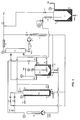
- FIG. 1 A complete schematic version of a preferred embodiment of the apparatus of the present invention is illustrated in figure 1.
- the pressured gas bottle is connected to valve 1 which delivers the gas to condenser C-1, where it is liquified.
- the condensed liquified gas is stored in the reservoir R-1.
- This liquified gas can be fed to the reservoir R-2 using valve V2.
- the gas phase existing in the reservoir R-1 can also be transferred to the reservoir R-2 via valve V3.
- the reservoir R-2 can be used as a reaction flask and is equipped with a magnetic transmission stirrer.
- the liquified gas can also be tranferred via the condenser C-2 to the pump P-1. From P-1, fluid can be fed back to reservoir via valve V4 and the condenser C-1.
- the fluid can be heated by the heat exhanger H-1 and fed to the reservoir R-2 via valve V5, or fod to the bottom side of reservoir R-3 via valve V-6, or to the top side of reservoir R-3 via valve V-7.
- Liquids, solutions, fluids, subcritical fluid or supercritical fluid existing in reservoir R-2 can be taken out and transferred via valve V-8 by the pump P-2. Inversely, substances stored in pump P-2 can be introduced back inside reservoir R-2, via valve V-8. Pump P-2 can also be used to transfer materials from the reservoir R-2 via the heat exchanger H-2 to reservoir R-3 via valve V9. Possibly, valve V10 can be used to equilibrate the pressure between the pump P-2 circuit and the reservoir R-2.
- Reservoir R-2 can be used as reaction flask for coating particles, for dissolving substances, for particles formations, for emulsions, for coacervation, for precipitation, for coprecipitation, for cristallisation, for desolvatation, for polymerization, for interfacial polymerisation, for polycondensation...
- the same operation can be done in reservoir R-3, or both reservoirs can be used in the same time, or inturn of each others, or in combination to each others.
- Reservoir R-3 and its heating or cooling jacket is designed to create gradient of temperature and density inside, thus assuming, if necessary, an internal turbulence in the fluid during experimental conditions.
- Contents of reservoir R-2 can be fed via valve V11 to the pressure controlling valve V12.
- the reservoir R-3 is also branched via V13 or V14 to the pressure controlling valve V12.
- Valve V12 is used to control the pressure during operations.
- the fluid can be decompressed in the separator S-1.
- the separator S1 From the separator S1, the gas phase can be recycled via V15 back to the reservoir R-1.
- All containers are equipped with a pressure jauge (PJ), an exhaut valve to atmosphere (Vair) and, or, drain valves (Vdrain).
- PJ pressure jauge
- Vair exhaut valve to atmosphere
- Vdrain drain valves
- Each reservoir and separator are equipped with separated cooling and heating jacket (TC) giving the possibility to obtain various temperatures at different places of the apparatus.
- TC cooling and heating jacket
- the apparatus is also equipped with several windows in order to see inside containers and with the necessary security valves and filtering devices not shown on the figure.
- Example 1 1.3 g Gelucire 50/02, an inert excipient derived from natural hydrogenated food-grade fats and oils (Source: Gattefosse S.A., F-69800 Saint Priest, France) is placed in a sealed sac formed from coffee filter paper, said sac then being attached to the shaft of the agitator placed in an autoclave (1.5 L capacity). 3.0 g HPMCP-55 (Source: Eastman, Kingsport, Tenn., USA) is then added to the autoclave as a free powder. The autoclave is sealed, agitation is initiated (430 RPM), and the interior of the autoclave is pressurized by addition of CO2 to the autoclave.
- an inert excipient derived from natural hydrogenated food-grade fats and oils (Source: Gattefosse S.A., F-69800 Saint Priest, France) is placed in a sealed sac formed from coffee filter paper, said sac then being attached to the shaft of the agitator placed in an autoclave (1.5 L capacity). 3.0 g HP
- the temperature of the contents of the autoclave is increased to 35°C.
- the pressure of the interior of the autoclave is 110 bar, so CO2 inside the autoclave is in the SCF state.
- the system is allowed to equilibrate under these conditions for 1 hr in order to allow the Gelucire 50/02 initially inside the sac sufficient time to dissolve in the SCF and migrate into the volume of the autoclave in which the particles of HPMCP-55 are suspended in the SC CO2.
- the temperature of the sealed autoclave is then slowly reduced to 27°C at an essentially linear rate over a 17 min period from 35°C thereby causing the SC CO2 suspending phase to become a mixture of liquid and gaseous CO2, said particles of HPMCP-55 being now suspended in the former.
- the autoclave is subsequently slowly depressurized to atmospheric pressure to yield particles of HPMCP-55 coated with a component of the Gelucire 50/02 (Gelucire 50/02 is a mixture of components, so the SCF process used selectively dissolves only certain components of the initial Gelucire 50/02 sample, in this case said components have a melting range of 35-40°C as shown by differential scanning calorimetry analysis of the coated particles.
- coated HPMCP-55 particles When the coated HPMCP-55 particles are placed in pH 10 buffer and observed microscopically, it is found that they dissolve at a significantly slower rate than uncoated HPMCP-55 due to the presence of the coating components extracted from Gelucire 50/02 that were deposited on the various surfaces of said particles by the SCF coating process.
- Example 2 1.3 g Gelucire 50/02, an inert excipient derived from natural hydrogenated food-grade fats and oils (Source: Gattefosse S.A., F-69800 Saint Priest, France) is placed in a sealed sac formed from coffee filter paper, said sac then being attached to the shaft of the agitator placed in an autoclave (1.5 L capacity).
- bovine serum albumin (BSA) (Source: Sigma, St. Louis, MO, USA) is then added to the autoclave as a free powder.
- the autoclave is sealed agitation is initiated (440 RPM), and the interior of the autoclave is pressurized by addition of CO2 to the autoclave.
- the temperature of the contents of the autoclave is increased to 35°C.
- the pressure of the interior of the autoclave is 110 bar, so CO2 inside the autoclave is in the SCF state.
- the system is allowed to equilibrate under these conditions for 1 hr in order to allow the Gelucire 50/02 initially inside the sac sufficient time to dissolve in the SCF and migrate into the volume of the autoclave in which the particles of BSA are suspended in the SC CO2.
- the temperature of the sealed autoclave is then reduced to 27°C by cooling at an essentially linear rate over a 17 min period from 35°C thereby causing the SC CO2 suspending phase to become a mixture of liquid and gaseous CO2, said particles of BSA being now suspended in the former.
- the autoclave is subsequently slowly depressurized to atmospheric pressure to yield particles of BSA coated with a component of the Gelucire 50/02 (Gelucire 50/02 is a mixture of components melting, so the SCF process used selectively dissolves only certain components of the initial Gelucire 50/02 sample, in this case said components have a melting range of 35-40°C as shown by differential scanning calorimetry analysis of the coated particles.
- the coated BSA particles are placed in water and observed microscopically, it is found that they dissolve at a slower rate than uncoated BSA due to the presence of coating material derived by extracting components from Gelucire 50/02, said components being deposited on the various surfaces of said particles by the SCF coating process disclosed.
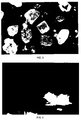
- FIG. 2A shows the starting material (BSA) observed under optical microscope. It can be seen that BSA appears as thin transparent plates.
- Figure 2B shows the BSA sample after treatment with Gelucire 50/02 used as the coating material. The sample is covered by a thin layer of gelucire and become opaque to the light.
- Example 3 1.3 g Gelucire 50/02, an inert excipient derived from natural hydrogenated food-grade fats and oils (Source: Gattefosse S.A., F-69800 Saint Priest, France) is placed in a sealed sac formed from coffee filter paper, said sac then being attached to the shaft of the agitator placed in an autoclave (1.5 L capacity).
- Hb hemoglobin
- the system is allowed to equilibrate under these conditions for 1 hr in order to allow the Gelucire 50/02 initially inside the sac sufficient time to dissolve in the SCF and migrate into the volume of the autoclave in which the particles of Hb are suspended in the SC CO2.
- the temperature of the sealed autoclave is then slowly reduced to 27°C at an essentially linear rate over a 17 min period from 35°C thereby causing the SC CO2 suspending phase to become a mixture of liquid and gaseous CO2, said particles of Hb being now suspended in the former.
- the autoclave is subsequently slowly depressurized to atmospheric pressure to yield particles of Hb coated with a component of the Gelucire 50/02 (Gelucire 50/02 is a mixture of components, so the SCF process used selectively dissolves only certain components of the initial Gelucire 50/02 sample, in this case said components have a melting range of 35-40°C as shown by differential scanning calorimetry analysis of the coated particles.
- the coated Hb particles are placed in water and observed microscopically, it is found that they dissolve at a significantly slower rate than uncoated Hb due to the presence of the Gelucire 50/02 coating deposited on the various surfaces of said particles by the SCF coating process.
- Example 4 1.3 g Gelucire 50/02, an inert excipient derived from natural hydrogenated food-grade fats and oils (Source: Gattefosse S.A., F-69800 Saint Priest, France) is placed in a sealed sac formed from coffee filter paper, said sac then being attached to the shaft of the agitator placed in an autoclave (1.5 L capacity).
- the system is allowed to equilibrate under these conditions for 1 hr in order to allow the Gelucire 50/02 initially inside the sac sufficient time to dissolve in the SCF and migrate into the volume of the autoclave in which the particles of erythrosine E are suspended in the SC CO2.
- the temperature of the sealed autoclave is then slowly reduced to 27°C at an essentially a linear rate over a 17 min period from 35°C thereby causing the SC CO2 suspending phase to become a mixture of liquid and gaseous CO2, said particles of erythrosine E being now suspended in the former.
- the autoclave is subsequently slowly depressurized to atmospheric pressure to yield particles of erythrosine E coated with a component of the Gelucire 50/02 (Gelucire 50/02 is a mixture of components, so the SCF process used selectively dissolves only certain components of the initial Gelucire 50/02 sample, in this case said components have a melting range of 35-40°C as shown by differential scanning calorimetry analysis if the coated particles.
- the coated erythrosine E particles are placed in water and observed microscopically, it is observed that they dissolve at a significantly slower rate than uncoated erythrosine E due to the presence of the coating deposited on the various surfaces of said particles by the SCF coating process.
- Example 5 1.3 g Gelucire 50/02, an inert excipient derived from natural hydrogenated food-grade fats and oils (Source: Gattefosse S.A., F-69800 Saint Priest, France) is placed in a sealed sac formed from coffee filter paper, said sac then being attached to the shaft of the agitator placed in an autoclave (1.5 L capacity).
- Juvamine a commercial vitamin C formulation that contains primarily sucrose (Source: SED, Paris, France) is then added to the autoclave as a free powder.
- the autoclave is sealed, agitation is initiated (440 RPM), and the interior of the autoclave is pressurized by addition of CO2 to the autoclave.
- the temperature of the contents of the autoclave is increased to 35°C.
- the pressure of the interior of the autoclave is 110 bar, so CO2 inside the autoclave is in the SCF state.
- the system is allowed to equilibrate under these conditions for 1 hr in order to allow the Gelucire 50/02 initially inside the sac sufficient time to dissolve in the SCF and migrate into the volume of the autoclave in which the particles of Juvamine are suspended in the SC CO2.
- the temperature of the sealed autoclave is then slowly reduced to 27°C at an essentially linear rate over a 17 min period from 35°C thereby causing the SC CO2 suspending phase to become a mixture of liquid and gaseous CO2, said particles of Juvamine being now suspended in the former.
- the autoclave is subsequently slowly depressurized to atmospheric pressure to yield particles of Juvamine coated with a component of the Gelucire 50/02 (Gelucire 50/02 is a mixture of components, so the SCF process used selectively dissolves only certain components of the initial Gelucire 50/02 sample, in this case said components have a melting range of 35-40°C as shown by differential scanning calorimetry analysis of the coated particles.
- the coated Juvamine particles are placed in water and observed microscopically, it is found that they dissolve at a significantly slower rate than uncoated particles due to the presence of the coating of the Gelucire 50/02 components deposited on the various surfaces of said particles by the SCF coating process.
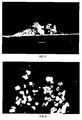
- Figure 3 shows a sample Juvamine covered by a thin layer of Gelucire 50/02 after 5 minutes in water. It can be seen that when the core materials is dissolved it remains a shell of gelucire which has the same shape as the covered cristal. In the central part of the picture, such shell was destroyed under the microscope by mechanical action of needle. It can be seen from the remaining material that the shell is formed by a very thin layer of gelucire.
- Example 6 5.0 g beeswax is placed in a sealed sac formed from coffee filter paper, said sac then being attached to the shaft of the agitator placed in an autoclave (1.5 L capacity). 2.0 BSA (Source: Sigma, St. Louis, MO, USA) is then added to the autoclave as a free powder. The autoclave is sealed, agitation is initiated (440 RPM), and the interior of the autoclave is pressurized by addition of CO2 to the autoclave. Once the autoclave is pressurized by the CO2, the temperature of the contents of the autoclave is increased to 35°C. At this point the pressure of the interior of the autoclave is 110 bar, so CO2 inside the autoclave is in the SCF state.
- 2.0 BSA Source: Sigma, St. Louis, MO, USA
- the system is allowed to equilibrate under these conditions for 1 hr in order to allow the Gelucire 50/02 initially inside the sac sufficient time to dissolve in the SCF and migrate into the volume of the autoclave in which the particles of BSA are suspended in the SC CO2.
- the temperature of the sealed autoclave is then slowly reduced to 27°C at an essentially linear rate over a 17 min period from 35°C thereby causing the SC CO2 suspending phase to become a mixture of liquid and gaseous CO2, said particles of BSA being now suspended in the former.
- the autoclave is subsequently slowly depressurized to atmospheric pressure to yield particles of BSA coated with a component of the beeswax (beeswax is a mixture of components, so the SCF process used selectively dissolves only certain components of the initial beeswax sample, in this case said components have a melting range of 35-45°C as shown by differential scanning calorimetry analysis of the coated particles).
- the coated BSA particles are placed on a glass slide and a drop of water is dropped on the particles on the slide, microscopic observation established that the coated BSA particles dissolved at a significantly slower rate than uncoated BSA particles due to the coating of the beeswax components deposited on the various surfaces of said particles by the SCF coating process. Indeed, it appeared that little BSA dissolved during an observation period of 5-10 min.
- Figure 4 shows BSA covered by a thin layer of beeswax. It can be seen that this sample is floating of the top a water drop. This shows the strong wettability difference existing between the treated sample and the starting material. Indeed the untreated starting material is completely soluble in water and thus can not stay on the surface of a water drop.
- Example 7 2.0 g paraffin wax 52-54 (Source: RP Prolabo, Paris, France) is placed in a sealed sac formed from coffee filter paper, said sac then being attached to the shaft of the agitator placed in an autoclave (1.5 L capacity). 3.0 BSA (Source: Sigma, St. Louis, MO, USA) is then added to the autoclave as a free powder. The autoclave is sealed, agitation is initiated (440 RPM), and the interior of the autoclave is pressurized by addition of CO2 to the autoclave. Once the autoclave is pressurized by the CO2, the temperature of the contents of the autoclave is increased to 35°C.
- the pressure of the interior of the autoclave is 110 bar, so CO2 inside the autoclave is in the SCF state.
- the system is allowed to equilibrate under these conditions for 1 hr in order to allow the paraffin wax 52-54 initially inside the sac sufficient time to dissolve in the SCF and migrate into the volume of the autoclave in which the particles of BSA are suspended in the SC CO2.
- the temperature of the sealed autoclave is then slowly reduced to 27°C at an essentially linear rate over a 17 min period from 35°C thereby causing the SC CO2 suspending phase to become a mixture of liquid and gaseous CO2 , said particles of BSA being now suspended in the former.
- the autoclave is subsequently slowly depressurized to atmospheric pressure to yield particles of BSA coated with a component of the paraffin wax 52-54 (paraffin wax 52-54 is a mixture of components, so the SCF process used selectively dissolves only certain components of the initial paraffin wax 52-54 sample), in this case said components have a melting range of 50-52°C as shown by differential scanning calorimetry analysis of the coated particles.
- the coated BSA particles are placed on a glass slide and a drop of water is dropped on the particles on the slide, microscopic observation established that the coated BSA particles were wetted with much more difficulty than uncoated BSA particles due to the presence of the paraffin 52-54 components deposited on the various surfaces of said particles by the SCF coating process.
- Example 8 5.0 g of the triglyceride of myristic acid, sold as Dynasan 114 (Source: Huls Aktiengellschaft, D-W-4370 Marl, Germany) is placed in a sealed sac formed from coffee filter paper, said sac then being attached to the shaft of the agitator placed in an autoclave (1.5 L capacity). 1.5 g bovine serum albumin (BSA) (Source: Sigma, St. Louis, MO, USA) is then added to the autoclave as a free powder. The autoclave is sealed, agitation is initiated (440 RPM), and the interior of the autoclave is pressurized by addition of CO2 to the autoclave.
- BSA bovine serum albumin
- the temperature of the contents of the autoclave is increased to 35°C.
- the pressure of the interior of the autoclave is 110 bar, so CO2 inside the autoclave is in the SCF state.
- the system is allowed to equilibrate under these conditions for 1 hr in order to allow the Dynasan 114 initially inside the sac sufficient time to dissolve in the SCF and migrate into the volume of the autoclave in which the particles of BSA are suspended in the SC CO2.
- the temperature of the sealed autoclave is then reduced to 27°C by cooling at an essentially linear rate over a 17 min period from 35°C thereby causing the SC CO2 suspending phase to become a mixture of liquid and gaseous CO2 , said particles of BSA being now suspended in the former.
- the autoclave is subsequently slowly depressurized to atmospheric pressure to yield particles of BSA coated with a component of the Dynasan 114 sample used(it contains a mixture of components, so the SCF process used selectively dissolves only certain components of the initial Dynasan 114 sample), in this case said components have a melting range of 50-55°C as shown by differential scanning calorimetry analysis of the coated particles.
- Example 9 5.0 g of stearic acid (Source: Merck, Schuchardt, Germany) is placed in a sealed sac formed from coffee filter paper, said sac then being attached to the shaft of the agitator placed in an autoclave (1.5 L capacity). 3 g bovine serum albumin (BSA) (Source: Sigma, St. Louis, MO, USA) is then added to the autoclave as a free powder. The autoclave is sealed, agitation is initiated (450 RPM), and the interior of the autoclave is pressurized by addition of CO2 to the autoclave. Once the autoclave is pressurized by the CO2, the temperature of the contents of the autoclave is increased to 35°C.
- BSA bovine serum albumin
- the pressure of the interior of the autoclave is 110 bar, so CO2 inside the autoclave is in the SCF state.
- the system is allowed to equilibrate under these conditions for 1 hr in order to allow the srearic acid initially inside the sac sufficient time to dissolve in the SCF and migrate into the volume of the autoclave in which the particles of BSA are suspended in the SC CO2.
- the temperature of the sealed autoclave is then reduced to 27°C by cooling at an essentially linear rate over a 17 min period from 35°C thereby causing the SC CO2 suspending phase to become a mixture of liquid and gaseous CO2, said particles of BSA being now suspended in the former.
- the autoclave is subsequently slowly depressurized to atmospheric pressure to yield particles of BSA coated with a component of the stearic acid sample used (it contains a mixture of components, so the SCF process used selectively dissolves only certain components of the initial stearic acid sample), in this case said components have a melting range of 50-55°C as shown by differential scanning calorimetry analysis of the coated particles.
- a component of the stearic acid sample used it contains a mixture of components, so the SCF process used selectively dissolves only certain components of the initial stearic acid sample
- said components have a melting range of 50-55°C as shown by differential scanning calorimetry analysis of the coated particles.
- Example 10 2.0 g of stearyl alcohol (Source: Janssen, Belgium) is placed in a sealed sac formed from coffee filter paper, said sac then being attached to the shaft of the agitator placed in an autoclave (1.5 L capacity). 3 g bovine serum ablbumin (BSA) (Source: Sigma, St. Louis, MO, USA) is then added to the autoclave as a free powder. The autoclave is sealed, agitation is initiated (440 RPM), and the interior of the autoclave is pressurized by addition of CO2 to the autoclave. Once the autoclave is pressurized by the CO2, the temperature of the contents of the autoclave is increased to 35°C.
- BSA bovine serum ablbumin
- the pressure of the interior of the autoclave is 110 bar, so CO2 inside the autoclave is in the SCF state.
- the system is allowed to equilibrate under these conditions for 1 hr in order to allow the Gelucire 50/13 initially inside the sac sufficient time to dissolve in the SCF and migrate into the volume of the autoclave in which the particles of BSA are suspended in the SC CO2.
- the temperature of the sealed autoclave is then reduced to 27°C by cooling at an essentially linear rate over a 17 min period from 35°C thereby causing the SC CO2 suspending phase to become a mixture of liquid and gaseous CO2 , said particles of BSA being now suspended in the former.
- the autoclave is subsequently slowly depressurized to atmospheric pressure to yield particles of BSA coated with a component of the stearyl alcohol sample used (it contains a mixture of components, so the SCF process used selectively dissolves only certain components of the initial stearyl alcohol sample), in this case said components have a melting range of 52-62°C as shown by differential scanning calorimetry analysis of the coated particles.
- a component of the stearyl alcohol sample used it contains a mixture of components, so the SCF process used selectively dissolves only certain components of the initial stearyl alcohol sample
- said components have a melting range of 52-62°C as shown by differential scanning calorimetry analysis of the coated particles.
- Example 11 2.0 g paraffin wax 52-54 (Source:RP Prolabo, Paris, France ) is placed in a sealed sac formed from coffee filter paper, said sac then being attached to the shaft of the agitator placed in an autoclave (1.5 L capacity). 3.0 g hemoglobin (Hb) (Source: Sigma, St. Louis, MO, USA) is then added to the autoclave as a free powder. The autoclave is sealed, agitation is initiated (240 RPM), and the interior of the autoclave is pressurized by addition of CO2 to the autoclave. Once the autoclave is pressurized by the CO2, the temperature of the contents of the autoclave is increased to 35°C.
- Hb hemoglobin
- the pressure of the interior of the autoclave is 110 bar, so CO2 inside the autoclave is in the SCF state.
- the system is allowed to equilibrate under these conditions for 1 hr in order to allow the paraffin wax 52 initially inside the sac sufficient time to dissolve in the SCF and migrate into the volume of the autoclave in which the particles of Hb are suspended in the SC CO2.
- the temperature of the sealed autoclave is then slowly reduced to 27°C at an essentially linear rate over a 17 min period from 35°C thereby causing the SC CO2 suspending phase to become a mixture of liquid and gaseous CO2 , said particles of Hb being now suspended in the former.
- the autoclave is subsequently slowly depressurized to atmospheric pressure to yield particles of Hb coated with a component of the paraffin wax 52-54 (paraffin wax 52-54 is a mixture of components, so the SCF process used selectively dissolves only certain components of the initial paraffin wax 52-54 sample), in this case said components have a melting range of 50-52°C as shown by differential scanning calorimetry analysis of the coated particles.
- the coated Hb particles are placed in water and observed microscopically, it is found that they are more difficult to wet than uncoated Hb due to the presence of the paraffin wax 52-54 components deposited on the various surfaces of said particles by the SCF coating process. Numerous flat plates and needles of crystalline paraffin 52-54 were attached to the Hb particles in such a manner that they grew away from the Hb particles in essentially a perpendicular direction.
- Example 12 2.0 g paraffin wax 52 (Source: RP Prolabo, Paris, France ) is placed in a sealed sac formed from coffee filter paper, said sac then being attached to the shaft of the agitator placed in an autoclave (1.5 L capacity). 3.0 g Juvamine, a commercial mixture of vitamin C and primarily sucrose (Source: SED, Paris, France) is then added to the autoclave as a free powder. The autoclave is sealed, agitation is initiated (440 RPM), and the interior of the autoclave is pressurized by addition of CO2 to the autoclave. Once the autoclave is pressurized by the CO2, the temperature of the contents of the autoclave is increased to 35°C.
- the pressure of the interior of the autoclave is 110 bar, so CO2 inside the autoclave is in the SCF state.
- the system is allowed to equilibrate under these conditions for 1 hr in order to allow the paraffin wax 52 initially inside the sac sufficient time to dissolve in the SCF and migrate into the volume of the autoclave in which the particles of Juvamine are suspended in the SC CO2.
- the temperature of the sealed autoclave is then slowly reduced to 27°C at an essentially linear rate over a 17 min period from 35°C thereby causing the SC CO2 suspending phase to become a mixture of liquid and gaseous CO2, said particles of Juvamine being now suspended in the former.
- the autoclave is subsequently slowly depressurized to atmospheric pressure to yield particles of Juvamine coated with a component of the paraffin wax 52-54 (paraffin wax 52-54 is a mixture of components, so the SCF process used selectively dissolves only certain components of the initial paraffin wax 52-54 sample), in this case said components are shown to have a melting range of 50-52°C as shown by differential scanning calorimetry analysis of the coated particles.
- the coated Juvamine particles are placed in water and observed microscopically, it is found that they are more difficult to wet than uncoated Juvamine due to the presence of the paraffin wax 52-54 components deposited on the surface of said particles by the SCF coating process.
- the contents of the coated particles of the Juvamine sample have completely dissolved in water, there is left a fragile shell of water-insoluble coating material that retains the geometry and external structure of uncoated crystals of sucrose, the primary component of Juvamine.
- Example 13 5.0 g beeswax (Source : APIS Centre Nursing Houseois, VISE, Belgium) is placed in a scaled sac formed from coffee filter paper, said sac then being attached to the shaft of the agitator placed in an autoclave (1.5 L capacity). 1.9 g hemoglobin (Hb) (Source: Sigma, St. Louis, MO, USA) is then added to the autoclave as a free powder. The autoclave is scaled, agitation is initiated (220 RPM), and the interior of the autoclave is pressurized by addition of CO2 to the autoclave. Once the autoclave is pressurized by the CO2, the temperature of the contents of the autoclave is increased to 35°C.
- Hb hemoglobin
- the pressure of the interior of the autoclave is 110 bar, so CO2 inside the autoclave is in the SCF state.
- the system is allowed to equilibrate under these conditions for 1 hr in order to allow the beeswax initially inside the sac sufficient time to dissolve in the SCF and migrate into the volume of the autoclave in which the particles of hemoglobin are suspended in the SC CO2 .
- the temperature of the scaled autoclave is then slowly reduced to 27°C at an essentially linear rate over a 17 min period from 35°C thereby causing the SC CO2 suspending phase to become a mixture of liquid and gaseous CO2, said particles of hemoglobin being now suspended in the former.
- the autoclave is subsequently slowly depressurized to atmospheric pressure to yield particles of hemoglobin coated with a component of the beeswax (beeswax is a mixture of components, so the SCF process used selectively dissolves only certain components of the initial beeswax sample).
- Beeswax is a mixture of components, so the SCF process used selectively dissolves only certain components of the initial beeswax sample.
- the pressure of the interior of the autoclave is 110 bar, so CO2 inside the autoclave is in the SCF state.
- the system is allowed to equilibrate under these conditions for 1 hr in order to allow the beeswax initially inside the sac sufficient time to dissolve in the SCF and migrate into the volume of the autoclave in which the particles of Juvamine are suspended in the SC CO2.
- the temperature of the scaled autoclave is then slowly reduced to 25°C at an essentially linear rate over a 20 min period from 35°C thereby causing the SC CO2 suspending phase to become a mixture of liquid and gaseous CO2, said particles of Juvamine being now suspended in the former.
- the autoclave is subsequently slowly depressurized to atmospheric pressure to yield particles of Juvamine coated with a component of the beeswax (beeswax is a mixture of components, so the SCF process used selectively dissolves only certain components of the initial beexwas sample).
- Beeswax is a mixture of components, so the SCF process used selectively dissolves only certain components of the initial beexwas sample.
- the coated Juvamine particles are placed in water and observed microscopically, it is found that they are more difficult to wet than uncoated Juvamine due to the presence of the beeswas components deposited on the surface of said particles by the SCF coating process.
- the contents of the coated particles of the Juvamine sample have completely dissolved in water, there is left a fragile shell of water-insoluble coating material that retains the geometry and external structure of uncoated crystals of sucrose, the primary component of Juvamine.
- the left part shows untreated strating material and the beeswax coated sample is placed on the right part of the picture.
- This is a picture obtained under the microscope.
- Figure 7 shows that after 15 sec the cristals of the left are under dissolution while at the right the water does not dissolve the sample with the same velocity.
- Figure 8 shows the same samples after 2 minutes under the water drop, it is clear that the starting cristals are completely dissolved (on the left) and that the coated cristals (at the right) are not yet completely be dissolved.
- Example 15 5.0 g beeswax (Source: APIS Centre Nursing Houseois, VISE, Belgium) is placed in a scaled sac formed from coffee filter paper, said sac then being attached to the shaft of the agitator placed in an autoclave (1.5 L capacity). 12 g acetaminophen is then added to the autoclave as a free powder. The autoclave is scaled, agitation is initiated (220 RPM), and the interior of the autoclave is pressurized by addition of CO2, the temperature of the contents of the autoclave is increased to 35°C. At this point the pressure of the interior of the autoclave is 110 bar, so CO2 inside the autoclave is in the SCF state.
- the system is allowed to equilibrate uner these conditions for 1 hr in order to allow the beexwax initially inside the sac sufficient time to dissolve in the SCF and migrate into the volume of the autoclave in which the particles of acetaminophen are suspended in the SC CO2.
- the temperature of the scaled autoclave is then slowly reduced to 27°C at an essentially linear rate over a 17 min period from 35°C thereby causing the SC CO2 suspending phase to become a mixture of liquid and gaseous CO2, said particles of acetaminophen being now suspended in the former.
- the autoclave is subsequently slowly depressurized to atmospheric pressure to yield particles of acetaminophen coated with a component of the beeswax (beeswax is a mixture of components, so the SCF process used selectively dissolves only certain components of the initial beeswax sample).
- beeswax is a mixture of components, so the SCF process used selectively dissolves only certain components of the initial beeswax sample.
- Example 16 5.0 g white beeswax (Source: Cocreate Pharmaceutique füre, Melun, France) is placed in a scaled sac formed from coffee filter paper, said sac then being attached to the shaft of the agitator placed in an autoclave (1.5 L capacity). 2.0 g Juvamine, a commercial mixture of vitamin C and primarily sucrose (Source: SED, Paris, France) is then added to the autoclave as a free powder. The autoclave is scaled, agitation is initiated (440 RPM) and the interior of the autoclave is pressurized by addition of CO2 to the autoclave. Once the autoclave is pressurized by the CO2, the temperature of the contents of the autoclave is increased to 35°C.
- the pressure of the interior of the autoclave is 110 bar, so CO2 inside the autoclave is in the SCF state.
- the system is allowed to equilibrate under these conditions for 1 hr in order to allow the white beeswax initially inside the sac sufficient time to dissolve in the SCF and migrate into the volume of the autoclave in which the particles of Juvamine are suspended in the SC CO2.
- the temperature of the sealed autoclave is then slowly reduced to 25°C at an essentially linear rate over a 20 min period from 35°C thereby causing the SC CO2 suspending phase to become a mixture of liquid and gaseous CO2, said particles of Juvamine being now suspended in the former.
- the autoclave is subsequently slowly depressurized to atmospheric pressure to yield particles of Juvamine coated with a component of the white beeswax (white beeswax is a mixture of components, so the SCF process used selectively dissolves only certain components of the initial white beeswax sample).
- white beeswax is a mixture of components, so the SCF process used selectively dissolves only certain components of the initial white beeswax sample.
- Example 17 5.0 g white beeswax (Source: Coherently Pharmaceutique füre, Melun, France) is placed in a scaled sac formed from coffee filter paper, said sac then being attached to the shaft of the agitator placed in an autoclave (1.5 L capacity). 2.0 g Xylitol (Source: Roquette Frées Lestrem, France) is then added to the autoclave as a free powder. the autoclave is scaled, agitation is initiated (440 RPM), and the interior of the autoclave is pressurized by addition of CO2 to the autoclave. Once the autoclave is pressurized by the CO2, the temperature of the contents of the autoclave is increased to 35°C.
- Xylitol Source: Roquette Fromme Lestrem, France
- the pressure of the interior of the autoclave is 110 bar, so CO2 inside the autoclave is in the SCF state.
- the system is allowed to equilibrate under these conditions for 1 hr in order to allow the white beeswax initially inside the sac sufficient time to dissolve in the SCF and migrate into the volume of the autoclave in which the particles of Xylitol are suspended in the SC CO2.
- the temperature of the sealed autoclave is then slowly reduced to 25°C at an essentially linear rate over a 20 min period from 35°C thereby causing the SC CO2 suspending phase to become a mixture of liquid and gaseous CO2, said particles of Xylitol being now suspended in the former.
- the autoclave is subsequently slowly depressurized to atmospheric pressure to yield particles of Xylitol coated with a component of the white beeswax (white beeswax is a mixture of components, so the SCF process used selectively dissolves only certain components of the initial white beeswax sample).
- white beeswax is a mixture of components, so the SCF process used selectively dissolves only certain components of the initial white beeswax sample.
- Example 18 5.1 g white beeswax (Source: Co relie Pharmaceutique Frangaise, Melun, France) is placed in a scaled sac formed from coffee filter paper, said sac then being attached to the shaft of the agitator placed in an autoclave (1.5 L capacity). 2.0 g potassium chloride (Source : Co relie Pharmaceutique füre, Melun, France) is then added to the autoclave as a free powder. The autoclave is sealed, agitation is initiated (440 RPM), and the interior of the autoclave is pressurized by addition of CO2 to the autoclave. Once the autoclave is pressurized by the CO2, the temperature of the contents of the autoclave is increased to 35°C.
- the pressure of the interior of the autoclave is 110 bar, so CO2 inside the autoclave is in the SCF state.
- the system is allowed to equilibrate under these conditions for 1 hr in order to allow the white beeswax initially inside the sac sufficient time to dissolve in the SCF and migrate into the volume of the autoclave in which the particles of potassium chloride are suspended in the SC CO2.
- the temperature of the scaled autoclave is then slowly reduced to 25°C at an essentially linear rate over a 20 min period from 35°C thereby causing the SC CO2 suspending phase to become a mixture of liquid and gaseous CO2, said particles of potassium chloride being now suspended in the former.
- the autoclave is subsequently slowly depressurized to atmospheric pressure to yield particles of potassium chloride coated with a component of the white beeswax (white beeswax is a mixture of components, so the SCF process used selectively dissolves only certain components of the initial white beeswax sample).
- white beeswax is a mixture of components, so the SCF process used selectively dissolves only certain components of the initial white beeswax sample.
- the system is allowed to equilibrate under these conditions for 1 hr in order to allow the beeswax initially inside the sac sufficient time to dissolve in the SCF and migrate into the volume of the autoclave in which the particles of acetaminophen are suspended in the SC CO2.
- the temperature of the scaled autoclave is then slowly reduced to 27°C at an essentially linear rate over a 17 min period from 35°C thereby causing the SC CO2 suspending phase to become a mixture of liquid and gaseous CO2, said particles of acetaminophen being now suspended in the former.
- the autoclave is subsequently slowly depressurized to atmospheric pressure to yield particles of acetaminophen coated with a component of the Myvacct 7-07 (Myvacct 7-07 is a mixture of components, so the SCF process used selectively dissolves only certain components of the initial Myvacet 7-07 sample).
- Myvacct 7-07 is a mixture of components, so the SCF process used selectively dissolves only certain components of the initial Myvacet 7-07 sample.
- the pressure of the interior of the autoclave is 200 bar, so CO2 inside the autoclave is in the SCF state.
- the system is allowed to equilibrate under these conditions for 1 hr in order to allow the white beeswax initially inside the sac sufficient time to dissolve in the SCF and migrate into the volume of the autoclave in which the particles of Gentamicin sulfate are suspended in the SC CO2.
- the temperature of the scaled autoclave is then slowly reduced to 20°C at an essentially linear rate over a 65 min period from 45°C thereby causing the SC CO2 suspending phase to become a mixture of liquid and gaseous CO2, said particles of Gentamicin sulfate being now suspended in the former.
- the autoclave is subsequently slowly depressurized to atmospheric pressure to yield particles of Gentamicin sulfate coated with a component of the white beeswax (white beeswax is a mixture of components, so the SCF process used selectively dissolves only certain components of the innitial white beeswas sample).
- the coated Gentamicin sulfate particles are placed in water and observed microscopically, it is found that they are much more difficult to wet than uncoated Gentamicin sulfate due to the presence of the white beeswax components deposited on the surface of said particles by the SCF coating process.
Landscapes
- Chemical & Material Sciences (AREA)
- Health & Medical Sciences (AREA)
- Organic Chemistry (AREA)
- Public Health (AREA)
- Dispersion Chemistry (AREA)
- Pharmacology & Pharmacy (AREA)
- Epidemiology (AREA)
- Life Sciences & Earth Sciences (AREA)
- Animal Behavior & Ethology (AREA)
- General Health & Medical Sciences (AREA)
- Engineering & Computer Science (AREA)
- Veterinary Medicine (AREA)
- Medicinal Chemistry (AREA)
- Bioinformatics & Cheminformatics (AREA)
- Chemical Kinetics & Catalysis (AREA)
- Medicinal Preparation (AREA)
- Glanulating (AREA)
- Manufacturing Of Micro-Capsules (AREA)
- Processes Of Treating Macromolecular Substances (AREA)
- Medical Preparation Storing Or Oral Administration Devices (AREA)
- Application Of Or Painting With Fluid Materials (AREA)
- Fats And Perfumes (AREA)
Priority Applications (11)
| Application Number | Priority Date | Filing Date | Title |
|---|---|---|---|
| EP94402251A EP0706821A1 (fr) | 1994-10-06 | 1994-10-06 | Procédé pour l'enrobage de particules |
| AT95935914T ATE176764T1 (de) | 1994-10-06 | 1995-10-06 | Verfahren zum umhuellen von teilchen |
| DE69507891T DE69507891T2 (de) | 1994-10-06 | 1995-10-06 | Verfahren zum umhuellen von teilchen |
| JP51232896A JP4122053B2 (ja) | 1994-10-06 | 1995-10-06 | 粒子のコーティング方法 |
| PCT/EP1995/003953 WO1996011055A1 (fr) | 1994-10-06 | 1995-10-06 | Procede de revetement de particules |
| EP95935914A EP0784506B1 (fr) | 1994-10-06 | 1995-10-06 | Procede de revetement de particules |
| DK95935914T DK0784506T3 (da) | 1994-10-06 | 1995-10-06 | Fremgangsmåde til coating af partikler |
| CA002201864A CA2201864C (fr) | 1994-10-06 | 1995-10-06 | Procede de revetement de particules |
| US08/817,305 US6087003A (en) | 1994-10-06 | 1995-10-06 | Method of coating particles and coated spherical particles |
| ES95935914T ES2130666T3 (es) | 1994-10-06 | 1995-10-06 | Procedimiento de revestimiento de particulas. |
| GR990401308T GR3030282T3 (en) | 1994-10-06 | 1999-05-13 | Method of coating particles |
Applications Claiming Priority (1)
| Application Number | Priority Date | Filing Date | Title |
|---|---|---|---|
| EP94402251A EP0706821A1 (fr) | 1994-10-06 | 1994-10-06 | Procédé pour l'enrobage de particules |
Publications (1)
| Publication Number | Publication Date |
|---|---|
| EP0706821A1 true EP0706821A1 (fr) | 1996-04-17 |
Family
ID=8218046
Family Applications (2)
| Application Number | Title | Priority Date | Filing Date |
|---|---|---|---|
| EP94402251A Withdrawn EP0706821A1 (fr) | 1994-10-06 | 1994-10-06 | Procédé pour l'enrobage de particules |
| EP95935914A Expired - Lifetime EP0784506B1 (fr) | 1994-10-06 | 1995-10-06 | Procede de revetement de particules |
Family Applications After (1)
| Application Number | Title | Priority Date | Filing Date |
|---|---|---|---|
| EP95935914A Expired - Lifetime EP0784506B1 (fr) | 1994-10-06 | 1995-10-06 | Procede de revetement de particules |
Country Status (10)
| Country | Link |
|---|---|
| US (1) | US6087003A (fr) |
| EP (2) | EP0706821A1 (fr) |
| JP (1) | JP4122053B2 (fr) |
| AT (1) | ATE176764T1 (fr) |
| CA (1) | CA2201864C (fr) |
| DE (1) | DE69507891T2 (fr) |
| DK (1) | DK0784506T3 (fr) |
| ES (1) | ES2130666T3 (fr) |
| GR (1) | GR3030282T3 (fr) |
| WO (1) | WO1996011055A1 (fr) |
Cited By (23)
| Publication number | Priority date | Publication date | Assignee | Title |
|---|---|---|---|---|
| WO1997014407A1 (fr) * | 1995-10-17 | 1997-04-24 | Research Triangle Pharmaceuticals | Administration de medicaments insolubles |
| FR2753639A1 (fr) * | 1996-09-25 | 1998-03-27 | Microencapsulation Centre | Procede de preparation de microcapsules de matieres actives enrobees par un polymere et nouvelles microcapsules notamment obtenues selon le procede |
| WO1998015348A1 (fr) * | 1996-10-08 | 1998-04-16 | University Of Delaware | Processus de microencapsulation mettant en oeuvre des fluides supercritiques |
| DE19711393C1 (de) * | 1997-03-19 | 1998-08-13 | Fraunhofer Ges Forschung | Verfahren zum Mikroverkapseln von Partikeln |
| EP1016454A1 (fr) * | 1998-12-28 | 2000-07-05 | Basf Aktiengesellschaft | Procédé et dispositif de préparation de poudres stables finement divisés |
| FR2797398A1 (fr) * | 1999-08-11 | 2001-02-16 | Mainelab | Microparticules pour administration pulmonaire |
| FR2800613A1 (fr) * | 1999-11-10 | 2001-05-11 | Sanofi Synthelabo | Procede pour le pelliculage de comprimes |
| WO2001049407A1 (fr) * | 2000-01-07 | 2001-07-12 | Separex (Societe Anonyme) | Procede de captage et d"encapsulation de fines particules |
| WO2001089481A1 (fr) * | 2000-05-23 | 2001-11-29 | Mainelab | Microspheres a liberation prolongee pour administration injectable et procede de preparation |
| US6387385B1 (en) | 1998-11-12 | 2002-05-14 | Fmc Corporation | Process to prepare microencapsulated formulations |
| EP1028820A4 (fr) * | 1997-10-15 | 2003-05-07 | Univ South Florida | Revetement de matiere particulaire a l'aide d'un fluide supercritique |
| US6561220B2 (en) * | 2001-04-23 | 2003-05-13 | International Business Machines, Corp. | Apparatus and method for increasing throughput in fluid processing |
| WO2003075881A1 (fr) * | 2002-03-09 | 2003-09-18 | Beiersdorf Ag | Particules de substance active cosmetiques enrobees de cire |
| FR2854071A1 (fr) * | 2003-04-25 | 2004-10-29 | Ethypharm Sa | Procede de dispersion de substances hydrosolubles ou hydrophiles dans un fluide a pression supercritique |
| WO2004091769A3 (fr) * | 2003-04-10 | 2004-11-25 | Separex Sa | Procede et installation d’encapsulation de composes actifs au sein d’un excipient |
| WO2004091571A3 (fr) * | 2003-04-08 | 2005-04-14 | New Jersey Tech Inst | Revetement/enrobage de nanoparticules au moyen de polymeres par un procede par antisolvant supercritique |
| US6967028B2 (en) | 2000-07-31 | 2005-11-22 | Mainelab | Prolonged release microspheres for injectable administration |
| WO2006074666A3 (fr) * | 2005-01-17 | 2007-02-15 | Nanon As | Procede permettant d'enrober une surface polymere avec un revetement contenant un polymere et un element comprenant un polymere enrobe d'un polymere |
| US7390411B2 (en) | 2001-10-12 | 2008-06-24 | Pierre Fabre Medicament | Method for preparing a compound of interaction of active substances with a porous support using supercritical fluid |
| FR2925488A1 (fr) * | 2007-12-19 | 2009-06-26 | Snpe Materiaux Energetiques Sa | Desensibilisation par enrobage de cristaux de substances energetiques explosives ; cristaux de telles substances enrobes, materiaux energetiques. |
| EP2289561A1 (fr) | 2003-04-25 | 2011-03-02 | Pierre Fabre Médicament | Procédé de préparation de complexes moleculaires |
| DE102018210030A1 (de) | 2018-06-20 | 2019-12-24 | Thyssenkrupp Ag | Verwendung und Recyclieren von überkritischen CO2 als Lösungsmittel für PLA und weitere biologisch abbaubaren Polymere in das Beschichtungsverfahren für Düngemittel |
| US11065593B2 (en) | 2015-09-03 | 2021-07-20 | Tagra Biotechnologies Ltd. | Microcapsules encapsulating a reflective agent |
Families Citing this family (36)
| Publication number | Priority date | Publication date | Assignee | Title |
|---|---|---|---|---|
| US6299937B1 (en) * | 1996-10-28 | 2001-10-09 | Douglas S. Richart | Methods and means for modifying the surfaces of polymeric solids |
| US20030148024A1 (en) * | 2001-10-05 | 2003-08-07 | Kodas Toivo T. | Low viscosity precursor compositons and methods for the depositon of conductive electronic features |
| WO2000024423A1 (fr) * | 1998-10-26 | 2000-05-04 | Tanabe Seiyaku Co., Ltd. | Particules a liberation prolongee |
| US6984404B1 (en) | 1998-11-18 | 2006-01-10 | University Of Florida Research Foundation, Inc. | Methods for preparing coated drug particles and pharmaceutical formulations thereof |
| DE19925184A1 (de) * | 1999-05-26 | 2000-11-30 | Schering Ag | Kontinuierliches Verfahren zur Herstellung von morphologisch einheitlichen Mikro- und Nanopartikeln mittels Mikromischer sowie nach diesem Verfahren hergestellte Partikel |
| US6406745B1 (en) | 1999-06-07 | 2002-06-18 | Nanosphere, Inc. | Methods for coating particles and particles produced thereby |
| FR2803538B1 (fr) * | 1999-12-15 | 2002-06-07 | Separex Sa | Procede et dispositif de captage de fines particules par percolation dans un lit de granules |
| US20030215572A1 (en) * | 2000-10-10 | 2003-11-20 | Naoki Nojiri | Process for preparing composite particles |
| DE60109701T2 (de) | 2000-10-10 | 2006-03-09 | Kao Corp. | Verfahren zur Herstellung von Verbundpartikeln |
| US20020176927A1 (en) * | 2001-03-29 | 2002-11-28 | Kodas Toivo T. | Combinatorial synthesis of material systems |
| DE10120821A1 (de) * | 2001-04-27 | 2002-10-31 | Sachtleben Chemie Gmbh | Mit Polyalken beschichtete, poröse Füllstoffe |
| EP1401404B1 (fr) * | 2001-05-30 | 2008-04-16 | Csir | Procede d'encapsulation d'une substance active |
| US20030044514A1 (en) * | 2001-06-13 | 2003-03-06 | Richard Robert E. | Using supercritical fluids to infuse therapeutic on a medical device |
| DE60211004T2 (de) * | 2001-10-10 | 2006-08-31 | Boehringer Ingelheim Pharmaceuticals, Inc., Ridgefield | Pulververarbeitung mit unter druck stehenden gasförmigen fluids |
| GB0205868D0 (en) * | 2002-03-13 | 2002-04-24 | Univ Nottingham | Polymer composite with internally distributed deposition matter |
| US7034084B2 (en) * | 2002-07-08 | 2006-04-25 | Bridgestone Corporation | Process and apparatus for the hydrogenation of polymers under supercritical conditions |
| EP1405665A1 (fr) * | 2002-10-01 | 2004-04-07 | Alarvita Biolife Corporation | Particule contenant des substances chimiques encastrées, et son procédé de production |
| US6966990B2 (en) | 2002-10-11 | 2005-11-22 | Ferro Corporation | Composite particles and method for preparing |
| US20060029666A1 (en) * | 2002-12-12 | 2006-02-09 | Te-Chun Tsou | Particle embedded with chemical substances and method of producing a particle |
| US7083748B2 (en) * | 2003-02-07 | 2006-08-01 | Ferro Corporation | Method and apparatus for continuous particle production using supercritical fluid |
| US20040184995A1 (en) * | 2003-03-17 | 2004-09-23 | Yamanouchi Pharmaceutical Co., Ltd. | Novel dry powder inhalation for lung-delivery and manufacturing method thereof |
| US20060008531A1 (en) * | 2003-05-08 | 2006-01-12 | Ferro Corporation | Method for producing solid-lipid composite drug particles |
| FR2861088B1 (fr) * | 2003-10-13 | 2006-01-20 | Centre Nat Rech Scient | Procede d'obtention d'un materiau composite ferroelectrique |
| WO2005123846A1 (fr) * | 2004-06-22 | 2005-12-29 | Canon Kabushiki Kaisha | Colorant dispersible et sa méthode de production, encre aqueuse utilisant ce colorant dispersible, réservoir d’encre, enregistreur à jet d’encre, méthode d’enregistrement à jet d’encre et image enregistrée à jet d’encre |
| WO2006001521A1 (fr) * | 2004-06-25 | 2006-01-05 | Canon Kabushiki Kaisha | Colorant dispersible, procédé de fabrication dudit colorant dispersible, encre aqueuse utilisant ledit colorant dispersible, réservoir d’encre, enregistreur à jet d’encre, procédé d’enregistrement à jet d’encre, et image enregistrée par jet d |
| WO2006057374A1 (fr) * | 2004-11-29 | 2006-06-01 | Japan Science And Technology Agency | Procede de preparation de particules fines composites |
| EP1904219A4 (fr) * | 2005-07-15 | 2011-07-27 | Map Pharmaceuticals Inc | Procede de formation de particules |
| WO2007011989A2 (fr) * | 2005-07-15 | 2007-01-25 | Map Pharmaceuticals, Inc. | Multiples principes actifs pharmaceutiques combines dans des particules d'inhalation discretes et leurs formulations |
| JP2008311277A (ja) * | 2007-06-12 | 2008-12-25 | Elpida Memory Inc | 成膜処理装置および成膜処理方法 |
| EP2048642A1 (fr) * | 2007-10-10 | 2009-04-15 | Barco NV | Réduction de la visibilité des erreurs d'affichage |
| GB0812742D0 (en) * | 2008-07-11 | 2008-08-20 | Critical Pharmaceuticals Ltd | Process |
| FR2943544B1 (fr) | 2009-03-31 | 2012-04-20 | Univ Angers | Procede de preparation de capsules lipidiques fonctionnalisees. |
| US20100291221A1 (en) * | 2009-05-15 | 2010-11-18 | Robert Owen Cook | Method of administering dose-sparing amounts of formoterol fumarate-budesonide combination particles by inhalation |
| JP6283847B2 (ja) * | 2013-08-30 | 2018-02-28 | 国立大学法人 熊本大学 | コア・シェル複合粒子の製造方法 |
| JP2022022663A (ja) * | 2020-06-30 | 2022-02-07 | 学校法人福岡大学 | コーティング粒子の製造方法 |
| CN112494336A (zh) * | 2020-12-14 | 2021-03-16 | 重庆华森制药股份有限公司 | 铝碳酸镁咀嚼片的智能制造方法与系统 |
Citations (2)
| Publication number | Priority date | Publication date | Assignee | Title |
|---|---|---|---|---|
| FR2171934A1 (fr) * | 1972-02-16 | 1973-09-28 | Rhone Poulenc Sa | |
| EP0616801A1 (fr) * | 1993-03-24 | 1994-09-28 | Ciba-Geigy Ag | Procédé pour la préparation à haute pression d'une dispersion de liposomes |
Family Cites Families (11)
| Publication number | Priority date | Publication date | Assignee | Title |
|---|---|---|---|---|
| DE3203849A1 (de) * | 1982-02-02 | 1983-08-11 | Schering Ag, 1000 Berlin Und 4619 Bergkamen | Duengemittel mit gesteuertem beginn der naehrstoffabgabe |
| DE3321053A1 (de) * | 1983-06-08 | 1984-12-13 | Schering AG, 1000 Berlin und 4709 Bergkamen | Duengemittel mit langzeitwirkung und programmierter naehrstoffabgabe |
| US4598006A (en) * | 1985-05-02 | 1986-07-01 | Hercules Incorporated | Method for impregnating a thermoplastic polymer |
| US5770459A (en) * | 1986-04-30 | 1998-06-23 | Igen International, Inc. | Methods and apparatus for improved luminescence assays using particle concentration, electrochemical generation of chemiluminescence detection |
| WO1992011083A1 (fr) * | 1987-09-28 | 1992-07-09 | Redding Bruce K Jr | Procede et appareil servant a fabriquer des microcapsules |
| DE3744329A1 (de) * | 1987-12-28 | 1989-07-06 | Schwarz Pharma Gmbh | Verfahren zur herstellung einer mindestens einen wirkstoff und einen traeger umfassenden zubereitung |
| US5069972A (en) * | 1988-09-12 | 1991-12-03 | Versic Ronald J | Moldable microcapsule that contains a high percentage of solid core material, and method of manufacture thereof |
| DE69220317T2 (de) * | 1991-10-01 | 1997-10-16 | Takeda Chemical Industries Ltd | Mikropartikeln-Zusammenfassung zur verlängerten Freigabe und Herstellung derselbe |
| AU4198793A (en) * | 1992-07-24 | 1994-01-27 | Takeda Chemical Industries Ltd. | Microparticle preparation and production thereof |
| US5753261A (en) * | 1993-02-12 | 1998-05-19 | Access Pharmaceuticals, Inc. | Lipid-coated condensed-phase microparticle composition |
| US5766637A (en) * | 1996-10-08 | 1998-06-16 | University Of Delaware | Microencapsulation process using supercritical fluids |
-
1994
- 1994-10-06 EP EP94402251A patent/EP0706821A1/fr not_active Withdrawn
-
1995
- 1995-10-06 US US08/817,305 patent/US6087003A/en not_active Expired - Lifetime
- 1995-10-06 ES ES95935914T patent/ES2130666T3/es not_active Expired - Lifetime
- 1995-10-06 DE DE69507891T patent/DE69507891T2/de not_active Expired - Lifetime
- 1995-10-06 WO PCT/EP1995/003953 patent/WO1996011055A1/fr not_active Ceased
- 1995-10-06 AT AT95935914T patent/ATE176764T1/de active
- 1995-10-06 CA CA002201864A patent/CA2201864C/fr not_active Expired - Lifetime
- 1995-10-06 EP EP95935914A patent/EP0784506B1/fr not_active Expired - Lifetime
- 1995-10-06 JP JP51232896A patent/JP4122053B2/ja not_active Expired - Fee Related
- 1995-10-06 DK DK95935914T patent/DK0784506T3/da active
-
1999
- 1999-05-13 GR GR990401308T patent/GR3030282T3/el unknown
Patent Citations (2)
| Publication number | Priority date | Publication date | Assignee | Title |
|---|---|---|---|---|
| FR2171934A1 (fr) * | 1972-02-16 | 1973-09-28 | Rhone Poulenc Sa | |
| EP0616801A1 (fr) * | 1993-03-24 | 1994-09-28 | Ciba-Geigy Ag | Procédé pour la préparation à haute pression d'une dispersion de liposomes |
Non-Patent Citations (2)
| Title |
|---|
| D.W. MATSON, R.C. PETERSEN, R.D. SMITH: "Production of powders and films by the rapid expansion of supercritical solutions", JOURNAL OF MATERIAL SCIENCE, no. 222, pages 1919 - 1928 * |
| JOURNAL OF AEROSOL SCIENCE, vol. 22, no. 5, pages 555 - 583 * |
Cited By (41)
| Publication number | Priority date | Publication date | Assignee | Title |
|---|---|---|---|---|
| US6576264B1 (en) | 1995-10-17 | 2003-06-10 | Skyepharma Canada Inc. | Insoluble drug delivery |
| WO1997014407A1 (fr) * | 1995-10-17 | 1997-04-24 | Research Triangle Pharmaceuticals | Administration de medicaments insolubles |
| US6974593B2 (en) | 1995-10-17 | 2005-12-13 | Jagotec Ag | Insoluble drug delivery |
| US6183783B1 (en) | 1996-09-25 | 2001-02-06 | Mainlab | Method for preparing microcapsules comprising active materials coated with a polymer and novel microcapsules in particular obtained according to the method |
| FR2753639A1 (fr) * | 1996-09-25 | 1998-03-27 | Microencapsulation Centre | Procede de preparation de microcapsules de matieres actives enrobees par un polymere et nouvelles microcapsules notamment obtenues selon le procede |
| WO1998013136A1 (fr) * | 1996-09-25 | 1998-04-02 | Mainelab | Procede de preparation de microcapsules de matieres actives enrobees par un polymere et nouvelles microcapsules notamment obtenues selon le procede |
| WO1998015348A1 (fr) * | 1996-10-08 | 1998-04-16 | University Of Delaware | Processus de microencapsulation mettant en oeuvre des fluides supercritiques |
| AU713965B2 (en) * | 1996-10-08 | 1999-12-16 | University Of Delaware | Microencapsulation process using supercritical fluids |
| EP0865819A1 (fr) * | 1997-03-19 | 1998-09-23 | Fraunhofer-Gesellschaft Zur Förderung Der Angewandten Forschung E.V. | Procédé de microencapsulation de particules |
| DE19711393C1 (de) * | 1997-03-19 | 1998-08-13 | Fraunhofer Ges Forschung | Verfahren zum Mikroverkapseln von Partikeln |
| EP1028820A4 (fr) * | 1997-10-15 | 2003-05-07 | Univ South Florida | Revetement de matiere particulaire a l'aide d'un fluide supercritique |
| US6387385B1 (en) | 1998-11-12 | 2002-05-14 | Fmc Corporation | Process to prepare microencapsulated formulations |
| EP1016454A1 (fr) * | 1998-12-28 | 2000-07-05 | Basf Aktiengesellschaft | Procédé et dispositif de préparation de poudres stables finement divisés |
| WO2001012160A1 (fr) * | 1999-08-11 | 2001-02-22 | Mainelab | Microparticules pour administration pulmonaire |
| AU784168B2 (en) * | 1999-08-11 | 2006-02-16 | Ethypharm S.A. | Microparticles for pulmonary administration |
| FR2797398A1 (fr) * | 1999-08-11 | 2001-02-16 | Mainelab | Microparticules pour administration pulmonaire |
| WO2001034122A1 (fr) * | 1999-11-10 | 2001-05-17 | Sanofi-Synthelabo | Procede pour le pelliculage de comprimes |
| FR2800613A1 (fr) * | 1999-11-10 | 2001-05-11 | Sanofi Synthelabo | Procede pour le pelliculage de comprimes |
| FR2803539A1 (fr) * | 2000-01-07 | 2001-07-13 | Separex Sa | Procede de captage et d'encapsulation de fines particules |
| WO2001049407A1 (fr) * | 2000-01-07 | 2001-07-12 | Separex (Societe Anonyme) | Procede de captage et d"encapsulation de fines particules |
| WO2001089481A1 (fr) * | 2000-05-23 | 2001-11-29 | Mainelab | Microspheres a liberation prolongee pour administration injectable et procede de preparation |
| FR2809309A1 (fr) * | 2000-05-23 | 2001-11-30 | Mainelab | Microspheres a liberation prolongee pour administration injectable |
| KR100787669B1 (ko) * | 2000-05-23 | 2007-12-21 | 멘느랍 | 주사가능한 투여용 장기 방출형 미소구체 및 이의 제조방법 |
| AU2001263996B2 (en) * | 2000-05-23 | 2006-01-19 | Ethypharm S.A. | Prolonged release microspheres for injection delivery and preparation method |
| US6967028B2 (en) | 2000-07-31 | 2005-11-22 | Mainelab | Prolonged release microspheres for injectable administration |
| US6561220B2 (en) * | 2001-04-23 | 2003-05-13 | International Business Machines, Corp. | Apparatus and method for increasing throughput in fluid processing |
| US7390411B2 (en) | 2001-10-12 | 2008-06-24 | Pierre Fabre Medicament | Method for preparing a compound of interaction of active substances with a porous support using supercritical fluid |
| WO2003075881A1 (fr) * | 2002-03-09 | 2003-09-18 | Beiersdorf Ag | Particules de substance active cosmetiques enrobees de cire |
| WO2004091571A3 (fr) * | 2003-04-08 | 2005-04-14 | New Jersey Tech Inst | Revetement/enrobage de nanoparticules au moyen de polymeres par un procede par antisolvant supercritique |
| WO2004091769A3 (fr) * | 2003-04-10 | 2004-11-25 | Separex Sa | Procede et installation d’encapsulation de composes actifs au sein d’un excipient |
| EP2289561A1 (fr) | 2003-04-25 | 2011-03-02 | Pierre Fabre Médicament | Procédé de préparation de complexes moleculaires |
| FR2854071A1 (fr) * | 2003-04-25 | 2004-10-29 | Ethypharm Sa | Procede de dispersion de substances hydrosolubles ou hydrophiles dans un fluide a pression supercritique |
| WO2004096173A3 (fr) * | 2003-04-25 | 2005-07-28 | Ethypharm Sa | Procede de dispersion de substances hydrosolubles ou hydrophiles dans un fluide a pression supercritique |
| US8741346B2 (en) | 2003-04-25 | 2014-06-03 | Pierre Fabre Medicament | Method for the preparation of molecular complexes |
| WO2006074666A3 (fr) * | 2005-01-17 | 2007-02-15 | Nanon As | Procede permettant d'enrober une surface polymere avec un revetement contenant un polymere et un element comprenant un polymere enrobe d'un polymere |
| FR2925488A1 (fr) * | 2007-12-19 | 2009-06-26 | Snpe Materiaux Energetiques Sa | Desensibilisation par enrobage de cristaux de substances energetiques explosives ; cristaux de telles substances enrobes, materiaux energetiques. |
| WO2009081048A3 (fr) * | 2007-12-19 | 2010-04-08 | Snpe Materiaux Energetiques | Desensibilisation par enrobage de cristaux de substances energetiques explosives; cristaux de telles substances enrobes; materiaux energetiques. |
| US11065593B2 (en) | 2015-09-03 | 2021-07-20 | Tagra Biotechnologies Ltd. | Microcapsules encapsulating a reflective agent |
| DE102018210030A1 (de) | 2018-06-20 | 2019-12-24 | Thyssenkrupp Ag | Verwendung und Recyclieren von überkritischen CO2 als Lösungsmittel für PLA und weitere biologisch abbaubaren Polymere in das Beschichtungsverfahren für Düngemittel |
| WO2019243204A1 (fr) | 2018-06-20 | 2019-12-26 | Thyssenkrupp Industrial Solutions Ag | Utilisation de co2 supercritique en tant que solvant pour des polymères organiques dans un procédé de revêtement pour un granulé contenant de l'urée |
| US12172144B2 (en) | 2018-06-20 | 2024-12-24 | Thyssenkrupp Uhde Gmbh | Use of supercritical CO2 as solvent for organic polymers in a method for coating urea-containing granules |
Also Published As
| Publication number | Publication date |
|---|---|
| US6087003A (en) | 2000-07-11 |
| GR3030282T3 (en) | 1999-09-30 |
| EP0784506B1 (fr) | 1999-02-17 |
| EP0784506A1 (fr) | 1997-07-23 |
| ATE176764T1 (de) | 1999-03-15 |
| CA2201864A1 (fr) | 1996-04-18 |
| CA2201864C (fr) | 2004-03-23 |
| WO1996011055A1 (fr) | 1996-04-18 |
| DK0784506T3 (da) | 1999-09-20 |
| ES2130666T3 (es) | 1999-07-01 |
| JPH10510243A (ja) | 1998-10-06 |
| JP4122053B2 (ja) | 2008-07-23 |
| DE69507891T2 (de) | 1999-10-14 |
| DE69507891D1 (de) | 1999-03-25 |
Similar Documents
| Publication | Publication Date | Title |
|---|---|---|
| US6087003A (en) | Method of coating particles and coated spherical particles | |
| CA2050911C (fr) | Procede d'encapsulation en microcapsule et produits encapsules | |
| JP4778997B2 (ja) | 加圧ガス状流体による粉末処理 | |
| Agnihotri et al. | Microencapsulation–a novel approach in drug delivery: a review | |
| EP1033973B1 (fr) | Procede d'encapsulage | |
| FR2491351A1 (fr) | Procede de microcapsulation | |
| WO2005016485A1 (fr) | Particules composites et procede de preparation associe | |
| Bodmeier et al. | Process and formulation variables in the preparation of wax microparticles by a melt dispersion technique. II. W/O/W multiple emulsion technique for water-soluble drugs | |
| Garg et al. | Microencapsulation techniques in pharmaceutical formulation | |
| IL181623A (en) | Powder coating method | |
| Tarun et al. | Patented microencapsulation techniques and its application | |
| Kikic et al. | Applications of supercritical fluids to pharmaceuticals: controlled drug release systems | |
| Harshitha et al. | A Cutting-Edge Method for Regulated Drug Delivery-Microencapsulation | |
| Chang et al. | Organic solvent-free polymeric microspheres prepared from aqueous colloidal polymer dispersions by aw/o-emulsion technique | |
| Salve et al. | International journal of current research and academic review | |
| Garg | MICROPARTICLE DRUG DELIVERY SCIENCES | |
| Akhtar et al. | The New Developed Concepts and Trends in Microencapsulation | |
| Khamborkar et al. | Microencapsulation techniques, factors influencing encapsulation efficiency | |
| Jiang et al. | Preparation and characterization of ethyl cellulose-based core–shell microcapsules containing argy wormwood solution | |
| Tech | Microencapsulation techniques and its practice | |
| HK1029931B (en) | Encapsulation method |
Legal Events
| Date | Code | Title | Description |
|---|---|---|---|
| PUAI | Public reference made under article 153(3) epc to a published international application that has entered the european phase |
Free format text: ORIGINAL CODE: 0009012 |
|
| 17P | Request for examination filed |
Effective date: 19950613 |
|
| AK | Designated contracting states |
Kind code of ref document: A1 Designated state(s): FR GB |
|
| 17Q | First examination report despatched |
Effective date: 19960611 |
|
| STAA | Information on the status of an ep patent application or granted ep patent |
Free format text: STATUS: THE APPLICATION IS DEEMED TO BE WITHDRAWN |
|
| 18D | Application deemed to be withdrawn |
Effective date: 19970402 |