EP0706982B1 - Procede de separation d'isomeres optiques - Google Patents
Procede de separation d'isomeres optiques Download PDFInfo
- Publication number
- EP0706982B1 EP0706982B1 EP95916011A EP95916011A EP0706982B1 EP 0706982 B1 EP0706982 B1 EP 0706982B1 EP 95916011 A EP95916011 A EP 95916011A EP 95916011 A EP95916011 A EP 95916011A EP 0706982 B1 EP0706982 B1 EP 0706982B1
- Authority
- EP
- European Patent Office
- Prior art keywords
- group
- polysaccharide
- separation
- optical isomers
- optical
- Prior art date
- Legal status (The legal status is an assumption and is not a legal conclusion. Google has not performed a legal analysis and makes no representation as to the accuracy of the status listed.)
- Expired - Lifetime
Links
- 230000003287 optical effect Effects 0.000 title claims abstract description 96
- 238000000034 method Methods 0.000 title claims abstract description 43
- 229920001282 polysaccharide Polymers 0.000 claims abstract description 59
- 239000005017 polysaccharide Substances 0.000 claims abstract description 59
- 239000002245 particle Substances 0.000 claims abstract description 39
- 239000000203 mixture Substances 0.000 claims abstract description 24
- 150000002148 esters Chemical class 0.000 claims abstract description 8
- 150000004676 glycans Chemical class 0.000 claims abstract 14
- 239000003480 eluent Substances 0.000 claims description 35
- 238000000926 separation method Methods 0.000 claims description 35
- 239000000945 filler Substances 0.000 claims description 26
- 239000012530 fluid Substances 0.000 claims description 25
- 239000000126 substance Substances 0.000 claims description 22
- 229920002678 cellulose Polymers 0.000 claims description 12
- 239000001913 cellulose Substances 0.000 claims description 12
- 125000003277 amino group Chemical group 0.000 claims description 8
- 125000002887 hydroxy group Chemical group [H]O* 0.000 claims description 8
- 238000006116 polymerization reaction Methods 0.000 claims description 7
- 125000003118 aryl group Chemical group 0.000 claims description 6
- 125000004429 atom Chemical group 0.000 claims description 6
- 125000001183 hydrocarbyl group Chemical group 0.000 claims description 6
- 125000001424 substituent group Chemical group 0.000 claims description 6
- 125000004642 (C1-C12) alkoxy group Chemical group 0.000 claims description 5
- 125000004400 (C1-C12) alkyl group Chemical group 0.000 claims description 5
- 125000002252 acyl group Chemical group 0.000 claims description 5
- 125000004423 acyloxy group Chemical group 0.000 claims description 5
- 125000004453 alkoxycarbonyl group Chemical group 0.000 claims description 5
- 125000004414 alkyl thio group Chemical group 0.000 claims description 5
- 150000004657 carbamic acid derivatives Chemical class 0.000 claims description 5
- 125000004093 cyano group Chemical group *C#N 0.000 claims description 5
- 125000004663 dialkyl amino group Chemical group 0.000 claims description 5
- 125000005843 halogen group Chemical group 0.000 claims description 5
- 125000005842 heteroatom Chemical group 0.000 claims description 5
- 125000000449 nitro group Chemical group [O-][N+](*)=O 0.000 claims description 5
- -1 polysaccharide carbamate derivatives Chemical class 0.000 claims description 5
- NGNBDVOYPDDBFK-UHFFFAOYSA-N 2-[2,4-di(pentan-2-yl)phenoxy]acetyl chloride Chemical compound CCCC(C)C1=CC=C(OCC(Cl)=O)C(C(C)CCC)=C1 NGNBDVOYPDDBFK-UHFFFAOYSA-N 0.000 claims description 3
- 125000004435 hydrogen atom Chemical group [H]* 0.000 claims description 3
- 239000012948 isocyanate Substances 0.000 claims description 3
- 150000002513 isocyanates Chemical class 0.000 claims description 3
- VYPSYNLAJGMNEJ-UHFFFAOYSA-N Silicium dioxide Chemical compound O=[Si]=O VYPSYNLAJGMNEJ-UHFFFAOYSA-N 0.000 abstract description 7
- 239000000741 silica gel Substances 0.000 abstract description 7
- 229910002027 silica gel Inorganic materials 0.000 abstract description 7
- 150000001875 compounds Chemical class 0.000 abstract description 5
- 238000012856 packing Methods 0.000 abstract description 4
- AKZWRTCWNXHHFR-PDIZUQLASA-N [(3S)-oxolan-3-yl] N-[(2S,3S)-4-[(5S)-5-benzyl-3-[(2R)-2-carbamoyloxy-2,3-dihydro-1H-inden-1-yl]-4-oxo-3H-pyrrol-5-yl]-3-hydroxy-1-phenylbutan-2-yl]carbamate Chemical compound NC(=O)O[C@@H]1Cc2ccccc2C1C1C=N[C@](C[C@H](O)[C@H](Cc2ccccc2)NC(=O)O[C@H]2CCOC2)(Cc2ccccc2)C1=O AKZWRTCWNXHHFR-PDIZUQLASA-N 0.000 abstract description 3
- 239000000463 material Substances 0.000 abstract description 3
- 150000004804 polysaccharides Chemical class 0.000 description 43
- 239000000243 solution Substances 0.000 description 25
- 238000011084 recovery Methods 0.000 description 10
- OKKJLVBELUTLKV-UHFFFAOYSA-N Methanol Chemical compound OC OKKJLVBELUTLKV-UHFFFAOYSA-N 0.000 description 9
- 239000002904 solvent Substances 0.000 description 9
- 238000001179 sorption measurement Methods 0.000 description 9
- KFZMGEQAYNKOFK-UHFFFAOYSA-N Isopropanol Chemical compound CC(C)O KFZMGEQAYNKOFK-UHFFFAOYSA-N 0.000 description 8
- 238000004587 chromatography analysis Methods 0.000 description 8
- 239000007788 liquid Substances 0.000 description 7
- YMWUJEATGCHHMB-UHFFFAOYSA-N Dichloromethane Chemical compound ClCCl YMWUJEATGCHHMB-UHFFFAOYSA-N 0.000 description 6
- 238000003795 desorption Methods 0.000 description 6
- VLKZOEOYAKHREP-UHFFFAOYSA-N n-Hexane Chemical compound CCCCCC VLKZOEOYAKHREP-UHFFFAOYSA-N 0.000 description 6
- 239000003960 organic solvent Substances 0.000 description 6
- SBTVLCPCSXMWIQ-UHFFFAOYSA-N (3,5-dimethylphenyl) carbamate Chemical compound CC1=CC(C)=CC(OC(N)=O)=C1 SBTVLCPCSXMWIQ-UHFFFAOYSA-N 0.000 description 5
- LFQSCWFLJHTTHZ-UHFFFAOYSA-N Ethanol Chemical compound CCO LFQSCWFLJHTTHZ-UHFFFAOYSA-N 0.000 description 5
- 239000007983 Tris buffer Substances 0.000 description 5
- XLYOFNOQVPJJNP-UHFFFAOYSA-N water Substances O XLYOFNOQVPJJNP-UHFFFAOYSA-N 0.000 description 5
- CSCPPACGZOOCGX-UHFFFAOYSA-N Acetone Chemical compound CC(C)=O CSCPPACGZOOCGX-UHFFFAOYSA-N 0.000 description 4
- 229920001503 Glucan Polymers 0.000 description 4
- 239000003463 adsorbent Substances 0.000 description 4
- 239000012141 concentrate Substances 0.000 description 4
- KIBRBMKSBVQDMK-UHFFFAOYSA-N methyl 2-phenoxypropanoate Chemical compound COC(=O)C(C)OC1=CC=CC=C1 KIBRBMKSBVQDMK-UHFFFAOYSA-N 0.000 description 4
- BKIMMITUMNQMOS-UHFFFAOYSA-N nonane Chemical compound CCCCCCCCC BKIMMITUMNQMOS-UHFFFAOYSA-N 0.000 description 4
- 238000004438 BET method Methods 0.000 description 3
- 229920001661 Chitosan Polymers 0.000 description 3
- 229920000858 Cyclodextrin Polymers 0.000 description 3
- 229940097362 cyclodextrins Drugs 0.000 description 3
- 238000001914 filtration Methods 0.000 description 3
- LPNBBFKOUUSUDB-UHFFFAOYSA-M p-toluate Chemical compound CC1=CC=C(C([O-])=O)C=C1 LPNBBFKOUUSUDB-UHFFFAOYSA-M 0.000 description 3
- 239000000843 powder Substances 0.000 description 3
- 238000002360 preparation method Methods 0.000 description 3
- 239000000047 product Substances 0.000 description 3
- AQHHHDLHHXJYJD-UHFFFAOYSA-N propranolol Chemical compound C1=CC=C2C(OCC(O)CNC(C)C)=CC=CC2=C1 AQHHHDLHHXJYJD-UHFFFAOYSA-N 0.000 description 3
- 238000003756 stirring Methods 0.000 description 3
- 229920001221 xylan Polymers 0.000 description 3
- BBMCTIGTTCKYKF-UHFFFAOYSA-N 1-heptanol Chemical compound CCCCCCCO BBMCTIGTTCKYKF-UHFFFAOYSA-N 0.000 description 2
- AFABGHUZZDYHJO-UHFFFAOYSA-N 2-Methylpentane Chemical compound CCCC(C)C AFABGHUZZDYHJO-UHFFFAOYSA-N 0.000 description 2
- 229920000856 Amylose Polymers 0.000 description 2
- IJGRMHOSHXDMSA-UHFFFAOYSA-N Atomic nitrogen Chemical compound N#N IJGRMHOSHXDMSA-UHFFFAOYSA-N 0.000 description 2
- 229920002498 Beta-glucan Polymers 0.000 description 2
- 229920002101 Chitin Polymers 0.000 description 2
- 229920002558 Curdlan Polymers 0.000 description 2
- 239000001879 Curdlan Substances 0.000 description 2
- 229920002307 Dextran Polymers 0.000 description 2
- 229920002670 Fructan Polymers 0.000 description 2
- LRHPLDYGYMQRHN-UHFFFAOYSA-N N-Butanol Chemical compound CCCCO LRHPLDYGYMQRHN-UHFFFAOYSA-N 0.000 description 2
- IMNFDUFMRHMDMM-UHFFFAOYSA-N N-Heptane Chemical compound CCCCCCC IMNFDUFMRHMDMM-UHFFFAOYSA-N 0.000 description 2
- OFBQJSOFQDEBGM-UHFFFAOYSA-N Pentane Chemical compound CCCCC OFBQJSOFQDEBGM-UHFFFAOYSA-N 0.000 description 2
- 229920001218 Pullulan Polymers 0.000 description 2
- 239000004373 Pullulan Substances 0.000 description 2
- DBMJMQXJHONAFJ-UHFFFAOYSA-M Sodium laurylsulphate Chemical compound [Na+].CCCCCCCCCCCCOS([O-])(=O)=O DBMJMQXJHONAFJ-UHFFFAOYSA-M 0.000 description 2
- 239000007864 aqueous solution Substances 0.000 description 2
- 238000011914 asymmetric synthesis Methods 0.000 description 2
- WQZGKKKJIJFFOK-VFUOTHLCSA-N beta-D-glucose Chemical compound OC[C@H]1O[C@@H](O)[C@H](O)[C@@H](O)[C@@H]1O WQZGKKKJIJFFOK-VFUOTHLCSA-N 0.000 description 2
- WQZGKKKJIJFFOK-RWOPYEJCSA-N beta-D-mannose Chemical compound OC[C@H]1O[C@@H](O)[C@@H](O)[C@@H](O)[C@@H]1O WQZGKKKJIJFFOK-RWOPYEJCSA-N 0.000 description 2
- 229940078035 curdlan Drugs 0.000 description 2
- 235000019316 curdlan Nutrition 0.000 description 2
- 238000009826 distribution Methods 0.000 description 2
- 238000010438 heat treatment Methods 0.000 description 2
- ZSIAUFGUXNUGDI-UHFFFAOYSA-N hexan-1-ol Chemical compound CCCCCCO ZSIAUFGUXNUGDI-UHFFFAOYSA-N 0.000 description 2
- QKGYJVXSKCDGOK-UHFFFAOYSA-N hexane;propan-2-ol Chemical compound CC(C)O.CCCCCC QKGYJVXSKCDGOK-UHFFFAOYSA-N 0.000 description 2
- ZXEKIIBDNHEJCQ-UHFFFAOYSA-N isobutanol Chemical compound CC(C)CO ZXEKIIBDNHEJCQ-UHFFFAOYSA-N 0.000 description 2
- 238000004519 manufacturing process Methods 0.000 description 2
- 125000001624 naphthyl group Chemical group 0.000 description 2
- 125000001997 phenyl group Chemical group [H]C1=C([H])C([H])=C(*)C([H])=C1[H] 0.000 description 2
- BDERNNFJNOPAEC-UHFFFAOYSA-N propan-1-ol Chemical compound CCCO BDERNNFJNOPAEC-UHFFFAOYSA-N 0.000 description 2
- 229960003712 propranolol Drugs 0.000 description 2
- 235000019423 pullulan Nutrition 0.000 description 2
- 125000004076 pyridyl group Chemical group 0.000 description 2
- 235000019333 sodium laurylsulphate Nutrition 0.000 description 2
- 239000007787 solid Substances 0.000 description 2
- 239000011550 stock solution Substances 0.000 description 2
- WDQLRUYAYXDIFW-RWKIJVEZSA-N (2r,3r,4s,5r,6r)-4-[(2s,3r,4s,5r,6r)-3,5-dihydroxy-4-[(2r,3r,4s,5s,6r)-3,4,5-trihydroxy-6-(hydroxymethyl)oxan-2-yl]oxy-6-[[(2r,3r,4s,5s,6r)-3,4,5-trihydroxy-6-(hydroxymethyl)oxan-2-yl]oxymethyl]oxan-2-yl]oxy-6-(hydroxymethyl)oxane-2,3,5-triol Chemical compound O[C@@H]1[C@@H](CO)O[C@@H](O)[C@H](O)[C@H]1O[C@H]1[C@H](O)[C@@H](O[C@H]2[C@@H]([C@@H](O)[C@H](O)[C@@H](CO)O2)O)[C@H](O)[C@@H](CO[C@H]2[C@@H]([C@@H](O)[C@H](O)[C@@H](CO)O2)O)O1 WDQLRUYAYXDIFW-RWKIJVEZSA-N 0.000 description 1
- AQHHHDLHHXJYJD-AWEZNQCLSA-N (2s)-1-naphthalen-1-yloxy-3-(propan-2-ylamino)propan-2-ol Chemical compound C1=CC=C2C(OC[C@@H](O)CNC(C)C)=CC=CC2=C1 AQHHHDLHHXJYJD-AWEZNQCLSA-N 0.000 description 1
- AQHHHDLHHXJYJD-CQSZACIVSA-N (R)-(+)-propranolol Chemical compound C1=CC=C2C(OC[C@H](O)CNC(C)C)=CC=CC2=C1 AQHHHDLHHXJYJD-CQSZACIVSA-N 0.000 description 1
- NWUYHJFMYQTDRP-UHFFFAOYSA-N 1,2-bis(ethenyl)benzene;1-ethenyl-2-ethylbenzene;styrene Chemical compound C=CC1=CC=CC=C1.CCC1=CC=CC=C1C=C.C=CC1=CC=CC=C1C=C NWUYHJFMYQTDRP-UHFFFAOYSA-N 0.000 description 1
- OZXIZRZFGJZWBF-UHFFFAOYSA-N 1,3,5-trimethyl-2-(2,4,6-trimethylphenoxy)benzene Chemical compound CC1=CC(C)=CC(C)=C1OC1=C(C)C=C(C)C=C1C OZXIZRZFGJZWBF-UHFFFAOYSA-N 0.000 description 1
- LIKMAJRDDDTEIG-UHFFFAOYSA-N 1-hexene Chemical compound CCCCC=C LIKMAJRDDDTEIG-UHFFFAOYSA-N 0.000 description 1
- 229920000936 Agarose Polymers 0.000 description 1
- 229920000945 Amylopectin Polymers 0.000 description 1
- NNDHDYDFEDRMGH-CAEIVAEBSA-N Anthranoyllycoctonine Chemical compound C([C@]12CN(C3[C@@]4(O)[C@]5(O)[C@H]6[C@@H](OC)[C@@H]([C@H](C5)OC)C[C@H]6[C@@]3([C@@H]1[C@@H]4OC)[C@@H](OC)CC2)CC)OC(=O)C1=CC=CC=C1N NNDHDYDFEDRMGH-CAEIVAEBSA-N 0.000 description 1
- BMFMQGXDDJALKQ-BYPYZUCNSA-N Argininic acid Chemical compound NC(N)=NCCC[C@H](O)C(O)=O BMFMQGXDDJALKQ-BYPYZUCNSA-N 0.000 description 1
- OKTJSMMVPCPJKN-UHFFFAOYSA-N Carbon Chemical compound [C] OKTJSMMVPCPJKN-UHFFFAOYSA-N 0.000 description 1
- XDTMQSROBMDMFD-UHFFFAOYSA-N Cyclohexane Chemical compound C1CCCCC1 XDTMQSROBMDMFD-UHFFFAOYSA-N 0.000 description 1
- 230000005526 G1 to G0 transition Effects 0.000 description 1
- UFHFLCQGNIYNRP-UHFFFAOYSA-N Hydrogen Chemical compound [H][H] UFHFLCQGNIYNRP-UHFFFAOYSA-N 0.000 description 1
- UXOXDDUEWZOAIW-UHFFFAOYSA-N Inuline Natural products CCN1CC2(CC(=O)Oc3ccccc3N)CCC(OC)C45C6CC7C(CC(O)(C6C7OC)C(O)(C(OC)C24)C15)OC UXOXDDUEWZOAIW-UHFFFAOYSA-N 0.000 description 1
- NHTMVDHEPJAVLT-UHFFFAOYSA-N Isooctane Chemical compound CC(C)CC(C)(C)C NHTMVDHEPJAVLT-UHFFFAOYSA-N 0.000 description 1
- 229920000057 Mannan Polymers 0.000 description 1
- 229920002305 Schizophyllan Polymers 0.000 description 1
- DKGAVHZHDRPRBM-UHFFFAOYSA-N Tert-Butanol Chemical compound CC(C)(C)O DKGAVHZHDRPRBM-UHFFFAOYSA-N 0.000 description 1
- 229910021536 Zeolite Inorganic materials 0.000 description 1
- 239000006096 absorbing agent Substances 0.000 description 1
- 239000002253 acid Substances 0.000 description 1
- 150000001298 alcohols Chemical class 0.000 description 1
- 125000005037 alkyl phenyl group Chemical group 0.000 description 1
- VNRZCPPHNPEBFC-UHFFFAOYSA-N anthranoyllycoctonine Natural products CCN1CC2(COC(=O)c3ccccc3N)CCC(OC)C45C2C(OC)C(O)(C14)C6(O)CC(OC)C7CC5(O)C6C7OC VNRZCPPHNPEBFC-UHFFFAOYSA-N 0.000 description 1
- 239000002585 base Substances 0.000 description 1
- 125000004618 benzofuryl group Chemical group O1C(=CC2=C1C=CC=C2)* 0.000 description 1
- 239000000872 buffer Substances 0.000 description 1
- 229910052799 carbon Inorganic materials 0.000 description 1
- 125000004432 carbon atom Chemical group C* 0.000 description 1
- 238000006243 chemical reaction Methods 0.000 description 1
- 238000004185 countercurrent chromatography Methods 0.000 description 1
- JVSWJIKNEAIKJW-UHFFFAOYSA-N dimethyl-hexane Natural products CCCCCC(C)C JVSWJIKNEAIKJW-UHFFFAOYSA-N 0.000 description 1
- HNPSIPDUKPIQMN-UHFFFAOYSA-N dioxosilane;oxo(oxoalumanyloxy)alumane Chemical compound O=[Si]=O.O=[Al]O[Al]=O HNPSIPDUKPIQMN-UHFFFAOYSA-N 0.000 description 1
- 230000000694 effects Effects 0.000 description 1
- 238000000921 elemental analysis Methods 0.000 description 1
- 238000005516 engineering process Methods 0.000 description 1
- 125000005678 ethenylene group Chemical group [H]C([*:1])=C([H])[*:2] 0.000 description 1
- 125000005677 ethinylene group Chemical group [*:2]C#C[*:1] 0.000 description 1
- 125000000816 ethylene group Chemical group [H]C([H])([*:1])C([H])([H])[*:2] 0.000 description 1
- 125000000219 ethylidene group Chemical group [H]C(=[*])C([H])([H])[H] 0.000 description 1
- 239000011552 falling film Substances 0.000 description 1
- 239000010408 film Substances 0.000 description 1
- 150000002243 furanoses Chemical group 0.000 description 1
- 125000002541 furyl group Chemical group 0.000 description 1
- 229930195733 hydrocarbon Natural products 0.000 description 1
- 150000002430 hydrocarbons Chemical class 0.000 description 1
- 229910052739 hydrogen Inorganic materials 0.000 description 1
- 239000001257 hydrogen Substances 0.000 description 1
- 125000003392 indanyl group Chemical group C1(CCC2=CC=CC=C12)* 0.000 description 1
- 125000003454 indenyl group Chemical group C1(C=CC2=CC=CC=C12)* 0.000 description 1
- 239000003456 ion exchange resin Substances 0.000 description 1
- 229920003303 ion-exchange polymer Polymers 0.000 description 1
- 125000005956 isoquinolyl group Chemical group 0.000 description 1
- AIHDCSAXVMAMJH-GFBKWZILSA-N levan Chemical compound O[C@H]1[C@H](O)[C@@H](CO)O[C@@]1(CO)OC[C@@H]1[C@@H](O)[C@H](O)[C@](CO)(CO[C@@H]2[C@H]([C@H](O)[C@@](O)(CO)O2)O)O1 AIHDCSAXVMAMJH-GFBKWZILSA-N 0.000 description 1
- 239000012528 membrane Substances 0.000 description 1
- SHOJXDKTYKFBRD-UHFFFAOYSA-N mesityl oxide Natural products CC(C)=CC(C)=O SHOJXDKTYKFBRD-UHFFFAOYSA-N 0.000 description 1
- 125000001570 methylene group Chemical group [H]C([H])([*:1])[*:2] 0.000 description 1
- 239000011259 mixed solution Substances 0.000 description 1
- 238000002156 mixing Methods 0.000 description 1
- SYSQUGFVNFXIIT-UHFFFAOYSA-N n-[4-(1,3-benzoxazol-2-yl)phenyl]-4-nitrobenzenesulfonamide Chemical class C1=CC([N+](=O)[O-])=CC=C1S(=O)(=O)NC1=CC=C(C=2OC3=CC=CC=C3N=2)C=C1 SYSQUGFVNFXIIT-UHFFFAOYSA-N 0.000 description 1
- 229910052757 nitrogen Inorganic materials 0.000 description 1
- TVMXDCGIABBOFY-UHFFFAOYSA-N octane Chemical compound CCCCCCCC TVMXDCGIABBOFY-UHFFFAOYSA-N 0.000 description 1
- 125000005561 phenanthryl group Chemical group 0.000 description 1
- 229920005640 poly alpha-1,3-glucan Polymers 0.000 description 1
- 229920000642 polymer Polymers 0.000 description 1
- 239000002244 precipitate Substances 0.000 description 1
- 150000003214 pyranose derivatives Chemical group 0.000 description 1
- 125000001725 pyrenyl group Chemical group 0.000 description 1
- 125000000714 pyrimidinyl group Chemical group 0.000 description 1
- 125000005493 quinolyl group Chemical group 0.000 description 1
- 230000006340 racemization Effects 0.000 description 1
- 150000003839 salts Chemical class 0.000 description 1
- 238000004062 sedimentation Methods 0.000 description 1
- 239000002002 slurry Substances 0.000 description 1
- 239000012265 solid product Substances 0.000 description 1
- 238000003860 storage Methods 0.000 description 1
- 239000000758 substrate Substances 0.000 description 1
- 125000000475 sulfinyl group Chemical group [*:2]S([*:1])=O 0.000 description 1
- 239000004094 surface-active agent Substances 0.000 description 1
- 239000010457 zeolite Substances 0.000 description 1
Images

Classifications
-
- B—PERFORMING OPERATIONS; TRANSPORTING
- B01—PHYSICAL OR CHEMICAL PROCESSES OR APPARATUS IN GENERAL
- B01D—SEPARATION
- B01D15/00—Separating processes involving the treatment of liquids with solid sorbents; Apparatus therefor
- B01D15/08—Selective adsorption, e.g. chromatography
- B01D15/10—Selective adsorption, e.g. chromatography characterised by constructional or operational features
- B01D15/18—Selective adsorption, e.g. chromatography characterised by constructional or operational features relating to flow patterns
- B01D15/1814—Recycling of the fraction to be distributed
- B01D15/1821—Simulated moving beds
- B01D15/185—Simulated moving beds characterised by the components to be separated
-
- C—CHEMISTRY; METALLURGY
- C07—ORGANIC CHEMISTRY
- C07B—GENERAL METHODS OF ORGANIC CHEMISTRY; APPARATUS THEREFOR
- C07B57/00—Separation of optically-active compounds
-
- B—PERFORMING OPERATIONS; TRANSPORTING
- B01—PHYSICAL OR CHEMICAL PROCESSES OR APPARATUS IN GENERAL
- B01D—SEPARATION
- B01D15/00—Separating processes involving the treatment of liquids with solid sorbents; Apparatus therefor
- B01D15/08—Selective adsorption, e.g. chromatography
- B01D15/10—Selective adsorption, e.g. chromatography characterised by constructional or operational features
- B01D15/18—Selective adsorption, e.g. chromatography characterised by constructional or operational features relating to flow patterns
- B01D15/1814—Recycling of the fraction to be distributed
- B01D15/1821—Simulated moving beds
-
- G—PHYSICS
- G01—MEASURING; TESTING
- G01N—INVESTIGATING OR ANALYSING MATERIALS BY DETERMINING THEIR CHEMICAL OR PHYSICAL PROPERTIES
- G01N30/00—Investigating or analysing materials by separation into components using adsorption, absorption or similar phenomena or using ion-exchange, e.g. chromatography or field flow fractionation
- G01N30/02—Column chromatography
- G01N30/88—Integrated analysis systems specially adapted therefor, not covered by a single one of the groups G01N30/04 - G01N30/86
- G01N2030/8809—Integrated analysis systems specially adapted therefor, not covered by a single one of the groups G01N30/04 - G01N30/86 analysis specially adapted for the sample
- G01N2030/8877—Integrated analysis systems specially adapted therefor, not covered by a single one of the groups G01N30/04 - G01N30/86 analysis specially adapted for the sample optical isomers
-
- G—PHYSICS
- G01—MEASURING; TESTING
- G01N—INVESTIGATING OR ANALYSING MATERIALS BY DETERMINING THEIR CHEMICAL OR PHYSICAL PROPERTIES
- G01N30/00—Investigating or analysing materials by separation into components using adsorption, absorption or similar phenomena or using ion-exchange, e.g. chromatography or field flow fractionation
- G01N30/02—Column chromatography
- G01N30/60—Construction of the column
- G01N30/6004—Construction of the column end pieces
Definitions
- the present invention relates to a method for separation of optical isomers. More particularly, the present invention relates to an efficient method for optical resolution of optical isomers using simulated moving bed chromatographic apparatus.
- Chromatography is a method of separation comprising using an adsorption column packed with an adsorbent such as ion exchange resin, zeolite, silica gel and the like as a filler and separating components by making use of the difference in their adsorbabilities by the adsorbent.
- an adsorbent such as ion exchange resin, zeolite, silica gel and the like
- water, an organic solvent or a mixture thereof is used as an eluent.
- a high purity object component can be obtained by concentrating the eluent portion containing the object component.
- simulated moving bed chromatography is very hopeful as a method for commercial scale separation of isomers for the reasons that the required amount of the eluent is smaller than required in the batch system chromatography, continuous separation of components is possible, etc.
- WO 92/16274 relates to an enantiomer separating process on chiral separation phases by means of a continuous counter-current chromatography process, wherein chiral polymers or chiral materials on an organic substrate are used as absorbers.
- EP-A-577 079 relates to a simulated moving bed separation system, being provided with rotary valves or check valves or both.
- EP-A-563 388 relates to a process for recovering optical isomers and solvents in optical resolution by introducing a liquid containing an optical isomer mixture and an eluent into a packed bed containing packings for optical resolution.
- J. Chromatogr., 1992, Vol. 590, pp 113-117 relates to an optical resolution process using simulated moving-bed adsorption technology with eight columns packed with chiral stationary phases.
- EP-A-471 082 relates to a process for separating optical isomers in a pseudo-moving bed system comprising introducing a solution containing an optical isomer mixture and a desorbing liquid into a packed bed containing an optical resolution packing therein.
- an adsorbent which does not require expensive silica gel as a support, is inexpensive per se and has excellent ability of separating optically active isomers, has been desired.
- the object of this invention is to provide a method for separation of optical isomers which is able to efficiently effect optical resolution of an optical isomer mixture using a filler for optical resolution, which is inexpensive per se, has excellent ability of optical resolution and requires no expensive silica gel support.
- a first embodiment of this invention is, in the method of separation of optical isomers, which comprises using a simulated moving bed chromatographic apparatus comprised of a plurality of columns packed with an optical resolution filler and endlessly connected and a circulating pump which circulates a fluid in one direction through the plurality of the columns, wherein an optical isomer mixture solution and an eluent are introduced into said fluid flow and simultaneously a solution rich in non-adsorbable or poorly-adsorbable substances and a solution rich in adsorbable or strongly adsorbable substances are simultaneously taken out, an inlet for a fluid to be introduced in to the columns and an outlet for a fluid to be taken out of the columns are alternately arranged in the direction of the circulating fluid and said inlet and outlet are intermittently shifted in the direction of the fluid flow, a method characterized in that particles of a polysaccharide derivative having a particle diameter of 10 - 300 ⁇ m, a specific surface area of 0.5 - 300 m 2 /g are used as said
- a second embodiment of the invention is a method of separation of optical isomers of the first embodiment in which an ester derivative and/or a carbamate derivative of the polysaccharide is used.
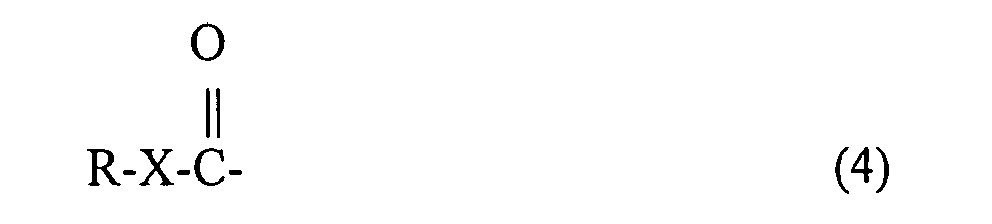
- a third embodiment of this invention is a method of separation of optical isomers of the first embodiment in which the polysaccharide derivative is that in which all or a part of hydrogen atoms of the hydroxyl or amino groups of the polysaccharide are substituted with at least one of the atom groups represented by the following formula (1), (2), (3) or (4): wherein R is an aromatic group which may contain a hetero atom and may be unsubstituted or substituted with at least one group or atom selected from a class consisting of C 1-12 alkyl group, C 1-12 alkoxyl group, C 1-12 alkylthio group, cyano group, halogen atom, C 1-8 acyl group, C 1-8 acyloxy group, hydroxyl group, C 1-12 alkoxycarbonyl group, nitro group, amino group and C 1-8 dialkylamino group; and X is a C 1-4 hydrocarbyl group which may contain a double bond or a triple bond.
- a fifth embodiment of this invention is a method of separation of optical isomers of any of said first to fourth embodiments in which the polysaccharide is cellulose.
- a sixth embodiment of this invention is a method of separation of optical isomers of any of said first to fifth embodiments, in which the number average degree of polymerization is not less than 5.
- a seventh embodiment of this invention is a method of separation of optical isomers of any of said first to sixth embodiments, in which the number average degree of polymerization is 10 - 2,000.
- An eighth embodiment of this invention is a method of separation of optical isomers of any of said first to seventh embodiments, in which the degree of introduction of the substituents in the polysaccharide is 10 - 100 %.
- a ninth embodiment of this invention is a method of separation of optical isomers of any of said first to seventh embodiments, in which the degree of introduction of the substituents in the polysaccharide is 30 - 100 %.
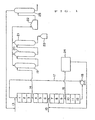
- Fig. 1 is a schematic presentation showing an example of the simulated moving bed chromatographic apparatus used for the present invention.
- Fig. 2 is a schematic presentation showing another example of the simulated moving bed chromatographic apparatus used for the present invention.
- Mixtures of optical isomers to be separated by the method of the present invention include racemic compounds or mixtures which are obtained by asymmetric synthesis and contain one optical isomer in excess.
- particles of polysaccharide derivatives are used as fillers for optical resolution.
- Particles of polysaccharide derivatives are not specifically limited, as long as they fulfill the requirements of claim 1, and particles of various polysaccharide derivatives can be used.
- the polysaccharide of said polysaccharide derivatives encompasses natural polysaccharides, modified natural polysaccharides and synthetic polysaccharides and all these are applicable insofar as they are optically active.
- polysaccharide of polysaccharide derivatives are: ⁇ -1,4-glucan (amylose, amylopectin), ⁇ -1,4-glucan (cellulose), ⁇ -1,6-glucan (dextran), ⁇ -1,6-glucan (pustulan), ⁇ -1,3-glucan (curdlan, schizophyllan), ⁇ -1,3-glucan, ⁇ -1,2-glucan (Crawn Gall polysaccharide), ⁇ -1,4-galactan, ⁇ -1,6-mannan, ⁇ -1,4-mannan, ⁇ -1,2-fructan (inuline), ⁇ -2,6-fructan (levan), ⁇ -1,4-xylan, ⁇ -1,3-xylan, ⁇ -1,4-chitosan, ⁇ -1,4-N-acetyl-chitosan (chitin), pullulan, agarose, arginic acid, cyclodextrins,
- cellulose, amylose, ⁇ -1,4-chitosan, ⁇ -1,4-acetylchitosan (chitin), ⁇ -1,4-mannan, ⁇ -1,4-xylan, curdlan, pullulan, dextran, cyclodextrins are preferred for the reason that high purity product is easily obtainable therewith.
- the number average degree of polymerization (average number of pyranose rings or furanose rings in a molecule) of these polysaccharides excepting cyclodextrins is usually not less than 5, preferably not less than 10.
- the ceiling of polymerization degree is not limited, polysaccharides having number average degree of polymerization of not more than 2,000 are easy to handle. Those of not more than 1,000 are more preferred and those of not more than 500 are most preferred.
- Preferably usable polysaccharide derivatives are ester derivatives and carbamate derivatives of polysaccharides.
- Examples of the especially preferred ester derivatives and carbamate derivatives of polysaccharides are those in which a part of or all of the hydrogen atoms of the hydroxyl or the amino groups of the polysaccharide are substituted with at least one of the groups represented by the following formula (1), (2), (3) or (4): wherein R is an aromatic group which may contain a hetero atom and may be unsubstituted or substituted with at least one group or atom selected from a class consisting of C 1-12 alkyl group, C 1-12 alkoxyl group, C 1-12 alkylthio group, cyano group, halogen atom, C 1-8 acyl group, C 1-8 acyloxy group, hydroxyl group, C 1-12 alkoxycarbonyl group, nitro group, amino group and C 1-8 dialkylamino group.
- R is an aromatic group which may contain a hetero atom and may be unsubstituted or substituted with at least one group or atom selected from a class consisting of C 1-12
- Said aromatic hydrocarbyl groups include phenyl group, naphthyl group, phenanthryl group, anthracyl group, indenyl group, indanyl group, furyl group, thionyl group, pyryl group, benzofuryl group, benzothionyl group, indyl group, pyridyl group, pyrimidyl group, quinolyl group, isoquinolyl group, etc.
- phenyl, naphthyl, pyridyl, etc. are preferred and alkylphenyl group is most preferred.
- X stands for C 1-4 hydrocarbyl group, which may contain a double bond or triple bond. Examples thereof are methylene group, methylmethylene group, ethylene group, ethylidene group, ethenylene group, ethynylene group, 1,2- or 1,3-propylene group, 1,2- or 2,2-propylidine group, etc.
- the degree of introduction of substituent in the polysaccharide is usually 10 % - 100 %, preferably 30 % - 100 % and more preferably 80 % - 100 %.
- the introduction of less than 10 % is not preferable because the polysaccharide has little ability of optical resolution.
- the introduction of less than 30 % is not so preferable because resolution is sometimes insufficient depending upon species and concentration of the optical isomer mixture to be separated.
- the introduction of in excess of 80 % is preferable because particles having excellent optical resolution ability can be obtained.
- the degree of introduction of substituents can be determined by elemental analysis of carbon, hydrogen and nitrogen before and after the introduction.
- said ester derivatives and carbamate derivatives of polysaccharides are used in the form of particles. These particles are particles of said derivatives per se.
- the particles may globular or in the crushed form.
- the method of preparing globular derivatives of polysaccharides is not particularly limited insofar as globular derivatives are obtainable thereby.
- a polysaccharide derivative is dissolved in an organic solvent, the solution is dispersed in water which may contain a surfactant, and finally the organic solvent is distilled off by heating or reducing pressure.
- An example of the method for preparing crushed particles is as follows.
- the obtained particles can be used as is, although they are preferably used after classified into a uniform particle size by a classifier such as air-elutriator, liquid cyclone, blow-shifter, vibration sieve, etc.
- the classification can also be made by utilizing differences between the particles in sedimentation rate in a slurry.
- the employable particle size depends on the size of the used column, etc., and it is 10 ⁇ m - 300 ⁇ m, preferably 50 ⁇ m - 100 ⁇ m. It is preferable that the particle size distribution is small. Particle size of less than 10 ⁇ m is not useful because pressure loss in passing of eluent is large. On the other hand, particle size of more than 300 ⁇ m is also not useful because of poor separation caused by reduced number of theoretical plates of the column.
- Examples of the eluent usable for the present invention are: hydrocarbons having not less than 5 carbon atoms such as n-hexane, n-pentane, heptane, octane, cyclohexane, isohexane, isooctane, hexene, etc.; alcohols such as methanol, ethanol, n-propanol, isopropanol, butanol, isobutanol, tertiary-butanol, heptanol, hexanol, etc.; water and other organic solvents. They can be used singly or in combination. When used in combination, the solvents must be homogeneously miscible.
- the eluent may contain acid, base, buffer, salt, etc. A suitable eluent is suitably determined depending upon the species of optical isomer mixture to be separated.
- the procedures of separation of optical isomers in the present invention comprises forming a circulatory passage or circuit of a plurality of columns which are packed with the above-described optical resolution filler and connected endlessly; forcing a fluid to circulate through said circuit in one direction; providing the circulatory passage with inlets for introducing a fluid into the columns and outlets for taking a fluid out of the columns alternately and shifting the positions of the inlets and the outlets intermittently in the direction of the flow of the circulating fluid; introducing a mixture of optical isomers and an eluent into the circulatory passage through the inlets and simultaneously taking out a solution rich in non-adsorbable substances and poorly-adsorbable substances and a solution rich in adsorbable or strongly-adsorbable substances through the outlets.
- a simulated moving bed comprising a plurality (12 for instance) of unit columns, which are connected in series, is employed in the circulatory passage for circulating a liquid.
- the liquid is circulated in the liquid passage in one direction.
- the number of the unit columns in the simulated moving bed is not limited as above-mentioned but optionally selected according to the scale of operation, the viewpoint of reaction engineering, etc.
- an inlet for the eluent, an outlet for the extract, an inlet for the optical isomer mixture solution and an outlet for the raffinate are respectively provided.
- the positions of these inlets and the outlets are shifted intermittently and successively.
- a rotary valve, an electromagnetic valve, an air-actuated valve, etc. are employed.
- Separation by adsorption of optical isomers in a simulated moving bed chromatographic apparatus is effected by continuously carrying out an adsorption step, a concentration step, a desorption step and an eluent recovery step in circulation.
- the members denoted by 1 - 12 are unit columns packed with an optical resolution filler and they are mutually connected in series by means of conduits.
- the member 13 is an eluent supply line (conduit).
- the member 14 is a line (conduit) by which the extract is taken out.
- the member 15 is a line (conduit) which supplies an optical isomer mixture solution.
- the member 16 is a line (conduit) by which the raffinate is taken out.
- the member 17 is a recycle line (conduit).
- the member 18 is a circulation pump.
- the eluent supply line (conduit), the line (conduit) for optical isomer mixture solution supply, the line (conduit) for taking out the eluent and the line (conduit) for taking out the raffinate are shifted in the direction of the fluid flow with a constant time interval one column by one column by means of valve operation for instance.
- the apparatus usable for the present invention is not limited to the one as represented by Fig. 1, but an apparatus as represented by Fig. 2 is also usable.
- the supply lines (conduits) and the take-out lines (conduits) are shifted by one column in each stage.
- distribution of the unit columns are as follows. That is, column 2 is for eluent recovery, columns 3 - 6 are for adsorption, unit columns 7 - 8 are for concentration and column 1 is for desorption.
- the stage is repeated and separation of an optical isomer mixture solution is continuously and efficiently achieved.
- the member 19 is a first falling film evaporator, which concentrates the extract.
- the member 20 is a second flow down type thin membrane evaporator which further concentrates the concentrated extract.
- the member 21 is a wiped film evaporator which still further concentrates the concentrated extract.
- the member 22 is a recovery tank which temporarily stores a recovered solvent.
- the member 23 is a storage tank for storing the optical isomer concentrate which has been concentrated by the evaporators.
- the member 24 is a racemization reactor in which an optical isomer mixture is racemized.
- the member 25 is a distillator, in which the solvent stored in the recovery tank 22, is purified to a desired degree.
- the raffinate contains another optical isomer which is an antipode of the optical isomer contained in the extract and the solvent.
- the solvent can be recovered by the same way as recovery of the solvent from the extract.
- racemic propranolol was supplied at a rate of 0.3 ml/min. (The racemic compound concentration was 26.6 mg/ml.)
- Optical resolution was carried out under the above-described conditions. At the outlet for the fluid containing adsorbable or strongly adsorbable substance, a solution containing 2350 ppm of (-)-propranolol having optical purity of 95 % ee. was taken out. At the outlet for the fluid containing non adsorbable or poorly adsorbable substances, a solution containing 8290 ppm of (+)-propranolol having an optical purity of 100 % ee was taken out.
- racemic methyl 2-phenoxypropionate was supplied at a rate of 0.1 ml/min. (The racemic compound concentration was 10 mg/ml.)
- Optical resolution was carried out under the above-described conditions. At the outlet for fluid containing adsorbable or strongly adsorbable substance, a solution containing 506 ppm of (-)-methyl 2-phenoxypropionate having an optical purity of 96 % ee. was taken out. At the outlet for fluid containing non adsorbable or poorly adsorbable substances, a solution containing 460 ppm of (+)-methyl-2-phenoxypropionate having an optical purity of 100 % ee was taken out.
- the present invention provides a method for separation of optical isomers not using expensive silica gel but using a adsorbent, which is inexpensive per se and has excellent optical resolution ability, as a optical resolution filler.
- the present invention enables efficient and economical production of a desired optical isomer with high optical purity by optical resolution of a racemic compound or a mixture which is obtained by asymmetric synthesis and contains one optical isomer in excess.
- the present invention provides a method for optical resolution which not only achieves efficient separation but also consumes far less amount of eluent.
Landscapes
- Chemical & Material Sciences (AREA)
- Organic Chemistry (AREA)
- Life Sciences & Earth Sciences (AREA)
- Sustainable Development (AREA)
- Analytical Chemistry (AREA)
- Chemical Kinetics & Catalysis (AREA)
- Organic Low-Molecular-Weight Compounds And Preparation Thereof (AREA)
- Treatment Of Liquids With Adsorbents In General (AREA)
- Solid-Sorbent Or Filter-Aiding Compositions (AREA)
Abstract
Claims (9)
- Procédé de séparation d'isomères optiques utilisant un appareil de chromatographie à lit mobile simulé, qui est formé en raccordant en circuit fermé, plusieurs colonnes, un fluide circulant à travers les colonnes dans une direction à l'aide d'une pompe de circulation, on introduit une solution de mélange d'isomères optiques et un éluant dans le circuit de circulation, on soutire du circuit une solution riche en substances non adsorbables ou faiblement adsorbables et une solution riche en substances adsorbables ou fortement adsorbables ; des orifices d'entrée pour le fluide destiné à être introduit dans les colonnes, et des orifices de sortie pour le fluide destiné à être soutiré des colonnes étant alternativement prévus dans la direction d'écoulement du fluide, et disposés de telle façon que les positions des orifices d'entrée et des orifices de sortie soient décalées par intermittence dans la direction d'écoulement du fluide dans les colonnes, caractérisé en ce que l'on emploie des particules de dérivés de polysaccharide ayant un diamètre particulaire moyen de 10 à 300 µm et une surface spécifique de 0,5 à 300 m2/g en tant que matériau de garnissage pour dédoublement optique.
- Le procédé de séparation d'isomères optiques tel que défini dans la revendication 1, dans lequel les dérivés de polysaccharide sont des dérivés estérifiés ou des dérivés de type carbamate de polysaccharides.
- Le procédé de séparation d'isomères optiques tel que défini dans la revendication 1 ou 2, dans lequel les dérivés de polysaccharide sont des polysaccharides dans lesquels une partie ou la totalité des atomes d'hydrogène sur les groupes hydroxy ou amino sont remplacés par l'un des groupes représentés par les formules (1), (2), (3) et (4) :


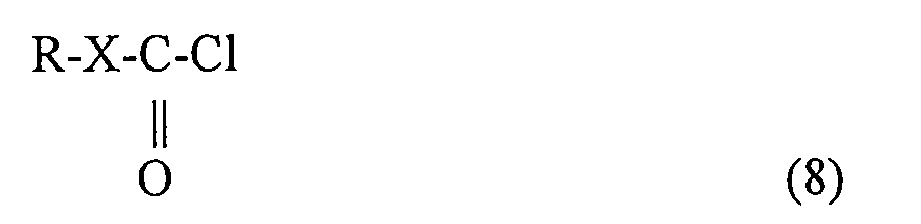
- Le procédé de séparation d'isomères optiques tel que défini dans la revendication 1 ou 2, dans lequel les dérivés de polysaccharide sont des dérivés de polysaccharide de type carbamate obtenus en faisant réagir un isocyanate représenté par la formule (5) ou (6) suivante, avec un polysaccharide, ou des dérivés estérifiés de polysaccharide obtenus en faisant réagir un chlorure d'acide représenté par la formule (7) ou (8) suivante, avec un polysaccharide :
R-N=C=O (5)
R-X-N=C=O (6)

- Le procédé de séparation d'isomères optiques tel que défini dans l'une quelconque des revendications 1 à 4, dans lequel le polysaccharide est la cellulose.
- Le procédé de séparation d'isomères optiques tel que défini dans l'une quelconque des revendications 1 à 5, dans lequel le polysaccharide a un degré de polymérisation moyen en nombre de pas moins de 5.
- Le procédé de séparation d'isomères optiques tel que défini dans l'une quelconque des revendications 1 à 6, dans lequel le polysaccharide a un degré de polymérisation moyen en nombre de 10 à 2 000.
- Le procédé de séparation d'isomères optiques tel que défini dans l'une quelconque des revendications 1 à 7, dans lequel le degré d'introduction du substituant des dérivés de polysaccharide, est de 10 à 100 %.
- Le procédé de séparation d'isomères optiques tel que défini dans l'une quelconque des revendications 1 à 7, dans lequel le degré d'introduction du substituant des dérivés de polysaccharide, est de 30 à 100 %.
Applications Claiming Priority (3)
| Application Number | Priority Date | Filing Date | Title |
|---|---|---|---|
| JP6081479A JPH07285889A (ja) | 1994-04-20 | 1994-04-20 | 光学異性体の分離方法 |
| JP81479/94 | 1994-04-20 | ||
| PCT/JP1995/000768 WO1995029142A1 (fr) | 1994-04-20 | 1995-04-19 | Procede de separation d'isomeres optiques |
Publications (3)
| Publication Number | Publication Date |
|---|---|
| EP0706982A1 EP0706982A1 (fr) | 1996-04-17 |
| EP0706982A4 EP0706982A4 (fr) | 1997-05-02 |
| EP0706982B1 true EP0706982B1 (fr) | 2007-01-03 |
Family
ID=13747547
Family Applications (1)
| Application Number | Title | Priority Date | Filing Date |
|---|---|---|---|
| EP95916011A Expired - Lifetime EP0706982B1 (fr) | 1994-04-20 | 1995-04-19 | Procede de separation d'isomeres optiques |
Country Status (5)
| Country | Link |
|---|---|
| US (1) | US6533936B1 (fr) |
| EP (1) | EP0706982B1 (fr) |
| JP (1) | JPH07285889A (fr) |
| DE (1) | DE69535355T2 (fr) |
| WO (1) | WO1995029142A1 (fr) |
Families Citing this family (16)
| Publication number | Priority date | Publication date | Assignee | Title |
|---|---|---|---|---|
| JPH10249191A (ja) * | 1997-03-17 | 1998-09-22 | Daicel Chem Ind Ltd | 分離剤 |
| US6124473A (en) * | 1998-05-08 | 2000-09-26 | Ucb, S.A. | Process for preparing (s)- and (R)-α-ethyl-2-oxo-1-pyrrolidineacetamide |
| US6107492A (en) * | 1998-05-08 | 2000-08-22 | Ucb, S.A. | Process for the preparation of levetiracetam |
| EP1389606B1 (fr) * | 2001-04-27 | 2013-06-05 | Daicel Chemical Industries, Ltd. | Agent de séparation pour isomères énantiomères comprenant un polysaccharide avec un groupe indanyl |
| US7199241B1 (en) | 2001-05-29 | 2007-04-03 | Ucb, S.A. | Process for preparing (S) and (R)-2-[4-(4-chlorobenzhydryl)piperazin-1-yl]-ethoxyacetamide |
| US6977301B1 (en) | 2001-05-29 | 2005-12-20 | Ucb, S.A. | Process for preparing (S) and (R)—2-[4-(4-chlorobenzhydryl)piperazin-1-yl]-ethoxyacetamide |
| SE0102369D0 (sv) * | 2001-07-03 | 2001-07-03 | Monocell Ab | New method |
| KR20060006052A (ko) * | 2003-04-24 | 2006-01-18 | 다이셀 가가꾸 고교 가부시끼가이샤 | 에틸(3r,5s,6e)-7-[2-시클로프로필-4-(4-플루오로페닐)퀴놀린-3-일]-3,5-디히드록시-6-헵테노에이트의 제조 방법 |
| US20060086667A1 (en) * | 2004-09-13 | 2006-04-27 | Cephalon, Inc., U.S. Corporation | Methods for the separation of enantiomeric sulfinylacetamides |
| JP5224264B2 (ja) * | 2006-05-09 | 2013-07-03 | 株式会社ダイセル | キトサン誘導体の製造方法 |
| EP2060588B1 (fr) | 2006-09-04 | 2014-08-06 | Daicel Corporation | Dérivé de polysaccharide et agent de séparation pour un isomère optique contenant celui-ci |
| WO2008088830A2 (fr) * | 2007-01-16 | 2008-07-24 | Evolved Nanomaterial Sciences, Inc. | Agents de séparation chirale pourvus d'un support actif |
| US7618539B2 (en) | 2008-03-31 | 2009-11-17 | Ampac Fine Chemicals Llc | Simulated moving bed chromatography for strongly retained compounds |
| US7906046B2 (en) * | 2008-04-04 | 2011-03-15 | Panduit Corp. | Antioxidant joint compound and method for forming an electrical connection |
| CN102311504B (zh) | 2010-07-09 | 2017-05-10 | 株式会社大赛璐 | 多糖衍生物及其制备方法以及分离剂 |
| WO2025029968A1 (fr) * | 2023-08-01 | 2025-02-06 | Gabalski Arielle H | Systèmes et procédés de séparation chirale |
Family Cites Families (15)
| Publication number | Priority date | Publication date | Assignee | Title |
|---|---|---|---|---|
| JPS60216842A (ja) * | 1984-04-11 | 1985-10-30 | Daicel Chem Ind Ltd | 多糖誘導体よりなる分離剤 |
| JPS60226832A (ja) * | 1984-04-02 | 1985-11-12 | Daicel Chem Ind Ltd | 多糖の脂肪族エステルを含む分離剤 |
| JPS60226831A (ja) * | 1984-04-02 | 1985-11-12 | Daicel Chem Ind Ltd | 分離剤 |
| US4861872A (en) * | 1986-03-20 | 1989-08-29 | Daicel Chemical Industries, Ltd. | Alkyl-phenylcarbamate derivative of polysaccharide |
| US5066793A (en) | 1987-10-26 | 1991-11-19 | Ciba-Geigy Corporation | Finely particulate cellulose esters of aromatic or aromatic-aliphatic carboxylic acids, process for their preparation, and the use thereof |
| JPH03100459A (ja) * | 1989-09-14 | 1991-04-25 | Sumitomo Heavy Ind Ltd | 擬似移動床式クロマト分離法 |
| JP2834225B2 (ja) * | 1989-10-20 | 1998-12-09 | オルガノ株式会社 | 擬似移動層式クロマト分離装置 |
| JP2925753B2 (ja) * | 1990-02-23 | 1999-07-28 | ダイセル化学工業株式会社 | 光学異性体の分離方法 |
| JP2828770B2 (ja) * | 1990-10-23 | 1998-11-25 | ダイセル化学工業株式会社 | 多糖のフェニルアルキルカルバメート誘導体及び分離剤 |
| DE69226578T2 (de) * | 1991-03-04 | 1998-12-24 | Daicel Chemical Industries, Ltd., Sakai, Osaka | Production eines Zellulosederivates |
| DK0586385T4 (da) * | 1991-03-14 | 2005-04-18 | Bayer Ag | Fremgangsmåde til spaltning af enantiomere på chirale spaltningsfaser ved hjælp af en kontinuerlig modströms-chromatografifremgangsmåde |
| US5498752A (en) * | 1991-08-22 | 1996-03-12 | Daicel Chemical Industries, Ltd. | Process for recovering optical isomers and solvent, process for using solvent by circulation and process for reusing optical isomers in optical resolution |
| JP3010816B2 (ja) * | 1991-08-22 | 2000-02-21 | ダイセル化学工業株式会社 | 光学分割における光学異性体と溶媒との回収方法、溶媒の循環使用方法、および光学異性体の再利用方法 |
| DE69327134T2 (de) * | 1992-06-30 | 2000-07-06 | Daicel Chemical Industries, Ltd. | Trennsystem mit simuliertem Fliessbett |
| US5518625A (en) * | 1995-02-13 | 1996-05-21 | Uop | Chiral separations by simulated moving bed chromatography operating at low k' values |
-
1994
- 1994-04-20 JP JP6081479A patent/JPH07285889A/ja active Pending
-
1995
- 1995-04-19 EP EP95916011A patent/EP0706982B1/fr not_active Expired - Lifetime
- 1995-04-19 DE DE69535355T patent/DE69535355T2/de not_active Expired - Lifetime
- 1995-04-19 WO PCT/JP1995/000768 patent/WO1995029142A1/fr not_active Ceased
-
1997
- 1997-10-16 US US08/951,502 patent/US6533936B1/en not_active Expired - Fee Related
Also Published As
| Publication number | Publication date |
|---|---|
| DE69535355D1 (de) | 2007-02-15 |
| DE69535355T2 (de) | 2007-08-16 |
| WO1995029142A1 (fr) | 1995-11-02 |
| US6533936B1 (en) | 2003-03-18 |
| EP0706982A4 (fr) | 1997-05-02 |
| EP0706982A1 (fr) | 1996-04-17 |
| JPH07285889A (ja) | 1995-10-31 |
Similar Documents
| Publication | Publication Date | Title |
|---|---|---|
| US6533936B1 (en) | Method for separation of optical isomers | |
| US5770088A (en) | Simulated moving bed chromatographic separation process | |
| EP0747341B1 (fr) | Procede de production de compose de mevalonolactone optiquement actif | |
| JPWO1995023125A1 (ja) | 光学活性なメバロノラクトン系化合物の製造方法 | |
| US5354852A (en) | Polysaccharide derivative, process for producing the same, and separating agent | |
| CN1116088C (zh) | 模拟移动床色谱分离方法 | |
| JP3306813B2 (ja) | 擬似移動床クロマト分離法 | |
| US7399409B2 (en) | Packing material for separation of optical isomer and method of separating optical isomer with the same | |
| EP1366809B1 (fr) | Agent de séparation pour isomère optique | |
| JPH0829404A (ja) | 光学異性体の擬似移動層式クロマト分離法 | |
| EP0687491A1 (fr) | Procédé de séparation chromatographique en lit mobile simulé | |
| JP2001124752A (ja) | 光学活性なオキシブチニンの製造方法 | |
| KR0174289B1 (ko) | 의사 이동상 크로마토분리법 | |
| EP1623978B1 (fr) | Procede de production d'un (3r, 5s, 6e)-7- [2-cyclopropyl-4-(4-fluorophenyl)quinoline-3-yl]-3,5-dihydroxy-6-heptanoate d'ethyle | |
| JP3866179B2 (ja) | 光学異性体分離用充填剤の製造方法 | |
| JP3905564B2 (ja) | 分離剤の製造方法 | |
| WO2002088048A1 (fr) | Agent de separation comprenant un derive de polysaccharide a structure polycyclique | |
| JPH08155207A (ja) | 擬似移動層式クロマト分離装置 | |
| EP1623976A1 (fr) | Procede pour separer des esters d'acide dihydroxy-heptenoique optiquement actifs | |
| Grill et al. | Preparative Separation of Enantiomers | |
| JPH06157358A (ja) | 光学活性ベータ遮断薬の製造法 | |
| KR20040028303A (ko) | 의사(擬似)이동마루식 크로마토그래피에 의한 광학 분할에있어서의 광학 이성체와 용매와의 회수 방법 및 용매의순환 사용 방법 |
Legal Events
| Date | Code | Title | Description |
|---|---|---|---|
| PUAI | Public reference made under article 153(3) epc to a published international application that has entered the european phase |
Free format text: ORIGINAL CODE: 0009012 |
|
| AK | Designated contracting states |
Kind code of ref document: A1 Designated state(s): CH DE FR GB IT LI |
|
| 17P | Request for examination filed |
Effective date: 19960304 |
|
| A4 | Supplementary search report drawn up and despatched |
Effective date: 19970318 |
|
| AK | Designated contracting states |
Kind code of ref document: A4 Designated state(s): CH DE FR GB IT LI |
|
| GRAP | Despatch of communication of intention to grant a patent |
Free format text: ORIGINAL CODE: EPIDOSNIGR1 |
|
| GRAS | Grant fee paid |
Free format text: ORIGINAL CODE: EPIDOSNIGR3 |
|
| RAP1 | Party data changed (applicant data changed or rights of an application transferred) |
Owner name: DAICEL CHEMICAL INDUSTRIES, LTD. |
|
| RIN1 | Information on inventor provided before grant (corrected) |
Inventor name: IKEDA, HIROKAZU |
|
| GRAA | (expected) grant |
Free format text: ORIGINAL CODE: 0009210 |
|
| AK | Designated contracting states |
Kind code of ref document: B1 Designated state(s): CH DE FR GB IT LI |
|
| REG | Reference to a national code |
Ref country code: GB Ref legal event code: FG4D |
|
| REF | Corresponds to: |
Ref document number: 69535355 Country of ref document: DE Date of ref document: 20070215 Kind code of ref document: P |
|
| ET | Fr: translation filed | ||
| PLBE | No opposition filed within time limit |
Free format text: ORIGINAL CODE: 0009261 |
|
| STAA | Information on the status of an ep patent application or granted ep patent |
Free format text: STATUS: NO OPPOSITION FILED WITHIN TIME LIMIT |
|
| 26N | No opposition filed |
Effective date: 20071005 |
|
| PGFP | Annual fee paid to national office [announced via postgrant information from national office to epo] |
Ref country code: IT Payment date: 20070525 Year of fee payment: 13 |
|
| REG | Reference to a national code |
Ref country code: CH Ref legal event code: PFA Owner name: DAICEL CHEMICAL INDUSTRIES, LTD. Free format text: DAICEL CHEMICAL INDUSTRIES, LTD.#1 TEPPOCHO,#SAKAI-KU SAKAI-SHI OSAKA-FU, 590-0905 (JP) -TRANSFER TO- DAICEL CHEMICAL INDUSTRIES, LTD.#1 TEPPOCHO,#SAKAI-KU SAKAI-SHI OSAKA-FU, 590-0905 (JP) |
|
| PG25 | Lapsed in a contracting state [announced via postgrant information from national office to epo] |
Ref country code: IT Free format text: LAPSE BECAUSE OF NON-PAYMENT OF DUE FEES Effective date: 20080419 |
|
| PGFP | Annual fee paid to national office [announced via postgrant information from national office to epo] |
Ref country code: FR Payment date: 20110426 Year of fee payment: 17 Ref country code: DE Payment date: 20110413 Year of fee payment: 17 Ref country code: CH Payment date: 20110412 Year of fee payment: 17 |
|
| PGFP | Annual fee paid to national office [announced via postgrant information from national office to epo] |
Ref country code: GB Payment date: 20110413 Year of fee payment: 17 |
|
| REG | Reference to a national code |
Ref country code: CH Ref legal event code: PL |
|
| GBPC | Gb: european patent ceased through non-payment of renewal fee |
Effective date: 20120419 |
|
| REG | Reference to a national code |
Ref country code: FR Ref legal event code: ST Effective date: 20121228 |
|
| PG25 | Lapsed in a contracting state [announced via postgrant information from national office to epo] |
Ref country code: LI Free format text: LAPSE BECAUSE OF NON-PAYMENT OF DUE FEES Effective date: 20120430 Ref country code: GB Free format text: LAPSE BECAUSE OF NON-PAYMENT OF DUE FEES Effective date: 20120419 Ref country code: CH Free format text: LAPSE BECAUSE OF NON-PAYMENT OF DUE FEES Effective date: 20120430 |
|
| REG | Reference to a national code |
Ref country code: DE Ref legal event code: R119 Ref document number: 69535355 Country of ref document: DE Effective date: 20121101 |
|
| PG25 | Lapsed in a contracting state [announced via postgrant information from national office to epo] |
Ref country code: FR Free format text: LAPSE BECAUSE OF NON-PAYMENT OF DUE FEES Effective date: 20120430 |
|
| PG25 | Lapsed in a contracting state [announced via postgrant information from national office to epo] |
Ref country code: DE Free format text: LAPSE BECAUSE OF NON-PAYMENT OF DUE FEES Effective date: 20121101 |