EP0707399A1 - Procédé et dispositif pour le contrÔle de congestion dans un réseau de communication de paquets - Google Patents
Procédé et dispositif pour le contrÔle de congestion dans un réseau de communication de paquets Download PDFInfo
- Publication number
- EP0707399A1 EP0707399A1 EP95402237A EP95402237A EP0707399A1 EP 0707399 A1 EP0707399 A1 EP 0707399A1 EP 95402237 A EP95402237 A EP 95402237A EP 95402237 A EP95402237 A EP 95402237A EP 0707399 A1 EP0707399 A1 EP 0707399A1
- Authority
- EP
- European Patent Office
- Prior art keywords
- congestion
- node
- network
- nodes
- data packets
- Prior art date
- Legal status (The legal status is an assumption and is not a legal conclusion. Google has not performed a legal analysis and makes no representation as to the accuracy of the status listed.)
- Granted
Links
- 238000000034 method Methods 0.000 title claims abstract description 11
- 230000005540 biological transmission Effects 0.000 claims abstract description 13
- 210000001367 artery Anatomy 0.000 claims description 9
- 238000011144 upstream manufacturing Methods 0.000 claims description 8
- 208000027744 congestion Diseases 0.000 claims 11
- 230000007246 mechanism Effects 0.000 description 2
- 230000000903 blocking effect Effects 0.000 description 1
- 230000001627 detrimental effect Effects 0.000 description 1
- 230000000644 propagated effect Effects 0.000 description 1
- 229920006395 saturated elastomer Polymers 0.000 description 1
- 230000011664 signaling Effects 0.000 description 1
Images
Classifications
-
- H—ELECTRICITY
- H04—ELECTRIC COMMUNICATION TECHNIQUE
- H04L—TRANSMISSION OF DIGITAL INFORMATION, e.g. TELEGRAPHIC COMMUNICATION
- H04L12/00—Data switching networks
- H04L12/54—Store-and-forward switching systems
- H04L12/56—Packet switching systems
- H04L12/5601—Transfer mode dependent, e.g. ATM
- H04L12/5602—Bandwidth control in ATM Networks, e.g. leaky bucket
-
- H—ELECTRICITY
- H04—ELECTRIC COMMUNICATION TECHNIQUE
- H04Q—SELECTING
- H04Q11/00—Selecting arrangements for multiplex systems
- H04Q11/04—Selecting arrangements for multiplex systems for time-division multiplexing
- H04Q11/0428—Integrated services digital network, i.e. systems for transmission of different types of digitised signals, e.g. speech, data, telecentral, television signals
- H04Q11/0478—Provisions for broadband connections
-
- H—ELECTRICITY
- H04—ELECTRIC COMMUNICATION TECHNIQUE
- H04L—TRANSMISSION OF DIGITAL INFORMATION, e.g. TELEGRAPHIC COMMUNICATION
- H04L12/00—Data switching networks
- H04L12/54—Store-and-forward switching systems
- H04L12/56—Packet switching systems
- H04L12/5601—Transfer mode dependent, e.g. ATM
- H04L2012/5619—Network Node Interface, e.g. tandem connections, transit switching
-
- H—ELECTRICITY
- H04—ELECTRIC COMMUNICATION TECHNIQUE
- H04L—TRANSMISSION OF DIGITAL INFORMATION, e.g. TELEGRAPHIC COMMUNICATION
- H04L12/00—Data switching networks
- H04L12/54—Store-and-forward switching systems
- H04L12/56—Packet switching systems
- H04L12/5601—Transfer mode dependent, e.g. ATM
- H04L2012/5629—Admission control
- H04L2012/563—Signalling, e.g. protocols, reference model
-
- H—ELECTRICITY
- H04—ELECTRIC COMMUNICATION TECHNIQUE
- H04L—TRANSMISSION OF DIGITAL INFORMATION, e.g. TELEGRAPHIC COMMUNICATION
- H04L12/00—Data switching networks
- H04L12/54—Store-and-forward switching systems
- H04L12/56—Packet switching systems
- H04L12/5601—Transfer mode dependent, e.g. ATM
- H04L2012/5629—Admission control
- H04L2012/5631—Resource management and allocation
- H04L2012/5636—Monitoring or policing, e.g. compliance with allocated rate, corrective actions
Definitions
- the present invention relates to a method and a device for congestion control of sporadic exchanges of data packets in a digital transmission network. It applies in particular to the creation of local networks operating in the transmission mode known by the English abbreviation ATM of "Asynchronous Transfer Mode".
- Each cell consists, on the one hand, of a header used to identify the cell and the communication to which it belongs and, on the other hand, of an information field containing the useful data to convey.
- the nodes of the network are responsible for routing the ATM cells applied to their inputs to one or more outputs.
- a first mode is to reserve a portion of the bandwidth for each active user, whether or not it transmits (peak rate reservation, for example). But then, the portion of the band reserved and not used by the active users who do not transmit, cannot be allocated to the other users.
- Another way of proceeding is not to reserve resources in the network, the latter being responsible for carrying out the statistical multiplexing of the information actually transmitted.
- users transmit more information than the network can manage to sell, which will result in the loss of part of this information (congestion phenomenon).
- a regulation method known by the English abbreviation ABR for "Available Bit Rate” can be implemented. This process allows the effective sharing of available bandwidth between active users, avoiding network congestion.
- the object of the invention is to overcome the aforementioned drawbacks.
- the subject of the invention is a method for controlling the congestion of sporadic exchanges of data packets in a digital transmission network, each packet being composed of a header making it possible to identify and guide it through virtual channels and a part containing information to be conveyed, characterized in that it consists at the level of each node of the network in detecting the congestion channels and in transmitting, on the nodes placed upstream relative to each detected virtual channel in congestion, a congestion indicator to block communications on this channel as long as the congestion noted by a node on this channel is not resolved.
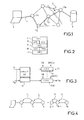
- the path taken by a communication between a user 2 and a data terminal 3 is illustrated by a dotted line 1.
- the path following line 1 is formed by setting cascade of communication nodes 41 to 4 N of an ATM local area network 5 communicating with each other on routes 6j.
- the information exchanged on the routes 6j is provided by fixed-format bit packets called "cells".
- Each cell is made up of an information field and a header enabling the cell to be identified, and in particular to the communication to which it belongs.
- the role of nodes 41 to 4 N is to direct the cells arriving at their inputs to one or more of their outputs.
- the header of each cell comprises, as shown in the example of FIG. 2, four zones VPI, VCI, PTI and HEC distributed in a block of 5 bytes of 8 bits each and referenced from 7 to 11. A byte and a half is reserved for coding the virtual beam VPI to which the cell belongs.
- the PTI area has 4 bits, the use of which is not defined here.
- the HEC area has a reserved byte to generate an error control code.
- Each node comprises, as shown in FIG. 3, a patching circuit 12 of the type described for example in patent applications FR 2 635 243 or FR 2 635 242.
- the role of the patching circuit 12 is to '' direct the incoming cells to its inputs e1 - e N on the output arteries of the node according to the VPI and VCI information contained in each header.
- the referral takes place in a known manner and as described for example in patent application 2,681,164 using a translator.
- the translator gives for each cell a new header and an outgoing artery according to the header it has when it enters the node and the artery that carried it.
- the mixing circuit 12 is connected to the outgoing arteries by means of registers 131 to 13 N organized in a stack.
- each queue is organized in a register 13j according to the "FIFO" mode of the English abbreviation "FIRST IN FIRST OUT".
- the registers 13i comprise, in a known manner, a filling sensor with two thresholds, a high threshold designated by SH and a low threshold designated by SB.
- the reception of the congestion indicator IC in a node causes the setting to the maximum value of an indicator (for example of the natural integer type) of type 2 congestion, associated (for example in the translator) with the virtual channel having encountered type 1 congestion in the downstream node.
- This indicator therefore signals that the path is saturated downstream.
- Each node transmits cyclically upstream the value of the congestion indicators IC (positioned or not) corresponding to each of the logical channels.
- Each node cyclically decrements the type 2 congestion indications whose value is non-zero (for example). Cells belonging to a logical channel whose type 2 flag is not at the value 0 (for example) are blocked.
- the type 1 congestion indicator is set to "not congested". This change of state is transmitted to the upstream nodes, which then set the type 2 congestion counter to its minimum value (for example 0).
- the congestion indicator IC is then propagated step by step as shown in FIG. 4 over all of the upstream nodes through which the cell has been transmitted in order to be stored in each of the zones VC i of the corresponding translators.
- This memorization allows the signaling in the nodes of the network of the virtual channels in congestion which are attached to them.
- a variant consists for a given node of cyclically informing the upstream nodes not only of the state of type 1 congestion (IC) as described above, but also of the state of type 2 congestion, such so that said upstream nodes in turn block traffic on the logical channels concerned.
- IC state of type 1 congestion
Landscapes
- Engineering & Computer Science (AREA)
- Computer Networks & Wireless Communication (AREA)
- Signal Processing (AREA)
- Data Exchanges In Wide-Area Networks (AREA)
Abstract
Description
- La présente invention concerne un procédé et un dispositif pour le contrôle de congestion des échanges sporadiques de paquets de données dans un réseau de transmission numérique. Elle s'applique notamment à la réalisation de réseaux locaux fonctionnant dans le mode de transmission connue sous l'abréviation anglo-saxonne ATM de "Asynchronous Transfert Mode".
- Dans un réseau fonctionnant en mode ATM, les informations numériques sont échangées entre des noeuds du réseau sous forme de paquets de bits de format fixe appelés "cellules". Chaque cellule se compose, d'une part, d'un entête servant à identifier la cellule et la communication à laquelle elle appartient et, d'autre part, d'un champ d'information contenant les données utiles à véhiculer. Les noeuds du réseau ont la charge d'aiguiller les cellules ATM appliquées à leurs entrées vers une ou plusieurs sorties.
- Dans ces réseaux, les utilisateurs actifs, en cours de communication, se partagent la bande passante disponible selon différents modes de fonctionnement. Un premier mode est de réserver une portion de la bande passante à chaque utilisateur actif, qu'il émette ou non (réservation de débit crête, par exemple). Mais alors, la portion de bande réservée et non utilisée par les utilisateurs actifs qui n'émettent pas, ne peut pas être attribuée aux autres utilisateurs. Une autre façon de procéder est de ne pas réserver de ressources dans le réseau, celui-ci se chargeant de réaliser le multiplexage statistique des informations réellement transmises. Cependant, il est possible qu'à un instant donné, les utilisateurs émettent plus d'information que le réseau ne sait en écouler, ce qui se traduira par une perte d'une partie de ces informations (phénomène de congestion). Pour éviter que ce phénomène de congestion du réseau ainsi produit ne perturbe la totalité du réseau, un procédé de régulation connu sous l'abréviation anglo-saxonne ABR de "Available Bit Rate" peut être mis en oeuvre. Ce procédé permet le partage effectif de la bande passante disponible entre les utilisateurs actifs, en évitant la congestion du réseau.
- Des mécanismes connus sous les abréviations anglo-saxonnes FECN et BECN de Forward Explicit Congestion Notification et Backward Explicit Congestion Notification sont alors appliqués. Ils permettent de bloquer les sources actives lorsque le réseau commence à ne plus pouvoir écouler tout le trafic qui lui est confié. Un mécanisme de déblocage associé permet d'éviter le blocage permanent de ces sources.
- Cependant, dans certains cas d'anomalies, par exemple la déconnexion des câbles de liaison, ou la défaillance des composants constituant les noeuds, il se peut que des sources ne reçoivent pas les informations de congestion et continuent d'émettre et donc de congestionner le réseau; il se peut également que des sources bloquées ne reçoivent pas l'information de déblocage, et restent bloquées pendant un temps très long, ce qui est préjudiciable aux applications qui l'utilisent.
- Le but de l'invention est de pallier les inconvénients précités.
- A cet effet, l'invention a pour objet un procédé pour le contrôle de congestion des échanges sporadiques de paquets de données dans un réseau de transmission numérique, chaque paquet étant composé d'un entête permettant de l'identifier et de le guider à travers des canaux virtuels et d'une partie contenant des informations à véhiculer, caractérisé en ce qu'il consiste au niveau de chaque noeud du réseau à détecter les canaux en congestion et à transmettre, sur les noeuds placés en amont relatifs à chaque canal virtuel détecté en congestion, un indicateur de congestion pour bloquer les communications sur ce canal tant que la congestion constatée par un noeud sur ce canal n'est pas résorbée.
- D'autres caractéristiques et avantages de l'invention apparaîtront dans la description qui suit faite en regard des dessins annexés qui représentent:
- la figure 1, un exemple pour illustrer une communication dans un réseau ATN ;
- la figure 2, le format d'un entête de cellule ATM ;
- la figure 3, un mode de réalisation d'un automate câblé pour la mise en oeuvre dans chaque noeud du réseau du procédé selon l'invention ;
- la figure 4, un exemple pour illustrer le principe d'une communication selon l'invention sur plusieurs noeuds en cascade.
- Dans l'exemple de la figure 1, le chemin pris par une communication entre un utilisateur 2 et un terminal de données 3 est illustré par une ligne en pointillés 1. Le chemin suivant la ligne 1 est formé par une mise en cascade de noeuds de communications 4₁ à 4N d'un réseau local ATM 5 communiquant entre eux sur des artères 6j.
- Les informations échangées sur les artères 6j sont fournies par des paquets de bits de format fixe appelés "cellules". Chaque cellule se compose d'un champ d'information et d'un entête permettant d'identifier la cellule et notamment à la communication à laquelle elle appartient. Le rôle des noeuds 4₁ à 4N est d'aiguiller les cellules arrivant sur leurs entrées vers une ou plusieurs de leurs sorties.
- A cet effet, l'entête de chaque cellule comporte comme le montre l'exemple de la figure 2, quatre zones VPI, VCI, PTI et HEC réparties dans un bloc de 5 octets de 8 bits chacun et référencés de 7 à 11. Un octet et demi est réservé au codage du faisceau virtuel VPI auquel appartient la cellule.
- Deux octets sont réservés au codage du canal virtuel VCI auquel appartient la cellule. La zone PTI comporte 4 bits dont l'usage n'est pas défini ici. Enfin la zone HEC comporte un octet réservé pour générer un code de contrôle d'erreur.
- Chaque noeud comporte de la manière représentée à la figure 3, un circuit de brassage 12 du type de celui qui est décrit par exemple dans les demandes de brevet FR 2 635 243 ou FR 2 635 242. Le rôle du circuit de brassage 12 est d'aiguiller les cellules entrantes sur ses entrées e₁--eN sur les artères de sortie du noeud en fonction des informations VPI et VCI contenues dans chaque entête. L'aiguillage a lieu de façon connue et telle que décrite par exemple dans la demande de brevet 2 681 164 en utilisant un traducteur. Le traducteur donne pour chaque cellule un nouvel entête et une artère sortante en fonction de l'entête qu'elle possède à son entrée dans le noeud et de l'artère qui l'a véhiculée. Le circuit de brassage 12 est relié aux artères sortantes par l'intermédiaire de registres 13₁ à 13N organisés en pile. Ces registres placent les cellules à transmettre sur chacune des artères sortantes S₁--SN du noeud dans une file d'attente. A cette fin, chaque file d'attente est organisée dans un registre 13j suivant le mode "FIFO" de l'abréviation anglo-saxonne "FIRST IN FIRST OUT". Pour la mise en oeuvre de l'invention, les registres 13i comportent de façon connue un capteur de remplissage à deux seuils, un seuil haut désigné par SH et un seuil bas désigné par SB.
- Lorsque la hauteur de la file d'attente de l'une des directions de sortie du noeud atteint ou dépasse le seuil haut SH, pour chaque canal virtuel (identifié par exemple par le champ VCI des cellules qu'il transmet) sur lequel arrive une cellule, on positionne un indicateur de type booléen de congestion de type 1, par exemple dans le traducteur (qui signale donc en interne que la sortie qui est emprunté par le canal virtuel considéré est en voie de congestion). Cette information est également émise vers le noeud amont correspondant au canal logique sur lequel on a reçu la cellule, sous la forme d'un indicateur de congestion IC, par exemple par l'intermédiaire d'une cellule émise spécifiquement à cet effet.
- La réception de l'indicateur de congestion IC dans un noeud provoque la mise à la valeur maximum d'un indicateur (par exemple de type entier naturel) de congestion de type 2, associé (par exemple dans le traducteur) au canal virtuel ayant rencontré la congestion de type 1 dans le noeud aval. Cet indicateur signale donc que le chemin est saturé en aval. Chaque noeud émet de façon cyclique vers l'amont la valeur des indicateurs de congestion IC (positionné ou non) correspondant à chacun des canaux logiques. Chaque noeud décrémente de façon cyclique les indications de congestion de type 2 dont la valeur est non nulle (par exemple). Les cellules appartenant à un canal logique dont l'indicateur de type 2 n'est pas à la valeur 0 (par exemple) sont bloquées. Lorsque la file d'attente d'un noeud congestionné redescend au niveau du seuil bas SB, l'indicateur de congestion de type 1 est positionné à "non congestionné". Ce changement d'état est transmis vers les noeuds amont, qui positionnent alors le compteur de congestion de type 2 à sa valeur minimale (par exemple 0).
- L'indicateur de congestion IC est ensuite propagé de proche en proche de la manière représentée à la figure 4 sur l'ensemble des noeuds amonts par où a été transmis la cellule afin d'être mémorisée dans chacune des zones VCi des traducteurs correspondants.
- Cette mémorisation permet le signalement dans les noeuds du réseau des canaux virtuels en congestion qui leur sont rattachés.
- Une variante consiste pour un noeud donné à informer cycliquement les noeuds amont non seulement de l'état de congestion de type 1 (IC) tel que décrit plus haut, mais aussi de l'état de congestion de type 2, de telle façon que les dits noeuds amont bloquent à leur tour le trafic sur les canaux logiques concernés.
Claims (6)
- Procédé pour le contrôle de congestion des échanges sporadiques de paquets de données dans un réseau (5) de transmission numérique, chaque paquet étant composé d'un entête (7--11) permettant de l'identifier et de le guider à travers des canaux virtuels (VCI) et d'une partie contenant des informations à véhiculer, caractérisé en ce qu'il consiste au niveau de chaque noeud (4₁--4N) du réseau à détecter les canaux en congestion et à transmettre, sur les noeuds placés en amont relatifs à chaque canal virtuel détecté en congestion, un indicateur de congestion (IC) pour bloquer les communications sur ce canal tant que la congestion constatée par un noeud sur ce canal n'est pas résorbée.
- Procédé selon la revendication 1, caractérisé en ce qu'il consiste à identifier chaque canal virtuel (VCI) en congestion par une valeur de compte prédéterminée et à émettre cycliquement des indicateurs de congestion sur les noeuds correspondants pour ramener la valeur du compteur à zéro et permettre le rétablissement des communications sur le canal.
- Procédé selon la revendication 2, caractérisé en ce que la valeur de compte est décrémentée périodiquement en l'absence d'information explicite venant des autres noeuds.
- Dispositif pour le contrôle de congestion des échanges sporadiques de paquets de données dans un réseau de transmission numérique, chaque paquet de données étant composé d'un entête (7--11) permettant de l'identifier et de le guider à travers des canaux virtuels et d'une partie contenant des informations à véhiculer, le réseau de transmission numérique étant composé de noeuds de transmission communiquant entre eux sur des artères de transmission (6j), caractérisé en ce qu'il comprend, dans chaque noeud (4₁--4N) du réseau, un circuit de brassage (12) pour distribuer sur des artères sortantes les paquets de données appliqués sur les artères entrantes du noeud de transmission et un ensemble de registres organisés en piles interposés entre le brasseur et les artères sortantes, pour placer les paquets de données à transmettre en file d'attente et indiquer, en mesurant (SH) la longueur de chaque file d'attente, les canaux virtuels de transmission en congestion.
- Dispositif selon la revendication 4, caractérisé en ce que chaque registre comprend un capteur de remplissage à deux seuils haut (SH) et bas (SB).
- Dispositif selon la revendication 4, caractérisé en ce que chaque noeud (4₁--4N) comprend un traducteur pour la mise à jour de l'entête (4--11) des paquets de données à transmettre et inscrire les canaux virtuels en congestion au reçu d'indicateur de congestion (IC) fourni par les capteurs de remplissage, (SH) des noeuds placés en aval.
Applications Claiming Priority (2)
| Application Number | Priority Date | Filing Date | Title |
|---|---|---|---|
| FR9412105 | 1994-10-11 | ||
| FR9412105A FR2725573B1 (fr) | 1994-10-11 | 1994-10-11 | Procede et dispositif pour le controle de congestion des echanges sporadiques de paquets de donnees dans un reseau de transmission numerique |
Publications (2)
| Publication Number | Publication Date |
|---|---|
| EP0707399A1 true EP0707399A1 (fr) | 1996-04-17 |
| EP0707399B1 EP0707399B1 (fr) | 2001-08-29 |
Family
ID=9467740
Family Applications (1)
| Application Number | Title | Priority Date | Filing Date |
|---|---|---|---|
| EP95402237A Expired - Lifetime EP0707399B1 (fr) | 1994-10-11 | 1995-10-06 | Procédé et dispositif pour le contrôle de congestion dans un réseau de communication de paquets |
Country Status (5)
| Country | Link |
|---|---|
| US (1) | US5757770A (fr) |
| EP (1) | EP0707399B1 (fr) |
| DE (1) | DE69522401T2 (fr) |
| FR (1) | FR2725573B1 (fr) |
| IL (1) | IL115546A (fr) |
Cited By (1)
| Publication number | Priority date | Publication date | Assignee | Title |
|---|---|---|---|---|
| US6874040B2 (en) | 2000-12-19 | 2005-03-29 | International Business Machines Corporation | Employing a data mover to communicate between dynamically selected zones of a central processing complex |
Families Citing this family (79)
| Publication number | Priority date | Publication date | Assignee | Title |
|---|---|---|---|---|
| FR2754964B1 (fr) | 1996-10-18 | 1999-07-16 | Thomson Csf | Dispositif a architecture repartie economique pour la commutation de cellules atm dans un reseau local, avec tolerance de panne des fonctions de brassage et de gestion |
| US5978379A (en) | 1997-01-23 | 1999-11-02 | Gadzoox Networks, Inc. | Fiber channel learning bridge, learning half bridge, and protocol |
| JP3445459B2 (ja) * | 1997-02-07 | 2003-09-08 | 沖電気工業株式会社 | セル組立装置 |
| US6430188B1 (en) | 1998-07-08 | 2002-08-06 | Broadcom Corporation | Unified table for L2, L3, L4, switching and filtering |
| US7430171B2 (en) | 1998-11-19 | 2008-09-30 | Broadcom Corporation | Fibre channel arbitrated loop bufferless switch circuitry to increase bandwidth without significant increase in cost |
| US7120117B1 (en) | 2000-08-29 | 2006-10-10 | Broadcom Corporation | Starvation free flow control in a shared memory switching device |
| WO2000056011A2 (fr) * | 1999-03-17 | 2000-09-21 | Broadcom Corporation | Procede de gestion de congestion dans un commutateur de reseau |
| US7184441B1 (en) | 1999-03-17 | 2007-02-27 | Broadcom Corporation | Network switch stacking configuration |
| US7643481B2 (en) | 1999-03-17 | 2010-01-05 | Broadcom Corporation | Network switch having a programmable counter |
| US6952401B1 (en) | 1999-03-17 | 2005-10-04 | Broadcom Corporation | Method for load balancing in a network switch |
| US7664115B1 (en) | 1999-04-30 | 2010-02-16 | Alcatel-Lucent Canada, Inc. | Method and apparatus for merging virtual connections |
| EP1181792B1 (fr) | 1999-05-21 | 2010-07-14 | Broadcom Corporation | Configuration d'empilement pour commutateurs de reseau |
| US7031302B1 (en) | 1999-05-21 | 2006-04-18 | Broadcom Corporation | High-speed stats gathering in a network switch |
| US6567417B2 (en) | 2000-06-19 | 2003-05-20 | Broadcom Corporation | Frame forwarding in a switch fabric |
| US7315552B2 (en) | 1999-06-30 | 2008-01-01 | Broadcom Corporation | Frame forwarding in a switch fabric |
| EP1208677B1 (fr) | 1999-09-03 | 2012-05-02 | Broadcom Corporation | Dispositif et procede permettant le support de la voix sur ip pour un commutateur de reseau |
| US7143294B1 (en) | 1999-10-29 | 2006-11-28 | Broadcom Corporation | Apparatus and method for secure field upgradability with unpredictable ciphertext |
| US7131001B1 (en) | 1999-10-29 | 2006-10-31 | Broadcom Corporation | Apparatus and method for secure filed upgradability with hard wired public key |
| ATE252298T1 (de) | 1999-11-16 | 2003-11-15 | Broadcom Corp | Verfahren und netzwerkvermittlungsstelle mit datenserialisierung durch gefahrlose mehrstufige störungsfreie multiplexierung |
| US7539134B1 (en) | 1999-11-16 | 2009-05-26 | Broadcom Corporation | High speed flow control methodology |
| EP1232612B1 (fr) | 1999-11-18 | 2006-11-02 | Broadcom Corporation | Mecanisme de recherche dans une table pour resolution d'adresse dans reseau a commutation par paquets |
| WO2001043354A2 (fr) | 1999-12-07 | 2001-06-14 | Broadcom Corporation | Duplication dans un ensemble de commutateurs de reseau superposes |
| US7009973B2 (en) | 2000-02-28 | 2006-03-07 | Broadcom Corporation | Switch using a segmented ring |
| US6678678B2 (en) | 2000-03-09 | 2004-01-13 | Braodcom Corporation | Method and apparatus for high speed table search |
| WO2001084702A2 (fr) | 2000-04-28 | 2001-11-08 | Broadcom Corporation | Systemes emetteurs-recepteurs tres rapides de donnees serie et procedes apparentes |
| US7103053B2 (en) | 2000-05-03 | 2006-09-05 | Broadcom Corporation | Gigabit switch on chip architecture |
| US6826561B2 (en) | 2000-05-22 | 2004-11-30 | Broadcom Corporation | Method and apparatus for performing a binary search on an expanded tree |
| US7139269B2 (en) | 2000-06-09 | 2006-11-21 | Broadcom Corporation | Cascading of gigabit switches |
| US7126947B2 (en) | 2000-06-23 | 2006-10-24 | Broadcom Corporation | Switch having external address resolution interface |
| US6999455B2 (en) | 2000-07-25 | 2006-02-14 | Broadcom Corporation | Hardware assist for address learning |
| US7469297B1 (en) | 2000-08-04 | 2008-12-23 | Intellon Corporation | Mechanism for using a quasi-addressed response to bind to a message requesting the response |
| US7352770B1 (en) * | 2000-08-04 | 2008-04-01 | Intellon Corporation | Media access control protocol with priority and contention-free intervals |
| US7298691B1 (en) | 2000-08-04 | 2007-11-20 | Intellon Corporation | Method and protocol to adapt each unique connection in a multi-node network to a maximum data rate |
| US6909723B1 (en) | 2000-08-04 | 2005-06-21 | Intellon Corporation | Segment bursting with priority pre-emption and reduced latency |
| US6907044B1 (en) | 2000-08-04 | 2005-06-14 | Intellon Corporation | Method and protocol to support contention-free intervals and QoS in a CSMA network |
| US6987770B1 (en) | 2000-08-04 | 2006-01-17 | Intellon Corporation | Frame forwarding in an adaptive network |
| US7227862B2 (en) | 2000-09-20 | 2007-06-05 | Broadcom Corporation | Network switch having port blocking capability |
| US7120155B2 (en) | 2000-10-03 | 2006-10-10 | Broadcom Corporation | Switch having virtual shared memory |
| US7274705B2 (en) | 2000-10-03 | 2007-09-25 | Broadcom Corporation | Method and apparatus for reducing clock speed and power consumption |
| US6851000B2 (en) | 2000-10-03 | 2005-02-01 | Broadcom Corporation | Switch having flow control management |
| US7420977B2 (en) | 2000-10-03 | 2008-09-02 | Broadcom Corporation | Method and apparatus of inter-chip bus shared by message passing and memory access |
| US7020166B2 (en) | 2000-10-03 | 2006-03-28 | Broadcom Corporation | Switch transferring data using data encapsulation and decapsulation |
| US6988177B2 (en) | 2000-10-03 | 2006-01-17 | Broadcom Corporation | Switch memory management using a linked list structure |
| US6850542B2 (en) | 2000-11-14 | 2005-02-01 | Broadcom Corporation | Linked network switch configuration |
| US7035255B2 (en) | 2000-11-14 | 2006-04-25 | Broadcom Corporation | Linked network switch configuration |
| US7424012B2 (en) | 2000-11-14 | 2008-09-09 | Broadcom Corporation | Linked network switch configuration |
| US7035286B2 (en) | 2000-11-14 | 2006-04-25 | Broadcom Corporation | Linked network switch configuration |
| US6950393B1 (en) | 2000-11-22 | 2005-09-27 | P-Cube, Ltd. | Method and apparatus for process flow random early discard in service aware networking systems |
| FR2818058B1 (fr) * | 2000-12-13 | 2008-10-24 | Thomson Csf | Procede et systeme pour echanger des informations entre une station principale et un cluster de stations mobiles |
| US7042843B2 (en) | 2001-03-02 | 2006-05-09 | Broadcom Corporation | Algorithm for time based queuing in network traffic engineering |
| US7212534B2 (en) | 2001-07-23 | 2007-05-01 | Broadcom Corporation | Flow based congestion control |
| US7355970B2 (en) | 2001-10-05 | 2008-04-08 | Broadcom Corporation | Method and apparatus for enabling access on a network switch |
| US7719980B2 (en) | 2002-02-19 | 2010-05-18 | Broadcom Corporation | Method and apparatus for flexible frame processing and classification engine |
| US6851008B2 (en) | 2002-03-06 | 2005-02-01 | Broadcom Corporation | Adaptive flow control method and apparatus |
| US7295555B2 (en) | 2002-03-08 | 2007-11-13 | Broadcom Corporation | System and method for identifying upper layer protocol message boundaries |
| US7254632B2 (en) * | 2002-04-26 | 2007-08-07 | P-Cube Ltd. | Apparatus and method for pattern matching in text based protocol |
| US8149703B2 (en) * | 2002-06-26 | 2012-04-03 | Qualcomm Atheros, Inc. | Powerline network bridging congestion control |
| US7826466B2 (en) * | 2002-06-26 | 2010-11-02 | Atheros Communications, Inc. | Communication buffer scheme optimized for VoIP, QoS and data networking over a power line |
| US7120847B2 (en) * | 2002-06-26 | 2006-10-10 | Intellon Corporation | Powerline network flood control restriction |
| US7934021B2 (en) | 2002-08-29 | 2011-04-26 | Broadcom Corporation | System and method for network interfacing |
| US7346701B2 (en) | 2002-08-30 | 2008-03-18 | Broadcom Corporation | System and method for TCP offload |
| US8180928B2 (en) | 2002-08-30 | 2012-05-15 | Broadcom Corporation | Method and system for supporting read operations with CRC for iSCSI and iSCSI chimney |
| US7313623B2 (en) | 2002-08-30 | 2007-12-25 | Broadcom Corporation | System and method for TCP/IP offload independent of bandwidth delay product |
| EP1554842A4 (fr) | 2002-08-30 | 2010-01-27 | Corporation Broadcom | Systeme et procede de manipulation de trames qui ne fonctionnent pas |
| EP1554848A4 (fr) | 2002-10-21 | 2010-03-03 | Intellon Corp | Intervalles d'acces sans contention dans un reseau a acces multiple par detection de porteuse (csma) |
| DE502004004504D1 (de) * | 2003-01-28 | 2007-09-13 | Siemens Ag | Zuordnung von verteilungsgewichten zu verbindungsabschnitten in einem paketnetz mit verkehrsverteilung |
| US7697432B2 (en) | 2003-06-27 | 2010-04-13 | Broadcom Corporation | Equal and weighted cost multipath load balancing in a network device |
| US7281187B2 (en) | 2003-11-20 | 2007-10-09 | Intellon Corporation | Using error checking bits to communicated an address or other bits |
| US8090857B2 (en) | 2003-11-24 | 2012-01-03 | Qualcomm Atheros, Inc. | Medium access control layer that encapsulates data from a plurality of received data units into a plurality of independently transmittable blocks |
| US7660327B2 (en) * | 2004-02-03 | 2010-02-09 | Atheros Communications, Inc. | Temporary priority promotion for network communications in which access to a shared medium depends on a priority level |
| US7715425B2 (en) * | 2004-02-26 | 2010-05-11 | Atheros Communications, Inc. | Channel adaptation synchronized to periodically varying channel |
| EP1646205A1 (fr) * | 2004-10-08 | 2006-04-12 | Deutsche Thomson-Brandt Gmbh | Méthode pour établir une communication entre pair-groupes |
| US7636370B2 (en) * | 2005-03-03 | 2009-12-22 | Intellon Corporation | Reserving time periods for communication on power line networks |
| US8175190B2 (en) | 2005-07-27 | 2012-05-08 | Qualcomm Atheros, Inc. | Managing spectra of modulated signals in a communication network |
| US7822059B2 (en) | 2005-07-27 | 2010-10-26 | Atheros Communications, Inc. | Managing contention-free time allocations in a network |
| WO2008141165A1 (fr) * | 2007-05-10 | 2008-11-20 | Intellon Corporation | Gestion d'un accès réparti à un support partagé |
| US7996520B2 (en) | 2007-09-19 | 2011-08-09 | Cisco Technology, Inc. | Behavioral classification of communication sessions using active session initiation |
| US8781016B2 (en) | 2010-04-12 | 2014-07-15 | Qualcomm Incorporated | Channel estimation for low-overhead communication in a network |
| US8891605B2 (en) | 2013-03-13 | 2014-11-18 | Qualcomm Incorporated | Variable line cycle adaptation for powerline communications |
Citations (3)
| Publication number | Priority date | Publication date | Assignee | Title |
|---|---|---|---|---|
| FR2635242A1 (fr) | 1988-08-05 | 1990-02-09 | Lmt Radio Professionelle | Procede et dispositif de transmission en mode asynchrone mettant en oeuvre des microcellules |
| FR2635243A1 (fr) | 1988-08-05 | 1990-02-09 | Lmt Radio Professionelle | Commutateur de paquets pour un transfert de donnees en mode asynchrone dans un reseau de transmission numerique |
| FR2681164A1 (fr) | 1991-09-06 | 1993-03-12 | Thomson Csf | Procede pour l'acheminement d'un paquet de donnees dans un reseau de transmission numerique. |
Family Cites Families (7)
| Publication number | Priority date | Publication date | Assignee | Title |
|---|---|---|---|---|
| FR2488469A1 (fr) * | 1980-08-06 | 1982-02-12 | Thomson Csf Mat Tel | Procede d'etablissement de conversations radio-telephoniques dama simple bond par l'intermediaire d'un satellite |
| FR2593008B1 (fr) * | 1986-01-10 | 1993-05-14 | Lmt Radio Professionelle | Procede et dispositif de regeneration de l'integrite du debit binaire dans un reseau plesiochrone |
| JP2701507B2 (ja) * | 1990-02-13 | 1998-01-21 | 日本電信電話株式会社 | セル廃棄率推定方法、ならびにこれを用いた呼受付制御装置およびバッファリンク設計装置 |
| JP3241716B2 (ja) * | 1990-08-31 | 2001-12-25 | 株式会社東芝 | Atm交換方法 |
| FR2669798B1 (fr) * | 1990-11-23 | 1994-09-16 | Lmt Radio Professionelle | Dispositif pour la transmission d'informations synchrones par un reseau asynchrone, notamment un reseau atm. |
| FR2670974A1 (fr) * | 1990-12-20 | 1992-06-26 | Lmt Radio Professionelle | Dispositif pour la transmission par un reseau asynchrone, notamment un reseau de type atm, de donnees de signalisation voie par voie regroupees dans une multitrame emise de maniere synchrone en mode hors bande. |
| FR2670972A1 (fr) * | 1990-12-20 | 1992-06-26 | Lmt Radio Professionelle | Commutateur de transit d'un reseau asynchrone, notamment un reseau atm. |
-
1994
- 1994-10-11 FR FR9412105A patent/FR2725573B1/fr not_active Expired - Fee Related
-
1995
- 1995-10-06 DE DE69522401T patent/DE69522401T2/de not_active Expired - Lifetime
- 1995-10-06 IL IL11554695A patent/IL115546A/xx not_active IP Right Cessation
- 1995-10-06 EP EP95402237A patent/EP0707399B1/fr not_active Expired - Lifetime
- 1995-10-10 US US08/541,704 patent/US5757770A/en not_active Expired - Lifetime
Patent Citations (3)
| Publication number | Priority date | Publication date | Assignee | Title |
|---|---|---|---|---|
| FR2635242A1 (fr) | 1988-08-05 | 1990-02-09 | Lmt Radio Professionelle | Procede et dispositif de transmission en mode asynchrone mettant en oeuvre des microcellules |
| FR2635243A1 (fr) | 1988-08-05 | 1990-02-09 | Lmt Radio Professionelle | Commutateur de paquets pour un transfert de donnees en mode asynchrone dans un reseau de transmission numerique |
| FR2681164A1 (fr) | 1991-09-06 | 1993-03-12 | Thomson Csf | Procede pour l'acheminement d'un paquet de donnees dans un reseau de transmission numerique. |
Non-Patent Citations (3)
| Title |
|---|
| CHAO H J: "A general architecture for link-layer congestion control in ATM networks", INTERNATIONAL SWITCHING SYMPOSIUM 1992. 'DIVERSIFICATION AND INTEGRATION OF NETWORKS AND SWITCHING TECHNOLOGIES TOWARDS THE 21ST CENTURY' PROCEEDINGS, YOKOHAMA, JAPAN, 25-30 OCT. 1992, 1992, TOKYO, JAPAN, INST. ELECTRON. INF. COMMUN. ENG, JAPAN, pages 229 - 233 vol.1, XP000337649 * |
| CHAO H J: "Design of leaky bucket access control schemes in ATM networks", ICC 91. INTERNATIONAL CONFERENCE ON COMMUNICATIONS CONFERENCE RECORD (CAT. NO.91CH2984-3), DENVER, CO, USA, 23-26 JUNE 1991, ISBN 0-7803-0006-8, 1991, NEW YORK, NY, USA, IEEE, USA, pages 180 - 187 vol.1, XP000269399 * |
| NEWMAN P: "Backward explicit congestion notification for ATM local area networks", IEEE IN HOUSTON. GLOBECOM '93. IEEE GLOBAL TELECOMMUNICATIONS CONFERENCE, INCLUDING A COMMUNICATIONS THEORY MINI-CONFERENCE. TECHNICAL PROGRAM CONFERENCE RECORD (CAT. NO.93CH3250-8), PROCEEDINGS OF GLOBECOM '93. IEEE GLOBAL TELECOMMUNICATIONS CONFERE, ISBN 0-7803-0917-0, 1993, NEW YORK, NY, USA, IEEE, USA, pages 719 - 723 vol.2, XP000427904 * |
Cited By (1)
| Publication number | Priority date | Publication date | Assignee | Title |
|---|---|---|---|---|
| US6874040B2 (en) | 2000-12-19 | 2005-03-29 | International Business Machines Corporation | Employing a data mover to communicate between dynamically selected zones of a central processing complex |
Also Published As
| Publication number | Publication date |
|---|---|
| IL115546A (en) | 1999-03-12 |
| US5757770A (en) | 1998-05-26 |
| FR2725573A1 (fr) | 1996-04-12 |
| EP0707399B1 (fr) | 2001-08-29 |
| DE69522401D1 (de) | 2001-10-04 |
| FR2725573B1 (fr) | 1996-11-15 |
| IL115546A0 (en) | 1996-01-19 |
| DE69522401T2 (de) | 2002-07-04 |
Similar Documents
| Publication | Publication Date | Title |
|---|---|---|
| EP0707399B1 (fr) | Procédé et dispositif pour le contrôle de congestion dans un réseau de communication de paquets | |
| EP0835010B1 (fr) | Système de gestion de trafic et de contrôle d'encombrement pour réseaux à base de paquets | |
| US6741553B1 (en) | Method and system for protecting virtual traffic in a communications network | |
| JP2930023B2 (ja) | Atm網における仮想送信端末/仮想受信端末 | |
| EP0487428A1 (fr) | Dispositif pour la transmission d'informations synchrones par un réseau asynchrone, notamment un réseau ATM | |
| EP1083710A2 (fr) | Méthode et dispositif pour commutation de protection de groupe ATM | |
| WO1999059305A1 (fr) | File d'attente multidestination reagissant a une surpression | |
| EP1309131A1 (fr) | Procédé de mise en oeuvre d'un réseau de communication redondant de type Ethernet full-duplex commuté | |
| EP1104220A1 (fr) | Procédé de transmission de flux de données sur un réseau ATM, et dispositif pour la mise en oeuvre du procédé | |
| JP3191754B2 (ja) | 輻輳回避システム | |
| Chen et al. | Monitoring and control of ATM networks using special cells | |
| EP0771132B1 (fr) | Dispositif de régulation du flux de cellules ATM au sein d'un brasseur ATM | |
| JPH09153906A (ja) | 伝送ビットレートを非同期転送モードで動作するデータマルチプレクス装置において使用可能なビットレート容量に整合させる方法および装置 | |
| JPH1075254A (ja) | セルレート監視装置 | |
| EP0750442B1 (fr) | Procédé et système pour la commutation intégrale de traffic commuté en mode circuit et de trafic commuté en mode paquet | |
| AU2009251167B2 (en) | Method of and apparatus for statistical packet multiplexing | |
| US6665302B2 (en) | Method and system for handling a loop back connection using a priority unspecified bit rate in ADSL interface | |
| Sisalem et al. | End-to-end rate control in ABR | |
| JP2000165395A (ja) | Atm交換装置 | |
| FR2771239A1 (fr) | Procede de controle de flux d'information numerique | |
| FR2758427A1 (fr) | Element de commutation, notamment de cellules atm, mettant en oeuvre des priorites probabilistes attachees aux cellules | |
| FR2673786A1 (fr) | Procede de commutation de flux de donnees. | |
| Bach et al. | Comparison and performance evaluation of CRMA-II and ATMR | |
| JP3203610B2 (ja) | セル流制御装置 | |
| JP3080041B2 (ja) | Abrのセルフヒーリングにおけるセル廃棄防止装置 |
Legal Events
| Date | Code | Title | Description |
|---|---|---|---|
| PUAI | Public reference made under article 153(3) epc to a published international application that has entered the european phase |
Free format text: ORIGINAL CODE: 0009012 |
|
| AK | Designated contracting states |
Kind code of ref document: A1 Designated state(s): BE DE FR GB LU NL |
|
| 17P | Request for examination filed |
Effective date: 19961001 |
|
| 17Q | First examination report despatched |
Effective date: 20000229 |
|
| RTI1 | Title (correction) |
Free format text: METHOD AND DEVICE FOR CONGESTION CONTROL IN A PACKET COMMUNICATION NETWORK |
|
| GRAG | Despatch of communication of intention to grant |
Free format text: ORIGINAL CODE: EPIDOS AGRA |
|
| RTI1 | Title (correction) |
Free format text: METHOD AND DEVICE FOR CONGESTION CONTROL IN A PACKET COMMUNICATION NETWORK |
|
| GRAG | Despatch of communication of intention to grant |
Free format text: ORIGINAL CODE: EPIDOS AGRA |
|
| GRAH | Despatch of communication of intention to grant a patent |
Free format text: ORIGINAL CODE: EPIDOS IGRA |
|
| GRAH | Despatch of communication of intention to grant a patent |
Free format text: ORIGINAL CODE: EPIDOS IGRA |
|
| GRAA | (expected) grant |
Free format text: ORIGINAL CODE: 0009210 |
|
| AK | Designated contracting states |
Kind code of ref document: B1 Designated state(s): BE DE FR GB LU NL |
|
| RAP2 | Party data changed (patent owner data changed or rights of a patent transferred) |
Owner name: THALES |
|
| REF | Corresponds to: |
Ref document number: 69522401 Country of ref document: DE Date of ref document: 20011004 |
|
| PG25 | Lapsed in a contracting state [announced via postgrant information from national office to epo] |
Ref country code: LU Free format text: LAPSE BECAUSE OF NON-PAYMENT OF DUE FEES Effective date: 20011006 |
|
| NLT2 | Nl: modifications (of names), taken from the european patent patent bulletin |
Owner name: THALES |
|
| GBT | Gb: translation of ep patent filed (gb section 77(6)(a)/1977) |
Effective date: 20011117 |
|
| REG | Reference to a national code |
Ref country code: GB Ref legal event code: IF02 |
|
| PLBE | No opposition filed within time limit |
Free format text: ORIGINAL CODE: 0009261 |
|
| STAA | Information on the status of an ep patent application or granted ep patent |
Free format text: STATUS: NO OPPOSITION FILED WITHIN TIME LIMIT |
|
| 26N | No opposition filed | ||
| PGFP | Annual fee paid to national office [announced via postgrant information from national office to epo] |
Ref country code: NL Payment date: 20061031 Year of fee payment: 12 |
|
| PGFP | Annual fee paid to national office [announced via postgrant information from national office to epo] |
Ref country code: BE Payment date: 20061229 Year of fee payment: 12 |
|
| BERE | Be: lapsed |
Owner name: *THOMSON-CSF Effective date: 20071031 |
|
| NLV4 | Nl: lapsed or anulled due to non-payment of the annual fee |
Effective date: 20080501 |
|
| PG25 | Lapsed in a contracting state [announced via postgrant information from national office to epo] |
Ref country code: BE Free format text: LAPSE BECAUSE OF NON-PAYMENT OF DUE FEES Effective date: 20071031 |
|
| PG25 | Lapsed in a contracting state [announced via postgrant information from national office to epo] |
Ref country code: NL Free format text: LAPSE BECAUSE OF NON-PAYMENT OF DUE FEES Effective date: 20080501 |
|
| REG | Reference to a national code |
Ref country code: FR Ref legal event code: TP |
|
| REG | Reference to a national code |
Ref country code: GB Ref legal event code: 732E Free format text: REGISTERED BETWEEN 20090903 AND 20090909 |
|
| PGFP | Annual fee paid to national office [announced via postgrant information from national office to epo] |
Ref country code: GB Payment date: 20140925 Year of fee payment: 20 |
|
| PGFP | Annual fee paid to national office [announced via postgrant information from national office to epo] |
Ref country code: DE Payment date: 20141028 Year of fee payment: 20 Ref country code: FR Payment date: 20140924 Year of fee payment: 20 |
|
| REG | Reference to a national code |
Ref country code: DE Ref legal event code: R071 Ref document number: 69522401 Country of ref document: DE |
|
| REG | Reference to a national code |
Ref country code: GB Ref legal event code: PE20 Expiry date: 20151005 |
|
| PG25 | Lapsed in a contracting state [announced via postgrant information from national office to epo] |
Ref country code: GB Free format text: LAPSE BECAUSE OF EXPIRATION OF PROTECTION Effective date: 20151005 |