EP0707772B1 - Systeme de transmission multiplex de signaux video comprimes et de signaux auxiliaires - Google Patents
Systeme de transmission multiplex de signaux video comprimes et de signaux auxiliaires Download PDFInfo
- Publication number
- EP0707772B1 EP0707772B1 EP94920289A EP94920289A EP0707772B1 EP 0707772 B1 EP0707772 B1 EP 0707772B1 EP 94920289 A EP94920289 A EP 94920289A EP 94920289 A EP94920289 A EP 94920289A EP 0707772 B1 EP0707772 B1 EP 0707772B1
- Authority
- EP
- European Patent Office
- Prior art keywords
- signal
- data
- compressed video
- auxiliary data
- signals
- Prior art date
- Legal status (The legal status is an assumption and is not a legal conclusion. Google has not performed a legal analysis and makes no representation as to the accuracy of the status listed.)
- Expired - Lifetime
Links
- 230000005540 biological transmission Effects 0.000 title abstract description 15
- 239000000872 buffer Substances 0.000 claims abstract description 66
- 230000004044 response Effects 0.000 claims abstract description 16
- 230000008054 signal transmission Effects 0.000 claims abstract description 7
- 230000000694 effects Effects 0.000 claims description 10
- 230000007423 decrease Effects 0.000 claims description 8
- 238000000034 method Methods 0.000 claims description 8
- 230000003247 decreasing effect Effects 0.000 claims description 3
- 230000003139 buffering effect Effects 0.000 claims 1
- 230000000875 corresponding effect Effects 0.000 description 11
- 230000006870 function Effects 0.000 description 8
- 230000008878 coupling Effects 0.000 description 5
- 238000010168 coupling process Methods 0.000 description 5
- 238000005859 coupling reaction Methods 0.000 description 5
- 238000013507 mapping Methods 0.000 description 5
- 230000006835 compression Effects 0.000 description 4
- 238000007906 compression Methods 0.000 description 4
- 230000008569 process Effects 0.000 description 3
- 238000010276 construction Methods 0.000 description 2
- 238000010586 diagram Methods 0.000 description 2
- 238000001228 spectrum Methods 0.000 description 2
- 241001103870 Adia Species 0.000 description 1
- 241000014654 Adna Species 0.000 description 1
- 230000002411 adverse Effects 0.000 description 1
- 230000003466 anti-cipated effect Effects 0.000 description 1
- 230000000295 complement effect Effects 0.000 description 1
- 230000000593 degrading effect Effects 0.000 description 1
- 238000005516 engineering process Methods 0.000 description 1
- 230000005236 sound signal Effects 0.000 description 1
Images


Classifications
-
- H—ELECTRICITY
- H04—ELECTRIC COMMUNICATION TECHNIQUE
- H04N—PICTORIAL COMMUNICATION, e.g. TELEVISION
- H04N7/00—Television systems
- H04N7/24—Systems for the transmission of television signals using pulse code modulation
- H04N7/52—Systems for transmission of a pulse code modulated video signal with one or more other pulse code modulated signals, e.g. an audio signal or a synchronizing signal
-
- H—ELECTRICITY
- H04—ELECTRIC COMMUNICATION TECHNIQUE
- H04N—PICTORIAL COMMUNICATION, e.g. TELEVISION
- H04N21/00—Selective content distribution, e.g. interactive television or video on demand [VOD]
- H04N21/20—Servers specifically adapted for the distribution of content, e.g. VOD servers; Operations thereof
- H04N21/23—Processing of content or additional data; Elementary server operations; Server middleware
- H04N21/236—Assembling of a multiplex stream, e.g. transport stream, by combining a video stream with other content or additional data, e.g. inserting a URL [Uniform Resource Locator] into a video stream, multiplexing software data into a video stream; Remultiplexing of multiplex streams; Insertion of stuffing bits into the multiplex stream, e.g. to obtain a constant bit-rate; Assembling of a packetised elementary stream
-
- H—ELECTRICITY
- H04—ELECTRIC COMMUNICATION TECHNIQUE
- H04N—PICTORIAL COMMUNICATION, e.g. TELEVISION
- H04N19/00—Methods or arrangements for coding, decoding, compressing or decompressing digital video signals
- H04N19/10—Methods or arrangements for coding, decoding, compressing or decompressing digital video signals using adaptive coding
- H04N19/102—Methods or arrangements for coding, decoding, compressing or decompressing digital video signals using adaptive coding characterised by the element, parameter or selection affected or controlled by the adaptive coding
- H04N19/124—Quantisation
-
- H—ELECTRICITY
- H04—ELECTRIC COMMUNICATION TECHNIQUE
- H04N—PICTORIAL COMMUNICATION, e.g. TELEVISION
- H04N19/00—Methods or arrangements for coding, decoding, compressing or decompressing digital video signals
- H04N19/10—Methods or arrangements for coding, decoding, compressing or decompressing digital video signals using adaptive coding
- H04N19/134—Methods or arrangements for coding, decoding, compressing or decompressing digital video signals using adaptive coding characterised by the element, parameter or criterion affecting or controlling the adaptive coding
- H04N19/136—Incoming video signal characteristics or properties
- H04N19/14—Coding unit complexity, e.g. amount of activity or edge presence estimation
-
- H—ELECTRICITY
- H04—ELECTRIC COMMUNICATION TECHNIQUE
- H04N—PICTORIAL COMMUNICATION, e.g. TELEVISION
- H04N19/00—Methods or arrangements for coding, decoding, compressing or decompressing digital video signals
- H04N19/10—Methods or arrangements for coding, decoding, compressing or decompressing digital video signals using adaptive coding
- H04N19/134—Methods or arrangements for coding, decoding, compressing or decompressing digital video signals using adaptive coding characterised by the element, parameter or criterion affecting or controlling the adaptive coding
- H04N19/146—Data rate or code amount at the encoder output
- H04N19/149—Data rate or code amount at the encoder output by estimating the code amount by means of a model, e.g. mathematical model or statistical model
-
- H—ELECTRICITY
- H04—ELECTRIC COMMUNICATION TECHNIQUE
- H04N—PICTORIAL COMMUNICATION, e.g. TELEVISION
- H04N19/00—Methods or arrangements for coding, decoding, compressing or decompressing digital video signals
- H04N19/10—Methods or arrangements for coding, decoding, compressing or decompressing digital video signals using adaptive coding
- H04N19/169—Methods or arrangements for coding, decoding, compressing or decompressing digital video signals using adaptive coding characterised by the coding unit, i.e. the structural portion or semantic portion of the video signal being the object or the subject of the adaptive coding
- H04N19/17—Methods or arrangements for coding, decoding, compressing or decompressing digital video signals using adaptive coding characterised by the coding unit, i.e. the structural portion or semantic portion of the video signal being the object or the subject of the adaptive coding the unit being an image region, e.g. an object
- H04N19/172—Methods or arrangements for coding, decoding, compressing or decompressing digital video signals using adaptive coding characterised by the coding unit, i.e. the structural portion or semantic portion of the video signal being the object or the subject of the adaptive coding the unit being an image region, e.g. an object the region being a picture, frame or field
-
- H—ELECTRICITY
- H04—ELECTRIC COMMUNICATION TECHNIQUE
- H04N—PICTORIAL COMMUNICATION, e.g. TELEVISION
- H04N19/00—Methods or arrangements for coding, decoding, compressing or decompressing digital video signals
- H04N19/30—Methods or arrangements for coding, decoding, compressing or decompressing digital video signals using hierarchical techniques, e.g. scalability
- H04N19/37—Methods or arrangements for coding, decoding, compressing or decompressing digital video signals using hierarchical techniques, e.g. scalability with arrangements for assigning different transmission priorities to video input data or to video coded data
-
- H—ELECTRICITY
- H04—ELECTRIC COMMUNICATION TECHNIQUE
- H04N—PICTORIAL COMMUNICATION, e.g. TELEVISION
- H04N19/00—Methods or arrangements for coding, decoding, compressing or decompressing digital video signals
- H04N19/42—Methods or arrangements for coding, decoding, compressing or decompressing digital video signals characterised by implementation details or hardware specially adapted for video compression or decompression, e.g. dedicated software implementation
-
- H—ELECTRICITY
- H04—ELECTRIC COMMUNICATION TECHNIQUE
- H04N—PICTORIAL COMMUNICATION, e.g. TELEVISION
- H04N19/00—Methods or arrangements for coding, decoding, compressing or decompressing digital video signals
- H04N19/46—Embedding additional information in the video signal during the compression process
-
- H—ELECTRICITY
- H04—ELECTRIC COMMUNICATION TECHNIQUE
- H04N—PICTORIAL COMMUNICATION, e.g. TELEVISION
- H04N19/00—Methods or arrangements for coding, decoding, compressing or decompressing digital video signals
- H04N19/60—Methods or arrangements for coding, decoding, compressing or decompressing digital video signals using transform coding
-
- H—ELECTRICITY
- H04—ELECTRIC COMMUNICATION TECHNIQUE
- H04N—PICTORIAL COMMUNICATION, e.g. TELEVISION
- H04N21/00—Selective content distribution, e.g. interactive television or video on demand [VOD]
- H04N21/20—Servers specifically adapted for the distribution of content, e.g. VOD servers; Operations thereof
- H04N21/23—Processing of content or additional data; Elementary server operations; Server middleware
- H04N21/234—Processing of video elementary streams, e.g. splicing of video streams or manipulating encoded video stream scene graphs
- H04N21/2343—Processing of video elementary streams, e.g. splicing of video streams or manipulating encoded video stream scene graphs involving reformatting operations of video signals for distribution or compliance with end-user requests or end-user device requirements
-
- H—ELECTRICITY
- H04—ELECTRIC COMMUNICATION TECHNIQUE
- H04N—PICTORIAL COMMUNICATION, e.g. TELEVISION
- H04N21/00—Selective content distribution, e.g. interactive television or video on demand [VOD]
- H04N21/20—Servers specifically adapted for the distribution of content, e.g. VOD servers; Operations thereof
- H04N21/23—Processing of content or additional data; Elementary server operations; Server middleware
- H04N21/236—Assembling of a multiplex stream, e.g. transport stream, by combining a video stream with other content or additional data, e.g. inserting a URL [Uniform Resource Locator] into a video stream, multiplexing software data into a video stream; Remultiplexing of multiplex streams; Insertion of stuffing bits into the multiplex stream, e.g. to obtain a constant bit-rate; Assembling of a packetised elementary stream
- H04N21/23614—Multiplexing of additional data and video streams
-
- H—ELECTRICITY
- H04—ELECTRIC COMMUNICATION TECHNIQUE
- H04N—PICTORIAL COMMUNICATION, e.g. TELEVISION
- H04N21/00—Selective content distribution, e.g. interactive television or video on demand [VOD]
- H04N21/20—Servers specifically adapted for the distribution of content, e.g. VOD servers; Operations thereof
- H04N21/25—Management operations performed by the server for facilitating the content distribution or administrating data related to end-users or client devices, e.g. end-user or client device authentication, learning user preferences for recommending movies
- H04N21/266—Channel or content management, e.g. generation and management of keys and entitlement messages in a conditional access system, merging a VOD unicast channel into a multicast channel
- H04N21/2662—Controlling the complexity of the video stream, e.g. by scaling the resolution or bitrate of the video stream based on the client capabilities
-
- H—ELECTRICITY
- H04—ELECTRIC COMMUNICATION TECHNIQUE
- H04N—PICTORIAL COMMUNICATION, e.g. TELEVISION
- H04N7/00—Television systems
- H04N7/08—Systems for the simultaneous or sequential transmission of more than one television signal, e.g. additional information signals, the signals occupying wholly or partially the same frequency band, e.g. by time division
-
- H—ELECTRICITY
- H04—ELECTRIC COMMUNICATION TECHNIQUE
- H04N—PICTORIAL COMMUNICATION, e.g. TELEVISION
- H04N19/00—Methods or arrangements for coding, decoding, compressing or decompressing digital video signals
- H04N19/10—Methods or arrangements for coding, decoding, compressing or decompressing digital video signals using adaptive coding
- H04N19/134—Methods or arrangements for coding, decoding, compressing or decompressing digital video signals using adaptive coding characterised by the element, parameter or criterion affecting or controlling the adaptive coding
- H04N19/146—Data rate or code amount at the encoder output
-
- H—ELECTRICITY
- H04—ELECTRIC COMMUNICATION TECHNIQUE
- H04N—PICTORIAL COMMUNICATION, e.g. TELEVISION
- H04N19/00—Methods or arrangements for coding, decoding, compressing or decompressing digital video signals
- H04N19/10—Methods or arrangements for coding, decoding, compressing or decompressing digital video signals using adaptive coding
- H04N19/134—Methods or arrangements for coding, decoding, compressing or decompressing digital video signals using adaptive coding characterised by the element, parameter or criterion affecting or controlling the adaptive coding
- H04N19/146—Data rate or code amount at the encoder output
- H04N19/152—Data rate or code amount at the encoder output by measuring the fullness of the transmission buffer
Definitions
- the present invention relates generally to television signal transmission systems and particularly concerns a system for multiplexed transmission of a compressed television signal and one or more auxiliary data signals.
- FIG. 1 illustrates a typical prior art arrangement of such a system.
- a digital video signal is applied to a discrete cosine transform (DCT) circuit 10 and to a video compressor 12.
- the transform coefficients developed by DCT 10 are applied to a perceptual model (PM) circuit 14 which develops an output signal reflecting the perceptual nature of the input signal.
- PM perceptual model
- Video compressor 12 preferably comprises a motion predictive encoder of the type well known in the art (e.g. of the MPEG variety) which provides a compressed variable rate video output signal.
- the compressed video signal is applied to a buffer 16 which acts as a regulator to provide the compressed video signal at a fixed rate to a packetizer 18.
- a control signal representing the fullness of the buffer is fed back to compressor 12 and, together with an output of PM 14, controls the operation of the compressor to maintain the buffer at a nominal level of fullness necessary to support the fixed rate output signal provided thereby. That is, as buffer fullness decreases, compressor 12 is operated to effect a decreased level of compression so that more video data is generated to increase the fullness of the buffer. On the other hand, as buffer fullness increases, the level of compression is increased so that less video data is applied to the buffer.
- the packetized, compressed fixed rate video signal is applied to a transmitter 20 for transmission over a suitable channel.
- the present invention provides a television signal transmission system comprising means for developing a variable rate compressed digital video data signal representing a source video signal; characterized by means for generating a control signal representing the difference in reproducible image quality between said source and compressed video signals; means for developing at least one auxiliary data signal representing auxiliary data for one or more auxiliary data services; means for multiplexing said auxiliary data signal and said compressed video data signal for generating a multiplexed output signal; and control means responsive to said control signal for increasing and decreasing the relative amount of said compressed video data signal in said multiplexed signal as said difference respectively increases and decreases.
- the present invention also provides a method of forming a television signal transmission system comprising the step of: developing a variable rate compressed digital video data signal representing a source video signal; characterized by generating a control signal representing the difference in reproducible image quality between said source and compressed video signals; developing at least one auxiliary data signal representing auxiliary data for one or more auxiliary data services; multiplexing packets of said auxiliary data signal and said compressed video data signal for generating a multiplexed output signal; and adjusting the relative number of said compressed video and auxiliary data signal packets in said multiplexed signal as said difference respectively increases and decreases.
- a digital video signal is applied to a DCT circuit 20 and to a video compressor 22 both of which may be substantially identical to the corresponding circuits 10 and 12 of Figure 1.
- the transform coefficients generated by DCT 20 are applied to a PM 24 (which may be substantially identical to PM 14 of Figure 1) whose output controls compressor 22.
- the variable rate output of compressor 22 is applied to a buffer 26.
- the input digital video signal is also applied to one input of a subtraction circuit 28 which receives at its other input the compressed video signal from compressor 22.
- Subtractor 28 includes the necessary circuitry to generate an output signal representing the difference between the input video signal and the corresponding compressed version of the input video signal supplied by compressor 22.
- This output signal may, for example, comprise the RMS error between the input video signal and the corresponding decompressed signal generated in subtractor 28 in response to the compressed output of compressor 22. It will be understood that this decompressed signal represents the video signal that would be reproduced in a television receiver in response to the received compressed video signal.
- perceptual quality circuit 30 includes a plurality of mapping functions PC, each corresponding to a different output of PM 24.
- Each mapping function PC may be implemented, for example, in the form of a memory look-up table.
- PC 0 - PC 2 are illustrated, each corresponding to a different perceptual characteristic of the video signal (e.g. edge, texture, etc.). It will be understood that while PC 0 - PC 2 are illustrated as comprising respective linear mapping functions, functions of various other shapes can be used in an equivalent manner.
- the error signal generated by subtractor 28 is converted by one of the mapping functions PC 0 - PC 2 , selected by the output of PM 24, to a weighted perceptual error signal WPE. Weighting of the error signal produced by subtractor 28 is therefore a function of the perceptual character of the corresponding portion of the video signal.
- the output signal WPE of circuit 30, which represents the perceivable quality of the video image reproduced in response to the compressed video signal generated by compressor 22, is supplied to one input of a multiplexer control circuit 32.
- a signal representing the fullness of buffer 26 is applied to a second input to multiplexer control circuit 32.
- multiplexer control circuit 32 may comprise a memory look-up table for converting the buffer fullness and WPE input signals to an output value which is used to generate a multiplexer control signal VDA.
- the multiplexer control signal is applied to the select input S of a multiplexer 34, which receives at its A and B inputs the respective outputs of a pair of packetizers 36 and 38.
- the input of packetizer 36 is coupled to the output of the buffer 26 while the input of packetizer 38 is supplied with an auxiliary data signal from a source 40.
- Auxiliary data source 40 is enabled in response to the complement of multiplexer control signal VDA. While shown as a single data source, it will be understood that data source 40 may actually comprise a plurality of different interruptable sources of auxiliary data.
- data source 40 may comprise one or more sources of auxiliary data of the type which only require that a certain average data rate be maintained over a given period of time, such as an audio signal accompanying the compressed video signal.
- the output of multiplexer 34 comprising either the packetized signal supplied to multiplexer input A or B as determined by the multiplexer control signal VDA applied to select input S, is coupled to a transmitter 42 for transmission over a selected channel.
- Another output of multiplexer control circuit 32 is applied as a control input to video compressor 22.
- auxiliary data source 40 may comprise any of a number of data services which are suitable for broadcast transmission over a television channel in, for example, time division multiplexed form with the compressed video signal.
- packetizers 36 and 38 preferably packetize the auxiliary data and the compressed video information in a similar format but with different subheaders so that different receivers can respond to the two or more different data streams.
- the amount of each type of data transmitted during any period of time, which is preferably encoded in the subheaders, is determined by multiplexer control circuit 32, which selectively operates multiplexer 34 for coupling either the data from packetizer 36 or 38 to transmitter 42.
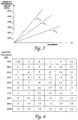
- each value in the look-up table represents the percentage of a given time interval, e.g. a data frame, during which multiplexer 34 is operated for coupling the packetized compressed video information from input A to transmitter 42.
- auxiliary data source 40 is enabled and packetized auxiliary data is coupled from multiplexer input B to transmitter 42.
- the look-up table of Figure 4 is programmed to provide for the transmission of sufficient video information to insure that a television receiver can reproduce a video image in response thereto of acceptable perceivable quality.
- the amount of data required to achieve this objective will, of course, vary depending on the nature of the video signal.
- the look-up table is also programmed to prevent buffer 26 from overflowing. Within these constraints, any excess capacity of the transmission system can be employed for transmitting auxiliary data.
- the perceivable quality of the reproducible video image is represented by signal WPE generated by circuit 30 and the fullness of buffer 26 is represented by control signal BF.
- the programmed values increase with increasing values of both control signals WPE and BF.
- a control signal is applied to compressor 22 from multiplexer control 32 to decrease the amount of compression being effected and thereby increasing the amount of compressed video data supplied to buffer 26.
- WPE now begins to decrease, the opposite scenario occurs. That is, less of the channel is devoted to transmitting video data and more to auxiliary data. Also, for any given value of WPE, more of the channel is devoted to transmitting video data as buffer fullness increases.
- a control signal may be applied to compressor 22 by multiplexer control 32 to increase the amount of compression being effected.
- each frame will comprise .7N compressed video packets and .3N auxiliary data packets. If WPE increases to say WPE 2 , the ratio changes to .9N compressed video packets and .1N auxiliary data packets in an attempt to quickly increase the perceivable quality of the reproducible video image. If, on the other hand, WPE decreases to WPE 0 , less video data (.5N packets) and more auxiliary data (.5N packets) is transmitted. It will be seen that similar changes in the operation of the system are effected in response to changes in buffer fullness. At the extreme (excessive values of either WPE or BF), the entire channel may be devoted to the transmission of video data.
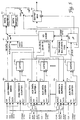
- Figure 5 illustrates an exemplary embodiment of multiplexer 34 and packetizers 36 and 38 of Figure 2.
- the circuit of Figure 5 is operable for multiplexing the variable rate compressed video data signal provided at the output of buffer 26 with one or more auxiliary data streams on a prioritized basis to form a data frame as illustrated in Figure 6.
- the circuit is further operable for inserting a header 44 in a predetermined location of each data frame, the header 44 comprising a number of subheaders 46 and one or more bytes of data 48 identifying the number of subheaders 46 in the respective header 44 (see Figure 7A).
- Each subheader 46 which identifies a respective one of the multiplexed data streams comprising the data frame, includes a first component 50 identifying the type of data of the corresponding data stream (e.g. video, audio, auxiliary data, etc.) and a second component 52 identifying the number of bytes of the data stream comprising the data frame.
- a first component 50 identifying the type of data of the corresponding data stream (e.g. video, audio, auxiliary data, etc.) and a second component 52 identifying the number of bytes of the data stream comprising the data frame.
- the compressed video data signal from buffer 26 is applied to the data input of a two frame delay buffer 60a.
- Buffer 60a also receives a clock signal (CLK) at its write (WR) input and the output signal VDA (video data active) of multiplexer control circuit 32 at its write enable (WREN) input.
- CLK and VDA signals are also applied to the clock and enable inputs respectively of a counter 62a.
- the output of counter 62a is coupled to the input of latch 64a, a frame sync signal occurring at the beginning of each data frame being applied to clock the latch and then reset the counter.
- the output video data from buffer 60a is supplied to a multiplexing node 66 while the output of latch 64a representing the number of bytes in the buffered video data stream for the current data frame is coupled to a microprocessor 68 over a bus 70 to facilitate construction of the video subheader (see Figures 7A and 7B).
- each auxiliary data stream AUX1-AUXN which are supplied by auxiliary data source 40, is coupled to the data input of a respective buffer 60b-60n, whose outputs are each applied to multiplexing node 66.
- Each buffer 60b-60n is enabled by the output of a respective AND gate 72b-72n and receives the CLK signal at its WR input.
- An inverting input of each AND gate 72b-72n is supplied with the activity signal reflecting the status of each respective preceding data stream while a non-inverting input of each gate is supplied with the activity signal (ADIA ... ADNA) of the associated data stream.
- each AND gate 72b-72n is also supplied to one input of a respective second AND gate 74b-74n, each of which also receives the CLK signal at its second input.
- the outputs AUX1RCLK-AUXNRCLK of AND gates 74b-74n are coupled back to the respective sources of auxiliary data signals AUXl-AUXN so that each such signal is read from its source synchronously with the CLK signal.
- Each buffer 60b-60n also includes an associated counter 62b-62n whose outputs supply respective latches 64b-64n.
- the output of each latch is coupled to microprocessor 68 over bus 70 to facilitate construction of the associated subheader.
- Each counter 62b-62n is clocked by clock signal CLK and enabled in response to the output of its associated AND gate 72b-72n. Also, as in the case of the video data channel, the frame synch signal clocks latches 64b-64n and then resets counters 62b-62n.
- the foregoing arrangement provides a hierarchial structure such that the different data streams are prioritized in order from top to bottom, the highest priority being given to video data, the next highest priority to AUXI data and so on.
- all available video data will first be used in forming a data frame, then all available AUXI data, and so on until the frame is completely composed.
- the frame sync signal is also applied to an interrupt input of microprocessor 68, to an input of an I/O logic unit 76 and to the input of a two-stage, multi-byte FIFO 78.
- FIFO 78 is coupled between bus 70 and a second input of I/O logic 76.
- I/O logic 76 includes an output operable for enabling the data bytes stored in the output stage of each respective data buffer 60a - 60n to be read to multiplexing node 66 and a further output for operating a switch SW1 coupled between multiplexing node 66 and a pair of data buffers 80 and 82.
- buffers 80 and 82 are coupled by a second switch SW2, whose state is controlled by an output of microprocessor 68, to a first input of an output multiplexer 84.
- Multiplexer 84 has a second input connected to bus 70 and a select input (SEL) controlled by an output of microprocessor 68.
- activity signal AD1A is active, meaning that data is available from the first auxiliary data source (i.e. the second highest priority data)
- AND gate 72b will enable buffer 60b for loading the first auxiliary data and counter 62b for counting the number of data bytes loaded in the buffer.
- activity signal AD1A goes inactive and the same process is repeated in turn for each subsequent auxiliary data source. It will be understood that if data is not available from any one or more sources, i.e. the corresponding activity signal is inactive, that source will be skipped over and no data will be loaded into the corresponding buffer.
- the next frame sync signal latches the byte counts accumulated by counters 62a-62n into respective latches 64a-64n and resets counters 62a-62n.
- Buffers 60a-60n are then loaded on the same prioritized basis with the data for the next frame, i.e. frame B, with the byte count for each buffer being accumulated by the respective counters 62a-62n.
- the byte counts corresponding to the frame A data stored in latches 64a-64n are transferred over bus 70 to microprocessor 68 which uses the counts to compose and store a header for frame A as shown in Figures 7A and 7B.
- the frame A counts are written into the input stage of two-stage multi-byte FIFO 78.
- the next frame sync signal latches the byte counts accumulated by counters 62a-62n for frame B into latches 64a-64n and again resets counters 62a-62n.
- Microprocessor 68 uses these counts to compose and store the header for frame B, the frame B counts also being written into the input stage of FIFO 78 whereby the frame A counts are transferred to the output stage thereof.
- buffers 60a-60n begin to load the date for the next frame, i.e. frame C.
- I/O logic 76 operates switch SW1 for connecting multiplexing node 66 to buffer 80 and sequentially enables buffers 60a-60n for reading the frame A data into buffer 80. It will be understood that each buffer 60a-60n is enabled by I/O logic 76 in response to the corresponding frame A byte count stored in the output stage of FIFO 78.
- switch SW1 is operated for storing the frame C data from the output stages of buffers 60a-60n in buffer 80, while the frame B data stored in buffer 82 is developed at the output of multiplexer 84 with the appropriate frame B header.
- the foregoing process is repeated for all subsequent data frames to provide a plurality of successive data frames at the output of mulitplexer 84, each including an appropriate header and each comprising a variable amount of compressed video data and auxiliary data from the various auxiliary data sources.
Landscapes
- Engineering & Computer Science (AREA)
- Multimedia (AREA)
- Signal Processing (AREA)
- General Physics & Mathematics (AREA)
- Physics & Mathematics (AREA)
- Algebra (AREA)
- Databases & Information Systems (AREA)
- Mathematical Analysis (AREA)
- Mathematical Optimization (AREA)
- Pure & Applied Mathematics (AREA)
- Compression Or Coding Systems Of Tv Signals (AREA)
- Television Systems (AREA)
- Time-Division Multiplex Systems (AREA)
- Compression, Expansion, Code Conversion, And Decoders (AREA)
Abstract
Claims (14)
- Système de transmission de signaux de télévision, comprenant un dispositif (22) destiné à développer un signal numérique de données vidéo comprimé avec un taux variable, représentant un signal vidéo source, caractérisé par un dispositif (28) générateur d'un signal de commande représentant la différence de qualité d'image reproductible entre les signaux vidéo source et comprimé, un dispositif (40) de développement d'au moins un signal auxiliaire de données représentant des données auxiliaires pour un ou plusieurs services auxiliaires de données, un dispositif (34) de multiplexage du signal auxiliaire de données et du signal comprimé de données vidéo et de création d'un signal multiplexé de sortie, et un dispositif de commande (32) commandé par le signal de commande et destiné à augmenter ou réduire la quantité relative du signal comprimé de données vidéo dans le signal multiplexé lorsque ladite différence augmente et diminue respectivement.
- Système selon la revendication 1, caractérisé par un dispositif (26) de conservation dans un circuit tampon du signal comprimé de données vidéo et de création d'un second signal de commande représentant son caractère complet, le dispositif de commande (32) étant en outre commandé par le second signal de commande et étant destiné à régler l'amplitude relative du signal comprimé de données vidéo contenu dans le signal multiplexé en fonction inverse du second signal de commande.
- Système selon la revendication 1, caractérisé en ce que le dispositif générateur du signal de commande (28) comporte un dispositif (30) destiné à créer un signal de commande qui correspond à la différence de qualité perceptible d'une image reproductible en fonction des signaux vidéo source et comprimé.
- Système selon la revendication 1, caractérisé en ce que le dispositif générateur du signal de commande comprend un dispositif (28) de développement d'un signal d'erreur qui représente la différence entre le signal vidéo source et une représentation décomprimée du signal comprimé de données vidéo, et un dispositif (30) de pondération du signal d'erreur en fonction d'une caractéristique perceptible du signal vidéo source pour la création du signal de commande.
- Système selon l'une quelconque des revendications 1 à 4, caractérisé en ce que le dispositif de multiplexage (34) donne un signal multiplexé de sortie qui comprend une série de trames successives de données, chacune des trames de données comprenant un nombre total fixe de paquets de données dont un nombre variable contient le signal vidéo numérique comprimé et le reste contient un ou plusieurs signaux auxiliaires de données.
- Système selon la revendication 5, caractérisé par un dispositif (34, 36, 38) d'insertion d'un en-tête (44) dans chacune des trames de données, l'en-tête (44) comprenant plusieurs sous-en-têtes (46) identifiant chacun soit le signal vidéo numérique comprimé soit un des signaux auxiliaires de données et la quantité de données de la trame associée de données dans chaque signal respectif.
- Système selon l'une quelconque des revendications précédentes, caractérisé par un dispositif (22, 40) destiné à créer plusieurs signaux d'activité qui représentent chacun la disponibilité d'un signal respectif parmi les signaux vidéo comprimé et de données auxiliaires, le dispositif de multiplexage (34) comprenant plusieurs circuits tampons (60a-60n) qui peuvent être validés chacun pour la mémorisation d'un signal respectif parmi les signaux de données, chacun des circuits tampons (60a-60n) ayant un niveau relatif de mémorisation d'un signal respectif parmi les signaux de données qui lui est affecté, chacun des circuits tampons (60a-60n) ayant un niveau relatif de priorité qui lui est affecté et fonctionnant de manière que le circuit tampon (60a-60n) qui a le niveau relatif de priorité le plus élevé soit validé afin qu'il mémorise le signal de données vidéo comprimé lors de la présence de son signal d'activité associé et chacun des circuits tampons restants (60a-60n) soit validé pour mémoriser un signal respectif parmi les signaux de données auxiliaires lors de la présence du signal d'activité associé et en l'absence de signaux d'activité associés aux circuits tampons (60a-60n) de niveau relatif de priorité plus élevé, et un dispositif (68, 78) de lecture des signaux de données conservés dans les circuits tampons (60a-60n) pour la formation de la trame de données.
- Système selon la revendication 7, caractérisé en ce que chacun des signaux de données comprend un ou plusieurs octets de données et un dispositif (62a-62n) destiné à compter le nombre d'octets de données de chacun des signaux de données conservés dans un circuit respectif parmi les circuits tampons (60a-60n) et comprenant en outre un dispositif de lecture (68, 76) destiné à insérer les nombres dans une partie prédéterminée de la trame de données.
- Système selon la revendication 8, caractérisé en ce que le dispositif de lecture (68, 78) comporte un dispositif commandé par lesdits nombres et destiné à permettre à chacun des circuits tampons (60a-60n) à son tour de transmettre le signal respectif de données qu'il mémorise.
- Système selon la revendication 7, 8 ou 9, caractérisé par un dispositif (CLK, 64a-64n) destiné à donner en synchronisme les signaux de données destinés à être mémorisés dans les circuits tampons (60a-60n).
- Procédé de formation d'un système de transmission d'un signal de télévision, comprenant l'étape de développement d'un signal numérique de données vidéo comprimé avec un taux variable représentant un signal vidéo source, caractérisé par la création d'un signal de commande représentant la différence de qualité d'image reproductible entre les signaux vidéo source et comprimé, le développement d'au moins un signal auxiliaire de données représentant des données auxiliaires d'un ou plusieurs services de données auxiliaires, le multiplexage de paquets du signal auxiliaire de données et du signal de données vidéo comprimé pour la création d'un signal multiplexé de sortie, et l'ajustement des nombres relatifs des paquets du signal vidéo comprimé et du signal auxiliaire de données dans le signal multiplexé lorsque la différence augmente et diminue respectivement.
- Procédé selon la revendication 11, caractérisé par l'application du signal vidéo comprimé à un circuit tampon et le réglage ultérieur des nombres de paquets de données auxiliaires et de paquets de données vidéo comprimées dans la trame de données lorsque le circuit tampon est plein.
- Procédé selon la revendication 11 ou 12, caractérisé en ce que l'étape de détermination comprend la détermination de la différence de qualité perceptible d'une image reproductible en fonction des signaux vidéo source et comprimé.
- Procédé selon la revendication 11 ou 12, caractérisé en ce que l'étape de détermination comprend le développement d'un signal d'erreur représentant la différence entre le signal vidéo source et une représentation décomprimée du signal vidéo comprimé, et la pondération du signal d'erreur en fonction d'une caractéristique perceptible du signal vidéo source pour la détermination de ladite différence.
Applications Claiming Priority (3)
| Application Number | Priority Date | Filing Date | Title |
|---|---|---|---|
| US88285 | 1993-07-06 | ||
| US08/088,285 US5461619A (en) | 1993-07-06 | 1993-07-06 | System for multiplexed transmission of compressed video and auxiliary data |
| PCT/US1994/006983 WO1995002301A2 (fr) | 1993-07-06 | 1994-06-21 | Systeme de transmission multiplex de signaux video comprimes et de signaux auxiliaires |
Publications (2)
| Publication Number | Publication Date |
|---|---|
| EP0707772A1 EP0707772A1 (fr) | 1996-04-24 |
| EP0707772B1 true EP0707772B1 (fr) | 1999-02-24 |
Family
ID=22210486
Family Applications (1)
| Application Number | Title | Priority Date | Filing Date |
|---|---|---|---|
| EP94920289A Expired - Lifetime EP0707772B1 (fr) | 1993-07-06 | 1994-06-21 | Systeme de transmission multiplex de signaux video comprimes et de signaux auxiliaires |
Country Status (10)
| Country | Link |
|---|---|
| US (1) | US5461619A (fr) |
| EP (1) | EP0707772B1 (fr) |
| JP (1) | JP3401007B2 (fr) |
| KR (1) | KR100290074B1 (fr) |
| CN (1) | CN1052366C (fr) |
| CA (1) | CA2166387C (fr) |
| DE (1) | DE69416678T2 (fr) |
| MX (1) | MX9405113A (fr) |
| TW (1) | TW278300B (fr) |
| WO (1) | WO1995002301A2 (fr) |
Families Citing this family (57)
| Publication number | Priority date | Publication date | Assignee | Title |
|---|---|---|---|---|
| JP3430630B2 (ja) * | 1994-05-02 | 2003-07-28 | ヤマハ株式会社 | カラオケ演奏用双方向ディジタル通信システム |
| US5734432A (en) * | 1994-07-15 | 1998-03-31 | Lucent Technologies, Inc. | Method of incorporating a variable rate auxiliary data stream with a variable rate primary data stream |
| EP0737402B1 (fr) * | 1994-10-28 | 2000-07-12 | Koninklijke Philips Electronics N.V. | Decodage d'un signal de donnees transmis dans un systeme de television |
| US5606369A (en) * | 1994-12-28 | 1997-02-25 | U.S. Philips Corporation | Buffering for digital video signal encoders using joint bit-rate control |
| EP0753235B1 (fr) * | 1994-12-28 | 2000-07-12 | Koninklijke Philips Electronics N.V. | Gestion de tampons destinee a des systemes de compression a debit binaire variable |
| US5671226A (en) * | 1995-02-09 | 1997-09-23 | Mitsubishi Denki Kabushiki Kaisha | Multimedia information processing system |
| JPH08322046A (ja) * | 1995-03-20 | 1996-12-03 | Sony Corp | データ符号化/復号化方法および装置、および符号化データ記録媒体 |
| US6700958B2 (en) | 1995-04-10 | 2004-03-02 | Starguide Digital Networks, Inc. | Method and apparatus for transmitting coded audio signals through a transmission channel with limited bandwidth |
| DE69631182T2 (de) * | 1995-04-28 | 2004-08-19 | Matsushita Electric Industrial Co., Ltd., Kadoma | Datenübertragungsverfahren |
| US5691986A (en) * | 1995-06-07 | 1997-11-25 | Hitachi America, Ltd. | Methods and apparatus for the editing and insertion of data into an encoded bitstream |
| WO1997007606A1 (fr) * | 1995-08-16 | 1997-02-27 | Starguide Digital Networks, Inc. | Affectation dynamique des bandes de frequences pour la transmission de signaux audio et d'un signal video |
| GB9517130D0 (en) * | 1995-08-22 | 1995-10-25 | Nat Transcommunications Ltd | Statistical multiplexing |
| US5966120A (en) * | 1995-11-21 | 1999-10-12 | Imedia Corporation | Method and apparatus for combining and distributing data with pre-formatted real-time video |
| DE19547707A1 (de) * | 1995-12-20 | 1997-07-03 | Thomson Brandt Gmbh | Verfahren, Encoder und Decoder zur Übertragung von hierarchisch in mehrere Teile gegliederten digitalen Signalen |
| US5729535A (en) * | 1995-12-29 | 1998-03-17 | Lsi Logic Corporation | Method and apparatus for adapting a computer for wireless communications |
| US5745642A (en) * | 1996-03-15 | 1998-04-28 | Broderbund Software, Inc. | System to add selectivley persistent resource data to unused bandwidth of digital movie |
| US6088360A (en) * | 1996-05-31 | 2000-07-11 | Broadband Networks Corporation | Dynamic rate control technique for video multiplexer |
| JP3750760B2 (ja) * | 1996-10-24 | 2006-03-01 | ソニー株式会社 | 繰返し使用データ挿入装置およびディジタル放送送信システム |
| US6172672B1 (en) * | 1996-12-18 | 2001-01-09 | Seeltfirst.Com | Method and system for providing snapshots from a compressed digital video stream |
| US6005620A (en) * | 1997-01-31 | 1999-12-21 | Hughes Electronics Corporation | Statistical multiplexer for live and pre-compressed video |
| US6188436B1 (en) | 1997-01-31 | 2001-02-13 | Hughes Electronics Corporation | Video broadcast system with video data shifting |
| US6084910A (en) * | 1997-01-31 | 2000-07-04 | Hughes Electronics Corporation | Statistical multiplexer for video signals |
| US6078958A (en) * | 1997-01-31 | 2000-06-20 | Hughes Electronics Corporation | System for allocating available bandwidth of a concentrated media output |
| JP3003618B2 (ja) * | 1997-03-19 | 2000-01-31 | 日本電気株式会社 | 動画像送受信装置 |
| US6052384A (en) * | 1997-03-21 | 2000-04-18 | Scientific-Atlanta, Inc. | Using a receiver model to multiplex variable-rate bit streams having timing constraints |
| JP3438223B2 (ja) * | 1997-03-28 | 2003-08-18 | ソニー株式会社 | 多重化装置および多重化方法、並びに伝送装置および伝送方法 |
| JPH1118083A (ja) | 1997-06-25 | 1999-01-22 | Sony Corp | ディジタル信号符号化方法及び装置、信号記録媒体並びに信号伝送方法 |
| JPH11202900A (ja) * | 1998-01-13 | 1999-07-30 | Nec Corp | 音声データ圧縮方法及びそれを適用した音声データ圧縮システム |
| US7194757B1 (en) | 1998-03-06 | 2007-03-20 | Starguide Digital Network, Inc. | Method and apparatus for push and pull distribution of multimedia |
| US6160797A (en) | 1998-04-03 | 2000-12-12 | Starguide Digital Networks, Inc. | Satellite receiver/router, system, and method of use |
| US8284774B2 (en) | 1998-04-03 | 2012-10-09 | Megawave Audio Llc | Ethernet digital storage (EDS) card and satellite transmission system |
| US6259733B1 (en) | 1998-06-16 | 2001-07-10 | General Instrument Corporation | Pre-processing of bit rate allocation in a multi-channel video encoder |
| JP3508915B2 (ja) * | 1998-09-18 | 2004-03-22 | シャープ株式会社 | データ表示制御方法、データ表示制御装置、及びデータ表示制御プログラムを記録したコンピュータ読み取り可能な記録媒体 |
| US6122660A (en) * | 1999-02-22 | 2000-09-19 | International Business Machines Corporation | Method for distributing digital TV signal and selection of content |
| CN1244080C (zh) | 1999-10-28 | 2006-03-01 | 美国安科公司 | 带宽动态分配方法 |
| US6519773B1 (en) | 2000-02-08 | 2003-02-11 | Sherjil Ahmed | Method and apparatus for a digitized CATV network for bundled services |
| ID29908A (id) * | 2000-04-11 | 2001-10-25 | Sony Corp | Peranti transmisi data, peranti penerima data, metode pentransmisi data, metode penerima data, peranti perekam, peranti pemutar ulang, metode perekam dan metode pemutaran ulang |
| US7360231B2 (en) * | 2000-05-01 | 2008-04-15 | The Directv Group, Inc. | System for obtaining data regarding customer use of interactive television |
| US20020188950A1 (en) * | 2000-05-01 | 2002-12-12 | Hughes Electronics Corporation | Low speed data port for data transactions and information |
| US6889384B1 (en) * | 2000-11-08 | 2005-05-03 | The Directv Group, Inc. | Simplified interactive user interface for multi-video channel navigation |
| US7154916B2 (en) * | 2001-07-26 | 2006-12-26 | The Directv Group, Inc. | Method for real-time insertion of auxiliary data packets into DSS bitstream in the presence of one or more service channels |
| US7376159B1 (en) * | 2002-01-03 | 2008-05-20 | The Directv Group, Inc. | Exploitation of null packets in packetized digital television systems |
| US7286473B1 (en) | 2002-07-10 | 2007-10-23 | The Directv Group, Inc. | Null packet replacement with bi-level scheduling |
| US8036250B1 (en) * | 2002-10-25 | 2011-10-11 | Bigband Networks Inc. | Method and apparatus of mutliplexing media streams |
| CN100454284C (zh) * | 2002-12-24 | 2009-01-21 | 联想(北京)有限公司 | 实现远程实时播放接收声音的方法及系统 |
| US7647221B2 (en) * | 2003-04-30 | 2010-01-12 | The Directv Group, Inc. | Audio level control for compressed audio |
| US7397774B1 (en) | 2003-05-23 | 2008-07-08 | The United States Of America As Represented By The Administrator Of The National Aeronautics And Space Administration | Downlink data multiplexer |
| US7912226B1 (en) | 2003-09-12 | 2011-03-22 | The Directv Group, Inc. | Automatic measurement of audio presence and level by direct processing of an MPEG data stream |
| WO2006077621A1 (fr) * | 2005-01-18 | 2006-07-27 | Mitsubishi Denki Kabushiki Kaisha | Appareil de multiplexage et appareil de réception |
| US20090208086A1 (en) * | 2008-02-15 | 2009-08-20 | Pelc Norbert J | Compression and decompression of raw image data |
| JP5332854B2 (ja) * | 2009-04-20 | 2013-11-06 | ソニー株式会社 | 無線送信機、無線送信方法、無線受信機および無線受信方法 |
| CN102215173B (zh) * | 2011-06-22 | 2014-03-05 | 博康智能网络科技股份有限公司 | 一种可动态配置带宽的发送、接收以太网业务的方法及装置 |
| US9729120B1 (en) | 2011-07-13 | 2017-08-08 | The Directv Group, Inc. | System and method to monitor audio loudness and provide audio automatic gain control |
| US10097869B2 (en) | 2011-08-29 | 2018-10-09 | Tata Consultancy Services Limited | Method and system for embedding metadata in multiplexed analog videos broadcasted through digital broadcasting medium |
| WO2013105116A2 (fr) | 2011-12-29 | 2013-07-18 | Tata Consultancy Services Limited | Méthode d'intégration et de multiplexage de métadonnées audio dans un train vidéo analogique diffusé |
| GB2561036A (en) | 2017-03-31 | 2018-10-03 | Cirrus Logic Int Semiconductor Ltd | Methods and apparatus for buffering and compression of data |
| CN111757061B (zh) * | 2020-06-29 | 2023-04-25 | 深圳市达程科技开发有限公司 | 一种基于fpga实现单通道传输双路视频数据的摄像头 |
Family Cites Families (16)
| Publication number | Priority date | Publication date | Assignee | Title |
|---|---|---|---|---|
| JPS58200654A (ja) * | 1982-05-18 | 1983-11-22 | Nec Corp | 通信装置 |
| US4593318A (en) * | 1983-06-03 | 1986-06-03 | At&T Bell Laboratories | Technique for the time compression multiplexing of three television signals |
| US4893308A (en) * | 1986-09-03 | 1990-01-09 | Motorola, Inc. | Method and apparatus for time companding a digital voice signal |
| US4975771A (en) * | 1989-02-10 | 1990-12-04 | Kassatly Salim A | Method and apparatus for TV broadcasting |
| US5231492A (en) * | 1989-03-16 | 1993-07-27 | Fujitsu Limited | Video and audio multiplex transmission system |
| US5170490A (en) * | 1990-09-28 | 1992-12-08 | Motorola, Inc. | Radio functions due to voice compression |
| JP3092850B2 (ja) * | 1990-10-05 | 2000-09-25 | 株式会社リコー | 多重化データ分離方法 |
| US5113256A (en) * | 1991-02-08 | 1992-05-12 | Zenith Electronics Corporation | Method of perceptually modeling a video image signal |
| US5111292A (en) * | 1991-02-27 | 1992-05-05 | General Electric Company | Priority selection apparatus as for a video signal processor |
| US5168356A (en) * | 1991-02-27 | 1992-12-01 | General Electric Company | Apparatus for segmenting encoded video signal for transmission |
| TW237589B (fr) * | 1991-02-27 | 1995-01-01 | Gen Electric | |
| US5285276A (en) * | 1991-03-12 | 1994-02-08 | Zenith Electronics Corp. | Bi-rate high definition television signal transmission system |
| WO1992017032A1 (fr) * | 1991-03-12 | 1992-10-01 | Zenith Electronics Corporation | Systeme d'emission de signal de television avec deux jeux de symboles de canaux |
| US5159447A (en) * | 1991-05-23 | 1992-10-27 | At&T Bell Laboratories | Buffer control for variable bit-rate channel |
| US5287178A (en) * | 1992-07-06 | 1994-02-15 | General Electric Company | Reset control network for a video signal encoder |
| US5231486A (en) * | 1992-07-27 | 1993-07-27 | General Electric Company | Data separation processing in a dual channel digital high definition television system |
-
1993
- 1993-07-06 US US08/088,285 patent/US5461619A/en not_active Expired - Lifetime
-
1994
- 1994-06-21 WO PCT/US1994/006983 patent/WO1995002301A2/fr not_active Ceased
- 1994-06-21 CA CA002166387A patent/CA2166387C/fr not_active Expired - Lifetime
- 1994-06-21 CN CN94192697A patent/CN1052366C/zh not_active Expired - Fee Related
- 1994-06-21 KR KR1019960700113A patent/KR100290074B1/ko not_active Expired - Lifetime
- 1994-06-21 JP JP50403895A patent/JP3401007B2/ja not_active Expired - Lifetime
- 1994-06-21 EP EP94920289A patent/EP0707772B1/fr not_active Expired - Lifetime
- 1994-06-21 DE DE69416678T patent/DE69416678T2/de not_active Expired - Fee Related
- 1994-06-30 TW TW083105974A patent/TW278300B/zh active
- 1994-07-05 MX MX9405113A patent/MX9405113A/es unknown
Also Published As
| Publication number | Publication date |
|---|---|
| US5461619A (en) | 1995-10-24 |
| DE69416678T2 (de) | 1999-09-09 |
| CN1126535A (zh) | 1996-07-10 |
| TW278300B (fr) | 1996-06-11 |
| CN1052366C (zh) | 2000-05-10 |
| WO1995002301A3 (fr) | 1995-03-09 |
| MX9405113A (es) | 1995-01-31 |
| EP0707772A1 (fr) | 1996-04-24 |
| KR100290074B1 (ko) | 2001-05-15 |
| DE69416678D1 (de) | 1999-04-01 |
| JP3401007B2 (ja) | 2003-04-28 |
| KR960704439A (ko) | 1996-08-31 |
| WO1995002301A2 (fr) | 1995-01-19 |
| JPH08512442A (ja) | 1996-12-24 |
| CA2166387C (fr) | 2000-03-28 |
Similar Documents
| Publication | Publication Date | Title |
|---|---|---|
| EP0707772B1 (fr) | Systeme de transmission multiplex de signaux video comprimes et de signaux auxiliaires | |
| US6944221B1 (en) | Buffer management in variable bit-rate compression systems | |
| US5361097A (en) | Priority processing of encoded video signal including insertion of datastream null words during priority analysis intervals | |
| US6477202B1 (en) | Apparatus of layered picture coding, apparatus of picture decoding, methods of picture decoding, apparatus of recording for digital broadcasting signal, and apparatus of picture and audio decoding | |
| US5598222A (en) | Method and apparatus for decoding multiple video bitstreams using a common memory | |
| US5815634A (en) | Stream synchronization method and apparatus for MPEG playback system | |
| US5410355A (en) | Video signal processor including input codeword buffer for providing stored codewords to codeword priority analysis circuit | |
| US5694332A (en) | MPEG audio decoding system with subframe input buffering | |
| US5534929A (en) | Data processing apparatus | |
| US6754239B2 (en) | Multiplexing apparatus and method, transmitting apparatus and method, and recording medium | |
| CA2028947C (fr) | Appareil de codage d'images | |
| US10812789B2 (en) | Encoding/transmitting apparatus and encoding/transmitting method | |
| US7593463B2 (en) | Video signal coding method and video signal encoder | |
| JPWO2002080575A1 (ja) | 画像処理装置、画像処理方法、画像処理プログラムおよび記録媒体 | |
| JPH09261604A (ja) | ディジタル信号符号化方法および装置、ディジタル信号伝送方法および装置、並びに記録媒体 | |
| JPH089387A (ja) | 高周波成分制御装置 |
Legal Events
| Date | Code | Title | Description |
|---|---|---|---|
| PUAI | Public reference made under article 153(3) epc to a published international application that has entered the european phase |
Free format text: ORIGINAL CODE: 0009012 |
|
| 17P | Request for examination filed |
Effective date: 19960201 |
|
| AK | Designated contracting states |
Kind code of ref document: A1 Designated state(s): BE DE FR GB NL SE |
|
| 17Q | First examination report despatched |
Effective date: 19971128 |
|
| GRAG | Despatch of communication of intention to grant |
Free format text: ORIGINAL CODE: EPIDOS AGRA |
|
| GRAG | Despatch of communication of intention to grant |
Free format text: ORIGINAL CODE: EPIDOS AGRA |
|
| GRAH | Despatch of communication of intention to grant a patent |
Free format text: ORIGINAL CODE: EPIDOS IGRA |
|
| GRAH | Despatch of communication of intention to grant a patent |
Free format text: ORIGINAL CODE: EPIDOS IGRA |
|
| GRAA | (expected) grant |
Free format text: ORIGINAL CODE: 0009210 |
|
| AK | Designated contracting states |
Kind code of ref document: B1 Designated state(s): BE DE FR GB NL SE |
|
| PG25 | Lapsed in a contracting state [announced via postgrant information from national office to epo] |
Ref country code: SE Free format text: THE PATENT HAS BEEN ANNULLED BY A DECISION OF A NATIONAL AUTHORITY Effective date: 19990224 Ref country code: BE Free format text: LAPSE BECAUSE OF FAILURE TO SUBMIT A TRANSLATION OF THE DESCRIPTION OR TO PAY THE FEE WITHIN THE PRESCRIBED TIME-LIMIT Effective date: 19990224 |
|
| REF | Corresponds to: |
Ref document number: 69416678 Country of ref document: DE Date of ref document: 19990401 |
|
| ET | Fr: translation filed | ||
| PLBE | No opposition filed within time limit |
Free format text: ORIGINAL CODE: 0009261 |
|
| STAA | Information on the status of an ep patent application or granted ep patent |
Free format text: STATUS: NO OPPOSITION FILED WITHIN TIME LIMIT |
|
| 26N | No opposition filed | ||
| REG | Reference to a national code |
Ref country code: GB Ref legal event code: IF02 |
|
| PGFP | Annual fee paid to national office [announced via postgrant information from national office to epo] |
Ref country code: NL Payment date: 20080514 Year of fee payment: 15 Ref country code: DE Payment date: 20080602 Year of fee payment: 15 |
|
| PGFP | Annual fee paid to national office [announced via postgrant information from national office to epo] |
Ref country code: FR Payment date: 20080529 Year of fee payment: 15 |
|
| PGFP | Annual fee paid to national office [announced via postgrant information from national office to epo] |
Ref country code: GB Payment date: 20080516 Year of fee payment: 15 |
|
| GBPC | Gb: european patent ceased through non-payment of renewal fee |
Effective date: 20090621 |
|
| NLV4 | Nl: lapsed or anulled due to non-payment of the annual fee |
Effective date: 20100101 |
|
| REG | Reference to a national code |
Ref country code: FR Ref legal event code: ST Effective date: 20100226 |
|
| PG25 | Lapsed in a contracting state [announced via postgrant information from national office to epo] |
Ref country code: FR Free format text: LAPSE BECAUSE OF NON-PAYMENT OF DUE FEES Effective date: 20090630 |
|
| PG25 | Lapsed in a contracting state [announced via postgrant information from national office to epo] |
Ref country code: GB Free format text: LAPSE BECAUSE OF NON-PAYMENT OF DUE FEES Effective date: 20090621 |
|
| PG25 | Lapsed in a contracting state [announced via postgrant information from national office to epo] |
Ref country code: DE Free format text: LAPSE BECAUSE OF NON-PAYMENT OF DUE FEES Effective date: 20100101 |
|
| PG25 | Lapsed in a contracting state [announced via postgrant information from national office to epo] |
Ref country code: NL Free format text: LAPSE BECAUSE OF NON-PAYMENT OF DUE FEES Effective date: 20100101 |