EP0707775B1 - Appareil de formation de signaux video comprimes a balayage non entrelace - Google Patents
Appareil de formation de signaux video comprimes a balayage non entrelace Download PDFInfo
- Publication number
- EP0707775B1 EP0707775B1 EP94921317A EP94921317A EP0707775B1 EP 0707775 B1 EP0707775 B1 EP 0707775B1 EP 94921317 A EP94921317 A EP 94921317A EP 94921317 A EP94921317 A EP 94921317A EP 0707775 B1 EP0707775 B1 EP 0707775B1
- Authority
- EP
- European Patent Office
- Prior art keywords
- compressed
- frames
- signal
- interlaced scanned
- primary
- Prior art date
- Legal status (The legal status is an assumption and is not a legal conclusion. Google has not performed a legal analysis and makes no representation as to the accuracy of the status listed.)
- Expired - Lifetime
Links
- 238000007906 compression Methods 0.000 claims description 27
- 230000006835 compression Effects 0.000 claims description 26
- 230000005540 biological transmission Effects 0.000 claims description 8
- 230000006837 decompression Effects 0.000 claims description 5
- 230000003750 conditioning effect Effects 0.000 claims 4
- 238000001514 detection method Methods 0.000 claims 2
- 230000002457 bidirectional effect Effects 0.000 claims 1
- 230000015654 memory Effects 0.000 description 6
- 238000010586 diagram Methods 0.000 description 5
- 238000000034 method Methods 0.000 description 4
- 230000006870 function Effects 0.000 description 3
- 230000015572 biosynthetic process Effects 0.000 description 2
- 230000003466 anti-cipated effect Effects 0.000 description 1
- 230000000694 effects Effects 0.000 description 1
- 238000004519 manufacturing process Methods 0.000 description 1
- 230000008520 organization Effects 0.000 description 1
- 230000006798 recombination Effects 0.000 description 1
- 238000005215 recombination Methods 0.000 description 1
- 230000003936 working memory Effects 0.000 description 1
Images


Classifications
-
- H—ELECTRICITY
- H04—ELECTRIC COMMUNICATION TECHNIQUE
- H04N—PICTORIAL COMMUNICATION, e.g. TELEVISION
- H04N19/00—Methods or arrangements for coding, decoding, compressing or decompressing digital video signals
- H04N19/30—Methods or arrangements for coding, decoding, compressing or decompressing digital video signals using hierarchical techniques, e.g. scalability
- H04N19/37—Methods or arrangements for coding, decoding, compressing or decompressing digital video signals using hierarchical techniques, e.g. scalability with arrangements for assigning different transmission priorities to video input data or to video coded data
-
- H—ELECTRICITY
- H04—ELECTRIC COMMUNICATION TECHNIQUE
- H04N—PICTORIAL COMMUNICATION, e.g. TELEVISION
- H04N19/00—Methods or arrangements for coding, decoding, compressing or decompressing digital video signals
- H04N19/10—Methods or arrangements for coding, decoding, compressing or decompressing digital video signals using adaptive coding
- H04N19/134—Methods or arrangements for coding, decoding, compressing or decompressing digital video signals using adaptive coding characterised by the element, parameter or criterion affecting or controlling the adaptive coding
- H04N19/157—Assigned coding mode, i.e. the coding mode being predefined or preselected to be further used for selection of another element or parameter
- H04N19/16—Assigned coding mode, i.e. the coding mode being predefined or preselected to be further used for selection of another element or parameter for a given display mode, e.g. for interlaced or progressive display mode
-
- H—ELECTRICITY
- H04—ELECTRIC COMMUNICATION TECHNIQUE
- H04N—PICTORIAL COMMUNICATION, e.g. TELEVISION
- H04N19/00—Methods or arrangements for coding, decoding, compressing or decompressing digital video signals
- H04N19/50—Methods or arrangements for coding, decoding, compressing or decompressing digital video signals using predictive coding
- H04N19/503—Methods or arrangements for coding, decoding, compressing or decompressing digital video signals using predictive coding involving temporal prediction
- H04N19/51—Motion estimation or motion compensation
- H04N19/577—Motion compensation with bidirectional frame interpolation, i.e. using B-pictures
-
- H—ELECTRICITY
- H04—ELECTRIC COMMUNICATION TECHNIQUE
- H04N—PICTORIAL COMMUNICATION, e.g. TELEVISION
- H04N19/00—Methods or arrangements for coding, decoding, compressing or decompressing digital video signals
- H04N19/50—Methods or arrangements for coding, decoding, compressing or decompressing digital video signals using predictive coding
- H04N19/587—Methods or arrangements for coding, decoding, compressing or decompressing digital video signals using predictive coding involving temporal sub-sampling or interpolation, e.g. decimation or subsequent interpolation of pictures in a video sequence
Definitions
- This invention relates to compressed video systems and more particularly to systems for providing compressed video which may be reproduced in interlaced form at a first resolution or non-interlaced form with a second higher resolution.
- MPEG Moving Picture Experts Group
- interlaced scanned signal There are two basic forms of video signal, interlaced scanned signal and non-interlaced scanned signal. Compression of interlaced scanned video has advantages in that lesser bandwidth is required and both production and receiver equipment for compressing/decompressing interlaced scanned signal can be manufactured at lower cost, than for non-interlaced scan signal.
- the television industry tends to favor a compressed video standard which is based on interlaced scanned signal.
- non-interlaced scanned images particularly in that segment of the computer community which process video images.
- the MPEG committee is desirous of satisfying both camps, that is establishing a standard which is useful to the greatest number of potential users.
- the present invention is directed to a compression system which provides compressed signal for the reproduction of both interlaced and non-interlaced scanned images without significantly increasing the compressed signal data rate over compressed interlaced scanned signal.
- the compression/decompression system of the present invention includes a source of (1:1 60 Hz) non-interlaced scanned video signal.
- a preprocessor constructs (2:1 60 Hz) interlaced scanned video signal from the non-interlaced scanned video signal by selection of alternate lines of successive non-interlaced image signals.
- the interlaced scanned video signal is compressed according to an MPEG protocol of I, P and B frame compression algorithms, where I-frames are intraframe compressed, P-frames are interframe predictively compressed from the last most I-frame or preceding P-frames, and B-frames are bidirectionally interframe compressed from the preceding and succeeding I- and P-frames between which they are disposed.
- I, P and B frame compression is performed such that there are an odd number, greater than one, of B-frames between successive I/P frames (for example the sequence of compressed frames may conform to I, B1, B2, B3, P, B1, B2, B3, P, B1, B2, B3, I, B1,...etc).
- the I compressed frames, the P compressed frames and alternate B compressed frames (the frames B2 in the exemplary sequence) selectively form a primary compressed (2:1 30 Hz) interlaced video signal for reproduction by interlaced scanned receivers.
- the intervening B-frames selectively form a secondary compressed video.
- the primary and secondary compressed video signals are received by non-interlaced scanned receivers for reproducing non-interlaced scanned images, while the primary signal alone may be reproduced by interlaced scanned receivers.
- a compression apparatus is defined in claim 1 and a corresponding decompression apparatus is defined in claim 7.
- the intervening B-frames include the difference information between the original non-interlaced scanned video and the primary video signal. It will be appreciated by those skilled in the art of video compression that B-frame compression generates significantly less compressed data than the I or P compressed frames. Hence, according to the foregoing system, the compressed information required to augment the primary data to generate non-interlaced scanned images may be provided with only a moderate increase in compressed information.
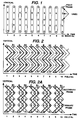
- FIGURE 1 is a pictorial diagram of the format of portions of respective frames of non-interlaced scanned video signal.
- FIGURES 3 is a block diagram of compression apparatus embodying the present invention.
- FIGURES 4 and 5 are pictorial diagrams of alternative interframe compression dependencies for B-frame compression.
- FIGURE 6 is a block diagram of an exemplary non-interlaced scanned receiver for reproducing images transmitted by the FIGURE 3 apparatus.
- the respective columns of letters represent, in abbreviated form, the lines in non-interlaced scanned images (fields/frames) of video signal. These images occur at a rate of 60 per second.
- the non-interlaced scanned images occur at the field rate of interlaced scanned images and include twice the number of lines as a field of interlaced scanned video.
- Interlaced scanned video occurs as successive fields of data occurring at a rate of 60 per second. Lines in even fields occur spatially between the lines of odd fields. Combining two successive fields forms a frame similar to one of the non-interlaced scanned images. However, because a finite time elapses between the scanning of successive interlaced scanned fields, a frame of interlaced scanned video will differ from a corresponding non-interlaced scanned image by virtue of any image motion occurring during the time elapsed between the scanning of successive interlaced fields.
- Interlaced scanned video may be generated from the non-interlaced scanned video signal by selecting alternate lines from alternate non-interlaced scanned images. Recall that non-interlaced images occur at a rate of 60 per second and interlaced frames occur at a rate of 30 per second (nominally). Hence if the odd numbered lines of the odd numbered non-interlaced images are combined with the even numbered lines of the even numbered images, interlaced scanned frames can be produced from the non-interlaced scanned signal. These frames are represented by the respective groupings of image lines circumscribed by the solid lines (frames I, P and B) in FIGURE 2 and will be referred to as primary frames.
- interlaced frames In forming the interlaced frames from non-interlaced data only fifty percent of the image information is used. The remaining data is arranged in secondary frames (frames B1 and B2) shown circumscribed by dashed lines in FIGURE 2.
- the secondary frames are interleaved with the primary frames and respective secondary frames share data with two primary frames from two non-interlaced scanned images.
- the primary frames represent interlaced scanned video data.
- the combination of both primary and secondary frames represent all of the non-interlaced scanned data but not in non-interlaced format.
- FIGURE 2A illustrates a second method of forming the secondary frames from the excess non-interlaced scanned data.
- the secondary frames shown in FIGURE 2A may be said to be intertwined with the primary frames, and respective secondary frames share data with one primary frame from two non-interlaced images. It will be noted that the odd and even fields of the intertwined secondary frames are in temporally reversed order. This is of no consequence if compression is to follow MPEG protocol, as the MPEG protocol supports a flag indicative of which of the two fields of respective frames is to be displayed first.
- a Compression sequence of I, B, B, B, P, B, B, B, P, B... is anticipated by the MPEG protocol, and therefore a sequence of frames of video data such as shown in FIGURE 2 or 2A may be compressed in standard MPEG compression apparatus.
- An example of such apparatus is described in U.S. Patent 5,122,875.
- FIGURE 4 herein shows the normal frame interdependence for predictive encoding of B-frames.
- arrows emanating from one frame and terminating on another frame indicate prediction dependence.
- the arrow drawn from the first P-frame and terminating on the I-frame indicates that the first P-frame is predicted from the I-frame.
- the arrow drawn from the second P-frame and terminating on the first P-frame indicates that the second P-frame is predicted from the first P-frame.
- Each of the respective B-frames disposed between a pair of anchor frames ( anchor frames being I and P-frames) are predicted from one of both of the anchor frames between which they are disposed.
- a prediction of the first B1-frame is made from the I-frame, and another is made from the first P-frame.
- the more accurate prediction of the two predictions is selected if the quality of the better prediction surpasses a minimum prediction criterion. If it does not, then a prediction is formed of the average of the two predictions. If this averaged prediction fails a minimum prediction criterion, at least a portion of the frame is then intraframe compressed.
- FIGURE 5 illustrates an alternative compression algorithm wherein the intervening B-frames (i.e. frames B1, B2) are bidirectionally predicted from the nearest neighbor frames.
- the intervening B-frames i.e. frames B1, B2
- the first B1-frame is predicted from the I-frame and the first B-frame.
- the first B2-frame is predicted from the first P-frame and the first B-frame, and so on.
- the FIGURE 5 compression algorithm complicates the compression/decompression hardware slightly in that the working memory of the compressor and decompressor must be enlarged to store a third frame, which frame is the successively occurring B-frames.
- FIGURE 3 illustrates exemplary compression apparatus.
- a source of video signal 10 provides non-interlaced scanned data at for example a 1:1 60 Hz rate. This video data is applied to a non-interlaced to interlaced scanned converter 12.
- Converter 12 separates the non-interlaced scanned image data into odd and even fields of data, for example odd numbered horizontal lines are segmented into odd fields and even numbered horizontal lines are segmented into even fields.
- the frame sequence provided by the converter 12 would occur in the sequence (FO n , FE n+1 ), (FO n+1 , FE n ), (FO n+2 , FE n+3 ), (FO n+3 , FE n+2 ) etc.
- the interlaced fields from the converter 12 are coupled to the compressor 14 which compresses the fields on a frame basis according to the MPEG protocol to produce a sequence of compressed frames.
- the MPEG protocol is versatile in that it permits of different intra- interframe compression sequences. That is, the compression apparatus is programmable to allow different selections of B-P sequences between I-frames. Thus one may program for two B-frames between P-frames, or three B-frames between P-frames etc.
- the present application suggests an odd number of B-frames between anchor frames.
- a sequence of three B-frames between anchor frames as shown in FIGURE 2 readily allows the formation of an interlaced scanned primary compressed video signal for reproduction on an interlaced scanned receiver.
- a secondary compressed signal which in conjunction with the primary signal provides for reproduction of a non-interlaced scanned image.
- Compressed video signal from element 14 is coupled to a selector 15 which separates the I, B and P compressed frames from the B1 and B2 frames.
- the I, B and P compressed frames comprise the primary interlaced scanned signal and are applied to a first buss, and the B1 and B2 frames, which comprise the secondary signal, are applied to a second buss.
- Both signals are applied to a transport processor 16 which segments the respective signal data into packets of predetermined amount. Synchronizing, identification and error correction data are generated for each packet and appended thereto to form transport packets for transmission.
- the transport packets of the respective signals may be time division multiplexed and coupled to a modem 28 which conditions the time division multiplexed signal for transmission on the desired transmission medium.
- the two respective packetized signals may be applied to separate modems for transmission on separate channels such as two cable channels.
- FIGURE 6 illustrates an exemplary receiver for processing a time division multiplexed version of the primary and secondary compressed video signals.
- the FIGURE 6 arrangement is configured to decompress all of the information transmitted by the modem 28, i.e. to display reproduced non-interlaced scanned images.
- Receivers constructed to display only the interlaced scanned data only require the elements 120, 101, 102, 107, 108 and a display device (not shown).
- neither interlaced scanned receivers nor non-interlaced scanned receivers require a separate demultiplexer 121 and it is only shown to illustrate the requisite inverse functions of the FIGURE 3 arrangement.
- the respective transport packets include identification codes indicating whether the data is primary or secondary.
- the interlaced scanned receivers will be programmed to process only transport packets in which data is identified as primary. Similarly in a non-interlaced scanned receiver, a single inverse transport processor can be arranged to perform the demultiplexing function based on the primary/secondary identification codes within the transport packets. This type of demultiplexing is, in general, described in the U.S. Patent 5,122,875.
- time division multiplexed transmitted data is received by a modem 120 which provides baseband compressed time division multiplexed data.
- This data is coupled to a demultiplexer 121 which separates the primary field data transport packets from the secondary field data transport packets.
- the primary and secondary field data are respectively coupled to the inverse transport processors 101 and 104, wherein the compressed video signal payloads are separated from the ancillary (e.g. synchronization, identification etc.) data transmitted therewith.
- the primary field video data is applied to a buffer memory 102 and secondary field video data is coupled to a buffer memory 106.
- Transport packet identifier and synchronization data from respective packets are coupled to a controller 103.
- the controller 103 responsive to the ancillary transport packet data, provides the compressed video signals from both of the buffer memories to a formatter 105.
- Formatter 105 is a two to one multiplexer which is responsive to the controller 103 to reform the compressed frames contained in the buffer memories 102 and 106 into the sequence of compressed interlaced frames provided by the compressor 14 of FIGURE 3. Since the secondary signal contains only B-frames (interframe predicted frames) it cannot be decompressed independently of the primary signal before recombination therewith. Rather the original compressed frame sequence must be re-established before decompression.
- Resequenced compressed frames (I, B1, B, B2, P, B1, B, B2, P, B1,...) from the formatter 105 are coupled to a decompressor 107 which performs the inverse process of the compressor 14 and outputs decompressed (2:1 60 Hz) interlaced scanned frames of video. Recall however that each frame of the original interlaced scanned data was derived from two successive images of non-interlaced video. To re-establish the non-interlaced images, the interlaced scanned video from the decompressor 107 is applied to a post processor 108 which reformats the successive interlaced fields into non-interlaced images.
- Post processor 108 responsive to the interlaced fields which are provided in an odd-even field sequence, resequences these fields to provide non-interlaced image frames of the following combination of fields (FO n , FE n-1 ), (FO n+1 , FE n ), (FO n+2 , FE n+1 )...etc. This is performed simply by writing the decompressed fields to memory as they occur from the decompressor and then reading the combination of fields from such memory as non-interlaced images in the field combinations indicated above.
- the decompressor 107 in the receiver will of necessity perform the inverse function. This has no effect on either the preprocessor, the transport processors, or the post processor of the alternative systems.
Landscapes
- Engineering & Computer Science (AREA)
- Multimedia (AREA)
- Signal Processing (AREA)
- Compression Or Coding Systems Of Tv Signals (AREA)
- Television Systems (AREA)
- Television Signal Processing For Recording (AREA)
- Time-Division Multiplex Systems (AREA)
Claims (11)
- Dispositif fournissant un signal vidéo à balayage non entrelacé compressé, comportant :une source (10) de signal vidéo 1:1 NHz à balayage non entrelacé, où N est une fréquence image prédéfinie,un préprocesseur (12) qui, en fonction du signal vidéo à balayage non entrelacé, génère un signal vidéo 2:1 NHz à balayage entrelacé où les images dudit signal vidéo à balayage entrelacé comportent une première trame et une seconde trame, chacune des premières trames étant déduite de l'image à balayage non entrelacé correspondante et le seconde trame de l'image étant déduite d'une image à balayage non entrelacé adjacente,un compresseur (14) d'un type permettant la compression des images du signal vidéo à l'aide de procédés de compression intra-image I, prédictif P, et prédictif bidirectionnel B et fournissant, à partir du signal vidéo à balayage entrelacé 2:1 NHz, des images compressées telles qu'il existe un nombre impair supérieur à un d'images à compression bidirectionnelle B entre des images à compression intra-image I ou à compression prédictive P, les images I et P étant désignées sous le terme d'images de référence,un dispositif sélecteur (15) permettant de sélectionner les images compressées I, P et la seconde image B ainsi qu'une image B sur deux parmi les images B compressées se trouvant entre deux images de référence successives afin de générer un signal vidéo principal à balayage entrelacé compressé 2:1 NHz/2, et permettant de sélectionner les images B intermédiaires afin de générer un signal compressé secondaire, etun dispositif (16.28) permettant de mettre en forme les signaux compressés principal et secondaire en vue de leur transmission.
- Dispositif selon la revendication 1, où ledit dispositif de mise en forme comporte un dispositif de traitement du transport qui met lesdits signaux compressés principal et secondaire sous forme de paquets de transport correspondants, contenant une quantité prédéfinie desdits signaux compressés, ainsi que des informations auxiliaires, notamment des informations d'identification et de détection d'erreurs et multiplexe temporellement les paquets de transport dudit signal vidéo compressé principal et dudit signal vidéo compressé secondaire.
- Dispositif selon la revendication 2, où ledit préprocesseur génère des images de signal vidéo à balayage entrelacé principal, chaque image comportant une trame impaire déduite d'une image à balayage non entrelacé et une trame paire déduite de l'image à balayage non entrelacé suivante, et générant des images secondaires insérées.
- Dispositif selon la revendication 2, où ledit préprocesseur génère des images de signal vidéo à balayage entrelacé principal, chaque image comportant une trame impaire déduite d'une image à balayage non entrelacé et une trame paire déduite de l'image à balayage non entrelacé suivante, et générant des images secondaires appairées.
- Dispositif selon la revendication 1 où ledit dispositif de mise en forme comporte un dispositif de traitement du transport qui met lesdits signaux compressés principal et secondaire sous forme de paquets de transport correspondants, contenant une quantité prédéfinie desdits signaux compressés, ainsi que des informations auxiliaires, notamment des informations d'identification et de détection d'erreurs et met en forme lesdits paquets de transport desdits signaux compressés principal et secondaire en vue de leur transmission sur des canaux de transmission séparés.
- Dispositif selon la revendication 1 où ledit compresseur prédit de manière bidirectionnelle lesdites images compressées B intermédiaires à partir des images voisines les plus proches, y compris les images I, P ou B.
- Dispositif de décompression d'un signal vidéo compressé d'un type comportant une composante de signal principal compressé contenant des images compressées selon les formats de compression I, P et B d'un protocole de similaire à MPEG et une composante de signal secondaire contenant des images compressées uniquement à l'aide du format de compression B, lesdites composantes principale et secondaire se trouvant dans des paquets de transport respectifs incluant des identificateurs des signaux, ledit appareil comportant :un dispositif (120) de détection desdits signaux compressés principal et secondaire,un dispositif (101, 104, 105) qui, en fonction des paquets de transport respectifs desdits signaux compressés principal et secondaire, constitue un signal d'images compressées où les images compressées de ladite composante secondaire alternent avec les images compressées de ladite composante principale,un décompresseur (107) fournissant un signal vidéo décompressé en fonction du signal composé des images alternées provenant des composantes compressées principale et secondaire.
- Dispositif selon la revendication 7 où :ladite composante de signal compressé principal correspond à un signal vidéo à balayage entrelacé 2:1 NHz, où N est une fréquence image prédéfinie et où ladite composante de signal compressé secondaire représente des images à balayage entrelacé insérées ou appairées avec les images de ladite composante principale :ledit dispositif de reconstitution réagit aux dits identificateurs des signaux dans les paquets de transport détectés contenant lesdits signaux compressés principal et secondaire et reconstituant ledit signal compressé, et,le dispositif contenant le dispositif de décompression fournit un signal 1:1 2 NHz à balayage non entrelacé en fonction des images compressées alternées des dites composantes principale et secondaire.
- Dispositif selon la revendication 8, où ledit dispositif contenant le dispositif de compression comporte:un décompresseur qui, en fonction des images alternées desdites composantes principale et secondaire, fournit un signal vidéo décompressé à balayage entrelacé 2:1 2NHz, et,un postprocesseur qui, en fonction du signal vidéo décompressé à balayage entrelacé 2:1 2NHz, convertit ce signal en un signal à balayage non entrelacé 1:1 2NHz.
- Dispositif selon la revendication 7 où :ladite composante de signal compressé principal correspond à un signal vidéo à balayage entrelacé 2:1 NHz, où N est une fréquence image prédéfinie et où ladite composante de signal compressé secondaire représente des images à balayage entrelacé insérées ou appairées avec les images de ladite composante principale :ledit dispositif de reconstitution réagit aux dits identificateurs des signaux dans les paquets de transport détectés contenant lesdits signaux compressés principal et secondaire et reconstituant ledit signal compressé, et,ledit décompresseur fournit un signal 2:1 2NHz à balayage entrelacé.
- Dispositif selon la revendication 10 comportant en outre :
un postprocesseur qui, en fonction du signal vidéo décompressé à balayage entrelacé 2:1 2NHz, convertit ce signal en un signal à balayage non entrelacé 1:1 2NHz.
Applications Claiming Priority (3)
| Application Number | Priority Date | Filing Date | Title |
|---|---|---|---|
| US08/088,475 US5329365A (en) | 1993-07-07 | 1993-07-07 | Method and apparatus for providing compressed non-interlaced scanned video signal |
| US88475 | 1993-07-07 | ||
| PCT/US1994/006867 WO1995002302A1 (fr) | 1993-07-07 | 1994-06-17 | Procede de formation de signaux video comprimes a balayage non entrelace et appareil associe |
Publications (2)
| Publication Number | Publication Date |
|---|---|
| EP0707775A1 EP0707775A1 (fr) | 1996-04-24 |
| EP0707775B1 true EP0707775B1 (fr) | 1998-08-26 |
Family
ID=22211601
Family Applications (1)
| Application Number | Title | Priority Date | Filing Date |
|---|---|---|---|
| EP94921317A Expired - Lifetime EP0707775B1 (fr) | 1993-07-07 | 1994-06-17 | Appareil de formation de signaux video comprimes a balayage non entrelace |
Country Status (14)
| Country | Link |
|---|---|
| US (2) | US5329365A (fr) |
| EP (1) | EP0707775B1 (fr) |
| JP (1) | JP3816516B2 (fr) |
| KR (1) | KR100313354B1 (fr) |
| CN (1) | CN1098598C (fr) |
| AU (1) | AU689482B2 (fr) |
| BR (1) | BR9406884A (fr) |
| DE (1) | DE69412834T2 (fr) |
| ES (1) | ES2120058T3 (fr) |
| MY (1) | MY112099A (fr) |
| RU (1) | RU2137321C1 (fr) |
| TR (1) | TR27571A (fr) |
| TW (1) | TW285806B (fr) |
| WO (1) | WO1995002302A1 (fr) |
Families Citing this family (60)
| Publication number | Priority date | Publication date | Assignee | Title |
|---|---|---|---|---|
| JP3358835B2 (ja) * | 1992-12-14 | 2002-12-24 | ソニー株式会社 | 画像符号化方法及び装置 |
| US6357047B1 (en) | 1997-06-30 | 2002-03-12 | Avid Technology, Inc. | Media pipeline with multichannel video processing and playback |
| US5812216A (en) * | 1994-04-19 | 1998-09-22 | Avid Technology, Inc. | Method and apparatus for creating motion picture transitions according to non-linear light response |
| CA2126467A1 (fr) * | 1993-07-13 | 1995-01-14 | Barin Geoffry Haskell | Codage et decodage variables pour systeme video haute definition progressif |
| BE1007330A3 (nl) * | 1993-07-16 | 1995-05-16 | Philips Electronics Nv | Inrichting voor het overdragen van een digitaal beeldsignaal. |
| US5422674A (en) * | 1993-12-22 | 1995-06-06 | Digital Equipment Corporation | Remote display of an image by transmitting compressed video frames representing background and overlay portions thereof |
| WO1995018511A1 (fr) * | 1993-12-29 | 1995-07-06 | Leica Ag | Procede et dispositif d'enregistrement et de restitution d'images video stereoscopiques |
| JP3192307B2 (ja) * | 1994-02-03 | 2001-07-23 | 松下電器産業株式会社 | 復号ビデオ画像シーケンス再配列方法 |
| US5689305A (en) * | 1994-05-24 | 1997-11-18 | Kabushiki Kaisha Toshiba | System for deinterlacing digitally compressed video and method |
| US5796438A (en) * | 1994-07-05 | 1998-08-18 | Sony Corporation | Methods and apparatus for interpolating picture information |
| JPH0879698A (ja) * | 1994-08-23 | 1996-03-22 | Internatl Business Mach Corp <Ibm> | ディスク記憶装置及びビデオ・サーバ |
| US5920352A (en) * | 1994-10-28 | 1999-07-06 | Matsushita Electric Industrial Co., Ltd. | Image memory storage system and method for a block oriented image processing system |
| EP0710033A3 (fr) * | 1994-10-28 | 1999-06-09 | Matsushita Electric Industrial Co., Ltd. | Décodeur vidéo MPEG avec une mémoire à large bande |
| US5559562A (en) * | 1994-11-01 | 1996-09-24 | Ferster; William | MPEG editor method and apparatus |
| JP2935340B2 (ja) * | 1995-03-17 | 1999-08-16 | 日本電気株式会社 | ビデオデコード装置 |
| US5530484A (en) * | 1995-05-19 | 1996-06-25 | Thomson Multimedia S.A | Image scanning format converter suitable for a high definition television system |
| US5612735A (en) * | 1995-05-26 | 1997-03-18 | Luncent Technologies Inc. | Digital 3D/stereoscopic video compression technique utilizing two disparity estimates |
| US5619256A (en) * | 1995-05-26 | 1997-04-08 | Lucent Technologies Inc. | Digital 3D/stereoscopic video compression technique utilizing disparity and motion compensated predictions |
| GB2303267B (en) * | 1995-06-06 | 2000-03-22 | Sony Uk Ltd | Video compression |
| US5717466A (en) * | 1995-06-29 | 1998-02-10 | Motorola, Inc. | Circuit for interpolating scan lines of a video signal and method of using same |
| US5742350A (en) * | 1995-06-29 | 1998-04-21 | Motorola, Inc. | Video system performing non-uniform interpolation of color space signals and method of using same |
| AUPN399295A0 (en) * | 1995-07-06 | 1995-07-27 | Diginet Systems Pty. Limited | Virtual broadband transmission |
| JP3055438B2 (ja) * | 1995-09-27 | 2000-06-26 | 日本電気株式会社 | 3次元画像符号化装置 |
| KR970025184A (ko) * | 1995-10-26 | 1997-05-30 | 김광호 | 예측매크로블럭 변환을 이용한 동화상 복호기 |
| US5892825A (en) * | 1996-05-15 | 1999-04-06 | Hyperlock Technologies Inc | Method of secure server control of local media via a trigger through a network for instant local access of encrypted data on local media |
| DE69735736T2 (de) * | 1996-01-31 | 2006-11-02 | Canon K.K. | Stereoskopische Bilddarstellungsvorrichtung mit verbreitertem Beobachtungsfeld |
| US5777677A (en) * | 1996-02-09 | 1998-07-07 | International Business Machines Corporation | Approximate MPEG decoder with compressed reference frames |
| US5668599A (en) * | 1996-03-19 | 1997-09-16 | International Business Machines Corporation | Memory management for an MPEG2 compliant decoder |
| JP3387769B2 (ja) * | 1996-04-05 | 2003-03-17 | 松下電器産業株式会社 | 映像データ送信方法、映像データ送信装置、及び映像データ再生装置 |
| US5903261A (en) * | 1996-06-20 | 1999-05-11 | Data Translation, Inc. | Computer based video system |
| US6222886B1 (en) * | 1996-06-24 | 2001-04-24 | Kabushiki Kaisha Toshiba | Compression based reduced memory video decoder |
| US5883670A (en) * | 1996-08-02 | 1999-03-16 | Avid Technology, Inc. | Motion video processing circuit for capture playback and manipulation of digital motion video information on a computer |
| US5818533A (en) * | 1996-08-08 | 1998-10-06 | Lsi Logic Corporation | Method and apparatus for decoding B frames in video codecs with minimal memory |
| EP1455516A3 (fr) * | 1996-10-31 | 2006-03-22 | Sensormatic Electronics Corporation | Système intelligent pour gérer des informations vidéo |
| EP0891674A2 (fr) * | 1997-01-13 | 1999-01-20 | Koninklijke Philips Electronics N.V. | Integration de donnees supplementaires dans un signal video numerique |
| DE19701942C1 (de) * | 1997-01-21 | 1998-07-02 | Sican Gmbh | Verfahren zur Codierung von Bilddaten |
| CN1217852A (zh) * | 1997-02-13 | 1999-05-26 | 三菱电机株式会社 | 动态图象预测方式 |
| JPH10290440A (ja) * | 1997-04-14 | 1998-10-27 | Matsushita Electric Ind Co Ltd | ディジタル放送送信方法、ディジタル放送送信装置、及びディジタル放送再生装置 |
| US6105083A (en) * | 1997-06-20 | 2000-08-15 | Avid Technology, Inc. | Apparatus and method for controlling transfer of data between and processing of data by interconnected data processing elements |
| AR016812A1 (es) * | 1997-08-14 | 2001-08-01 | Samsung Electronics Co Ltd | Metodo para transmitir informacion de video comprimida, disposiciones de compresion y de grabacion de video y aparato de reproduccion de video |
| US6307886B1 (en) | 1998-01-20 | 2001-10-23 | International Business Machines Corp. | Dynamically determining group of picture size during encoding of video sequence |
| JP3185763B2 (ja) * | 1998-07-13 | 2001-07-11 | 日本電気株式会社 | 動画像符号化装置 |
| US6697525B1 (en) | 1998-10-02 | 2004-02-24 | Parthusceva Ltd. | System method and apparatus for performing a transform on a digital image |
| FR2811186B1 (fr) * | 2000-07-03 | 2003-05-23 | Telediffusion De France Tdf | Procede et installation de videosurveillance a codage adaptatif pour la transmission et/ou le stockage de sequences video |
| FR2811187B1 (fr) * | 2000-07-03 | 2003-03-14 | Telediffusion De France Tdf | Procede et installation de videosurveillance a codage adaptif pour la transmission et/ou le stockage de sequences video |
| US7020205B1 (en) * | 2000-07-12 | 2006-03-28 | Thomson Licensing | Sending progressive video sequences suitable for MPEG and other data formats |
| US6868186B1 (en) | 2000-07-13 | 2005-03-15 | Ceva D.S.P. Ltd. | Visual lossless image compression |
| FI110376B (fi) * | 2000-08-16 | 2002-12-31 | Skyvision Oy | Menetelmä tietokoneresoluutioisen kuvan siirtämiseksi MPEG2-järjestelmässä reaaliajassa |
| CN1220391C (zh) * | 2001-06-29 | 2005-09-21 | 株式会社Ntt都科摩 | 图像编码装置、图像译码装置、图像编码方法和图像译码方法 |
| AU2008203058B2 (en) * | 2001-11-06 | 2009-07-02 | Panasonic Intellectual Property Corporation Of America | Moving picture coding method and moving picture decoding method |
| CN1913634B (zh) * | 2001-11-06 | 2011-08-24 | 松下电器产业株式会社 | 运动图像解码方法 |
| US7782936B2 (en) | 2001-11-06 | 2010-08-24 | Panasonic Corporation | Moving picture coding method and moving picture decoding method |
| JP2004088722A (ja) * | 2002-03-04 | 2004-03-18 | Matsushita Electric Ind Co Ltd | 動画像符号化方法および動画像復号化方法 |
| CN101431681B (zh) * | 2002-03-04 | 2011-03-30 | 松下电器产业株式会社 | 图像解码方法及图像解码装置 |
| ES2745059T3 (es) | 2002-04-19 | 2020-02-27 | Panasonic Ip Corp America | Método de cálculo de vectores de movimiento |
| KR100693669B1 (ko) * | 2003-03-03 | 2007-03-09 | 엘지전자 주식회사 | 피일드 매크로 블록의 레퍼런스 픽쳐 결정 방법 |
| US8064520B2 (en) * | 2003-09-07 | 2011-11-22 | Microsoft Corporation | Advanced bi-directional predictive coding of interlaced video |
| US8675730B2 (en) * | 2009-07-13 | 2014-03-18 | Nvidia Corporation | Macroblock grouping in a destination video frame to improve video reconstruction performance |
| US9049445B2 (en) | 2012-01-04 | 2015-06-02 | Dolby Laboratories Licensing Corporation | Dual-layer backwards-compatible progressive video delivery |
| US12425371B2 (en) * | 2022-09-16 | 2025-09-23 | Cisco Technology, Inc. | System and method for providing SCHC-based edge firewalling |
Family Cites Families (5)
| Publication number | Priority date | Publication date | Assignee | Title |
|---|---|---|---|---|
| US5148272A (en) * | 1991-02-27 | 1992-09-15 | Rca Thomson Licensing Corporation | Apparatus for recombining prioritized video data |
| US5122875A (en) * | 1991-02-27 | 1992-06-16 | General Electric Company | An HDTV compression system |
| US5146325A (en) * | 1991-04-29 | 1992-09-08 | Rca Thomson Licensing Corporation | Video signal decompression apparatus for independently compressed even and odd field data |
| US5144425A (en) * | 1991-08-26 | 1992-09-01 | General Electric Company | Apparatus for hierarchically dividing video signals |
| JPH05137131A (ja) * | 1991-11-13 | 1993-06-01 | Sony Corp | フレーム間動き予測方法 |
-
1993
- 1993-07-07 US US08/088,475 patent/US5329365A/en not_active Expired - Lifetime
-
1994
- 1994-02-18 TW TW083101364A patent/TW285806B/zh active
- 1994-03-17 US US08/214,739 patent/US5410354A/en not_active Expired - Lifetime
- 1994-06-17 BR BR9406884A patent/BR9406884A/pt not_active IP Right Cessation
- 1994-06-17 ES ES94921317T patent/ES2120058T3/es not_active Expired - Lifetime
- 1994-06-17 AU AU72090/94A patent/AU689482B2/en not_active Ceased
- 1994-06-17 RU RU96102004A patent/RU2137321C1/ru not_active IP Right Cessation
- 1994-06-17 JP JP50403495A patent/JP3816516B2/ja not_active Expired - Fee Related
- 1994-06-17 DE DE69412834T patent/DE69412834T2/de not_active Expired - Lifetime
- 1994-06-17 WO PCT/US1994/006867 patent/WO1995002302A1/fr not_active Ceased
- 1994-06-17 CN CN94192712A patent/CN1098598C/zh not_active Expired - Fee Related
- 1994-06-17 KR KR1019960700024A patent/KR100313354B1/ko not_active Expired - Fee Related
- 1994-06-17 EP EP94921317A patent/EP0707775B1/fr not_active Expired - Lifetime
- 1994-06-28 MY MYPI94001675A patent/MY112099A/en unknown
- 1994-07-07 TR TR00627/94A patent/TR27571A/xx unknown
Also Published As
| Publication number | Publication date |
|---|---|
| US5329365A (en) | 1994-07-12 |
| KR960704437A (ko) | 1996-08-31 |
| DE69412834D1 (de) | 1998-10-01 |
| KR100313354B1 (ko) | 2001-12-28 |
| MY112099A (en) | 2001-04-30 |
| CN1136877A (zh) | 1996-11-27 |
| WO1995002302A1 (fr) | 1995-01-19 |
| DE69412834T2 (de) | 1999-01-14 |
| AU7209094A (en) | 1995-02-06 |
| CN1098598C (zh) | 2003-01-08 |
| JP3816516B2 (ja) | 2006-08-30 |
| ES2120058T3 (es) | 1998-10-16 |
| RU2137321C1 (ru) | 1999-09-10 |
| BR9406884A (pt) | 1996-04-02 |
| JPH09502311A (ja) | 1997-03-04 |
| EP0707775A1 (fr) | 1996-04-24 |
| AU689482B2 (en) | 1998-04-02 |
| US5410354A (en) | 1995-04-25 |
| TR27571A (tr) | 1995-06-13 |
| TW285806B (fr) | 1996-09-11 |
Similar Documents
| Publication | Publication Date | Title |
|---|---|---|
| EP0707775B1 (fr) | Appareil de formation de signaux video comprimes a balayage non entrelace | |
| AU687835B2 (en) | Method and apparatus for providing scaleable compressed video signal | |
| JP3365771B2 (ja) | ビデオ信号圧縮装置 | |
| EP0499088B1 (fr) | Procédé et appareil de communication des signaux vidéo numérique comprimés utilisant des processeurs multiples | |
| US5510842A (en) | Parallel architecture for a high definition television video decoder having multiple independent frame memories | |
| KR100274524B1 (ko) | 디지탈 비디오 처리 시스템의 에러 은닉 장치 | |
| KR0128233B1 (ko) | 디지탈통신 시스템용 전송에러 복구방법 및 그 장치 | |
| US5270813A (en) | Spatially scalable video coding facilitating the derivation of variable-resolution images | |
| EP1127467B1 (fr) | Masquage d'erreur dans un signal video | |
| EP0579395A1 (fr) | Codage vidéo hybride spatial/fréquentiel pour faciliter la dérivation d'images de résolution variable | |
| US6295321B1 (en) | Video decoding method, video decoder and digital TV system using the video decoding method and video decoder | |
| JPH06224861A (ja) | データ分離処理装置 | |
| KR100233764B1 (ko) | 비디오 신호 코더 | |
| US6115072A (en) | 16:9 aspect ratio conversion by letterbox method for an MPEG image | |
| US6040875A (en) | Method to compensate for a fade in a digital video input sequence | |
| EP1418754A2 (fr) | Conversion progressive de vidéo entrelacée basée sur l'analyse du flux binaire | |
| US6816553B1 (en) | Coding method for an image signal | |
| JP2000509572A (ja) | ビデオデコーダ及び関連する方法 | |
| JPH07107490A (ja) | 映像信号符号化/復号化装置 | |
| JPH0818958A (ja) | 映像信号符号化装置及び復号化装置 |
Legal Events
| Date | Code | Title | Description |
|---|---|---|---|
| PUAI | Public reference made under article 153(3) epc to a published international application that has entered the european phase |
Free format text: ORIGINAL CODE: 0009012 |
|
| 17P | Request for examination filed |
Effective date: 19951228 |
|
| AK | Designated contracting states |
Kind code of ref document: A1 Designated state(s): DE ES FR GB IT NL PT |
|
| GRAG | Despatch of communication of intention to grant |
Free format text: ORIGINAL CODE: EPIDOS AGRA |
|
| 17Q | First examination report despatched |
Effective date: 19971113 |
|
| GRAG | Despatch of communication of intention to grant |
Free format text: ORIGINAL CODE: EPIDOS AGRA |
|
| GRAH | Despatch of communication of intention to grant a patent |
Free format text: ORIGINAL CODE: EPIDOS IGRA |
|
| GRAH | Despatch of communication of intention to grant a patent |
Free format text: ORIGINAL CODE: EPIDOS IGRA |
|
| GRAA | (expected) grant |
Free format text: ORIGINAL CODE: 0009210 |
|
| AK | Designated contracting states |
Kind code of ref document: B1 Designated state(s): DE ES FR GB IT NL PT |
|
| REF | Corresponds to: |
Ref document number: 69412834 Country of ref document: DE Date of ref document: 19981001 |
|
| REG | Reference to a national code |
Ref country code: ES Ref legal event code: FG2A Ref document number: 2120058 Country of ref document: ES Kind code of ref document: T3 |
|
| ET | Fr: translation filed | ||
| REG | Reference to a national code |
Ref country code: PT Ref legal event code: SC4A Free format text: AVAILABILITY OF NATIONAL TRANSLATION Effective date: 19981123 |
|
| PLBE | No opposition filed within time limit |
Free format text: ORIGINAL CODE: 0009261 |
|
| STAA | Information on the status of an ep patent application or granted ep patent |
Free format text: STATUS: NO OPPOSITION FILED WITHIN TIME LIMIT |
|
| 26N | No opposition filed | ||
| REG | Reference to a national code |
Ref country code: GB Ref legal event code: 732E |
|
| REG | Reference to a national code |
Ref country code: GB Ref legal event code: IF02 |
|
| REG | Reference to a national code |
Ref country code: FR Ref legal event code: D6 |
|
| REG | Reference to a national code |
Ref country code: GB Ref legal event code: 746 Effective date: 20030228 |
|
| PGFP | Annual fee paid to national office [announced via postgrant information from national office to epo] |
Ref country code: NL Payment date: 20030630 Year of fee payment: 10 |
|
| PG25 | Lapsed in a contracting state [announced via postgrant information from national office to epo] |
Ref country code: NL Free format text: LAPSE BECAUSE OF NON-PAYMENT OF DUE FEES Effective date: 20050101 |
|
| NLV4 | Nl: lapsed or anulled due to non-payment of the annual fee |
Effective date: 20050101 |
|
| PGFP | Annual fee paid to national office [announced via postgrant information from national office to epo] |
Ref country code: PT Payment date: 20080617 Year of fee payment: 15 |
|
| PGFP | Annual fee paid to national office [announced via postgrant information from national office to epo] |
Ref country code: ES Payment date: 20080717 Year of fee payment: 15 |
|
| REG | Reference to a national code |
Ref country code: PT Ref legal event code: MM4A Free format text: LAPSE DUE TO NON-PAYMENT OF FEES Effective date: 20091217 |
|
| REG | Reference to a national code |
Ref country code: FR Ref legal event code: ST Effective date: 20100226 |
|
| PG25 | Lapsed in a contracting state [announced via postgrant information from national office to epo] |
Ref country code: PT Free format text: LAPSE BECAUSE OF NON-PAYMENT OF DUE FEES Effective date: 20091217 |
|
| PG25 | Lapsed in a contracting state [announced via postgrant information from national office to epo] |
Ref country code: FR Free format text: LAPSE BECAUSE OF NON-PAYMENT OF DUE FEES Effective date: 20090630 |
|
| REG | Reference to a national code |
Ref country code: ES Ref legal event code: FD2A Effective date: 20090618 |
|
| PGFP | Annual fee paid to national office [announced via postgrant information from national office to epo] |
Ref country code: IT Payment date: 20100616 Year of fee payment: 17 |
|
| PG25 | Lapsed in a contracting state [announced via postgrant information from national office to epo] |
Ref country code: ES Free format text: LAPSE BECAUSE OF NON-PAYMENT OF DUE FEES Effective date: 20090618 |
|
| PGFP | Annual fee paid to national office [announced via postgrant information from national office to epo] |
Ref country code: GB Payment date: 20100527 Year of fee payment: 17 Ref country code: FR Payment date: 20100902 Year of fee payment: 17 Ref country code: DE Payment date: 20100610 Year of fee payment: 17 |
|
| REG | Reference to a national code |
Ref country code: FR Ref legal event code: D3 |
|
| PGRI | Patent reinstated in contracting state [announced from national office to epo] |
Ref country code: FR Effective date: 20101103 |
|
| GBPC | Gb: european patent ceased through non-payment of renewal fee |
Effective date: 20110617 |
|
| PG25 | Lapsed in a contracting state [announced via postgrant information from national office to epo] |
Ref country code: IT Free format text: LAPSE BECAUSE OF NON-PAYMENT OF DUE FEES Effective date: 20110617 |
|
| REG | Reference to a national code |
Ref country code: FR Ref legal event code: ST Effective date: 20120229 |
|
| REG | Reference to a national code |
Ref country code: DE Ref legal event code: R119 Ref document number: 69412834 Country of ref document: DE Effective date: 20120103 |
|
| PG25 | Lapsed in a contracting state [announced via postgrant information from national office to epo] |
Ref country code: DE Free format text: LAPSE BECAUSE OF NON-PAYMENT OF DUE FEES Effective date: 20120103 Ref country code: FR Free format text: LAPSE BECAUSE OF NON-PAYMENT OF DUE FEES Effective date: 20110630 |
|
| PG25 | Lapsed in a contracting state [announced via postgrant information from national office to epo] |
Ref country code: GB Free format text: LAPSE BECAUSE OF NON-PAYMENT OF DUE FEES Effective date: 20110617 |