EP0707780B1 - Frequenzplan fur ein zellulares netzwerk - Google Patents
Frequenzplan fur ein zellulares netzwerk Download PDFInfo
- Publication number
- EP0707780B1 EP0707780B1 EP94919524A EP94919524A EP0707780B1 EP 0707780 B1 EP0707780 B1 EP 0707780B1 EP 94919524 A EP94919524 A EP 94919524A EP 94919524 A EP94919524 A EP 94919524A EP 0707780 B1 EP0707780 B1 EP 0707780B1
- Authority
- EP
- European Patent Office
- Prior art keywords
- cell
- sector
- frequency
- channel
- assigned
- Prior art date
- Legal status (The legal status is an assumption and is not a legal conclusion. Google has not performed a legal analysis and makes no representation as to the accuracy of the status listed.)
- Expired - Lifetime
Links
Images



Classifications
-
- H—ELECTRICITY
- H04—ELECTRIC COMMUNICATION TECHNIQUE
- H04W—WIRELESS COMMUNICATION NETWORKS
- H04W16/00—Network planning, e.g. coverage or traffic planning tools; Network deployment, e.g. resource partitioning or cells structures
- H04W16/02—Resource partitioning among network components, e.g. reuse partitioning
- H04W16/12—Fixed resource partitioning
-
- H—ELECTRICITY
- H04—ELECTRIC COMMUNICATION TECHNIQUE
- H04W—WIRELESS COMMUNICATION NETWORKS
- H04W16/00—Network planning, e.g. coverage or traffic planning tools; Network deployment, e.g. resource partitioning or cells structures
- H04W16/02—Resource partitioning among network components, e.g. reuse partitioning
-
- H—ELECTRICITY
- H04—ELECTRIC COMMUNICATION TECHNIQUE
- H04W—WIRELESS COMMUNICATION NETWORKS
- H04W16/00—Network planning, e.g. coverage or traffic planning tools; Network deployment, e.g. resource partitioning or cells structures
- H04W16/24—Cell structures
Definitions
- This invention relates to a frequency plan for a cellular network and is particularly concerned with 60 degree STSR (Sector Transmit Sector Receive).
- Frequency planning is a method of optimizing spectrum usage, enhancing channel capacity and reducing interference. Frequency planning involves channel numbering, channel grouping into subsets, cell planning and channel assignment. A principal aim of frequency planning is ensuring adequate channel isolation to avoid energy spillover between channels so that adjacent channel interference is reduced to a minimum. A further aim is to provide adequate repeat distance in order to ensure co-channel interference is acceptable while maintaining a high channel capacity. Although new techniques such as NAMPS (Narrowband Advanced Mobile Phone System) and TDMA (Time Division Multiple Access) are available to alleviate these problems, additional techniques are needed to further enhance the cellular network's capacity.
- NAMPS Narrowband Advanced Mobile Phone System
- TDMA Time Division Multiple Access
- An object of the present invention is to provide an improved frequency plan for a cellular network.
- a method of assigning frequencies comprising the steps of forming a triangular three-cell cluster, dividing each cell of the three-cell cluster into six sectors, and characterised by the step of assigning one frequency grouping to each sector to provide a separation of three between each sector and a channel separation of eight between cells.
- An embodiment of the present invention includes the step of allowing cell growth within the cellular network by forming a second triangular three-cell cluster, dividing each cell of the three-cell cluster into six sectors, and assigning one frequency grouping to each sector to provide a channel separation of three between each sector and a channel separation of eight between cells.
- a sixty degree sector transmit sector receive cellular network with an N 3 frequency plan wherein available channel frequencies are divided into eighteen frequency groupings, the network comprising a generally triangular three-cell cluster with each cell of the three-cell cluster divided into six sectors, characterised in that one frequency grouping is assigned to each sector to provide a channel separation of three between each sector and a channel separation of eight between cells.
- Each 4-cell cluster 10 includes cells 12, 14, 16, and 18 in which each cell is divided into 6 sectors A1-A6, B1-B6, C1-C6, and D1-D6, respectively.
- Control channel assignment is based on distributing 21 control channels among 21 sectors; three control channels are re-used among the remaining three frequency groups. Alternatively, three voice channels are used as control channels at the expense of capacity.
- Channel capacity/sector in this plan is limited to 333/24 ⁇ 13.
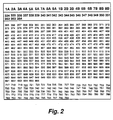
- a cell cluster for the N 3 frequency plan of Fig. 2.
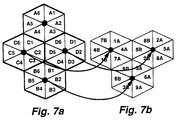
- the cell cluster is based on three cells 20, 22, and 24, with six sectors/cell for a total of 18 sectors/cluster.
- Channel distribution is based on an ODD/EVEN cyclic distribution of channels which ensures adequate channel isolation between sectors and better adjacent channel C/I performance throughout the network.
- cell 20 has frequency groups 1A, 4A, 7A, 1B, 4B, 7B
- the cell 22 has frequency groups 2A, 5A, 8A, 2B, 5B, 8B
- the cell 24 has frequency groups 3A, 6A, 9A, 3B, 6B, 9B.
- Combiners are bandpass filters connected in parallel in groups of four (typically). As a result the effective radiated power (ERP) is reduced due to selectivity, and return loss. Intermodulation products are also generated when several channels are combined into one. A solution to this problem is to provide a wider channel separation in the frequency group. Typically a channel separation of twenty-one or greater is sought. Although high selectivity combiners are available to alleviate this problem, better techniques must be provided to further enhance the system performance.
- the base station includes two multi-channel transmitters 30 and 32 for each of two antennas, a main 34 and a diversity 36.
- the multi-channel transmitter 30 for 'odd' channels in a frequency group is coupled to the main antenna 34.
- the multi-channel transmitter 32 for 'even' channels in a frequency group is coupled to the diversity antenna 36.
- the multi-channel transmitter 30 is coupled to the main antenna 34 via a 9-channel combiner 38 and a duplexer 40.
- the multi-channel transmitter 32 is coupled to the diversity antenna 36 via a 9-channel combiner 42 and a duplexer 44.
- the duplexer 40 is connected to a receive multi-coupler (RMC) 46 which is in turn connected to 1:9 splitters 48 and 50, main receiver 52 and diversity receiver 54, respectively.
- the duplexer 44 is connected to a receive multi-coupler (RMC) 56 which is in turn connected to 1:9 splitters 58 and 60, diversity receiver 62 and main receiver 64, respectively.
- the available channels in a frequency group are divided into two sub-groups, an ODD Group and an EVEN Group.
- the ODD group is formed by combining row-1, row-3, row-5, ... from Fig. 2
- the EVEN group is formed by combining row-2, row-4, row-6, ... from Fig. 2.
- the combined signals are then transmitted through separate antennas. Diversity signals are received on a shared basis as indicated in Fig. 5. Additional antennas are not needed in this configuration. By using, the diversity antenna for both transmitting and receiving, the channel separation is doubled over transmitting solely via the main antenna.
- antenna configuration and their directivity play an important role in determining the C/I performance.
- a sectorized site, using directional antennas with downtilt provides line of sight propagation in the serving base and out of sight propagation in adjacent bases. Since line of sight propagation closely approximates square law attenuation and out of sight propagation approximates 4th power attenuation, antenna directivity improves C/I performance due to antenna orientation as well as due to different propagation factors.
- the co-channel interference(C/I) as function of antenna directivity can be evaluated as:
- the performance can be further improved by using high gain antennas having a large front to back ratio.
Landscapes
- Engineering & Computer Science (AREA)
- Computer Networks & Wireless Communication (AREA)
- Signal Processing (AREA)
- Mobile Radio Communication Systems (AREA)
Claims (21)
- In einem 60-Grad-Sektor-Sende-Sektor-Empfang Zellularnetz mit einem N=3-Frequenzplan, bei dem verfügbare Kanalfrequenzen in 18 Frequenzgruppen unterteilt sind, umfaßt ein Verfahren zur Zuordnung der Frequenzen die Schritte der:und ist gekennzeichnet durch den Schritt der:Ausbildung eines allgemein dreieckförmigen 3-Zellen-Bündelsund der Unterteilung jeder Zelle des 3-Zellen-Bündels in sechs Sektoren,Zuteilung einer Frequenzgruppe zu jedem Sektor zur Schaffung einer Kanaltrennung von drei zwischen jedem Sektor und einer Kanaltrennung von acht zwischen Zellen.
- Verfahren nach Anspruch 1,
das weiterhin den Schritt des Zulassens eines Zellenwachstums innerhalb des zellularen Netzes dadurch umfaßt, daß ein zweites dreieckförmiges 3-Zellen-Bündel geschaffen, jede Zelle des 3-Zellen-Bündels in sechs Sektoren unterteilt und eine Frequenzgruppe jedem Sektor zugeteilt wird, um eine Kanaltrennung von drei zwischen jedem Sektor und eine Kanaltrennung von acht zwischen Zellen zu schaffen. - Verfahren nach Anspruch 1,
bei dem die verfügbaren Frequenzgruppen mit 1A, 2A, 3A, 4A, 5A, 6A, 7A, 8A, 9A, 1B, 2B, 3B, 4B, 5B, 6B, 7B, 8B, 9B bezeichnet sind. - Verfahren nach Anspruch 3,
bei dem der Schritt der Zuteilung einer Frequenzgruppe zu jedem Sektor innerhalb der Zelle eine Zuordnung in einer UNGERADE-/GERADE-Reihenfolge umfaßt. - Verfahren nach Anspruch 4,
bei dem die Reihenfolge für eine erste Zelle in dem 3-Zellen-Bündel 1A, 4A, 7A, 1B, 4B, 7B ist. - Verfahren nach Anspruch 4,
bei dem die Reihenfolge für eine zweite Zelle in dem 3-Zellen-Bündel 2A, 5A, 8A, 2B, 5B, 8B ist. - Verfahren nach Anspruch 4,
bei dem die Reihenfolge für eine dritte Zelle in dem 3-Zellen-Bündel 3A, 6A, 9A, 3B, 6B, 9B ist. - Verfahren nach Anspruch 3,
bei dem der Sektor einer ersten Zelle, der die Frequenzgruppe 4A zugeordnet ist, an den Sektor einer zweiten Zelle angrenzt, dem die Frequenzgruppe 5B zugeordnet ist. - Verfahren nach Anspruch 3,
bei dem der Sektor einer zweiten Zelle, dem die Frequenzgruppe 2B zugeordnet ist, an den Sektor einer dritten Zelle angrenzt, dem die Frequenzgruppe 3A zugeordnet ist. - Verfahren nach Anspruch 3,
bei dem der Sektor einer dritten Zelle, dem die Frequenzgruppe 9B zugeordnet ist, an den Sektor einer ersten Zelle angrenzt, dem die Frequenzgruppe 7A zugeordnet ist. - Verfahren nach Anspruch 2,
bei dem die verfügbaren Frequenzgruppen mit 1A, 2A, 3A, 4A, 5A, 6A, 7A, 8A, 9A, 1B, 2B, 3B, 4B, 5B, 6B, 7B, 8B, 9B bezeichnet sind. - Verfahren nach Anspruch 11,
bei dem der Schritt der Zuordnung einer Frequenzgruppe zu jedem Sektor in jeder Zelle eine Zuordnung in einer UNGERADE-/GERADE-Reihenfolge erfolgt. - Verfahren nach Anspruch 12,
bei dem die Reihenfolge für eine erste Zelle in dem 3-Zellen-Bündel 1A, 4A, 7A, 1B, 4B, 7B ist. - Verfahren nach Anspruch 12.
bei dem die Reihenfolge für eine zweite Zelle in dem 3-Zellen-Bündel 2A, 5A, 8A, 2B, 5B, 8B ist. - Verfahren nach Anspruch 12,
bei dem die Reihenfolge für eine dritte Zelle in dem 3-Zellen-Bündel 3A, 6A, 9A, 3B, 6B, 9B ist. - Verfahren nach Anspruch 11,
bei dem der Sektor einer ersten Zelle, dem die Frequenzgruppe 4A zugeordnet ist, an den Sektor einer zweiten Zelle angrenzt, dem die Frequenzgruppe 5B zugeordnet ist. - Verfahren nach Anspruch 11,
bei dem der Sektor einer zweiten Zelle, dem die Frequenzgruppe 2B zugeordnet ist, an den Sektor einer dritten Zelle angrenzt, dem die Frequenzgruppe 3A zugeordnet ist. - Verfahren nach Anspruch 11,
bei dem der Sektor einer dritten Zelle, dem die Frequenzgruppe 9B zugeordnet ist, an den Sektor einer ersten Zelle angrenzt, dem die Frequenzgruppe 7A zugeordnet ist. - Basisstation für ein 60-Grad-Sektor-Sende-Sektor-Empfang-Zellularnetz mit einem N=3-Frequenzplan, bei dem verfügbare Kanal frequenzen in 18 Frequenzgruppen unterteilt sind, wobei die Basisstation folgendes umfaßt:eine erste Vielzahl von Sendern (30) für eine erste Teilgruppe von Kanal frequenzen,einen ersten Kombinierer (38) zum Kombinieren der Ausgangssignale von der ersten Vielzahl von Sendern,einen ersten Duplexer (40) zur Lieferung des kombinierten Ausganges an eine erste Sende-/Empfangsantenne (34) zur Aussendung,eine zweite Vielzahl von Sendern (32) für eine zweite Teilgruppe von Kanal frequenzen,einen zweiten Kombinierer (42) zum Kombinieren der Ausgangssignale von der zweiten Vielzahl von Sendern,einen zweiten Duplexer (44) zur Lieferung des kombinierten Ausgangs an eine zweite Sende-/Empfangsantenne (36) zur Aussendung,einen ersten Empfangs-Mehrfach-Koppler (46), der mit dem ersten Duplexer zum Empfang eines Signals von der ersten Antenne verbunden ist,einen zweiten Empfangs-Mehrfach-Koppler (56), der mit dem zweiten Duplexer zum Empfang eines Signals von der zweiten Antenne verbunden ist,einen ersten Empfänger, der einen primären Teiler (48), der mit dem ersten Duplexer und einem primären Empfänger (52) verbunden ist, und einen sekundären Teiler aufweist, der mit dem zweiten Duplexer (58) und einem sekundären Empfänger (62) verbunden ist, undeinen zweiten Empfänger, der einen primären Teiler (60), der mit dem zweiten Duplexer verbunden ist, und einen sekundären Teiler (50) aufweist, der mit dem ersten Duplexer verbunden ist.
- Basisstation nach Anspruch 19, bei dem die erste Teilgruppe von Kanalfrequenzen jeden UNGERADE-Kanal einer Frequenzgruppe einschließt, während die zweite Teilgruppe von Kanalfrequenzen jeden GERADE-Kanal der Frequenzgruppe einschließt, wodurch die Kanaltrennung verglichen mit der Aussendung mit einer einzigen Antenne verdoppelt ist.
- 60-Grad-Sektor-Sende-Sektor-Empfang-Zellularnetz mit einem N=3 Frequenzplan, bei dem verfügbare Kanal frequenzen in 18 Frequenzgruppen unterteilt sind, und das Netz ein allgemein dreieckförmiges 3-Zellen-Bündel umfaßt, wobei jede Zelle des 3-Zellen-Bündels in sechs Sektoren unterteilt ist,
dadurch gekennzeichnet,
daß eine Frequenzgruppe jedem Sektor zugeordnet ist, um eine Kanaltrennung von drei zwischen jedem Sektor und eine Kanaltrennung von acht zwischen Zellen zu schaffen.
Applications Claiming Priority (3)
| Application Number | Priority Date | Filing Date | Title |
|---|---|---|---|
| US89083 | 1993-07-08 | ||
| US08/089,083 US5483667A (en) | 1993-07-08 | 1993-07-08 | Frequency plan for a cellular network |
| PCT/CA1994/000334 WO1995002308A1 (en) | 1993-07-08 | 1994-06-15 | Frequency plan for a cellular network |
Publications (2)
| Publication Number | Publication Date |
|---|---|
| EP0707780A1 EP0707780A1 (de) | 1996-04-24 |
| EP0707780B1 true EP0707780B1 (de) | 1999-01-27 |
Family
ID=22215596
Family Applications (1)
| Application Number | Title | Priority Date | Filing Date |
|---|---|---|---|
| EP94919524A Expired - Lifetime EP0707780B1 (de) | 1993-07-08 | 1994-06-15 | Frequenzplan fur ein zellulares netzwerk |
Country Status (6)
| Country | Link |
|---|---|
| US (1) | US5483667A (de) |
| EP (1) | EP0707780B1 (de) |
| JP (2) | JPH08507190A (de) |
| CA (1) | CA2166538C (de) |
| DE (1) | DE69416309T2 (de) |
| WO (1) | WO1995002308A1 (de) |
Families Citing this family (91)
| Publication number | Priority date | Publication date | Assignee | Title |
|---|---|---|---|---|
| US5655216A (en) * | 1993-06-10 | 1997-08-05 | Matsushita Electric Industrial Co., Ltd. | Mobile communication system providing for coexistence of both a cellular automobile telephone system and a micro cellular system |
| FI940196L (fi) * | 1994-01-14 | 1995-07-15 | Nokia Telecommunications Oy | Menetelmä kanavien allokoimiseksi radiojärjestelmässä, tilaaja-asema ja tukiasema |
| JPH08293846A (ja) * | 1995-04-19 | 1996-11-05 | Sony Corp | 送受信装置 |
| GB9508639D0 (en) * | 1995-04-28 | 1995-06-14 | Ionica Int Ltd | Frequency assignment in a cellular radio telecommunications network |
| US5835859A (en) * | 1995-10-13 | 1998-11-10 | Airnet Communications Corporation | Method for frequency allocation and assignment in wireless communication systems |
| US5815813A (en) * | 1995-11-24 | 1998-09-29 | Northern Telecom Limited | Multipath tolerant cellular communication system and method |
| GB2308275B (en) * | 1995-12-11 | 2000-02-09 | Motorola Ltd | Cellular communication system and re-use pattern therefor |
| US5740536A (en) * | 1995-12-29 | 1998-04-14 | At&T Corp. | System and method for managing neighbor-channel interference in channelized cellular systems |
| US5787352A (en) * | 1995-12-29 | 1998-07-28 | At&T Corp. | System and method for management of neighbor-channel interference with power control and directed channel assignment |
| SE9600245L (sv) * | 1996-01-23 | 1996-12-23 | Comviq Gsm Ab | Förfarande för att förtäta ett sändar- och mottagarnät för mobiltelefoni |
| US6141557A (en) * | 1996-05-31 | 2000-10-31 | The Whitaker Corporation | LMDS system having cell-site diversity and adaptability |
| US5822698A (en) * | 1996-08-08 | 1998-10-13 | Northern Telecom Limited | Microcell frequency planning |
| US5924039A (en) * | 1996-08-13 | 1999-07-13 | Telesis Technologies Laboratory | Digital multichannel multipoint distribution system (MMDS) network that supports broadcast video and two-way data transmissions |
| US5974323A (en) * | 1996-09-13 | 1999-10-26 | Airnet Communications Corporation | Frequency plan for wireless communication system that accommodates demand growth to high efficiency reuse factors |
| JP3063648B2 (ja) * | 1996-10-28 | 2000-07-12 | ケイディディ株式会社 | スペクトラム拡散通信システム |
| US5850608A (en) * | 1996-11-08 | 1998-12-15 | Nothern Telecom Limited | Directional frequency assignment in a cellular radio system |
| US5924037A (en) * | 1996-12-31 | 1999-07-13 | Ericsson, Inc. | Frequency assigning method in a seven cell frequency plan for a cellular communications system without adjacent frequencies |
| US6097708A (en) * | 1996-12-31 | 2000-08-01 | Ericsson Inc. | Frequency assigning method for an eight cell frequency re-use plan providing cellular communications system without adjacent frequency channels |
| US5974324A (en) * | 1997-02-10 | 1999-10-26 | Ericsson Inc. | Adaptive frequency reuse plan |
| US6052593A (en) * | 1997-05-08 | 2000-04-18 | Telefonaktiebolaget L M Ericsson | Method for frequency mode validation for, frequency assignment for, and evaluating the network effect of a frequency plan revision within a dual mode cellular telephone system |
| US5960349A (en) * | 1997-05-20 | 1999-09-28 | Northern Telecom | Enhanced cellular layout for CDMA networks having six-sectored cells |
| US6002935A (en) | 1997-05-22 | 1999-12-14 | At&T Corp | Wireless communications cellular architecture for improving communications resource allocation |
| US5970412A (en) * | 1997-12-02 | 1999-10-19 | Maxemchuk; Nicholas Frank | Overload control in a packet-switching cellular environment |
| AU3218899A (en) * | 1998-03-31 | 1999-10-18 | Qualcomm Incorporated | Signal combining method in a base station of a cdma system |
| US6418316B2 (en) | 1998-08-06 | 2002-07-09 | Harris Corporation | Increasing channel capacity of wireless local loop via polarization diversity antenna distribution scheme |
| US6560459B1 (en) * | 1998-12-18 | 2003-05-06 | Nortel Networks Limited | CDMA frequency planning for fixed wireless application |
| US6424836B1 (en) * | 1999-02-09 | 2002-07-23 | Innowave Eci Wireless Systems Ltd. | Method for allocating frequency channels for sectors of a cell in cellular systems |
| US6456851B1 (en) * | 2000-03-06 | 2002-09-24 | Aurora Networks, Inc. | Wireless communications architecture |
| US6553234B1 (en) | 2000-05-01 | 2003-04-22 | Alcatel Canada, Inc. | Method of frequency reuse in a fixed access wireless network |
| US6577869B1 (en) * | 2000-06-29 | 2003-06-10 | Harris Broadband Wireless Access, Inc. | Frequency re-use for TDD applications |
| US7142523B1 (en) * | 2000-07-31 | 2006-11-28 | Lucent Technologies Inc. | Methods and apparatus for design, adjustment or operation of wireless networks using pre-frequency-assignment optimization |
| PL347682A1 (en) * | 2001-05-23 | 2002-12-02 | Polska Telefonia Cyfrowa Sp Z | Method of determining interchannel spacings between predetermined cells of cellular telephony base stations |
| US8194770B2 (en) | 2002-08-27 | 2012-06-05 | Qualcomm Incorporated | Coded MIMO systems with selective channel inversion applied per eigenmode |
| US8208364B2 (en) | 2002-10-25 | 2012-06-26 | Qualcomm Incorporated | MIMO system with multiple spatial multiplexing modes |
| US7324429B2 (en) | 2002-10-25 | 2008-01-29 | Qualcomm, Incorporated | Multi-mode terminal in a wireless MIMO system |
| US8570988B2 (en) | 2002-10-25 | 2013-10-29 | Qualcomm Incorporated | Channel calibration for a time division duplexed communication system |
| US8218609B2 (en) | 2002-10-25 | 2012-07-10 | Qualcomm Incorporated | Closed-loop rate control for a multi-channel communication system |
| US8170513B2 (en) | 2002-10-25 | 2012-05-01 | Qualcomm Incorporated | Data detection and demodulation for wireless communication systems |
| US8134976B2 (en) | 2002-10-25 | 2012-03-13 | Qualcomm Incorporated | Channel calibration for a time division duplexed communication system |
| US20040081131A1 (en) | 2002-10-25 | 2004-04-29 | Walton Jay Rod | OFDM communication system with multiple OFDM symbol sizes |
| US7986742B2 (en) | 2002-10-25 | 2011-07-26 | Qualcomm Incorporated | Pilots for MIMO communication system |
| US8320301B2 (en) | 2002-10-25 | 2012-11-27 | Qualcomm Incorporated | MIMO WLAN system |
| US8169944B2 (en) | 2002-10-25 | 2012-05-01 | Qualcomm Incorporated | Random access for wireless multiple-access communication systems |
| US7002900B2 (en) | 2002-10-25 | 2006-02-21 | Qualcomm Incorporated | Transmit diversity processing for a multi-antenna communication system |
| US20040203804A1 (en) * | 2003-01-03 | 2004-10-14 | Andrew Corporation | Reduction of intermodualtion product interference in a network having sectorized access points |
| US7280467B2 (en) * | 2003-01-07 | 2007-10-09 | Qualcomm Incorporated | Pilot transmission schemes for wireless multi-carrier communication systems |
| US9473269B2 (en) | 2003-12-01 | 2016-10-18 | Qualcomm Incorporated | Method and apparatus for providing an efficient control channel structure in a wireless communication system |
| US10886979B2 (en) | 2004-04-02 | 2021-01-05 | Rearden, Llc | System and method for link adaptation in DIDO multicarrier systems |
| US9826537B2 (en) | 2004-04-02 | 2017-11-21 | Rearden, Llc | System and method for managing inter-cluster handoff of clients which traverse multiple DIDO clusters |
| US11394436B2 (en) | 2004-04-02 | 2022-07-19 | Rearden, Llc | System and method for distributed antenna wireless communications |
| US10985811B2 (en) | 2004-04-02 | 2021-04-20 | Rearden, Llc | System and method for distributed antenna wireless communications |
| US8542763B2 (en) | 2004-04-02 | 2013-09-24 | Rearden, Llc | Systems and methods to coordinate transmissions in distributed wireless systems via user clustering |
| US9312929B2 (en) | 2004-04-02 | 2016-04-12 | Rearden, Llc | System and methods to compensate for Doppler effects in multi-user (MU) multiple antenna systems (MAS) |
| US10749582B2 (en) | 2004-04-02 | 2020-08-18 | Rearden, Llc | Systems and methods to coordinate transmissions in distributed wireless systems via user clustering |
| US9819403B2 (en) | 2004-04-02 | 2017-11-14 | Rearden, Llc | System and method for managing handoff of a client between different distributed-input-distributed-output (DIDO) networks based on detected velocity of the client |
| US11451275B2 (en) | 2004-04-02 | 2022-09-20 | Rearden, Llc | System and method for distributed antenna wireless communications |
| US10425134B2 (en) | 2004-04-02 | 2019-09-24 | Rearden, Llc | System and methods for planned evolution and obsolescence of multiuser spectrum |
| US11309943B2 (en) | 2004-04-02 | 2022-04-19 | Rearden, Llc | System and methods for planned evolution and obsolescence of multiuser spectrum |
| US8654815B1 (en) | 2004-04-02 | 2014-02-18 | Rearden, Llc | System and method for distributed antenna wireless communications |
| US10277290B2 (en) | 2004-04-02 | 2019-04-30 | Rearden, Llc | Systems and methods to exploit areas of coherence in wireless systems |
| US10200094B2 (en) | 2004-04-02 | 2019-02-05 | Rearden, Llc | Interference management, handoff, power control and link adaptation in distributed-input distributed-output (DIDO) communication systems |
| RU2342784C2 (ru) * | 2004-06-15 | 2008-12-27 | Телефонактиеболагет Лм Эрикссон (Пабл) | Устройство и способ пространственного разнесения антенн |
| US9685997B2 (en) | 2007-08-20 | 2017-06-20 | Rearden, Llc | Systems and methods to enhance spatial diversity in distributed-input distributed-output wireless systems |
| JP4353082B2 (ja) * | 2004-11-30 | 2009-10-28 | 沖電気工業株式会社 | 無線通信システム |
| US7466749B2 (en) | 2005-05-12 | 2008-12-16 | Qualcomm Incorporated | Rate selection with margin sharing |
| US8358714B2 (en) | 2005-06-16 | 2013-01-22 | Qualcomm Incorporated | Coding and modulation for multiple data streams in a communication system |
| US8483616B1 (en) * | 2005-11-01 | 2013-07-09 | At&T Intellectual Property Ii, L.P. | Non-interference technique for spatially aware mobile ad hoc networking |
| US8917673B2 (en) * | 2006-07-14 | 2014-12-23 | Qualcomm Incorporation | Configurable downlink and uplink channels for improving transmission of data by switching duplex nominal frequency spacing according to conditions |
| KR101023833B1 (ko) * | 2006-08-31 | 2011-03-22 | 아주대학교산학협력단 | 통신 시스템에서 자원 이용 시스템 및 방법 |
| JP4690466B2 (ja) * | 2006-12-08 | 2011-06-01 | 富士通株式会社 | 隣接セクタ間干渉低減方法及び基地局装置 |
| US9544922B2 (en) | 2008-09-16 | 2017-01-10 | At&T Intellectual Property I, L.P. | Quality of service scheme for collision-based wireless networks |
| US9118428B2 (en) | 2009-11-04 | 2015-08-25 | At&T Intellectual Property I, L.P. | Geographic advertising using a scalable wireless geocast protocol |
| DE102010035729B4 (de) * | 2010-08-28 | 2014-10-09 | Deutsches Zentrum für Luft- und Raumfahrt e.V. | Zellulares Kommunikationsnetzwerk |
| US10016684B2 (en) | 2010-10-28 | 2018-07-10 | At&T Intellectual Property I, L.P. | Secure geographic based gaming |
| US9319842B2 (en) | 2011-06-27 | 2016-04-19 | At&T Intellectual Property I, L.P. | Mobile device configured point and shoot type weapon |
| US9161158B2 (en) | 2011-06-27 | 2015-10-13 | At&T Intellectual Property I, L.P. | Information acquisition using a scalable wireless geocast protocol |
| US9495870B2 (en) | 2011-10-20 | 2016-11-15 | At&T Intellectual Property I, L.P. | Vehicular communications using a scalable ad hoc geographic routing protocol |
| US8744419B2 (en) | 2011-12-15 | 2014-06-03 | At&T Intellectual Property, I, L.P. | Media distribution via a scalable ad hoc geographic protocol |
| US9071451B2 (en) | 2012-07-31 | 2015-06-30 | At&T Intellectual Property I, L.P. | Geocast-based situation awareness |
| US11190947B2 (en) | 2014-04-16 | 2021-11-30 | Rearden, Llc | Systems and methods for concurrent spectrum usage within actively used spectrum |
| US11189917B2 (en) | 2014-04-16 | 2021-11-30 | Rearden, Llc | Systems and methods for distributing radioheads |
| US10194346B2 (en) | 2012-11-26 | 2019-01-29 | Rearden, Llc | Systems and methods for exploiting inter-cell multiplexing gain in wireless cellular systems via distributed input distributed output technology |
| US11050468B2 (en) | 2014-04-16 | 2021-06-29 | Rearden, Llc | Systems and methods for mitigating interference within actively used spectrum |
| US9660745B2 (en) | 2012-12-12 | 2017-05-23 | At&T Intellectual Property I, L.P. | Geocast-based file transfer |
| US9923657B2 (en) | 2013-03-12 | 2018-03-20 | Rearden, Llc | Systems and methods for exploiting inter-cell multiplexing gain in wireless cellular systems via distributed input distributed output technology |
| US10164698B2 (en) * | 2013-03-12 | 2018-12-25 | Rearden, Llc | Systems and methods for exploiting inter-cell multiplexing gain in wireless cellular systems via distributed input distributed output technology |
| US10488535B2 (en) | 2013-03-12 | 2019-11-26 | Rearden, Llc | Apparatus and method for capturing still images and video using diffraction coded imaging techniques |
| US9973246B2 (en) | 2013-03-12 | 2018-05-15 | Rearden, Llc | Systems and methods for exploiting inter-cell multiplexing gain in wireless cellular systems via distributed input distributed output technology |
| US10547358B2 (en) | 2013-03-15 | 2020-01-28 | Rearden, Llc | Systems and methods for radio frequency calibration exploiting channel reciprocity in distributed input distributed output wireless communications |
| US11290162B2 (en) | 2014-04-16 | 2022-03-29 | Rearden, Llc | Systems and methods for mitigating interference within actively used spectrum |
| KR102560875B1 (ko) * | 2015-12-18 | 2023-07-28 | 한국전자통신연구원 | 분산형 다중 점 협력 동적 셀 구성 방법 |
Family Cites Families (7)
| Publication number | Priority date | Publication date | Assignee | Title |
|---|---|---|---|---|
| US4144411A (en) * | 1976-09-22 | 1979-03-13 | Bell Telephone Laboratories, Incorporated | Cellular radiotelephone system structured for flexible use of different cell sizes |
| JPH0616602B2 (ja) * | 1983-11-15 | 1994-03-02 | 日本電信電話株式会社 | 移動通信無線チャネル配置方式 |
| GB8915863D0 (en) * | 1989-07-11 | 1989-08-31 | Telecom Sec Cellular Radio Ltd | Cellular radio system |
| US5073971A (en) * | 1989-09-05 | 1991-12-17 | Motorola, Inc. | Cellular radiotelephone communications system |
| US5247699A (en) * | 1990-04-12 | 1993-09-21 | Telefonaktiebolaget L M Ericsson | Cellular frequency reuse cell plan |
| CA2023053C (en) * | 1990-08-10 | 1994-06-28 | Frank D. Benner | Method for assigning telecommunications channels in a cellular telephone system |
| US5233643A (en) * | 1991-10-08 | 1993-08-03 | Network Access Corporation | Method and system network for providing an area with limited bandwidth bi-direction burst personnel telecommunications |
-
1993
- 1993-07-08 US US08/089,083 patent/US5483667A/en not_active Expired - Fee Related
-
1994
- 1994-06-15 CA CA002166538A patent/CA2166538C/en not_active Expired - Fee Related
- 1994-06-15 EP EP94919524A patent/EP0707780B1/de not_active Expired - Lifetime
- 1994-06-15 DE DE69416309T patent/DE69416309T2/de not_active Expired - Fee Related
- 1994-06-15 WO PCT/CA1994/000334 patent/WO1995002308A1/en not_active Ceased
- 1994-06-15 JP JP7503724A patent/JPH08507190A/ja active Pending
-
2000
- 2000-12-20 JP JP2000387260A patent/JP2001231074A/ja not_active Ceased
Also Published As
| Publication number | Publication date |
|---|---|
| DE69416309D1 (de) | 1999-03-11 |
| JPH08507190A (ja) | 1996-07-30 |
| DE69416309T2 (de) | 1999-06-02 |
| WO1995002308A1 (en) | 1995-01-19 |
| EP0707780A1 (de) | 1996-04-24 |
| JP2001231074A (ja) | 2001-08-24 |
| CA2166538C (en) | 1999-08-24 |
| US5483667A (en) | 1996-01-09 |
| CA2166538A1 (en) | 1995-01-19 |
Similar Documents
| Publication | Publication Date | Title |
|---|---|---|
| EP0707780B1 (de) | Frequenzplan fur ein zellulares netzwerk | |
| EP0399206B1 (de) | Signalleitvorrichtung | |
| US6233229B1 (en) | Method of allocating frequency bands to different cells, and TDMA cellular radio system | |
| US6201972B1 (en) | Cellular system and frequency carrier allocation method | |
| US5073971A (en) | Cellular radiotelephone communications system | |
| US5966094A (en) | Base station antenna arrangement | |
| US5570352A (en) | Digital cellular network/system with mobile stations communicating with base stations using frequency-hopping and having enhanced effect of interference diversity | |
| EP0934671B1 (de) | Verfahren und einrichtung zur reduzierung von intermodulationsstörungen in einem mehrfachsignal-übertragungssystem | |
| CA2126746C (en) | Communication management technique for a radiotelephone system including microcells | |
| CA2419263C (en) | Transmission control apparatus and transmission control method | |
| US6580912B2 (en) | Method and apparatus for a high-capacity cellular network by improved sectorization and interleaved channel assignment | |
| US5838670A (en) | Point to multipoint radio access system | |
| US5734983A (en) | Frequency assignment in a cellular radio system | |
| JPH03167924A (ja) | 移動通信チャネル割当て制御方法 | |
| WO1995025406A1 (en) | A method and apparatus for frequency allocation in a cellular telecommunications network | |
| US5850608A (en) | Directional frequency assignment in a cellular radio system | |
| JP2001309424A (ja) | 無線基地局およびそのフレーム構成方法 | |
| US7242907B2 (en) | System and method for inband signaling for sector synchronization in a wireless communication system | |
| US6097708A (en) | Frequency assigning method for an eight cell frequency re-use plan providing cellular communications system without adjacent frequency channels | |
| CN1905729A (zh) | 分布式天线系统中的无线通信资源配置方法 | |
| US5970411A (en) | N=4 directional frequency assignment in a cellular radio system | |
| KR102927390B1 (ko) | 다중 사용자를 위한 분할 ris 기반 oam 무선 통신 시스템 | |
| US20070249358A1 (en) | System and method for frequency re-use in a sectorized cell pattern in a wireless communication system | |
| Faruque | Directional frequency reuse for cellular communications | |
| Matsumoto et al. | Investigation on Distributed Joint Optimization of User Association and ICIC Based on PF Criteria in Small Cell Deployments |
Legal Events
| Date | Code | Title | Description |
|---|---|---|---|
| PUAI | Public reference made under article 153(3) epc to a published international application that has entered the european phase |
Free format text: ORIGINAL CODE: 0009012 |
|
| 17P | Request for examination filed |
Effective date: 19951219 |
|
| AK | Designated contracting states |
Kind code of ref document: A1 Designated state(s): DE FR GB |
|
| RIN1 | Information on inventor provided before grant (corrected) |
Inventor name: FARUQUE, SALEH, MOHAMED |
|
| 17Q | First examination report despatched |
Effective date: 19970305 |
|
| GRAG | Despatch of communication of intention to grant |
Free format text: ORIGINAL CODE: EPIDOS AGRA |
|
| GRAG | Despatch of communication of intention to grant |
Free format text: ORIGINAL CODE: EPIDOS AGRA |
|
| GRAG | Despatch of communication of intention to grant |
Free format text: ORIGINAL CODE: EPIDOS AGRA |
|
| GRAH | Despatch of communication of intention to grant a patent |
Free format text: ORIGINAL CODE: EPIDOS IGRA |
|
| GRAH | Despatch of communication of intention to grant a patent |
Free format text: ORIGINAL CODE: EPIDOS IGRA |
|
| GRAH | Despatch of communication of intention to grant a patent |
Free format text: ORIGINAL CODE: EPIDOS IGRA |
|
| GRAH | Despatch of communication of intention to grant a patent |
Free format text: ORIGINAL CODE: EPIDOS IGRA |
|
| GRAA | (expected) grant |
Free format text: ORIGINAL CODE: 0009210 |
|
| AK | Designated contracting states |
Kind code of ref document: B1 Designated state(s): DE FR GB |
|
| REF | Corresponds to: |
Ref document number: 69416309 Country of ref document: DE Date of ref document: 19990311 |
|
| ET | Fr: translation filed | ||
| RAP4 | Party data changed (patent owner data changed or rights of a patent transferred) |
Owner name: NORTEL NETWORKS CORPORATION |
|
| PLBE | No opposition filed within time limit |
Free format text: ORIGINAL CODE: 0009261 |
|
| STAA | Information on the status of an ep patent application or granted ep patent |
Free format text: STATUS: NO OPPOSITION FILED WITHIN TIME LIMIT |
|
| 26N | No opposition filed | ||
| REG | Reference to a national code |
Ref country code: GB Ref legal event code: IF02 |
|
| PGFP | Annual fee paid to national office [announced via postgrant information from national office to epo] |
Ref country code: DE Payment date: 20030630 Year of fee payment: 10 |
|
| REG | Reference to a national code |
Ref country code: FR Ref legal event code: CD |
|
| PGFP | Annual fee paid to national office [announced via postgrant information from national office to epo] |
Ref country code: GB Payment date: 20040528 Year of fee payment: 11 |
|
| PGFP | Annual fee paid to national office [announced via postgrant information from national office to epo] |
Ref country code: FR Payment date: 20040602 Year of fee payment: 11 |
|
| PG25 | Lapsed in a contracting state [announced via postgrant information from national office to epo] |
Ref country code: DE Free format text: LAPSE BECAUSE OF NON-PAYMENT OF DUE FEES Effective date: 20050101 |
|
| PG25 | Lapsed in a contracting state [announced via postgrant information from national office to epo] |
Ref country code: GB Free format text: LAPSE BECAUSE OF NON-PAYMENT OF DUE FEES Effective date: 20050615 |
|
| PG25 | Lapsed in a contracting state [announced via postgrant information from national office to epo] |
Ref country code: FR Free format text: LAPSE BECAUSE OF NON-PAYMENT OF DUE FEES Effective date: 20060228 |
|
| GBPC | Gb: european patent ceased through non-payment of renewal fee |
Effective date: 20050615 |
|
| REG | Reference to a national code |
Ref country code: FR Ref legal event code: ST Effective date: 20060228 |