EP0707921B1 - Procédé de fabrication d'un couteau - Google Patents
Procédé de fabrication d'un couteau Download PDFInfo
- Publication number
- EP0707921B1 EP0707921B1 EP95115744A EP95115744A EP0707921B1 EP 0707921 B1 EP0707921 B1 EP 0707921B1 EP 95115744 A EP95115744 A EP 95115744A EP 95115744 A EP95115744 A EP 95115744A EP 0707921 B1 EP0707921 B1 EP 0707921B1
- Authority
- EP
- European Patent Office
- Prior art keywords
- coating
- blade
- blade body
- hard material
- layer
- Prior art date
- Legal status (The legal status is an assumption and is not a legal conclusion. Google has not performed a legal analysis and makes no representation as to the accuracy of the status listed.)
- Expired - Lifetime
Links
- 238000004519 manufacturing process Methods 0.000 title claims description 6
- 239000011248 coating agent Substances 0.000 claims description 54
- 238000000576 coating method Methods 0.000 claims description 54
- 239000000463 material Substances 0.000 claims description 32
- 238000005496 tempering Methods 0.000 claims description 17
- 238000000034 method Methods 0.000 claims description 16
- 229910000831 Steel Inorganic materials 0.000 claims description 14
- 239000010959 steel Substances 0.000 claims description 14
- 239000002245 particle Substances 0.000 claims description 12
- 238000005520 cutting process Methods 0.000 claims description 9
- UONOETXJSWQNOL-UHFFFAOYSA-N tungsten carbide Chemical compound [W+]#[C-] UONOETXJSWQNOL-UHFFFAOYSA-N 0.000 claims description 7
- 239000008187 granular material Substances 0.000 claims description 6
- 239000010941 cobalt Substances 0.000 claims description 5
- 229910017052 cobalt Inorganic materials 0.000 claims description 5
- GUTLYIVDDKVIGB-UHFFFAOYSA-N cobalt atom Chemical compound [Co] GUTLYIVDDKVIGB-UHFFFAOYSA-N 0.000 claims description 5
- 238000010285 flame spraying Methods 0.000 claims description 5
- 229910000760 Hardened steel Inorganic materials 0.000 claims description 3
- 239000013067 intermediate product Substances 0.000 claims description 2
- 239000000758 substrate Substances 0.000 description 4
- 230000005855 radiation Effects 0.000 description 3
- 238000005507 spraying Methods 0.000 description 3
- 230000003746 surface roughness Effects 0.000 description 3
- VYZAMTAEIAYCRO-UHFFFAOYSA-N Chromium Chemical compound [Cr] VYZAMTAEIAYCRO-UHFFFAOYSA-N 0.000 description 2
- PXHVJJICTQNCMI-UHFFFAOYSA-N Nickel Chemical compound [Ni] PXHVJJICTQNCMI-UHFFFAOYSA-N 0.000 description 2
- 230000001154 acute effect Effects 0.000 description 2
- 239000012876 carrier material Substances 0.000 description 2
- 239000000203 mixture Substances 0.000 description 2
- 208000031872 Body Remains Diseases 0.000 description 1
- ZOXJGFHDIHLPTG-UHFFFAOYSA-N Boron Chemical compound [B] ZOXJGFHDIHLPTG-UHFFFAOYSA-N 0.000 description 1
- 238000004873 anchoring Methods 0.000 description 1
- 229910052796 boron Inorganic materials 0.000 description 1
- 239000013590 bulk material Substances 0.000 description 1
- 229910052804 chromium Inorganic materials 0.000 description 1
- 239000011651 chromium Substances 0.000 description 1
- 230000007797 corrosion Effects 0.000 description 1
- 238000005260 corrosion Methods 0.000 description 1
- 238000011161 development Methods 0.000 description 1
- 230000018109 developmental process Effects 0.000 description 1
- 230000000694 effects Effects 0.000 description 1
- 238000005530 etching Methods 0.000 description 1
- 239000012634 fragment Substances 0.000 description 1
- 239000011159 matrix material Substances 0.000 description 1
- 229910052759 nickel Inorganic materials 0.000 description 1
- 239000000843 powder Substances 0.000 description 1
- 239000000047 product Substances 0.000 description 1
- 229910052710 silicon Inorganic materials 0.000 description 1
- 239000010703 silicon Substances 0.000 description 1
- IHQKEDIOMGYHEB-UHFFFAOYSA-M sodium dimethylarsinate Chemical class [Na+].C[As](C)([O-])=O IHQKEDIOMGYHEB-UHFFFAOYSA-M 0.000 description 1
- 239000007921 spray Substances 0.000 description 1
- 230000008646 thermal stress Effects 0.000 description 1
Images




Classifications
-
- B—PERFORMING OPERATIONS; TRANSPORTING
- B26—HAND CUTTING TOOLS; CUTTING; SEVERING
- B26B—HAND-HELD CUTTING TOOLS NOT OTHERWISE PROVIDED FOR
- B26B9/00—Blades for hand knives
-
- B—PERFORMING OPERATIONS; TRANSPORTING
- B23—MACHINE TOOLS; METAL-WORKING NOT OTHERWISE PROVIDED FOR
- B23P—METAL-WORKING NOT OTHERWISE PROVIDED FOR; COMBINED OPERATIONS; UNIVERSAL MACHINE TOOLS
- B23P15/00—Making specific metal objects by operations not covered by a single other subclass or a group in this subclass
- B23P15/28—Making specific metal objects by operations not covered by a single other subclass or a group in this subclass cutting tools
- B23P15/40—Making specific metal objects by operations not covered by a single other subclass or a group in this subclass cutting tools shearing tools
-
- B—PERFORMING OPERATIONS; TRANSPORTING
- B26—HAND CUTTING TOOLS; CUTTING; SEVERING
- B26D—CUTTING; DETAILS COMMON TO MACHINES FOR PERFORATING, PUNCHING, CUTTING-OUT, STAMPING-OUT OR SEVERING
- B26D1/00—Cutting through work characterised by the nature or movement of the cutting member or particular materials not otherwise provided for; Apparatus or machines therefor; Cutting members therefor
- B26D1/0006—Cutting members therefor
-
- B—PERFORMING OPERATIONS; TRANSPORTING
- B26—HAND CUTTING TOOLS; CUTTING; SEVERING
- B26D—CUTTING; DETAILS COMMON TO MACHINES FOR PERFORATING, PUNCHING, CUTTING-OUT, STAMPING-OUT OR SEVERING
- B26D1/00—Cutting through work characterised by the nature or movement of the cutting member or particular materials not otherwise provided for; Apparatus or machines therefor; Cutting members therefor
- B26D1/0006—Cutting members therefor
- B26D2001/002—Materials or surface treatments therefor, e.g. composite materials
-
- B—PERFORMING OPERATIONS; TRANSPORTING
- B26—HAND CUTTING TOOLS; CUTTING; SEVERING
- B26D—CUTTING; DETAILS COMMON TO MACHINES FOR PERFORATING, PUNCHING, CUTTING-OUT, STAMPING-OUT OR SEVERING
- B26D1/00—Cutting through work characterised by the nature or movement of the cutting member or particular materials not otherwise provided for; Apparatus or machines therefor; Cutting members therefor
- B26D1/0006—Cutting members therefor
- B26D2001/0053—Cutting members therefor having a special cutting edge section or blade section
Definitions
- the invention relates to a method for producing flame spray coated knives, knife blades or the like.
- Such a method of manufacture such is known from US-A 3,732,771.
- the blade body made of hard steel is said to be one Knife blade on one side with a hard material coating be provided.
- a coating there is an under other flame-sprayed chrome layer provided.
- the Layer should be harder than the material of the steel Blade body.
- the US PS is based on the concept from the fact that a knife blade coated in this way moves from the peel the uncoated side in such a way that the bevel is formed from an edge of the coating.
- the ground surface section is said to be state of the art the coating a sanded Connect the surface section of the steel area.
- Knife blades made according to the process disclosed there have been made, microscopically none Have wading training. Viewed microscopically the sanded surface section closes not stepless, in particular not in alignment the grinded steel surface section.
- the invention has for its object this disadvantage to fix in the prior art that the Microscopic connection of the layer to the substrate on the wading side is designed so that the actually acting Do not cut from the steel blade body is trained.
- a lower roughness has as the broadside surface of the coating, there is a further improved cutting performance.
- the roughness of the ground Surface section essentially identical is with the roughness depth of the sanded surface section of the steel blade body.
- the surface roughness the broadside surface of the coating can be about 10 ⁇ m or less.
- the roughness of the ground surface section of the coating can be about 5 ⁇ m or less. It has been with Flame spray coating showed that the steel blade body is heated.
- the tempering zone has a minimized thickness.
- the thickness of the The tempering zone is less than that Thickness of the coating and preferably less than 5 or 10 ⁇ m.
- the thickness of the coating depends on used material - preferably between 10 and 60 microns. It has been found that an optimal layer thickness is about 30 to 40 microns. Because of this layer thickness on the one hand it becomes a sufficiently large grindable Surface area of the coating is formed and on the other hand, the layer is thin enough not to flake off. It can also be provided that the Thickness of the tempering zone over the entire coated broad side surface extends homogeneously, i.e. essentially has a constant thickness.
- the coating consists of a hard carrier material, in which Hard material particles are embedded.
- the thickness of the The starting zone should be a maximum of 10 times larger than that Thickness of the hard material particles. Through this size selection it is ensured that the coating in the Surface digging hard particles an optimal Adhere to the softer blade body zone.
- the hard material particles can consist of tungsten carbide and the carrier material made of cobalt.
- the hard material particles and the support material can be in a ratio from 80 to 20 to 90 to 10. Prefers is a ratio of 88 to 12.
- a second component of the layer can be provided which in particular nickel, chromium, boron and / or silicon having. The second component should then be less than 50%, preferably 30% of the layer composition.
- the hardness of the coating is preferably wide above the hardness of the blade body.
- a hardness of 1,800 HV 0.3 is specified. That hardness stands for a hardness of the blade body of about 650 HV 0.3 across from.
- the hardness of the tempering zone is less than that Hardness of the blade body and can be about 550 HV 0.3.
- the inventive method for producing a Knife blade provides that on the hardened blade body a hard material coating sprayed on one side at high speed by flame and that afterwards the blade is peeled off on the other side. It is provided that the surface area to be coated before coating hard material with an abrasive granulate is irradiated. This should increase the roughness change the surface to be coated.
- the radiation with the granules is such that the Peak area of the blade body due to the jet pressure dodges sideways. In cross section through one irradiated blade body then forms on the wading side a laterally evasive nose. That nose will also sprayed during the subsequent flame spray coating and then sanded down. This is preferably done Hard material coating with supersonic speed.
- the powder coating material introduced into the flame is said to be in the flame at about 2000 to 3000 ° C can be heated.
- the broadside surface during flame spray coating of the blade body is heated to an unacceptably high level the blade in several consecutive Steps coated with a thin sub-layer becomes. Between the order of the individual This gives partial layers the opportunity to cool off again. Also needs because of that in the individual partial steps each separated small Less heat can be dissipated.
- the softer tempering zone reduced to an undetectable minimum.
- the blade should preferably be pulled off in several successive steps. Prefers the abovementioned removal is carried out in the first deduction step the vertex zone. This will cause the coating to flake off accepted in this area. In a or several second removal steps, the blade body and then the coating is peeled off so far that the peeled surface areas of blade body and layer x are aligned.
- the heat application in high speed flame spraying is selected in combination with the exposure time so that neither on the bevel, nor on the broad side surface pitting corrosion in the finished knife during use occurs.
- the coating parameters are preferred chosen so that the thermal stress of the Blade body to no harmful tension in the blade body leads.
- the starting point of the invention is shown in FIG. 3. It is a cut through the Wading area of a blade according to the above State of the art has been coated. It forms there is an edge on this knife (protrusion Ü) formed by two surfaces of the layer however, this edge is not the cutting edge.
- the Cutting edge is formed by the steel base body 1 and that from a head start on which the broadside surface 2 to be coated connects.
- Fig. 3 shows that the adhesion of the coating 3 to the Boundary layer 2 is insufficient.
- the face of the coating is not rubbed off. Rather, fragments of the layer of burst the boundary layer 2, so that in the cutting area Layer has no meaning.
- the knife manufactured according to the invention has a blade body 1 on which is made of hardened steel. 4 the blank to be coated is sanded towards the edge. This results in a sharp edge Apex zone 11, the two opposite Broad side surfaces 2 and 4 divides. The two broad sides 2 and 4 meet in the apex region 11 in one acute angles to each other.
- the Blank in the wading area of a broadside 2 irradiated with granules.
- the granules are fine-grained and abrasive.
- the broad side surface 2 is roughened by this radiation.
- the radiation takes place with such intensity and duration that the apex region 11 in the direction facing away from the steel is bent. This creates in cross section a nose-shaped turn (see Fig. 5).
- the irradiated Broad side surface 2 with a hard material coating Mistake.
- the hard material consists of tungsten carbide particles about 1 ⁇ m in diameter.
- the tungsten carbide particles are embedded in a matrix of cobalt.
- the coating is carried out using the flame spraying process.
- the layer material becomes powdery in given a flame and using the flame to about 2000 heated up to 3000 ° C.
- the mass so heated becomes then at a very high speed, namely a supersonic speed, on that from the broadside 2 of the blade body 1 formed substrate applied.
- First a very thin first layer is applied, in which the hard material particles are also treated Immerse the surface of the broad side surface 2 and anchor yourself there.
- the thin layer is applied in that the beam at the appropriate speed the broad side surface 2 of the knife is coated.
- the speed and the beam intensity are chosen so that the surface of the broad side surface with this coating to a maximum of 400 ° C warmed to a temperature at which none disruptive material softening takes place.
- Coating steps are gradually becoming a multitude applied by thin layers until the target thickness layer 3 is reached.
- the coating material consists of a mixture of Tungsten carbide particles and cobalt in a mixing ratio from 88 to 12. It is in this ratio then put the layer together.
- Layer 3 extends over the end section of the Broadside surface 2 to about the central plane of the Blade area of the blade body in the direction of the uncoated broadside, since the crown zone 11 is bent towards the leeward side. It is permissible that the apex zone 11 during coating heats up a higher temperature than the rest to be coated Broadside surface 2. The temperature, on which heats the apex zone 11 can be so large that the entire crown zone is one Experiences material softening.
- the sanding becomes smoothed so that the surface section 6 has a lower roughness depth than the surface section 8, which was created by the flame coating is.
- the edge is formed from the edge 5.
- the surface sections 6 and 8 occur in one Angles of preferably 22 to 24 ° to one another.
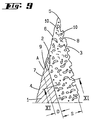
- Fig. 9 is the structure of the wading section actually achieved reproduced.
- the surface sections 6 and 7 go smoothly over each other and have the same roughness (Surface roughness), which is less than the surface roughness of the Surface 8.
- the thickness D is in the exemplary embodiment less than 1 ⁇ m and is therefore disproportionate in the figures shown large.
- the thickness S of the hard coating is 30 ⁇ m.
- the bevel A is made at an acute angle (22 to 24 °) to the uncoated broadside, so that a cutting edge 5 forms with an obtuse angle, than the vertex angle of the vertex 11 of the blank (Fig. 4).
- the length of the steel section subtracted is many times longer than the length of the Section 6.
- a typical layer thickness of approximately 30 ⁇ m is thus a bevel A, in which microscopically aligned the layer sections 6 and 7 merge into each other, so that it is guaranteed that the Wate is formed from the edge 5 of the coating.
- this takes place Selection of the layer thickness so that it is at the intended Use of the knife has not flaked off.
- Another parameter has a thickness of the tempering zone Importance; their thickness is chosen so that an optimal Anchoring the coating through the surface 2 of the steel body entering toilet granules is given.
- the course of hardness in the wading section is in the Fig. 11 shown.
- the coating 3 has on it Thickness S has an essentially constant hardness, namely about 1800 HV 0.3. Sinks in the area of the interface the hardness jumps to a value that is about 550 HV is 0.3. This value is the tempering zone 9 assigned.
- the thickness D of the tempering zone 9 increases Hardness continuously to greater depths T down to the Hardness of the bulk material of the blade body 1; here the hardness is 650 HV 0.3.
- the end of the boundary layer 9 is represented by the dashed line.
- the apex zone 11 is a higher thickness of the tempering zone 9 approved.
- the whole Vertex 11 assigned to the tempering zone 9. is removed later.
- the layer runs out continuously.
- the Limit (dashed line) of tempering zone 9 goes here up to the broadside surface, so that a tempered Surface area 13 arises, its extension corresponds to the thickness D of the tempering zone 9.
Landscapes
- Engineering & Computer Science (AREA)
- Mechanical Engineering (AREA)
- Life Sciences & Earth Sciences (AREA)
- Forests & Forestry (AREA)
- Nonmetal Cutting Devices (AREA)
- Heat Treatment Of Articles (AREA)
- Knives (AREA)
Claims (6)
- Procédé de fabrication d'un couteau ou d'une lame munie d'une arête de coupe, dans lequel une première des surfaces latérales larges (2) du corps de lame (1) réalisé en acier trempé est revêtue par projection à la flamme de particules en matières dures noyées dans un matériau de support, dans lequel la deuxième surface latérale large (4) reste non revêtue, tandis que l'arête de coupe est constituée par un affûtage de la face non revêtue qui est réalisé à partir d'une arête de la couche (3), de telle façon que le tronçon de surface affûté (6) du revêtement se raccorde au tronçon de surface (7) affûté et réalisé en acier du corps de lame (1), dans lequel la zone de surface (2) à revêtir est revêtue par projection, avant le revêtement par une matière dure, d'un granulat abrasif, de telle façon que la zone de crête (11) du corps de base (1) de la lame, sous l'effet de la pression de l'acier se gauchisse ou s'affaisse latéralement, et dans lequel le revêtement en matière dure est réalisé sous la forme d'une pluralité de couches partielles minces appliqués les unes sur les autres, de sorte que l'épaisseur (D) de la zone de démarrage (9) résultant de la projection à la flamme, après l'affûtage des deuxièmes surfaces latérales larges non revêtues (4), soit plus petite que l'épaisseur (S) du revêtement (3) et de préférence soit inférieure à 10 µm ou à 5 µm.
- Procédé selon la revendication 1, caractérisé en ce qu'au cours du revêtement, la surface latérale (2) revêtue du corps de lame (1) atteint, pendant un temps court, au maximum 400°C, une température plus élevée étant admissible dans la zone de crête (11).
- Procédé selon l'une des revendications précédentes, caractérisé en ce que le revêtement à la flamme par une matière dure est réalisé à une température comprise entre 2000°C et 3000°C.
- Procédé selon l'une des revendications précédentes, caractérisé en ce qu'au cours d'une première étape de retrait (par moulage), on enlève la zone de crête ou de pointe (11) affaissée latéralement, par accommodation d'un écaillage du revêtement se produisant dans cette zone.
- Procédé selon l'une des revendications précédentes, caractérisé en ce qu'au cours d'une ou plusieurs deuxièmes étapes de retrait (par moulage) du revêtement (3) et du corps de lame (1), on enlève suffisamment de matériau pour que les deux tronçons de surface (6 et 7) éliminés soient alignés l'un sur l'autre.
- Produit intermédiaire d'un couteau ou d'une lame munie d'une arête de coupe résultant du procédé selon la revendication 1 après le revêtement en matière dure et avant l'affûtage de la deuxième surface latérale large (4) non revêtue, le produit comprenant un corps de lame (1) réalisé en acier trempé, dont une surface latérale large (2) comporte un revêtement (3) en matière dure projetée à la flamme, dont une deuxième surface latérale (6) est non revêtue, et dans lequel l'arête de coupe d'un bord (5) de la couche (3) doit être formée par un affûtage par moulage (A) de la face non revêtue, produit dans lequel le revêtement est constitué par des particules de matière dure en carbure de tungstène noyées dans un matériau support dur en cobalt, et dans lequel les particules de matière dure et le matériau support sont appliqués selon un rapport de 80 à 20, jusqu'à 90 à 10, et l'épaisseur du revêtement est comprise entre 10 et 60 µm, avec une zone de crête (11) du corps de lame (1) s'affaissant latéralement, et qui est revêtue à l'extérieur jusque sur le plan médian de la pointe de lame.
Priority Applications (1)
| Application Number | Priority Date | Filing Date | Title |
|---|---|---|---|
| DE29521007U DE29521007U1 (de) | 1994-10-22 | 1995-10-06 | Messer |
Applications Claiming Priority (2)
| Application Number | Priority Date | Filing Date | Title |
|---|---|---|---|
| DE4437911A DE4437911A1 (de) | 1994-10-22 | 1994-10-22 | Messer und Verfahren zur Herstellung eines Messers |
| DE4437911 | 1994-10-22 |
Publications (3)
| Publication Number | Publication Date |
|---|---|
| EP0707921A2 EP0707921A2 (fr) | 1996-04-24 |
| EP0707921A3 EP0707921A3 (fr) | 1997-07-23 |
| EP0707921B1 true EP0707921B1 (fr) | 2000-12-06 |
Family
ID=6531527
Family Applications (1)
| Application Number | Title | Priority Date | Filing Date |
|---|---|---|---|
| EP95115744A Expired - Lifetime EP0707921B1 (fr) | 1994-10-22 | 1995-10-06 | Procédé de fabrication d'un couteau |
Country Status (6)
| Country | Link |
|---|---|
| EP (1) | EP0707921B1 (fr) |
| JP (1) | JPH08206989A (fr) |
| KR (1) | KR960013588A (fr) |
| BR (1) | BR9504506A (fr) |
| CA (1) | CA2161031A1 (fr) |
| DE (2) | DE4437911A1 (fr) |
Families Citing this family (16)
| Publication number | Priority date | Publication date | Assignee | Title |
|---|---|---|---|---|
| DE29710489U1 (de) * | 1997-06-17 | 1998-10-15 | P.D. Rasspe Söhne GmbH & Co KG, 42651 Solingen | Rundmesser |
| DE19902818C2 (de) * | 1999-01-25 | 2003-03-27 | Wolfgang Bauer | Metallmesser mit speziell angepaßter Materialhärtenverteilung für Zerkleinerungs- und Schneidmaschinen |
| DE19938115A1 (de) * | 1999-08-12 | 2001-02-22 | Fein C & E | Schneidmesser |
| GB0207375D0 (en) * | 2002-03-28 | 2002-05-08 | Hardide Ltd | Cutting tool with hard coating |
| US7194933B2 (en) | 2002-07-01 | 2007-03-27 | Premark Feg L.L.C. | Composite circular slicer knife |
| KR100573371B1 (ko) * | 2003-07-21 | 2006-04-25 | 김원철 | 유공강관을 적용한 현장타설말뚝 시공방법 |
| FR2868725B1 (fr) * | 2004-04-08 | 2006-06-02 | Tarreirias Bonjean Sa Soc D Ex | Procede de fabrication d'une lame tranchante |
| ATE493220T1 (de) | 2004-02-18 | 2011-01-15 | Tarrerias Bonjean Soc D Expl | Verfahren zur herstellung eines schneidmessers |
| EP1985726A1 (fr) * | 2007-04-27 | 2008-10-29 | WMF Aktiengesellschaft | Outil de coupe doté d'une arête coupante renforcée en céramique |
| US8505414B2 (en) | 2008-06-23 | 2013-08-13 | Stanley Black & Decker, Inc. | Method of manufacturing a blade |
| RU2518856C2 (ru) * | 2010-01-20 | 2014-06-10 | АйЭйчАй КОРПОРЕЙШН | Покрытие на режущем инструменте, выполненное в виде режущего кромочного элемента, и режущий инструмент, содержащий такое покрытие |
| US8769833B2 (en) * | 2010-09-10 | 2014-07-08 | Stanley Black & Decker, Inc. | Utility knife blade |
| DE102011050601A1 (de) * | 2011-05-24 | 2012-11-29 | Heusch Gmbh & Co. Kg | Messer und Schneideinrichtung sowie Verfahren zum Schneiden |
| DE102012200425A1 (de) * | 2012-01-12 | 2013-07-18 | Heusch Gmbh & Co. Kg | Messer sowie Verfahren zu dessen Herstellung |
| DE202013008594U1 (de) * | 2013-09-27 | 2015-01-09 | Weil Engineering Gmbh | Schneid- oder Stanzwerkzeug |
| JP6372258B2 (ja) * | 2014-09-01 | 2018-08-15 | 株式会社Ihi | 刃物及び刃身の仕上げ方法 |
Citations (1)
| Publication number | Priority date | Publication date | Assignee | Title |
|---|---|---|---|---|
| US3618654A (en) * | 1969-08-28 | 1971-11-09 | Bandag Inc | High-speed cutting blade |
Family Cites Families (12)
| Publication number | Priority date | Publication date | Assignee | Title |
|---|---|---|---|---|
| BE546121A (fr) * | 1955-03-28 | 1900-01-01 | ||
| FR2038992A5 (fr) * | 1970-03-16 | 1971-01-08 | Terrin Ateliers | |
| CA955127A (en) | 1970-08-26 | 1974-09-24 | Teijin Limited | Knives for the gru-gru cutter |
| CA1177383A (fr) * | 1980-06-19 | 1984-11-06 | Ernest H. Roberts | Methode de sectionnement et de perforation de pellicules en matiere plastique |
| DE3139871A1 (de) * | 1981-10-07 | 1983-04-21 | Busatis-Werke GmbH u. Co KG, 5630 Remscheid | Beschichtete schneidmesser bzw. reibverschleissteile |
| JPS58177238A (ja) * | 1982-04-05 | 1983-10-17 | Toshiba Corp | 刃物の製造方法 |
| US4653373A (en) | 1986-01-08 | 1987-03-31 | Gerber Scientific Inc. | Knife blade and method for making same |
| JP2736525B2 (ja) * | 1987-09-14 | 1998-04-02 | バブコツク日立株式会社 | 溶射方法 |
| JPH01190386A (ja) * | 1988-01-26 | 1989-07-31 | Kawatetsu Techno Res Corp | 料理用刃物 |
| JPH04310325A (ja) * | 1991-04-05 | 1992-11-02 | O S G Kk | 硬質膜被覆高速度鋼切削工具の製造方法 |
| GB9108759D0 (en) * | 1991-04-24 | 1991-06-12 | Mcphersons Ltd | Knife blades |
| GB9208952D0 (en) * | 1992-04-24 | 1992-06-10 | Mcphersons Ltd | Knife blades |
-
1994
- 1994-10-22 DE DE4437911A patent/DE4437911A1/de not_active Withdrawn
-
1995
- 1995-09-28 KR KR1019950032504A patent/KR960013588A/ko not_active Withdrawn
- 1995-10-06 EP EP95115744A patent/EP0707921B1/fr not_active Expired - Lifetime
- 1995-10-06 DE DE59508888T patent/DE59508888D1/de not_active Expired - Fee Related
- 1995-10-19 JP JP7271543A patent/JPH08206989A/ja not_active Withdrawn
- 1995-10-20 CA CA002161031A patent/CA2161031A1/fr not_active Abandoned
- 1995-10-23 BR BR9504506A patent/BR9504506A/pt not_active Application Discontinuation
Patent Citations (1)
| Publication number | Priority date | Publication date | Assignee | Title |
|---|---|---|---|---|
| US3618654A (en) * | 1969-08-28 | 1971-11-09 | Bandag Inc | High-speed cutting blade |
Also Published As
| Publication number | Publication date |
|---|---|
| CA2161031A1 (fr) | 1996-04-23 |
| BR9504506A (pt) | 1997-05-20 |
| EP0707921A3 (fr) | 1997-07-23 |
| DE4437911A1 (de) | 1996-04-25 |
| EP0707921A2 (fr) | 1996-04-24 |
| DE59508888D1 (de) | 2001-01-11 |
| KR960013588A (ko) | 1996-05-22 |
| JPH08206989A (ja) | 1996-08-13 |
Similar Documents
| Publication | Publication Date | Title |
|---|---|---|
| EP0707921A2 (fr) | Couteau et son procédé de fabrication | |
| DE3700250C2 (fr) | ||
| DE69319489T2 (de) | Messerklingen | |
| DE69122085T2 (de) | Schleifkörper, insbesondere Honkörper, und Verfahren, um Schleifpartikel auf solch einem Körper anzubringen | |
| EP1285728A2 (fr) | Disque abrasif | |
| DE10226358A1 (de) | Verbesserte konstruierte Schleifmittel | |
| DE69010293T3 (de) | Mit Keramik überzogenes Sinterkarbidwerkzeug mit hoher Bruchbeständigkeit. | |
| DE69805075T2 (de) | Verfahren und vorrichtung zum abrunden einer schneide | |
| EP0254941A2 (fr) | Outil de dressage pour meules de rectification | |
| DE3609251A1 (de) | Drehendes innenmesser fuer einen elektrischen rasierer und herstellungsverfahren dafuer | |
| DE3329009C2 (de) | Bodenbearbeitungswerkzeug | |
| DE69717552T2 (de) | Entschalmesser und seiner Herstellungsmethode | |
| EP0918586B1 (fr) | Outil servant notamment a l'usinage | |
| EP0336066A2 (fr) | Meule de rectification en plongée | |
| DE69936548T2 (de) | Metallpulvermischung aus zementiertem Karbid | |
| EP0290051B1 (fr) | Procédé de fabrication d'une lame autoaiguisante | |
| DE69425277T3 (de) | Rotierendes schneidwerkzeug zum bearbeiten von holz oder holzverbundwerkstoff. | |
| DE29521007U1 (de) | Messer | |
| DE2443238A1 (de) | Reibrotor | |
| DE6925061U (de) | Schleifwerkzeug | |
| DE69519800T2 (de) | Schleifscheibe | |
| DE69509303T2 (de) | Schleifwerkzeug in Schichtkonstruktion zum Bearbeiten von Plattenkanten aus Marmor, Granit und ähnlichem | |
| AT404086B (de) | Häckselvorrichtung | |
| EP3698921B1 (fr) | Outil pourvu de corps de base et de revêtement en matériau dur agencé sur ledit corps ainsi que procédé de fabrication d'un outil | |
| DE3520960A1 (de) | Chirurgisches instrument |
Legal Events
| Date | Code | Title | Description |
|---|---|---|---|
| PUAI | Public reference made under article 153(3) epc to a published international application that has entered the european phase |
Free format text: ORIGINAL CODE: 0009012 |
|
| AK | Designated contracting states |
Kind code of ref document: A2 Designated state(s): DE ES FR GB IT |
|
| GBC | Gb: translation of claims filed (gb section 78(7)/1977) | ||
| PUAL | Search report despatched |
Free format text: ORIGINAL CODE: 0009013 |
|
| AK | Designated contracting states |
Kind code of ref document: A3 Designated state(s): DE ES FR GB IT |
|
| 17P | Request for examination filed |
Effective date: 19970625 |
|
| 17Q | First examination report despatched |
Effective date: 19980407 |
|
| RTI1 | Title (correction) |
Free format text: METHOD OF FABRICATING A KNIFE |
|
| RTI1 | Title (correction) |
Free format text: METHOD OF FABRICATING A KNIFE |
|
| RTI1 | Title (correction) |
Free format text: METHOD OF FABRICATING A KNIFE |
|
| GRAG | Despatch of communication of intention to grant |
Free format text: ORIGINAL CODE: EPIDOS AGRA |
|
| RTI1 | Title (correction) |
Free format text: METHOD OF FABRICATING A KNIFE |
|
| RTI1 | Title (correction) |
Free format text: METHOD OF FABRICATING A KNIFE |
|
| GRAG | Despatch of communication of intention to grant |
Free format text: ORIGINAL CODE: EPIDOS AGRA |
|
| GRAH | Despatch of communication of intention to grant a patent |
Free format text: ORIGINAL CODE: EPIDOS IGRA |
|
| GRAH | Despatch of communication of intention to grant a patent |
Free format text: ORIGINAL CODE: EPIDOS IGRA |
|
| GRAA | (expected) grant |
Free format text: ORIGINAL CODE: 0009210 |
|
| AK | Designated contracting states |
Kind code of ref document: B1 Designated state(s): DE ES FR GB IT |
|
| PG25 | Lapsed in a contracting state [announced via postgrant information from national office to epo] |
Ref country code: IT Free format text: LAPSE BECAUSE OF FAILURE TO SUBMIT A TRANSLATION OF THE DESCRIPTION OR TO PAY THE FEE WITHIN THE PRESCRIBED TIME-LIMIT;WARNING: LAPSES OF ITALIAN PATENTS WITH EFFECTIVE DATE BEFORE 2007 MAY HAVE OCCURRED AT ANY TIME BEFORE 2007. THE CORRECT EFFECTIVE DATE MAY BE DIFFERENT FROM THE ONE RECORDED. Effective date: 20001206 Ref country code: GB Free format text: LAPSE BECAUSE OF FAILURE TO SUBMIT A TRANSLATION OF THE DESCRIPTION OR TO PAY THE FEE WITHIN THE PRESCRIBED TIME-LIMIT Effective date: 20001206 Ref country code: FR Free format text: LAPSE BECAUSE OF FAILURE TO SUBMIT A TRANSLATION OF THE DESCRIPTION OR TO PAY THE FEE WITHIN THE PRESCRIBED TIME-LIMIT Effective date: 20001206 Ref country code: ES Free format text: THE PATENT HAS BEEN ANNULLED BY A DECISION OF A NATIONAL AUTHORITY Effective date: 20001206 |
|
| REF | Corresponds to: |
Ref document number: 59508888 Country of ref document: DE Date of ref document: 20010111 |
|
| EN | Fr: translation not filed | ||
| GBV | Gb: ep patent (uk) treated as always having been void in accordance with gb section 77(7)/1977 [no translation filed] |
Effective date: 20001206 |
|
| PLBE | No opposition filed within time limit |
Free format text: ORIGINAL CODE: 0009261 |
|
| STAA | Information on the status of an ep patent application or granted ep patent |
Free format text: STATUS: NO OPPOSITION FILED WITHIN TIME LIMIT |
|
| 26N | No opposition filed | ||
| PG25 | Lapsed in a contracting state [announced via postgrant information from national office to epo] |
Ref country code: DE Free format text: LAPSE BECAUSE OF NON-PAYMENT OF DUE FEES Effective date: 20020702 |