EP0708024A1 - Procédé et dispositif pour introduire des articles dans un manchon d'emballage - Google Patents
Procédé et dispositif pour introduire des articles dans un manchon d'emballage Download PDFInfo
- Publication number
- EP0708024A1 EP0708024A1 EP95810577A EP95810577A EP0708024A1 EP 0708024 A1 EP0708024 A1 EP 0708024A1 EP 95810577 A EP95810577 A EP 95810577A EP 95810577 A EP95810577 A EP 95810577A EP 0708024 A1 EP0708024 A1 EP 0708024A1
- Authority
- EP
- European Patent Office
- Prior art keywords
- objects
- time
- speed
- packaging
- groups
- Prior art date
- Legal status (The legal status is an assumption and is not a legal conclusion. Google has not performed a legal analysis and makes no representation as to the accuracy of the status listed.)
- Withdrawn
Links
- 238000004806 packaging method and process Methods 0.000 title claims abstract description 22
- 238000000034 method Methods 0.000 title claims description 19
- 238000007789 sealing Methods 0.000 claims abstract 3
- 239000000463 material Substances 0.000 claims description 7
- 239000005022 packaging material Substances 0.000 description 10
- 238000003466 welding Methods 0.000 description 3
- 230000015572 biosynthetic process Effects 0.000 description 2
- 235000015895 biscuits Nutrition 0.000 description 2
- 238000010586 diagram Methods 0.000 description 2
- 239000000969 carrier Substances 0.000 description 1
- 238000010438 heat treatment Methods 0.000 description 1
- 238000003780 insertion Methods 0.000 description 1
- 230000037431 insertion Effects 0.000 description 1
- 230000001105 regulatory effect Effects 0.000 description 1
- 239000012815 thermoplastic material Substances 0.000 description 1
- 238000011144 upstream manufacturing Methods 0.000 description 1
Images

Classifications
-
- B—PERFORMING OPERATIONS; TRANSPORTING
- B65—CONVEYING; PACKING; STORING; HANDLING THIN OR FILAMENTARY MATERIAL
- B65B—MACHINES, APPARATUS OR DEVICES FOR, OR METHODS OF, PACKAGING ARTICLES OR MATERIALS; UNPACKING
- B65B23/00—Packaging fragile or shock-sensitive articles other than bottles; Unpacking eggs
- B65B23/10—Packaging biscuits
- B65B23/18—Wrapping individual biscuits, or groups of biscuits
-
- B—PERFORMING OPERATIONS; TRANSPORTING
- B65—CONVEYING; PACKING; STORING; HANDLING THIN OR FILAMENTARY MATERIAL
- B65B—MACHINES, APPARATUS OR DEVICES FOR, OR METHODS OF, PACKAGING ARTICLES OR MATERIALS; UNPACKING
- B65B57/00—Automatic control, checking, warning, or safety devices
- B65B57/10—Automatic control, checking, warning, or safety devices responsive to absence, presence, abnormal feed, or misplacement of articles or materials to be packaged
- B65B57/12—Automatic control, checking, warning, or safety devices responsive to absence, presence, abnormal feed, or misplacement of articles or materials to be packaged and operating to control, or stop, the feed of wrapping materials, containers, or packages
-
- B—PERFORMING OPERATIONS; TRANSPORTING
- B65—CONVEYING; PACKING; STORING; HANDLING THIN OR FILAMENTARY MATERIAL
- B65B—MACHINES, APPARATUS OR DEVICES FOR, OR METHODS OF, PACKAGING ARTICLES OR MATERIALS; UNPACKING
- B65B9/00—Enclosing successive articles, or quantities of material, e.g. liquids or semiliquids, in flat, folded, or tubular webs of flexible sheet material; Subdividing filled flexible tubes to form packages
- B65B9/06—Enclosing successive articles, or quantities of material, in a longitudinally-folded web, or in a web folded into a tube about the articles or quantities of material placed upon it
- B65B9/067—Enclosing successive articles, or quantities of material, in a longitudinally-folded web, or in a web folded into a tube about the articles or quantities of material placed upon it the web advancing continuously
Definitions
- the invention relates to a method for transferring successive objects or groups of objects, each with a gap between them, to a longitudinally and transversely sealable packaging tube.
- a method of this type has long been known, in particular for packaging biscuits, and is described, for example, in DE-C-1 136 928.
- the objects are usually inserted into the preformed tube, with a relative movement between the objects and the wrapping material.
- a relative movement between the objects and the wrapping material is not possible if the objects have to be kept in the hose.
- the objects would then be crushed.
- a deduction length was chosen for the packaging material that corresponded as closely as possible to the division of the items or groups of items supplied.
- the relative movement between the objects and the packaging material has thus been kept to a minimum. In this way, a comparatively high level of operational safety was achieved.
- the conveyor belt had to be replaced by another with an adapted chain pitch, which was comparatively complex.
- the invention has for its object to provide a method of the type mentioned, which is easier to adapt to different objects and groups of objects.
- the object is achieved in a generic method in that each time an object or a group of objects is transferred to the packaging tube in a first part time of a cycle, the conveying speed of the objects or groups of objects to be transferred has a smaller difference than the speed at which the packaging tube is pulled off Passing of a subsequent gap during a second part of this bar.
- the take-off speed thus lags in a time range of each cycle with regard to the conveying speed of the objects or groups of objects to be inserted into the hose.
- the main advantage is that a higher level of operational safety is guaranteed even at high outputs.
- objects get under the transverse heating because of different slip between objects and the wrapping material.
- An existing chain division can be used for very different formats, ie in particular paper take-off lengths. With greater flexibility, lower costs also result.
- a particularly suitable device for performing the method is the subject of claim 8.
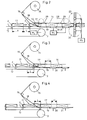
- the objects 11 to be packed are pushed on a table 1 by means of an endless conveyor belt 12 from left to right into a folding box 13 in which the packaging tube 14 is formed.
- Carriers 2 are attached to the conveyor belt 12 at regular intervals, which reach through a slot in the table 1 (not shown here) and take the objects 11 with them.
- the conveyor belt 12 is driven by a motor M 2 which is connected to the drive roller 3.
- the packaging material 18 for the articles 11 is, for example, a film made of thermoplastic material and is fed to the folding box 13 from a supply roll 15 via a deflection roll 16 in the form of a tape.
- the packaging material 18 is placed around the objects 11 to be packed in the folding box 13.
- a longitudinal seam 19 is formed on the underside.
- This seam is detected by rollers 20 and 21 which are driven by a drive M 1 and thus the hose formed is conveyed further and trailing packaging material is withdrawn from the supply roll 15.
- At least one pair of rollers 20 or 21 is heated and welded during the passage of the packaging tube 14 along the longitudinal seam 19.
- the tubular 11 surrounded with packaging material 18 now go to the formation of the transverse seams to a transverse welding point with two rollers 22 and 23 which are driven by a drive M3.
- the formation of such transverse welding points is known.
- the rollers 22 and 23 have a knife, not shown here, which are used to cut through the transverse welding points.
- the fully packaged objects 11 are conveyed further after the rollers 22 and 23 by a further conveying device, not shown here.
- a securing device with an endless belt 28 is expedient, which engages with elements 29 which are arranged at equal intervals from one another between gaps between adjacent objects 11 and thereby supports the objects 11.
- elements 29 are arranged at equal intervals from one another between gaps between adjacent objects 11 and thereby supports the objects 11.
- FIG. 2 shows a state during the start of a new cycle.
- An object 11 ' is inserted into the tube 14 that forms.
- the drives M1 and M2 are controlled so that the conveying speed of the conveyor belt 12 and the take-off speed of the belt 18 in the conveying direction are preferably largely the same.
- the object 11 ' is thus introduced into the tube 14 essentially without friction on the packaging material 18.
- FIG. 3 shows a state in which the object 11 ′ is almost completely inserted into the hose 14. This state corresponds to approximately 100 ° of the cycle.
- the state shown in FIG. 4 is reached.
- the object 11 ' is now completely inserted into the hose 14.
- Part of the following gap L may also already be in the hose 14.
- the take-off speed of the packaging material 18 is reduced, so that there is now a speed difference between the take-off speed of the packaging material 18 and the speed of the conveyor belt 12.
- the gap L between the objects 11 'and 11 is thus reduced with a reduced speed of the packaging material 18.
- the same gap L ' can be set, for example, by increasing the speed difference mentioned without further changes.
- the speed difference is canceled towards the end of the cycle until it is at least less or zero.
- the speed difference mentioned is thus substantially smaller during a second part-time of the cycle.
- an object 11 ' is transferred to the hose 14 and during the second part-time of the cycle the subsequent gap L, which is preferably reduced during the second part-time.
- Figure 1 shows a path / time diagram in a curve 4, the path of the conveyor belt 12 and in a curve 5, the path of the hose 14.
- the distance traveled by the conveyor belt 12 in a first part time T1 is equal to the distance traveled Hose 14.
- T2 of the cycle T the distance traveled by the hose 14 is smaller than the corresponding distance of the conveyor belt 12.
- FIG. 5 shows schematically the control of the drives M1, M2 and M3 mentioned above.
- a master 24, which can be a virtual master, is connected upstream of a controller for the drive M2, a controller 26 for the drive M1 and a controller 27 for the drive M3.
- the controller 25 With the controller 25 the running speed of the conveyor belt 12, with the controller 26, the feed of the rollers 20 and 21 and with the controller 27, the speed of the rollers 22 and 23 regulated.
- Three input means 6, 7 and 8 are provided for control. Setup parameters, for example the feed division, are entered with the first input means 6.
- Product parameters for example the length of the objects 11, can be entered on the second input means 7.
- the third input means 8 serve to input packaging parameters, in particular the length of the wrapping material.
Landscapes
- Engineering & Computer Science (AREA)
- Mechanical Engineering (AREA)
- Containers And Plastic Fillers For Packaging (AREA)
- Basic Packing Technique (AREA)
- Wrapping Of Specific Fragile Articles (AREA)
Applications Claiming Priority (2)
| Application Number | Priority Date | Filing Date | Title |
|---|---|---|---|
| CH2998/94 | 1994-10-05 | ||
| CH299894 | 1994-10-05 |
Publications (1)
| Publication Number | Publication Date |
|---|---|
| EP0708024A1 true EP0708024A1 (fr) | 1996-04-24 |
Family
ID=4246345
Family Applications (1)
| Application Number | Title | Priority Date | Filing Date |
|---|---|---|---|
| EP95810577A Withdrawn EP0708024A1 (fr) | 1994-10-05 | 1995-09-18 | Procédé et dispositif pour introduire des articles dans un manchon d'emballage |
Country Status (3)
| Country | Link |
|---|---|
| EP (1) | EP0708024A1 (fr) |
| JP (1) | JPH08175505A (fr) |
| BR (1) | BR9504295A (fr) |
Cited By (1)
| Publication number | Priority date | Publication date | Assignee | Title |
|---|---|---|---|---|
| US20120198795A1 (en) * | 2011-02-08 | 2012-08-09 | Ct Pack S.R.L. | Packaging machine and method |
Families Citing this family (1)
| Publication number | Priority date | Publication date | Assignee | Title |
|---|---|---|---|---|
| JP6856250B2 (ja) * | 2017-12-28 | 2021-04-07 | 株式会社フジキカイ | 横形製袋充填機における物品供給装置 |
Citations (5)
| Publication number | Priority date | Publication date | Assignee | Title |
|---|---|---|---|---|
| DE1136928B (de) | 1959-08-31 | 1962-09-20 | Sig Schweiz Industrieges | Vorrichtung zum kontinuierlichen Herstellen von schlauchfoermigen Packungen |
| GB2138381A (en) * | 1983-04-18 | 1984-10-24 | Baker Perkins Holdings Plc | Form-fill-seal wrapping apparatus |
| DE3615442A1 (de) * | 1985-05-08 | 1986-11-13 | Fuji Machinery Co., Ltd., Nagoya, Aichi | Verfahren und vorrichtung zum steuern eines antriebssystemes in einer verpackungsmaschine |
| US4722168A (en) * | 1987-06-25 | 1988-02-02 | Doboy Packaging Machinery, Inc. | Product-out-of-registration control for high speed wrapping machine |
| GB2204552A (en) * | 1987-05-13 | 1988-11-16 | Omori Machinery | Automatic packaging method |
-
1995
- 1995-09-18 EP EP95810577A patent/EP0708024A1/fr not_active Withdrawn
- 1995-10-04 JP JP25804195A patent/JPH08175505A/ja active Pending
- 1995-10-05 BR BR9504295A patent/BR9504295A/pt not_active Application Discontinuation
Patent Citations (5)
| Publication number | Priority date | Publication date | Assignee | Title |
|---|---|---|---|---|
| DE1136928B (de) | 1959-08-31 | 1962-09-20 | Sig Schweiz Industrieges | Vorrichtung zum kontinuierlichen Herstellen von schlauchfoermigen Packungen |
| GB2138381A (en) * | 1983-04-18 | 1984-10-24 | Baker Perkins Holdings Plc | Form-fill-seal wrapping apparatus |
| DE3615442A1 (de) * | 1985-05-08 | 1986-11-13 | Fuji Machinery Co., Ltd., Nagoya, Aichi | Verfahren und vorrichtung zum steuern eines antriebssystemes in einer verpackungsmaschine |
| GB2204552A (en) * | 1987-05-13 | 1988-11-16 | Omori Machinery | Automatic packaging method |
| US4722168A (en) * | 1987-06-25 | 1988-02-02 | Doboy Packaging Machinery, Inc. | Product-out-of-registration control for high speed wrapping machine |
Cited By (1)
| Publication number | Priority date | Publication date | Assignee | Title |
|---|---|---|---|---|
| US20120198795A1 (en) * | 2011-02-08 | 2012-08-09 | Ct Pack S.R.L. | Packaging machine and method |
Also Published As
| Publication number | Publication date |
|---|---|
| BR9504295A (pt) | 1996-10-01 |
| JPH08175505A (ja) | 1996-07-09 |
Similar Documents
| Publication | Publication Date | Title |
|---|---|---|
| DE69302168T2 (de) | Verfahren und vorrichtung zur manipulation eines produktstromes | |
| EP1260436B1 (fr) | Dispositif et procédé pour alimenter des articles à une station d'ensachage | |
| EP0827931B1 (fr) | Dispositif et méthode pour le guidage dynamique d'objets plats | |
| EP1188670A1 (fr) | Procédé et machine pour envelopper des produits imprimés dans un matériau d' emballage | |
| DE3816262A1 (de) | Verfahren und vorrichtung zum steuern einer verpackungsmaschine | |
| DE4207725A1 (de) | Verfahren und vorrichtung zum verpacken von gegenstaenden in einem kontinuierlich ablaufenden prozess | |
| CH671755A5 (fr) | ||
| DE69900222T2 (de) | Verfahren und Vorrichtung zum Verpacken von Gegenständen mittels Zuschnitten aus einer kontinuierlichen Bahn | |
| DE3615442A1 (de) | Verfahren und vorrichtung zum steuern eines antriebssystemes in einer verpackungsmaschine | |
| DE69110152T2 (de) | Apparat zum Umwickeln von Artikeln. | |
| EP0608861A2 (fr) | Procédé et dispositif pour alimenter des objets sensibles dans une machine de traitement | |
| DE60310836T2 (de) | Verpackungsmaschine zum Umhüllen von Gegenständen, Verfahren zum Betrieb einer solchen Maschine, und Verpackungen hergestellt durch dieses Verfahren | |
| DE2812579C2 (de) | Vorrichtung zum Einführen des freien Endes einer kontinuierlich geförderten Kunststoffbahn in eine Streck- und Fixierstation | |
| DE69212122T2 (de) | Vorrichtung zum kontinuierlichen Abschneiden von Blutplasmabeuteln | |
| DE2131217A1 (de) | Verpackungsvorrichtung | |
| DE4343477C1 (de) | Verfahren sowie Vorrichtung zum Verteilen von Behältern oder dergleichen Fördergut auf einen mehrreihigen Förderabschnitt | |
| EP1000860B1 (fr) | Procédé et dispositif pour cercler ou envelopper des objets | |
| DE3638370A1 (de) | Vorrichtung zum verpacken von kontinuierlich fortbewegten gegenstaenden mit einem schrumpfverpackungsband | |
| DE1611710B1 (de) | Verfahren und Vorrichtung zum Herstellen von Saecken oder Beuteln mit einem aus der OEffnung vorstehenden Einstecksack | |
| EP0516991B1 (fr) | Dispositif pour séparer des sections d'un matériau en bande pourvu de perforations transversales | |
| EP1751002B1 (fr) | Procede et dispositif pour emballer des objets plats | |
| DE102007010994B4 (de) | Verfahren und Vorrichtung zum Auftragen von Abschnitten eines Bandmaterials auf bewegte Zuschnitte | |
| EP1426293B1 (fr) | Procédé et appareil pour emballer des articles plats | |
| DE19502240C2 (de) | Verfahren und Vorrichtung zum Einziehen einer Bedruckstoffbahn im Rollenrotationsdruck | |
| EP0925910B1 (fr) | Procédé et dispositif pour la formation de piles de sacs faits à partir d'une feuille continue en plastique, en particulier de sacs pourvus d'une poignée. |
Legal Events
| Date | Code | Title | Description |
|---|---|---|---|
| PUAI | Public reference made under article 153(3) epc to a published international application that has entered the european phase |
Free format text: ORIGINAL CODE: 0009012 |
|
| AK | Designated contracting states |
Kind code of ref document: A1 Designated state(s): CH DE GB IT LI NL |
|
| 17P | Request for examination filed |
Effective date: 19961012 |
|
| STAA | Information on the status of an ep patent application or granted ep patent |
Free format text: STATUS: THE APPLICATION HAS BEEN WITHDRAWN |
|
| 17Q | First examination report despatched |
Effective date: 19970903 |
|
| 18W | Application withdrawn |
Withdrawal date: 19970919 |