EP0708081B1 - Verwendung von N,N'-disubstituierten p-Chinondiiminen bei der Herstellung und zur Stabilisierung von Organosilanen - Google Patents
Verwendung von N,N'-disubstituierten p-Chinondiiminen bei der Herstellung und zur Stabilisierung von Organosilanen Download PDFInfo
- Publication number
- EP0708081B1 EP0708081B1 EP95113268A EP95113268A EP0708081B1 EP 0708081 B1 EP0708081 B1 EP 0708081B1 EP 95113268 A EP95113268 A EP 95113268A EP 95113268 A EP95113268 A EP 95113268A EP 0708081 B1 EP0708081 B1 EP 0708081B1
- Authority
- EP
- European Patent Office
- Prior art keywords
- general formula
- process according
- quinonediimines
- organosilanes
- carbon atoms
- Prior art date
- Legal status (The legal status is an assumption and is not a legal conclusion. Google has not performed a legal analysis and makes no representation as to the accuracy of the status listed.)
- Expired - Lifetime
Links
- 229910052757 nitrogen Inorganic materials 0.000 title claims abstract description 93
- 150000001282 organosilanes Chemical class 0.000 title claims abstract description 47
- 230000000087 stabilizing effect Effects 0.000 title claims description 7
- 125000000217 alkyl group Chemical group 0.000 claims abstract description 31
- 125000000113 cyclohexyl group Chemical group [H]C1([H])C([H])([H])C([H])([H])C([H])(*)C([H])([H])C1([H])[H] 0.000 claims abstract description 15
- 125000001997 phenyl group Chemical group [H]C1=C([H])C([H])=C(*)C([H])=C1[H] 0.000 claims abstract description 15
- ISWSIDIOOBJBQZ-UHFFFAOYSA-N Phenol Chemical compound OC1=CC=CC=C1 ISWSIDIOOBJBQZ-UHFFFAOYSA-N 0.000 claims abstract description 6
- -1 methacryloxy Chemical group 0.000 claims description 62
- 238000000034 method Methods 0.000 claims description 59
- 125000004432 carbon atom Chemical group C* 0.000 claims description 30
- 239000003381 stabilizer Substances 0.000 claims description 25
- IJGRMHOSHXDMSA-UHFFFAOYSA-N Atomic nitrogen Chemical compound N#N IJGRMHOSHXDMSA-UHFFFAOYSA-N 0.000 claims description 24
- 239000000203 mixture Substances 0.000 claims description 22
- 238000007254 oxidation reaction Methods 0.000 claims description 20
- QVGXLLKOCUKJST-UHFFFAOYSA-N atomic oxygen Chemical compound [O] QVGXLLKOCUKJST-UHFFFAOYSA-N 0.000 claims description 19
- 230000003647 oxidation Effects 0.000 claims description 19
- 239000001301 oxygen Substances 0.000 claims description 19
- 229910052760 oxygen Inorganic materials 0.000 claims description 19
- 238000003408 phase transfer catalysis Methods 0.000 claims description 15
- 238000002360 preparation method Methods 0.000 claims description 13
- NLZUEZXRPGMBCV-UHFFFAOYSA-N Butylhydroxytoluene Chemical compound CC1=CC(C(C)(C)C)=C(O)C(C(C)(C)C)=C1 NLZUEZXRPGMBCV-UHFFFAOYSA-N 0.000 claims description 11
- 239000007800 oxidant agent Substances 0.000 claims description 10
- 150000002989 phenols Chemical class 0.000 claims description 10
- 235000010354 butylated hydroxytoluene Nutrition 0.000 claims description 9
- 125000004435 hydrogen atom Chemical group [H]* 0.000 claims description 9
- 125000002496 methyl group Chemical group [H]C([H])([H])* 0.000 claims description 9
- 238000011105 stabilization Methods 0.000 claims description 8
- 238000010626 work up procedure Methods 0.000 claims description 7
- 125000003545 alkoxy group Chemical group 0.000 claims description 5
- 239000011541 reaction mixture Substances 0.000 claims description 5
- 238000007701 flash-distillation Methods 0.000 claims description 4
- 150000004989 p-phenylenediamines Chemical class 0.000 claims description 4
- 238000004040 coloring Methods 0.000 claims description 2
- 238000004508 fractional distillation Methods 0.000 claims description 2
- 229910052740 iodine Inorganic materials 0.000 claims description 2
- 239000007858 starting material Substances 0.000 claims description 2
- 239000012429 reaction media Substances 0.000 claims 1
- 239000003513 alkali Substances 0.000 abstract description 13
- 230000001476 alcoholic effect Effects 0.000 abstract description 5
- GEYOCULIXLDCMW-UHFFFAOYSA-N 1,2-phenylenediamine Chemical class NC1=CC=CC=C1N GEYOCULIXLDCMW-UHFFFAOYSA-N 0.000 abstract 1
- CBCKQZAAMUWICA-UHFFFAOYSA-N 1,4-phenylenediamine Chemical compound NC1=CC=C(N)C=C1 CBCKQZAAMUWICA-UHFFFAOYSA-N 0.000 abstract 1
- 125000004104 aryloxy group Chemical group 0.000 abstract 1
- OKKJLVBELUTLKV-UHFFFAOYSA-N Methanol Chemical compound OC OKKJLVBELUTLKV-UHFFFAOYSA-N 0.000 description 39
- RAABOESOVLLHRU-UHFFFAOYSA-N diazene Chemical compound N=N RAABOESOVLLHRU-UHFFFAOYSA-N 0.000 description 29
- 229910000071 diazene Inorganic materials 0.000 description 29
- AZQWKYJCGOJGHM-UHFFFAOYSA-N 1,4-benzoquinone Chemical class O=C1C=CC(=O)C=C1 AZQWKYJCGOJGHM-UHFFFAOYSA-N 0.000 description 28
- 238000004821 distillation Methods 0.000 description 28
- 239000000243 solution Substances 0.000 description 17
- 230000015572 biosynthetic process Effects 0.000 description 15
- UTGQNNCQYDRXCH-UHFFFAOYSA-N N,N'-diphenyl-1,4-phenylenediamine Chemical compound C=1C=C(NC=2C=CC=CC=2)C=CC=1NC1=CC=CC=C1 UTGQNNCQYDRXCH-UHFFFAOYSA-N 0.000 description 13
- 238000006243 chemical reaction Methods 0.000 description 12
- 229920000642 polymer Polymers 0.000 description 12
- 150000004985 diamines Chemical class 0.000 description 11
- 235000002017 Zea mays subsp mays Nutrition 0.000 description 10
- 241000482268 Zea mays subsp. mays Species 0.000 description 10
- 238000004519 manufacturing process Methods 0.000 description 10
- 238000009835 boiling Methods 0.000 description 8
- 150000003839 salts Chemical class 0.000 description 8
- NIXOWILDQLNWCW-UHFFFAOYSA-N 2-Propenoic acid Chemical class OC(=O)C=C NIXOWILDQLNWCW-UHFFFAOYSA-N 0.000 description 6
- CSCPPACGZOOCGX-UHFFFAOYSA-N Acetone Chemical compound CC(C)=O CSCPPACGZOOCGX-UHFFFAOYSA-N 0.000 description 6
- CERQOIWHTDAKMF-UHFFFAOYSA-N Methacrylic acid Chemical class CC(=C)C(O)=O CERQOIWHTDAKMF-UHFFFAOYSA-N 0.000 description 6
- WCUXLLCKKVVCTQ-UHFFFAOYSA-M Potassium chloride Chemical compound [Cl-].[K+] WCUXLLCKKVVCTQ-UHFFFAOYSA-M 0.000 description 6
- 239000007789 gas Substances 0.000 description 6
- 230000006641 stabilisation Effects 0.000 description 6
- SMZOUWXMTYCWNB-UHFFFAOYSA-N 2-(2-methoxy-5-methylphenyl)ethanamine Chemical class COC1=CC=C(C)C=C1CCN SMZOUWXMTYCWNB-UHFFFAOYSA-N 0.000 description 5
- 238000001816 cooling Methods 0.000 description 5
- BDAWXSQJJCIFIK-UHFFFAOYSA-N potassium methoxide Chemical compound [K+].[O-]C BDAWXSQJJCIFIK-UHFFFAOYSA-N 0.000 description 5
- 238000003786 synthesis reaction Methods 0.000 description 5
- 239000000706 filtrate Substances 0.000 description 4
- 238000002844 melting Methods 0.000 description 4
- 230000008018 melting Effects 0.000 description 4
- 238000006116 polymerization reaction Methods 0.000 description 4
- 239000000047 product Substances 0.000 description 4
- 239000012808 vapor phase Substances 0.000 description 4
- OXYZDRAJMHGSMW-UHFFFAOYSA-N 3-chloropropyl(trimethoxy)silane Chemical compound CO[Si](OC)(OC)CCCCl OXYZDRAJMHGSMW-UHFFFAOYSA-N 0.000 description 3
- XDLMVUHYZWKMMD-UHFFFAOYSA-N 3-trimethoxysilylpropyl 2-methylprop-2-enoate Chemical compound CO[Si](OC)(OC)CCCOC(=O)C(C)=C XDLMVUHYZWKMMD-UHFFFAOYSA-N 0.000 description 3
- QTBSBXVTEAMEQO-UHFFFAOYSA-N Acetic acid Chemical compound CC(O)=O QTBSBXVTEAMEQO-UHFFFAOYSA-N 0.000 description 3
- UHOVQNZJYSORNB-UHFFFAOYSA-N Benzene Chemical compound C1=CC=CC=C1 UHOVQNZJYSORNB-UHFFFAOYSA-N 0.000 description 3
- MYMOFIZGZYHOMD-UHFFFAOYSA-N Dioxygen Chemical compound O=O MYMOFIZGZYHOMD-UHFFFAOYSA-N 0.000 description 3
- LFQSCWFLJHTTHZ-UHFFFAOYSA-N Ethanol Chemical compound CCO LFQSCWFLJHTTHZ-UHFFFAOYSA-N 0.000 description 3
- KWYUFKZDYYNOTN-UHFFFAOYSA-M Potassium hydroxide Chemical compound [OH-].[K+] KWYUFKZDYYNOTN-UHFFFAOYSA-M 0.000 description 3
- BLRPTPMANUNPDV-UHFFFAOYSA-N Silane Chemical compound [SiH4] BLRPTPMANUNPDV-UHFFFAOYSA-N 0.000 description 3
- 239000006227 byproduct Substances 0.000 description 3
- 229910001882 dioxygen Inorganic materials 0.000 description 3
- 239000001103 potassium chloride Substances 0.000 description 3
- 235000011164 potassium chloride Nutrition 0.000 description 3
- FBCQUCJYYPMKRO-UHFFFAOYSA-N prop-2-enyl 2-methylprop-2-enoate Chemical compound CC(=C)C(=O)OCC=C FBCQUCJYYPMKRO-UHFFFAOYSA-N 0.000 description 3
- 229910000077 silane Inorganic materials 0.000 description 3
- JRMUNVKIHCOMHV-UHFFFAOYSA-M tetrabutylammonium bromide Chemical compound [Br-].CCCC[N+](CCCC)(CCCC)CCCC JRMUNVKIHCOMHV-UHFFFAOYSA-M 0.000 description 3
- XLYOFNOQVPJJNP-UHFFFAOYSA-N water Substances O XLYOFNOQVPJJNP-UHFFFAOYSA-N 0.000 description 3
- JUHXTONDLXIGGK-UHFFFAOYSA-N 1-n,4-n-bis(5-methylheptan-3-yl)benzene-1,4-diamine Chemical compound CCC(C)CC(CC)NC1=CC=C(NC(CC)CC(C)CC)C=C1 JUHXTONDLXIGGK-UHFFFAOYSA-N 0.000 description 2
- ZJNLYGOUHDJHMG-UHFFFAOYSA-N 1-n,4-n-bis(5-methylhexan-2-yl)benzene-1,4-diamine Chemical compound CC(C)CCC(C)NC1=CC=C(NC(C)CCC(C)C)C=C1 ZJNLYGOUHDJHMG-UHFFFAOYSA-N 0.000 description 2
- APTGHASZJUAUCP-UHFFFAOYSA-N 1-n,4-n-di(octan-2-yl)benzene-1,4-diamine Chemical compound CCCCCCC(C)NC1=CC=C(NC(C)CCCCCC)C=C1 APTGHASZJUAUCP-UHFFFAOYSA-N 0.000 description 2
- ZRMMVODKVLXCBB-UHFFFAOYSA-N 1-n-cyclohexyl-4-n-phenylbenzene-1,4-diamine Chemical compound C1CCCCC1NC(C=C1)=CC=C1NC1=CC=CC=C1 ZRMMVODKVLXCBB-UHFFFAOYSA-N 0.000 description 2
- HDYFAPRLDWYIBU-UHFFFAOYSA-N 1-silylprop-2-en-1-one Chemical class [SiH3]C(=O)C=C HDYFAPRLDWYIBU-UHFFFAOYSA-N 0.000 description 2
- BVUXDWXKPROUDO-UHFFFAOYSA-N 2,6-di-tert-butyl-4-ethylphenol Chemical compound CCC1=CC(C(C)(C)C)=C(O)C(C(C)(C)C)=C1 BVUXDWXKPROUDO-UHFFFAOYSA-N 0.000 description 2
- NIXOWILDQLNWCW-UHFFFAOYSA-M Acrylate Chemical compound [O-]C(=O)C=C NIXOWILDQLNWCW-UHFFFAOYSA-M 0.000 description 2
- 0 CNc(cc1)ccc1N* Chemical compound CNc(cc1)ccc1N* 0.000 description 2
- CERQOIWHTDAKMF-UHFFFAOYSA-M Methacrylate Chemical compound CC(=C)C([O-])=O CERQOIWHTDAKMF-UHFFFAOYSA-M 0.000 description 2
- OUBMGJOQLXMSNT-UHFFFAOYSA-N N-isopropyl-N'-phenyl-p-phenylenediamine Chemical compound C1=CC(NC(C)C)=CC=C1NC1=CC=CC=C1 OUBMGJOQLXMSNT-UHFFFAOYSA-N 0.000 description 2
- 239000002253 acid Substances 0.000 description 2
- 150000001252 acrylic acid derivatives Chemical class 0.000 description 2
- 229910000287 alkaline earth metal oxide Inorganic materials 0.000 description 2
- 239000003054 catalyst Substances 0.000 description 2
- 239000013065 commercial product Substances 0.000 description 2
- 230000000052 comparative effect Effects 0.000 description 2
- 238000010790 dilution Methods 0.000 description 2
- 239000012895 dilution Substances 0.000 description 2
- 230000007717 exclusion Effects 0.000 description 2
- 239000003444 phase transfer catalyst Substances 0.000 description 2
- RQAGEUFKLGHJPA-UHFFFAOYSA-N prop-2-enoylsilicon Chemical compound [Si]C(=O)C=C RQAGEUFKLGHJPA-UHFFFAOYSA-N 0.000 description 2
- 230000001681 protective effect Effects 0.000 description 2
- 238000001953 recrystallisation Methods 0.000 description 2
- NDVLTYZPCACLMA-UHFFFAOYSA-N silver oxide Chemical compound [O-2].[Ag+].[Ag+] NDVLTYZPCACLMA-UHFFFAOYSA-N 0.000 description 2
- 239000007787 solid Substances 0.000 description 2
- 239000010409 thin film Substances 0.000 description 2
- AOGDNNLIBAUIIX-UHFFFAOYSA-N 1-n,4-n-dinaphthalen-1-ylbenzene-1,4-diamine Chemical compound C1=CC=C2C(NC=3C=CC(NC=4C5=CC=CC=C5C=CC=4)=CC=3)=CC=CC2=C1 AOGDNNLIBAUIIX-UHFFFAOYSA-N 0.000 description 1
- VETPHHXZEJAYOB-UHFFFAOYSA-N 1-n,4-n-dinaphthalen-2-ylbenzene-1,4-diamine Chemical compound C1=CC=CC2=CC(NC=3C=CC(NC=4C=C5C=CC=CC5=CC=4)=CC=3)=CC=C21 VETPHHXZEJAYOB-UHFFFAOYSA-N 0.000 description 1
- SLUKQUGVTITNSY-UHFFFAOYSA-N 2,6-di-tert-butyl-4-methoxyphenol Chemical compound COC1=CC(C(C)(C)C)=C(O)C(C(C)(C)C)=C1 SLUKQUGVTITNSY-UHFFFAOYSA-N 0.000 description 1
- DTOOTUYZFDDTBD-UHFFFAOYSA-N 3-chloropropylsilane Chemical class [SiH3]CCCCl DTOOTUYZFDDTBD-UHFFFAOYSA-N 0.000 description 1
- KBQVDAIIQCXKPI-UHFFFAOYSA-N 3-trimethoxysilylpropyl prop-2-enoate Chemical compound CO[Si](OC)(OC)CCCOC(=O)C=C KBQVDAIIQCXKPI-UHFFFAOYSA-N 0.000 description 1
- ZJWLWMJQQFNJDH-UHFFFAOYSA-N CCC(C)(CC)[NH+]([O-])O Chemical compound CCC(C)(CC)[NH+]([O-])O ZJWLWMJQQFNJDH-UHFFFAOYSA-N 0.000 description 1
- OKTJSMMVPCPJKN-UHFFFAOYSA-N Carbon Chemical group [C] OKTJSMMVPCPJKN-UHFFFAOYSA-N 0.000 description 1
- VEXZGXHMUGYJMC-UHFFFAOYSA-M Chloride anion Chemical compound [Cl-] VEXZGXHMUGYJMC-UHFFFAOYSA-M 0.000 description 1
- DGAQECJNVWCQMB-PUAWFVPOSA-M Ilexoside XXIX Chemical compound C[C@@H]1CC[C@@]2(CC[C@@]3(C(=CC[C@H]4[C@]3(CC[C@@H]5[C@@]4(CC[C@@H](C5(C)C)OS(=O)(=O)[O-])C)C)[C@@H]2[C@]1(C)O)C)C(=O)O[C@H]6[C@@H]([C@H]([C@@H]([C@H](O6)CO)O)O)O.[Na+] DGAQECJNVWCQMB-PUAWFVPOSA-M 0.000 description 1
- ZLMJMSJWJFRBEC-UHFFFAOYSA-N Potassium Chemical compound [K] ZLMJMSJWJFRBEC-UHFFFAOYSA-N 0.000 description 1
- 238000002835 absorbance Methods 0.000 description 1
- 238000010521 absorption reaction Methods 0.000 description 1
- 230000002411 adverse Effects 0.000 description 1
- 150000001298 alcohols Chemical class 0.000 description 1
- 229910001854 alkali hydroxide Inorganic materials 0.000 description 1
- 229910052783 alkali metal Inorganic materials 0.000 description 1
- 150000008044 alkali metal hydroxides Chemical class 0.000 description 1
- 150000001408 amides Chemical class 0.000 description 1
- 239000004305 biphenyl Substances 0.000 description 1
- 150000004649 carbonic acid derivatives Chemical class 0.000 description 1
- 238000006555 catalytic reaction Methods 0.000 description 1
- KRVSOGSZCMJSLX-UHFFFAOYSA-L chromic acid Substances O[Cr](O)(=O)=O KRVSOGSZCMJSLX-UHFFFAOYSA-L 0.000 description 1
- 238000004440 column chromatography Methods 0.000 description 1
- 238000010924 continuous production Methods 0.000 description 1
- 239000012043 crude product Substances 0.000 description 1
- KPUWHANPEXNPJT-UHFFFAOYSA-N disiloxane Chemical class [SiH3]O[SiH3] KPUWHANPEXNPJT-UHFFFAOYSA-N 0.000 description 1
- 239000002360 explosive Substances 0.000 description 1
- 238000005194 fractionation Methods 0.000 description 1
- AWJWCTOOIBYHON-UHFFFAOYSA-N furo[3,4-b]pyrazine-5,7-dione Chemical compound C1=CN=C2C(=O)OC(=O)C2=N1 AWJWCTOOIBYHON-UHFFFAOYSA-N 0.000 description 1
- 238000004817 gas chromatography Methods 0.000 description 1
- 229910052736 halogen Inorganic materials 0.000 description 1
- 150000002367 halogens Chemical class 0.000 description 1
- 229910001385 heavy metal Inorganic materials 0.000 description 1
- 150000004679 hydroxides Chemical class 0.000 description 1
- 239000011261 inert gas Substances 0.000 description 1
- 230000007257 malfunction Effects 0.000 description 1
- 150000002734 metacrylic acid derivatives Chemical class 0.000 description 1
- FSWDLYNGJBGFJH-UHFFFAOYSA-N n,n'-di-2-butyl-1,4-phenylenediamine Chemical compound CCC(C)NC1=CC=C(NC(C)CC)C=C1 FSWDLYNGJBGFJH-UHFFFAOYSA-N 0.000 description 1
- 239000012071 phase Substances 0.000 description 1
- ISWSIDIOOBJBQZ-UHFFFAOYSA-M phenolate Chemical compound [O-]C1=CC=CC=C1 ISWSIDIOOBJBQZ-UHFFFAOYSA-M 0.000 description 1
- 229940031826 phenolate Drugs 0.000 description 1
- 238000005375 photometry Methods 0.000 description 1
- 229910052700 potassium Inorganic materials 0.000 description 1
- 239000011591 potassium Substances 0.000 description 1
- 235000011118 potassium hydroxide Nutrition 0.000 description 1
- LLLCSBYSPJHDJX-UHFFFAOYSA-M potassium;2-methylprop-2-enoate Chemical compound [K+].CC(=C)C([O-])=O LLLCSBYSPJHDJX-UHFFFAOYSA-M 0.000 description 1
- 150000003138 primary alcohols Chemical class 0.000 description 1
- 238000000746 purification Methods 0.000 description 1
- 230000035484 reaction time Effects 0.000 description 1
- 238000009419 refurbishment Methods 0.000 description 1
- 239000011833 salt mixture Substances 0.000 description 1
- 150000003333 secondary alcohols Chemical class 0.000 description 1
- 229910001923 silver oxide Inorganic materials 0.000 description 1
- 229910052708 sodium Inorganic materials 0.000 description 1
- 239000011734 sodium Substances 0.000 description 1
- 238000003756 stirring Methods 0.000 description 1
- 150000003509 tertiary alcohols Chemical class 0.000 description 1
- 125000005207 tetraalkylammonium group Chemical group 0.000 description 1
- YUYCVXFAYWRXLS-UHFFFAOYSA-N trimethoxysilane Chemical compound CO[SiH](OC)OC YUYCVXFAYWRXLS-UHFFFAOYSA-N 0.000 description 1
- 230000007306 turnover Effects 0.000 description 1
Classifications
-
- C—CHEMISTRY; METALLURGY
- C07—ORGANIC CHEMISTRY
- C07C—ACYCLIC OR CARBOCYCLIC COMPOUNDS
- C07C251/00—Compounds containing nitrogen atoms doubly-bound to a carbon skeleton
- C07C251/02—Compounds containing nitrogen atoms doubly-bound to a carbon skeleton containing imino groups
- C07C251/20—Compounds containing nitrogen atoms doubly-bound to a carbon skeleton containing imino groups having carbon atoms of imino groups being part of rings other than six-membered aromatic rings
- C07C251/22—Quinone imines
-
- C—CHEMISTRY; METALLURGY
- C07—ORGANIC CHEMISTRY
- C07C—ACYCLIC OR CARBOCYCLIC COMPOUNDS
- C07C249/00—Preparation of compounds containing nitrogen atoms doubly-bound to a carbon skeleton
- C07C249/02—Preparation of compounds containing nitrogen atoms doubly-bound to a carbon skeleton of compounds containing imino groups
-
- C—CHEMISTRY; METALLURGY
- C07—ORGANIC CHEMISTRY
- C07F—ACYCLIC, CARBOCYCLIC OR HETEROCYCLIC COMPOUNDS CONTAINING ELEMENTS OTHER THAN CARBON, HYDROGEN, HALOGEN, OXYGEN, NITROGEN, SULFUR, SELENIUM OR TELLURIUM
- C07F7/00—Compounds containing elements of Groups 4 or 14 of the Periodic Table
- C07F7/02—Silicon compounds
- C07F7/08—Compounds having one or more C—Si linkages
- C07F7/18—Compounds having one or more C—Si linkages as well as one or more C—O—Si linkages
- C07F7/1804—Compounds having Si-O-C linkages
Definitions
- the invention relates to the use of N, N'-disubstituted p-quinone diimines of the general formula I.
- R 1 and R 2 are the same or different and represent a phenyl group and / or a straight-chain and / or branched alkyl group having 3 to 8 carbon atoms and / or a cyclohexyl group, for the stabilization of methacryloxy or acryloxy groups containing organosilanes of the general formula II in which R 3 represents a hydrogen atom or a methyl group and R 4 and R 5 are identical or different alkyl groups having 1 to 4 C atoms and m is 0 or 1 or 2.
- organosilanes of general formula II are also below referred to as acrylic silanes.
- N, N'-disubstituted used as stabilizers according to the invention p-Quinone diimines of the general formula I and processes their manufacture is known. For these processes one uses as The corresponding N, N'-disubstituted p-phenylenediamines, under the influence of oxidizing agents in the corresponding Diimines are transferred. So is the production of N, N'-diphenyl-p-quinone diimine from the corresponding diamine Oxidation with chromic acid in dilute acetic acid solution is described (Chem. Ber. 46 (1913) p. 1853).
- N, N'-diphenyl-p-quinone diimine by shaking a benzene solution of N, N'-diphenyl-p-phenylenediamine with an aqueous potassium ferricyanide solution (F. Feichtmayr and F. Würstlin, reports from the Bunsen Society Vol. 67 (1963) p. 435).
- the same procedure is used for the preparation of N-phenyl-N'-isopropyl-p-quinone diimine and N-phenyl-N'-cyclohexyl-p-quinone diimine (L. Kotulak et al., Collect. Czech. Chem. Commun. 48 (1983) 12, pp.
- N, N'-diphenyl-p-phenylenediamine is in the presence of high excesses of azoisobutyronitrile (AIBN) due to atmospheric oxygen converted to a diimine (C.E. Boozer et al., Journ. Amer. Chem. Soc. 77 (1955) p.3233).
- AIBN azoisobutyronitrile
- EP-PS 0 437 653 teaches the synthesis of organosilanes of the general formula II by reacting alkali metal salts of methacrylic acid or acrylic acid with chloropropylsilanes of the general formula III, in which R 4 , R 5 and m have the abovementioned meaning, in the presence of phase transfer catalysts of the tetraalkylammonium type, with N, N'-diphenyl-p-phenylenediamine as a stabilizer in order to prevent undesired polymer formation, in particular the formation of “popcorn” polymer the examples given is used. It is known that, for example, heavy metal salts trigger the undesired polymerization of the acrylic silanes and can also accelerate the siloxane formation of alkoxysilane functions.
- the acrylic silanes are prepared by distillation measures.
- the stabilizer system is generally added after first stage of the process. the preparation of the alkali acrylates.
- the stabilizer combination of N, N'-disubstituted diamines and sterically hindered phenols also prove to be effective the (meth) acrylsilane synthesis by the PTC process as ineffective. It is by adding the stabilizer combination in the course of or after completion of the first stage of the procedure, the usual procedure Production of alkali methacrylate or acrylate from alcoholic Alkaline alcoholate solution and methacrylic acid or acrylic acid, the phenolic Component converted into non-volatile alkali phenolate, and regardless of whether the acid or the salt preparation Alcoholate is presented. This is how the distillative workup works the free, volatile phenol is not available to the raw acrylic silanes, whereby "popcorn" polymer formation occurs in the columns and the product yield deteriorates.
- the invention is therefore based on the object of being economical and provide environmentally friendly stabilizer system that a Polymerization of the organosilanes of the general formula II during the Manufacturing process, in particular also in the distillative product processing, prevented.
- one of the objects of the invention is the use of N, N'-disubstituted p-quinone diimines of the formula I, wherein R 1 and R 2 are the same or different and are a phenyl group and / or a straight-chain and / or branched alkyl group having 3 to 8 carbon atoms and / or a cyclohexyl group, for the stabilization of methacryloxy or acryloxy -Group-containing organosilanes of the general formula II in which R 3 represents a hydrogen atom or a methyl group and R 4 and R 5 are identical or different alkyl groups having 1 to 4 C atoms and m is 0 or 1 or 2.
- compositions consisting of organosilanes of the general formula II containing methacryloxy or acryloxy groups in which R 3 represents a hydrogen atom or a methyl group and R 4 and R 5 are identical or different alkyl groups with 1 to 4 C atoms and m is 0 or 1 or 2, and one or more N, N '-disubstituted p-quinone diimines of the general formula I.
- R 1 and R 2 are the same or different and represent a phenyl group and / or a straight-chain and / or branched alkyl group having 3 to 8 carbon atoms and / or a cyclohexyl group, as stabilizer (s).
- N, N'-disubstituted p-quinone diimines of the general formula I stabilize the acrylsilanes during their preparation, in particular when they are worked up by distillation - both in the bottom and in the vapor phase - and lead to improved yields. It was particularly surprising that N, N'-disubstituted p-quinone diimines also during the PTC production process by targeted oxidation of N, N'-disubstituted p-phenylenediamines of the general formula IV can be generated without otherwise adversely affecting the process flow and the synthesis of the acrylic silanes. In this way, the PTC process could be significantly improved in a simple and economical manner.
- the present invention further provides a process for stabilizing organosilanes of the general formula II containing methacryloxy or acryloxy groups in which R 3 represents a hydrogen atom or a methyl group and R 4 and R 5 are identical or different alkyl groups having 1 to 4 carbon atoms and m is 0 or 1 or 2, which is characterized in that as stabilizers N, N'-disubstituted p-quinone diimines of the general formula I wherein R 1 and R 2 are the same or different and represent a phenyl group and / or a straight-chain and / or branched alkyl group having 3 to 8 carbon atoms and / or a cyclohexyl group.
- Another object of the invention is a phase transfer catalysis (PTC) process for the preparation of organosilanes of the general formula II containing methacryloxy or acryloxy groups in which R 3 represents a hydrogen atom or a methyl group and R 4 and R 5 are identical or different alkyl groups having 1 to 4 carbon atoms and m is 0 or 1 or 2, which is characterized in that the Crude organosilanes of the general formula II during the PTC process by N, N'-disubstituted p-quinone diimines of the general formula I wherein R 1 and R 2 are the same or different and represent a phenyl group and / or a straight-chain and / or branched alkyl group having 3 to 8 carbon atoms and / or a cyclohexyl group.
- PTC phase transfer catalysis
- the p-quinone diimines used for the purposes described, as well their manufacture are not the subject of the invention. You can by e.g. according to the procedure of the pending European Patent application 95 113 266.1 by oxidation of N, N'-disubstituted p-Phenylenediamines can be produced using halogens.
- N, N'-disubstituted p-Phenylenediamines can be produced using halogens.
- Oxidizer serves as molecular oxygen Oxidizer, and the oxidation takes place in alkaline-alcoholic Solution instead. It can be used as an alkaline component of alkaline alcohol Solution alkali alcoholates and / or alkali hydroxides used become.
- the alkaline-alcoholic solution preferably contains 5 to 15% by weight.
- Alkaline alcoholate can also be used, although at higher Concentrations as 15 wt .-% increasingly N, N'-disubstituted 2,5-dialkoxy-p-quinone diimines arise as by-products and less than 5 wt .-% the oxidation progressively slower runs.
- Preferred alkali alcoholates are the methylates and Ethylates of sodium and potassium.
- alcohols e.g. primary, secondary or tertiary alcohols can be used with 1 to 6 carbon atoms in the carbon skeleton, preferred are methanol and ethanol.
- the diamine used can have the general formula IV completely or only partially in the alcoholate solution used are solved.
- the oxidation is preferably at a Temperature between 10 and 60 ° C, particularly preferably at a Temperature between 20 and 40 ° C, most preferably at one Temperature between 25 and 35 ° C, carried out.
- Oxygen mixed with nitrogen is preferred as the oxidizing agent used.
- An oxygen / nitrogen mixture is used as the oxidizing agent, preferably with a content of more than 0.1 and less than 21% by volume oxygen, particularly preferably more than 0.1 and less than 8.4% by volume oxygen.
- Prefers is worked without pressure. But it can also work at higher pressures suitably up to 5 bar.
- the diimines used according to the invention do not need to be pure Form. So the product of the oxidation reaction Mixture of N, N'-disubstituted p-phenylenediamine and N, N'-disubstituted contain p-quinone diimine. Even with a 10% turnover of diamine to diimine can be added to organosilanes of the general Formula II has a stabilizing effect, but the diamine conversion should amounts to more than 30%.
- the diimines prepared as described can by conventional Refurbishment methods, such as B. working up by distillation under reduced pressure Print, recrystallization or column chromatography, in pure Form.
- the use in analytical form is but, as already mentioned, no precondition for the invention Use of the diimines.
- Stabilization of the organosilanes of the general formula II is their Content of p-quinone diimines of the general formula I is preferred > 0.0005 to 1.5% by weight, particularly preferably 0.01 to 1.0% by weight, very particularly preferably 0.1 to 0.5% by weight.
- the N, N'-disubstituted p-quinone diimines can be used to stabilize the organosilanes of the formula II.
- the organosilanes N, N'-disubstituted p-phenylenediamines of the general formula IV stabilized according to the invention can be used as additional stabilizers wherein R 1 and R 2 are the same or different and represent a phenyl group and / or a straight-chain and / or branched alkyl group having 3 to 8 carbon atoms and / or a cyclohexyl group, and / or volatile, sterically hindered Phenols of the general formula V wherein R 6 is an alkyl or alkoxy group having 1 to 4 carbon atoms.
- organosilanes of the general formula II are made from alkali methacrylates or alkali acrylates and chloropropylalkoxysilanes of the general formula III in which R 4 and R 5 represent the same or different alkyl groups having 1 to 4 carbon atoms and m represents 0 or 1 or 2.
- the p-quinone diimines of the general used as stabilizers Formula I can also during the manufacturing process of the organosilanes of the general formula II are generated.
- the p-Quinone diimines of the general formula I by oxidation of the corresponding ones p-Phenylenediamines of the general formula IV generated become.
- Oxygen is preferably used as the oxidizing agent in the mixture used with nitrogen.
- the oxidation is preferably at a Temperature between 10 and 60 ° C, particularly preferably at a Temperature between 20 and 40 ° C, most preferably at one Temperature between 25 and 35 ° C, carried out.
- the p-quinone diimines of general formula I can thus e.g. by Oxidation of the corresponding p-phenylenediamines of the general Formula IV generated in the reaction environment of stage 1 of the PTC process become.
- the desired conversion of the diamine to the diimine can be brought about by the targeted O 2 oxidation.
- the molecular oxygen used as the oxidizing agent can be diluted by an inert gas, preferably nitrogen, to the extent that explosive mixtures are not formed with any of the components in the above-mentioned system.
- the crude organosilanes of the general formula II stabilized here according to the invention preferably contain> 0.0005 to 1.5% by weight, particularly preferably 0.01 to 1.0% by weight, very particularly preferably 0.1 to 0.5 %
- p-quinone diimines of the general formula I Preferred N, N'-disubstituted p-quinone diimines are those which are volatile. which is not higher than the boiling point of the acrylic silane to be stabilized.
- the volatilities of the diimines are preferably only insignificantly below the boiling points of the acrylic silanes.
- N, N'-disubstituted p-phenylenediamines of the general formula IV can also be used as additional stabilizers for the process according to the invention for stabilizing the organosilanes of the general formula II wherein R 1 and R 1 are the same or different and represent a phenyl group and / or a straight-chain and / or branched alkyl group having 3 to 8 carbon atoms and / or a cyclohexyl group, and / or volatile, sterically hindered Phenols of the general formula V where R 6 is an alkyl or alkoxy group having 1 to 4 carbon atoms.
- the phenolic stabilizers suitably have boiling points comparable to those of the acrylsilanes of the general formula II.
- the pure representation of the organosilanes of the general formula II takes place usually by distillation measures. You can go to Use of short path or thin film evaporators and / or through Column distillation take place.
- the crude organosilanes of the general formula II, the p-quinone diimines of the general formula I are used to separate high boilers preferably subjected to flash distillation.
- Flash distillation means pre-purification by distillation, for example via a thin film evaporator.
- a preferred embodiment of the distillative preparation of the crude organosilane II consists in the combination of flash distillation (Preliminary stage) and column distillation.
- prepress can Catalysts, unreacted diamines, residual salts and small amounts Polymer are separated.
- the flash distillate is used in an amount of preferably> 5 to 15,000 ppm by weight, particularly preferably 10 to 3,000 ppm by weight and most preferably 50 to 1,000 ppm by weight, p-quinone diimines of general formula I stabilized.
- the flash distillate is then suitably fractionally distilled.
- p-quinone diimines I used according to the invention are highly volatile and in distillation the acrylic silanes also get into the vapor phase and stabilize there, i.e. prevent polymerization, act.
- Organosilanes containing are preferably free of p-quinone diimines of general formula I obtained.
- the organosilanes containing methacryloxy or acryloxy groups the general formula II is preferably fractionated Distillation is a non-coloring, sterically hindered phenol general formula V added for post-stabilization; is preferred 2,6-di-tert-butyl-4-methylphenol added.
- the distillative workup can be carried out batchwise or continuously.
- the concentration of the N, N'-disubstituted diimines is determined suitably photometric.
- the p-quinone diimines can general formula I and N, N'-disubstituted p-phenylenediamines general formula IV the starting material mixture and / or the reaction mixture and / or the crude organosilane of the general formula II and / or the Flash distillate and / or elsewhere in the distillative Workup are added;
- the raw organosilane of the general formula II and / or the flash distillate and / or at another point of the distillative workup and / or the Pure distillate volatile, sterically hindered phenols of the general Formula V can be added.
- N N'-disubstituted p-quinone diimines I at the production of methacryloxy- or acryloxy-containing organosilanes of the general formula II, especially in the PTC process, succeeds it in a simple way to prevent the "popcorn" polymerization and to obtain acrylic silanes of high purity and colorless appearance.
- organosilanes of the general formula II, which are used for Manufacture of polymers used have such high To meet quality requirements.
- Another important advantage of the measures according to the invention is in that the yield of specification-compliant acrylic silanes II and thus the economy of the PCT process even further could be improved.
- the precipitated potassium chloride was filtered off from the cooled mixture and washed out with methanol.
- the filtrate freed from methanol was flashed off at 0.4 mbar over a Claisen bridge: boiling point 88-90 ° C.
- Amount of distillate 766.8 g (92.1% of theory).
- the yellow-orange colored distillate contained 80 mg N, N'-diphenyl-p-quinone diimine / kg after photometric determination.
- Fractional distillation over a packed column equipped with Raschig rings gave 722.3 g of 86.7% of theory 3-methacryloxypropyltrimethoxysilane obtained.
- Boiling point 81-82 ° C / 0.2 mbar; GC purity: 99.7%.
- the potassium chloride formed was centrifuged off from the cooled reaction mixture and washed with methanol.
- a diimine content of 2.8 g / kg was determined photometrically in the methanol-free filtrate.
- a distillation yield of 11.557 kg 93.2% was achieved.
- the diimine content determined photometrically was 92 mg / kg of distillate.
- allyl methacrylate and 3 g of 2,6-di-tert-butyl-4-methylphenol were placed in a multi-necked flask equipped with a stirrer, dropping funnel, thermometer and cooler, and a weak oxygen / nitrogen mixture (volume ratio 1: 11.9 ) heated to 105 ° C.
- 240 g of trimethoxysilane were added dropwise from the dropping funnel. After a quarter, half and three quarters of the silane addition and after the silane addition had ended, 250 mg of a 10% acetone solution of H 2 PtCl 6 were added. During the reaction the temperature was kept between 100 and 105 ° C. After a reaction time of 2 hours, the crude product obtained was flashed off under vacuum.
- Example 2 In contrast to Example 2, the procedure here was that instead of of N, N'-diphenyl-p-quinonediamine 4.2 g of N, N'-diphenyl-p-phenylenediamine was used with largely exclusion of oxygen.
- the flash distillate was almost colorless and contained less than 5 mg diimine per kg Distillate.
- An oxygen-containing protective gas occurred in a significant amount of "popcorn" polymer formation in the column and in the swamp. The yield was 42%.
- Example 2 was changed so that instead of N, N'-diphenyl-p-quinone diimine 4.2 g of N, N'-diphenyl-p-phenylenediamine and 0.23 g 2,6-di-tert-butyl-4-methylphenol immediately after the formation of Potassium methacrylate were added.
- the reaction was largely Exclusion of oxygen carried out.
- the flash distillate was practically colorless and had less than 5 mg diimine per kg distillate on.
- GC analysis showed no evidence of 2,6-di-tert-butyl-4-methylphenol in flash distillate.
- In the case of pure distillation via a column without using an oxygen-containing protective gas, entered considerable amount of "popcorn" polymer formation in the column and in Swamp up. The yield was 39%.
Landscapes
- Chemical & Material Sciences (AREA)
- Organic Chemistry (AREA)
- Organic Low-Molecular-Weight Compounds And Preparation Thereof (AREA)
Description















In eine Lösung von 22 g N,N'-Diphenyl-p-phenylendiamin in 5 1 8 %iger Kaliummethylat/-Methanol-Lösung wurde unter Rühren bei einer Temperatur um 30 °C ein lebhafter Gasstrom aus O2 und N2 (1 : 11) eingeleitet. Nach 3 h betrug die N,N'-Diphenyl-p-chinondiimin-Ausbeute 78 %. Die Ausbeute wurde photometrisch aus der Extinktion beim Absorptionsmaximum von 442 nm ermittelt. Der ausgefallene Feststoff wurde abfiltriert. Der Schmelzpunkt wurde nach Umkristallisation aus Aceton/Methanol bestimmt: 181 - 183 °C.
Vor Beginn der Reindestillation wurden in die Destillationsvorlage 144 mg 2,6-Di-tert.-butyl-4-methylphenol (Handelsprodukt Ionol CP der Fa. Shell) eingebracht. Während der Flash- und Reindestillation wurden in die Kolonnensümpfe geringe Mengen eines O2/N2-Gemisches mit einem Verhältnis O2:N2 von 1:11,5 eingeperlt.
Nach den Destillationen wären in den benutzten Apparaturen, in den Destillaten und Sümpfen keine Hinweise für "Popcorn"-Polymerisate zu finden.
Nach Zugabe von 225,8 g Tetrabutylammoniumbromid und 10,0 kg 3-Chlorpropyl-trimethoxysilan wurde über eine kurze Kolonne solange Methanol abdestilliert, bis bei 118°C eine exotherme Reaktion einsetzte, die durch Kühlung auf einer Temperatur von unter 120°C gehalten wurde. Nach Abklingen der exothermen Reaktion wurde noch 2 h bei 120°C erwärmt. Aus der gekühlten Reaktionsmischung wurde das gebildete Kaliumchlorid abgeschleudert und mit Methanol gewaschen. Im Methanolfreien Filtrat wurde photometrisch ein Diimin-Gehalt von 2,8 g/kg ermittelt.
Nach Destillation über einen Kurzwegverdampfer (Typ KD 10 der Firma Leybold-Heraeus) unter einem Sauerstoff/Stickstoff-Strom (Volumenverhältnis 1:12) von 1750 ml/h, bei einer Verdampfertemperatur von 94 °C und einem Arbeitsdruck von 0,4 mbar, wurde eine Destillationsausbeute von 11,557 kg 93,2 % erreicht. Der photometrisch ermittelte Diimin-Gehalt betrug 92 mg/kg Destillat.
Nach Zugabe von 3,467 g 2,6-Di-tert.-butyl-4-methylphenol wurde über eine 40 cm lange Kolonne (Füllkörper V4A-Drahtnetze) unter einem O2/N2-Strom (Volumenverhältnis 1:11,9) von 150 l/h fraktioniert. Ausbeute: 11,146 kg (90,0 % d. Th.) 3-Methacryloxypropyltrimethoxysilan. Siedepunkt: 76-77°C/0,25 mbar. GC-Reinheit: 99,6 %.
Weder in den Destillationsrückständen noch im Kurzwegverdampfer oder der Destillationskolonne wurde "Popcorn"-Polymerisat festgestellt.
Nach Zugabe von 163 g Tetrabutylammoniumbromid und 7,190 kg 3-Chlorpropyltrimethoxysilan wurde soweit Methanol über eine kurze Kolonne abdestilliert, daß bei 115°C eine exotherme Reaktion einsetzte. Nach deren Abklingen wurde 1,5 h bei 120°C weitererhitzt. Nach Abkühlung wurde vom gebildeten Kaliumchlorid abgeschleudert und mit Methanol gewaschen. Im vom Methanol befreiten Filtrat wurde photometrisch ein Diimin-Gehalt von 3,2 g/kg Filtrat bestimmt.
Nach Destillation über einen Kurzwegverdampfer (Typ KD 10 der Firma Leybold-Heraeus) wurden bei einer Verdampfertemperatur von 95°C und einem Arbeitsdruck von 0,4 mbar bei Einleitung eines Sauerstoff/Stickstoff-Gemisches (Volumenverhältnis 1:15) von 1.050 ml/h eine Destillationsausbeute von 94,3 % d. Th. erreicht. Der photometrisch ermittelte Diimin-Gehalt betrug 80 mg/kg Destillat.
Nach Zugabe von 1,9 g 2,6-Di-tert.-butyl-4-methylphenol wurde über eine 40 cm hohe Füllkörperkolonne unter o.g. Sauerstoff/Stickstoff-Verhältnis und einer eingeleiteten Gasmenge von 100 ml/h fraktioniert. Reinausbeute: 7,991 kg 89,5 % 3-Acryloxypropyltrimethoxysilan. Siedepunkt: 63-64 °C/0,1-0,15 mbar. GC-Reinheit: 99,3 %.
Weder in den Destillationsrückständen noch im Kurzwegverdampfer oder der Destillationskolonne war "Popcorn"-Polymerisat enthalten.
Nach Zugabe von 4,5 g N-Phenyl-N'-isopropyl-p-chinondiimin wurde der Rückstand unter reduziertem Druck über eine kurze Füllkörperkolonne destilliert, wobei als Hauptfraktion bei 110 bis 112°C (3 mbar) 417,6 g 3-Methacryloxypropyltrimethoxysilan übergingen, was einer Ausbeute von 85,6 %, bezogen auf eingesetztes Allylmethacrylat, entspricht.
In der Kolonne befand sich kein "Popcorn"-Polymerisat, der Destillationsrückstand war dünnflüssig, und das Destillat wies eine Hazenzahl von weniger als 10 auf.
Claims (31)
- Verwendung von N,N'-disubstituierten p-Chinondiiminen der allgemeinen Formel Iworin R1 und R2 gleich oder verschieden sind und eine Phenyl-Gruppe und/oder eine geradkettige und/oder verzweigte Alkyl-Gruppe mit 3 bis 8 C-Atomen und/oder eine Cyclohexyl-Gruppe bedeuten, zur Stabilisierung von Methacryloxy- oder Acryloxygruppen enthaltenden Organosilanen der allgemeinen Formel II
 in der R3 für ein Wasserstoffatom oder eine Methyl-Gruppe steht und R4 und R5 gleiche oder verschiedene Alkyl-Gruppen mit 1 bis 4 C-Atomen sind und m gleich 0 oder 1 oder 2 ist.
- Zusammensetzung, bestehend aus Methacryloxy- oder Acryloxy-Gruppen enthaltenden Organosilanen der allgemeinen Formel IIin der R3 für ein Wasserstoffatom oder eine Methyl-Gruppe steht und R4 und R5 gleiche oder verschiedene Alkyl-Gruppen mit 1 bis 4 C-Atomen sind und m gleich 0 oder 1 oder 2 ist, und einem oder mehreren N,N'-disubstituierten p-Chinondiiminen der allgemeinen Formel I
 worin R1 und R2 gleich oder verschieden sind und eine Phenyl-Gruppe und/oder eine geradkettige und/oder verzweigte Alkyl-Gruppe mit 3 bis 8 C-Atomen und/oder eine Cyclohexyl-Gruppe bedeuten, als Stabilisator(en).
- Zusammensetzung nach Anspruch 2, dadurch gekennzeichnet, daß der Gehalt an p-Chinondiiminen der allgemeinen Formel I >0,0005 bis 1,5 Gew.-% beträgt.
- Zusammensetzung nach Anspruch 3, dadurch gekennzeichnet, daß der Gehalt an p-Chinondiiminen der allgemeinen Formel I 0,01 bis 1,0 Gew.-% beträgt.
- Zusammensetzung nach Anspruch 4, dadurch gekennzeichnet, daß der Gehalt der an p-Chinondiiminen der allgemeinen Formel I 0,1 bis 0,5 Gew.-% beträgt.
- Zusammensetzung nach den Ansprüchen 2 bis 5, dadurch gekennzeichnet, daß als zusätzliche Stabilisatoren N,N'-disubstituierte p-Phenylendiamine der allgemeinen Formel IVworin R1 und R2 gleich oder verschieden sind und eine Phenyl-Gruppe und/oder eine geradkettige und/oder verzweigte Alkyl-Gruppe mit 3 bis 8 C-Atomen und/oder eine Cyclohexyl-Gruppe bedeuten, und/oder flüchtige, sterisch gehinderte Phenole der allgemeinen Formel V
 worin R6 eine Alkyl- oder Alkoxy-Gruppe mit 1 bis 4 C-Atomen ist, enthalten sind.
- Verfahren zur Stabilisierung von Methacryloxy- oder Acryloxy-Gruppen enthaltenden Organosilanen der allgemeinen Formel IIin der R3 für ein Wasserstoffatom oder eine Methyl-Gruppe steht und R4 und R5 gleiche oder verschiedene Alkyl-Gruppen mit 1 bis 4 C-Atomen sind und m gleich 0 oder 1 oder 2 ist, dadurch gekennzeichnet, daß man als Stabilisatoren N,N'-disubstituierte p-Chinondiimine der allgemeinen Formel I
 worin R1 und R2 gleich oder verschieden sind und eine Phenyl-Gruppe und/oder eine geradkettige und/oder verzweigte Alkyl-Gruppe mit 3 bis 8 C-Atomen und/oder eine Cyclohexyl-Gruppe bedeuten, einsetzt.
- Verfahren nach Anspruch 7, dadurch gekennzeichnet, daß die als Stabilisatoren eingesetzten p-Chinondiimine der allgemeinen Formel I während des Herstellprozesses der Organosilane der allgemeinen Formel II zugesetzt werden.
- Verfahren nach Anspruch 7, dadurch gekennzeichnet, daß die als Stabilisatoren eingesetzten p-Chinondiimine der allgemeinen Formel I während des Herstellprozesses der Organosilane der allgemeinen Formel II erzeugt werden.
- Verfahren nach Anspruch 9, dadurch gekennzeichnet, daß die p-Chinondiimine der allgemeinen Formel I durch Oxidation der korrespondierenden p-Phenylendiamine der allgemeinen Formel IV erzeugt werden.
- Verfahren nach Anspruch 10, dadurch gekennzeichnet, daß als Oxidationsmittel Sauerstoff im Gemisch mit Stickstoff verwendet wird.
- Verfahren nach den Ansprüchen 9 bis 11, dadurch gekennzeichnet, daß die Oxidation bei einer Temperatur zwischen 10 und 60 °C durchgeführt wird.
- Verfahren nach Anspruch 12, dadurch gekennzeichnet, daß die Oxidation bei einer Temperatur zwischen 20 und 40 °C durchgeführt wird.
- Verfahren nach Anspruch 13, dadurch gekennzeichnet, daß die Oxidation bei einer Temperatur zwischen 25 und 35 °C durchgeführt wird.
- Verfahren nach den Ansprüchen 9 bis 14, dadurch gekennzeichnet, daß die p-Chinondiimine der allgemeinen Formel I durch die Oxidation der korrespondierenden p-Phenylendiamine der allgemeinen Formel IV im Reaktionsmilieu der Stufe 1 des PTC-Verfahrens erzeugt werden.
- Verfahren nach den Ansprüchen 7 bis 15, dadurch gekennzeichnet, daß die Roh-Organosilane der allgemeinen Formel II >0,0005 bis 1,5 Gew.-% p-Chinondiimine der allgemeinen Formel I enthalten.
- Verfahren nach Anspruch 16, dadurch gekennzeichnet, daß die Roh-Organosilane der allgemeinen Formel II 0,01 bis 1,0 Gew.-% p-Chinondiimine der allgemeinen Formel I enthalten.
- Verfahren nach Anspruch 17, dadurch gekennzeichnet, daß die Roh-Organosilane der allgemeinen Formel II 0,1 bis 0,5 Gew.-% p-Chinondiimine der allgemeinen Formel I enthalten.
- Verfahren nach den Ansprüchen 7 bis 18, dadurch gekennzeichnet, daß man als zusätzliche Stabilisatoren N,N'-disubstituierte p-Phenylendiamine der allgemeinen Formel IVworin R1 und R2 gleich oder verschieden sind und eine Phenyl-Gruppe und/oder eine geradkettige und/oder verzweigte Alkyl-Gruppe mit 3 bis 8 C-Atomen und/oder eine Cyclohexyl-Gruppe bedeuten, und/oder flüchtige, sterisch gehinderte Phenole der allgemeinen Formel V
 worin R6 eine Alkyl- oder Alkoxy-Gruppe mit 1 bis 4 C-Atomen ist, einsetzt.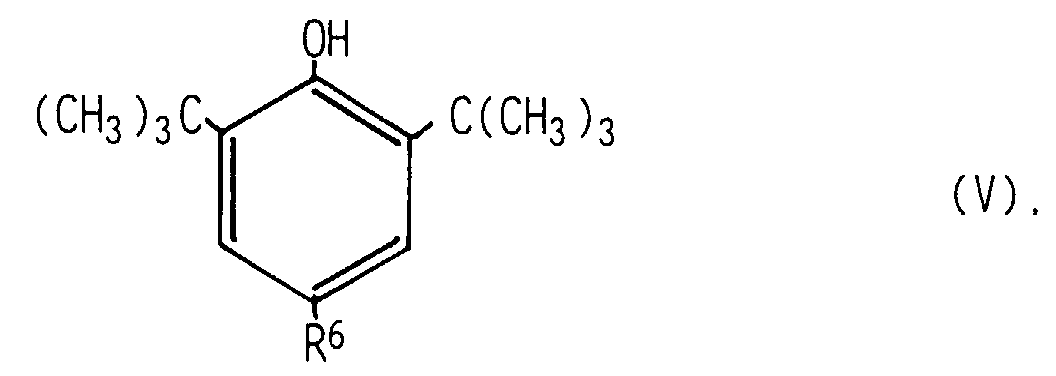
- Phasentransferkatalyse-Verfahren (PTC-Verfahren) zur Herstellung von Methacryloxy- oder Acryloxy-Gruppen enthaltenden Organosilanen der allgemeinen Formel IIin der R3 für ein Wasserstoffatom oder eine Methyl-Gruppe steht und R4 und R5 gleiche oder verschiedene Alkyl-Gruppen mit 1 bis 4 C-Atomen sind und m gleich 0 oder 1 oder 2 ist, dadurch gekennzeichnet, daß die Roh-Organosilane der allgemeinen Formel II während des PTC-Verfahrens durch N,N'-disubstituierte p-Chinondiimine der allgemeinen Formel I
 worin R1 und R2 gleich oder verschieden sind und eine Phenyl-Gruppe und/oder eine geradkettige und/oder verzweigte Alkyl-Gruppe mit 3 bis 8 C-Atomen und/oder eine Cyclohexyl-Gruppe bedeuten, stabilisiert werden.
- Verfahren nach Anspruch 20, dadurch gekennzeichnet, daß während des PTC-Verfahrens die als Stabilisatoren verwendeten p-Chinondiimine der allgemeinen Formel I zugesetzt und/oder erzeugt werden.
- Verfahren nach den Ansprüchen 20 und 21, dadurch gekennzeichnet, daß die Roh-Organosilane der allgemeinen Formel II, die p-Chinondiimine der allgemeinen Formel I enthalten, zur Abtrennung von Hochsiedern einer Flash-Destillation unterzogen werden.
- Verfahren nach Anspruch 22, dadurch gekennzeichnet, daß das Flash-Destillat mit einer Menge von > 5 bis 15.000 Gew.-ppm p-Chinondiiminen der allgemeinen Formel I stabilisiert wird.
- Verfahren nach Anspruch 23, dadurch gekennzeichnet, daß das Flash-Destillat mit einer Menge von 10 bis 3.000 Gew.-ppm p-Chinondiiminen der allgemeinen Formel I stabilisiert wird.
- Verfahren nach Anspruch 24, dadurch gekennzeichnet, daß das Flash-Destillat mit einer Menge von 50 bis 1 000 Gew.-ppm p-Chinondiiminen der allgemeinen Formel I stabilisiert wird.
- Verfahren nach den Ansprüchen 20 bis 25, dadurch gekennzeichnet, daß das Flash-Destillat fraktioniert destilliert wird.
- Verfahren nach Anspruch 26, dadurch gekennzeichnet, daß die über Kopf der Kolonne destillierten Methacryloxy- oder Acryloxy-Gruppen enthaltenden Organosilane frei von p-Chinondiiminen der allgemeinen Formel I erhalten werden.
- Verfahren nach den Ansprüchen 20 bis 27, dadurch gekennzeichnet, daß die p-Chinondiimine der allgemeinen Formel I und N,N'-disubstituierte p-Phenylendiamine der allgemeinen Formel IVworin R1 und R2 gleich oder verschieden sind und eine Phenyl-Gruppe und/oder eine geradkettige und/oder verzweigte Alkyl-Gruppe mit 3 bis 8 C-Atomen und/oder eine Cyclohexyl-Gruppe bedeuten, dem Eduktgemisch und/oder dem Reaktionsgemisch und/oder dem Roh-Organosilan der allgemeinen Formel II und/oder dem Flash-Destillat und/oder an einer anderen Stelle der destillativen Aufarbeitung zugegeben werden.

- Verfahren nach Anspruch 28, dadurch gekennzeichnet, daß dem Roh-Organosilan der allgemeinen Formel II und/oder dem Flash-Destillat und/oder an einer anderen Stelle der destillativen Aufarbeitung und/oder dem Reindestillat flüchtige, sterisch gehinderte Phenole der allgemeinen Formel Vworin R6 eine Alkyl- oder Alkoxy-Gruppe mit 1 bis 4 C-Atomen ist. zugegeben werden.

- Verfahren nach den Ansprüchen 20 bis 29, dadurch gekennzeichnet, daß den Methacryloxy- oder Acryloxy-Gruppen enthaltenden Organosilanen der allgemeinen Formel II nach fraktionierter Destillation ein nicht färbendes, sterisch gehindertes Phenol der allgemeinen Formel V zur Nachstabilisierung zugegeben wird.
- Verfahren nach den Ansprüchen 29 und 30, dadurch gekennzeichnet, daß 2,6-Di-tert.-butyl-4-methylphenol zugegeben wird.
Applications Claiming Priority (2)
| Application Number | Priority Date | Filing Date | Title |
|---|---|---|---|
| DE4437667 | 1994-10-21 | ||
| DE4437667A DE4437667A1 (de) | 1994-10-21 | 1994-10-21 | Verfahren zur Herstellung von N,N'-disubstituierten p-Chinondiiminen, deren Verwendung und Methacryloxy- oder Acryloxy-Gruppen enthaltende Organosilane, Verfahren zu deren Stabilisierung und deren Herstellung |
Publications (3)
| Publication Number | Publication Date |
|---|---|
| EP0708081A2 EP0708081A2 (de) | 1996-04-24 |
| EP0708081A3 EP0708081A3 (de) | 1997-03-19 |
| EP0708081B1 true EP0708081B1 (de) | 1999-06-02 |
Family
ID=6531370
Family Applications (1)
| Application Number | Title | Priority Date | Filing Date |
|---|---|---|---|
| EP95113268A Expired - Lifetime EP0708081B1 (de) | 1994-10-21 | 1995-08-24 | Verwendung von N,N'-disubstituierten p-Chinondiiminen bei der Herstellung und zur Stabilisierung von Organosilanen |
Country Status (8)
| Country | Link |
|---|---|
| US (2) | US5856542A (de) |
| EP (1) | EP0708081B1 (de) |
| JP (2) | JP4163761B2 (de) |
| AT (1) | ATE180768T1 (de) |
| CA (1) | CA2160958A1 (de) |
| DE (2) | DE4437667A1 (de) |
| ES (1) | ES2133632T3 (de) |
| GR (1) | GR3030662T3 (de) |
Cited By (2)
| Publication number | Priority date | Publication date | Assignee | Title |
|---|---|---|---|---|
| DE10308579B3 (de) * | 2003-02-27 | 2004-06-24 | Wacker-Chemie Gmbh | Verfahren zur Stabilisierung ungesättigter Organosiliziumverbindungen |
| DE102008040475A1 (de) | 2008-07-16 | 2010-01-21 | Wacker Chemie Ag | Verfahren zur Verhinderung der Polymerisation von ungesättigten Organosiliciumverbindungen |
Families Citing this family (14)
| Publication number | Priority date | Publication date | Assignee | Title |
|---|---|---|---|---|
| US6114554A (en) * | 1997-10-29 | 2000-09-05 | Flexsys America L.P. | Preparation of quinonediimines from phenylenediamines using a hypochlorite as an oxidation agent |
| US5959126A (en) * | 1997-10-29 | 1999-09-28 | Flexsys America L. P. | Formation of quinonedimines from phenylenediamines by catalytic oxidation |
| US6072061A (en) * | 1998-04-10 | 2000-06-06 | Flexsys America L.P. | Preparation of quinoneimines from hydroxyphenylamines using a hypochlorite as an oxidation agent |
| EP0965593B2 (de) † | 1998-06-19 | 2008-12-03 | Shin-Etsu Chemical Co., Ltd. | Destillationsverfahren für (Meth)acryloxysilane |
| DE19854218A1 (de) | 1998-11-25 | 2000-05-31 | Degussa | 3-Methacryloxy- und 3-Acryloxyisobutylalkoxysilane |
| US6342648B1 (en) * | 1999-09-30 | 2002-01-29 | Baker Hughes Incorporated | Methods and compositions for inhibiting vinyl aromatic monomer polymerization |
| US6447649B1 (en) * | 2000-07-24 | 2002-09-10 | Ge Betz, Inc. | Polymerization inhibitor for vinyl-containing materials |
| WO2003026001A2 (en) * | 2001-09-18 | 2003-03-27 | Applied Materials, Inc. | Integrated equipment set for forming an interconnect on a substrate |
| US7704518B2 (en) * | 2003-08-04 | 2010-04-27 | Foamix, Ltd. | Foamable vehicle and pharmaceutical compositions thereof |
| DE10258982B3 (de) * | 2002-12-16 | 2004-08-05 | Degussa Ag | Verfahren zur Herstellung von Acryloxy- oder Methacryloxygruppen enthaltenden Organosilanen höchster Reinheit |
| CN102766386A (zh) * | 2007-05-15 | 2012-11-07 | 赢创德固赛有限责任公司 | 制备丙烯酰氧基烷基烷氧基硅烷的方法,其提纯方法,在组合物中的稳定化方法及其应用 |
| CN102108085A (zh) | 2009-12-24 | 2011-06-29 | 瓦克化学股份公司 | 一种在离子液体中制备官能化硅烷的方法 |
| DE102013214830A1 (de) | 2013-07-30 | 2015-02-05 | Evonik Industries Ag | Verfahren, Vorrichtung und deren Verwendung zur Herstellung von Acryloxy- und Methacryloxypropyltrialkoxysilanen |
| CN107406261A (zh) * | 2014-11-04 | 2017-11-28 | 薄膜电子有限公司 | 用于硅烷的聚合抑制剂 |
Family Cites Families (9)
| Publication number | Priority date | Publication date | Assignee | Title |
|---|---|---|---|---|
| US2118826A (en) | 1936-10-27 | 1938-05-31 | Goodrich Co B F | Method of making quinone di-imides |
| US2118827A (en) * | 1937-10-13 | 1938-05-31 | Goodrich Co B F | Method of making quinone di-imides |
| US2741625A (en) * | 1953-12-30 | 1956-04-10 | Du Pont | Tertiary alkyl derivatives of n,n'-dialkyl-1,4-benzoquinone dimine |
| US3078283A (en) * | 1961-02-28 | 1963-02-19 | Gen Electric | Process for preparing tetraalkyl substituted benzoquinones |
| US3637769A (en) * | 1967-12-21 | 1972-01-25 | American Cyanamid Co | Quinonediimonium salts |
| US4246181A (en) * | 1969-06-11 | 1981-01-20 | L'oreal | Quinonediimine intermediates for indoanilines |
| JPS604194A (ja) * | 1983-06-21 | 1985-01-10 | Kanegafuchi Chem Ind Co Ltd | アクリルオキシシラン用安定剤 |
| US4946977A (en) | 1987-09-25 | 1990-08-07 | Huels Troisdorf Ag | Method for the preparation of organosilanes containing methacryloxy or acryloxy groups |
| DE3832621C1 (de) * | 1988-09-26 | 1989-09-21 | Huels Ag, 4370 Marl, De |
-
1994
- 1994-10-21 DE DE4437667A patent/DE4437667A1/de not_active Withdrawn
-
1995
- 1995-08-24 EP EP95113268A patent/EP0708081B1/de not_active Expired - Lifetime
- 1995-08-24 DE DE59506088T patent/DE59506088D1/de not_active Expired - Lifetime
- 1995-08-24 AT AT95113268T patent/ATE180768T1/de not_active IP Right Cessation
- 1995-08-24 ES ES95113268T patent/ES2133632T3/es not_active Expired - Lifetime
- 1995-10-17 US US08/543,932 patent/US5856542A/en not_active Expired - Lifetime
- 1995-10-18 JP JP26981495A patent/JP4163761B2/ja not_active Expired - Fee Related
- 1995-10-19 CA CA002160958A patent/CA2160958A1/en not_active Abandoned
-
1998
- 1998-09-15 US US09/153,085 patent/US6147239A/en not_active Expired - Fee Related
-
1999
- 1999-06-30 GR GR990401748T patent/GR3030662T3/el unknown
-
2006
- 2006-07-11 JP JP2006190771A patent/JP4351689B2/ja not_active Expired - Fee Related
Cited By (3)
| Publication number | Priority date | Publication date | Assignee | Title |
|---|---|---|---|---|
| DE10308579B3 (de) * | 2003-02-27 | 2004-06-24 | Wacker-Chemie Gmbh | Verfahren zur Stabilisierung ungesättigter Organosiliziumverbindungen |
| DE102008040475A1 (de) | 2008-07-16 | 2010-01-21 | Wacker Chemie Ag | Verfahren zur Verhinderung der Polymerisation von ungesättigten Organosiliciumverbindungen |
| US8247590B2 (en) | 2008-07-16 | 2012-08-21 | Wacker Chemie Ag | Method for preventing polymerization of unsaturated organosilicon compounds |
Also Published As
| Publication number | Publication date |
|---|---|
| DE59506088D1 (de) | 1999-07-08 |
| GR3030662T3 (en) | 1999-10-29 |
| JPH08208581A (ja) | 1996-08-13 |
| JP4351689B2 (ja) | 2009-10-28 |
| JP2006312642A (ja) | 2006-11-16 |
| US5856542A (en) | 1999-01-05 |
| DE4437667A1 (de) | 1996-04-25 |
| EP0708081A3 (de) | 1997-03-19 |
| ATE180768T1 (de) | 1999-06-15 |
| CA2160958A1 (en) | 1996-04-22 |
| ES2133632T3 (es) | 1999-09-16 |
| JP4163761B2 (ja) | 2008-10-08 |
| US6147239A (en) | 2000-11-14 |
| EP0708081A2 (de) | 1996-04-24 |
Similar Documents
| Publication | Publication Date | Title |
|---|---|---|
| EP0483480B1 (de) | Verfahren zur Herstellung von Methacryloxy-oder Acryloxygruppen enthaltende Organosilanen | |
| DE4437667A1 (de) | Verfahren zur Herstellung von N,N'-disubstituierten p-Chinondiiminen, deren Verwendung und Methacryloxy- oder Acryloxy-Gruppen enthaltende Organosilane, Verfahren zu deren Stabilisierung und deren Herstellung | |
| EP0638575B1 (de) | Verfahren zur Herstellung von Diorganodialkoxysilanen | |
| EP0437653A1 (de) | Verfahren zur Herstellung von Methacryloxy- oder Acryloxygruppen enthaltenden Organosilanen | |
| DE2523838A1 (de) | Verfahren zur herstellung von gemischen aus butandiol-(1,4) und 2-methylpropandiol-(1,3) | |
| EP2334690B1 (de) | Verfahren zur darstellung von (meth-)acrylsilanen | |
| WO1998023570A1 (de) | VERFAHREN ZUR HERSTELLUNG η, δ-UNGESÄTTIGTER KETONE DURCH UMSETZUNG TERTIÄRER ALLYLALKOHOLE MIT ALKENYLALKYLETHERN | |
| DE3884109T2 (de) | Synthese von Silylketenacetal aus Allyl-2-organoacrylaten. | |
| EP0330058A1 (de) | Verfahren zur Herstellung von Perfluoralkylgruppen enthaltenden Silyläthern und Alkoholen | |
| DE2263819B2 (de) | Verfahren zur Herstellung von a- Alkoxy w-siloxanolen | |
| EP0124002A1 (de) | Verfahren zur Herstellung von aromatischen Verbindungen, die über ein Heteroatom gebundene perfluorierte Seitenketten enthalten | |
| DE3707367A1 (de) | Umsetzung von hexafluorpropenoxid mit fluorierten carbonsaeurefluoriden | |
| DE3422412A1 (de) | Verfahren zur herstellung eines gemisches aus einem gegebenenfalls substituierten zimtsaeureester und einem gegenbenenfalls substituierten ss-alkoxy-ss-phenyl-propionsaeureester sowie verfahren zur herstellung von gegebenenfalls substituierter zimtsaeure | |
| EP0415247B1 (de) | Verfahren zur Herstellung von etherischen Lösungen von Arylmethylmagnesiumhalogeniden | |
| DE2364181C3 (de) | Verfahren zur Herstellung von aromatischen Dihydroxyverbindungen oder deren Monoäthern | |
| EP0708080B1 (de) | Verfahren zur Herstellung von N,N'-Disubstituierten p-Chinondiiminen und deren Verwendung | |
| DE2538310C3 (de) | Verfahren zur Herstellung von O.O-Dialkylthionophosphorsäurechloriden | |
| DE1173454B (de) | Verfahren zur Herstellung von N-Vinyl-carbaminsaeureestern | |
| DE69405507T2 (de) | Zwischenprodukte zur Herstellung von Vitamin A und von Carotenoiden und Verfahren zu deren Herstellung | |
| EP0028759B1 (de) | Verfahren zur Herstellung von Pivaloylessigsäureestern | |
| EP0639175B1 (de) | Verfahren zur herstellung von 2-(dialkoxymethyl)-carbonsäureestern | |
| DE1235893B (de) | Verfahren zur Herstellung von N-Vinyl-N-alkyl-formamiden | |
| EP0196504B1 (de) | Verfahren zur Herstellung des (+)-Antipoden des (E)-1-Cyclohexyl-4,4-dimethyl-3-hydroxy-2-(1,2,4-triazol-1-yl)-pent-1-ens | |
| DE1545867A1 (de) | Verfahren zur Herstellung von N-Vinylazetidin-2-onen | |
| EP0602573B1 (de) | Verfahren zur Herstellung von Acetalen |
Legal Events
| Date | Code | Title | Description |
|---|---|---|---|
| PUAI | Public reference made under article 153(3) epc to a published international application that has entered the european phase |
Free format text: ORIGINAL CODE: 0009012 |
|
| AK | Designated contracting states |
Kind code of ref document: A2 Designated state(s): AT BE CH DE ES FR GB GR IT LI NL SE |
|
| PUAL | Search report despatched |
Free format text: ORIGINAL CODE: 0009013 |
|
| AK | Designated contracting states |
Kind code of ref document: A3 Designated state(s): AT BE CH DE ES FR GB GR IT LI NL SE |
|
| 17P | Request for examination filed |
Effective date: 19970212 |
|
| 17Q | First examination report despatched |
Effective date: 19971023 |
|
| GRAG | Despatch of communication of intention to grant |
Free format text: ORIGINAL CODE: EPIDOS AGRA |
|
| GRAG | Despatch of communication of intention to grant |
Free format text: ORIGINAL CODE: EPIDOS AGRA |
|
| GRAG | Despatch of communication of intention to grant |
Free format text: ORIGINAL CODE: EPIDOS AGRA |
|
| GRAH | Despatch of communication of intention to grant a patent |
Free format text: ORIGINAL CODE: EPIDOS IGRA |
|
| GRAH | Despatch of communication of intention to grant a patent |
Free format text: ORIGINAL CODE: EPIDOS IGRA |
|
| GRAA | (expected) grant |
Free format text: ORIGINAL CODE: 0009210 |
|
| AK | Designated contracting states |
Kind code of ref document: B1 Designated state(s): AT BE CH DE ES FR GB GR IT LI NL SE |
|
| PG25 | Lapsed in a contracting state [announced via postgrant information from national office to epo] |
Ref country code: SE Free format text: THE PATENT HAS BEEN ANNULLED BY A DECISION OF A NATIONAL AUTHORITY Effective date: 19990602 Ref country code: GR Free format text: LAPSE BECAUSE OF NON-PAYMENT OF DUE FEES Effective date: 19990602 |
|
| REF | Corresponds to: |
Ref document number: 180768 Country of ref document: AT Date of ref document: 19990615 Kind code of ref document: T |
|
| REG | Reference to a national code |
Ref country code: CH Ref legal event code: NV Representative=s name: SCHMAUDER & PARTNER AG PATENTANWALTSBUERO Ref country code: CH Ref legal event code: EP |
|
| GBT | Gb: translation of ep patent filed (gb section 77(6)(a)/1977) |
Effective date: 19990607 |
|
| REF | Corresponds to: |
Ref document number: 59506088 Country of ref document: DE Date of ref document: 19990708 |
|
| ET | Fr: translation filed | ||
| PG25 | Lapsed in a contracting state [announced via postgrant information from national office to epo] |
Ref country code: ES Free format text: LAPSE BECAUSE OF NON-PAYMENT OF DUE FEES Effective date: 19990825 |
|
| REG | Reference to a national code |
Ref country code: ES Ref legal event code: FG2A Ref document number: 2133632 Country of ref document: ES Kind code of ref document: T3 |
|
| RAP2 | Party data changed (patent owner data changed or rights of a patent transferred) |
Owner name: DEGUSSA-HUELS AKTIENGESELLSCHAFT |
|
| NLT2 | Nl: modifications (of names), taken from the european patent patent bulletin |
Owner name: DEGUSSA-HUELS AKTIENGESELLSCHAFT |
|
| PLBE | No opposition filed within time limit |
Free format text: ORIGINAL CODE: 0009261 |
|
| STAA | Information on the status of an ep patent application or granted ep patent |
Free format text: STATUS: NO OPPOSITION FILED WITHIN TIME LIMIT |
|
| EUG | Se: european patent has lapsed |
Ref document number: 95113268.7 |
|
| 26N | No opposition filed | ||
| REG | Reference to a national code |
Ref country code: CH Ref legal event code: PFA Free format text: HUELS AKTIENGESELLSCHAFT TRANSFER- DEGUSSA-HUELS AKTIENGESELLSCHAFT |
|
| NLS | Nl: assignments of ep-patents |
Owner name: DEGUSSA-HUELS AKTIENGESELLSCHAFT |
|
| REG | Reference to a national code |
Ref country code: FR Ref legal event code: CD Ref country code: FR Ref legal event code: CA |
|
| REG | Reference to a national code |
Ref country code: GB Ref legal event code: IF02 |
|
| PGFP | Annual fee paid to national office [announced via postgrant information from national office to epo] |
Ref country code: CH Payment date: 20020717 Year of fee payment: 8 |
|
| REG | Reference to a national code |
Ref country code: GB Ref legal event code: 732E |
|
| PGFP | Annual fee paid to national office [announced via postgrant information from national office to epo] |
Ref country code: NL Payment date: 20020725 Year of fee payment: 8 |
|
| PGFP | Annual fee paid to national office [announced via postgrant information from national office to epo] |
Ref country code: AT Payment date: 20020729 Year of fee payment: 8 |
|
| REG | Reference to a national code |
Ref country code: CH Ref legal event code: PUE Owner name: DEGUSSA-HUELS AKTIENGESELLSCHAFT TRANSFER- DEGUSSA |
|
| NLS | Nl: assignments of ep-patents |
Owner name: DEGUSSA AG |
|
| REG | Reference to a national code |
Ref country code: FR Ref legal event code: TP |
|
| PG25 | Lapsed in a contracting state [announced via postgrant information from national office to epo] |
Ref country code: AT Free format text: LAPSE BECAUSE OF NON-PAYMENT OF DUE FEES Effective date: 20030824 |
|
| PG25 | Lapsed in a contracting state [announced via postgrant information from national office to epo] |
Ref country code: LI Free format text: LAPSE BECAUSE OF NON-PAYMENT OF DUE FEES Effective date: 20030831 Ref country code: CH Free format text: LAPSE BECAUSE OF NON-PAYMENT OF DUE FEES Effective date: 20030831 |
|
| PG25 | Lapsed in a contracting state [announced via postgrant information from national office to epo] |
Ref country code: NL Free format text: LAPSE BECAUSE OF NON-PAYMENT OF DUE FEES Effective date: 20040301 |
|
| REG | Reference to a national code |
Ref country code: CH Ref legal event code: PL |
|
| NLV4 | Nl: lapsed or anulled due to non-payment of the annual fee |
Effective date: 20040301 |
|
| REG | Reference to a national code |
Ref country code: ES Ref legal event code: FD2A Effective date: 20000911 |
|
| PGFP | Annual fee paid to national office [announced via postgrant information from national office to epo] |
Ref country code: BE Payment date: 20040902 Year of fee payment: 10 |
|
| PG25 | Lapsed in a contracting state [announced via postgrant information from national office to epo] |
Ref country code: BE Free format text: LAPSE BECAUSE OF NON-PAYMENT OF DUE FEES Effective date: 20050831 |
|
| BERE | Be: lapsed |
Owner name: *DEGUSSA A.G. Effective date: 20050831 |
|
| REG | Reference to a national code |
Ref country code: FR Ref legal event code: CJ Ref country code: FR Ref legal event code: CD Ref country code: FR Ref legal event code: CA |
|
| PGFP | Annual fee paid to national office [announced via postgrant information from national office to epo] |
Ref country code: GB Payment date: 20120821 Year of fee payment: 18 |
|
| PGFP | Annual fee paid to national office [announced via postgrant information from national office to epo] |
Ref country code: FR Payment date: 20120906 Year of fee payment: 18 |
|
| PGFP | Annual fee paid to national office [announced via postgrant information from national office to epo] |
Ref country code: DE Payment date: 20130821 Year of fee payment: 19 |
|
| PGFP | Annual fee paid to national office [announced via postgrant information from national office to epo] |
Ref country code: IT Payment date: 20130826 Year of fee payment: 19 |
|
| GBPC | Gb: european patent ceased through non-payment of renewal fee |
Effective date: 20130824 |
|
| REG | Reference to a national code |
Ref country code: FR Ref legal event code: ST Effective date: 20140430 |
|
| PG25 | Lapsed in a contracting state [announced via postgrant information from national office to epo] |
Ref country code: GB Free format text: LAPSE BECAUSE OF NON-PAYMENT OF DUE FEES Effective date: 20130824 |
|
| PG25 | Lapsed in a contracting state [announced via postgrant information from national office to epo] |
Ref country code: FR Free format text: LAPSE BECAUSE OF NON-PAYMENT OF DUE FEES Effective date: 20130902 |
|
| REG | Reference to a national code |
Ref country code: DE Ref legal event code: R119 Ref document number: 59506088 Country of ref document: DE |
|
| PG25 | Lapsed in a contracting state [announced via postgrant information from national office to epo] |
Ref country code: IT Free format text: LAPSE BECAUSE OF NON-PAYMENT OF DUE FEES Effective date: 20140824 |
|
| REG | Reference to a national code |
Ref country code: DE Ref legal event code: R119 Ref document number: 59506088 Country of ref document: DE Effective date: 20150303 |
|
| PG25 | Lapsed in a contracting state [announced via postgrant information from national office to epo] |
Ref country code: DE Free format text: LAPSE BECAUSE OF NON-PAYMENT OF DUE FEES Effective date: 20150303 |