EP0708316A2 - Dispositif pour générer un rayonnement à large bande - Google Patents
Dispositif pour générer un rayonnement à large bande Download PDFInfo
- Publication number
- EP0708316A2 EP0708316A2 EP95116153A EP95116153A EP0708316A2 EP 0708316 A2 EP0708316 A2 EP 0708316A2 EP 95116153 A EP95116153 A EP 95116153A EP 95116153 A EP95116153 A EP 95116153A EP 0708316 A2 EP0708316 A2 EP 0708316A2
- Authority
- EP
- European Patent Office
- Prior art keywords
- radiation
- broadband
- radiator
- absorption layer
- housing
- Prior art date
- Legal status (The legal status is an assumption and is not a legal conclusion. Google has not performed a legal analysis and makes no representation as to the accuracy of the status listed.)
- Withdrawn
Links
- 230000005855 radiation Effects 0.000 title claims abstract description 67
- 238000010521 absorption reaction Methods 0.000 claims abstract description 62
- 239000004065 semiconductor Substances 0.000 claims abstract description 25
- 230000003287 optical effect Effects 0.000 claims abstract description 17
- 238000001228 spectrum Methods 0.000 claims description 10
- 238000010438 heat treatment Methods 0.000 claims description 8
- 230000005540 biological transmission Effects 0.000 claims description 4
- 239000000463 material Substances 0.000 claims description 4
- 230000005693 optoelectronics Effects 0.000 claims description 3
- 239000000203 mixture Substances 0.000 claims description 2
- 239000000126 substance Substances 0.000 claims description 2
- 238000001179 sorption measurement Methods 0.000 abstract 1
- 239000007789 gas Substances 0.000 description 24
- 238000005259 measurement Methods 0.000 description 7
- 238000011156 evaluation Methods 0.000 description 4
- 238000011161 development Methods 0.000 description 3
- 230000005670 electromagnetic radiation Effects 0.000 description 3
- 238000005265 energy consumption Methods 0.000 description 3
- 230000003595 spectral effect Effects 0.000 description 3
- VYPSYNLAJGMNEJ-UHFFFAOYSA-N Silicium dioxide Chemical compound O=[Si]=O VYPSYNLAJGMNEJ-UHFFFAOYSA-N 0.000 description 2
- BASFCYQUMIYNBI-UHFFFAOYSA-N platinum Chemical compound [Pt] BASFCYQUMIYNBI-UHFFFAOYSA-N 0.000 description 2
- 230000035945 sensitivity Effects 0.000 description 2
- RTAQQCXQSZGOHL-UHFFFAOYSA-N Titanium Chemical compound [Ti] RTAQQCXQSZGOHL-UHFFFAOYSA-N 0.000 description 1
- 238000005299 abrasion Methods 0.000 description 1
- 239000012080 ambient air Substances 0.000 description 1
- 239000000919 ceramic Substances 0.000 description 1
- 238000001514 detection method Methods 0.000 description 1
- 238000005516 engineering process Methods 0.000 description 1
- 230000007613 environmental effect Effects 0.000 description 1
- 238000004868 gas analysis Methods 0.000 description 1
- PCHJSUWPFVWCPO-UHFFFAOYSA-N gold Chemical compound [Au] PCHJSUWPFVWCPO-UHFFFAOYSA-N 0.000 description 1
- 239000010931 gold Substances 0.000 description 1
- 229910052737 gold Inorganic materials 0.000 description 1
- 229910010272 inorganic material Inorganic materials 0.000 description 1
- 239000011147 inorganic material Substances 0.000 description 1
- 238000004519 manufacturing process Methods 0.000 description 1
- 229910052751 metal Inorganic materials 0.000 description 1
- 239000002184 metal Substances 0.000 description 1
- 238000000034 method Methods 0.000 description 1
- 238000012544 monitoring process Methods 0.000 description 1
- TWNQGVIAIRXVLR-UHFFFAOYSA-N oxo(oxoalumanyloxy)alumane Chemical compound O=[Al]O[Al]=O TWNQGVIAIRXVLR-UHFFFAOYSA-N 0.000 description 1
- 230000000737 periodic effect Effects 0.000 description 1
- 229910052697 platinum Inorganic materials 0.000 description 1
- 229910052719 titanium Inorganic materials 0.000 description 1
- 239000010936 titanium Substances 0.000 description 1
- 238000007740 vapor deposition Methods 0.000 description 1
Images


Classifications
-
- G—PHYSICS
- G01—MEASURING; TESTING
- G01J—MEASUREMENT OF INTENSITY, VELOCITY, SPECTRAL CONTENT, POLARISATION, PHASE OR PULSE CHARACTERISTICS OF INFRARED, VISIBLE OR ULTRAVIOLET LIGHT; COLORIMETRY; RADIATION PYROMETRY
- G01J3/00—Spectrometry; Spectrophotometry; Monochromators; Measuring colours
- G01J3/02—Details
- G01J3/10—Arrangements of light sources specially adapted for spectrometry or colorimetry
- G01J3/108—Arrangements of light sources specially adapted for spectrometry or colorimetry for measurement in the infrared range
Definitions
- the invention relates to a device for generating broadband radiation with at least one broadband radiator that can be heated with an energy source for radiating an electromagnetic broadband spectrum, in particular a black or gray radiator.
- a broadband radiator of the type mentioned at the outset which is designed as an incandescent lamp with an incandescent filament enclosed by inorganic material.
- Such broadband emitters are used, for example, in gas analyzers to measure the concentration of certain gases by means of photometric methods.
- the broadband radiator is preferably followed by a narrowband filter, the pass band of which is matched to an absorption wavelength of the gas to be measured.
- the radiation filtered in this way then passes through a measuring chamber in which the gas to be measured is located.
- the radiation is more or less strongly absorbed in the measuring chamber, which is detected by means of a radiation intensity sensor connected downstream of the measuring chamber and is evaluated to determine the radiation intensity.
- the incandescent filament has a not inconsiderable power consumption, which is particularly unfavorable in battery-operated gas measuring devices, such as those used in fire detectors for detecting CO or CO2.
- battery-operated gas measuring devices such as those used in fire detectors for detecting CO or CO2.
- fire detectors for detecting CO or CO2.
- larger buildings for example in factory halls, department stores or office buildings, several hundred such fire detectors are often installed, which must remain operational for several days in the event of a power failure for safety reasons.
- each of the broadband emitters contained in the fire detectors has a remarkable total output, which requires a correspondingly complex and expensive emergency power supply.
- the object is therefore to create a device of the type mentioned at the outset in which the energy consumption or the power consumption is reduced and which is also particularly suitable for battery or accumulator operation.
- the broadband radiator is designed as a thin layer with low heat capacity and that a pulsable energy source with low average power is provided for heating the broadband radiator, the output pulses with respect to their pulse energy and their pulse
- the pause ratio is so matched to the heat capacity of the broadband radiator that it largely cools down in the pulse pauses.
- the broadband radiator is thus designed as a thin layer therefore has a comparatively large radiation area despite its low heat capacity.
- the broadband radiator can be heated from room temperature to the intended operating temperature in a short time, for example in one millisecond.
- the broadband radiator is coupled to a pulsable energy source, the pulse energy of which is so matched to the thermal capacity of the broadband radiator that it is heated to operating temperature during the pulse time and largely cools down in the pulse pauses. Because of the low thermal capacity of the broadband radiator, only a comparatively small amount of energy or a correspondingly low heating output is required to heat it to operating temperature.
- the device Since the device absorbs practically no energy during the pulse pauses and only a small amount of energy is required even during the pulse phases, the device overall has a low average energy consumption, which is particularly advantageous when the device is used in battery-operated devices. Since it is sufficient for many applications, in particular for monitoring tasks, to carry out measurements at certain time intervals without loss of information, the clocked mode of operation of the broadband radiator has practically no disadvantage in practice.
- the low heat capacity of the broadband radiator enables optical radiation pulses to be emitted in rapid succession, so that the device according to the invention can be used for quasi-continuous measurements in most applications, for example in industrial gas analysis, in fire detectors or in environmental measurement technology, despite the clocked mode of operation.
- an optical semiconductor radiation source in particular a laser diode, is provided as the energy source for heating the broadband radiator, the broadband radiator essentially consisting of or having an absorption layer which is arranged in the beam path of the semiconductor radiation source.
- the practical Inertia-free semiconductor radiation source enables the absorption layer to be heated particularly quickly and with little loss. It is particularly advantageous that semiconductor radiation sources, for example laser or light-emitting diodes, are inexpensively available in large quantities as series components. Laser diodes are particularly suitable as energy sources because their high pulse energies, short pulse times and small beam angle enable particularly high energy densities and thus correspondingly short heating times for the absorption layer.
- the pulse duration and / or the intensity of the semiconductor radiation can be changed in order to adjust the radiation temperature of the absorption layer.
- the radiation intensity of the absorption layer can thereby be adapted in a simple manner to the respective application, for example to a transmission link present in a measuring system.
- the material or the material composition of the absorption layer is adapted to a radiation spectrum specified for broadband radiation, in particular to a spectrum which deviates from the spectrum of a black or gray radiator.
- the spectral range of the device can thus be matched, for example, to the filter characteristic of a downstream optical filter.
- a platinum, titanium, aluminum oxide or a sintered ceramic layer can be provided as the absorption layer.
- At least one layer property of the absorption layer that is relevant for the spectrum of the broadband radiation, in particular its emission coefficient, can be changed by electrical, optical and / or chemical influencing of the absorption layer, preferably during operation of the broadband radiator.
- the device can thereby be particularly good the spectral range of optical filters with different frequency ranges can be tuned. It is also possible to adapt to the spectral sensitivity of receivers coupled to the broadband radiator.
- the absorption layer or the broadband radiator is arranged on a carrier which is preferably transparent to the semiconductor radiation, in particular a carrier plate with high thermal conductivity.
- the absorption layer can be particularly thin, for example in the form of a layer evaporated onto a quartz glass plate, and nevertheless has good mechanical stability in combination with the carrier.
- a particularly advantageous embodiment provides that the semiconductor radiator is integrated as an optoelectronic component in a housing, that the absorption layer is an integral part of this housing and is preferably micromechanically connected to the housing.
- the device then has a particularly compact structure and can be easily integrated into an electronic circuit as an optoelectronic standard component.
- the semiconductor radiation source, the absorption layer and, if appropriate, at least one frequency-selective optical filter for the broadband radiation form a compact structural unit.
- the optical filter can then be integrated into the structural unit, for example in a laser or light-emitting diode housing, for the most important absorption wavelengths, for example for CO2 (4.7 ⁇ m), for CO (4.3 ⁇ m) or for any other wavelength, so that standard components are available for the individual wavelengths, with which, for example, very compact and simply constructed gas measuring devices for different gases can be realized.
- the semiconductor radiator is integrated in a housing which is radiation-permeable to the semiconductor radiation at least in a partial region and that the absorption layer is provided on the outer wall of the housing in this partial region of the housing.
- the device can be produced particularly cost-effectively by vapor deposition or the like application of an absorption layer to the housing of a commercially available semiconductor emitter, for example a laser or light-emitting diode.
- the semiconductor radiator is integrated into a housing in such a way that the absorption layer is provided in a region of the inner wall of this housing that is exposed to the semiconductor radiation and that at least a partial region of the housing is transparent to radiation at least in a certain wavelength range of the broadband radiation.
- the absorption layer is therefore provided on the inner wall of the housing and is therefore particularly well protected against mechanical damage or against abrasion.
- the housing can be designed as a frequency-selective optical filter, in particular as an interference filter, at least in its radiation-permeable partial area.
- the radiation characteristic of the device can thereby be influenced practically as desired, in particular by designing the radiation-permeable housing sub-region as an interference filter, very narrow-band radiators with almost any wavelength can be realized.
- a thin metal or gold layer can, for example, be evaporated onto the outside of the housing as an interference filter.
- the broadband radiator essentially consists of an electrically conductive resistance layer and that a pulse current source is provided as the energy source for heating the radiator.
- the device is then particularly simple and inexpensive to manufacture.
- a further development of the invention provides that the broadband radiator for measuring the concentration of at least one gas is electromagnetically coupled to at least one receiver, that the gas to be detected is located in a beam path between the broadband radiator and the receiver, and that at least one frequency-selective one is in the beam path Optical filter is arranged, the pass band is matched to at least one absorption wavelength of the gas to be measured.
- a device can be designed, for example, as a fire detector if a narrow-band filter with a pass-through window in the range of the absorption wavelengths of CO2 (4.7 ⁇ m) and / or CO (4.3 ⁇ m) is provided as the filter.
- the received signal drops with increasing concentration of the aforementioned gases in the beam path, which can be converted into a fire warning signal, for example by means of a suitable control and evaluation device, if a predetermined threshold value is undershot. Because of the low power consumption, such a device is particularly suitable for battery-operated or battery-backed devices.
- a device designated as 1 for generating broadband radiation has a laser diode 3 integrated in a device housing 2, in the beam path of which an absorption layer 4 that absorbs the laser radiation is arranged.
- the absorption layer 4 is arranged on the outer flat side of a carrier plate 5 made of quartz glass which is connected to the device housing 2 and which is transparent to the laser radiation from the laser diode 3.
- the absorption layer 4 is made very thin and has only a small heat capacity with a comparatively large area.
- the device 1 also has a pulsable energy source 6, the pulse-pause ratio of which is matched to the heat capacity of the absorption layer 4 in such a way that it is heated to operating temperature in the pulse phase and largely cools in the pulse pauses. Since the laser diode 3 does not require any operating current during the pulse pauses, the device has a very low energy consumption with a corresponding pulse-pause ratio. If the device is used, for example, in a measuring system with which approximately one measurement is to be carried out per second, a pulse-pause ratio of approximately 1: 1000 results with a pulse time of one millisecond. The current consumption of the device 1 is thereby compared to that cw operation of the laser diode 3 reduced by approximately three powers of ten. The device is therefore particularly suitable for battery or accumulator operation.
- the pulse duration t of the energy source 6 can be adjusted to set the radiation temperature of the absorption layer 4 or the intensity of the emitted electromagnetic radiation (FIG. 1).
- the intensity of the laser radiation from the laser diode 3 can be changed by adjusting the pulse current I of the energy source 6 in order to adjust the radiation temperature of the absorption layer 4.
- the absorption layer 4 is applied to the carrier plate 5 on the outside.
- the carrier plate 5 has a low thermal conductivity, so that the absorption layer 4 can be heated as quickly as possible to the desired radiation temperature using the laser radiation emitted by the laser diode 3.
- the carrier plate 5 also has a high transparency in the region of the wavelength of the laser diode radiation, so that the laser diode radiation can reach the absorption layer 4 with as little loss as possible.
- the absorption layer 4 arranged close to the inside 7 of the carrier plate 5 in the device housing 2.
- the absorption layer 4 is fastened here laterally to the device housing 2 by means of micromechanical connection 8.
- the absorption layer 4 is thereby suspended practically freely in the device housing 2, so that the heat conduction losses of the absorption layer 4 are correspondingly low.
- a narrow-band filter 9 is applied to the outside of the carrier plate 5.
- device 1 can be used to generate narrow-band electromagnetic radiation in practically any wavelength range.
- the radiation wavelength of the device 1 can thus be easily adapted to the absorption wavelengths of different gases, which is why the device 1 is particularly well suited for use in gas measuring devices.
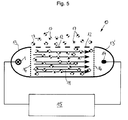
- FIG. 5 shows a device, generally designated 10, for measuring the concentration of a gas, for example, contained in the ambient air.
- the device has a measuring chamber 11 with a gas-permeable outer wall 12 through which the gas atoms shown as balls in FIG. 5 can diffuse from the surroundings of the device 10 into the measuring chamber 11.
- the device 1 shown in FIG. 3 is arranged at one end of the measuring chamber 11 and has an absorption layer 4 designed as a black radiator, which is arranged in the beam path of a laser diode 3 operated by a pulsable current source and is periodically heated by the latter.
- the absorption layer 4 thus emits periodic, recurring broadband radiation pulses in accordance with Plank's law of radiation at time intervals predetermined by the pulse cycle.
- the absorption layer 4 is followed by a narrow-band filter 9 (FIG. 3), the transmission window of which is matched to an absorption wavelength of the gas to be measured.
- the device 1 is arranged in the focal point of a parabolic mirror 13 (FIG. 5), which is that of the device 1 emits radiation so that it penetrates the measuring chamber 11 and reaches a receiver 14 arranged on the end of the measuring chamber 11 facing away from the device 1.
- the receiver 14 is also arranged in the focal point of a parabolic mirror 13 '.
- the device 1 and the receiver 14 are connected to an evaluation and control device 15, which evaluates the signal detected by the receiver 14 synchronously with the transmission pulses of the device 1, in each case at the time of the greatest radiation intensity.
- the radiation passing through the measuring chamber is weakened to a greater or lesser extent by absorption.
- the measurement signal detected by the receiver 14 thus represents a measure of the gas concentration in the measurement chamber 11, so that this can be determined in the evaluation and control device after the measurement values have been processed.
- the device 10 has only a very low average power consumption because of the laser diode 3 operated in pulse mode and is therefore particularly well suited for battery or rechargeable battery operation.
- the device 10 can be used, for example, as a fire detector if the wavelength of the narrowband filter 9 is matched to the absorption wavelength of CO2 (4.7 ⁇ ) and / or CO (4.3 ⁇ ). In the case of battery or rechargeable battery operation, such a fire detector works independently of the mains, so that the fire detector remains fully functional even in the event of a power failure or in the event of faults in the electrical power supply.
- the receiver 14 and the device 1 for the parabolic mirrors 13, 13 ' are provided with a radiation-permeable cover 16.
- the device 10 can then also be used, for example, for detecting aggressive gas.
Landscapes
- Physics & Mathematics (AREA)
- Spectroscopy & Molecular Physics (AREA)
- General Physics & Mathematics (AREA)
- Investigating Or Analysing Materials By Optical Means (AREA)
Applications Claiming Priority (2)
| Application Number | Priority Date | Filing Date | Title |
|---|---|---|---|
| DE4437311 | 1994-10-19 | ||
| DE19944437311 DE4437311A1 (de) | 1994-10-19 | 1994-10-19 | Vorrichtung zum Erzeugen einer Breitbandstrahlung |
Publications (2)
| Publication Number | Publication Date |
|---|---|
| EP0708316A2 true EP0708316A2 (fr) | 1996-04-24 |
| EP0708316A3 EP0708316A3 (fr) | 1996-12-18 |
Family
ID=6531135
Family Applications (1)
| Application Number | Title | Priority Date | Filing Date |
|---|---|---|---|
| EP95116153A Withdrawn EP0708316A3 (fr) | 1994-10-19 | 1995-10-13 | Dispositif pour générer un rayonnement à large bande |
Country Status (2)
| Country | Link |
|---|---|
| EP (1) | EP0708316A3 (fr) |
| DE (1) | DE4437311A1 (fr) |
Cited By (1)
| Publication number | Priority date | Publication date | Assignee | Title |
|---|---|---|---|---|
| EP1821087A2 (fr) | 2006-02-21 | 2007-08-22 | Deutsches Zentrum für Luft- und Raumfahrt e.V. | Radiateur thermique |
Families Citing this family (2)
| Publication number | Priority date | Publication date | Assignee | Title |
|---|---|---|---|---|
| ES2206210T3 (es) | 1999-03-08 | 2004-05-16 | Gasbeetle Gmbh | Sensor de gas y procedimiento de funcionamiento de un sensor de gas. |
| DE19922590C2 (de) * | 1999-03-08 | 2001-10-18 | Inst Chemo Biosensorik | Infrarot-Gassensor und Verfahren zum Betreiben des Infrarot-Gassensors |
Citations (1)
| Publication number | Priority date | Publication date | Assignee | Title |
|---|---|---|---|---|
| DE4126364A1 (de) | 1991-08-06 | 1992-06-17 | Heinz Prof Dr Gatzmanga | Thermische strahlungsquelle |
Family Cites Families (5)
| Publication number | Priority date | Publication date | Assignee | Title |
|---|---|---|---|---|
| DE1936245A1 (de) * | 1969-07-16 | 1971-02-04 | Beckman Instruments Gmbh | Infrarotstrahleranordnung |
| NO170366C (no) * | 1989-05-26 | 1997-02-10 | Kanstad Teknologi As | Pulserende infraröd strålingskilde |
| DE4140988C2 (de) * | 1991-12-12 | 1996-04-25 | Max Planck Gesellschaft | Erzeugung Planck'scher Schwarzkörperstrahlung mit einer punktförmigen Lichtquelle |
| DE4216085A1 (de) * | 1992-05-15 | 1992-12-10 | Merkel Wolfgang | Infrarot-gasanalysator |
| US5408101A (en) * | 1992-07-06 | 1995-04-18 | Telaire Systems, Inc. | Laser assisted quasi-blackbody radiation source |
-
1994
- 1994-10-19 DE DE19944437311 patent/DE4437311A1/de not_active Withdrawn
-
1995
- 1995-10-13 EP EP95116153A patent/EP0708316A3/fr not_active Withdrawn
Patent Citations (1)
| Publication number | Priority date | Publication date | Assignee | Title |
|---|---|---|---|---|
| DE4126364A1 (de) | 1991-08-06 | 1992-06-17 | Heinz Prof Dr Gatzmanga | Thermische strahlungsquelle |
Cited By (4)
| Publication number | Priority date | Publication date | Assignee | Title |
|---|---|---|---|---|
| EP1821087A2 (fr) | 2006-02-21 | 2007-08-22 | Deutsches Zentrum für Luft- und Raumfahrt e.V. | Radiateur thermique |
| EP1821087A3 (fr) * | 2006-02-21 | 2008-06-18 | Deutsches Zentrum für Luft- und Raumfahrt e.V. | Radiateur thermique |
| US8153998B2 (en) | 2006-02-21 | 2012-04-10 | Deutsches Zentrum für Luft- und Raumfahrt e.V. | Temperature radiator |
| DE102006008409B4 (de) * | 2006-02-21 | 2016-12-01 | Deutsches Zentrum für Luft- und Raumfahrt e.V. | Temperaturstrahler |
Also Published As
| Publication number | Publication date |
|---|---|
| EP0708316A3 (fr) | 1996-12-18 |
| DE4437311A1 (de) | 1996-04-25 |
Similar Documents
| Publication | Publication Date | Title |
|---|---|---|
| EP1183520B1 (fr) | Dispositif de capteur de gaz | |
| DE69128859T2 (de) | Einfacher Feuerdetektor | |
| EP0874233B1 (fr) | Capteur permettant une détection sélective de gaz | |
| DE602004000374T2 (de) | Gasdetektionsverfahren und gasdetektoreinrichtung | |
| EP0855592B1 (fr) | Détecteur de gaz optoacoustique | |
| DE69820308T2 (de) | Mikrotechnologischer ableitender optisch-thermischer Gassensor | |
| DE102011119431C5 (de) | Streustrahlungsbrandmelder und Verfahren zur automatischen Erkennung einer Brandsituation | |
| EP0472668B1 (fr) | Procede pour la determination de l'etat de surface d'une chaussee | |
| DE19608604C2 (de) | Gasanalysator und Meßküvette zur Verwendung in einem Gasanalysator | |
| DE69827389T2 (de) | Photothermischer mikrotechnologisch hergestellter gassensor | |
| EP0704691A2 (fr) | Capteur de gaz par spectrometrie infrarouge | |
| DE19720007C2 (de) | Gassensorsystem zur Detektion von mindestens einem Gas oder von Partikeln oder einer Kombination daraus mit zwei Gassensoren, Verfahren zu dessen Betrieb und Verwendung des Gassensorsystems | |
| EP0758079A2 (fr) | Photomètre d'absorption infrarouge ayant une microstructure | |
| DE4433336A1 (de) | Verfahren und Einrichtung zum Bestimmen der Konzentration einer Substanz, vorzugsweise eines Fluids, besonders bevorzugt eines Gases | |
| DE4402054A1 (de) | Gaslaser und Gasnachweis damit | |
| EP0244721A2 (fr) | Procédé et système pour mesurer la transmission optique | |
| DE10051691A1 (de) | Gasdetektor mit geschlossener Zelle | |
| EP1163503B1 (fr) | Detecteur de gaz et procede permettant d'actionner un detecteur de gaz | |
| CH665915A5 (de) | Vorrichtung zur ueberwachung der eisbildung. | |
| DE4301457A1 (de) | Detektor für brennbare Gase insbesondere Methan | |
| DE4437311A1 (de) | Vorrichtung zum Erzeugen einer Breitbandstrahlung | |
| DE10245822B4 (de) | Verfahren und Gasmesszelle zur Detektion unterschiedlicher Gase | |
| EP0421100B1 (fr) | Procédé et dispositif pour reconnaître des conditions dangereuses dans une pièce | |
| DE19716061C1 (de) | Infrarotoptisches Gasmeßsystem | |
| DE10221708A1 (de) | Verfahren und NDIR-Gasanalysator zur Bestimmung der Konzentration von Gasen und Dämpfen |
Legal Events
| Date | Code | Title | Description |
|---|---|---|---|
| PUAI | Public reference made under article 153(3) epc to a published international application that has entered the european phase |
Free format text: ORIGINAL CODE: 0009012 |
|
| AK | Designated contracting states |
Kind code of ref document: A2 Designated state(s): CH DE DK ES FR GB IT LI NL PT SE |
|
| PUAL | Search report despatched |
Free format text: ORIGINAL CODE: 0009013 |
|
| AK | Designated contracting states |
Kind code of ref document: A3 Designated state(s): CH DE DK ES FR GB IT LI NL PT SE |
|
| RAP1 | Party data changed (applicant data changed or rights of an application transferred) |
Owner name: SOMMER, MICHAEL |
|
| 17P | Request for examination filed |
Effective date: 19970617 |
|
| 17Q | First examination report despatched |
Effective date: 19990727 |
|
| 19U | Interruption of proceedings before grant |
Effective date: 19991113 |
|
| 19W | Proceedings resumed before grant after interruption of proceedings |
Effective date: 20060301 |
|
| STAA | Information on the status of an ep patent application or granted ep patent |
Free format text: STATUS: THE APPLICATION HAS BEEN WITHDRAWN |
|
| 18W | Application withdrawn |
Effective date: 20060301 |