EP0708358A2 - Vorrichtung zur Steuerung der Lichtmenge - Google Patents
Vorrichtung zur Steuerung der Lichtmenge Download PDFInfo
- Publication number
- EP0708358A2 EP0708358A2 EP95118783A EP95118783A EP0708358A2 EP 0708358 A2 EP0708358 A2 EP 0708358A2 EP 95118783 A EP95118783 A EP 95118783A EP 95118783 A EP95118783 A EP 95118783A EP 0708358 A2 EP0708358 A2 EP 0708358A2
- Authority
- EP
- European Patent Office
- Prior art keywords
- light
- quantity control
- aperture
- diaphragm
- control members
- Prior art date
- Legal status (The legal status is an assumption and is not a legal conclusion. Google has not performed a legal analysis and makes no representation as to the accuracy of the status listed.)
- Granted
Links
Images





Classifications
-
- G—PHYSICS
- G03—PHOTOGRAPHY; CINEMATOGRAPHY; ANALOGOUS TECHNIQUES USING WAVES OTHER THAN OPTICAL WAVES; ELECTROGRAPHY; HOLOGRAPHY
- G03B—APPARATUS OR ARRANGEMENTS FOR TAKING PHOTOGRAPHS OR FOR PROJECTING OR VIEWING THEM; APPARATUS OR ARRANGEMENTS EMPLOYING ANALOGOUS TECHNIQUES USING WAVES OTHER THAN OPTICAL WAVES; ACCESSORIES THEREFOR
- G03B7/00—Control of exposure by setting shutters, diaphragms or filters, separately or conjointly
- G03B7/08—Control effected solely on the basis of the response, to the intensity of the light received by the camera, of a built-in light-sensitive device
- G03B7/091—Digital circuits
- G03B7/095—Digital circuits for control of aperture
-
- G—PHYSICS
- G03—PHOTOGRAPHY; CINEMATOGRAPHY; ANALOGOUS TECHNIQUES USING WAVES OTHER THAN OPTICAL WAVES; ELECTROGRAPHY; HOLOGRAPHY
- G03B—APPARATUS OR ARRANGEMENTS FOR TAKING PHOTOGRAPHS OR FOR PROJECTING OR VIEWING THEM; APPARATUS OR ARRANGEMENTS EMPLOYING ANALOGOUS TECHNIQUES USING WAVES OTHER THAN OPTICAL WAVES; ACCESSORIES THEREFOR
- G03B7/00—Control of exposure by setting shutters, diaphragms or filters, separately or conjointly
- G03B7/08—Control effected solely on the basis of the response, to the intensity of the light received by the camera, of a built-in light-sensitive device
- G03B7/081—Analogue circuits
- G03B7/085—Analogue circuits for control of aperture
-
- G—PHYSICS
- G03—PHOTOGRAPHY; CINEMATOGRAPHY; ANALOGOUS TECHNIQUES USING WAVES OTHER THAN OPTICAL WAVES; ELECTROGRAPHY; HOLOGRAPHY
- G03B—APPARATUS OR ARRANGEMENTS FOR TAKING PHOTOGRAPHS OR FOR PROJECTING OR VIEWING THEM; APPARATUS OR ARRANGEMENTS EMPLOYING ANALOGOUS TECHNIQUES USING WAVES OTHER THAN OPTICAL WAVES; ACCESSORIES THEREFOR
- G03B7/00—Control of exposure by setting shutters, diaphragms or filters, separately or conjointly
- G03B7/08—Control effected solely on the basis of the response, to the intensity of the light received by the camera, of a built-in light-sensitive device
- G03B7/10—Control effected solely on the basis of the response, to the intensity of the light received by the camera, of a built-in light-sensitive device a servo-motor providing energy to move the setting member
Definitions
- This invention relates to a light-quantity control device for use in a video camera or the like.
- Document US-4 470 679 discloses a central shutter for cameras, wherein a polygonal diaphragm is provided, the leaves of which can be actuated by means of a diaphragm actuator control curve cam. To this end, a plurality of diaphragm leaves is arranged in an interlocking state, each to be movable in accordance with a driving force of a diaphragm actuator being mounted rotatably on an annular projection provided concentrically to the shutter light passage. A coil spring is further used for biassing a setting lever with a certain tension.
- document EP-A-0 388 139 discloses a light-quantity control device having a speed controller of a motor for adjusting a light amount control member of a camera, wherein a drive source information is used to control the rotational speed of the drive source. The amount of rotation of the rotor magnet of the motor is linearily detected and evaluated to obtain an output signal which serves as a control parameter for correcting the driving speed information. A correcting means provides a new driving speed information as the corrected value to the driving means.
- figures 7 or 8 refer to such a light-quantity control device.
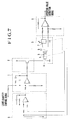
- Fig. 7 shows in a circuit diagram the essential arrangement of the control circuit of the conventional light-quantity control device.
- a motor part 3 is arranged to drive a light-quantity control member.
- the motor part 3 includes a driving coil 4 for causing a magnet rotor 5 to rotate according to the output of a power amplifier 2 which is arranged to make into a motor driving signal a speed error signal output from a differential amplifier 1 which is arranged to compare a light-quantity control signal with a speed control signal; the magnet rotor 5 which is arranged to move the light-quantity control member; a damping coil 6 which is arranged to detect the rotating speed of the magnet rotor 5; and a magnetic sensitive element 7 which is arranged to detect the position of the magnet rotor 5.
- a signal output from the damping coil 6 is input to the differential amplifier 1 as the speed control signal via a signal amplifier 9.
- a linear position detection signal which is output from the magnetic sensitive element 7 is converted into a linear aperture-value detection signal and output via a differential
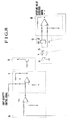
- Fig. 8 shows in a circuit diagram the essential arrangement of the control circuit of another light-quantity control device which has been proposed also in the past.
- a motor part 13 is arranged to drive a light-quantity control member.
- the motor part 13 includes a driving coil 14 for causing a magnet rotor 15 to rotate according to the output of a power amplifier 12 which is arranged to make into a motor driving signal a speed error signal output from a differential amplifier 11 which compares a light-quantity control signal with a speed control signal; the magnet rotor 15 which is arranged to move the light quantity control member; and a magnetic sensitive element 17 which is arranged to detect the position of the magnet rotor 15.
- a linear position detection signal which is output from the magnetic sensitive element 17 is converted into a linear aperture-value detection signal and is output via a differential amplifier 18. Further, the linear aperture-value detection signal is converted into a speed control signal by a differentiation circuit 19. The speed control signal is inputted to the differential amplifier 11.
- the speed control signal is an output proportional to the rotating speed of the magnet rotor but not proportional to a rate of change per unit time of the area of an aperture (aperture value).
- speed control thus can be performed with a constant strength in relation to the rotating speed of the magnet rotor, the speed control is not uniformly performed in relation to a rate of change per unit time of the quantity of light which is an essential target for the control.
- an action of the light-quantity control member becomes too slow at a large aperture (on the side of a maximum aperture) and too fast at a small aperture (on the side of a minimum aperture) under the above-stated conventional speed control.
- hunting tends to take place on the side of a minimum aperture in the event of an excessive quantity of light and, moreover, the response time of the light-quantity control member becomes too slow in shifting the aperture from a maximum position to a minimum position.
- the aperture-value detection signal is a linear position detection signal which is in proportion to the amount of driving of the magnet rotor but not in proportion to a rate of change of the area of an aperture. The accuracy of detecting an aperture value, therefore, excessively degrades on the side of the minimum aperture.
- a diaphragm device of a video camera or the like is in a circular shape having at least three blades
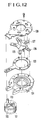
- a ring-shaped member 120 as shown in Fig. 12, for opening and closing the diaphragm blades in an interlocking relation.
- a lever 122 which is connected to the rotation shaft of a motor 121 is arranged to engage the diaphragm blades 125, 126 and 127 through the ring-shaped member 120.
- a cover plate 128 which is arranged to prevent the diaphragm blades from coming off the diaphragm unit and also to provide a sliding face for the diaphragm blades.
- the diaphragm blades 125, 126 and 127 cannot be smoothly turned (opened and closed), because a load for rotating the ring-shaped member 120 is large and because the amount of space in the direction of the plate thickness of the diaphragm blades 125 to 127 cannot be kept constant due to unevenness of the ring-shaped member 120 in the direction of the plate thickness thereof. Besides, a reduction in thickness and size of the device is limited by a space required for the ring-shaped member 120. The conventional arrangement thus has caused difficulty also in reducing the weight of the light-quantity control device.
- Another problem with the conventional arrangement lies in that the presence of the lever 122 in the path of driving force transmission to the diaphragm blades degrades the efficiency of the driving force transmission.
- a further problem lies in that the presence of the cover plate 128 increases a sliding resistance of the diaphragm blades.
- a still further problem lies in that these members require spaces for them and thus limits a possible reduction in thickness and size of the device. The presence of these members also makes a reduction in weight difficult.
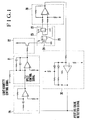
- Fig. 1 is a circuit diagram showing in outline the arrangement of the control part of a light-quantity control device which is arranged as a first embodiment of this invention.
- Fig. 2 is an exploded oblique view showing the light-quantity control device arranged as the first embodiment.
- Fig. 3 is a graph showing a position detection signal obtained with a rate of change of the area of an aperture assumed to be constant.
- Fig. 4 is a graph showing a position detection signal obtained with a rate of change of the angle of rotation of a magnet rotor assumed to be constant.
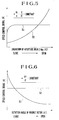
- Fig. 5 is a graph showing a speed control signal obtained with a rate of change per unit time of the area of an aperture assumed to be constant.
- Fig. 1 is a circuit diagram showing in outline the arrangement of the control part of a light-quantity control device which is arranged as a first embodiment of this invention.
- Fig. 2 is an exploded oblique view showing the light-quantity control device arranged as the first embodiment.
- Fig. 6 is a graph showing a speed control signal obtained with the rotating speed of a magnet rotor assumed to be constant.
- Fig. 7 is a circuit diagram showing the essential arrangement of the control circuit of a light-quantity control device of the prior art.
- Fig. 8 is a circuit diagram showing the essential arrangement of the control circuit of another light-quantity control device previously proposed.
- Fig. 9 is an exploded oblique view showing a light-quantity control device arranged as a second embodiment of this invention.
- Fig. 10 is an exploded oblique view showing a light-quantity control device arranged as a third embodiment of the invention.
- FIG. 11(a), 11(b) and 11(c) show the action of the diaphragm blades of the light-quantity control device shown in Fig. 10.
- Fig. 12 is an exploded oblique view showing the light-quantity control device of the prior art.
- Fig. 13 is an exploded oblique view showing a light-quantity control device which is arranged as a fourth embodiment of the invention.
- Figs. 14(a), 14(b) and 14(c) show the action of the diaphragm blades of the light-quantity control device shown in Fig. 13.
- the light-quantity control signal is first applied to the driving coil 24 via the differential amplifier 21 and the power amplifier 22.
- the driving coil 24 is energized to rotate the magnet rotor 25.
- the diaphragm blades 34 and 35 are driven by the rotation of the magnet rotor 25.
- the rotating position of the magnet rotor 25 is linearly detected by the magnetic sensitive element 27.
- the output signal of the magnetic sensitive element 27 is inputted via the differential amplifier 28 to the function generator 30 as a position detection signal in a given linear form.
- the function generator 30 converts the linear position detection signal into a linear position detection signal which is proportional to a rate of change of the area of the aperture as shown by a line V0 in Fig. 3 or Fig. 4.
- the function generator 30 then outputs the thus-converted linear position detection signal as an aperture-value detection signal.
- the aperture-value detection signal which is linear relative to a rate of change of the area of the aperture is inputted to the differentiation circuit 29.
- the differentiation circuit 29 then outputs a speed control signal which is proportional to the inclination of the linear aperture-value detection signal. More specifically, the speed control signal is proportional to a rate of change per unit time of the area of the aperture, as shown by a line V3 in Figs. 5 and 6.
- This speed control signal is inputted to the differential amplifier 21 to be compared with the light-quantity control signal.
- the differential amplifier 21 outputs a speed error signal which serves to prevent the light-quantity control signal from abruptly changing.
- the speed error signal passes through the power amplifier 22 to energize with current the driving coil 24.
- the driving coil 24 then causes the magnet rotor 25 to rotate.
- the rotation of the magnet rotor 25 drives the diaphragm blades 34 and 35 to speedily set the quantity of light at an apposite value.
- the function generator 30 and the differential amplifier 29 cause the speed control signal to be proportional to a rate of change per unit time of the area of the aperture and not proportional to the rotating speed of the magnet rotor 25.
- the speed control signal is an output which is proportional to a rate of change per unit time of the quantity of light which is the essential target for the control, so that speed control can be always appositely performed.
- Fig. 3 shows the position detection signal (the aperture-value detection signal) obtained when the diaphragm blades are moved from a closed position to a fully open position with a rate of change of the area of the aperture "ds/s" assumed to be constant.
- a line V0 represents the aperture-value detection signal according to this embodiment of the invention.
- Another line V1 represents an aperture-value detection signal obtained by the conventional device. The logarithm of the area of the aperture with "2" taken as a base thereof, which is shown on the axis of abscissa, makes a rate of change of the area of the aperture "ds/s" constant relative to equally spaced graduations. It is apparent from the illustration that the conventional position detection signal V1 is improved to become the position detection signal V0 of this embodiment having a rate of change proportional to a rate of change of the area of the aperture (having a constant inclination).
- Fig. 4 shows the position detection signal (the aperture-value detection signal) obtained with a rate of change of the angle of rotation of the magnet rotor "d ⁇ / ⁇ " assumed to be constant, in contrast to the case where a rate of change of the area of the aperture "ds/s" is assumed to be constant as shown in Fig. 3.
- the conventional aperture-value detection signal V1 has a rate of change proportional to the rate of change of the angle of rotation "d ⁇ / ⁇ " (having a constant inclination).
- Fig. 5 shows the speed control signal obtained with a rate of change per unit time of the area of the aperture "ds/s ⁇ d/dt" assumed to be constant.
- a line V3 represents the speed control signal according to this embodiment of the invention.
- Another line V2 represents the conventional speed control signal.
- the conventional speed control signal V2 is improved to become the speed control signal V3 of this embodiment having a constant output where the rate of change per unit time of the area of the aperture "ds/s ⁇ d/dt" is assumed to be constant.
- Fig. 6 shows the speed control signal obtained with the speed of rotation of the magnet rotor "d ⁇ /dt" assumed to be constant, in contrast to the case where the rate of change ds/s ⁇ d/dt is assumed to be constant as shown in Fig. 5.
- the conventional speed control signal V2 has a constant output where the speed of rotation of the magnet rotor "d ⁇ /dt" is constant.
- the first embodiment of this invention is arranged to perform speed control proportional to a rate of change per unit time of the area of the aperture.
- This arrangement enables the light-quantity control device to always adequately perform the speed control in relation to a change of the quantity of light. Therefore, the hunting which would occur at a stopped-down aperture (on the side of the minimum aperture) in the event of an excessive quantity of light can be minimized, and the response speed from the maximum aperture to the minimum aperture can be increased.
- the light-quantity control thus can be stably and speedily carried out with a high degree of accuracy.
- the accuracy of detecting an aperture value attainable on the side of the minimum aperture can be enhanced by means of the position detection signal which has a rate of change proportional to a rate of change of the area of the aperture.
- This arrangement contributes to the accuracy of automatic focusing performed by using aperture value information and also to the accuracy of aperture correction to be made by a so-called intelligent automatic iris device.
- the stability of control on the side of the minimum aperture in conjunction with the highly accurate aperture-value detection signal for a stopped-down aperture enables the manual stop to be accurately positioned on its minimum aperture side.
- a motor 101 serves as a drive source.
- a spring 103 is provided for returning diaphragm blades in the direction of closing them.
- a base plate 104 is provided for a diaphragm device.
- Diaphragm blades 105, 106 and 107 serve as light-quantity control members.
- a cover plate 108 is arranged to keep the diaphragm blades 105, 106 and 107 between it and the base plate 104.
- the rotation shaft 101a of the motor 101 is connected, by press fitting or the like, to a hole 105d which is provided in the dowel 105b of the diaphragm blade 105.
- the diaphragm blade 105 is arranged to be turnable (or swingable) on a hole 104a provided in the base plate 104.
- Other diaphragm blades 106 and 107 are respectively arranged to be turnable around dowels 106a and 107a which engage holes 104b and 104c provided in the base plate 104.
- each of the dowels 106b and 107b is provided with a stepped part which is arranged to secure a space required for preventing interference between the diaphragm blades 105 and 106 or between the diaphragm blades 106 and 107.
- the second embodiment described is arranged to obviate the necessity of use of any parts other than the diaphragm blades in opening and closing the diaphragm blades in an interlocking state.
- the driving force of the motor 101 can be transmitted with a minimal amount of loss to the diaphragm blades.
- the driving force thus can be efficiently transmitted.
- interference between the diaphragm blades can be minimized to lessen a working load on the diaphragm blades for a smooth operation.
- the efficiency of driving force transmission can be enhanced by the absence of the driving lever 122 which is included in the conventional device shown in Fig. 12.
- Fig. 10 shows a third embodiment of this invention.
- a motor 101 serves as a drive source.
- a spring 110 is arranged to return diaphragm blades in the direction of closing them.
- a base plate 109 is provided for a diaphragm device.
- Diaphragm blades 112, 113 and 114 are arranged to serve as light-quantity control members.
- Blade turning shafts 115 are provided for turning or swinging the diaphragm blades.
- the rotation shaft 101a of the motor 101 is connected, by press fitting or the like, to a hole 112d provided in the dowel 112b of the diaphragm blade 112.
- the diaphragm blade 112 is thus arranged to be turnable on a hole 109a provided in the base plate 109.
- the diaphragm blades 113 and 114 are respectively arranged to turn or swing around the parts 115b of the blade turning shafts 115 which engage holes 113a and 114a provided in the diaphragm blades 113 and 114.
- Parts 115a of the shafts 115 are connected, by press fitting or the like, to holes 109b and 109c provided in the base plate 109, respectively.
- the diaphragm blades 113 and 114 are rotatably held respectively at spaces provided between the base plate 109 and stepped parts 115c of the shafts 115.
- the diaphragm blade 112 which is connected to the shaft 101a of the motor 101 turns (opens or closes).
- the diaphragm blade 113 is caused to turn (open or close) by a dowel 113b which engages a cam-like slot 112c formed in the diaphragm blade 112.
- the diaphragm blade 114 is caused, also at the same time, to turn (open or close) by a dowel 114b which engages a cam-like slot 113c formed in the diaphragm blade 113.
- Figs. 11(a), 11(b) and 11(c) show the actions of the diaphragm blades 112, 113 and 114.
- each of the dowels 113b and 114b is provided with a stepped part which is arranged to prevent interference between the diaphragm blades 112 and 113 or between the diaphragm blades 113 and 114.
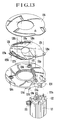
- Fig. 13 is an exploded oblique view showing a light-quantity control device which is arranged according to this invention as the fourth embodiment thereof.
- a motor 121 serves as a drive source.
- a lever 122 is provided for transmitting the driving force of the motor 121 to diaphragm blades.
- a spring 123 is provided for returning the diaphragm blades in the direction of closing them.
- a base plate 124 is provided for a diaphragm device. Diaphragm blades 125, 126 and 127 serve as light-quantity control members.
- a cover plate 128 is arranged to keep the diaphragm blades 125, 126 and 127 between it and the base plate 124.
- the diaphragm blade 125 is arranged to turn or swing on a hole 125b which engages a pin 124a provided on the base plate 124.
- Other diaphragm blades 126 and 127 are arranged to turn or swing on dowels 126a and 127a which engage holes 124b and 124c provided in the base plate 124, respectively.
- the diaphragm blade 126 is caused to turn (open or close) by a dowel 126b which engages a cam-like slot 125c formed in the diaphragm blade 125.
- the diaphragm blade 127 is caused to turn (open or close) by a dowel 127b which engages a cam-like slot 126c formed in the diaphragm blade 126.
- Figs. 14(a), 14(b) and 14(c) show the actions of the diaphragm blades 125, 126 and 127.
- each of the dowels 126b and 127b is provided with a stepped part which is arranged to secure a space for preventing interference between the diaphragm blades 125 and 126 or between the diaphragm blades 126 and 127.
- the arrangement of the embodiment shown in Fig. 13 requires no parts other than the diaphragm blades in opening and closing the diaphragm blades in an interlocking state. Therefore, the loss of the driving force of the motor 121 in transmitting the driving force to the diaphragm blades can be lessened for efficient driving force transmission. Further, the interference between the diaphragm blades can be lessened to reduce a working load on the diaphragm blades for a smooth operation.
- the return spring 123 is carried by a guide shaft 124e provided on the base plate 124 with one end of the return spring 123 connected to a spring engaging part 122b of the lever 122 and the other end to a spring engaging part 124d of the base plate 124.
- the fourth embodiment of the invention is, as apparent from the above description, arranged to have the return spring 123 mountable and dismountable in a unitized state.
- the return spring 123 is, therefore, replaceable without dismounting the motor 121, so that the working load can be easily adjusted.
- the coil part of the return spring 123 is disposed more outward than the outer diameter of a cylindrical part of the motor 121. Therefore, the position of the motor 121 in the axial direction of its cylindrical shape is shiftable toward the base plate 124 to an extent corresponding to the space of the coil part of the return spring 123. This arrangement permits a reduction in size of the device by minimizing the protruding amount of the motor 121.
- a light-quantity control device includes a drive source, a light-quantity control member which is arranged to vary the amount of opening of an aperture by shifting its position, and a speed control part which is arranged to control the driving speed of the drive source in proportion to a rate of change per unit time of the area of the aperture of the light-quantity control member.
Landscapes
- Physics & Mathematics (AREA)
- General Physics & Mathematics (AREA)
- Diaphragms For Cameras (AREA)
- Facsimile Scanning Arrangements (AREA)
- Endoscopes (AREA)
- Exposure Or Original Feeding In Electrophotography (AREA)
Applications Claiming Priority (13)
| Application Number | Priority Date | Filing Date | Title |
|---|---|---|---|
| JP41908290 | 1990-12-25 | ||
| JP419082/90 | 1990-12-25 | ||
| JP2419082A JP2571982B2 (ja) | 1990-12-25 | 1990-12-25 | 光量制御装置および光量制御装置を有する光学機器 |
| JP121325/91 | 1991-05-27 | ||
| JP121324/91 | 1991-05-27 | ||
| JP3121323A JP2765768B2 (ja) | 1991-05-27 | 1991-05-27 | 光量調節装置 |
| JP3121325A JP2765769B2 (ja) | 1991-05-27 | 1991-05-27 | 光量調節装置 |
| JP12132491A JPH05232542A (ja) | 1991-05-27 | 1991-05-27 | 光量制御装置 |
| JP12132391 | 1991-05-27 | ||
| JP12132491 | 1991-05-27 | ||
| JP121323/91 | 1991-05-27 | ||
| JP12132591 | 1991-05-27 | ||
| EP91122211A EP0492617B1 (de) | 1990-12-25 | 1991-12-24 | Vorrichtung zur Steuerung der Lichtmenge |
Related Parent Applications (2)
| Application Number | Title | Priority Date | Filing Date |
|---|---|---|---|
| EP91122211A Division EP0492617B1 (de) | 1990-12-25 | 1991-12-24 | Vorrichtung zur Steuerung der Lichtmenge |
| EP91122211.5 Division | 1991-12-24 |
Publications (3)
| Publication Number | Publication Date |
|---|---|
| EP0708358A2 true EP0708358A2 (de) | 1996-04-24 |
| EP0708358A3 EP0708358A3 (de) | 1997-06-04 |
| EP0708358B1 EP0708358B1 (de) | 2000-03-22 |
Family
ID=27470770
Family Applications (2)
| Application Number | Title | Priority Date | Filing Date |
|---|---|---|---|
| EP95118783A Expired - Lifetime EP0708358B1 (de) | 1990-12-25 | 1991-12-24 | Vorrichtung zur Steuerung der Lichtmenge |
| EP91122211A Expired - Lifetime EP0492617B1 (de) | 1990-12-25 | 1991-12-24 | Vorrichtung zur Steuerung der Lichtmenge |
Family Applications After (1)
| Application Number | Title | Priority Date | Filing Date |
|---|---|---|---|
| EP91122211A Expired - Lifetime EP0492617B1 (de) | 1990-12-25 | 1991-12-24 | Vorrichtung zur Steuerung der Lichtmenge |
Country Status (4)
| Country | Link |
|---|---|
| US (3) | US5646769A (de) |
| EP (2) | EP0708358B1 (de) |
| CA (1) | CA2058396C (de) |
| DE (2) | DE69131039T2 (de) |
Families Citing this family (23)
| Publication number | Priority date | Publication date | Assignee | Title |
|---|---|---|---|---|
| JP2746509B2 (ja) * | 1992-12-09 | 1998-05-06 | キヤノン電子株式会社 | 光量制御装置 |
| US5414460A (en) * | 1993-06-08 | 1995-05-09 | Eastman Kodak Company | Mechanical aperture for controlling illumination level |
| US6325554B1 (en) | 2000-03-15 | 2001-12-04 | Eastman Kodak Company | Camera with electrostatic light valve that functions as image reflecting mirror for viewfinder |
| US6443637B1 (en) | 2000-03-15 | 2002-09-03 | Eastman Kodak Company | Camera with electrostatic light valve that functions as diaphragm |
| JP3802870B2 (ja) * | 2002-12-20 | 2006-07-26 | 株式会社タムロン | 光量調節装置 |
| US7394497B2 (en) * | 2003-03-27 | 2008-07-01 | Fujifilm Corporation | Camera with variable aperture member |
| JP4540322B2 (ja) * | 2003-09-29 | 2010-09-08 | Hoya株式会社 | 画像間対応点検出装置および画像間対応点検出方法 |
| KR101179286B1 (ko) * | 2003-10-29 | 2012-09-03 | 칼 짜이스 에스엠테 게엠베하 | 조리개 변경 장치 |
| JP4250516B2 (ja) * | 2003-12-08 | 2009-04-08 | キヤノン株式会社 | 光量調節装置、光学装置および撮影装置 |
| US20050226612A1 (en) * | 2004-04-08 | 2005-10-13 | Asia Optical Co., Inc. | Automatic diaphragm assembly with a variable aperture for a lens |
| JP2006018019A (ja) * | 2004-07-01 | 2006-01-19 | Canon Inc | 光量調節装置、撮像装置、及び光学装置 |
| US7553094B2 (en) * | 2004-07-01 | 2009-06-30 | Canon Kabushiki Kaisha | Light quantity adjusting apparatus, image pickup apparatus and optical apparatus |
| JP3983235B2 (ja) * | 2004-08-20 | 2007-09-26 | ニスカ株式会社 | 光量調整装置 |
| KR100933294B1 (ko) * | 2007-11-29 | 2009-12-22 | 삼성전자주식회사 | 셔터 및 이를 구비한 마이크로 카메라 모듈 |
| JP5373433B2 (ja) * | 2009-02-27 | 2013-12-18 | 日本電産コパル株式会社 | カメラ用絞り装置 |
| KR20110081700A (ko) * | 2010-01-08 | 2011-07-14 | 삼성전자주식회사 | 광 차폐 장치 및 그 제조방법 |
| TWI468848B (zh) * | 2010-03-04 | 2015-01-11 | Hon Hai Prec Ind Co Ltd | 機械式快門及採用該機械式快門的便攜式電子裝置 |
| CN102193272B (zh) * | 2010-03-05 | 2015-09-09 | 鸿富锦精密工业(深圳)有限公司 | 机械式快门及采用该机械式快门的便携式电子装置 |
| KR20120068569A (ko) | 2010-12-17 | 2012-06-27 | 삼성전자주식회사 | 광 차폐 장치 및 이를 구비한 전자 기기 |
| KR101878719B1 (ko) | 2011-06-24 | 2018-07-16 | 삼성전자 주식회사 | 광 차폐 장치 및 그 제조 방법 |
| JP6172955B2 (ja) * | 2013-01-30 | 2017-08-02 | キヤノン株式会社 | 光量調整装置、レンズ鏡筒および撮像装置 |
| JP6345026B2 (ja) * | 2013-08-08 | 2018-06-20 | キヤノン株式会社 | 絞り装置及びそれを有するレンズ装置及び撮像装置 |
| TWI648590B (zh) * | 2017-07-13 | 2019-01-21 | 致能機電工業股份有限公司 | Mobile device with variable aperture function |
Citations (2)
| Publication number | Priority date | Publication date | Assignee | Title |
|---|---|---|---|---|
| US4470679A (en) | 1983-02-03 | 1984-09-11 | Franz Starp | Central shutter for cameras, especially professional cameras |
| EP0388139A2 (de) | 1989-03-14 | 1990-09-19 | Canon Denshi Kabushiki Kaisha | Geschwindigkeitsregler und Instrument, das denselben beinhaltet |
Family Cites Families (12)
| Publication number | Priority date | Publication date | Assignee | Title |
|---|---|---|---|---|
| US3984847A (en) * | 1973-09-29 | 1976-10-05 | Olympus Optical Co., Ltd. | Electric eye exposure apparatus for use in a camera having a bladed shutter mechanism |
| US4335947A (en) * | 1979-11-21 | 1982-06-22 | Balda-Werke Photographische Gerate Und Kunststoff Gmbh & Co., Kg | Camera shutter assembly |
| JPS5919471A (ja) * | 1982-07-24 | 1984-01-31 | Asahi Optical Co Ltd | ビデオカメラのアイリス制御回路 |
| US5134435A (en) * | 1985-04-25 | 1992-07-28 | Canon Kabushiki Kaisha | Camera |
| US4716432A (en) * | 1986-04-24 | 1987-12-29 | Eastman Kodak Company | Exposure control apparatus |
| JPS62188744U (de) * | 1986-05-21 | 1987-12-01 | ||
| US4862207A (en) * | 1987-05-21 | 1989-08-29 | Olympus Optical Company Limited | Diaphragm apparatus for camera |
| JP2563334B2 (ja) * | 1987-05-27 | 1996-12-11 | オリンパス光学工業株式会社 | 絞り機構 |
| JPH02156233A (ja) * | 1988-12-08 | 1990-06-15 | Nikon Corp | 絞り装置 |
| US5313244A (en) * | 1989-06-28 | 1994-05-17 | Asahi Kogaku Kogyo Kabushiki Kaisha | Camera |
| US5115261A (en) * | 1989-07-25 | 1992-05-19 | Asahi Kogaku Kogyo Kabushiki Kaisha | Photographing light quantity controller for endoscope |
| US4978991A (en) * | 1989-12-29 | 1990-12-18 | Polaroid Corporation | Open-loop stepper motor controlled shutter |
-
1991
- 1991-12-23 CA CA002058396A patent/CA2058396C/en not_active Expired - Lifetime
- 1991-12-24 EP EP95118783A patent/EP0708358B1/de not_active Expired - Lifetime
- 1991-12-24 EP EP91122211A patent/EP0492617B1/de not_active Expired - Lifetime
- 1991-12-24 DE DE69131039T patent/DE69131039T2/de not_active Expired - Lifetime
- 1991-12-24 DE DE69132075T patent/DE69132075T2/de not_active Expired - Fee Related
-
1995
- 1995-03-24 US US08/409,541 patent/US5646769A/en not_active Expired - Lifetime
- 1995-04-06 US US08/417,826 patent/US5646770A/en not_active Expired - Lifetime
- 1995-04-06 US US08/417,829 patent/US5749015A/en not_active Expired - Lifetime
Patent Citations (2)
| Publication number | Priority date | Publication date | Assignee | Title |
|---|---|---|---|---|
| US4470679A (en) | 1983-02-03 | 1984-09-11 | Franz Starp | Central shutter for cameras, especially professional cameras |
| EP0388139A2 (de) | 1989-03-14 | 1990-09-19 | Canon Denshi Kabushiki Kaisha | Geschwindigkeitsregler und Instrument, das denselben beinhaltet |
Also Published As
| Publication number | Publication date |
|---|---|
| CA2058396A1 (en) | 1992-06-26 |
| US5646770A (en) | 1997-07-08 |
| DE69132075D1 (de) | 2000-04-27 |
| EP0708358B1 (de) | 2000-03-22 |
| DE69132075T2 (de) | 2000-09-14 |
| US5646769A (en) | 1997-07-08 |
| EP0492617A3 (en) | 1993-05-26 |
| US5749015A (en) | 1998-05-05 |
| DE69131039T2 (de) | 1999-10-21 |
| EP0708358A3 (de) | 1997-06-04 |
| EP0492617B1 (de) | 1999-03-24 |
| DE69131039D1 (de) | 1999-04-29 |
| EP0492617A2 (de) | 1992-07-01 |
| CA2058396C (en) | 1995-05-30 |
Similar Documents
| Publication | Publication Date | Title |
|---|---|---|
| EP0708358B1 (de) | Vorrichtung zur Steuerung der Lichtmenge | |
| KR100229112B1 (ko) | 조리개 제어방법 및 조리개 구동장치 | |
| US6350068B1 (en) | Quantity-of-light adjusting device and optical apparatus having the same | |
| US5117137A (en) | Stepping motor for use in a camera with multiple shutters | |
| US4918480A (en) | Electromagnetic shutter for camera | |
| EP0520912B1 (de) | Antriebsmechanismus für eine Irisblende | |
| US4636041A (en) | Aperture device for zoom lens | |
| JP3723645B2 (ja) | 絞り機構の絞り原点調整方法および装置 | |
| US6535691B1 (en) | Lens drive and lens shutter unit | |
| US4614416A (en) | Operation control device for camera | |
| JP2614351B2 (ja) | 位置検出装置を有する光量制御装置 | |
| JP2001290190A (ja) | ズームレンズの可変絞り装置 | |
| JP3110179B2 (ja) | カメラ用シャッタの信号検出装置 | |
| JPS59219074A (ja) | ビデオカメラの絞装置 | |
| JPH07319005A (ja) | 光量調節装置 | |
| JPH0641224Y2 (ja) | モ−タ駆動による絞り装置 | |
| JP2000352657A (ja) | ズームレンズ | |
| JP2543967Y2 (ja) | ステップモータ駆動の絞り装置 | |
| JPH0637404Y2 (ja) | カメラの絞り機構 | |
| JP3192043B2 (ja) | 露出制御装置 | |
| JP2001281725A (ja) | カメラ用シャッタ装置及び濃度フィルタ装置 | |
| JP2533640Y2 (ja) | 遮光羽根装置 | |
| JP2879235B2 (ja) | セクタシャッタ | |
| JPH0527303B2 (de) | ||
| JPH05346531A (ja) | フォーカスレンズ駆動装置並びにフォーカスレンズ及び 絞り駆動装置 |
Legal Events
| Date | Code | Title | Description |
|---|---|---|---|
| PUAI | Public reference made under article 153(3) epc to a published international application that has entered the european phase |
Free format text: ORIGINAL CODE: 0009012 |
|
| AC | Divisional application: reference to earlier application |
Ref document number: 492617 Country of ref document: EP |
|
| AK | Designated contracting states |
Kind code of ref document: A2 Designated state(s): DE FR GB NL |
|
| PUAL | Search report despatched |
Free format text: ORIGINAL CODE: 0009013 |
|
| AK | Designated contracting states |
Kind code of ref document: A3 Designated state(s): DE FR GB NL |
|
| 17P | Request for examination filed |
Effective date: 19971118 |
|
| GRAG | Despatch of communication of intention to grant |
Free format text: ORIGINAL CODE: EPIDOS AGRA |
|
| 17Q | First examination report despatched |
Effective date: 19990406 |
|
| GRAG | Despatch of communication of intention to grant |
Free format text: ORIGINAL CODE: EPIDOS AGRA |
|
| GRAH | Despatch of communication of intention to grant a patent |
Free format text: ORIGINAL CODE: EPIDOS IGRA |
|
| GRAH | Despatch of communication of intention to grant a patent |
Free format text: ORIGINAL CODE: EPIDOS IGRA |
|
| GRAA | (expected) grant |
Free format text: ORIGINAL CODE: 0009210 |
|
| AC | Divisional application: reference to earlier application |
Ref document number: 492617 Country of ref document: EP |
|
| AK | Designated contracting states |
Kind code of ref document: B1 Designated state(s): DE FR GB NL |
|
| PG25 | Lapsed in a contracting state [announced via postgrant information from national office to epo] |
Ref country code: NL Free format text: LAPSE BECAUSE OF FAILURE TO SUBMIT A TRANSLATION OF THE DESCRIPTION OR TO PAY THE FEE WITHIN THE PRESCRIBED TIME-LIMIT Effective date: 20000322 Ref country code: FR Free format text: LAPSE BECAUSE OF FAILURE TO SUBMIT A TRANSLATION OF THE DESCRIPTION OR TO PAY THE FEE WITHIN THE PRESCRIBED TIME-LIMIT Effective date: 20000322 |
|
| REF | Corresponds to: |
Ref document number: 69132075 Country of ref document: DE Date of ref document: 20000427 |
|
| EN | Fr: translation not filed | ||
| NLV1 | Nl: lapsed or annulled due to failure to fulfill the requirements of art. 29p and 29m of the patents act | ||
| PLBE | No opposition filed within time limit |
Free format text: ORIGINAL CODE: 0009261 |
|
| STAA | Information on the status of an ep patent application or granted ep patent |
Free format text: STATUS: NO OPPOSITION FILED WITHIN TIME LIMIT |
|
| 26N | No opposition filed | ||
| PG25 | Lapsed in a contracting state [announced via postgrant information from national office to epo] |
Ref country code: DE Free format text: LAPSE BECAUSE OF NON-PAYMENT OF DUE FEES Effective date: 20011002 |
|
| REG | Reference to a national code |
Ref country code: GB Ref legal event code: IF02 |
|
| PGFP | Annual fee paid to national office [announced via postgrant information from national office to epo] |
Ref country code: GB Payment date: 20101222 Year of fee payment: 20 |
|
| REG | Reference to a national code |
Ref country code: GB Ref legal event code: PE20 Expiry date: 20111223 |
|
| PG25 | Lapsed in a contracting state [announced via postgrant information from national office to epo] |
Ref country code: GB Free format text: LAPSE BECAUSE OF EXPIRATION OF PROTECTION Effective date: 20111223 |