EP0708960B1 - Identifieur de sujets de conversation - Google Patents
Identifieur de sujets de conversation Download PDFInfo
- Publication number
- EP0708960B1 EP0708960B1 EP95915682A EP95915682A EP0708960B1 EP 0708960 B1 EP0708960 B1 EP 0708960B1 EP 95915682 A EP95915682 A EP 95915682A EP 95915682 A EP95915682 A EP 95915682A EP 0708960 B1 EP0708960 B1 EP 0708960B1
- Authority
- EP
- European Patent Office
- Prior art keywords
- topic
- event
- word
- speech
- events
- Prior art date
- Legal status (The legal status is an assumption and is not a legal conclusion. Google has not performed a legal analysis and makes no representation as to the accuracy of the status listed.)
- Expired - Lifetime
Links
Images


Classifications
-
- G—PHYSICS
- G10—MUSICAL INSTRUMENTS; ACOUSTICS
- G10L—SPEECH ANALYSIS TECHNIQUES OR SPEECH SYNTHESIS; SPEECH RECOGNITION; SPEECH OR VOICE PROCESSING TECHNIQUES; SPEECH OR AUDIO CODING OR DECODING
- G10L15/00—Speech recognition
- G10L15/08—Speech classification or search
- G10L15/18—Speech classification or search using natural language modelling
- G10L15/1822—Parsing for meaning understanding
-
- G—PHYSICS
- G10—MUSICAL INSTRUMENTS; ACOUSTICS
- G10L—SPEECH ANALYSIS TECHNIQUES OR SPEECH SYNTHESIS; SPEECH RECOGNITION; SPEECH OR VOICE PROCESSING TECHNIQUES; SPEECH OR AUDIO CODING OR DECODING
- G10L15/00—Speech recognition
- G10L15/02—Feature extraction for speech recognition; Selection of recognition unit
-
- G—PHYSICS
- G10—MUSICAL INSTRUMENTS; ACOUSTICS
- G10L—SPEECH ANALYSIS TECHNIQUES OR SPEECH SYNTHESIS; SPEECH RECOGNITION; SPEECH OR VOICE PROCESSING TECHNIQUES; SPEECH OR AUDIO CODING OR DECODING
- G10L15/00—Speech recognition
- G10L15/08—Speech classification or search
- G10L15/10—Speech classification or search using distance or distortion measures between unknown speech and reference templates
-
- G—PHYSICS
- G10—MUSICAL INSTRUMENTS; ACOUSTICS
- G10L—SPEECH ANALYSIS TECHNIQUES OR SPEECH SYNTHESIS; SPEECH RECOGNITION; SPEECH OR VOICE PROCESSING TECHNIQUES; SPEECH OR AUDIO CODING OR DECODING
- G10L15/00—Speech recognition
- G10L15/08—Speech classification or search
- G10L15/18—Speech classification or search using natural language modelling
- G10L15/1815—Semantic context, e.g. disambiguation of the recognition hypotheses based on word meaning
Definitions
- the present invention relates generally to speech recognition systems, and more particularly to an improved topic discriminator of a spoken message.
- a topic discriminator for spoken data is used to classify the data into one of a set of known topics or to discriminate between data belonging to a known topic from data belonging to other topics.
- the topic discrimination is usually performed using only features extracted from the speech data itself.
- Applications similar, but not identical, to topic discrimination have been disclosed previously in the art, and have been designated by terms such as “gisting”, “topic identification” , and as “automatic acquisition of language.”
- An example of a prior use of a speech topic discriminator includes classification of recording of air-traffic-control dialogs by whether the flight is landing, taking off, or neither landing or taking off, as was described in Rohlicek, Ayuso et al. (1992) (J.R. Rohlicek and D. Ayuso, et al.; "Gisting Conversational Speech”; IEEE ICASSP; 1992; Volume II, pp. 113-116).
- Implementing a topic discriminator generally involves a training cycle in which a human operator selects the topic categories of interest.
- Selected topics may be, for example, (1) the weather, (2) the arts, and (3) sports.
- the operator also provides a set of recorded speech messages that exemplify each of the selected topic categories.
- the operator would provide a set of recorded speech messages about the weather, a set of recorded speech messages about the arts, and a set of recorded speech messages about sports.
- the set of all the recorded speech messages used in training is generally known as a training corpus.
- a training corpus is generally developed by recording speech samples of one or more people, as for example, where one or more people have been directed to speak about a specific topic (e.g., the weather).
- a good training corpus typically contains speech messages recorded from a large number of people.
- a training corpus may contain written transcripts of the speech messages, acoustically recorded speech messages, or both.
- a topic discriminator attempts to determine which of the preselected topics is the most likely subject matter of each speech message received.
- the discriminator will attempt to recognize whether the determined subject matter of the input speech message is more similar to the subject matter of those speech messages of the training corpus in one of the categories than to the subject matter of those speech messages of the training corpus in the other categories.
- This system is based on a one-layer neural network whose connection weights are related to the "association" between a word known to the system, with each word represented by a node at the input layer of the neural network, and a desired action, each action being represented by a node at the output layer. While it is assumed that all possible actions are known, the system has the capacity to interactively learn new vocabulary words as it is being used by a customer. Using acoustic similarity measures between words spoken and the system's current vocabulary, an unknown word can be identified in an incoming message. The new word is then added to the vocabulary through the creation of a new input node and its association with the desired action is learned through an iterative training process.
- the training process attempts to increase the rate of learning for new words appearing in messages that were initially mis-classified.
- This learning process requires that the system be able to query the user as to the correctness of the action it proposes (e.g., "Would you like to be connected with the furniture department?"), and subsequently re-learn those messages which produce undesirable recommendations.
- the system presently under discussion cannot be used in applications where the user speaks "naturally” or without making a special effort to be understood--it is dependent on each word being spoken in isolation.
- Related research is described in Gorin, et al. (A.L. Gorin, L.G. Miller and S.E. Levinson; " Some Experiments in Spoken Language Acquisition”; IEEE ICASSP; 1993; Volume I, pp. 505-508).
- each transmission must begin with a flight identification and then contain one or more instructions whose number is known in advance.
- the word recognizer comprising one component of the gisting system is able to make use of finite state networks specifically designed to model each of a number of commonly occurring words and phrases; less commonly occurring words are not as explicitly modeled, but instead are represented by a phoneme or "filler" loop.
- Message classification is performed in the gisting system by forming a binary vector representing each word or phrase present in a recognized utterance, which may well be errorful. This vector is taken as the input to a classification tree that has been previously constructed based on some amount of recognized training data. See Breimin, et al. (L. Breiman, J.H. Friedman, R.A. Olshen and C.J. Stone; "Classification and Regression Trees"; Wadsworth International Group, Belmont, CA, 1984). The tree performs the desired classification based on an optimal set of "questions" about the absence or presence of sets of words and phrases. A variation on the basic approach attempts to reduce the effect of recognition errors by using for classification the N-best or most likely word sequences instead of only the single best.
- General objects of the present invention are to provide a topic discriminator which addresses situations for which the prior art is not applicable and to provide substantially improved topic discrimination performance relative to that possible using the prior art.
- a more specific object of the present invention is to provide a topic discriminator capable of working when little or no transcribed training data is available for the topic modeling component of the discriminator.
- Another specific object of the present invention is to address situations in which user feedback is undesirable or impossible, such as when using prerecorded speech data.
- Yet another specific object of the present invention is to provide an improved topic discriminator, which can use the occurrence of complex phases, for example any dollar amount, in addition to words or simple word sequences as input events on which to base topic discrimination decisions.
- Still another object of the present invention is to improve performance of a topic discriminator by making direct use of confidence scores from a word or phrase spotter, rather than using binary detection decisions or hypothesized transcriptions, in the topic discriminator.
- Another object of the present invention is to provide a means of determining a set of potential speech events to be detected by the speech event detector of a topic discriminator using transcribed training data if it is available.
- an improved topic discriminator as claimed by claims 1-19 that includes an integrated speech recognizer or word and phrase spotter as part of a speech event detector, and a topic classifier trained on topic-dependent event frequencies.
- the event frequencies are determined from either or both transcribed data with a text event detector and untranscribed speech data with a speech event detector.
- the phrase spotter is used to detect the presence of phrases without the need of parsing the output of a speech recognizer's hypothesized transcription.
- an improved technique is used to select a subset of the potential speech events on whose event frequencies the topic discrimination decision is made.
- an improved method as claimed by claims 20-41 of topic modeling is used to improve the performance of the topic discriminator.
- Figure 1 is a block diagram of the components that are used to process a spoken message, or other speech data input, indicated at 10, and ultimately produce the topic classifier output 18.
- the spoken message 10 is processed by a speech event frequency detector 12, which in turn is coupled to a predetermined set of potential speech events 20, e.g., a vocabulary of predetermined words and phrases.
- the speech event frequency detector produces a signal representative of a set of event frequencies 14 for the potential speech events.
- the potential speech events 20 can include individual words, multiword phrases, and complex phrases specified in a form such as a regular expression or a context-free grammar.
- the event frequencies are preferably estimates of the frequency of occurrence of the potential speech events in the spoken data.
- the speech event frequency detector preferably includes a speech recognizer or word and phrase spotter.
- the frequency of occurrence of the specified potential speech events is determined by processing the output of the speech recognizer or word spotter although such processing could be integrated into the speech recognizer or word and phrase spotter.
- the event frequencies are processed by the topic classifier 16 to produce the topic classifier output 18.
- the output can take the form of a choice from a preselected set of known topics, a choice of either presence or absence of a particular known topic, or a confidence score that a particular known topic is present.
- the topic classifier 16 makes use of topic model parameters 22 that are determined during a prior, or potentially ongoing, training procedure.
- Figure 2 is a block diagram of the primary components used in the training procedure for training the system of Figure 1.
- the input to the training procedure is either or both a transcribed training data 30 and untranscribed speech data 36.
- Transcribed training data corresponds to a set of text sequences each identified with the true topic.
- Untranscribed speech data corresponds to a set of recorded messages each labeled with its true topic but which are otherwise unannotated.
- each text sequence is converted into a set of event frequencies using the text event detector 32.
- the text event detector scans the text and determines the frequency of occurrence of that event.
- potential text events can include individual words, multiword phrases, and complex phrases specified in a form such as a regular expression or a context-free grammar.
- each speech data sequence is processed using the speech event frequency detector 38 into a set of event frequencies in the same manner as will be used for new unknown topic messages using the speech event detector 12 shown in Figure 1.
- the topic modeling component 42 uses as input the output 40 representative set of event frequencies along with the true topic labels.
- topic modeling comprises first selection of a subset of the available events. Then, parametric probabilistic models for the event frequency of each of the selected events are estimated.
- the parametric models take the form of multinomial distributions or mixtures of multinomial distributions, although other distributions can be used as described in greater detail hereinafter.
- the topic model parameters 22 are then comprised of the selected subsets of events and the parameter values for the individual event frequency distributions.
- Figure 3 is a block diagram of further components that are used in a preliminary phase of training to determine the potential speech events 20.
- the set of potential speech events can be provided as an input to the system based, for example, on a human specification 58.
- the set of potential speech events can be determined from a set of transcribed text data 50.
- the transcribed training data 50 can be distinct from the transcribed training data 30, shown in Figure 2, used in the training of the topic classifier.
- a text event detector 52 is used to generate at output 54 a signal representative of event frequencies from which the set of potential speech events 20 is selected by the potential speech event selector 56.
- the speech event frequency detectors 12 and 38 of Figures 1 and 2 which are used either in processing new speech data or in training the system, are each designed to extract relevant features from the speech data. These features are the estimated frequency of occurrence of each event of a selected set of events.
- Events include presence of individual words, multiword phrases, and complex phrases specified in a form such as a regular expression or a context-free grammar.
- An example of a multiword phrase would be "credit card” or a brand name card such as "American Express”.
- An example of a complex phrase would be a syntactically correct flight identification in an air-traffic-control command, or a time including any form such as "twelve o'clock", “noon”, or "five minutes to ten.”
- Each event frequency detector 12 and 38 can be constructed by first detecting a hypothesized string of events and then computing the event frequencies from the string of events.
- the hypothesized string can be a hypothesized word sequence produced by a speech recognizer, a set of putative word or phrase occurrences produced by a word spotter, or a set of putative word or phrase occurrences with associated confidence scores.
- the event frequencies can be computed by simple counting of words in the case of the speech recognizer, by counting putative word and phrase events or by combining (e.g., summing) the confidence scores in the case of the word and phrase spotter, or by first detecting phrases in the word sequence (i.e., parsing) produced by the speech recognizer followed by counting the number of word and phrase events.
- Other related techniques for generating speech events are also possible, as well as integrating the counting of combination steps directly into the speech recognition or word spotting phases.
- a hidden Markov model (HMM) based word and phrase spotter is used.
- Confidence scores which are probabilities of occurrence of the putative words and phrase are computed using the techniques described in Rohlicek, et al. (1989) (J.R. Rohlicek, W.Russell, S. Roukos, and H. Gish; "Continuous Hidden Markov Modeling for Speaker-Independent Word Spotting", IEEE ICASSP, 1989, pp. 627-630), Rohlicek, et al. (1993) (J.R. Rohlicek, P. Jeanrenaud, K. Ng, H. Gish, et al.
- the scoring statistic computed is either the probability of ending a keyword at time t given input data up to that time O 1 ,..., O t , or else the probability of ending the keyword given all the data in the message up to the ending time T.
- the probability of a phrase event is computed in the same manner except that the end state e w is replaced with the ending state of a subnetwork allowing all valid word sequences for the phrase.
- the estimate of the number of occurrences of a word or phrase can be obtained by summing over time as follows: In the case where p ( w , t ) is computed from the ⁇ and ⁇ terms, n ( w ) is the conditional expectation of the number of occurrences given all the data O 1 ,...., O T .
- the potential speech events can be used to configure the speech recognizer or word and phrase spotter so that these events are reported in the hypothesized event string.
- Topic model training as shown in Figure 2 is composed of two steps. First, a subset of events are selected. Second, probabilistic models for the event frequencies, conditional on the topic, are estimated. The second step, topic modeling, is described first followed by the event selection step.
- Topic modeling is the process of constructing a probability model for the word or event occurrence patterns observed in speech messages about a given topic.
- one such probability model is trained for every topic in a known set; optionally, a "background" topic may be defined so as to include the universe of topics not of interest to the potential user.
- These models are trained using a set of word occurrence statistics that vary according to the specific topic on which they are based.
- word occurrence statistics can be derived from text transcriptions indicated at 30 in Figure 2, where each transcription corresponds to a speech message in a training set.
- occurrence statistics can be derived from the output of event detector 38 when the speech messages 36 in the training set are used as input.
- the second method is to be preferred, as it has proven more effective in capturing the specific characteristics of both the input speech, and the event detector that comprises one component of the topic discrimination system.
- the topic-conditional mixture density can be expressed as where q im isthepriorprobabilityoftheselectionofmixturemconditionedontopic T i , f im ( ⁇ ) is the conditional multi-variate probability density function of ⁇ ; and M i is the total number of mixtures associated with topic T i .
- the mixture density of equation (7) is used in conjunction with the multi-nomial model of equation (6), the resulting sequence likelihood can be expressed as
- f im ( ⁇ ) Two preferred density functions f im ( ⁇ ) are the Dirac delta function, and the beta-density function, given by where C ( n (0) / im , n (1) / im ,..., n ( K ) / im ) is a normalization constant chosen to ensure f im ( ⁇ ) is a proper density function.
- event selection is necessary to determine the subset of words or other acoustic events which, when observed or hypothesized in a speech message, best serve to indicate the topic membership of that message.
- this type of selection can be made on the basis of either text transcriptions of speech messages or the output produced by an event detector when such speech messages are taken as input. The latter method is generally preferred for reasons given previously.
- hypothesis testing is used to determine whether or not there is sufficient evidence to establish that the occurrence pattern for a given keyword or event is dependent on the topic membership of the speech messages in which the event is observed. If such a dependence is established, the event is assumed to be a good indicator of topic membership.
- the ⁇ 2 -test is well-known in the art (see Alexander M. Mood and Franklin A. Graybill, Introduction to the Theory of Statistics , McGraw-Hill, NY, NY, 1950) and useful for testing dependencies of this type.
- each cell of the contingency table contains the number of speech messages, drawn from a topic or set of topics, for which the candidate word or event was observed to occur within a specified frequency range.
- Two variations on the analysis are introduced by the manner in which the messages from each topic are grouped. In the table of Figure 4a, each topic is allotted its own row and the relevance of each word is tested across all topics simultaneously.
- All- against-All test This is referred to as the All- against-All (AAA) test.
- AAA All- against-All
- a single topic i.e., the topic of interest
- TAO Topic- against-All-Other
- TAO Topic- against-All-Other
- the raw ⁇ 2 statistic can be converted into a corresponding significance value by means well-known in the art (see, for example, William H. Press, Saul A. Teukolsky, et al, Numerical Recipes in C: The Art of Scientific Computing , Cambridge University Press, Cambridge, England, 1992). Event selection is accomplished by considering as relevant all those words or events whose significance values exceed a predefined threshold.
- a second preferred method for event selection is based on the determination of a mutual information measure between the ensemble of event occurrences and the ensemble of message topic membership.
- a mutual information measure between the ensemble of event occurrences and the ensemble of message topic membership.
- Such measures are well-known in the art (see Thomas M. Cover and Joy A. Thomas, Elements of Information Theory , John Wiley and Sons, NY, NY, 1991).
- the desired mutual information measure I(T,W) can be expressed as where p ( w ( n ) / k
- T ( n ) ) can be estimated by resorting to any of the probability models previously discussed; a preferred method makes use of the multi-nomial model in combination with an event occurrence probability characterized by a mixture density.
- a third preferred method for event selection employs a Kullback-Liebler distance measure.
- a distance measure is well-known in the art (see, for example, (see Thomas M. Cover and Joy A. Thomas, Elements of Information Theory , John Wiley and Sons, NY, NY, 1991) and provides a measure of the dissimilarity of the occurrence patterns of an event for a given topic, as opposed to all other topics.
- the Kullback-Liebler distance can be estimated according to where N ( T ) is the total number of conversations or messages relating to the topic of interest, and N ( ) is the number relating to all other topics.
- T ( n ) ) can be estimated using any of the probability models previously mentioned.
- a generic phrase refers to a segment of speech that can be described by a formalized grammar. Examples of generic phrases are a phone number, a dollar amount, a date, and a time. Each generic phrase encompasses a large class of specific phrases. For example, a dollar amount might include the specific phrases "five dollars and ten cents" and "twenty-two dollars and thirty cents.” Another way to define a generic phrase is to enumerate every specific phrase in a generic category. For example, the generic phrase "dog breeds" could encompass a prescribed set of different kinds of dogs. Recent advances in the art (Jeanrenaud et al) provide for the construction of event detectors capable of modeling and detecting such generalized phrases.
- the present invention can be used for sorting speech data in any one of a number of applications.
- other examples include sorting of speech data, such as radio news recordings, by the topic of the news story. This type of sorting can be used for automatic detection of speech data of interest or can be used as part of an automatic indexing mechanism for improved access to audio archives.
- Still other examples include automatic response to or routing of phone calls based on the topic or subject matter in a spoken message from the caller.
- Still other applications similar to the automatic indexing and data detection applications described above include classification of stored or incoming voice messages in a voice mail system.
- the topic discriminator of the present invention thus addresses situations for which the prior art is not applicable; and provides substantially improved topic discrimination performance compared to the above-noted prior art techniques.
- the topic discriminator of the present invention is capable of working when little or no transcribed training data is available for the topic modeling component of the discriminator; is capable of being used is situations in which user feedback is undesirable or impossible, such as when using prerecorded speech data; and can use the occurrence of complex phrases, for example any dollar amount, in addition to words or simple word sequences as input events on which to base topic discrimination decisions.
- the performance of a topic discriminator is improved by making direct use of confidence scores from a word or phrase spotter, rather than using binary detection decisions or hypothesized transcriptions, and by using these scores to derive an expected number of occurrences for every event in a given set.
- the topic discriminator of the present invention allows one to determine a set of potential speech events to be detected by the text event detector of a topic discriminator using transcribed training data if it is available.
Landscapes
- Engineering & Computer Science (AREA)
- Artificial Intelligence (AREA)
- Computational Linguistics (AREA)
- Health & Medical Sciences (AREA)
- Audiology, Speech & Language Pathology (AREA)
- Human Computer Interaction (AREA)
- Physics & Mathematics (AREA)
- Acoustics & Sound (AREA)
- Multimedia (AREA)
- Machine Translation (AREA)
- Stabilization Of Oscillater, Synchronisation, Frequency Synthesizers (AREA)
- Manipulator (AREA)
- Radar Systems Or Details Thereof (AREA)
Claims (41)
- Identificateur de thème pour déterminer le thème, représenté par un ensemble prescrit d'événements de parole, de données de parole d'entrée, ledit identificateur comprenant, en combinaison :des moyens pour recevoir un signal d'entrée représentant lesdites données de parole d'entrée ;des moyens pour estimer la fréquence d'apparition de chaque événement de parole prescrit associé au thème et potentiellement contenu dans les données de parole ; etdes moyens de classification de thème, réagissant aux fréquences d'événements estimées, pour distinguer le thème des données de parole d'entrée.
- Identificateur de thème selon la revendication 1, dans lequel les moyens de classification de thème comportent des moyens pour exécuter une détermination binaire du fait que les données de parole appartiennent audit thème.
- Identificateur de thème selon la revendication 1, comprenant en outre des moyens pour fournir une mesure de confiance conformément à la certitude du fait que les données de parole d'entrée appartiennent audit thème.
- Identificateur de thème selon la revendication 1, dans lequel les événements de parole comportent des événements de mots et lesdits moyens d'estimation de la fréquence d'apparition de chaque événement de parole prescrit associé au thème et contenu potentiellement dans les données de parole comprennent :un dispositif de reconnaissance de parole pour produire une séquence de mots supposés correspondant aux données de parole d'entrée ; etdes moyens de comptage pour déterminer le nombre de chaque événement de mot présent dans la sortie du dispositif de reconnaissance de parole.
- Identificateur de thème selon la revendication 1, dans lequel les événements de parole comportent des événements de mots et de phrases et lesdits moyens d'estimation de la fréquence d'apparition de chaque événement de parole prescrit associé au thème et contenu potentiellement dans les données de parole comprennent :un dispositif de reconnaissance de parole pour produire une séquence de mots supposés correspondant aux données de parole d'entrée ;un analyseur pour détecter la présence d'événements de phrase dans la séquence de mots reconnus ; etdes moyens de comptage pour déterminer le nombre de chaque événement de mot ou phrase dans la sortie du dispositif de reconnaissance de parole.
- Identificateur de thème selon la revendication 1, dans lequel les événements de parole comportent des événements de mots et de phrase et les moyens d'estimation de la fréquence d'apparition de chaque événement de parole prescrit associé au thème et potentiellement contenu dans les données de parole comprennent :un observateur de mots et de phrases produisant un ensemble d'apparitions d'événements supposés correspondant aux données de parole d'entrée ; etdes moyens de comptage, réagissant à la sortie de l'observateur de mots et de phrases pour estimer le nombre de chaque événement de mot et de phrase présent dans les données de parole.
- Identificateur de thème selon la revendication 6, dans lequel ledit observateur de mots et de phrases comporte des moyens pour associer des scores de confiance à chaque événement supposé et les moyens de comptage comportent des moyens pour combiner les scores de confiance pour déterminer l'estimation du nombre de chaque événement de mot ou de phrase présent dans les données de parole d'entrée.
- Identificateur de thème selon la revendication 7, dans lequel l'observateur de mot et de phrase comporte un modèle de Markov caché pour déterminer les scores de confiance en se basant sur la probabilité d'apparition de chaque événement de parole prescrit.
- Identificateur de thème selon la revendication 8, dans lequel les moyens de comptage comprennent des moyens pour accumuler les probabilités d'apparition de chaque événement prescrit.
- Identificateur de thème selon la revendication 1, dans lequel au moins une partie de l'ensemble prescrit d'événements de parole représentant ledit thème est déterminée par des paramètres de modèles de thèmes appris qui sont eux-mêmes déterminés à partir d'un ensemble de fréquences d'événements d'apprentissage associées chacune audit thème.
- Identificateur de thème selon la revendication 10, dans lequel les fréquences d'événements d'apprentissage sont déterminées à partir d'un ensemble de données d'apprentissage de texte.
- Identificateur de thème selon la revendication 10, dans lequel les fréquences d'événements d'apprentissage sont déterminées à partir d'un ensemble de données d'apprentissage de parole non transcrites.
- Identificateur de thème selon la revendication 10, dans lequel au moins une autre partie des événements prescrits est sélectionnée.
- Identificateur de thème selon la revendication 10, dans lequel des modèles de probabilité paramétriques pour déterminer la fréquence d'événements sélectionnés sont estimés à partir des fréquences d'événements d'apprentissage.
- Identificateur de thème selon la revendication 10, dans lequel lesdits modèles de probabilité paramétriques comportent un modèle unique multinomial de probabilité d'événement pour chaque thème d'un ensemble connu.
- Identificateur de thème selon la revendication 15, dans lequel ledit modèle unique multinomial est défini comme suit :
 où Ti est l'un des i thèmes ;nk est le nombre de fois où l'événement vk est supposé ou observé dans une séquence w ;
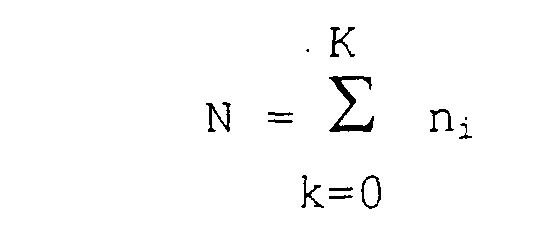 est le nombre total d'événements observés dans w ; etpk(Ti) = P (vk | Ti) est la probabilité d'apparition de l'événement vk conditionné sur le thème Ti.
 - Identificateur de thème selon la revendication 16, dans lequel lesdits modèles de probabilité paramétriques comportent un modèle multinomial de probabilité d'événement en combinaison avec un mélange spécifique à un thème de densités de probabilité de mot pour chaque thème d'un ensemble connu.
- Identificateur de thème selon la revendication 17, dans lequel lesdites densités de mélange de probabilité de mot ont la forme suivante :
 où Ti est l'un des i thèmes ;qim est la probabilité antérieure de la sélection du mélange m conditionné sur le thème Ti ;fim () est la fonction de densité de probabilité multivariée conditionnelle de ; etMi est le nombre total de mélanges associés au thème Ti.
 - Identificateur de thème selon la revendication 17, dans lequel les paramètres correspondant auxdites densités de mélange sont estimés avec un algorithme d'estimation-maximisation.
- Procédé de sélection d'un vocabulaire de mots-clés ou d'événements de parole importants, dont la présence ou l'absence dans une chaíne supposée associée à un message de parole sert à indiquer l'appartenance au sujet du message, ledit procédé comprenant les étapes consistant à :produire des chaínes supposées pour une pluralité de message d'apprentissage, dont chacun est connu comme étant un thème d'un ensemble fini de thèmes ; etdéterminer les statistiques de fréquences de mots ou d'événements à partir desdites chaínes supposées ; etutiliser lesdites statistiques de fréquence d'événement pour affecter des scores de signification ou d'association conditionnels à un thème à tous les mots ou événements possibles ; etsélectionner les mots ou événements ayant des scores de signification ou d'association conditionnels à un thème supérieurs à un seuil prédéterminé.
- Procédé selon la revendication 20, dans lequel ladite étape de production desdites chaínes supposées pour une pluralité de messages d'apprentissage comporte l'étape de productions desdites chaínes supposées de façon que chacune indique seulement la présence ou l'absence en valeur binaire d'un mot ou d'un événement.
- Procédé selon la revendication 21, dans lequel ladite étape de production desdites chaínes supposées pour une pluralité de messages d'apprentissage comporte l'étape de détermination desdites chaínes supposées à partir d'une transcription de texte du message de parole.
- Procédé selon la revendication 21, dans lequel ladite étape de production desdites chaínes supposées pour une pluralité de messages d'apprentissage comporte les étapes (a) d'obtention desdites chaínes supposées par application des messages de parole à l'entrée d'un détecteur d'événement du type fournissant une sortie de chaíne supposée en réponse à un message de parole ; et (b) de détection de la sortie du détecteur d'événement.
- Procédé selon la revendication 23, dans lequel le détecteur d'événement est un dispositif de reconnaissance de parole et ladite étape de détection de la sortie du détecteur d'événement comporte l'étape de détection de la sortie dudit dispositif de reconnaissance de parole.
- Procédé selon la revendication 20, dans lequel ladite étape de production de chaínes supposées pour une pluralité de messages d'apprentissage comporte l'étape de production de chaque chaíne supposée de façon que ladite chaíne supposée comporte une probabilité ou score de confiance pour chaque mot ou événement de la chaíne, ledit score indiquant la probabilité globale du mot ou de l'événement apparaissant dans le message de parole réel associé à la chaíne.
- Procédé selon la revendication 25, dans lequel ladite étape de production de chaínes supposées pour une pluralité de messages d'apprentissage comporte les étapes (a) de production desdites chaínes supposées en appliquant les messages de parole à l'entrée d'un détecteur d'événement du type fournissant des chaínes supposées et des scores de mots ou d'événements associés en réponse au message de parole ; et (b) de détection de la sortie du détecteur d'événement.
- Procédé selon la revendication 26, dans lequel le détecteur d'événement est un observateur de mot ou d'événements et ladite étape de détection de la sortie du détecteur d'événement comporte l'étape de détection de la sortie dudit observateur de mots ou d'événements.
- Procédé selon la revendication 20, dans lequel ladite étape de détermination des statistiques de fréquences de mots ou d'événements à partir desdites chaínes supposées comporte l'étape de comptage du nombre d'apparitions de mots-clés ou d'événements dans les chaínes supposées.
- Procédé selon la revendication 20, dans lequel ladite étape de détermination des statistiques de fréquence de mots ou d'événements à partir desdites chaínes supposées comporte l'étape d'obtention desdites statistiques de fréquence de mot en faisant la somme des scores de confiance pour tous les mots ou événements dans les chaínes supposées.
- Procédé selon la revendication 20, dans lequel ladite étape d'utilisation desdites statistiques de fréquence d'événements pour affecter des scores de signification ou d'association conditionnels à un thème à tous les mots ou événements possibles comporte l'étape d'obtention des scores de signification ou d'association conditionnels à un thème par un test d'hypothèse.
- Procédé selon la revendication 30, dans lequel ledit test d'hypothèse est un test en khi carré et l'étape d'obtention des scores de signification ou d'association conditionnels à un thème par ledit test en khi carré comporte l'étape de calcul des valeurs de khi carré (X2) comme suit :
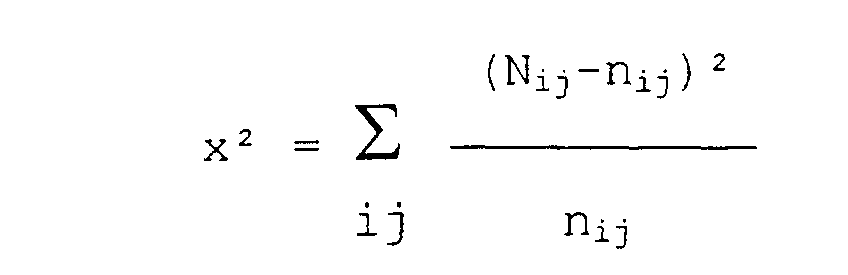 et de stockage desdites valeurs de khi carré dans une table comportant des cellules définies par i rangées et j colonnes ;où nij = Ni.N.j / nijest le nombre attendu de comptes pour chaque cellule ;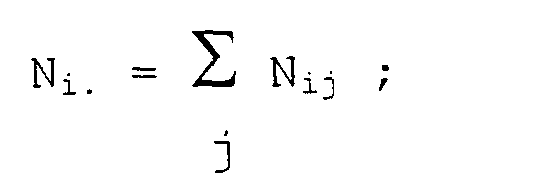
 Nij est égal au nombre de conversations affectées à la cellule (i, j) trouvées pour chaque cellule de la table.
 - Procédé selon la revendication 31, dans lequel ladite étape d'obtention des scores de signification ou d'association conditionnels à un thème par un test en khi carré comporte l'étape de production au moins d'une table de contingence à partir des statistiques de fréquence de mot déterminées à partir des chaínes supposées de message et en basant ledit test en khi carré sur lesdites tables de contingence.
- Procédé selon la revendication 32, dans lequel à chaque thème est affectée sa propre rangée dans la table de contingence et ladite étape d'obtention de scores de signification ou d'association conditionnels à un thème par un test en khi carré comporte l'étape d'exécution d'un test d'hypothèse simultanément sur tous les thèmes.
- Procédé selon la revendication 32, dans lequel à un thème unique est affectée sa propre rangée dans la table de contingence tandis que tous les autres thèmes sont regroupés dans une deuxième rangée de ladite table et ladite étape d'obtention des scores de signification ou d'association conditionnels à un thème par un test en khi carré comporte l'étape d'exécution dudit test en khi carré pour un seul mot et thème à la fois.
- Procédé selon la revendication 20, dans lequel ladite étape de détermination des statistiques de fréquence de mot ou d'événement à partir desdites chaínes supposées comporte les étapes (a) d'utilisation desdites statistiques de fréquence de mot ou d'événement pour construire des densités de mélange conditionnelles à un thème pour chaque mot ou événement possible, et (b) d'utilisation desdites densités de mélange conditionnelles à un thème pour calculer un score d'association pour chaque mot.
- Procédé selon la revendication 35, dans lequel les densités de mélange ont la forme :
 où Ti est l'un des i thèmes ;qim est la probabilité antérieure de la sélection du mélange m conditionné sur le thème Ti ;fim() est la fonction de densité de probabilité multivariée conditionnelle de ; etMi est le nombre total de mélanges associés au thème Ti.
 - Procédé selon la revendication 36, dans lequel lesdites densités de mélange sont constituées de la somme pondérée de fonctions Delta-Dirac.
- Procédé selon la revendication 36, dans lequel lesdites densités de mélange sont constituées de la somme pondérée de fonction de densité bêta de la forme :où C(n (0) / im, n (1) / im,..., n (K) / im) est une constante de normalisation choisie de manière à s'assurer que fim () est une fonction de densité convenable.
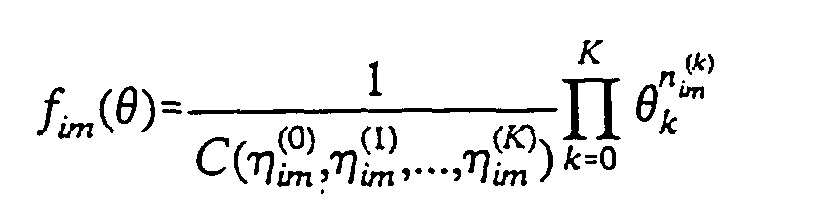
- Procédé selon la revendication 38, comprenant en outre les étapes d'estimation des paramètres desdites densités de mélange avec un algorithme d'estimation-maximisation.
- Procédé selon la revendication 38, dans lequel ledit score d'association est une mesure d'informations mutuelles des apparitions et de celle des appartenances de thème, de la forme :la mesure d'informations mutuelles désirées I(T,W) peut être exprimée par :
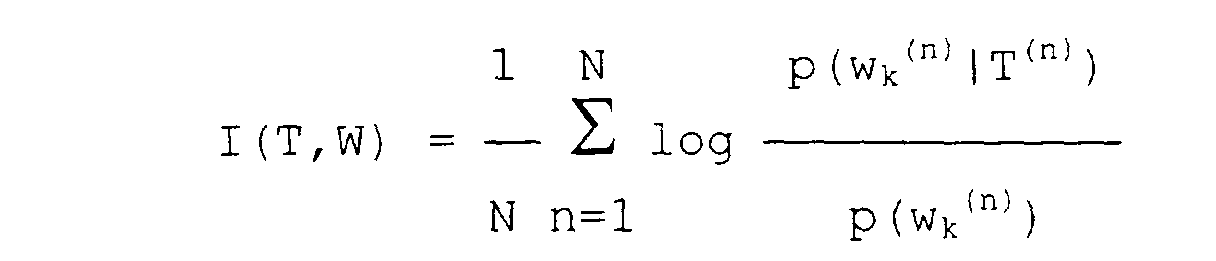 où p(wk (n)|T(n)) est la probabilité du motif d'apparition pour un mot ou événement vk observé dans la séquence d'apprentissage wk (n) conditionnée sur son thème réel T(n) et
 est la probabilité pour le même motif d'apparition indépendamment du thème.
 - Procédé selon la revendication 38, dans lequel ledit score d'association est une distance de Kullback-Liebler entre la densité de probabilité du mot conditionné sur un thème donné et la densité du mot conditionné sur tous les autres thèmes, ladite mesure de distance ayant la forme :où N(T) est le nombre total de conversations ou messages concernant le thème intéressant et N(

T ) est le nombre associé à tous les autres thèmes.
Applications Claiming Priority (3)
| Application Number | Priority Date | Filing Date | Title |
|---|---|---|---|
| US228755 | 1994-04-18 | ||
| US08/228,755 US5625748A (en) | 1994-04-18 | 1994-04-18 | Topic discriminator using posterior probability or confidence scores |
| PCT/US1995/004673 WO1995028700A1 (fr) | 1994-04-18 | 1995-04-14 | Identifieur de sujets de conversation |
Publications (3)
| Publication Number | Publication Date |
|---|---|
| EP0708960A1 EP0708960A1 (fr) | 1996-05-01 |
| EP0708960A4 EP0708960A4 (fr) | 1998-06-03 |
| EP0708960B1 true EP0708960B1 (fr) | 2001-11-21 |
Family
ID=22858461
Family Applications (1)
| Application Number | Title | Priority Date | Filing Date |
|---|---|---|---|
| EP95915682A Expired - Lifetime EP0708960B1 (fr) | 1994-04-18 | 1995-04-14 | Identifieur de sujets de conversation |
Country Status (7)
| Country | Link |
|---|---|
| US (1) | US5625748A (fr) |
| EP (1) | EP0708960B1 (fr) |
| JP (1) | JPH08512148A (fr) |
| AU (1) | AU688030B2 (fr) |
| CA (1) | CA2162696C (fr) |
| DE (1) | DE69524036T2 (fr) |
| WO (1) | WO1995028700A1 (fr) |
Cited By (3)
| Publication number | Priority date | Publication date | Assignee | Title |
|---|---|---|---|---|
| DE10220521A1 (de) * | 2002-05-08 | 2003-11-27 | Sap Ag | Verfahren und System zur Verarbeitung von Sprachdaten und Klassifizierung von Gesprächen |
| US7343288B2 (en) | 2002-05-08 | 2008-03-11 | Sap Ag | Method and system for the processing and storing of voice information and corresponding timeline information |
| US7406413B2 (en) | 2002-05-08 | 2008-07-29 | Sap Aktiengesellschaft | Method and system for the processing of voice data and for the recognition of a language |
Families Citing this family (142)
| Publication number | Priority date | Publication date | Assignee | Title |
|---|---|---|---|---|
| JP2751856B2 (ja) * | 1995-02-03 | 1998-05-18 | 日本電気株式会社 | 木構造を用いたパターン適応化方式 |
| US5717826A (en) * | 1995-08-11 | 1998-02-10 | Lucent Technologies Inc. | Utterance verification using word based minimum verification error training for recognizing a keyboard string |
| US6064959A (en) * | 1997-03-28 | 2000-05-16 | Dragon Systems, Inc. | Error correction in speech recognition |
| US6067517A (en) * | 1996-02-02 | 2000-05-23 | International Business Machines Corporation | Transcription of speech data with segments from acoustically dissimilar environments |
| US7903029B2 (en) | 1996-09-09 | 2011-03-08 | Tracbeam Llc | Wireless location routing applications and architecture therefor |
| US7274332B1 (en) | 1996-09-09 | 2007-09-25 | Tracbeam Llc | Multiple evaluators for evaluation of a purality of conditions |
| WO1998010307A1 (fr) | 1996-09-09 | 1998-03-12 | Dennis Jay Dupray | Localisation d'une station mobile |
| US7714778B2 (en) | 1997-08-20 | 2010-05-11 | Tracbeam Llc | Wireless location gateway and applications therefor |
| US6236365B1 (en) * | 1996-09-09 | 2001-05-22 | Tracbeam, Llc | Location of a mobile station using a plurality of commercial wireless infrastructures |
| US9134398B2 (en) | 1996-09-09 | 2015-09-15 | Tracbeam Llc | Wireless location using network centric location estimators |
| US5797123A (en) * | 1996-10-01 | 1998-08-18 | Lucent Technologies Inc. | Method of key-phase detection and verification for flexible speech understanding |
| US6185531B1 (en) * | 1997-01-09 | 2001-02-06 | Gte Internetworking Incorporated | Topic indexing method |
| US6035017A (en) * | 1997-01-24 | 2000-03-07 | Lucent Technologies Inc. | Background speech recognition for voice messaging applications |
| GB2323693B (en) * | 1997-03-27 | 2001-09-26 | Forum Technology Ltd | Speech to text conversion |
| US6009392A (en) * | 1998-01-15 | 1999-12-28 | International Business Machines Corporation | Training speech recognition by matching audio segment frequency of occurrence with frequency of words and letter combinations in a corpus |
| US6104989A (en) * | 1998-07-29 | 2000-08-15 | International Business Machines Corporation | Real time detection of topical changes and topic identification via likelihood based methods |
| US6185530B1 (en) | 1998-08-14 | 2001-02-06 | International Business Machines Corporation | Apparatus and methods for identifying potential acoustic confusibility among words in a speech recognition system |
| US6269335B1 (en) | 1998-08-14 | 2001-07-31 | International Business Machines Corporation | Apparatus and methods for identifying homophones among words in a speech recognition system |
| US6192337B1 (en) * | 1998-08-14 | 2001-02-20 | International Business Machines Corporation | Apparatus and methods for rejecting confusible words during training associated with a speech recognition system |
| GB9824552D0 (en) * | 1998-11-09 | 1999-01-06 | Royal Holloway University Of L | Data classification apparatus and method thereof |
| US6571210B2 (en) * | 1998-11-13 | 2003-05-27 | Microsoft Corporation | Confidence measure system using a near-miss pattern |
| US8135413B2 (en) | 1998-11-24 | 2012-03-13 | Tracbeam Llc | Platform and applications for wireless location and other complex services |
| US20030146871A1 (en) * | 1998-11-24 | 2003-08-07 | Tracbeam Llc | Wireless location using signal direction and time difference of arrival |
| US6275803B1 (en) * | 1999-02-12 | 2001-08-14 | International Business Machines Corp. | Updating a language model based on a function-word to total-word ratio |
| US6304833B1 (en) * | 1999-04-27 | 2001-10-16 | The United States Of America As Represented By The Secretary Of The Navy | Hypothesis selection for evidential reasoning systems |
| US6711585B1 (en) | 1999-06-15 | 2004-03-23 | Kanisa Inc. | System and method for implementing a knowledge management system |
| JP2001160067A (ja) * | 1999-09-22 | 2001-06-12 | Ddi Corp | 類似文書検索方法および該類似文書検索方法を利用した推薦記事通知サービスシステム |
| EP1286735A1 (fr) | 1999-09-24 | 2003-03-05 | Dennis Jay Dupray | Services de reseau soumis a des restrictions geographiques |
| US6539353B1 (en) | 1999-10-12 | 2003-03-25 | Microsoft Corporation | Confidence measures using sub-word-dependent weighting of sub-word confidence scores for robust speech recognition |
| US9076448B2 (en) | 1999-11-12 | 2015-07-07 | Nuance Communications, Inc. | Distributed real time speech recognition system |
| US7050977B1 (en) * | 1999-11-12 | 2006-05-23 | Phoenix Solutions, Inc. | Speech-enabled server for internet website and method |
| US7725307B2 (en) * | 1999-11-12 | 2010-05-25 | Phoenix Solutions, Inc. | Query engine for processing voice based queries including semantic decoding |
| US7392185B2 (en) | 1999-11-12 | 2008-06-24 | Phoenix Solutions, Inc. | Speech based learning/training system using semantic decoding |
| US8108218B1 (en) * | 1999-12-13 | 2012-01-31 | Avaya Inc. | Methods and apparatus for voice recognition for call treatment modification on messaging |
| US6411683B1 (en) * | 2000-02-09 | 2002-06-25 | At&T Corp. | Automated telephone call designation system |
| US7505921B1 (en) | 2000-03-03 | 2009-03-17 | Finali Corporation | System and method for optimizing a product configuration |
| US7263484B1 (en) | 2000-03-04 | 2007-08-28 | Georgia Tech Research Corporation | Phonetic searching |
| EP1275042A2 (fr) * | 2000-03-06 | 2003-01-15 | Kanisa Inc. | Systeme et procede servant a fournir un dialogue intelligent a plusieurs etapes avec un utilisateur |
| US6912498B2 (en) * | 2000-05-02 | 2005-06-28 | Scansoft, Inc. | Error correction in speech recognition by correcting text around selected area |
| US7028250B2 (en) * | 2000-05-25 | 2006-04-11 | Kanisa, Inc. | System and method for automatically classifying text |
| US10684350B2 (en) | 2000-06-02 | 2020-06-16 | Tracbeam Llc | Services and applications for a communications network |
| US10641861B2 (en) | 2000-06-02 | 2020-05-05 | Dennis J. Dupray | Services and applications for a communications network |
| US9875492B2 (en) | 2001-05-22 | 2018-01-23 | Dennis J. Dupray | Real estate transaction system |
| US6856956B2 (en) * | 2000-07-20 | 2005-02-15 | Microsoft Corporation | Method and apparatus for generating and displaying N-best alternatives in a speech recognition system |
| US7216077B1 (en) * | 2000-09-26 | 2007-05-08 | International Business Machines Corporation | Lattice-based unsupervised maximum likelihood linear regression for speaker adaptation |
| US7162422B1 (en) * | 2000-09-29 | 2007-01-09 | Intel Corporation | Apparatus and method for using user context information to improve N-best processing in the presence of speech recognition uncertainty |
| US7191133B1 (en) | 2001-02-15 | 2007-03-13 | West Corporation | Script compliance using speech recognition |
| US7664641B1 (en) | 2001-02-15 | 2010-02-16 | West Corporation | Script compliance and quality assurance based on speech recognition and duration of interaction |
| US7966187B1 (en) | 2001-02-15 | 2011-06-21 | West Corporation | Script compliance and quality assurance using speech recognition |
| US7739115B1 (en) | 2001-02-15 | 2010-06-15 | West Corporation | Script compliance and agent feedback |
| US8180643B1 (en) | 2001-02-15 | 2012-05-15 | West Corporation | Script compliance using speech recognition and compilation and transmission of voice and text records to clients |
| US20020133392A1 (en) * | 2001-02-22 | 2002-09-19 | Angel Mark A. | Distributed customer relationship management systems and methods |
| US6996531B2 (en) * | 2001-03-30 | 2006-02-07 | Comverse Ltd. | Automated database assistance using a telephone for a speech based or text based multimedia communication mode |
| US6895083B1 (en) * | 2001-05-02 | 2005-05-17 | Verizon Corporate Services Group Inc. | System and method for maximum benefit routing |
| US6839667B2 (en) * | 2001-05-16 | 2005-01-04 | International Business Machines Corporation | Method of speech recognition by presenting N-best word candidates |
| US8082096B2 (en) | 2001-05-22 | 2011-12-20 | Tracbeam Llc | Wireless location routing applications and architecture therefor |
| JP2002366166A (ja) * | 2001-06-11 | 2002-12-20 | Pioneer Electronic Corp | コンテンツ提供システム及び方法、並びにそのためのコンピュータプログラム |
| US20030115191A1 (en) * | 2001-12-17 | 2003-06-19 | Max Copperman | Efficient and cost-effective content provider for customer relationship management (CRM) or other applications |
| US7206778B2 (en) | 2001-12-17 | 2007-04-17 | Knova Software Inc. | Text search ordered along one or more dimensions |
| KR20030069377A (ko) * | 2002-02-20 | 2003-08-27 | 대한민국(전남대학교총장) | 음성인식시스템의 토픽 검출장치 및 방법 |
| US7343372B2 (en) * | 2002-02-22 | 2008-03-11 | International Business Machines Corporation | Direct navigation for information retrieval |
| US7716207B2 (en) * | 2002-02-26 | 2010-05-11 | Odom Paul S | Search engine methods and systems for displaying relevant topics |
| US20060004732A1 (en) * | 2002-02-26 | 2006-01-05 | Odom Paul S | Search engine methods and systems for generating relevant search results and advertisements |
| US7340466B2 (en) * | 2002-02-26 | 2008-03-04 | Kang Jo Mgmt. Limited Liability Company | Topic identification and use thereof in information retrieval systems |
| US20030220917A1 (en) * | 2002-04-03 | 2003-11-27 | Max Copperman | Contextual search |
| DE10220522B4 (de) * | 2002-05-08 | 2005-11-17 | Sap Ag | Verfahren und System zur Verarbeitung von Sprachdaten mittels Spracherkennung und Frequenzanalyse |
| DE10220520A1 (de) * | 2002-05-08 | 2003-11-20 | Sap Ag | Verfahren zur Erkennung von Sprachinformation |
| US7403967B1 (en) | 2002-06-18 | 2008-07-22 | West Corporation | Methods, apparatus, and computer readable media for confirmation and verification of shipping address data associated with a transaction |
| US7228275B1 (en) * | 2002-10-21 | 2007-06-05 | Toyota Infotechnology Center Co., Ltd. | Speech recognition system having multiple speech recognizers |
| US8032358B2 (en) | 2002-11-28 | 2011-10-04 | Nuance Communications Austria Gmbh | Classifying text via topical analysis, for applications to speech recognition |
| US20040128132A1 (en) * | 2002-12-30 | 2004-07-01 | Meir Griniasty | Pronunciation network |
| EP1590798A2 (fr) * | 2003-02-05 | 2005-11-02 | Verint Systems Inc. | Procede pour la classification et le regroupement automatique et semi-automatique de textes non deterministes |
| DE10306022B3 (de) * | 2003-02-13 | 2004-02-19 | Siemens Ag | Dreistufige Einzelworterkennung |
| US7292982B1 (en) * | 2003-05-29 | 2007-11-06 | At&T Corp. | Active labeling for spoken language understanding |
| US7454336B2 (en) * | 2003-06-20 | 2008-11-18 | Microsoft Corporation | Variational inference and learning for segmental switching state space models of hidden speech dynamics |
| US7487094B1 (en) | 2003-06-20 | 2009-02-03 | Utopy, Inc. | System and method of call classification with context modeling based on composite words |
| US7650282B1 (en) * | 2003-07-23 | 2010-01-19 | Nexidia Inc. | Word spotting score normalization |
| WO2005010866A1 (fr) * | 2003-07-23 | 2005-02-03 | Nexidia Inc. | Interrogations pour la detection de mots parles |
| US8170873B1 (en) * | 2003-07-23 | 2012-05-01 | Nexidia Inc. | Comparing events in word spotting |
| US6930759B2 (en) * | 2003-09-23 | 2005-08-16 | Eastman Kodak Company | Method and apparatus for exposing a latent watermark on film |
| US20070162272A1 (en) * | 2004-01-16 | 2007-07-12 | Nec Corporation | Text-processing method, program, program recording medium, and device thereof |
| EP1723636A1 (fr) * | 2004-03-12 | 2006-11-22 | Siemens Aktiengesellschaft | Determination de seuils de fiabilite et de rejet avec adaptation a l'utilisateur et au vocabulaire |
| US20050282563A1 (en) * | 2004-06-17 | 2005-12-22 | Ixi Mobile (R&D) Ltd. | Message recognition and display system and method for a mobile communication device |
| WO2006017495A2 (fr) * | 2004-08-02 | 2006-02-16 | Market Central, Inc. | Procedes et systemes de moteurs de recherche permettant de generer des resultats de recherche et des annonces publicitaires pertinents |
| US20060122834A1 (en) * | 2004-12-03 | 2006-06-08 | Bennett Ian M | Emotion detection device & method for use in distributed systems |
| US7627638B1 (en) * | 2004-12-20 | 2009-12-01 | Google Inc. | Verbal labels for electronic messages |
| US7949533B2 (en) * | 2005-02-04 | 2011-05-24 | Vococollect, Inc. | Methods and systems for assessing and improving the performance of a speech recognition system |
| US7895039B2 (en) * | 2005-02-04 | 2011-02-22 | Vocollect, Inc. | Methods and systems for optimizing model adaptation for a speech recognition system |
| US7865362B2 (en) * | 2005-02-04 | 2011-01-04 | Vocollect, Inc. | Method and system for considering information about an expected response when performing speech recognition |
| US7827032B2 (en) * | 2005-02-04 | 2010-11-02 | Vocollect, Inc. | Methods and systems for adapting a model for a speech recognition system |
| US8200495B2 (en) * | 2005-02-04 | 2012-06-12 | Vocollect, Inc. | Methods and systems for considering information about an expected response when performing speech recognition |
| US20060245641A1 (en) * | 2005-04-29 | 2006-11-02 | Microsoft Corporation | Extracting data from semi-structured information utilizing a discriminative context free grammar |
| WO2007064639A2 (fr) * | 2005-11-29 | 2007-06-07 | Scientigo, Inc. | Procedes et systemes permettant de fournir des resultats de recherche contextuelle personnalises |
| US8509563B2 (en) * | 2006-02-02 | 2013-08-13 | Microsoft Corporation | Generation of documents from images |
| US7539616B2 (en) * | 2006-02-20 | 2009-05-26 | Microsoft Corporation | Speaker authentication using adapted background models |
| US7599861B2 (en) | 2006-03-02 | 2009-10-06 | Convergys Customer Management Group, Inc. | System and method for closed loop decisionmaking in an automated care system |
| US8364467B1 (en) * | 2006-03-31 | 2013-01-29 | Google Inc. | Content-based classification |
| US8379830B1 (en) | 2006-05-22 | 2013-02-19 | Convergys Customer Management Delaware Llc | System and method for automated customer service with contingent live interaction |
| US7809663B1 (en) | 2006-05-22 | 2010-10-05 | Convergys Cmg Utah, Inc. | System and method for supporting the utilization of machine language |
| US8275613B2 (en) * | 2006-08-21 | 2012-09-25 | Unifiedvoice Corporation | All voice transaction data capture—dictation system |
| JP5177561B2 (ja) * | 2007-02-06 | 2013-04-03 | 日本電気株式会社 | 認識器重み学習装置および音声認識装置、ならびに、システム |
| US8051372B1 (en) * | 2007-04-12 | 2011-11-01 | The New York Times Company | System and method for automatically detecting and extracting semantically significant text from a HTML document associated with a plurality of HTML documents |
| US9342588B2 (en) * | 2007-06-18 | 2016-05-17 | International Business Machines Corporation | Reclassification of training data to improve classifier accuracy |
| US9058319B2 (en) * | 2007-06-18 | 2015-06-16 | International Business Machines Corporation | Sub-model generation to improve classification accuracy |
| US8285539B2 (en) * | 2007-06-18 | 2012-10-09 | International Business Machines Corporation | Extracting tokens in a natural language understanding application |
| US8521511B2 (en) * | 2007-06-18 | 2013-08-27 | International Business Machines Corporation | Information extraction in a natural language understanding system |
| US20090099847A1 (en) * | 2007-10-10 | 2009-04-16 | Microsoft Corporation | Template constrained posterior probability |
| US7437291B1 (en) * | 2007-12-13 | 2008-10-14 | International Business Machines Corporation | Using partial information to improve dialog in automatic speech recognition systems |
| WO2009158581A2 (fr) * | 2008-06-27 | 2009-12-30 | Adpassage, Inc. | Système et procédé de reconnaissance de sujet parlé ou de critère dans un contenu numérique et de la publicité contextuelle |
| US8654963B2 (en) | 2008-12-19 | 2014-02-18 | Genesys Telecommunications Laboratories, Inc. | Method and system for integrating an interaction management system with a business rules management system |
| US8463606B2 (en) | 2009-07-13 | 2013-06-11 | Genesys Telecommunications Laboratories, Inc. | System for analyzing interactions and reporting analytic results to human-operated and system interfaces in real time |
| JP2011033680A (ja) * | 2009-07-30 | 2011-02-17 | Sony Corp | 音声処理装置及び方法、並びにプログラム |
| US20110184736A1 (en) * | 2010-01-26 | 2011-07-28 | Benjamin Slotznick | Automated method of recognizing inputted information items and selecting information items |
| JP5533042B2 (ja) * | 2010-03-04 | 2014-06-25 | 富士通株式会社 | 音声検索装置、音声検索方法、プログラム及び記録媒体 |
| US9538493B2 (en) | 2010-08-23 | 2017-01-03 | Finetrak, Llc | Locating a mobile station and applications therefor |
| US10248960B2 (en) | 2010-11-16 | 2019-04-02 | Disney Enterprises, Inc. | Data mining to determine online user responses to broadcast messages |
| US8688453B1 (en) * | 2011-02-28 | 2014-04-01 | Nuance Communications, Inc. | Intent mining via analysis of utterances |
| US8914290B2 (en) | 2011-05-20 | 2014-12-16 | Vocollect, Inc. | Systems and methods for dynamically improving user intelligibility of synthesized speech in a work environment |
| US8965763B1 (en) | 2012-02-02 | 2015-02-24 | Google Inc. | Discriminative language modeling for automatic speech recognition with a weak acoustic model and distributed training |
| US8543398B1 (en) | 2012-02-29 | 2013-09-24 | Google Inc. | Training an automatic speech recognition system using compressed word frequencies |
| US8473293B1 (en) * | 2012-04-17 | 2013-06-25 | Google Inc. | Dictionary filtering using market data |
| US8374865B1 (en) * | 2012-04-26 | 2013-02-12 | Google Inc. | Sampling training data for an automatic speech recognition system based on a benchmark classification distribution |
| EP2842124A4 (fr) * | 2012-04-27 | 2015-12-30 | Interactive Intelligence Inc | Perfectionnement des résultats de la reconnaissance de la parole basé sur des exemples négatifs (anti-mots) |
| US8805684B1 (en) | 2012-05-31 | 2014-08-12 | Google Inc. | Distributed speaker adaptation |
| US8571859B1 (en) | 2012-05-31 | 2013-10-29 | Google Inc. | Multi-stage speaker adaptation |
| US8554559B1 (en) | 2012-07-13 | 2013-10-08 | Google Inc. | Localized speech recognition with offload |
| US9123333B2 (en) | 2012-09-12 | 2015-09-01 | Google Inc. | Minimum bayesian risk methods for automatic speech recognition |
| US9912816B2 (en) | 2012-11-29 | 2018-03-06 | Genesys Telecommunications Laboratories, Inc. | Workload distribution with resource awareness |
| US9542936B2 (en) | 2012-12-29 | 2017-01-10 | Genesys Telecommunications Laboratories, Inc. | Fast out-of-vocabulary search in automatic speech recognition systems |
| US20140278357A1 (en) * | 2013-03-14 | 2014-09-18 | Wordnik, Inc. | Word generation and scoring using sub-word segments and characteristic of interest |
| US9978395B2 (en) | 2013-03-15 | 2018-05-22 | Vocollect, Inc. | Method and system for mitigating delay in receiving audio stream during production of sound from audio stream |
| US9645703B2 (en) | 2014-05-14 | 2017-05-09 | International Business Machines Corporation | Detection of communication topic change |
| US10304440B1 (en) * | 2015-07-10 | 2019-05-28 | Amazon Technologies, Inc. | Keyword spotting using multi-task configuration |
| US9984677B2 (en) * | 2015-09-30 | 2018-05-29 | Nice Ltd. | Bettering scores of spoken phrase spotting |
| US10714121B2 (en) | 2016-07-27 | 2020-07-14 | Vocollect, Inc. | Distinguishing user speech from background speech in speech-dense environments |
| KR101934280B1 (ko) * | 2016-10-05 | 2019-01-03 | 현대자동차주식회사 | 발화내용 분석 장치 및 방법 |
| US10235365B2 (en) * | 2017-06-20 | 2019-03-19 | Microsoft Technology Licensing, Llc | Transforming spoken thoughts to a visual representation |
| US10963510B2 (en) * | 2018-08-09 | 2021-03-30 | Bank Of America Corporation | Dynamic natural language processing tagging |
| US12142163B2 (en) * | 2018-08-17 | 2024-11-12 | The Mitre Corporation | System for evaluating radar vectoring aptitude |
| US11405506B2 (en) * | 2020-06-29 | 2022-08-02 | Avaya Management L.P. | Prompt feature to leave voicemail for appropriate attribute-based call back to customers |
| US12033619B2 (en) * | 2020-11-12 | 2024-07-09 | International Business Machines Corporation | Intelligent media transcription |
| US11995542B2 (en) | 2021-02-22 | 2024-05-28 | Tencent America LLC | Dialogue model training based on reference-free discriminators |
Family Cites Families (6)
| Publication number | Priority date | Publication date | Assignee | Title |
|---|---|---|---|---|
| FR2554623B1 (fr) * | 1983-11-08 | 1986-08-14 | Texas Instruments France | Procede d'analyse de la parole independant du locuteur |
| US4718094A (en) * | 1984-11-19 | 1988-01-05 | International Business Machines Corp. | Speech recognition system |
| JPS6219899A (ja) * | 1985-07-18 | 1987-01-28 | 松下電器産業株式会社 | 文章音声認識装置 |
| JPS6273391A (ja) * | 1985-09-27 | 1987-04-04 | Toshiba Corp | パタ−ン認識学習装置 |
| JPH0634207B2 (ja) * | 1987-07-24 | 1994-05-02 | 日本電気株式会社 | 話題予測装置 |
| GB9220404D0 (en) * | 1992-08-20 | 1992-11-11 | Nat Security Agency | Method of identifying,retrieving and sorting documents |
-
1994
- 1994-04-18 US US08/228,755 patent/US5625748A/en not_active Expired - Lifetime
-
1995
- 1995-04-14 JP JP7527135A patent/JPH08512148A/ja not_active Ceased
- 1995-04-14 DE DE69524036T patent/DE69524036T2/de not_active Expired - Fee Related
- 1995-04-14 AU AU22480/95A patent/AU688030B2/en not_active Ceased
- 1995-04-14 EP EP95915682A patent/EP0708960B1/fr not_active Expired - Lifetime
- 1995-04-14 CA CA002162696A patent/CA2162696C/fr not_active Expired - Fee Related
- 1995-04-14 WO PCT/US1995/004673 patent/WO1995028700A1/fr not_active Ceased
Cited By (4)
| Publication number | Priority date | Publication date | Assignee | Title |
|---|---|---|---|---|
| DE10220521A1 (de) * | 2002-05-08 | 2003-11-27 | Sap Ag | Verfahren und System zur Verarbeitung von Sprachdaten und Klassifizierung von Gesprächen |
| DE10220521B4 (de) * | 2002-05-08 | 2005-11-24 | Sap Ag | Verfahren und System zur Verarbeitung von Sprachdaten und Klassifizierung von Gesprächen |
| US7343288B2 (en) | 2002-05-08 | 2008-03-11 | Sap Ag | Method and system for the processing and storing of voice information and corresponding timeline information |
| US7406413B2 (en) | 2002-05-08 | 2008-07-29 | Sap Aktiengesellschaft | Method and system for the processing of voice data and for the recognition of a language |
Also Published As
| Publication number | Publication date |
|---|---|
| CA2162696C (fr) | 2000-06-20 |
| AU2248095A (en) | 1995-11-10 |
| JPH08512148A (ja) | 1996-12-17 |
| EP0708960A4 (fr) | 1998-06-03 |
| AU688030B2 (en) | 1998-03-05 |
| DE69524036T2 (de) | 2002-07-18 |
| US5625748A (en) | 1997-04-29 |
| WO1995028700A1 (fr) | 1995-10-26 |
| EP0708960A1 (fr) | 1996-05-01 |
| CA2162696A1 (fr) | 1995-10-26 |
| DE69524036D1 (de) | 2002-01-03 |
Similar Documents
| Publication | Publication Date | Title |
|---|---|---|
| EP0708960B1 (fr) | Identifieur de sujets de conversation | |
| CN109151218B (zh) | 通话语音质检方法、装置、计算机设备及存储介质 | |
| US5797123A (en) | Method of key-phase detection and verification for flexible speech understanding | |
| US5675706A (en) | Vocabulary independent discriminative utterance verification for non-keyword rejection in subword based speech recognition | |
| US9646605B2 (en) | False alarm reduction in speech recognition systems using contextual information | |
| EP0788649B1 (fr) | Procede et systeme de reconnaissance de formes d'apres des densites de probabilite organisees de maniere arborescente | |
| US6738745B1 (en) | Methods and apparatus for identifying a non-target language in a speech recognition system | |
| Deshmukh et al. | Hierarchical search for large-vocabulary conversational speech recognition: working toward a solution to the decoding problem | |
| McDonough et al. | Approaches to topic identification on the switchboard corpus | |
| US6618702B1 (en) | Method of and device for phone-based speaker recognition | |
| US20150073792A1 (en) | Method and system for automatically detecting morphemes in a task classification system using lattices | |
| EP1800293B1 (fr) | Systeme d'identification de langue parlee et methodes d'entrainement et d'exploitation de ce systeme | |
| Wright et al. | Automatic acquisition of salient grammar fragments for call-type classification. | |
| WO2001022400A1 (fr) | Reconnaissance de la parole iterative a partir de multiples vecteurs de caracteristiques | |
| JPH0394299A (ja) | 音声認識方法と音声認識装置訓練方法 | |
| Szöke et al. | Phoneme based acoustics keyword spotting in informal continuous speech | |
| Gorin | Processing of semantic information in fluently spoken language | |
| Gillick et al. | Application of large vocabulary continuous speech recognition to topic and speaker identification using telephone speech | |
| Rose | Word spotting from continuous speech utterances | |
| Rose et al. | Integration of utterance verification with statistical language modeling and spoken language understanding | |
| Thambiratnam | Acoustic keyword spotting in speech with applications to data mining | |
| JPH07261785A (ja) | 音声認識方法及び音声認識装置 | |
| Williams | A study of the use and evaluation of confidence measures in automatic speech recognition | |
| EP2948943B1 (fr) | Réduction de fausses alarmes dans des systèmes de reconnaissance vocale au moyen d'informations contextuelles | |
| Modi et al. | Discriminative utterance verification using multiple confidence measures. |
Legal Events
| Date | Code | Title | Description |
|---|---|---|---|
| PUAI | Public reference made under article 153(3) epc to a published international application that has entered the european phase |
Free format text: ORIGINAL CODE: 0009012 |
|
| AK | Designated contracting states |
Kind code of ref document: A1 Designated state(s): BE DE FR GB IT LU NL |
|
| 17P | Request for examination filed |
Effective date: 19960422 |
|
| RIN1 | Information on inventor provided before grant (corrected) |
Inventor name: JEANRENAUD, PHILLIPPE Inventor name: NG, KENNY Inventor name: ROHLICEK, JAN, ROBIN Inventor name: GISH, HERBERT Inventor name: MCDONOUGH, JOHN, W. |
|
| A4 | Supplementary search report drawn up and despatched |
Effective date: 19980417 |
|
| AK | Designated contracting states |
Kind code of ref document: A4 Designated state(s): BE DE FR GB IT LU NL |
|
| 17Q | First examination report despatched |
Effective date: 20000308 |
|
| GRAG | Despatch of communication of intention to grant |
Free format text: ORIGINAL CODE: EPIDOS AGRA |
|
| RIC1 | Information provided on ipc code assigned before grant |
Free format text: 7G 10L 15/18 A |
|
| GRAG | Despatch of communication of intention to grant |
Free format text: ORIGINAL CODE: EPIDOS AGRA |
|
| GRAH | Despatch of communication of intention to grant a patent |
Free format text: ORIGINAL CODE: EPIDOS IGRA |
|
| GRAH | Despatch of communication of intention to grant a patent |
Free format text: ORIGINAL CODE: EPIDOS IGRA |
|
| GRAA | (expected) grant |
Free format text: ORIGINAL CODE: 0009210 |
|
| AK | Designated contracting states |
Kind code of ref document: B1 Designated state(s): BE DE FR GB IT LU NL |
|
| PG25 | Lapsed in a contracting state [announced via postgrant information from national office to epo] |
Ref country code: NL Free format text: LAPSE BECAUSE OF FAILURE TO SUBMIT A TRANSLATION OF THE DESCRIPTION OR TO PAY THE FEE WITHIN THE PRESCRIBED TIME-LIMIT Effective date: 20011121 |
|
| REG | Reference to a national code |
Ref country code: GB Ref legal event code: IF02 |
|
| REF | Corresponds to: |
Ref document number: 69524036 Country of ref document: DE Date of ref document: 20020103 |
|
| NLV1 | Nl: lapsed or annulled due to failure to fulfill the requirements of art. 29p and 29m of the patents act | ||
| ET | Fr: translation filed | ||
| PLBE | No opposition filed within time limit |
Free format text: ORIGINAL CODE: 0009261 |
|
| STAA | Information on the status of an ep patent application or granted ep patent |
Free format text: STATUS: NO OPPOSITION FILED WITHIN TIME LIMIT |
|
| BECA | Be: change of holder's address |
Owner name: *VERIZON CORPORATE SERVICES GROUP INC.A CORP.OF TH |
|
| BECH | Be: change of holder |
Owner name: *VERIZON CORPORATE SERVICES GROUP INC.A CORP.OF TH |
|
| BECN | Be: change of holder's name |
Owner name: *VERIZON CORPORATE SERVICES GROUP INC.A CORP.OF TH |
|
| REG | Reference to a national code |
Ref country code: GB Ref legal event code: 732E |
|
| 26N | No opposition filed | ||
| PGFP | Annual fee paid to national office [announced via postgrant information from national office to epo] |
Ref country code: LU Payment date: 20070502 Year of fee payment: 13 |
|
| PGFP | Annual fee paid to national office [announced via postgrant information from national office to epo] |
Ref country code: BE Payment date: 20070515 Year of fee payment: 13 |
|
| PGFP | Annual fee paid to national office [announced via postgrant information from national office to epo] |
Ref country code: DE Payment date: 20070531 Year of fee payment: 13 |
|
| PGFP | Annual fee paid to national office [announced via postgrant information from national office to epo] |
Ref country code: GB Payment date: 20070425 Year of fee payment: 13 |
|
| BECA | Be: change of holder's address |
Owner name: *BBNT SOLUTIONS LLC10 MOULTON STREET, CAMBRIDGE, M Effective date: 20051223 |
|
| PGFP | Annual fee paid to national office [announced via postgrant information from national office to epo] |
Ref country code: IT Payment date: 20070525 Year of fee payment: 13 |
|
| PGFP | Annual fee paid to national office [announced via postgrant information from national office to epo] |
Ref country code: FR Payment date: 20070417 Year of fee payment: 13 |
|
| BERE | Be: lapsed |
Owner name: *BBNT SOLUTIONS LLC Effective date: 20080430 |
|
| GBPC | Gb: european patent ceased through non-payment of renewal fee |
Effective date: 20080414 |
|
| PG25 | Lapsed in a contracting state [announced via postgrant information from national office to epo] |
Ref country code: DE Free format text: LAPSE BECAUSE OF NON-PAYMENT OF DUE FEES Effective date: 20081101 |
|
| REG | Reference to a national code |
Ref country code: FR Ref legal event code: ST Effective date: 20081231 |
|
| PG25 | Lapsed in a contracting state [announced via postgrant information from national office to epo] |
Ref country code: BE Free format text: LAPSE BECAUSE OF NON-PAYMENT OF DUE FEES Effective date: 20080430 |
|
| PG25 | Lapsed in a contracting state [announced via postgrant information from national office to epo] |
Ref country code: FR Free format text: LAPSE BECAUSE OF NON-PAYMENT OF DUE FEES Effective date: 20080430 |
|
| PG25 | Lapsed in a contracting state [announced via postgrant information from national office to epo] |
Ref country code: GB Free format text: LAPSE BECAUSE OF NON-PAYMENT OF DUE FEES Effective date: 20080414 |
|
| PG25 | Lapsed in a contracting state [announced via postgrant information from national office to epo] |
Ref country code: IT Free format text: LAPSE BECAUSE OF NON-PAYMENT OF DUE FEES Effective date: 20080414 |
|
| PG25 | Lapsed in a contracting state [announced via postgrant information from national office to epo] |
Ref country code: LU Free format text: LAPSE BECAUSE OF NON-PAYMENT OF DUE FEES Effective date: 20080414 |