EP0709409B1 - Particules fines de polymères réticulés hydrophiliques et procédé de leur préparation - Google Patents
Particules fines de polymères réticulés hydrophiliques et procédé de leur préparation Download PDFInfo
- Publication number
- EP0709409B1 EP0709409B1 EP95116749A EP95116749A EP0709409B1 EP 0709409 B1 EP0709409 B1 EP 0709409B1 EP 95116749 A EP95116749 A EP 95116749A EP 95116749 A EP95116749 A EP 95116749A EP 0709409 B1 EP0709409 B1 EP 0709409B1
- Authority
- EP
- European Patent Office
- Prior art keywords
- fine particles
- monomer
- group
- polymer fine
- water
- Prior art date
- Legal status (The legal status is an assumption and is not a legal conclusion. Google has not performed a legal analysis and makes no representation as to the accuracy of the status listed.)
- Expired - Lifetime
Links
- 239000010419 fine particle Substances 0.000 title claims description 63
- 229920006037 cross link polymer Polymers 0.000 title claims description 19
- 238000000034 method Methods 0.000 title claims description 11
- 238000004519 manufacturing process Methods 0.000 title description 13
- 239000000178 monomer Substances 0.000 claims description 104
- 229920000642 polymer Polymers 0.000 claims description 61
- XLYOFNOQVPJJNP-UHFFFAOYSA-N water Substances O XLYOFNOQVPJJNP-UHFFFAOYSA-N 0.000 claims description 49
- 239000006185 dispersion Substances 0.000 claims description 43
- 239000002245 particle Substances 0.000 claims description 35
- 238000006116 polymerization reaction Methods 0.000 claims description 32
- 239000000203 mixture Substances 0.000 claims description 31
- HRPVXLWXLXDGHG-UHFFFAOYSA-N Acrylamide Chemical compound NC(=O)C=C HRPVXLWXLXDGHG-UHFFFAOYSA-N 0.000 claims description 30
- 239000003960 organic solvent Substances 0.000 claims description 27
- 229920005989 resin Polymers 0.000 claims description 27
- 239000011347 resin Substances 0.000 claims description 27
- 239000008199 coating composition Substances 0.000 claims description 18
- 150000001875 compounds Chemical class 0.000 claims description 18
- 125000004435 hydrogen atom Chemical group [H]* 0.000 claims description 17
- -1 cycloalkyl ester Chemical class 0.000 claims description 16
- 229920001577 copolymer Polymers 0.000 claims description 15
- 238000004132 cross linking Methods 0.000 claims description 15
- 125000004432 carbon atom Chemical group C* 0.000 claims description 14
- 239000003381 stabilizer Substances 0.000 claims description 14
- 229920000036 polyvinylpyrrolidone Polymers 0.000 claims description 13
- 239000001267 polyvinylpyrrolidone Substances 0.000 claims description 13
- 235000013855 polyvinylpyrrolidone Nutrition 0.000 claims description 13
- CNCOEDDPFOAUMB-UHFFFAOYSA-N N-Methylolacrylamide Chemical compound OCNC(=O)C=C CNCOEDDPFOAUMB-UHFFFAOYSA-N 0.000 claims description 12
- 125000000217 alkyl group Chemical group 0.000 claims description 11
- 125000002496 methyl group Chemical group [H]C([H])([H])* 0.000 claims description 10
- 239000012046 mixed solvent Substances 0.000 claims description 8
- CERQOIWHTDAKMF-UHFFFAOYSA-N Methacrylic acid Chemical compound CC(=C)C(O)=O CERQOIWHTDAKMF-UHFFFAOYSA-N 0.000 claims description 7
- 239000000839 emulsion Substances 0.000 claims description 7
- 125000000962 organic group Chemical group 0.000 claims description 5
- 229920002451 polyvinyl alcohol Polymers 0.000 claims description 5
- 239000004372 Polyvinyl alcohol Substances 0.000 claims description 4
- QGZKDVFQNNGYKY-UHFFFAOYSA-O ammonium group Chemical group [NH4+] QGZKDVFQNNGYKY-UHFFFAOYSA-O 0.000 claims description 4
- 239000012736 aqueous medium Substances 0.000 claims description 4
- FQPSGWSUVKBHSU-UHFFFAOYSA-N methacrylamide Chemical compound CC(=C)C(N)=O FQPSGWSUVKBHSU-UHFFFAOYSA-N 0.000 claims description 4
- 125000004433 nitrogen atom Chemical group N* 0.000 claims description 4
- 229910052717 sulfur Inorganic materials 0.000 claims description 4
- 125000000956 methoxy group Chemical group [H]C([H])([H])O* 0.000 claims description 3
- WFKDPJRCBCBQNT-UHFFFAOYSA-N n,2-dimethylprop-2-enamide Chemical compound CNC(=O)C(C)=C WFKDPJRCBCBQNT-UHFFFAOYSA-N 0.000 claims description 3
- UTSYWKJYFPPRAP-UHFFFAOYSA-N n-(butoxymethyl)prop-2-enamide Chemical compound CCCCOCNC(=O)C=C UTSYWKJYFPPRAP-UHFFFAOYSA-N 0.000 claims description 3
- DNTMQTKDNSEIFO-UHFFFAOYSA-N n-(hydroxymethyl)-2-methylprop-2-enamide Chemical compound CC(=C)C(=O)NCO DNTMQTKDNSEIFO-UHFFFAOYSA-N 0.000 claims description 3
- ULYOZOPEFCQZHH-UHFFFAOYSA-N n-(methoxymethyl)prop-2-enamide Chemical compound COCNC(=O)C=C ULYOZOPEFCQZHH-UHFFFAOYSA-N 0.000 claims description 3
- YPHQUSNPXDGUHL-UHFFFAOYSA-N n-methylprop-2-enamide Chemical compound CNC(=O)C=C YPHQUSNPXDGUHL-UHFFFAOYSA-N 0.000 claims description 3
- 229910052760 oxygen Inorganic materials 0.000 claims description 3
- 125000004430 oxygen atom Chemical group O* 0.000 claims description 3
- 230000000379 polymerizing effect Effects 0.000 claims description 3
- 125000004434 sulfur atom Chemical group 0.000 claims description 3
- 229920002554 vinyl polymer Polymers 0.000 claims description 3
- YQIGLEFUZMIVHU-UHFFFAOYSA-N 2-methyl-n-propan-2-ylprop-2-enamide Chemical compound CC(C)NC(=O)C(C)=C YQIGLEFUZMIVHU-UHFFFAOYSA-N 0.000 claims description 2
- CCIDRBFZPRURMU-UHFFFAOYSA-N 2-methyl-n-propylprop-2-enamide Chemical compound CCCNC(=O)C(C)=C CCIDRBFZPRURMU-UHFFFAOYSA-N 0.000 claims description 2
- 239000004925 Acrylic resin Substances 0.000 claims description 2
- 229920000178 Acrylic resin Polymers 0.000 claims description 2
- 229910006069 SO3H Inorganic materials 0.000 claims description 2
- QYKIQEUNHZKYBP-UHFFFAOYSA-N Vinyl ether Chemical compound C=COC=C QYKIQEUNHZKYBP-UHFFFAOYSA-N 0.000 claims description 2
- 125000003178 carboxy group Chemical group [H]OC(*)=O 0.000 claims description 2
- 239000001913 cellulose Substances 0.000 claims description 2
- 229920002678 cellulose Polymers 0.000 claims description 2
- 125000003700 epoxy group Chemical group 0.000 claims description 2
- 229920006226 ethylene-acrylic acid Polymers 0.000 claims description 2
- 229920000554 ionomer Polymers 0.000 claims description 2
- QRWZCJXEAOZAAW-UHFFFAOYSA-N n,n,2-trimethylprop-2-enamide Chemical compound CN(C)C(=O)C(C)=C QRWZCJXEAOZAAW-UHFFFAOYSA-N 0.000 claims description 2
- 229940088644 n,n-dimethylacrylamide Drugs 0.000 claims description 2
- YLGYACDQVQQZSW-UHFFFAOYSA-N n,n-dimethylprop-2-enamide Chemical compound CN(C)C(=O)C=C YLGYACDQVQQZSW-UHFFFAOYSA-N 0.000 claims description 2
- ADGJZVKOKVENDN-UHFFFAOYSA-N n-(butoxymethyl)-2-methylprop-2-enamide Chemical compound CCCCOCNC(=O)C(C)=C ADGJZVKOKVENDN-UHFFFAOYSA-N 0.000 claims description 2
- YGRMNBNGHHDGCX-UHFFFAOYSA-N n-(ethoxymethyl)-2-methylprop-2-enamide Chemical compound CCOCNC(=O)C(C)=C YGRMNBNGHHDGCX-UHFFFAOYSA-N 0.000 claims description 2
- LSWADWIFYOAQRZ-UHFFFAOYSA-N n-(ethoxymethyl)prop-2-enamide Chemical compound CCOCNC(=O)C=C LSWADWIFYOAQRZ-UHFFFAOYSA-N 0.000 claims description 2
- YOZHLACIXDCHPV-UHFFFAOYSA-N n-(methoxymethyl)-2-methylprop-2-enamide Chemical compound COCNC(=O)C(C)=C YOZHLACIXDCHPV-UHFFFAOYSA-N 0.000 claims description 2
- YRVUCYWJQFRCOB-UHFFFAOYSA-N n-butylprop-2-enamide Chemical compound CCCCNC(=O)C=C YRVUCYWJQFRCOB-UHFFFAOYSA-N 0.000 claims description 2
- ZIWDVJPPVMGJGR-UHFFFAOYSA-N n-ethyl-2-methylprop-2-enamide Chemical compound CCNC(=O)C(C)=C ZIWDVJPPVMGJGR-UHFFFAOYSA-N 0.000 claims description 2
- SWPMNMYLORDLJE-UHFFFAOYSA-N n-ethylprop-2-enamide Chemical compound CCNC(=O)C=C SWPMNMYLORDLJE-UHFFFAOYSA-N 0.000 claims description 2
- QNILTEGFHQSKFF-UHFFFAOYSA-N n-propan-2-ylprop-2-enamide Chemical compound CC(C)NC(=O)C=C QNILTEGFHQSKFF-UHFFFAOYSA-N 0.000 claims description 2
- WDFKEEALECCKTJ-UHFFFAOYSA-N n-propylprop-2-enamide Chemical compound CCCNC(=O)C=C WDFKEEALECCKTJ-UHFFFAOYSA-N 0.000 claims description 2
- 150000002825 nitriles Chemical class 0.000 claims description 2
- 229920000728 polyester Polymers 0.000 claims description 2
- 229920002635 polyurethane Polymers 0.000 claims description 2
- 239000004814 polyurethane Substances 0.000 claims description 2
- 229920001567 vinyl ester resin Polymers 0.000 claims description 2
- 239000004711 α-olefin Substances 0.000 claims description 2
- 125000004849 alkoxymethyl group Chemical group 0.000 claims 1
- 229940117913 acrylamide Drugs 0.000 description 24
- 239000002904 solvent Substances 0.000 description 18
- ARXJGSRGQADJSQ-UHFFFAOYSA-N 1-methoxypropan-2-ol Chemical compound COCC(C)O ARXJGSRGQADJSQ-UHFFFAOYSA-N 0.000 description 17
- 239000007787 solid Substances 0.000 description 17
- NIXOWILDQLNWCW-UHFFFAOYSA-M Acrylate Chemical compound [O-]C(=O)C=C NIXOWILDQLNWCW-UHFFFAOYSA-M 0.000 description 14
- 230000000052 comparative effect Effects 0.000 description 13
- 239000003999 initiator Substances 0.000 description 13
- IJGRMHOSHXDMSA-UHFFFAOYSA-N Atomic nitrogen Chemical compound N#N IJGRMHOSHXDMSA-UHFFFAOYSA-N 0.000 description 8
- 229910052757 nitrogen Inorganic materials 0.000 description 8
- 229910052782 aluminium Inorganic materials 0.000 description 7
- 230000015572 biosynthetic process Effects 0.000 description 7
- 238000003860 storage Methods 0.000 description 7
- XAGFODPZIPBFFR-UHFFFAOYSA-N aluminium Chemical compound [Al] XAGFODPZIPBFFR-UHFFFAOYSA-N 0.000 description 6
- 239000003795 chemical substances by application Substances 0.000 description 6
- AVTLBBWTUPQRAY-UHFFFAOYSA-N 2-(2-cyanobutan-2-yldiazenyl)-2-methylbutanenitrile Chemical compound CCC(C)(C#N)N=NC(C)(CC)C#N AVTLBBWTUPQRAY-UHFFFAOYSA-N 0.000 description 5
- LFQSCWFLJHTTHZ-UHFFFAOYSA-N Ethanol Chemical compound CCO LFQSCWFLJHTTHZ-UHFFFAOYSA-N 0.000 description 5
- ROOXNKNUYICQNP-UHFFFAOYSA-N ammonium peroxydisulfate Substances [NH4+].[NH4+].[O-]S(=O)(=O)OOS([O-])(=O)=O ROOXNKNUYICQNP-UHFFFAOYSA-N 0.000 description 5
- VAZSKTXWXKYQJF-UHFFFAOYSA-N ammonium persulfate Chemical compound [NH4+].[NH4+].[O-]S(=O)OOS([O-])=O VAZSKTXWXKYQJF-UHFFFAOYSA-N 0.000 description 5
- 229910001870 ammonium persulfate Inorganic materials 0.000 description 5
- 239000007810 chemical reaction solvent Substances 0.000 description 5
- 239000011248 coating agent Substances 0.000 description 5
- 238000000576 coating method Methods 0.000 description 5
- 239000008367 deionised water Substances 0.000 description 5
- 229910021641 deionized water Inorganic materials 0.000 description 5
- 238000012674 dispersion polymerization Methods 0.000 description 5
- 239000000463 material Substances 0.000 description 5
- POAOYUHQDCAZBD-UHFFFAOYSA-N 2-butoxyethanol Chemical compound CCCCOCCO POAOYUHQDCAZBD-UHFFFAOYSA-N 0.000 description 4
- PPBRXRYQALVLMV-UHFFFAOYSA-N Styrene Chemical compound C=CC1=CC=CC=C1 PPBRXRYQALVLMV-UHFFFAOYSA-N 0.000 description 4
- 238000001035 drying Methods 0.000 description 4
- 238000002360 preparation method Methods 0.000 description 4
- OZAIFHULBGXAKX-UHFFFAOYSA-N 2-(2-cyanopropan-2-yldiazenyl)-2-methylpropanenitrile Chemical compound N#CC(C)(C)N=NC(C)(C)C#N OZAIFHULBGXAKX-UHFFFAOYSA-N 0.000 description 3
- WOBHKFSMXKNTIM-UHFFFAOYSA-N Hydroxyethyl methacrylate Chemical compound CC(=C)C(=O)OCCO WOBHKFSMXKNTIM-UHFFFAOYSA-N 0.000 description 3
- KFZMGEQAYNKOFK-UHFFFAOYSA-N Isopropanol Chemical compound CC(C)O KFZMGEQAYNKOFK-UHFFFAOYSA-N 0.000 description 3
- OKKJLVBELUTLKV-UHFFFAOYSA-N Methanol Chemical compound OC OKKJLVBELUTLKV-UHFFFAOYSA-N 0.000 description 3
- 239000003377 acid catalyst Substances 0.000 description 3
- 238000006243 chemical reaction Methods 0.000 description 3
- 125000000524 functional group Chemical group 0.000 description 3
- 239000000049 pigment Substances 0.000 description 3
- 239000007870 radical polymerization initiator Substances 0.000 description 3
- 229920001897 terpolymer Polymers 0.000 description 3
- 125000000999 tert-butyl group Chemical group [H]C([H])([H])C(*)(C([H])([H])[H])C([H])([H])[H] 0.000 description 3
- WYGWHHGCAGTUCH-UHFFFAOYSA-N 2-[(2-cyano-4-methylpentan-2-yl)diazenyl]-2,4-dimethylpentanenitrile Chemical compound CC(C)CC(C)(C#N)N=NC(C)(C#N)CC(C)C WYGWHHGCAGTUCH-UHFFFAOYSA-N 0.000 description 2
- WBIQQQGBSDOWNP-UHFFFAOYSA-N 2-dodecylbenzenesulfonic acid Chemical compound CCCCCCCCCCCCC1=CC=CC=C1S(O)(=O)=O WBIQQQGBSDOWNP-UHFFFAOYSA-N 0.000 description 2
- KAKZBPTYRLMSJV-UHFFFAOYSA-N Butadiene Chemical compound C=CC=C KAKZBPTYRLMSJV-UHFFFAOYSA-N 0.000 description 2
- VZCYOOQTPOCHFL-OWOJBTEDSA-N Fumaric acid Chemical compound OC(=O)\C=C\C(O)=O VZCYOOQTPOCHFL-OWOJBTEDSA-N 0.000 description 2
- XEEYBQQBJWHFJM-UHFFFAOYSA-N Iron Chemical compound [Fe] XEEYBQQBJWHFJM-UHFFFAOYSA-N 0.000 description 2
- RRHGJUQNOFWUDK-UHFFFAOYSA-N Isoprene Chemical compound CC(=C)C=C RRHGJUQNOFWUDK-UHFFFAOYSA-N 0.000 description 2
- VYPSYNLAJGMNEJ-UHFFFAOYSA-N Silicium dioxide Chemical compound O=[Si]=O VYPSYNLAJGMNEJ-UHFFFAOYSA-N 0.000 description 2
- NIXOWILDQLNWCW-UHFFFAOYSA-N acrylic acid group Chemical group C(C=C)(=O)O NIXOWILDQLNWCW-UHFFFAOYSA-N 0.000 description 2
- 125000003545 alkoxy group Chemical group 0.000 description 2
- 239000003054 catalyst Substances 0.000 description 2
- 229940060296 dodecylbenzenesulfonic acid Drugs 0.000 description 2
- FJKIXWOMBXYWOQ-UHFFFAOYSA-N ethenoxyethane Chemical compound CCOC=C FJKIXWOMBXYWOQ-UHFFFAOYSA-N 0.000 description 2
- 125000001495 ethyl group Chemical group [H]C([H])([H])C([H])([H])* 0.000 description 2
- VOZRXNHHFUQHIL-UHFFFAOYSA-N glycidyl methacrylate Chemical compound CC(=C)C(=O)OCC1CO1 VOZRXNHHFUQHIL-UHFFFAOYSA-N 0.000 description 2
- 239000010954 inorganic particle Substances 0.000 description 2
- 229910052751 metal Inorganic materials 0.000 description 2
- 239000002184 metal Substances 0.000 description 2
- 238000002156 mixing Methods 0.000 description 2
- 238000000465 moulding Methods 0.000 description 2
- QYZFTMMPKCOTAN-UHFFFAOYSA-N n-[2-(2-hydroxyethylamino)ethyl]-2-[[1-[2-(2-hydroxyethylamino)ethylamino]-2-methyl-1-oxopropan-2-yl]diazenyl]-2-methylpropanamide Chemical compound OCCNCCNC(=O)C(C)(C)N=NC(C)(C)C(=O)NCCNCCO QYZFTMMPKCOTAN-UHFFFAOYSA-N 0.000 description 2
- 231100000989 no adverse effect Toxicity 0.000 description 2
- JRKICGRDRMAZLK-UHFFFAOYSA-L persulfate group Chemical group S(=O)(=O)([O-])OOS(=O)(=O)[O-] JRKICGRDRMAZLK-UHFFFAOYSA-L 0.000 description 2
- 150000003839 salts Chemical class 0.000 description 2
- 239000004094 surface-active agent Substances 0.000 description 2
- 239000008399 tap water Substances 0.000 description 2
- 235000020679 tap water Nutrition 0.000 description 2
- 238000010998 test method Methods 0.000 description 2
- CWERGRDVMFNCDR-UHFFFAOYSA-N thioglycolic acid Chemical compound OC(=O)CS CWERGRDVMFNCDR-UHFFFAOYSA-N 0.000 description 2
- VZCYOOQTPOCHFL-UHFFFAOYSA-N trans-butenedioic acid Natural products OC(=O)C=CC(O)=O VZCYOOQTPOCHFL-UHFFFAOYSA-N 0.000 description 2
- 125000000391 vinyl group Chemical group [H]C([*])=C([H])[H] 0.000 description 2
- OVSGBKZKXUMMHS-VGKOASNMSA-L (z)-4-oxopent-2-en-2-olate;propan-2-olate;titanium(4+) Chemical compound [Ti+4].CC(C)[O-].CC(C)[O-].C\C([O-])=C\C(C)=O.C\C([O-])=C\C(C)=O OVSGBKZKXUMMHS-VGKOASNMSA-L 0.000 description 1
- 0 *C(C(N(*)*)=O)=* Chemical compound *C(C(N(*)*)=O)=* 0.000 description 1
- XHAFIUUYXQFJEW-UHFFFAOYSA-N 1-chloroethenylbenzene Chemical compound ClC(=C)C1=CC=CC=C1 XHAFIUUYXQFJEW-UHFFFAOYSA-N 0.000 description 1
- OVGRCEFMXPHEBL-UHFFFAOYSA-N 1-ethenoxypropane Chemical compound CCCOC=C OVGRCEFMXPHEBL-UHFFFAOYSA-N 0.000 description 1
- STMDPCBYJCIZOD-UHFFFAOYSA-N 2-(2,4-dinitroanilino)-4-methylpentanoic acid Chemical compound CC(C)CC(C(O)=O)NC1=CC=C([N+]([O-])=O)C=C1[N+]([O-])=O STMDPCBYJCIZOD-UHFFFAOYSA-N 0.000 description 1
- SMZOUWXMTYCWNB-UHFFFAOYSA-N 2-(2-methoxy-5-methylphenyl)ethanamine Chemical compound COC1=CC=C(C)C=C1CCN SMZOUWXMTYCWNB-UHFFFAOYSA-N 0.000 description 1
- PRAMZQXXPOLCIY-UHFFFAOYSA-N 2-(2-methylprop-2-enoyloxy)ethanesulfonic acid Chemical compound CC(=C)C(=O)OCCS(O)(=O)=O PRAMZQXXPOLCIY-UHFFFAOYSA-N 0.000 description 1
- JAHNSTQSQJOJLO-UHFFFAOYSA-N 2-(3-fluorophenyl)-1h-imidazole Chemical compound FC1=CC=CC(C=2NC=CN=2)=C1 JAHNSTQSQJOJLO-UHFFFAOYSA-N 0.000 description 1
- PFHOSZAOXCYAGJ-UHFFFAOYSA-N 2-[(2-cyano-4-methoxy-4-methylpentan-2-yl)diazenyl]-4-methoxy-2,4-dimethylpentanenitrile Chemical compound COC(C)(C)CC(C)(C#N)N=NC(C)(C#N)CC(C)(C)OC PFHOSZAOXCYAGJ-UHFFFAOYSA-N 0.000 description 1
- ZNQVEEAIQZEUHB-UHFFFAOYSA-N 2-ethoxyethanol Chemical compound CCOCCO ZNQVEEAIQZEUHB-UHFFFAOYSA-N 0.000 description 1
- 125000000954 2-hydroxyethyl group Chemical group [H]C([*])([H])C([H])([H])O[H] 0.000 description 1
- RCEJCSULJQNRQQ-UHFFFAOYSA-N 2-methylbutanenitrile Chemical compound CCC(C)C#N RCEJCSULJQNRQQ-UHFFFAOYSA-N 0.000 description 1
- FRIBMENBGGCKPD-UHFFFAOYSA-N 3-(2,3-dimethoxyphenyl)prop-2-enal Chemical compound COC1=CC=CC(C=CC=O)=C1OC FRIBMENBGGCKPD-UHFFFAOYSA-N 0.000 description 1
- VFXXTYGQYWRHJP-UHFFFAOYSA-N 4,4'-azobis(4-cyanopentanoic acid) Chemical compound OC(=O)CCC(C)(C#N)N=NC(C)(CCC(O)=O)C#N VFXXTYGQYWRHJP-UHFFFAOYSA-N 0.000 description 1
- VVAAYFMMXYRORI-UHFFFAOYSA-N 4-butoxy-2-methylidene-4-oxobutanoic acid Chemical compound CCCCOC(=O)CC(=C)C(O)=O VVAAYFMMXYRORI-UHFFFAOYSA-N 0.000 description 1
- FYYIUODUDSPAJQ-UHFFFAOYSA-N 7-oxabicyclo[4.1.0]heptan-4-ylmethyl 2-methylprop-2-enoate Chemical compound C1C(COC(=O)C(=C)C)CCC2OC21 FYYIUODUDSPAJQ-UHFFFAOYSA-N 0.000 description 1
- DPTGFYXXFXSRIR-UHFFFAOYSA-N 7-oxabicyclo[4.1.0]heptan-4-ylmethyl prop-2-enoate Chemical compound C1C(COC(=O)C=C)CCC2OC21 DPTGFYXXFXSRIR-UHFFFAOYSA-N 0.000 description 1
- NLHHRLWOUZZQLW-UHFFFAOYSA-N Acrylonitrile Chemical compound C=CC#N NLHHRLWOUZZQLW-UHFFFAOYSA-N 0.000 description 1
- 239000004342 Benzoyl peroxide Substances 0.000 description 1
- OMPJBNCRMGITSC-UHFFFAOYSA-N Benzoylperoxide Chemical compound C=1C=CC=CC=1C(=O)OOC(=O)C1=CC=CC=C1 OMPJBNCRMGITSC-UHFFFAOYSA-N 0.000 description 1
- BZBNOTDCXTZVMC-DAXSKMNVSA-N CC/C=C\C(C)N1CCCC1 Chemical compound CC/C=C\C(C)N1CCCC1 BZBNOTDCXTZVMC-DAXSKMNVSA-N 0.000 description 1
- IQOWILIBHNFAEO-XQRVVYSFSA-N CCC(CC/C=C\C)C(C)N(CCC1)C1=O Chemical compound CCC(CC/C=C\C)C(C)N(CCC1)C1=O IQOWILIBHNFAEO-XQRVVYSFSA-N 0.000 description 1
- RYGMFSIKBFXOCR-UHFFFAOYSA-N Copper Chemical compound [Cu] RYGMFSIKBFXOCR-UHFFFAOYSA-N 0.000 description 1
- VGGSQFUCUMXWEO-UHFFFAOYSA-N Ethene Chemical compound C=C VGGSQFUCUMXWEO-UHFFFAOYSA-N 0.000 description 1
- IMROMDMJAWUWLK-UHFFFAOYSA-N Ethenol Chemical compound OC=C IMROMDMJAWUWLK-UHFFFAOYSA-N 0.000 description 1
- 239000005977 Ethylene Substances 0.000 description 1
- 239000004606 Fillers/Extenders Substances 0.000 description 1
- YIVJZNGAASQVEM-UHFFFAOYSA-N Lauroyl peroxide Chemical compound CCCCCCCCCCCC(=O)OOC(=O)CCCCCCCCCCC YIVJZNGAASQVEM-UHFFFAOYSA-N 0.000 description 1
- GYCMBHHDWRMZGG-UHFFFAOYSA-N Methylacrylonitrile Chemical compound CC(=C)C#N GYCMBHHDWRMZGG-UHFFFAOYSA-N 0.000 description 1
- WHNWPMSKXPGLAX-UHFFFAOYSA-N N-Vinyl-2-pyrrolidone Chemical compound C=CN1CCCC1=O WHNWPMSKXPGLAX-UHFFFAOYSA-N 0.000 description 1
- 239000002202 Polyethylene glycol Substances 0.000 description 1
- OFOBLEOULBTSOW-UHFFFAOYSA-N Propanedioic acid Natural products OC(=O)CC(O)=O OFOBLEOULBTSOW-UHFFFAOYSA-N 0.000 description 1
- 229910000831 Steel Inorganic materials 0.000 description 1
- ATJFFYVFTNAWJD-UHFFFAOYSA-N Tin Chemical compound [Sn] ATJFFYVFTNAWJD-UHFFFAOYSA-N 0.000 description 1
- XTXRWKRVRITETP-UHFFFAOYSA-N Vinyl acetate Chemical compound CC(=O)OC=C XTXRWKRVRITETP-UHFFFAOYSA-N 0.000 description 1
- HCHKCACWOHOZIP-UHFFFAOYSA-N Zinc Chemical compound [Zn] HCHKCACWOHOZIP-UHFFFAOYSA-N 0.000 description 1
- LXEKPEMOWBOYRF-UHFFFAOYSA-N [2-[(1-azaniumyl-1-imino-2-methylpropan-2-yl)diazenyl]-2-methylpropanimidoyl]azanium;dichloride Chemical compound Cl.Cl.NC(=N)C(C)(C)N=NC(C)(C)C(N)=N LXEKPEMOWBOYRF-UHFFFAOYSA-N 0.000 description 1
- 238000005299 abrasion Methods 0.000 description 1
- 239000002253 acid Substances 0.000 description 1
- 150000003926 acrylamides Chemical class 0.000 description 1
- 239000000654 additive Substances 0.000 description 1
- 125000002947 alkylene group Chemical group 0.000 description 1
- XYLMUPLGERFSHI-UHFFFAOYSA-N alpha-Methylstyrene Chemical compound CC(=C)C1=CC=CC=C1 XYLMUPLGERFSHI-UHFFFAOYSA-N 0.000 description 1
- 150000001412 amines Chemical class 0.000 description 1
- 239000003429 antifungal agent Substances 0.000 description 1
- 229940121375 antifungal agent Drugs 0.000 description 1
- 125000003710 aryl alkyl group Chemical group 0.000 description 1
- 125000003118 aryl group Chemical group 0.000 description 1
- 235000019400 benzoyl peroxide Nutrition 0.000 description 1
- 125000000484 butyl group Chemical group [H]C([*])([H])C([H])([H])C([H])([H])C([H])([H])[H] 0.000 description 1
- UTOVMEACOLCUCK-PLNGDYQASA-N butyl maleate Chemical compound CCCCOC(=O)\C=C/C(O)=O UTOVMEACOLCUCK-PLNGDYQASA-N 0.000 description 1
- 239000013522 chelant Substances 0.000 description 1
- ZCDOYSPFYFSLEW-UHFFFAOYSA-N chromate(2-) Chemical compound [O-][Cr]([O-])(=O)=O ZCDOYSPFYFSLEW-UHFFFAOYSA-N 0.000 description 1
- 238000004040 coloring Methods 0.000 description 1
- 238000009833 condensation Methods 0.000 description 1
- 238000007334 copolymerization reaction Methods 0.000 description 1
- 229910052802 copper Inorganic materials 0.000 description 1
- 239000010949 copper Substances 0.000 description 1
- LDHQCZJRKDOVOX-NSCUHMNNSA-N crotonic acid Chemical compound C\C=C\C(O)=O LDHQCZJRKDOVOX-NSCUHMNNSA-N 0.000 description 1
- 125000000753 cycloalkyl group Chemical group 0.000 description 1
- 125000000113 cyclohexyl group Chemical group [H]C1([H])C([H])([H])C([H])([H])C([H])(*)C([H])([H])C1([H])[H] 0.000 description 1
- UWIVMLUBHUNIBC-MJSUFJGSSA-N dcaa Chemical compound Cl.CN1C2=CC=CC=C2C2([C@@H](C34)OC(=O)CCl)[C@@H]1[C@@H]1CC3[C@H](CC)[C@@H](OC(=O)CCl)N1[C@H]4C2 UWIVMLUBHUNIBC-MJSUFJGSSA-N 0.000 description 1
- LSXWFXONGKSEMY-UHFFFAOYSA-N di-tert-butyl peroxide Chemical compound CC(C)(C)OOC(C)(C)C LSXWFXONGKSEMY-UHFFFAOYSA-N 0.000 description 1
- JXTHNDFMNIQAHM-UHFFFAOYSA-N dichloro-acetic acid Natural products OC(=O)C(Cl)Cl JXTHNDFMNIQAHM-UHFFFAOYSA-N 0.000 description 1
- 229940028356 diethylene glycol monobutyl ether Drugs 0.000 description 1
- XXJWXESWEXIICW-UHFFFAOYSA-N diethylene glycol monoethyl ether Chemical compound CCOCCOCCO XXJWXESWEXIICW-UHFFFAOYSA-N 0.000 description 1
- 229940075557 diethylene glycol monoethyl ether Drugs 0.000 description 1
- 238000004090 dissolution Methods 0.000 description 1
- 125000003438 dodecyl group Chemical group [H]C([H])([H])C([H])([H])C([H])([H])C([H])([H])C([H])([H])C([H])([H])C([H])([H])C([H])([H])C([H])([H])C([H])([H])C([H])([H])C([H])([H])* 0.000 description 1
- 230000008030 elimination Effects 0.000 description 1
- 238000003379 elimination reaction Methods 0.000 description 1
- 238000005516 engineering process Methods 0.000 description 1
- 150000002148 esters Chemical class 0.000 description 1
- UIWXSTHGICQLQT-UHFFFAOYSA-N ethenyl propanoate Chemical compound CCC(=O)OC=C UIWXSTHGICQLQT-UHFFFAOYSA-N 0.000 description 1
- 125000001301 ethoxy group Chemical group [H]C([H])([H])C([H])([H])O* 0.000 description 1
- LYCAIKOWRPUZTN-UHFFFAOYSA-N ethylene glycol Natural products OCCO LYCAIKOWRPUZTN-UHFFFAOYSA-N 0.000 description 1
- 239000000945 filler Substances 0.000 description 1
- 239000008394 flocculating agent Substances 0.000 description 1
- 239000001530 fumaric acid Substances 0.000 description 1
- 239000011521 glass Substances 0.000 description 1
- 238000010438 heat treatment Methods 0.000 description 1
- 125000005842 heteroatom Chemical group 0.000 description 1
- 125000004051 hexyl group Chemical group [H]C([H])([H])C([H])([H])C([H])([H])C([H])([H])C([H])([H])C([H])([H])* 0.000 description 1
- 230000002209 hydrophobic effect Effects 0.000 description 1
- 125000002887 hydroxy group Chemical group [H]O* 0.000 description 1
- WGCNASOHLSPBMP-UHFFFAOYSA-N hydroxyacetaldehyde Natural products OCC=O WGCNASOHLSPBMP-UHFFFAOYSA-N 0.000 description 1
- 125000002768 hydroxyalkyl group Chemical group 0.000 description 1
- 229910052742 iron Inorganic materials 0.000 description 1
- 125000000959 isobutyl group Chemical group [H]C([H])([H])C([H])(C([H])([H])[H])C([H])([H])* 0.000 description 1
- 239000012948 isocyanate Substances 0.000 description 1
- 125000003253 isopropoxy group Chemical group [H]C([H])([H])C([H])(O*)C([H])([H])[H] 0.000 description 1
- 125000001449 isopropyl group Chemical group [H]C([H])([H])C([H])(*)C([H])([H])[H] 0.000 description 1
- 239000004973 liquid crystal related substance Substances 0.000 description 1
- VZCYOOQTPOCHFL-UPHRSURJSA-N maleic acid Chemical compound OC(=O)\C=C/C(O)=O VZCYOOQTPOCHFL-UPHRSURJSA-N 0.000 description 1
- 239000011976 maleic acid Substances 0.000 description 1
- 238000005259 measurement Methods 0.000 description 1
- 239000002609 medium Substances 0.000 description 1
- 150000002739 metals Chemical class 0.000 description 1
- XMYQHJDBLRZMLW-UHFFFAOYSA-N methanolamine Chemical compound NCO XMYQHJDBLRZMLW-UHFFFAOYSA-N 0.000 description 1
- ZQMHJBXHRFJKOT-UHFFFAOYSA-N methyl 2-[(1-methoxy-2-methyl-1-oxopropan-2-yl)diazenyl]-2-methylpropanoate Chemical compound COC(=O)C(C)(C)N=NC(C)(C)C(=O)OC ZQMHJBXHRFJKOT-UHFFFAOYSA-N 0.000 description 1
- LVHBHZANLOWSRM-UHFFFAOYSA-N methylenebutanedioic acid Natural products OC(=O)CC(=C)C(O)=O LVHBHZANLOWSRM-UHFFFAOYSA-N 0.000 description 1
- 125000006606 n-butoxy group Chemical group 0.000 description 1
- 125000004108 n-butyl group Chemical group [H]C([H])([H])C([H])([H])C([H])([H])C([H])([H])* 0.000 description 1
- 125000000740 n-pentyl group Chemical group [H]C([H])([H])C([H])([H])C([H])([H])C([H])([H])C([H])([H])* 0.000 description 1
- 125000003506 n-propoxy group Chemical group [H]C([H])([H])C([H])([H])C([H])([H])O* 0.000 description 1
- 125000004123 n-propyl group Chemical group [H]C([H])([H])C([H])([H])C([H])([H])* 0.000 description 1
- 230000003472 neutralizing effect Effects 0.000 description 1
- 125000002347 octyl group Chemical group [H]C([*])([H])C([H])([H])C([H])([H])C([H])([H])C([H])([H])C([H])([H])C([H])([H])C([H])([H])[H] 0.000 description 1
- RPQRDASANLAFCM-UHFFFAOYSA-N oxiran-2-ylmethyl prop-2-enoate Chemical compound C=CC(=O)OCC1CO1 RPQRDASANLAFCM-UHFFFAOYSA-N 0.000 description 1
- JCGNDDUYTRNOFT-UHFFFAOYSA-N oxolane-2,4-dione Chemical compound O=C1COC(=O)C1 JCGNDDUYTRNOFT-UHFFFAOYSA-N 0.000 description 1
- 239000003973 paint Substances 0.000 description 1
- 150000002978 peroxides Chemical class 0.000 description 1
- 229920003023 plastic Polymers 0.000 description 1
- 239000004033 plastic Substances 0.000 description 1
- 229920001223 polyethylene glycol Polymers 0.000 description 1
- 229940057838 polyethylene glycol 4000 Drugs 0.000 description 1
- 239000003505 polymerization initiator Substances 0.000 description 1
- USHAGKDGDHPEEY-UHFFFAOYSA-L potassium persulfate Chemical compound [K+].[K+].[O-]S(=O)(=O)OOS([O-])(=O)=O USHAGKDGDHPEEY-UHFFFAOYSA-L 0.000 description 1
- 230000002265 prevention Effects 0.000 description 1
- HJWLCRVIBGQPNF-UHFFFAOYSA-N prop-2-enylbenzene Chemical compound C=CCC1=CC=CC=C1 HJWLCRVIBGQPNF-UHFFFAOYSA-N 0.000 description 1
- QQONPFPTGQHPMA-UHFFFAOYSA-N propylene Natural products CC=C QQONPFPTGQHPMA-UHFFFAOYSA-N 0.000 description 1
- 125000004805 propylene group Chemical group [H]C([H])([H])C([H])([*:1])C([H])([H])[*:2] 0.000 description 1
- 230000035484 reaction time Effects 0.000 description 1
- 229920006395 saturated elastomer Polymers 0.000 description 1
- 229910000077 silane Inorganic materials 0.000 description 1
- 239000000377 silicon dioxide Substances 0.000 description 1
- AKHNMLFCWUSKQB-UHFFFAOYSA-L sodium thiosulfate Chemical compound [Na+].[Na+].[O-]S([O-])(=O)=S AKHNMLFCWUSKQB-UHFFFAOYSA-L 0.000 description 1
- 235000019345 sodium thiosulphate Nutrition 0.000 description 1
- 238000001179 sorption measurement Methods 0.000 description 1
- 125000006850 spacer group Chemical group 0.000 description 1
- 230000000087 stabilizing effect Effects 0.000 description 1
- 238000010186 staining Methods 0.000 description 1
- 239000010959 steel Substances 0.000 description 1
- 238000003756 stirring Methods 0.000 description 1
- 239000000126 substance Substances 0.000 description 1
- 230000008961 swelling Effects 0.000 description 1
- 230000002194 synthesizing effect Effects 0.000 description 1
- BWSZXUOMATYHHI-UHFFFAOYSA-N tert-butyl octaneperoxoate Chemical compound CCCCCCCC(=O)OOC(C)(C)C BWSZXUOMATYHHI-UHFFFAOYSA-N 0.000 description 1
- HWCKGOZZJDHMNC-UHFFFAOYSA-M tetraethylammonium bromide Chemical compound [Br-].CC[N+](CC)(CC)CC HWCKGOZZJDHMNC-UHFFFAOYSA-M 0.000 description 1
- 239000004753 textile Substances 0.000 description 1
- 229910052718 tin Inorganic materials 0.000 description 1
- 239000011135 tin Substances 0.000 description 1
- 239000010936 titanium Substances 0.000 description 1
- 229910052719 titanium Inorganic materials 0.000 description 1
- JOXIMZWYDAKGHI-UHFFFAOYSA-N toluene-4-sulfonic acid Chemical compound CC1=CC=C(S(O)(=O)=O)C=C1 JOXIMZWYDAKGHI-UHFFFAOYSA-N 0.000 description 1
- LDHQCZJRKDOVOX-UHFFFAOYSA-N trans-crotonic acid Natural products CC=CC(O)=O LDHQCZJRKDOVOX-UHFFFAOYSA-N 0.000 description 1
- 239000002023 wood Substances 0.000 description 1
- 229910052725 zinc Inorganic materials 0.000 description 1
- 239000011701 zinc Substances 0.000 description 1
- 229910052726 zirconium Inorganic materials 0.000 description 1
Classifications
-
- C—CHEMISTRY; METALLURGY
- C08—ORGANIC MACROMOLECULAR COMPOUNDS; THEIR PREPARATION OR CHEMICAL WORKING-UP; COMPOSITIONS BASED THEREON
- C08F—MACROMOLECULAR COMPOUNDS OBTAINED BY REACTIONS ONLY INVOLVING CARBON-TO-CARBON UNSATURATED BONDS
- C08F220/00—Copolymers of compounds having one or more unsaturated aliphatic radicals, each having only one carbon-to-carbon double bond, and only one being terminated by only one carboxyl radical or a salt, anhydride ester, amide, imide or nitrile thereof
- C08F220/02—Monocarboxylic acids having less than ten carbon atoms; Derivatives thereof
- C08F220/52—Amides or imides
- C08F220/54—Amides, e.g. N,N-dimethylacrylamide or N-isopropylacrylamide
-
- C—CHEMISTRY; METALLURGY
- C09—DYES; PAINTS; POLISHES; NATURAL RESINS; ADHESIVES; COMPOSITIONS NOT OTHERWISE PROVIDED FOR; APPLICATIONS OF MATERIALS NOT OTHERWISE PROVIDED FOR
- C09D—COATING COMPOSITIONS, e.g. PAINTS, VARNISHES OR LACQUERS; FILLING PASTES; CHEMICAL PAINT OR INK REMOVERS; INKS; CORRECTING FLUIDS; WOODSTAINS; PASTES OR SOLIDS FOR COLOURING OR PRINTING; USE OF MATERIALS THEREFOR
- C09D7/00—Features of coating compositions, not provided for in group C09D5/00; Processes for incorporating ingredients in coating compositions
- C09D7/40—Additives
- C09D7/65—Additives macromolecular
-
- C—CHEMISTRY; METALLURGY
- C09—DYES; PAINTS; POLISHES; NATURAL RESINS; ADHESIVES; COMPOSITIONS NOT OTHERWISE PROVIDED FOR; APPLICATIONS OF MATERIALS NOT OTHERWISE PROVIDED FOR
- C09D—COATING COMPOSITIONS, e.g. PAINTS, VARNISHES OR LACQUERS; FILLING PASTES; CHEMICAL PAINT OR INK REMOVERS; INKS; CORRECTING FLUIDS; WOODSTAINS; PASTES OR SOLIDS FOR COLOURING OR PRINTING; USE OF MATERIALS THEREFOR
- C09D7/00—Features of coating compositions, not provided for in group C09D5/00; Processes for incorporating ingredients in coating compositions
- C09D7/40—Additives
- C09D7/66—Additives characterised by particle size
- C09D7/67—Particle size smaller than 100 nm
-
- C—CHEMISTRY; METALLURGY
- C09—DYES; PAINTS; POLISHES; NATURAL RESINS; ADHESIVES; COMPOSITIONS NOT OTHERWISE PROVIDED FOR; APPLICATIONS OF MATERIALS NOT OTHERWISE PROVIDED FOR
- C09D—COATING COMPOSITIONS, e.g. PAINTS, VARNISHES OR LACQUERS; FILLING PASTES; CHEMICAL PAINT OR INK REMOVERS; INKS; CORRECTING FLUIDS; WOODSTAINS; PASTES OR SOLIDS FOR COLOURING OR PRINTING; USE OF MATERIALS THEREFOR
- C09D7/00—Features of coating compositions, not provided for in group C09D5/00; Processes for incorporating ingredients in coating compositions
- C09D7/40—Additives
- C09D7/66—Additives characterised by particle size
- C09D7/68—Particle size between 100-1000 nm
Definitions
- the present invention relates to hydrophilic crosslinked polymer fine particles, particularly hydrophilic crosslinked polymer fine particles suitably used for formation of a hydrophilic film; a process for production of the polymer fine particles; and a hydrophilic film-forming aqueous coating composition containing the polymer fine particles.
- a process which comprises conducting dispersion polymerization using acrylamide as a main monomer component, in a water-miscible organic solvent capable of dissolving the monomer components but substantially incapable of dissolving the polymer formed.
- the dispersion polymerization is conducted in the absence of any dispersion stabilizer, the polymer fine particles formed are agglomerated and precipitated in many cases; therefore, the dispersion polymerization is conducted generally in the presence of a dispersion stabilizer for formed polymer [see, for example, JP 4-132705/1992].
- US 4 792 593 discloses water soluble terpolymers of acrylamide, acrylic salt and alkyl poly(etheroxy)acrylate and a process for preparing these copolymers. Many of these water soluble copolymers of acrylamide and alkyl poly(etheroxy)acrylate have been described as viscosification agents in salt water.
- FR 1 566 863 discloses a copolymer consisting of alkyl polyethylene glycol, N-methylolamide or a derivative thereof and a non-saturated ethylenic composition, a process for the preparation of this copolymer and the use of this copolymer in the finishing of textiles.
- US 4 981 936 describes water soluble terpolymers based on an acrylamide or acrylamide derivative, a cationic vinyl monomer and a hydrophilic vinyl monomer, the terpolymer being water soluble and useful as flocculants.
- the main object of the present invention is to provide hydrophilic crosslinked polymer fine particles which are superior in in-solvent polymerization stability as well as in dispersion stability during storage, which undergoes no adverse effect by dispersion stabilizer owing to the non use of any dispersion stabilizer, and which can be suitably used for formation of a hydrophilic film.
- the other object of the present invention is to provide a hydrophilic film-forming aqueous coating composition containing the above hydrophilic crosslinked polymer fine particles, which can form a film having excellent hydrophilicity.
- the present inventors made a study in order to solve the above-mentioned problems of the prior art and, as a result, found out that the above problems can be solved by hydrophilic crosslinked polymer fine particles obtained by polymerization of a monomer mixture containing given amounts of essential components, i.e. a monomer having at least one polymerizable double bond and a polyoxyalkylene or polyvinylpyrrolidone chain, a (meth)acrylamide type monomer and a crosslinkable unsaturated monomer having at least one N-methylol or N-alkoxymethyl group.
- the present invention has been completed based on the finding.
- hydrophilic crosslinked polymer fine particles made of a copolymer composed of: 2-50% by weight of (a) a hydrophilic monomer having, in the molecule, at least one polymerizable double bond and a polyoxyalkylene or polyvinylpyrrolidone chain, 20-97% by weight of (b) at least one (meth)acrylamide type monomer selected from the group consisting of the compounds represented by the following general formula [1]: (wherein R 1 is a hydrogen atom or a methyl group; and R 2 and R 3 may be the same or different and are each a hydrogen atom or an alkyl group having 1-5 carbon atoms with a proviso that the sum of the carbon atoms of R 2 and R 3 is 5 or less), 1-30% by weight of (c) a crosslinkable unsaturated monomer having, in the molecule, at least one N-methylol or N-alkoxymethyl group and a polymerizable double bond, and 0-50% by
- hydrophilic crosslinked polymer fine particles of the present invention are hereinafter described in more detail.
- the monomer (a) is a compound having, in the molecule, at least one, preferably one or two, particularly preferably one polymerizable double bond and a polyoxyalkylene or polyvinylpyrrolidone chain.
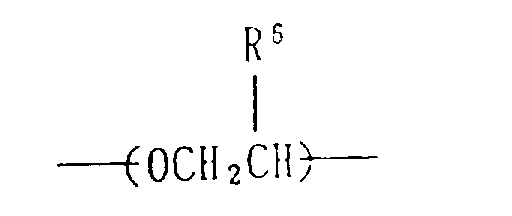
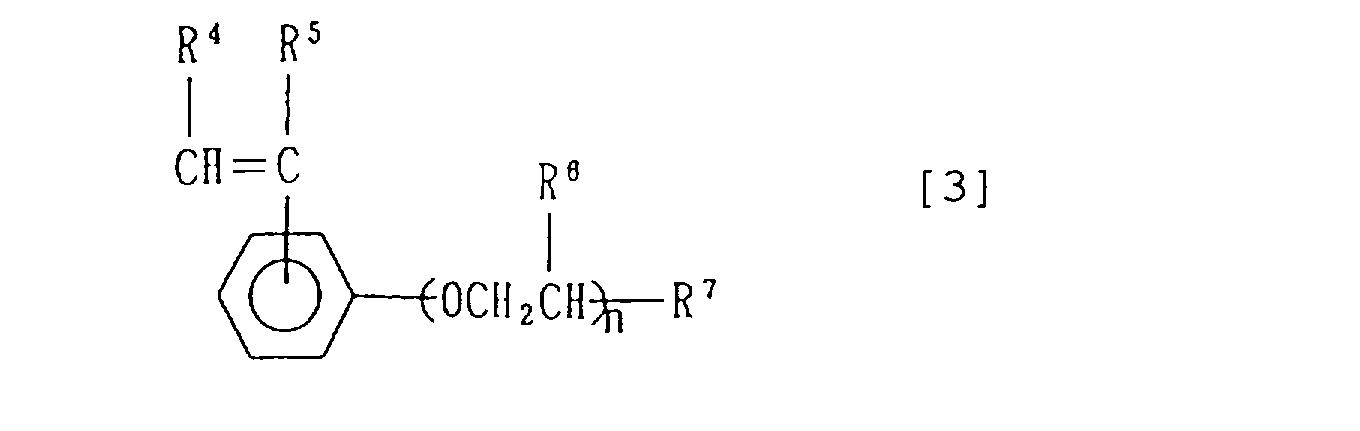
- Typical examples thereof are the compounds represented by the following general formulas [2], [3] and [4]: [wherein R 4 , R 5 and R 6 may be the same or different and are each a hydrogen atom or a methyl group; n is an integer of 10-200; R 7 is -OH, -OCH 3 , -SO 3 H or -SO 3 - M + (where M + is Na + , K + , Li + , NH 4 + or an organic ammonium group); R 6 s in the n groups represented by: may be the same or different; the above organic ammonium group may be a primary, secondary, tertiary or quaternary organic ammonium group, and the nitrogen atom has at least one organic group and 0-3 hydrogen atoms bonded
- the monomer (a) is preferably a compound of formula [2] or [3], particularly a compound of formula [2] or [3] wherein n is 30-200, particularly 40-150, in view of, for example, the dispersion stability of the resulting polymer fine particles when the monomer (b) is used in a large amount.
- Particularly preferable is a compound of formula [2] or [3] wherein R 4 is a hydrogen atom, R 5 is a hydrogen atom or a methyl group, and R 6 is a hydrogen atom.
- the monomer (b) used for forming the polymer fine particles of the present invention is at least one compound selected from the compounds represented by the following general formula [1]: (wherein R 1 is a hydrogen atom or a methyl group; and R 2 and R 3 may be the same or different and are each a hydrogen atom or an alkyl group having 1-5 carbon atoms with a proviso that the sum of the carbon atoms of R 2 and R 3 is 5 or less).
- the "alkyl group having 1-5 carbon atoms" which may be represented by R 2 or R 3 , can have a straight chain or a branched chain. Examples thereof are a methyl group, an ethyl group, a n-propyl group, an isopropyl group, a n-butyl group, an isobutyl group, a tert-butyl group and an amyl group.
- Typical examples of the monomer (b) represented by the above general formula [1] are acrylamide, methacrylamide, N-methylacrylamide, N-methylmethacrylamide, N,N-dimethylacrylamide, N,N-dimethylmethacrylamide, N-ethylacrylamide, N-ethylmethacrylamide, N-n-propylacrylamide, N-n-propylmethacrylamide, N-isopropylacrylamide, N-isopropylmethacrylamide and N-n-butylacrylamide. Of these, particularly preferable are acrylamide, methacrylamide, N-methylacrylamide and N-methylmethacrylamide.
- the crosslinkable unsaturated monomer (c) used for forming the polymer fine particles of the present invention is a component which contributes to the crosslinking of the formed particles, and is a compound having, in the molecule, at least one, preferably one to two, particularly one N-methylol or N-alkoxymethyl group and a polymerizable double bond.
- the alkoxy moiety of the "N-alkoxymethyl group” is generally an alkoxyl group having 1-6 carbon atoms; and a methoxy group, an ethoxy group, a n-propoxy group, an isopropoxy group, a n-butoxy group or a tert-butyl group is preferred.
- crosslinkable unsaturated monomer (c) are N-methylolacrylamide, N-methylolmethacrylamide, N-methoxymethylacrylamide, N-methoxymethylmethacrylamide, N-ethoxymethylacrylamide, N-ethoxymethylmethacrylamide, N-n-butoxymethylacrylamide and N-n-butoxymethylmethacrylamide.
- particularly preferable are N-methylolacrylamide, N-methylolmethacrylamide, N-methoxymethylacrylamide and N-n-butoxymethylacrylamide.
- the monomer (d) used as necessary for forming the polymer fine particles of the present invention is a compound other than the above monomers (a), (b) and (c), which has a polymerizable unsaturated group in the molecule and which is copolymerizable with the monomers (a), (b) and (c).
- Typical examples of the monomer (d) are C 1-24, alkyl or cycloalkyl esters of (meth)acrylic acid, such as methyl (meth)acrylate, ethyl (meth)acrylate, butyl (meth)acrylate, hexyl (meth)acrylate, octyl (meth)acrylate, lauryl (meth)acrylate, and cyclohexyl (meth)acrylate; C 2-8 hydroxyalkyl esters of (meth)acrylic acid, such as 2-hydroxyethyl (meth)acrylate, hydroxypropyl (meth)acrylate, and hydroxybutyl (meth)acrylate; carboxyl group-containing unsaturated monomers such as acrylic acid, methacrylic acid, crotonic acid, itaconic acid, maleic acid, fumaric acid, monobutyl itaconate, and monobutyl maleate; polymerizable unsaturated nitriles such as acryl
- the monomer (d) is a monomer having a functional group (e.g.
- the above copolymer can be subjected to crosslinking not only by the above-mentioned reaction between the N-methylol or N-alkoxymethyl groups but also by the reaction between the N-methylol or N-alkoxymethyl group of each monomer (c) unit and the functional group of each monomer (d) unit.
- the hydrophilic crosslinked polymer fine particles of the present invention can be produced by polymerizing the hydrophilic monomer (a), (meth)acrylamide type monomer (b), crosslinkable unsaturated monomer (c) and, as necessary, monomer (d) all mentioned above, in the absence of any dispersion stabilizer in an organic solvent soluble in water at 20°C in any proportion and capable of dissolving the above monomers but substantially incapable of dissolving the copolymer formed or in a mixed solvent of the organic solvent soluble in water at 20°C in any proportion and water.
- the proportions of the monomers used can be the same as those desired for the copolymer formed, and can be as follows, for example, Hydrophilic monomer (a) 2-50% by weight, preferably 2-40% by weight, more preferably 5-35% by weight (Meth)acrylamide type monomer (b) 20-97% by weight, preferably 40-97% by weight, more preferably 40-90% by weight Crosslinkable unsaturated monomer (c) 1-30% by weight, preferably 2-20% by weight, more preferably 2-15% by weight Monomer (d) 0-50% by weight, preferably 0-40% by weight, more preferably 0-35% by weight
- the amount of the hydrophilic monomer (a) is less than 2% by weight, it is difficult to sufficiently stabilize the polymer particles formed, and agglomerates are easily formed during polymerization or during storage.
- the amount is more than 50% by weight, the polymer particles formed dissolve easily in the reaction solvent and a large portion of the polymer formed is dissolved, making it impossible to form polymer fine particles satisfactorily.
- the amount of the (meth)acrylamide type monomer (b) is less than 20% by weight, the polymer formed dissolves easily in the reaction solvent, making it difficult to form polymer fine particles.
- the amount is more than 97% by weight, the stability of polymer fine particles during polymerization and during storage is insufficient and agglomerates are formed easily.
- the amount of the crosslinkable unsaturated monomer (c) is less than 1% by weight, the crosslinking degree of the polymer particles formed is low and, when other solvent is added later, the polymer particles may cause swelling and dissolution depending upon the solvent added.
- the amount is more than 30% by weight, agglomerates are formed in a large amount during polymerization, making it difficult to produce desired polymer fine particles stably.
- the hydrophilic monomer (a) used in production of the polymer fine particles of the present invention contains, in the molecule, a polyoxyalkylene or polyvinylpyrrolidone chain of high hydrophilicity and plays a role of dispersing and stabilizing the polymer formed. Therefore, no use of any dispersion stabilizer is necessary in production of the polymer fine particles of the present invention.
- reaction solvent a water-miscible organic solvent capable of dissolving the monomers mixture but substantially incapable of dissolving the copolymer formed, or a mixed solvent of the above water-miscible organic solvent and water.
- water-miscible refers to "soluble in water at 20°C in any proportion”.
- the water-miscible organic solvent can be any organic solvent as long as it satisfies the above requirement.
- particularly preferred from the standpoint of the polymerization stability is a water-miscible organic solvent containing at least 50% by weight, particularly at least 70% by weight of an organic solvent having a solubility parameter (SP) of generally 9-11, particularly 9.5-10.7.
- solubility parameter (SP) used in the present specification is based on the description made in Journal of Paint Technology, Vol. 42, No. 541, pp. 76-118 (Feb., 1970).
- Examples of the organic solvent having a SP of the above range are alkylene glycol monoalkyl ethers such as ethylene glycol monobutyl ether, propylene glycol monomethyl ether, ethylene glycol monoethyl ether, diethylene glycol monoethyl ether, and diethylene glycol monobutyl ether. Of these, particularly preferable are ethylene glycol monobutyl ether and propylene glycol monomethyl ether.
- the water-miscible organic solvent can contain, besides the organic solvent having a SP of 9-11, other water-miscible or water-immiscible organic solvent.
- the other organic solvent are water-miscible organic solvents such as methanol, ethanol, and isopropyl alcohol.
- the other organic solvent is used in an amount of 50% by weight or less, particularly 30% by weight or less based on the total amount of the organic solvents.
- the preferable content of water in the mixed solvent is generally 60 parts by weight or less, particularly 40 parts by weight or less per 100 parts by weight of the water-miscible organic solvent, in view of the polymerization stability of polymer formed.
- the copolymerization of the hydrophilic monomer (a), the (meth)acrylamide type monomer (b), the crosslinkable unsaturated monomer (c) and the monomer (d) is conducted generally in the presence of a radical polymerization initiator.
- the radical polymerization initiator can be one known per se.
- peroxides such as benzoyl peroxide, lauroyl peroxide, di-tert-butyl peroxide, cumene hydroperoxide, tert-butyl peroctoate, and tert-butyl peroxy-2-ethylhexanonate ;
- azo compounds such as 2,2'-azobisisobutyronitrile, 2,2'-azobis(2,4-dimethylvaleronitrile), 2,2'-azobis(4-methoxy-2,4-dimethylvaleronitrile), dimethyl 2,2'-azobisisobutyrate, and 4,4'-azobis(4-cyanopentanoic acid); amidine compounds such as 2,2'-azobis(2-amidinopropane) dihydrochloride, 2,2'-azobis(N,N'-dimethyleneisobutylamidine), and 2,2'-azobis(N,N'-dimethyleneisobutylamidine) dihydrochloride pers
- the amount of the radical polymerization initiator used can be generally 0.2-5% by weight based on the total amount of the monomers.
- the polymerization temperature can be varied depending upon the kind of the polymerization initiator used, but an appropriate polymerization temperature is generally 50 - 160°C, particularly 90-160°C.
- the reaction time can be 0.1-10 hours.
- a polymerization temperature of 90°C or more there occurs, during the polymerization, a crosslinking reaction between the N-methylol or N-alkoxymethyl groups of the monomer (c) and/or between the N-methylol or N-alkoxymethyl group of the monomer (c) and the functional group of the monomer (d) when the monomer (d) is present, whereby the intraparticle crosslinking of polymer particles can be allowed to proceed.
- the polymer formed is heated at a temperature of 90°C or more for 0.2-5 hours after the polymerization reaction to allow the intraparticle crosslinking to proceed.
- a crosslinking catalyst may be added as necessary to the polymerization system in order to allow the intraparticle crosslinking of polymer particles to proceed as quickly as possible during or after the polymerization reaction.
- the crosslinking catalyst includes, for example, strong acid catalysts such as dodecylbenzenesulfonic acid, and paratoluenesulfonic acid ; and polymerizable double bond-containing strong acid catalysts such as sulfoethyl methacrylate.
- the particle diameters of the present polymer fine particles produced as above there is no particular restriction as to the particle diameters of the present polymer fine particles produced as above.
- the polymer fine particles have an average particle diameter of generally 0.03-1 ⁇ m, preferably 0.05-0.6 ⁇ m in view of the stability of the polymer fine particles formed, the prevention of formation of agglomerates.
- This average particle diameter can be measured by the use of a particle diameter tester, for example, Coulter Model N4MD (a product of Coulter Co.).
- the polymer fine particles of the present invention have, at the surfaces, the chemically bonded polyoxyalkylene or polyvinylpyrrolidone chains derived from the monomer (a), with the chains oriented outward. Therefore, the polymer fine particles, although containing no dispersion stabilizer, are highly superior in polymerization stability in water-miscible organic solvent or in mixed solvent of said water-miscible organic solvent and water, as well as in dispersion stability during storage, and their surfaces are hydrophilic.
- the present polymer fine particles are crosslinked inside the particles owing to the presence of the monomer (c) units. Therefore, the polymer fine particles can hold the shape even in a medium (e.g. an aqueous coating) containing a large amount of water or even when heated (the particles are not easily melted by heating).
- a medium e.g. an aqueous coating
- the present polymer fine particles can find applications in hydrophilizing agent, liquid crystal spacer, column filler, non-staining coating, etc.
- the hydrophilic crosslinked polymer fine particles of the present invention can be made, in one preferable application, into a hydrophilic film-forming coating composition by mixing with an water-miscible film-forming resin in an aqueous medium substantially incapable of dissolving the polymer fine particles but capable of dissolving or dispersing the water-miscible film-forming resin.
- the water-miscible film-forming resin used in the preparation of the above coating composition can be any resin as long as it does not significantly impair the hydrophilicity of the polymer fine particles, can be dissolved in the aqueous medium or dispersed therein in fine particles (e.g. in the form of an emulsion), and can form a continuous resin film on the surface of the material coated.
- the water-miscible film-forming resin there can be used, for example, a polyvinyl alcohol, a polycarboxymethyl cellulose, an aqueous acrylic resin emulsion, an aqueous polyester emulsion, an aqueous polyurethane emulsion and an ethylene-acrylic acid ionomer resin.
- the amount of the water-miscible film-forming resin used can be varied over a wide range depending upon the application of the coating composition, but the resin is preferably used in a weight ratio of hydrophilic crosslinked polymer fine particles/water-miscible film-forming resin, of generally 1/99 to 90/10, particularly 10/90 to 80/20, more particularly 15/85 to 70/30.
- aqueous medium used in the hydrophilic film-forming coating composition there can be used water, or a mixed solvent of water and the above-mentioned water-miscible organic solvent wherein the content of water is 50% by weight or more, preferably 70% by weight or more.
- the solid content of the coating composition is not particularly restricted, but can be generally 3-60% by weight, preferably 5-50% by weight.
- the coating composition may further comprise, as necessary, coating additives such as neutralizing agent, surfactant, curing agent, levelling agent, antifungal agent, coloring pigment, rust-preventive pigment, and extender pigment.
- the surfactant includes, for example, a salt of a dialkylsulfosuccinic acid ester and an alkylene oxide silane compound.
- the curing agent includes, for example, an amino-aldehyde resin, a blocked isocyanate compound, a polyepoxy compound and a chelate compound of a metal selected from Ti, Zr and Al.
- the coating composition of the present invention can form a hydrophilic film by being coated on a material (article) to be coated and being dried and can therefore be widely used in applications wherein the formation of a hydrophilic film is desired.
- the material to be coated includes metals (e.g. iron, aluminum, zinc, copper, tin and metal-plated steel); plastics; glass; and wood.
- the film thickness in which the coating composition is coated can generally be 0.5-5.0 ⁇ m as dried film thickness when the material to be coated is an aluminum fin of heat exchanger.
- the hydrophilic crosslinked polymer fine particles are superior in polymerization stability in solvent as well as in dispersion stability during storage, undergo no adverse effect by dispersion stabilizer owing to no use of the stabilizer, and can be suitably used for formation of a hydrophilic film.
- the hydrophilic film-forming aqueous coating composition containing the hydrophilic crosslinked polymer fine particles of the present invention when coated on a material to be coated, can form fine unevenness thereon owing to the presence of hydrophilic resin fine particles and moreover can exhibit excellent hydrophilicity because the fine particles themselves have hydrophilicity.
- the coating composition is coated on an aluminum fin to form a film thereon and the resulting fin is subjected to molding, as compared with a case using a conventional coating containing inorganic particles of silica, the abrasion of mold during molding is less because the hydrophilic resin fine particles are softer than the inorganic particles.
- the resulting dispersion was an opaque white stable dispersion having a solid content of 20% and an average particle diameter (of resin particles) of 345 nm.
- the resulting dispersion was an opaque white stable dispersion having a solid content of 20% and an average particle diameter (of resin particles) of 441 nm.
- Polymerization was conducted in the same manner as in Example 1 except that the mixture used in Example 1 was changed to the following mixture of monomers, a solvent and an initiator.
- Polyvinylpyrrolidone macromonomer solution (solid content: 52%) obtained in Production Example 2 38.5 parts Acryl amide 50 parts N-methylolacrylamide 20 parts 2-Hydroxyethyl methacrylate 10 parts Propylene glycol monomethyl ether 181.5 parts 2,2'-Azobis(2-methylbutyronitrile) 1.5 parts
- the resulting dispersion was an opaque white stable dispersion having a solid content of 20% and an average particle diameter (of resin particles) of 254 nm.
- Example 2 Polymerization was conducted in the same manner as in Example 1 except that the mixture used in Example 1 was changed to the following mixture of monomers, solvents and an initiator.
- Deionized water 40 parts Ammonium persulfate 1.5 parts
- the resulting dispersion was an opaque white stable dispersion having a solid content of 20% and an average particle diameter (of resin particles) of 629 nm.
- Example 2 Polymerization was conducted in the same manner as in Example 1 except that the mixture used in Example 1 was changed to the following mixture of monomers, a solvent and an initiator.
- Blemmer PME-4000® 40 parts Acrylamide 40 parts N-methylolacrylamide 20 parts
- Propylene glycol monomethyl ether 200 parts
- the resulting dispersion was an opaque white stable dispersion having a solid content of 20% and an average particle diameter (of resin particles) of 339 nm.
- Example 2 Polymerization was conducted in the same manner as in Example 1 except that the mixture used in Example 1 was changed to the following mixture of monomers, a solvent and an initiator.
- RMA-300M® 20 parts Acrylamide 40 parts Methacrylamide 15 parts N-methylolacrylamide 15 parts 2-Hydroxyethyl methacrylate 10 parts
- Propylene glycol monomethyl ether 200 parts 2,2'-Azobis(2-methylbutyronitrile) 1.5 parts
- the resulting dispersion was an opaque white stable dispersion having a solid content of 20% and an average particle diameter (of resin particles) of 339 nm.
- Example 2 Polymerization was conducted in the same manner as in Example 1 except that the mixture used in Example 1 was changed to the following mixture of monomers, a solvent and an initiator.
- Acryl amide 75 parts N-methylolacrylamide 25 parts
- Propylene glycol monomethyl ether 200 parts
- the resulting polymer became large agglomerates and no stable dispersion could be obtained.
- Example 2 Polymerization was conducted in the same manner as in Example 1 except that the Blemmer PME-4000® used in Example 1 was changed to a polyethylene glycol 4000 having no polymerizable double bond (a product of Wako Pure Chemical Industries, Ltd.). The resulting polymer became large agglomerates and no stable dispersion could be obtained.
- Example 2 Polymerization was conducted in the same manner as in Example 1 except that the mixture used in Example 1 was changed to the following mixture of monomers, a solvent and an initiator.
- Blemmer PME-4000® 1 part Acrylamide 89 parts N-methylolacrylamide 10 parts
- Propylene glycol monomethyl ether 200 parts
- the resulting polymer became large agglomerates and no stable dispersion could be obtained.
- Example 2 Polymerization was conducted in the same manner as in Example 1 except that the mixture used in Example 1 was changed to the following mixture of monomers, solvents and an initiator.
- RMA-300M® 55 parts Acrylamide 15 parts N-methylolacrylamide 10 parts 2-Hydroxyethyl methacrylate 20 parts Propylene glycol monomethyl ether 140 parts Deionized water 60 parts Ammonium persulfate 1.5 parts
- the resulting polymer did not become particles and became a gel.
- Example 2 Polymerization was conducted in the same manner as in Example 1 except that the mixture used in Example 1 was changed to the following mixture of monomers, a solvent and an initiator.
- the resulting dispersion was an opaque white stable dispersion having a solid content of 20% and an average particle diameter (of resin particles) of 195 nm.
- the dispersion however, dissolved in water when diluted with water.
- Example 2 Polymerization was conducted in the same manner as in Example 1 except that the mixture used in Example 1 was changed to the following mixture of monomers, solvents and an initiator.
- the resulting polymer became large agglomerates and no stable dispersion could be obtained.
- the resulting dispersion was an opaque white stable dispersion having a solid content of 20% and an average particle diameter (of resin particles) of 539 nm.
- Hydrophilic film-forming coating compositions were prepared by mixing and stirring the following components in the following amounts.
- An aqueous PVA solution (solid content: 16%) obtained by dissolving, in water, a almost completely saponified PVA [Poval PVA-117 (trade name) manufactured by Kuraray Co., Ltd.] 100 parts (16 parts as solid) Diisopropoxy-bis(acetylacetonato)titanium 1 part Dispersion of resin fine particles, obtained in one of Examples 1-6 and Comparative Examples 6 and 8 Parts (as solid) shown in Table 1
- Each of the hydrophilic film-forming coating compositions obtained in Examples 7-14 and Comparative Examples 9-10 was coated on a chromate-treated aluminum plate (A1050; thickness: 0.1 mm) in a film thickness (as dried) of 1 ⁇ m by the use of a bar coater.
- the resulting aluminum plate was subjected to baking for 45 seconds in a hot air of 220°C so that the temperature of the aluminum plate reached 215°C, whereby a coated plate was obtained.
- a volatile press oil was applied onto the coated plate, followed by drying at 150°C for 5 minutes, to obtain various coated plates for test.
- Each of the coated plates for test was tested for hydrophilicty (water wettability and contact angle of water drop) according to the following test methods. The test results are shown in Table 1.
- a coated plate (1) or (2) was immersed in a tap water placed in a beaker, for 10 seconds and then pulled up. Immediately, the water-wet condition of the plate surface was examined visually and rated according to the following yardstick.
- the contact angle between coated plate (1) or (2) and water was measured by drying the plate at 80°C for 5 minutes and then subjecting the plate to contact angle measurement using a contact angle meter DCAA (a product of Kyowa Kagaku K.K. ).
Landscapes
- Chemical & Material Sciences (AREA)
- Engineering & Computer Science (AREA)
- Organic Chemistry (AREA)
- Life Sciences & Earth Sciences (AREA)
- Materials Engineering (AREA)
- Wood Science & Technology (AREA)
- Nanotechnology (AREA)
- Chemical Kinetics & Catalysis (AREA)
- Health & Medical Sciences (AREA)
- Medicinal Chemistry (AREA)
- Polymers & Plastics (AREA)
- Addition Polymer Or Copolymer, Post-Treatments, Or Chemical Modifications (AREA)
- Compositions Of Macromolecular Compounds (AREA)
- Polymerisation Methods In General (AREA)
- Paints Or Removers (AREA)
- Macromonomer-Based Addition Polymer (AREA)
Claims (20)
- Particules fines de polymère réticulé hydrophile, constitué d'un copolymère composé :de 2 à 50 % en poids de (a) un monomère hydrophile ayant au moins une double liaison polymérisable et une chaíne polyoxyalkylène ou polyvinylpyrrolidone dans la molécule,de 20 à 97 % en poids de (b) au moins un monomère de type (méth)acrylamide pris dans le groupe constitué de composés représentés par la formule générale suivante [1]:(où R1 est un atome d'hydrogène ou un groupe méthyle ; et R2 et R3 peuvent être identiques ou différents et représentent chacun un atome d'hydrogène ou un groupe alkyle ayant de 1 à 5 atomes de carbone, à la condition que la somme des atomes de carbone de R2 et de R3 soit égale à 5 ou moins),
 de 1 à 30 % en poids de (c) un monomère réticulable insaturé ayant au moins un groupe N-méthylol ou N-alcoxyméthyle et une double liaison polymérisable dans la molécule, etde 0 à 50 % en poids de (d) un monomère autre que (a), (b) et (c) ci-dessus, ayant un groupe polymérisable insaturé dans la molécule et lequel est copolymérisable avec les monomères (a), (b) et (c).
 - Particules fines de polymère selon la revendication 1, où le monomère hydrophile (a) possède une double liaison polymérisable dans la molécule.
- Particules fines de polymère selon la revendication 1, où le monomère hydrophile (a) est pris dans le groupe constitué de composés représentés par les formules générales suivantes [2], [3] et [4] :[où R4, R5 et R6 peuvent être identiques ou différents et représentent chacun un atome d'hydrogène ou un groupe méthyle ; n est un entier de 10 à 200 ; R7 est -OH, -OCH3, -SO3H ou -SO3 -M+ (où M+ est Na+, K+, Li+, NH4 + ou un groupe ammonium organique) ; et les R6 dans les groupes avec l'indice n représentés par :
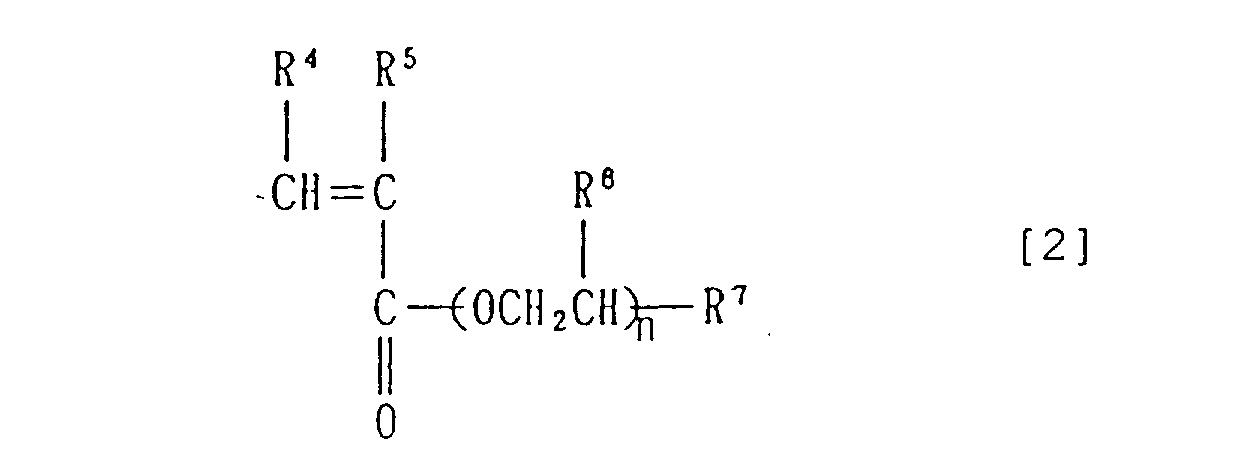 peuvent être identiques ou différents],
 (où R4, R5, R6, R7 et n ont les mêmes définitions que celles données ci-dessus),
 (où R4 et R5 ont les mêmes définitions que celles données ci-dessus) ;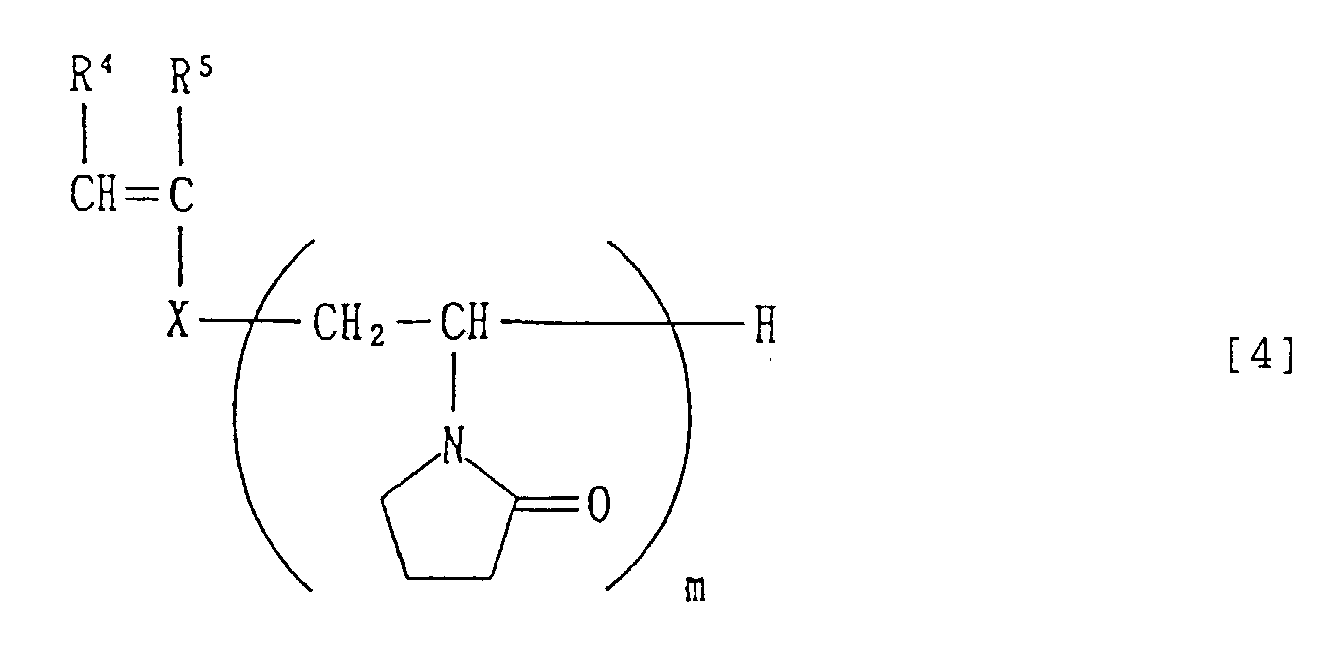
X est un groupe organique bivalent ayant de 5 à 10 atomes de carbone, lequel peut contenir un ou des atome(s) de O, S ou N ; et m est un entier de 10 à 100). - Particules fines de polymère selon la revendication 3, où le monomère hydrophile (a) est un composé de formule [2] ou [3].
- Particules fines de polymère selon la revendication 4, où n est un entier de 30 à 200.
- Particules fines de polymère selon la revendication 4, où R4 est un atome d'hydrogène, R5 est un atome d'hydrogène ou un groupe méthyle et R6 est un atome d'hydrogène.
- Particules fines de polymère selon la revendication 1, où le monomère (b) de type (méth)acrylamide est pris dans le groupe constitué d'acrylamide, de méthacrylamide, de N-méthylacrylamide, de N-méthylméthacrylamide, de N,N-diméthylacrylamide, de N,N-diméthylaméthacrylamide, de N-éthylacrylamide, de N-éthylméthacrylamide, de N-n-propylacrylamide, de N-n-propylméthacrylamide, de N-isopropylacrylamide, de N-isopropylméthacrylamide et de N-n-butylacrylamide.
- Particules fines de polymère selon la revendication 1, où le monomère réticulant insaturé (c) possède un groupe N-méthylol ou N-(alcoxy en C1-6)-méthyle et une double liaison polymérisable dans la molécule.
- Particules fines de polymère selon la revendication 1, où le monomère insaturé réticulant (c) est pris dans le groupe constitué de N-méthylolacrylamide, de N-méthylolméthacrylamide, de N-méthoxyméthylacrylamide, de N-méthoxyméthylméthacrylamide, de N-éthoxyméthylacrylamide, de N-éthoxyméthylméthacrylamide, de N-n-butoxyméthylacrylamide et de N-n-butoxyméthylméthacrylamide.
- Particules fines de polymère selon la revendication 1, où le monomère (d) est pris dans le groupe constitué d'esters d'alkyles ou de cycloalkyles en C1-24 d'acide (méth)acrylique, d'esters d'hydroxyalkyles en C2-8 d'acide (méth)acrylique, d'un monomère insaturé contenant un groupe carboxyle, d'un nitrile insaturé polymérisable, d'un composé vinylique aromatique, d'un ester d'alkyle en C3-8 azoté d'acide (méth)acrylique, d'un monomère insaturé contenant un groupe époxy, d'une α-oléfine, d'un composé diénique, d'un ester vinylique et d'un éther vinylique.
- Particules fines de polymère selon la revendication 1, constitué d'un copolymère composé :de 2 à 40 % en poids du monomère hydrophile (a),de 40 à 97 % en poids du monomère (b) de type (méth)acrylamide,de 2 à 20 % en poids du monomère insaturé réticulable (c), etde 0 à 40 % en poids du monomère (d).
- Particules fines de polymère selon la revendication 1, ayant une granulométrie moyenne de 0,03 à 1 µm.
- Particules fines de polymère selon la revendication 1, lesquels sont préparées par polymérisation du monomère hydrophile (a), du monomère (b) de type (méth)acrylamide, du monomère insaturé réticulant (c) et, si nécessaire, du monomère (d), en l'absence de tout stabilisant de dispersion, dans un solvant organique soluble dans n'importe quelle proportion dans l'eau à 20°C et capable de dissoudre les monomères ci-dessus, mais essentiellement incapable de dissoudre le copolymère formé, ou bien dans un solvant mixte dudit solvant organique soluble dans n'importe quelle proportion dans l'eau à 20°C et de l'eau.
- Procédé pour la préparation de particules fines de polymère hydrophile, réticulé, ayant une granulométrie moyenne de 0,03 à 1 µm, qui comprend la polymérisation :de 2 à 50 % en poids de (a) monomère hydrophile ayant au moins une double liaison polymérisable et une chaíne polyoxyalkylène ou polyvinylpyrrolidone dans la molécule,de 20 à 97 % en poids de (b) au moins un monomère de type (méth)acrylamide pris dans le groupe constitué de composés représentés par la formule générale suivante [1]:(où R1 est un atome d'hydrogène ou un groupe méthyle ; et R2 et R3 peuvent être identiques ou différents et représentent chacun un atome d'hydrogène ou un groupe alkyle ayant de 1 à 5 atomes de carbone, à la condition que la somme des atomes de carbone de R2 et de R3 soit égalé à 5 ou moins),
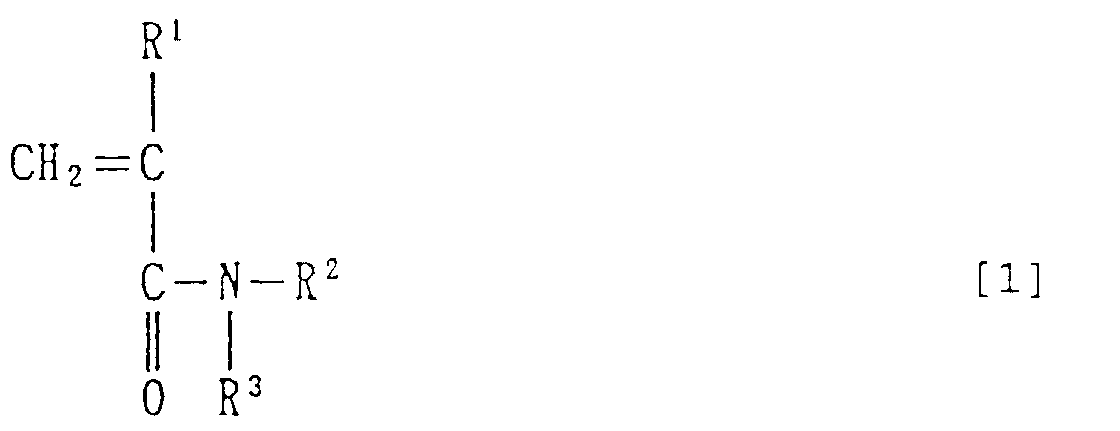 de 1 à 30 % en poids de monomère insaturé réticulable (c) ayant au moins un groupe N-méthylol ou N-alcoxyméthyle et une double liaison polymérisable dans la molécule, etde 0 à 50 % en poids de (d) monomère autre que (a), (b) et (c), ayant un groupe insaturé polymérisable dans la molécule,
en l'absence de tout stabilisant de dispersion dans un solvant organique soluble dans n'importe quelle proportion dans l'eau à 20°C et capable de dissoudre les monomères ci-dessus, mais essentiellement incapable de dissoudre le copolymère formé, ou bien dans un solvant mixte dudit solvant organique soluble dans l'eau à 20°C, dans n'importe quelle proportion, et de l'eau. - Procédé selon la revendication 14, où le solvant organique soluble dans n'importe quelle proportion dans l'eau à 20°C, présente un paramètre de solubilité de 9 à 11.
- Procédé selon la revendication 14, où la polymérisation est réalisée à une température de 90 à 160°C.
- Composition de revêtement formant un film hydrophile comprenant :de fines particules de polymère hydrophile réticulé selon la revendication 1,une résine filmogène soluble dans n'importe quelle proportiondans l'eau à 20°C etun milieu aqueux essentiellement incapable de dissoudre lesdites particules fines de polymère mais capable de dissoudre ou de disperser ladite résine filmogène soluble dans n'importe quelle proportion dans l'eau à 20°C.
- Composition selon la revendication 17, où la résine filmogène, soluble dans n'importe quelle proportion dans l'eau à 20°C, est prise dans le groupe constitué d'un poly(alcool vinylique), d'une polycarboxyméthylcellulose, d'une émulsion aqueuse de résine acrylique, d'une émulsion aqueuse de polyester, d'une émulsion aqueuse de polyuréthanne et d'une résine ionomère d'acide éthylène-acrylique.
- Composition selon la revendication 17, où le rapport pondéral des particules fines de polymère hydrophile/résine filmogène soluble dans n'importe quelle proportion dans l'eau à 20°C est de 1/99 à 90/10.
- Article revêtu d'une composition de revêtement formant un film hydrophile selon la revendication 17.
Applications Claiming Priority (2)
| Application Number | Priority Date | Filing Date | Title |
|---|---|---|---|
| JP6284340A JPH08120003A (ja) | 1994-10-24 | 1994-10-24 | 親水性架橋重合体微粒子及びその製造方法 |
| JP284340/94 | 1994-10-24 |
Publications (2)
| Publication Number | Publication Date |
|---|---|
| EP0709409A1 EP0709409A1 (fr) | 1996-05-01 |
| EP0709409B1 true EP0709409B1 (fr) | 1998-03-25 |
Family
ID=17677312
Family Applications (1)
| Application Number | Title | Priority Date | Filing Date |
|---|---|---|---|
| EP95116749A Expired - Lifetime EP0709409B1 (fr) | 1994-10-24 | 1995-10-24 | Particules fines de polymères réticulés hydrophiliques et procédé de leur préparation |
Country Status (4)
| Country | Link |
|---|---|
| US (1) | US5621058A (fr) |
| EP (1) | EP0709409B1 (fr) |
| JP (1) | JPH08120003A (fr) |
| DE (1) | DE69501867T2 (fr) |
Families Citing this family (21)
| Publication number | Priority date | Publication date | Assignee | Title |
|---|---|---|---|---|
| JP3819956B2 (ja) * | 1995-09-22 | 2006-09-13 | 関西ペイント株式会社 | 親水化処理用組成物及び親水化処理方法 |
| US6506478B1 (en) * | 2000-06-09 | 2003-01-14 | 3M Innovative Properties Company | Inkjet printable media |
| US7147873B2 (en) | 2002-01-16 | 2006-12-12 | 3M Innovative Properties Company | Antiseptic compositions and methods |
| US7005031B2 (en) * | 2002-01-16 | 2006-02-28 | 3M Innovative Properties Company | Pressure sensitive adhesives having quaternary ammonium functionality, articles, and methods |
| US6838078B2 (en) | 2002-01-16 | 2005-01-04 | 3M Innovative Properties Company | Film-forming compositions and methods |
| JP3999746B2 (ja) * | 2003-05-19 | 2007-10-31 | ローム アンド ハース カンパニー | ポリマーナノ粒子の高固形分調製方法 |
| JP4464076B2 (ja) * | 2003-06-09 | 2010-05-19 | 日本ペイント株式会社 | 架橋性微粒子、親水処理剤、親水皮膜被覆方法及び親水皮膜 |
| US20050080209A1 (en) * | 2003-10-08 | 2005-04-14 | Blankenship Robert Mitchell | Continuous production of crosslinked polymer nanoparticles |
| DE102004049609A1 (de) * | 2004-10-12 | 2006-04-13 | Mitsubishi Polyester Film Gmbh | Polyesterfolie mit hydrophiler Beschichtung, Verfahren zu ihrer Herstellung und ihre Verwendung |
| US7504466B2 (en) * | 2004-11-04 | 2009-03-17 | Rohm And Haas Company | High solids preparation of crosslinked polymer particles |
| JP5001015B2 (ja) | 2006-09-28 | 2012-08-15 | 富士フイルム株式会社 | 非特異吸着を抑制した表面を有する生化学用器具 |
| JP5180145B2 (ja) * | 2009-05-20 | 2013-04-10 | 日本ペイント株式会社 | 架橋性微粒子、親水処理剤、親水皮膜被覆方法及び親水皮膜 |
| JP5635766B2 (ja) * | 2009-12-14 | 2014-12-03 | 関西ペイント株式会社 | エマルション樹脂系塗料 |
| JP5635778B2 (ja) * | 2010-01-22 | 2014-12-03 | 関西ペイント株式会社 | エマルション樹脂系塗料 |
| JP5635799B2 (ja) * | 2010-04-16 | 2014-12-03 | 関西ペイント株式会社 | エマルション樹脂系塗料 |
| EP2698669A4 (fr) | 2011-04-12 | 2014-11-26 | Nissan Chemical Ind Ltd | Particule organique photosensible |
| WO2012165494A1 (fr) * | 2011-05-31 | 2012-12-06 | 関西ペイント株式会社 | Composition de matière de revêtement hydrophile et procédé d'hydrophilisation |
| JP5866182B2 (ja) * | 2011-11-17 | 2016-02-17 | 住友ゴム工業株式会社 | 共重合体、ゴム組成物及び空気入りタイヤ |
| JP5179679B1 (ja) * | 2012-05-28 | 2013-04-10 | 日本ビー・ケミカル株式会社 | 架橋樹脂微粒子及び塗料組成物 |
| JP5995546B2 (ja) | 2012-06-19 | 2016-09-21 | 日本ペイント・サーフケミカルズ株式会社 | アルミニウム製フィン材の親水皮膜被覆方法、アルミニウム製フィン材及びアルミニウム製熱交換器 |
| JP7194587B2 (ja) | 2018-12-28 | 2022-12-22 | 日本ペイント・サーフケミカルズ株式会社 | 親水化処理剤、親水皮膜形成方法、および親水皮膜 |
Family Cites Families (5)
| Publication number | Priority date | Publication date | Assignee | Title |
|---|---|---|---|---|
| NL246911A (fr) * | 1958-03-06 | |||
| CH478286A (de) * | 1967-04-24 | 1969-10-31 | Ciba Geigy | Verwendung von Copolymerisaten zum Veredeln von Textilien |
| US4792593A (en) * | 1987-11-05 | 1988-12-20 | Exxon Research And Engineering Company | Novel acrylamide acrylate copolymers |
| US4981936A (en) * | 1989-04-14 | 1991-01-01 | Polypure, Inc. | Terpolymer of oxyalkyene acrylates, acrylamides and quaternary monomers |
| JP3054447B2 (ja) | 1990-01-05 | 2000-06-19 | 三菱製紙株式会社 | 水溶性ポリマー微粒子の製造方法 |
-
1994
- 1994-10-24 JP JP6284340A patent/JPH08120003A/ja active Pending
-
1995
- 1995-10-24 DE DE69501867T patent/DE69501867T2/de not_active Expired - Fee Related
- 1995-10-24 EP EP95116749A patent/EP0709409B1/fr not_active Expired - Lifetime
- 1995-10-24 US US08/547,539 patent/US5621058A/en not_active Expired - Fee Related
Also Published As
| Publication number | Publication date |
|---|---|
| DE69501867T2 (de) | 1998-07-23 |
| DE69501867D1 (de) | 1998-04-30 |
| EP0709409A1 (fr) | 1996-05-01 |
| JPH08120003A (ja) | 1996-05-14 |
| US5621058A (en) | 1997-04-15 |
Similar Documents
| Publication | Publication Date | Title |
|---|---|---|
| EP0709409B1 (fr) | Particules fines de polymères réticulés hydrophiliques et procédé de leur préparation | |
| CN100467502C (zh) | 减振器用水基乳液 | |
| CN101277979B (zh) | 水性固化性树脂组合物 | |
| GB1593790A (en) | Thermosetting paint composition comprising a thermosetting resin produced from an amphoionic monomer | |
| CN100348632C (zh) | 交联性微粒、亲水处理剂、亲水性被膜的涂覆方法和亲水性被膜 | |
| KR102910014B1 (ko) | 친수화 처리제 및 친수 피막의 형성 방법 | |
| CN107614633A (zh) | 亲水化处理剂、亲水皮膜形成方法及亲水皮膜 | |
| EP0780411B1 (fr) | Particules fines de polymère hydrophile réticulé et leur procédé de préparation | |
| US8741985B2 (en) | Resin emulsion for sealer | |
| EP1241193A2 (fr) | Polymères cationiques en dispersion colloidale pour revêtements par jet d'encre | |
| CN101228247A (zh) | 减振材料用乳液 | |
| CN110506085A (zh) | 亲水化处理剂和亲水性皮膜的形成方法 | |
| US5681889A (en) | Hydrophilic crosslinked polymer fine particles and process for production thereof | |
| JP5030779B2 (ja) | 制振材用エマルション | |
| JP2020085492A (ja) | 樹脂エマルションの機械的安定性評価方法 | |
| CN110431200B (zh) | 减振涂料用树脂乳液、减振涂料、和减振涂料用树脂乳液的制造方法 | |
| JPH09267034A (ja) | 消泡性ノニオン系高分子界面活性剤及びその用途 | |
| JP3394588B2 (ja) | 水性被覆材組成物 | |
| KR102636889B1 (ko) | N-비닐카르복실산아미드의 중합체를 포함하는 수성 도공액용 조성물 | |
| JP7129481B2 (ja) | 水性分散体、その製造方法、塗料組成物及び塗膜 | |
| JP7745072B1 (ja) | 縮合反応性ミクロゲル分散体、及びその製造方法、親水化処理剤、親水化処理方法、並びに親水皮膜 | |
| JP2009127028A (ja) | 水性塗料用親水化剤および該親水化剤が含まれてなる水性塗料組成物 | |
| CN112534021A (zh) | 减振材料用树脂组合物 | |
| DE69504694T2 (de) | Feine Partikel von hydrophilen vernetzten Polymerisaten und Verfahren zu ihrer Herstellung | |
| JP2004107518A (ja) | 建材用エマルション塗料 |
Legal Events
| Date | Code | Title | Description |
|---|---|---|---|
| PUAI | Public reference made under article 153(3) epc to a published international application that has entered the european phase |
Free format text: ORIGINAL CODE: 0009012 |
|
| AK | Designated contracting states |
Kind code of ref document: A1 Designated state(s): DE GB |
|
| 17P | Request for examination filed |
Effective date: 19960624 |
|
| 17Q | First examination report despatched |
Effective date: 19970113 |
|
| GRAG | Despatch of communication of intention to grant |
Free format text: ORIGINAL CODE: EPIDOS AGRA |
|
| GRAG | Despatch of communication of intention to grant |
Free format text: ORIGINAL CODE: EPIDOS AGRA |
|
| GRAH | Despatch of communication of intention to grant a patent |
Free format text: ORIGINAL CODE: EPIDOS IGRA |
|
| GRAH | Despatch of communication of intention to grant a patent |
Free format text: ORIGINAL CODE: EPIDOS IGRA |
|
| GRAA | (expected) grant |
Free format text: ORIGINAL CODE: 0009210 |
|
| AK | Designated contracting states |
Kind code of ref document: B1 Designated state(s): DE GB |
|
| REF | Corresponds to: |
Ref document number: 69501867 Country of ref document: DE Date of ref document: 19980430 |
|
| PGFP | Annual fee paid to national office [announced via postgrant information from national office to epo] |
Ref country code: DE Payment date: 19981027 Year of fee payment: 4 |
|
| PLBE | No opposition filed within time limit |
Free format text: ORIGINAL CODE: 0009261 |
|
| STAA | Information on the status of an ep patent application or granted ep patent |
Free format text: STATUS: NO OPPOSITION FILED WITHIN TIME LIMIT |
|
| 26N | No opposition filed | ||
| PG25 | Lapsed in a contracting state [announced via postgrant information from national office to epo] |
Ref country code: GB Free format text: LAPSE BECAUSE OF NON-PAYMENT OF DUE FEES Effective date: 19991024 |
|
| GBPC | Gb: european patent ceased through non-payment of renewal fee |
Effective date: 19991024 |
|
| PG25 | Lapsed in a contracting state [announced via postgrant information from national office to epo] |
Ref country code: DE Free format text: LAPSE BECAUSE OF NON-PAYMENT OF DUE FEES Effective date: 20000801 |