EP0709477B1 - Alliage réfractaire et soudable à base de nickel - Google Patents
Alliage réfractaire et soudable à base de nickel Download PDFInfo
- Publication number
- EP0709477B1 EP0709477B1 EP19950114242 EP95114242A EP0709477B1 EP 0709477 B1 EP0709477 B1 EP 0709477B1 EP 19950114242 EP19950114242 EP 19950114242 EP 95114242 A EP95114242 A EP 95114242A EP 0709477 B1 EP0709477 B1 EP 0709477B1
- Authority
- EP
- European Patent Office
- Prior art keywords
- content
- alloy
- weldability
- point
- based alloy
- Prior art date
- Legal status (The legal status is an assumption and is not a legal conclusion. Google has not performed a legal analysis and makes no representation as to the accuracy of the status listed.)
- Expired - Lifetime
Links
Images



Classifications
-
- C—CHEMISTRY; METALLURGY
- C22—METALLURGY; FERROUS OR NON-FERROUS ALLOYS; TREATMENT OF ALLOYS OR NON-FERROUS METALS
- C22C—ALLOYS
- C22C19/00—Alloys based on nickel or cobalt
- C22C19/03—Alloys based on nickel or cobalt based on nickel
- C22C19/05—Alloys based on nickel or cobalt based on nickel with chromium
- C22C19/051—Alloys based on nickel or cobalt based on nickel with chromium and Mo or W
- C22C19/056—Alloys based on nickel or cobalt based on nickel with chromium and Mo or W with the maximum Cr content being at least 10% but less than 20%
-
- C—CHEMISTRY; METALLURGY
- C22—METALLURGY; FERROUS OR NON-FERROUS ALLOYS; TREATMENT OF ALLOYS OR NON-FERROUS METALS
- C22C—ALLOYS
- C22C19/00—Alloys based on nickel or cobalt
- C22C19/03—Alloys based on nickel or cobalt based on nickel
- C22C19/05—Alloys based on nickel or cobalt based on nickel with chromium
- C22C19/051—Alloys based on nickel or cobalt based on nickel with chromium and Mo or W
- C22C19/055—Alloys based on nickel or cobalt based on nickel with chromium and Mo or W with the maximum Cr content being at least 20% but less than 30%
Definitions
- the present invention relates to a heat-resistant nickel-based alloy that can be used as a material for forming the stationary turbine vane of a gas turbine and other parts to be exposed to high temperatures.
- Heat-resistant alloys heretofore used as materials for parts to be exposed to high temperatures include an Ni-based alloy which enjoys the effects of both strengthening through precipitation of an intermetallic compound Ni 3 (Al,Ti), i.e., a ⁇ ' phase, and strengthening through solid solution with Mo, W, etc., and a Co-based alloy strengthened through precipitation of a carbide.
- an increase in the amount of precipitation of the ⁇ ' phase generally tends to lower the weldability of the alloy, though it improves the high-temperature strength of the alloy.
- this is clear from the fact that an alloy increased in the amount of precipitation of the ⁇ ' phase to improve the high-temperature strength thereof (Japanese Patent Publication No. 6,968/1979) is very poor in weldability, while an alloy decreased in the amount of precipitation of the ⁇ ' phase to improve the weldability thereof (Japanese Patent Laid-Open No. 104,738/1989) is very low in high-temperature strength.
- the Co-based alloy though generally good in weldability, is low in high-temperature strength, and no remarkable improvement can be expected.
- the Ni-based alloy since the high-temperature strength of the Co-based alloy is limited, the Ni-based alloy must be improved in weldability without detriment to the high-temperature strength thereof.
- the contents of ⁇ ' phase-forming elements such as Al and Ti should not be lowered, but the contents of other elements such as W, C, and Zr must be adjusted for the desired purpose of obtaining an alloy which can be used to produce, for example, welded structures to be used at high temperatures, such as the stationary vane of a gas turbine and apparatuses having a welded structure.
- the performance of such an alloy is characterized by a creep rupture life of at least 110 hours as measured under 20 kgf/mm 2 at 900°C, and a maximum crack length of at most 0.8 mm, as measured using 5x60x100 mm test pieces TIG-welded to each other under welding conditions involving a welding current of 100 A, a welding voltage of 12 V and a welding speed of 1.67 mm/sec, according to a varestraint test wherein the added strain (total strain) is 0.25% or 0.77%.
- an alloy having an excellent high-temperature strength and a good weldability can be obtained by increasing the high-temperature strength through the addition of Cr and Co within such respective ranges of contents as not to form deleterious phases such as a ⁇ phase and a ⁇ phase and further addition of ⁇ ' phase-forming elements such as Al, Ti, Nb and Ta as well as solid solution strengthening elements, such as W and Mo, while at the same time improving the weldability through the addition of suitable amounts of C, Zr and B liable to segregate in grain boundaries, as corresponds to an alloy composition which will be described later; and that a Ni-based alloy usable as a material for parts to be exposed to high temperatures and used in a low-grade fuel such as heavy oil, i.e., having excellent oxidation resistance and corrosion resistance as well, can be prepared.
- the present invention has been completed based on these findings.
- Fig. 1 is a diagram showing the scope of the alloy of the present invention and the test results with respect to creep rupture life.
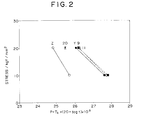
- Fig. 2 is a diagram showing a comparison of alloys tested for creep rupture strength.
- Fig. 3 is a diagram showing the relationship between the maximum varestraint crack length and the creep rupture life.
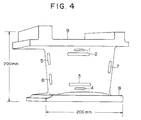
- Fig. 4 is a perspective view of the stationary vane of a gas turbine produced using the alloy of the present invention and subjected to a weldability test.
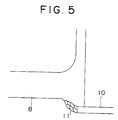
- Fig. 5 is an illustration of the welded portion in the weldability test.
- Figs. 6A and 6B are illustrations of the essentials of the varestraint test carried out for the evaluation of weldabilities of alloys according to the present invention and comparative alloys.
- C forms a carbide which precipitates particularly in crystal grain boundaries and in dendrite boundaries to strengthen the grain boundaries and the dendrite boundaries.
- the strengthening effect thereof is negligible.
- it exceeds 0.25% the ductility and creep strength of the alloy are lowered. It is especially preferably in the range of 0.09 to 0.23%.
- the Cr content is specified to be 18 to 25% in the foregoing nickel-based nickel alloy (1) of the first type and 10 to less than 20% in the nickel-based nickel alloy (2) of the second type.
- Cr is an element capable of imparting an oxidation resistance and a corrosion resistance at high temperatures to the alloy.
- the Cr content is lower than the above-specified lower limits, the effect thereof is poor.
- it exceeds the above-specified upper limits it involves a fear of forming the a phase when the alloy is used at a high temperature for a long period of time.
- the nickel-based nickel alloy (1) is provided having particular regard to the corrosion resistance and oxidation resistance thereof, while the nickel-based nickel alloy (2) is provided having particular regard to the high-temperature strength thereof.
- Co has a function of increasing the limit of solid solution (solid solution limit) of ⁇ ' phase-forming elements such as Ti and Al into the matrix at a high temperature.
- ⁇ ' phase-forming elements such as Ti and Al into the matrix at a high temperature.
- a Co content'of at least 15.0% must be adopted.
- the Co content is specified to be at most 25.0% in order to avoid a fear of forming the ⁇ phase.
- Ti is an element required for precipitation of the ⁇ ' phase to increase the high-temperature strength of the alloy.
- the Ti content is lower than 1.0%, the desired strength cannot be secured.
- it is specified to be at most 5.0% because too much addition of Ti spoils the ductility and weldability of the alloy.
- Al forms the ⁇ ' phase like Ti to increase the high-temperature strength of the alloy while contributing to imparting to the alloy an oxidation resistance and a corrosion resistance at high temperatures.
- the Al content must be at least 1.0%, while it is specified to be atmost 4.0% because too much addition of Al spoils the ductility and weldability of the alloy.
- the (Al + Ti) content is especially preferably in the range of 3.0 to 7.0%.
- W and Mo have a function of solid solution strengthening and,weak precipitation strengthening to contribute to imparting a high-temperature strength to the alloy.
- the (W + 1/2Mo) content must be at least 0.5%. Since too much addition of these elements spoils the ductility of the alloy, the W content, the Mo content, and the (W + 1/2Mo) content are specified to be at most 10%, at most 3.5%, and at most 10%, respectively.
- Ta and Nb contribute to an improvement in high-temperature strength through solid solution strengthening and ⁇ ' phase precipitation strengthening. This effect is exhibited when the Ta content is at least 0.5% and when the Nb content is at least 0.2%. On the other hand, since too much addition of these elements lowers the ductility of the alloy, the Ta content and the Nb content are specified to be at most 4.5% and at most 3.0%, respectively.
- the Ta content and the Nb content are especially preferably in the range of 1.0 to 4.2% and in the range of 0.5 to 1.5%, respectively.
- Zr exhibits the effect of increasing the bonding strength in crystal grain boundaries to strengthen the grain boundaries.
- the Zr content is lower than 0.005%, no improvement in creep strength can be observed.
- it exceeds 0.10% the weldability of the alloy is unfavorably lowered.
- it must be in the range of 0.005 to 0.10%, and is especially preferably in the range of 0.01 to 0.10%.
- B increases the bonding strength in crystal grain boundaries like Zr to strengthen the grain boundaries.
- the B content is lower than 0.001%, no improvement in creep strength can be observed.
- it exceeds 0.01% the weldability of the alloy is unfavorably lowered.
- the B content is specified to be in the range of 0.001 to 0.01%.
- the lower limit of the (Al + Ti) content is specified, with taking also into account the Cr content, to be at least 4%, as shown in the same figure.
- W and Mo have a function of solid solution strengthening and carbide precipitation strengthening to exhibit the effect of increasing the high-temperature strength of the alloy.
- the (W + 1/2Mo) content must be at least 0.5%.
- the upper limit of the (W + 1/2Mo) content is specified to be 10%.
- Table 1 shows the chemical compositions (by wt.%) of representative alloys invented for the stationary vane of a gas turbine.
- Table 2 shows the chemical compositions of comparative alloys as conventional alloys.
- Each composition was melted in a high-frequency vacuum melting furnace to prepare 20 kg of an ingot. This sample was precision-cast as the master ingot according to a lost wax process, and then heat-treated at 1,160°C for 4 hours, at 1,000°C for 6 hours, and at 800°C for 4 hours. Thereafter, it was machined into creep rupture test pieces of 6.25 mm ⁇ x 25 mm in parallel portion size, 5x60x100 mm varestraint test pieces, etc. Alloys Nos.
- alloys according to the present invention are alloys according to the present invention, while Alloys Nos. X, Y, Z, and 19 to 36 are comparative alloys. Additionally stated, the Alloys Nos. X and Y are examples of the aforementioned alloy of Japanese Patent Publication No. 6,968/1979, while the Alloy No. Z is an example of the aforementioned alloy of Japanese Patent Laid-Open No. 104,738/1989.
- Fig. 1 shows the relationship between the (Al + Ti) content and the (W + 1/2Mo) content for every sample as well as the creep rupture life under 20 kgf/mm 2 at 900°C in ( ) accompanying every sample No. Additionally stated, in Fig. 1, the alloys according to the present invention were indicated by the open symbol (o), while the comparative alloys are indicated by the solid symbol ( ⁇ ).
- Fig. 2 shows a comparison of Alloys Nos. 9 and 11 of the present invention in Table 1 with the Comparative Alloys Nos. Y, Z, and 20 in Table 2 with respect to creep rupture strength under 20 kgf/mm 2 at 900°C and under 10 kgf/mm 2 at 980°C.
- the test results at 900°C and 980°C correspond to the points of 20 kgf/mm 2 and 10 kgf/mm 2 , respectively, in terms of stress represented by the ordinate.
- Alloys Nos. 9 and 11 of the present invention are higher in Larson-Miller parameter under the same test stress than the Comparative Alloys Nos. Y, Z, and 20. This is the effect of increasing the (Al + Ti) content and the (W + 1/2Mo) content while decreasing the Cr content (No.11).
- Comparative Alloy No. Y which was slightly higher in (Al + Ti) content than the Alloy No. 9 and high also in Cr content
- Comparative Alloy No. 20 which was low in (Al + Ti) content but high in (W + 1/2Mo) content
- Comparative Alloy No. Z which was low in both of (Al + Ti) content and (W + 1/2Mo) content, etc. are lower in Larson-Miller parameter under the same test stress than the alloys of the present invention.
- varestraint test As shown in Figs. 6A and 6B.
- reference numerals are as follows: 12: varestraint test piece (before application of flexural stress), 13: yoke, 14: bead, 15: welding torch, 16: varestraint test piece (after application of flexural stress), and 17: bending block.
- test pieces were TIG-welded to each other under welding conditions involving a welding current of 100 A, a welding voltage of 12 V, and a welding speed of 1.67 mm/sec, and then loaded with a total strain of 0.25% or 0.77%.
- the resulting maximum crack length as a yardstick of the zone turned brittle when welded was measured.
- Fig. 3 shows the relationship between the maximum crack length and the creep rupture life (900°C x 20 kgf/mm 2 ).
- the ordinate in the same figure demonstrates that the smaller the maximum crack length, the better the weldability. Accordingly, as the point is located at the furtherest right side and at the lower side, the alloy is higher in high-temperature strength and better in weldability, respectively.
- the resulting product was subjected to a solution heat treatment at 1,160°C for 4 hours, and then subjected to a weldability test.
- the stationary vane had a profile portion width of about 200 mm and a height of about 200 mm, and was a cast article having a hollow structure provided with an internal air path for cooling the same.
- build-up welding, or padding was carried out in ventral places 1, 2, 3, and 4 of a vane portion, places 5 and 6 of the leading edge, and a place 7 of the trailing edge.
- Reference numeral 9 represents an outer shroud.
- the shroud portion 8 (Alloy No. 11 of the present invention) of the inner shroud 8 was welded with a cover plate 10 (Hastelloy X alloy) with a fillet welding of Hastelloy W alloy 11 according to the TIG welding method.
- a visual inspection, a fluorescence penetrant inspection, an observation of the microstructure of the cross section at the position as shown in Fig. 5, etc. were carried out and no cracks were found in any place.
- substantially the same stationary vane of a gas turbine as described above was produced using Comparative Alloy No. Y (Japanese Patent Publication No.
- a heat-resistant Ni-based alloy can be obtained, which has a higher high-temperature strength and a better weldability than conventional heat-resistant Ni-based alloys.
- This heat-resistant Ni-based alloy is especially suitable as a material for the stationary vane of a gas turbine required to be reliable in keeping with an increase in the service temperature of the gas turbine.
Landscapes
- Chemical & Material Sciences (AREA)
- Engineering & Computer Science (AREA)
- Materials Engineering (AREA)
- Mechanical Engineering (AREA)
- Metallurgy (AREA)
- Organic Chemistry (AREA)
- Turbine Rotor Nozzle Sealing (AREA)
Claims (2)
- Alliage à base de nickel résistant à la chaleur ayant une excellente aptitude au soudage, ledit alliage à base de nickel comprenant, en pourcentage en poids, entre 0,05 et 0,25% de C, entre 18 et 25% de Cr, entre 15 et 25% de Co, jusqu'à 3,5% de Mo et entre 5 et 10% de W, à la condition que la quantité de W de 5% soit exclue, la teneur en l'un ou les deux parmi Mo et W étant comprise entre 5 et 10% en termes de W + 1/2Mo, en excluant une quantité de 5% de W + 1/2Mo, entre 1,0 et 5,0% de Ti, entre 1,0 et 4,0% de Al, entre 0,5 et 4,5% de Ta, entre 0,2 et 3,0% de Nb, entre 0,005 et 0,10% de Zr, entre 0,001 et 0,01% de B, le reste étant du Ni et des éléments d'impuretés inévitables, dans lequel la teneur en (Al + Ti) et la teneur en (W + 1/2Mo) sont comprises dans la zone entourée par la ligne connectant le point A (Al + Ti : 3%, W + 1/2Mo : 10%), le point B (Al + Ti : 5%, W + 1/2Mo : 7,5%), le point C (Al + Ti : 5%, W + 1/2Mo : 5%), le point D (Al + Ti : 7%, W + 1/2Mo : 5%), et le point E (Al + Ti : 7%, W + 1/2Mo : 10%), dans cet ordre, en figure 1.
- Alliage à base de nickel résistant à la chaleur ayant une excellente aptitude au soudage, ledit alliage à base de nickel comprenant, en pourcentage en poids, entre 0,05 et 0,25% de C, entre 10 et 20% de Cr, à la condition que la quantité de Cr de 20% soit exclue, entre 15 et 25% de Co, jusqu'à 3,5% de Mo et entre 0,5 et 10% de W, la teneur en l'un ou les deux parmi Mo et W étant comprise entre 0,5 et 10% en termes de W + 1/2Mo, entre 1,0 et 5,0% de Ti, entre 1,0 et 4,0% de Al, entre 0,5 et 4,5% de Ta, entre 0,2 et 3,0% de Nb, entre 0,005 et 0,10% de Zr, entre 0,001 et 0,01% de B, le reste étant du Ni et des éléments d'impuretés inévitables, dans lequel la teneur en (Al + Ti) et la teneur en (W + 1/2Mo) sont comprises dans la zone entourée par la ligne connectant le point A (Al + Ti : 3%, W + 1/2Mo : 10%), le point B (Al + Ti : 5%, W + 1/2Mo : 7,5%), le point C (Al + Ti : 5%, W + 1/2Mo : 5%), le point F (Al + Ti : 4%, W + 1/2Mo : 5%), le point G (Al + Ti : 4%, W + 1/2Mo : 0,5%), le point H (Al + Ti : 7%, W + 1/2Mo : 0,5%), et le point E (Al + Ti : 7%, W + 1/2Mo : 10%), dans cet ordre, en figure 1.
Applications Claiming Priority (2)
| Application Number | Priority Date | Filing Date | Title |
|---|---|---|---|
| JP267111/94 | 1994-10-31 | ||
| JP6267111A JP2862487B2 (ja) | 1994-10-31 | 1994-10-31 | 溶接性にすぐれたニッケル基耐熱合金 |
Publications (2)
| Publication Number | Publication Date |
|---|---|
| EP0709477A1 EP0709477A1 (fr) | 1996-05-01 |
| EP0709477B1 true EP0709477B1 (fr) | 1998-05-27 |
Family
ID=17440220
Family Applications (1)
| Application Number | Title | Priority Date | Filing Date |
|---|---|---|---|
| EP19950114242 Expired - Lifetime EP0709477B1 (fr) | 1994-10-31 | 1995-09-11 | Alliage réfractaire et soudable à base de nickel |
Country Status (4)
| Country | Link |
|---|---|
| EP (1) | EP0709477B1 (fr) |
| JP (1) | JP2862487B2 (fr) |
| CA (1) | CA2146534C (fr) |
| DE (1) | DE69502680T2 (fr) |
Cited By (1)
| Publication number | Priority date | Publication date | Assignee | Title |
|---|---|---|---|---|
| US12319985B2 (en) | 2019-10-02 | 2025-06-03 | Alloyed Limited | Nickel-based alloy |
Families Citing this family (18)
| Publication number | Priority date | Publication date | Assignee | Title |
|---|---|---|---|---|
| US6120624A (en) * | 1998-06-30 | 2000-09-19 | Howmet Research Corporation | Nickel base superalloy preweld heat treatment |
| US6284392B1 (en) * | 1999-08-11 | 2001-09-04 | Siemens Westinghouse Power Corporation | Superalloys with improved weldability for high temperature applications |
| CA2287116C (fr) * | 1999-10-25 | 2003-02-18 | Mitsubishi Heavy Industries, Ltd. | Procede pour le traitement thermique d'un alliage a base de ni thermoresistant |
| JP4382244B2 (ja) | 2000-04-11 | 2009-12-09 | 日立金属株式会社 | 耐高温硫化腐食性に優れたNi基合金の製造方法 |
| US6696176B2 (en) | 2002-03-06 | 2004-02-24 | Siemens Westinghouse Power Corporation | Superalloy material with improved weldability |
| JP3842717B2 (ja) * | 2002-10-16 | 2006-11-08 | 株式会社日立製作所 | 溶接材料、溶接構造物、ガスタービン動翼及びガスタービン動翼又は静翼の補修方法 |
| US6866727B1 (en) * | 2003-08-29 | 2005-03-15 | Honeywell International, Inc. | High temperature powder metallurgy superalloy with enhanced fatigue and creep resistance |
| JP4906611B2 (ja) * | 2007-07-03 | 2012-03-28 | 株式会社日立製作所 | Ni基合金 |
| JP5078537B2 (ja) | 2007-10-15 | 2012-11-21 | 三菱重工業株式会社 | 補修方法 |
| JP5201334B2 (ja) * | 2008-03-19 | 2013-06-05 | 大同特殊鋼株式会社 | Co基合金 |
| US20110062220A1 (en) * | 2009-09-15 | 2011-03-17 | General Electric Company | Superalloy composition and method of forming a turbine engine component |
| JP5657964B2 (ja) * | 2009-09-15 | 2015-01-21 | 三菱日立パワーシステムズ株式会社 | 高強度Ni基鍛造超合金及びその製造方法 |
| JP5296046B2 (ja) | 2010-12-28 | 2013-09-25 | 株式会社日立製作所 | Ni基合金、及びそれを用いたガスタービンのタービン動・静翼 |
| US20160326613A1 (en) * | 2015-05-07 | 2016-11-10 | General Electric Company | Article and method for forming an article |
| GB2565063B (en) | 2017-07-28 | 2020-05-27 | Oxmet Tech Limited | A nickel-based alloy |
| EP3572541B1 (fr) | 2018-05-23 | 2023-05-17 | Rolls-Royce plc | Superalliage à base de nickel |
| GB2584654B (en) | 2019-06-07 | 2022-10-12 | Alloyed Ltd | A nickel-based alloy |
| CN112981186B (zh) * | 2021-04-22 | 2021-08-24 | 北京钢研高纳科技股份有限公司 | 低层错能的高温合金、结构件及其应用 |
Family Cites Families (6)
| Publication number | Priority date | Publication date | Assignee | Title |
|---|---|---|---|---|
| GB1367661A (en) * | 1971-04-07 | 1974-09-18 | Int Nickel Ltd | Nickel-chromium-cobalt alloys |
| US4039330A (en) * | 1971-04-07 | 1977-08-02 | The International Nickel Company, Inc. | Nickel-chromium-cobalt alloys |
| JPS546968A (en) | 1977-06-13 | 1979-01-19 | Unitika Ltd | Sewing process |
| US4810467A (en) | 1987-08-06 | 1989-03-07 | General Electric Company | Nickel-base alloy |
| JP2778705B2 (ja) * | 1988-09-30 | 1998-07-23 | 日立金属株式会社 | Ni基超耐熱合金およびその製造方法 |
| TW222017B (fr) * | 1992-03-18 | 1994-04-01 | Westinghouse Electric Corp |
-
1994
- 1994-10-31 JP JP6267111A patent/JP2862487B2/ja not_active Expired - Lifetime
-
1995
- 1995-04-06 CA CA 2146534 patent/CA2146534C/fr not_active Expired - Lifetime
- 1995-09-11 EP EP19950114242 patent/EP0709477B1/fr not_active Expired - Lifetime
- 1995-09-11 DE DE1995602680 patent/DE69502680T2/de not_active Expired - Lifetime
Cited By (1)
| Publication number | Priority date | Publication date | Assignee | Title |
|---|---|---|---|---|
| US12319985B2 (en) | 2019-10-02 | 2025-06-03 | Alloyed Limited | Nickel-based alloy |
Also Published As
| Publication number | Publication date |
|---|---|
| CA2146534C (fr) | 2001-10-02 |
| CA2146534A1 (fr) | 1996-05-01 |
| EP0709477A1 (fr) | 1996-05-01 |
| JPH08127833A (ja) | 1996-05-21 |
| JP2862487B2 (ja) | 1999-03-03 |
| DE69502680D1 (de) | 1998-07-02 |
| DE69502680T2 (de) | 1998-09-24 |
Similar Documents
| Publication | Publication Date | Title |
|---|---|---|
| EP0709477B1 (fr) | Alliage réfractaire et soudable à base de nickel | |
| US5882586A (en) | Heat-resistant nickel-based alloy excellent in weldability | |
| US4830934A (en) | Alloy powder mixture for treating alloys | |
| CA2396578C (fr) | Alliage refractaire a base de nickel (ni) et joint soude integrant celui-ci | |
| US8491838B2 (en) | Low thermal expansion Ni-base superalloy | |
| CA1333342C (fr) | Alliage de nickel | |
| EP2902516B1 (fr) | Produit d'apport de soudure pour superalliages à base de nickel | |
| US4818486A (en) | Low thermal expansion superalloy | |
| US4888253A (en) | High strength cast+HIP nickel base superalloy | |
| JPH09157779A (ja) | 低熱膨張Ni基超耐熱合金およびその製造方法 | |
| US4476091A (en) | Oxidation-resistant nickel alloy | |
| EP4347176A2 (fr) | Charge de soudure de superalliage à base de nickel | |
| US4414178A (en) | Nickel-palladium-chromium-boron brazing alloy | |
| EP4565387A1 (fr) | Alliage de brasage à base de nickel, composant et procédé | |
| US8048368B2 (en) | High temperature and oxidation resistant material | |
| WO1997010368A1 (fr) | Alliage a base de cobalt, buse de turbine a gaz et materiau de soudure fabriques avec cet alliage | |
| US7261783B1 (en) | Low density, high creep resistant single crystal superalloy for turbine airfoils | |
| US20050067062A1 (en) | Single-crystal Ni-based superalloy with high temperature strength, oxidation resistance and hot corrosion resistance | |
| EP1203104A2 (fr) | Superalliages a soudabilite amelioree pour des utilisations a haute temperature | |
| JPH06287667A (ja) | 耐熱鋳造Co基合金 | |
| JP2001294959A (ja) | 単結晶Ni基耐熱合金およびタービン翼 | |
| JP2732934B2 (ja) | 高温強度および高温耐酸化性のすぐれたNi基合金製恒温鍛造金型 | |
| JPH07238349A (ja) | 耐熱鋼 | |
| JPH0211292A (ja) | Co基精密鋳造部品の溶接補修用溶接材料 | |
| JP2721723B2 (ja) | ガスタービン翼用耐熱鋳造合金 |
Legal Events
| Date | Code | Title | Description |
|---|---|---|---|
| PUAI | Public reference made under article 153(3) epc to a published international application that has entered the european phase |
Free format text: ORIGINAL CODE: 0009012 |
|
| 17P | Request for examination filed |
Effective date: 19950911 |
|
| AK | Designated contracting states |
Kind code of ref document: A1 Designated state(s): CH DE FR GB IT LI |
|
| 17Q | First examination report despatched |
Effective date: 19960712 |
|
| GRAG | Despatch of communication of intention to grant |
Free format text: ORIGINAL CODE: EPIDOS AGRA |
|
| GRAG | Despatch of communication of intention to grant |
Free format text: ORIGINAL CODE: EPIDOS AGRA |
|
| GRAH | Despatch of communication of intention to grant a patent |
Free format text: ORIGINAL CODE: EPIDOS IGRA |
|
| GRAH | Despatch of communication of intention to grant a patent |
Free format text: ORIGINAL CODE: EPIDOS IGRA |
|
| GRAA | (expected) grant |
Free format text: ORIGINAL CODE: 0009210 |
|
| ITF | It: translation for a ep patent filed | ||
| AK | Designated contracting states |
Kind code of ref document: B1 Designated state(s): CH DE FR GB IT LI |
|
| REG | Reference to a national code |
Ref country code: CH Ref legal event code: NV Representative=s name: DR. CONRAD A. RIEDERER PATENTANWALT Ref country code: CH Ref legal event code: EP |
|
| REF | Corresponds to: |
Ref document number: 69502680 Country of ref document: DE Date of ref document: 19980702 |
|
| ET | Fr: translation filed | ||
| PLBE | No opposition filed within time limit |
Free format text: ORIGINAL CODE: 0009261 |
|
| STAA | Information on the status of an ep patent application or granted ep patent |
Free format text: STATUS: NO OPPOSITION FILED WITHIN TIME LIMIT |
|
| 26N | No opposition filed | ||
| REG | Reference to a national code |
Ref country code: GB Ref legal event code: IF02 |
|
| REG | Reference to a national code |
Ref country code: CH Ref legal event code: NV Representative=s name: RIEDERER HASLER & PARTNER PATENTANWAELTE AG |
|
| PGFP | Annual fee paid to national office [announced via postgrant information from national office to epo] |
Ref country code: CH Payment date: 20140915 Year of fee payment: 20 Ref country code: DE Payment date: 20140903 Year of fee payment: 20 |
|
| PGFP | Annual fee paid to national office [announced via postgrant information from national office to epo] |
Ref country code: GB Payment date: 20140910 Year of fee payment: 20 |
|
| PGFP | Annual fee paid to national office [announced via postgrant information from national office to epo] |
Ref country code: IT Payment date: 20140912 Year of fee payment: 20 |
|
| PGFP | Annual fee paid to national office [announced via postgrant information from national office to epo] |
Ref country code: FR Payment date: 20140906 Year of fee payment: 20 |
|
| REG | Reference to a national code |
Ref country code: DE Ref legal event code: R071 Ref document number: 69502680 Country of ref document: DE |
|
| REG | Reference to a national code |
Ref country code: CH Ref legal event code: PL |
|
| REG | Reference to a national code |
Ref country code: GB Ref legal event code: PE20 Expiry date: 20150910 |
|
| PG25 | Lapsed in a contracting state [announced via postgrant information from national office to epo] |
Ref country code: GB Free format text: LAPSE BECAUSE OF EXPIRATION OF PROTECTION Effective date: 20150910 |