EP0709635A1 - Elimination de l'humidité et passivation de surfaces - Google Patents
Elimination de l'humidité et passivation de surfaces Download PDFInfo
- Publication number
- EP0709635A1 EP0709635A1 EP95116557A EP95116557A EP0709635A1 EP 0709635 A1 EP0709635 A1 EP 0709635A1 EP 95116557 A EP95116557 A EP 95116557A EP 95116557 A EP95116557 A EP 95116557A EP 0709635 A1 EP0709635 A1 EP 0709635A1
- Authority
- EP
- European Patent Office
- Prior art keywords
- moisture
- alkynyl
- alkenyl
- alkyl
- aryl
- Prior art date
- Legal status (The legal status is an assumption and is not a legal conclusion. Google has not performed a legal analysis and makes no representation as to the accuracy of the status listed.)
- Granted
Links
Images


Classifications
-
- F—MECHANICAL ENGINEERING; LIGHTING; HEATING; WEAPONS; BLASTING
- F26—DRYING
- F26B—DRYING SOLID MATERIALS OR OBJECTS BY REMOVING LIQUID THEREFROM
- F26B21/00—Arrangements for supplying or controlling air or other gases for drying solid materials or objects
- F26B21/40—Arrangements for supplying or controlling air or other gases for drying solid materials or objects using gases other than air
Definitions
- the present invention is directed to the field of moisture removal from surfaces and passivation of such surfaces to retard subsequent adsorption of moisture to such surfaces.
- UHP ultra-high purity gases
- the storage and delivery of ultra-high purity (UHP) gases is a critical issue to industry, particularly the electronics industry.
- UHP ultra-high purity gases
- all the constituents of ambient air must be thoroughly removed from the system.
- Atmospheric contaminants such are oxygen, nitrogen, and argon are gaseous and do not adsorb strongly on the metal walls of the vessel or delivery system. These gases are therefore easily removed from the system by purging with an inert gas, evacuating the system, or cycling the system between pressurized inert gas and vacuum.
- Atmospheric moisture is different. It readily condenses on metal surfaces in multiple layers. Under normal atmospheric conditions less than 1 molecular layer of oxygen or nitrogen will physically adsorb on a metal surface. Under the same conditions, up to 125 molecular layers of moisture will adsorb on the metal. Moisture also adsorbs to metal surfaces more strongly than does oxygen or nitrogen.
- the activation energy of desorption for oxygen from a metal surface is about 3-4 kcal/mol.
- the activation energy of desorption of moisture is typically 15-20 kcal/mol. This large difference in activation energy corresponds to the desorption rate of moisture being about 100,000,000 times slower than the desorption rate of oxygen. This strong adsorption of multiple layers of moisture makes complete removal of moisture from a system a very difficult task.
- moisture is removed by purging or evacuation for long periods of time. In some cases it takes several weeks to adequately remove moisture from a delivery system. This is an expensive, time consuming process. Sometimes systems are heated to high temperature to reduce the time required to remove moisture. However heating is not always practical, and it does nothing to prevent re-adsorption of water if the system is again exposed to ambient atmosphere.
- moisture is the critical contaminant in the gas delivery system. This is especially true when the gas is corrosive. Gases such as hydrogen chloride, hydrogen bromide, fluorine, tungsten hexafluoride, and other halogen containing gases will severely corrode many metals if moisture is present. Corrosion of the storage vessel or delivery manifold can result in introduction of impurities, particles or gas-phase, into the ultra-high purity gas or in extreme cases failure of the system. Component such as valves, regulators, and mass flow controllers are very susceptible to failure due to corrosion and frequently need to be replaced. However, if moisture is rigorously removed, these gases will not corrode commonly used metals such as stainless steel and aluminum. Methods are needed to rapidly remove adsorbed water and passivate the metal surface such that re-adsorption of water is inhibited. Such methods would shorten the time required to completely remove moisture from a system and protect expensive components from failure.
- Y-E. Li, J. Rizos, and G. Kasper disclose a method to dry a metal surface to enhance the stability of a gas mixture contacting such surface. Their method is to expose a purged metal surface to a drying agent consisting of one or more gaseous hydrides in low concentration. In their examples, they show that the stability of a low concentration mixture of arsine in argon is improved if the cylinder is first treated with a silane. However, if the metal surface is re-exposed to moisture the beneficial effect of silane treatment is destroyed. This demonstrates that silane treatment does not produce a stable hydrophobic surface.
- K. Tatenuma, T. Momose, and H. Ishimaru J. Vac. Sci. Technol. A, 11 , 1719 (1993)
- Japanese Patent number 177299 describe a method to chemically remove moisture using reactive organic halides such as COCl2 and CH3CCl2CH3. at either room or elevated temperature. These compounds react with surface bound moisture to form gaseous by-products which are more easily removed than moisture.
- Their experiment was to expose a UHV vacuum chamber to a vapor of the moisture-reactive chemical for 10 minutes between 1 and 5 times. The time for the system to pump down to 10 ⁇ 7 and 10 ⁇ 8 torr was then measured and compared with the pump-down time of an untreated chamber.
- the present invention overcomes the drawbacks in the prior art of preparing piping for ultra high purity gas delivery service by using a class of reagents in a novel process to reduce the amount of time it takes to dry down a system to a specified moisture level, generate a hydrophobic surface that inhibits water from re-adsorbing after the treatment, enhance point-of-use purity for gases, improve the corrosion resistance of the materials of construction, enhance stability of process gas, especially gas mixtures having a low concentration of a component, and prevent moisture transients from being dampened; as set forth in greater detail below.
- the organic groups are selected from the group consisting of alkyl, alkenyl, alkynyl, aryl, alkyl-, alkenyl- or alkynyl- substituted aryl, aryl substituted alkyl-, alkenyl- or alkynyl- and mixtures thereof.
- the drying reagent is a composition of the formula: R a SiH 4-a wherein R is alkyl, alkenyl, alkynyl, aryl, alkyl-, alkenyl- or alkynyl-substituted aryl, aryl substituted alkyl-, alkenyl- or alkynyl- and mixtures thereof, and a is 1-3.
- the drying reagent is a composition of the formula: R a Si(OR') 4-a wherein R and R' are alkyl, alkenyl, alkynyl, aryl, alkyl-, alkenyl- or alkynyl- substituted aryl, aryl substituted alkyl-, alkenyl- or alkynyl-and mixtures thereof, and a is 1-3.
- the drying reagent is a composition of the formula: HN(SiR3)2 wherein R is alkyl, alkenyl, alkynyl, aryl, alkyl-, alkenyl or alkynyl-substituted aryl, aryl substituted alkyl-, alkenyl- or alkynyl- and mixtures thereof.
- the flow of a carrier gas containing a drying reagent contacts the surface at a temperature less than approximately 65°C.
- the surface is a metal surface. More preferably, the metal surface is steel.
- the metal surface is an interior of piping of a high purity gas delivery device.
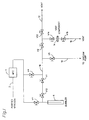
- Figure 1 is a schematic illustration of the test apparatus used to perform the moisture removal and moisture passivation of the present invention.
- Figure 2 is a graph of moisture (ppb) vs. time (min.) for a test tubing passivated with hexamethyldisilazane showing shortened drydown to 100 ppb H2O for the treated tube.
- Figure 3 is a graph of moisture (ppb) vs. time (min.) for a test tubing passivated with hexamethyldisilazane and subsequently chlorotrimethylsilane showing shortened breakthrough (therefore, less H2O readsorption) of moisture over an untreated tube.
- Figure 4 is a graph of moisture (ppb) vs. time (min.) for a test tubing passivated with chlorotrimethylsilane showing shortened drydown to 100 ppb H2O for the treated tube.
- Figure 5 is a graph of moisture (ppb) vs. time (min.) for a test tubing passivated with chlorotrimethylsilane showing shortened drydown to 100 ppb H2O for the treated tube after equilibration of the tubing with nitrogen containing 950 ppb of moisture.
- Figure 6 is a graph of moisture (ppb) vs. time (min.) for a test stainless steel filter passivated with chlorotrimethylsilane at 20°C and 65°C showing shortened drydown to 50 ppb H2O for the treated filter at 65°C, an intermediate drydown time for the treated filter at 20°C and the longest drydown time for the untreated filter.
- Figure 7 is a graph of moisture (ppb) vs. time (min.) for a test filter passivated with chlorotrimethylsilane showing shortened breakthrough (therefore, less H2O readsorption) of moisture over an untreated filter.
- Figure 8 is a graph of moisture (ppb) vs. time (min.) for a test filter passivated with chlorotrimethylsilane showing shortened drydown to 100 ppb H2O for the treated filter after equilibration of the filter with nitrogen containing 950 ppb of moisture.
- Figure 9 is a graph of moisture (ppb) vs. time (min.) for a test filter passivated with chlorodimethylsilane showing shortened drydown to 50 ppb H2O for the treated filter.
- the present invention is a process for removing moisture from metal surfaces used with high purity bulk and corrosive-specialty gases. Furthermore, the present invention passivates the metal at ambient to superambient pressures by forming a hydrophobic surface that prevents water from re-adsorbing. Benefits of the process include the ability to deliver ultra-high purity (UHP) gases and protection of the delivery system from component failure.
- UHP gases have less than 1% by volume of any undesired components. Preferably, UHP gases have less than 100 ppm of undesired components. Most preferably, UHP gases have less than 1 ppm of undesired components.
- R is preferably alkyl, alkenyl, alkynyl, aryl; alkyl-, alkenyl- or alkynyl- substituted aryl; aryl substituted alkyl-, alkenyl- or alkynyl- and mixtures thereof. More preferably, R is individually chosen from one or more hydrocarbon groups comprising C1-C6, such as methyl, ethyl, vinyl, propyl, butyl, pentane, hexyl, cyclohexyl, phenyl, as well as iso and tertiary forms of those substituents.
- the most preferred moisture removal and moisture passivating agents for the present invention are those that have a very readily hydrolyzable bond to silicon (e.g. Si-N, Si-H, Si-Cl, Si-Br), are liquids with normal boiling points in the range of 0-130°C, and form thermally stable species of the type R3Si-O-M bound to a metal surface.
- Specific compounds which meet this criteria are hexamethyldisilazane, trimethylsilane, ethyldimethylsilane, diethylmethylsilane, chlorotrimethylsilane, chlorodimethylvinylsilane, chlorodimethylethylsilane, chlorodimethylisopropylsilane and bromotrimethylsilane.
- a bond to silicon that is readily hydrolyzable is for the purpose of the present invention a substituent bound to silicon where the bond is readily cleaved by reaction with moisture (gas phase, dissociated or undissociated surface bound water) leaving the silicon with any other silicon bound substituents to bond with the surface or an oxygen atom associated with the surface.
- An inert gas for purposes of the present invention is inert to reaction with the materials of construction of the surface being treated.
- the surface is a metal, such as iron, steel, aluminum, copper, brass, nickel, nickel alloys, etc.
- the inert gas would not react with these metals under the conditions contemplated for the surface: 0-3000 psia and -50°C to 250°C.
- Exemplary are nitrogen, argon, helium and other noble gases.
- the treatment when conducted at near ambient to superambient pressures incorporates stable organosilicon moieties into the surface which destroys the polar character associated with the OH terminated surface.
- the treated surface is hydrophobic and inhibits water from re-adsorbing during a subsequent moisture exposure. This retained hydrophobic character of the treated surface is referred to in the present invention as passivation. Removal of adsorbed water and prevention of readsorption is known to be the key to reduced dry down times, improved corrosion resistance and the stability of reactive gases.
- R group in the radical -N(H)Si(R3) is as defined above, namely one or more organic groups, more preferably alkyl, alkenyl, alkynyl, aryl; alkyl-, alkenyl- or alkynyl- substituted aryl; aryl substituted alkyl-, alkenyl- or alkynyl- and mixtures thereof, most preferably, R is individually chosen from one or more hydrocarbon groups comprising C1-C6, such as methyl, ethyl, vinyl, propyl, butyl, pentane, hexyl, cyclohexyl, phenyl, as well as iso and tertiary forms of those substituents.
- Example 1 Passivation of Electropolished Stainless Steel Tubing with Hexamethyldisilazane, (HMDS).
- HMDS Hexamethyldisilazane
- a 12 meter length of 1/4" diameter electropolished 316L tubing 14 fitted with a valve V14 and V15 on each end was equilibrated with nitrogen containing 950 ppb moisture at 25 psia.
- the valves V14 and V15 were then closed and the tubing 14 attached to the manifold 18 shown in Figure 1.
- the bubbler 6 in the manifold 18 contained 35 mL of HMDS. With V11 and V12 closed, the manifold was cycled between 10 ⁇ 3 torr vacuum, through valve V5 and vacuum source 10, and 25 psig UHP N2 (#2) (H2O ⁇ 20 ppb) 10 times to remove contaminants.
- the flow rate on the mass flow controller (MFC) 4 was then set to 500 sccm and V11, V12, V1, V2, and V13 were opened and V4 closed.
- the manifold 18 was passivated with HMDS by flowing HMDS saturated nitrogen to vent 12 for 3 minutes. After 3 minutes, V13 was closed and V14 and V15 were opened.
- the 500 sccm flow of HMDS saturated nitrogen was allowed to pass through the test component 14 and vent 16 for 90 seconds at a pressure of 14.7 psia. After which, V14 and V15 were closed.
- the HMDS saturated nitrogen was then allowed to react with the moisture in the tubing 14 for 15 minutes at a pressure of 30 psia.
- V11 and V12 were closed and the rest of the manifold 18 was repeatedly cycled between vacuum and UHP N2 to remove all the HMDS vapor.
- a 500 sccm flow of nitrogen was then established by setting the mass flow controller 4 and opening V4, V2, and V13.
- the HMDS vapor was purged at a pressure of 14.7 psia from the test component 14 by closing V13, and opening V14 and V15.
- the test component 14 was then purged for 8.5 minutes at a pressure of 14.7 psia, after which V14 and V15 were closed and the isolated length of tubing was transferred to a moisture analyzer.
- Example 2 Initial Dry-Down of HMDS Passivated Electropolished Stainless Steel Tubing.
- the EP 316L tubing test component was purged with UHP N2 (H2O ⁇ 20 ppb, 500 sccm at a pressure of 14.7 psia) while monitoring the outlet moisture level with a certified, quartz crystal oscillator (Ametek 5700).
- Figure 2 shows dry-down curves before, and immediately, after HMDS treatment. The time taken to passivate the tubing (10 min.) has been included in the purge time and so no moisture level is measured during the first 10 min. of the dry-down curve. The untreated tubing dries down to 100 ppb in 48 min., whereas the HMDS treatment enhances the rate of moisture removal, reducing the dry-down time to 28 min.
- Example 3 Amount of Moisture Adsorbed by Electropolished Stainless Steel Tubing Following HMDS Passivation.
- FIG. 3 shows the moisture uptake curves for the untreated and HMDS treated tubing.
- the purge gas 500 sccm
- UHP N2 H2O ⁇ 20 ppb
- N2 having 950 ppb of water.
- test component tubing was passivated with CTMS.
- the bubbler shown in Figure 1 was filled with 35 mL of CTMS and the procedure described in Example 1 was followed.
- the test component (length of tubing) was passivated by flowing 500 sccm of CTMS saturated nitrogen through the tubing for 1.5 minutes at a pressure of 14.7 psia. V14 and V15 were then closed and the CTMS saturated nitrogen was then allowed to react with the moisture in the tubing for 15 minutes.
- the CTMS vapor was purged from the test component for 8.5 minutes, after which V14 and V15 were closed and the isolated length of test component tubing was transferred to the moisture analyzer.
- FIG. 4 shows dry-down curves before, and immediately, after CTMS treatment.
- the time taken to passivate the test component tubing (10 min.) has been included in the purge time and so no moisture level is measured during the first 10 min. of the dry-down curve.
- the untreated test component tubing dries down to 100 ppb in 48 min. whereas the CTMS treatment enhances the rate of moisture removal, reducing the dry-down time to 30 min.
- Example 6 Amount of Moisture Adsorbed by Electropolished Stainless Steel Tubing Following CTMS Passivation.
- Example 5 shows that CTMS can rapidly remove water adsorbed on stainless steel during the treatment, reducing the dry-down time. CTMS also inhibits water from re-adsorbing during a post-treatment moisture exposure by producing a stable, hydrophobic surface (passivation).
- Fig. 3 shows the moisture uptake curves for untreated and CTMS-treated EP 316L tubing. At time zero, the purge gas is switched from UHP N2 (H2O ⁇ 20 ppb) to N2 having a moisture level of 950 ppb. It takes 7.5 min. for the moisture front to appear at the outlet of the untreated tubing whereas the breakthrough time for CTMS treated EP 316L is only 3.5 min.
- This breakthrough time is longer than the gas residence time (0.3 min) and results from water adsorbing on the walls of the tubing.
- the shorter breakthrough time after treatment means that less water adsorbs onto the tube surface during the moisture exposure.
- a lower surface coverage, and the stability of the passivated surface is apparent from the dry down curve after equilibrating at 950 ppb (Fig. 5).
- Example 7 Passivation of Stainless Steel Gas Filter with Chlorotrimethylsilane, (CTMS) at Room Temperature.
- a stainless steel gas filter fitted with a valve on each end was equilibrated with nitrogen containing 1 ppm moisture. The valves were then closed and the filter attached to the manifold shown in Figure 1.
- the bubbler in the manifold contained 35 mL of CTMS.
- the test component (gas filter) was passivated by flowing 500 sccm of CTMS saturated nitrogen through the filter for 1.5 minutes at a pressure of 14.7 psia. V14 and V15 were then closed and the CTMS saturated nitrogen was then allowed to react with the moisture in the test component (gas filter) for 15 minutes.
- the CTMS vapor was purged from the test component for 8.5 minutes, after which V14 and V15 were closed and the isolated test component (gas filter) was transferred to the moisture analyzer.
- FIG. 6 shows dry-down curves for the filter before, and immediately after this room temperature CTMS treatment.
- the time taken to passivate the test component filter (10 min.) has been included in the purge time and so there is no moisture measurement during the first 10 min. of the dry-down curve.
- the untreated filter dries down to 50 ppb in 300 min. whereas the CTMS treatment enhances the rate of moisture removal, reducing the dry-down time to 140 min., which is over a factor of 2 in improvement.
- Example 8 shows that CTMS can rapidly remove water adsorbed onto the stainless steel filter during treatment, reducing the dry-down time.
- CTMS also inhibits water from re-adsorbing during a post-treatment moisture exposure by producing a stable, hydrophobic surface.
- Fig. 7 shows the moisture uptake curves for the same filter, before (untreated) and after CTMS treatment.
- the purge gas is switched from UHP N2 (H2O ⁇ 20 ppb) to N2 having a moisture level of 950 ppb. It takes 22 min. for the moisture front to appear at the outlet of the untreated filter whereas the breakthrough time for the CTMS treated filter is only 11 min. This breakthrough time is longer than the gas residence time (0.3 min) and results from water adsorbing on the walls of the tubing. The shorter breakthrough time after treatment means that less water adsorbs onto the filter surface during the moisture exposure.
- Example 9 demonstrates that the CTMS treatment inhibits water from readsorbing by producing a stable, hydrophobic surface.
- a lower surface coverage is apparent by comparing the dry-down curves of the untreated and CTMS-treated filter after equilibrating with N2 having a moisture level of 950 ppb (Fig. 8).
- the filter dries down much faster after the CTMS treatment, illustrating the stable nature of the surface generated by CTMS treatment.
- a stainless steel gas filter fitted with a valve on each end was equilibrated with nitrogen containing 1 ppm moisture. The valves were then closed and the filter attached to the manifold shown in Figure 1.
- the bubbler in the manifold contained 35 mL of CTMS.
- the test component gas filter
- V14 and V15 were then closed and gas filter was then heated to 65°C for 15 minutes. The heating was then discontinued and the gas filter allowed to cool to room temperature for 30 minutes.
- the CTMS vapor was purged from the test component for 8.5 minutes, after which V14 and V15 were closed and the isolated filter was transferred to the moisture analyzer.
- FIG. 6 shows dry-down curves for the untreated, and 65°C CTMS treated filter.
- the time taken to passivate the filter (10 min.) has been included in the purge time and so there is no moisture measurement during the first 10 min. of the dry-down curve.
- the untreated filter takes 300 min. to dry down to 50 ppb whereas the 65° C CTMS treatment enhances the rate of moisture removal, reducing the dry-down time by a factor of 4, to 74 min.
- a stainless steel gas filter fitted with a valve on each end was equilibrated with nitrogen containing 1 ppm moisture.
- the valves were then closed and the tubing attached to the manifold shown in Figure 1.
- the bubbler in the manifold contained 35 mL of CDMS.
- the test component gas filter
- the test component was passivated by flowing 500 sccm of CTMS saturated nitrogen through the filter for 1.5 minutes at a pressure of 14.7 psia.
- V14 and V15 were then closed and the CTMS saturated nitrogen was then allow to react with the moisture in the tubing for 15 minutes at a pressure of 30 psia.
- the CTMS vapor was purged from the test component for 8.5 minutes, after which V14 and V15 were closed and the isolated filter was transferred to the moisture analyzer.
- FIG. 9 shows dry-down curves for the same filter before, and immediately after, CDMS treatment.
- the time taken to passivate the filter (10 min.) has been included in the purge time and so there is no moisture measurement during the first 10 min. of the dry-down curve.
- the untreated filter takes 280 min. to dry down to 50 ppb whereas the CDMS treatment enhances the rate of moisture removal by a factor of 4.7, reducing the dry-down time to 60 min.
- Coupons of electropolished 316L stainless steel were cleaned then loaded into a Hastelloy C-22 reactor.
- the reactor was attached to the electropolished stainless steel manifold, heated at 100°C and evacuated to ⁇ 10 ⁇ 3 torr for 12 hours in order to remove adsorbed moisture from the samples and reactor walls.
- the reactor was then allowed to cool to room temperature and exposed to a flowing nitrogen atmosphere contained 1000 ppm of moisture for 8 hours.
- the total pressure in the reactor was 15 psia.
- the reactor was purged for 10 minutes with UHP N2 (H2O ⁇ 20 ppb) flowing at 500 sccm, again at 15 psia total pressure.
- the reactor was then isolated and connected to an HBr manifold.
- HBr (15psia) was added to the reactor bringing the total pressure to 30 psia. The reactor was then isolated and allowed to stand for 12 days. The HBr was then thoroughly removed from the reactor by repeatedly evacuating the atmosphere in the reactor to a pressure below 1 mtorr and back-filling with 30 psia of UHP N2 (H2O ⁇ 20 ppb).
- the coupons were transported under nitrogen atmosphere to the scanning electron microscope in sealed, airtight glass vials and were loaded into a polyethylene glove bag which was attached to the airlock chamber of the microscope. The glove bag was purged for approximately 16 hours with nitrogen before the sample vials were opened. This procedure was used to prevent exposing the coupons to ambient air and water vapor before analysis.
- the CTMS vapor was then purged from the reactor for 8.0 minutes.
- the reactor was then isolated and connected to an HBr manifold.
- HBr (15psia) was added to the reactor bringing the total pressure to 30 psia.
- the reactor was then isolated and allowed to stand for 12 days.
- the HBr was then thoroughly removed by repeatedly evacuating the atmosphere in the reactor to a pressure below 1 mtorr and back-filling with 30 psia of purified nitrogen.
- Semi-quantitative standardless EDS analysis were performed to analyze the extent bromine incorporation (i.e. corrosion) of the sample.
- the surface bromine concentration for this sample was measured as 0.7 wt% bromine, or about 1/10th the amount bromine incorporated into the unpassivated samples (Example 15).
- Example 17 Re-wetting of 65°C CTMS Passivated Gas Filter.
- Example 9 shows that room temperature, ambient pressure CTMS passivation inhibits water from re-adsorbing during a post-treatment moisture exposure by producing a stable, hydrophobic surface.
- Example 12 shows that a CTMS passivation at 65°C enhances the rate of moisture removal, reducing the dry-down time. However, in this example, we show that 65°C CTMS passivation does not inhibit water from re-adsorbing during a post-treatment moisture exposure.
- the purge gas is switched from UHP N2 (H2O ⁇ 20 ppb) to N2 having a moisture level of 950 ppb.
- the moisture uptake curves for the same filter, before (untreated) and after 65°C CTMS treatment were indistinguishable. This demonstrates that although 65°C CTMS passivation substantially enhances the rate of moisture removal, 65°C is too high a temperature to perform the passivation in order to achieve a stable hydrophobic surface.
- the present invention provides an improved process for the removal of moisture rapidly from a metal surface such as an industrial gas delivery conduit and passivates such a metal surface by adhering a layer of hydrophobic drying reagent molecule derivatives to the surface at near ambient to super ambient pressure to retard the readsorption of moisture during subsequent use, such as in delivery of high purity industrial gases at positive pressure to an electronic component fabrication tool, where purity is critical and absence of moisture is also critical.
- This advantage of moisture removal and moisture passivation at ambient and super ambient pressure is achieved in the present invention with drying reagents having enhanced stability and safety while having reduced toxicity over the drying reagents of the prior art.
Landscapes
- Engineering & Computer Science (AREA)
- Mechanical Engineering (AREA)
- General Engineering & Computer Science (AREA)
- Drying Of Gases (AREA)
- Drying Of Solid Materials (AREA)
- Solid-Sorbent Or Filter-Aiding Compositions (AREA)
- Detergent Compositions (AREA)
- Preventing Corrosion Or Incrustation Of Metals (AREA)
Applications Claiming Priority (2)
| Application Number | Priority Date | Filing Date | Title |
|---|---|---|---|
| US08/329,029 US5479727A (en) | 1994-10-25 | 1994-10-25 | Moisture removal and passivation of surfaces |
| US329029 | 1994-10-25 |
Publications (2)
| Publication Number | Publication Date |
|---|---|
| EP0709635A1 true EP0709635A1 (fr) | 1996-05-01 |
| EP0709635B1 EP0709635B1 (fr) | 1998-01-21 |
Family
ID=23283561
Family Applications (1)
| Application Number | Title | Priority Date | Filing Date |
|---|---|---|---|
| EP95116557A Expired - Lifetime EP0709635B1 (fr) | 1994-10-25 | 1995-10-20 | Elimination de l'humidité et passivation de surfaces |
Country Status (6)
| Country | Link |
|---|---|
| US (1) | US5479727A (fr) |
| EP (1) | EP0709635B1 (fr) |
| JP (1) | JP2774471B2 (fr) |
| KR (1) | KR960014412A (fr) |
| DE (1) | DE69501493T2 (fr) |
| TW (1) | TW323960B (fr) |
Cited By (4)
| Publication number | Priority date | Publication date | Assignee | Title |
|---|---|---|---|---|
| DE19638709A1 (de) * | 1996-09-21 | 1998-04-09 | Sts Gmbh Sanierung Tech System | Verfahren zur Sanierung technischer Bauteile unter Verwendung von Stickstoff sowie eine Anlage dazu |
| EP1528430A1 (fr) * | 2003-10-30 | 2005-05-04 | ASML Netherlands B.V. | Appareil lithographique ainsi que méthode pour fabriquer un élément |
| US7750095B2 (en) | 2008-08-22 | 2010-07-06 | Chevron Phillips Chemical Company Lp | System and method for reducing fouling in a reactor |
| CN101005024B (zh) * | 2002-04-12 | 2011-06-08 | 东京毅力科创株式会社 | 减少多孔介电薄膜清洗期间损伤的处理方法 |
Families Citing this family (23)
| Publication number | Priority date | Publication date | Assignee | Title |
|---|---|---|---|---|
| JP2975917B2 (ja) * | 1998-02-06 | 1999-11-10 | 株式会社半導体プロセス研究所 | 半導体装置の製造方法及び半導体装置の製造装置 |
| KR100797202B1 (ko) * | 2000-06-23 | 2008-01-23 | 허니웰 인터내셔널 인코포레이티드 | 손상된 실리카 유전 필름에 소수성을 부여하는 방법 및 손상된 실리카 유전 필름 처리 방법 |
| KR100417035B1 (ko) * | 2001-07-06 | 2004-02-25 | 박정선 | 유기 전계발광 소자 |
| US7832550B2 (en) * | 2001-07-17 | 2010-11-16 | American Air Liquide, Inc. | Reactive gases with concentrations of increased stability and processes for manufacturing same |
| US20030017359A1 (en) * | 2001-07-17 | 2003-01-23 | American Air Liquide, Inc. | Increased stability low concentration gases, products comprising same, and methods of making same |
| EP1412551B1 (fr) * | 2001-07-17 | 2011-03-02 | L'AIR LIQUIDE, Société Anonyme pour l'Etude et l'Exploitation des Procédés Georges Claude | Methode de fabrication d'une surface passive |
| EP1481284A4 (fr) * | 2002-03-04 | 2006-10-25 | Tokyo Electron Ltd | Procede de passivation de materiaux a faible constante dielectrique dans le traitement de plaquettes |
| EP1512000A1 (fr) * | 2002-05-29 | 2005-03-09 | L'air liquide, Société anonyme à Directoire et Conseil de Surveillance pour l'Etude et l'Exploitation des Procédés G. Claude | Compositions a humidite reduite comprenant un gaz acide et un gaz de matrice, produits de fabrication comprenant lesdites compositions et procedes de fabrication associes |
| US7709371B2 (en) * | 2003-01-25 | 2010-05-04 | Honeywell International Inc. | Repairing damage to low-k dielectric materials using silylating agents |
| WO2004068555A2 (fr) * | 2003-01-25 | 2004-08-12 | Honeywell International Inc | Reparation et restauration de materiaux et de films dielectriques endommages |
| US7914847B2 (en) * | 2003-05-09 | 2011-03-29 | Asm America, Inc. | Reactor surface passivation through chemical deactivation |
| JP4959333B2 (ja) * | 2003-05-09 | 2012-06-20 | エーエスエム アメリカ インコーポレイテッド | 化学的不活性化を通じたリアクタ表面のパシベーション |
| EP1651093B1 (fr) * | 2003-07-30 | 2016-09-07 | BSH Hausgeräte GmbH | Procede permettant de faire fonctionner un lave-vaisselle et comportant au moins une etape sechage de programme |
| US8475666B2 (en) * | 2004-09-15 | 2013-07-02 | Honeywell International Inc. | Method for making toughening agent materials |
| US20060040054A1 (en) * | 2004-08-18 | 2006-02-23 | Pearlstein Ronald M | Passivating ALD reactor chamber internal surfaces to prevent residue buildup |
| US7678712B2 (en) * | 2005-03-22 | 2010-03-16 | Honeywell International, Inc. | Vapor phase treatment of dielectric materials |
| US7500397B2 (en) * | 2007-02-15 | 2009-03-10 | Air Products And Chemicals, Inc. | Activated chemical process for enhancing material properties of dielectric films |
| US20090026924A1 (en) * | 2007-07-23 | 2009-01-29 | Leung Roger Y | Methods of making low-refractive index and/or low-k organosilicate coatings |
| US8293658B2 (en) * | 2010-02-17 | 2012-10-23 | Asm America, Inc. | Reactive site deactivation against vapor deposition |
| US8590705B2 (en) | 2010-06-11 | 2013-11-26 | Air Products And Chemicals, Inc. | Cylinder surface treated container for monochlorosilane |
| US9223203B2 (en) | 2011-07-08 | 2015-12-29 | Asm International N.V. | Microcontact printed films as an activation layer for selective atomic layer deposition |
| IN2014KN01689A (fr) | 2012-02-09 | 2015-10-23 | Georgia Pacific Chemicals Llc | |
| EP2861779A1 (fr) * | 2012-06-15 | 2015-04-22 | Praxair Technology Inc. | Préparation de cylindre servant à maintenir la stabilité de matériaux stockés |
Citations (3)
| Publication number | Priority date | Publication date | Assignee | Title |
|---|---|---|---|---|
| US4723363A (en) * | 1986-12-29 | 1988-02-09 | Motorola Inc. | Process for removal of water |
| CA2070145A1 (fr) | 1991-06-03 | 1992-12-04 | Yao-En Li | Procede de passivation de surfaces metalliques pour augmenter la stabilite de melanges d'hydrure a faible concentration venant en contact avec celles-ci |
| US5255445A (en) | 1991-06-06 | 1993-10-26 | American Air Liquide, Chicago Research Center | Process for drying metal surfaces using gaseous hydrides to inhibit moisture adsorption and for removing adsorbed moisture from the metal surfaces |
Family Cites Families (5)
| Publication number | Priority date | Publication date | Assignee | Title |
|---|---|---|---|---|
| US3307271A (en) * | 1964-02-06 | 1967-03-07 | Du Pont | Process for drying polymers |
| BE754997A (fr) * | 1969-08-20 | 1971-02-19 | Packo Joseph J | Methode et compositions de colmatage des fuites |
| US3716384A (en) * | 1971-05-12 | 1973-02-13 | Packo J | Compositions for sealing leaks in vessels |
| JPH085623B2 (ja) * | 1989-09-27 | 1996-01-24 | 株式会社神戸製鋼所 | クレーンの安全装置 |
| JPH05310445A (ja) * | 1992-05-13 | 1993-11-22 | Nippon Sheet Glass Co Ltd | 撥水性ガラス物品およびその製造方法 |
-
1994
- 1994-10-25 US US08/329,029 patent/US5479727A/en not_active Expired - Fee Related
-
1995
- 1995-07-31 TW TW084107951A patent/TW323960B/zh active
- 1995-10-18 JP JP7294692A patent/JP2774471B2/ja not_active Expired - Lifetime
- 1995-10-20 DE DE69501493T patent/DE69501493T2/de not_active Expired - Fee Related
- 1995-10-20 EP EP95116557A patent/EP0709635B1/fr not_active Expired - Lifetime
- 1995-10-25 KR KR1019950036988A patent/KR960014412A/ko not_active Abandoned
Patent Citations (3)
| Publication number | Priority date | Publication date | Assignee | Title |
|---|---|---|---|---|
| US4723363A (en) * | 1986-12-29 | 1988-02-09 | Motorola Inc. | Process for removal of water |
| CA2070145A1 (fr) | 1991-06-03 | 1992-12-04 | Yao-En Li | Procede de passivation de surfaces metalliques pour augmenter la stabilite de melanges d'hydrure a faible concentration venant en contact avec celles-ci |
| US5255445A (en) | 1991-06-06 | 1993-10-26 | American Air Liquide, Chicago Research Center | Process for drying metal surfaces using gaseous hydrides to inhibit moisture adsorption and for removing adsorbed moisture from the metal surfaces |
Non-Patent Citations (2)
| Title |
|---|
| K.TATENUMA, T.MOMOSE & H.ISHIMARU, J. VAC. SCI. TECHNOL. A., no. 11, 1993, pages 1719 |
| TATENUMA ET AL: "Quick acquisition of clean ultrahigh vacuum by chemical process technology", J.VAC.SCI.TECHNOL.A, vol. 11, no. 4, pages 1719 - 1724, XP000403685 * |
Cited By (5)
| Publication number | Priority date | Publication date | Assignee | Title |
|---|---|---|---|---|
| DE19638709A1 (de) * | 1996-09-21 | 1998-04-09 | Sts Gmbh Sanierung Tech System | Verfahren zur Sanierung technischer Bauteile unter Verwendung von Stickstoff sowie eine Anlage dazu |
| CN101005024B (zh) * | 2002-04-12 | 2011-06-08 | 东京毅力科创株式会社 | 减少多孔介电薄膜清洗期间损伤的处理方法 |
| EP1528430A1 (fr) * | 2003-10-30 | 2005-05-04 | ASML Netherlands B.V. | Appareil lithographique ainsi que méthode pour fabriquer un élément |
| US7075617B2 (en) | 2003-10-30 | 2006-07-11 | Asml Netherlands B.V. | Device manufacturing method and a lithographic apparatus |
| US7750095B2 (en) | 2008-08-22 | 2010-07-06 | Chevron Phillips Chemical Company Lp | System and method for reducing fouling in a reactor |
Also Published As
| Publication number | Publication date |
|---|---|
| JP2774471B2 (ja) | 1998-07-09 |
| US5479727A (en) | 1996-01-02 |
| DE69501493D1 (de) | 1998-02-26 |
| TW323960B (en) | 1998-01-01 |
| JPH08303948A (ja) | 1996-11-22 |
| EP0709635B1 (fr) | 1998-01-21 |
| KR960014412A (ko) | 1996-05-22 |
| DE69501493T2 (de) | 1998-04-30 |
Similar Documents
| Publication | Publication Date | Title |
|---|---|---|
| EP0709635B1 (fr) | Elimination de l'humidité et passivation de surfaces | |
| US6391385B1 (en) | Method of abating of effluents from chemical vapor deposition processes using organometallic source reagents | |
| US6833024B2 (en) | Abatement of effluent from chemical vapor deposition processes using ligand exchange resistant metal-organic precursor solutions | |
| US6790358B2 (en) | Composition for removing trace impurities from inert, non-reactive and reactive liquids | |
| US7837806B2 (en) | Articles of manufacture containing increased stability low concentration gases and methods of making and using the same | |
| KR100618072B1 (ko) | 흡착재 전처리를 이용한 흡착제계 기체 저장 및 분배시스템의 제조 방법 | |
| JPH02184501A (ja) | ハロゲン化シラン化合物を含有する担体ガスからガス状の汚染性化合物、とくにドープ成分化合物を除去する方法 | |
| JP2004515344A (ja) | 水素化物ガス、不活性ガス及び非反応性ガスを精製するための方法及び材料 | |
| JP3045425B2 (ja) | ステンレス鋼表面不動態化処理 | |
| Carslaw et al. | Uncertainties in reactive uptake coefficients for solid stratospheric particles‐1. Surface chemistry | |
| US8535423B2 (en) | Removal of impurities from hydrogen-containing materials | |
| KR100227065B1 (ko) | 기체상 하이드라이드를 이용하는 금속 표면의 건조 방법 및 이에 의해 건조된 저장수단에 가스 등을 안정하게 저장하는 방법 | |
| KR102235005B1 (ko) | 이동형 공정 잔류가스 제거장치 및 공정 잔류가스 제거방법 | |
| KR100227064B1 (ko) | 저농도의 기체상 하이드라이드의 안정성을 증진시키기 위해 그와 접촉되어 있는 금속 표면을 패시베이션 시키는 방법 | |
| Sadtchenko et al. | H 2 O adsorption on BaF 2 (111) at ambient temperatures | |
| JP2005529730A (ja) | 多孔性ガス精製基材の迅速活性化または前調整の方法 | |
| JP2008507397A (ja) | 超高純度ガスからの金属汚染物の除去 | |
| EP1188759A2 (fr) | Procédé et dispositif pour la purification de methylsilanes | |
| JPS624168B2 (fr) | ||
| JPH11124386A (ja) | トリメトキシシランの安定化方法 | |
| JPH0677145A (ja) | 薄膜形成方法 | |
| JP2002068717A (ja) | 三フッ化窒素の精製方法 | |
| JP2000309890A (ja) | 腐食性ガス供給系での腐食低減方法 | |
| JP2001248793A (ja) | 吸着式気体貯蔵容器及びその活性化方法 |
Legal Events
| Date | Code | Title | Description |
|---|---|---|---|
| PUAI | Public reference made under article 153(3) epc to a published international application that has entered the european phase |
Free format text: ORIGINAL CODE: 0009012 |
|
| AK | Designated contracting states |
Kind code of ref document: A1 Designated state(s): BE DE FR GB IE NL |
|
| 17P | Request for examination filed |
Effective date: 19960510 |
|
| GRAG | Despatch of communication of intention to grant |
Free format text: ORIGINAL CODE: EPIDOS AGRA |
|
| 17Q | First examination report despatched |
Effective date: 19970424 |
|
| GRAG | Despatch of communication of intention to grant |
Free format text: ORIGINAL CODE: EPIDOS AGRA |
|
| GRAH | Despatch of communication of intention to grant a patent |
Free format text: ORIGINAL CODE: EPIDOS IGRA |
|
| GRAH | Despatch of communication of intention to grant a patent |
Free format text: ORIGINAL CODE: EPIDOS IGRA |
|
| GRAA | (expected) grant |
Free format text: ORIGINAL CODE: 0009210 |
|
| AK | Designated contracting states |
Kind code of ref document: B1 Designated state(s): BE DE FR GB IE NL |
|
| REF | Corresponds to: |
Ref document number: 69501493 Country of ref document: DE Date of ref document: 19980226 |
|
| ET | Fr: translation filed | ||
| REG | Reference to a national code |
Ref country code: IE Ref legal event code: FG4D Free format text: 78590 |
|
| PGFP | Annual fee paid to national office [announced via postgrant information from national office to epo] |
Ref country code: FR Payment date: 19981006 Year of fee payment: 4 |
|
| PGFP | Annual fee paid to national office [announced via postgrant information from national office to epo] |
Ref country code: IE Payment date: 19981015 Year of fee payment: 4 |
|
| PGFP | Annual fee paid to national office [announced via postgrant information from national office to epo] |
Ref country code: DE Payment date: 19981028 Year of fee payment: 4 |
|
| PGFP | Annual fee paid to national office [announced via postgrant information from national office to epo] |
Ref country code: BE Payment date: 19981112 Year of fee payment: 4 |
|
| PLBE | No opposition filed within time limit |
Free format text: ORIGINAL CODE: 0009261 |
|
| STAA | Information on the status of an ep patent application or granted ep patent |
Free format text: STATUS: NO OPPOSITION FILED WITHIN TIME LIMIT |
|
| 26N | No opposition filed | ||
| PG25 | Lapsed in a contracting state [announced via postgrant information from national office to epo] |
Ref country code: IE Free format text: LAPSE BECAUSE OF NON-PAYMENT OF DUE FEES Effective date: 19991020 Ref country code: GB Free format text: LAPSE BECAUSE OF NON-PAYMENT OF DUE FEES Effective date: 19991020 |
|
| PG25 | Lapsed in a contracting state [announced via postgrant information from national office to epo] |
Ref country code: BE Free format text: LAPSE BECAUSE OF NON-PAYMENT OF DUE FEES Effective date: 19991031 |
|
| BERE | Be: lapsed |
Owner name: AIR PRODUCTS AND CHEMICALS INC. Effective date: 19991031 |
|
| PG25 | Lapsed in a contracting state [announced via postgrant information from national office to epo] |
Ref country code: NL Free format text: LAPSE BECAUSE OF NON-PAYMENT OF DUE FEES Effective date: 20000501 |
|
| GBPC | Gb: european patent ceased through non-payment of renewal fee |
Effective date: 19991020 |
|
| PG25 | Lapsed in a contracting state [announced via postgrant information from national office to epo] |
Ref country code: FR Free format text: LAPSE BECAUSE OF NON-PAYMENT OF DUE FEES Effective date: 20000630 |
|
| NLV4 | Nl: lapsed or anulled due to non-payment of the annual fee |
Effective date: 20000501 |
|
| PG25 | Lapsed in a contracting state [announced via postgrant information from national office to epo] |
Ref country code: DE Free format text: LAPSE BECAUSE OF NON-PAYMENT OF DUE FEES Effective date: 20000801 |
|
| REG | Reference to a national code |
Ref country code: FR Ref legal event code: ST |
|
| REG | Reference to a national code |
Ref country code: IE Ref legal event code: MM4A |