EP0709826A1 - Verfahren zur Erkennung von Mustern - Google Patents
Verfahren zur Erkennung von Mustern Download PDFInfo
- Publication number
- EP0709826A1 EP0709826A1 EP95116877A EP95116877A EP0709826A1 EP 0709826 A1 EP0709826 A1 EP 0709826A1 EP 95116877 A EP95116877 A EP 95116877A EP 95116877 A EP95116877 A EP 95116877A EP 0709826 A1 EP0709826 A1 EP 0709826A1
- Authority
- EP
- European Patent Office
- Prior art keywords
- distributions
- dimension
- distribution
- dimensional continuous
- pattern recognition
- Prior art date
- Legal status (The legal status is an assumption and is not a legal conclusion. Google has not performed a legal analysis and makes no representation as to the accuracy of the status listed.)
- Granted
Links
Images


Classifications
-
- G—PHYSICS
- G10—MUSICAL INSTRUMENTS; ACOUSTICS
- G10L—SPEECH ANALYSIS TECHNIQUES OR SPEECH SYNTHESIS; SPEECH RECOGNITION; SPEECH OR VOICE PROCESSING TECHNIQUES; SPEECH OR AUDIO CODING OR DECODING
- G10L15/00—Speech recognition
- G10L15/08—Speech classification or search
- G10L15/14—Speech classification or search using statistical models, e.g. Hidden Markov Models [HMMs]
- G10L15/142—Hidden Markov Models [HMMs]
-
- G—PHYSICS
- G06—COMPUTING OR CALCULATING; COUNTING
- G06F—ELECTRIC DIGITAL DATA PROCESSING
- G06F18/00—Pattern recognition
- G06F18/20—Analysing
- G06F18/29—Graphical models, e.g. Bayesian networks
- G06F18/295—Markov models or related models, e.g. semi-Markov models; Markov random fields; Networks embedding Markov models
-
- G—PHYSICS
- G10—MUSICAL INSTRUMENTS; ACOUSTICS
- G10L—SPEECH ANALYSIS TECHNIQUES OR SPEECH SYNTHESIS; SPEECH RECOGNITION; SPEECH OR VOICE PROCESSING TECHNIQUES; SPEECH OR AUDIO CODING OR DECODING
- G10L25/00—Speech or voice analysis techniques not restricted to a single one of groups G10L15/00 - G10L21/00
- G10L25/03—Speech or voice analysis techniques not restricted to a single one of groups G10L15/00 - G10L21/00 characterised by the type of extracted parameters
- G10L25/24—Speech or voice analysis techniques not restricted to a single one of groups G10L15/00 - G10L21/00 characterised by the type of extracted parameters the extracted parameters being the cepstrum
Definitions
- the present invention relates to a pattern recognition method which uses an HMM (Hidden Markov Model) technique and calculates the likelihood of each HMM model for an input vector to recognize it.
- HMM Hidden Markov Model
- the HMM technique which models data to be recognized on the basis of theories of probability and statistics, is a useful technique for speech, character, graphics and similar pattern recognition. To facilitate a better understanding of the present invention, a description will be given first of a conventional method for speech recognition through the use of the HMM technique.
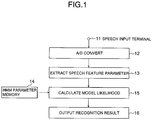
- Fig. 1 shows, by way of example, the configuration of conventional speech recognition equipment which employs the HMM technique.
- Speech inputted via an input terminal 11 is converted into a digital signal in an A/D converting part 12.
- the digital signal is fed to a speech feature parameter extracting part 13, wherein speech feature parameters are extracted from the digital signal.
- the thus extracted speech feature parameters are LPC cepstrum coefficients, delta cepstrum coefficients, delta power, FFT cepstrum coefficients, Mel-cepstrum coefficients and a channel output value of a filter bank.
- HMMs which have been prepared beforehand for each speech unit or category (e.g., a phoneme, syllable, or word) to be recognized, are read out from an HMM parameter memory 14 and inputted into a model likelihood calculating part 15, wherein the likelihood of each model is calculated for the inputted speech.
- a speech unit or category that the model of the maximum likelihood is provided as the result of recognition from a recognition result outputting part 16.
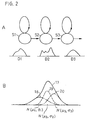
- Fig. 2A shows an example of a three-state (S1, S2, S3) HMM.
- S1, S2, S3 Such a model as shown is produced for each speech unit (or category).
- the states S1, S2 and S3 are represented by statistical distributions D1, D2 and D3 of speech feature parameters, respectively.
- this model is a phoneme model
- the distribution D1 of the first state S1, the distribution D2 of the second state S2 and the distribution D3 of the third state S3 represent statistical distributions of feature parameters in the vicinities of the beginning, center and end of the phoneme model, respectively.
- the feature parameter distribution of each state is in may cases represented using a plurality of continuous probability distributions (hereinafter referred to as mixture continuous distributions).
- a variety of continuous probability distributions are usable, but in many instances normal distributions are employed.
- the normal distributions are each represented in the form of a multi-dimensional uncorrelated normal distribution with dimensions of the same number as that of feature parameters.
- Fig. 2B there is depicted an example of the mixture continuous distribution.
- the mixture continuous distribution, identified by 17, is shown to be represented by three distributions, that is, a normal distribution N( ⁇ 1, ⁇ 1) which has a mean vector ⁇ 1 and variance ⁇ 1, a normal distribution N( ⁇ 2, ⁇ 2) 19 which has a mean vector ⁇ 2 and a variance ⁇ 2, and a normal distribution N( ⁇ 3, ⁇ 3) 20 which has a mean vector ⁇ 3 and a variance ⁇ 3.
- ⁇ s k,i represents an i-th order element of the mean vector of the k-th multi-dimensional normal distribution of the state s
- ⁇ s k,i an i-th order diagonal element (a variance) of the covariance matrix of the k-th multi-dimensional normal distribution of the state s.
- This calculation is done for each model in terms of the feature parameter vector of the input speech at every point in time and the result of recognition is outputted on the basis of the logarithmic likelihood calculated for each model.
- the representation ability of the phoneme model needs to be improved--this calls for increasing the number of model parameters.
- An enormous amount of data is needed to train a large number of model parameters, but in practice, only a limited amount of data can be collected, and consequently, the number of model parameters cannot be increased indiscriminately.
- the model becomes heavily dependent on the training data and a recognition error arises even if data is only slightly different from the training data. If the number of model parameters is small, the representation ability is so poor that satisfactory recognition performance cannot be expected.
- the accuracy of the model or model complexity and the recognition robustness bear what is called a trade-off relationship--this poses a problem that it is necessary to represent a model of more complexity with a smaller number of model parameters.
- the cost of calculation for the output probability by Eq. (2) is the highest.
- the time consumed for this calculation accounts for 45 to 65% of the entire speech recognition processing time.
- model level tying is proposed in K-F Lee and H-W Hon, "Speaker-Independent Phone Recognition Using Hidden Markov Models, " IEEE Trans. Acoust., Speech, Signal Processing, vol. ASSP-37, pp. 1641-1648, No. 11, 1989.
- the model level tying is to share the same model by different phoneme or contextual environments. In a triphone environment, for example, as shown in Fig.
- triphones a/m/a, o/m/o and u/m/o are common in that preceding and succeeding phonemes have substantially the same effect on the center phoneme m, and hence they share one model M m1 as the phoneme m.
- triphones o/m/i and u/m/e share the same model M m2 as their center phoneme m. This is intended to achieve a high recognition rate with a small number of models.
- the model M m1 of the phoneme m is composed of three states Sl m1 , S2 m1 and S3 m1
- the model M m2 is composed of three states Sl m2 , S2 m2 and S3 m2
- the states S1 m1 and S1 m2 have similar feature distributions
- the states S2 m1 and S2 m2 have similar feature distributions
- the models M m1 and M m2 share the same state S1 m in place of the states S1 m1 and S2 m2 and the same state S2 m in place of the states S2 m1 and S2 m2 . That is to say, as depicted in Fig.
- the model M m1 is expressed by the state S1 m -S2 m -S3 m1 and the model M m2 by the state S1 m -S2 m -S3 m2 .
- the model M m1 is expressed by the state S1 m -S2 m -S3 m1 and the model M m2 by the state S1 m -S2 m -S3 m2 .
- context-dependent models are represented with a smaller number of states.
- the mixture continuous distribution of the state S1 m1 of the model M m1 contains basic distributions 21 and 221
- the mixture continuous distribution of the state S2 m1 contains a basic distribution 222
- the mixture continuous distribution of the state S3 m1 contains basic distributions 223 and 23
- the basic distributions 221, 222 and 223 have substantially the same mean vectors and covariance matrices, they share the same basic distribution 22.
- the distribution 22 is shared by the states S1 m , S2 m and S3 m .
- the distributions are each shown as a two-dimensional distribution, they are usually multi-dimensional distributions such as 30-dimensional ones. As described above, the distribution of each state is represented with a small number of basic distributions.
- the total number of parameters of each HMM is reduced by tying similar parameters of distributions in each dimension across different HMMs or states. For example, similar ones of parameters (mean values or variances, or both of them) that define the normal distributions in respective dimensions forming a multi-dimensional normal probability distributions are tied.
- the elements ⁇ 1,2 and ⁇ 2,2 in the second dimension are tied for the mean vectors ⁇ 1 and ⁇ 2; namely, the mean vector ⁇ 1 is used as ( ⁇ 1,1 , ⁇ c2 ) and the mean vector ⁇ 2 was ( ⁇ 2,1 , ⁇ c2 ).
- the mean vectors ⁇ 1 and ⁇ 2 are far apart from each other, and hence are not tied, but their elements in the second dimension are tied as mentioned above.
- the total number of parameters could be reduced from eight (four dimensions ⁇ two vectors) to seven.
- indexes I1 to I7 are appended to respective feature parameters, i.e., respective element parameters ⁇ a,1 , ⁇ a,3 , ⁇ a,4 , ⁇ b,1 , ⁇ b,3 , ⁇ b,4 and ⁇ c,2 of the mean vectors ⁇ a and ⁇ b , and the indexes I1 to I7 are used to describe the mean vectors ⁇ a and ⁇ b .
- a calculation result buffer such as shown in Fig. 6B is provided, in which the result of the calculation (X t ,i- ⁇ k,i ) 2 of each element parameter ⁇ k,i and the corresponding element X t,i of the input vector is stored referring to the index I i of the element parameter ⁇ k,i .
- the calculation result buffer is initialized to -1, for example.
- the calculation of the mean vector with respect to the input vector X t starts with the mean vector ⁇ a . Since the index appended to the first element of the mean vector ⁇ a is I1, a check is made to see if the stored contents of the calculation result buffer corresponding to the index I1 is -1. If so, the element parameter ⁇ a,1 is read out of the element parameter-index table of Fig. 6A, then (X t,1 - ⁇ a,1 )2 is calculated, and the calculated result is stored in the storage area of the index I1 of the calculation result buffer.
- a similar calculation (X t,2 - ⁇ c,2 )2 is performed and its result is stored in the storage area of the index I7 in the calculation result buffer. Similar processing is performed for the subsequent element parameters.
- the calculation of the mean vector ⁇ b with respect to the input vector X t uses, as the value of its second element parameter index I7, the value, not -1, previously obtained with the calculation for the mean value ⁇ a and stored in the storage area of the index I7 in the calculation result buffer.
- Such sharing of calculated results by feature parameter tying can be carried out regardless of the number of models , the number of states, the number of distributions in each state and the number of dimensions of each feature parameter.
- the NSK mean values are clustered by a k-means method and the mean values belonging to the same cluster share its centroid.
- M The number of mean vectors that can be represented with M mean values in each dimension is M P --this ensures considerable representation ability.
- the above-mentioned M is in the range of 16 to 64.
- the total number of mean values can be reduced by tying from 1.3 to 5% of the number of non-tied mean values.
- Speech recognition involves a speaker adaptation task which uses speech, uttered by certain speaker, to adapt to him a speaker-independent acoustic model.
- the situation occasionally arises where only a small amount of speech data can be obtained for adaptation use.
- the model parameters that can be adapted are limited to only those related to training data.
- the tying technique according to the present invention when only some of the model parameters are adapted, the other model parameters which shares them can simultaneously be adapted.
- HMM tying was performed by (1) model level tying (first level), (2) state level tying (second level), (3) basic distribution level tying (third level), mentioned previously, and (4) feature parameter level tying whereby similar mean values are tied across mean vectors of different multi-dimensional normal distributions according to the present invention (four-level tying).
- Step 1 To implement the first and second tying, an HMnet is generated using a State Successive Splitting (SSS) method (Takami J. and Sagayama S., "A Successive State Splitting Algorithm for Efficient Allophone Modeling," Proc. ICASSP92, pp. 573-576, 1992). Data obtained from one speaker is used to generate a 600-state HMnet in which each state is represented with a single normal distribution.
- SSS State Successive Splitting
- Step 2 Four HMnets are trained with the same state-tied structure as that of the model obtained in Step 1. Then, a four-mixture HMnet is produced by overlapping the corresponding states of the four HMnets.
- the four-mixture HMnet is used as an initial model to perform training with data obtained from 16 speakers, generating a speaker-independent HMnet (Kosaka T., Takami J., Sagayama S., "Rapid Speaker Adaptation Using Speaker-Mixture Allophone Models Applied to Speaker-Independent Speech Recognition," Pro. ICASSP93, pp. II-570-573).
- the metric or distance measure for clustering is the Kullback-divergence.
- K being the total number of distributions in the cluster.
- the Euclidean distance is used as a metric or distance measure for the clustering.
- the original mean vectors are each represented by a combination of the n representative mean values.
- the clustering method used in the third and fourth levels is the k-means method, and the diagonal covariance matrices are not tied.
- Fig. 7 shows the total number of distributions, the number of mean value clusters and the average phoneme recognition rate of the model of each level.
- speech data of 16 speakers was used for training and speech data of four speakers for evaluation.
- the performance of the two-level model was 3.2% better than that of the context-independent model.
- the three-level model was slightly inferior to the two-level model, the total number of parameters decreased by 33%.
- Fig. 8 is a table showing experimental results of the speaker adaptation.
- a model trained with data of one standard speaker was adapted to a new speaker with a small amount of data obtained from a new speaker.
- a two-level and a four-level model were compared.
- the two-level model contained 600 representative mean values and the four-level model had its 600 mean vectors represented with combinations of 16 representative mean values in each dimension.
- Fig. 8 shows the average phoneme recognition rate when increasing the number of adaptation words.
- each mean value was shared by a large number of mean vector elements (600/16 ⁇ 38 mean vector elements on the average), many vector elements were adapted when a small number of mean vectors were moved.
- the recognition rate of the four-level model is higher than that of the less-tied two-level model.
- Fig. 9 shows the results of comparison of the two-level model (containing 2400 mean vectors) and four-level model (containing 1600 mean vectors represented by 16 representative mean values per dimension), both produced for the experiment on phoneme recognition, in terms of word recognition rate and the amount of calculation needed for recognition.
- the vocabulary size used was 1000 words and 100-word sets uttered by four testing speakers were used for evaluation.
- the amount of calculation counted was the number of times the squaring of the difference between the input value and the mean value (the calculation of the numerator of the third term on the right-hand side of Eq. (3)) was performed during likelihood calculation. From the results shown in Fig. 9 it was confirmed that the feature parameter tying significantly reduces the amount of calculation related to mean values in the likelihood calculation.
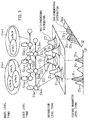
- the distributions 24 and 25 are overlapped as indicated by 312 and the distribution 22 and 23 are also overlapped as indicated by 322, but the distribution 21 and 26 are significantly displaced from the other distributions as indicated by 332 and 342, respectively.
- the one-dimensional distributions ( ⁇ 1,1 , ⁇ 1,1 ) and ( ⁇ 2,1 , ⁇ 2,1 ) in the two-dimensional distributions 21 and 22 ⁇ ( ⁇ 1,1 , ⁇ , 1,1 , ⁇ 1,2 , ⁇ 1,2 ) and ( ⁇ 2,1 , ⁇ 2,1 , ⁇ 2,2 , ⁇ 2,1 ) ⁇ are tied.
- the one-dimensional distributions ( ⁇ 3,2 , ⁇ 3,2 ) and ( ⁇ 4,2 , ⁇ 4,2 ) in the two-dimensional distributions 24 and 25 ⁇ ( ⁇ 3,1 , ⁇ 3,1 , ⁇ 3,2 , ⁇ 3,2 ) and ( ⁇ 4,1 , ⁇ 4,1 , ⁇ 4,2 , ⁇ 4,2 ) ⁇ are tied. In this way, the one-dimensional distributions in each dimension of the multi-dimensional distribution are also tied.
- N( ⁇ 1,2 A , ⁇ 1,2 A ) and N( ⁇ 1,2 B , ⁇ 1,2 B ) of the second dimension are similar to each other, they are tied and represented by one distribution N( ⁇ 1,2 C , ⁇ 1,2 C
- the calculation for the input vector X t (x t,1 , x t,2 , x t,3 , x t,4 ) starts with the distribution A (N( ⁇ 1 A , ⁇ 1 A )). Since its first element index is I1, a check is made to see if the content stored in the calculation result buffer (Fig. 10B)corresponding to the index I1 is -1. If so, the parameters ⁇ 1,1 A and ⁇ 1,1 A of the distribution A are read out from the element index table of Fig. 10A and the calculation result with X t,1 is stored in the storage area of the index I1 in the calculation result buffer.
- Similar processing is also performed for the next element index I7, and the calculation result is stored in the storage area of the index I7 in the calculation result buffer. Similar processing is carried out for the subsequent elements.
- the calculation for the distribution B utilizes, for its second index I7, the result of the calculation executed for the distribution A since the storage area of the index I7 in the calculation result buffer is not -1.
- Such sharing of calculation results by the parameter tying can be carried out regardless of the number of models, the number of states, the number of distributions in each state and the number of dimensions of feature parameters.
- each dimension has a different amount of information for discriminating phonemes .
- a cepstrum coefficient that is one of feature parameter vectors is in many cases represented using about 16 dimensions, and elements of lower dimensions mainly contain larger amounts of information.
- the number of parameters to be tied for the distributions in the lower dimensions is reduced to provide a large number of parameters, thereby improving the representation ability.
- the feature parameter level tying is positively performed to tie as many similar distributions as possible.
- the number of distributions need not always differ with the dimensions but may also be the same in some dimensions.
- the respective dimensions are tied in the same tying relationship so as to tie the vectors. Consequently, the same number of distributions exist in each dimension after tying, and no matter how much information they may have, the dimensions are represented by the same number of distributions.
- the tying method of the present invention provides a model of higher performance by increasing the number of distributions in the dimension with larger amounts of information and decreasing the number of distributions in the dimension with smaller amounts of information.
- a model of the same performance could be generated with a smaller number of distributions, cutting the amount of calculation.
- the number of parameters and the amount of training data are strongly related.
- the number of parameters to be estimated is large and a large amount of training data is needed.
- the amount of training data is small, the generality of the model will be lost.
- the present invention effectively reduces the number of distributions while maintaining information necessary for recognition, and hence enables high recognition performance to be obtained with a small amount of training data.
- HMM tying was performed by (1) the model level tying (first level), (2) the state level tying (second level), (3) the basic distribution level tying (third level), described previously, and (4) the feature parameter level tying for tying one-dimensional normal distributions (mean value and variance) across different multi-dimensional normal distributions according to the present invention.
- Step 1 To implement the first and second levels, the State Successive Splitting (SSS) method was used. Data of one speaker was used to generate a 450-state HMnet in which each state was represented with a single normal distribution.
- SSS State Successive Splitting
- Step 2 After the model obtained in Step 1 was subjected to two-mixture distribution processing for each state, the model was trained with data obtained from many speakers to generate a speaker-independent HMnet (a two-level tied model).
- the distributions in the cluster Accordingly, the total number of d representative distribution in each cluster is shared by the istributions is reduced from 900 to 700 with the two-mixture state held unchanged (the three-level tied model).
- Step 4 In the feature parameter level tying, each dimension is represented with a different number of distributions.
- average inter-distribution distances of 900 distributions in each dimension of the model obtained in Step 2 were calculated, and based on the average distance normalized by the total average distances, the number of distributions in each dimension m p (where p indicates the dimension) was determined.
- the distance measure was the same as is given by Eq. (4).
- Step 5 The model obtained in Step 3 was used to generate m p distribution clusters in each dimension, and the representative distributions in the respective clusters were used as tied distributions in that dimension (a four-level tied model).
- the respective models thus obtained were evaluated in terms of recognition performance and the calculation time during recognition by experiments in phoneme recognition and word recognition.
- 5240-important-Japanese word sets and 216-word sets uttered by 10 male speakers were used. Of the 10 speakers, 8 speakers were used for training and two speakers for evaluation.
- a 10,480-word set selected uniformly from the even-numbered words in the 5240-word sets and the 216-word sets of all training speakers were used for training models.
- 524 words arbitrarily selected from the odd-numbered 5240-word set were used.
- the word recognition test 1500 words were arbitrarily selected from the odd-numbered 5240-word set and used as the vocabulary for recognition, and 200 words were actually recognized for evaluation.
- the number of phoneme categories was 26.
- the feature parameters were 16 cepstrum coefficients, 16 delta cepstrum coefficients and delta power (33 dimensions in total).
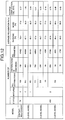
- Fig. 12 is a table showing the configuration, average phoneme recognition rate, average word recognition rate and average computation time (CPU time) ratio of each model.
- the three-level model and four-level model both always keep their structure which consists of 450 states with 2 mixtures (900 distributions).
- the numerical values given in Fig. 12 are average numbers of distributions.
- the mean value, the covariance matrix and the distribution weighting factor are taken into account.
- the computation time is expressed as a ratio with the CPU time needed for the output probability calculation in the word recognition of the two-level model being set at 1.0.
- the computer used is SUN SPARC10.
- Fig. 13 is a graph showing the relationship between the four-level tied structure model in Fig. 12 and a conventional three-level tied structure model in terms of the total number of model parameters and the word recognition rate.
- the word recognition rate remains as high as 90.0% and the computation time can be reduced.
- the tying of basic distributions is based on the assumption that the mean values and covariance are both similar in all dimensions, the reduction of the number of basic distributions down to 256 and 64 causes excessive tying for 900 distributions or lowers the degree of similarity of the distributions to be tied, with the result that the word recognition rate, for instance, drastically goes down to 87.5% and 77.0% as shown in the table of Fig. 12.
- the phoneme recognition rate and the word recognition rate only slightly drop to 86.4% and 89.3%, appreciably higher than in the case of 64 distributions of the three-level model, and the computation time can also be reduced.
- the present invention permits reduction of the number of parameters down to 1/10 to 1/15 without degrading the performance of a model which has a large number of parameters (in Figs. 12 and 13, a model having a total of about 50,000 parameters).
- the normal distributions are tied independently in each dimension in such a manner that the number of distributions to be tied is changed with the amount of discrimination information in the dimension as shown in Fig. 11. That is to say, larger numbers of parameters are tied in higher dimensions with smaller amounts of information to reduce the numbers of parameters that can be selected for representing distributions in those dimensions and smaller numbers of parameters are tied in lower dimensions with larger amounts of information to increase the numbers of parameters that can be selected for representing distributions in those dimensions; hence, the model can efficiently be represented with a smaller number of distributions as a whole.
- the feature parameter level tying according to the present invention has been described to be performed for the model subjected to the model-level, state-level and basic distribution level tying, but the feature parameter level tying may also be performed for a model subjected to the model-level and the state-level tying alone.
- HMMs generated beforehand for individual face images of persons are used to recognize or identify the face shown by an unknown input image (F. Samaria, "Face Segmentation For Identification Using Hidden Markov Models," Proceedings of 4th British Machine Vision Conference, 1993). It has also been proposed to train a sequence of images of a tennis player with HMMs for each action or scene, such as a service, volley or ground stroke, and recognize what play an unknown input image shows (J. Yamato, J. Ohya and K. Ishii, "Recognizing Human Action in Time-Sequential Images Using Hidden Markov Model," Proceedings of IEEE Conference on Computer Vision and Pattern Recognition, pp.
- model parameters are set independently for each model and are trained using data of respective categories.
- the tied parameters can be trained using data of the categories concerned--this means that the substantial amount of data increases.
- a context-dependent acoustic model for instance, has a large number of multi-dimensional normal distributions (1000 or more, for example), and consequently, the numbers of one-dimensional normal distributions and mean values are the same in all dimensions.
- the multi-dimensional normal distributions are each represented with a combination of m one-dimensional normal distributions, so that a total of m P (P being the number of dimensions) multi-dimensional normal distributions can be represented with the m normal distributions; namely, the representation ability is still considerably high even after tying.
- the number of representative points for the feature parameter space need not be as large as 1000, but less than 100 points may be enough for each dimension.
- Eq. (3) provides the sum of probability density values for normal distributions in each dimension, and no calculation is involved across dimensions. Accordingly, the calculation can be considered independently in each dimension.
- the results for each dimension in Eq. (3) can be tied across models.
- mean values the results of calculation of the numerator in the braced second term on the right side of Eq. (3) can be shared by the models. Thus, the amount of calculation for recognition can be reduced.
Landscapes
- Engineering & Computer Science (AREA)
- Physics & Mathematics (AREA)
- Data Mining & Analysis (AREA)
- Theoretical Computer Science (AREA)
- Life Sciences & Earth Sciences (AREA)
- Bioinformatics & Computational Biology (AREA)
- Human Computer Interaction (AREA)
- Acoustics & Sound (AREA)
- Multimedia (AREA)
- Health & Medical Sciences (AREA)
- Computational Linguistics (AREA)
- Artificial Intelligence (AREA)
- Bioinformatics & Cheminformatics (AREA)
- Audiology, Speech & Language Pathology (AREA)
- Computer Vision & Pattern Recognition (AREA)
- Evolutionary Biology (AREA)
- Evolutionary Computation (AREA)
- General Engineering & Computer Science (AREA)
- General Physics & Mathematics (AREA)
- Probability & Statistics with Applications (AREA)
- Image Analysis (AREA)
- Complex Calculations (AREA)
Applications Claiming Priority (6)
| Application Number | Priority Date | Filing Date | Title |
|---|---|---|---|
| JP265394/94 | 1994-10-28 | ||
| JP26539494 | 1994-10-28 | ||
| JP6265394A JPH08123478A (ja) | 1994-10-28 | 1994-10-28 | パターン認識方法 |
| JP52391/95 | 1995-03-13 | ||
| JP7052391A JPH08248986A (ja) | 1995-03-13 | 1995-03-13 | パターン認識方法 |
| JP5239195 | 1995-03-13 |
Publications (2)
| Publication Number | Publication Date |
|---|---|
| EP0709826A1 true EP0709826A1 (de) | 1996-05-01 |
| EP0709826B1 EP0709826B1 (de) | 2000-06-21 |
Family
ID=26392997
Family Applications (1)
| Application Number | Title | Priority Date | Filing Date |
|---|---|---|---|
| EP95116877A Expired - Lifetime EP0709826B1 (de) | 1994-10-28 | 1995-10-26 | Verfahren zur Erkennung von Mustern |
Country Status (3)
| Country | Link |
|---|---|
| US (1) | US5794198A (de) |
| EP (1) | EP0709826B1 (de) |
| DE (1) | DE69517571T2 (de) |
Cited By (3)
| Publication number | Priority date | Publication date | Assignee | Title |
|---|---|---|---|---|
| EP0831461A3 (de) * | 1996-09-20 | 1998-11-18 | Nippon Telegraph And Telephone Corporation | Schema und Modelladaption bei Mustererkennung welche auf Taylorausdehnung basiert |
| WO1999053478A1 (en) * | 1998-04-15 | 1999-10-21 | Microsoft Corporation | Dynamically configurable acoustic model for speech recognition systems |
| EP1187098A3 (de) * | 2000-09-06 | 2003-01-22 | Siemens Aktiengesellschaft | Komprimieren von HMM-Prototypen |
Families Citing this family (17)
| Publication number | Priority date | Publication date | Assignee | Title |
|---|---|---|---|---|
| JP3674990B2 (ja) * | 1995-08-21 | 2005-07-27 | セイコーエプソン株式会社 | 音声認識対話装置および音声認識対話処理方法 |
| US6064958A (en) * | 1996-09-20 | 2000-05-16 | Nippon Telegraph And Telephone Corporation | Pattern recognition scheme using probabilistic models based on mixtures distribution of discrete distribution |
| US6009390A (en) * | 1997-09-11 | 1999-12-28 | Lucent Technologies Inc. | Technique for selective use of Gaussian kernels and mixture component weights of tied-mixture hidden Markov models for speech recognition |
| US6073098A (en) * | 1997-11-21 | 2000-06-06 | At&T Corporation | Method and apparatus for generating deterministic approximate weighted finite-state automata |
| US6772152B2 (en) * | 2001-03-22 | 2004-08-03 | International Business Machines Corporation | System and method for mining patterns from a dataset |
| US6691110B2 (en) | 2001-03-22 | 2004-02-10 | International Business Machines Corporation | System and method for discovering patterns with noise |
| JP2003308091A (ja) * | 2002-04-17 | 2003-10-31 | Pioneer Electronic Corp | 音声認識装置、音声認識方法および音声認識プログラム |
| DE60327020D1 (de) * | 2002-05-27 | 2009-05-20 | Pioneer Corp | Vorrichtung, Verfahren und computerlesbares Aufzeichnungsmedium zur Erkennung von Schlüsselwörtern in spontaner Sprache |
| US20060136210A1 (en) * | 2004-12-16 | 2006-06-22 | Sony Corporation | System and method for tying variance vectors for speech recognition |
| KR100631786B1 (ko) * | 2005-02-18 | 2006-10-12 | 삼성전자주식회사 | 프레임의 신뢰도를 측정하여 음성을 인식하는 방법 및 장치 |
| JP4298672B2 (ja) * | 2005-04-11 | 2009-07-22 | キヤノン株式会社 | 混合分布hmmの状態の出力確率計算方法および装置 |
| KR100664960B1 (ko) * | 2005-10-06 | 2007-01-04 | 삼성전자주식회사 | 음성 인식 장치 및 방법 |
| US20070088552A1 (en) * | 2005-10-17 | 2007-04-19 | Nokia Corporation | Method and a device for speech recognition |
| US20070260459A1 (en) * | 2006-05-04 | 2007-11-08 | Texas Instruments, Incorporated | System and method for generating heterogeneously tied gaussian mixture models for automatic speech recognition acoustic models |
| US9418662B2 (en) * | 2009-01-21 | 2016-08-16 | Nokia Technologies Oy | Method, apparatus and computer program product for providing compound models for speech recognition adaptation |
| US8781825B2 (en) * | 2011-08-24 | 2014-07-15 | Sensory, Incorporated | Reducing false positives in speech recognition systems |
| CN115019234B (zh) * | 2022-06-15 | 2025-08-29 | 天津市国瑞数码安全系统股份有限公司 | 一种改进的场景内容检测的方法和系统 |
Citations (3)
| Publication number | Priority date | Publication date | Assignee | Title |
|---|---|---|---|---|
| EP0533491A2 (de) * | 1991-09-19 | 1993-03-24 | Xerox Corporation | Schlüsselwörtererkennung in einem zusammenhängenden Text mittels zweier "Hidden Markov" Modelle |
| EP0560378A1 (de) * | 1992-03-13 | 1993-09-15 | Kabushiki Kaisha Toshiba | Erkennungssystem |
| US5289562A (en) * | 1990-09-13 | 1994-02-22 | Mitsubishi Denki Kabushiki Kaisha | Pattern representation model training apparatus |
Family Cites Families (4)
| Publication number | Priority date | Publication date | Assignee | Title |
|---|---|---|---|---|
| US4783804A (en) * | 1985-03-21 | 1988-11-08 | American Telephone And Telegraph Company, At&T Bell Laboratories | Hidden Markov model speech recognition arrangement |
| JP3050934B2 (ja) * | 1991-03-22 | 2000-06-12 | 株式会社東芝 | 音声認識方式 |
| US5390278A (en) * | 1991-10-08 | 1995-02-14 | Bell Canada | Phoneme based speech recognition |
| JPH0743598B2 (ja) * | 1992-06-25 | 1995-05-15 | 株式会社エイ・ティ・アール視聴覚機構研究所 | 音声認識方法 |
-
1995
- 1995-10-24 US US08/547,544 patent/US5794198A/en not_active Expired - Fee Related
- 1995-10-26 EP EP95116877A patent/EP0709826B1/de not_active Expired - Lifetime
- 1995-10-26 DE DE69517571T patent/DE69517571T2/de not_active Expired - Fee Related
Patent Citations (3)
| Publication number | Priority date | Publication date | Assignee | Title |
|---|---|---|---|---|
| US5289562A (en) * | 1990-09-13 | 1994-02-22 | Mitsubishi Denki Kabushiki Kaisha | Pattern representation model training apparatus |
| EP0533491A2 (de) * | 1991-09-19 | 1993-03-24 | Xerox Corporation | Schlüsselwörtererkennung in einem zusammenhängenden Text mittels zweier "Hidden Markov" Modelle |
| EP0560378A1 (de) * | 1992-03-13 | 1993-09-15 | Kabushiki Kaisha Toshiba | Erkennungssystem |
Cited By (6)
| Publication number | Priority date | Publication date | Assignee | Title |
|---|---|---|---|---|
| EP0831461A3 (de) * | 1996-09-20 | 1998-11-18 | Nippon Telegraph And Telephone Corporation | Schema und Modelladaption bei Mustererkennung welche auf Taylorausdehnung basiert |
| WO1999053478A1 (en) * | 1998-04-15 | 1999-10-21 | Microsoft Corporation | Dynamically configurable acoustic model for speech recognition systems |
| US6141641A (en) * | 1998-04-15 | 2000-10-31 | Microsoft Corporation | Dynamically configurable acoustic model for speech recognition system |
| JP2010049291A (ja) * | 1998-04-15 | 2010-03-04 | Microsoft Corp | 音声認識システムのための動的にコンフィギュレーション可能な音響モデル |
| EP1187098A3 (de) * | 2000-09-06 | 2003-01-22 | Siemens Aktiengesellschaft | Komprimieren von HMM-Prototypen |
| US6907398B2 (en) | 2000-09-06 | 2005-06-14 | Siemens Aktiengesellschaft | Compressing HMM prototypes |
Also Published As
| Publication number | Publication date |
|---|---|
| DE69517571T2 (de) | 2001-02-08 |
| DE69517571D1 (de) | 2000-07-27 |
| EP0709826B1 (de) | 2000-06-21 |
| US5794198A (en) | 1998-08-11 |
Similar Documents
| Publication | Publication Date | Title |
|---|---|---|
| EP0709826B1 (de) | Verfahren zur Erkennung von Mustern | |
| EP0831456B1 (de) | Verfahren und Vorrichtung zur Spracherkennung | |
| EP0891618B1 (de) | Sprachverarbeitung | |
| US5812975A (en) | State transition model design method and voice recognition method and apparatus using same | |
| EP0504485B1 (de) | Sprecherunabhängiges Gerät zur Markierungskodierung | |
| EP0788648B1 (de) | Verfahren und system zur mustererkennung mittels dynamischer erzeugung einer untermenge von referenzvektoren | |
| EP1070314B1 (de) | Dynamisch konfigurierbares akustisches modell für spracherkennungssysteme | |
| EP0847041A2 (de) | Verfahren und Vorrichtung zur Spracherkennung mit Rauschadaptierung | |
| EP0109190A1 (de) | Einsilbenerkennungseinrichtung | |
| US20090055182A1 (en) | Discriminative Training of Hidden Markov Models for Continuous Speech Recognition | |
| EP1005019B1 (de) | Segmentbasiertes Verfahren zur Messung eines Ähnlichkeitsgrads für die Spracherkennung | |
| US6243695B1 (en) | Access control system and method therefor | |
| US6131089A (en) | Pattern classifier with training system and methods of operation therefor | |
| Braga et al. | Best of both worlds: Multi-task audio-visual automatic speech recognition and active speaker detection | |
| US6725195B2 (en) | Method and apparatus for probabilistic recognition using small number of state clusters | |
| JP3525082B2 (ja) | 統計モデル作成方法 | |
| Jourlin | Word-dependent acoustic-labial weights in HMM-based speech recognition. | |
| Rabiner et al. | Isolated word recognition using a two-pass pattern recognition approach | |
| JP2531227B2 (ja) | 音声認識装置 | |
| JP2973805B2 (ja) | 標準パターン作成装置 | |
| Foote | Decision-tree probability modeling for HMM speech recognition | |
| JP3036509B2 (ja) | 話者照合における閾値決定方法及び装置 | |
| JPH08248986A (ja) | パターン認識方法 | |
| JPH0990981A (ja) | パターン認識のためのモデル学習方法 | |
| Nadas et al. | Automatic speech recognition via pseudo-independent marginal mixtures |
Legal Events
| Date | Code | Title | Description |
|---|---|---|---|
| PUAI | Public reference made under article 153(3) epc to a published international application that has entered the european phase |
Free format text: ORIGINAL CODE: 0009012 |
|
| 17P | Request for examination filed |
Effective date: 19951026 |
|
| AK | Designated contracting states |
Kind code of ref document: A1 Designated state(s): DE FR |
|
| GRAG | Despatch of communication of intention to grant |
Free format text: ORIGINAL CODE: EPIDOS AGRA |
|
| 17Q | First examination report despatched |
Effective date: 19990722 |
|
| GRAG | Despatch of communication of intention to grant |
Free format text: ORIGINAL CODE: EPIDOS AGRA |
|
| GRAH | Despatch of communication of intention to grant a patent |
Free format text: ORIGINAL CODE: EPIDOS IGRA |
|
| GRAH | Despatch of communication of intention to grant a patent |
Free format text: ORIGINAL CODE: EPIDOS IGRA |
|
| GRAA | (expected) grant |
Free format text: ORIGINAL CODE: 0009210 |
|
| RIC1 | Information provided on ipc code assigned before grant |
Free format text: 7G 10L 15/06 A, 7G 10L 15/14 B |
|
| AK | Designated contracting states |
Kind code of ref document: B1 Designated state(s): DE FR |
|
| REF | Corresponds to: |
Ref document number: 69517571 Country of ref document: DE Date of ref document: 20000727 |
|
| ET | Fr: translation filed | ||
| PLBE | No opposition filed within time limit |
Free format text: ORIGINAL CODE: 0009261 |
|
| STAA | Information on the status of an ep patent application or granted ep patent |
Free format text: STATUS: NO OPPOSITION FILED WITHIN TIME LIMIT |
|
| 26N | No opposition filed | ||
| PGFP | Annual fee paid to national office [announced via postgrant information from national office to epo] |
Ref country code: DE Payment date: 20071030 Year of fee payment: 13 |
|
| PGFP | Annual fee paid to national office [announced via postgrant information from national office to epo] |
Ref country code: FR Payment date: 20070716 Year of fee payment: 13 |
|
| REG | Reference to a national code |
Ref country code: FR Ref legal event code: ST Effective date: 20090630 |
|
| PG25 | Lapsed in a contracting state [announced via postgrant information from national office to epo] |
Ref country code: DE Free format text: LAPSE BECAUSE OF NON-PAYMENT OF DUE FEES Effective date: 20090501 |
|
| PG25 | Lapsed in a contracting state [announced via postgrant information from national office to epo] |
Ref country code: FR Free format text: LAPSE BECAUSE OF NON-PAYMENT OF DUE FEES Effective date: 20081031 |