EP0709910A1 - Anschlussvorrichtung für Batterieüberwachungsschaltung - Google Patents
Anschlussvorrichtung für Batterieüberwachungsschaltung Download PDFInfo
- Publication number
- EP0709910A1 EP0709910A1 EP95305569A EP95305569A EP0709910A1 EP 0709910 A1 EP0709910 A1 EP 0709910A1 EP 95305569 A EP95305569 A EP 95305569A EP 95305569 A EP95305569 A EP 95305569A EP 0709910 A1 EP0709910 A1 EP 0709910A1
- Authority
- EP
- European Patent Office
- Prior art keywords
- battery
- monitoring circuit
- lead wire
- terminal
- mounting
- Prior art date
- Legal status (The legal status is an assumption and is not a legal conclusion. Google has not performed a legal analysis and makes no representation as to the accuracy of the status listed.)
- Withdrawn
Links
- 238000012544 monitoring process Methods 0.000 title claims abstract description 80
- WABPQHHGFIMREM-UHFFFAOYSA-N lead(0) Chemical compound [Pb] WABPQHHGFIMREM-UHFFFAOYSA-N 0.000 claims abstract description 60
- 230000000007 visual effect Effects 0.000 claims description 5
- 229910000679 solder Inorganic materials 0.000 claims 1
- 238000012806 monitoring device Methods 0.000 description 8
- 238000003860 storage Methods 0.000 description 7
- XEEYBQQBJWHFJM-UHFFFAOYSA-N Iron Chemical compound [Fe] XEEYBQQBJWHFJM-UHFFFAOYSA-N 0.000 description 4
- 150000001875 compounds Chemical class 0.000 description 4
- 238000001746 injection moulding Methods 0.000 description 4
- 238000004382 potting Methods 0.000 description 4
- 229910000978 Pb alloy Inorganic materials 0.000 description 3
- 239000000463 material Substances 0.000 description 3
- 238000005476 soldering Methods 0.000 description 3
- RYGMFSIKBFXOCR-UHFFFAOYSA-N Copper Chemical compound [Cu] RYGMFSIKBFXOCR-UHFFFAOYSA-N 0.000 description 2
- 239000004020 conductor Substances 0.000 description 2
- 229910052802 copper Inorganic materials 0.000 description 2
- 239000010949 copper Substances 0.000 description 2
- 239000003792 electrolyte Substances 0.000 description 2
- 238000009413 insulation Methods 0.000 description 2
- 229910052742 iron Inorganic materials 0.000 description 2
- 239000002184 metal Substances 0.000 description 2
- 229910052751 metal Inorganic materials 0.000 description 2
- 238000003466 welding Methods 0.000 description 2
- 239000004593 Epoxy Substances 0.000 description 1
- 240000005561 Musa balbisiana Species 0.000 description 1
- 235000018290 Musa x paradisiaca Nutrition 0.000 description 1
- 239000002253 acid Substances 0.000 description 1
- 239000004063 acid-resistant material Substances 0.000 description 1
- 239000000853 adhesive Substances 0.000 description 1
- 230000001070 adhesive effect Effects 0.000 description 1
- 230000000712 assembly Effects 0.000 description 1
- 238000000429 assembly Methods 0.000 description 1
- 230000005540 biological transmission Effects 0.000 description 1
- 238000006073 displacement reaction Methods 0.000 description 1
- 238000010438 heat treatment Methods 0.000 description 1
- 238000000034 method Methods 0.000 description 1
- 238000012986 modification Methods 0.000 description 1
- 230000004048 modification Effects 0.000 description 1
- 238000000465 moulding Methods 0.000 description 1
- 230000002093 peripheral effect Effects 0.000 description 1
- 230000000135 prohibitive effect Effects 0.000 description 1
- 238000005728 strengthening Methods 0.000 description 1
- 239000000126 substance Substances 0.000 description 1
Images


Classifications
-
- H—ELECTRICITY
- H01—ELECTRIC ELEMENTS
- H01M—PROCESSES OR MEANS, e.g. BATTERIES, FOR THE DIRECT CONVERSION OF CHEMICAL ENERGY INTO ELECTRICAL ENERGY
- H01M10/00—Secondary cells; Manufacture thereof
- H01M10/42—Methods or arrangements for servicing or maintenance of secondary cells or secondary half-cells
- H01M10/48—Accumulators combined with arrangements for measuring, testing or indicating the condition of cells, e.g. the level or density of the electrolyte
-
- Y—GENERAL TAGGING OF NEW TECHNOLOGICAL DEVELOPMENTS; GENERAL TAGGING OF CROSS-SECTIONAL TECHNOLOGIES SPANNING OVER SEVERAL SECTIONS OF THE IPC; TECHNICAL SUBJECTS COVERED BY FORMER USPC CROSS-REFERENCE ART COLLECTIONS [XRACs] AND DIGESTS
- Y02—TECHNOLOGIES OR APPLICATIONS FOR MITIGATION OR ADAPTATION AGAINST CLIMATE CHANGE
- Y02E—REDUCTION OF GREENHOUSE GAS [GHG] EMISSIONS, RELATED TO ENERGY GENERATION, TRANSMISSION OR DISTRIBUTION
- Y02E60/00—Enabling technologies; Technologies with a potential or indirect contribution to GHG emissions mitigation
- Y02E60/10—Energy storage using batteries
Definitions
- This invention relates to storage battery assemblies, and more particularly, to a connection arrangement for battery monitoring circuits that monitor conditions and/or operating parameters of storage batteries that are used in deep cycle applications, or for motor vehicle batteries, and the like.
- Storage batteries are often used in deep cycle applications to provide electrical energy to power electrical devices such as electric motors or emergency lighting.
- Typical deep cycle applications for a battery include providing power to lights and accessories in recreational vehicles, providing power to an electric trolling motor in a fishing boat, providing power to the electric drive of a battery-operated wheelchair, or providing back-up and emergency power for security systems.
- the storage battery may be required to supply current for several hours. Supplying this current will discharge the battery to a relatively low state of charge.
- batteries are being produced which include a state of charge monitoring circuit for providing a visual or audible indication when the state of charge of the battery has fallen below a predetermined threshold.
- monitoring circuits are particularly suited for deep cycle applications, the monitoring circuits can be used in other applications, such as for monitoring one or more operating parameters of storage batteries used in motor vehicles and providing an output indicative of the monitored condition for use by the vehicle computer for control and diagnostic purposes.
- United States Patent No. 5,321,627 to Michael T. Reher which was issued on July 14, 1992 and which is assigned to Globe Union Inc., discloses a battery monitor which provides an indication of the absolute state of charge, the relative state of charge, and the capacity of a battery under discharge, rest, and recharge conditions, as well as other information and indications.
- Most battery state of charge monitoring circuits include an electronic circuit that must be continually connected to the terminals of the battery being monitored. To facilitate such connections, the monitoring circuit is usually installed permanently into or onto the battery and connected to the positive and negative terminals of the battery.
- the connections to the battery terminals are accomplished through permanent copper bus bars that are molded into the battery cover using an injection molding process. This requires that the battery cover be of a non-standard size to accommodate the bus bars.
- the bus bars must be sized so that they can withstand the injection molding process resulting in substantially more metal than is necessary to meet the conductor resistance requirement. Studies have demonstrated that the cost of molding bus bars into the battery cover for this purpose is prohibitive.
- the bus bars must be free to move relative to the termination by which they are connected to the battery terminals.
- the secondary battery terminals defined by the battery terminal bushings are connected directly to the circuit of the battery monitoring device, this arrangement requires relatively long secondary terminal arms, even though the housing of the battery monitoring device extends over more than half the length of the battery cover. Also, because of the size of the battery monitoring device, a non-standard cover is required to accommodate the device.
- the present invention provides an arrangement for mounting a battery monitoring circuit on a battery cover and for electrically and mechanically connecting lead wires of the battery monitoring circuit to the positive and negative terminals of the battery.
- the battery cover includes means for securing the battery monitoring circuit to the cover and first and second lead wire slots which extend from the location of the battery monitoring circuit to the locations of the battery terminals.
- the lead wires of the battery monitoring circuit are pressed into the lead wire slots which direct the lead wires to mounting sites which are defined by extensions of the battery terminal bushings.
- the terminal ends of the lead wires are electrically and mechanically connected to the mounting sites in a suitable manner.
- each mounting site is defined by an upwardly projecting post which has a notch formed in its upper end for receiving the terminal end of one of the lead wires.
- the extensions of the battery terminal bushings locate the mounting posts in wells that are molded into the battery cover.
- the lead wire slots terminate at the wells so that when the lead wires are pressed into the lead wire slots, the terminal ends of the lead wires are guided directly into the notches in the mounting posts.
- the mounting posts of the battery terminal bushings are made of a material, such as lead or a lead alloy, that will melt around the terminal ends of the lead wires when heated by a soldering iron, for example.
- the battery cover has molded therein a cavity which is adapted to receive and secure the battery monitoring circuit module.
- the cavity in the battery cover locates the housing of the battery monitoring circuit such that the lead wire output apertures of the housing align with the slots formed in the battery cover to facilitate the positioning of the lead wires in the lead wire slots.
- the battery monitoring circuit includes a light emitting diode that provides a visual output for indicating a condition of the battery being monitored by the battery monitoring circuit.
- a light guide such as a fiber-optic cable, is used as a light transmission medium to permit light emitted by the light emitting diode to be conducted to a location remote from the location of the battery being monitored, for display at or near the dash board of a motor vehicle or the control console of a boat or other type of vehicle, for example.
- the monitoring circuit includes a socket for receiving the plug of an electrical cable for conducting an electrical signal, indicative of the status of the monitored condition, to a location remote from the location of the battery for controlling a suitable indicator device at the remote location.
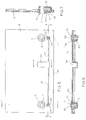
- FIGS. 1 and 2 of the drawings there is illustrated a cover assembly 10 for a battery, incorporating the connection arrangement according to the present invention for mounting a monitoring circuit module 11 on a battery cover 12 and for connecting lead wires 13 and 14 of the monitoring circuit module 11 to the positive and negative terminals of the battery.
- the cover assembly 10 includes a battery terminal bushing 16 and a battery terminal bushing 18 which are molded into the cover 12.
- the battery terminal bushing 16 has an opening 17 therethrough which receives the positive battery terminal in an electrical conducting relationship, the battery terminal bushing 16 being connected to the positive battery terminal such as by welding when the cover assembly 10 is assembled on the battery housing.
- the battery terminal bushing 18 has an opening 19 therethrough which receives the negative battery terminal in an electrical conducting relationship, the battery terminal bushing 18 being connected to the negative battery terminal such as by welding when the cover assembly 10 is assembled on the battery housing.
- the battery terminal bushings 16 and 18 include respective extensions 21 and 23, shown in FIGS. 7-10, which define respective mounting sites defined by mounting posts 22 and 24 to facilitate connection of the lead wires of the battery monitoring circuit to the battery terminals.
- the lead wires 13 and 14 of the monitoring circuit module 11 are positioned in lead wire slots 25 and 26 formed in the upper surface 28 of the battery cover 12.
- the lead wire slots 25 and 26 extend from the location of the monitoring circuit module 11 to the battery terminal bushing 16 and a battery terminal 18, respectively.
- One of the lead wires 13 has its terminal end 47 electrically and mechanically connected to the mounting post 22 of the battery terminal bushing 16 that is connected to the positive battery terminal when the cover is assembled on the battery.
- the other lead wire 14 has its terminal end 48 electrically and mechanically connected to the mounting post 24 of the battery terminal bushing 18 that is connected to the negative battery terminal when the cover is assembled on the battery.
- the mounting posts are offset from the battery terminals and recessed below the upper surface 28 of the battery cover 12.
- the monitoring circuit module 11 is assumed to include a state of charge indicator circuit such as the charge indicator that is disclosed in the co-pending United States Patent Application Serial No. 08/030,648 of Michael T. Reher et al., which was filed on March 12, 1993, which application is incorporated herein by reference.
- the connection arrangement can be used to mount other types of monitoring circuits, switching devices, or control devices on a battery cover, in or on the battery housing, and to connect such circuits or devices in circuit with the battery.
- the state of charge indicator monitors a voltage produced by a depletable energy source, such as a storage battery, and provides an indication when the state of charge falls below a predetermined threshold.
- the state of charge indicator includes an input circuit for sensing the battery voltage and producing a plurality of sense voltages that are proportional to the voltage between the battery terminals.
- the state of charge indicator includes a monitor circuit for comparing these voltages with a corresponding threshold voltage and producing an output signal for each sense voltage falling below its corresponding threshold.
- the output signals for a plurality of comparisons are stored in memory and used for producing an accumulated status.
- An output circuit including a light emitting diode produces a visual indication of low state of charge when the accumulated status exceeds a threshold value.
- the monitoring circuit indicated generally at 30 in FIG. 2, is contained within a housing 32.
- the battery monitoring circuit module 11 is mounted in a cavity 34 formed in the upper or outer surface 28 of the battery cover 12 near the front edge 35 of the battery cover 12.
- the module housing 32 is sized to fit within the cavity 34.
- the housing 32 has projections 36 on opposite sides of the sidewalls 37 of the housing which are received in recesses 40 in the side walls 42 of the cavity 34 when the module is mounted in the cavity, for securing the module 11 to the battery cover 12 by the housing 32.
- the housing 32 has openings 38 near one end 39 thereof through which the lead wires 13 and 14 are fed to the lead wire slots 25 and 26, so that the housing 32 locates the lead wires in the lead wire slots.
- the light-emitting diode 31 contained within the raised portion 33 of the housing is exposed to view at the upper surface of the battery.
- the housing 32 is made of a translucent plastic material so that light emitted by the light-emitting diode 31 can be seen through the housing.
- the light emitting diode 31 is coupled to a location remote from the battery by way of a light guide 50, or the like.
- the light guide 50 is mounted to the module housing 32 by a yoke 52 which has projections 53 at the ends of its arms which are received in recesses 54 in the outer surface of the module housing.
- One end 55 of the light guide is passed through an opening in the end wall of the raised portion 33 of the module housing.
- the yoke 52 locates the end 55 of the light guide in close proximity to the light emitting diode 31 to permit light emitted by the light emitting diode to be conducted through the light guide to a location remote from the location of the battery being monitored, for display at or near the dashboard of a motor vehicle or the control console of a boat or other type of vehicle, for example.
- an electrical signal output that is indicative of the status of the monitored condition for the battery being monitored by the battery monitoring circuit 30 is extended by an electrical cable 57 to a location remote from the location of the battery for controlling a suitable indicating device or circuit.
- the battery monitoring circuit includes an electrical socket 58 adapted to receive the plug 59 of the electrical cable 57.
- the electrical socket is mounted within the raised portion 33 of the module housing 32.
- the battery cover 12 is formed by injection molding to mold in the lead wire slots 25 and 26, the module cavity 34 and other features of the battery not shown, such as vent cap openings, internal strengthening ribs, etc.
- the battery terminal bushings 16 and 18 are molded into the cover 12 during the injection molding process in the manner known in the art.
- the module cavity 34 extends inwardly from the upper surface 28 of the battery cover and is located inward from the front edge 35 of the battery cover 12.
- the module cavity is offset relative to the center of the battery cover so that the raised portion 33 of the monitoring circuit module, which projects above the surface 28 of the battery cover, does not interfere with hold-downs or battery clamping devices that maintain the battery in position on the marine craft, motor vehicle or other vehicle with which it is used.
- the upper portion 33 of the module housing 32 containing the light emitting diode does not project higher than the vent caps (not shown) that are located on the upper surface of the battery in the conventional manner.
- the light-emitting diode 31 shown in FIG. 3, or the socket 58 shown in FIG. 4 can be located within the cavity so that the module housing 32 is flush with the upper surface of the battery cover.
- the mounting portions 22 and 24 of the battery terminal bushings are located in wells 61 and 62 which are molded into the cover 12, which provide access to the mounting posts but permit the mounting posts to be located recessed relative to the upper surface 28 of the battery cover 12.
- the lead wire slots 25 and 26 are molded into the cover 12, extending generally parallel to and spaced inward from the front edge 35 of the cover 12.
- the lead wire slot 25 extends from one side of the cavity 34 to the well 61 and the lead wire slot 26 extends from the other side of the cavity 34 to the well 62.
- the monitoring circuit module is mounted on the upper surface of the battery cover and the connection of the monitoring circuit to the battery terminals is made on the top of the battery cover 12
- the module cavity, the lead wire slots, and the extensions 21 and 23 of the terminal bushings are isolated from the interior of the battery by the lower surface of the battery cover.
- the monitoring module can be mounted on the inner surface of the cover, or within the battery housing, and encapsulated to protect the circuit and the connections thereto from the electrolyte contained within the battery.
- the lead wires 13 and 14 of the battery monitoring circuit 30 are insulation coated, small gauge wires formed of copper or another highly conductive material.
- the lead wires may be 28 gauge wire.
- the lead wires are pressed into the lead wire slots 25 and 26 in the cover 12 using a roller type tool or any other suitable tool.
- the lead wire slots are substantially rectangular in cross section and are formed to be wider than the outer diameter of the lead wires.
- Each lead wire slot such as lead wire slot 25 shown in FIG. 11, has a plurality of pairs of inwardly directed portions 64 and 66 which define pinch points spaced periodically along the length of the lead wire slot.
- the inwardly directed portions 64 and 66 are spaced apart a distance that is less than the outer diameter of the lead wire so that the portions 64 and 66 engage the lead wire, pinching the lead wire to hold the lead wire in the slot 25.
- the pinch points provide compensation for variations in the tolerance in the outer diameter of the lead wires.
- battery terminal bushing 16 and 18, which connect the terminal ends 47 and 48 (FIG. 2) of the lead wires 13 and 14 to the positive and negative terminals of the battery, are identical in size and shape, and accordingly, only battery terminal bushing 16 is described in detail.
- battery terminal bushing 16 includes a cylindrical body portion 71 having an annular flange 72 near its upper end and the extension 21 near its lower end.
- the cylindrical portion has a central aperture 17 extending therethrough from its upper end to its lower end for receiving the positive battery terminal of the battery on which the cover assembly is mounted.
- the extension 21 projects radially outward from the body portion 71 at the lower end thereof and has a curved outer end.
- the vertical height of the extension 21 is about half the height of the cylindrical battery terminal receiving portion and of a width that corresponds to the diameter of the central aperture 17.
- the extension 21 includes an upstanding portion near its curved outer end which defines the mounting post 22.
- the mounting post has a notch 77, which may be a "v"-shaped notch, in its upper end 79 for receiving the terminal end of the lead wire.
- the length of the extension 21 is selected to locate the mounting post to be offset laterally a distance "d" from the axis of the aperture 17.
- the peripheral edge of the battery terminal bushing, including the cylindrical portion 71 and the extension 21, has grooves 73 formed therein for minimizing leakage of the electrolyte upwardly through the battery terminal bushing in the completed battery.
- the battery terminal bushings 16 and 18, including the extension portions 21 and 23 and the mounting posts, are made of lead or a lead alloy.
- the terminal ends 47 and 48 of the lead wires are connected to the mounting posts by a soldering operation.
- the terminal ends are tinned to improve the connection between the wire ends and the mounting posts.
- the terminal ends 47 and 48 can be secured to the mounting posts in other ways.
- the terminal ends 47 and 48 can be connected using an insulation displacement connector molded into the lead terminal bushing.
- the connection can be accomplished using a female/male disconnect technique with the male disconnect terminal being molded into the lead terminal bushing and the female terminal being attached to the end of the lead wire.
- Another connection arrangement that could be used is to terminate the lead wire with a modified banana jack connector and forcing the connector into a small hole formed in the lead terminal bushing.
- the lead wire could be stapled to the lead terminal bushing and covering the connection with potting compound to enhance the connection.
- the lead wires can be connected to the lead terminal bushing using a crimped connection or riveted to the lead terminal bushing using pop rivet connection arrangement.
- Another way of connecting the monitoring circuit to the lead terminal bushing is to use strips of conductive plastic in place of the metal lead wires and securing the conductive plastic strips to the lead terminal bushing by conductive adhesive.
- the notch 77 of the mounting post 22 is aligned with the lead wire slot 25 so that the terminal end 47 of the lead wire 13 falls into the notch 77 as the lead wire is being pressed into the lead wire slot.
- the lead wires are secured to the mounting posts by heating the mounting posts with a soldering iron. This causes the lead material of the mounting posts to flow around the lead wires, forming an low resistance electrical connections between the terminal ends 47 and 48 of the lead wires and the mounting posts 22 and 24 and mechanically connecting the lead wires to the mounting posts.
- the battery terminal bushings 16 and 18 are welded to the battery terminal in the manner known in the art for assembling a cover on a battery housing.
- connection areas at which the connection are made between the terminal ends 47 and 48 of the two lead wires and the mounting posts are encapsulated with a suitable potting compound, as indicated by the reference numeral 80, to protect the connection from physical and chemical damage.
- the lead wire slot is sized such that the upper surface of each of the insulated lead wires is flush with the top surface of the battery cover.
- the mounting post is recessed below the upper surface of the battery cover 12 to allow sufficient volume within the well to encapsulate the electrical connection with potting compound, obtaining a flush surface between the top of the battery cover and the potting compound.
- connection sites and the area around the battery terminals and around the monitoring circuit module may be covered by a label or decal, which is represented by the dashed line 82 in FIG. 1, to provide further protection for the lead wires.
- the label or decal may bear information about use and operation of the battery monitoring circuit and/or about the battery itself.
- this invention provides an arrangement for mounting a battery monitoring circuit on a battery cover and for electrically and mechanically connecting lead wires of the battery monitoring circuit to the positive and negative terminals of the battery.
- the battery cover has a cavity molded therein for mounting the battery monitoring circuit and first and second lead wire slots are molded into the cover for directing the lead wires to the locations of the battery terminals.
- the lead wires of the battery monitoring circuit are pressed into the lead wire slots and extend therein to lead mounting posts which are defined by the battery terminal bushings.
- the cavity in the battery cover locates the housing of the battery monitoring circuit with lead wire output apertures of the housing aligned with the slots formed in the battery cover to facilitate the positioning of the lead wires in the slots.
- the terminal ends of the wire leads are electrically and mechanically connected to the mounting posts in a suitable manner.
- the mounting posts have a notch formed in their upper end which receives and holds the terminal end of the lead wire.
- the connector post is formed of lead, or a lead alloy, and is heated to flow around the terminal end of the lead wire to make to connection.
- the battery monitoring circuit is shown mounted on the outer surface of the cover, the battery monitoring circuit could be mounted on the inner surface of the battery cover and be enclosed within the battery when the cover assembly is assembled on the battery. In such arrangement, the monitoring circuit and the lead wires also would be encapsulated with epoxy or other acid resistant material. While the invention has been described with reference to preferred embodiments, various modifications can be made without departing from the spirit and scope of the invention as defined in the appended claims.
Landscapes
- Engineering & Computer Science (AREA)
- Manufacturing & Machinery (AREA)
- Chemical & Material Sciences (AREA)
- Chemical Kinetics & Catalysis (AREA)
- Electrochemistry (AREA)
- General Chemical & Material Sciences (AREA)
- Connection Of Batteries Or Terminals (AREA)
Applications Claiming Priority (2)
| Application Number | Priority Date | Filing Date | Title |
|---|---|---|---|
| US08/316,616 US5449570A (en) | 1994-09-30 | 1994-09-30 | Connection arrangement for battery monitoring circuits |
| US316616 | 1994-09-30 |
Publications (1)
| Publication Number | Publication Date |
|---|---|
| EP0709910A1 true EP0709910A1 (de) | 1996-05-01 |
Family
ID=23229831
Family Applications (1)
| Application Number | Title | Priority Date | Filing Date |
|---|---|---|---|
| EP95305569A Withdrawn EP0709910A1 (de) | 1994-09-30 | 1995-08-09 | Anschlussvorrichtung für Batterieüberwachungsschaltung |
Country Status (2)
| Country | Link |
|---|---|
| US (1) | US5449570A (de) |
| EP (1) | EP0709910A1 (de) |
Cited By (3)
| Publication number | Priority date | Publication date | Assignee | Title |
|---|---|---|---|---|
| WO2007033690A1 (de) * | 2005-09-20 | 2007-03-29 | Metabowerke Gmbh | Akkupack sowie elektrohandwerkzeuggerät |
| JP2016527676A (ja) * | 2013-07-11 | 2016-09-08 | ローベルト ボッシュ ゲゼルシャフト ミット ベシュレンクテル ハフツング | 収容装置、バッテリ、及び車両 |
| WO2018001540A1 (de) * | 2016-06-29 | 2018-01-04 | FRÖTEK Vermögensverwaltung GmbH | Verschlussdeckel einer batteriezelle |
Families Citing this family (13)
| Publication number | Priority date | Publication date | Assignee | Title |
|---|---|---|---|---|
| CN1178314C (zh) * | 1996-07-09 | 2004-12-01 | 松下电器产业株式会社 | 可充电电池及可充电电池用安装封口板 |
| DE29611978U1 (de) * | 1996-07-10 | 1997-02-13 | Muntermann, Axel, 35583 Wetzlar | Akkumulator |
| US6094030A (en) * | 1999-05-13 | 2000-07-25 | Deltatee Enterprises Ltd. | Resistance and charging monitor within a standby battery bank |
| US20080063930A1 (en) * | 2006-09-08 | 2008-03-13 | Karr Rhett J | Universal portable power pack |
| KR101028936B1 (ko) | 2008-10-02 | 2011-04-12 | 주식회사 엘지화학 | 셀 모듈 어셈블리의 전압 센싱을 위한 접촉 패드 및 셀 모듈 조립체 |
| US8188876B1 (en) | 2009-05-29 | 2012-05-29 | Brunswick Corporation | Integrated battery level indicator, method and circuit for a trolling motor controller |
| JP4995298B2 (ja) * | 2010-03-29 | 2012-08-08 | 三菱重工業株式会社 | 電池システム |
| US10608293B2 (en) | 2016-11-01 | 2020-03-31 | Duracell U.S. Operations, Inc. | Dual sided reusable battery indicator |
| US10151802B2 (en) | 2016-11-01 | 2018-12-11 | Duracell U.S. Operations, Inc. | Reusable battery indicator with electrical lock and key |
| US10818979B2 (en) * | 2016-11-01 | 2020-10-27 | Duracell U.S. Operations, Inc. | Single sided reusable battery indicator |
| DE102016222083A1 (de) * | 2016-11-10 | 2018-05-17 | Robert Bosch Gmbh | Batteriemodul, Deckelelement eines Batteriemoduls, Verfahren zur Herstellung derselben und Batterie |
| CN113921944A (zh) * | 2021-09-30 | 2022-01-11 | 北京帮安迪信息科技股份有限公司 | 一种移动视频监控终端设备的电路电池温度监测机构 |
| CN222483474U (zh) * | 2022-08-30 | 2025-02-14 | 宁德时代新能源科技股份有限公司 | 电池单体、电池及用电装置 |
Citations (9)
| Publication number | Priority date | Publication date | Assignee | Title |
|---|---|---|---|---|
| US2004049A (en) * | 1933-06-08 | 1935-06-04 | Charles E Hoover | Means for connecting cables to batteries |
| US2058787A (en) * | 1931-05-02 | 1936-10-27 | George G Greger | Storage battery connection |
| US3064893A (en) | 1958-03-13 | 1962-11-20 | Carl E Grinstead | Counter |
| JPS57189466A (en) * | 1981-05-18 | 1982-11-20 | Yuasa Battery Co Ltd | Storage battery |
| JPH0246664A (ja) * | 1988-08-08 | 1990-02-16 | Matsushita Electric Ind Co Ltd | 蓄電池 |
| EP0355461A2 (de) * | 1988-07-27 | 1990-02-28 | Gnb Incorporated | Gerät und Einrichtung zur Überwachung einer elektrischen Akkumulatorenbatterie |
| WO1990016090A1 (en) * | 1989-06-12 | 1990-12-27 | Globe-Union Inc. | Switched dual battery system |
| US5130699A (en) | 1991-04-18 | 1992-07-14 | Globe-Union, Inc. | Digital battery capacity warning device |
| US5321627A (en) | 1992-03-11 | 1994-06-14 | Globe-Union, Inc. | Battery monitor and method for providing operating parameters |
Family Cites Families (5)
| Publication number | Priority date | Publication date | Assignee | Title |
|---|---|---|---|---|
| GB8804011D0 (en) * | 1988-02-22 | 1988-03-23 | Tremblay A | Polarity indicator for car batteries |
| US4957828A (en) * | 1988-12-09 | 1990-09-18 | Ssmc Inc. | Emergency battery monitor |
| US5002840A (en) * | 1989-06-12 | 1991-03-26 | Globe-Union Inc. | Switched emergency battery system |
| US5057383A (en) * | 1990-03-30 | 1991-10-15 | Anton/Bauer, Inc | Battery system |
| US5281493A (en) * | 1992-09-04 | 1994-01-25 | Globe-Union Inc. | Terminal construction for a battery |
-
1994
- 1994-09-30 US US08/316,616 patent/US5449570A/en not_active Expired - Fee Related
-
1995
- 1995-08-09 EP EP95305569A patent/EP0709910A1/de not_active Withdrawn
Patent Citations (10)
| Publication number | Priority date | Publication date | Assignee | Title |
|---|---|---|---|---|
| US2058787A (en) * | 1931-05-02 | 1936-10-27 | George G Greger | Storage battery connection |
| US2004049A (en) * | 1933-06-08 | 1935-06-04 | Charles E Hoover | Means for connecting cables to batteries |
| US3064893A (en) | 1958-03-13 | 1962-11-20 | Carl E Grinstead | Counter |
| JPS57189466A (en) * | 1981-05-18 | 1982-11-20 | Yuasa Battery Co Ltd | Storage battery |
| EP0355461A2 (de) * | 1988-07-27 | 1990-02-28 | Gnb Incorporated | Gerät und Einrichtung zur Überwachung einer elektrischen Akkumulatorenbatterie |
| US5159272A (en) | 1988-07-27 | 1992-10-27 | Gnb Incorporated | Monitoring device for electric storage battery and configuration therefor |
| JPH0246664A (ja) * | 1988-08-08 | 1990-02-16 | Matsushita Electric Ind Co Ltd | 蓄電池 |
| WO1990016090A1 (en) * | 1989-06-12 | 1990-12-27 | Globe-Union Inc. | Switched dual battery system |
| US5130699A (en) | 1991-04-18 | 1992-07-14 | Globe-Union, Inc. | Digital battery capacity warning device |
| US5321627A (en) | 1992-03-11 | 1994-06-14 | Globe-Union, Inc. | Battery monitor and method for providing operating parameters |
Non-Patent Citations (2)
| Title |
|---|
| PATENT ABSTRACTS OF JAPAN vol. 14, no. 210 (E - 0922) 27 April 1990 (1990-04-27) * |
| PATENT ABSTRACTS OF JAPAN vol. 7, no. 36 (E - 158) 15 February 1983 (1983-02-15) * |
Cited By (5)
| Publication number | Priority date | Publication date | Assignee | Title |
|---|---|---|---|---|
| WO2007033690A1 (de) * | 2005-09-20 | 2007-03-29 | Metabowerke Gmbh | Akkupack sowie elektrohandwerkzeuggerät |
| US8211560B2 (en) | 2005-09-20 | 2012-07-03 | Metabowerke Gmbh | Battery pack and hand-held power tool |
| JP2016527676A (ja) * | 2013-07-11 | 2016-09-08 | ローベルト ボッシュ ゲゼルシャフト ミット ベシュレンクテル ハフツング | 収容装置、バッテリ、及び車両 |
| WO2018001540A1 (de) * | 2016-06-29 | 2018-01-04 | FRÖTEK Vermögensverwaltung GmbH | Verschlussdeckel einer batteriezelle |
| CN109314195A (zh) * | 2016-06-29 | 2019-02-05 | 德国福泰科投资管理有限公司 | 电池单体的封闭盖 |
Also Published As
| Publication number | Publication date |
|---|---|
| US5449570A (en) | 1995-09-12 |
Similar Documents
| Publication | Publication Date | Title |
|---|---|---|
| US5449570A (en) | Connection arrangement for battery monitoring circuits | |
| CN216672012U (zh) | 输出稳定的电池端电连接器、电池包和电动汽车 | |
| CN101453089B (zh) | 电连接器 | |
| US7663466B1 (en) | Corner-mounted battery fuse | |
| KR102327471B1 (ko) | 접속 장치 및 전기 모터 | |
| US6955567B2 (en) | Junction terminal and connector having the same | |
| EP0884750A2 (de) | Schmelzsicherungsanordnung | |
| US4473264A (en) | Battery cable | |
| US20140141287A1 (en) | Battery pack and battery control module | |
| CN105518902A (zh) | 用于电池模块中的电池单元互连的总线条联接件 | |
| US12431670B2 (en) | Charging inlet assembly having a proximity resistor assembly | |
| JP2001345082A (ja) | 電源装置 | |
| EP4354644A1 (de) | Zellmodulanordnung und batteriepack damit | |
| CN114709659B (zh) | 一种功率插针冷却组件、充电连接器 | |
| US12476425B2 (en) | Charging inlet assembly having a proximity resistor assembly | |
| EP1744601B1 (de) | Anordnung zum Zünden einer Entladungslampe und Herstellungsverfahren dafür | |
| US6520804B2 (en) | Fuse box device | |
| CN221080293U (zh) | 电池包断路单元的标准化模块控制盒 | |
| EP1052743B1 (de) | Fahrzeugmontierter Drehverbinder | |
| EP3267509A1 (de) | Batteriepack | |
| US4759728A (en) | Vehicle battery jumper improvement | |
| US20240305030A1 (en) | Type-2 connector with low building height | |
| US20240243536A1 (en) | Electrical connection system for charging vehicles | |
| CN220437610U (zh) | 一种温度采样传感器及汽车bdu | |
| US7063570B1 (en) | Electrical connector and component packaging assembly |
Legal Events
| Date | Code | Title | Description |
|---|---|---|---|
| PUAI | Public reference made under article 153(3) epc to a published international application that has entered the european phase |
Free format text: ORIGINAL CODE: 0009012 |
|
| AK | Designated contracting states |
Kind code of ref document: A1 Designated state(s): DE ES FR GB |
|
| 17P | Request for examination filed |
Effective date: 19961026 |
|
| 17Q | First examination report despatched |
Effective date: 19980819 |
|
| STAA | Information on the status of an ep patent application or granted ep patent |
Free format text: STATUS: THE APPLICATION IS DEEMED TO BE WITHDRAWN |
|
| 18D | Application deemed to be withdrawn |
Effective date: 19981230 |