EP0710536A2 - Anschlusseinheiten für Blasform-Steuersystemen - Google Patents
Anschlusseinheiten für Blasform-Steuersystemen Download PDFInfo
- Publication number
- EP0710536A2 EP0710536A2 EP95307114A EP95307114A EP0710536A2 EP 0710536 A2 EP0710536 A2 EP 0710536A2 EP 95307114 A EP95307114 A EP 95307114A EP 95307114 A EP95307114 A EP 95307114A EP 0710536 A2 EP0710536 A2 EP 0710536A2
- Authority
- EP
- European Patent Office
- Prior art keywords
- wall thickness
- signal
- interface unit
- actual position
- machine
- Prior art date
- Legal status (The legal status is an assumption and is not a legal conclusion. Google has not performed a legal analysis and makes no representation as to the accuracy of the status listed.)
- Withdrawn
Links
- 238000010101 extrusion blow moulding Methods 0.000 title claims abstract description 23
- 238000005303 weighing Methods 0.000 claims abstract description 16
- 238000001125 extrusion Methods 0.000 claims abstract description 11
- 230000001419 dependent effect Effects 0.000 claims abstract description 10
- 238000012545 processing Methods 0.000 claims abstract description 5
- 238000012937 correction Methods 0.000 claims description 19
- 238000006073 displacement reaction Methods 0.000 claims description 4
- 208000037063 Thinness Diseases 0.000 claims description 2
- 206010048828 underweight Diseases 0.000 claims description 2
- 239000000047 product Substances 0.000 abstract description 26
- 238000000465 moulding Methods 0.000 abstract description 12
- 239000000463 material Substances 0.000 abstract description 9
- 230000003247 decreasing effect Effects 0.000 abstract description 4
- 239000012467 final product Substances 0.000 abstract description 3
- 230000000694 effects Effects 0.000 description 9
- 238000004519 manufacturing process Methods 0.000 description 9
- 238000013461 design Methods 0.000 description 3
- 229920003023 plastic Polymers 0.000 description 3
- 239000004033 plastic Substances 0.000 description 3
- 238000010586 diagram Methods 0.000 description 2
- 239000012530 fluid Substances 0.000 description 2
- 230000006872 improvement Effects 0.000 description 2
- 238000000034 method Methods 0.000 description 2
- 238000005096 rolling process Methods 0.000 description 2
- 230000008901 benefit Effects 0.000 description 1
- 238000000071 blow moulding Methods 0.000 description 1
- 230000008859 change Effects 0.000 description 1
- 238000010276 construction Methods 0.000 description 1
- 230000001186 cumulative effect Effects 0.000 description 1
- 230000006870 function Effects 0.000 description 1
- 230000010354 integration Effects 0.000 description 1
- 238000012986 modification Methods 0.000 description 1
- 230000004048 modification Effects 0.000 description 1
- 230000009467 reduction Effects 0.000 description 1
- 230000004044 response Effects 0.000 description 1
- 239000007787 solid Substances 0.000 description 1
- 230000006641 stabilisation Effects 0.000 description 1
- 238000012546 transfer Methods 0.000 description 1
Images

Classifications
-
- B—PERFORMING OPERATIONS; TRANSPORTING
- B29—WORKING OF PLASTICS; WORKING OF SUBSTANCES IN A PLASTIC STATE IN GENERAL
- B29C—SHAPING OR JOINING OF PLASTICS; SHAPING OF MATERIAL IN A PLASTIC STATE, NOT OTHERWISE PROVIDED FOR; AFTER-TREATMENT OF THE SHAPED PRODUCTS, e.g. REPAIRING
- B29C49/00—Blow-moulding, i.e. blowing a preform or parison to a desired shape within a mould; Apparatus therefor
- B29C49/42—Component parts, details or accessories; Auxiliary operations
- B29C49/78—Measuring, controlling or regulating
-
- B—PERFORMING OPERATIONS; TRANSPORTING
- B29—WORKING OF PLASTICS; WORKING OF SUBSTANCES IN A PLASTIC STATE IN GENERAL
- B29C—SHAPING OR JOINING OF PLASTICS; SHAPING OF MATERIAL IN A PLASTIC STATE, NOT OTHERWISE PROVIDED FOR; AFTER-TREATMENT OF THE SHAPED PRODUCTS, e.g. REPAIRING
- B29C48/00—Extrusion moulding, i.e. expressing the moulding material through a die or nozzle which imparts the desired form; Apparatus therefor
- B29C48/03—Extrusion moulding, i.e. expressing the moulding material through a die or nozzle which imparts the desired form; Apparatus therefor characterised by the shape of the extruded material at extrusion
- B29C48/09—Articles with cross-sections having partially or fully enclosed cavities, e.g. pipes or channels
-
- B—PERFORMING OPERATIONS; TRANSPORTING
- B29—WORKING OF PLASTICS; WORKING OF SUBSTANCES IN A PLASTIC STATE IN GENERAL
- B29C—SHAPING OR JOINING OF PLASTICS; SHAPING OF MATERIAL IN A PLASTIC STATE, NOT OTHERWISE PROVIDED FOR; AFTER-TREATMENT OF THE SHAPED PRODUCTS, e.g. REPAIRING
- B29C48/00—Extrusion moulding, i.e. expressing the moulding material through a die or nozzle which imparts the desired form; Apparatus therefor
- B29C48/25—Component parts, details or accessories; Auxiliary operations
- B29C48/92—Measuring, controlling or regulating
-
- B—PERFORMING OPERATIONS; TRANSPORTING
- B29—WORKING OF PLASTICS; WORKING OF SUBSTANCES IN A PLASTIC STATE IN GENERAL
- B29C—SHAPING OR JOINING OF PLASTICS; SHAPING OF MATERIAL IN A PLASTIC STATE, NOT OTHERWISE PROVIDED FOR; AFTER-TREATMENT OF THE SHAPED PRODUCTS, e.g. REPAIRING
- B29C49/00—Blow-moulding, i.e. blowing a preform or parison to a desired shape within a mould; Apparatus therefor
- B29C49/02—Combined blow-moulding and manufacture of the preform or the parison
- B29C49/04—Extrusion blow-moulding
- B29C49/0411—Means for defining the wall or layer thickness
-
- B—PERFORMING OPERATIONS; TRANSPORTING
- B29—WORKING OF PLASTICS; WORKING OF SUBSTANCES IN A PLASTIC STATE IN GENERAL
- B29C—SHAPING OR JOINING OF PLASTICS; SHAPING OF MATERIAL IN A PLASTIC STATE, NOT OTHERWISE PROVIDED FOR; AFTER-TREATMENT OF THE SHAPED PRODUCTS, e.g. REPAIRING
- B29C49/00—Blow-moulding, i.e. blowing a preform or parison to a desired shape within a mould; Apparatus therefor
- B29C49/42—Component parts, details or accessories; Auxiliary operations
- B29C49/78—Measuring, controlling or regulating
- B29C2049/787—Thickness
- B29C2049/78715—Thickness of the blown article thickness
-
- B—PERFORMING OPERATIONS; TRANSPORTING
- B29—WORKING OF PLASTICS; WORKING OF SUBSTANCES IN A PLASTIC STATE IN GENERAL
- B29C—SHAPING OR JOINING OF PLASTICS; SHAPING OF MATERIAL IN A PLASTIC STATE, NOT OTHERWISE PROVIDED FOR; AFTER-TREATMENT OF THE SHAPED PRODUCTS, e.g. REPAIRING
- B29C49/00—Blow-moulding, i.e. blowing a preform or parison to a desired shape within a mould; Apparatus therefor
- B29C49/42—Component parts, details or accessories; Auxiliary operations
- B29C49/78—Measuring, controlling or regulating
- B29C2049/7874—Preform or article shape, weight, defect or presence
-
- B—PERFORMING OPERATIONS; TRANSPORTING
- B29—WORKING OF PLASTICS; WORKING OF SUBSTANCES IN A PLASTIC STATE IN GENERAL
- B29C—SHAPING OR JOINING OF PLASTICS; SHAPING OF MATERIAL IN A PLASTIC STATE, NOT OTHERWISE PROVIDED FOR; AFTER-TREATMENT OF THE SHAPED PRODUCTS, e.g. REPAIRING
- B29C49/00—Blow-moulding, i.e. blowing a preform or parison to a desired shape within a mould; Apparatus therefor
- B29C49/42—Component parts, details or accessories; Auxiliary operations
- B29C49/78—Measuring, controlling or regulating
- B29C2049/788—Controller type or interface
- B29C2049/7882—Control interface, e.g. display
-
- B—PERFORMING OPERATIONS; TRANSPORTING
- B29—WORKING OF PLASTICS; WORKING OF SUBSTANCES IN A PLASTIC STATE IN GENERAL
- B29C—SHAPING OR JOINING OF PLASTICS; SHAPING OF MATERIAL IN A PLASTIC STATE, NOT OTHERWISE PROVIDED FOR; AFTER-TREATMENT OF THE SHAPED PRODUCTS, e.g. REPAIRING
- B29C2948/00—Indexing scheme relating to extrusion moulding
- B29C2948/92—Measuring, controlling or regulating
- B29C2948/92009—Measured parameter
- B29C2948/92076—Position, e.g. linear or angular
-
- B—PERFORMING OPERATIONS; TRANSPORTING
- B29—WORKING OF PLASTICS; WORKING OF SUBSTANCES IN A PLASTIC STATE IN GENERAL
- B29C—SHAPING OR JOINING OF PLASTICS; SHAPING OF MATERIAL IN A PLASTIC STATE, NOT OTHERWISE PROVIDED FOR; AFTER-TREATMENT OF THE SHAPED PRODUCTS, e.g. REPAIRING
- B29C2948/00—Indexing scheme relating to extrusion moulding
- B29C2948/92—Measuring, controlling or regulating
- B29C2948/92009—Measured parameter
- B29C2948/9218—Weight
-
- B—PERFORMING OPERATIONS; TRANSPORTING
- B29—WORKING OF PLASTICS; WORKING OF SUBSTANCES IN A PLASTIC STATE IN GENERAL
- B29C—SHAPING OR JOINING OF PLASTICS; SHAPING OF MATERIAL IN A PLASTIC STATE, NOT OTHERWISE PROVIDED FOR; AFTER-TREATMENT OF THE SHAPED PRODUCTS, e.g. REPAIRING
- B29C2948/00—Indexing scheme relating to extrusion moulding
- B29C2948/92—Measuring, controlling or regulating
- B29C2948/92323—Location or phase of measurement
- B29C2948/92361—Extrusion unit
- B29C2948/92409—Die; Nozzle zone
-
- B—PERFORMING OPERATIONS; TRANSPORTING
- B29—WORKING OF PLASTICS; WORKING OF SUBSTANCES IN A PLASTIC STATE IN GENERAL
- B29C—SHAPING OR JOINING OF PLASTICS; SHAPING OF MATERIAL IN A PLASTIC STATE, NOT OTHERWISE PROVIDED FOR; AFTER-TREATMENT OF THE SHAPED PRODUCTS, e.g. REPAIRING
- B29C2948/00—Indexing scheme relating to extrusion moulding
- B29C2948/92—Measuring, controlling or regulating
- B29C2948/92323—Location or phase of measurement
- B29C2948/92438—Conveying, transporting or storage of articles
-
- B—PERFORMING OPERATIONS; TRANSPORTING
- B29—WORKING OF PLASTICS; WORKING OF SUBSTANCES IN A PLASTIC STATE IN GENERAL
- B29C—SHAPING OR JOINING OF PLASTICS; SHAPING OF MATERIAL IN A PLASTIC STATE, NOT OTHERWISE PROVIDED FOR; AFTER-TREATMENT OF THE SHAPED PRODUCTS, e.g. REPAIRING
- B29C2948/00—Indexing scheme relating to extrusion moulding
- B29C2948/92—Measuring, controlling or regulating
- B29C2948/92504—Controlled parameter
- B29C2948/92609—Dimensions
- B29C2948/92647—Thickness
-
- B—PERFORMING OPERATIONS; TRANSPORTING
- B29—WORKING OF PLASTICS; WORKING OF SUBSTANCES IN A PLASTIC STATE IN GENERAL
- B29C—SHAPING OR JOINING OF PLASTICS; SHAPING OF MATERIAL IN A PLASTIC STATE, NOT OTHERWISE PROVIDED FOR; AFTER-TREATMENT OF THE SHAPED PRODUCTS, e.g. REPAIRING
- B29C2948/00—Indexing scheme relating to extrusion moulding
- B29C2948/92—Measuring, controlling or regulating
- B29C2948/92504—Controlled parameter
- B29C2948/92676—Weight
-
- B—PERFORMING OPERATIONS; TRANSPORTING
- B29—WORKING OF PLASTICS; WORKING OF SUBSTANCES IN A PLASTIC STATE IN GENERAL
- B29C—SHAPING OR JOINING OF PLASTICS; SHAPING OF MATERIAL IN A PLASTIC STATE, NOT OTHERWISE PROVIDED FOR; AFTER-TREATMENT OF THE SHAPED PRODUCTS, e.g. REPAIRING
- B29C2948/00—Indexing scheme relating to extrusion moulding
- B29C2948/92—Measuring, controlling or regulating
- B29C2948/92819—Location or phase of control
- B29C2948/92857—Extrusion unit
- B29C2948/92904—Die; Nozzle zone
Definitions
- This invention relates to interface units for extrusion blow moulding control systems for controlling parison wall thickness in extrusion blow moulding machines.
- plastics mouldings such as plastics bottles and medical and automotive mouldings
- an extrusion blow moulding machine which forms a plastics tube, called a parison, by extrusion, and then, after transferring it to a mould, inflates the tube within the mould.
- changes in the constituency of the moulding material or in the ambient temperature, or machine variations can all have an effect on the properties of the final moulded product, and in particular on the weight of the product. Since variation in the product weight can cause it to drift outside acceptable limits, it is important to control the extrusion blow moulding process so as to keep the product weight within acceptable limits.
- a conventional extrusion blow moulding machine incorporates an annular die gap through which the moulding material is extruded to produce the tubular parison which is subsequently subjected to blow moulding to produce a product which is outputted from the machine.
- the die gap can be controlled by a movable member which is displaceable by supply of hydraulic fluid to a cylinder under the control of an electrohydraulic servovalve.
- the servovalve is under the control of a parison programmer which is set by the machine operator to the desired wall thickness and weight settings and which receives a feedback signal from a transducer indicative of the actual position of the movable member, and which supplies an output signal to the servovalve to effect movement of the movable member to a desired position corresponding to the desired width of the die gap.
- the parison programmer may be programmed to vary the wall thickness during extrusion of the parison so that the wall thickness of the generally tubular parison varies along its length in the manner required by the form of the final moulded product, that is to take account of features such as the shaped bottom and the necked outlet of a container, for example.
- control system Whilst such a control system enables the parison wall thickness to be controlled so as to produce final moulded products of reasonable quality and within a permitted weight range, the inherent tolerances of the control system are such that it may be necessary for the machine operator to aim to produce overweight products so as to ensure that the lightest product so produced does not fall below the permitted minimum weight.
- an interface unit for an extrusion blow moulding control system for controlling parison wall thickness in an extrusion blow moulding machine the interface unit being adapted to supply an input signal dependent on the actual width of an extrusion die gap defining parison wall thickness within the machine, as determined by transducer means from the position of a movable member delimiting the die gap, to a wall thickness controller for supplying a desired position signal to displacement means for controlling the position of the movable member to provide a desired width of the die gap
- the interface unit comprises signal processing means for receiving an actual position signal from the transducer means and a feedback signal from weighing means indicative of weight variation of product outputted by the machine and for producing the input signal for the wall thickness controller in dependence on the actual position signal and the feedback signal.
- Such an interface unit provides an input signal to the wall thickness controller (parison programmer) which depends not only on the actual position of the movable member delimiting the die gap, but also on the weight of the product which will usually be determined by an automatic weighing system which weighs each moulded product as it emerges from the machine.
- an input signal may be supplied to the controller which results in control of the die gap so as to produce slightly lighter or heavier products, as the case may be and where necessary.
- a closed loop control system can be used to control the weight of the final product within a narrow weight range, and this results in improved product consistency and an improvement in production quality.
- the improved product consistency permits the machine to be set to produce product having a target weight which is only slightly above a permitted minimum weight, whilst ensuring that all products outputted by the machine are above the minimum weight. Because the products so produced will vary over a narrow weight range which is only slightly above the permitted minimum weight, it will be appreciated that the total quantity of moulding material used to produce such products can be significantly decreased as compared with the case when such a machine is controlled by a conventional control system, and significant cost savings will result.
- the interface unit includes input means for receiving the feedback signal and for supplying a correction factor to compensate for underweight or overweight product outputted by the machine.
- the input means may include a digital-to-analogue converter for converting the feedback signal to an analogue signal.
- the input means may include an integrator for integrating the signal to produce the correction factor.
- the input means may also include a memory for storing the current correction factor. This enables the correction factor to be made available again after a temporary shutdown of the machine.
- the interface unit also preferably includes level shifting means having a first input to which the actual position signal is supplied and a second input to which the correction factor is applied in order to shift the level of the actual position signal.
- the invention also provides an extrusion blow moulding control system for controlling parison wall thickness in an extrusion blow moulding machine, the control system comprising a wall thickness controller for controlling the width of an extrusion die gap defining parison wall thickness within the machine, input means for supplying an input signal to the wall thickness controller dependent on an actual position signal from transducer means indicative of the actual position of a movable member delimiting the die gap, and output means for supplying a desired position signal from the wall thickness controller to displacement means for controlling the position of the movable member to provide a desired width of the die gap, wherein the input means comprises signal processing means for receiving the actual position signal from the transducer means and a feedback signal from weighing means indicative of weight variation of product outputted by the machine and for producing the input signal for the wall thickness controller in dependence on the actual position signal and the feedback signal.
- the wall thickness controller is adapted to vary the width of the die gap during extrusion of a parison so as to vary the wall thickness of the parison along its length to provide a desired wall thickness profile. This enables production of a generally tubular parison having a wall thickness which varies in the required manner so as to produce the required blow moulded product, such as a container having a shaped bottom and a necked outlet at its top, for example.
- the wall thickness controller is preferably adapted to be manually adjustable to vary the desired wall thickness profile and/or the desired parison weight.
- a parison 1 is produced by an extruder 2, forming part of an extrusion blow moulding machine, by extrusion of moulding material through a die 3 which incorporates a die passage 4 terminating in an annular die gap 5 through which the moulding material is extruded.
- the annular die gap 5 is defined between a frustoconical internal surface of the passage 4 and a frustoconical outer surface of a movable die member 6 coupled to a piston 7 within a hydraulic cylinder 8, such that the radial width of the die gap 5 may be varied by movement of the piston 7 within the cylinder 8.
- An electrohydraulic servo or proportional valve 9 is provided for selectively supplying hydraulic fluid to the cylinder 8 above and below the piston 7 under control of an output signal from a wall thickness controller 10 (parison programmer) so as to effect upward or downward movement of the movable die member 6 to decrease or increase the width of the die gap 5.
- a position transducer 12 senses the position of the movable die member 6, which determines the width of the die gap 5, and supplies an analogue actual position signal dependent on the sensed position to an interface unit 14.
- the interface unit 14 also receives an increase/decrease weight feedback signal from an automatic weighing system 16 which automatically weighs each moulded container 18 outputted from the machine on a conveyor 20 as the container reaches a weighing platform 22.
- the automatic weighing system 16 incorporates comparison circuitry which compares the rolling average of a predetermined number of weight values with a target weight value, and supplies either an increase weight digital signal of appropriate duration to at increase weight input of the interface unit 14 or a decrease weight digital signal of appropriate duration to a decrease weight input of the interface unit 14, as the case may be.
- the interface unit 14 supplies an input signal to the wall thickness controller 10 which is dependent on both the actual position signal received from the transducer 12 and the feedback signal received from the automatic weighing system 16.
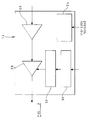
- the interface unit 14 comprises a stabilised power supply 24, a unity gain buffer amplifier 26, and a unity gain level shifting amplifier 28 for outputting the signal to the wall thickness controller.
- the feedback signal from the automatic weighing system is supplied to a digital-to-analogue converter 30 by way of the increase weight input or decrease weight input, as the case may be, and the resulting analogue output is supplied to an integrator and memory circuit 32 which integrates the output to obtain a correction factor, and maintains a permanent record of the current correction factor in the memory so that the correction factor is available immediately the machine is started up or production is recommenced after a temporary shutdown.
- the correction factor is increased at a constant rate until it reaches a level at which it is maintained until a decrease weight signal is supplied to the decrease weight input to cause the correction factor to be decreased at a constant rate (or until the correction factor is caused to increase further by supply of a further increase weight signal).
- the amplifier 28 is a unity gain amplifier having a level shifting capability, and the correction factor is used to shift the actual position signal applied to the amplifier 28 so as to cause the wall thickness controller 10 to automatically adjust the die gap to effect the required change in weight of the moulded containers outputted by the machine.
- the input signal supplied to the wall thickness controller is at all times dependent both on the actual position signal and on the correction factor which is dependent on the increase/decrease weight feedback signal from the automatic weighing machine 16.
- the correction factor applied to the actual position signal from the transducer will affect the way in which the wall thickness controller controls the width of the die gap.
- the wall thickness controller should be able to control the die gap in such a manner as to hold the weight of the moulded product to within a tolerance of less than half a gramme.
- the cumulative errors in the weighing system and the interface unit should be at least one order of magnitude less than this tolerance limit in their effect on container weight.
- the design of the interface unit is of critical importance in that this unit translates the feedback signal from the weighing system into a suitable form to render it capable of adjusting the die gap.
- the correction factor applied to the amplifier 28 is obtained by integration of the output from the digital-to-analogue converter 30, and also the increase/decrease weight feedback signals supplied to the interface unit 14 are obtained by comparison of the target weight-with the rolling average of the weight values of the last few containers weighed, rather than simply by comparison with the weight value of the last container weighed.
- the effect of these two techniques is to cause the wall thickness controller to control the die gap in such a manner as to home in on the correct container weight without any appreciable hunting effect.
- the interface unit 14 permits the unit to be retrofitted to upgrade existing extrusion blow moulding machines, without it being necessary to effect major modifications to the designs of such machines. All that is necessary is to connect the interface unit 14 within the input signal line from the transducer 12 to the wail thickness controller 10.
- the interface unit 14 is of fully solid state construction, and thus it does not suffer from the problems associated with mechanical linkages such as hysteresis or threshold (deadband) problems, and in addition the response time of the interface unit is effectively instantaneous.
- the control linearity is dependent on the transfer function of the transducer 12.
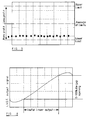
- Figure 7 shows a graph of the output signal of the transducer 12 against the stroke of the movable die member 6, and it will be appreciated that the transducer will only be used in the linear portion of its stroke range.
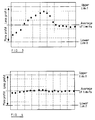
- Figure 3 shows the spread of weight values obtained by weighing of successive containers outputted by a conventional extrusion blow moulding machine which does not include the interface unit previously described, and illustrates how the weight of the containers may drift appreciably during a typical production run.
- the deviation from the target weight depends on many factors, such as the inconsistency of the moulding material, including the variable percentage of any scrap material used, the ambient temperature, etc., and the net effect of such factors may be to cause the weight to vary outside acceptable tolerances.
- a specification is to be met in which all containers must have weight values between specified upper and lower limits, it is advisable to set the target weight at an average of these limits in order to ensure that no containers are produced which have weights below the lower limit.
- Figure 4 shows the spread of weight values when a similar target weight is set using a machine provided with the interface unit 14. It will be appreciated that, in this case, the spread of weight values is appreciably decreased, and this leads to an improvement in the production quality due to the improved cycle-to-cycle consistency.
- Figure 5 illustrates a secondary benefit of the stabilisation of container weights obtained by use of the interface unit in that it shows that the target weight may be set by the machine operator to a value only slightly above the lower weight limit without leading to an appreciable risk that a container will be produced having a weight less than the lower limit. This enables substantial reductions in the total amount of moulding material needed to produce mouldings of acceptable quality.
Landscapes
- Engineering & Computer Science (AREA)
- Mechanical Engineering (AREA)
- Manufacturing & Machinery (AREA)
- Blow-Moulding Or Thermoforming Of Plastics Or The Like (AREA)
Applications Claiming Priority (2)
| Application Number | Priority Date | Filing Date | Title |
|---|---|---|---|
| GB9422187 | 1994-11-03 | ||
| GB9422187A GB2294659B (en) | 1994-11-03 | 1994-11-03 | Interface units for extrusion blow moulding control systems |
Publications (2)
| Publication Number | Publication Date |
|---|---|
| EP0710536A2 true EP0710536A2 (de) | 1996-05-08 |
| EP0710536A3 EP0710536A3 (de) | 1997-01-15 |
Family
ID=10763833
Family Applications (1)
| Application Number | Title | Priority Date | Filing Date |
|---|---|---|---|
| EP95307114A Withdrawn EP0710536A3 (de) | 1994-11-03 | 1995-10-06 | Anschlusseinheiten für Blasform-Steuersystemen |
Country Status (3)
| Country | Link |
|---|---|
| US (1) | US5665399A (de) |
| EP (1) | EP0710536A3 (de) |
| GB (1) | GB2294659B (de) |
Cited By (2)
| Publication number | Priority date | Publication date | Assignee | Title |
|---|---|---|---|---|
| EP0945246A3 (de) * | 1998-03-27 | 1999-11-17 | Ossberger-Turbinenfabrik Gmbh & Co. | Herstellvorrichtung mit Kontrolleinrichtungen für einen Kunststoff-Hohlkörper |
| WO2005092591A3 (en) * | 2004-03-03 | 2005-11-10 | Owens Il Healthcare Packaging | Process and system for monitoring and controlling manufacturing of plastic containers |
Families Citing this family (6)
| Publication number | Priority date | Publication date | Assignee | Title |
|---|---|---|---|---|
| DE19544634A1 (de) * | 1995-11-30 | 1997-06-05 | Feuerherm Harald | Verfahren zum Blasformen von Hohlkörpern aus thermoplastischem Kunststoff |
| JP4764565B2 (ja) * | 2001-06-01 | 2011-09-07 | 株式会社フコク | 熱可塑性プラスチックからなる中空体の製造方法、該中空体の製造装置 |
| WO2005000558A1 (en) * | 2003-06-10 | 2005-01-06 | Petwall, Llc | Container manufacturing inspection and control system |
| DE102008013419A1 (de) | 2008-03-06 | 2009-09-10 | Khs Corpoplast Gmbh & Co. Kg | Verfahren und Vorrichtung zur Blasformung von Behältern |
| DE102022134118A1 (de) * | 2022-12-20 | 2024-06-20 | Krones Aktiengesellschaft | Verfahren und Vorrichtung zum Überwachen und Regeln einer Wanddickenverteilung bei einem Herstellungsprozess von Fasern umfassenden Behältern, Fasern umfassender Behälter und Vorrichtung zum Herstellen eines Fasern umfassenden Behälters |
| CN116353034B (zh) * | 2023-03-01 | 2026-01-09 | 深圳市宝捷信科技有限公司 | 一种全闭环壁厚控制及轮廓跟随误差检测控制方法及系统 |
Family Cites Families (7)
| Publication number | Priority date | Publication date | Assignee | Title |
|---|---|---|---|---|
| US3936713A (en) * | 1974-04-08 | 1976-02-03 | Hunkar Laboratories, Inc. | Machine control circuit |
| DE2533077A1 (de) * | 1975-07-24 | 1977-02-10 | Kromberg Ges Fuer Ingenieurlei | Steuer- und regeleinrichtung zur veraenderung von materialaustrittsquerschnitten |
| US4474716A (en) * | 1979-10-05 | 1984-10-02 | Krupp-Kautex Maschinenbau Gmbh | Controlling an extrusion blowing process |
| DE3816273C3 (de) * | 1988-05-12 | 1996-03-21 | Harald Feuerherm | Verfahren zum Extrusionsblasformen eines Hohlkörpers und Vorrichtung zur Durchführung des Verfahrens |
| DE3936301A1 (de) * | 1989-11-01 | 1991-05-02 | Kautex Maschinenbau Gmbh | Verfahren zum herstellen von hohlkoerpern aus thermoplastischen kunststoff |
| JP2748993B2 (ja) * | 1991-05-21 | 1998-05-13 | 宇部興産株式会社 | ブロー成形機 |
| US5338173A (en) * | 1993-03-19 | 1994-08-16 | The Japan Steel Works, Ltd. | Parison controller of blow molding apparatus |
-
1994
- 1994-11-03 GB GB9422187A patent/GB2294659B/en not_active Expired - Fee Related
-
1995
- 1995-10-06 EP EP95307114A patent/EP0710536A3/de not_active Withdrawn
- 1995-10-26 US US08/548,862 patent/US5665399A/en not_active Expired - Fee Related
Non-Patent Citations (1)
| Title |
|---|
| None |
Cited By (4)
| Publication number | Priority date | Publication date | Assignee | Title |
|---|---|---|---|---|
| EP0945246A3 (de) * | 1998-03-27 | 1999-11-17 | Ossberger-Turbinenfabrik Gmbh & Co. | Herstellvorrichtung mit Kontrolleinrichtungen für einen Kunststoff-Hohlkörper |
| KR100553865B1 (ko) * | 1998-03-27 | 2006-02-24 | 오스베르거 투르빈넨파브릭 게엠베하 + 코. | 플라스틱 중공체들을 제조하기 위한 몰딩머신 |
| WO2005092591A3 (en) * | 2004-03-03 | 2005-11-10 | Owens Il Healthcare Packaging | Process and system for monitoring and controlling manufacturing of plastic containers |
| US7534378B2 (en) | 2004-03-03 | 2009-05-19 | Rexam Prescription Products Inc. | Plastic forming process monitoring and control |
Also Published As
| Publication number | Publication date |
|---|---|
| GB9422187D0 (en) | 1994-12-21 |
| EP0710536A3 (de) | 1997-01-15 |
| GB2294659A (en) | 1996-05-08 |
| US5665399A (en) | 1997-09-09 |
| GB2294659B (en) | 1998-05-06 |
Similar Documents
| Publication | Publication Date | Title |
|---|---|---|
| US6090318A (en) | Process for controlling the hot-runner heating of a multicavity injection mould | |
| US4311446A (en) | Injection molding machine controls | |
| US4559991A (en) | Method and system of controlling injection molding machines | |
| US4094940A (en) | Injection molding machine controls | |
| US6192299B1 (en) | Method of measuring operation characteristic of proportional electromagnetic control valve, method of controlling operation of hydraulic cylinder, and method of modifying operation characteristic of proportional electromagnetic control valve | |
| US4798527A (en) | Control system for injection molding machine | |
| US4382761A (en) | Controlling an extrusion blowing process | |
| US5665399A (en) | Interface units for extrusion blow moulding control systems | |
| US4444702A (en) | Method and apparatus for producing extruded sections of thermoplastic material | |
| US3870445A (en) | Injection molding machine controls | |
| US3937776A (en) | Method for controlling injection molding machines | |
| US5256345A (en) | Injection control method for injection molder | |
| GB2265567A (en) | Producing stepped pressed articles | |
| US5409647A (en) | Process for the production of hollow bodies from thermoplastic material | |
| US5198161A (en) | Parison thickness control method | |
| US4971542A (en) | Blow molding machine with accumulator cushion regulation | |
| US4959001A (en) | Blow molding machine with accumulator waiting time control | |
| EP0372899A1 (de) | Verfahren und Vorrichtung zum gleichzeitigen Steuern von zwei oder mehreren abhängigen Variablen | |
| US4474716A (en) | Controlling an extrusion blowing process | |
| US5110519A (en) | Process for minimizing disturbance of multi-layer laminate material in extrusion of multi-layer preforms for blow molding of hollow bodies | |
| JP2979323B2 (ja) | 制御信号発生用電気的制御装置 | |
| US5980794A (en) | Method of controlling compacting by measuring hydraulic fluid | |
| JPH0124055B2 (de) | ||
| EP0612984B1 (de) | Verfahren zum genauen Wiegen von pulverigen Materialien in luftfördernden Abfüllmaschinen | |
| JP2786440B2 (ja) | 型締圧力の制御方法 |
Legal Events
| Date | Code | Title | Description |
|---|---|---|---|
| PUAI | Public reference made under article 153(3) epc to a published international application that has entered the european phase |
Free format text: ORIGINAL CODE: 0009012 |
|
| AK | Designated contracting states |
Kind code of ref document: A2 Designated state(s): DE FR IT |
|
| PUAL | Search report despatched |
Free format text: ORIGINAL CODE: 0009013 |
|
| AK | Designated contracting states |
Kind code of ref document: A3 Designated state(s): DE FR IT |
|
| 17P | Request for examination filed |
Effective date: 19970626 |
|
| 17Q | First examination report despatched |
Effective date: 19990503 |
|
| STAA | Information on the status of an ep patent application or granted ep patent |
Free format text: STATUS: THE APPLICATION IS DEEMED TO BE WITHDRAWN |
|
| 18D | Application deemed to be withdrawn |
Effective date: 20000503 |