EP0710549A2 - Procédé pour le soudage thermique de parties en polymère acrylique - Google Patents
Procédé pour le soudage thermique de parties en polymère acrylique Download PDFInfo
- Publication number
- EP0710549A2 EP0710549A2 EP95116875A EP95116875A EP0710549A2 EP 0710549 A2 EP0710549 A2 EP 0710549A2 EP 95116875 A EP95116875 A EP 95116875A EP 95116875 A EP95116875 A EP 95116875A EP 0710549 A2 EP0710549 A2 EP 0710549A2
- Authority
- EP
- European Patent Office
- Prior art keywords
- polymethacrylate
- parts
- polymethacrylate plastic
- plastic
- esp
- Prior art date
- Legal status (The legal status is an assumption and is not a legal conclusion. Google has not performed a legal analysis and makes no representation as to the accuracy of the status listed.)
- Granted
Links
Images

Classifications
-
- B—PERFORMING OPERATIONS; TRANSPORTING
- B32—LAYERED PRODUCTS
- B32B—LAYERED PRODUCTS, i.e. PRODUCTS BUILT-UP OF STRATA OF FLAT OR NON-FLAT, e.g. CELLULAR OR HONEYCOMB, FORM
- B32B27/00—Layered products comprising a layer of synthetic resin
- B32B27/06—Layered products comprising a layer of synthetic resin as the main or only constituent of a layer, which is next to another layer of the same or of a different material
- B32B27/08—Layered products comprising a layer of synthetic resin as the main or only constituent of a layer, which is next to another layer of the same or of a different material of synthetic resin
-
- B—PERFORMING OPERATIONS; TRANSPORTING
- B32—LAYERED PRODUCTS
- B32B—LAYERED PRODUCTS, i.e. PRODUCTS BUILT-UP OF STRATA OF FLAT OR NON-FLAT, e.g. CELLULAR OR HONEYCOMB, FORM
- B32B27/00—Layered products comprising a layer of synthetic resin
- B32B27/30—Layered products comprising a layer of synthetic resin comprising vinyl (co)polymers; comprising acrylic (co)polymers
-
- B—PERFORMING OPERATIONS; TRANSPORTING
- B32—LAYERED PRODUCTS
- B32B—LAYERED PRODUCTS, i.e. PRODUCTS BUILT-UP OF STRATA OF FLAT OR NON-FLAT, e.g. CELLULAR OR HONEYCOMB, FORM
- B32B27/00—Layered products comprising a layer of synthetic resin
- B32B27/30—Layered products comprising a layer of synthetic resin comprising vinyl (co)polymers; comprising acrylic (co)polymers
- B32B27/308—Layered products comprising a layer of synthetic resin comprising vinyl (co)polymers; comprising acrylic (co)polymers comprising acrylic (co)polymers
-
- B—PERFORMING OPERATIONS; TRANSPORTING
- B32—LAYERED PRODUCTS
- B32B—LAYERED PRODUCTS, i.e. PRODUCTS BUILT-UP OF STRATA OF FLAT OR NON-FLAT, e.g. CELLULAR OR HONEYCOMB, FORM
- B32B3/00—Layered products comprising a layer with external or internal discontinuities or unevennesses, or a layer of non-planar shape; Layered products comprising a layer having particular features of form
- B32B3/26—Layered products comprising a layer with external or internal discontinuities or unevennesses, or a layer of non-planar shape; Layered products comprising a layer having particular features of form characterised by a particular shape of the outline of the cross-section of a continuous layer; characterised by a layer with cavities or internal voids ; characterised by an apertured layer
- B32B3/30—Layered products comprising a layer with external or internal discontinuities or unevennesses, or a layer of non-planar shape; Layered products comprising a layer having particular features of form characterised by a particular shape of the outline of the cross-section of a continuous layer; characterised by a layer with cavities or internal voids ; characterised by an apertured layer characterised by a layer formed with recesses or projections, e.g. hollows, grooves, protuberances, ribs
-
- B—PERFORMING OPERATIONS; TRANSPORTING
- B32—LAYERED PRODUCTS
- B32B—LAYERED PRODUCTS, i.e. PRODUCTS BUILT-UP OF STRATA OF FLAT OR NON-FLAT, e.g. CELLULAR OR HONEYCOMB, FORM
- B32B37/00—Methods or apparatus for laminating, e.g. by curing or by ultrasonic bonding
- B32B37/0046—Methods or apparatus for laminating, e.g. by curing or by ultrasonic bonding characterised by constructional aspects of the apparatus
- B32B37/0053—Constructional details of laminating machines comprising rollers; Constructional features of the rollers
-
- B—PERFORMING OPERATIONS; TRANSPORTING
- B32—LAYERED PRODUCTS
- B32B—LAYERED PRODUCTS, i.e. PRODUCTS BUILT-UP OF STRATA OF FLAT OR NON-FLAT, e.g. CELLULAR OR HONEYCOMB, FORM
- B32B37/00—Methods or apparatus for laminating, e.g. by curing or by ultrasonic bonding
- B32B37/06—Methods or apparatus for laminating, e.g. by curing or by ultrasonic bonding characterised by the heating method
-
- B—PERFORMING OPERATIONS; TRANSPORTING
- B32—LAYERED PRODUCTS
- B32B—LAYERED PRODUCTS, i.e. PRODUCTS BUILT-UP OF STRATA OF FLAT OR NON-FLAT, e.g. CELLULAR OR HONEYCOMB, FORM
- B32B37/00—Methods or apparatus for laminating, e.g. by curing or by ultrasonic bonding
- B32B37/14—Methods or apparatus for laminating, e.g. by curing or by ultrasonic bonding characterised by the properties of the layers
- B32B37/16—Methods or apparatus for laminating, e.g. by curing or by ultrasonic bonding characterised by the properties of the layers with all layers existing as coherent layers before laminating
- B32B37/22—Methods or apparatus for laminating, e.g. by curing or by ultrasonic bonding characterised by the properties of the layers with all layers existing as coherent layers before laminating involving the assembly of both discrete and continuous layers
- B32B37/223—One or more of the layers being plastic
- B32B37/226—Laminating sheets, panels or inserts between two continuous plastic layers
-
- B—PERFORMING OPERATIONS; TRANSPORTING
- B32—LAYERED PRODUCTS
- B32B—LAYERED PRODUCTS, i.e. PRODUCTS BUILT-UP OF STRATA OF FLAT OR NON-FLAT, e.g. CELLULAR OR HONEYCOMB, FORM
- B32B2309/00—Parameters for the laminating or treatment process; Apparatus details
- B32B2309/02—Temperature
-
- B—PERFORMING OPERATIONS; TRANSPORTING
- B32—LAYERED PRODUCTS
- B32B—LAYERED PRODUCTS, i.e. PRODUCTS BUILT-UP OF STRATA OF FLAT OR NON-FLAT, e.g. CELLULAR OR HONEYCOMB, FORM
- B32B2309/00—Parameters for the laminating or treatment process; Apparatus details
- B32B2309/08—Dimensions, e.g. volume
- B32B2309/10—Dimensions, e.g. volume linear, e.g. length, distance, width
- B32B2309/105—Thickness
-
- Y—GENERAL TAGGING OF NEW TECHNOLOGICAL DEVELOPMENTS; GENERAL TAGGING OF CROSS-SECTIONAL TECHNOLOGIES SPANNING OVER SEVERAL SECTIONS OF THE IPC; TECHNICAL SUBJECTS COVERED BY FORMER USPC CROSS-REFERENCE ART COLLECTIONS [XRACs] AND DIGESTS
- Y10—TECHNICAL SUBJECTS COVERED BY FORMER USPC
- Y10T—TECHNICAL SUBJECTS COVERED BY FORMER US CLASSIFICATION
- Y10T156/00—Adhesive bonding and miscellaneous chemical manufacture
- Y10T156/17—Surface bonding means and/or assemblymeans with work feeding or handling means
- Y10T156/1702—For plural parts or plural areas of single part
- Y10T156/1712—Indefinite or running length work
- Y10T156/1741—Progressive continuous bonding press [e.g., roll couples]
Definitions
- the invention relates to a method for the thermal bonding of at least two acrylic plastic parts and to composites produced using this method.
- Acrylic plastics such as polymethyl methacrylate in particular, exhibit thermoplastic to thermo-elastic behavior when heated, depending on their average molecular weight.
- Thermoplastic polymethacrylate plastics such as those used in injection molding or extrusion, have average molecular weights M w between 2 x 10⁴ and 5 x 10⁵, in particular between 5 x 10⁴ and 2 x 10⁵ daltons (for the determination of M w cf. for example, HF Mark et al., Encyclopedia of Polymer Science and Technology, 2nd Ed., Vol. 10, pages 1 to 19, J. Wiley, 1989).
- Such thermoplastic polymethacrylate plastics can be welded under pressure at temperatures above 100 degrees C.
- the polymerization adhesives for gluing polymethacrylate plastic parts generally contain the components methyl methacrylate, polymethyl methacrylate and, to accelerate the adhesive process, polymerization initiators, such as peroxides, light initiators or redox initiators. With this method too, stress corrosion cracking can occur in the polymethacrylate plastic parts due to the monomeric methyl methacrylate acting as a solvent.
- the curing times for polymerization adhesives are generally between 1 and 3 hours, which is also disadvantageous for some applications, such as, for example, for series production.
- composites of polymethacrylate plastics can be produced by thermal welding, both thermoplastic and partially cast, thermoelastic polymethacrylate plastics being used can be.
- the thermal welding is carried out at temperatures above 100 degrees C and, if necessary, using pressure (see, for example, Kunststoff-Handbuch, Vol. IX, Polymethacrylate, pages 466, 467, 600, 601, 604 to 608, 613, 614, Carl Hanser , Kunststoff, 1975).
- pressure see, for example, Kunststoff-Handbuch, Vol. IX, Polymethacrylate, pages 466, 467, 600, 601, 604 to 608, 613, 614, Carl Hanser , Kunststoff-Handbuch, Vol. IX, Polymethacrylate, pages 466, 467, 600, 601, 604 to 608, 613, 614, Carl Hanser , Kunststoff, 1975).
- Kunststoff-Handbuch, Vol. IX, Polymethacrylate pages 466, 467, 600, 601, 604 to 608, 613, 614, Carl Hanser , Kunststoff, 1975.
- local overheating at the welding points which lead to the decomposition of the polymethacrylate plastics and thus to the splitting
- EP-A 584 593 describes plastic composites in which at least part of the composite consists of polymethacrylate plastic and at least one connection between two polymethacrylate plastic layers has been produced by thermal welding, the thermal welding in the presence of a between 0.01 and a few mm thick intermediate layer of a polymer composed essentially of methyl methacrylate is carried out.
- the intermediate layer is preferably a film or a thin plate made of polymethyl methacrylate.
- the thermal bonding of the plastic composites claimed in EP-A 584 593 is carried out by heating the materials to 150 to 200 degrees C, preferably to about 170 degrees C, the heated parts being pressed together under pressure. Inclusions of air or monomers also occasionally occur in this process Decomposition products in combination if the prescribed temperature control is not exactly adhered to.
- 1,1 are preheated to temperatures between 130 and 200 degrees C on their surface (1a) intended for gluing or joining, with the proviso that the plastic parts themselves remain dimensionally stable, and between a pair of rollers ( 2, 3), in which at least one roller (3), via which a pressing force (4) can be exerted, is movably mounted, is pressed under continuous feed with a pressing force (4) between 10 and 500 N, the feed speed being between 5 and is 200 mm / s.
- the polymethacrylate plastic parts are preferably plates or foils with thicknesses between 0.5 and 100 mm, particularly preferably with thicknesses between 1 and 50 mm.
- flat objects such as, for example, pictures or color foils, or elongated objects (8), such as, for example, threads, wires, steel spirals or, are pressed between the adhesive surfaces (1a) of the polymethacrylate plastic parts thin sheets of other plastics, stored.
- the condition for this is that the thickness of such objects is a maximum of 50%, preferably a maximum of 25% of the thickness of the polymethacrylate plastic parts.
- the polymethacrylate plastic parts (1) to be glued are plates which have engravings or embossings (FIGS.
- the surface temperatures on the adhesive sides (1a) of the polymethacrylate plastic parts (1) required for the gluing can be generated with indirect physical methods, such as by high-frequency or ultrasonic fields, or preferably by direct irradiation, for example with warm air blowers or infrared radiators.
- the polymethacrylate plastic parts (1) are preheated in the oven to avoid thermal stresses before the heat radiation.
- the difference between the surface and core temperature of the polymethacrylate plastic parts (1) is between 20 and 150 K, preferably between 30 and 120 K, the core temperature always remaining at least 10 K below the Vicat softening temperature VET of the polymethacrylate plastic.
- the polymethacrylate plastic parts preferably consist of polymers of methyl methacrylate, which can be composed of up to 50% by weight of other monomers copolymerizable with methyl methacrylate.
- the proportion of methyl methacrylate is particularly preferably 80 to 100% by weight.
- Suitable comonomers are primarily alkyl acrylates having 1 to 6 carbon atoms in the alkyl ester radical, alkyl and / or methacrylonitrile, styrene and / or substituted styrenes and maleic anhydride.
- thermoplastic or thermoelastically deformable polymethacrylate plastics of the above composition with specific viscosities according to DIN 51562 in chloroform at 25 degrees C in the range between 20 and 1000 ml / g, corresponding to approximate average molecular weights M w between 3 x 10⁴ and about 5 x 10⁶ dalton.
- the polymethacrylate plastic parts can contain conventional plastic additives, such as light stabilizers, stabilizers against thermal decomposition, lubricants, fillers, and in particular dyes or pigments, in amounts of 10 -3 to 20% by weight, based on the polymethacrylate.
- the polymethacrylate plastic parts are preferably plates or foils which enable large-area bonding, for which the method according to the invention is preferably suitable.
- the plates or foils preferably have thicknesses between 0.5 and 100 mm, particularly preferably between 1 and 50 mm.
- the area of the plates can be, for example, between 0.01 and 5 square meters, with plate widths between 0.1 and 2 m and plate lengths between 0.1 and 5 m.
- foils can Composites of virtually any length with widths of, for example, 0.1 to 2 m can be produced.
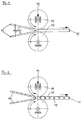
- Fig. 1 the inventive device for producing composites from polymethacrylate parts (1) is shown as an example in a schematic diagram.
- the polymethacrylate plates or foils (1) which are heated to temperatures between 130 and 200 degrees C on the surface of the adhesive side (1a), are guided by a pair of rollers rotating in opposite directions, the lower roller (2) being fixedly mounted and the one being movably mounted upper roller (3) with a pressing force (4) of 10 to 500 N can be applied.
- the feed rate at which the polymethacrylate sheets or foils are pressed is determined, for example, by the speed of rotation of the rollers (2) and (3) and is between 5 and 200 mm / s, preferably between 10 and 150 mm / s.
- the rollers (2) and (3) which are made of stainless steel, for example, are generally surface polished or provided with an elastic surface coating, for example a soft rubber layer with a low shore hardness (cf. EP-A 201 044), in order to prevent damage to the surface side (1b) to produce the plates or foils and later the composites (5).
- the surfaces of the rollers (2) and (3) can be structured, whereby defined patterns can be generated on the surface of the composites (5), the surfaces (1b) of the plates or foils (1) preferably being at temperatures between 100 and 150 degrees C.
- the surfaces of the adhesive sides (1a) of the plates or foils (1) are heated in such a way that the plates or films themselves remain dimensionally stable, whereby indirect physical methods, such as electromagnetic high-frequency or ultrasound fields, can be used for heating. Direct methods of heat radiation are preferably used, such as warm air blowers or infrared radiators.
- the polymethacrylate plastic parts (1) are preheated in the oven to avoid thermal stresses from the heat radiation in such a way that the difference between surface and core temperature of the polymethacrylate plastic parts (1) is between 20 and 150 K, preferably between 30 and 120 K.
- the core temperature of the polymethacrylate plastic parts (1) always remains at least 10 K below the softening temperature VET of the polymethacrylate plastic.
- the pressing force (4) which is exerted on the polymethacrylate parts (1) and the resulting composite (5) of the polymethacrylate parts (1) with the upper roller (3), can be generated pneumatically or hydraulically, for example, with simple lever devices.
- the pressing force (4) is constant during the entire pressing process, pressing forces (4) between 10 and 500 N, preferably between 25 and 400 N, being used.
- composites (5) can be produced from polymethacrylate plastic parts with flat edges, such as domes, barrel vaults or shells, by selectively heating the edges and joining them together using the method according to the invention.
- the plates or foils (1) can have engravings or impressions (FIGS. 2, 6) which have depths of at least 0.2 mm, preferably of at least 1 mm, which are either on the outside (1b) or on the adhesive side ( 1b) of the plates or foils (2). If the engravings or embossments are on the adhesive side (1a), three-dimensional inclusions (7) of a defined shape can be created in the band (5) (FIG. 2). Such three-dimensional inclusions (7) are preferably produced by gluing at least two plates (1), in which each plate has engravings or impressions (6) on the adhesive side (1a), which are joined together in mirror image.
- the condition for the production of such three-dimensional inclusions (7) is that the engravings or impressions (6) remain dimensionally stable when the surfaces of the adhesive side (1a) are heated to temperatures of up to 200 degrees C.
- flat or elongated objects (FIGS. 3, 8) can be embedded between the adhesive sides (1a) of the plates or foils.
- the thickness of the objects (8) is a maximum of 50%, preferably a maximum of 25% of the thickness of the plates or foils.
- Flat objects (8) that can be stored between the adhesive sides (1a) of the plates or foils (1) are, for example: Photographs, prints, colored foils, pigment papers or foils made of thermoplastic elastomers, whereby safety glass composites can be produced with the latter. It should be noted that the stored items (8) may occupy a maximum of 90% of the area of the adhesive sides (1a).
- Elongated objects (8) that can be stored between the plates or foils (1) are, for example, narrow plastic sheets that can be colored, wires, steel spirals, strips of fabric, paper strips or preferably threads, very particularly preferably plastic threads with high elasticity and high modulus, such as polyester or nylon fibers, the inclusion of which leads to particularly impact-resistant bonds.
- the method according to the invention enables polymethacrylate plastic parts (1), in particular plates or foils, to be bonded over a large area with the simplest means without simultaneous generation of gas inclusions, which can be formed by trapped air or monomers as thermal decomposition products.
- gas inclusions which can be formed by trapped air or monomers as thermal decomposition products.
- figures can be represented as inclusions (7) by embossing the mirror-image half formats in the polymethacrylate plastic parts (1) and be positively joined with the method according to the invention.
- flat or elongated objects (8) such as pictures, foils, threads, wires or steel spirals, can be embedded in the composites (5) between the adhesive sides (1a) in such a way that the polymethacrylate plastic completely encloses the objects (8) (Fig. 3).
- Such composite systems can advantageously be used, for example, in the advertising sector (illuminated display, large-scale advertising), as composite systems (with foils made of thermoplastic elastomers) or as splinter-proof noise barriers (with embedded threads or spirals made of steel or made of elastic plastics with a high modulus).
- the plates are then heated on their adhesive side to a surface temperature of 175 degrees C., arranged with opposite, still separate adhesive sides in front of the rollers and drawn in between the rollers at a feed rate of 50 mm / s, the rollers being pressed together with a force of 100 N. become.
- the result is a composite with embedded three-dimensional inclusions without gas inclusions, in which no adhesive seams are visible from the top.
Landscapes
- Lining Or Joining Of Plastics Or The Like (AREA)
- Laminated Bodies (AREA)
- Adhesives Or Adhesive Processes (AREA)
- Shaping Of Tube Ends By Bending Or Straightening (AREA)
- Manufacture Of Macromolecular Shaped Articles (AREA)
Applications Claiming Priority (2)
| Application Number | Priority Date | Filing Date | Title |
|---|---|---|---|
| DE4439419 | 1994-11-04 | ||
| DE4439419A DE4439419A1 (de) | 1994-11-04 | 1994-11-04 | Verfahren zum thermischen Verkleben von Acrylkunststoffteilen |
Publications (3)
| Publication Number | Publication Date |
|---|---|
| EP0710549A2 true EP0710549A2 (fr) | 1996-05-08 |
| EP0710549A3 EP0710549A3 (fr) | 1997-03-05 |
| EP0710549B1 EP0710549B1 (fr) | 2000-08-23 |
Family
ID=6532474
Family Applications (1)
| Application Number | Title | Priority Date | Filing Date |
|---|---|---|---|
| EP95116875A Expired - Lifetime EP0710549B1 (fr) | 1994-11-04 | 1995-10-26 | Procédé pour le soudage thermique de parties en polymère acrylique |
Country Status (7)
| Country | Link |
|---|---|
| US (1) | US5837091A (fr) |
| EP (1) | EP0710549B1 (fr) |
| AT (1) | ATE195688T1 (fr) |
| CA (1) | CA2162104C (fr) |
| DE (2) | DE4439419A1 (fr) |
| DK (1) | DK0710549T3 (fr) |
| ES (1) | ES2149912T3 (fr) |
Cited By (1)
| Publication number | Priority date | Publication date | Assignee | Title |
|---|---|---|---|---|
| CN101596548B (zh) * | 2009-07-02 | 2011-04-27 | 西南铝业(集团)有限责任公司 | 一种双金属板的制造方法和双金属板制造机列 |
Families Citing this family (14)
| Publication number | Priority date | Publication date | Assignee | Title |
|---|---|---|---|---|
| DE4439420A1 (de) * | 1994-11-04 | 1996-05-09 | Roehm Gmbh | Verfahren zum thermischen Verkleben von Teilen aus Acrylkunststoff und Teilen aus technischen Kunststoffen |
| DE19632795A1 (de) * | 1996-08-15 | 1998-02-19 | Cicorel S A | Verfahren und Vorrichtung zum Laminieren von Folienbahnen |
| US6123798A (en) * | 1998-05-06 | 2000-09-26 | Caliper Technologies Corp. | Methods of fabricating polymeric structures incorporating microscale fluidic elements |
| DE10012421A1 (de) * | 2000-03-15 | 2001-09-20 | Roehm Gmbh | Kunststoffverbunde und Verfahren zu ihrer Herstellung |
| CA2353025A1 (fr) * | 2000-08-18 | 2002-02-18 | Craig W. Desantis | Stratifie tridimensionnel |
| US20060046034A1 (en) * | 2001-07-25 | 2006-03-02 | Schober, Inc. | Solid surface products |
| US20060147655A1 (en) * | 2001-07-25 | 2006-07-06 | Lumicor | Solid surface products |
| US20040247801A1 (en) * | 2001-07-25 | 2004-12-09 | Dennis Schober | Solid surface products |
| US6743327B2 (en) * | 2001-07-25 | 2004-06-01 | Schober, Inc. | Solid surface products |
| JP3873213B2 (ja) * | 2003-04-25 | 2007-01-24 | フジプラ株式会社 | 巻込み防止機構付ラミネート装置 |
| DE10329938A1 (de) * | 2003-07-02 | 2005-03-17 | Röhm GmbH & Co. KG | Kunststoffkörper mit mikrostrukturierter Oberfläche |
| MX2009011920A (es) * | 2007-05-08 | 2010-02-18 | Hunter Douglas Ind Bv | Sistema de color multivariado con aplicacion de textura. |
| EP2138303B1 (fr) | 2008-06-27 | 2015-01-14 | Pact Technologies Switzerland AG | Procédé de raccordement de deux plaques en plastique |
| AT510589B1 (de) * | 2010-11-18 | 2012-05-15 | Pact Technologies Switzerland Ag | Verfahren zum herstellen von kunststoffgegenständen mit darin eingeschlossenen objekten |
Family Cites Families (8)
| Publication number | Priority date | Publication date | Assignee | Title |
|---|---|---|---|---|
| FR1473254A (fr) * | 1966-01-24 | 1967-03-17 | Reveyron Ets | Assembleuse de bandes thermosoudables |
| NL7015947A (fr) * | 1969-12-31 | 1971-07-02 | ||
| GB8822328D0 (en) * | 1988-09-22 | 1988-10-26 | Stoddard Sekers Int | Pressure roller assembly |
| DE3903022C1 (fr) * | 1989-02-02 | 1990-04-26 | Hermann Berstorff Maschinenbau Gmbh, 3000 Hannover, De | |
| JPH08564B2 (ja) * | 1989-08-31 | 1996-01-10 | 株式会社松澤製作所 | 熱可塑性樹脂シートのシール方法及び装置 |
| US5158641A (en) * | 1990-05-11 | 1992-10-27 | Agfa-Gevaert N.V. | Heat-laminating apparatus |
| DE9210767U1 (de) * | 1992-08-12 | 1992-11-26 | Röhm GmbH, 6100 Darmstadt | Verbunde als Gestaltungen durch thermisches Verbinden |
| DE4301848A1 (de) * | 1993-01-23 | 1994-07-28 | Roehm Gmbh | Transparentes Scheiben-Verbundsystem |
-
1994
- 1994-11-04 DE DE4439419A patent/DE4439419A1/de not_active Withdrawn
-
1995
- 1995-10-26 DK DK95116875T patent/DK0710549T3/da active
- 1995-10-26 EP EP95116875A patent/EP0710549B1/fr not_active Expired - Lifetime
- 1995-10-26 AT AT95116875T patent/ATE195688T1/de active
- 1995-10-26 DE DE59508661T patent/DE59508661D1/de not_active Expired - Lifetime
- 1995-10-26 ES ES95116875T patent/ES2149912T3/es not_active Expired - Lifetime
- 1995-11-03 CA CA002162104A patent/CA2162104C/fr not_active Expired - Fee Related
- 1995-11-03 US US08/552,933 patent/US5837091A/en not_active Expired - Lifetime
Cited By (1)
| Publication number | Priority date | Publication date | Assignee | Title |
|---|---|---|---|---|
| CN101596548B (zh) * | 2009-07-02 | 2011-04-27 | 西南铝业(集团)有限责任公司 | 一种双金属板的制造方法和双金属板制造机列 |
Also Published As
| Publication number | Publication date |
|---|---|
| CA2162104C (fr) | 2005-09-06 |
| EP0710549A3 (fr) | 1997-03-05 |
| DK0710549T3 (da) | 2000-10-02 |
| EP0710549B1 (fr) | 2000-08-23 |
| DE59508661D1 (de) | 2000-09-28 |
| ES2149912T3 (es) | 2000-11-16 |
| ATE195688T1 (de) | 2000-09-15 |
| US5837091A (en) | 1998-11-17 |
| CA2162104A1 (fr) | 1996-05-05 |
| DE4439419A1 (de) | 1996-05-09 |
Similar Documents
| Publication | Publication Date | Title |
|---|---|---|
| EP0710549B1 (fr) | Procédé pour le soudage thermique de parties en polymère acrylique | |
| DE69929812T2 (de) | Gegenstände mit klebstofflage | |
| DE2948235C2 (de) | Verfahren und Vorrichtung zur Herstellung einer mit Glasfasern verstärkten thermoplastischen Harzplatte | |
| DE69027228T2 (de) | Mikrostruktur aufweisende Kunststoff-Verbundkörper und Verfahren zur Herstellung | |
| DE69925086T2 (de) | Retroreflektierende Folie mit einem Bild zur Echtheitsprüfung und Verfahren zu ihrer Herstellung | |
| EP3439850B1 (fr) | Procédé et outil de formage pour former à chaud un matériau stratifié thermoplastique plan | |
| DE69117720T2 (de) | Abs/acryl-laminierungsverfahren | |
| EP1134075B1 (fr) | Laminés de polymères et méthodes de fabrication de ces derniers | |
| DE1694844B2 (de) | Verfahren zur herstellung von beiderseitig mattierten oder gerauhten folienbahnen | |
| EP0710548B1 (fr) | Procédé pour le soudage thermique de parties en polymère acrylique et parties en matières plastiques industrielles | |
| DE2918923C2 (de) | Schichtstoff mit einer Polyvinylidenfluoridschicht | |
| DE69901914T2 (de) | Mehrschichtige, biaxial verstreckte Styrol-Kunststoffplatten und Verfahren zur Herstellung davon | |
| DE1779124A1 (de) | Verfahren zum Herstellen von Schichtstoffen aus Folien | |
| DE3844584A1 (de) | Verfahren zur herstellung eines duennwandigen, tiefgezogenen kunststoff-formteils und das erhaltene kunststoff-formteil | |
| DE19815632C2 (de) | Klebstoff-freie Verbindungen von Polymerbauteilen zur Erzeugung von geschlossenen Mikro- und Nanokanalstrukturen | |
| EP0584593A2 (fr) | Matériaux composites formés par laminiation à chaud | |
| DE2165620B2 (de) | Vorrichtung zum flächenmässigen Ultraschallvers chweissen kunststoffhaltiger oder kunststoffbeschichteter Folien | |
| DE9015306U1 (de) | Extrudierte Kunststoffbahn mit walzengeglätteter Oberfläche | |
| DE2730977A1 (de) | Puzzlespiel und verfahren zur herstellung eines puzzlespiels | |
| DE102017217246A1 (de) | Fügeverbindung und Verfahren zur deren Herstellung | |
| DE2740325A1 (de) | Verfahren zur herstellung eines komplexen materials mit dem aussehen eines spiegels und anwendung des verfahrens zur herstellung eines spiegels | |
| DE3536061A1 (de) | Transferdruckverfahren | |
| DE1930971U (de) | Vorrichtung zur kontinuierlichen herstellung von filmscharnieren an platten aus thermoplastischem material. | |
| DE2029127A1 (en) | Transversally laminated film | |
| DE29924906U1 (de) | Gegenstände mit rückseitiger Klebelage |
Legal Events
| Date | Code | Title | Description |
|---|---|---|---|
| PUAI | Public reference made under article 153(3) epc to a published international application that has entered the european phase |
Free format text: ORIGINAL CODE: 0009012 |
|
| AK | Designated contracting states |
Kind code of ref document: A2 Designated state(s): AT BE CH DE DK ES FR GB IT LI NL SE |
|
| PUAL | Search report despatched |
Free format text: ORIGINAL CODE: 0009013 |
|
| AK | Designated contracting states |
Kind code of ref document: A3 Designated state(s): AT BE CH DE DK ES FR GB IT LI NL SE |
|
| 17P | Request for examination filed |
Effective date: 19970702 |
|
| GRAG | Despatch of communication of intention to grant |
Free format text: ORIGINAL CODE: EPIDOS AGRA |
|
| 17Q | First examination report despatched |
Effective date: 19991214 |
|
| GRAG | Despatch of communication of intention to grant |
Free format text: ORIGINAL CODE: EPIDOS AGRA |
|
| GRAH | Despatch of communication of intention to grant a patent |
Free format text: ORIGINAL CODE: EPIDOS IGRA |
|
| GRAH | Despatch of communication of intention to grant a patent |
Free format text: ORIGINAL CODE: EPIDOS IGRA |
|
| ITF | It: translation for a ep patent filed | ||
| GRAA | (expected) grant |
Free format text: ORIGINAL CODE: 0009210 |
|
| AK | Designated contracting states |
Kind code of ref document: B1 Designated state(s): AT BE CH DE DK ES FR GB IT LI NL SE |
|
| REF | Corresponds to: |
Ref document number: 195688 Country of ref document: AT Date of ref document: 20000915 Kind code of ref document: T |
|
| REG | Reference to a national code |
Ref country code: CH Ref legal event code: NV Representative=s name: BOVARD AG PATENTANWAELTE Ref country code: CH Ref legal event code: EP |
|
| REF | Corresponds to: |
Ref document number: 59508661 Country of ref document: DE Date of ref document: 20000928 |
|
| REG | Reference to a national code |
Ref country code: DK Ref legal event code: T3 |
|
| ET | Fr: translation filed | ||
| REG | Reference to a national code |
Ref country code: ES Ref legal event code: FG2A Ref document number: 2149912 Country of ref document: ES Kind code of ref document: T3 |
|
| GBT | Gb: translation of ep patent filed (gb section 77(6)(a)/1977) |
Effective date: 20001127 |
|
| RAP2 | Party data changed (patent owner data changed or rights of a patent transferred) |
Owner name: ROEHM GMBH & CO. KG |
|
| PLBE | No opposition filed within time limit |
Free format text: ORIGINAL CODE: 0009261 |
|
| STAA | Information on the status of an ep patent application or granted ep patent |
Free format text: STATUS: NO OPPOSITION FILED WITHIN TIME LIMIT |
|
| NLT2 | Nl: modifications (of names), taken from the european patent patent bulletin |
Owner name: ROEHM GMBH & CO. KG |
|
| 26N | No opposition filed | ||
| NLT1 | Nl: modifications of names registered in virtue of documents presented to the patent office pursuant to art. 16 a, paragraph 1 |
Owner name: ROEHM GMBH & CO. KG |
|
| REG | Reference to a national code |
Ref country code: GB Ref legal event code: IF02 |
|
| REG | Reference to a national code |
Ref country code: FR Ref legal event code: CJ |
|
| REG | Reference to a national code |
Ref country code: CH Ref legal event code: PFA Owner name: EVONIK ROEHM GMBH Free format text: ROEHM GMBH#KIRSCHENALLEE#64293 DARMSTADT (DE) -TRANSFER TO- EVONIK ROEHM GMBH#KIRSCHENALLEE#64293 DARMSTADT (DE) |
|
| REG | Reference to a national code |
Ref country code: FR Ref legal event code: CJ Ref country code: FR Ref legal event code: CD |
|
| REG | Reference to a national code |
Ref country code: NL Ref legal event code: TD Effective date: 20100223 Ref country code: NL Ref legal event code: SD Effective date: 20100223 |
|
| REG | Reference to a national code |
Ref country code: CH Ref legal event code: PFA Owner name: EVONIK ROEHM GMBH Free format text: EVONIK ROEHM GMBH#KIRSCHENALLEE#64293 DARMSTADT (DE) -TRANSFER TO- EVONIK ROEHM GMBH#KIRSCHENALLEE#64293 DARMSTADT (DE) |
|
| PGFP | Annual fee paid to national office [announced via postgrant information from national office to epo] |
Ref country code: DK Payment date: 20131021 Year of fee payment: 19 |
|
| PGFP | Annual fee paid to national office [announced via postgrant information from national office to epo] |
Ref country code: FR Payment date: 20131022 Year of fee payment: 19 Ref country code: GB Payment date: 20131021 Year of fee payment: 19 Ref country code: AT Payment date: 20131011 Year of fee payment: 19 Ref country code: SE Payment date: 20131022 Year of fee payment: 19 Ref country code: DE Payment date: 20131021 Year of fee payment: 19 Ref country code: CH Payment date: 20131021 Year of fee payment: 19 Ref country code: BE Payment date: 20131022 Year of fee payment: 19 |
|
| PGFP | Annual fee paid to national office [announced via postgrant information from national office to epo] |
Ref country code: IT Payment date: 20131028 Year of fee payment: 19 Ref country code: ES Payment date: 20131029 Year of fee payment: 19 Ref country code: NL Payment date: 20131022 Year of fee payment: 19 |
|
| REG | Reference to a national code |
Ref country code: DE Ref legal event code: R119 Ref document number: 59508661 Country of ref document: DE |
|
| REG | Reference to a national code |
Ref country code: NL Ref legal event code: V1 Effective date: 20150501 |
|
| REG | Reference to a national code |
Ref country code: DK Ref legal event code: EBP Effective date: 20141031 |
|
| REG | Reference to a national code |
Ref country code: CH Ref legal event code: PL |
|
| REG | Reference to a national code |
Ref country code: SE Ref legal event code: EUG |
|
| REG | Reference to a national code |
Ref country code: AT Ref legal event code: MM01 Ref document number: 195688 Country of ref document: AT Kind code of ref document: T Effective date: 20141026 |
|
| GBPC | Gb: european patent ceased through non-payment of renewal fee |
Effective date: 20141026 |
|
| PG25 | Lapsed in a contracting state [announced via postgrant information from national office to epo] |
Ref country code: BE Free format text: LAPSE BECAUSE OF NON-PAYMENT OF DUE FEES Effective date: 20141031 |
|
| PG25 | Lapsed in a contracting state [announced via postgrant information from national office to epo] |
Ref country code: LI Free format text: LAPSE BECAUSE OF NON-PAYMENT OF DUE FEES Effective date: 20141031 Ref country code: DE Free format text: LAPSE BECAUSE OF NON-PAYMENT OF DUE FEES Effective date: 20150501 Ref country code: CH Free format text: LAPSE BECAUSE OF NON-PAYMENT OF DUE FEES Effective date: 20141031 Ref country code: GB Free format text: LAPSE BECAUSE OF NON-PAYMENT OF DUE FEES Effective date: 20141026 Ref country code: SE Free format text: LAPSE BECAUSE OF NON-PAYMENT OF DUE FEES Effective date: 20141027 |
|
| REG | Reference to a national code |
Ref country code: FR Ref legal event code: ST Effective date: 20150630 |
|
| PG25 | Lapsed in a contracting state [announced via postgrant information from national office to epo] |
Ref country code: AT Free format text: LAPSE BECAUSE OF NON-PAYMENT OF DUE FEES Effective date: 20141026 Ref country code: NL Free format text: LAPSE BECAUSE OF NON-PAYMENT OF DUE FEES Effective date: 20150501 Ref country code: FR Free format text: LAPSE BECAUSE OF NON-PAYMENT OF DUE FEES Effective date: 20141031 Ref country code: IT Free format text: LAPSE BECAUSE OF NON-PAYMENT OF DUE FEES Effective date: 20141026 |
|
| PG25 | Lapsed in a contracting state [announced via postgrant information from national office to epo] |
Ref country code: DK Free format text: LAPSE BECAUSE OF NON-PAYMENT OF DUE FEES Effective date: 20141031 |
|
| REG | Reference to a national code |
Ref country code: ES Ref legal event code: FD2A Effective date: 20151127 |
|
| PG25 | Lapsed in a contracting state [announced via postgrant information from national office to epo] |
Ref country code: ES Free format text: LAPSE BECAUSE OF NON-PAYMENT OF DUE FEES Effective date: 20141027 |