EP0710651A1 - Verfahren zur Herstellung eines Decahydroisochinolino-alpha,alpha'diamino-alkohols - Google Patents
Verfahren zur Herstellung eines Decahydroisochinolino-alpha,alpha'diamino-alkohols Download PDFInfo
- Publication number
- EP0710651A1 EP0710651A1 EP95114205A EP95114205A EP0710651A1 EP 0710651 A1 EP0710651 A1 EP 0710651A1 EP 95114205 A EP95114205 A EP 95114205A EP 95114205 A EP95114205 A EP 95114205A EP 0710651 A1 EP0710651 A1 EP 0710651A1
- Authority
- EP
- European Patent Office
- Prior art keywords
- formula
- lower alkyl
- benzyl
- butyl
- phenyl
- Prior art date
- Legal status (The legal status is an assumption and is not a legal conclusion. Google has not performed a legal analysis and makes no representation as to the accuracy of the status listed.)
- Granted
Links
- 0 *C(NC(Cc1ccccc1)C1OC1)=O Chemical compound *C(NC(Cc1ccccc1)C1OC1)=O 0.000 description 2
Classifications
-
- C—CHEMISTRY; METALLURGY
- C07—ORGANIC CHEMISTRY
- C07D—HETEROCYCLIC COMPOUNDS
- C07D303/00—Compounds containing three-membered rings having one oxygen atom as the only ring hetero atom
- C07D303/02—Compounds containing oxirane rings
- C07D303/36—Compounds containing oxirane rings with hydrocarbon radicals, substituted by nitrogen atoms
-
- C—CHEMISTRY; METALLURGY
- C07—ORGANIC CHEMISTRY
- C07C—ACYCLIC OR CARBOCYCLIC COMPOUNDS
- C07C271/00—Derivatives of carbamic acids, i.e. compounds containing any of the groups, the nitrogen atom not being part of nitro or nitroso groups
- C07C271/06—Esters of carbamic acids
- C07C271/08—Esters of carbamic acids having oxygen atoms of carbamate groups bound to acyclic carbon atoms
- C07C271/10—Esters of carbamic acids having oxygen atoms of carbamate groups bound to acyclic carbon atoms with the nitrogen atoms of the carbamate groups bound to hydrogen atoms or to acyclic carbon atoms
- C07C271/16—Esters of carbamic acids having oxygen atoms of carbamate groups bound to acyclic carbon atoms with the nitrogen atoms of the carbamate groups bound to hydrogen atoms or to acyclic carbon atoms to carbon atoms of hydrocarbon radicals substituted by singly-bound oxygen atoms
-
- C—CHEMISTRY; METALLURGY
- C07—ORGANIC CHEMISTRY
- C07C—ACYCLIC OR CARBOCYCLIC COMPOUNDS
- C07C271/00—Derivatives of carbamic acids, i.e. compounds containing any of the groups, the nitrogen atom not being part of nitro or nitroso groups
- C07C271/06—Esters of carbamic acids
- C07C271/08—Esters of carbamic acids having oxygen atoms of carbamate groups bound to acyclic carbon atoms
- C07C271/10—Esters of carbamic acids having oxygen atoms of carbamate groups bound to acyclic carbon atoms with the nitrogen atoms of the carbamate groups bound to hydrogen atoms or to acyclic carbon atoms
- C07C271/18—Esters of carbamic acids having oxygen atoms of carbamate groups bound to acyclic carbon atoms with the nitrogen atoms of the carbamate groups bound to hydrogen atoms or to acyclic carbon atoms to carbon atoms of hydrocarbon radicals substituted by doubly-bound oxygen atoms
-
- C—CHEMISTRY; METALLURGY
- C07—ORGANIC CHEMISTRY
- C07D—HETEROCYCLIC COMPOUNDS
- C07D217/00—Heterocyclic compounds containing isoquinoline or hydrogenated isoquinoline ring systems
- C07D217/22—Heterocyclic compounds containing isoquinoline or hydrogenated isoquinoline ring systems with hetero atoms or with carbon atoms having three bonds to hetero atoms with at the most one bond to halogen, e.g. ester or nitrile radicals, directly attached to carbon atoms of the nitrogen-containing ring
- C07D217/26—Carbon atoms having three bonds to hetero atoms with at the most one bond to halogen
Definitions
- the present invention relates to a new process for the preparation of an ⁇ , ⁇ '-diamino alcohol, namely 2- [3 (S) -amino-2 (R) -hydroxy-4-phenylbutyl] -N-tert.butyl-decahydro- ( 4aS, 8aS) -isoquinoline-3 (S) -carboxamids of the formula
- the compound of the above formula I is specifically described, for example, in example 1 of European patent publication 0.432.695 or in US patent 5,196,438 and is a valuable intermediate for the preparation of pharmacologically active compounds.
- the compound of the formula I can be converted, as described in Examples 1 and 3 of the publication mentioned, into pharmacologically active compounds which are suitable for the treatment of viral infections, in particular those infections which are caused by HIV and other retroviruses.
- lower alkyl refers to straight-chain or branched saturated hydrocarbon radicals having 1-8, preferably 1-4, carbon atoms, such as methyl, ethyl, n-propyl, isopropyl, n-butyl, isobutyl, sec.butyl, tert. Butyl, pentyl, hexyl, heptyl, octyl and the like.
- Halogen means bromine, chlorine, fluorine or iodine.
- the diester of formula II is obtained by methods known per se by heating L-phenylalanine with thionyl chloride in a lower alkanol, such as methanol, evaporating the lower alkanol and reacting the resulting L-phenylalanine lower alkyl ester with a chloroformic acid ester ClCOOR1, wherein R1 is lower alkyl, for example methyl or ethyl, benzyl or phenyl, in one Solvents, such as a ketone, for example methyl ethyl ketone, or an ether, for example tert-butyl methyl ether, or a hydrocarbon, preferably toluene, in the presence of a base, such as a lower alkylamine or an alkali or alkaline earth metal hydroxide, preferably potassium or sodium hydroxide, in the presence of water, at a temperature of 0 ° - 60 ° C, preferably at 0 ° - 10 °
- the halomethylation of the diester II obtained is preferably carried out using halogenated methyl lithium produced in situ.
- the latter is advantageously carried out with dihalogenated methane, preferably with bromochloromethane, and a lower alkyl lithium, preferably butyl or hexyllithium, in an ether, preferably tetrahydrofuran, at -20 ° to -120 ° C, preferably -80 ° C, educated.
- the reduction of the halomethyl ketone III is expediently carried out in a solvent such as toluene, tetrahydrofuran or an alcohol, preferably methanol, ethanol or isopropanol, at a temperature between -30 and 80 ° C, preferably -15 ° C and 50 ° C, if necessary under reduced pressure Pressure, using sodium bis (2-metoxyethoxy) aluminum hydride, lithium aluminum hydride, lithium aluminum tri-tert-butoxy hydride, sodium borohydride, tetramethylammonium borohydride or, preferably, using an aluminum tri-alkoxide or lithium aluminum tri -Alkoxihydrid performed.
- a solvent such as toluene, tetrahydrofuran or an alcohol, preferably methanol, ethanol or isopropanol
- alkoxides encompasses straight-chain or branched-chain saturated hydrocarbon oxides having 1-8, preferably 3-4, carbon atoms, namely methyl, ethyl, n-propyl, isopropyl, n-butyl, isobutyl, sec-butyl, tert. Butyl oxide as well as pentyl, hexyl, heptyl and octyl oxides.
- the aluminum compounds can have identical or different alkoxide groups. Particularly preferred compounds are aluminum tri-isopropoxide or aluminum tri-sec-butoxide.
- the ring closure of the halohydrin of the formula IV is expediently carried out in a solvent, such as ethanol or, preferably, a toluene / water mixture, in the presence of a base, such as an alkali metal or alkaline earth metal hydroxide, preferably sodium or Potassium hydroxide, carried out at a temperature between 0 ° and 80 ° C, preferably 40 ° - 50 ° C, wherein the epoxy of formula V formed does not have to be purified.
- a solvent such as ethanol or, preferably, a toluene / water mixture
- a base such as an alkali metal or alkaline earth metal hydroxide, preferably sodium or Potassium hydroxide
- reaction of the epoxide of formula V with the amide VI is conveniently carried out in a solvent such as a hydrocarbon, e.g. Toluene, or a lower alkanol, preferably ethanol, with heating to the reflux temperature, preferably at 20 ° -100 ° C., in particular at 80 ° C.
- a solvent such as a hydrocarbon, e.g. Toluene, or a lower alkanol, preferably ethanol
- the N-protecting group is expediently removed from the compound of the formula VII in a solvent, such as water, ethanol or a mixture thereof, using a base, such as sodium or potassium hydroxide, with heating to the reflux temperature, preferably at 20 ° -100 ° C, especially at 80 °.
- a solvent such as water, ethanol or a mixture thereof
- a base such as sodium or potassium hydroxide
- R 1 is methyl, in particular the (S) -1-benzyl-3-chloro-2-oxopropyl) carbamic acid methyl ester or the (1S, 2S) - (1-benzyl-3-chloro-2-hydroxypropyl) carbamic acid methyl ester, such as the compounds of the formulas V and VII, in which R 1 is methyl, namely the [(S) -1 - [(S) -oxiran-2-yl] -2-phenethyl] carbamic acid methyl ester or the (1S, 2R) - [1-benzyl-3 - [(3S, 4aS, 8aS) -3-tert-butoxycarbamoyl-octahydroisoquinolin-2-yl] -2-hydroxypropyl] carbamic acid methyl ester, are new and as such also the subject of the present invention.
- the invention also encompasses the compounds of the formulas I
Landscapes
- Chemical & Material Sciences (AREA)
- Organic Chemistry (AREA)
- Organic Low-Molecular-Weight Compounds And Preparation Thereof (AREA)
- Pharmaceuticals Containing Other Organic And Inorganic Compounds (AREA)
- Other In-Based Heterocyclic Compounds (AREA)
- Nitrogen Condensed Heterocyclic Rings (AREA)
Abstract
Description
- Die vorliegende Erfindung betrifft ein neues Verfahren zur Herstellung eines α,α'-Diaminoalkohols, nämlich des 2-[3(S)-Amino-2(R)-hydroxy-4-phenylbutyl]-N-tert.butyl-decahydro-(4aS,8aS)-isochinolin-3(S)-carboxamids der Formel

Die Verbindung der obigen Formel I ist beispielsweise in Beispiel 1 der Europäischen Patentpublikation 0.432.695 bzw. in dem U.S. Patent 5,196,438 spezifisch beschrieben und ist ein wertvolles Zwischenprodukt zur Herstellung von pharmakologisch aktiven Verbindungen. So kann die Verbindung der Formel I wie in den Beispielen 1 und 3 der genannten Publikation beschrieben in pharmakologisch aktive Verbindungen übergeführt werden, welche sich zur Behandlung viraler Infektionen eignen, insbesondere solcher Infektionen, die durch HIV und andere Retroviren verursacht werden. - Das erfindungsgemässe Verfahren ist dadurch gekennzeichnet, dass man
- a) einen L-Phenylalanin-nieder-alkylester mit einem Chlorameisensäure-ester der Formel ClCOOR¹, worin R¹ nieder-Alkyl, Benzyl oder Phenyl bedeutet, umsetzt,
- b) einen erhaltenen Diester der allgemeinen Formel

mit halogeniertem Methyllithium umsetzt, - c) ein erhaltenes halogeniertes α-Aminoketon der allgemeinen Formel

reduziert, - d) einen erhaltenen halogenierten α-Aminoalkohol der allgemeinen Formel

mit einer Base cyclisiert, - e) einen erhaltenen [(S)-1-[(S)-Oxiran-2-yl]-2-phenyl-ethyl]-carbaminsäureester der allgemeinen Formel

mit N-tert.Butyl-decahydro-(4aS,8aS)-isochinolin-3(S)-carboxamid der Formel
- f) den entstandenen (1S,2R)-[1-Benzyl-3-[(3S,4aS,8aS)-3-tert-butoxycarbamoyl-octahydro-isochinolin-2-yl]-2-hydroxy-propyl]-carbaminsäure-methylester der Formel

- Der oben verwendete Ausdruck "nieder-Alkyl" betrifft geradkettige oder verzweigte gesättigte Kohlenwasserstoffreste mit 1 - 8, vorzugsweise 1 - 4, Kohlenstoffatomen, wie Methyl, Aethyl, n-Propyl, Isopropyl, n-Butyl, Isobutyl, sec.Butyl, tert.Butyl, Pentyl, Hexyl, Heptyl, Octyl und dergleichen. Halogen bezeichnet Brom, Chlor, Fluor oder Jod.
- Den Diester der Formel II erhält man nach an sich bekannten Methoden durch Erwärmen von L-Phenylalanin mit Thionylchlorid in einem nieder-Alkanol, wie Methanol, eindampfen des nieder-Alkanols und Reaktion des entstandenen L-Phenylalanin-nieder-alkylesters mit einem Chlorameisensäureester ClCOOR¹, worin R¹ nieder-Alkyl, z.B. Methyl oder Aethyl, Benzyl oder Phenyl bedeutet, in einem Lösungsmittel, wie einem Keton, z.B. Methyläthylketon, oder einem Aether, z.B. tert.Butylmethyläther, oder einem Kohlenwasserstoff, vorzugsweise Toluol, in Gegenwart einer Base, wie einem nieder-Alkylamin oder einem Alkali- oder Erdalkalimetallhydroxid, vorzugsweise Kalium- oder Natriumhydroxid, in Gegenwart von Wasser, bei einer Temperatur von 0° - 60°C, vorzugsweise bei 0° - 10°C, bei pH 4 - 10, vorzugsweise 6 - 7.
- Die Halomethylierung des erhaltenen Diesters II erfolgt vorzugsweise mit in situ erzeugtem halogenierten Methyllithium. Letzteres wird zweckmässigerweise mit dihalogeniertem Methan, vorzugsweise mit Brom-chlormethan, und einem nieder-Alkyl-lithium, vorzugsweise Butyl- oder Hexyllithium, in einem Aether, vorzugsweise Tetrahydrofuran, bei -20° bis -120°C, vorzugsweise -80°C, gebildet.
- Die Halomethylierung des Diesters II zum halogenierten α-Aminoketon III kann zweckmässigerweise, dadurch bewerkstelligt werden, dass man
- a) einen Diester der allgemeinen Formel

mit einem nieder-Alkyl-lithium und einem Organochlorsilan der Formel ClSi(R²,R³,R⁴), worin R², R³ und R⁴ nieder-Alkyl oder Phenyl bedeuten, umsetzt und - b) eine intermediär gebildete silylgeschützte Verbindung der allgemeinen Formel VIII oder IX

in Gegenwart von dihalogeniertem Methan und eines nieder-Alkyllithiums umsetzt. - Es wurde nämlich unerwarteter Weise gefunden, dass der vorgängige Schutz der im Diester II enthaltenen Carbamatgruppe durch eine Silylgruppe unter intermediärer Bildung der Verbindungen der obigen Formel VIII oder IX zu einer beträchtlichen Steigerung der Ausbeute führt. Als nieder-Alkyl-lithium verwendet man vorzugsweise Butyl- oder Hexyllithium und als Organochlorsilan ClSi(R²,R³,R⁴) das Chlortrimethylsilan. Ausserdem konnte ein nahezu vollständiger Umsatz mit bedeutend weniger nieder-Alkyl-lithium und dihalogeniertem Methan erzielt werden.
- Die Reduktion des Halomethylketons III wird zweckmässigerweise in einem Lösungsmittel wie Toluol, Tetrahydrofuran oder einem Alkohol, vorzugsweise Methanol, Aethanol oder Isopropanol, bei einer Temperatur zwischen -30 und 80°C, vorzugsweise -15°C und 50°C, ggf. unter vermindertem Druck, mittels Natrium-bis(2-metoxyäthoxy)-aluminiumhydrid, Lithium-aluminiumhydrid, Lithium-aluminium-tri-tert.-butoxyhydrid, Natrium-borhydrid, Tetramethylammoniumborhydrid oder, vorzugsweise, mittels einem Aluminium-tri-alkoxid bzw. Lithiumaluminium-tri-alkoxihydrid durchgeführt. Der Ausdruck Alkoxide umfasst gerad- oder verzweigtkettige gesättigte Kohlenwasserstoffoxide mit 1-8, vorzugsweise 3-4, Kohlenstoffatomen, nämlich Methyl-, Aethyl-, n-Propyl-, Isopropyl-, n-Butyl-, Isobutyl-, sec.Butyl-, tert. Butyloxid sowie Pentyl-, Hexyl-, Heptyl- und Octyl-Oxide. Die Aluminiumverbindungen können identische oder verschiedene Alkoxidgruppen aufweisen. Besonders bevorzugte Verbindungen sind Aluminium-tri-isopropoxid oder Aluminium-tri-sec.-butoxid. Die Reagentien Lithium-aluminium-tri-tert.butoxyhydrid, Aluminium-tri-isopropoxid und Aluminium-tri-sec.-butoxid ergaben unerwarteterweise eine hohe Stereoselektivität von 95:5 der (1S, 2S)- und (1S, 2R)-isomeren Halohydrine IV, die aus dem Reaktionsmedium in >99% optischer Reinheit und mit hoher Ausbeute kristallisiert werden konnten.
- Der Ringschluss des Halohydrins der Formel IV wird zweckmässigerweise in einem Lösungsmittel, wie Aethanol oder vorzugsweise einem Toluol/Wasser-Gemisch, in Gegenwart einer Base, wie einem Alkali- oder Erdalkalimetallhydroxid, vorzugsweise Natrium- oder Kaliumhydroxid, bei einer Temperatur zwischen 0° und 80°C, vorzugsweise 40° - 50°C, durchgeführt, wobei das gebildete Epoxid der Formel V nicht gereinigt werden muss.
- Die Reaktion des Epoxides der Formel V mit dem Amid VI wird zweckmässigerweise in einem Lösungsmittel, wie einem Kohlenwasserstoff, z.B. Toluol, oder einem nieder-Alkanol, vorzugsweise Aethanol, unter Erhitzen bis zur Rückflusstemperatur, vorzugsweise bei 20° - 100°C, insbesondere bei 80°C, durchgeführt.
- Die Abspaltung der N-Schutzgruppe aus der Verbindung der Formel VII erfolgt zweckmässigerweise in einem Lösungsmittel, wie Wasser, Aethanol oder einem Gemisch davon, mittels einer Base, wie Natrium- oder Kaliumhydroxid, unter Erhitzen bis zur Rückflusstemperatur, vorzugsweise bei 20° - 100°C, insbesondere bei 80°.
- Die Verbindungen der Formeln III bzw. IV, worin R¹ Methyl bedeutet, insbesondere
der (S)-1-Benzyl-3-chlor-2-oxopropyl)carbaminsäuremethylester bzw.
der (1S,2S)-(1-Benzyl-3-chlor-2-hydroxypropyl)carbaminsäuremethylester,
sowie
die Verbindungen der Formeln V bzw. VII, worin R¹ Methyl bedeutet, nämlich
der [(S)-1-[(S)-Oxiran-2-yl]-2-phenethyl]carbaminsäuremethylester bzw.
der (1S,2R)-[1-Benzyl-3-[(3S,4aS,8aS)-3-tert-butoxycarbamoyl-octahydroisochinolin-2-yl]-2-hydroxypropyl]carbaminsäuremethylester,
sind neu und als solche ebenfalls Gegenstand der vorliegenden Erfindung. Die Erfindung umfasst ebenfalls die Verbindungen der Formeln I, III und IV, die durch die oben beschriebenen Verfahren erhalten werden können sowie die Verwendung der Verbindungen der allgemeinen Formeln III und IV zur Herstellung der Verbindung der Formel I. - Die als Ausgangsstoff eingesetzte Verbindung der Formel VI ist bekannt und entspricht derjenigen der Formel VII in der Europäischen Patentpublikation 0.432.695 bzw. in dem U.S. Patent 5,196,438.
- Die folgenden Beispiele sollen die vorliegende Erfindung erläutern, sie jedoch in keiner Weise einschränken.
- Zu 800 ml Methanol wurden bei 0°C 160 ml Thionylchlorid getropft. Anschliessend wurde mit 330,4 g L-Phenylalanin versetzt und 2,5 Stunden auf 45°C erwärmt. Die entstandene Lösung wurde vollständig eingeengt, der Rückstand in 1,6 l Wasser aufgenommen und bei 0°C mit 185 ml Chlorameisensäuremethylester versetzt, wobei der pH-Wert mit 40% Natronlauge zwischen 6 - 7 gehalten wurde. Die Lösung wurde mit Toluol extrahiert, die Extrakte nach Waschen mit Wasser eingeengt und der Rückstand bei 45°C/0,1 mbar getrocknet, wobei man 474,6 g (100%) reinen (S)-2-Methoxycarbonylamino-3-phenyl-propionsäure-methylester erhielt. IR (KBr): 3338m (NH), 1726s br. (C=O), 1531s (Amid II).
- Zu einer Lösung von 9,50 g (S)-2-Methoxycarbonylamino-3-phenylpropionsäure-methylester und 3,22 ml Bromchlormethan in 60 ml Tetrahydrofuran wurden bei -80°C 41,7 ml einer 2,6 molaren Lösung von Hexyllithium in Hexan getropft. Anschliessend wurden weitere 2,14 ml Bromchlormethan zugegeben und erneut mit 23 ml Hexyllithiumlösung versetzt, weitere 1,54 ml Bromchlormethan zugegeben und erneut mit 7,7 ml Hexyllithiumlösung versetzt. Die Lösung wurde bei -80°C mit 15 ml 20%iger methanolischer Salzsäure versetzt, auf 22° erwärmt und mit 100 ml Wasser und 40 ml Tetrahydrofuran verdünnt. Die Phasen wurden getrennt, die organische Phase mit gesättigter Natriumchloridlösung gewaschen, getrocknet und eingeengt. Der Rückstand wurde aus 40 ml Essigester und 160 ml Hexan umkristallisiert und das Kristallisat getrocknet, wobei man 3,83 g (37%) reinen (S)-(1-Benzyl-3-chlor-2-oxopropyl)-carbaminsäure-methylester, Smp. 121° - 122°C, erhielt. IR (KBr): 3336s (NH), 1737s und 1686s (C=O), 1535s (Amid II).
- Zu einer Lösung von 9,50 g (S)-2-Methoxycarbonylamino-3-phenylpropionsäure-methylester in 60 ml Tetrahydrofuran wurden bei -80°C 15,4 ml einer 2,6 molaren Lösung von Hexyllithium in Hexan getropft. Anschliessend wurde mit 5,60 ml Chlortrimethylsilan versetzt. Die entstandene Suspension wurde gerührt und mit 3,22 ml Bromchlormethan versetzt. Anschliessend wurden 18,4 ml Hexyllithiumlösung zugesetzt. Die Lösung wurde bei -80°C mit 11 ml 20%iger methanolischer Salzsäure versetzt, auf 22° erwärmt und mit 100 ml Wasser und 40 ml Tetrahydrofuran verdünnt. Die Phasen wurden getrennt, die organische Phase mit gesättigter Natriumchloridlösung gewaschen, getrocknet und eingeengt. Der Rückstand wurde aus Essigester und Hexan umkristallisiert und das Kristallisat getrocknet, wobei man 7,20 g (70 %) reinen (S)-(1-Benzyl-3-chlor-2-oxo-propyl)-carbaminsäure-methylester, Smp. 122° - 123°C, erhielt. IR (KBr): 3336s (NH), 1737s und 1686s (C=O), 1535s (Amid II).
-
- A) Zu einer Suspension von 25,57 g (S)-(1-Benzyl-3-chlor-2-oxo-propyl)-carbaminsäure-methylester in 280 ml Aethanol wurden bei -15°C portionsweise 33.06 g Lithium-aluminium-tri-tert.butoxyhydrid gegeben und anschliessend mit 140 ml 3N Salzsäure und 170 ml Wasser bei O°C hydrolysiert. Die Suspension wurde auf 370 ml eingeengt, abfiltriert, der Rückstand mit Wasser/Aethanol (4:1) gewaschen und getrocknet, wobei man 23.27 g (90%) isomerenreinen (1S,2S)-(1-Benzyl-3-chlor-2-hydroxypropyl)-carbaminsäure-methylester, Smp. 163-164.5°C, erhielt. IR (KBr): 3323s, br. (NH, OH), 1689 (C=O), 1546s (Amid II).
- B) Zu einer Suspension von 21.44 g Aluminium-isopropoxid in 260 ml Isopropanol wurden bei 22°C portionsweise 25.57 g (S)-(1-Benzyl-3-chlor-2-oxo-propyl)-carbaminsäure-methylester gegeben. Die Suspension wurde bei 50°/400 mbar 2 Stunden gerührt, mit 100 ml 3N Salzsäure bei 0° hydrolysiert, anschliessend auf ein Volumen von 125 ml eingeengt, mit 125 ml Wasser verdünnt, auf 0° gekühlt und abfiltriert. Der Rückstand wurde mit Wasser/Isopropanol (4:1) gewaschen und getrocknet, wobei man 23.01 g (89%) isomerenreinen (1S,2S)-(1-Benzyl-3-chlor-2-hydroxypropyl)-carbaminsäure-methylester, Smp. 162-163.5°C, erhielt. IR (KBr): 3323s, br. (NH, OH), 1689 (C=O), 1546s (Amid II).
- Zu einer Suspension von 46,03 g (S)-(1-Benzyl-3-chlor-2-oxo-propyl)-carbaminsäure-methylester in 275 ml Methanol wurden bei -15°C portionenweise 3,75 g Natriumborhydrid gegeben. Es wurde 1,5 Stunden gerührt, mit 21 ml Essigsäure und 460 ml Wasser verdünnt, 1 Stunde bei -15°C gerührt und abfiltriert. Der Rückstand wurde mit Wasser gewaschen, aus 430 ml Isopropanol umkristallisiert und das Kristallisat getrocknet, wobei man 28,68 g (62%) eines 98 : 2-Gemisches der (1S,2S): (1S,2R)-Isomeren des (1-Benzyl-3-chlor-2-hydroxy-propyl)-carbaminsäure-methylesters, Smp. 161,5° - 162,5°C, erhielt. IR (KBr): 3323s, br. (NH, OH), 1689s (C=O), 1546s (Amid II).
- Ein Gemisch von 28.35 g(1S,2S)-(1-Benzyl-3-chlor-2-hydroxy-propyl)-carbaminsäuremethylester, 8,8 g Natriumhydroxid, 110 ml Toluol und 110 ml Wasser wurde bei 40°C gerührt, die organische Phase dann mit Wasser gewaschen und eingeengt. Der zurückbleibende [(S)-1-[(S)-Oxiran-2-yl]-2-phenyl-ethyl]-carbaminsäure-methylester wurde in 130 ml Aethanol aufgenommen, mit 26,22 g N-tert.Butyl-decahydro-(4aS,8aS)-isochinolin-3(S)-carboxamid versetzt und 5,3 Stunden am Rückfluss erhitzt. Die Suspension wurde mit 80 ml Wasser verdünnt, auf 22° abgekühlt und abfiltriert, der Rückstand mit einem 1:1-Gemisch von Aethanol/Wasser gewaschen und getrocknet, wobei man 46,30 g (92%) des (1S,2R)-[1-Benzyl-3-[(3S,4aS,8aS)-3-tert-butoxy-carbamoyl-octahydroisochinolin-2-yl]-2-hydroxy-propyl]-carbaminsäure-methylesters, Smp. 194° - 195°C, erhielt. IR (KBr): 3411m und 3317m (NH, OH), 1715s und 1659s (C=O), 1548s (Amid II).
- Eine Suspension von 41,37 g (1S,2R)-[1-Benzyl-3-[(3S,4aS,8aS)-3-tert-butoxycarbamoyl-octahydro-isochinolin-2-yl]-2-hydroxy-propyl]-carbaminsäure-methylester und 23,0 g Natriumhydroxid in 90 ml Aethanol und 90 ml Wasser wurde 3,5 Stunden am Rückfluss erhitzt, mit 45 ml Wasser verdünnt und auf 22° abgekühlt, der ausgefallene Festkörper abfiltriert, mit einem 1:4-Gemisch von Aethanol/Wasser gewaschen und getrocknet, wobei man 35,35 g (98%) reines 2-[3(S)-Amino-2(R)-hydroxy-4-phenylbutyl]-N-tert.butyl-decahydro-(4aS,8aS)-isochinolin-3(S)-carboxamid, Smp. 173° - 175°C, erhielt. IR (KBr): 3435m, br. (NH, OH), 1665s (C=O), 1562m (Amid II).
Claims (7)
- Verfahren zur Herstellung von 2-[3(S)-Amino-2(R)-hydroxy-4-phenyl-butyl]-N-tert.butyl-decahydro-(4aS,8aS)-isochinolin-3(S)-carboxamids der Formel
 a) einen L-Phenylalanin-nieder-alkylester mit einem Chlorameisensäure-ester der Formel ClCOOR¹, worin R¹ nieder-Alkyl, Benzyl oder Phenyl bedeutet, umsetzt,b) einen erhaltenen Diester der allgemeinen Formel
mit halogeniertem Methyllithium umsetzt,c) ein erhaltenes halogeniertes α-Aminoketon der allgemeinen Formel
reduziert,d) einen erhaltenen halogenierten α-Aminoalkohol der allgemeinen Formel
mit einer Base cyclisiert,e) einen erhaltenen [(S)-1-[(S)-Oxiran-2-yl]-2-phenyl-ethyl]-carbaminsäureester der allgemeinen Formel
mit N-tert.Butyl-decahydro-(4aS,8aS)-isochinolin-3(S)-carboxamid der Formel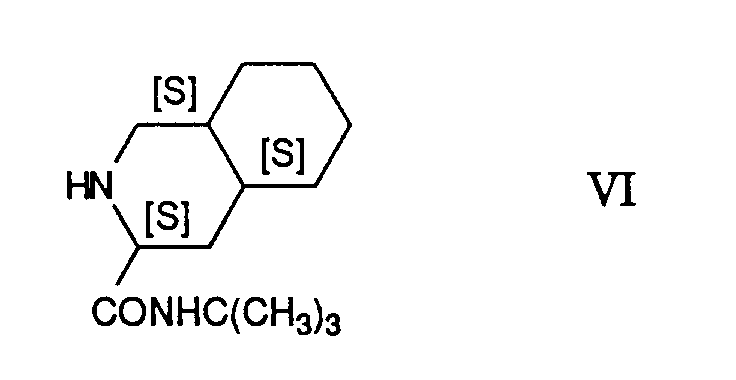 f) den entstandenen (1S,2R)-[1-Benzyl-3-[(3S,4aS,8aS)-3-tert-butoxycarbamoyl-octahydro-isochinolin-2-yl]-2-hydroxy-propyl]-carbaminsäuremethylester der Formel
- Verfahren zur Herstellung eines halogenierten α-Aminoketons der allgemeinen Formel

dadurch gekennzeichnet, dass mana) einen Diester der allgemeinen Formel
mit einem nieder-Alkyl-lithium und einem Organochlorsilan der Formel ClSi(R²,R³,R⁴), worin R², R³ und R⁴ nieder-Alkyl oder Phenyl bedeuten, umsetzt undb) eine intermediär gebildete silylgeschützte Verbindung der allgemeinen Formel VIII oder IX
in Gegenwart von dihalogeniertem Methan und eines nieder-Alkyllithiums umsetzt. - Verfahren zur Reduktion eines α-Aminoketons der allgemeinen Formel

- Die Verbindungen der Formeln III bzw. IV, worin R¹ Methyl bedeutet, insbesondere
der (S)-1-Benzyl-3-chlor-2-oxopropyl)carbaminsäuremethylester bzw.
der (1S,2S)-(1-Benzyl-3-chlor-2-hydroxypropyl)carbaminsäuremethylester. - Die Verbindungen der Formeln V bzw. VII, worin R¹ Methyl bedeutet, nämlich
der [(S)-1-[(S)-Oxiran-2-yl]-2-phenethyl]carbaminsäuremethylester bzw.
der (1S,2R)-[1-Benzyl-3-[(3S,4aS,8aS)-3-tert-butoxycarbamoyl-octahydroisochinolin-2-yl]-2-hydroxypropyl]carbaminsäuremethylester. - Verwendung von Verbindungen der Formeln III bzw. IV, worin R¹ Methyl bedeutet, und/oder von Verbindungen der Formeln V bzw. VII, worin R¹ Methyl bedeutet zur Herstellung von 2-[3(S)-Amino-2(R)-hydroxy-4-phenyl-butyl]-N-tert.butyl-decahydro-(4aS,8aS)-isochinolin-3(S)-carboxamids der Formel

- Verwendung von (S)-1-Benzyl-3-chlor-2-oxopropyl)carbaminsäure-methylester, (1S,2S)-(1-Benzyl-3-chlor-2-hydroxypropyl)carbamin-säuremethylester, [(S)-1-[(S)-Oxiran-2-yl]-2-phenethyl]car Herstellung von 2-[3(S)-Amino-2(R)-hydroxy-4-phenyl-butyl]-N-tert.butyl-decahydro-(4aS,8aS)-isochinolin-3(S)-carboxamids der Formel

Applications Claiming Priority (6)
| Application Number | Priority Date | Filing Date | Title |
|---|---|---|---|
| CH290494 | 1994-09-23 | ||
| CH290494 | 1994-09-23 | ||
| CH2904/94 | 1994-09-23 | ||
| CH373694 | 1994-12-09 | ||
| CH373694 | 1994-12-09 | ||
| CH3736/94 | 1994-12-09 |
Publications (2)
| Publication Number | Publication Date |
|---|---|
| EP0710651A1 true EP0710651A1 (de) | 1996-05-08 |
| EP0710651B1 EP0710651B1 (de) | 2001-01-17 |
Family
ID=25691689
Family Applications (1)
| Application Number | Title | Priority Date | Filing Date |
|---|---|---|---|
| EP95114205A Expired - Lifetime EP0710651B1 (de) | 1994-09-23 | 1995-09-11 | Verfahren zur Herstellung eines Decahydroisochinolino-alpha,alpha'diamino-alkohols |
Country Status (9)
| Country | Link |
|---|---|
| US (5) | US5591885A (de) |
| EP (1) | EP0710651B1 (de) |
| JP (1) | JP3819955B2 (de) |
| KR (1) | KR100418237B1 (de) |
| CN (3) | CN1116284C (de) |
| AT (1) | ATE198740T1 (de) |
| DE (1) | DE59508973D1 (de) |
| DK (1) | DK0710651T3 (de) |
| ES (1) | ES2154310T3 (de) |
Cited By (4)
| Publication number | Priority date | Publication date | Assignee | Title |
|---|---|---|---|---|
| EP0703209A3 (de) * | 1994-09-23 | 1996-10-30 | Hoffmann La Roche | Verfahren zur Herstellung von halogenierten Alpha-Amino-Ketonen und Alpha-Amino-Alkoholen |
| EP1148046A4 (de) * | 1999-01-28 | 2003-05-14 | Ajinomoto Kk | Verfahren zur herstellung von alpha-aminoketonen |
| EP1604662A1 (de) * | 2004-06-08 | 2005-12-14 | Santhera Pharmaceuticals (Deutschland) Aktiengesellschaft | 1-[(3R)-Amino-4-(2-fluoro-phenyl)-butyl]-pyrrolidin-(2R)-carbonsäure-benzylamine-Derivate und verwandte Verbindungen als Dipeptidyl-Peptidase IV (DPP-IV) Inhibitoren zur Behandlung von Typ 2 Diabetes Mellitus |
| EP1348691A4 (de) * | 1999-07-28 | 2006-02-08 | Ajinomoto Kk | Verfahren zur herstellung von a-aminohalogenmethylketonderivaten |
Families Citing this family (8)
| Publication number | Priority date | Publication date | Assignee | Title |
|---|---|---|---|---|
| KR100411856B1 (ko) * | 1995-02-03 | 2004-05-20 | 카네카 코포레이션 | α-할로케톤,α-할로히드린및에폭사이드의제조법 |
| WO1997028105A1 (fr) * | 1996-01-29 | 1997-08-07 | Kaneka Corporation | Procede de reduction de composes de carbonyle |
| DK0847994T3 (da) | 1996-12-11 | 2003-07-28 | Hoffmann La Roche | Fremgangsmåde til fremstilling af blandede anhydrider |
| US6605732B1 (en) | 1999-05-03 | 2003-08-12 | Aerojet Fine Chemicals Llc | Clean, high-yield preparation of S,S and R,S amino acid isosteres |
| DE10143742A1 (de) | 2001-09-06 | 2003-03-27 | Consortium Elektrochem Ind | Verfahren zur Herstellung von alpha-Halogenketonen |
| US7038553B2 (en) * | 2002-10-03 | 2006-05-02 | International Business Machines Corporation | Scalable computer system having surface-mounted capacitive couplers for intercommunication |
| BRPI0919257B8 (pt) * | 2008-09-24 | 2021-05-25 | Zach System | processo de preparação de nebivolol |
| CN102127061B (zh) * | 2010-01-15 | 2016-02-17 | 浙江华海药业股份有限公司 | 一种制备6-氟-3,4-二氢-2h-1-苯并吡喃-2-环氧乙烷的改进方法 |
Citations (5)
| Publication number | Priority date | Publication date | Assignee | Title |
|---|---|---|---|---|
| EP0432695A2 (de) | 1989-12-11 | 1991-06-19 | F. Hoffmann-La Roche Ag | Aminosäurederivate |
| EP0525880A1 (de) * | 1991-07-26 | 1993-02-03 | Fmc Corporation | Katalytisches Verfahren zur Alkylierung |
| EP0543343A2 (de) * | 1991-11-19 | 1993-05-26 | Lonza Ag | Verfahren zur Herstellung von alpha-Hydroxy-beta-aminocarbonsäuren |
| WO1994011345A1 (en) * | 1992-11-09 | 1994-05-26 | Merck & Co., Inc. | Process for optically pure decahydroisoquinolines |
| EP0635493A2 (de) * | 1993-03-24 | 1995-01-25 | F. Hoffmann-La Roche Ag | Verfahren zur Herstellung eines beta-Aminoalkohols |
Family Cites Families (5)
| Publication number | Priority date | Publication date | Assignee | Title |
|---|---|---|---|---|
| CA1340588C (en) * | 1988-06-13 | 1999-06-08 | Balraj Krishan Handa | Amino acid derivatives |
| GB8927915D0 (en) * | 1989-12-11 | 1990-02-14 | Hoffmann La Roche | Novel alcohols |
| US5430041A (en) * | 1991-05-10 | 1995-07-04 | Hoffmann-La Roche Inc. | Amino acid derivatives having antiviral activity |
| DE59401846D1 (de) * | 1993-07-15 | 1997-04-03 | Hoffmann La Roche | Verfahren zur Herstellung eines N-tert.Butylisochinolin-3-carboxamid Derivates und Zwischenprodukte in diesem Verfahren |
| US5523463A (en) * | 1994-09-23 | 1996-06-04 | Hoffmann-La Roche Inc. | Method of producing halogenated and alpha-aminoalchohols |
-
1995
- 1995-08-11 US US08/514,329 patent/US5591885A/en not_active Expired - Lifetime
- 1995-09-11 DK DK95114205T patent/DK0710651T3/da active
- 1995-09-11 DE DE59508973T patent/DE59508973D1/de not_active Expired - Lifetime
- 1995-09-11 AT AT95114205T patent/ATE198740T1/de active
- 1995-09-11 ES ES95114205T patent/ES2154310T3/es not_active Expired - Lifetime
- 1995-09-11 EP EP95114205A patent/EP0710651B1/de not_active Expired - Lifetime
- 1995-09-18 JP JP26204995A patent/JP3819955B2/ja not_active Expired - Lifetime
- 1995-09-21 CN CN95116887A patent/CN1116284C/zh not_active Expired - Lifetime
- 1995-09-22 KR KR1019950031290A patent/KR100418237B1/ko not_active Expired - Lifetime
-
1996
- 1996-09-18 US US08/718,109 patent/US5684176A/en not_active Expired - Lifetime
-
1997
- 1997-07-25 US US08/900,413 patent/US5847144A/en not_active Expired - Lifetime
-
1998
- 1998-07-09 US US09/112,651 patent/US5977388A/en not_active Expired - Lifetime
- 1998-11-16 US US09/192,656 patent/US5965733A/en not_active Expired - Lifetime
-
1999
- 1999-12-30 CN CN99127411A patent/CN1111156C/zh not_active Expired - Lifetime
- 1999-12-30 CN CNB991274121A patent/CN1133620C/zh not_active Expired - Lifetime
Patent Citations (6)
| Publication number | Priority date | Publication date | Assignee | Title |
|---|---|---|---|---|
| EP0432695A2 (de) | 1989-12-11 | 1991-06-19 | F. Hoffmann-La Roche Ag | Aminosäurederivate |
| US5196438A (en) | 1989-12-11 | 1993-03-23 | Hoffmann-La Roche Inc. | Amino acid derivatives |
| EP0525880A1 (de) * | 1991-07-26 | 1993-02-03 | Fmc Corporation | Katalytisches Verfahren zur Alkylierung |
| EP0543343A2 (de) * | 1991-11-19 | 1993-05-26 | Lonza Ag | Verfahren zur Herstellung von alpha-Hydroxy-beta-aminocarbonsäuren |
| WO1994011345A1 (en) * | 1992-11-09 | 1994-05-26 | Merck & Co., Inc. | Process for optically pure decahydroisoquinolines |
| EP0635493A2 (de) * | 1993-03-24 | 1995-01-25 | F. Hoffmann-La Roche Ag | Verfahren zur Herstellung eines beta-Aminoalkohols |
Non-Patent Citations (5)
| Title |
|---|
| ANGRICK,M.: "Schutzgruppen : Hilfsmittel der präparativen Chemie", PHARMAZIE I.U.ZT., vol. 13, no. 3, WEINHEIM, pages 83 - 88 * |
| D'ANIELLO,F. ET AL.: "A stereoselective Method for the Preparation of HIV-1 Protease Inhibitors Based on the Lewis Acid Mediated Reaction of Allylsilanes and N-Boc-alpha-amino Aldehydes", J.ORG.CHEM., vol. 57, pages 5247 - 5250, XP002012284, DOI: doi:10.1021/jo00045a045 * |
| KONRADI,A.W. ET AL.: "Pinacol Cross Coupling of 2-[N-(Alkoxycarbonyl) amino] Aldehydes by ....", J.AM.CHEM.SOC., vol. 116, WASHINGTON, pages 1316 - 1323 * |
| REETZ,M.T.: "New Approaches to the Use of Amino Acids as Chiral Building Blocks in Organic Synthesis", ANGEW.CHEM.INT.ED.ENGL., vol. 30, no. 12, WEINHEIM, pages 1531 - 1546 * |
| SHIRAHATA,A.: "Novel and Facile Synthesis of t-butyl substituted Silanes from t-butyl Magnesium Chloride and Chlorosilanes Catalyzed by Cuprous Cyanide", TETRAHEDRON LETT., vol. 30, no. 46, OXFORD, pages 6393 - 6394, XP002012283, DOI: doi:10.1016/S0040-4039(01)93903-6 * |
Cited By (6)
| Publication number | Priority date | Publication date | Assignee | Title |
|---|---|---|---|---|
| EP0703209A3 (de) * | 1994-09-23 | 1996-10-30 | Hoffmann La Roche | Verfahren zur Herstellung von halogenierten Alpha-Amino-Ketonen und Alpha-Amino-Alkoholen |
| EP1148046A4 (de) * | 1999-01-28 | 2003-05-14 | Ajinomoto Kk | Verfahren zur herstellung von alpha-aminoketonen |
| US6683214B2 (en) | 1999-01-28 | 2004-01-27 | Ajinomoto Co., Inc. | Process for producing α-aminoketones |
| EP1348691A4 (de) * | 1999-07-28 | 2006-02-08 | Ajinomoto Kk | Verfahren zur herstellung von a-aminohalogenmethylketonderivaten |
| EP1604662A1 (de) * | 2004-06-08 | 2005-12-14 | Santhera Pharmaceuticals (Deutschland) Aktiengesellschaft | 1-[(3R)-Amino-4-(2-fluoro-phenyl)-butyl]-pyrrolidin-(2R)-carbonsäure-benzylamine-Derivate und verwandte Verbindungen als Dipeptidyl-Peptidase IV (DPP-IV) Inhibitoren zur Behandlung von Typ 2 Diabetes Mellitus |
| WO2005120494A1 (en) * | 2004-06-08 | 2005-12-22 | Santhera Pharmaceuticals (Schweiz) Ag | 1-`(3r)-amino-4-(2-fluoro-phenyl)-butyl !-pyrrolidine-(2r)-carboxilic acid-benzyl amine derivatives and related compounds as dipeptidyl-peptidase iv (dpp-iv) inhibitors for the treatment of type 2 diabetes mellitus |
Also Published As
| Publication number | Publication date |
|---|---|
| CN1127251A (zh) | 1996-07-24 |
| CN1133620C (zh) | 2004-01-07 |
| CN1275563A (zh) | 2000-12-06 |
| CN1116284C (zh) | 2003-07-30 |
| JPH0899959A (ja) | 1996-04-16 |
| US5684176A (en) | 1997-11-04 |
| US5591885A (en) | 1997-01-07 |
| KR100418237B1 (ko) | 2004-07-23 |
| US5965733A (en) | 1999-10-12 |
| EP0710651B1 (de) | 2001-01-17 |
| US5977388A (en) | 1999-11-02 |
| JP3819955B2 (ja) | 2006-09-13 |
| DE59508973D1 (de) | 2001-02-22 |
| KR960010629A (ko) | 1996-04-20 |
| DK0710651T3 (da) | 2001-05-14 |
| CN1111156C (zh) | 2003-06-11 |
| CN1275562A (zh) | 2000-12-06 |
| ATE198740T1 (de) | 2001-02-15 |
| ES2154310T3 (es) | 2001-04-01 |
| US5847144A (en) | 1998-12-08 |
Similar Documents
| Publication | Publication Date | Title |
|---|---|---|
| EP0432694B1 (de) | Aminoalkohole | |
| DE69433715T2 (de) | Delta 6,7-Taxol Derivate antineoplastische Verwendung und diese enthaltende pharmazeutische Zusammenstellungen | |
| DE69321845T2 (de) | Hydroxyethylaminosulfonamide verwendbar als inhibitoren retroviraler proteasen | |
| EP1200384B1 (de) | 2-alkyl-5-halogen-pent-4-encarbonsäuren und deren herstellung | |
| EP0710651B1 (de) | Verfahren zur Herstellung eines Decahydroisochinolino-alpha,alpha'diamino-alkohols | |
| DE69124110T2 (de) | Retrovirale protease inhibitoren | |
| DE69616446T2 (de) | Verfahren zur herstellung von alpha-haloketonen, alpha-halohydrinen und epoxiden | |
| DE69717974T2 (de) | Verfahren zur herstellung von ganciclovirderivaten | |
| CA2032259A1 (en) | Hiv protease inhibitors useful for the treatment of aids | |
| DE69614824T2 (de) | Verfahren zur herstellung von retrovial protease hemmenden zwischenprodukten | |
| EP0454624B1 (de) | Verfahren zur Herstellung von 1,3-Diketonen | |
| EP0192829A1 (de) | Amino-propanol-Derivate, Verfahren zu ihrer Herstellung und diese Verbindungen enthaltende Arzneimittel sowie Zwischenprodukte | |
| EP0703209A2 (de) | Verfahren zur Herstellung von halogenierten Alpha-Amino-Ketonen und Alpha-Amino-Alkoholen | |
| SK112296A3 (en) | Process for making an epoxide and epoxide made by this method | |
| DE69715417T2 (de) | Oxazolidinester | |
| DE69812079T2 (de) | Verfahren zur herstellung eines buthylthuio-isochinolinderivates und zwischenprodukte dafür | |
| DE69410222T2 (de) | Verfahren zur Herstellung von optisch aktiven Erythro-3-amino-1,2-epoxy-Verbindungen | |
| DE69502772T2 (de) | Baccatinderivate und Verfahren zu ihrer Herstellung | |
| DE69424065T2 (de) | Verfahren zur herstellung von zwischenprodukten, die für die herstellung von retroviral-protease hemmenden verbindungen verwendbar sind | |
| EP0959070B1 (de) | Verfahren zur Herstellung von 3-Amino-2-oxopyrrolidinen, neue Zwischenprodukte und deren Verwendung | |
| DE4431530C2 (de) | Verfahren zur Herstellung von 2-[3(S)-Amino-2(R)-hydroxy-4-phenylbutyl]-N-tert.butyl-decahydro-(4aS,8aS)-isochinolin-3(S)-carboxamid | |
| DE60031299T2 (de) | Verfahren zur industriellen Herstellung von (Aminomethyl)trifluormethlcarbinol-Derivaten | |
| US6573388B1 (en) | Ethylaziridine derivatives and their preparation methods | |
| EP0279350B1 (de) | Annelierte Azepinon- und Azocinon-Derivate, Verfahren zu ihrer Herstellung, diese enthaltende Mittel und ihre Verwendung, sowie Zwischenprodukte bei ihrer Herstellung | |
| US6437134B2 (en) | Process for a phenylthiobutyl-isoquinoline and intermediates therefor |
Legal Events
| Date | Code | Title | Description |
|---|---|---|---|
| PUAI | Public reference made under article 153(3) epc to a published international application that has entered the european phase |
Free format text: ORIGINAL CODE: 0009012 |
|
| 17P | Request for examination filed |
Effective date: 19950911 |
|
| AK | Designated contracting states |
Kind code of ref document: A1 Designated state(s): AT BE CH DE DK ES FR GB IT LI NL |
|
| 17Q | First examination report despatched |
Effective date: 19971022 |
|
| GRAG | Despatch of communication of intention to grant |
Free format text: ORIGINAL CODE: EPIDOS AGRA |
|
| GRAG | Despatch of communication of intention to grant |
Free format text: ORIGINAL CODE: EPIDOS AGRA |
|
| GRAG | Despatch of communication of intention to grant |
Free format text: ORIGINAL CODE: EPIDOS AGRA |
|
| GRAH | Despatch of communication of intention to grant a patent |
Free format text: ORIGINAL CODE: EPIDOS IGRA |
|
| GRAH | Despatch of communication of intention to grant a patent |
Free format text: ORIGINAL CODE: EPIDOS IGRA |
|
| GRAA | (expected) grant |
Free format text: ORIGINAL CODE: 0009210 |
|
| AK | Designated contracting states |
Kind code of ref document: B1 Designated state(s): AT BE CH DE DK ES FR GB IT LI NL |
|
| REF | Corresponds to: |
Ref document number: 198740 Country of ref document: AT Date of ref document: 20010215 Kind code of ref document: T |
|
| REG | Reference to a national code |
Ref country code: CH Ref legal event code: EP |
|
| REF | Corresponds to: |
Ref document number: 59508973 Country of ref document: DE Date of ref document: 20010222 |
|
| GBT | Gb: translation of ep patent filed (gb section 77(6)(a)/1977) |
Effective date: 20010223 |
|
| REG | Reference to a national code |
Ref country code: ES Ref legal event code: FG2A Ref document number: 2154310 Country of ref document: ES Kind code of ref document: T3 |
|
| ITF | It: translation for a ep patent filed | ||
| REG | Reference to a national code |
Ref country code: DK Ref legal event code: T3 |
|
| ET | Fr: translation filed | ||
| PLBE | No opposition filed within time limit |
Free format text: ORIGINAL CODE: 0009261 |
|
| STAA | Information on the status of an ep patent application or granted ep patent |
Free format text: STATUS: NO OPPOSITION FILED WITHIN TIME LIMIT |
|
| REG | Reference to a national code |
Ref country code: GB Ref legal event code: IF02 |
|
| 26N | No opposition filed | ||
| PGFP | Annual fee paid to national office [announced via postgrant information from national office to epo] |
Ref country code: DK Payment date: 20140825 Year of fee payment: 20 Ref country code: CH Payment date: 20140725 Year of fee payment: 20 Ref country code: NL Payment date: 20140911 Year of fee payment: 20 |
|
| PGFP | Annual fee paid to national office [announced via postgrant information from national office to epo] |
Ref country code: GB Payment date: 20140826 Year of fee payment: 20 Ref country code: AT Payment date: 20140825 Year of fee payment: 20 Ref country code: FR Payment date: 20140825 Year of fee payment: 20 Ref country code: ES Payment date: 20140904 Year of fee payment: 20 |
|
| PGFP | Annual fee paid to national office [announced via postgrant information from national office to epo] |
Ref country code: IT Payment date: 20140918 Year of fee payment: 20 |
|
| PGFP | Annual fee paid to national office [announced via postgrant information from national office to epo] |
Ref country code: DE Payment date: 20140930 Year of fee payment: 20 |
|
| PGFP | Annual fee paid to national office [announced via postgrant information from national office to epo] |
Ref country code: BE Payment date: 20141020 Year of fee payment: 20 |
|
| REG | Reference to a national code |
Ref country code: DE Ref legal event code: R071 Ref document number: 59508973 Country of ref document: DE |
|
| REG | Reference to a national code |
Ref country code: DK Ref legal event code: EUP Effective date: 20150911 |
|
| REG | Reference to a national code |
Ref country code: CH Ref legal event code: PL |
|
| REG | Reference to a national code |
Ref country code: GB Ref legal event code: PE20 Expiry date: 20150910 Ref country code: NL Ref legal event code: MK Effective date: 20150910 |
|
| PG25 | Lapsed in a contracting state [announced via postgrant information from national office to epo] |
Ref country code: GB Free format text: LAPSE BECAUSE OF EXPIRATION OF PROTECTION Effective date: 20150910 |
|
| REG | Reference to a national code |
Ref country code: AT Ref legal event code: MK07 Ref document number: 198740 Country of ref document: AT Kind code of ref document: T Effective date: 20150911 |
|
| REG | Reference to a national code |
Ref country code: ES Ref legal event code: FD2A Effective date: 20151229 |
|
| PG25 | Lapsed in a contracting state [announced via postgrant information from national office to epo] |
Ref country code: ES Free format text: LAPSE BECAUSE OF EXPIRATION OF PROTECTION Effective date: 20150912 |