EP0710730A2 - Hochfeste und hochsteife Aluminiumbasislegierung und deren Herstellungsverfahren - Google Patents
Hochfeste und hochsteife Aluminiumbasislegierung und deren Herstellungsverfahren Download PDFInfo
- Publication number
- EP0710730A2 EP0710730A2 EP95117263A EP95117263A EP0710730A2 EP 0710730 A2 EP0710730 A2 EP 0710730A2 EP 95117263 A EP95117263 A EP 95117263A EP 95117263 A EP95117263 A EP 95117263A EP 0710730 A2 EP0710730 A2 EP 0710730A2
- Authority
- EP
- European Patent Office
- Prior art keywords
- aluminum
- based alloy
- alloy
- quasi
- amount
- Prior art date
- Legal status (The legal status is an assumption and is not a legal conclusion. Google has not performed a legal analysis and makes no representation as to the accuracy of the status listed.)
- Granted
Links
Images


Classifications
-
- B—PERFORMING OPERATIONS; TRANSPORTING
- B22—CASTING; POWDER METALLURGY
- B22F—WORKING METALLIC POWDER; MANUFACTURE OF ARTICLES FROM METALLIC POWDER; MAKING METALLIC POWDER; APPARATUS OR DEVICES SPECIALLY ADAPTED FOR METALLIC POWDER
- B22F9/00—Making metallic powder or suspensions thereof
- B22F9/002—Making metallic powder or suspensions thereof amorphous or microcrystalline
- B22F9/008—Rapid solidification processing
-
- C—CHEMISTRY; METALLURGY
- C22—METALLURGY; FERROUS OR NON-FERROUS ALLOYS; TREATMENT OF ALLOYS OR NON-FERROUS METALS
- C22C—ALLOYS
- C22C1/00—Making non-ferrous alloys
- C22C1/04—Making non-ferrous alloys by powder metallurgy
- C22C1/0408—Light metal alloys
- C22C1/0416—Aluminium-based alloys
-
- C—CHEMISTRY; METALLURGY
- C22—METALLURGY; FERROUS OR NON-FERROUS ALLOYS; TREATMENT OF ALLOYS OR NON-FERROUS METALS
- C22C—ALLOYS
- C22C21/00—Alloys based on aluminium
-
- C—CHEMISTRY; METALLURGY
- C23—COATING METALLIC MATERIAL; COATING MATERIAL WITH METALLIC MATERIAL; CHEMICAL SURFACE TREATMENT; DIFFUSION TREATMENT OF METALLIC MATERIAL; COATING BY VACUUM EVAPORATION, BY SPUTTERING, BY ION IMPLANTATION OR BY CHEMICAL VAPOUR DEPOSITION, IN GENERAL; INHIBITING CORROSION OF METALLIC MATERIAL OR INCRUSTATION IN GENERAL
- C23C—COATING METALLIC MATERIAL; COATING MATERIAL WITH METALLIC MATERIAL; SURFACE TREATMENT OF METALLIC MATERIAL BY DIFFUSION INTO THE SURFACE, BY CHEMICAL CONVERSION OR SUBSTITUTION; COATING BY VACUUM EVAPORATION, BY SPUTTERING, BY ION IMPLANTATION OR BY CHEMICAL VAPOUR DEPOSITION, IN GENERAL
- C23C26/00—Coating not provided for in groups C23C2/00 - C23C24/00
- C23C26/02—Coating not provided for in groups C23C2/00 - C23C24/00 applying molten material to the substrate
-
- C—CHEMISTRY; METALLURGY
- C23—COATING METALLIC MATERIAL; COATING MATERIAL WITH METALLIC MATERIAL; CHEMICAL SURFACE TREATMENT; DIFFUSION TREATMENT OF METALLIC MATERIAL; COATING BY VACUUM EVAPORATION, BY SPUTTERING, BY ION IMPLANTATION OR BY CHEMICAL VAPOUR DEPOSITION, IN GENERAL; INHIBITING CORROSION OF METALLIC MATERIAL OR INCRUSTATION IN GENERAL
- C23C—COATING METALLIC MATERIAL; COATING MATERIAL WITH METALLIC MATERIAL; SURFACE TREATMENT OF METALLIC MATERIAL BY DIFFUSION INTO THE SURFACE, BY CHEMICAL CONVERSION OR SUBSTITUTION; COATING BY VACUUM EVAPORATION, BY SPUTTERING, BY ION IMPLANTATION OR BY CHEMICAL VAPOUR DEPOSITION, IN GENERAL
- C23C6/00—Coating by casting molten material on the substrate
Definitions
- the present invention relates to an aluminum-based alloy for use in a wide range of applications such as in a structural material for aircraft, vehicles, and ships, and for engine parts.
- the present invention may be employed in sashes, roofing materials, and exterior materials for use in construction, or as material for use in marine equipment, nuclear reactors, and the like.
- alloys incorporating various components such as Al-Cu, Al-Si, Al-Mg, Al-Cu-Si, Al-Cu-Mg, and Al-Zn-Mg are known.
- superior anti-corrosive properties are obtained at a light weight, and thus the aforementioned alloys are being widely used as structural material for machines in vehicles, ships, and aircraft, in addition to being employed in sashes, roofing materials, exterior materials for use in construction, structural material for use in LNG tanks, and the like.
- the prior art aluminum-based alloys generally exhibit disadvantages such as a low hardness and poor heat resistance when compared to material incorporating Fe.
- some materials have incorporated elements such as Cu, Mg, and Zn for increased hardness, disadvantages remain such as low anti-corrosive properties.
- an aluminum-based alloy comprising a composition A1M1X with a special composition ratio (wherein M1 represents an element such as V, Cr, Mn, Fe, Co, Ni, Cu, Zr and the like, and X represents a rare earth element such as La, Ce, Sm, and Nd, or an element such as Y, Nb, Ta, Mm (misch metal) and the like), and having an amorphous or a combined amorphous/fine crystalline structure, is disclosed.
- M1 represents an element such as V, Cr, Mn, Fe, Co, Ni, Cu, Zr and the like
- X represents a rare earth element such as La, Ce, Sm, and Nd, or an element such as Y, Nb, Ta, Mm (misch metal) and the like
- This aluminum-based alloy can be utilized as material with a high hardness, high strength, high electrical resistance, anti-abrasion properties, or as soldering material.
- the disclosed aluminum-based alloy has a superior heat resistance, and may undergo extruding or press processing by utilizing the superplastic phenomenon observed near crystallization temperatures.
- the aforementioned aluminum-based alloy is disadvantageous in that high costs result from the incorporation of large amounts of expensive rare earth elements and/or metal elements with a high activity such as Y. Namely, in addition to the aforementioned use of expensive raw materials, problems also arise such as increased consumption and labor costs due to the large scale of the manufacturing facilities required to treat materials with high activities. Furthermore, this aluminum-based alloy having the aforementioned composition tends to display insufficient resistance to oxidation and corrosion.
- the present invention provides a high strength and high rigidity aluminum-based alloy consisting essentially of a composition represented by the general formula Al 100-(a+b) Q a M b (wherein Q is at least one metal element selected from the group consisting of V, Mo, Fe, W, Nb, and Pd; M is at least one metal element selected from the group consisting of Mn, Fe, Co, Ni, and Cu; and a and b, which represent a composition ratio in atomic percentages, satisfy the relationships 1 ⁇ a ⁇ 10, 0 ⁇ b ⁇ 5, and 3 ⁇ a+b ⁇ 12 ) having a metallographic structure comprising a quasi-crystalline phase.
- Q is at least one metal element selected from the group consisting of V, Mo, Fe, W, Nb, and Pd
- M is at least one metal element selected from the group consisting of Mn, Fe, Co, Ni, and Cu
- a and b which represent a composition ratio in atomic percentages, satisfy the relationships 1 ⁇ a
- the present invention by adding a predetermined amount of V, Mo, Fe, W, Nb, and/or Pd to Al, the ability of the alloy to form a quasi-crystalline phase is improved, and the strength, hardness, and toughness of the alloy is also improved. Moreover, by adding a predetermined amount of Mn, Fe, Co, Ni, and/or Cu, the effects of quick-quenching are enhanced, the thermal stability of the overall metallographic structure is improved, and the strength and hardness of the resulting alloy are also increased.
- the aluminum-based alloy according to the present invention is useful as materials with a high hardness, strength, and rigidity. Furthermore, this alloy also stands up well to bending, and thus possesses superior properties such as the ability to be mechanically processed.
- the aluminum-based alloys according to the present invention can be used in a wide range of applications such as in the structural material for aircraft, vehicles, and ships, as well as for engine parts.
- the aluminum-based alloys of the present invention may be employed in sashes, roofing materials, and exterior materials for use in construction, or as materials for use in marine equipment, nuclear reactors, and the like.
- Fig. 1 shows a construction of an example of a single roll apparatus used at the time of manufacturing a tape of an alloy of the present invention following quick-quench solidification.
- Fig. 2 shows the analysis result of the X-ray diffraction of an alloy having the composition of Al94V4Fe2.
- Fig. 3 shows the analysis result of the X-ray diffraction of an alloy having the composition of Al95Mo3Ni2.
- Fig. 4 shows the analysis result of the X-ray diffraction of an alloy having the composition of Al91Nb6Co3.
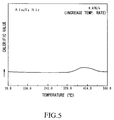
- Fig. 5 shows the thermal properties of an alloy having the composition of Al94V4Ni2.
- the first preferred embodiment of the present invention provides a high strength and high rigidity aluminum-based alloy consisting essentially of a composition represented by the general formula Al 100-(a+b) Q a M b (wherein Q is at least one metal element selected from the group consisting of V, Mo, Fe, W, Nb, and Pd; M is at least one metal element selected from the group consisting of Mn, Fe, Co, Ni, and Cu; and a and b, which represent a composition ratio in atomic percentages, satisfy the relationships 1 ⁇ a ⁇ 10, 0 ⁇ b ⁇ 5, and 3 ⁇ a+b ⁇ 12 ), comprising a quasi-crystalline phase in the alloy.
- Q is at least one metal element selected from the group consisting of V, Mo, Fe, W, Nb, and Pd
- M is at least one metal element selected from the group consisting of Mn, Fe, Co, Ni, and Cu
- a and b which represent a composition ratio in atomic percentages, satisfy the relationships 1 ⁇ a
- the atomic percentage of Al is in the range of 88 ⁇ Al ⁇ 97, preferably in the range of 92 ⁇ Al ⁇ 97, and more preferably in the range of 94 ⁇ Al ⁇ 97.
- An atomic percentage for Al of less than 88% results in embrittlement of the alloy.
- an atomic percentage for Al exceeding 97% results in reduction of the strength and hardness of the alloy.
- the amount of at least one metal element selected from the group consisting of V (vanadium), Mo (molybdenum), Fe (iron), W (tungsten), Nb (niobium), and Pd (palladium) in atomic percentage is at least 1% and does not exceed 10%; preferably, the amount is at least 2% and does not exceed 8%; more prefarably, the amount is at least 2% and does not exceed 6%. If the amount is less than 1%, a quasi-crystalline phase cannot be obtained, and the strength is markedly reduced. On the other hand, if the amount exceeds 10%, coarsening (the diameter of particles is 500 nm or more) of a quasi-crystalline phase occurs, and this results in remarkable embrittlement of the alloy and reduction of (rupture) strength of the alloy.
- the amount of at least one metal element selected from the group consisting of Mn (manganese), Fe (iron), Co (cobalt), Ni (nickel), and Cu (copper) in atomic percentage is less than 5%; preferably, the amount is at least 1% and does not exceed 3%; more preferably, the amount is at least 1% and does not exceed 2%. If the amount is 5% or more, forming and coarsening (the diameter of particles is 500 nm or more) of intermetallic compounds occur, and these result in remarkable embrittlement and reduction of toughness of the alloy.
- the total amount of unavoidable impurities does not exceed 0.3% by weight; preferably, the amount does not exceed 0.15% by weight; and more preferably, the amount does not exceed 0.10% by weight. If the amount exceeds 0.3% by weight, the effects of quick-quenching is lowered, and this results in reduction of the formability of a quasi-crystalline phase.
- the unavoidable impurities particularly, it is preferable that the amount of O does not exceed 0.1% by weight and that the amount of C or N does not exceed 0.03% by weight.
- the aforementioned aluminum-based alloys can be manufactured by quick-quench solidification of the alloy liquid-melts having the aforementioned compositions using a liquid quick-quenching method.
- This liquid quick-quenching method essentially entails rapid cooling of the melted alloy. For example, single roll, double roll, and submerged rotational spin methods have proved to be particularly effective. In these aforementioned methods, a cooling rate of 104 to 106 K/sec is easily obtainable.
- the liquid-melt is first poured into a storage vessel such as a silica tube, and is then discharged, via a nozzle aperture at the tip of the silica tube, towards a copper or copper alloy roll of diameter 30 to 300 mm, which is rotating at a fixed velocity in the range of 300 to 1000 rpm.
- a storage vessel such as a silica tube
- a copper or copper alloy roll of diameter 30 to 300 mm, which is rotating at a fixed velocity in the range of 300 to 1000 rpm.
- fine wire-thin material can be easily obtained through the submerged rotational spin method by discharging the liquid-melt via the nozzle aperture, into a refrigerant solution layer of depth 1 to 10 cm, maintained by means of centrifugal force inside an air drum rotating at 50 to 500 rpm, under argon gas back pressure.
- the angle between the liquid-melt discharged from the nozzle, and the refrigerant surface is preferably 60 to 90 degrees, and the relative velocity ratio of the liquid-melt and the refrigerant surface is preferably 0.7 to 0.9.
- thin layers of aluminum-based alloy of the aforementioned compositions can also be obtained without using the above methods, by employing layer formation processes such as the sputtering method.
- aluminum alloy powder of the aforementioned compositions can be obtained by quick-quenching the liquid-melt using various atomizer and spray methods such as a high pressure gas spray method.
- Condition (A) may be satisfied by a crystal.
- quasi-crystal relates to reciprocal lattices. Therefore, examination of diffraction patterns in detail allows experimental judgement as to whether or not a material is a quasi-crystal.
- quasi-crystals having a five-fold rotation symmetry are known.
- regular icosahedral phase, regular decagonal phase, regular dodecagonal phase, and regular octagonal phase have been found.
- the fine crystalline phase of the present invention represents a crystalline phase in which the crystal particles have an average maximum diameter of 1 ⁇ m.
- any of the metallographic-structural states described in (1) to (4) above can be obtained.
- An alloy of the multiphase structural state described in (1) and (2) above has a high strength and an excellent bending ductility.
- An alloy of the multiphase structural state described in (3) above has a higher strength and lower ductility than the alloys of the multiphase structural state described in (1) and (2).
- the lower ductility does not hinder its high strength.
- An alloy of the multiphase structural state described in (4) has a high strength, high toughness and a high ductility.
- Each of the aforementioned metallographic-structural states can be easily determined by a normal X-ray diffraction method or by observation using a transmission electron microscope. In the case when a quasi-crystal exists, a dull peak, which is characteristic of a quasi-crystalline phase, is exhibited.
- any of the multiphase structural states described in (1) to (3) above can be obtained.
- any of the metallographic-structural states described in (4) can be obtained.
- the aluminum-based alloy of the present invention displays superplasticity at temperatures near the crystallization temperature (crystallization temperature ⁇ 50°C), as well as, at the high temperatures within the fine crystalline stable temperature range, and thus processes such as extruding, pressing, and hot forging can easily be performed. Consequently, aluminum-based alloys of the above-mentioned compositions obtained in the aforementioned thin tape, wire, plate, and/or powder states can be easily formed into bulk materials by means of extruding, pressing and hot forging processes at the aforementioned temperatures. Furthermore, the aluminum-based alloys of the aforementioned compositions possess a high ductility, thus bending of 180° is also possible.
- the aforementioned aluminum-based alloys having multiphase structure composed of a pure-aluminum phase, a quasi-crystalline phase, a metal solid solution, and/or an amorphous phase, and the like do not display structural or chemical non-uniformity of crystal grain boundary, segregation and the like, as seen in crystalline alloys. These alloys cause passivation due to formation of an aluminum oxide layer, and thus display a high resistance to corrosion. Furthermore, disadvantages exist when incorporating rare earth elements: due to the activity of these rare earth elements, non-uniformity occurs easily in the passive layer on the alloy surface resulting in the progress of corrosion from this portion towards the interior. However, since the alloys of the aforementioned compositions do not incorporate rare earth elements, these aforementioned problems are effectively circumvented.
- the tape alloy manufactured by means of the aforementioned quick-quenching process is pulverized in a ball mill, and then powder pressed in a vacuum hot press under vacuum (e.g. 10 ⁇ 3 Torr) at a temperature slightly below the crystallization temperature (e.g. approximately 470K), thereby forming a billet for use in extruding with a diameter and length of several centimeters.
- This billet is set inside a container of an extruder, and is maintained at a temperature slightly greater than the crystallization temperature for several tens of minutes. Extruded materials can then be obtained in desired shapes such as round bars, etc., by extruding.
- a molten alloy having a predetermined composition was manufactured using a high frequency melting furnace. Then, as shown in Fig. 1, this melt was poured into a silica tube 1 with a small aperture 5 (aperture diameter: 0.2 to 0.5 mm) at the tip, and then heated to melt, after which the aforementioned silica tube 1 was positioned directly above copper roll 2. This roll 2 was then rotated at a high speed of 4000 rpm, and argon gas pressure (0.7 kg/cm3) was applied to silica tube 1. Quick-quench solidification was subsequently performed by quick-quenching the liquid-melt by means of discharging the liquid-melt from small aperture 5 of silica tube 1 onto the surface of roll 2 and quick-quenching to yield an alloy tape 4.
- the samples according to the present invention display an extremely high hardness from 295 to 375 DPN.
- Fig. 2 shows an X-ray diffraction pattern possessed by an alloy sample having the composition of Al94V4Fe2.
- Fig. 3 shows an X-ray diffraction pattern possessed by an alloy sample having the composition of Al95Mo3Ni2.
- Fig. 4 shows an X-ray diffraction pattern possessed by an alloy sample having the composition of Al91Nb6Co3. According to these patterns, each of these three alloy samples has a multiphase structure comprising a fine Al-crystalline phase having an fcc structure and a fine regular-icosahedral quasi-crystalline phase.
- peaks expressed as (111), (200), (220), and (311) are crystalline peaks of Al having an fcc structure, while peaks expressed as (211111) and (221001) are dull peaks of regular-icosahedral quasi crystals.
- Fig. 5 shows the DSC (Differential Scanning Calorimetry) curve in the case when an alloy having the composition of Al94V4Ni2 is heated at rate of 0.67 K/s.
- DSC Different Scanning Calorimetry
Landscapes
- Chemical & Material Sciences (AREA)
- Engineering & Computer Science (AREA)
- Materials Engineering (AREA)
- Mechanical Engineering (AREA)
- Metallurgy (AREA)
- Organic Chemistry (AREA)
- Chemical Kinetics & Catalysis (AREA)
- Crystallography & Structural Chemistry (AREA)
- Continuous Casting (AREA)
- Manufacture Of Metal Powder And Suspensions Thereof (AREA)
Applications Claiming Priority (3)
| Application Number | Priority Date | Filing Date | Title |
|---|---|---|---|
| JP27006294 | 1994-11-02 | ||
| JP270062/94 | 1994-11-02 | ||
| JP27006294 | 1994-11-02 |
Publications (3)
| Publication Number | Publication Date |
|---|---|
| EP0710730A2 true EP0710730A2 (de) | 1996-05-08 |
| EP0710730A3 EP0710730A3 (de) | 1996-11-27 |
| EP0710730B1 EP0710730B1 (de) | 2002-10-02 |
Family
ID=17480994
Family Applications (1)
| Application Number | Title | Priority Date | Filing Date |
|---|---|---|---|
| EP95117263A Expired - Lifetime EP0710730B1 (de) | 1994-11-02 | 1995-11-02 | Hochfeste und hochsteife Aluminiumbasislegierung und deren Herstellungsverfahren |
Country Status (2)
| Country | Link |
|---|---|
| EP (1) | EP0710730B1 (de) |
| DE (1) | DE69528432T2 (de) |
Cited By (3)
| Publication number | Priority date | Publication date | Assignee | Title |
|---|---|---|---|---|
| EP0860509A3 (de) * | 1997-02-20 | 1998-11-11 | Ykk Corporation | Hochfeste, hochduktile Aluminiumlegierung |
| US5858131A (en) * | 1994-11-02 | 1999-01-12 | Tsuyoshi Masumoto | High strength and high rigidity aluminum-based alloy and production method therefor |
| WO2000006788A1 (de) * | 1998-07-29 | 2000-02-10 | Miba Gleitlager Aktiengesellschaft | Zwischenschicht, insbesondere bindungsschicht, aus einer legierung auf aluminiumbasis |
Families Citing this family (3)
| Publication number | Priority date | Publication date | Assignee | Title |
|---|---|---|---|---|
| DE102007023323B4 (de) * | 2007-05-16 | 2010-10-28 | Technische Universität Clausthal | Verwendung einer Al-Mn-Legierung für hochwarmfeste Erzeugnisse |
| DE102014102254A1 (de) * | 2014-02-21 | 2015-08-27 | Dr. Ing. H.C. F. Porsche Aktiengesellschaft | Verfahren zum Herstellen eines Kraftstoffbehälters und Kraftstoffbehälter |
| RU2611253C1 (ru) * | 2015-10-26 | 2017-02-21 | Федеральное государственное автономное образовательное учреждение высшего образования "Сибирский федеральный университет" | Способ получения порошка квазикристаллического сплава Al-Cu-Fe |
Family Cites Families (2)
| Publication number | Priority date | Publication date | Assignee | Title |
|---|---|---|---|---|
| EP0584596A3 (en) * | 1992-08-05 | 1994-08-10 | Yamaha Corp | High strength and anti-corrosive aluminum-based alloy |
| JP3142659B2 (ja) * | 1992-09-11 | 2001-03-07 | ワイケイケイ株式会社 | 高力、耐熱アルミニウム基合金 |
-
1995
- 1995-11-02 EP EP95117263A patent/EP0710730B1/de not_active Expired - Lifetime
- 1995-11-02 DE DE69528432T patent/DE69528432T2/de not_active Expired - Lifetime
Cited By (8)
| Publication number | Priority date | Publication date | Assignee | Title |
|---|---|---|---|---|
| US5858131A (en) * | 1994-11-02 | 1999-01-12 | Tsuyoshi Masumoto | High strength and high rigidity aluminum-based alloy and production method therefor |
| US6331218B1 (en) * | 1994-11-02 | 2001-12-18 | Tsuyoshi Masumoto | High strength and high rigidity aluminum-based alloy and production method therefor |
| EP0860509A3 (de) * | 1997-02-20 | 1998-11-11 | Ykk Corporation | Hochfeste, hochduktile Aluminiumlegierung |
| US6334911B2 (en) | 1997-02-20 | 2002-01-01 | Ykk Corporation | High-strength, high-ductility aluminum alloy |
| WO2000006788A1 (de) * | 1998-07-29 | 2000-02-10 | Miba Gleitlager Aktiengesellschaft | Zwischenschicht, insbesondere bindungsschicht, aus einer legierung auf aluminiumbasis |
| GB2358406A (en) * | 1998-07-29 | 2001-07-25 | Miba Gleitlager Ag | Intermediate layer,notably binding layer,made of an alloy on aluminium basis |
| GB2358406B (en) * | 1998-07-29 | 2002-11-06 | Miba Gleitlager Ag | Friction bearing having an intermediate layer, notably binding layer, made of an alloy on aluminium basis |
| US6506503B1 (en) | 1998-07-29 | 2003-01-14 | Miba Gleitlager Aktiengesellschaft | Friction bearing having an intermediate layer, notably binding layer, made of an alloy on aluminium basis |
Also Published As
| Publication number | Publication date |
|---|---|
| EP0710730B1 (de) | 2002-10-02 |
| DE69528432D1 (de) | 2002-11-07 |
| EP0710730A3 (de) | 1996-11-27 |
| DE69528432T2 (de) | 2003-06-12 |
Similar Documents
| Publication | Publication Date | Title |
|---|---|---|
| US5858131A (en) | High strength and high rigidity aluminum-based alloy and production method therefor | |
| US5509978A (en) | High strength and anti-corrosive aluminum-based alloy | |
| EP0339676B1 (de) | Hochfeste, hitzebeständige Aluminiumlegierungen | |
| EP0584596A2 (de) | Rostfeste und hochfeste Aluminiumlegierung | |
| US4365994A (en) | Complex boride particle containing alloys | |
| US4576653A (en) | Method of making complex boride particle containing alloys | |
| EP0675209B1 (de) | Hochfeste Aluminiumlegierung | |
| US4439236A (en) | Complex boride particle containing alloys | |
| US4359352A (en) | Nickel base superalloys which contain boron and have been processed by a rapid solidification process | |
| EP0361136A1 (de) | Hochfeste Legierungen auf Magnesiumbasis | |
| EP0333216B1 (de) | Hochfeste, wärmebeständige Legierungen aus Aluminium-Basis | |
| EP0558957B1 (de) | Hochfestige und verschleissfestige Aluminiumlegierung | |
| US5607523A (en) | High-strength aluminum-based alloy | |
| EP0558977B1 (de) | Hochfestige, rasch erstarrte Legierung | |
| US5350468A (en) | Process for producing amorphous alloy materials having high toughness and high strength | |
| US5240517A (en) | High strength, heat resistant aluminum-based alloys | |
| EP0606572A1 (de) | Hochfeste und wärmebeständige Aluminiumlegierung, verdichteter und verfestigter Werkstoff daraus und Verfahren zur Herstellung | |
| EP0710730B1 (de) | Hochfeste und hochsteife Aluminiumbasislegierung und deren Herstellungsverfahren | |
| US6017403A (en) | High strength and high rigidity aluminum-based alloy | |
| JP3725279B2 (ja) | 高強度、高延性アルミニウム合金 | |
| JP2703481B2 (ja) | 高強度高剛性アルミニウム基合金 | |
| JP3504401B2 (ja) | 高強度高剛性アルミニウム基合金 | |
| JP2583718B2 (ja) | 高強度耐食性アルミニウム基合金 | |
| JP2941571B2 (ja) | 高強度耐食性アルミニウム基合金およびその製造方法 | |
| JP2703480B2 (ja) | 高強度高耐食性アルミニウム基合金 |
Legal Events
| Date | Code | Title | Description |
|---|---|---|---|
| PUAI | Public reference made under article 153(3) epc to a published international application that has entered the european phase |
Free format text: ORIGINAL CODE: 0009012 |
|
| AK | Designated contracting states |
Kind code of ref document: A2 Designated state(s): DE FR |
|
| PUAL | Search report despatched |
Free format text: ORIGINAL CODE: 0009013 |
|
| AK | Designated contracting states |
Kind code of ref document: A3 Designated state(s): DE FR |
|
| 17P | Request for examination filed |
Effective date: 19970522 |
|
| 17Q | First examination report despatched |
Effective date: 19980319 |
|
| GRAG | Despatch of communication of intention to grant |
Free format text: ORIGINAL CODE: EPIDOS AGRA |
|
| GRAG | Despatch of communication of intention to grant |
Free format text: ORIGINAL CODE: EPIDOS AGRA |
|
| GRAH | Despatch of communication of intention to grant a patent |
Free format text: ORIGINAL CODE: EPIDOS IGRA |
|
| GRAH | Despatch of communication of intention to grant a patent |
Free format text: ORIGINAL CODE: EPIDOS IGRA |
|
| GRAA | (expected) grant |
Free format text: ORIGINAL CODE: 0009210 |
|
| AK | Designated contracting states |
Kind code of ref document: B1 Designated state(s): DE FR |
|
| REF | Corresponds to: |
Ref document number: 69528432 Country of ref document: DE Date of ref document: 20021107 |
|
| ET | Fr: translation filed | ||
| PLBE | No opposition filed within time limit |
Free format text: ORIGINAL CODE: 0009261 |
|
| STAA | Information on the status of an ep patent application or granted ep patent |
Free format text: STATUS: NO OPPOSITION FILED WITHIN TIME LIMIT |
|
| 26N | No opposition filed |
Effective date: 20030703 |
|
| PGFP | Annual fee paid to national office [announced via postgrant information from national office to epo] |
Ref country code: FR Payment date: 20121130 Year of fee payment: 18 |
|
| PGFP | Annual fee paid to national office [announced via postgrant information from national office to epo] |
Ref country code: DE Payment date: 20131030 Year of fee payment: 19 |
|
| REG | Reference to a national code |
Ref country code: FR Ref legal event code: ST Effective date: 20140731 |
|
| PG25 | Lapsed in a contracting state [announced via postgrant information from national office to epo] |
Ref country code: FR Free format text: LAPSE BECAUSE OF NON-PAYMENT OF DUE FEES Effective date: 20131202 |
|
| REG | Reference to a national code |
Ref country code: DE Ref legal event code: R119 Ref document number: 69528432 Country of ref document: DE |
|
| PG25 | Lapsed in a contracting state [announced via postgrant information from national office to epo] |
Ref country code: DE Free format text: LAPSE BECAUSE OF NON-PAYMENT OF DUE FEES Effective date: 20150602 |