EP0714853A1 - Méthode pour améliorer le brillant d'hydroxyde d'aluminium - Google Patents
Méthode pour améliorer le brillant d'hydroxyde d'aluminium Download PDFInfo
- Publication number
- EP0714853A1 EP0714853A1 EP94118571A EP94118571A EP0714853A1 EP 0714853 A1 EP0714853 A1 EP 0714853A1 EP 94118571 A EP94118571 A EP 94118571A EP 94118571 A EP94118571 A EP 94118571A EP 0714853 A1 EP0714853 A1 EP 0714853A1
- Authority
- EP
- European Patent Office
- Prior art keywords
- solution
- aluminum hydroxide
- hydrotalcite
- group
- contacting
- Prior art date
- Legal status (The legal status is an assumption and is not a legal conclusion. Google has not performed a legal analysis and makes no representation as to the accuracy of the status listed.)
- Ceased
Links
Images


Classifications
-
- C—CHEMISTRY; METALLURGY
- C01—INORGANIC CHEMISTRY
- C01F—COMPOUNDS OF THE METALS BERYLLIUM, MAGNESIUM, ALUMINIUM, CALCIUM, STRONTIUM, BARIUM, RADIUM, THORIUM, OR OF THE RARE-EARTH METALS
- C01F7/00—Compounds of aluminium
- C01F7/02—Aluminium oxide; Aluminium hydroxide; Aluminates
-
- C—CHEMISTRY; METALLURGY
- C01—INORGANIC CHEMISTRY
- C01F—COMPOUNDS OF THE METALS BERYLLIUM, MAGNESIUM, ALUMINIUM, CALCIUM, STRONTIUM, BARIUM, RADIUM, THORIUM, OR OF THE RARE-EARTH METALS
- C01F7/00—Compounds of aluminium
- C01F7/02—Aluminium oxide; Aluminium hydroxide; Aluminates
- C01F7/46—Purification of aluminium oxide, aluminium hydroxide or aluminates
- C01F7/47—Purification of aluminium oxide, aluminium hydroxide or aluminates of aluminates, e.g. removal of compounds of Si, Fe, Ga or of organic compounds from Bayer process liquors
-
- C—CHEMISTRY; METALLURGY
- C01—INORGANIC CHEMISTRY
- C01P—INDEXING SCHEME RELATING TO STRUCTURAL AND PHYSICAL ASPECTS OF SOLID INORGANIC COMPOUNDS
- C01P2006/00—Physical properties of inorganic compounds
- C01P2006/10—Solid density
-
- C—CHEMISTRY; METALLURGY
- C01—INORGANIC CHEMISTRY
- C01P—INDEXING SCHEME RELATING TO STRUCTURAL AND PHYSICAL ASPECTS OF SOLID INORGANIC COMPOUNDS
- C01P2006/00—Physical properties of inorganic compounds
- C01P2006/60—Optical properties, e.g. expressed in CIELAB-values
-
- C—CHEMISTRY; METALLURGY
- C01—INORGANIC CHEMISTRY
- C01P—INDEXING SCHEME RELATING TO STRUCTURAL AND PHYSICAL ASPECTS OF SOLID INORGANIC COMPOUNDS
- C01P2006/00—Physical properties of inorganic compounds
- C01P2006/80—Compositional purity
- C01P2006/82—Compositional purity water content
Definitions
- This invention relates to the purification of caustic liquors and high caustic streams, especially those relating to the production of aluminum hydroxides (also called alumina trihydrates) and aluminas from bauxite according to the Bayer process (sometimes referred to as Bayer liquor streams).
- the invention further relates to means for making an intermediate grade aluminum hydroxide/hydrate product in terms of brightness, i.e., having a whiteness level of about 85% or higher, more preferably about 90 or 92% whiteness, based on a 100% TiO2 standard and a target adsorbence level of about 0.20.
- the terms "brightness” and “whiteness” are used interchangeably.
- the recovery of aluminum hydroxide from bauxite according to the Bayer process is achieved by digesting hydroxide-containing ores with a caustic liquor. A major portion of alumina dissolves in this liquor while most unwanted ore constituents, sometimes called "red mud", remain undissolved. After bauxite is pressure digested with a caustic such as sodium hydroxide, red mud may be removed from this liquor. Aluminum hydroxide is then separated from a liquor of supersaturated sodium aluminate, also known as "green” or "pregnant" liquor, typically by precipitation.
- the supersaturated sodium aluminate is cooled and mixed with a slurry of aluminum hydroxide particles acting as seed material, or seed stock, to induce the formation of more aluminum hydroxide.
- the slurry is pumped through a classifier system where a coarse fraction of crystallized aluminum hydroxide is separated from the liquor.
- the fine fractions of crystallized (or precipitated) aluminum hydroxide are further classified into two finer fractions called "secondary seed” and "tray seed", the latter being the finest fraction from this classifier system.
- These secondary and tray seeds are often recycled to a precipitator to act as seed for further aluminum hydroxide precipitation.
- the resulting spent sodium aluminate may be recycled to a digester for mixing with new (or incoming) bauxite.
- Sodium aluminate liquors can also be made by digesting precipitated aluminum hydroxide (primary), secondary seed, tray seed or combinations thereof in a method known as redigestion.
- Some Bayer plants produce excess seed (generally tray seed) which they may thereafter redigest by recycling to bauxite digesters or through a separate, specially designed digester.
- Organic impurities When organic and inorganic impurities are present, lower liquor productivity and reduced alumina purity result. Organic impurities may cause such other complications as: lower alumina yields; excessively fine hydroxide particles; the production of colored liquors and aluminum hydroxide; lower red mud settling rates; caustic losses due to sodium organic formation; an increase in liquor density; increased viscosities; higher boiling points; and unwanted liquor foaming.
- German Patent No. 3,501,350 discloses adding a mixture of calcium oxide/hydroxide and kierserite (MgSO4 ⁇ H2O) to Bayer liquors for lowering impurity levels, especially iron contents.
- MgSO4 ⁇ H2O calcium oxide/hydroxide and kierserite
- an aluminum hydroxide of improved whiteness is produced by contacting liquor streams with a mixture of tricalcium aluminate and unactivated hydrotalcite.
- caustic solutions are treated with calcined hydrotalcite to remove colorants, especially iron.
- High dosages of about 10 g/l were preferred to make hydroxide/hydrates with about 80% whiteness levels or higher.
- the present invention represents an improvement over the aforementioned Nigro et al. method.
- One preferred embodiment of this method comprises: (a) filtering the solution to remove contaminants, typically those which are 50 microns or less in size; (b) contacting this filtered solution with an adsorbent consisting essentially of a calcined compound having the formula A w B x (OH) y C z ⁇ nH2O wherein A represents a divalent metal cation selected from the group consisting of: Mg2+, Ni2+, Fe2+, Ca2+ and Zn2+; B represents a trivalent metal cation selected from the group consisting of: Al3+, Fe3+ and Cu3+; C represents a mono- to tetravalent anion selected from the group consisting of: OH ⁇ , Cl ⁇ , Br ⁇ , NO3 ⁇ , CH3COO ⁇ , C2O42 ⁇ , CO32 ⁇ , SO42 ⁇ , PO43 ⁇ , Fe(CN)63 ⁇ and Fe(CN)64 ⁇ ; and w, x, y, z and n satisfy the following: 0 ⁇ z
- the foregoing method further includes: (d) separating or filtering contacted compound and additional contaminants from the solution after step (c).
- Yet another preferred step adds to the solution as seed material an aluminum hydroxide of high brightness, preferably about 85% or higher based on a 100% TiO2 reference standard. In some instances, this seed may be a fine classified fraction of the aluminum hydroxide produced during above step (d).
- Optional method steps include: (i) recalcining contacted compound separated from the solution in step (d); and (ii) contacting this recalcined compound with additional solution thereby recycling said adsorbent for enhanced efficiencies.
- the adsorbent in step (b) preferably consists essentially of calcined or activated hydrotalcite (sometimes abbreviated as "Activ. HTC” in the accompanying FIGURES and TABLES).
- This product is delivered to a caustic stream in preferred dosages of 1.0 g/l or less, more preferably about 0.3 g/l or less, even as low as about 0.1 g/l or less, for total treatment times of about 15-30 minutes or less.
- the invention further provides aluminum hydroxide of improved whiteness, about 85% or higher based on a 100% TiO2 reference standard.
- the invention may employ still other metal hydroxides belonging to the structural family having the formula: A w B x (OH) y C z ⁇ nH2O, wherein A represents a divalent metal cation, B a trivalent metal cation, C a mono-to tetravalent anion, and w, x, y, z and n satisfy the following: 0 ⁇ z ⁇ z ⁇ x ⁇ 4 ⁇ w ⁇ 1 ⁇ 2 y and 12 ⁇ n ⁇ 1 ⁇ 2(w-x).
- A6B2(OH)16C z ⁇ 4H2O wherein A is: Mg2+, Ni2+, Fe2+, Ca2+ and/or Zn2+; B is: Al3+, Fe3+ and/or Cr3+; and C is one or more anions selected from the list which includes: OH ⁇ , Cl ⁇ , Br ⁇ , NO3 ⁇ , CH3COO ⁇ , C2O42 ⁇ , CO32 ⁇ , SO42 ⁇ , PO43 ⁇ , Fe(CN)63 ⁇ and Fe(CN)64 ⁇ with 1 ⁇ 2 ⁇ z ⁇ 2 depending on the anionic charge being substituted.
- pyroaurites or “sjogrenites” have the basic formula: Mg6Fe2OH16CO3 ⁇ 4H2O.
- Takovites include compounds resembling: Ni6Al2OH16CO3 ⁇ 4H2O.
- hydrotalcite includes any natural or synthetic compound satisfying the formula: Mg6Al2OH16CO3 ⁇ 4H2O. This is sometimes rewritten as 6MgO ⁇ Al2O3 ⁇ CO2 ⁇ 12H2O. In its ionic form, hydrotalcite appears as: [Mg6Al2(OH)16]2+[CO3]2 ⁇ 4H2O.
- the main structural unit for this compound is brucite, or magnesium hydroxide, in an octagonal sheet-like form, with Mg ions positioned between multiple (OH) ions which share a common edge.
- anions indicated by letter "C” in the foregoing formulae
- water molecules are intercalated to form interlayers of (C z ⁇ nH2O) between such brucite-like layers.
- the anion with the greatest affinity to combine with water and form hydrotalcite is carbonate (CO32 ⁇ ).
- the spacial distribution of carbonate ions within hydrotalcite can vary depending on how freely Al3+ ions substitute from the Mg2+ ions therein.
- Brucite layer spacing also depends on the amount of aluminum substituted into hydrotalcite's basic structure. As aluminum substitution increases, interlayer spacing generally decreases due to an increase in the electrostatic attraction between the positive hydroxide layers and negative interlayers of hydrotalcite. Interlayer thicknesses may vary still further with the size and orientation of those anions substituted for carbonate in the basic structure of hydrotalcite.
- Natural deposits of hydrotalcites have been found in Snarum, Norway and the Ural Mountains. Typical occurrences are in the form of serpentines, talc schists, or as a spinel pseudomorph. Like most ores, natural hydrotalcite is virtually impossible to find in a pure state. Natural deposits typically contain one or more other minerals including penninite and muscovite.
- the method comprises heating magnesium carbonate and/or magnesium hydroxide to form activated magnesia, then combining the latter with an aqueous solution of aluminate, carbonate and hydroxyl ions.
- hydrotalcite adds dry ice or ammonium carbonate to a magnesium oxide and alpha alumina mixture.
- Another process described in The American Mineralogist , Vol. 52, pp. 1036-1047 (1967), produces hydrotalcite-like materials by titrating MgCl2 and AlCl3 with a carbon dioxide-free NaOH system. The resulting suspension is dialyzed for 30 days at 60°C. to form a hydrated Mg-Al carbonate hydroxide with both hydrotalcite and manasseite properties.
- caustic solutions may be treated by contact with a substance consisting essentially of calcined or activated hydrotalcite.
- a substance consisting essentially of calcined or activated hydrotalcite By use of the term “consisting essentially”, it is meant that any contacting adsorbent should contain greater than 85 or 90% activated hydrotalcite, and more preferably about 95 to 98%.
- calcined hydrotalcite In its fully dehydrated state, calcined hydrotalcite is believed to have the formula: Mg6Al2O8(OH)2. when only partially activated or calcined, hydrotalcite contains more water ions.
- a granular calcined hydrotalcite may be used, said granular form being made by combining hydrotalcite powders with about 10 to 35% of one or more binder materials.
- activation or heat treatment of hydrotalcite to form calcined variants may be carried out in any conventional or newly-developed medium maintained at temperatures between about 400 - 650°C.
- Preferred activation/calcination temperatures between about 425-550 or 600°C., generally maximize surface area and pore volumes for this compound.
- a substance having a porous, skeletal structure is produced from which most if not all water and carbonate ions have been expelled.
- This product has: an average pore diameter of about 55 angstroms; a skeletal (or solid component) density of about 2.9 g/cm3; and total pore volume of about 0.3 cm3/g.
- the specific surface areas of hydrotalcite are also known to increase from about 20 m2/g to between about 50-200 m2/g (as determined by BET nitrogen adsorption) after such thermal activation.
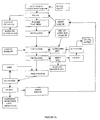
- FIGURE 1a aluminum hydroxide of improved whiteness/brightness is made by contacting a hydroxide-containing solution with a substance consisting essentially of: calcined hydrotalcite, pyroaurite, takovite, or mixtures thereof. Contacted substance is then separated from this solution for preferably recalcining and recycle. Such recalcining and recycle are optional and may not be necessary if adsorbent dosages are low.
- An aluminum hydroxide seed of high whiteness, 85% or higher is then used as seed stock for causing a purer aluminum hydroxide to start precipitating from the solution, typically at one or more temperatures between about 60 - 85°C. (140-185°F.). After start-up, the high brightness level of this product can be maintained by recycling classified seed from the precipitation stream.
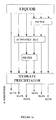
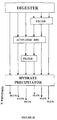
- color contaminant levels of an aluminate solution are lowered by pre-washing tray seed to remove Bayer liquor, therefrom.
- the tray seed is then redigested and the resultant sodium aluminate liquor contacted with the calcined form of an adsorbent having the formula: A6B(OH)16C ⁇ 4H2O, wherein A is selected from the group consisting of: Mg2+, Ni2+, Fe2+, Ca2+ and Zn2+; B from: Al3+, Fe3+ and Cr3+; and C from: OH ⁇ , Cl ⁇ , Br ⁇ , NO3 ⁇ , CH3COO ⁇ , C2O42 ⁇ , CO32 ⁇ , SO42 ⁇ , PO43 ⁇ , Fe(CN)63 ⁇ and Fe(CN)64 ⁇ with 1 ⁇ 2 ⁇ z ⁇ 2.
- Contacted or spent adsorbent is then separated from the solution to precipitate a whiter aluminum hydroxide product.
- powdered forms of calcined hydrotalcite are added directly to the caustic solution (or liquor) being treated.
- the amount of adsorbent to be added may be determined by testing representative samples so as to avoid underdosing or, more importantly, wasteful overdosing.
- significantly lower dosages of activated hydrotalcite (as compared with the prior art) will achieve higher whiteness levels than realized with prior known method.
- dosages of 1.0 g/l or less have proven satisfactory with prefiltering though lesser amounts of about 0.5 g/l, 0.2 g/1 or even 0.1 g/l have also removed sufficient amounts of colorants/contaminants. While total contact times may vary from several minutes to one hour or more, current data shows that total treatment times of about 15 minutes or less accomplish sufficient colorant removal according to this embodiment of the present invention.
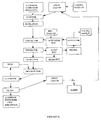
- Saturated, spent, or contacted adsorbent is typically removed from caustic liquors by known or subsequently-developed techniques including filtration, using a primary separator, gravity settling and/or centrifugation. On a preferred basis, a pressure filter is used. When activated hydrotalcite contact and settling is followed by another filtration step (per FIGURE 1c), even greater levels of hydrate brightness may be achieved. Such post-contact filtering is believed to remove from solution most unactivated forms of hydrotalcite which may have formed during treatment together with any organics that are adsorbed or don't otherwise resolubilize.
- calcined hydrotalcite powders When calcined hydrotalcite powders are combined with one or more binders before being extruded, formed or otherwise shaped into large particle sizes, such particles can then be loaded into columns, fluidized beds or other containment means through which solution may be passed.
- a third contacting alternative exposes caustic solutions to a semi-solid sludge, or slurry, of calcined hydrotalcite. This treatment form is especially good at removing such representative contaminants as NaFeO2, FeOOH, Fe2O3 and even certain humic acids.
- the method of this invention is generally receptive to adsorbing electronegative or anionic colorants which are divalent, trivalent or higher in charge.
- Calcined hydrotalcite may also remove monovalent contaminants from solution though on a less preferred basis. Without being limited as to any particular theory of operation, it is believed that preferred embodiments proceed as follows. Upon calcination (or activation), both carbonate and water are expelled from hydrotalcite's basic structure according to the formula: Mg6Al2OH16CO3 ⁇ 4H2O ⁇ Mg6Al2O8(OH)2 + CO2 + 11H2O Contact with an anionic or electronegative contaminant then causes said colorants to occupy vacated anion positions in the calcined product during solution contact and rehydration. For some contaminants, it is believed that a tricalcium aluminate intermediate forms upon hydrate redigestion. This intermediate then attracts hydrophobic, high molecular weight, organic colored molecules which are removed together through post-contact filtering practices.
- a concentrated synthetic sodium aluminate liquor was prepared as follows: 536 grams of NaOH pellets were added with overhead stirring to 1484 grams of deionized water in a stainless steel beaker. Using a hot plate, the solution temperature was raised from 18°C. to 88°C. and the NaOH was allowed to dissolve. 724 grams of A-30 hydrate (65.0% brightness) was added to this solution and stirred. The combined solution was allowed to evaporate down before additional deionized water was added. This solution was then filtered for 45 minutes with #40 paper, measured for specific gravity and refrigerated.
- the target was 352 g/l Total Caustic (T/C) as Na2CO3, an alumina to caustic ratio of 0.667, 235 g/l of Al2O3 and a specific gravity of 1.372.
- T/C Total Caustic
- alumina to caustic ratio 0.667
- 235 g/l of Al2O3 a specific gravity of 1.372.
Landscapes
- Chemical & Material Sciences (AREA)
- Organic Chemistry (AREA)
- Life Sciences & Earth Sciences (AREA)
- Geology (AREA)
- Inorganic Chemistry (AREA)
- Health & Medical Sciences (AREA)
- General Health & Medical Sciences (AREA)
- Compounds Of Alkaline-Earth Elements, Aluminum Or Rare-Earth Metals (AREA)
- Solid-Sorbent Or Filter-Aiding Compositions (AREA)
Priority Applications (1)
| Application Number | Priority Date | Filing Date | Title |
|---|---|---|---|
| EP94118571A EP0714853A1 (fr) | 1994-11-21 | 1994-11-25 | Méthode pour améliorer le brillant d'hydroxyde d'aluminium |
Applications Claiming Priority (2)
| Application Number | Priority Date | Filing Date | Title |
|---|---|---|---|
| AU78958/94A AU681711B2 (en) | 1994-11-21 | 1994-11-21 | Method for improving the brightness of aluminium hydroxide |
| EP94118571A EP0714853A1 (fr) | 1994-11-21 | 1994-11-25 | Méthode pour améliorer le brillant d'hydroxyde d'aluminium |
Publications (1)
| Publication Number | Publication Date |
|---|---|
| EP0714853A1 true EP0714853A1 (fr) | 1996-06-05 |
Family
ID=25639131
Family Applications (1)
| Application Number | Title | Priority Date | Filing Date |
|---|---|---|---|
| EP94118571A Ceased EP0714853A1 (fr) | 1994-11-21 | 1994-11-25 | Méthode pour améliorer le brillant d'hydroxyde d'aluminium |
Country Status (1)
| Country | Link |
|---|---|
| EP (1) | EP0714853A1 (fr) |
Cited By (3)
| Publication number | Priority date | Publication date | Assignee | Title |
|---|---|---|---|---|
| CN103204529A (zh) * | 2013-05-06 | 2013-07-17 | 淄博鹏丰铝业有限公司 | 一种填料级高白氢氧化铝的生产方法 |
| CN107469767A (zh) * | 2017-09-14 | 2017-12-15 | 山东理工大学 | 处理含氰废水的二氧化硅/纳米二氧化钛/硅沸石复合材料及其应用 |
| CN114044532A (zh) * | 2021-12-06 | 2022-02-15 | 中国铝业股份有限公司 | 一种铝型材加工厂铝泥制备的片状氢氧化铝的制备方法 |
Citations (2)
| Publication number | Priority date | Publication date | Assignee | Title |
|---|---|---|---|---|
| US4915930A (en) * | 1986-07-31 | 1990-04-10 | Aluminum Company Of America | Process for producing aluminum hydroxide of improved whiteness |
| US5068095A (en) * | 1986-07-31 | 1991-11-26 | Aluminum Company Of America | Method for reducing the amount of colorants in a caustic liquor |
-
1994
- 1994-11-25 EP EP94118571A patent/EP0714853A1/fr not_active Ceased
Patent Citations (2)
| Publication number | Priority date | Publication date | Assignee | Title |
|---|---|---|---|---|
| US4915930A (en) * | 1986-07-31 | 1990-04-10 | Aluminum Company Of America | Process for producing aluminum hydroxide of improved whiteness |
| US5068095A (en) * | 1986-07-31 | 1991-11-26 | Aluminum Company Of America | Method for reducing the amount of colorants in a caustic liquor |
Cited By (5)
| Publication number | Priority date | Publication date | Assignee | Title |
|---|---|---|---|---|
| CN103204529A (zh) * | 2013-05-06 | 2013-07-17 | 淄博鹏丰铝业有限公司 | 一种填料级高白氢氧化铝的生产方法 |
| CN107469767A (zh) * | 2017-09-14 | 2017-12-15 | 山东理工大学 | 处理含氰废水的二氧化硅/纳米二氧化钛/硅沸石复合材料及其应用 |
| CN107469767B (zh) * | 2017-09-14 | 2019-10-25 | 山东理工大学 | 处理含氰废水的二氧化硅/纳米二氧化钛/硅沸石复合材料及其应用 |
| CN114044532A (zh) * | 2021-12-06 | 2022-02-15 | 中国铝业股份有限公司 | 一种铝型材加工厂铝泥制备的片状氢氧化铝的制备方法 |
| CN114044532B (zh) * | 2021-12-06 | 2023-08-08 | 中国铝业股份有限公司 | 一种铝型材加工厂铝泥制备的片状氢氧化铝的制备方法 |
Similar Documents
| Publication | Publication Date | Title |
|---|---|---|
| DE112011101459B4 (de) | Verfahren zum Herstellen von Aluminiumoxid von metallurgischem Grad unter Verwendung von Wirbelschicht-Flugasche | |
| EP0186312B1 (fr) | Purification de liqueurs du procédé Bayer | |
| DE68927106T2 (de) | Kleine partikel und plättchen von alpha-aluminiumoxyd | |
| DE2906646C2 (fr) | ||
| US5068095A (en) | Method for reducing the amount of colorants in a caustic liquor | |
| DE2725384C2 (de) | Verwendung von Magnesiateilchen | |
| CA1083827A (fr) | Production d'alumine par le procede bayer | |
| US4548795A (en) | Treatment of aluminous materials | |
| AU748945B2 (en) | Process for producing alumina | |
| DE2647259A1 (de) | Verfahren zur behandlung einer alkalischen natriumaluminatloesung des bayer-verfahrens | |
| US5628972A (en) | Process for removing iron in sodium aluminate liquors obtained from alkaline attack of bauxite containing alumina monohydrate | |
| US4130402A (en) | Method for producing coarsely crystalline alumina | |
| DE3720444A1 (de) | Verfahren zur behandlung von rotschlamm nach dem bayer-verfahren | |
| US5624646A (en) | Method for improving the brightness of aluminum hydroxide | |
| US4915930A (en) | Process for producing aluminum hydroxide of improved whiteness | |
| US6110377A (en) | Process for recovering the sodium contained in industrial alkaline waste | |
| EP0180604B1 (fr) | Extraction de substances organiques a partir de courants dans un procede bayer | |
| US5888461A (en) | Process for purifying sodium aluminate solutions containing sodium oxalate | |
| CA1150517A (fr) | Methode pour diminuer la quantite de matiere organique dans le cycle de production d'alun selon le procede bayer | |
| AU681711B2 (en) | Method for improving the brightness of aluminium hydroxide | |
| US3728432A (en) | Purification of sodium aluminate solutions | |
| AU594035B2 (en) | Process for the production of aluminium hydroxide with low content of impurities, especially of iron, and with high degree of whiteness | |
| CA2136386A1 (fr) | Methode d'amelioration de l'eclat de l'hydroxyde d'aluminium | |
| DE69401418T2 (de) | Verfahren zur Behandlung von einer Mischung von Aluminiumoxydtrihydrat und Aluminiumoxydmonohydrat enthaltenden Bauxiten | |
| US4091071A (en) | Process for digesting goethite-containing bauxites according to the Bayer technology |
Legal Events
| Date | Code | Title | Description |
|---|---|---|---|
| PUAI | Public reference made under article 153(3) epc to a published international application that has entered the european phase |
Free format text: ORIGINAL CODE: 0009012 |
|
| 17P | Request for examination filed |
Effective date: 19960403 |
|
| AK | Designated contracting states |
Kind code of ref document: A1 Designated state(s): DE ES FR GB GR IE IT |
|
| 17Q | First examination report despatched |
Effective date: 19961212 |
|
| GRAG | Despatch of communication of intention to grant |
Free format text: ORIGINAL CODE: EPIDOS AGRA |
|
| STAA | Information on the status of an ep patent application or granted ep patent |
Free format text: STATUS: THE APPLICATION HAS BEEN REFUSED |
|
| 18R | Application refused |
Effective date: 20010211 |