EP0715947A2 - Kern zum Aufbau eines Fahrzeugluftreifens - Google Patents
Kern zum Aufbau eines Fahrzeugluftreifens Download PDFInfo
- Publication number
- EP0715947A2 EP0715947A2 EP95118997A EP95118997A EP0715947A2 EP 0715947 A2 EP0715947 A2 EP 0715947A2 EP 95118997 A EP95118997 A EP 95118997A EP 95118997 A EP95118997 A EP 95118997A EP 0715947 A2 EP0715947 A2 EP 0715947A2
- Authority
- EP
- European Patent Office
- Prior art keywords
- core
- tire
- features
- core according
- shell
- Prior art date
- Legal status (The legal status is an assumption and is not a legal conclusion. Google has not performed a legal analysis and makes no representation as to the accuracy of the status listed.)
- Granted
Links
- 238000004073 vulcanization Methods 0.000 claims abstract description 32
- 238000010438 heat treatment Methods 0.000 claims abstract description 13
- 238000010276 construction Methods 0.000 claims abstract description 8
- 229920001169 thermoplastic Polymers 0.000 claims abstract description 8
- 239000004416 thermosoftening plastic Substances 0.000 claims abstract description 8
- 238000012856 packing Methods 0.000 claims description 9
- 239000000463 material Substances 0.000 claims description 5
- 230000009477 glass transition Effects 0.000 claims description 3
- 238000007493 shaping process Methods 0.000 claims description 3
- 238000007664 blowing Methods 0.000 claims 2
- 238000004804 winding Methods 0.000 abstract description 20
- 238000000034 method Methods 0.000 abstract description 8
- 230000002093 peripheral effect Effects 0.000 description 7
- 238000004519 manufacturing process Methods 0.000 description 6
- 238000007789 sealing Methods 0.000 description 6
- 239000011324 bead Substances 0.000 description 4
- 238000001746 injection moulding Methods 0.000 description 4
- 239000007787 solid Substances 0.000 description 4
- 238000013459 approach Methods 0.000 description 3
- 230000015572 biosynthetic process Effects 0.000 description 3
- 238000000748 compression moulding Methods 0.000 description 3
- 239000000945 filler Substances 0.000 description 3
- 238000003780 insertion Methods 0.000 description 3
- 230000037431 insertion Effects 0.000 description 3
- 238000012432 intermediate storage Methods 0.000 description 3
- 239000004033 plastic Substances 0.000 description 3
- 238000003860 storage Methods 0.000 description 3
- 208000002197 Ehlers-Danlos syndrome Diseases 0.000 description 2
- QXJJQWWVWRCVQT-UHFFFAOYSA-K calcium;sodium;phosphate Chemical compound [Na+].[Ca+2].[O-]P([O-])([O-])=O QXJJQWWVWRCVQT-UHFFFAOYSA-K 0.000 description 2
- 238000005520 cutting process Methods 0.000 description 2
- 238000013461 design Methods 0.000 description 2
- 238000005516 engineering process Methods 0.000 description 2
- 239000011521 glass Substances 0.000 description 2
- 229920001643 poly(ether ketone) Polymers 0.000 description 2
- 239000004417 polycarbonate Substances 0.000 description 2
- 229920000515 polycarbonate Polymers 0.000 description 2
- 239000007795 chemical reaction product Substances 0.000 description 1
- 239000011258 core-shell material Substances 0.000 description 1
- 230000000694 effects Effects 0.000 description 1
- 230000008020 evaporation Effects 0.000 description 1
- 238000001704 evaporation Methods 0.000 description 1
- 230000008018 melting Effects 0.000 description 1
- 238000002844 melting Methods 0.000 description 1
- 239000002184 metal Substances 0.000 description 1
- 238000000465 moulding Methods 0.000 description 1
- 238000000926 separation method Methods 0.000 description 1
- 239000012815 thermoplastic material Substances 0.000 description 1
- 230000007704 transition Effects 0.000 description 1
Images



Classifications
-
- B—PERFORMING OPERATIONS; TRANSPORTING
- B29—WORKING OF PLASTICS; WORKING OF SUBSTANCES IN A PLASTIC STATE IN GENERAL
- B29C—SHAPING OR JOINING OF PLASTICS; SHAPING OF MATERIAL IN A PLASTIC STATE, NOT OTHERWISE PROVIDED FOR; AFTER-TREATMENT OF THE SHAPED PRODUCTS, e.g. REPAIRING
- B29C66/00—General aspects of processes or apparatus for joining preformed parts
- B29C66/50—General aspects of joining tubular articles; General aspects of joining long products, i.e. bars or profiled elements; General aspects of joining single elements to tubular articles, hollow articles or bars; General aspects of joining several hollow-preforms to form hollow or tubular articles
- B29C66/51—Joining tubular articles, profiled elements or bars; Joining single elements to tubular articles, hollow articles or bars; Joining several hollow-preforms to form hollow or tubular articles
- B29C66/54—Joining several hollow-preforms, e.g. half-shells, to form hollow articles, e.g. for making balls, containers; Joining several hollow-preforms, e.g. half-cylinders, to form tubular articles
-
- B—PERFORMING OPERATIONS; TRANSPORTING
- B29—WORKING OF PLASTICS; WORKING OF SUBSTANCES IN A PLASTIC STATE IN GENERAL
- B29C—SHAPING OR JOINING OF PLASTICS; SHAPING OF MATERIAL IN A PLASTIC STATE, NOT OTHERWISE PROVIDED FOR; AFTER-TREATMENT OF THE SHAPED PRODUCTS, e.g. REPAIRING
- B29C33/00—Moulds or cores; Details thereof or accessories therefor
- B29C33/44—Moulds or cores; Details thereof or accessories therefor with means for, or specially constructed to facilitate, the removal of articles, e.g. of undercut articles
- B29C33/48—Moulds or cores; Details thereof or accessories therefor with means for, or specially constructed to facilitate, the removal of articles, e.g. of undercut articles with means for collapsing or disassembling
- B29C33/50—Moulds or cores; Details thereof or accessories therefor with means for, or specially constructed to facilitate, the removal of articles, e.g. of undercut articles with means for collapsing or disassembling elastic or flexible
- B29C33/505—Moulds or cores; Details thereof or accessories therefor with means for, or specially constructed to facilitate, the removal of articles, e.g. of undercut articles with means for collapsing or disassembling elastic or flexible cores or mandrels, e.g. inflatable
-
- B—PERFORMING OPERATIONS; TRANSPORTING
- B29—WORKING OF PLASTICS; WORKING OF SUBSTANCES IN A PLASTIC STATE IN GENERAL
- B29C—SHAPING OR JOINING OF PLASTICS; SHAPING OF MATERIAL IN A PLASTIC STATE, NOT OTHERWISE PROVIDED FOR; AFTER-TREATMENT OF THE SHAPED PRODUCTS, e.g. REPAIRING
- B29C43/00—Compression moulding, i.e. applying external pressure to flow the moulding material; Apparatus therefor
- B29C43/02—Compression moulding, i.e. applying external pressure to flow the moulding material; Apparatus therefor of articles of definite length, i.e. discrete articles
- B29C43/10—Isostatic pressing, i.e. using non-rigid pressure-exerting members against rigid parts or dies
- B29C43/102—Isostatic pressing, i.e. using non-rigid pressure-exerting members against rigid parts or dies using rigid mould parts specially adapted for moulding articles having an axis of symmetry
- B29C43/104—Isostatic pressing, i.e. using non-rigid pressure-exerting members against rigid parts or dies using rigid mould parts specially adapted for moulding articles having an axis of symmetry the mould cavity lying totally outside the axis of symmetry, e.g. toroidal moulds
-
- B—PERFORMING OPERATIONS; TRANSPORTING
- B29—WORKING OF PLASTICS; WORKING OF SUBSTANCES IN A PLASTIC STATE IN GENERAL
- B29C—SHAPING OR JOINING OF PLASTICS; SHAPING OF MATERIAL IN A PLASTIC STATE, NOT OTHERWISE PROVIDED FOR; AFTER-TREATMENT OF THE SHAPED PRODUCTS, e.g. REPAIRING
- B29C43/00—Compression moulding, i.e. applying external pressure to flow the moulding material; Apparatus therefor
- B29C43/32—Component parts, details or accessories; Auxiliary operations
- B29C43/36—Moulds for making articles of definite length, i.e. discrete articles
- B29C43/3642—Bags, bleeder sheets or cauls for isostatic pressing
-
- B—PERFORMING OPERATIONS; TRANSPORTING
- B29—WORKING OF PLASTICS; WORKING OF SUBSTANCES IN A PLASTIC STATE IN GENERAL
- B29C—SHAPING OR JOINING OF PLASTICS; SHAPING OF MATERIAL IN A PLASTIC STATE, NOT OTHERWISE PROVIDED FOR; AFTER-TREATMENT OF THE SHAPED PRODUCTS, e.g. REPAIRING
- B29C53/00—Shaping by bending, folding, twisting, straightening or flattening; Apparatus therefor
- B29C53/56—Winding and joining, e.g. winding spirally
- B29C53/58—Winding and joining, e.g. winding spirally helically
- B29C53/583—Winding and joining, e.g. winding spirally helically for making tubular articles with particular features
- B29C53/588—Winding and joining, e.g. winding spirally helically for making tubular articles with particular features having a non-linear axis, e.g. elbows, toroids
-
- B—PERFORMING OPERATIONS; TRANSPORTING
- B29—WORKING OF PLASTICS; WORKING OF SUBSTANCES IN A PLASTIC STATE IN GENERAL
- B29C—SHAPING OR JOINING OF PLASTICS; SHAPING OF MATERIAL IN A PLASTIC STATE, NOT OTHERWISE PROVIDED FOR; AFTER-TREATMENT OF THE SHAPED PRODUCTS, e.g. REPAIRING
- B29C65/00—Joining or sealing of preformed parts, e.g. welding of plastics materials; Apparatus therefor
- B29C65/02—Joining or sealing of preformed parts, e.g. welding of plastics materials; Apparatus therefor by heating, with or without pressure
-
- B—PERFORMING OPERATIONS; TRANSPORTING
- B29—WORKING OF PLASTICS; WORKING OF SUBSTANCES IN A PLASTIC STATE IN GENERAL
- B29C—SHAPING OR JOINING OF PLASTICS; SHAPING OF MATERIAL IN A PLASTIC STATE, NOT OTHERWISE PROVIDED FOR; AFTER-TREATMENT OF THE SHAPED PRODUCTS, e.g. REPAIRING
- B29C66/00—General aspects of processes or apparatus for joining preformed parts
- B29C66/50—General aspects of joining tubular articles; General aspects of joining long products, i.e. bars or profiled elements; General aspects of joining single elements to tubular articles, hollow articles or bars; General aspects of joining several hollow-preforms to form hollow or tubular articles
- B29C66/63—Internally supporting the article during joining
-
- B—PERFORMING OPERATIONS; TRANSPORTING
- B29—WORKING OF PLASTICS; WORKING OF SUBSTANCES IN A PLASTIC STATE IN GENERAL
- B29D—PRODUCING PARTICULAR ARTICLES FROM PLASTICS OR FROM SUBSTANCES IN A PLASTIC STATE
- B29D30/00—Producing pneumatic or solid tyres or parts thereof
- B29D30/06—Pneumatic tyres or parts thereof (e.g. produced by casting, moulding, compression moulding, injection moulding, centrifugal casting)
- B29D30/0601—Vulcanising tyres; Vulcanising presses for tyres
- B29D30/0661—Rigid cores therefor, e.g. annular or substantially toroidal cores
-
- B—PERFORMING OPERATIONS; TRANSPORTING
- B29—WORKING OF PLASTICS; WORKING OF SUBSTANCES IN A PLASTIC STATE IN GENERAL
- B29D—PRODUCING PARTICULAR ARTICLES FROM PLASTICS OR FROM SUBSTANCES IN A PLASTIC STATE
- B29D30/00—Producing pneumatic or solid tyres or parts thereof
- B29D30/06—Pneumatic tyres or parts thereof (e.g. produced by casting, moulding, compression moulding, injection moulding, centrifugal casting)
- B29D30/08—Building tyres
- B29D30/10—Building tyres on round cores, i.e. the shape of the core is approximately identical with the shape of the completed tyre
- B29D30/12—Cores
-
- B—PERFORMING OPERATIONS; TRANSPORTING
- B29—WORKING OF PLASTICS; WORKING OF SUBSTANCES IN A PLASTIC STATE IN GENERAL
- B29C—SHAPING OR JOINING OF PLASTICS; SHAPING OF MATERIAL IN A PLASTIC STATE, NOT OTHERWISE PROVIDED FOR; AFTER-TREATMENT OF THE SHAPED PRODUCTS, e.g. REPAIRING
- B29C33/00—Moulds or cores; Details thereof or accessories therefor
- B29C33/02—Moulds or cores; Details thereof or accessories therefor with incorporated heating or cooling means
-
- B—PERFORMING OPERATIONS; TRANSPORTING
- B29—WORKING OF PLASTICS; WORKING OF SUBSTANCES IN A PLASTIC STATE IN GENERAL
- B29C—SHAPING OR JOINING OF PLASTICS; SHAPING OF MATERIAL IN A PLASTIC STATE, NOT OTHERWISE PROVIDED FOR; AFTER-TREATMENT OF THE SHAPED PRODUCTS, e.g. REPAIRING
- B29C33/00—Moulds or cores; Details thereof or accessories therefor
- B29C33/44—Moulds or cores; Details thereof or accessories therefor with means for, or specially constructed to facilitate, the removal of articles, e.g. of undercut articles
- B29C33/48—Moulds or cores; Details thereof or accessories therefor with means for, or specially constructed to facilitate, the removal of articles, e.g. of undercut articles with means for collapsing or disassembling
- B29C33/50—Moulds or cores; Details thereof or accessories therefor with means for, or specially constructed to facilitate, the removal of articles, e.g. of undercut articles with means for collapsing or disassembling elastic or flexible
-
- B—PERFORMING OPERATIONS; TRANSPORTING
- B29—WORKING OF PLASTICS; WORKING OF SUBSTANCES IN A PLASTIC STATE IN GENERAL
- B29C—SHAPING OR JOINING OF PLASTICS; SHAPING OF MATERIAL IN A PLASTIC STATE, NOT OTHERWISE PROVIDED FOR; AFTER-TREATMENT OF THE SHAPED PRODUCTS, e.g. REPAIRING
- B29C66/00—General aspects of processes or apparatus for joining preformed parts
- B29C66/70—General aspects of processes or apparatus for joining preformed parts characterised by the composition, physical properties or the structure of the material of the parts to be joined; Joining with non-plastics material
- B29C66/73—General aspects of processes or apparatus for joining preformed parts characterised by the composition, physical properties or the structure of the material of the parts to be joined; Joining with non-plastics material characterised by the intensive physical properties of the material of the parts to be joined, by the optical properties of the material of the parts to be joined, by the extensive physical properties of the parts to be joined, by the state of the material of the parts to be joined or by the material of the parts to be joined being a thermoplastic or a thermoset
- B29C66/731—General aspects of processes or apparatus for joining preformed parts characterised by the composition, physical properties or the structure of the material of the parts to be joined; Joining with non-plastics material characterised by the intensive physical properties of the material of the parts to be joined, by the optical properties of the material of the parts to be joined, by the extensive physical properties of the parts to be joined, by the state of the material of the parts to be joined or by the material of the parts to be joined being a thermoplastic or a thermoset characterised by the intensive physical properties of the material of the parts to be joined
- B29C66/7311—Thermal properties
- B29C66/73117—Tg, i.e. glass transition temperature
Definitions
- the invention relates to a core for building a pneumatic vehicle tire with side walls and tread. It is known to produce the carcass of a pneumatic vehicle tire by wrapping an annular core around it and then separating the carcass layer formed radially below the core by cutting in the circumferential direction over the entire circumference and then folding over the edges created by the separation in order to produce a tire bead around the tire cores .
- Such tires are known for example from DE-OS 1934018.
- Such cores are usually removed from the tire in succession after the tire has been built up, for example by folding in (DE-OS 1934018) or by removing the individual segments of an annular core EP 0481805 A2 which is divided into peripheral segments.
- the tires are temporarily stored and, after a predetermined storage time, inserted into the vulcanization press without being centered.
- the bellows of the vulcanization press are filled with superheated steam from the inside, causing the desired elevation to securely press the outer contour of the tire into the profiled inner contour of the recess.
- This conventional production requires a series of individual steps by completely removing the tire from the mold, then intermediate storage without a mold, a core and an additional bladder in the vulcanization press, on which the tire is placed more or less precisely without being centered.
- the insertion accuracy left to chance in the heating press poses problems with regard to the concentricity (uniformity) of the tire produced.
- the associated dangers can only be at least partially reduced with additional effort and corresponding experience of the operating personnel.
- EP 0481805 indicates the possibility of removing the tire from the rigid, segmented core only after vulcanization has taken place.
- a rigid core With such a rigid core, however, the elevation generated in conventional vulcanization presses by the bladder from the radial inside, which reliably presses the green tire into the inner contour of the shape surrounding the tire, is not readily possible. Reliable shaping of the profile, especially in the tread pattern, does not seem to be guaranteed without additional measures with such a stiff core.
- the reliable heating that is generated in conventional vulcanization presses via the bladder from the radial inside by the superheated steam is also not guaranteed.
- the many circumferential segments result in a series of gaps between the individual segments, which favors the formation of circumferentially distributed burrs of rubber material which pushes into the gaps. Since such occurrences are distributed at certain points in the circumferential direction and these burrs are not necessarily formed uniformly, this can also result in additional uniformity problems.
- the invention is therefore based on the object of providing a core for the construction of a pneumatic vehicle tire for use on conventional rims by winding technology, by means of which the structure and vulcanization of the tire is improved by simple means.
- the object is achieved according to the invention by a core according to the features of claim 1.
- the manufacturing simplifications and cost advantages of the winding technology for producing a conventional tubeless tire that is open radially towards the rim and can be mounted with its bead cores on conventional rims is considerably simplified by the design of the core as a bellows for vulcanization.
- a tire of this type in the state built up on the core, can be inserted together with the core into the vulcanization press.
- the bladder in the Vulcanization press filled with heating steam in accordance with the controlled processes already known from conventional vulcanization systems.
- the core expands due to the superheated steam and provides for the necessary elevation of the tire, so that the blank is reliably pressed into the inner profile of the outer shape surrounding the tire.
- the desired profile of the tire is formed safely and without loss of quality compared to conventional vulcanizing devices.
- the temperature profile inside the tire can also be guaranteed on the basis of the known control processes. Additional canting, deformation, the uniformity problems, which can lead to uniformity problems due to canting, deformation or damage during the dismantling of the blank from the core or when inserting the blank, which is not supported from the inside, into a vulcanization press in conventional tire production, are largely eliminated.
- thermoplastic shell enables a rigid, solid core which favors a very precise construction of the carcass.
- the tire can be built exactly on the outer contour of the shell, which corresponds to the desired inner contour of the tire. Uniformity problems due to possible deformations of the winding core during assembly are thus minimized.
- the shell is plasticized in the vulcanization press due to the increasing temperature, so that it is still before the vulcanization temperature is reached due to the Heat from inside with internal pressure expands and the desired elevation of the tire for optimal treading takes place.
- the core is preferably designed to be fastened on a centering element.
- a centering element With the aid of the centering element, a centered core structure is ensured and the centering element can be fastened in the vulcanizing device without great effort, which also ensures centering of the core and thus of the tire in the vulcanizing device. Without the additional effort of more or less inaccurate adjustment, as is usual with conventional insertion, the tire can be vulcanized precisely in the centered position built up. This further reduces the uniformity problems.
- thermoplastic shell is preferably constructed from two concentric half shells that extend over the circumference. These are simple to produce, for example by compression molding or injection molding, and produce a maximum of one circumferential gap in the assembled state. This reduces the problems of uniformity due to the formation of burrs.
- the winding core is preferably constructed from thermoplastic, polymeric material, the glass transition temperature of which is above RT (room temperature) and which is thermally stable up to 200 ° C.
- This material gives the shell the necessary hardness and changes to a thermoplastic state at temperatures above room temperature. These temperatures are below the usual vulcanization temperatures up to 200 °.
- Polycarbonate or polyether ketone is particularly easy to process further using suitable standard processes, for example compression molding or injection molding.
- the core according to the features of claim 6 represents a further preferred embodiment.
- a firm core is produced.
- the tightly packed fillers give the surrounding elastic shell sufficient strength to build up the tire.
- the internal pressure is increased in the vulcanizing device, so that the elastic shell expands and thus ensures the necessary elevation of the tire for reliable tread generation.
- the core is solidified in a particularly dimensionally stable manner.
- the packing elements can be reliably fed in before the tire structure to produce the desired contour and removed again after the vulcanization process or after insertion into the vulcanization trough before the vulcanization process become.
- the elastic shell can be compressed to a minimum volume after the packing has been removed, which makes it particularly easy to remove the core from the vulcanized tire.
- the setting of the internal pressure is particularly simple with the aid of controlled means for setting the internal pressure.
- the internal pressure is preferably generated by changing the gas volume from the vacuum state to the internal pressure.
- Conventional devices for filling or emptying heating bellows in vulcanizing devices can be used here.
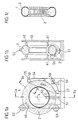
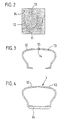
- Figures 1 to 3 show the wrapping of a ring-shaped body core, the outer contour of which corresponds to the inner contour of a tire, in a known manner with carcass threads 2.
- a winding core 1 is shown in a schematic cross-sectional view according to section IV-IV of Figure 1 in Figure 4.
- the winding core 1 consists of two annular half-shells 12 and 13 formed concentrically with the winding core with cooperating annular clamping closure lugs 14 and 15.
- the half-shells, as shown in FIG. 2 are pressed in a known manner between an upper mold part 10 and a lower mold part 11 and then attached to it in a sealing manner on a centering ring 16, as shown in FIG. 4.
- the half-shell elements are fastened to one another in a sealing manner with their ring-shaped corresponding closure elements 14 and 15, respectively, with a positive fit.
- the outer contour of the shells of the core 1 formed by the two half-shells 12 and 13 corresponds to the inner contour of the tire to be manufactured.
- the half-shells are made of a thermoplastic material, the limit temperature for which the ins Plastic lies in the range between the operating temperature for the structure of the tire and the vulcanizing temperature.
- the half-shells are made from a thermoplastic, polymeric material whose glass transition temperature is above RT (room temperature) and which is thermally stable up to 200 ° C and can be processed by compression molding or injection molding or another suitable standard process.
- RT room temperature
- the centering ring is made of metal and has a circumferential centering surface on its radial inside.
- an inner layer is first placed in a known manner before the winding core is wound with a circumferential carcass thread 2 in the known manner shown in FIGS. 1a to 1c.
- the core is stored in a three-point bearing between the bearing disks 52 and 53 and a bearing belt 54, which is guided in a rotating manner via deflection rollers 55, 57 and a drive roller 58.
- a winding ring 51 is then built up around the cross-section of the core of Figure 4, as shown in Figures 1 a and b.
- the winding ring 51 is rotatably mounted between the bearing disks 61 about the cross section of the core 1.
- a coil 56 with a carcass thread 2 is fastened to the winding ring 51 in a known manner.
- the winding ring 51 is rotated in a known manner with a constant direction of rotation around the cross section of the core.
- the core 1 is slowly rotated about its axis via the bearing belt 54 at a speed which is precisely matched to the rotational speed of the winding ring 51.
- the carcass thread 2 is spiraled around with a precisely adjusted step size the structural core is wound, as shown in Figure 1c. In this way, several layers of carcass can be wound one above the other.
- cruciform arrangements of the carcass threads of different layers relative to one another are possible.
- a tire core 8 with a core profile 9 is placed concentrically on both sides of the core 1 outside the carcass.
- the carcass 2 is cut in a known manner in the middle of its axial extent in the radially lower region over the circumference and its ends are folded over radially outwards with the tire core 8 and the tire core profile 9. It is also conceivable to put the tire core 8 on before wrapping the carcass and after the carcass has been opened, to fold the carcass inwards around the core.
- the tire is covered in a known manner with belt 6, side stripes 5 and tread 7 and in the state built up on the core 1, together with the centering ring, temporarily stored until vulcanization.
- the centering ring can be used in a manner not shown to secure the tire by fastening in the storage area during intermediate storage to protect the tire.
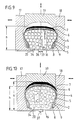
- the tire not previously removed from the core and from the centering ring is placed in a vulcanization press of a known type, consisting of conventional movable vulcanizing mold side parts 17 and 18 and radially movable profile segments distributed over the circumference between the side parts 19 of the mold trough centripedal design inserted.
- a vulcanization press of a known type, consisting of conventional movable vulcanizing mold side parts 17 and 18 and radially movable profile segments distributed over the circumference between the side parts 19 of the mold trough centripedal design inserted.
- the profile segments 19 form a closed circumferential ring.
- the centering ring 16 is opened an annular centering edge 20 of the one vulcanizing mold side part 17 is attached.
- the outer diameter of the centering edge 20 is precisely matched to the inner diameter of the centering ring 16.
- the side parts 18 and 17 move axially inwards relative to one another, the profile segments 19 are displaced radially inwards to produce the desired shape circle for the outer diameter of the tire.
- the molded parts 17, 18, the profile segments 19 and the centering ring 16 form a closed shape.
- a valve 21 in the centering ring 16 hot steam is introduced into the interior 22 of the tire core at a precisely predetermined pressure in a known manner, as in the case of conventional bellows for vulcanizing presses.
- the shell of the core 1 reaches a temperature which corresponds to the temperature for the transition to the plastic state, the shell becomes plastic.
- the shell expands due to the internal pressure in the interior 22 and thereby raises the assembled tire outwards into the molds 17, 18, 19.
- the area of the tread of the tire is raised from a height h from the lower centering ring edge of FIG. 5 to a height h 'raised. In this way, the tread is securely pressed into the profile contours of the profile segments 19.
- the tire is vulcanized in a conventional manner. After vulcanization, the superheated steam is drawn off either through the valve 21 or through one or more additional valves through the centering ring 16. Additional suction devices can be used for this. After opening the vulcanizing press, the tire with the centering ring is removed, the centering ring is detached from the half-shells 12 and 13 and the half-shells 12 and 13 are pulled out.
- centering ring 16 from two coaxial halves 16 ′, 16 ′′, which, as shown in FIG. 4a, are arranged axially next to one another for the core structure and are fastened to one another in a sealing manner.
- the halves 16 ', 16 are released and pulled out of the side of the tire.
- the centering ring halves of FIG. 4a are designed, for example, with an axially delimiting peripheral edge 63, against each of which a lip 62 of the elastic shell 13 or the shell 12 lies axially tight.
- the peripheral edge 63 is formed with its outer diameter so that it can be led out below the bead rubber 64.
- centering surfaces 16 are formed for centering the shells 12, 13.
- the core assembly shell halves 30 and 31 form with their inner contours the desired outer contour for the core 1 and thus for the inner contour of the desired tire.
- suitable filling bodies for example solid spheres made of glass, with a maximum diameter of 8 mm and with an average diameter of 0.5 to 5 mm, are produced to produce a particularly uniform, smooth Shell surface, preferably up to 2 mm, filled.
- the air in the core can escape through additional evacuation openings 35, the opening diameter of which is smaller than the diameter of the glass balls. If necessary, it can also be suctioned off with suitable known suction devices.
- the spheres 34 shown in greatly enlarged form in the figures, fill the entire interior 22 of the stretched sheath 32, so that a solid core is formed from the glass spheres 34 and the elastically stretched sheath 32 which holds the glass spheres 34 in the shape corresponding to the inner contour of the molds 30, 31 .
- the molds 30 and 31 are removed, and the tire in the manner already described for executing FIG. 4, as shown in FIG. 1, by placing an inner layer and by wrapping the carcass layers all round, by applying the tire cores and cutting open the carcass built up in the radially inner area, folding around the cores and by applying the side parts of the belt and the tread.
- the tire After appropriate intermediate storage, the tire, as shown in FIG. 9, is centered in a vulcanizing press of a known type. After the molds have been closed, hot steam at a predetermined pressure and temperature is additionally blown into the interior 22 of the core through valve openings 37 in the centering ring. Due to the resulting overpressure, the elastic sleeve 32 is stretched further outward and presses the built-up tire into the molded parts 17, 18, 19. As a result, the predetermined profile of the molded parts 19 is reliably transferred into the tread. When the internal and external temperature for the vulcanization is reached, the tire is vulcanized in a known manner.
- the superheated steam is first removed from the interior through valve opening 37. After opening the closure 36 of the filling openings 33, the balls are sucked out of the interior with the aid of suction pumps.
- the elastic cover collapses. The centering ring and the elastic cover can be easily pulled axially out of the tire.
Landscapes
- Engineering & Computer Science (AREA)
- Mechanical Engineering (AREA)
- Physics & Mathematics (AREA)
- Nonlinear Science (AREA)
- Moulds For Moulding Plastics Or The Like (AREA)
- Heating, Cooling, Or Curing Plastics Or The Like In General (AREA)
Abstract
Description
- Die Erfindung betrifft einen Kern zum Aufbau eines Fahrzeugluftreifens mit Seitenwänden und Lauffläche. Es ist bekannt, die Karkasse eines Fahrzeugluftreifens durch Rundumwickeln eines ringförmigen Kerns und anschließendes Auftrennen der radial unterhalb des Kerns gebildeten Karkassenschicht durch Schnitt in Umfangsrichtung über den gesamten Umfang hinweg zu erzeugen und anschließend die durch die Trennung entstandenen Ränder zur Erzeugung eines Reifenwulstes um aufgelegte Reifenkerne umzuklappen. Derartige Reifen sind beispielsweise aus der DE-OS 1934018 bekannt. Üblicherweise werden derartige Kerne nach Reifenaufbau, beispielsweise durch Einklappen (DE-OS 1934018) oder durch Entfernen der einzelnen Segmente eines in Umfangssegmente aufgeteilten ringförmigen Kerns EP 0481805 A2 nacheinander vom Reifen entfernt. Nach ihrer Fertigstellung, die in manchen Fällen durch zusätzliche Aufbauschritte außerhalb des Kerns erfolgt, werden die Reifen zwischengelagert und nach vorbestimmter Lagerzeit in die Vulkanisationspresse unzentriert eingelegt. In der Vulkanisationspresse wird von radial innen der Heizbalg der Vulkanisationspresse mit Heißdampf gefüllt und bewirkt die gewünschte Erhebung zum sicheren Eindrücken der Reifenaußenkontur in die profilierte Innenkontur der Mulde. Diese herkömmliche Fertigung fordert eine Reihe von Einzelschritten durch komplettes Entfernen des Reifens von der Form, anschließendes Zwischenlagern ohne Form, einen Kern und einen zusätzlichen Heizbalg in der Vulkanisationspresse, auf den der Reifen eigenständig mehr oder weniger genau aufgelegt wird ohne jedoch gesichert zentriert zu werden. Die dem Zufall überlassene Einlegegenauigkeit in der Heizpresse bringt Probleme hinsichtlich der Rundlaufgenauigkeiten (Uniformity) beim erzeugten Reifen mit sich. Nur mit zusätzlichem Aufwand und entsprechender Erfahrung des Bedienpersonals können die dadurch bedingten Gefahren zumindest teilweise reduziert werden.
- In der EP 0481805 wird die Möglichkeit angedeutet, den Reifen erst nach erfolgter Vulkanisation vom starren, segmentierten Kern zu entfernen. Bei einem solchen starren Kern scheint jedoch die in herkömmlichen Vulkanisationspressen durch den Heizbalg von radial innen erzeugte Erhebung, die den Reifenrohling zuverlässig in die Innenkontur der den Reifen umgebenden Form drückt, nicht ohne weiteres möglich zu sein. Eine zuverlässige Ausformung der Profilierung, insbesondere im Laufflächenprofil, scheint somit mit einem derart steifen Kern nicht ohne zusätzliche Maßnahmen gewährleistet zu sein. Außerdem ist die zuverlässige Beheizung, die in üblichen Vulkanisationspressen über den Heizbalg von radial innen durch den Heißdampf erzeugt wird, ebenfalls nicht gewährleistet. Die vielen Umfangssegmente bringen eine Reihe von Spalten zwischen den einzelnen Segmenten mit sich, wodurch die Entstehung in Umfangsrichtung verteilter Grate von Gummimaterial, das sich in die Spalten schiebt, begünstigt wird. Da solche in Umfangsrichtung punktuell verteilt auftreten und diese Grate nicht unbedingt gleichmäßig ausgebildet sind, können auch hierdurch zusätzliche Uniformityprobleme entstehen.
- Außerdem ist es bekannt, Reifen mit schlauchförmigen Innenschichten herzustellen, bei denen die schlauchförmige Innenschicht auf einen festen Kern durch Aufwickeln erzeugt wird, und die äußeren Schichten im Anschluß daran aufgelegt werden. Durch kleine Öffnungen fließt der beim Vulkanisationsprozeß verflüssigte, bzw. verdampfte Kern ab. Bei den eher ungenau und unvollständig ablaufenden Schmelz- und Verdampfungsprozessen ist auch hier eine sichere zuverlässige, gleichmäßige vorherbestimmbare Erhebung, wie eine bei üblichen Heizbälgen erzielt wird, nicht gewährleistet. Ebenso ist eine gleichmäßige Erhitzung von innen, wie sie bei üblichen Heizbälgen einer Vulkanisationspresse ermöglicht wird, nicht gewährleistet. Derartige wulst- und kernlose Reifen erfordern zudem Spezialfelgen für die Montage. Die vollständige Entfernung des Füllstoffes aus dem Inneren des Schlauchs kann nur mit erheblichem Aufwand, wenn überhaupt, gewährleistet werden.
- Der Erfindung liegt demnach die Aufgabe zugrunde, einen Kern zum Aufbau eines Fahrzeugluftreifens zum Einsatz auf herkömmlichen Felgen durch Wickeltechnik zu schaffen, mit dem Aufbau und Vulkanisieren des Reifens mit einfachen Mitteln verbessert wird.
- Die Aufgabe wird erfindungsgemäß durch einen Kern gemäß den Merkmalen von Anspruch 1 gelöst. Die Herstellungsvereinfachungen und Kostenvorteile der Wickeltechnik zur Herstellung eines herkömmlichen radial zur Felge hin offenen schlauchlosen Reifens, der mit seinen Wulstkernen auf herkömmlichen Felgen montiert werden kann, wird durch die Ausbildung des Kerns als Heizbalg für die Vulkanisation wesentlich vereinfacht. Nach Aufbau des Reifens kann ein deartiger Reifen in dem auf dem Kern aufgebauten Zustand zusammen mit dem Kern in die Vulkanisationspresse eingelegt werden. In herkömmlicher Weise wird der Heizbalg in der Vulkanisationspresse mit Heizdampf entsprechend den bereits aus üblichen Vulkanisieranlagen bekannten gesteuerten Abläufen gefüllt. Der Kern dehnt sich aufgrund des Heißdampfes aus und sorgt für die erforderliche Erhebung des Reifens, so daß der Rohling zuverlässig in die Innenprofilierung der den Reifen umgebenden Außenform gepreßt wird. Das gewünschte Profil des Reifens bildet sich sicher und ohne Qualitätsverlust gegenüber herkömmlichen Vulkanisiereinrichtungen. Auch der Temperaturverlauf im Innern des Reifens kann aufgrund der bekannten Steuerabläufe gewährleistet werden. Zusätzliche Verkantungen, Verformungen, die Uniformityprobleme, die durch Verkanten, Verformen oder durch Beschädigungen während des Abbaus des Rohlings vom Kern oder beim Einlegen des von innen nicht gestützten Rohlings in eine Vulkanisationspresse bei herkömmlichen Reifenherstellung zu Uniformityproblemen führen können, entfallen weitgehend. Der Arbeitsaufwand für die Entfernung vom Kern nach dem Aufbau, anschließendes Einlegen in die Vulkanisierpresse und späteres Entfernen aus Vulkanisierpresse und vom Heizbalg, wie er bei herkömmlichen Reifenherstellungsverfahren üblich ist, wird auf das Einlegen in die Vulkanisierpresse und das Entfernen vom Heizbalg und aus der Vulkanisierpresse reduziert.
- Besonders vorteilhaft ist die Ausbildung eines erfindungsgemäßen Kerns gemäß den Merkmalen von Anspruch 2. Die thermoplastische Schale ermöglicht einen starren, festen Kern, der einen sehr genauen Aufbau der Karkasse begünstigt. Der Reifen kann exakt auf die Außenkontur der Schale aufgebaut werden, die der gewünschten Innenkontur des Reifens entspricht. Uniformityprobleme aufgrund von möglichen Verformungen des Wickelkerns beim Aufbau werden somit minimiert. In der Vulkanisationspresse wird die Schale aufgrund der sich erhöhenden Temperatur plastifiziert, so daß sie noch vor Erreichen der Vulkanisiertemperatur aufgrund des von innen mit Innendruck wirkenden Hitze expandiert und die gewünschte Erhebung des Reifens zur optimalen Profilierung erfolgt.
- Bevorzugt wird der Kern auf einem Zentrierelement befestigt ausgebildet. Mit Hilfe des Zentrierelements wird ein zentrierter Kernaufbau gewährleistet und ohne großen Aufwand kann das Zentrierelement in der Vulkanisiereinrichtung befestigt werden, wodurch auch eine Zentrierung des Kerns und somit des Reifens in der Vulkanisiereinrichtung gewährleistet ist. Ohne den zusätzlichen Aufwand zum mehr oder weniger ungenauen Einstellen, wie beim herkömmlichen Einlegen üblich, ist der Reifen genau in der aufgebauten zentrierten Position zentriert vulkanisierbar. Hierdurch werden die Uniformityprobleme zusätzlich reduziert.
- Bevorzugt werden eine thermoplastische Schale aus zwei konzentrischen, sich über den Umfang erstreckenden Halbschalen aufgebaut. Diese sind einfach, beispielsweise durch Formpressen oder durch Spritzguß herstellbar, und erzeugen maximal einen in Umfangsrichtung verlaufenden Spalt im zusammengefügten Zustand. Die Uniformityprobleme aufgrund der Gratbildung werden hierdurch reduziert.
- Bevorzugt wird der Wickelkern aus thermoplastischem, polymerem Werkstoff, dessen Glasübergangstemperatur oberhalb RT (Raumtemperatur) liegt, und der bis 200°C thermisch stabil ist, aufgebaut. Dies Material gibt der Schale die notwendige Härte und geht bei Temperaturen oberhalb der Raumtemperatur in einen thermoplastischen Zustand über. Diese Temperaturen befinden sich unterhalb der üblichen Vulkanisiertemperaturen bis 200°. Polycarbonat oder Polyetherketon ist durch geeignete Standardverfahren, beispielsweise Formpressen oder Spritzgießen, besonders einfach weiterverarbeitbar.
- Eine weitere bevorzugte Ausführungsform stellt der Kern gemäß den Merkmalen von Anspruch 6 dar. Durch Füllen der elastischen Schale mit festen, kleinen Füllkörpern entsprechend der gewünschten Außenkontur, die der Innenkontur des Reifens entspricht, wird ein fester Kern erzeugt. Die dicht an dicht liegenden Füllkörper geben der sie umgebenden elastischen Schale hinreichend Festigkeit zum Aufbau des Reifens. In der Vulkanisiereinrichtung wird der Innendruck erhöht, so daß die elastische Schale expandiert und somit für die notwendige Erhebung des Reifens zur zuverlässigen Profilerzeugung sorgt. Durch Anlegen eines Vakuums nach Füllen der elastischen Schale wird der Kern besonders formstabil verfestigt.
- Durch Öffnungen zum gesteuerten Zuführen bzw. Entnehmen der Füllkörper mit Hilfe der Mittel zum Zuführen bzw. Entnehmen der Füllkörper können die Füllkörper zuverlässig vor Reifenaufbau zur Erzeugung der gewünschten Kontur zugeführt und im Anschluß an den Vulkanisationsprozeß oder nach Einlegen in die Vulkanisiermulde vor dem Vulkanisationsprozeß wieder entnommen werden. Hierdurch kann die elastische Schale nach Entnahme der Füllkörper auf ein minimales Volumen zusammengedrückt werden, wodurch das Entfernen des Kerns vom vulkanisierten Reifen besonders einfach wird. Mit Hilfe eines Sauganschlusses und mittels gesteuerter Mittel zum Saugen ist die Entleerung und somit die Entfernung nach der Vulkanisation besonders schnell und auch automatisiert durchführbar.
- Vorteilhafterweise sind die Füllkörper kugel- oder rundkornförmig mit Durchmessern von D = 0,05 bis 5 mm ausgebildet.
- Besonders einfach erfolgt die Einstellung des Innendrucks mit Hilfe von gesteuerten Mitteln zum Einstellen des Innendrucks.
- Hierdurch ist ein zuverlässiges Einstellen des Innendrucks, der gewünschten Erhebung und der Genauigkeit des Endprodukts einfach erzielbar. Bevorzugt wird der Innendruck durch Veränderung des Gasvolumens vom Vakuumzustand auf Innendruck erzeugt. Hierbei sind herkömmliche Einrichtungen zum Füllen bzw. Entleeren von Heizbälgen in Vulkanisiereinrichtungen einsetzbar.
- Die Erfindung wird im folgenden anhand der in den Figuren 1 bis 10 dargestellten Ausführungsbeispiele näher erläutert:
- Hierin zeigen:
- Figur 1
- Schema zur Karkassenwicklung
- Figur 2
- Formpressen zur Herstellung der Halbschale
- Figur 3
- Aufbau des Kerns durch Zusammensetzen der Halbschalen
- Figur 4
- Auf Zentrierring montierten Aufbaukern
- Figur 4a
- Fixierung des Aufbaukerns auf Zentrierring
- Figur 4b
- Fixierung des Aufbaukerns auf Zentrierring
- Figur 5
- Aufgebauter Reifen in nicht geschlossener Vulkanisierpresse
- Figur 6
- Aufgebauter Reifen bei geschlossener Vulkanisierpresse
- Figur 7
- Aufbau und Befüllen eines Kerns mit elastischer Außenhaut
- Figur 8
- Evakuieren des Kerns von Figur 7
- Figur 9
- Aufgebauter Reifen auf Kern von Figur 8 in nichtgeschlossener Vulkanisierpresse
- Figur 10
- Aufgebauter Reifen von Figur 9 in geschlossener Vulkanisierpresse
- Die Figuren 1 bis 3 zeigen die Umwicklung eines ringförmigen Aufbaukerns, dessen Außenkontur der Innenkontur eines Reifens entspricht, in bekannter Weise mit Karkassenfäden 2 . Ein derartiger Wickelkern 1 ist in einer schematischen Querschnittsdarstellung gemäß Schnitt IV-IV von Figur 1 in Figur 4 dargestellt. Der Wickelkern 1 besteht aus zwei konzentrisch zum Wickelkern ausgebildeten, ringförmigen Halbschalen 12 und 13 mit zusammenwirkenden ringförmigen Klemmverschlußansätzen 14 und 15. Die Halbschalen werden, wie in Figur 2 dargestellt ist, in bekannter Weise zwischen einem Preßformoberteil 10 und einem Preßformunterteil 11 gepreßt und im Anschluß daran dichtend auf einem Zentrierring 16, wie in Figur 4 dargestellt ist, lösbar befestigt. Im radial äußeren Umfangsbereich werden die Halbschalenelemente mit ihren ringförmigen korrespondierenden Verschlußelementen 14 bzw 15 unter Formschluß dichtend aneinander befestigt. Die äußere Kontur der durch die beiden Halbschalen 12 und 13 gebildeten Schalen des Kerns 1 entspricht der Innenkontur des zu fertigenden Reifens.
- Es ist auch denkbar, die Halbschalen durch Spritzgießen herzustellen.
- Die Halbschalen werden aus einem thermoplastischen Material gefertigt, dessen Grenztemperatur für den Umschlag ins Plastische im Bereich zwischen Betriebstemperatur für den Aufbau des Reifens und Vulkanisiertemperatur liegt. Die Halbschalen werden aus einem thermoplastischem, polymerem Werkstoff, dessen Glasübergangstemperatur oberhalb RT (Raumtemperatur) liegt und der bis 200°C thermisch stabil ist und sich durch Formpressen oder Spritzgießen oder ein anderes geeignetes Standardverfahren verarbeiten läßt, hergestellt. Bespielsweise ist es denkbar, die Halbschalen aus Polycarbonat oder Polyetherketon zu fertigen. Der Zentrierring ist aus Metall gefertigt und weist an seiner radialen Innenseite eine über den Umfang reichende Zentrierfläche auf.
- Nach Fertigstellung des Wickelkerns wird in bekannter Weise zunächst eine Innenschicht aufgelegt, bevor der Wickelkern in bekannter, in den Figuren 1a bis 1c dargestellten Weise mit einem umlaufenden Karkaßfaden 2 bewickelt werden. Hierfür wird der Kern zwischen den Lagerscheiben 52 und 53 und einem Lagerband 54, das über Umlenkrollen 55, 57 und eine Antriebsrolle 58 umlaufend geführt wird, in einer Dreipunktlagerung gelagert. Ein Wickelring 51 wird anschließend rund um den Querschnitt des Kerns von Figur 4, wie in Figur 1 a und b dargestellt ist, aufgebaut. Der Wickelring 51 ist dabei zwischen Lagerscheiben 61 drehbar um den Querschnitt des Kerns 1 bewegbar gelagert. Am Wickelring 51 ist in bekannter Weise eine Spule 56 mit einem Karkaßfaden 2 befestigt. Der Wickelring 51 wird in bekannter Weise mit konstanter Drehrichtung um den Querschnitt des Kerns gedreht. Dabei wird mit Hilfe der vom Antriebsmotor 59 angetriebenen Antriebsrolle der Kern 1 über das Lagerband 54 langsam in genau zur Drehgeschwindigkeit des Wickelrings 51 abgestimmter Geschwindigkeit um seine Achse gedreht. Durch die Drehbewegung des Wickelrings 51 sowie des Kerns 1 wird mit genau vorher abgestimmter Schrittweite der Karkaßfaden 2 spiralenförmig um den Aufbaukern gewickelt, wie in Figur 1c dargestellt ist. Auf diese Weise können mehrere Karkaßschichten übereinander gewickelt werden. Durch Verändern der Drehrichtung von Kern 1 oder von Wickelring 51 sind dabei kreuzförmige Anordnungen der Karkaßfäden verschiedener Lagen zueinander möglich. In bekannter Weise wird nach Aufbau der Karkasse beiderseits des Kerns 1 außerhalb der Karkasse ein Reifenkern 8 mit Kernprofil 9 konzentrisch aufgelegt. Die Karkasse 2 wird in bekannter Weise in der Mitte ihrer axialen Erstreckung im radial unteren Bereich über den Umfang hinweg aufgeschnitten und mit ihren Enden um Reifenkern 8 und Reifenkernprofil 9 radial nach außen umgeklappt. Ebenso ist es denkbar, den Reifenkern 8 vor Umwickeln der Karkasse aufzulegen und nach Auftrennen der Karkasse die Karkasse um den Kern nach innen zu klappen.
- Der Reifen wird in bekannter Weise mit Gürtel 6, Seitenstreifen 5 und Laufstreifen 7 belegt und im auf dem Kern 1 aufgebauten Zustand mitsamt dem Zentrierring bis zur Vulkanisation zwischengelagert. Der Zentrierring kann dabei in nicht dargestellter Weise zur Sicherung des Reifens durch Befestigung im Lagerbereich bei der Zwischenlagerung zum Schutz des Reifens verwendet werden.
- Im Anschluß daran wird der bis dahin nicht vom Kern und vom Zentrierring entfernte Reifen, wie in Figur 5 dargestellt ist, in eine Vulkanisationspresse bekannter Bauart, bestehend aus herkömmlichen beweglichen Vulkanisierformseitenteilen 17 und 18 und radial beweglichen, über den Umfang zwischen den Seitenteilen verteilt angeordneten Profilsegmenten 19 der Formmulde zentripedaler Bauart eingelegt. Die Profilsegmente 19 bilden dabei im geschlossenen Zustand gemäß Figur 6 einen geschlossenen Umfangsring. Im offenen Zustand der Vulkanisierpresse gemäß Figur 5 wird der Zentrierring 16 auf eine ringförmige Zentrierkante 20 des einen Vulkanisierformseitenteils 17 aufgesetzt. Der Außendurchmesser der Zentrierkante 20 ist dabei genau auf den Innendurchmesser des Zentrierrings 16 abgestimmt. Beim Schließen der Presse rücken die Seitenteile 18 und 17 axial zueinander nach innen, die Profilsegmente 19 werden radial nach innen zur Herstellung des gewünschten Formkreises für den Außendurchmesser des Reifens verschoben. Die Formteile 17, 18, die Profilsegmente 19 und der Zentrierring 16 bilden eine geschlossene Form. Durch ein Ventil 21 im Zentrierring 16 wird in bekannter Weise wie bei herkömmlichen Heizbalgen von Vulkanisierpressen Heißdampf mit genau vorbestimmtem Druck in den Innenraum 22 des Reifenkerns eingebracht. Sobald die Schale des Kerns 1 eine Temperatur erreicht, die der Temperatur zum Übergang in den plastischen Zustand entspricht, wird die Schale plastisch. Die Schale dehnt sich aufgrund des Innendrucks im Innenraum 22 aus und erhebt dabei den aufgebauten Reifen nach außen in die Formen 17, 18, 19. Der Bereich der Lauffläche des Reifens wird dabei aus einer Höhe h vom unteren Zentrierringrand von Figur 5 in eine Höhe h' angehoben. Auf diese Weise wird die Lauffläche sicher in die Profilkonturen der Profilsegmente 19 eingepreßt. Aufgrund der danach erreichten Vulkanisiertemperaturen der Profilsegmente 19 der Profilseitenwände 17, 18 sowie der Schale wird der Reifen in herkömmlicher Weise vulkanisiert. Nach erfolgter Vulkanisation wird der Heißdampf entweder durch das Ventil 21 oder durch ein oder mehrere zusätzliche Ventile durch den Zentrierring 16 abgezogen. Hierzu können zusätzliche Saugeinrichtungen verwendet werden. Nach Öffnen der Vulkanisierpresse wird der Reifen mit dem Zentrierring entfernt, der Zentrierring von den Halbschalen 12 und 13 gelöst und die Halbschalen 12 und 13 herausgezogen.
- Es ist denkbar, den Zentrierring 16 aus zwei koaxialen Hälften 16', 16" auszubilden, die zum Kernaufbau wie in Figur 4a dargestellt ist, axial nebeneinander angeordnet und dichtend aneinander befestigt werden.
- Zum Entfernen des Zentrierringes 16 vom fertigen Reifen werden die Hälften 16', 16" gelöst und seitlich aus dem Reifen herausgezogen.
- Die Zentrierringhälften von Figur 4a sind beispielhaft mit einer axial begrenzenden Umfangskante 63 ausgebildet, an der je eine Lippe 62 der elastischen Schale 13 bzw. der Schale 12 axial dicht anliegt. Die Umfangskante 63 ist mit ihrem Außendurchmesser so ausgebildet, daß sie unterhalb des Wulstgummis 64 herausgeführt werden kann.
- Ebenso ist es denkbar, wie in Figur 4b dargestellt ist, einen einstückigen Zentrierring an seinen axialen äußeren Außenkonturbereichen mit Umfangsnut 66 und hierzu korrespondierend die elastischen Schalen 12, 13 im Bereich der Dichtlippe 62 mit einer Umfangsnase auszubilden. Axial innerhalb der Umfangsnuten 66 kann der Zentrierring 16 zur Verstärkung der Dichtwirkung mit seiner radialen Außenkontur ansteigend ausgebildet werden. Zur Montage werden die Schalen 12, 13 axial von außen nach innen auf den Zentrierring geschoben, bis die Umfangsnase 65 in der Umfangsnut 66 einklickt. Die Demontage erfolgt umgekehrt durch Herausziehen des Zentrierrings.
- Sowohl bei der Ausführung von Figur 4a als auch bei der von Figur 4b sind Zentrierflächen 16 ausgebildet zur Zentrierung der Schalen 12, 13.
- Wie in Figur 7 und 8 dargestellt ist, ist es auch denkbar, den Kern auf einer elastischen Haut 35, zum Beispiel aus Gummi, aufzubauen, der an den axialen Begrenzungen des Zentrierrings 16 dicht befestigt ist. Der Zentrierring 16 wird in einer Kernaufbauform, bestehend aus den Kernaufbauschalenhälften 31 und 30, zentriert angelegt. Die Kernaufbauschalenhälften 30 und 31 bilden in ihrem geschlossenen Zustand mit ihren Innenkonturen die gewünschte Außenkontur für den Kern 1 und somit für die Innenkontur des gewünschten Reifens. Durch über den Umfang des Zentrierringes im Zentrierring verteilt vorgesehene Füllöffnungen 33 werden geeignete Füllkörper, zum Beispiel feste Kugeln aus Glas, mit einem maximalen Durchmesser von 8 mm und mit einem durchschnittlichen Durchmesser von 0,5 bis 5 mm, zur Erzeugung einer besonders gleichmäßigen, glatten Mantelfläche, bevorzugt bis 2 mm, eingefüllt. Durch zusätzliche Evakuierungsöffnungen 35, deren Öffnungsdurchmesser kleiner als der Durchmesser der Glaskugeln ist, kann die Luft im Kern entweichen. Bei Bedarf kann sie zusätzlich mit geeigneten bekannten Saugeinrichtungen abgesaugt werden. Die in den Figuren stark vergrößert dargestellten Kugeln 34 füllen den gesamten Innenraum 22 der gedehnten Hülle 32, so daß ein fester Kern aus den Glaskugeln 34 und der die Glaskugeln 34 in der der Innenkontur der Formen 30, 31 entsprechenden Form haltenden elastisch gedehnten Hülle 32 entsteht.
- Nach Verschließen der Füllöffnungen 33 werden die Formen 30 und 31 entfernt, und der Reifen in der bereits zur Ausführung von Figur 4 beschriebenen Weise gemäß der Darstellung von Figur 1 durch Auflegen einer Innenschicht und durch Rundumwickeln der Karkassenschichten, durch Aufbringen der Reifenkerne, Aufschneiden der Karkasse im radial inneren Bereich, Umklappen um die Kerne sowie durch Aufbringen der Seitenteile des Gürtels und der Lauffläche aufgebaut.
- Nach entsprechender Zwischenlagerung wird der Reifen, wie in Figur 9 dargestellt ist, in eine Vulkanisierpresse bekannter Bauart zentriert eingelegt. Nach Schließen der Formen wird durch Ventilöffnungen 37 im Zentrierring zusätzlich heißer Dampf mit vorgegebenem Druck und Temperatur in den Innenraum 22 des Kerns eingeblasen. Aufgrund des hierdurch entstehenden Überdrucks wird die elastische Hülle 32 weiter nach außen gedehnt und drückt den aufgebauten Reifen in die Formteile 17, 18, 19. Hierdurch wird das vorgegebene Profil der Formteile 19 zuverlässig in die Lauffläche übertragen. Bei erreichter Innen- und Außentemperatur für die Vulkanisation wird der Reifen in bekannter Weise vulkanisiert.
- Nach erfolgter Vulkanisation wird zunächst der Heißdampf durch Ventilöffnung 37 aus dem Innenraum entfernt. Nach Öffnen des Verschlusses 36 der Füllöffnungen 33 werden die Kugeln mit Hilfe von Absaugpumpen aus dem Innenraum gesaugt. Die elastische Hülle fällt in sich zusammen. Der zentrierring kann mitsamt der elastischen Hülle einfach aus dem Reifen axial herausgezogen werden.
-
- 1
- Wickelkern
- 2
- Karkasse
- 3
- Karkaßfäden
- 4
- Innenschicht
- 5
- Seitenstreifen
- 6
- Gürtel
- 7
- Laufstreifen
- 8
- Reifenkern
- 9
- Reifenkernprofil
- 10
- Preßformoberteil
- 11
- Preßformunterteil
- 12
- Halbschale
- 13
- Halbschale
- 14
- Verschlußansatz
- 15
- Verschlußansatz
- 16
- Zentrierring
- 17
- Vulkanisierformseitenteil
- 18
- Vulkanisierformseitenteil
- 19
- Zentripetalbewegliches Profilsegment der Vulkanisierform
- 20
- Zentrieransatz
- 21
- Ventil
- 22
- Innenraum
- 30
- Kernaufbauformhalbschale
- 31
- Kernaufbauformhalbschale
- 32
- elastische Haut
- 33
- Füllöffnung
- 34
- Kugel
- 35
- Evakuieröffnung
- 36
- Verschluß
- 37
- Ventilöffnung
- 50
- Gestell
- 51
- Wickelring
- 52
- Lagerscheibe
- 53
- Lagerscheibe
- 54
- Lagerband
- 55
- Umlenkrolle
- 56
- Spule
- 57
- Umlenkrolle
- 56
- Spule
- 57
- Umlenkrolle
- 58
- Antriebsrolle
- 59
- Schrittmotor
- 60
- Seitenführung
- 61
- Lagerrolle
- 62
- Dichtlippe
- 63
- Umlaufkante
- 64
- Wulstgummi
- 65
- Zentriernase
- 66
- Zentrierrille
- 67
- Zentrierfläche
Claims (12)
- Kern mit ringförmigem Torus zum Aufbau eines Fahrzeugluftreifens durch Rundumwickeln der Karkasse um den Kern,- der als Heizbalg zum Heizen bei der Vulkanisation ausgebildet ist.
- Kern gemäß den Merkmalen von Anspruch 1,- der mit einer nach radial innen hin offenen, ansonsten geschlossenen thermoplastischen Schale ausgebildet ist,- dessen Plastifiziertemperatur oberhalb der Betriebstemperatur für den Reifenaufbau und unterhalb der Betriebstemperatur für den Vulkanisationsprozeß liegt.
- Kern gemäß den Merkmalen von Anspruch 1 oder Anspruch 2,- der auf einem Zentrierelement zur Zentrierung beim Aufbau und während des Heizprozesses angeordnet ist.
- Kern gemäß den Merkmalen von Anspruch 2,- dessen Schale aus zwei konzentrischen in Achsrichtung nebeneinander in Umfangsrichtung geschlossenen ringförmigen Halbschalen ausgebildet ist.
- Kern gemäß den Merkmalen der Ansprüche 2 oder 4,- dessen Schale aus thermoplastischem, polymerem Werkstoff, dessen Glasübergangstemperatur oberhalb RT (Raumtemperatur) liegt und der bis 200°C thermisch stabil ist, aufgebaut ist.
- Kern gemäß den Merkmalen von Anspruch 1,- mit einem Innenraum zur Aufnahme bzw. zur Entnahme von Füllkörpern für die Formgebung des Reifens,- der nach radial außen und zu den Seitenflächen hin mit einer geschlossenen sich über den Umfang erstreckenden elastischen Schale begrenzt ist,- mit im Innenraum einstellbarem Innendruck zur Erzeugung einer elastischen Erhebung der Schale während des Heizens,- mit Mitteln zum Einstellen des Innendrucks.
- Kern gemäß den Merkmalen von Anspruch 1,- mit einem Innenraum zur Aufnahme bzw. zur Entnahme von Füllkörpern für die Formgebung des Reifens,- der nach radial außen und zu den Seitenflächen hin mit einer geschlossenen sich über den Umfang erstreckenden elastischen Schale begrenzt ist,- mit im Innenraum einstellbarem Innendruck zur Erzeugung eines Unterdrucks zur Verfestigung des Kerns und zur Erzeugung einer elastischen Erhebung der Schale während des Heizens,- mit Mitteln zum Einstellen des Innendrucks.
- Kern gemäß den Merkmalen von Anspruch 6 oder 7,- mit einer oder mehreren Öffnungen zum Zuführen bzw. zum Entnehmen der Füllkörper in bzw. aus dem Innenraum mit Mitteln zum Zuführen bzw. zum Entnehmen der Füllkörper.
- Kern gemäß den Merkmalen von Anspruch 8,- mit einem Ventil zum Anschluß einer Saug- bzw. Blaseinrichtung zum Entlehren bzw. Befüllen des Inneraums mit Füllkörpern.
- Kern gemäß den Merkmalen von Anspruch 6 oder 7,- bei dem Füllkörper kugel- oder rundkornförmig ausgebildet sind.
- Kern gemäß den Merkmalen von Anspruch 6 oder 7- mit zumindest einem Anschlußelement zum Anschluß einer Saug- bzw. Blaseinrichtung zum gesteuerten Einstellen des Innendrucks.
- Kern gemäß den Merkmalen von Anspruch 6 oder 7,- mit Mitteln zum gesteuerten Einstellen des Innendrucks durch Veränderung des Gasvolumens im Innenraum.
Applications Claiming Priority (2)
| Application Number | Priority Date | Filing Date | Title |
|---|---|---|---|
| DE4443049A DE4443049A1 (de) | 1994-12-05 | 1994-12-05 | Kern zum Aufbau eines Fahrzeugluftreifens |
| DE4443049 | 1994-12-05 |
Publications (3)
| Publication Number | Publication Date |
|---|---|
| EP0715947A2 true EP0715947A2 (de) | 1996-06-12 |
| EP0715947A3 EP0715947A3 (de) | 1996-12-27 |
| EP0715947B1 EP0715947B1 (de) | 2001-05-23 |
Family
ID=6534814
Family Applications (1)
| Application Number | Title | Priority Date | Filing Date |
|---|---|---|---|
| EP95118997A Expired - Lifetime EP0715947B1 (de) | 1994-12-05 | 1995-12-02 | Kern zum Aufbau eines Fahrzeugluftreifens |
Country Status (2)
| Country | Link |
|---|---|
| EP (1) | EP0715947B1 (de) |
| DE (2) | DE4443049A1 (de) |
Cited By (6)
| Publication number | Priority date | Publication date | Assignee | Title |
|---|---|---|---|---|
| EP0822047A1 (de) * | 1996-08-01 | 1998-02-04 | Conception et Développement Michelin | Zerstörbarer Dorn, insbesondere verwendbar für die Reifenherstellung |
| EP0894614A1 (de) * | 1997-07-31 | 1999-02-03 | PIRELLI COORDINAMENTO PNEUMATICI S.p.A. | Verfahren zur Herstellung eines Luftreifens für Fahrzeugräder |
| US6336985B1 (en) | 1997-07-31 | 2002-01-08 | Pirelli Coordinamento Pneumatici S.P.A. | Method for making a tire for vehicle wheels |
| WO2007072511A1 (en) | 2005-12-19 | 2007-06-28 | Pirelli Tyre S.P.A. | Method and apparatus for manufacturing pneumatic tyres |
| FR2917326A1 (fr) * | 2007-06-15 | 2008-12-19 | Trelleborg Prodyn Soc Par Acti | Element de moulage d'une piece et procede de moulage correspondant |
| WO2018178586A1 (fr) * | 2017-03-30 | 2018-10-04 | Compagnie Generale Des Etablissements Michelin | Membrane et procédé de cuisson de pneumatique |
Citations (2)
| Publication number | Priority date | Publication date | Assignee | Title |
|---|---|---|---|---|
| DE1934018A1 (de) | 1969-07-04 | 1971-01-14 | Continental Gummi Werke Ag | Verfahren zum Aufbauen von Luftreifenkarkassen |
| EP0481805A2 (de) | 1990-10-18 | 1992-04-22 | Bridgestone Corporation | Verfahren zum Herstellen grüner Gehäuse und grüner Reifen und so hergestellte Reifen |
Family Cites Families (10)
| Publication number | Priority date | Publication date | Assignee | Title |
|---|---|---|---|---|
| US1687945A (en) * | 1925-05-08 | 1928-10-16 | Fisk Rubber Co | Tire building |
| DE598839C (de) * | 1932-01-15 | 1934-06-20 | Pirelli | Verfahren zur Herstellung von Kautschukhohlkoerpern mit Hilfe zerfliessbarer Kerne |
| US3183134A (en) * | 1962-04-03 | 1965-05-11 | Fairchild Hiller Corp | Tire building apparatus and method |
| NL6413789A (de) * | 1964-11-27 | 1966-05-31 | ||
| DE1604528A1 (de) * | 1966-06-16 | 1970-11-12 | Bayer Ag | Formkern zur Herstellung von Hohlkoerpern aller Art |
| DE1934465A1 (de) * | 1969-07-08 | 1971-01-21 | Continental Gummi Werke Ag | Trommel oder Dorn zum Aufbauen von Luftreifen |
| DE2832566A1 (de) * | 1978-07-25 | 1980-02-07 | Bayer Ag | Verfahren zur herstellung von hohlkoerpern |
| JPS5675846A (en) * | 1979-11-24 | 1981-06-23 | Kobe Steel Ltd | Manufacture of beadless pneumatic tyre |
| US4474633A (en) * | 1982-06-03 | 1984-10-02 | The Goodyear Tire & Rubber Company | Method of manufacturing radial tires |
| FR2720326A1 (fr) * | 1994-05-27 | 1995-12-01 | Sedepro | Assemblage et vulcanisation de pneumatique. |
-
1994
- 1994-12-05 DE DE4443049A patent/DE4443049A1/de not_active Withdrawn
-
1995
- 1995-12-02 DE DE59509284T patent/DE59509284D1/de not_active Expired - Fee Related
- 1995-12-02 EP EP95118997A patent/EP0715947B1/de not_active Expired - Lifetime
Patent Citations (2)
| Publication number | Priority date | Publication date | Assignee | Title |
|---|---|---|---|---|
| DE1934018A1 (de) | 1969-07-04 | 1971-01-14 | Continental Gummi Werke Ag | Verfahren zum Aufbauen von Luftreifenkarkassen |
| EP0481805A2 (de) | 1990-10-18 | 1992-04-22 | Bridgestone Corporation | Verfahren zum Herstellen grüner Gehäuse und grüner Reifen und so hergestellte Reifen |
Cited By (11)
| Publication number | Priority date | Publication date | Assignee | Title |
|---|---|---|---|---|
| EP0822047A1 (de) * | 1996-08-01 | 1998-02-04 | Conception et Développement Michelin | Zerstörbarer Dorn, insbesondere verwendbar für die Reifenherstellung |
| AU720587B2 (en) * | 1996-08-01 | 2000-06-08 | Conception Et Developpement Michelin, S.A. | Destructible core for use, in particular, in the assembling of a tire |
| US6224808B1 (en) | 1996-08-01 | 2001-05-01 | Conception Et Developpement Michelin S.A. | Destructible core for use, in particular, in the assembling of a tire |
| EP0894614A1 (de) * | 1997-07-31 | 1999-02-03 | PIRELLI COORDINAMENTO PNEUMATICI S.p.A. | Verfahren zur Herstellung eines Luftreifens für Fahrzeugräder |
| US6336985B1 (en) | 1997-07-31 | 2002-01-08 | Pirelli Coordinamento Pneumatici S.P.A. | Method for making a tire for vehicle wheels |
| WO2007072511A1 (en) | 2005-12-19 | 2007-06-28 | Pirelli Tyre S.P.A. | Method and apparatus for manufacturing pneumatic tyres |
| US20100032873A1 (en) * | 2005-12-19 | 2010-02-11 | Maurizio Marchini | Method and Apparatus for Manufacturing Pneumatic Tyres |
| US8609007B2 (en) | 2005-12-19 | 2013-12-17 | Pirelli Tyre S.P.A. | Method and apparatus for manufacturing pneumatic tyres |
| FR2917326A1 (fr) * | 2007-06-15 | 2008-12-19 | Trelleborg Prodyn Soc Par Acti | Element de moulage d'une piece et procede de moulage correspondant |
| WO2018178586A1 (fr) * | 2017-03-30 | 2018-10-04 | Compagnie Generale Des Etablissements Michelin | Membrane et procédé de cuisson de pneumatique |
| FR3064526A1 (fr) * | 2017-03-30 | 2018-10-05 | Compagnie Generale Des Etablissements Michelin | Membrane et procede de cuisson de pneumatique |
Also Published As
| Publication number | Publication date |
|---|---|
| DE4443049A1 (de) | 1996-06-13 |
| DE59509284D1 (de) | 2001-06-28 |
| EP0715947A3 (de) | 1996-12-27 |
| EP0715947B1 (de) | 2001-05-23 |
Similar Documents
| Publication | Publication Date | Title |
|---|---|---|
| KR920003078B1 (ko) | 블래더리스 타이어 성형장치 | |
| EP4225567B1 (de) | Heizpresse und verfahren zur vulkanisation eines fahrzeugreifens in dieser heizpresse unter vakuum | |
| EP4225564B1 (de) | Heizpresse und verfahren zur vulkanisation eines fahrzeugreifens in dieser heizpresse unter vakuum | |
| DE1071325B (de) | Verfahren zum befestigen von metallkappen an luftfederbälgen | |
| EP4225566B1 (de) | Heizpresse und verfahren zur vulkanisation eines fahrzeugreifens in dieser heizpresse unter vakuum | |
| DE2659587A1 (de) | Elastischer formheizbalg fuer luftreifen sowie verfahren und vorrichtung zu dessen herstellung | |
| EP4146465A1 (de) | Heizpresse und verfahren zur vulkanisation eines fahrzeugreifens in dieser heizpresse unter vakuum | |
| EP0715947B1 (de) | Kern zum Aufbau eines Fahrzeugluftreifens | |
| DE1579266C3 (de) | Vorrichtung zum Bombieren ejner auf einer Hochschultertrommel aufgebauten Reifenkarkasse | |
| EP2214880B1 (de) | Vorrichtung und Verfahren zum Vulkanisieren und Formen von Reifen | |
| EP0182026B1 (de) | Vulkanisierverfahren und -vorrichtung für Fahrzeugluftreifen | |
| DE19800289C2 (de) | Verfahren zur Herstellung von Luftreifen | |
| EP1993819A1 (de) | Reifenaufbautrommel | |
| US3674899A (en) | Process for curing pneumatic tires | |
| DE69402071T2 (de) | Verfahren zur herstellung eines reifens mit einer aus mindenstens einem fadengewebe oder seilgewebe hergestellten karkasse | |
| DE2644515C3 (de) | Verfahren zum Formen und Vulkanisieren eines Gürtel-Radial-Reifens | |
| DE10208613C1 (de) | Fahrzeugrad mit einem Notlaufstützkörper | |
| EP3869081B1 (de) | Hochdruckbehälter | |
| EP3939776B1 (de) | Verfahren zum ermitteln spulmusters für eine laufstreifenwicklung und anlage zur herstellung von reifen | |
| WO2017220227A1 (de) | Verfahren zur herstellung eines vollgummireifens und nach dem verfahren hergestellter vollgummireifen | |
| EP3957462A1 (de) | Herstellungsverfahren für eine halbschale | |
| DE10036999C2 (de) | Vulkanisiervorrichtung zum Vulkanisieren eines Kautschukartikels sowie Verfahren zum Formen und Vulkanisieren eines Kautschukartikels, insbesondere eines Fahrzeugreifens in einer Vulkanisiereinrichtung | |
| EP0722853B1 (de) | Fahrzeugrad, Verfahren zur Herstellung eines Fahrzeugrades und Verwendung einer Felge eines Fahrzeugrads | |
| EP4417406B1 (de) | Reifenheizform | |
| DE19624766A1 (de) | Fahrzeugrad, Verfahren zur Herstellung eines Fahrzeugrades und Verwendung einer Felge eines Fahrzeugrads |
Legal Events
| Date | Code | Title | Description |
|---|---|---|---|
| PUAI | Public reference made under article 153(3) epc to a published international application that has entered the european phase |
Free format text: ORIGINAL CODE: 0009012 |
|
| AK | Designated contracting states |
Kind code of ref document: A2 Designated state(s): DE FR GB IT |
|
| PUAL | Search report despatched |
Free format text: ORIGINAL CODE: 0009013 |
|
| AK | Designated contracting states |
Kind code of ref document: A3 Designated state(s): DE FR GB IT |
|
| 17P | Request for examination filed |
Effective date: 19970627 |
|
| 17Q | First examination report despatched |
Effective date: 19990427 |
|
| GRAG | Despatch of communication of intention to grant |
Free format text: ORIGINAL CODE: EPIDOS AGRA |
|
| GRAG | Despatch of communication of intention to grant |
Free format text: ORIGINAL CODE: EPIDOS AGRA |
|
| GRAH | Despatch of communication of intention to grant a patent |
Free format text: ORIGINAL CODE: EPIDOS IGRA |
|
| GRAH | Despatch of communication of intention to grant a patent |
Free format text: ORIGINAL CODE: EPIDOS IGRA |
|
| GRAA | (expected) grant |
Free format text: ORIGINAL CODE: 0009210 |
|
| AK | Designated contracting states |
Kind code of ref document: B1 Designated state(s): DE FR GB IT |
|
| REF | Corresponds to: |
Ref document number: 59509284 Country of ref document: DE Date of ref document: 20010628 |
|
| ITF | It: translation for a ep patent filed | ||
| GBT | Gb: translation of ep patent filed (gb section 77(6)(a)/1977) |
Effective date: 20010814 |
|
| ET | Fr: translation filed | ||
| REG | Reference to a national code |
Ref country code: GB Ref legal event code: IF02 |
|
| PLBE | No opposition filed within time limit |
Free format text: ORIGINAL CODE: 0009261 |
|
| STAA | Information on the status of an ep patent application or granted ep patent |
Free format text: STATUS: NO OPPOSITION FILED WITHIN TIME LIMIT |
|
| 26N | No opposition filed | ||
| PGFP | Annual fee paid to national office [announced via postgrant information from national office to epo] |
Ref country code: GB Payment date: 20041122 Year of fee payment: 10 |
|
| PG25 | Lapsed in a contracting state [announced via postgrant information from national office to epo] |
Ref country code: GB Free format text: LAPSE BECAUSE OF NON-PAYMENT OF DUE FEES Effective date: 20051202 |
|
| GBPC | Gb: european patent ceased through non-payment of renewal fee |
Effective date: 20051202 |
|
| PGFP | Annual fee paid to national office [announced via postgrant information from national office to epo] |
Ref country code: IT Payment date: 20081223 Year of fee payment: 14 |
|
| PGFP | Annual fee paid to national office [announced via postgrant information from national office to epo] |
Ref country code: FR Payment date: 20081212 Year of fee payment: 14 |
|
| PGFP | Annual fee paid to national office [announced via postgrant information from national office to epo] |
Ref country code: DE Payment date: 20081121 Year of fee payment: 14 |
|
| REG | Reference to a national code |
Ref country code: FR Ref legal event code: ST Effective date: 20100831 |
|
| PG25 | Lapsed in a contracting state [announced via postgrant information from national office to epo] |
Ref country code: FR Free format text: LAPSE BECAUSE OF NON-PAYMENT OF DUE FEES Effective date: 20091231 |
|
| PG25 | Lapsed in a contracting state [announced via postgrant information from national office to epo] |
Ref country code: DE Free format text: LAPSE BECAUSE OF NON-PAYMENT OF DUE FEES Effective date: 20100701 |
|
| PG25 | Lapsed in a contracting state [announced via postgrant information from national office to epo] |
Ref country code: IT Free format text: LAPSE BECAUSE OF NON-PAYMENT OF DUE FEES Effective date: 20091202 |