EP0716073B1 - Verfahren zum Unschädlichmachen von Herbiziden im Getreide unter Verwendung von 5-Aryloxy-1,2-(disubstituierten) Benzolverbindungen - Google Patents
Verfahren zum Unschädlichmachen von Herbiziden im Getreide unter Verwendung von 5-Aryloxy-1,2-(disubstituierten) Benzolverbindungen Download PDFInfo
- Publication number
- EP0716073B1 EP0716073B1 EP95308911A EP95308911A EP0716073B1 EP 0716073 B1 EP0716073 B1 EP 0716073B1 EP 95308911 A EP95308911 A EP 95308911A EP 95308911 A EP95308911 A EP 95308911A EP 0716073 B1 EP0716073 B1 EP 0716073B1
- Authority
- EP
- European Patent Office
- Prior art keywords
- compound
- alkyl
- oxy
- halogen
- methyl
- Prior art date
- Legal status (The legal status is an assumption and is not a legal conclusion. Google has not performed a legal analysis and makes no representation as to the accuracy of the status listed.)
- Expired - Lifetime
Links
- 239000004009 herbicide Substances 0.000 title claims description 153
- 238000000034 method Methods 0.000 title claims description 67
- 235000013339 cereals Nutrition 0.000 title claims description 35
- 125000001997 phenyl group Chemical class [H]C1=C([H])C([H])=C(*)C([H])=C1[H] 0.000 title claims description 20
- 230000002363 herbicidal effect Effects 0.000 claims description 114
- -1 imidazolinone compound Chemical class 0.000 claims description 114
- 239000000203 mixture Substances 0.000 claims description 77
- 239000002689 soil Substances 0.000 claims description 57
- 150000001875 compounds Chemical class 0.000 claims description 56
- 125000004178 (C1-C4) alkyl group Chemical group 0.000 claims description 53
- 229910052736 halogen Inorganic materials 0.000 claims description 43
- 150000002367 halogens Chemical class 0.000 claims description 43
- 230000006378 damage Effects 0.000 claims description 42
- 208000027418 Wounds and injury Diseases 0.000 claims description 41
- 208000014674 injury Diseases 0.000 claims description 41
- 239000001257 hydrogen Substances 0.000 claims description 39
- 229910052739 hydrogen Inorganic materials 0.000 claims description 39
- XLYOFNOQVPJJNP-UHFFFAOYSA-N water Substances O XLYOFNOQVPJJNP-UHFFFAOYSA-N 0.000 claims description 37
- 241000209140 Triticum Species 0.000 claims description 30
- 125000004765 (C1-C4) haloalkyl group Chemical group 0.000 claims description 29
- 125000004767 (C1-C4) haloalkoxy group Chemical group 0.000 claims description 27
- 125000000229 (C1-C4)alkoxy group Chemical group 0.000 claims description 27
- 235000021307 Triticum Nutrition 0.000 claims description 26
- 125000004093 cyano group Chemical group *C#N 0.000 claims description 22
- XBDQKXXYIPTUBI-UHFFFAOYSA-N dimethylselenoniopropionate Natural products CCC(O)=O XBDQKXXYIPTUBI-UHFFFAOYSA-N 0.000 claims description 22
- 125000000449 nitro group Chemical group [O-][N+](*)=O 0.000 claims description 22
- 240000008042 Zea mays Species 0.000 claims description 19
- 235000005824 Zea mays ssp. parviglumis Nutrition 0.000 claims description 19
- 235000002017 Zea mays subsp mays Nutrition 0.000 claims description 19
- 235000005822 corn Nutrition 0.000 claims description 19
- 125000004435 hydrogen atom Chemical group [H]* 0.000 claims description 19
- 235000007319 Avena orientalis Nutrition 0.000 claims description 18
- 235000007340 Hordeum vulgare Nutrition 0.000 claims description 18
- 240000006394 Sorghum bicolor Species 0.000 claims description 16
- 244000075850 Avena orientalis Species 0.000 claims description 15
- QGZKDVFQNNGYKY-UHFFFAOYSA-O Ammonium Chemical compound [NH4+] QGZKDVFQNNGYKY-UHFFFAOYSA-O 0.000 claims description 13
- XVOKUMIPKHGGTN-UHFFFAOYSA-N Imazethapyr Chemical compound OC(=O)C1=CC(CC)=CN=C1C1=NC(C)(C(C)C)C(=O)N1 XVOKUMIPKHGGTN-UHFFFAOYSA-N 0.000 claims description 13
- 235000007164 Oryza sativa Nutrition 0.000 claims description 13
- 235000011684 Sorghum saccharatum Nutrition 0.000 claims description 13
- 235000009566 rice Nutrition 0.000 claims description 13
- 125000000882 C2-C6 alkenyl group Chemical group 0.000 claims description 11
- 235000019260 propionic acid Nutrition 0.000 claims description 11
- 125000003601 C2-C6 alkynyl group Chemical group 0.000 claims description 10
- PXHVJJICTQNCMI-UHFFFAOYSA-N Nickel Chemical compound [Ni] PXHVJJICTQNCMI-UHFFFAOYSA-N 0.000 claims description 10
- 229940100389 Sulfonylurea Drugs 0.000 claims description 10
- 125000001797 benzyl group Chemical group [H]C1=C([H])C([H])=C(C([H])=C1[H])C([H])([H])* 0.000 claims description 10
- CABMTIJINOIHOD-UHFFFAOYSA-N 2-[4-methyl-5-oxo-4-(propan-2-yl)-4,5-dihydro-1H-imidazol-2-yl]quinoline-3-carboxylic acid Chemical compound N1C(=O)C(C(C)C)(C)N=C1C1=NC2=CC=CC=C2C=C1C(O)=O CABMTIJINOIHOD-UHFFFAOYSA-N 0.000 claims description 9
- 244000038559 crop plants Species 0.000 claims description 9
- 230000002605 anti-dotal effect Effects 0.000 claims description 8
- 241001057636 Dracaena deremensis Species 0.000 claims description 7
- 229910052783 alkali metal Inorganic materials 0.000 claims description 7
- 150000001340 alkali metals Chemical class 0.000 claims description 7
- 229910052784 alkaline earth metal Inorganic materials 0.000 claims description 7
- 150000001342 alkaline earth metals Chemical class 0.000 claims description 7
- UFHFLCQGNIYNRP-UHFFFAOYSA-N Hydrogen Chemical compound [H][H] UFHFLCQGNIYNRP-UHFFFAOYSA-N 0.000 claims description 6
- NUPJIGQFXCQJBK-UHFFFAOYSA-N 2-(4-isopropyl-4-methyl-5-oxo-4,5-dihydro-1H-imidazol-2-yl)-5-(methoxymethyl)nicotinic acid Chemical compound OC(=O)C1=CC(COC)=CN=C1C1=NC(C)(C(C)C)C(=O)N1 NUPJIGQFXCQJBK-UHFFFAOYSA-N 0.000 claims description 5
- PVSGXWMWNRGTKE-UHFFFAOYSA-N 5-methyl-2-[4-methyl-5-oxo-4-(propan-2-yl)-4,5-dihydro-1H-imidazol-2-yl]pyridine-3-carboxylic acid Chemical compound N1C(=O)C(C(C)C)(C)N=C1C1=NC=C(C)C=C1C(O)=O PVSGXWMWNRGTKE-UHFFFAOYSA-N 0.000 claims description 5
- RYGMFSIKBFXOCR-UHFFFAOYSA-N Copper Chemical compound [Cu] RYGMFSIKBFXOCR-UHFFFAOYSA-N 0.000 claims description 5
- BQCADISMDOOEFD-UHFFFAOYSA-N Silver Chemical compound [Ag] BQCADISMDOOEFD-UHFFFAOYSA-N 0.000 claims description 5
- HCHKCACWOHOZIP-UHFFFAOYSA-N Zinc Chemical compound [Zn] HCHKCACWOHOZIP-UHFFFAOYSA-N 0.000 claims description 5
- 229910017052 cobalt Inorganic materials 0.000 claims description 5
- 239000010941 cobalt Substances 0.000 claims description 5
- GUTLYIVDDKVIGB-UHFFFAOYSA-N cobalt atom Chemical compound [Co] GUTLYIVDDKVIGB-UHFFFAOYSA-N 0.000 claims description 5
- 239000010949 copper Substances 0.000 claims description 5
- 229910052802 copper Inorganic materials 0.000 claims description 5
- WPBNNNQJVZRUHP-UHFFFAOYSA-L manganese(2+);methyl n-[[2-(methoxycarbonylcarbamothioylamino)phenyl]carbamothioyl]carbamate;n-[2-(sulfidocarbothioylamino)ethyl]carbamodithioate Chemical compound [Mn+2].[S-]C(=S)NCCNC([S-])=S.COC(=O)NC(=S)NC1=CC=CC=C1NC(=S)NC(=O)OC WPBNNNQJVZRUHP-UHFFFAOYSA-L 0.000 claims description 5
- HLSYPCGUANRZJM-UHFFFAOYSA-N methyl 2-(4-methyl-5-oxo-4-propan-2-yl-1h-imidazol-2-yl)pyridine-3-carboxylate Chemical compound COC(=O)C1=CC=CN=C1C1=NC(C)(C(C)C)C(=O)N1 HLSYPCGUANRZJM-UHFFFAOYSA-N 0.000 claims description 5
- 229910052759 nickel Inorganic materials 0.000 claims description 5
- 229910052709 silver Inorganic materials 0.000 claims description 5
- 239000004332 silver Substances 0.000 claims description 5
- 229910052725 zinc Inorganic materials 0.000 claims description 5
- 239000011701 zinc Substances 0.000 claims description 5
- 230000003287 optical effect Effects 0.000 claims description 4
- 125000004169 (C1-C6) alkyl group Chemical group 0.000 claims description 3
- FFCCBBNQPIMUJI-UHFFFAOYSA-N methyl 2-(4-isopropyl-4-methyl-5-oxo-2-imidazolin-2-yl)-para-toluate Chemical compound COC(=O)C1=CC=C(C)C=C1C1=NC(C)(C(C)C)C(=O)N1 FFCCBBNQPIMUJI-UHFFFAOYSA-N 0.000 claims description 3
- TYIHVCIQMMTVHE-UHFFFAOYSA-N methyl 2-(4-isopropyl-4-methyl-5-oxo-4,5-dihydro-1H-imidazol-2-yl)-5-methylbenzoate Chemical compound COC(=O)C1=CC(C)=CC=C1C1=NC(C)(C(C)C)C(=O)N1 TYIHVCIQMMTVHE-UHFFFAOYSA-N 0.000 claims description 3
- QDAIYONGIKTEJS-UHFFFAOYSA-N 1-(1,2-oxazol-3-yl)imidazolidin-2-one Chemical compound O=C1NCCN1C1=NOC=C1 QDAIYONGIKTEJS-UHFFFAOYSA-N 0.000 claims description 2
- LZGUHMNOBNWABZ-UHFFFAOYSA-N n-nitro-n-phenylnitramide Chemical compound [O-][N+](=O)N([N+]([O-])=O)C1=CC=CC=C1 LZGUHMNOBNWABZ-UHFFFAOYSA-N 0.000 claims description 2
- 150000002431 hydrogen Chemical class 0.000 claims 14
- 240000005979 Hordeum vulgare Species 0.000 claims 3
- 240000007594 Oryza sativa Species 0.000 claims 1
- WPYMKLBDIGXBTP-UHFFFAOYSA-N benzoic acid Chemical compound OC(=O)C1=CC=CC=C1 WPYMKLBDIGXBTP-UHFFFAOYSA-N 0.000 description 138
- OJURWUUOVGOHJZ-UHFFFAOYSA-N methyl 2-[(2-acetyloxyphenyl)methyl-[2-[(2-acetyloxyphenyl)methyl-(2-methoxy-2-oxoethyl)amino]ethyl]amino]acetate Chemical compound C=1C=CC=C(OC(C)=O)C=1CN(CC(=O)OC)CCN(CC(=O)OC)CC1=CC=CC=C1OC(C)=O OJURWUUOVGOHJZ-UHFFFAOYSA-N 0.000 description 78
- 239000007921 spray Substances 0.000 description 74
- 239000005711 Benzoic acid Substances 0.000 description 69
- 235000010233 benzoic acid Nutrition 0.000 description 69
- 239000000243 solution Substances 0.000 description 66
- 238000012360 testing method Methods 0.000 description 64
- ZMXDDKWLCZADIW-UHFFFAOYSA-N N,N-Dimethylformamide Chemical compound CN(C)C=O ZMXDDKWLCZADIW-UHFFFAOYSA-N 0.000 description 60
- 238000011282 treatment Methods 0.000 description 59
- CSCPPACGZOOCGX-UHFFFAOYSA-N Acetone Chemical compound CC(C)=O CSCPPACGZOOCGX-UHFFFAOYSA-N 0.000 description 57
- KFZMGEQAYNKOFK-UHFFFAOYSA-N Isopropanol Chemical compound CC(C)O KFZMGEQAYNKOFK-UHFFFAOYSA-N 0.000 description 36
- 238000009472 formulation Methods 0.000 description 36
- 239000007787 solid Substances 0.000 description 29
- YMWUJEATGCHHMB-UHFFFAOYSA-N Dichloromethane Chemical compound ClCCl YMWUJEATGCHHMB-UHFFFAOYSA-N 0.000 description 27
- 238000011156 evaluation Methods 0.000 description 26
- RTZKZFJDLAIYFH-UHFFFAOYSA-N Diethyl ether Chemical compound CCOCC RTZKZFJDLAIYFH-UHFFFAOYSA-N 0.000 description 24
- 241000209219 Hordeum Species 0.000 description 18
- OKKJLVBELUTLKV-UHFFFAOYSA-N Methanol Chemical compound OC OKKJLVBELUTLKV-UHFFFAOYSA-N 0.000 description 18
- 229920003171 Poly (ethylene oxide) Polymers 0.000 description 18
- 239000002671 adjuvant Substances 0.000 description 18
- 125000002877 alkyl aryl group Chemical group 0.000 description 18
- 235000021588 free fatty acids Nutrition 0.000 description 18
- 150000002334 glycols Chemical class 0.000 description 18
- 239000011550 stock solution Substances 0.000 description 18
- 239000000080 wetting agent Substances 0.000 description 18
- 241000196324 Embryophyta Species 0.000 description 15
- VEXZGXHMUGYJMC-UHFFFAOYSA-N Hydrochloric acid Chemical compound Cl VEXZGXHMUGYJMC-UHFFFAOYSA-N 0.000 description 15
- 235000007558 Avena sp Nutrition 0.000 description 14
- 241000209094 Oryza Species 0.000 description 14
- VLKZOEOYAKHREP-UHFFFAOYSA-N n-Hexane Chemical class CCCCCC VLKZOEOYAKHREP-UHFFFAOYSA-N 0.000 description 14
- CHIFOSRWCNZCFN-UHFFFAOYSA-N pendimethalin Chemical group CCC(CC)NC1=C([N+]([O-])=O)C=C(C)C(C)=C1[N+]([O-])=O CHIFOSRWCNZCFN-UHFFFAOYSA-N 0.000 description 14
- VYPSYNLAJGMNEJ-UHFFFAOYSA-N Silicium dioxide Chemical compound O=[Si]=O VYPSYNLAJGMNEJ-UHFFFAOYSA-N 0.000 description 13
- 238000002360 preparation method Methods 0.000 description 13
- 125000002496 methyl group Chemical group [H]C([H])([H])* 0.000 description 12
- 239000000047 product Substances 0.000 description 12
- 125000002023 trifluoromethyl group Chemical group FC(F)(F)* 0.000 description 11
- 239000003921 oil Substances 0.000 description 10
- 235000019198 oils Nutrition 0.000 description 10
- XEKOWRVHYACXOJ-UHFFFAOYSA-N Ethyl acetate Chemical compound CCOC(C)=O XEKOWRVHYACXOJ-UHFFFAOYSA-N 0.000 description 9
- 239000000460 chlorine Substances 0.000 description 9
- 239000011541 reaction mixture Substances 0.000 description 9
- QTBSBXVTEAMEQO-UHFFFAOYSA-N Acetic acid Natural products CC(O)=O QTBSBXVTEAMEQO-UHFFFAOYSA-N 0.000 description 8
- XMJMYDRELXEWGM-UHFFFAOYSA-N CCCC(=O)C1=C(O)CC(CC(C)SCC)CC1=O Chemical compound CCCC(=O)C1=C(O)CC(CC(C)SCC)CC1=O XMJMYDRELXEWGM-UHFFFAOYSA-N 0.000 description 8
- YGSDEFSMJLZEOE-UHFFFAOYSA-N salicylic acid Chemical compound OC(=O)C1=CC=CC=C1O YGSDEFSMJLZEOE-UHFFFAOYSA-N 0.000 description 8
- DBSHNJPQBGKIFZ-UHFFFAOYSA-N 1-[(2-acetylphenyl)sulfamoyl]-3-(4,6-dimethoxypyrimidin-2-yl)urea Chemical compound COC1=CC(OC)=NC(NC(=O)NS(=O)(=O)NC=2C(=CC=CC=2)C(C)=O)=N1 DBSHNJPQBGKIFZ-UHFFFAOYSA-N 0.000 description 7
- SCFGLMLXZAQXGC-UHFFFAOYSA-N 3-(5-tert-butyl-1,2-oxazol-3-yl)-4-hydroxy-1-methylimidazolidin-2-one Chemical compound O=C1N(C)CC(O)N1C1=NOC(C(C)(C)C)=C1 SCFGLMLXZAQXGC-UHFFFAOYSA-N 0.000 description 7
- VJYIFXVZLXQVHO-UHFFFAOYSA-N chlorsulfuron Chemical compound COC1=NC(C)=NC(NC(=O)NS(=O)(=O)C=2C(=CC=CC=2)Cl)=N1 VJYIFXVZLXQVHO-UHFFFAOYSA-N 0.000 description 7
- 238000010348 incorporation Methods 0.000 description 7
- MFSWTRQUCLNFOM-UHFFFAOYSA-N methyl 2-(4-{[3-chloro-5-(trifluoromethyl)pyridin-2-yl]oxy}phenoxy)propanoate Chemical compound C1=CC(OC(C)C(=O)OC)=CC=C1OC1=NC=C(C(F)(F)F)C=C1Cl MFSWTRQUCLNFOM-UHFFFAOYSA-N 0.000 description 7
- UHOVQNZJYSORNB-UHFFFAOYSA-N monobenzene Natural products C1=CC=CC=C1 UHOVQNZJYSORNB-UHFFFAOYSA-N 0.000 description 7
- XMTQQYYKAHVGBJ-UHFFFAOYSA-N 3-(3,4-DICHLOROPHENYL)-1,1-DIMETHYLUREA Chemical compound CN(C)C(=O)NC1=CC=C(Cl)C(Cl)=C1 XMTQQYYKAHVGBJ-UHFFFAOYSA-N 0.000 description 6
- 235000004263 Ocotea pretiosa Nutrition 0.000 description 6
- 244000009660 Sassafras variifolium Species 0.000 description 6
- HEMHJVSKTPXQMS-UHFFFAOYSA-M Sodium hydroxide Chemical compound [OH-].[Na+] HEMHJVSKTPXQMS-UHFFFAOYSA-M 0.000 description 6
- WYURNTSHIVDZCO-UHFFFAOYSA-N Tetrahydrofuran Chemical compound C1CCOC1 WYURNTSHIVDZCO-UHFFFAOYSA-N 0.000 description 6
- 239000000706 filtrate Substances 0.000 description 6
- 239000004576 sand Substances 0.000 description 6
- VRPXDJACUVCOTN-UHFFFAOYSA-N 3-[4-(3,5-dichloropyridin-2-yl)oxyphenoxy]-2-hydroxybutanenitrile;ethyl hydrogen carbonate Chemical compound CCOC(O)=O.C1=CC(OC(C)C(O)C#N)=CC=C1OC1=NC=C(Cl)C=C1Cl VRPXDJACUVCOTN-UHFFFAOYSA-N 0.000 description 5
- PMZURENOXWZQFD-UHFFFAOYSA-L Sodium Sulfate Chemical compound [Na+].[Na+].[O-]S([O-])(=O)=O PMZURENOXWZQFD-UHFFFAOYSA-L 0.000 description 5
- LHLBTMGDJFKSMU-UHFFFAOYSA-N ethyl N-(3,4-dipropylthiophen-2-yl)carbamate Chemical compound C(CC)C=1C(=C(SC1)NC(=O)OCC)CCC LHLBTMGDJFKSMU-UHFFFAOYSA-N 0.000 description 5
- 239000000741 silica gel Substances 0.000 description 5
- 229910002027 silica gel Inorganic materials 0.000 description 5
- 239000007858 starting material Substances 0.000 description 5
- WBYWAXJHAXSJNI-VOTSOKGWSA-M .beta-Phenylacrylic acid Natural products [O-]C(=O)\C=C\C1=CC=CC=C1 WBYWAXJHAXSJNI-VOTSOKGWSA-M 0.000 description 4
- WBYWAXJHAXSJNI-SREVYHEPSA-N Cinnamic acid Chemical compound OC(=O)\C=C/C1=CC=CC=C1 WBYWAXJHAXSJNI-SREVYHEPSA-N 0.000 description 4
- KDLHZDBZIXYQEI-UHFFFAOYSA-N Palladium Chemical compound [Pd] KDLHZDBZIXYQEI-UHFFFAOYSA-N 0.000 description 4
- 229930016911 cinnamic acid Natural products 0.000 description 4
- 235000013985 cinnamic acid Nutrition 0.000 description 4
- 239000000284 extract Substances 0.000 description 4
- ZTYVMAQSHCZXLF-UHFFFAOYSA-N methyl 2-[[4,6-bis(difluoromethoxy)pyrimidin-2-yl]carbamoylsulfamoyl]benzoate Chemical compound COC(=O)C1=CC=CC=C1S(=O)(=O)NC(=O)NC1=NC(OC(F)F)=CC(OC(F)F)=N1 ZTYVMAQSHCZXLF-UHFFFAOYSA-N 0.000 description 4
- WBYWAXJHAXSJNI-UHFFFAOYSA-N methyl p-hydroxycinnamate Natural products OC(=O)C=CC1=CC=CC=C1 WBYWAXJHAXSJNI-UHFFFAOYSA-N 0.000 description 4
- FJKROLUGYXJWQN-UHFFFAOYSA-N papa-hydroxy-benzoic acid Natural products OC(=O)C1=CC=C(O)C=C1 FJKROLUGYXJWQN-UHFFFAOYSA-N 0.000 description 4
- 235000020004 porter Nutrition 0.000 description 4
- 229960004889 salicylic acid Drugs 0.000 description 4
- 238000005507 spraying Methods 0.000 description 4
- FGOJCPKOOGIRPA-UHFFFAOYSA-N 1-o-tert-butyl 4-o-ethyl 5-oxoazepane-1,4-dicarboxylate Chemical compound CCOC(=O)C1CCN(C(=O)OC(C)(C)C)CCC1=O FGOJCPKOOGIRPA-UHFFFAOYSA-N 0.000 description 3
- KCTKQZUYHSKJLP-UHFFFAOYSA-N 2-(4-methyl-5-oxo-4-propan-2-yl-1h-imidazol-2-yl)pyridine-3-carboxylate;propan-2-ylazanium Chemical compound CC(C)[NH3+].N1C(=O)C(C(C)C)(C)N=C1C1=NC=CC=C1C([O-])=O KCTKQZUYHSKJLP-UHFFFAOYSA-N 0.000 description 3
- VHUUQVKOLVNVRT-UHFFFAOYSA-N Ammonium hydroxide Chemical compound [NH4+].[OH-] VHUUQVKOLVNVRT-UHFFFAOYSA-N 0.000 description 3
- 241000209761 Avena Species 0.000 description 3
- PQKBPHSEKWERTG-UHFFFAOYSA-N Fenoxaprop ethyl Chemical compound C1=CC(OC(C)C(=O)OCC)=CC=C1OC1=NC2=CC=C(Cl)C=C2O1 PQKBPHSEKWERTG-UHFFFAOYSA-N 0.000 description 3
- UIIMBOGNXHQVGW-UHFFFAOYSA-M Sodium bicarbonate Chemical class [Na+].OC([O-])=O UIIMBOGNXHQVGW-UHFFFAOYSA-M 0.000 description 3
- 241000209072 Sorghum Species 0.000 description 3
- YXFVVABEGXRONW-UHFFFAOYSA-N Toluene Chemical compound CC1=CC=CC=C1 YXFVVABEGXRONW-UHFFFAOYSA-N 0.000 description 3
- ZMANZCXQSJIPKH-UHFFFAOYSA-N Triethylamine Chemical compound CCN(CC)CC ZMANZCXQSJIPKH-UHFFFAOYSA-N 0.000 description 3
- 239000000908 ammonium hydroxide Substances 0.000 description 3
- 235000010357 aspartame Nutrition 0.000 description 3
- 150000001555 benzenes Chemical class 0.000 description 3
- WPYMKLBDIGXBTP-UHFFFAOYSA-M benzoate Chemical compound [O-]C(=O)C1=CC=CC=C1 WPYMKLBDIGXBTP-UHFFFAOYSA-M 0.000 description 3
- PASDCCFISLVPSO-UHFFFAOYSA-N benzoyl chloride Chemical compound ClC(=O)C1=CC=CC=C1 PASDCCFISLVPSO-UHFFFAOYSA-N 0.000 description 3
- 238000003818 flash chromatography Methods 0.000 description 3
- PCHJSUWPFVWCPO-UHFFFAOYSA-N gold Chemical compound [Au] PCHJSUWPFVWCPO-UHFFFAOYSA-N 0.000 description 3
- 229910052737 gold Inorganic materials 0.000 description 3
- 239000010931 gold Substances 0.000 description 3
- 125000000951 phenoxy group Chemical group [H]C1=C([H])C([H])=C(O*)C([H])=C1[H] 0.000 description 3
- 150000003839 salts Chemical class 0.000 description 3
- YLQBMQCUIZJEEH-UHFFFAOYSA-N tetrahydrofuran Natural products C=1C=COC=1 YLQBMQCUIZJEEH-UHFFFAOYSA-N 0.000 description 3
- YQVMVCCFZCMYQB-JTQLQIEISA-N (2s)-2-(n-benzoyl-3-chloro-4-fluoroanilino)propanoic acid Chemical compound C=1C=C(F)C(Cl)=CC=1N([C@@H](C)C(O)=O)C(=O)C1=CC=CC=C1 YQVMVCCFZCMYQB-JTQLQIEISA-N 0.000 description 2
- 0 *c(c(*)c1)ccc1Oc(ccc(C(F)(F)F)c1)c1Cl Chemical compound *c(c(*)c1)ccc1Oc(ccc(C(F)(F)F)c1)c1Cl 0.000 description 2
- KVFYDUCVEMQTIN-UHFFFAOYSA-N 1-[(2-acetylphenyl)sulfamoyl]-3-(4-methoxy-6-methylpyrimidin-2-yl)urea Chemical compound COC1=CC(C)=NC(NC(=O)NS(=O)(=O)NC=2C(=CC=CC=2)C(C)=O)=N1 KVFYDUCVEMQTIN-UHFFFAOYSA-N 0.000 description 2
- WXTMDXOMEHJXQO-UHFFFAOYSA-N 2,5-dihydroxybenzoic acid Chemical compound OC(=O)C1=CC(O)=CC=C1O WXTMDXOMEHJXQO-UHFFFAOYSA-N 0.000 description 2
- PAYRUJLWNCNPSJ-UHFFFAOYSA-N Aniline Chemical compound NC1=CC=CC=C1 PAYRUJLWNCNPSJ-UHFFFAOYSA-N 0.000 description 2
- SBQNJPMENLLVNG-UHFFFAOYSA-N COC(CCO1)C1=O Chemical compound COC(CCO1)C1=O SBQNJPMENLLVNG-UHFFFAOYSA-N 0.000 description 2
- OFSLKOLYLQSJPB-UHFFFAOYSA-N Cyclosulfamuron Chemical compound COC1=CC(OC)=NC(NC(=O)NS(=O)(=O)NC=2C(=CC=CC=2)C(=O)C2CC2)=N1 OFSLKOLYLQSJPB-UHFFFAOYSA-N 0.000 description 2
- ZDQWESQEGGJUCH-UHFFFAOYSA-N Diisopropyl adipate Chemical compound CC(C)OC(=O)CCCCC(=O)OC(C)C ZDQWESQEGGJUCH-UHFFFAOYSA-N 0.000 description 2
- IAZDPXIOMUYVGZ-UHFFFAOYSA-N Dimethylsulphoxide Chemical compound CS(C)=O IAZDPXIOMUYVGZ-UHFFFAOYSA-N 0.000 description 2
- 239000005909 Kieselgur Substances 0.000 description 2
- BAPJBEWLBFYGME-UHFFFAOYSA-N Methyl acrylate Chemical compound COC(=O)C=C BAPJBEWLBFYGME-UHFFFAOYSA-N 0.000 description 2
- JUJWROOIHBZHMG-UHFFFAOYSA-N Pyridine Chemical compound C1=CC=NC=C1 JUJWROOIHBZHMG-UHFFFAOYSA-N 0.000 description 2
- DTQVDTLACAAQTR-UHFFFAOYSA-N Trifluoroacetic acid Chemical compound OC(=O)C(F)(F)F DTQVDTLACAAQTR-UHFFFAOYSA-N 0.000 description 2
- 229960000583 acetic acid Drugs 0.000 description 2
- XXROGKLTLUQVRX-UHFFFAOYSA-N allyl alcohol Chemical compound OCC=C XXROGKLTLUQVRX-UHFFFAOYSA-N 0.000 description 2
- 239000007864 aqueous solution Substances 0.000 description 2
- 239000012267 brine Substances 0.000 description 2
- VAIZTNZGPYBOGF-UHFFFAOYSA-N butyl 2-(4-{[5-(trifluoromethyl)pyridin-2-yl]oxy}phenoxy)propanoate Chemical compound C1=CC(OC(C)C(=O)OCCCC)=CC=C1OC1=CC=C(C(F)(F)F)C=N1 VAIZTNZGPYBOGF-UHFFFAOYSA-N 0.000 description 2
- 238000006243 chemical reaction Methods 0.000 description 2
- NSWAMPCUPHPTTC-UHFFFAOYSA-N chlorimuron-ethyl Chemical compound CCOC(=O)C1=CC=CC=C1S(=O)(=O)NC(=O)NC1=NC(Cl)=CC(OC)=N1 NSWAMPCUPHPTTC-UHFFFAOYSA-N 0.000 description 2
- 238000010586 diagram Methods 0.000 description 2
- 125000005843 halogen group Chemical group 0.000 description 2
- 229910052740 iodine Inorganic materials 0.000 description 2
- 125000000956 methoxy group Chemical group [H]C([H])([H])O* 0.000 description 2
- CTSLXHKWHWQRSH-UHFFFAOYSA-N oxalyl chloride Chemical compound ClC(=O)C(Cl)=O CTSLXHKWHWQRSH-UHFFFAOYSA-N 0.000 description 2
- 150000002923 oximes Chemical class 0.000 description 2
- 239000003208 petroleum Substances 0.000 description 2
- BWHMMNNQKKPAPP-UHFFFAOYSA-L potassium carbonate Chemical compound [K+].[K+].[O-]C([O-])=O BWHMMNNQKKPAPP-UHFFFAOYSA-L 0.000 description 2
- 229960001860 salicylate Drugs 0.000 description 2
- YGSDEFSMJLZEOE-UHFFFAOYSA-M salicylate Chemical compound OC1=CC=CC=C1C([O-])=O YGSDEFSMJLZEOE-UHFFFAOYSA-M 0.000 description 2
- VWDWKYIASSYTQR-UHFFFAOYSA-N sodium nitrate Chemical compound [Na+].[O-][N+]([O-])=O VWDWKYIASSYTQR-UHFFFAOYSA-N 0.000 description 2
- HPALAKNZSZLMCH-UHFFFAOYSA-M sodium;chloride;hydrate Chemical compound O.[Na+].[Cl-] HPALAKNZSZLMCH-UHFFFAOYSA-M 0.000 description 2
- 125000001424 substituent group Chemical group 0.000 description 2
- RIOQSEWOXXDEQQ-UHFFFAOYSA-N triphenylphosphine Chemical compound C1=CC=CC=C1P(C=1C=CC=CC=1)C1=CC=CC=C1 RIOQSEWOXXDEQQ-UHFFFAOYSA-N 0.000 description 2
- WZZRJCUYSKKFHO-JTQLQIEISA-N (2s)-2-(n-benzoyl-3,4-dichloroanilino)propanoic acid Chemical compound C=1C=C(Cl)C(Cl)=CC=1N([C@@H](C)C(O)=O)C(=O)C1=CC=CC=C1 WZZRJCUYSKKFHO-JTQLQIEISA-N 0.000 description 1
- PDHRDXBMKOUKQB-UHFFFAOYSA-N 1-[2-(3-chloropropoxy)phenyl]sulfonyl-3-(4-methoxy-6-methyl-1,3,5-triazin-2-yl)urea Chemical compound COC1=NC(C)=NC(NC(=O)NS(=O)(=O)C=2C(=CC=CC=2)OCCCCl)=N1 PDHRDXBMKOUKQB-UHFFFAOYSA-N 0.000 description 1
- GFTNDAONGFWODF-UHFFFAOYSA-N 2-(2,6-dichloro-3-methylphenoxy)-2-methyl-n-phenylpropanamide Chemical compound CC1=CC=C(Cl)C(OC(C)(C)C(=O)NC=2C=CC=CC=2)=C1Cl GFTNDAONGFWODF-UHFFFAOYSA-N 0.000 description 1
- FROBCXTULYFHEJ-UHFFFAOYSA-N 2-(propan-2-ylideneamino)oxyethyl 2-[4-(6-chloroquinoxalin-2-yl)oxyphenoxy]propanoate Chemical compound C1=CC(OC(C)C(=O)OCCON=C(C)C)=CC=C1OC1=CN=C(C=C(Cl)C=C2)C2=N1 FROBCXTULYFHEJ-UHFFFAOYSA-N 0.000 description 1
- NGNBDVOYPDDBFK-UHFFFAOYSA-N 2-[2,4-di(pentan-2-yl)phenoxy]acetyl chloride Chemical compound CCCC(C)C1=CC=C(OCC(Cl)=O)C(C(C)CCC)=C1 NGNBDVOYPDDBFK-UHFFFAOYSA-N 0.000 description 1
- BKHVEYHSOXVAOP-UHFFFAOYSA-N 2-chloro-1-fluoro-4-(trifluoromethyl)benzene Chemical compound FC1=CC=C(C(F)(F)F)C=C1Cl BKHVEYHSOXVAOP-UHFFFAOYSA-N 0.000 description 1
- VONWPEXRCLHKRJ-UHFFFAOYSA-N 2-chloro-n-phenylacetamide Chemical compound ClCC(=O)NC1=CC=CC=C1 VONWPEXRCLHKRJ-UHFFFAOYSA-N 0.000 description 1
- MIJLZGZLQLAQCM-UHFFFAOYSA-N 2-ethoxyethyl 2-(4-{[3-chloro-5-(trifluoromethyl)pyridin-2-yl]oxy}phenoxy)propanoate Chemical compound C1=CC(OC(C)C(=O)OCCOCC)=CC=C1OC1=NC=C(C(F)(F)F)C=C1Cl MIJLZGZLQLAQCM-UHFFFAOYSA-N 0.000 description 1
- CAAMSDWKXXPUJR-UHFFFAOYSA-N 3,5-dihydro-4H-imidazol-4-one Chemical compound O=C1CNC=N1 CAAMSDWKXXPUJR-UHFFFAOYSA-N 0.000 description 1
- ZCYVEMRRCGMTRW-UHFFFAOYSA-N 7553-56-2 Chemical compound [I] ZCYVEMRRCGMTRW-UHFFFAOYSA-N 0.000 description 1
- WKBOTKDWSSQWDR-UHFFFAOYSA-N Bromine atom Chemical compound [Br] WKBOTKDWSSQWDR-UHFFFAOYSA-N 0.000 description 1
- 238000006418 Brown reaction Methods 0.000 description 1
- BMTAFVWTTFSTOG-UHFFFAOYSA-N Butylate Chemical compound CCSC(=O)N(CC(C)C)CC(C)C BMTAFVWTTFSTOG-UHFFFAOYSA-N 0.000 description 1
- HBXUKEYLLIXGAE-UHFFFAOYSA-N C1C(=O)C(C(=O)CC)=C(O)CC1C1=C(C)C=C(C)C=C1C Chemical compound C1C(=O)C(C(=O)CC)=C(O)CC1C1=C(C)C=C(C)C=C1C HBXUKEYLLIXGAE-UHFFFAOYSA-N 0.000 description 1
- SDNBDESWJZDINZ-UHFFFAOYSA-N C1C(=O)C(C(=O)CCC)=C(O)CC1C1CSCCC1 Chemical compound C1C(=O)C(C(=O)CCC)=C(O)CC1C1CSCCC1 SDNBDESWJZDINZ-UHFFFAOYSA-N 0.000 description 1
- CQCICXJERGZLEO-UHFFFAOYSA-N CCSC(C)CC1CC(O)=C(C(=O)CC)C(=O)C1 Chemical compound CCSC(C)CC1CC(O)=C(C(=O)CC)C(=O)C1 CQCICXJERGZLEO-UHFFFAOYSA-N 0.000 description 1
- OYPRJOBELJOOCE-UHFFFAOYSA-N Calcium Chemical compound [Ca] OYPRJOBELJOOCE-UHFFFAOYSA-N 0.000 description 1
- ZAMOUSCENKQFHK-UHFFFAOYSA-N Chlorine atom Chemical compound [Cl] ZAMOUSCENKQFHK-UHFFFAOYSA-N 0.000 description 1
- 229910021595 Copper(I) iodide Inorganic materials 0.000 description 1
- QXNVGIXVLWOKEQ-UHFFFAOYSA-N Disodium Chemical class [Na][Na] QXNVGIXVLWOKEQ-UHFFFAOYSA-N 0.000 description 1
- 241000380130 Ehrharta erecta Species 0.000 description 1
- LFQSCWFLJHTTHZ-UHFFFAOYSA-N Ethanol Chemical compound CCO LFQSCWFLJHTTHZ-UHFFFAOYSA-N 0.000 description 1
- PXGOKWXKJXAPGV-UHFFFAOYSA-N Fluorine Chemical compound FF PXGOKWXKJXAPGV-UHFFFAOYSA-N 0.000 description 1
- DGAQECJNVWCQMB-PUAWFVPOSA-M Ilexoside XXIX Chemical compound C[C@@H]1CC[C@@]2(CC[C@@]3(C(=CC[C@H]4[C@]3(CC[C@@H]5[C@@]4(CC[C@@H](C5(C)C)OS(=O)(=O)[O-])C)C)[C@@H]2[C@]1(C)O)C)C(=O)O[C@H]6[C@@H]([C@H]([C@@H]([C@H](O6)CO)O)O)O.[Na+] DGAQECJNVWCQMB-PUAWFVPOSA-M 0.000 description 1
- NEKOXWSIMFDGMA-UHFFFAOYSA-N Isopropalin Chemical compound CCCN(CCC)C1=C([N+]([O-])=O)C=C(C(C)C)C=C1[N+]([O-])=O NEKOXWSIMFDGMA-UHFFFAOYSA-N 0.000 description 1
- WHXSMMKQMYFTQS-UHFFFAOYSA-N Lithium Chemical compound [Li] WHXSMMKQMYFTQS-UHFFFAOYSA-N 0.000 description 1
- FYYHWMGAXLPEAU-UHFFFAOYSA-N Magnesium Chemical compound [Mg] FYYHWMGAXLPEAU-UHFFFAOYSA-N 0.000 description 1
- CSNNHWWHGAXBCP-UHFFFAOYSA-L Magnesium sulfate Chemical compound [Mg+2].[O-][S+2]([O-])([O-])[O-] CSNNHWWHGAXBCP-UHFFFAOYSA-L 0.000 description 1
- ILUJQPXNXACGAN-UHFFFAOYSA-N O-methylsalicylic acid Chemical compound COC1=CC=CC=C1C(O)=O ILUJQPXNXACGAN-UHFFFAOYSA-N 0.000 description 1
- LQVSRUILSCAYMN-UHFFFAOYSA-N OC(c1cc(Oc(ccc(C(F)(F)F)c2)c2Cl)ccc1OCC([O])=O)=O Chemical compound OC(c1cc(Oc(ccc(C(F)(F)F)c2)c2Cl)ccc1OCC([O])=O)=O LQVSRUILSCAYMN-UHFFFAOYSA-N 0.000 description 1
- 235000019502 Orange oil Nutrition 0.000 description 1
- ZLMJMSJWJFRBEC-UHFFFAOYSA-N Potassium Chemical compound [K] ZLMJMSJWJFRBEC-UHFFFAOYSA-N 0.000 description 1
- YLPGTOIOYRQOHV-UHFFFAOYSA-N Pretilachlor Chemical compound CCCOCCN(C(=O)CCl)C1=C(CC)C=CC=C1CC YLPGTOIOYRQOHV-UHFFFAOYSA-N 0.000 description 1
- BGNQYGRXEXDAIQ-UHFFFAOYSA-N Pyrazosulfuron-ethyl Chemical compound C1=NN(C)C(S(=O)(=O)NC(=O)NC=2N=C(OC)C=C(OC)N=2)=C1C(=O)OCC BGNQYGRXEXDAIQ-UHFFFAOYSA-N 0.000 description 1
- OKUGPJPKMAEJOE-UHFFFAOYSA-N S-propyl dipropylcarbamothioate Chemical compound CCCSC(=O)N(CCC)CCC OKUGPJPKMAEJOE-UHFFFAOYSA-N 0.000 description 1
- 238000000297 Sandmeyer reaction Methods 0.000 description 1
- KEAYESYHFKHZAL-UHFFFAOYSA-N Sodium Chemical compound [Na] KEAYESYHFKHZAL-UHFFFAOYSA-N 0.000 description 1
- QHTQREMOGMZHJV-UHFFFAOYSA-N Thiobencarb Chemical compound CCN(CC)C(=O)SCC1=CC=C(Cl)C=C1 QHTQREMOGMZHJV-UHFFFAOYSA-N 0.000 description 1
- GNVMUORYQLCPJZ-UHFFFAOYSA-M Thiocarbamate Chemical compound NC([S-])=O GNVMUORYQLCPJZ-UHFFFAOYSA-M 0.000 description 1
- PHSUVQBHRAWOQD-UHFFFAOYSA-N Tiocarbazil Chemical compound CCC(C)N(C(C)CC)C(=O)SCC1=CC=CC=C1 PHSUVQBHRAWOQD-UHFFFAOYSA-N 0.000 description 1
- 239000002253 acid Substances 0.000 description 1
- 239000004480 active ingredient Substances 0.000 description 1
- 230000009418 agronomic effect Effects 0.000 description 1
- XCSGPAVHZFQHGE-UHFFFAOYSA-N alachlor Chemical compound CCC1=CC=CC(CC)=C1N(COC)C(=O)CCl XCSGPAVHZFQHGE-UHFFFAOYSA-N 0.000 description 1
- 125000001931 aliphatic group Chemical group 0.000 description 1
- 150000001412 amines Chemical class 0.000 description 1
- VZTDIZULWFCMLS-UHFFFAOYSA-N ammonium formate Chemical compound [NH4+].[O-]C=O VZTDIZULWFCMLS-UHFFFAOYSA-N 0.000 description 1
- 239000006286 aqueous extract Substances 0.000 description 1
- SMDHCQAYESWHAE-UHFFFAOYSA-N benfluralin Chemical compound CCCCN(CC)C1=C([N+]([O-])=O)C=C(C(F)(F)F)C=C1[N+]([O-])=O SMDHCQAYESWHAE-UHFFFAOYSA-N 0.000 description 1
- XMQFTWRPUQYINF-UHFFFAOYSA-N bensulfuron-methyl Chemical compound COC(=O)C1=CC=CC=C1CS(=O)(=O)NC(=O)NC1=NC(OC)=CC(OC)=N1 XMQFTWRPUQYINF-UHFFFAOYSA-N 0.000 description 1
- GDTBXPJZTBHREO-UHFFFAOYSA-N bromine Substances BrBr GDTBXPJZTBHREO-UHFFFAOYSA-N 0.000 description 1
- 229910052794 bromium Inorganic materials 0.000 description 1
- 125000004106 butoxy group Chemical group [*]OC([H])([H])C([H])([H])C(C([H])([H])[H])([H])[H] 0.000 description 1
- 229910052791 calcium Inorganic materials 0.000 description 1
- 239000011575 calcium Substances 0.000 description 1
- GTCAXTIRRLKXRU-UHFFFAOYSA-N carbamic acid methyl ester Natural products COC(N)=O GTCAXTIRRLKXRU-UHFFFAOYSA-N 0.000 description 1
- 125000001951 carbamoylamino group Chemical group C(N)(=O)N* 0.000 description 1
- 125000004432 carbon atom Chemical group C* 0.000 description 1
- 239000003610 charcoal Substances 0.000 description 1
- 229910052801 chlorine Inorganic materials 0.000 description 1
- 239000011248 coating agent Substances 0.000 description 1
- 238000000576 coating method Methods 0.000 description 1
- LSXDOTMGLUJQCM-UHFFFAOYSA-M copper(i) iodide Chemical compound I[Cu] LSXDOTMGLUJQCM-UHFFFAOYSA-M 0.000 description 1
- 238000002425 crystallisation Methods 0.000 description 1
- 230000008025 crystallization Effects 0.000 description 1
- MHDVGSVTJDSBDK-UHFFFAOYSA-N dibenzyl ether Chemical compound C=1C=CC=CC=1COCC1=CC=CC=C1 MHDVGSVTJDSBDK-UHFFFAOYSA-N 0.000 description 1
- UAOMVDZJSHZZME-UHFFFAOYSA-N diisopropylamine Chemical class CC(C)NC(C)C UAOMVDZJSHZZME-UHFFFAOYSA-N 0.000 description 1
- 150000002148 esters Chemical class 0.000 description 1
- HVCNNTAUBZIYCG-UHFFFAOYSA-N ethyl 2-[4-[(6-chloro-1,3-benzothiazol-2-yl)oxy]phenoxy]propanoate Chemical compound C1=CC(OC(C)C(=O)OCC)=CC=C1OC1=NC2=CC=C(Cl)C=C2S1 HVCNNTAUBZIYCG-UHFFFAOYSA-N 0.000 description 1
- OSUHJPCHFDQAIT-UHFFFAOYSA-N ethyl 2-{4-[(6-chloroquinoxalin-2-yl)oxy]phenoxy}propanoate Chemical compound C1=CC(OC(C)C(=O)OCC)=CC=C1OC1=CN=C(C=C(Cl)C=C2)C2=N1 OSUHJPCHFDQAIT-UHFFFAOYSA-N 0.000 description 1
- 125000001495 ethyl group Chemical group [H]C([H])([H])C([H])([H])* 0.000 description 1
- 238000001914 filtration Methods 0.000 description 1
- 239000011737 fluorine Substances 0.000 description 1
- 229910052731 fluorine Inorganic materials 0.000 description 1
- 239000007789 gas Substances 0.000 description 1
- 239000012362 glacial acetic acid Substances 0.000 description 1
- IXCSERBJSXMMFS-UHFFFAOYSA-N hydrogen chloride Substances Cl.Cl IXCSERBJSXMMFS-UHFFFAOYSA-N 0.000 description 1
- 229910000041 hydrogen chloride Inorganic materials 0.000 description 1
- XMBWDFGMSWQBCA-UHFFFAOYSA-N hydrogen iodide Chemical compound I XMBWDFGMSWQBCA-UHFFFAOYSA-N 0.000 description 1
- 239000005457 ice water Substances 0.000 description 1
- 239000000543 intermediate Substances 0.000 description 1
- 239000011630 iodine Substances 0.000 description 1
- 125000002346 iodo group Chemical group I* 0.000 description 1
- 239000007788 liquid Substances 0.000 description 1
- 229910052744 lithium Inorganic materials 0.000 description 1
- 229910052749 magnesium Inorganic materials 0.000 description 1
- 239000011777 magnesium Substances 0.000 description 1
- GBMDVOWEEQVZKZ-UHFFFAOYSA-N methanol;hydrate Chemical compound O.OC GBMDVOWEEQVZKZ-UHFFFAOYSA-N 0.000 description 1
- BACHBFVBHLGWSL-UHFFFAOYSA-N methyl 2-[4-(2,4-dichlorophenoxy)phenoxy]propanoate Chemical compound C1=CC(OC(C)C(=O)OC)=CC=C1OC1=CC=C(Cl)C=C1Cl BACHBFVBHLGWSL-UHFFFAOYSA-N 0.000 description 1
- YDCHPLOFQATIDS-UHFFFAOYSA-N methyl 2-bromoacetate Chemical compound COC(=O)CBr YDCHPLOFQATIDS-UHFFFAOYSA-N 0.000 description 1
- RIYBRKZTWIDBPE-UHFFFAOYSA-N methyl 5-butanoyl-2,2-dimethyl-4,6-dioxocyclohexane-1-carboxylate Chemical compound CCCC(=O)C1C(=O)CC(C)(C)C(C(=O)OC)C1=O RIYBRKZTWIDBPE-UHFFFAOYSA-N 0.000 description 1
- QPJVMBTYPHYUOC-UHFFFAOYSA-N methyl benzoate Chemical compound COC(=O)C1=CC=CC=C1 QPJVMBTYPHYUOC-UHFFFAOYSA-N 0.000 description 1
- 150000004702 methyl esters Chemical class 0.000 description 1
- RSMUVYRMZCOLBH-UHFFFAOYSA-N metsulfuron methyl Chemical compound COC(=O)C1=CC=CC=C1S(=O)(=O)NC(=O)NC1=NC(C)=NC(OC)=N1 RSMUVYRMZCOLBH-UHFFFAOYSA-N 0.000 description 1
- DEDOPGXGGQYYMW-UHFFFAOYSA-N molinate Chemical compound CCSC(=O)N1CCCCCC1 DEDOPGXGGQYYMW-UHFFFAOYSA-N 0.000 description 1
- UQRVEZGNPCMVBR-UHFFFAOYSA-N n-(butoxymethyl)-2-chloro-n-(2-ethylphenyl)acetamide Chemical compound CCCCOCN(C(=O)CCl)C1=CC=CC=C1CC UQRVEZGNPCMVBR-UHFFFAOYSA-N 0.000 description 1
- RTCOGUMHFFWOJV-UHFFFAOYSA-N nicosulfuron Chemical compound COC1=CC(OC)=NC(NC(=O)NS(=O)(=O)C=2C(=CC=CN=2)C(=O)N(C)C)=N1 RTCOGUMHFFWOJV-UHFFFAOYSA-N 0.000 description 1
- 229910052757 nitrogen Inorganic materials 0.000 description 1
- 125000004433 nitrogen atom Chemical group N* 0.000 description 1
- 239000010502 orange oil Substances 0.000 description 1
- UNAHYJYOSSSJHH-UHFFFAOYSA-N oryzalin Chemical compound CCCN(CCC)C1=C([N+]([O-])=O)C=C(S(N)(=O)=O)C=C1[N+]([O-])=O UNAHYJYOSSSJHH-UHFFFAOYSA-N 0.000 description 1
- LXNAVEXFUKBNMK-UHFFFAOYSA-N palladium(II) acetate Substances [Pd].CC(O)=O.CC(O)=O LXNAVEXFUKBNMK-UHFFFAOYSA-N 0.000 description 1
- YJVFFLUZDVXJQI-UHFFFAOYSA-L palladium(ii) acetate Chemical compound [Pd+2].CC([O-])=O.CC([O-])=O YJVFFLUZDVXJQI-UHFFFAOYSA-L 0.000 description 1
- WROZTZHKRRNHBS-UHFFFAOYSA-N phenyl propaneperoxoate Chemical compound CCC(=O)OOC1=CC=CC=C1 WROZTZHKRRNHBS-UHFFFAOYSA-N 0.000 description 1
- 231100000208 phytotoxic Toxicity 0.000 description 1
- 230000000885 phytotoxic effect Effects 0.000 description 1
- 229910052700 potassium Inorganic materials 0.000 description 1
- 239000011591 potassium Substances 0.000 description 1
- 229910000027 potassium carbonate Inorganic materials 0.000 description 1
- MFOUDYKPLGXPGO-UHFFFAOYSA-N propachlor Chemical compound ClCC(=O)N(C(C)C)C1=CC=CC=C1 MFOUDYKPLGXPGO-UHFFFAOYSA-N 0.000 description 1
- 125000006239 protecting group Chemical group 0.000 description 1
- UMJSCPRVCHMLSP-UHFFFAOYSA-N pyridine Natural products COC1=CC=CN=C1 UMJSCPRVCHMLSP-UHFFFAOYSA-N 0.000 description 1
- IUVKMZGDUIUOCP-BTNSXGMBSA-N quinbolone Chemical compound O([C@H]1CC[C@H]2[C@H]3[C@@H]([C@]4(C=CC(=O)C=C4CC3)C)CC[C@@]21C)C1=CCCC1 IUVKMZGDUIUOCP-BTNSXGMBSA-N 0.000 description 1
- 238000011160 research Methods 0.000 description 1
- 229920006395 saturated elastomer Polymers 0.000 description 1
- 229910052708 sodium Inorganic materials 0.000 description 1
- 239000011734 sodium Substances 0.000 description 1
- 239000012312 sodium hydride Substances 0.000 description 1
- 229910000104 sodium hydride Inorganic materials 0.000 description 1
- 239000004317 sodium nitrate Substances 0.000 description 1
- 235000010344 sodium nitrate Nutrition 0.000 description 1
- 159000000000 sodium salts Chemical class 0.000 description 1
- 238000003756 stirring Methods 0.000 description 1
- 239000000126 substance Substances 0.000 description 1
- OJXASOYYODXRPT-UHFFFAOYSA-N sulfamoylurea Chemical compound NC(=O)NS(N)(=O)=O OJXASOYYODXRPT-UHFFFAOYSA-N 0.000 description 1
- YROXIXLRRCOBKF-UHFFFAOYSA-N sulfonylurea Chemical class OC(=N)N=S(=O)=O YROXIXLRRCOBKF-UHFFFAOYSA-N 0.000 description 1
- AHTPATJNIAFOLR-UHFFFAOYSA-N thifensulfuron-methyl Chemical compound S1C=CC(S(=O)(=O)NC(=O)NC=2N=C(OC)N=C(C)N=2)=C1C(=O)OC AHTPATJNIAFOLR-UHFFFAOYSA-N 0.000 description 1
- ZSDSQXJSNMTJDA-UHFFFAOYSA-N trifluralin Chemical compound CCCN(CCC)C1=C([N+]([O-])=O)C=C(C(F)(F)F)C=C1[N+]([O-])=O ZSDSQXJSNMTJDA-UHFFFAOYSA-N 0.000 description 1
- 239000004563 wettable powder Substances 0.000 description 1
Classifications
-
- C—CHEMISTRY; METALLURGY
- C07—ORGANIC CHEMISTRY
- C07D—HETEROCYCLIC COMPOUNDS
- C07D213/00—Heterocyclic compounds containing six-membered rings, not condensed with other rings, with one nitrogen atom as the only ring hetero atom and three or more double bonds between ring members or between ring members and non-ring members
- C07D213/02—Heterocyclic compounds containing six-membered rings, not condensed with other rings, with one nitrogen atom as the only ring hetero atom and three or more double bonds between ring members or between ring members and non-ring members having three double bonds between ring members or between ring members and non-ring members
- C07D213/04—Heterocyclic compounds containing six-membered rings, not condensed with other rings, with one nitrogen atom as the only ring hetero atom and three or more double bonds between ring members or between ring members and non-ring members having three double bonds between ring members or between ring members and non-ring members having no bond between the ring nitrogen atom and a non-ring member or having only hydrogen or carbon atoms directly attached to the ring nitrogen atom
- C07D213/60—Heterocyclic compounds containing six-membered rings, not condensed with other rings, with one nitrogen atom as the only ring hetero atom and three or more double bonds between ring members or between ring members and non-ring members having three double bonds between ring members or between ring members and non-ring members having no bond between the ring nitrogen atom and a non-ring member or having only hydrogen or carbon atoms directly attached to the ring nitrogen atom with hetero atoms or with carbon atoms having three bonds to hetero atoms with at the most one bond to halogen, e.g. ester or nitrile radicals, directly attached to ring carbon atoms
- C07D213/62—Oxygen or sulfur atoms
- C07D213/63—One oxygen atom
- C07D213/64—One oxygen atom attached in position 2 or 6
- C07D213/643—2-Phenoxypyridines; Derivatives thereof
-
- C—CHEMISTRY; METALLURGY
- C07—ORGANIC CHEMISTRY
- C07C—ACYCLIC OR CARBOCYCLIC COMPOUNDS
- C07C205/00—Compounds containing nitro groups bound to a carbon skeleton
- C07C205/49—Compounds containing nitro groups bound to a carbon skeleton the carbon skeleton being further substituted by carboxyl groups
- C07C205/57—Compounds containing nitro groups bound to a carbon skeleton the carbon skeleton being further substituted by carboxyl groups having nitro groups and carboxyl groups bound to carbon atoms of six-membered aromatic rings of the carbon skeleton
- C07C205/59—Compounds containing nitro groups bound to a carbon skeleton the carbon skeleton being further substituted by carboxyl groups having nitro groups and carboxyl groups bound to carbon atoms of six-membered aromatic rings of the carbon skeleton the carbon skeleton being further substituted by singly-bound oxygen atoms
- C07C205/60—Compounds containing nitro groups bound to a carbon skeleton the carbon skeleton being further substituted by carboxyl groups having nitro groups and carboxyl groups bound to carbon atoms of six-membered aromatic rings of the carbon skeleton the carbon skeleton being further substituted by singly-bound oxygen atoms in ortho-position to the carboxyl group, e.g. nitro-salicylic acids
-
- C—CHEMISTRY; METALLURGY
- C07—ORGANIC CHEMISTRY
- C07C—ACYCLIC OR CARBOCYCLIC COMPOUNDS
- C07C65/00—Compounds having carboxyl groups bound to carbon atoms of six—membered aromatic rings and containing any of the groups OH, O—metal, —CHO, keto, ether, groups, groups, or groups
- C07C65/21—Compounds having carboxyl groups bound to carbon atoms of six—membered aromatic rings and containing any of the groups OH, O—metal, —CHO, keto, ether, groups, groups, or groups containing ether groups, groups, groups, or groups
- C07C65/24—Compounds having carboxyl groups bound to carbon atoms of six—membered aromatic rings and containing any of the groups OH, O—metal, —CHO, keto, ether, groups, groups, or groups containing ether groups, groups, groups, or groups polycyclic
-
- C—CHEMISTRY; METALLURGY
- C07—ORGANIC CHEMISTRY
- C07C—ACYCLIC OR CARBOCYCLIC COMPOUNDS
- C07C65/00—Compounds having carboxyl groups bound to carbon atoms of six—membered aromatic rings and containing any of the groups OH, O—metal, —CHO, keto, ether, groups, groups, or groups
- C07C65/21—Compounds having carboxyl groups bound to carbon atoms of six—membered aromatic rings and containing any of the groups OH, O—metal, —CHO, keto, ether, groups, groups, or groups containing ether groups, groups, groups, or groups
- C07C65/28—Compounds having carboxyl groups bound to carbon atoms of six—membered aromatic rings and containing any of the groups OH, O—metal, —CHO, keto, ether, groups, groups, or groups containing ether groups, groups, groups, or groups having unsaturation outside the aromatic rings
-
- C—CHEMISTRY; METALLURGY
- C07—ORGANIC CHEMISTRY
- C07C—ACYCLIC OR CARBOCYCLIC COMPOUNDS
- C07C69/00—Esters of carboxylic acids; Esters of carbonic or haloformic acids
- C07C69/76—Esters of carboxylic acids having a carboxyl group bound to a carbon atom of a six-membered aromatic ring
- C07C69/84—Esters of carboxylic acids having a carboxyl group bound to a carbon atom of a six-membered aromatic ring of monocyclic hydroxy carboxylic acids, the hydroxy groups and the carboxyl groups of which are bound to carbon atoms of a six-membered aromatic ring
- C07C69/92—Esters of carboxylic acids having a carboxyl group bound to a carbon atom of a six-membered aromatic ring of monocyclic hydroxy carboxylic acids, the hydroxy groups and the carboxyl groups of which are bound to carbon atoms of a six-membered aromatic ring with etherified hydroxyl groups
Definitions
- herbicides One of the most common practices for controlling undesirable plant species is the use of herbicides. However, it is known that when certain herbicides are applied in effective amounts they may also damage the crop plants. For example, certain herbicides which are effective against certain annual and perennial grass weeds cannot be used in all crops, especially cereal crops such as corn, wheat, sorghum, oat, barley and rice because the herbicide injures the crops as well as controls the weeds.
- the present invention relates to a method for protecting cereal crops from injury caused by a herbicidally effective amount of a herbicide which comprises applying to the cereal crop plant, the seed of the cereal crop, or the soil or water surrounding the cereal crop or cereal crop seed an effective antidotal amount of a 5-aryloxy-1,2-(disubstituted)benzene compound of formula I wherein
- This invention further relates to safener compositions which safen herbicides to cereal crops, but do not safen herbicides to weeds.
- the present invention provides a method for safening herbicides by applying a chemical safener, a 5-aryloxy-1,2-(disubstituted)benzene compound of formula I, to the seed of the cereal crop, the foliage of the cereal crop or the soil or water surrounding the cereal crop or cereal crop seed.
- the safener compounds useful in the method and compositions of the present invention have the following structural formula I wherein X, X 1 , X 2 , X 3 , Y, R and W are as described hereinabove for formula I.
- Preferred safener compounds of the present invention are those wherein
- More preferred safener compounds of the present invention are those wherein
- halogen hereinabove are fluorine, chlorine, bromine and iodine.
- C 1 -C 4 haloalkyl is defined as a C 1 -C 4 alkyl group substituted with one or more halogen atoms.
- C 1 -C 4 haloalkoxy is defined as a C 1 -C 4 alkoxy group substituted with one or more halogen atoms.
- alkali metals include: sodium, potassium and lithium.
- Alkaline earth metals of formula I include magnesium and calcium.
- organic ammonium is defined as a group consisting of a positively charged nitrogen atom joined to from one to four aliphatic groups, each containing from one to sixteen carbon atoms.
- Certain 5-aryloxy-1,2-(disubstituted)benzene compounds of formula I may be prepared as shown in Flow Diagram I. wherein Y, X, X 1 , X 2 , X 3 , R 1 , R 2 and n are as described hereinabove for formula I and
- compounds wherein W is -O(CR 1 R 2 ) n C(O)R 8 may be prepared from the appropriate starting material of formula VIa: Br(CR 1 R 2 ) n C(O)R 8 and compounds wherein W is may be prepared from the starting material
- the iodo starting material can suitably be prepared from the corresponding aniline by the Sandmeyer reaction.
- the 5-aryloxy-1,2-(disubstituted)benzene compounds of formula I are useful for protecting cereal crops such as corn, wheat, sorghum, oat, barley and rice from injury caused by a herbicidally effective amount of a herbicide.
- Herbicides which may be safened by the formula I compounds include imidazolinone herbicides such as
- a corn plant is safened from injury caused by a herbicidally effective amount of an imidazolinone compound, a dinitroaniline compound, a sulfonylurea compound, a sulfamoylurea compound, an oxime compound, a 2-(4-aryloxyphenoxy)propionic acid compound, a thiocarbamate compound, a 2-chloroacetanilide compound or an isoxazolyl-2-imidazolidinone compound by applying to the corn plant or seed of the corn plant an effective antidotal amount of a safener compound of formula I.
- the method of the present invention is particularly useful for safening corn from injury caused by a herbicidally effective amount of
- wheat, barley and sorghum plants are safened from injury caused by a herbicidally effective amount of an imidazolinone compound, a dinitroaniline compound, a sulfonylurea compound, a sulfamoylurea compound, an oxime compound, a 2-(4-aryloxyphenoxy)propionic acid compound, a 2-chloroacetanilide compound or an isoxazolyl-2-imidazolidinone compound by applying to the seed of the wheat, barley or sorghum plant an effective antidotal amount of a safener compound of formula I.
- the method of the present invention is particularly useful for safening wheat from injury caused by a herbicidally effective amount of a dinitroaniline compound, especially N-(1-ethylpropyl)-2,6-dinitro-3,4-xylidine, by applying to the seed of the wheat an effective antidotal amount of a safener compound of formula I.
- a dinitroaniline compound especially N-(1-ethylpropyl)-2,6-dinitro-3,4-xylidine
- wheat, barley and sorghum plants are safened from injury caused by a herbicidally effective amount of an imidazolinone compound, a sulfonylurea compound, a sulfamoylurea compound, an oxime compound, a 2-(4-aryloxyphenoxy)propionic acid compound or an isoxazolyl-2-imidazolidinone compound by applying to the wheat, barley or sorghum plant an effective antidotal amount of a safener compound of formula I.
- the method of the present invention is particularly useful for safening wheat from injury caused by a herbicidally effective amount of an imidazolinone compound, a sulfamoylurea compound, a 2-(4-aryloxyphenoxy)propionic acid compound or an isoxazolyl-2-imidazolidinone compound by applying to the wheat plant an effective antidotal amount of a safener compound of formula I.
- rice and oat plants are safened from injury caused by a herbicidally effective amount of an imidazolinone compound, a sulfonylurea compound, a sulfamoylurea compound, an oxime compound, a 2-(4-aryloxyphenoxy)propionic acid compound or an isoxazolyl-2-imidazolidinone compound by applying to the rice or oat plant or seed of the rice or oat plant an effective antidotal amount of a safener compound of formula I.
- the method of the present invention is particularly useful for safening rice from injury caused by a herbicidally effective amount of an imidazolinone compound, a sulfonylurea compound, a sulfamoylurea compound, an oxime compound or a 2-(4-aryloxy-phenoxy)propionic acid compound.
- the present invention also provides a safener composition
- a safener composition comprising an agronomically acceptable inert solid or liquid carrier and about 0.5 to 95% by weight of a safener compound of formula I.
- the present invention further provides novel compounds having the structural formula wherein
- the safener compounds of this invention do not protect weeds from herbicidal injury. In fact, excellent weed control is maintained in the presence of the safener compounds of the present invention.
- Safening of cereal crops such as corn, wheat, sorghum, oat, barley and rice from the postemergence application of herbicides may be effected by allowing the crop plants to grow until the third to fourth leaf stage then spraying with an aqueous solution of the safener either alone or tank mixed with at least one of the above described herbicides. If the herbicide is applied before the safener, the safener should be applied prior to significant crop injury.
- the tank mix should contain an effective amount of herbicide and an effective amount of safener. Although rates will naturally vary with the particular herbicide and crop, typical rates of application for the safener are about 0.032 kg/ha to 2.0 kg/ha, preferably about 0.10 kg/ha to 1.0 kg/ha.
- the present invention may also be practiced by applying the herbicide and/or safener to the soil preemergence.
- a tank mix of the safener and herbicide may be conveniently prepared and employed or sequential spraying may be used in accordance with the present method.
- a wide variety of troublesome weed species can also be effectively controlled in the presence of important agronomic cereal crops such as corn, wheat, sorghum, oat, barley and rice by safening the crop plants by uniformly coating the crop seeds with a 5% to 50% composition of the safener, preferably a wettable powder composition, planting the coated seed in the usual manner, and spraying the soil with a herbicide or by incorporating the herbicide into the soil before the coated seeds have been planted or by allowing the crop plants from the coated seeds to grow until the third to fourth leaf stage then spraying with a herbicide.
- rates will vary with the particular herbicide and crop, typical rates of application are about 0.10 mg to 4.0 mg of safener per gram of crop seed, preferably about 0.50 mg to 4.0 mg of safener per gram of crop seed.
- Corn plants (Pioneer 3475) in the third leaf stage are sprayed with a formulation of the appropriate herbicide, or a formulation of the appropriate herbicide mixed with a formulation of ⁇ -carboxy-5-[(2-chloro- ⁇ , ⁇ , ⁇ -trifluoro-p-tolyl)oxy]-o-anisic acid, dimethyl ester.
- the herbicide and safener are diluted with water to provide the equivalent of 0.0015 kg/ha to 1.0 kg/ha of herbicide and 0.50 kg/ha of safener to the foliage when applied through a spray nozzle operating as 40 psi for a predetermined time.
- the herbicide spray solution contains 0.25% of the spray adjuvant ORTHO X-77, a non-ionic wetting agent containing alkylaryl polyoxyethylene, glycols, free fatty acids and isopropanol, manufactured by Valent USA Corp. Pots are then placed on greenhouse benches, watered and cared for in accordance with conventional greenhouse procedures. From 2-4 weeks after treatment, the tests are terminated and each pot is examined and rated by measuring the height of the foliage. The test results are averaged and expressed as a percent growth reduction compared to an untreated check, using the following formula:
- Sorghum plants approximately 4 to 5 inches tall are sprayed with a formulation of the appropriate herbicide, or a formulation of the appropriate herbicide mixed with a formulation of ⁇ -carboxy-5-[(2-chloro- ⁇ , ⁇ , ⁇ -trifluoro-p-tolyl)oxy]-o-anisic acid, dimethyl ester.
- the herbicide and safener are diluted with water to provide the equivalent of 0.0015 kg/ha to 1.0 kg/ha of herbicide and 0.50 kg/ha of safener to the foliage when applied through a spray nozzle operating at 40 psi for a predetermined time.
- the herbicide spray solution contains 0.25% of the spray adjuvant ORTHO X-77, a non-ionic wetting agent containing alkylaryl polyoxyethylene, glycols, free fatty acids and isopropanol, manufactured by Valent USA Corp. Pots are then placed on greenhouse benches, watered and cared for in accordance with conventional greenhouse procedures. From 2 to 4 weeks after treatment, the tests are terminated and each pot is examined and rated by measuring the height of the foliage. The test results are averaged and expressed as a percent growth reduction compared to an untreated check, as described in Example 1.
- Oat plants approximately 4 to 5 inches tall are sprayed with a formulation of the appropriate herbicide, or a formulation of the appropriate herbicide mixed with a formulation of ⁇ -carboxy-5-[(2-chloro- ⁇ , ⁇ , ⁇ -trifluoro-p-tolyl)oxy]-o-anisic acid, dimethyl ester.
- the herbicide and safener are diluted with water to provide the equivalent of 0.012 kg/ha to 1.0 kg/ha of herbicide and 0.50 kg/ha of safener to the foliage when applied through a spray nozzle operating at 40 psi for a predetermined time.
- the herbicide spray solution contains 0.25% of the spray adjuvant ORTHO X-77, a non-ionic wetting agent containing alkylaryl polyoxyethylene, glycols, free fatty acids and isopropanol, manufactured by Valent USA Corp. Pots are then placed on greenhouse benches, watered and cared for in accordance with conventional greenhouse procedures. From 2 to 4 weeks after treatment, the tests are terminated and each pot is examined and rated by measuring the height of the foliage. The test results are averaged and expressed as a percent growth reduction compared to an untreated check, as described in Example 1.
- Rice plants approximately 4 to 5 inches tall are sprayed with a formulation of the appropriate herbicide, or a formulation of the appropriate herbicide mixed with a formulation of ⁇ -carboxy-5-[(2-chloro- ⁇ , ⁇ , ⁇ -trifluoro-p-tolyl)oxy]-o-anisic acid, dimethyl ester.
- the herbicide and safener are diluted with water to provide the equivalent of 0.0015 kg/ha to 1.0 kg/ha of herbicide and 0.50 kg/ha of safener to the foliage when applied through a spray nozzle operating at 40 psi for a predetermined time.
- the herbicide spray solution contains 0.25% of the spray adjuvant ORTHO X-77, a non-ionic wetting agent containing alkylaryl polyoxyethylene, glycols, free fatty acids and isopropanol, manufactured by Valent USA Corp. Pots are then placed on greenhouse benches, watered and cared for in accordance with conventional greenhouse procedures. From 2 to 4 weeks after treatment, the tests are terminated and each pot is examined and rated by measuring the height of the foliage. The test results are averaged and expressed as a percent growth reduction compared to an untreated check, as described in Example 1.
- Spring barley plants approximately 4 to 5 inches tall are sprayed with a formulation of the appropriate herbicide, or a formulation of the appropriate herbicide mixed with a formulation of ⁇ -carboxy-5-[(2-chloro- ⁇ , ⁇ , ⁇ -trifluoro-p-tolyl)oxy]-o-anisic acid, dimethyl ester.
- the herbicide and safener are diluted with water to provide the equivalent of 0.012 kg/ha to 1.0 kg/ha of herbicide and 0.50 kg/ha of safener to the foliage when applied through a spray nozzle operating at 40 psi for a predetermined time.
- the herbicide spray solution contains 0.25% of the spray adjuvant ORTHO X-77, a non-ionic wetting agent containing alkylaryl polyoxyethylene, glycols, free fatty acids and isopropanol, manufactured by Valent USA Corp. Pots are then placed on greenhouse benches, watered and cared for in accordance with conventional greenhouse procedures. From 2 to 4 weeks after treatment, the tests are terminated and each pot is examined and rated by measuring the height of the foliage. The test results are averaged and expressed as a percent growth reduction compared to an untreated check, as described in Example 1.
- Winter barley plants approximately 4 to 5 inches tall are sprayed with a formulation of the appropriate herbicide, or a formulation of the appropriate herbicide mixed with a formulation of ⁇ -carboxy-5-[(2-chloro- ⁇ , ⁇ , ⁇ -trifluoro-p-tolyl)oxy]-o-anisic acid, dimethyl ester.
- the herbicide and safener are diluted with water to provide the equivalent of 0.012 kg/ha to 1.0 kg/ha of herbicide and 0.50 kg/ha of safener to the foliage when applied through a spray nozzle operating at 40 psi for a predetermined time.
- the herbicide spray solution contains 0.25% of the spray adjuvant ORTHO X-77, a non-ionic wetting agent containing alkylaryl polyoxyethylene, glycols, free fatty acids and isopropanol, manufacturated by Valent USA Corp. Pots are then placed on greenhouse benches, watered and cared for in accordance with conventional greenhouse procedures. From 2 to 4 weeks after treatment, the tests are terminated and each pot is examined and rated by measuring the height of the foliage. The test results are averaged and expressed as a percent growth reduction compared to an untreated check, as described in Example 1.
- Durum wheat plants (Wakooma) approximately 4 to 5 inches tall are sprayed with a formulation of the appropriate herbicide, or a formulation of the appropriate herbicide mixed with a formulation of ⁇ -carboxy-5-[(2-chloro- ⁇ , ⁇ , ⁇ -trifluoro-p-tolyl)oxy]-o-anisic acid, dimethyl ester.
- the herbicide and safener are diluted with water to provide the equivalent of 0.003 kg/ha to 0.50 kg/ha of herbicide and 0.50 kg/ha of safener to the foliage when applied through a spray nozzle operating at 40 psi for a predetermined time.
- the herbicide spray solution contains 0.25% of the spray adjuvant ORTHO X-77, a non-ionic wetting agent containing alkylaryl polyoxyethylene, glycols, free fatty acids and isopropanol, manufactured by Valent USA Corp. Pots are then placed on greenhouse benches, watered and cared for in accordance with conventional greenhouse procedures. From 2 to 4 weeks after treatment, the tests are terminated and each pot is examined and rated by measuring the height of the foliage. The test results are averaged and expressed as a percent growth reduction compared to an untreated check, as described in Example 1.
- the herbicide spray solution contains 0.25% of the spray adjuvant ORTHO X-77, a non-ionic wetting agent containing alkylaryl polyoxyethylene, glycols, free fatty acids and isopropanol, manufactured by Valent USA Corp. Pots are then placed on greenhouse benches, watered and cared for in accordance with conventional greenhouse procedures. From 2 to 4 weeks after treatment, the tests are terminated and each pot is examined and rated by measuring the height of the foliage. The test results are averaged and expressed as a percent growth reduction compared to an untreated check, as described in Example 1.
- Corn seeds are treated with the safener ⁇ -carboxy-5-[(2-chloro- ⁇ , ⁇ , ⁇ -trifluoro-p-tolyl)oxy]-o-anisic acid, dimethyl ester by first making a stock solution of 100 mg of the safener in 2.5 mL of an acetone:dimethylformamide (5:1) mixture. Aliquots of the stock solution ranging from 62.5 ⁇ L to 1.0 mL are made up to 1 mL with an acetone:dimethylformamide (10:1) mixture, added to 10 g of corn seed and shaken thoroughly to provide seed treatment rates equivalent to 0.25 to 4.0 mg of safener per gram of seed.
- Seeds are dried, planted in soil, placed on greenhouse benches, watered and cared for in accordance with conventional greenhouse procedures.
- the corn plants are sprayed with a herbicide solution.
- the herbicide spray solution is diluted with water to provide the equivalent of 0.0015 kg/ha to 0.25 kg/ha of herbicide to the foliage when applied through a spray nozzle operating at 40 psi for a predetermined time.
- the herbicide spray solution contains 0.25% of the spray adjuvant ORTHO X-77, a non-ionic wetting agent containing alkylaryl polyoxyethylene, glycols, free fatty acids and isopropanol, manufactured by Valent USA Corp.
- Pots are then placed on greenhouse benches, watered after 48 hours and cared for in accordance with conventional greenhouse procedures. After 14 days, the tests are terminated and each pot is examined and rated by measuring the height of the foliage. The test results are averaged and expressed as a percent growth reduction compared to an untreated check, as described in Example 1.
- Barley seeds (Volga) are treated with the safener ⁇ -carboxy-5-[(2-chloro- ⁇ , ⁇ , ⁇ -trifluoro-p-tolyl)oxy]-o-anisic acid, dimethyl ester by first making a stock solution of 100 mg of the safener in 2.5 mL of an acetone:dimethylformamide (5:1) mixture. Aliquots of the stock solution ranging from 62.5 ⁇ L to 1.0 mL are made up to 1 mL with an acetone:dimethylformamide (10:1) mixture, added to 10 g of barley seed and shaken thoroughly to provide seed treatment rates equivalent to 0.25 to 4.0 mg of safener per gram of seed.
- the herbicide spray solution is diluted with water to provide the equivalent of 0.0125 kg/ha to 1.0 kg/ha of herbicide to the foliage when applied through a spray nozzle operating at 40 psi for a predetermined time.
- the herbicide spray solution contains 0.25% of the spray adjuvant ORTHO X-77, a non-ionic wetting agent containing alkylaryl polyoxyethylene, glycols, free fatty acids and isopropanol, manufactured by Valent USA Corp.
- Pots are then placed on greenhouse benches, watered after 48 hours and cared for in accordance with conventional greenhouse procedures. After 14 days, the tests are terminated and each pot is examined and rated by measuring the height of the foliage. The test results are averaged and expressed as a percent growth reduction compared to an untreated check, as described in Example 1.
- Tame oat seeds are treated with the safener ⁇ -carboxy-5-[(2-chloro- ⁇ , ⁇ , ⁇ -trifluoro-p-tolyl)oxy]-o-anisic acid, dimethyl ester by first making a stock solution of 100 mg of the safener in 2.5 mL of an acetone:dimethylformamide (5:1) mixture. Aliquots of the stock solution ranging from 62.5 ⁇ L to 1.0 mL are made up to 1 mL with an acetone:dimethylformamide (10:1) mixture, added to 10 g of oat seed and shaken thoroughly to provide seed treatment rates equivalent to 0.25 to 4.0 mg of safener per gram of seed.
- Seeds are dried, planted in soil, placed on greenhouse benches, watered and cared for in accordance with conventional greenhouse procedures.
- the oat plants are sprayed with a herbicide solution.
- the herbicide spray solution is diluted with water to provide the equivalent of 0.025 kg/ha to 0.05 kg/ha of herbicide to the foliage when applied through a spray nozzle operating at 40 psi for a predetermined time.
- the herbicide spray solution contains 0.25% of the spray adjuvant ORTHO X-77, a non-ionic wetting agent containing alkylaryl polyoxyethylene, glycols, free fatty acids and isopropanol, manufactured by Valent USA Corp.
- Pots are then placed on greenhouse benches, watered after 48 hours and cared for in accordance with conventional greenhouse procedures. After 14 days, the tests are terminated and each pot is examined and rated by measuring the height of the foliage. The test results are averaged and expressed as a percent growth reduction compared to an untreated check, as described in Example 1.
- Sorghum seeds (NC 271) are treated with the safener ⁇ -carboxy-5-[(2-chloro- ⁇ , ⁇ , ⁇ -trifluoro-p-tolyl)oxy]-o-anisic acid, dimethyl ester by first making a stock solution of 100 mg of the safener in 2.5 mL of an acetone:dimethylformamide (5:1) mixture. Aliquots of the stock solution ranging from 62.5 ⁇ L to 1.0 mL are made up to 1 mL with an acetone:dimethylformamide (10:1) mixture, added to 10 g of sorghum seed and shaken thoroughly to provide seed treatment rates equivalent to 0.25 to 4.0 mg of safener per gram of seed.
- the herbicide spray formulation is diluted with water to provide the equivalent of 0.0015 kg/ha to 1.0 kg/ha of herbicide to the foliage when applied through a spray nozzle operating at 40 psi for a predetermined time.
- the herbicide spray formulation contains 0.25% of the spray adjuvant ORTHO X-77, a non-ionic wetting agent containing alkylaryl polyoxyethylene, glycols, free fatty acids and isopropanol, manufactured by Valent USA Corp.
- Pots are then placed on greenhouse benches, watered after 48 hours and cared for in accordance with conventional greenhouse procedures. After 14 days, the tests are terminated and each pot is examined and rated by measuring the height of the foliage. The test results are averaged and expressed as a percent growth reduction compared to an untreated check, as described in Example 1.
- Wheat seeds are treated with the safener ⁇ -carboxy-5-[(2-chloro- ⁇ , ⁇ , ⁇ -trifluoro-p-tolyl)oxy]-o-anisic acid, dimethyl ester by first making a stock solution of 100 mg of the safener in 2.5 mL of an acetone:dimethylformamide (5:1) mixture. Aliquots of the stock solution ranging from 62.5 ⁇ L to 1.0 mL are made up to 1 mL with an acetone:dimethylformamide (10:1) mixture, added to 10 g of wheat seed and shaken thoroughly to provide seed treatment rates equivalent to 0.25 to 4.0 mg of safener per gram of seed.
- the herbicide spray formulation is diluted with water to provide the equivalent of 0.02 kg/ha to 1.0 kg/ha of herbicide to the foliage when applied through a spray nozzle operating at 40 psi for a predetermined time.
- the herbicide spray formulation contains 0.25% of the spray adjuvant ORTHO X-77, a non-ionic wetting agent containing alkylaryl polyoxyethylene, glycols, free fatty acids and isopropanol, manufactured by Valent USA Corp.
- Pots are then placed on greenhouse benches, watered after 48 hours and cared for in accordance with conventional greenhouse procedures. After 14 days, the tests are terminated and each pot is examined and rated by measuring the height of the foliage. The test results are averaged and expressed as a percent growth reduction compared to an untreated check, as described in Example 1.
- Rice seeds (Tebonnet) are treated with the safener ⁇ -carboxy-5-[(2-chloro- ⁇ , ⁇ , ⁇ -trifluoro-p-tolyl)oxy]-o-anisic acid, dimethyl ester by first making a stock solution of 100 mg of the safener in 2.5 mL of an acetone:dimethylformamide (5:1) mixture. Aliquots of the stock solution ranging from 62.5 ⁇ L to 1.0 mL are made up to 1 mL with an acetone:dimethylformamide (10:1) mixture, added to 10 g of rice seed and shaken thoroughly to provide seed treatment rates equivalent to 0.25 to 4.0 mg of safener per gram of seed.
- the herbicide spray formulation is diluted with water to provide the equivalent of 0.008 kg/ha to 0.50 kg/ha of herbicide to the foliage when applied through a spray nozzle operating at 40 psi for a predetermined time.
- the herbicide spray formulation contains 0.25% of the spray adjuvant ORTHO X-77, a non-ionic wetting agent containing alkylaryl polyoxyethylene, glycols, free fatty acids and isopropanol, manufactured by Valent USA Corp.
- Pots are then placed on greenhouse benches, watered after 48 hours and cared for in accordance with conventional greenhouse procedures. After 14 days, the tests are terminated and each pot is examined and rated by measuring the height of the foliage. The test results are averaged and expressed as a percent growth reduction compared to an untreated check, as described in Example 1.
- Corn seeds are treated with the safener ⁇ -carboxy-5-[(2-chloro- ⁇ , ⁇ , ⁇ -trifluoro-p-tolyl)oxy]-o-anisic acid, dimethyl ester by first making a stock solution of 100 mg of the safener in 2.5 mL of an acetone:dimethylformamide (5:1) mixture. Aliquots of the stock solution ranging from 62.5 ⁇ L to 1.0 mL are made up to 1 mL with an acetone:dimethylformamide (10:1) mixture, added to 10 g of corn seed and shaken thoroughly to provide seed treatment rates equivalent to 0.25 to 4.0 mg of safener per gram of seed. Seeds are dried and planted in soil.
- the soil surface is moistened and sprayed preemergence with a herbicide solution.
- the herbicide spray solution is diluted with water to provide the equivalent of 2.0 kg/ha to 5.0 kg/ha of herbicide to the soil surface when applied through a spray nozzle operating at 40 psi for a predetermined time.
- the herbicide spray solution contains 0.25% of the spray adjuvant ORTHO X-77, a non-ionic wetting agent containing alkylaryl polyoxyethylene, glycols, free fatty acids and isopropanol, manufactured by Valent USA Corp. Pots are then placed on greenhouse benches, watered and cared for in accordance with conventional greenhouse procedures.
- test results are averaged and expressed as a percent growth reduction compared to an untreated check, as described in Example 1.
- Tame oat seeds are treated with the safener ⁇ -carboxy-5-[(2-chloro- ⁇ , ⁇ , ⁇ -trifluoro-p-tolyl)oxy]-o-anisic acid, dimethyl ester by first making a stock solution of 100 mg of the safener in 2.5 mL of an acetone:dimethylformamide (5:1) mixture. Aliquots of the stock solution ranging from 25.0 ⁇ L to 0.5 mL are made up to 1 mL with an acetone:dimethylformamide (10:1) mixture, added to 10 g of seed and shaken thoroughly to provide seed treatment rates equivalent to 0.10 to 2.0 mg of safener per gram of seed. Seeds are dried and planted in soil.
- the soil surface is moistened and sprayed preemergence with a herbicide solution.
- the herbicide spray solution is diluted with water to provide the equivalent of 0.50 kg/ha to 5.0 kg/ha of herbicide to the soil surface when applied through a spray nozzle operating at 40 psi for a predetermined time.
- the herbicide spray solution contains 0.25% of the spray adjuvant ORTHO X-77, a non-ionic wetting agent containing alkylaryl polyoxyethylene, glycols, free fatty acids and isopropanol, manufactured by Valent USA Corp. Pots are then placed on greenhouse benches, watered and cared for in accordance with conventional greenhouse procedures.
- test results are averaged and expressed as a percent growth reduction compared to an untreated check, as described in Example 1.
- Wheat seeds are treated with the safener ⁇ -carboxy-5-[(2-chloro- ⁇ , ⁇ , ⁇ -trifluoro-p-tolyl)oxy]-o-anisic acid, dimethyl ester by first making a stock solution of 100 mg of the safener in 2.5 mL of an acetone:dimethylformamide (5:1) mixture. Aliquots of the stock solution ranging from 25.0 ⁇ L to 0.5 mL are made up to 1 mL with an acetone:dimethylformamide (10:1) mixture, added to 10 g of wheat seed and shaken thoroughly to provide seed treatment rates equivalent to 0.10 to 2.0 mg of safener per gram of seed. Seeds are dried and planted in soil.
- the soil surface is moistened and sprayed preemergence with a 2-chloro-6'-ethyl-N-(2-methoxy-1-methylethyl)-o-acetotoluidide solution.
- the 2-chloro-6'-ethyl-N-(2-methoxy-1-methylethyl)-o-aceto-toluidide spray solution is diluted with water to provide the equivalent of 0.30 kg/ha to 0.60 kg/ha of 2-chloro-6'-ethyl-N-(2-methoxy-1-methylethyl)-o-acetoluidide to the soil surface when applied through a spray nozzle operating at 40 psi for a predetermined time.
- the 2-chloro-6'-ethyl-N-(2-methoxy-1-methylethyl)-o-aceto-toluidide spray solution contains 0.25% of the spray adjuvant ORTHO X-77, a non-ionic wetting agent containing alkylaryl polyoxyethylene, glycols, free fatty acids and isopropanol, manufactured by Valent USA Corp. Pots are then placed on greenhouse benches, watered and cared for in accordance with conventional greenhouse procedures.
- test results are averaged and expressed as a percent growth reduction compared to an untreated check, as described in Example 1.
- Three inch square pots are filled with 150 mL of Sassafras soil containing 17% sand and sprayed with a herbicide solution.
- the herbicide spray solution is diluted with water to provide the equivalent of 1.0 kg/ha to 4.0 kg/ha of herbicide to the soil surface when applied through a spray nozzle operating at 40 psi for a predetermined time. After the soil is sprayed, it is poured into a plastic basin and mixed. The pots are refilled with 100 mL of the treated soil.
- Corn seeds (Pioneer 3475) are treated with the safener ⁇ -carboxy-5-[(2-chloro- ⁇ , ⁇ , ⁇ -trifluoro-p-tolyl)oxy]-o-anisic acid, dimethyl ester according to the procedure described in Example 9, planted in the treated soil and covered with the remaining 50 mL of treated soil. Pots are then placed on greenhouse benches, watered and cared for in accordance with conventional greenhouse procedures.
- test results are averaged and expressed as a percent growth reduction compared to an untreated check, as described in Example 1.
- Three inch square pots are filled with 150 mL of Sassafras soil containing 17% sand and sprayed with a herbicide solution.
- the herbicide spray solution is diluted with water to provide the equivalent of 0.5 kg/ha to 4.0 kg/ha of herbicide to the soil surface when applied through a spray nozzle operating at 40 psi for a prede-termined time. After the soil is sprayed, it is poured into a plastic basin and mixed. The pots are refilled with 100 mL of the treated soil.
- Barley seeds (Volga) are treated with the safener ⁇ -carboxy-5-[(2-chloro- ⁇ , ⁇ , ⁇ -trifluoro-p-tolyl)oxy]-o-anisic acid, dimethyl ester according to the procedure described in Example 10, planted in the treated soil and covered with the remaining 50 mL of treated soil. Pots are then placed on greenhouse benches, watered and cared for in accordance with conventional greenhouse procedures.
- test results are averaged and expressed as a percent growth reduction compared to an untreated check, as described in Example 1.
- Three inch square pots are filled with 150 mL of Sassafras soil containing 17% sand and sprayed with a herbicide solution.
- the herbicide spray solution is diluted with water to provide the equivalent of 0.125 kg/ha to 3.0 kg/ha of herbicide to the soil surface when applied through a spray nozzle operating at 40 psi for a prede-termined time. After the soil is sprayed, it is poured into a plastic basin and mixed. The pots are refilled with 100 mL of the treated soil.
- Oat seeds are treated with the safener ⁇ -carboxy-5-[(2-chloro- ⁇ , ⁇ , ⁇ -trifluoro-p-tolyl)oxy]-o-anisic acid, dimethyl ester according to the procedure described in Example 11, planted in the treated soil and covered with the remaining 50 mL of treated soil. Pots are then placed on greenhouse benches, watered and cared for in accordance with conventional greenhouse procedures.
- test results are averaged and expressed as a percent growth reduction compared to an untreated check, as described in Example 1.
- Three inch square pots are filled with 150 mL of Sassafras soil containing 17% sand and sprayed with a formulation of the appropriate herbicide, or a formulation of the appropriate herbicide mixed with a formulation of ⁇ -carboxy-5-[(2-chloro- ⁇ , ⁇ , ⁇ -trifluoro-p-tolyl)oxy]-o-anisic acid, dimethyl ester.
- the herbicide and safener are diluted with water to provide the equivalent of 1.0 kg/ha to 4.5 kg/ha of herbicide and 0.032 kg/ha to 0.50 kg/ha of safener to the soil surface when applied through a spray nozzle operating at 40 psi for a predetermined time.
- test results are averaged and expressed as a percent growth reduction compared to an untreated check, as described in Example 1.
- Three inch square pots are filled with 150 mL of Sassafras soil containing 17% sand and sprayed with a N-ethylpropyl)-2,6-dinitro-3,4-xylidine solution.
- the N-(1-ethylpropyl)-2,6-dinitro-3,4-xylidine spray solution is diluted with water to provide the equivalent of 2.0 kg/ha to 4.0 kg/ha of N-(1-ethylpropyl)-2,6-dinitro-3,4-xylidine to the soil surface when applied through a spray nozzle operating at 40 psi for a predetermined time. After the soil is sprayed, it is poured into a plastic basin and mixed.
- the pots are refilled with 100 mL of the treated soil.
- Sorghum seeds (NC 271) are treated with the safener ⁇ -carboxy-5-[(2-chloro- ⁇ , ⁇ , ⁇ -trifluoro-p-tolyl)oxy]-o-anisic acid, dimethyl ester according to the procedure described in Example 12, planted in the treated soil and covered with the remaining 50 mL of treated soil. Pots are then placed on greenhouse benches, watered and cared for in accordance with conventional greenhouse procedures.
- test results are averaged and expressed as a percent growth reduction compared to an untreated check, as described in Example 1.
- test compounds as safeners for corn injury from postemergence applications of 5-ethyl-2-(4-isopropyl-4-methyl-5-oxo-2-imidazolin-2-yl)nicotinic acid
- Corn plants (Pioneer 3475) in the third leaf stage are sprayed with a solution of 5-ethyl-2-(4-isopropyl-4-methyl-5-oxo-2-imidazolin-2-yl)nicotinic acid or a solution of 5-ethyl-2-(4-isopropyl-4-methyl-5-oxo-2-imidazolin-2-yl)nicotinic acid mixed with a solution of a test compound.
- the 5-ethyl-2-(4-isopropyl-4-methyl-5-oxo-2-imidazolin-2-yl)nicotinic acid and test compound solutions are diluted with water to provide the equivalent of 0.05 kg/ha of 5-ethyl-2-(4-isopropyl-4-methyl-5-oxo-2-imidazolin-2-yl)nicotinic acid and 0.032 kg/ha to 0.50 kg/ha of test compound to the foliage when applied through a spray nozzle operating at 40 psi for a prede-termined time.
- the herbicide spray solution contains 0.25% of the spray adjuvant ORTHO X-77, a non-ionic wetting agent containing alkylaryl polyoxyethylene, glycols, free fatty acids and isopropanol, manufactured by Valent USA Corp. Pots are then placed on greenhouse benches, watered and cared for in accordance with conventional greenhouse procedures. From 3 to 4 weeks after treatment, the tests are terminated and each pot is examined and rated by measuring the height of the foliage. The test results are averaged and expressed as a ratio of the height of the safener and herbicide treated plants divided by the height of the herbicide alone treated plants. A ratio greater than one indicates that the test compound is a safener.
- Three inch square pots are filled with 150 mL of Sassafras soil containing 17% sand and sprayed with a N-(1-ethylpropyl)-2,6-dinitro-3,4-xylidine solution.
- the N-(1-ethylpropyl)-2,6-dinitro-3,4-xylidine spray solution is diluted with water to provide the equivalent of 0.25 kg/ha of active ingredient to the soil surface when applied through a spray nozzle operating at 40 psi for a predetermined time.
- Fifteen mL test tubes are filled with about ten mL of the treated soil.
- Wheat seeds (Sceptre) are treated with test compounds according to the procedure described in Example 13 and planted in the treated soil in the test tubes. The test tubes are then placed in a growth chamber.
- test results are averaged and expressed as a ratio of the root length of the safener and herbicide treated plants divided by the root length of the herbicide alone treated plants. A ratio greater than one indicates that the test compound is a safener.
- a mixture of 3-chloro-4-fluoro- ⁇ , ⁇ , ⁇ -trifluorotoluene (103 g, 0.52 mol), 2,5-dihydroxybenzoic acid (80 g, 0.52 mol) and potassium carbonate (180 g, 1.3 mol) in dimethyl sulfoxide is heated to and held at 130°C for about 30 hours, cooled to room temperature and poured into ice-water.
- the aqueous mixture is acidified to pH 2 with concentrated hydrochloric acid and decanted to obtain an oil.
- a chilled solution of 5-[(2-chloro- ⁇ , ⁇ , ⁇ -trifluoro-p-tolyl)oxy]salicylic acid (148 g, 0.45 mol) in methanol is saturated with hydrogen chloride gas, warmed to and held at room temperature overnight and poured onto ice.
- the aqueous mixture is adjusted to about pH 7.5 with concentrated ammonium hydroxide solution and extracted with methylene chloride.
- the combined organic extracts are washed with saturated sodium bicarbonate solution, dried over anhydrous sodium sulfate, treated with 10 g of silica gel, filtered and concentrated in vacuo to obtain a dark gum.
- the gum is dissolved in a methanol-water solution, treated with charcoal, filtered and crystallized to give the title product as an off-white solid (102.3 g, 66.2%, mp 62-64°C).
- the resultant brown reaction mixture is heated to and held at 40°C for 5 minutes, diluted with methylene chloride and filtered. The filtrate is extracted with methylene chloride. The combined organic extracts are washed sequentially with water and saturated sodium bicarbonate solution, dried over anhydrous sodium sulfate and concentrated in vacuo to obtain a dark brown oil. Flash column chromatography of the oil using silica gel and a 5% ether in hexanes solution gives the title product as a gold oil.
- Methyl acrylate (12.8 g, 148.7 mmol) is added to a mixture of methyl 5-[(2-chloro- ⁇ , ⁇ , ⁇ -trifluoro-p-tolyl)oxy]-2-iodobenzoate (13.58g, 29.74 mmol), palladium (II) acetate (0.08 g, 0.36 mmol), triphenyl phosphine (0.31 g, 1.2 mmol) and triethylamine (7.52 g, 74.32 mmol) .
- the reaction mixture is heated for several hours at 115°C in a Parr Bomb and filtered to remove solids. The filtrate is concentrated in vacuo to obtain a gold solid which is recrystallized from an ether/hexanes solution to give the title product as a yellow solid (7.79 g, mp 95-97°C).
Landscapes
- Chemical & Material Sciences (AREA)
- Organic Chemistry (AREA)
- Agricultural Chemicals And Associated Chemicals (AREA)
- Organic Low-Molecular-Weight Compounds And Preparation Thereof (AREA)
- Cultivation Of Plants (AREA)
- Furan Compounds (AREA)
- Pyridine Compounds (AREA)
Claims (10)
- Verfahren zum Schützen von Getreidekulturen gegen durch eine herbizid wirksame Menge eines Herbizids verursachte Schädigungen, welches umfaßt: Aufbringen, auf der Getreidekulturpflanze, auf dem Samen der Getreidekultur, oder auf dem Boden oder auf dem die Getreidekultur oder den Getreidekultursamen umgebenden Wasser, einer wirksamen Antidot-Menge einer Schutzmittel-Verbindung der Strukturformelworin
 wenn R1 und R2 nicht gleich sind, der optischen Isomere hievon.Y die Bedeutung N oder CX4 hat;X, X1, X2, X3 und X4 jeweils unabhängig Wasserstoff, Halogen, C1-C4-Alkyl, C1-C4-Halogenalkyl, C1-C4-Alkoxy oder C1-C4-Halogenalkoxy darstellen;W bedeutet: O(CR1R2)nC(O)R3, CR4=CR5C(O)R6 oder
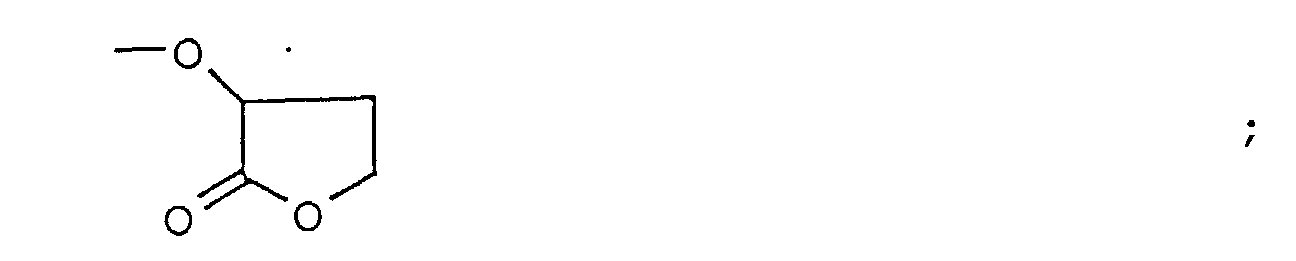 R, R3 und R6 jeweils unabhängig OR7 oder R8 sind;R7 Wasserstoff, C1-C4-Alkyl, C2-C6-Alkenyl, C2-C6-Alkinyl, Furfuryl, Benzyl, gegebenenfalls substituiert mit einer oder mehreren Halogen-, Nitro-, Cyano-, C1-C4-Alkyl-, C1-C4-Halogenalkyl-, C1-C4-Alkoxy- oder C1-C4-Halogenalkoxy-Gruppen, oder ein Alkalimetall-, Erdalkalimetall-, Mangan-, Kupfer-, Zink-, Cobalt-, Silber-, Nickel-, Ammonium- oder organisches Ammoniumkation bedeutet;R8 Wasserstoff, C1-C4-Alkyl, C2-C6-Alkenyl, C2-C6-Alkinyl, Phenyl, gegebenenfalls substituiert mit einer oder mehreren Halogen-, Nitro-, Cyano-, C1-C4-Alkyl-, C1-C4-Halogenalkyl-, C1-C4-Alkoxy- oder C1-C4-Halogenalkoxy-Gruppen, oder Benzyl, gegebenenfalls substituiert mit einer oder mehreren Halogen-, Nitro-, Cyano-, C1-C4-Alkyl-, C1-C4-Halogenalkyl-, C1-C4-Alkoxy- oder C1-C4-Halogenalkoxy-Gruppen, darstellt;R1 Wasserstoff, Halogen, Phenyl, gegebenenfalls substituiert mit einer oder mehreren Halogen-, Nitro-, Cyano-, C1-C4-Alkyl-, C1-C4-Halogenalkyl-, C1-C4-Alkoxy- oder C1-C4-Halogenalkoxy-Gruppen, oder C1-C12-Alkyl, gegebenenfalls substituiert mit Phenyl, gegebenenfalls substituiert mit einer oder mehreren Halogen-, Nitro-, Cyano-, C1-C4-Alkyl-, C1-C4-Halogenalkyl-, C1-C4-Alkoxy- oder C1-C4-Halogenalkoxy-Gruppen, ist;R2, R4 und R5 jeweils unabhängig Wasserstoff, Halogen, oder C1-C4-Alkyl bedeuten;n eine ganze Zahl von 1, 2, 3 oder 4 ist; oder
- Verfahren nach Anspruch 1, wobei:Y die Bedeutung N oder CX4 hat;X, X1, X2, X3 und X4 jeweils unabhängig Wasserstoff, Halogen oder C1-C4-Halogenalkoxy darstellen;W bedeutet: O(CR1R2)nC(O)R3;R OR7 ist;R8 C1-C4-Alkyl darstellt;R1 Wasserstoff, Halogen, Phenyl oder C1-C12-Alkyl, gegebenenfalls substituiert mit Phenyl, ist;R2 Wasserstoff oder C1-C4-Alkyl bedeutet.
- Verfahren nach Anspruch 1, wobei die Getreidekultur Mais ist, das Herbizid ausgewählt wird aus der Gruppe bestehend aus einer Imidazolinon-Verbindung, einer Dinitroanilin-Verbindung, einer Sulfonylharnstoff-Verbindung, einer Sulfamoylharnstoff-Verbindung, einer Oxim-Verbindung, einer 2-(4-Aryloxyphenoxy)propionsäure-Verbindung, einer Thiocarbamat-Verbindung, einer 2-Chloracetanilid-Verbindung und einer Isoxazolyl-2-imidazolidinon-Verbindung, und die Schutzmittel-Verbindung auf der Maispflanze oder dem Maissamen aufgebracht wird.
- Verfahren nach Anspruch 3, wobei das Herbizid eine Imidazolinon-Verbindung ist, ausgewählt aus der Gruppe bestehend aus5-Ethyl-2-(4-isopropyl-4-methyl-5-oxo-2-imidazolin-2-yl)nicotinsäure;2-(4-Isopropyl-4-methyl-5-oxo-2-imidazolin-2-yl)-3-chinolincarbonsäure;Methyl-2-(4-isopropyl-4-methyl-5-oxo-2-imidazolin-2-yl)nicotinat;2-(4-Isopropyl-4-methyl-5-oxo-2-imidazolin-2-yl)-5-(methoxymethyl)-nicotinsäure;einer Mischung von Methyl-2-(4-isopropyl-4-methyl-5-oxo-2-imidazolin-2-yl)-p-toluat und Methyl-6-(4-isopropyl-4-methyl-5-oxo-2-imidazolin-2-yl)-m-toluat; und2-(4-Isopropyl-4-methyl-5-oxo-2-imidazolin-2-yl)-5-methylnicotinsäure.
- Verfahren nach Anspruch 1, wobei die Getreidekultur Weizen, Gerste oder Sorghum ist, das Herbizid ausgewählt wird aus der Gruppe bestehend aus einer Imidazolinon-Verbindung, einer Dinitroanilin-Verbindung, einer Sulfonylharnstoff-Verbindung, einer Sulfamoylharnstoff-Verbindung, einer Oxim-Verbindung, einer 2-(4-Aryloxyphenoxy)-propionsäure-Verbindung, einer 2-Chloracetanilid-Verbindung und einer Isoxazolyl-2-imidazolidinon-Verbindung, und die Schutzmittel-Verbindung auf dem Weizen-, Gerste- oder Sorghumsamen aufgebracht wird.
- Verfahren nach Anspruch 5, wobei die Getreidekultur Weizen ist, und das Herbizid ein Dinitroanilin ist.
- Verfahren nach Anspruch 1, wobei die Getreidekultur Weizen, Gerste oder Sorghum ist, das Herbizid ausgewählt wird aus der Gruppe bestehend aus einer Imidazolinon-Verbindung, einer Sulfonylharnstoff-Verbindung, einer Sulfamoylharnstoff-Verbindung, einer Oxim-Verbindung, einer 2-(4-Aryloxyphenoxy)propionsäure-Verbindung und einer Isoxazolyl-2-imidazolidinon-Verbindung, und die Schutzmittel-Verbindung auf der Kulturpflanze aufgebracht wird.
- Verfahren nach Anspruch 1, wobei die Getreidekultur Reis oder Hafer ist, das Herbizid ausgewählt wird aus der Gruppe bestehend aus einer Imidazolinon-Verbindung, einer Sulfonylharnstoff-Verbindung, einer Sulfamoylharnstoff-Verbindung, einer Oxim-Verbindung, einer 2-(4-Aryloxyphenoxy)-propionsäure-Verbindung und einer Isoxazolyl-2-imidazolidinon-Verbindung, und die Schutzmittel-Verbindung auf der Getreidekulturpflanze oder dem Samen der Getreidekulturpflanze aufgebracht wird.
- Verbindung der Strukturformelworin
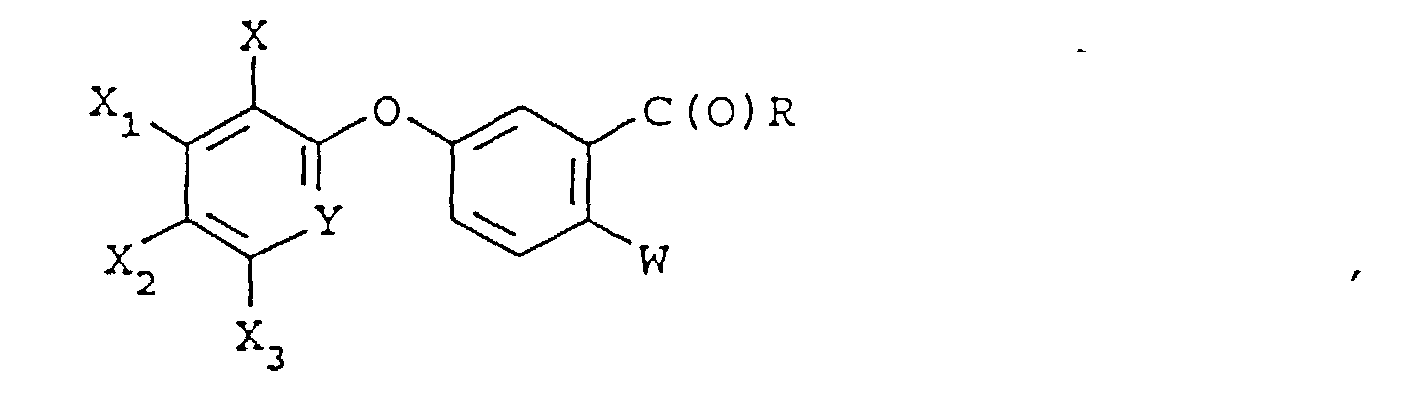 wenn R1 und R2 nicht gleich sind, die optischen Isomere hievon;Y die Bedeutung N oder CX4 hat;X, X1, X2, X3 und X4 jeweils unabhängig Wasserstoff, Halogen, C1-C4-Alkyl, C1-C4-Halogenalkyl, C1-C4-Alkoxy oder C1-C4-Halogenalkoxy darstellen;W bedeutet: O(CR1R2)nC(O)R3, CR4=CR5C(O)R6 oder
 R, R3 und R6 jeweils unabhängig OR7 oder R8 sind;R7 Wasserstoff, C1-C4-Alkyl, C2-C6-Alkenyl, C2-C6-Alkinyl, Furfuryl, Benzyl, gegebenenfalls substituiert mit einer oder mehreren Halogen-, Nitro-, Cyano-, C1-C4-Alkyl-, C1-C4-Halogenalkyl-, C1-C4-Alkoxy- oder C1-C4-Halogenalkoxy-Gruppen, oder ein Alkalimetall-, Erdalkalimetall-, Mangan-, Kupfer-, Zink-, Cobalt-, Silber-, Nickel-, Ammonium- oder organisches Ammoniumkation bedeutet;R8 Wasserstoff, C1-C4-Alkyl, C2-C6-Alkenyl, C2-C6-Alkinyl, Phenyl, gegebenenfalls substituiert mit einer oder mehreren Halogen-, Nitro-, Cyano-, C1-C4-Alkyl-, C1-C4-Halogenalkyl-, C1-C4-Alkoxy- oder C1-C4-Halogenalkoxy-Gruppen, oder Benzyl, gegebenenfalls substituiert mit einer oder mehreren Halogen-, Nitro-, Cyano-, C1-C4-Alkyl-, C1-C4-Halogenalkyl-, C1-C4-Alkoxy- oder C1-C4-Halogenalkoxy-Gruppen, darstellt;R1 Wasserstoff, Halogen, Phenyl, gegebenenfalls substituiert mit einer oder mehreren Halogen-, Nitro-, Cyano-, C1-C4-Alkyl-, C1-C4-Halogenalkyl-, C1-C4-Alkoxy- oder C1-C4-Halogenalkoxy-Gruppen, oder C1-C12-Alkyl, gegebenenfalls substituiert mit Phenyl, gegebenenfalls substituiert mit einer oder mehreren Halogen-, Nitro-, Cyano-, C1-C4-Alkyl-, C1-C4-Halogenalkyl-, C1-C4-Alkoxy- oder C1-C4-Halogenalkoxy-Gruppen, ist;R2, R4 und R5 jeweils unabhängig Wasserstoff, Halogen, oder C1-C4-Alkyl bedeuten;n eine ganze Zahl von 1, 2, 3 oder 4 ist; oder
mit der Maßgabe, daß, wenn R1 Wasserstoff oder C1-C6-Alkyl bedeutet, R2 Wasserstoff oder C1-C4-Alkyl darstellt, und R3 die Bedeutung O(C1-C4-Alkyl) hat, R von O(C1-C4-Alkyl) verschieden ist. - Verbindung nach Anspruch 9, worinY die Bedeutung N oder CX4 hat;X, X1, X2, X3 und X4 jeweils unabhängig Wasserstoff, Halogen oder C1-C4-Halogenalkoxy darstellen;W bedeutet: O(CR1R2)nC(O)R3;R OR7 ist;R8 C1-C4-Alkyl darstellt;R1 Wasserstoff, Halogen, Phenyl oder C1-C12-Alkyl, gegebenenfalls substituiert mit Phenyl, ist;R2 Wasserstoff oder C1-C4-Alkyl bedeutet.
Applications Claiming Priority (2)
| Application Number | Priority Date | Filing Date | Title |
|---|---|---|---|
| US353029 | 1994-12-09 | ||
| US08/353,029 US5596124A (en) | 1994-12-09 | 1994-12-09 | Method for safening herbicides in cereal crops using 5-aryloxy-1,2-(disubstituted)benzene compounds |
Publications (2)
| Publication Number | Publication Date |
|---|---|
| EP0716073A1 EP0716073A1 (de) | 1996-06-12 |
| EP0716073B1 true EP0716073B1 (de) | 1999-03-31 |
Family
ID=23387456
Family Applications (1)
| Application Number | Title | Priority Date | Filing Date |
|---|---|---|---|
| EP95308911A Expired - Lifetime EP0716073B1 (de) | 1994-12-09 | 1995-12-08 | Verfahren zum Unschädlichmachen von Herbiziden im Getreide unter Verwendung von 5-Aryloxy-1,2-(disubstituierten) Benzolverbindungen |
Country Status (13)
| Country | Link |
|---|---|
| US (1) | US5596124A (de) |
| EP (1) | EP0716073B1 (de) |
| JP (1) | JPH08245487A (de) |
| AR (1) | AR001056A1 (de) |
| AT (1) | ATE178309T1 (de) |
| AU (1) | AU690381B2 (de) |
| BR (1) | BR9505715A (de) |
| CA (1) | CA2164690C (de) |
| DE (1) | DE69508712T2 (de) |
| DK (1) | DK0716073T3 (de) |
| ES (1) | ES2129766T3 (de) |
| GR (1) | GR3030555T3 (de) |
| ZA (1) | ZA9510461B (de) |
Families Citing this family (6)
| Publication number | Priority date | Publication date | Assignee | Title |
|---|---|---|---|---|
| US6017850A (en) * | 1996-12-06 | 2000-01-25 | Novartis Finance Corporation | Herbicidal composition and method of weed control |
| EP1366012A4 (de) * | 2001-02-09 | 2005-11-02 | Merck & Co Inc | 2-aryloxy-2-arylalkansäuren gegen diabetes und störungen des fettstoffwechsels |
| DE10335726A1 (de) * | 2003-08-05 | 2005-03-03 | Bayer Cropscience Gmbh | Verwendung von Hydroxyaromaten als Safener |
| SA05260065B1 (ar) | 2004-03-26 | 2009-12-29 | سينجنتا بارتيسيبيشنزا ايه جى | توليفة مبيدة للحشائش |
| WO2014172551A1 (en) | 2013-04-17 | 2014-10-23 | Sepro Corporation | Herbicidal compositions and methods |
| US11026423B2 (en) | 2013-04-17 | 2021-06-08 | Sepro Corporation | Herbicidal compositions and methods |
Family Cites Families (7)
| Publication number | Priority date | Publication date | Assignee | Title |
|---|---|---|---|---|
| GB1543964A (en) * | 1976-04-08 | 1979-04-11 | Ici Ltd | Method of antagonising herbicides on soyabean and cotton |
| US4309210A (en) * | 1978-12-01 | 1982-01-05 | Ciba-Geigy Corporation | Preemergence method of selectively controlling weeds in crops of cereals and composition therefor |
| EP0075377A3 (de) * | 1979-07-18 | 1983-08-31 | Imperial Chemical Industries Plc | Diphenylätherverbindungen, ihre Verwendung als Herbizide und diese enthaltende Herbizide-Zusammensetzungen |
| US4780128A (en) * | 1979-07-18 | 1988-10-25 | Imperial Chemical Industries Plc | Herbicides |
| US4465508A (en) * | 1979-07-18 | 1984-08-14 | Imperial Chemical Industries Plc | Diphenyl ether herbicides |
| DE3000076A1 (de) * | 1980-01-03 | 1981-09-03 | Hoechst Ag, 6000 Frankfurt | Wachstumsfoerdernde und pflanzenschuetzende mittel |
| US4845264A (en) * | 1987-03-05 | 1989-07-04 | Teijin Limited | Phenoxycarboxylic acid and herbicide comprising it as active ingredient |
-
1994
- 1994-12-09 US US08/353,029 patent/US5596124A/en not_active Expired - Fee Related
-
1995
- 1995-12-07 CA CA002164690A patent/CA2164690C/en not_active Expired - Fee Related
- 1995-12-07 AR AR33454895A patent/AR001056A1/es unknown
- 1995-12-08 DE DE69508712T patent/DE69508712T2/de not_active Expired - Fee Related
- 1995-12-08 ZA ZA9510461A patent/ZA9510461B/xx unknown
- 1995-12-08 JP JP34503495A patent/JPH08245487A/ja active Pending
- 1995-12-08 BR BR9505715A patent/BR9505715A/pt not_active IP Right Cessation
- 1995-12-08 AT AT95308911T patent/ATE178309T1/de not_active IP Right Cessation
- 1995-12-08 DK DK95308911T patent/DK0716073T3/da active
- 1995-12-08 AU AU40310/95A patent/AU690381B2/en not_active Ceased
- 1995-12-08 EP EP95308911A patent/EP0716073B1/de not_active Expired - Lifetime
- 1995-12-08 ES ES95308911T patent/ES2129766T3/es not_active Expired - Lifetime
-
1999
- 1999-06-17 GR GR990401636T patent/GR3030555T3/el unknown
Also Published As
| Publication number | Publication date |
|---|---|
| AR001056A1 (es) | 1997-09-24 |
| ATE178309T1 (de) | 1999-04-15 |
| DE69508712T2 (de) | 1999-12-02 |
| GR3030555T3 (en) | 1999-10-29 |
| DE69508712D1 (de) | 1999-05-06 |
| ES2129766T3 (es) | 1999-06-16 |
| US5596124A (en) | 1997-01-21 |
| JPH08245487A (ja) | 1996-09-24 |
| EP0716073A1 (de) | 1996-06-12 |
| BR9505715A (pt) | 1997-11-11 |
| AU4031095A (en) | 1996-06-20 |
| CA2164690C (en) | 2005-08-09 |
| ZA9510461B (en) | 1997-06-09 |
| AU690381B2 (en) | 1998-04-23 |
| CA2164690A1 (en) | 1996-06-10 |
| DK0716073T3 (da) | 1999-10-11 |
Similar Documents
| Publication | Publication Date | Title |
|---|---|---|
| US5407897A (en) | Method for safening herbicides in crops using substituted benzopyran and tetrahydronaphthalene compounds | |
| US4332961A (en) | Herbicidal compound, herbicidal composition containing the same, and method of use thereof | |
| US4046553A (en) | Herbicidal compound, herbicidal composition containing the same and method of use thereof | |
| US5110343A (en) | Cyclohexenone derivatives | |
| HU205748B (en) | Herbicidal compositions comprising substituted benzotriazole derivatives as active ingredient and process for producing the active ingredient | |
| HU188783B (en) | Herbicides containing dichloro-quinoline derivatives | |
| CS214755B2 (en) | Herbicide means and method of making the active component | |
| US5596124A (en) | Method for safening herbicides in cereal crops using 5-aryloxy-1,2-(disubstituted)benzene compounds | |
| US4406688A (en) | Herbicidal 4-benzoyl-5-phenacyloxy-pyrazole derivatives, composition and method | |
| US4416687A (en) | 3,5-Bis (trifluoromethyl)phenoxy carboxylic acids and derivatives thereof | |
| US4259105A (en) | Diphenylamine derivatives | |
| EP0647612A1 (de) | Aryloxybenzole als herbizide Mittel | |
| US5559080A (en) | 3-phenoxypyridazines, herbicidal compositions and uses thereof | |
| US4399072A (en) | N-Phenyl-N-methylurea derivatives | |
| US4434108A (en) | Herbicidally active 2-nitro-5-(2'-chloro-4'-trifluoromethylphenoxy)phenylphosphinic acid derivatives | |
| US5672715A (en) | Herbicidal substituted 3-aryl-pyrazoles | |
| US4280835A (en) | Herbicidal N-phenyl-N-methylurea derivatives | |
| US4548641A (en) | Herbicides: N,N-dialkyl-2-(4-substituted-1-naphthoxy) propionamides | |
| US4846882A (en) | Herbicidal aryl tetrahydrophthalimides | |
| JP2603557B2 (ja) | ピリミジンまたはトリアジン誘導体及び除草剤 | |
| HU208297B (en) | Herbicidal compositions comprising diphenyl ether derivatives as active ingredient, process for producing the active ingredients of the compositions and use of the compositions | |
| JPS60248677A (ja) | イミダゾリニルトルイル酸のレジオおよび光学的異性体、エステルおよび塩、その製法、並びに除草剤としてのその使用 | |
| US5733849A (en) | Halopyridyl triazolinone herbicides and herbicidal use thereof | |
| US4259532A (en) | Herbicidal ethers | |
| US4659365A (en) | Herbicidal 2-chloro-2'-fluoroalkoxyacetanilides |
Legal Events
| Date | Code | Title | Description |
|---|---|---|---|
| PUAI | Public reference made under article 153(3) epc to a published international application that has entered the european phase |
Free format text: ORIGINAL CODE: 0009012 |
|
| AK | Designated contracting states |
Kind code of ref document: A1 Designated state(s): AT BE CH DE DK ES FR GB GR IE IT LI LU NL PT SE |
|
| AX | Request for extension of the european patent |
Free format text: LT PAYMENT 951220;LV PAYMENT 951220;SI PAYMENT 951220 |
|
| RAX | Requested extension states of the european patent have changed |
Free format text: LT PAYMENT 951220;LV PAYMENT 951220;SI PAYMENT 951220 |
|
| 17P | Request for examination filed |
Effective date: 19961205 |
|
| GRAG | Despatch of communication of intention to grant |
Free format text: ORIGINAL CODE: EPIDOS AGRA |
|
| 17Q | First examination report despatched |
Effective date: 19980522 |
|
| GRAG | Despatch of communication of intention to grant |
Free format text: ORIGINAL CODE: EPIDOS AGRA |
|
| GRAH | Despatch of communication of intention to grant a patent |
Free format text: ORIGINAL CODE: EPIDOS IGRA |
|
| GRAH | Despatch of communication of intention to grant a patent |
Free format text: ORIGINAL CODE: EPIDOS IGRA |
|
| GRAA | (expected) grant |
Free format text: ORIGINAL CODE: 0009210 |
|
| AK | Designated contracting states |
Kind code of ref document: B1 Designated state(s): AT BE CH DE DK ES FR GB GR IE IT LI LU NL PT SE |
|
| AX | Request for extension of the european patent |
Free format text: LT PAYMENT 951220;LV PAYMENT 951220;SI PAYMENT 951220 |
|
| LTIE | Lt: invalidation of european patent or patent extension | ||
| REF | Corresponds to: |
Ref document number: 178309 Country of ref document: AT Date of ref document: 19990415 Kind code of ref document: T |
|
| REG | Reference to a national code |
Ref country code: CH Ref legal event code: EP |
|
| ITF | It: translation for a ep patent filed | ||
| REG | Reference to a national code |
Ref country code: IE Ref legal event code: FG4D |
|
| REF | Corresponds to: |
Ref document number: 69508712 Country of ref document: DE Date of ref document: 19990506 |
|
| ET | Fr: translation filed | ||
| REG | Reference to a national code |
Ref country code: ES Ref legal event code: FG2A Ref document number: 2129766 Country of ref document: ES Kind code of ref document: T3 |
|
| REG | Reference to a national code |
Ref country code: CH Ref legal event code: NV Representative=s name: E. BLUM & CO. PATENTANWAELTE |
|
| REG | Reference to a national code |
Ref country code: PT Ref legal event code: SC4A Free format text: AVAILABILITY OF NATIONAL TRANSLATION Effective date: 19990607 |
|
| REG | Reference to a national code |
Ref country code: DK Ref legal event code: T3 |
|
| PLBE | No opposition filed within time limit |
Free format text: ORIGINAL CODE: 0009261 |
|
| STAA | Information on the status of an ep patent application or granted ep patent |
Free format text: STATUS: NO OPPOSITION FILED WITHIN TIME LIMIT |
|
| 26N | No opposition filed | ||
| REG | Reference to a national code |
Ref country code: GB Ref legal event code: IF02 |
|
| REG | Reference to a national code |
Ref country code: CH Ref legal event code: PFA Owner name: AMERICAN CYANAMID COMPANY Free format text: AMERICAN CYANAMID COMPANY#FIVE GIRALDA FARMS#MADISON, NEW JERSEY 07940-0874 (US) -TRANSFER TO- AMERICAN CYANAMID COMPANY#FIVE GIRALDA FARMS#MADISON, NEW JERSEY 07940-0874 (US) |
|
| PGFP | Annual fee paid to national office [announced via postgrant information from national office to epo] |
Ref country code: NL Payment date: 20071203 Year of fee payment: 13 Ref country code: LU Payment date: 20071211 Year of fee payment: 13 Ref country code: DK Payment date: 20071215 Year of fee payment: 13 |
|
| PGFP | Annual fee paid to national office [announced via postgrant information from national office to epo] |
Ref country code: AT Payment date: 20071212 Year of fee payment: 13 Ref country code: CH Payment date: 20071128 Year of fee payment: 13 |
|
| PGFP | Annual fee paid to national office [announced via postgrant information from national office to epo] |
Ref country code: SE Payment date: 20071205 Year of fee payment: 13 |
|
| PGFP | Annual fee paid to national office [announced via postgrant information from national office to epo] |
Ref country code: GB Payment date: 20071205 Year of fee payment: 13 Ref country code: FR Payment date: 20071210 Year of fee payment: 13 Ref country code: ES Payment date: 20080118 Year of fee payment: 13 |
|
| PGFP | Annual fee paid to national office [announced via postgrant information from national office to epo] |
Ref country code: PT Payment date: 20071126 Year of fee payment: 13 Ref country code: IT Payment date: 20071228 Year of fee payment: 13 Ref country code: GR Payment date: 20071116 Year of fee payment: 13 Ref country code: DE Payment date: 20071206 Year of fee payment: 13 |
|
| PGFP | Annual fee paid to national office [announced via postgrant information from national office to epo] |
Ref country code: BE Payment date: 20080709 Year of fee payment: 13 |
|
| REG | Reference to a national code |
Ref country code: PT Ref legal event code: MM4A Free format text: LAPSE DUE TO NON-PAYMENT OF FEES Effective date: 20090608 |
|
| BERE | Be: lapsed |
Owner name: AMERICAN *YANAMID CY Effective date: 20081231 |
|
| REG | Reference to a national code |
Ref country code: CH Ref legal event code: PL |
|
| REG | Reference to a national code |
Ref country code: DK Ref legal event code: EBP |
|
| EUG | Se: european patent has lapsed | ||
| GBPC | Gb: european patent ceased through non-payment of renewal fee |
Effective date: 20081208 |
|
| PG25 | Lapsed in a contracting state [announced via postgrant information from national office to epo] |
Ref country code: PT Free format text: LAPSE BECAUSE OF NON-PAYMENT OF DUE FEES Effective date: 20090608 Ref country code: AT Free format text: LAPSE BECAUSE OF NON-PAYMENT OF DUE FEES Effective date: 20081208 |
|
| PGFP | Annual fee paid to national office [announced via postgrant information from national office to epo] |
Ref country code: IE Payment date: 20071212 Year of fee payment: 13 |
|
| NLV4 | Nl: lapsed or anulled due to non-payment of the annual fee |
Effective date: 20090701 |
|
| REG | Reference to a national code |
Ref country code: IE Ref legal event code: MM4A |
|
| PG25 | Lapsed in a contracting state [announced via postgrant information from national office to epo] |
Ref country code: BE Free format text: LAPSE BECAUSE OF NON-PAYMENT OF DUE FEES Effective date: 20081231 |
|
| REG | Reference to a national code |
Ref country code: FR Ref legal event code: ST Effective date: 20090831 |
|
| PG25 | Lapsed in a contracting state [announced via postgrant information from national office to epo] |
Ref country code: LI Free format text: LAPSE BECAUSE OF NON-PAYMENT OF DUE FEES Effective date: 20081231 Ref country code: IE Free format text: LAPSE BECAUSE OF NON-PAYMENT OF DUE FEES Effective date: 20081208 Ref country code: DE Free format text: LAPSE BECAUSE OF NON-PAYMENT OF DUE FEES Effective date: 20090701 Ref country code: CH Free format text: LAPSE BECAUSE OF NON-PAYMENT OF DUE FEES Effective date: 20081231 |
|
| PG25 | Lapsed in a contracting state [announced via postgrant information from national office to epo] |
Ref country code: NL Free format text: LAPSE BECAUSE OF NON-PAYMENT OF DUE FEES Effective date: 20090701 Ref country code: GB Free format text: LAPSE BECAUSE OF NON-PAYMENT OF DUE FEES Effective date: 20081208 |
|
| PG25 | Lapsed in a contracting state [announced via postgrant information from national office to epo] |
Ref country code: DK Free format text: LAPSE BECAUSE OF NON-PAYMENT OF DUE FEES Effective date: 20090105 |
|
| PG25 | Lapsed in a contracting state [announced via postgrant information from national office to epo] |
Ref country code: GR Free format text: LAPSE BECAUSE OF NON-PAYMENT OF DUE FEES Effective date: 20090703 |
|
| REG | Reference to a national code |
Ref country code: ES Ref legal event code: FD2A Effective date: 20081209 |
|
| PG25 | Lapsed in a contracting state [announced via postgrant information from national office to epo] |
Ref country code: FR Free format text: LAPSE BECAUSE OF NON-PAYMENT OF DUE FEES Effective date: 20081231 Ref country code: ES Free format text: LAPSE BECAUSE OF NON-PAYMENT OF DUE FEES Effective date: 20081209 |
|
| PG25 | Lapsed in a contracting state [announced via postgrant information from national office to epo] |
Ref country code: LU Free format text: LAPSE BECAUSE OF NON-PAYMENT OF DUE FEES Effective date: 20081208 |
|
| PG25 | Lapsed in a contracting state [announced via postgrant information from national office to epo] |
Ref country code: SE Free format text: LAPSE BECAUSE OF NON-PAYMENT OF DUE FEES Effective date: 20081209 |
|
| PG25 | Lapsed in a contracting state [announced via postgrant information from national office to epo] |
Ref country code: IT Free format text: LAPSE BECAUSE OF NON-PAYMENT OF DUE FEES Effective date: 20081208 |