EP0716835A2 - Formgedächtnis-Sperrmechanismus für einen intravaskulären Stent - Google Patents
Formgedächtnis-Sperrmechanismus für einen intravaskulären Stent Download PDFInfo
- Publication number
- EP0716835A2 EP0716835A2 EP95308211A EP95308211A EP0716835A2 EP 0716835 A2 EP0716835 A2 EP 0716835A2 EP 95308211 A EP95308211 A EP 95308211A EP 95308211 A EP95308211 A EP 95308211A EP 0716835 A2 EP0716835 A2 EP 0716835A2
- Authority
- EP
- European Patent Office
- Prior art keywords
- stent
- teeth
- locking mechanism
- longitudinal slot
- locking
- Prior art date
- Legal status (The legal status is an assumption and is not a legal conclusion. Google has not performed a legal analysis and makes no representation as to the accuracy of the status listed.)
- Ceased
Links
- 230000007246 mechanism Effects 0.000 title claims description 24
- 239000000463 material Substances 0.000 claims description 23
- 229910001000 nickel titanium Inorganic materials 0.000 claims description 18
- 229920000642 polymer Polymers 0.000 claims description 13
- 239000011248 coating agent Substances 0.000 claims description 12
- 238000000576 coating method Methods 0.000 claims description 12
- 238000010438 heat treatment Methods 0.000 claims description 9
- 239000012530 fluid Substances 0.000 claims description 7
- 229920001610 polycaprolactone Polymers 0.000 claims description 6
- 239000004632 polycaprolactone Substances 0.000 claims description 6
- 239000010935 stainless steel Substances 0.000 claims description 4
- 229910001220 stainless steel Inorganic materials 0.000 claims description 4
- 101100021395 Arabidopsis thaliana LIP1 gene Proteins 0.000 claims description 3
- JVTAAEKCZFNVCJ-UHFFFAOYSA-N lactic acid Chemical compound CC(O)C(O)=O JVTAAEKCZFNVCJ-UHFFFAOYSA-N 0.000 claims description 3
- 229960000448 lactic acid Drugs 0.000 claims description 3
- 239000000203 mixture Substances 0.000 claims description 3
- 229920001432 poly(L-lactide) Polymers 0.000 claims description 3
- 229910052715 tantalum Inorganic materials 0.000 claims description 3
- GUVRBAGPIYLISA-UHFFFAOYSA-N tantalum atom Chemical compound [Ta] GUVRBAGPIYLISA-UHFFFAOYSA-N 0.000 claims description 3
- 229940126585 therapeutic drug Drugs 0.000 claims description 3
- QTBSBXVTEAMEQO-UHFFFAOYSA-M Acetate Chemical compound CC([O-])=O QTBSBXVTEAMEQO-UHFFFAOYSA-M 0.000 claims description 2
- 229920001817 Agar Polymers 0.000 claims description 2
- WQZGKKKJIJFFOK-GASJEMHNSA-N Glucose Natural products OC[C@H]1OC(O)[C@H](O)[C@@H](O)[C@@H]1O WQZGKKKJIJFFOK-GASJEMHNSA-N 0.000 claims description 2
- 229920002472 Starch Polymers 0.000 claims description 2
- 239000008272 agar Substances 0.000 claims description 2
- WQZGKKKJIJFFOK-VFUOTHLCSA-N beta-D-glucose Chemical compound OC[C@H]1O[C@@H](O)[C@H](O)[C@@H](O)[C@@H]1O WQZGKKKJIJFFOK-VFUOTHLCSA-N 0.000 claims description 2
- 239000002131 composite material Substances 0.000 claims description 2
- 239000013013 elastic material Substances 0.000 claims description 2
- 239000008103 glucose Substances 0.000 claims description 2
- 239000000017 hydrogel Substances 0.000 claims description 2
- 230000006698 induction Effects 0.000 claims description 2
- 239000008107 starch Substances 0.000 claims description 2
- 235000019698 starch Nutrition 0.000 claims description 2
- 230000002792 vascular Effects 0.000 abstract description 13
- 210000004351 coronary vessel Anatomy 0.000 abstract description 3
- 238000000034 method Methods 0.000 description 25
- HLXZNVUGXRDIFK-UHFFFAOYSA-N nickel titanium Chemical compound [Ti].[Ti].[Ti].[Ti].[Ti].[Ti].[Ti].[Ti].[Ti].[Ti].[Ti].[Ni].[Ni].[Ni].[Ni].[Ni].[Ni].[Ni].[Ni].[Ni].[Ni].[Ni].[Ni].[Ni].[Ni] HLXZNVUGXRDIFK-UHFFFAOYSA-N 0.000 description 14
- 230000008569 process Effects 0.000 description 8
- 238000013461 design Methods 0.000 description 5
- 208000037803 restenosis Diseases 0.000 description 5
- 239000000126 substance Substances 0.000 description 5
- FAPWRFPIFSIZLT-UHFFFAOYSA-M Sodium chloride Chemical compound [Na+].[Cl-] FAPWRFPIFSIZLT-UHFFFAOYSA-M 0.000 description 4
- 238000004519 manufacturing process Methods 0.000 description 4
- 229910052751 metal Inorganic materials 0.000 description 4
- 239000002184 metal Substances 0.000 description 4
- 230000007704 transition Effects 0.000 description 4
- 210000005166 vasculature Anatomy 0.000 description 4
- 208000007536 Thrombosis Diseases 0.000 description 3
- JKQOBWVOAYFWKG-UHFFFAOYSA-N molybdenum trioxide Chemical compound O=[Mo](=O)=O JKQOBWVOAYFWKG-UHFFFAOYSA-N 0.000 description 3
- 238000005096 rolling process Methods 0.000 description 3
- 239000012781 shape memory material Substances 0.000 description 3
- 208000031481 Pathologic Constriction Diseases 0.000 description 2
- 230000001154 acute effect Effects 0.000 description 2
- 239000000853 adhesive Substances 0.000 description 2
- 230000001070 adhesive effect Effects 0.000 description 2
- 238000002399 angioplasty Methods 0.000 description 2
- 210000004204 blood vessel Anatomy 0.000 description 2
- 238000005219 brazing Methods 0.000 description 2
- 210000000748 cardiovascular system Anatomy 0.000 description 2
- 230000010261 cell growth Effects 0.000 description 2
- 238000004891 communication Methods 0.000 description 2
- 238000010276 construction Methods 0.000 description 2
- 230000006378 damage Effects 0.000 description 2
- 238000002224 dissection Methods 0.000 description 2
- 230000000694 effects Effects 0.000 description 2
- 206010020718 hyperplasia Diseases 0.000 description 2
- 238000006213 oxygenation reaction Methods 0.000 description 2
- 208000037804 stenosis Diseases 0.000 description 2
- 230000036262 stenosis Effects 0.000 description 2
- 238000003466 welding Methods 0.000 description 2
- 208000032843 Hemorrhage Diseases 0.000 description 1
- 229910052779 Neodymium Inorganic materials 0.000 description 1
- 208000034827 Neointima Diseases 0.000 description 1
- 239000004698 Polyethylene Substances 0.000 description 1
- 208000024248 Vascular System injury Diseases 0.000 description 1
- 208000012339 Vascular injury Diseases 0.000 description 1
- 208000027418 Wounds and injury Diseases 0.000 description 1
- JNDMLEXHDPKVFC-UHFFFAOYSA-N aluminum;oxygen(2-);yttrium(3+) Chemical compound [O-2].[O-2].[O-2].[Al+3].[Y+3] JNDMLEXHDPKVFC-UHFFFAOYSA-N 0.000 description 1
- 229940127217 antithrombotic drug Drugs 0.000 description 1
- 210000001367 artery Anatomy 0.000 description 1
- 230000003143 atherosclerotic effect Effects 0.000 description 1
- 230000009286 beneficial effect Effects 0.000 description 1
- 230000008901 benefit Effects 0.000 description 1
- 230000008512 biological response Effects 0.000 description 1
- 208000034158 bleeding Diseases 0.000 description 1
- 230000000740 bleeding effect Effects 0.000 description 1
- 239000008280 blood Substances 0.000 description 1
- 210000004369 blood Anatomy 0.000 description 1
- 230000017531 blood circulation Effects 0.000 description 1
- 210000004027 cell Anatomy 0.000 description 1
- 230000001684 chronic effect Effects 0.000 description 1
- 238000007887 coronary angioplasty Methods 0.000 description 1
- 229940079593 drug Drugs 0.000 description 1
- 239000003814 drug Substances 0.000 description 1
- 238000012377 drug delivery Methods 0.000 description 1
- 210000002889 endothelial cell Anatomy 0.000 description 1
- 230000003511 endothelial effect Effects 0.000 description 1
- 238000005530 etching Methods 0.000 description 1
- 239000011888 foil Substances 0.000 description 1
- 230000006870 function Effects 0.000 description 1
- 230000012010 growth Effects 0.000 description 1
- 239000003102 growth factor Substances 0.000 description 1
- 229920001903 high density polyethylene Polymers 0.000 description 1
- 239000004700 high-density polyethylene Substances 0.000 description 1
- 238000002513 implantation Methods 0.000 description 1
- 208000014674 injury Diseases 0.000 description 1
- 238000003780 insertion Methods 0.000 description 1
- 230000037431 insertion Effects 0.000 description 1
- 238000003754 machining Methods 0.000 description 1
- 229910000734 martensite Inorganic materials 0.000 description 1
- QEFYFXOXNSNQGX-UHFFFAOYSA-N neodymium atom Chemical compound [Nd] QEFYFXOXNSNQGX-UHFFFAOYSA-N 0.000 description 1
- 230000010412 perfusion Effects 0.000 description 1
- -1 polyethylene Polymers 0.000 description 1
- 229920000573 polyethylene Polymers 0.000 description 1
- 239000002861 polymer material Substances 0.000 description 1
- 230000002265 prevention Effects 0.000 description 1
- 238000012545 processing Methods 0.000 description 1
- 238000011084 recovery Methods 0.000 description 1
- 230000000306 recurrent effect Effects 0.000 description 1
- 230000008458 response to injury Effects 0.000 description 1
- 239000011780 sodium chloride Substances 0.000 description 1
- 230000009885 systemic effect Effects 0.000 description 1
- 238000002560 therapeutic procedure Methods 0.000 description 1
- 229960000103 thrombolytic agent Drugs 0.000 description 1
- 230000002537 thrombolytic effect Effects 0.000 description 1
- 229910019901 yttrium aluminum garnet Inorganic materials 0.000 description 1
Images



Classifications
-
- A—HUMAN NECESSITIES
- A61—MEDICAL OR VETERINARY SCIENCE; HYGIENE
- A61F—FILTERS IMPLANTABLE INTO BLOOD VESSELS; PROSTHESES; DEVICES PROVIDING PATENCY TO, OR PREVENTING COLLAPSING OF, TUBULAR STRUCTURES OF THE BODY, e.g. STENTS; ORTHOPAEDIC, NURSING OR CONTRACEPTIVE DEVICES; FOMENTATION; TREATMENT OR PROTECTION OF EYES OR EARS; BANDAGES, DRESSINGS OR ABSORBENT PADS; FIRST-AID KITS
- A61F2/00—Filters implantable into blood vessels; Prostheses, i.e. artificial substitutes or replacements for parts of the body; Appliances for connecting them with the body; Devices providing patency to, or preventing collapsing of, tubular structures of the body, e.g. stents
- A61F2/82—Devices providing patency to, or preventing collapsing of, tubular structures of the body, e.g. stents
- A61F2/92—Stents in the form of a rolled-up sheet expanding after insertion into the vessel, e.g. with a spiral shape in cross-section
- A61F2/93—Stents in the form of a rolled-up sheet expanding after insertion into the vessel, e.g. with a spiral shape in cross-section circumferentially expandable by using ratcheting locks
-
- A—HUMAN NECESSITIES
- A61—MEDICAL OR VETERINARY SCIENCE; HYGIENE
- A61F—FILTERS IMPLANTABLE INTO BLOOD VESSELS; PROSTHESES; DEVICES PROVIDING PATENCY TO, OR PREVENTING COLLAPSING OF, TUBULAR STRUCTURES OF THE BODY, e.g. STENTS; ORTHOPAEDIC, NURSING OR CONTRACEPTIVE DEVICES; FOMENTATION; TREATMENT OR PROTECTION OF EYES OR EARS; BANDAGES, DRESSINGS OR ABSORBENT PADS; FIRST-AID KITS
- A61F2210/00—Particular material properties of prostheses classified in groups A61F2/00 - A61F2/26 or A61F2/82 or A61F9/00 or A61F11/00 or subgroups thereof
- A61F2210/0014—Particular material properties of prostheses classified in groups A61F2/00 - A61F2/26 or A61F2/82 or A61F9/00 or A61F11/00 or subgroups thereof using shape memory or superelastic materials, e.g. nitinol
- A61F2210/0023—Particular material properties of prostheses classified in groups A61F2/00 - A61F2/26 or A61F2/82 or A61F9/00 or A61F11/00 or subgroups thereof using shape memory or superelastic materials, e.g. nitinol operated at different temperatures whilst inside or touching the human body, heated or cooled by external energy source or cold supply
-
- A—HUMAN NECESSITIES
- A61—MEDICAL OR VETERINARY SCIENCE; HYGIENE
- A61M—DEVICES FOR INTRODUCING MEDIA INTO, OR ONTO, THE BODY; DEVICES FOR TRANSDUCING BODY MEDIA OR FOR TAKING MEDIA FROM THE BODY; DEVICES FOR PRODUCING OR ENDING SLEEP OR STUPOR
- A61M25/00—Catheters; Hollow probes
- A61M25/01—Introducing, guiding, advancing, emplacing or holding catheters
- A61M2025/0183—Rapid exchange or monorail catheters
Definitions
- the present invention generally relates to expandable endoprosthesis devices, in particular expandable intraluminal vascular grafts, generally referred to as stents, that are adapted to be implanted in a body lumen, such as a coronary artery or other vessel to maintain the patency of the lumen.
- stents expandable intraluminal vascular grafts
- PTCA percutanecus transluminal coronary angioplasty
- Stents also are used to support a body lumen where a flap or dissection has occurred or, in general, whenever a lumen is weak.
- the present invention also relates to an expandable intraluminal vascular graft that can be used in essentially any body lumen.
- the stents In expandable stents that are delivered with expandable catheters, such as balloon catheters, the stents are positioned over the balloon portion of the catheter and are expanded, from a reduced diameter to an enlarged diameter greater than or equal to the diameter of the arterial wall, by inflating the balloon. Stents of this type can be expanded to an enlarged diameter by deforming the stent, by engagement of the stent walls with respect to one another, and by one-way engagement of the stent walls together with endothelial growth onto and over the stent. Other stents are self-expanding, through the properties of the material constituting the stent or by design. Examples of intravascular stents can be found in U.S. Patent No.
- ratcheting stent designs include a series of stents which are interconnected and which utilize teeth on their outer edges to ratchet through a slot in order to achieve mechanical locking of a stent in a cylindrical form. Examples of such ratcheting stents can be found in co-pending application U.S. Serial No. 08/052,410 and assigned to common assignee, Advanced Cardiovascular Systems, Inc.
- the ratcheting stent design of the prior art is generally made of 316L stainless steel, poly-L-lactic acid (LPLA), poly-DL-lactic acid (DLPLA), or polycaprolactone (PCL) polymers.
- the teeth because of the polymer material properties, may be deformed or damaged and thus may affect stent-locking integrity.
- the ratcheting forces required to expand and deploy the stent can be higher than would be ideal because of the interference between the teeth and the locking slot.
- the interference of the teeth with the locking slot might be somewhat offset and might cause an uneven expansion of the individual rings of the stent.
- the interlocking teeth do not engage the slot until after expansion has occurred, and thus some of the difficulties with the prior art devices are eliminated.
- Preferred embodiments of the invention are directed to an intravascular stent which is adapted to be inserted within a body lumen and which is designed to expand and lock therein in an enlarged diameter form.
- the stent is designed to engage into the locked position after the stent has been expanded, by utilizing shape-memory-retaining material in teeth which move, when heated, into engagement with a longitudinal slot.
- an intraluminal stent is formed from a substantially rectangular sheet having a longitudinal slot formed in one edge. A plurality of teeth are positioned along the edges of the sheet and the edges intersect with said longitudinal slot in a belt buckle fashion.
- the stent is rolled onto a balloon portion of a catheter to form a cylindrical configuration and the stent is delivered within a body lumen for deployment.
- the balloon portion of the catheter is expanded, which thereby expands the stent into engagement with the vascular wall of the body lumen. Thereafter, heat is applied to the stent and the teeth will move as a result of application of the heat so that the teeth will engage and interlock with the longitudinal slot. The stent then is locked in an open position to maintain the patency of the body lumen in which it is deployed.
- the teeth can be made from any shape-memory-retaining material such as nitinol a nickel-titanium alloy (NiTi). Generally NiTi, as used in this invention, is in the form of foil having either shape-memory effect (SME) or super-elasticity (SE).
- Heat can be applied to the stent by several methods, one of which methods involves a heated balloon.
- a saline solution that is heated is used to inflate the balloon and to cause the temperature at the teeth to rise and to move into locking engagement with the longitudinal slot, as described above.
- Another method of heating the stent involves injecting heated saline into the body lumen after balloon expansion at the site of the implanted stent.
- Preferred embodiments of the invention allow the stent to be expanded from a smaller diameter, as it is rolled on the balloon, to the larger expanded diameter, for implanting in the diseased area, without fear that the engaging teeth will be damaged or might cause the stent to deploy unevenly if one set of teeth engage while the other set does not. Further, deployment can be accomplished in a smoother and slower manner than with previous designs because the teeth are not ratcheting along the longitudinal slot as the stent is being expanded. It is only after the stent is expanded and heated that the teeth engage the longitudinal slot.
- the stent may also be encapsulated by a polymer coating such that at least the locking mechanism components are protected by the coating.
- a polymer coating such that at least the teeth and the slot they engage are coated with a polymer.
- other portions of the stent can be coated as well.
- FIGURE 1 depicts an intraluminal catheter having rapid exchange features for the purpose of delivering an intraluminal stent such as the stents shown in FIGS. 1 or 4.
- FIG. 2 is an over-the-wire type intravascular catheter for delivering an intraluminal stent such as the stents depicted in FIGS. 1 or 4.
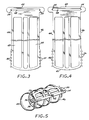
- FIG. 3 is a top view of an intraluminal stent having a plurality of teeth which constitute locking mechanisms when in the closed position.
- FIG. 4 is the intravascular stent of FIG. 3 wherein the plurality of teeth have moved outwardly into the locking position.
- FIG. 4A is the intravascular stent of FIG. 4 wherein portions of the stent are encapsulated by a polymeric coating.
- FIG. 5 is a perspective view of the intravascular stent of FIGS. 1 and 2 in which the stent has been rolled in a cylindrical configuration and the locking teeth have expanded into engagement with a slot.
- FIG. 6 is a top view of a plurality of interconnected intravascular stents with the plurality of teeth on each of the stent ends in the closed position.
- FIG. 7 depicts a top view of the intravascular stents of FIG. 4 wherein the plurality of teeth on each stent have opened outwardly for locking engagement.
- FIG. 8 is a top view of an intraluminal stent wherein separate stent sections are mounted on the stent structure.
- FIG. 9 is a top view of an intraluminal stent wherein separate stent sections each having a plurality of teeth in the closed position have been attached to the stent structure.
- FIG. 10 is a cross-sectional view taken along lines 10-10 depicting the stent section attached to the stent body.
- Acute thrombosis also is a result of vascular injury and requires systemic antithrombotic drugs and possibly thrombolytics as well. Such therapy can increase bleeding complications at the catheter insertion site and may result in a longer stay in the hospital.
- Sub-acute closure can be a result of thrombosis, as can be elastic recoil and/or vessel dissection.
- stents as yet are in a developmental stage, and are being used in clinical trials throughout the United States. The devices regularly are being implanted in patients in Europe and other countries. Generally stents can take numerous forms. The most common form, however, comprises a generally cylindrical hollow tube which holds open the vascular wall at the area that has been dilated by the dilatation catheter.
- stents are mounted on the balloon portion of catheter while in a contracted state and then are delivered intraluminally to the injured or damaged area.
- the balloon is expanded and it in turn expands the stent into engagement with the vascular wall.
- FIGS. 1 and 2 There is a wide range of catheter systems available to deploy these stents, two of which are depicted in FIGS. 1 and 2. In FIG. 1 a rapid exchange catheter system is depicted and in FIG. 2 an over-the-wire system is depicted.
- FIGS. 1 and 2 illustrate a stent delivery system which embodies features of the invention.
- the delivery system includes a delivery sheath 10 which has an outer lumen 11 and an intravascular catheter 12 disposed within the outer lumen 11.
- the intravascular catheter has an elongated catheter body 13 and a balloon 14 on the distal portion of the catheter body.
- a manipulating device 15 is provided on the distal end of the delivery system, which is employed to affect relative axial or longitudinal movement between the delivery sheath 10 and the intravascular catheter 12.
- the delivery sheath 10 has a distal port 17 in its distal end, which is in fluid communication with the outer lumen 11 and a proximal port 18 disposed proximally to the distal port.
- the distal portion of the delivery sheath 10 tapers down in a spherical-like manner so that the cross-sectional area is somewhat less in the distal region than it is in the other portions of the delivery sheath.
- a slit 19 extends from the proximal port 18 to a location just proximal to the distal port 17.
- the intravascular catheter 12 has a distal port 20 and a proximal port 21 which are in fluid communication with a first inner lumen 22 extending within the distal portion of the catheter 12.
- This first inner lumen 22 is adapted to slidably receive a guidewire therein.
- a slit 23 extends from the proximal port 21 to a location 24 proximal to the proximal end of balloon 14.
- the proximal end of the guidewire receiving first inner lumen 22 is provided with a ramp 25 to guide the proximal end of guidewire 26 out of the proximal port 21 of intravascular catheter 12 when the catheter is mounted onto the guidewire, as will be discussed hereinafter.
- a second, much longer, inner lumen 27 is provided within the catheter body 13, to direct inflation fluid from the proximal end of the catheter body to the interior of balloon 14.
- a stiffening member 28 Proximal to the proximal port 21 in the catheter body 13 is a stiffening member 28 which is disposed in a third inner lumen 29 provided within the catheter body 13. As shown in the drawings, the third inner lumen 29 and the first inner lumen 22 may be the same lumen with a plug 30 separating the two lumens.
- the ramp 25 is on the distal side of plug 30.
- the intravascular stent 16 will be implanted in the vascular system of a patient at the site of the diseased or injured area to provide sufficient blood flow through the vessel.
- the implanted stent 16 will aid in the prevention of restenosis, abrupt closure, and poor angiographic results.
- a guidewire 26 (or other guiding member) extends across the damaged section of the artery, while the proximal and of the guidewire 26 extends out of the patient during the entire procedure and is inserted through the distal port 20 in the distal end of the catheter 12 and advanced proximally through the first inner lumen 22 until the proximal end of the guidewire impacts the ramp 25 and is thereby directed through the proximal port 21.
- the intravascular catheter 12 preferably is positioned within the outer lumen 11 of the delivery sheath 10 so that at least a significant portion of the proximal port 18 in the sheath is in alignment with the proximal port 21 of the intravascular catheter. In this manner, proximal advancement of the guidewire 26 through the inner lumen 22 also will direct the proximal end of the guidewire out of the proximal port 18 in the delivery sheath. The proximal end of the guidewire 26 then manually may be held to maintain the position of the guidewire across the targeted area of deployment, while the catheter 12 and the stent 16 are advanced over the guidewire and through the vascular system of the patient.
- the advancement of the catheter system with the stent 16 mounted thereon continues until the distal ends of the catheter and sheath extend adjacent to, or across, the area targeted for deployment.
- the manipulator 15 on the proximal end of the delivery system is actuated to move the sheath 10 proximally with respect to the catheter 12 and to thereby expose the stent 16 which is mounted on the balloon 14.
- inflation fluid is directed under substantial pressure through the inflation lumen 27 in the catheter body 13 to the interior of the balloon 14, thereby expanding the balloon and simultaneously expanding the stent 16 against the vessel wall of the patient.
- the delivery systems, both the sheath 10 and the catheter 12 then are removed from the patient, along with the guidewire 26, leaving the expanded stent 16 pressed against the vessel wall.
- an over-the-wire catheter system is employed to deliver the stent 16 within the vasculature of the patient to the damaged area.
- a guidewire 26 is employed to cross a damaged area and to locate the position within the patient so that the intravascular catheter 12 can reach the diseased or damaged area.
- the intravascular catheter has an outer member 37 and an inner member 38 which are coaxially aligned.
- the inner member 38 has an inner lumen 39 which carries a guidewire 26.
- the guidewire can move freely within inner lumen 39 in an axial direction.
- the intravascular catheter is slidably disposed within the sheath 10 in the inner lumen 11.
- a port 17 at the distal end of sheath 10 provides an opening through which the catheter can extend.
- the method of deploying the stent 16 is similar to that described for the rapid exchange system above and as depicted in FIG. 2.
- the guidewire 26 is positioned at a location just past the targeted site of deployment and the catheter system is threaded over the guidewire 26 so that the balloon 14, along with the stent 16 is positioned at the targeted area.
- the balloon 14 is expanded radially outwardly to thereby expand and deploy the stent 16 by forcibly expanding it into the vessel wall.
- the balloon 14 then is deflated and the catheter system 12 is withdrawn from the vasculature of the patient leaving the stent 16 securely implanted in the damaged or injured area.
- the intravascular stent 16 is depicted as a flat sheet which can be manufactured in numerous ways, including by use of laser or chemical etchants.
- a pattern is cut from a sheet of metal by using a CO 2 laser or a Nd:YAG (neodymium:yttrium aluminumgarnet) laser to cut the pattern.
- a known etching process can be used to remove metal, leaving the pattern depicted in FIGS. 3 or 4. Both laser and chemical etchant processes are described in U.S. Serial No. 08/164,986, commonly assigned to Advanced Cardiovascular Systems, Inc.
- Other known methods of making the stent 16 include stamping and using a process of EDM (electronic discharge machining).
- the stent 16 depicted in FIG. 3 has a first edge 40 and a second edge 42, a third edge 44 and a fourth edge 46. It is desirable to have open spaces 49 cut within the stent body to allow more flexibility and to permit endothelial cell growth through the openings after the stent has been implanted and to allow for side branch flow and vessel wall oxygenation.
- the open spaces 49 can take any geometric shape as long as the expanded radial strength of the stent 16 is maintained.
- a plurality of the teeth 50 are formed along the third edge 44 and fourth edge 46 and appear in a closed position.
- the teeth 50 are desirably made from a shape-memory or super-elastic material such as nitinol (NiTi) (see FIG. 8).
- the remainder of the stent 16 can be made of known materials such as stainless steel, tantalum, polymers, or composites of these materials. Further, the closed teeth 50 can be attached to the third edge 44 and the fourth edge 46 by known means such as welding, brazing, staking, adhesives, or chemical bonding (see FIG. 8). It also is contemplated that all of the stent 16 can be made from a NiTi material, which would make the manufacturing process somewhat less complex.
- the stent 16 In order to deploy the stent 16 in the vasculature of a patient, the stent must be capable of being rolled into a cylindrical configuration having a relatively low profile for delivery through the vascular system. Thereafter, and as is described above, the balloon portion of a catheter will expand the stent 16 to an enlarged diameter whereafter it will press against the vessel wall and will remain open.
- the present invention provides fcr a stent that is capable of expanding in a controlled manner and locking after the stent has been expanded.
- portions of the stent of the present invention can be encapsulated by a polymeric material.
- the stent 16 may have a polymeric coating 57 on open teeth 56A, a first edge 40A, a third edge 44A, a fourth edge 46A, and longitudinal slot 48A. Further, the polymeric coating 57 can fill the openings 58. A plurality of holes 59 are formed in the polymeric coating 57 to provide more flexibility for the stent 16 and to provide more uniform expansion.
- the polymeric coating 57 can be comprised of poly-L-lactic acid (LPLA), poly-DL-lactic acid (DLPLA) or polycaprolactone (PCL) polymers, and the polymers can be infused or otherwise characterized by a therapeutic drug which diffuses into the body lumen of the patient at a controlled (predetermined) rate.
- LPLA poly-L-lactic acid
- DLPLA poly-DL-lactic acid
- PCL polycaprolactone
- the stent 16 is rolled into a cylindrical configuration by inserting the first edge 40 through the longitudinal slot 48.
- the closed teeth 50 will not engage the edges 54 of the longitudinal slot 48, since the teeth 50 are in a closed position and will simply slide past the edges 54.
- the stent can be mounted on a balloon portion of a catheter and the teeth 50 will not engage with the edges 54 during either the rolling process or the expansion process as is described further.
- the catheter is used to position the balloon and stent in the diseased or injured area. Thereafter, the balloon is expanded to expand the stent 16 radially outwardly and into contact with the vessel wall. As the closed teeth 50 move past the edges 54 and slide through the longitudinal slot 58, there is an even and uniform expansion of the stent because the teeth do not engage the edges. After fully expanding the stent, however, it is desirable to lock the stent in its fully-open position.
- the teeth 56 move into an open position as shown by the open teeth 56 in FIGS. 4 and 5.
- the teeth 56 move into an open position when heated to a specific, predetermined temperature.
- a heated saline solution or other fluid can be injected into the balloon, thereby heating the stent 16 and the teeth 56.
- Another method of heating includes injecting a heated saline solution into the body lumen at the site where the stent 16 is implanted.
- Other means to heat the stent 16 are available, such as using a thermal balloon device, using radio frequency waves to develop heat, or by using induction heating. Such heating methods are well known in the art.
- the increase in temperature causes the teeth to move from a closed position to an open position and thereby to engage with the edges 54 of the longitudinal slot 48.
- An advantage to the described embodiment is that it permits a more uniform and low-pressure expansion of the stent 16, without concern of the teeth 50 catching on the edges of the longitudinal slot and thereby disrupting the deployment and expansion of the stent. Further, because the teeth 50 are very small and susceptible to damage, the fact that the teeth are closed during the expansion process minimizes the risk of damaging the teeth as they pass through the longitudinal slot.
- the material considered best for the present stent is nitinol (NiTi).
- NiTi nitinol
- the shape-memory characteristics of nitinol metallurgically represents a crystalline transition from the martensitic phase to the austenitic phase.
- the recovery or transition temperature attendant upon the phase transition can be altered by making minor variations in the composition of the metal and in processing the material.
- biological temperature compatibility must be determined in order to select the correct transition temperature. In other words, when the stent is heated, it must not be so hot so that it is incompatible with the surrounding body tissue.
- the stent can be manufactured in several ways, including by a laser or by use of chemical etchants. Whatever process is used, the teeth will be annealed and formed so that they lay flush against the stent body in their closed position. The teeth then will be cooled to room temperature so that the teeth remain against the stent body until heated, after the stent is fully expanded and implanted in the vessel wall.
- irradiated memory polymers such as auto-crosslinkable high density polyethylene (HDPEX).
- HDPEX auto-crosslinkable high density polyethylene
- the invention has been depicted and described as a single stent having a cylindrical shape, a plurality of such stent strut components can be connected together to accomplish the same objective.
- the plurality of stent strut components 60 are interconnected yet have the same basic features as the stent 16 as described in FIGS. 2-5.
- the open areas 62 can take any form as shown in FIGS. 6 and 7, and can be similar to the open areas 49 as depicted in FIG. 3. Again, the open areas 62 provide greater flexibility to the stent as it is delivered on the balloon and subsequently is expanded to its enlarged diameter.
- the open areas 62 also provide for cell growth from the vessel wall into and over open areas so that a smooth cell structure eventually lines the inner wall of the stent to provide a restructured vessel.
- the open areas 62 also allow side branch flow and vessel wall oxygenation.
- stent strut components 60 can expand independently of one another and are flexible so that the stent can be implanted on a curved section of a patient's vasculature.
- the first edge 40 is inserted through the longitudinal slot 48 respectively for each of the stent strut components 60 depicted in FIG. 6.
- the closed teeth 50 are in a closed position and will not engage the edges 54 of the longitudinal slot, so that rolling and expansion can take place uniformly and without fear of damaging the teeth.
- the teeth are moved to an open position as depicted by the open teeth 52 in FIG. 7.
- the open teeth 52 will engage edges 54 of longitudinal slot 48 thereby locking the stent strut components 60 in a fully open and expanded position.
- nitinol may be used with the present invention.
- Firet a nitinol foil with SME (shape-memory effect) is heat treated at approximately 500°C.
- the teeth are mechanically deformed into the closed position so that the teeth remain closed until after the stent has been expanded and the temperature of the stent has been raised to a predetermined level.
- 45°C heat is applied and the teeth will return to an open position and will be locked into engagement with the longitudinal slot as described above.
- the application of 45°C of heat is compatible with most applications in the human body, but it is not to be limited to this temperature, as higher or lower temperatures are contemplated without departing from the invention.
- a second method includes providing a nitinol foil having SE properties (super-elastic properties) wherein the material is non-malleable and is heat treated to approximately 500°C.
- the teeth are deformed and set into a very hydrophilic structure such as hydrogel, glucose, acetate, starch, agar, or similar material.
- the teeth which engage the longitudinal slot are shown as a separate add-on section to the main stent.
- the stent 16 has several alignment holes 60 that correspond to the alignment holes 60 in teeth sections 63.
- the teeth sections 63 will overlay the stent 16 and are aligned thereon using a pin or other alignment tool inserted through the alignment hole 60.
- the teeth sections 63 are attached to the stent 60 by any conventional means such as welding, brazing, adhesives, and the like. Either before or after the teeth sections 63 are attached to the stent 16, the entire structure is laminated with a thin polymer coating which allows for local delivery of drugs loaded in the polymer.
- the teeth sections 63 can be formed from a nitinol or other shape-memory material such as that described above, while the stent 16 can be made from any of the materials referred to above such as stainless steel, tantalum, polymers, nitinol, and the like.
- the stent 16 is deployed and implanted in the same manner described above for the other embodiments disclosed. Since the teeth 50 are made from nitinol, they will expand upon application of heat and engage the longitudinal slot 48 in the same manner described above for the other embodiments.
- the thickness of the stent 16 and the teeth sections 63 can vary depending upon the application, however, they should be as thin as possible in order to provide a low profile for transport through the vascular system of the patient, yet be thick enough to maintain structural integrity when the stent is fully expanded.
- any of the aforementioned embodiments can be laminated according to the following process.
- the stent comprised of a nitinol foil having either SME or SE properties, is lased or etched into a specific configuration and thereafter heat treated in its flat condition at approximately 500°C.
- the structure is laminated with a polymer or similar substance at approximately 190°C.
- the polymer laminate is loaded with a therapeutic drug that will allow for localized drug delivery.
- the resulting structure can be lased again to refine the configuration, such as to cut the teeth or to cut various apertures so that the stent is more compatible with the biological environment in which it is deployed.
- the laminate coating is then removed from the teeth so that the nitinol metal is exposed.
- the teeth then are collapsed and the stent is rolled into a cylindrical configuration onto the balloon portion of a catheter for intraluminal delivery.
- the manufacturing processes as described herein can vary, including the temperatures employed and the types and combinations of various materials used. The foregoing methods of manufacture are described for example purposes only and are not meant to be limiting of the invention.
- the dimensions of the intravascular catheter described herein generally will follow the dimensions of intravascular catheters used in angioplasty procedures in the same arterial location.
- the length of a catheter for use in the coronary arteries is about 150 centimeters
- the outer diameter of the catheter shaft is about 0.89 millimeters (0.035 inch)
- the length of the balloon is typically about 2 centimeters
- the inflated diameter is approximately 1 to about 8 millimeters.
- the materials of construction may be selected from those used in conventional balloon angioplasty catheters.
- the delivery sheath generally will be slightly shorter than the intravascular catheter, e.g., by about the length of the manipulating device 15, with an inner diameter large enough to accommodate the intravascular catheter and to allow the catheter free longitudinal movement therein.
- the sheath and the catheter shaft can be made of conventional polyethylene tubing, or any other suitable material.
Landscapes
- Health & Medical Sciences (AREA)
- Engineering & Computer Science (AREA)
- Biomedical Technology (AREA)
- Cardiology (AREA)
- Oral & Maxillofacial Surgery (AREA)
- Transplantation (AREA)
- Heart & Thoracic Surgery (AREA)
- Vascular Medicine (AREA)
- Life Sciences & Earth Sciences (AREA)
- Animal Behavior & Ethology (AREA)
- General Health & Medical Sciences (AREA)
- Public Health (AREA)
- Veterinary Medicine (AREA)
- Media Introduction/Drainage Providing Device (AREA)
- Prostheses (AREA)
Applications Claiming Priority (2)
| Application Number | Priority Date | Filing Date | Title |
|---|---|---|---|
| US34061294A | 1994-11-16 | 1994-11-16 | |
| US340612 | 1994-11-16 |
Publications (2)
| Publication Number | Publication Date |
|---|---|
| EP0716835A2 true EP0716835A2 (de) | 1996-06-19 |
| EP0716835A3 EP0716835A3 (de) | 1997-06-11 |
Family
ID=23334174
Family Applications (1)
| Application Number | Title | Priority Date | Filing Date |
|---|---|---|---|
| EP95308211A Ceased EP0716835A3 (de) | 1994-11-16 | 1995-11-16 | Formgedächtnis-Sperrmechanismus für einen intravaskulären Stent |
Country Status (5)
| Country | Link |
|---|---|
| US (1) | US5827322A (de) |
| EP (1) | EP0716835A3 (de) |
| JP (1) | JP2940859B2 (de) |
| AU (1) | AU3783295A (de) |
| CA (1) | CA2162970C (de) |
Cited By (10)
| Publication number | Priority date | Publication date | Assignee | Title |
|---|---|---|---|---|
| EP0756853A1 (de) * | 1995-08-01 | 1997-02-05 | Advanced Cardiovascular Systems, Inc. | Aus Metall und Polymer zusammengesetzter Stent mit Verschluss zur Arzneistoffabgabe |
| EP0839503A1 (de) * | 1996-10-02 | 1998-05-06 | Navius Corporation | Stent |
| US5868781A (en) * | 1996-10-22 | 1999-02-09 | Scimed Life Systems, Inc. | Locking stent |
| WO1999018890A1 (en) * | 1997-10-15 | 1999-04-22 | Navius Corporation | Stent and method for making a stent |
| US6702849B1 (en) | 1999-12-13 | 2004-03-09 | Advanced Cardiovascular Systems, Inc. | Method of processing open-celled microcellular polymeric foams with controlled porosity for use as vascular grafts and stent covers |
| US6790226B2 (en) | 1995-03-10 | 2004-09-14 | Bard Peripheral Vascular, Inc. | Endoluminal prosthesis with support wire |
| WO2007047027A1 (en) * | 2005-10-17 | 2007-04-26 | Medtronic Vascular, Inc. | Intraluminal stent, delivery system, and method of treating a vascular condition |
| US8617441B2 (en) | 1995-03-10 | 2013-12-31 | Bard Peripheral Vascular, Inc. | Methods for making an encapsulated stent |
| US8617337B2 (en) | 1999-02-02 | 2013-12-31 | Bard Peripheral Vascular, Inc. | Partial encapsulation of stents |
| EP3050541B1 (de) | 2008-05-01 | 2019-08-14 | Edwards Lifesciences Corporation | Künstliche mitralklappenanordnung |
Families Citing this family (90)
| Publication number | Priority date | Publication date | Assignee | Title |
|---|---|---|---|---|
| US6579305B1 (en) * | 1995-12-07 | 2003-06-17 | Medtronic Ave, Inc. | Method and apparatus for delivery deployment and retrieval of a stent comprising shape-memory material |
| US6770092B2 (en) | 1996-05-03 | 2004-08-03 | Medinol Ltd. | Method of delivering a bifurcated stent |
| US7641685B2 (en) | 1996-05-03 | 2010-01-05 | Medinol Ltd. | System and method for delivering a bifurcated stent |
| US6440165B1 (en) * | 1996-05-03 | 2002-08-27 | Medinol, Ltd. | Bifurcated stent with improved side branch aperture and method of making same |
| US5993460A (en) * | 1998-03-27 | 1999-11-30 | Advanced Cardiovascular Systems, Inc. | Rapid exchange delivery system for stenting a body lumen |
| US6241762B1 (en) | 1998-03-30 | 2001-06-05 | Conor Medsystems, Inc. | Expandable medical device with ductile hinges |
| US20040254635A1 (en) | 1998-03-30 | 2004-12-16 | Shanley John F. | Expandable medical device for delivery of beneficial agent |
| US7208011B2 (en) | 2001-08-20 | 2007-04-24 | Conor Medsystems, Inc. | Implantable medical device with drug filled holes |
| US7208010B2 (en) | 2000-10-16 | 2007-04-24 | Conor Medsystems, Inc. | Expandable medical device for delivery of beneficial agent |
| AU3342399A (en) * | 1998-03-31 | 1999-10-18 | Salviac Limited | A delivery catheter |
| US6482217B1 (en) | 1998-04-10 | 2002-11-19 | Endicor Medical, Inc. | Neuro thrombectomy catheter |
| US6666874B2 (en) | 1998-04-10 | 2003-12-23 | Endicor Medical, Inc. | Rotational atherectomy system with serrated cutting tip |
| US6001112A (en) | 1998-04-10 | 1999-12-14 | Endicor Medical, Inc. | Rotational atherectomy device |
| US6293967B1 (en) | 1998-10-29 | 2001-09-25 | Conor Medsystems, Inc. | Expandable medical device with ductile hinges |
| US6317615B1 (en) | 1999-04-19 | 2001-11-13 | Cardiac Pacemakers, Inc. | Method and system for reducing arterial restenosis in the presence of an intravascular stent |
| US6245101B1 (en) | 1999-05-03 | 2001-06-12 | William J. Drasler | Intravascular hinge stent |
| US8016873B1 (en) | 1999-05-03 | 2011-09-13 | Drasler William J | Intravascular hinge stent |
| US6290673B1 (en) * | 1999-05-20 | 2001-09-18 | Conor Medsystems, Inc. | Expandable medical device delivery system and method |
| US7708749B2 (en) | 2000-12-20 | 2010-05-04 | Fox Hollow Technologies, Inc. | Debulking catheters and methods |
| US7713279B2 (en) | 2000-12-20 | 2010-05-11 | Fox Hollow Technologies, Inc. | Method and devices for cutting tissue |
| US6299622B1 (en) | 1999-08-19 | 2001-10-09 | Fox Hollow Technologies, Inc. | Atherectomy catheter with aligned imager |
| US8328829B2 (en) | 1999-08-19 | 2012-12-11 | Covidien Lp | High capacity debulking catheter with razor edge cutting window |
| US6312463B1 (en) | 2000-02-01 | 2001-11-06 | Endotex Interventional Systems, Inc. | Micro-porous mesh stent with hybrid structure |
| US6676698B2 (en) * | 2000-06-26 | 2004-01-13 | Rex Medicol, L.P. | Vascular device with valve for approximating vessel wall |
| US6695878B2 (en) * | 2000-06-26 | 2004-02-24 | Rex Medical, L.P. | Vascular device for valve leaflet apposition |
| US6808533B1 (en) | 2000-07-28 | 2004-10-26 | Atrium Medical Corporation | Covered stent and method of covering a stent |
| US6764507B2 (en) | 2000-10-16 | 2004-07-20 | Conor Medsystems, Inc. | Expandable medical device with improved spatial distribution |
| EP1582180B1 (de) | 2000-10-16 | 2008-02-27 | Conor Medsystems, Inc. | Expandierbare medizinische Vorrichtung zum Zuführen eines Heilmittels |
| JP2002136537A (ja) * | 2000-11-01 | 2002-05-14 | Aloka Co Ltd | 血管治療装置及び血管診断治療システム |
| JP4080874B2 (ja) | 2000-12-20 | 2008-04-23 | フォックス ハロウ テクノロジーズ,インコーポレイティド | 減嵩カテーテル |
| US6964680B2 (en) | 2001-02-05 | 2005-11-15 | Conor Medsystems, Inc. | Expandable medical device with tapered hinge |
| US20040073294A1 (en) | 2002-09-20 | 2004-04-15 | Conor Medsystems, Inc. | Method and apparatus for loading a beneficial agent into an expandable medical device |
| US6733525B2 (en) * | 2001-03-23 | 2004-05-11 | Edwards Lifesciences Corporation | Rolled minimally-invasive heart valves and methods of use |
| US7056338B2 (en) | 2003-03-28 | 2006-06-06 | Conor Medsystems, Inc. | Therapeutic agent delivery device with controlled therapeutic agent release rates |
| US20030077310A1 (en) | 2001-10-22 | 2003-04-24 | Chandrashekhar Pathak | Stent coatings containing HMG-CoA reductase inhibitors |
| US7147661B2 (en) * | 2001-12-20 | 2006-12-12 | Boston Scientific Santa Rosa Corp. | Radially expandable stent |
| US20100016943A1 (en) * | 2001-12-20 | 2010-01-21 | Trivascular2, Inc. | Method of delivering advanced endovascular graft |
| US20040034405A1 (en) * | 2002-07-26 | 2004-02-19 | Dickson Andrew M. | Axially expanding polymer stent |
| US6895282B2 (en) | 2002-10-04 | 2005-05-17 | Boston Scientific Scimed, Inc. | Induction heating for the delivery of thermal therapy |
| EP2289571B1 (de) | 2003-03-28 | 2016-08-03 | Innovational Holdings, LLC | Implantierbare medizinische vorrichtung mit kontinuerlichem gradienten einer therapeutischen substanz |
| US8246640B2 (en) | 2003-04-22 | 2012-08-21 | Tyco Healthcare Group Lp | Methods and devices for cutting tissue at a vascular location |
| US7169179B2 (en) | 2003-06-05 | 2007-01-30 | Conor Medsystems, Inc. | Drug delivery device and method for bi-directional drug delivery |
| US7785653B2 (en) | 2003-09-22 | 2010-08-31 | Innovational Holdings Llc | Method and apparatus for loading a beneficial agent into an expandable medical device |
| DE102004009237B3 (de) * | 2004-02-26 | 2005-09-22 | Siemens Ag | Vorrichtung zum Einbringen eines Stents in ein Hohlorgan |
| US7731740B2 (en) * | 2004-04-02 | 2010-06-08 | Arterial Remodelling Technologies, Inc. | Polymer-based stent assembly |
| USD516723S1 (en) | 2004-07-06 | 2006-03-07 | Conor Medsystems, Inc. | Stent wall structure |
| US8292944B2 (en) | 2004-12-17 | 2012-10-23 | Reva Medical, Inc. | Slide-and-lock stent |
| US9149378B2 (en) | 2005-08-02 | 2015-10-06 | Reva Medical, Inc. | Axially nested slide and lock expandable device |
| US20070276419A1 (en) | 2006-05-26 | 2007-11-29 | Fox Hollow Technologies, Inc. | Methods and devices for rotating an active element and an energy emitter on a catheter |
| US20080033524A1 (en) * | 2006-07-11 | 2008-02-07 | Gale David C | Heated balloon assembly for delivery of polymeric stents |
| WO2008011612A2 (en) * | 2006-07-20 | 2008-01-24 | Orbusneich Medical, Inc. | Bioabsorbable polymeric medical device |
| USD568476S1 (en) | 2006-10-27 | 2008-05-06 | Orbusneich Medical, Inc. | Interlocking tubular stent structure |
| US8460362B2 (en) * | 2006-07-20 | 2013-06-11 | Orbusneich Medical, Inc. | Bioabsorbable polymeric medical device |
| EP3009477B1 (de) | 2006-07-20 | 2024-01-24 | Orbusneich Medical Pte. Ltd | Bioresorbierbare polymerzusammensetzung für eine medizinische vorrichtung |
| USD597671S1 (en) | 2006-10-20 | 2009-08-04 | Orbusneich Medical, Inc. | Polymeric stent structure |
| US7959942B2 (en) * | 2006-10-20 | 2011-06-14 | Orbusneich Medical, Inc. | Bioabsorbable medical device with coating |
| CN101631513B (zh) | 2006-10-20 | 2013-06-05 | 奥巴斯尼茨医学公司 | 可生物吸收的聚合物组合物和医疗设备 |
| US20110130822A1 (en) * | 2007-07-20 | 2011-06-02 | Orbusneich Medical, Inc. | Bioabsorbable Polymeric Compositions and Medical Devices |
| US20100094405A1 (en) * | 2008-10-10 | 2010-04-15 | Orbusneich Medical, Inc. | Bioabsorbable Polymeric Medical Device |
| US8834551B2 (en) * | 2007-08-31 | 2014-09-16 | Rex Medical, L.P. | Vascular device with valve for approximating vessel wall |
| US9597172B2 (en) | 2007-09-28 | 2017-03-21 | W. L. Gore & Associates, Inc. | Retrieval catheter |
| WO2009070180A1 (en) | 2007-11-30 | 2009-06-04 | Reva Medical, Inc. | Axially-radially nested expandable device |
| US8784440B2 (en) | 2008-02-25 | 2014-07-22 | Covidien Lp | Methods and devices for cutting tissue |
| AU2009303347B2 (en) | 2008-10-10 | 2013-10-24 | Reva Medical, Inc. | Expandable slide and lock stent |
| CN102245125A (zh) * | 2008-10-11 | 2011-11-16 | 奥巴斯尼茨医学公司 | 生物可吸收聚合物组合物和医疗器材 |
| EP3275383A1 (de) | 2008-10-13 | 2018-01-31 | Covidien LP | Vorrichtungen und verfahren zur manipulation eines katheterschafts |
| AU2010241801B2 (en) | 2009-04-29 | 2013-04-11 | Covidien Lp | Methods and devices for cutting and abrading tissue |
| JP5281195B2 (ja) | 2009-05-14 | 2013-09-04 | コヴィディエン リミテッド パートナーシップ | 簡単に清掃され得るアテレクトミー用カテーテルおよび使用の方法 |
| JPWO2011021654A1 (ja) * | 2009-08-20 | 2013-01-24 | 学校法人 久留米大学 | ステント |
| BR112012013389A2 (pt) | 2009-12-02 | 2018-03-06 | Tyco Healthcare | métodos e dispositivos para o corte de um tecido |
| KR101398384B1 (ko) | 2009-12-11 | 2014-05-23 | 코비디엔 엘피 | 물질 포획 효율이 향상된 물질 제거 장치 및 사용 방법 |
| EP2558041B1 (de) | 2010-04-10 | 2018-01-10 | Reva Medical, Inc. | Dehnbarer schieber und verschlussstent |
| US9119662B2 (en) | 2010-06-14 | 2015-09-01 | Covidien Lp | Material removal device and method of use |
| US8367460B2 (en) | 2010-06-22 | 2013-02-05 | Micron Technology, Inc. | Horizontally oriented and vertically stacked memory cells |
| CN103200886B (zh) | 2010-10-28 | 2015-07-29 | 科维蒂恩有限合伙公司 | 物质移除装置和使用方法 |
| BR112013011632A2 (pt) | 2010-11-11 | 2016-08-09 | Covidien Lp | cateteres de citorredução flexíveis com imagiologia e métodos de uso e fabricação |
| WO2013033426A2 (en) | 2011-09-01 | 2013-03-07 | Covidien Lp | Catheter with helical drive shaft and methods of manufacture |
| US9168122B2 (en) | 2012-04-26 | 2015-10-27 | Rex Medical, L.P. | Vascular device and method for valve leaflet apposition |
| US9579157B2 (en) | 2012-09-13 | 2017-02-28 | Covidien Lp | Cleaning device for medical instrument and method of use |
| US9943329B2 (en) | 2012-11-08 | 2018-04-17 | Covidien Lp | Tissue-removing catheter with rotatable cutter |
| US9597110B2 (en) | 2012-11-08 | 2017-03-21 | Covidien Lp | Tissue-removing catheter including operational control mechanism |
| WO2014159337A1 (en) | 2013-03-14 | 2014-10-02 | Reva Medical, Inc. | Reduced - profile slide and lock stent |
| US9456843B2 (en) | 2014-02-03 | 2016-10-04 | Covidien Lp | Tissue-removing catheter including angular displacement sensor |
| US9526519B2 (en) | 2014-02-03 | 2016-12-27 | Covidien Lp | Tissue-removing catheter with improved angular tissue-removing positioning within body lumen |
| US9668861B2 (en) | 2014-03-15 | 2017-06-06 | Rex Medical, L.P. | Vascular device for treating venous valve insufficiency |
| WO2015200702A1 (en) | 2014-06-27 | 2015-12-30 | Covidien Lp | Cleaning device for catheter and catheter including the same |
| US10314667B2 (en) | 2015-03-25 | 2019-06-11 | Covidien Lp | Cleaning device for cleaning medical instrument |
| US10292721B2 (en) | 2015-07-20 | 2019-05-21 | Covidien Lp | Tissue-removing catheter including movable distal tip |
| US10314664B2 (en) | 2015-10-07 | 2019-06-11 | Covidien Lp | Tissue-removing catheter and tissue-removing element with depth stop |
| WO2017081704A1 (en) * | 2015-11-11 | 2017-05-18 | Council Of Scientific & Industrial Research | Radially self-expandable rolled up tubular stent |
Citations (6)
| Publication number | Priority date | Publication date | Assignee | Title |
|---|---|---|---|---|
| US4580568A (en) | 1984-10-01 | 1986-04-08 | Cook, Incorporated | Percutaneous endovascular stent and method for insertion thereof |
| US4776337A (en) | 1985-11-07 | 1988-10-11 | Expandable Grafts Partnership | Expandable intraluminal graft, and method and apparatus for implanting an expandable intraluminal graft |
| US4856516A (en) | 1989-01-09 | 1989-08-15 | Cordis Corporation | Endovascular stent apparatus and method |
| US5092877A (en) | 1988-09-01 | 1992-03-03 | Corvita Corporation | Radially expandable endoprosthesis |
| US5241093A (en) | 1991-01-18 | 1993-08-31 | Institut Francais Du Petrole | Process for preparing aluminophosphate compounds and substituted derivatives of the structural type vfi |
| US5292331A (en) | 1989-08-24 | 1994-03-08 | Applied Vascular Engineering, Inc. | Endovascular support device |
Family Cites Families (60)
| Publication number | Priority date | Publication date | Assignee | Title |
|---|---|---|---|---|
| US3174851A (en) * | 1961-12-01 | 1965-03-23 | William J Buehler | Nickel-base alloys |
| US3700434A (en) * | 1969-04-21 | 1972-10-24 | Stanley Abkowitz | Titanium-nickel alloy manufacturing methods |
| US3989552A (en) * | 1969-11-12 | 1976-11-02 | Fulmer Research Institute Limited | Method of making a heat-recoverable article |
| BE758862A (fr) * | 1969-11-12 | 1971-04-16 | Fulmer Res Inst Ltd | Perfectionnements relatifs au traitement d'alliages |
| US3753700A (en) * | 1970-07-02 | 1973-08-21 | Raychem Corp | Heat recoverable alloy |
| US3868956A (en) * | 1972-06-05 | 1975-03-04 | Ralph J Alfidi | Vessel implantable appliance and method of implanting it |
| US3913444A (en) * | 1972-11-08 | 1975-10-21 | Raychem Corp | Thermally deformable fastening pin |
| JPS53925B2 (de) * | 1974-05-04 | 1978-01-13 | ||
| US4036669A (en) * | 1975-02-18 | 1977-07-19 | Raychem Corporation | Mechanical preconditioning method |
| CH606456A5 (de) * | 1976-08-26 | 1978-10-31 | Bbc Brown Boveri & Cie | |
| US4304613A (en) * | 1980-05-12 | 1981-12-08 | The United States Of America As Represented By The Secretary Of The Navy | TiNi Base alloy shape memory enhancement through thermal and mechanical processing |
| US4282033A (en) * | 1980-06-16 | 1981-08-04 | The United States Of America As Represented By The Secretary Of The Navy | Melting method for high-homogeneity precise-composition nickel-titanium alloys |
| US4565589A (en) * | 1982-03-05 | 1986-01-21 | Raychem Corporation | Nickel/titanium/copper shape memory alloy |
| US5067957A (en) * | 1983-10-14 | 1991-11-26 | Raychem Corporation | Method of inserting medical devices incorporating SIM alloy elements |
| US4665906A (en) * | 1983-10-14 | 1987-05-19 | Raychem Corporation | Medical devices incorporating sim alloy elements |
| US4505767A (en) * | 1983-10-14 | 1985-03-19 | Raychem Corporation | Nickel/titanium/vanadium shape memory alloy |
| US5190546A (en) * | 1983-10-14 | 1993-03-02 | Raychem Corporation | Medical devices incorporating SIM alloy elements |
| US4533411A (en) * | 1983-11-15 | 1985-08-06 | Raychem Corporation | Method of processing nickel-titanium-base shape-memory alloys and structure |
| US4654092A (en) * | 1983-11-15 | 1987-03-31 | Raychem Corporation | Nickel-titanium-base shape-memory alloy composite structure |
| US4631094A (en) * | 1984-11-06 | 1986-12-23 | Raychem Corporation | Method of processing a nickel/titanium-based shape memory alloy and article produced therefrom |
| US4770725A (en) * | 1984-11-06 | 1988-09-13 | Raychem Corporation | Nickel/titanium/niobium shape memory alloy & article |
| US4740253A (en) * | 1985-10-07 | 1988-04-26 | Raychem Corporation | Method for preassembling a composite coupling |
| SE455834B (sv) * | 1986-10-31 | 1988-08-15 | Medinvent Sa | Anordning for transluminal implantation av en i huvudsak rorformig, radiellt expanderbar protes |
| JPH0665742B2 (ja) * | 1987-01-08 | 1994-08-24 | 株式会社ト−キン | 形状記憶TiNiV合金の製造方法 |
| JPS63238872A (ja) * | 1987-03-25 | 1988-10-04 | テルモ株式会社 | 管状器官内腔の内径確保用器具 |
| JP2769616B2 (ja) * | 1987-03-30 | 1998-06-25 | 時枝 直満 | 多結晶体の結晶方位再配列方法 |
| US4795458A (en) * | 1987-07-02 | 1989-01-03 | Regan Barrie F | Stent for use following balloon angioplasty |
| JPH088933B2 (ja) * | 1987-07-10 | 1996-01-31 | 日本ゼオン株式会社 | カテ−テル |
| US4984581A (en) * | 1988-10-12 | 1991-01-15 | Flexmedics Corporation | Flexible guide having two-way shape memory alloy |
| US4935068A (en) * | 1989-01-23 | 1990-06-19 | Raychem Corporation | Method of treating a sample of an alloy |
| CH678393A5 (de) * | 1989-01-26 | 1991-09-13 | Ulrich Prof Dr Med Sigwart | |
| JPH07103457B2 (ja) * | 1989-02-10 | 1995-11-08 | トミー株式会社 | 形状記憶合金製矯正ワイヤーの形態付与方法 |
| EP0395098B1 (de) * | 1989-04-28 | 1994-04-06 | Tokin Corporation | Schnell betriebsbereiter Führungsdraht für Katheter unter Anwendung einer Memory-Legierung mit Pseudoelastizität |
| US5120308A (en) * | 1989-05-03 | 1992-06-09 | Progressive Angioplasty Systems, Inc. | Catheter with high tactile guide wire |
| US4991602A (en) * | 1989-06-27 | 1991-02-12 | Flexmedics Corporation | Flexible guide wire with safety tip |
| KR910008004B1 (ko) * | 1989-09-19 | 1991-10-05 | 한국과학기술원 | 동(銅)을 기본으로 한 고강도 형상기억합금과 그 제조방법 |
| US5238004A (en) * | 1990-04-10 | 1993-08-24 | Boston Scientific Corporation | High elongation linear elastic guidewire |
| US5158548A (en) | 1990-04-25 | 1992-10-27 | Advanced Cardiovascular Systems, Inc. | Method and system for stent delivery |
| EP0491349B1 (de) * | 1990-12-18 | 1998-03-18 | Advanced Cardiovascular Systems, Inc. | Verfahren zur Herstellung eines super-elastischen Führungsteils |
| US5341818A (en) * | 1992-12-22 | 1994-08-30 | Advanced Cardiovascular Systems, Inc. | Guidewire with superelastic distal portion |
| US5231989A (en) * | 1991-02-15 | 1993-08-03 | Raychem Corporation | Steerable cannula |
| US5197978B1 (en) * | 1991-04-26 | 1996-05-28 | Advanced Coronary Tech | Removable heat-recoverable tissue supporting device |
| CA2069052A1 (en) * | 1991-05-21 | 1992-11-22 | L. Venkata Raman | Superelastic formable guidewire |
| US5219358A (en) * | 1991-08-29 | 1993-06-15 | Ethicon, Inc. | Shape memory effect surgical needles |
| CA2087132A1 (en) * | 1992-01-31 | 1993-08-01 | Michael S. Williams | Stent capable of attachment within a body lumen |
| US5271975A (en) * | 1992-02-28 | 1993-12-21 | Raychem Corporation | Heat recoverable tubular article |
| US5551871A (en) * | 1993-03-05 | 1996-09-03 | Besselink; Petrus A. | Temperature-sensitive medical/dental apparatus |
| US5365943A (en) * | 1993-03-12 | 1994-11-22 | C. R. Bard, Inc. | Anatomically matched steerable PTCA guidewire |
| US5356413A (en) * | 1993-03-12 | 1994-10-18 | Mitek Surgical Products, Inc. | Surgical anchor and method for deploying the same |
| US5372599A (en) * | 1993-03-12 | 1994-12-13 | Mitek Surgical Products, Inc. | Surgical anchor and method for deploying the same |
| US5318528A (en) * | 1993-04-13 | 1994-06-07 | Advanced Surgical Inc. | Steerable surgical devices |
| US5441515A (en) * | 1993-04-23 | 1995-08-15 | Advanced Cardiovascular Systems, Inc. | Ratcheting stent |
| US5409015A (en) * | 1993-05-11 | 1995-04-25 | Target Therapeutics, Inc. | Deformable tip super elastic guidewire |
| US5505735A (en) * | 1993-06-10 | 1996-04-09 | Mitek Surgical Products, Inc. | Surgical anchor and method for using the same |
| US5334168A (en) * | 1993-06-11 | 1994-08-02 | Catheter Research, Inc. | Variable shape guide apparatus |
| US5514115A (en) * | 1993-07-07 | 1996-05-07 | Device For Vascular Intervention, Inc. | Flexible housing for intracorporeal use |
| US5411549A (en) * | 1993-07-13 | 1995-05-02 | Scimed Life Systems, Inc. | Selectively expandable, retractable and removable stent |
| US5492119A (en) * | 1993-12-22 | 1996-02-20 | Heart Rhythm Technologies, Inc. | Catheter tip stabilizing apparatus |
| US5480383A (en) * | 1994-05-27 | 1996-01-02 | Advanced Cardiovascular Systems, Inc. | Dilation catheter with a smooth transition between a stiff proximal portion and a flexible distal portion |
| US5408932A (en) * | 1994-09-07 | 1995-04-25 | The United States Of America As Represented By The Secretary Of The Navy | Long rod extension system utilizing shape memory alloy |
-
1995
- 1995-11-14 AU AU37832/95A patent/AU3783295A/en not_active Abandoned
- 1995-11-15 CA CA002162970A patent/CA2162970C/en not_active Expired - Fee Related
- 1995-11-16 EP EP95308211A patent/EP0716835A3/de not_active Ceased
- 1995-11-16 JP JP33387295A patent/JP2940859B2/ja not_active Expired - Lifetime
-
1996
- 1996-09-20 US US08/717,324 patent/US5827322A/en not_active Expired - Lifetime
Patent Citations (7)
| Publication number | Priority date | Publication date | Assignee | Title |
|---|---|---|---|---|
| US4580568A (en) | 1984-10-01 | 1986-04-08 | Cook, Incorporated | Percutaneous endovascular stent and method for insertion thereof |
| US4776337A (en) | 1985-11-07 | 1988-10-11 | Expandable Grafts Partnership | Expandable intraluminal graft, and method and apparatus for implanting an expandable intraluminal graft |
| US4776337B1 (en) | 1985-11-07 | 2000-12-05 | Cordis Corp | Expandable intraluminal graft and method and apparatus for implanting an expandable intraluminal graft |
| US5092877A (en) | 1988-09-01 | 1992-03-03 | Corvita Corporation | Radially expandable endoprosthesis |
| US4856516A (en) | 1989-01-09 | 1989-08-15 | Cordis Corporation | Endovascular stent apparatus and method |
| US5292331A (en) | 1989-08-24 | 1994-03-08 | Applied Vascular Engineering, Inc. | Endovascular support device |
| US5241093A (en) | 1991-01-18 | 1993-08-31 | Institut Francais Du Petrole | Process for preparing aluminophosphate compounds and substituted derivatives of the structural type vfi |
Cited By (16)
| Publication number | Priority date | Publication date | Assignee | Title |
|---|---|---|---|---|
| US8337650B2 (en) | 1995-03-10 | 2012-12-25 | Bard Peripheral Vascular, Inc. | Methods for making a supported graft |
| US8647458B2 (en) | 1995-03-10 | 2014-02-11 | Bard Peripheral Vascular, Inc. | Methods for making a supported graft |
| US6790226B2 (en) | 1995-03-10 | 2004-09-14 | Bard Peripheral Vascular, Inc. | Endoluminal prosthesis with support wire |
| US8617441B2 (en) | 1995-03-10 | 2013-12-31 | Bard Peripheral Vascular, Inc. | Methods for making an encapsulated stent |
| US8157940B2 (en) | 1995-03-10 | 2012-04-17 | Bard Peripheral Vascular, Inc. | Methods for making a supported graft |
| EP0756853A1 (de) * | 1995-08-01 | 1997-02-05 | Advanced Cardiovascular Systems, Inc. | Aus Metall und Polymer zusammengesetzter Stent mit Verschluss zur Arzneistoffabgabe |
| EP0839503A1 (de) * | 1996-10-02 | 1998-05-06 | Navius Corporation | Stent |
| US5868781A (en) * | 1996-10-22 | 1999-02-09 | Scimed Life Systems, Inc. | Locking stent |
| US6022371A (en) * | 1996-10-22 | 2000-02-08 | Scimed Life Systems, Inc. | Locking stent |
| WO1999018890A1 (en) * | 1997-10-15 | 1999-04-22 | Navius Corporation | Stent and method for making a stent |
| US8617337B2 (en) | 1999-02-02 | 2013-12-31 | Bard Peripheral Vascular, Inc. | Partial encapsulation of stents |
| US10213328B2 (en) | 1999-02-02 | 2019-02-26 | Bard Peripheral Vascular, Inc. | Partial encapsulation of stents |
| US6702849B1 (en) | 1999-12-13 | 2004-03-09 | Advanced Cardiovascular Systems, Inc. | Method of processing open-celled microcellular polymeric foams with controlled porosity for use as vascular grafts and stent covers |
| US7749262B2 (en) | 2005-10-17 | 2010-07-06 | Medtronic Vascular, Inc. | Intraluminal stent delivery system, and method of treating a vascular condition |
| WO2007047027A1 (en) * | 2005-10-17 | 2007-04-26 | Medtronic Vascular, Inc. | Intraluminal stent, delivery system, and method of treating a vascular condition |
| EP3050541B1 (de) | 2008-05-01 | 2019-08-14 | Edwards Lifesciences Corporation | Künstliche mitralklappenanordnung |
Also Published As
| Publication number | Publication date |
|---|---|
| CA2162970C (en) | 2000-01-25 |
| EP0716835A3 (de) | 1997-06-11 |
| JPH08336598A (ja) | 1996-12-24 |
| AU3783295A (en) | 1996-05-23 |
| CA2162970A1 (en) | 1996-05-17 |
| JP2940859B2 (ja) | 1999-08-25 |
| US5827322A (en) | 1998-10-27 |
Similar Documents
| Publication | Publication Date | Title |
|---|---|---|
| CA2162970C (en) | Shape memory locking mechanism for intravascular stent | |
| EP1470798B1 (de) | Verfahren zur Stentretention mittels eines Klebstoffs | |
| US7335227B2 (en) | Multilayer stent | |
| US5911732A (en) | Articulated expandable intraluminal stent | |
| EP0712615B1 (de) | Arzneimittelenthaltende Manschette | |
| US5782907A (en) | Involuted spring stent and graft assembly and method of use | |
| US6010530A (en) | Self-expanding endoluminal prosthesis | |
| US5556413A (en) | Coiled stent with locking ends | |
| EP1017335B1 (de) | Nicht thrombogener stentmantel | |
| US6629992B2 (en) | Sheath for self-expanding stent | |
| US4739762A (en) | Expandable intraluminal graft, and method and apparatus for implanting an expandable intraluminal graft | |
| US5453090A (en) | Method of stent delivery through an elongate softenable sheath | |
| EP1755485B1 (de) | Verfahren und system zum festhalten eines stents mit einem klebstoff | |
| US6440162B1 (en) | Stent having increased scaffolding expandable bar arms | |
| JP2004531347A (ja) | 屈曲性および柔軟性が高いステント | |
| JP2001025508A (ja) | 内腔内人工器官搬送組立体及びその使用方法 | |
| WO2005067820A2 (en) | Ostium stent system | |
| WO2007051183A1 (en) | Flared stents and apparatus and methods for delivering them | |
| US20100241069A1 (en) | Ostial lesion stent delivery system | |
| CA2087132A1 (en) | Stent capable of attachment within a body lumen | |
| US6514284B1 (en) | Stent having inner flow channels | |
| AU722466B2 (en) | Shape memory locking mechanism for intravascular stent | |
| EP1472992A1 (de) | Verfahren und System zur Verbesserung der Stenthaftung mittels Stentöffnungen | |
| CA2204832A1 (en) | Expandable intraluminal graft or stent and method for implanting such an expandable intraluminal stent |
Legal Events
| Date | Code | Title | Description |
|---|---|---|---|
| PUAI | Public reference made under article 153(3) epc to a published international application that has entered the european phase |
Free format text: ORIGINAL CODE: 0009012 |
|
| AK | Designated contracting states |
Kind code of ref document: A2 Designated state(s): CH DE FR GB IT LI NL |
|
| PUAL | Search report despatched |
Free format text: ORIGINAL CODE: 0009013 |
|
| AK | Designated contracting states |
Kind code of ref document: A3 Designated state(s): CH DE FR GB IT LI NL |
|
| RHK1 | Main classification (correction) |
Ipc: A61F 2/02 |
|
| 17P | Request for examination filed |
Effective date: 19970609 |
|
| 17Q | First examination report despatched |
Effective date: 19990217 |
|
| GRAG | Despatch of communication of intention to grant |
Free format text: ORIGINAL CODE: EPIDOS AGRA |
|
| STAA | Information on the status of an ep patent application or granted ep patent |
Free format text: STATUS: THE APPLICATION HAS BEEN REFUSED |
|
| 18R | Application refused |
Effective date: 20001127 |