EP0716888B1 - Verfahren zum Zerlegen und sortenreinen Trennen von zu recyclierenden Verbundbauteilen - Google Patents
Verfahren zum Zerlegen und sortenreinen Trennen von zu recyclierenden Verbundbauteilen Download PDFInfo
- Publication number
- EP0716888B1 EP0716888B1 EP19940112347 EP94112347A EP0716888B1 EP 0716888 B1 EP0716888 B1 EP 0716888B1 EP 19940112347 EP19940112347 EP 19940112347 EP 94112347 A EP94112347 A EP 94112347A EP 0716888 B1 EP0716888 B1 EP 0716888B1
- Authority
- EP
- European Patent Office
- Prior art keywords
- fraction
- particles
- sorting
- separated
- foam
- Prior art date
- Legal status (The legal status is an assumption and is not a legal conclusion. Google has not performed a legal analysis and makes no representation as to the accuracy of the status listed.)
- Expired - Lifetime
Links
- 238000000034 method Methods 0.000 title claims description 61
- 239000002131 composite material Substances 0.000 title claims description 47
- 238000000926 separation method Methods 0.000 title claims description 28
- 238000000354 decomposition reaction Methods 0.000 title claims description 3
- 239000000463 material Substances 0.000 claims description 48
- 229920003023 plastic Polymers 0.000 claims description 33
- 239000004033 plastic Substances 0.000 claims description 33
- 230000008569 process Effects 0.000 claims description 30
- 239000002245 particle Substances 0.000 claims description 28
- XLYOFNOQVPJJNP-UHFFFAOYSA-N water Substances O XLYOFNOQVPJJNP-UHFFFAOYSA-N 0.000 claims description 14
- 239000011888 foil Substances 0.000 claims description 13
- 150000001875 compounds Chemical class 0.000 claims description 11
- 239000000243 solution Substances 0.000 claims description 7
- 239000002904 solvent Substances 0.000 claims description 7
- 239000007787 solid Substances 0.000 claims description 6
- FAPWRFPIFSIZLT-UHFFFAOYSA-M Sodium chloride Chemical compound [Na+].[Cl-] FAPWRFPIFSIZLT-UHFFFAOYSA-M 0.000 claims description 5
- ZWEHNKRNPOVVGH-UHFFFAOYSA-N 2-Butanone Chemical compound CCC(C)=O ZWEHNKRNPOVVGH-UHFFFAOYSA-N 0.000 claims description 4
- 239000012266 salt solution Substances 0.000 claims description 2
- 239000007767 bonding agent Substances 0.000 claims 2
- 239000008187 granular material Substances 0.000 claims 2
- 239000010408 film Substances 0.000 description 46
- 239000006260 foam Substances 0.000 description 39
- 101000620653 Homo sapiens Serine/threonine-protein phosphatase 5 Proteins 0.000 description 25
- 102100022346 Serine/threonine-protein phosphatase 5 Human genes 0.000 description 25
- 239000012876 carrier material Substances 0.000 description 21
- 239000004814 polyurethane Substances 0.000 description 17
- 239000002699 waste material Substances 0.000 description 14
- 229920000915 polyvinyl chloride Polymers 0.000 description 13
- 238000004064 recycling Methods 0.000 description 13
- 238000005520 cutting process Methods 0.000 description 12
- 238000004080 punching Methods 0.000 description 12
- 238000012545 processing Methods 0.000 description 11
- 238000011084 recovery Methods 0.000 description 11
- 239000002318 adhesion promoter Substances 0.000 description 9
- 239000000203 mixture Substances 0.000 description 9
- 238000010586 diagram Methods 0.000 description 8
- 230000008901 benefit Effects 0.000 description 7
- 239000006261 foam material Substances 0.000 description 7
- 230000029087 digestion Effects 0.000 description 6
- 230000007717 exclusion Effects 0.000 description 6
- 238000004519 manufacturing process Methods 0.000 description 6
- 239000004743 Polypropylene Substances 0.000 description 5
- 238000001035 drying Methods 0.000 description 5
- -1 e.g. Top coat Substances 0.000 description 4
- 239000000126 substance Substances 0.000 description 4
- 239000000853 adhesive Substances 0.000 description 3
- 230000001070 adhesive effect Effects 0.000 description 3
- 238000010835 comparative analysis Methods 0.000 description 3
- 230000000694 effects Effects 0.000 description 3
- 238000000227 grinding Methods 0.000 description 3
- 238000002347 injection Methods 0.000 description 3
- 239000007924 injection Substances 0.000 description 3
- 238000011068 loading method Methods 0.000 description 3
- 229920001155 polypropylene Polymers 0.000 description 3
- 239000004800 polyvinyl chloride Substances 0.000 description 3
- 238000003825 pressing Methods 0.000 description 3
- 229920005830 Polyurethane Foam Polymers 0.000 description 2
- NIXOWILDQLNWCW-UHFFFAOYSA-N acrylic acid group Chemical group C(C=C)(=O)O NIXOWILDQLNWCW-UHFFFAOYSA-N 0.000 description 2
- MTAZNLWOLGHBHU-UHFFFAOYSA-N butadiene-styrene rubber Chemical compound C=CC=C.C=CC1=CC=CC=C1 MTAZNLWOLGHBHU-UHFFFAOYSA-N 0.000 description 2
- 239000011246 composite particle Substances 0.000 description 2
- 238000001704 evaporation Methods 0.000 description 2
- 230000008020 evaporation Effects 0.000 description 2
- 238000001125 extrusion Methods 0.000 description 2
- 238000007667 floating Methods 0.000 description 2
- 230000008570 general process Effects 0.000 description 2
- 238000001746 injection moulding Methods 0.000 description 2
- 229920000642 polymer Polymers 0.000 description 2
- 229920002635 polyurethane Polymers 0.000 description 2
- 239000011496 polyurethane foam Substances 0.000 description 2
- 238000005406 washing Methods 0.000 description 2
- 230000001133 acceleration Effects 0.000 description 1
- 230000001464 adherent effect Effects 0.000 description 1
- 230000001174 ascending effect Effects 0.000 description 1
- 230000000052 comparative effect Effects 0.000 description 1
- 238000010276 construction Methods 0.000 description 1
- 238000011109 contamination Methods 0.000 description 1
- 238000007872 degassing Methods 0.000 description 1
- 230000001419 dependent effect Effects 0.000 description 1
- 238000013461 design Methods 0.000 description 1
- 238000011161 development Methods 0.000 description 1
- 230000018109 developmental process Effects 0.000 description 1
- 229920001971 elastomer Polymers 0.000 description 1
- 239000000806 elastomer Substances 0.000 description 1
- 238000005516 engineering process Methods 0.000 description 1
- 239000003344 environmental pollutant Substances 0.000 description 1
- 238000011156 evaluation Methods 0.000 description 1
- 238000005469 granulation Methods 0.000 description 1
- 230000003179 granulation Effects 0.000 description 1
- 230000005484 gravity Effects 0.000 description 1
- 230000002209 hydrophobic effect Effects 0.000 description 1
- 239000012535 impurity Substances 0.000 description 1
- 238000011835 investigation Methods 0.000 description 1
- 238000002372 labelling Methods 0.000 description 1
- 239000007788 liquid Substances 0.000 description 1
- 239000006148 magnetic separator Substances 0.000 description 1
- 238000002844 melting Methods 0.000 description 1
- 230000008018 melting Effects 0.000 description 1
- 239000002184 metal Substances 0.000 description 1
- 231100000719 pollutant Toxicity 0.000 description 1
- 229920006264 polyurethane film Polymers 0.000 description 1
- 238000001556 precipitation Methods 0.000 description 1
- 230000001737 promoting effect Effects 0.000 description 1
- 238000000197 pyrolysis Methods 0.000 description 1
- 238000009416 shuttering Methods 0.000 description 1
- 238000003797 solvolysis reaction Methods 0.000 description 1
- 239000000725 suspension Substances 0.000 description 1
- 230000008961 swelling Effects 0.000 description 1
- 239000000454 talc Substances 0.000 description 1
- 229910052623 talc Inorganic materials 0.000 description 1
- 238000012360 testing method Methods 0.000 description 1
- 229920001187 thermosetting polymer Polymers 0.000 description 1
Images




Classifications
-
- B—PERFORMING OPERATIONS; TRANSPORTING
- B29—WORKING OF PLASTICS; WORKING OF SUBSTANCES IN A PLASTIC STATE IN GENERAL
- B29B—PREPARATION OR PRETREATMENT OF THE MATERIAL TO BE SHAPED; MAKING GRANULES OR PREFORMS; RECOVERY OF PLASTICS OR OTHER CONSTITUENTS OF WASTE MATERIAL CONTAINING PLASTICS
- B29B17/00—Recovery of plastics or other constituents of waste material containing plastics
- B29B17/02—Separating plastics from other materials
-
- B—PERFORMING OPERATIONS; TRANSPORTING
- B03—SEPARATION OF SOLID MATERIALS USING LIQUIDS OR USING PNEUMATIC TABLES OR JIGS; MAGNETIC OR ELECTROSTATIC SEPARATION OF SOLID MATERIALS FROM SOLID MATERIALS OR FLUIDS; SEPARATION BY HIGH-VOLTAGE ELECTRIC FIELDS
- B03B—SEPARATING SOLID MATERIALS USING LIQUIDS OR USING PNEUMATIC TABLES OR JIGS
- B03B9/00—General arrangement of separating plant, e.g. flow sheets
- B03B9/06—General arrangement of separating plant, e.g. flow sheets specially adapted for refuse
- B03B9/061—General arrangement of separating plant, e.g. flow sheets specially adapted for refuse the refuse being industrial
-
- B—PERFORMING OPERATIONS; TRANSPORTING
- B07—SEPARATING SOLIDS FROM SOLIDS; SORTING
- B07B—SEPARATING SOLIDS FROM SOLIDS BY SIEVING, SCREENING, SIFTING OR BY USING GAS CURRENTS; SEPARATING BY OTHER DRY METHODS APPLICABLE TO BULK MATERIAL, e.g. LOOSE ARTICLES FIT TO BE HANDLED LIKE BULK MATERIAL
- B07B9/00—Combinations of apparatus for screening or sifting or for separating solids from solids using gas currents; General arrangement of plant, e.g. flow sheets
-
- B—PERFORMING OPERATIONS; TRANSPORTING
- B29—WORKING OF PLASTICS; WORKING OF SUBSTANCES IN A PLASTIC STATE IN GENERAL
- B29B—PREPARATION OR PRETREATMENT OF THE MATERIAL TO BE SHAPED; MAKING GRANULES OR PREFORMS; RECOVERY OF PLASTICS OR OTHER CONSTITUENTS OF WASTE MATERIAL CONTAINING PLASTICS
- B29B17/00—Recovery of plastics or other constituents of waste material containing plastics
- B29B17/04—Disintegrating plastics, e.g. by milling
- B29B17/0404—Disintegrating plastics, e.g. by milling to powder
-
- B—PERFORMING OPERATIONS; TRANSPORTING
- B29—WORKING OF PLASTICS; WORKING OF SUBSTANCES IN A PLASTIC STATE IN GENERAL
- B29B—PREPARATION OR PRETREATMENT OF THE MATERIAL TO BE SHAPED; MAKING GRANULES OR PREFORMS; RECOVERY OF PLASTICS OR OTHER CONSTITUENTS OF WASTE MATERIAL CONTAINING PLASTICS
- B29B17/00—Recovery of plastics or other constituents of waste material containing plastics
- B29B17/04—Disintegrating plastics, e.g. by milling
- B29B17/0412—Disintegrating plastics, e.g. by milling to large particles, e.g. beads, granules, flakes, slices
-
- B—PERFORMING OPERATIONS; TRANSPORTING
- B29—WORKING OF PLASTICS; WORKING OF SUBSTANCES IN A PLASTIC STATE IN GENERAL
- B29B—PREPARATION OR PRETREATMENT OF THE MATERIAL TO BE SHAPED; MAKING GRANULES OR PREFORMS; RECOVERY OF PLASTICS OR OTHER CONSTITUENTS OF WASTE MATERIAL CONTAINING PLASTICS
- B29B17/00—Recovery of plastics or other constituents of waste material containing plastics
- B29B17/02—Separating plastics from other materials
- B29B2017/0203—Separating plastics from plastics
-
- B—PERFORMING OPERATIONS; TRANSPORTING
- B29—WORKING OF PLASTICS; WORKING OF SUBSTANCES IN A PLASTIC STATE IN GENERAL
- B29B—PREPARATION OR PRETREATMENT OF THE MATERIAL TO BE SHAPED; MAKING GRANULES OR PREFORMS; RECOVERY OF PLASTICS OR OTHER CONSTITUENTS OF WASTE MATERIAL CONTAINING PLASTICS
- B29B17/00—Recovery of plastics or other constituents of waste material containing plastics
- B29B17/02—Separating plastics from other materials
- B29B2017/0213—Specific separating techniques
- B29B2017/0217—Mechanical separating techniques; devices therefor
- B29B2017/0231—Centrifugating, cyclones
-
- B—PERFORMING OPERATIONS; TRANSPORTING
- B29—WORKING OF PLASTICS; WORKING OF SUBSTANCES IN A PLASTIC STATE IN GENERAL
- B29B—PREPARATION OR PRETREATMENT OF THE MATERIAL TO BE SHAPED; MAKING GRANULES OR PREFORMS; RECOVERY OF PLASTICS OR OTHER CONSTITUENTS OF WASTE MATERIAL CONTAINING PLASTICS
- B29B17/00—Recovery of plastics or other constituents of waste material containing plastics
- B29B17/02—Separating plastics from other materials
- B29B2017/0213—Specific separating techniques
- B29B2017/0217—Mechanical separating techniques; devices therefor
- B29B2017/0234—Mechanical separating techniques; devices therefor using gravity, e.g. separating by weight differences in a wind sifter
-
- B—PERFORMING OPERATIONS; TRANSPORTING
- B29—WORKING OF PLASTICS; WORKING OF SUBSTANCES IN A PLASTIC STATE IN GENERAL
- B29B—PREPARATION OR PRETREATMENT OF THE MATERIAL TO BE SHAPED; MAKING GRANULES OR PREFORMS; RECOVERY OF PLASTICS OR OTHER CONSTITUENTS OF WASTE MATERIAL CONTAINING PLASTICS
- B29B17/00—Recovery of plastics or other constituents of waste material containing plastics
- B29B17/02—Separating plastics from other materials
- B29B2017/0213—Specific separating techniques
- B29B2017/0217—Mechanical separating techniques; devices therefor
- B29B2017/0237—Mechanical separating techniques; devices therefor using density difference
- B29B2017/0244—Mechanical separating techniques; devices therefor using density difference in liquids
-
- B—PERFORMING OPERATIONS; TRANSPORTING
- B29—WORKING OF PLASTICS; WORKING OF SUBSTANCES IN A PLASTIC STATE IN GENERAL
- B29B—PREPARATION OR PRETREATMENT OF THE MATERIAL TO BE SHAPED; MAKING GRANULES OR PREFORMS; RECOVERY OF PLASTICS OR OTHER CONSTITUENTS OF WASTE MATERIAL CONTAINING PLASTICS
- B29B17/00—Recovery of plastics or other constituents of waste material containing plastics
- B29B17/02—Separating plastics from other materials
- B29B2017/0213—Specific separating techniques
- B29B2017/0293—Dissolving the materials in gases or liquids
-
- B—PERFORMING OPERATIONS; TRANSPORTING
- B29—WORKING OF PLASTICS; WORKING OF SUBSTANCES IN A PLASTIC STATE IN GENERAL
- B29B—PREPARATION OR PRETREATMENT OF THE MATERIAL TO BE SHAPED; MAKING GRANULES OR PREFORMS; RECOVERY OF PLASTICS OR OTHER CONSTITUENTS OF WASTE MATERIAL CONTAINING PLASTICS
- B29B17/00—Recovery of plastics or other constituents of waste material containing plastics
- B29B17/04—Disintegrating plastics, e.g. by milling
- B29B2017/0424—Specific disintegrating techniques; devices therefor
- B29B2017/0488—Hammers or beaters
-
- B—PERFORMING OPERATIONS; TRANSPORTING
- B29—WORKING OF PLASTICS; WORKING OF SUBSTANCES IN A PLASTIC STATE IN GENERAL
- B29B—PREPARATION OR PRETREATMENT OF THE MATERIAL TO BE SHAPED; MAKING GRANULES OR PREFORMS; RECOVERY OF PLASTICS OR OTHER CONSTITUENTS OF WASTE MATERIAL CONTAINING PLASTICS
- B29B17/00—Recovery of plastics or other constituents of waste material containing plastics
- B29B17/04—Disintegrating plastics, e.g. by milling
- B29B2017/0424—Specific disintegrating techniques; devices therefor
- B29B2017/0492—Projecting the material on stationary or moving impact surfaces or plates
-
- B—PERFORMING OPERATIONS; TRANSPORTING
- B29—WORKING OF PLASTICS; WORKING OF SUBSTANCES IN A PLASTIC STATE IN GENERAL
- B29K—INDEXING SCHEME ASSOCIATED WITH SUBCLASSES B29B, B29C OR B29D, RELATING TO MOULDING MATERIALS OR TO MATERIALS FOR MOULDS, REINFORCEMENTS, FILLERS OR PREFORMED PARTS, e.g. INSERTS
- B29K2023/00—Use of polyalkenes or derivatives thereof as moulding material
- B29K2023/10—Polymers of propylene
- B29K2023/12—PP, i.e. polypropylene
-
- B—PERFORMING OPERATIONS; TRANSPORTING
- B29—WORKING OF PLASTICS; WORKING OF SUBSTANCES IN A PLASTIC STATE IN GENERAL
- B29K—INDEXING SCHEME ASSOCIATED WITH SUBCLASSES B29B, B29C OR B29D, RELATING TO MOULDING MATERIALS OR TO MATERIALS FOR MOULDS, REINFORCEMENTS, FILLERS OR PREFORMED PARTS, e.g. INSERTS
- B29K2027/00—Use of polyvinylhalogenides or derivatives thereof as moulding material
- B29K2027/06—PVC, i.e. polyvinylchloride
-
- B—PERFORMING OPERATIONS; TRANSPORTING
- B29—WORKING OF PLASTICS; WORKING OF SUBSTANCES IN A PLASTIC STATE IN GENERAL
- B29K—INDEXING SCHEME ASSOCIATED WITH SUBCLASSES B29B, B29C OR B29D, RELATING TO MOULDING MATERIALS OR TO MATERIALS FOR MOULDS, REINFORCEMENTS, FILLERS OR PREFORMED PARTS, e.g. INSERTS
- B29K2055/00—Use of specific polymers obtained by polymerisation reactions only involving carbon-to-carbon unsaturated bonds, not provided for in a single one of main groups B29K2023/00 - B29K2049/00, e.g. having a vinyl group, as moulding material
- B29K2055/02—ABS polymers, i.e. acrylonitrile-butadiene-styrene polymers
-
- B—PERFORMING OPERATIONS; TRANSPORTING
- B29—WORKING OF PLASTICS; WORKING OF SUBSTANCES IN A PLASTIC STATE IN GENERAL
- B29K—INDEXING SCHEME ASSOCIATED WITH SUBCLASSES B29B, B29C OR B29D, RELATING TO MOULDING MATERIALS OR TO MATERIALS FOR MOULDS, REINFORCEMENTS, FILLERS OR PREFORMED PARTS, e.g. INSERTS
- B29K2075/00—Use of PU, i.e. polyureas or polyurethanes or derivatives thereof, as moulding material
-
- B—PERFORMING OPERATIONS; TRANSPORTING
- B29—WORKING OF PLASTICS; WORKING OF SUBSTANCES IN A PLASTIC STATE IN GENERAL
- B29K—INDEXING SCHEME ASSOCIATED WITH SUBCLASSES B29B, B29C OR B29D, RELATING TO MOULDING MATERIALS OR TO MATERIALS FOR MOULDS, REINFORCEMENTS, FILLERS OR PREFORMED PARTS, e.g. INSERTS
- B29K2105/00—Condition, form or state of moulded material or of the material to be shaped
- B29K2105/04—Condition, form or state of moulded material or of the material to be shaped cellular or porous
-
- B—PERFORMING OPERATIONS; TRANSPORTING
- B29—WORKING OF PLASTICS; WORKING OF SUBSTANCES IN A PLASTIC STATE IN GENERAL
- B29L—INDEXING SCHEME ASSOCIATED WITH SUBCLASS B29C, RELATING TO PARTICULAR ARTICLES
- B29L2007/00—Flat articles, e.g. films or sheets
- B29L2007/008—Wide strips, e.g. films, webs
-
- B—PERFORMING OPERATIONS; TRANSPORTING
- B29—WORKING OF PLASTICS; WORKING OF SUBSTANCES IN A PLASTIC STATE IN GENERAL
- B29L—INDEXING SCHEME ASSOCIATED WITH SUBCLASS B29C, RELATING TO PARTICULAR ARTICLES
- B29L2009/00—Layered products
-
- Y—GENERAL TAGGING OF NEW TECHNOLOGICAL DEVELOPMENTS; GENERAL TAGGING OF CROSS-SECTIONAL TECHNOLOGIES SPANNING OVER SEVERAL SECTIONS OF THE IPC; TECHNICAL SUBJECTS COVERED BY FORMER USPC CROSS-REFERENCE ART COLLECTIONS [XRACs] AND DIGESTS
- Y02—TECHNOLOGIES OR APPLICATIONS FOR MITIGATION OR ADAPTATION AGAINST CLIMATE CHANGE
- Y02W—CLIMATE CHANGE MITIGATION TECHNOLOGIES RELATED TO WASTEWATER TREATMENT OR WASTE MANAGEMENT
- Y02W30/00—Technologies for solid waste management
- Y02W30/50—Reuse, recycling or recovery technologies
- Y02W30/52—Mechanical processing of waste for the recovery of materials, e.g. crushing, shredding, separation or disassembly
-
- Y—GENERAL TAGGING OF NEW TECHNOLOGICAL DEVELOPMENTS; GENERAL TAGGING OF CROSS-SECTIONAL TECHNOLOGIES SPANNING OVER SEVERAL SECTIONS OF THE IPC; TECHNICAL SUBJECTS COVERED BY FORMER USPC CROSS-REFERENCE ART COLLECTIONS [XRACs] AND DIGESTS
- Y02—TECHNOLOGIES OR APPLICATIONS FOR MITIGATION OR ADAPTATION AGAINST CLIMATE CHANGE
- Y02W—CLIMATE CHANGE MITIGATION TECHNOLOGIES RELATED TO WASTEWATER TREATMENT OR WASTE MANAGEMENT
- Y02W30/00—Technologies for solid waste management
- Y02W30/50—Reuse, recycling or recovery technologies
- Y02W30/62—Plastics recycling; Rubber recycling
Definitions
- the invention relates to a method for disassembling and sorting separated from recyclable Three-component composite parts with the largest mass fraction and the carrier forming hard plastic (PP-T 30), an intermediate layer adhered to the carrier made of foam and a flexible film adhered to the outside of the latter, by using the composite parts in at least one working step to form an unseparated composite pre-shredded in a cutting mill with a sieve insert, then machine-made into a separate composite crushed and the resulting material fractions of at least one material sorting subjected, separated and then eliminated from the process and / or to be processed further.
- PP-T 30 carrier forming hard plastic
- a known from DE 42 16 638 method of the type mentioned should ensure that all the plastic components involved in one for reuse let usable grade of variety be separated without inferior or non-reusable and therefore to be disposed of Mixed fractions occur and without making changes on the recyclables that are reusable impair or even make impossible.
- EP 4 22 460 A also describes methods for dividing and sorting the different plastics from Punching waste from vehicle dashboards made from a Base layer made of hydrophilic polyurethane foam and one associated outer skin made of hydrophobic PVC film consist. After that, after a mechanical crushing under the influence of water the PUR foam swell and detach from the film. As problematic can turn out in this known method, whether the forces caused by those with water Swelling of the foam residues on the adhesive connection can be exercised between foam and film, in Given the elasticity and compressibility of the Foam will be enough to make the much higher To be able to overcome adhesive forces.
- the invention is therefore based on the object of a method of the type mentioned at the beginning shape that compared to the prior art, a more effective decomposition and pure Separation of three-component composite components to be recycled, taking into account the previously mentioned specifications can be achieved.
- the key performance indicators relevant to the specified targets can be determined from the following tables A and B and the material can be sorted according to the criteria from the following table C.
- the separation and / or further processing of the resulting material fractions can be carried out taking into account the exclusion criteria according to Table D.
- Exclusion criteria for the processing processes Exclusion criteria Extrusion with granulation Max. Grain size ⁇ 12mm Impurities no metal, non-melting substances thermosets / elastomers Max. Share 5% Residual moisture ⁇ 2-4% Foreign substances
- the method according to the invention proves to be particularly advantageous in that that taking into account the specifications a compared to the booth technology, higher benefits can be achieved, with the resulting Material qualities such a starting position create a new processing (possibly with upgrading measures integrated therein) in higher quality Products is possible.
- the composite components may be old parts scrapping vehicles or rejects from the Production or also punching waste during production act as composite components. It is on it to point out that - especially with old products - dependent on the degree of pollution - the described process chains with "wet" process steps are preferable.
- the product structure essentially determines the number and type of the machines and processes for separation in question of the association.
- For use on composite components oriented assessment procedure will be a division of the Recycling routes made in sub-areas. These subareas are group separation, sorting, additional processes (e.g. washing or drying) and processing.
- To determine practice-relevant process steps in accordance with The invention will be used in the comparative evaluation of these sub-areas of effort and benefit assigned exclusion criteria used with which First of all, it is possible to create rough process diagrams. A selection can then be made based on selection criteria Refinement of the flow diagrams take place. Not available Data for implementation and evaluation are based on examples from production with practical Investigations determined. The effort is assessed using a point system made, the difference from a point assigned to a certain cost range is. In this way, the performance indicators result.
- FIG. 2 shows a partial cross section through the Slide 2 assumes that it is the slide 2 around a three-layer composite component with a top coat layer 5, a layer of e.g. a mixture of Acrylbutadienstyrol (ABS) and polyvinyl chloride (PVC) 6 and one Adhesion layer 7 acts.
- ABS Acrylbutadienstyrol
- PVC polyvinyl chloride
- 3 gives a process chain in the form of a flow diagram again, which is suitable the backing material as the material with the highest percentage by mass to be recovered in the product in single-variety form.
- 2 is punching waste with a carrier made of hard plastic (PP-T 30) too coarse by machine using a cutting mill pre-crushed ground composite particles (unseparated composite), which are then closed using a hammer mill a regrind made of hard plastic (PP-T 30) crumbs and coarser particle remnants are processed (separate Composite), whereupon from the one forming the separate composite Grind the hard plastic (PP-T 30) crumbs using a Zigzag sifter leaving a mixed fraction be recovered according to type.
- So 4a and 4b each go in the form of a flow diagram further process chains emerge, which are suitable for foam and carrier material or To recover film and carrier material according to type.
- So 4a is punching waste with a carrier made of hard plastic (PP-T 30) using a granulator with a sieve insert to coarsely ground composite particles (unseparated Composite), which is then shredded another granulator with sieve insert into one Grist from hard plastic (PP-T 30) crumbs and coarser Particle remnants (separate composite) are processed. From the regrind that forms the separate bond then the hard plastic (PP-T 30) crumbs using of a zigzag sifter, leaving a mixed fraction recovered by type.
- the carrier material is obtained with high yield and high degree of purity.
- the left mixed fraction representing the light goods becomes a sorting centrifuge in a further sorting step supplied, water being used as the separation medium and pure PUR foam recovered becomes.
- 4b is also used Punching waste e.g. from the production of a dashboard body with a carrier made of hard plastic (PP-T 30) using a granulator with a sieve insert Coarse regrind pre-crushed by machine (unseparated composite).
- the strategic goal here is the recovery of Carrier material and film in single-variety form.
- the machine is shredded by means of a modified hammer mill with suction. At this mechanical crushing in the hammer mill is a batch operation, the loading of the Grinding room takes place on such a scale that predominantly the foam is crushed and the film and the carrier material increases the effect of the shuttering of the foam comes into play and the smaller foam particles with the help of a sieve insert a suction can be removed.
- the coarser parts of the Mixed fraction which mainly contains film and carrier material, are opened in batches by opening a discharge flap removed from the hammer mill.
- a zigzag sifter is used for the film and carrier material, where as the property differences in particular Differences in shape can be exploited.
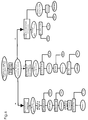
- FIG. 5 schematically shows a general process chain for products of the structure according to FIGS. 1 and 2 using the example of punching waste.
- Mechanical shredding as a measure of compound separation should in the said composite component either be carried out with shredders that according to Impact or impact stress work (preferably Speeds of over 1000 revolutions per minute and Sieve insert with hammer mill with hole width diameter not over 12 mm or with an impact mill with an impact surface grinding track for example with 1/4 division and a gap width over 7.5 mm but under 12 mm or cutting mill (Cutting as a type of stress), with a sieve insert is to be used, the hole width diameter preferably at Should be 5 or 6 mm.
- the choice of the shredder is geared towards the subsequent material sorting steps. When using a free fall separator or Compound separation is preferred in a sorting centrifuge to carry out with the mentioned cutting mill comminution.
- the degree of digestion degree of separation is in the Magnitude of 98% and higher.
- An additional process is necessary if it is for use following sorting procedure necessary prerequisites are not fulfilled, as is the case e.g. Using a free fall separator is the case (prerequisite: Residual moisture well below 1%, i.e. optionally drying process as well as a pretreatment to make up differences in triboelectric Charging behavior of the materials influence or reinforce, as well as grain size ⁇ 8 mm, i.e. possibly additional crushing process).
- the number of material sorting steps required depends on the strategy; for strategy film, foam and carrier material in as pure a sort as possible to recover, a maximum of three sorting steps are required.
- the separation of the carrier material here PP-T 30
- the separation of the carrier material should be preferred when using a "dry process" done with a zigzag sifter, the composite separation with a shredding machine, which after impact or. Impact stress works, or with a cutting mill can be done.
- Example: Sorting with a free fall separator is particularly suitable for sorting one Fraction consisting mainly of PP-T 30 and PVC / ABS film exists because the triboelectric charge is in opposite directions. The above Requirements must be met, as well as the PUR foam must be separated by another process got to.
- FIG. 6a shows a process chain for the recovery of Foil, foam and carrier material in sorted form from a stamped scrap with a carrier made of hard plastic (PP-T 30), with which a material recycling with Reuse and reuse can be done.
- a material recycling with Reuse and reuse can be done.
- For A granulator with sieve insert is used for pre-shredding Influencing the maximum grain size used.
- the use of a perforated screen should be the hole width diameter are in the range of 20 to 30 mm.
- the pre-shredding represents an additional process, which has the advantage that at a subsequent crushing step a smaller one Machine type that can only be used on the desired throughput and not due to the otherwise available piece size must be oversized. A compound separation is not connected to it.
- the subsequent mechanical crushing step serves to separate the bond (digestion).
- a comminution machine can be used, which - as is the case with a hammer mill - causes the breakage due to an impact load. Under certain conditions, a good degree of digestion is achieved with 98% and higher.
- a sieve insert should be used. The decisive prerequisites for the high degree of digestion are the use of a sieve insert and the selected speed range. When using a perforated screen, the hole width diameter should not exceed 12 mm. The hammer mill should be operated at relatively high rotor speeds. Successful test results were achieved at revolutions above 1000 min -1 .
- the result of the mechanical crushing mixed material fraction is a first sorting step fed to the PP-T 30 from the carrier in high To obtain yield and with a high degree of purity.
- To the Sorting has a number of methods available based on the exploitation of various property differences with regard to the product structure with the separating materials.
- To sort materials to achieve through wind sifting the ones to be separated Materials in density and / or grain shape and / or grain size differentiate.
- a suitable method is Wind sifting, with a special zigzag sifter is used as it is shown schematically in FIG. 12 emerges. It is a vertical tube with a more or less large number of kinks, with air flowing through it from below.
- the one to be separated It is well fed from above or at one of the kinks.
- its structure is shown schematically in FIG. 12 and is used conventionally for material sorting is a zigzag sifter not a gravity sighting, but a sighting in so-called "vortex rolls".
- Vortex rolls At every bend in the pipe creates a "vortex roller” in which there is a viewing process plays.
- a laminar, low vortex flow like the one in Fig. 12 schematically shown upwind and riser sifter is therefore in accordance with the zigzag sifter Fig. 13 not before.
- the shape influence the sorting process support, but also limit it; the latter then when the particle shape compensates for the density difference.
- the light fraction of polyurethane foam and film sorting is, as explained above, a wind sifter not suitable because the property differences of Compensate geometry and density in such a sorting device and thus a successful separation due to the resulting similar behavior is not possible is.
- a suitable method for sorting the use of an aero stove its sorting principle essentially on the exploitation of density differences is based.
- the material mixture to be sorted arrives at the aero hearth via a product inlet to the resonating Feeding device and is there on the machine width distributed and placed on the inclined sieve. On the the product is fluidized and separated according to the specific weight.
- the lighter foam particles migrate to the lower one Screen edge as a stove bottom, while the fraction, the predominantly film particles but also incorrect discharge of PP-T 30 - contains carrier material as a stove overflow the higher sieve edge is discharged.
- the sorting stage is especially the PUR foam high yield and variety purity recovered.
- the third sorting process is said to be optimized for recovery the film can be carried out in single-variety form. It can can be assumed that in particular the in the overflow fraction of the incorrect discharge of PP-T 30 must be removed.
- a zigzag sifter can be used are used, as can be seen from Fig. 6a.
- the process chain according to the invention which is shown in FIG. 6b, is also based as a strategic goal on the recovery of carrier material, film and foam in sorted form when using punching waste from the manufacture of the dashboard base body, which as a composite component according to FIG. 1 with a carrier made of hard plastic (PP T 30) is constructed.
- the mechanical comminution takes place for compound separation with a cutting mill with a sieve insert. Good results of the degree of digestion are obtained when using a sieve insert with round perforations and a hole width diameter of 6 mm.
- the resulting comminution fraction in which the various materials are mixed, is subsequently introduced into the sorting centrifuge for sorting.
- the mixed fraction to be separated is fed as a suspension axially into the centrifuge through a standing tube and hits the surface of the water ring rotating at high speed (up to 1500 times acceleration).
- the result is a floating fraction made of PUR foam with a very high degree of purity.
- the sink fraction is returned to the sorting centrifuge for further sorting.
- a salt solution is used as the separation medium, the density of which is set to the order of 1.14 g / cm 3 .
- a saline solution should preferably be used.
- the film is obtained as a sink fraction with a high yield and a high degree of purity.
- the floating fraction which in addition to the large proportion of PP-T 30 also has a higher proportion of PUR foam, is dried and fed to a zigzag sifter. The air flow is adjusted so that the PUR foam is discharged as a light fraction at the top.
- the process chain according to FIG. 6c is also strategic Aim to recover carrier material, film and foam in pure form when using Stamping waste from the manufacture of the dashboard base, with the composite component according to FIG. 1 a carrier made of hard plastic (PP-T 30), underlying.
- a carrier made of hard plastic P-T 30
- the coarser parts the mixed fraction, the predominantly film and carrier material is included in batches by opening a discharge flap removed from the hammer mill.
- a zigzag sifter is used for the film and carrier material, where as a property difference in particular Differences in shape can be exploited.
- For the recovery of PUR foam in pure form is the extracted Fraction fed to a sorting step with an aero stove.
- Fig. 7 includes a schematic representation that the Explanation of for the determination of the performance indicators the comparative assessment on which the procedure is based serves, the goal being the determination of practice-relevant Recycling routes for the sort recovery of film, Foam and carrier material when using dashboard punch waste made of PP-T 30, PVC / ABS and PUR. 7, are first of all the possibilities of composite separation such as mechanical Crushing, disassembly, rough disassembly, the Possibilities of material sorting according to density, triboelectric Charging or magnetic behavior and the Processing options such as material recycling or to consider chemical recycling.
- FIG. 8 are the exclusion criteria (ASK) for the applicability of measures for composite separation (VT), material sorting (WS) and processing in the left half and a rough flow chart indicated in the right half, the representation in the left half in FIG. 8 essentially corresponds to FIG. 7.
- ASK exclusion criteria
- VT measure for composite separation
- WS material sorting
- FIG. 7 essentially corresponds to FIG. 7.
- the heavy fraction is sorted in a second stage again about the density of the materials in one Heavy fraction and a light fraction sorted.
- the processing the heavy fraction is then injection molded in injection molded parts, while the light fraction of the first and second sorting stages by pressing into plates or processed into sheets by extrusion.
- ASK The selection criteria for the Implementation of measures for composite separation
- VT Material sorting
- WS Material sorting
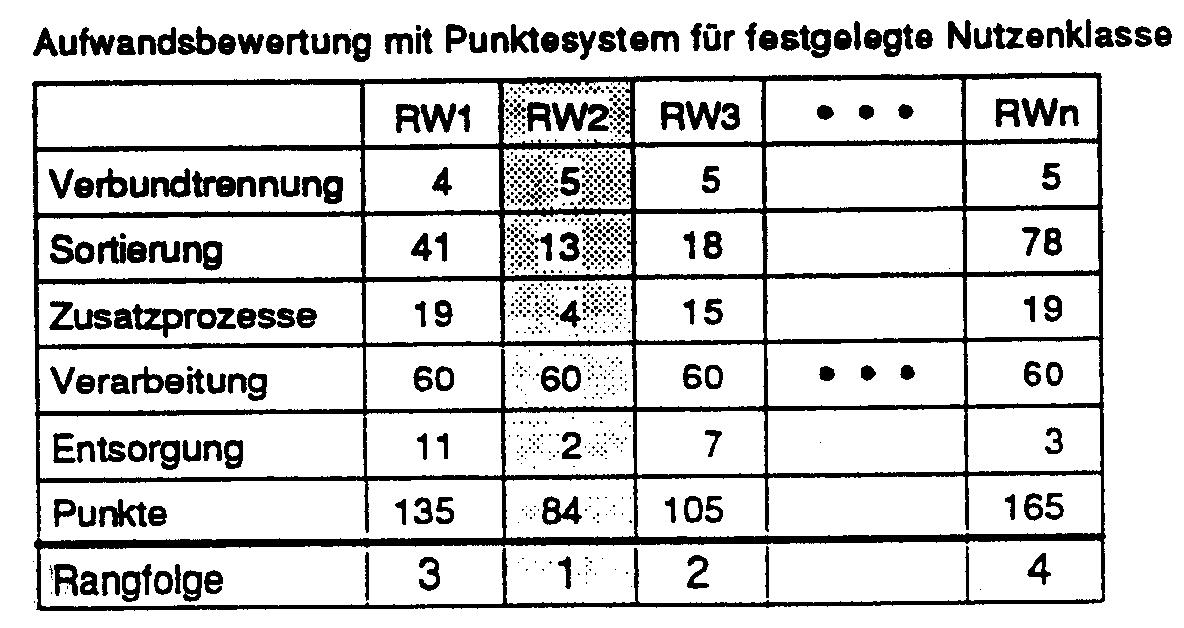
- Fig. 10 shows a section of selected ones Recycling routes (RW) again, which are the basis of the assessment for the strategy of single-grade film recovery, Foam and carrier material e.g. for three-component composite components by means of a point system (performance indicators) serves for defined benefit classes as listed below is. Since the selected recycling routes RW1, RW2, RW3 ... RWn as a result of the intended labeling are understandable, reference is made to the latter.
- the following table shows the cost assessment with point system for defined benefit classes, whereby the classification of the benefit classes is based on criteria such as degree of purity in%, yield in% as well as the type and percentage of contamination.
- Fig. 11 gives a diagram of the cheapest recycling route again.
- the input is a composite component with the composition PP-T 30 59%, ABS / PVC 23% and PUR 18% provided, the mechanical pre-shredding (unseparated compound) and mechanical crushing (separate compound) by means of a cutting mill or a hammer mill followed by three sorting levels.
- To the first sorting stage using an air classifier a heavy fraction to 52%, which is almost pure made of PP-T 30 (99.2%) with 0.5% ABS / PVC and 0.3% PUR component exists.
- a mixed fraction of 29% is in a third Sorting level to approximate using an air classifier pure 24% fraction with 92% ABS / PVC, 6% PP-T 30 and 2% PUR as well as a disposal fraction separated by 5%.
- FIG. 14 illustrates a process chain for redemption of the adhesion promoter of the film with recovery of the Foil without adhesion promoter and foam buildup in single-variety form.
- the Foil as the bottom layer an adhesion promoter and foam buildup on.
- the film is placed in a container Solvent, preferably ethyl methyl ketone for solubility of the adhesion promoter introduced at room temperature, whereupon the solution is filtered such that, on the one hand the dissolved solids such as film without adhesion promoter and essentially foam and on the other hand the solution be preserved.
- Solvent preferably ethyl methyl ketone for solubility of the adhesion promoter introduced at room temperature
- the undissolved solids are used to recover the film either a swim-sink process with water exposed (variant A), where the density differences the unmixed film and a residual fraction with the largest proportion of foam, or after one Variant B becomes the undissolved solids of an evaporation process exposed to evaporation of the solvent, with the single-variety film and a residual fraction with the largest proportion of foam.
Landscapes
- Engineering & Computer Science (AREA)
- Environmental & Geological Engineering (AREA)
- Mechanical Engineering (AREA)
- Separation, Recovery Or Treatment Of Waste Materials Containing Plastics (AREA)
Description


| Ausschlußkriterien für die Verarbeitungsprozesse | |
| Ausschlußkriterien | Extrusion mit Granulierung |
| max. Korngröße | <12mm |
| Verunreinigungen | kein Metall, nicht schmelzende Substanzen Duromere/ Elastomere max. Anteil 5% |
| Restfeuchte | <2-4% |
| Fremdstoffe |
- Es wird ein guter Aufschluß- bzw. Verbundtrennungsgrad bezüglich der verschiedenen Kunststoffe/Werkstoffe aus dem Verbundbauteil erzielt (Größenordnung: mindestens 98 %), so daß Folien- und Hartkunststoffteile gar nicht oder nur noch geringfügig mit Schaumstoff behaftet sind.
- Entsprechend der gewünschten strategischen Zielvor-gaben führt das erfindungsgemäße Verfahren zu der jeweils gewünschten Anzahl und Art von Kunststoff/Werkstofffraktionen mit hoher Sortenreinheit und hoher Ausbeute.
- Es handelt sich größtenteils um großtechnisch problemlos umsetzbare Verfahrensmaβnahmen, da bereits anderweitig bewährte Komponenten eingesetzt werden.
- Deponieraum und Entsorgungskosten werden eingespart sowie Ressourcen geschont.
- tragender, in der Regel dickwandiger als die äußere Folie ausgebildeten Träger 4 aus einem verstärkten Hartkunststoff, beispielsweise talkumverstärktes Polypropylen wie PP-T 30
- diesen Träger festhaftend umgebende Zwischenlage 3 aus Schaumstoff, z.B. Polyurethan und
- außenseitig darauf festhaftend angebrachte, flexible Folie 2, bei der es sich in der Regel auch um ein Verbundsystem handelt und deren wesentlicher Bestandteil beispielsweise ein Gemisch aus Acrylbutadienstyrol (ABS) und Polyvinylchlorid (PVC) darstellt.
Claims (9)
- Verfahren zum Zerlegen und sortenreinen Trennen von zu recyclierenden Dreistoff-Verbundbauteilen (1) mit einem den größten Masseanteil aufweisenden und den Träger (4) bildenden Hartkunststoff, einer auf dem Träger (4) festhaftend aufgebrachten Zwischenlage (3) aus Schaumstoff und einer auf letzterer außenseitig festhaftend aufgebrachter, flexibler Folie (2), indem die Verbundbauteile (1) in mindestens einer Arbeitsstufe zu einem ungetrennten Verbund mittels einer Schneidmühle mit Siebeinlage vorzerkleinert, darauf zu einem getrennten Verbund maschinell zerkleinert und die resultierenden Werkstofffraktionen mindestens einer Werkstoffsortierung unterworfen, getrennt und dann aus dem Verfahrensablauf ausgeschieden und/oder weiterverarbeitet werden, dadurch gekennzeichnet, daß der ungetrennte Verbund mittels einer weiteren Schneidmühle mit Siebeinlage zum getrennten Verbund, bestehend aus Hartkunststoff-Krümeln und einer gröberen gemischten Zerkleinerungsfraktion, verarbeitet wird, der getrennte Verbund gewaschen und dann in einer Sortierzentrifuge mit Wasser als Trennmedium in PUR-Schaumstoff mit sehr hohem Reinheitsgrad als Schwimmfraktion und eine aus Teilchen mit höherer Dichte als die des Wassers bestehende Sink-Mischfraktion zerteilt wird, die wiederum in einer weiteren Sortierzentrifuge mit einer Salzlösung als Trennmedium in Folienteilchen mit hohem Reinheitsgrad als Sinkfraktion sowie eine aus Hartkunststoff und einem größeren Anteil PUR-Schaumstoff bestehende Schwimmfraktion getrennt wird, die getrocknet und mittels eines Zick-Zack-Sichters in von dessen Luftstrom nach oben ausgetragenen PUR-Schaumstoff als Leichtfraktion und in sortenrein rückgewonnene Hartkunststoff-(PP- T 30)-Krümel getrennt wird.
- Verfahren nach Anspruch 1, dadurch gekennzeichnet, daß die Dichte der Salzlösung in der Größenordnung von 1,14 g/cm2 eingestellt wird.
- Verfahren nach Anspruch 1 und 2, dadurch gekennzeichnet, daß als Salzlösung eine Kochsalzlösung verwendet wird.
- Verfahren nach Anspruch 1, dadurch gekennzeichnet, daß die noch auf dem Haftvermittler der Folienteilchen haftenden Schaumstoffreste durch selektive Inlösungsnahme des Haftvermittlers in einem Lösungsmittel von den Folienteilchen getrennt werden.
- Verfahren nach Anspruch 4, dadurch gekennzeichnet, daß als Lösungsmittel Ethylmethylketon verwendet wird.
- Verfahren nach Anspruch 4 und 5, dadurch gekennzeichnet, daß die ungelösten Feststoflieilchen aus der Lösung filtriert werden.
- Verfahren nach Anspruch 6, dadurch gekennzeichnet, daß das Lösungsmittel durch Ausfällung der Lösung mit Wasser zurückgewonnen wird.
- Verfahren nach Anspruch 6, dadurch gekennzeichnet, daß die aus der Lösung filtrierten ungelösten Feststoflieilchen einem Schwimm-Sink-Wasserbecken zugeführt werden, in dem die Folienteilchen von der Restfraktion mit größtem Anteil Schaumstoff abgetrennt werden.
- Verfahren nach Anspruch 6, dadurch gekennzeichnet, daß die aus der Lösung filtrierten Feststoflieilchen getrocknet und dann einem Zick-Zack-Sichter zugeführt werden, durch den die Folienteile abgetrennt werden.
Priority Applications (4)
| Application Number | Priority Date | Filing Date | Title |
|---|---|---|---|
| EP19990123674 EP1044722B1 (de) | 1994-08-07 | 1994-08-07 | Verfahren zum Zerlegen und sortenreinen Trennen von zu recyclierenden Dreistoff-Verbundteilen |
| EP19990123677 EP1036596B1 (de) | 1994-08-07 | 1994-08-07 | Verfahren zum Zerlegen und sortenreinen Trennen von zu recyclierenden Dreistoff-Verbundteilen |
| DE59409684T DE59409684D1 (de) | 1994-08-07 | 1994-08-07 | Verfahren zum Zerlegen und sortenreinen Trennen von zu recyclierenden Verbundbauteilen |
| EP19940112347 EP0716888B1 (de) | 1994-08-07 | 1994-08-07 | Verfahren zum Zerlegen und sortenreinen Trennen von zu recyclierenden Verbundbauteilen |
Applications Claiming Priority (1)
| Application Number | Priority Date | Filing Date | Title |
|---|---|---|---|
| EP19940112347 EP0716888B1 (de) | 1994-08-07 | 1994-08-07 | Verfahren zum Zerlegen und sortenreinen Trennen von zu recyclierenden Verbundbauteilen |
Related Child Applications (2)
| Application Number | Title | Priority Date | Filing Date |
|---|---|---|---|
| EP19990123677 Division EP1036596B1 (de) | 1994-08-07 | 1994-08-07 | Verfahren zum Zerlegen und sortenreinen Trennen von zu recyclierenden Dreistoff-Verbundteilen |
| EP19990123674 Division EP1044722B1 (de) | 1994-08-07 | 1994-08-07 | Verfahren zum Zerlegen und sortenreinen Trennen von zu recyclierenden Dreistoff-Verbundteilen |
Publications (2)
| Publication Number | Publication Date |
|---|---|
| EP0716888A1 EP0716888A1 (de) | 1996-06-19 |
| EP0716888B1 true EP0716888B1 (de) | 2001-03-14 |
Family
ID=8216186
Family Applications (3)
| Application Number | Title | Priority Date | Filing Date |
|---|---|---|---|
| EP19940112347 Expired - Lifetime EP0716888B1 (de) | 1994-08-07 | 1994-08-07 | Verfahren zum Zerlegen und sortenreinen Trennen von zu recyclierenden Verbundbauteilen |
| EP19990123677 Expired - Lifetime EP1036596B1 (de) | 1994-08-07 | 1994-08-07 | Verfahren zum Zerlegen und sortenreinen Trennen von zu recyclierenden Dreistoff-Verbundteilen |
| EP19990123674 Expired - Lifetime EP1044722B1 (de) | 1994-08-07 | 1994-08-07 | Verfahren zum Zerlegen und sortenreinen Trennen von zu recyclierenden Dreistoff-Verbundteilen |
Family Applications After (2)
| Application Number | Title | Priority Date | Filing Date |
|---|---|---|---|
| EP19990123677 Expired - Lifetime EP1036596B1 (de) | 1994-08-07 | 1994-08-07 | Verfahren zum Zerlegen und sortenreinen Trennen von zu recyclierenden Dreistoff-Verbundteilen |
| EP19990123674 Expired - Lifetime EP1044722B1 (de) | 1994-08-07 | 1994-08-07 | Verfahren zum Zerlegen und sortenreinen Trennen von zu recyclierenden Dreistoff-Verbundteilen |
Country Status (2)
| Country | Link |
|---|---|
| EP (3) | EP0716888B1 (de) |
| DE (1) | DE59409684D1 (de) |
Families Citing this family (11)
| Publication number | Priority date | Publication date | Assignee | Title |
|---|---|---|---|---|
| AU3765497A (en) * | 1996-07-10 | 1998-02-02 | Guschall, Dietmar | Process and system for treatment of mixed plastic materials |
| DE19911010A1 (de) * | 1999-03-12 | 2000-10-05 | Georg Schons | Anlage und Verfahren für die Verwendung von Shredderabfällen o. dgl. Verbundstoffen sowie Verwendung einer Rotorprallmühle |
| DE19955697A1 (de) * | 1999-11-18 | 2001-05-31 | Schreiter Klaus | Verfahren und Vorrichtung zum Trennen von Kunststoffen |
| WO2001046304A2 (en) * | 1999-12-23 | 2001-06-28 | Mobius Technologies, Inc. | Polymeric foam processing |
| JP4258413B2 (ja) * | 2004-03-26 | 2009-04-30 | 三菱ふそうトラック・バス株式会社 | 車両走行状態判定装置 |
| DE102015102471A1 (de) | 2015-02-20 | 2016-08-25 | Mondi Consumer Packaging Technologies Gmbh | Folienverpackungsbeutel sowie Folienverbundbahn zur Herstellung eines Folienverpackungsbeutels |
| EP3168169B1 (de) | 2015-11-13 | 2020-02-05 | Mondi AG | Folienbeutel |
| CN112405939A (zh) * | 2020-11-07 | 2021-02-26 | 江苏特伟尔斯新材料有限公司 | 一种废弃泡沫塑料回收利用工艺 |
| CN119816404A (zh) * | 2022-09-06 | 2025-04-11 | 欧拓管理股份有限公司 | 从汽车装饰部件废料中回收材料的工艺 |
| JP2025529308A (ja) * | 2022-09-06 | 2025-09-04 | オートニアム マネジメント アクチエンゲゼルシャフト | 自動車用エラストマートリム廃棄物をリサイクルするための方法 |
| CN118305930A (zh) * | 2024-05-06 | 2024-07-09 | 东莞市意普升塑胶科技有限公司 | 一种塑料回收装置 |
Family Cites Families (6)
| Publication number | Priority date | Publication date | Assignee | Title |
|---|---|---|---|---|
| CH522736A (de) * | 1970-04-10 | 1972-06-30 | Alusuisse | Verfahren zur Aufarbeitung von Abfällen aus Verbundwerkstoffen |
| DE3002227A1 (de) * | 1980-01-23 | 1981-07-30 | Felten & Guilleaume Carlswerk AG, 5000 Köln | Verfahren zur rueckgewinnung von kaschierten und unkaschierten schichtstoffabfaellen |
| DE4026786A1 (de) * | 1990-08-24 | 1992-02-27 | Basf Ag | Wiederverwertung von kunststoff-altteilen und -abfaellen |
| DE4216638C1 (de) * | 1992-05-20 | 1993-09-16 | Daimler-Benz Aktiengesellschaft, 70567 Stuttgart, De | |
| DE9217799U1 (de) * | 1992-12-23 | 1993-05-27 | Schulz, Detlef, O-1017 Berlin | Vorrichtung zur mechanischen Separation metallhaltiger Kunststoffgemische und -verbunde |
| DE9309107U1 (de) * | 1993-06-18 | 1993-09-23 | Noell Abfall- Und Energietechnik Gmbh, 41464 Neuss | Vorrichtung zur dichtesortierung von sekundaerrohstoffen |
-
1994
- 1994-08-07 DE DE59409684T patent/DE59409684D1/de not_active Expired - Lifetime
- 1994-08-07 EP EP19940112347 patent/EP0716888B1/de not_active Expired - Lifetime
- 1994-08-07 EP EP19990123677 patent/EP1036596B1/de not_active Expired - Lifetime
- 1994-08-07 EP EP19990123674 patent/EP1044722B1/de not_active Expired - Lifetime
Also Published As
| Publication number | Publication date |
|---|---|
| EP0716888A1 (de) | 1996-06-19 |
| DE59409684D1 (de) | 2001-04-19 |
| EP1036596A1 (de) | 2000-09-20 |
| EP1044722B1 (de) | 2002-05-08 |
| EP1044722A1 (de) | 2000-10-18 |
| EP1036596B1 (de) | 2002-07-17 |
Similar Documents
| Publication | Publication Date | Title |
|---|---|---|
| DE4217005C2 (de) | Verfahren zur Wiedergewinnung des Kunststoffes aus lackierten Kunststoffteilen | |
| EP2364246B1 (de) | Verfahren und vorrichtung zum abtrennen einzelner wertstoffe aus gemischtem, insbesondere zerkleinertem, kunstoffabfall | |
| DE4216638C1 (de) | ||
| EP2094462B1 (de) | Verfahren zum abtrennen von zellstoff und anderen anhaftenden stoffen beim recycling von abfallkunststoff, insbesondere mischkunststoff | |
| DE102014220330B4 (de) | Verfahren zur Aufbereitung von Kunststoffen und Vorrichtung | |
| EP0681896B1 (de) | Trennverfahren für Teppichböden | |
| EP0716888B1 (de) | Verfahren zum Zerlegen und sortenreinen Trennen von zu recyclierenden Verbundbauteilen | |
| EP2268406B1 (de) | Verfahren und anlage zur aufbereitung von kunststoffreichen abfällen | |
| EP2823945B1 (de) | Verfahren und Vorrichtung zur Aufbereitung von Kunststoffabfällen | |
| EP2274103B1 (de) | Verfahren und anlage zur aufbereitung einer schweren, kunststoffreichen fraktion | |
| DE102007029498A1 (de) | Verfahren, Anlage und Vorrichtungen zur Aufbereitung kunststoffhaltiger Abfälle | |
| EP0876847A2 (de) | Verfahren zur Trennung von Mischkunststoffen | |
| DE4306781A1 (de) | Verfahren und Anlage zur Aufbereitung von kunststoffreichen Müllgemischen | |
| EP0883441B1 (de) | Verfahren und anlage für die sortengerechte aufbereitung von wertstoffabfällen | |
| DE4205309A1 (de) | Verfahren zur aufbereitung von reststoffen aus altautomobilen | |
| DE19509244C1 (de) | Recyclingverfahren für Zwischenfolien aus Verbundglasscheiben | |
| DE10308500A1 (de) | Verfahren und Vorrichtung zur trockenmechanischen Aufbereitung von Kunststoff-Hohlkörpern, welche mit Etiketten versehen sind | |
| EP0635308A1 (de) | Verfahren und Vorrichtung zur Aufbereitung von Formkörpern aus unterschiedlichen Polymeren | |
| DE4442631C2 (de) | Verfahren und Anlage zur Aufbereitung der in Shredderanlagen anfallenden Leichtfraktion | |
| EP3259080B1 (de) | Vorrichtung zum trennen von verbundwerkstoffen und gemischen, insbesondere feststoffgemischen und schlacken | |
| EP2473328A1 (de) | Verfahren zum wiederaufbereiten von papiermaschinenbespannungen | |
| DE4218443A1 (de) | Verfahren zum Materialrecycling der Innenverkleidungsteile von Fahrzeugen | |
| DE102020108204B4 (de) | Verfahren und System zur Separation von staubhaltigen Materialgemischen aus der Verwertung von Elektro- oder Elektronikgeräten | |
| EP0876844B1 (de) | Vorrichtung und Verfahren zur Aufbereitung von Abfällen | |
| DE102021115384A1 (de) | Vorrichtung und Verfahren zum Recyceln von Verbundglasscheiben |
Legal Events
| Date | Code | Title | Description |
|---|---|---|---|
| PUAI | Public reference made under article 153(3) epc to a published international application that has entered the european phase |
Free format text: ORIGINAL CODE: 0009012 |
|
| AK | Designated contracting states |
Kind code of ref document: A1 Designated state(s): CH DE FR GB IT LI NL SE |
|
| 17P | Request for examination filed |
Effective date: 19961112 |
|
| 17Q | First examination report despatched |
Effective date: 19981009 |
|
| GRAG | Despatch of communication of intention to grant |
Free format text: ORIGINAL CODE: EPIDOS AGRA |
|
| GRAG | Despatch of communication of intention to grant |
Free format text: ORIGINAL CODE: EPIDOS AGRA |
|
| GRAG | Despatch of communication of intention to grant |
Free format text: ORIGINAL CODE: EPIDOS AGRA |
|
| GRAH | Despatch of communication of intention to grant a patent |
Free format text: ORIGINAL CODE: EPIDOS IGRA |
|
| GRAH | Despatch of communication of intention to grant a patent |
Free format text: ORIGINAL CODE: EPIDOS IGRA |
|
| GRAA | (expected) grant |
Free format text: ORIGINAL CODE: 0009210 |
|
| AK | Designated contracting states |
Kind code of ref document: B1 Designated state(s): CH DE FR GB IT LI NL SE |
|
| PG25 | Lapsed in a contracting state [announced via postgrant information from national office to epo] |
Ref country code: NL Free format text: LAPSE BECAUSE OF FAILURE TO SUBMIT A TRANSLATION OF THE DESCRIPTION OR TO PAY THE FEE WITHIN THE PRESCRIBED TIME-LIMIT Effective date: 20010314 Ref country code: IT Free format text: LAPSE BECAUSE OF FAILURE TO SUBMIT A TRANSLATION OF THE DESCRIPTION OR TO PAY THE FEE WITHIN THE PRESCRIBED TIME-LIMIT;WARNING: LAPSES OF ITALIAN PATENTS WITH EFFECTIVE DATE BEFORE 2007 MAY HAVE OCCURRED AT ANY TIME BEFORE 2007. THE CORRECT EFFECTIVE DATE MAY BE DIFFERENT FROM THE ONE RECORDED. Effective date: 20010314 Ref country code: GB Free format text: LAPSE BECAUSE OF FAILURE TO SUBMIT A TRANSLATION OF THE DESCRIPTION OR TO PAY THE FEE WITHIN THE PRESCRIBED TIME-LIMIT Effective date: 20010314 Ref country code: FR Free format text: LAPSE BECAUSE OF FAILURE TO SUBMIT A TRANSLATION OF THE DESCRIPTION OR TO PAY THE FEE WITHIN THE PRESCRIBED TIME-LIMIT Effective date: 20010314 |
|
| REG | Reference to a national code |
Ref country code: CH Ref legal event code: EP |
|
| REF | Corresponds to: |
Ref document number: 59409684 Country of ref document: DE Date of ref document: 20010419 |
|
| PG25 | Lapsed in a contracting state [announced via postgrant information from national office to epo] |
Ref country code: SE Free format text: LAPSE BECAUSE OF FAILURE TO SUBMIT A TRANSLATION OF THE DESCRIPTION OR TO PAY THE FEE WITHIN THE PRESCRIBED TIME-LIMIT Effective date: 20010614 |
|
| NLV1 | Nl: lapsed or annulled due to failure to fulfill the requirements of art. 29p and 29m of the patents act | ||
| EN | Fr: translation not filed | ||
| PG25 | Lapsed in a contracting state [announced via postgrant information from national office to epo] |
Ref country code: LI Free format text: LAPSE BECAUSE OF NON-PAYMENT OF DUE FEES Effective date: 20010831 Ref country code: CH Free format text: LAPSE BECAUSE OF NON-PAYMENT OF DUE FEES Effective date: 20010831 |
|
| GBV | Gb: ep patent (uk) treated as always having been void in accordance with gb section 77(7)/1977 [no translation filed] |
Effective date: 20010314 |
|
| PLBE | No opposition filed within time limit |
Free format text: ORIGINAL CODE: 0009261 |
|
| STAA | Information on the status of an ep patent application or granted ep patent |
Free format text: STATUS: NO OPPOSITION FILED WITHIN TIME LIMIT |
|
| 26N | No opposition filed | ||
| REG | Reference to a national code |
Ref country code: CH Ref legal event code: PL |
|
| PGFP | Annual fee paid to national office [announced via postgrant information from national office to epo] |
Ref country code: DE Payment date: 20110227 Year of fee payment: 17 |
|
| REG | Reference to a national code |
Ref country code: DE Ref legal event code: R119 Ref document number: 59409684 Country of ref document: DE Effective date: 20120301 |
|
| PG25 | Lapsed in a contracting state [announced via postgrant information from national office to epo] |
Ref country code: DE Free format text: LAPSE BECAUSE OF NON-PAYMENT OF DUE FEES Effective date: 20120301 |