EP0717068B1 - Procédé de préparation de mousses à froid de polyuréthane - Google Patents
Procédé de préparation de mousses à froid de polyuréthane Download PDFInfo
- Publication number
- EP0717068B1 EP0717068B1 EP95118998A EP95118998A EP0717068B1 EP 0717068 B1 EP0717068 B1 EP 0717068B1 EP 95118998 A EP95118998 A EP 95118998A EP 95118998 A EP95118998 A EP 95118998A EP 0717068 B1 EP0717068 B1 EP 0717068B1
- Authority
- EP
- European Patent Office
- Prior art keywords
- foam
- stabilizers
- foams
- cold
- polyols
- Prior art date
- Legal status (The legal status is an assumption and is not a legal conclusion. Google has not performed a legal analysis and makes no representation as to the accuracy of the status listed.)
- Expired - Lifetime
Links
- 238000000034 method Methods 0.000 title claims description 18
- 230000008569 process Effects 0.000 title claims description 14
- 239000006260 foam Substances 0.000 title description 92
- 229920002635 polyurethane Polymers 0.000 title description 6
- 239000004814 polyurethane Substances 0.000 title description 5
- 239000003381 stabilizer Substances 0.000 claims description 67
- 229920005862 polyol Polymers 0.000 claims description 48
- 150000003077 polyols Chemical class 0.000 claims description 48
- -1 polysiloxanes Polymers 0.000 claims description 37
- 239000000203 mixture Substances 0.000 claims description 30
- 229920001296 polysiloxane Polymers 0.000 claims description 16
- 239000012948 isocyanate Substances 0.000 claims description 14
- 150000002513 isocyanates Chemical class 0.000 claims description 14
- 150000001875 compounds Chemical class 0.000 claims description 8
- 125000002887 hydroxy group Chemical group [H]O* 0.000 claims description 8
- 239000004971 Cross linker Substances 0.000 claims description 7
- 239000004604 Blowing Agent Substances 0.000 claims description 6
- 150000003254 radicals Chemical class 0.000 claims description 6
- 229920005830 Polyurethane Foam Polymers 0.000 claims description 5
- 239000012190 activator Substances 0.000 claims description 5
- 150000001412 amines Chemical class 0.000 claims description 5
- 239000011496 polyurethane foam Substances 0.000 claims description 4
- 239000000945 filler Substances 0.000 claims description 3
- 239000012974 tin catalyst Substances 0.000 claims description 3
- WCYWZMWISLQXQU-UHFFFAOYSA-N methyl Chemical compound [CH3] WCYWZMWISLQXQU-UHFFFAOYSA-N 0.000 claims description 2
- RUELTTOHQODFPA-UHFFFAOYSA-N toluene 2,6-diisocyanate Chemical compound CC1=C(N=C=O)C=CC=C1N=C=O RUELTTOHQODFPA-UHFFFAOYSA-N 0.000 description 24
- UPMLOUAZCHDJJD-UHFFFAOYSA-N 4,4'-Diphenylmethane Diisocyanate Chemical compound C1=CC(N=C=O)=CC=C1CC1=CC=C(N=C=O)C=C1 UPMLOUAZCHDJJD-UHFFFAOYSA-N 0.000 description 18
- 238000009472 formulation Methods 0.000 description 16
- 238000011105 stabilization Methods 0.000 description 13
- 238000004519 manufacturing process Methods 0.000 description 12
- 239000013518 molded foam Substances 0.000 description 12
- 230000006641 stabilisation Effects 0.000 description 12
- IMNIMPAHZVJRPE-UHFFFAOYSA-N triethylenediamine Chemical compound C1CN2CCN1CC2 IMNIMPAHZVJRPE-UHFFFAOYSA-N 0.000 description 10
- 238000006243 chemical reaction Methods 0.000 description 9
- 238000005187 foaming Methods 0.000 description 9
- 239000007787 solid Substances 0.000 description 9
- XLYOFNOQVPJJNP-UHFFFAOYSA-N water Substances O XLYOFNOQVPJJNP-UHFFFAOYSA-N 0.000 description 9
- KPUWHANPEXNPJT-UHFFFAOYSA-N disiloxane Chemical class [SiH3]O[SiH3] KPUWHANPEXNPJT-UHFFFAOYSA-N 0.000 description 8
- 239000002994 raw material Substances 0.000 description 8
- 230000008901 benefit Effects 0.000 description 6
- 235000013870 dimethyl polysiloxane Nutrition 0.000 description 6
- 238000009826 distribution Methods 0.000 description 6
- 229920000435 poly(dimethylsiloxane) Polymers 0.000 description 6
- GTEXIOINCJRBIO-UHFFFAOYSA-N 2-[2-(dimethylamino)ethoxy]-n,n-dimethylethanamine Chemical compound CN(C)CCOCCN(C)C GTEXIOINCJRBIO-UHFFFAOYSA-N 0.000 description 5
- 230000015572 biosynthetic process Effects 0.000 description 5
- ZBCBWPMODOFKDW-UHFFFAOYSA-N diethanolamine Chemical compound OCCNCCO ZBCBWPMODOFKDW-UHFFFAOYSA-N 0.000 description 5
- IQPQWNKOIGAROB-UHFFFAOYSA-N isocyanate group Chemical group [N-]=C=O IQPQWNKOIGAROB-UHFFFAOYSA-N 0.000 description 5
- 229920000642 polymer Polymers 0.000 description 5
- PEDCQBHIVMGVHV-UHFFFAOYSA-N Glycerine Chemical compound OCC(O)CO PEDCQBHIVMGVHV-UHFFFAOYSA-N 0.000 description 4
- GSEJCLTVZPLZKY-UHFFFAOYSA-N Triethanolamine Chemical compound OCCN(CCO)CCO GSEJCLTVZPLZKY-UHFFFAOYSA-N 0.000 description 4
- 230000033228 biological regulation Effects 0.000 description 4
- 230000002093 peripheral effect Effects 0.000 description 4
- 238000001556 precipitation Methods 0.000 description 4
- YMWUJEATGCHHMB-UHFFFAOYSA-N Dichloromethane Chemical compound ClCCl YMWUJEATGCHHMB-UHFFFAOYSA-N 0.000 description 3
- PPBRXRYQALVLMV-UHFFFAOYSA-N Styrene Chemical compound C=CC1=CC=CC=C1 PPBRXRYQALVLMV-UHFFFAOYSA-N 0.000 description 3
- UKLDJPRMSDWDSL-UHFFFAOYSA-L [dibutyl(dodecanoyloxy)stannyl] dodecanoate Chemical compound CCCCCCCCCCCC(=O)O[Sn](CCCC)(CCCC)OC(=O)CCCCCCCCCCC UKLDJPRMSDWDSL-UHFFFAOYSA-L 0.000 description 3
- 229920001577 copolymer Polymers 0.000 description 3
- 238000004132 cross linking Methods 0.000 description 3
- 239000003431 cross linking reagent Substances 0.000 description 3
- 239000012975 dibutyltin dilaurate Substances 0.000 description 3
- 239000004205 dimethyl polysiloxane Substances 0.000 description 3
- 239000004872 foam stabilizing agent Substances 0.000 description 3
- 238000007373 indentation Methods 0.000 description 3
- 230000000704 physical effect Effects 0.000 description 3
- 230000001105 regulatory effect Effects 0.000 description 3
- 230000036548 skin texture Effects 0.000 description 3
- 230000000087 stabilizing effect Effects 0.000 description 3
- 239000000126 substance Substances 0.000 description 3
- CSCPPACGZOOCGX-UHFFFAOYSA-N Acetone Chemical compound CC(C)=O CSCPPACGZOOCGX-UHFFFAOYSA-N 0.000 description 2
- NLHHRLWOUZZQLW-UHFFFAOYSA-N Acrylonitrile Chemical compound C=CC#N NLHHRLWOUZZQLW-UHFFFAOYSA-N 0.000 description 2
- IAYPIBMASNFSPL-UHFFFAOYSA-N Ethylene oxide Chemical group C1CO1 IAYPIBMASNFSPL-UHFFFAOYSA-N 0.000 description 2
- 239000004721 Polyphenylene oxide Substances 0.000 description 2
- GOOHAUXETOMSMM-UHFFFAOYSA-N Propylene oxide Chemical compound CC1CO1 GOOHAUXETOMSMM-UHFFFAOYSA-N 0.000 description 2
- ZJCCRDAZUWHFQH-UHFFFAOYSA-N Trimethylolpropane Chemical compound CCC(CO)(CO)CO ZJCCRDAZUWHFQH-UHFFFAOYSA-N 0.000 description 2
- 125000000217 alkyl group Chemical group 0.000 description 2
- 230000009134 cell regulation Effects 0.000 description 2
- 230000000052 comparative effect Effects 0.000 description 2
- 238000007906 compression Methods 0.000 description 2
- 230000006835 compression Effects 0.000 description 2
- 230000002349 favourable effect Effects 0.000 description 2
- 235000011187 glycerol Nutrition 0.000 description 2
- 230000001788 irregular Effects 0.000 description 2
- 238000000465 moulding Methods 0.000 description 2
- 229920000570 polyether Polymers 0.000 description 2
- 238000003825 pressing Methods 0.000 description 2
- 230000009257 reactivity Effects 0.000 description 2
- UOCLXMDMGBRAIB-UHFFFAOYSA-N 1,1,1-trichloroethane Chemical compound CC(Cl)(Cl)Cl UOCLXMDMGBRAIB-UHFFFAOYSA-N 0.000 description 1
- UEEJHVSXFDXPFK-UHFFFAOYSA-N N-dimethylaminoethanol Chemical compound CN(C)CCO UEEJHVSXFDXPFK-UHFFFAOYSA-N 0.000 description 1
- 239000006057 Non-nutritive feed additive Substances 0.000 description 1
- 229920002396 Polyurea Polymers 0.000 description 1
- 239000004614 Process Aid Substances 0.000 description 1
- ATJFFYVFTNAWJD-UHFFFAOYSA-N Tin Chemical compound [Sn] ATJFFYVFTNAWJD-UHFFFAOYSA-N 0.000 description 1
- 239000000654 additive Substances 0.000 description 1
- 238000000149 argon plasma sintering Methods 0.000 description 1
- 125000003710 aryl alkyl group Chemical group 0.000 description 1
- 230000000712 assembly Effects 0.000 description 1
- 238000000429 assembly Methods 0.000 description 1
- 239000002585 base Substances 0.000 description 1
- 238000007664 blowing Methods 0.000 description 1
- 238000006555 catalytic reaction Methods 0.000 description 1
- 239000002666 chemical blowing agent Substances 0.000 description 1
- 125000004965 chloroalkyl group Chemical group 0.000 description 1
- 125000004218 chloromethyl group Chemical group [H]C([H])(Cl)* 0.000 description 1
- 125000004966 cyanoalkyl group Chemical group 0.000 description 1
- 229960002887 deanol Drugs 0.000 description 1
- 230000001419 dependent effect Effects 0.000 description 1
- JQZRVMZHTADUSY-UHFFFAOYSA-L di(octanoyloxy)tin Chemical compound [Sn+2].CCCCCCCC([O-])=O.CCCCCCCC([O-])=O JQZRVMZHTADUSY-UHFFFAOYSA-L 0.000 description 1
- 239000012972 dimethylethanolamine Substances 0.000 description 1
- 230000000694 effects Effects 0.000 description 1
- 238000005516 engineering process Methods 0.000 description 1
- 238000011067 equilibration Methods 0.000 description 1
- 239000003063 flame retardant Substances 0.000 description 1
- 239000011521 glass Substances 0.000 description 1
- 125000002768 hydroxyalkyl group Chemical group 0.000 description 1
- 238000011065 in-situ storage Methods 0.000 description 1
- 238000011031 large-scale manufacturing process Methods 0.000 description 1
- 230000007774 longterm Effects 0.000 description 1
- 239000000463 material Substances 0.000 description 1
- 238000002844 melting Methods 0.000 description 1
- 230000008018 melting Effects 0.000 description 1
- 239000000178 monomer Substances 0.000 description 1
- 230000006855 networking Effects 0.000 description 1
- CXQXSVUQTKDNFP-UHFFFAOYSA-N octamethyltrisiloxane Chemical compound C[Si](C)(C)O[Si](C)(C)O[Si](C)(C)C CXQXSVUQTKDNFP-UHFFFAOYSA-N 0.000 description 1
- 239000012766 organic filler Substances 0.000 description 1
- 125000000962 organic group Chemical group 0.000 description 1
- 238000012856 packing Methods 0.000 description 1
- 238000004987 plasma desorption mass spectroscopy Methods 0.000 description 1
- 229920003023 plastic Polymers 0.000 description 1
- 239000004033 plastic Substances 0.000 description 1
- 239000002861 polymer material Substances 0.000 description 1
- 238000006116 polymerization reaction Methods 0.000 description 1
- 239000003380 propellant Substances 0.000 description 1
- 239000011541 reaction mixture Substances 0.000 description 1
- 229920005871 reactive polyether polyol Polymers 0.000 description 1
- 230000009467 reduction Effects 0.000 description 1
- 230000002787 reinforcement Effects 0.000 description 1
- 230000036633 rest Effects 0.000 description 1
- 238000000926 separation method Methods 0.000 description 1
- 208000017520 skin disease Diseases 0.000 description 1
- 150000003512 tertiary amines Chemical class 0.000 description 1
- 239000011135 tin Substances 0.000 description 1
- 238000009423 ventilation Methods 0.000 description 1
Classifications
-
- C—CHEMISTRY; METALLURGY
- C08—ORGANIC MACROMOLECULAR COMPOUNDS; THEIR PREPARATION OR CHEMICAL WORKING-UP; COMPOSITIONS BASED THEREON
- C08J—WORKING-UP; GENERAL PROCESSES OF COMPOUNDING; AFTER-TREATMENT NOT COVERED BY SUBCLASSES C08B, C08C, C08F, C08G or C08H
- C08J9/00—Working-up of macromolecular substances to porous or cellular articles or materials; After-treatment thereof
- C08J9/0061—Working-up of macromolecular substances to porous or cellular articles or materials; After-treatment thereof characterized by the use of several polymeric components
-
- C—CHEMISTRY; METALLURGY
- C08—ORGANIC MACROMOLECULAR COMPOUNDS; THEIR PREPARATION OR CHEMICAL WORKING-UP; COMPOSITIONS BASED THEREON
- C08J—WORKING-UP; GENERAL PROCESSES OF COMPOUNDING; AFTER-TREATMENT NOT COVERED BY SUBCLASSES C08B, C08C, C08F, C08G or C08H
- C08J2375/00—Characterised by the use of polyureas or polyurethanes; Derivatives of such polymers
- C08J2375/04—Polyurethanes
-
- C—CHEMISTRY; METALLURGY
- C08—ORGANIC MACROMOLECULAR COMPOUNDS; THEIR PREPARATION OR CHEMICAL WORKING-UP; COMPOSITIONS BASED THEREON
- C08J—WORKING-UP; GENERAL PROCESSES OF COMPOUNDING; AFTER-TREATMENT NOT COVERED BY SUBCLASSES C08B, C08C, C08F, C08G or C08H
- C08J2483/00—Characterised by the use of macromolecular compounds obtained by reactions forming in the main chain of the macromolecule a linkage containing silicon with or without sulfur, nitrogen, oxygen, or carbon only; Derivatives of such polymers
Definitions
- Hot flexible foams hereinafter hot foams
- cold foams cold flexible foams
- cold foams Due to the different raw material bases, cold foams exhibit very typical physical properties that they from Differentiate between hot foams.
- a mixture of polyol, polyfunctional isocyanate, amine activator, tin catalyst, stabilizer, blowing agent either water for the formation of CO 2 and / or addition of physical blowing agents, if appropriate with the addition of flame retardants, crosslinking agents or other, is used to produce a flexible PU foam usual processing aids implemented.
- Stabilizers are therefore required for the cold foam, to control the cell size and cell size distribution as well contribute to the stabilization of peripheral areas, but none or only have weak stabilizing properties. Still results in contrast to the hot foam process for cold foam a higher proportion of closed cells after demolding must be pressed open. In addition, the cold foam has one irregular cell structure and usually coarser cells as a hot foam on what is essential to its properties mentioned above contributes.
- Highly reactive polyols are used as polyols. It acts on the one hand, there are trifunctional polyols which in addition to a high molecular weight of usually between 4800 and 6500 g / mol at least 70% (up to 95%) primary Have hydroxyl groups, so that their OH number between 36 and 26 lies. These polyols are made up of 90% propylene oxide, contain almost exclusively ethylene oxide end groups. The primary OH groups are much more reactive towards the isocyanate groups as the secondary OH groups of the polyols used for the flexible soft foam. Their OH numbers are usually (at molecular weights between 3000 and 4500) between 56 and 42.
- the highly reactive polyols are obtained by polyaddition of Propylene oxide or ethylene oxide on higher functional compounds, such as glycerin or trimethylolpropane, in the presence of basic Links.
- the solid content which, depending on the application, preferably between 5 and 40% is responsible for an improved cell opening, so that the polyol is controlled in particular with the TDI becomes foamable and the foams do not shrink.
- the solid thus acts as an essential process aid.
- Another function is about the solids content to control the hardness, because higher solid contents cause a higher hardness of the foam.
- formulations with solid polyols are clear less inherently stable and therefore require chemical as well Stabilization through the crosslinking reaction additionally one physical stabilization.
- polystyrene resin Depending on the solids content of the polyols, they are used alone or used in a mixture with the above-mentioned unfilled polyols.
- Both TDI (2,4- and 2,6-tolylene diisocyanate isomer mixture) are used as isocyanates as well as MDI (4,4'-diphenylmethane diisocyanate) used.
- the so-called “crude MDI” or “polymer MDI” contains not only the 4,4'- but also the 2,4'- and 2,2'-isomers as well as higher core products.
- Single-core is referred to as "pure MDI" Products from predominantly 2,4'- and 4,4'-isomer mixtures or their prepolymers.
- the isomer ratio can be 2,4'- and 4,4'- and the monomer to polymer ratio of the isocyanate in one wide range can be varied.
- Preferred amine activators are tertiary amines, such as. B. the predominantly cross-linking, d. H. the reaction between isocyanate and polyol catalyzing triethylenediamine (TEDA) or the predominantly driving, d. H. the reaction between isocyanate and water catalyzing bis (2-dimethylaminoethyl) ether (BDE) used.
- B. the predominantly cross-linking d. H. the reaction between isocyanate and polyol catalyzing triethylenediamine (TEDA) or the predominantly driving, d. H. the reaction between isocyanate and water catalyzing bis (2-dimethylaminoethyl) ether (BDE) used.
- TDA triethylenediamine
- BDE bis (2-dimethylaminoethyl) ether
- Crosslinkers are low molecular weight compared to isocyanates reactive multifunctional connections. Suitable are hydroxyl or amine-terminated substances, such as. B. glycerin, Triethanolamine (TEOA), diethanolamine (DEOA) and trimethylolpropane.
- TEOA Triethanolamine
- DEOA diethanolamine
- the concentration of use is usually between 0.5 and 2.0 parts, based on 100.0 parts of polyol each according to wording, but can also differ.
- crude MDI for the foaming process also a networking function.
- the content of low molecular weight Crosslinkers can therefore with increasing amount of crude MDI be reduced accordingly.
- the polyurethane reaction is generally by the addition catalyzed by tin activators. Either dibutyltin dilaurate is used (DBTL) or tin (II) octoate; the amounts used are usually between 0.01 and 0.3 parts, based per 100.0 parts of polyol, but can also differ.
- DBTL dibutyltin dilaurate
- II tin
- Chemical blowing agents include water, the reaction of which with the isocyanate groups leads to the formation of CO 2 .
- the bulk density of the foam is controlled by the amount of water added, the preferred amounts being between 1.5 and 4.0 parts, based on 100.0 parts of polyol.
- physical blowing agents e.g. chlorofluorocarbons, methylene chloride, acetone, 1,1,1-trichloroethane, etc.
- chlorofluorocarbons e.g. chlorofluorocarbons, methylene chloride, acetone, 1,1,1-trichloroethane, etc.
- Stabilizers are also used for the production of cold foam needed to control cell size and cell size distribution as well as marginal zone regulation, but in comparison hot foam stabilizers are usually weak have stabilizing properties. Make a difference the requirements for the stabilizers depending on the block or foaming:
- the requirements for the stabilizer for the cold block foam are primarily controlled foam stabilization, Cell opening at the right time, cell regulation and control the cell size distribution.
- a cold-form foam stabilizer the following requirements: sufficient stabilization foam, stabilization against the effects of shear forces, Stabilization of the peripheral zone and the skin, control cell size and cell size distribution as well as avoidance an increased closed cell.
- the typical cold foam stabilizers to polymers based on polysiloxanes, which more or less modified by suitable organic groups are.
- the chain lengths are those for the cold foam suitable polysiloxanes are generally shorter than that Chain lengths of the stabilizers used in the hot foam.
- organomodified siloxanes are of greater importance. Suitable polysiloxane-polyoxyalkylene copolymers are described, for example, in US Pat. Nos. 3,741,917 and 4,031,044. Other suitable organomodified siloxanes can be found in the table: Modifying group Reference Cyanoalkyl U.S. Patent 3,952,038 Cyanoalkoxyalkyl DE-AS 24 02 690 Sulfolanyloxyalkyl U.S. Patent 4,110,272 Morpholinoalkoxyalkyl U.S. Patent 4,067,828 tert.
- the present invention is therefore concerned with the object new stabilizers for the production of cold polyurethane foams find who are able to find already known ones Solving problems better or solving new problems for the first time.
- a problem with the cold foams used in the automotive sector is that they contribute to unwanted fogging.
- Fogging is the formation of light-scattering precipitation labeled on the inner surfaces of automotive glazing.
- the primary source of this precipitation is volatile components the polymer materials used for the vehicle interior, which gas out due to the temperature conditions in the vehicle and condense on the relatively colder glass surfaces.
- the automotive industry is therefore interested in such Reduce fogging precipitation as much as possible.
- An object of the present invention is therefore the new development of stabilizers in which these proportions are reduced or are completely eliminated.
- the present invention is also more generally concerned with the problem of stabilizers with improved properties to develop. These properties include in particular:
- the stabilizers to be used in the process according to the invention can compared to stabilizers of the prior art be used in reduced concentration. Associated with it is a significantly reduced fogging behavior of the stabilizers.
- the degree of open cell, measured as a pressing force, is increased in the foams produced according to the invention, so that thereby a clearly reduced tendency to Shrinkage of the foams obtained results. It is particularly evident that to be used in the method according to the invention Polysiloxanes a much better balance have between stabilizing and cell opening properties. In addition, skin disorders are avoided, at the same time to observe a good regulation of the peripheral zone area is.
- the stabilizers according to the invention are thus concerned a new class of universal stabilizers that both for cold block and cold molded foam, for systems based on pure TDI, TDI / MDI mixtures and pure MDI in Combination with the corresponding polyols can be used.
- a process according to the invention is particularly preferred in which compounds are used as stabilizers which are free of polysiloxanes with a chain length of ⁇ 5 and> 16.
- the polysiloxanes are expediently fractionated in accordance with the prior art before the introduction of group (s) R 1 .
- fractionated polysiloxanes of the formula are used I, whose composition is thus based on a statistical distribution of polysiloxanes of different chain lengths, like them usually obtained by equilibration, deviates, in cold foam systems, the fractionated siloxanes show the equilibrated siloxanes have the following special advantages:
- the stabilizers have a wider processing clearance. Good stabilization is achieved with improved at the same time Open-celledness of the foam and gets particularly in Molded foam systems Foams with very good skin properties. At the same time, cell regulation is improved.
- the check is carried out using a typical block foam formulation based on filled polyols and pure TDI.
- the siloxane is used in different concentrations. The results are compared to a prior art stabilizer preferred for this type of foam. It is a polysiloxane which has chloropropyl groups as modifying groups according to DE-PS 36 26 297.
- Raw material Shares Polymer polyol 100.00 water 3.50 Diethanolamine 1.00 Bis (2-dimethylaminoethyl) ether 0.05 Triethanolamine 0.15 Dibutyltin dilaurate 0.15 TDI 41.00 stabilizer 0.2 - 1.5 Index ⁇ 100 ⁇
- the index 100 means that the amount of isocyanate groups used is equal to the stoichiometrically calculated amount Isocyanate groups required for the reaction with the water and the OH groups of the polyols are required.
- the check is carried out using a typical molded foam formulation based on filler-containing polyols and pure TDI.
- the siloxane is used in different concentrations. The results are compared to a prior art stabilizer preferred for this type of foam. It is a polysiloxane which has polyether groups as modifying groups according to EP-PS 0 106 101.
- Raw material Shares PHD polyol 100.00 water 4.00 Diethanolamine 1.50 Triethylenediamine 0.50 Bis (2-dimethylaminoethyl) ether 0.07 TDI 47.90 stabilizer 0.1 - 1.5 Index ⁇ 100 ⁇
- the product according to the invention is in all assessment criteria think:
- the stabilizer is free of polysiloxanes with a chain length of ⁇ 5 and ⁇ 16.
- the check is carried out using a typical cold molded foam formulation. This is based on a conventional (unfilled) polyol and a TDI / crude MDI mixture as an isocyanate component. According to the prior art, only unmodified polydimethylsiloxanes could be used as stabilizers in such formulations.
- Raw material Shares conv. Polyol 100.00 water 3.00 Triethylenediamine 0.60 Dimethylethanolamine 0.20 Triethanolamine 2.00 40% crude MDI / 60% TDI 46.20 stabilizer 0.1-1.0 Index ⁇ 100 ⁇
- fractionated modified organopolysiloxane permits the use of the stabilizers in a further concentration range from 0.1 to 1.2 parts. Basically, you get more open, non-shrinking, very well-regulated foams, even at very high concentrations.
- a particular advantage of these fractionated products used in the method according to the invention is thus their wide processing range, which is expressed in the pressing forces listed below: product Use Conc. / Tel 1. ADW / N according to 0.1 625 0.6 705 1.2 808 comparison 0.1 no border zone regulation 0.6 879 1.2 severe shrinkage
- the foams according to the invention have the required reduction in fogging behavior, which is illustrated by the fogging values determined in accordance with DIN 75201B (when using concentrations of 0.6 parts in both cases): Fogging value comparison 2.7 mg Fogging value according to the invention 1.1 mg
- the stabilizer is free of polysiloxanes with a chain length of ⁇ 5 and ⁇ 16.
- the check is carried out with a filled polyol / TDI molded foam formulation.
- a comparison with chloroalkyl groups is used modified stabilizer according to the prior art DE-PS 36 26 297.
- a stabilizer with the abovementioned indices based on equilibrated organofunctionally modified siloxanes is also used for comparison.
- raw material Shares PHD polyol 100.00 water 4.00 Diethanolamine 1.50 Triethylenediamine 0.50 Bis (2-dimethylaminoethyl) ether 0.07 TDI 47.90 stabilizer 0.1 - 1.5 Index ⁇ 100 ⁇
- the special property of the stabilizers according to the invention is also the excellent balance between sufficient stabilization and at the same time high open cell of cold foams. They have a wide range of processing options and lead to foams with a particularly good skin texture.
- the stabilizers are also characterized by their high effectiveness from the fact that in addition to the inherent lower volatility through in addition, lower quantities used a significantly reduced Fogging behavior of the foams results.
- the stabilizers can also be used in combination with unmodified siloxanes become.
Landscapes
- Chemical & Material Sciences (AREA)
- Engineering & Computer Science (AREA)
- Materials Engineering (AREA)
- Health & Medical Sciences (AREA)
- Chemical Kinetics & Catalysis (AREA)
- Medicinal Chemistry (AREA)
- Polymers & Plastics (AREA)
- Organic Chemistry (AREA)
- Polyurethanes Or Polyureas (AREA)
- Manufacture Of Porous Articles, And Recovery And Treatment Of Waste Products (AREA)
Claims (2)
- Procédé de préparation de mousses à froid de polyuréthannes par réaction d'un mélange de polyols hautement réactifs, qui présentent un poids moléculaire moyen entre 4800 et 6500 g/mole et au moins 70% de groupements hydroxyle primaires et qui contiennent éventuellement des charges, des isocyanates polyfonctionnels, des activateurs aminés, des agents de réticulation, des catalyseurs d'étain, des agents moussants et des stabilisants, caractérisé en ce qu'on utilise comme stabilisants des composés de formule généraledans laquelle
 à condition que le quotient p = (n + m 2)/m soit de 1,66 à 12.R1 est identique ou différent dans la molécule moyenne et signifie un radical méthyle ou un radical de formule générale(a = 0 ou 1, R2 = -O-CH3) à condition qu'au moins un radical R1 soit un radical de formule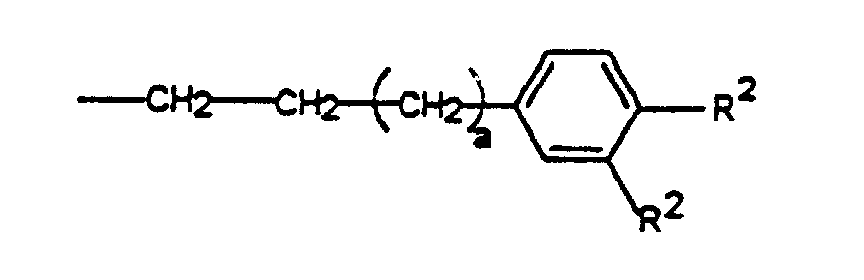
 que n ait une valeur numérique moyenne de 2 à 11,que m ait une valeur numérique moyenne de 1 à 6,
 - Procédé selon la revendication 1, caractérisé en ce qu'on utilise comme stabilisants des composés qui sont exempts de polysiloxanes d'une longueur de chaíne de ≤ 5 et de ≥ 16.
Applications Claiming Priority (2)
| Application Number | Priority Date | Filing Date | Title |
|---|---|---|---|
| DE4444898A DE4444898C1 (de) | 1994-12-16 | 1994-12-16 | Verfahren zur Herstellung von Polyurethankaltschäumen |
| DE4444898 | 1994-12-16 |
Publications (2)
| Publication Number | Publication Date |
|---|---|
| EP0717068A1 EP0717068A1 (fr) | 1996-06-19 |
| EP0717068B1 true EP0717068B1 (fr) | 1999-04-28 |
Family
ID=6536012
Family Applications (1)
| Application Number | Title | Priority Date | Filing Date |
|---|---|---|---|
| EP95118998A Expired - Lifetime EP0717068B1 (fr) | 1994-12-16 | 1995-12-02 | Procédé de préparation de mousses à froid de polyuréthane |
Country Status (4)
| Country | Link |
|---|---|
| US (1) | US5633292A (fr) |
| EP (1) | EP0717068B1 (fr) |
| CA (1) | CA2164889A1 (fr) |
| DE (2) | DE4444898C1 (fr) |
Families Citing this family (17)
| Publication number | Priority date | Publication date | Assignee | Title |
|---|---|---|---|---|
| US6245824B1 (en) | 1999-09-01 | 2001-06-12 | Air Products And Chemicals, Inc. | Silicone surfactants for making polyurethane flexible molded foams |
| US6239186B1 (en) * | 1999-10-28 | 2001-05-29 | Air Products And Chemicals, Inc. | Silicone surfactants for the production of open cell polyurethane flexible foams |
| US6235804B1 (en) | 1999-12-23 | 2001-05-22 | Air Products And Chemicals, Inc. | Silicone surfactants for making polyurethane flexible molded foams |
| DE102007046860A1 (de) | 2007-09-28 | 2009-04-09 | Evonik Goldschmidt Gmbh | Aminkatalysatoren geeignet zur Herstellung emissionsarmer, rekatalysestabiler Polyurethanweichschaumstoffe |
| DE102010039004A1 (de) | 2010-08-06 | 2012-02-09 | Evonik Goldschmidt Gmbh | Silikoncopolymere mit seitenständigen über Allylglycidylether und verwandte Verbindungen angebundenen Alkylreisten und ihre Verwendung als Stabilisatoren zur Herstellug von Polyurethanweichschäumen |
| DE102011003148A1 (de) | 2011-01-26 | 2012-07-26 | Evonik Goldschmidt Gmbh | Verwendung von Silikonpolyetherblock-Copolymere mit hochmolekularen nicht endverkappten Polyetherresten als Stabilisatoren zur Herstellung von Polyuretherschäumen niedriger Dichte |
| DE102011079791A1 (de) | 2011-07-26 | 2013-01-31 | Evonik Goldschmidt Gmbh | Additivzusammensetzung, einsetzbar zur Steuerung der Schaumeigenschaften bei der Herstellung von Polyurethanweichschäumen, die Polyole auf Basis nachwachsender Rohstoffe enthalten |
| DE102011109547A1 (de) | 2011-08-03 | 2013-02-07 | Evonik Goldschmidt Gmbh | Polysiloxanpolyether-Copolymere mit Carbonatgruppenhaltigen (Polyether-)Resten und deren Verwendung als Stabilisatorne zur Herstellung von Polyurethanschäumen |
| DE102012212077A1 (de) | 2012-07-11 | 2014-01-16 | Evonik Industries Ag | Verfahren zur Herstellung emissionsarmer Polyurethanweichschaumstoffe |
| DE102013204991A1 (de) | 2013-03-21 | 2014-09-25 | Evonik Industries Ag | Herstellung von Polyurethanschäumen, die Polyole auf Polyolefinbasis enthalten |
| DE102013207117A1 (de) | 2013-04-19 | 2014-10-23 | Evonik Industries Ag | PUR-Schaum mit vergröberter Zellstruktur |
| EP3067343B1 (fr) | 2015-03-10 | 2018-07-25 | Evonik Degussa GmbH | Antioxydants destinés à fabriquer des systèmes PUR à faible émission |
| EP3067376A1 (fr) | 2015-03-11 | 2016-09-14 | Evonik Degussa GmbH | Fabrication de système en polyuréthane utilisant des polyols de polyéther polycarbonates |
| LT3133097T (lt) | 2015-08-17 | 2022-12-12 | Evonik Operations Gmbh | Elastingi poliuretano putplasčiai, pasižymintys padidintu kietumu |
| EP3360912B1 (fr) | 2017-02-10 | 2019-07-03 | Evonik Degussa GmbH | Procédé de fabrication d'ethers de polyoxyalkylène susceptible d'être hydrosilylés |
| ES2898877T5 (en) | 2019-01-07 | 2026-04-24 | Evonik Operations Gmbh | Preparation of polyurethane foam |
| WO2020144003A1 (fr) | 2019-01-07 | 2020-07-16 | Evonik Operations Gmbh | Production d'une mousse rigide de polyuréthane |
Family Cites Families (18)
| Publication number | Priority date | Publication date | Assignee | Title |
|---|---|---|---|---|
| US3741917A (en) * | 1970-10-26 | 1973-06-26 | Union Carbide Corp | Cold cure high resilience foam |
| DE2221811A1 (de) * | 1972-05-04 | 1973-11-22 | Bayer Ag | Verfahren zur herstellung von flammfesten urethangruppen aufweisenden schaumstoffen |
| US3839384A (en) * | 1972-11-13 | 1974-10-01 | Union Carbide Corp | Polyether urethane foam |
| US3896062A (en) * | 1972-11-13 | 1975-07-22 | Union Carbide Corp | Polyether urethane foam |
| US3952038A (en) * | 1973-01-22 | 1976-04-20 | Union Carbide Corporation | Polyether urethane foam |
| CH586723A5 (fr) * | 1974-04-08 | 1977-04-15 | Goldschmidt Ag Th | |
| DE2603498C3 (de) * | 1974-04-08 | 1982-04-08 | Th. Goldschmidt Ag, 4300 Essen | Weitere Ausbildung des Verfahrens zur Herstellung von vernetzten, elastischen, offenzelligen Urethangruppen aufweisenden Schaumstoffen |
| US4031044A (en) * | 1974-04-15 | 1977-06-21 | Dow Corning Corporation | Polyether based, high resilient polyurethane foam |
| CH597270A5 (fr) * | 1974-08-30 | 1978-03-31 | Goldschmidt Ag Th | |
| US4049675A (en) * | 1975-06-30 | 1977-09-20 | Union Carbide Corporation | Sulfolanyloxy alkyl-polyalkyl-siloxanes |
| US4016163A (en) * | 1975-06-30 | 1977-04-05 | Union Carbide Corporation | Morpholino-bearing polyalkylsiloxanes |
| US4039490A (en) * | 1975-12-29 | 1977-08-02 | Union Carbide Corporation | High resilience foam |
| DE2736138A1 (de) * | 1977-08-11 | 1979-03-01 | Bayer Ag | Verfahren zur herstellung von urethangruppen aufweisenden schaumstoffen |
| US4299923A (en) * | 1980-03-27 | 1981-11-10 | Union Carbide Corporation | Alkyl-modified siloxane copolymers useful as foam stabilizers in high resilience polyurethane foam |
| US4331555A (en) * | 1980-09-29 | 1982-05-25 | Union Carbide Corporation | Use of organosiloxane compositions as foam stabilizers in flexible polyester polyurethane foam |
| DE3215317C1 (de) * | 1982-04-23 | 1983-06-09 | Th. Goldschmidt Ag, 4300 Essen | Verfahren zur Herstellung hochelastischer kalthaertender Polyurethanschaumstoffe |
| DE3234462C1 (de) * | 1982-09-17 | 1984-01-05 | Th. Goldschmidt Ag, 4300 Essen | Verfahren zur Herstellung hochelastischer kalthaertender Polyurethanschaumstoffe |
| GB8609803D0 (en) * | 1986-04-22 | 1986-05-29 | Bp Chem Int Ltd | Silicone surfactants |
-
1994
- 1994-12-16 DE DE4444898A patent/DE4444898C1/de not_active Expired - Fee Related
-
1995
- 1995-12-02 DE DE59505768T patent/DE59505768D1/de not_active Expired - Fee Related
- 1995-12-02 EP EP95118998A patent/EP0717068B1/fr not_active Expired - Lifetime
- 1995-12-07 US US08/568,888 patent/US5633292A/en not_active Expired - Fee Related
- 1995-12-11 CA CA002164889A patent/CA2164889A1/fr not_active Abandoned
Also Published As
| Publication number | Publication date |
|---|---|
| DE59505768D1 (de) | 1999-06-02 |
| US5633292A (en) | 1997-05-27 |
| EP0717068A1 (fr) | 1996-06-19 |
| CA2164889A1 (fr) | 1996-06-17 |
| DE4444898C1 (de) | 1996-10-10 |
Similar Documents
| Publication | Publication Date | Title |
|---|---|---|
| EP1777252B1 (fr) | Procédé de fabrication de mousses de polyuréthane durcies à froid | |
| DE60017847T2 (de) | Silikon-Schaumstabilisatoren zur Herstellung offenzelliger Polyurethanweichschaumstoffe | |
| DE4444898C1 (de) | Verfahren zur Herstellung von Polyurethankaltschäumen | |
| DE69123821T2 (de) | Prepolymer mit Isocyanatendgruppen und daraus hergestellter flexibler Polyurethanschaum | |
| DE3856207T2 (de) | Verfahren zur Herstellung von Polyurethan-Weichschaumstoffen mit niedriger Dichte | |
| DE69321535T2 (de) | Polyurethanweichschäume unter Verwendung von chlorinierten Alkanen | |
| DE3850495T2 (de) | Polyurethanschaumstoffherstellung. | |
| DE69220338T2 (de) | Polyurethanschäume | |
| DE69413811T2 (de) | Körnige organische feststoffe enthaltende polyurethan-schaumstoff sowie verfahren zu dessen herstellung | |
| DE2533074A1 (de) | Verfahren zur herstellung von hochelastischen polyurethanweichschaeumen | |
| DE69209686T2 (de) | Treibreaktionskatalysator-Zusammensetzung, die bei dem resultierenden Polyurethanschaum Zellöffnung bewirkt | |
| DE1544634A1 (de) | Verfahren zur Herstellung von flexiblem Polyurethanschaum | |
| EP0106101B1 (fr) | Procédé pour la préparation de mousses de polyuréthanes, très élastiques et se réticulant à température ambiante | |
| DE4204395A1 (de) | Verfahren zur herstellung von kalthaertenden polyurethan-weichformschaumstoffen | |
| DE3721058A1 (de) | Verfahren zur herstellung von kalthaertenden polyurethan-weichformschaumstoffen | |
| DE3103757A1 (de) | Polymer-modifizierte polyalkohole, verfahren zu deren herstellung und verwendung zur herstellung von polyurethan | |
| DE1251019B (de) | Verfahren zur Herste'lung von Polyurethanschaumstoffen | |
| DE10129062A1 (de) | Verfahren zur Herstellung von hochelastischen Polyurethanschaumstoffen | |
| DE2728031C2 (de) | Verfahren zur Herstellung von hochelastischen, offenzelligen Urethangruppen aufweisenden Schaumstoffen | |
| DE69111117T2 (de) | Verfahren zur Herstellung eines eine hohe Luftdurchlässigkeit aufweisenden, flexiblen Polyurethanschaumstoffes. | |
| EP0939097A1 (fr) | Utilisation de copolymères de polyéthersilicone dans la fabrication de mousses de polyuréthanes à haute résilience | |
| DE1212718B (de) | Verfahren zur Herstellung flexibler Polyurethanschaumstoffe | |
| DE69312711T2 (de) | Flammwidrige polyurethanweichschaumstoffe | |
| DE60001635T2 (de) | Verfahren zur herstellung von mikrozellulären polyurethan-elastomeren mit verbesserten verarbeitungseigenschaften | |
| EP0258600B1 (fr) | Procédé pour préparer des mousses de polyuréthane à haute élasticité réticulant à température ordinaire |
Legal Events
| Date | Code | Title | Description |
|---|---|---|---|
| PUAI | Public reference made under article 153(3) epc to a published international application that has entered the european phase |
Free format text: ORIGINAL CODE: 0009012 |
|
| 17P | Request for examination filed |
Effective date: 19951213 |
|
| AK | Designated contracting states |
Kind code of ref document: A1 Designated state(s): BE DE GB IT NL |
|
| 17Q | First examination report despatched |
Effective date: 19980518 |
|
| GRAG | Despatch of communication of intention to grant |
Free format text: ORIGINAL CODE: EPIDOS AGRA |
|
| GRAG | Despatch of communication of intention to grant |
Free format text: ORIGINAL CODE: EPIDOS AGRA |
|
| GRAH | Despatch of communication of intention to grant a patent |
Free format text: ORIGINAL CODE: EPIDOS IGRA |
|
| GRAH | Despatch of communication of intention to grant a patent |
Free format text: ORIGINAL CODE: EPIDOS IGRA |
|
| GRAA | (expected) grant |
Free format text: ORIGINAL CODE: 0009210 |
|
| AK | Designated contracting states |
Kind code of ref document: B1 Designated state(s): BE DE GB IT NL |
|
| ITF | It: translation for a ep patent filed | ||
| REF | Corresponds to: |
Ref document number: 59505768 Country of ref document: DE Date of ref document: 19990602 |
|
| GBT | Gb: translation of ep patent filed (gb section 77(6)(a)/1977) |
Effective date: 19990527 |
|
| PLBE | No opposition filed within time limit |
Free format text: ORIGINAL CODE: 0009261 |
|
| STAA | Information on the status of an ep patent application or granted ep patent |
Free format text: STATUS: NO OPPOSITION FILED WITHIN TIME LIMIT |
|
| 26N | No opposition filed | ||
| PG25 | Lapsed in a contracting state [announced via postgrant information from national office to epo] |
Ref country code: NL Free format text: LAPSE BECAUSE OF NON-PAYMENT OF DUE FEES Effective date: 20000701 |
|
| NLV4 | Nl: lapsed or anulled due to non-payment of the annual fee |
Effective date: 20000701 |
|
| PGFP | Annual fee paid to national office [announced via postgrant information from national office to epo] |
Ref country code: GB Payment date: 20001123 Year of fee payment: 6 |
|
| PGFP | Annual fee paid to national office [announced via postgrant information from national office to epo] |
Ref country code: DE Payment date: 20001201 Year of fee payment: 6 |
|
| PGFP | Annual fee paid to national office [announced via postgrant information from national office to epo] |
Ref country code: BE Payment date: 20001207 Year of fee payment: 6 |
|
| PG25 | Lapsed in a contracting state [announced via postgrant information from national office to epo] |
Ref country code: GB Free format text: LAPSE BECAUSE OF NON-PAYMENT OF DUE FEES Effective date: 20011202 |
|
| PG25 | Lapsed in a contracting state [announced via postgrant information from national office to epo] |
Ref country code: BE Free format text: LAPSE BECAUSE OF NON-PAYMENT OF DUE FEES Effective date: 20011231 |
|
| REG | Reference to a national code |
Ref country code: GB Ref legal event code: IF02 |
|
| BERE | Be: lapsed |
Owner name: GOLDSCHMIDT A.G. Effective date: 20011231 |
|
| PG25 | Lapsed in a contracting state [announced via postgrant information from national office to epo] |
Ref country code: DE Free format text: LAPSE BECAUSE OF NON-PAYMENT OF DUE FEES Effective date: 20020702 |
|
| GBPC | Gb: european patent ceased through non-payment of renewal fee |
Effective date: 20011202 |
|
| PG25 | Lapsed in a contracting state [announced via postgrant information from national office to epo] |
Ref country code: IT Free format text: LAPSE BECAUSE OF NON-PAYMENT OF DUE FEES;WARNING: LAPSES OF ITALIAN PATENTS WITH EFFECTIVE DATE BEFORE 2007 MAY HAVE OCCURRED AT ANY TIME BEFORE 2007. THE CORRECT EFFECTIVE DATE MAY BE DIFFERENT FROM THE ONE RECORDED. Effective date: 20051202 |