EP0717082A1 - Verfahren zur Herstellung von kationischen 1,3,4-Thiadiazolfarbstoffen - Google Patents
Verfahren zur Herstellung von kationischen 1,3,4-Thiadiazolfarbstoffen Download PDFInfo
- Publication number
- EP0717082A1 EP0717082A1 EP95119062A EP95119062A EP0717082A1 EP 0717082 A1 EP0717082 A1 EP 0717082A1 EP 95119062 A EP95119062 A EP 95119062A EP 95119062 A EP95119062 A EP 95119062A EP 0717082 A1 EP0717082 A1 EP 0717082A1
- Authority
- EP
- European Patent Office
- Prior art keywords
- formula
- alkyl
- hydrogen
- dyes
- piperidino
- Prior art date
- Legal status (The legal status is an assumption and is not a legal conclusion. Google has not performed a legal analysis and makes no representation as to the accuracy of the status listed.)
- Withdrawn
Links
- 239000000975 dye Substances 0.000 title claims abstract description 89
- 125000002091 cationic group Chemical group 0.000 title claims abstract description 23
- 238000000034 method Methods 0.000 title claims abstract description 22
- MBIZXFATKUQOOA-UHFFFAOYSA-N 1,3,4-thiadiazole Chemical compound C1=NN=CS1 MBIZXFATKUQOOA-UHFFFAOYSA-N 0.000 title claims abstract description 14
- 238000002360 preparation method Methods 0.000 title claims description 9
- -1 pyrrolidino, piperidino, morpholino Chemical group 0.000 claims abstract description 104
- 125000001731 2-cyanoethyl group Chemical group [H]C([H])(*)C([H])([H])C#N 0.000 claims abstract description 20
- 125000000217 alkyl group Chemical group 0.000 claims abstract description 18
- 150000001450 anions Chemical class 0.000 claims abstract description 16
- 125000003710 aryl alkyl group Chemical group 0.000 claims abstract description 14
- GAWIXWVDTYZWAW-UHFFFAOYSA-N C[CH]O Chemical group C[CH]O GAWIXWVDTYZWAW-UHFFFAOYSA-N 0.000 claims abstract description 13
- 125000003342 alkenyl group Chemical group 0.000 claims abstract description 13
- 125000003118 aryl group Chemical group 0.000 claims abstract description 13
- 125000001495 ethyl group Chemical group [H]C([H])([H])C([H])([H])* 0.000 claims abstract description 10
- 239000000976 ink Substances 0.000 claims abstract description 9
- NLHHRLWOUZZQLW-UHFFFAOYSA-N Acrylonitrile Chemical compound C=CC#N NLHHRLWOUZZQLW-UHFFFAOYSA-N 0.000 claims abstract description 6
- 229920001577 copolymer Polymers 0.000 claims abstract description 6
- 239000000463 material Substances 0.000 claims abstract description 6
- 239000004952 Polyamide Substances 0.000 claims abstract description 5
- KYPOHTVBFVELTG-UHFFFAOYSA-N but-2-enedinitrile Chemical group N#CC=CC#N KYPOHTVBFVELTG-UHFFFAOYSA-N 0.000 claims abstract description 5
- 239000001913 cellulose Substances 0.000 claims abstract description 5
- 229920002678 cellulose Polymers 0.000 claims abstract description 5
- 239000010985 leather Substances 0.000 claims abstract description 5
- 229920002647 polyamide Polymers 0.000 claims abstract description 5
- 229920000728 polyester Polymers 0.000 claims abstract description 5
- 125000000623 heterocyclic group Chemical group 0.000 claims abstract description 4
- 229910052739 hydrogen Inorganic materials 0.000 claims description 30
- 239000001257 hydrogen Substances 0.000 claims description 30
- 125000002496 methyl group Chemical group [H]C([H])([H])* 0.000 claims description 27
- 229910052736 halogen Inorganic materials 0.000 claims description 22
- 150000002367 halogens Chemical group 0.000 claims description 22
- XLYOFNOQVPJJNP-UHFFFAOYSA-N water Substances O XLYOFNOQVPJJNP-UHFFFAOYSA-N 0.000 claims description 20
- 125000004093 cyano group Chemical group *C#N 0.000 claims description 18
- 125000004435 hydrogen atom Chemical class [H]* 0.000 claims description 18
- 125000000229 (C1-C4)alkoxy group Chemical group 0.000 claims description 17
- 125000002887 hydroxy group Chemical group [H]O* 0.000 claims description 15
- 125000004178 (C1-C4) alkyl group Chemical group 0.000 claims description 13
- 150000001412 amines Chemical class 0.000 claims description 13
- 125000000956 methoxy group Chemical group [H]C([H])([H])O* 0.000 claims description 12
- 125000001997 phenyl group Chemical group [H]C1=C([H])C([H])=C(*)C([H])=C1[H] 0.000 claims description 12
- VGGSQFUCUMXWEO-UHFFFAOYSA-N Ethene Chemical compound C=C VGGSQFUCUMXWEO-UHFFFAOYSA-N 0.000 claims description 11
- 125000001449 isopropyl group Chemical group [H]C([H])([H])C([H])(*)C([H])([H])[H] 0.000 claims description 10
- 125000004209 (C1-C8) alkyl group Chemical group 0.000 claims description 9
- 125000000882 C2-C6 alkenyl group Chemical group 0.000 claims description 9
- 238000006243 chemical reaction Methods 0.000 claims description 9
- 125000000753 cycloalkyl group Chemical group 0.000 claims description 9
- 125000005344 pyridylmethyl group Chemical group [H]C1=C([H])C([H])=C([H])C(=N1)C([H])([H])* 0.000 claims description 9
- 239000012429 reaction media Substances 0.000 claims description 9
- 239000005977 Ethylene Substances 0.000 claims description 8
- 150000001875 compounds Chemical class 0.000 claims description 8
- 125000000325 methylidene group Chemical group [H]C([H])=* 0.000 claims description 8
- 239000002904 solvent Substances 0.000 claims description 8
- 125000001797 benzyl group Chemical group [H]C1=C([H])C([H])=C(C([H])=C1[H])C([H])([H])* 0.000 claims description 6
- 239000003795 chemical substances by application Substances 0.000 claims description 6
- 239000012530 fluid Substances 0.000 claims description 6
- 125000004573 morpholin-4-yl group Chemical group N1(CCOCC1)* 0.000 claims description 6
- 230000008878 coupling Effects 0.000 claims description 5
- 238000010168 coupling process Methods 0.000 claims description 5
- 238000005859 coupling reaction Methods 0.000 claims description 5
- 238000004043 dyeing Methods 0.000 claims description 5
- 239000000835 fiber Substances 0.000 claims description 5
- 229920000642 polymer Polymers 0.000 claims description 5
- 150000003254 radicals Chemical class 0.000 claims description 5
- 238000009835 boiling Methods 0.000 claims description 4
- 150000005573 methoxybenzenes Chemical class 0.000 claims description 4
- 125000003903 2-propenyl group Chemical group [H]C([*])([H])C([H])=C([H])[H] 0.000 claims description 3
- 125000000113 cyclohexyl group Chemical group [H]C1([H])C([H])([H])C([H])([H])C([H])(*)C([H])([H])C1([H])[H] 0.000 claims description 3
- 125000001511 cyclopentyl group Chemical group [H]C1([H])C([H])([H])C([H])([H])C([H])(*)C1([H])[H] 0.000 claims description 3
- 238000004519 manufacturing process Methods 0.000 claims description 3
- 125000001436 propyl group Chemical group [H]C([*])([H])C([H])([H])C([H])([H])[H] 0.000 claims description 3
- 229920001971 elastomer Polymers 0.000 claims description 2
- QTBSBXVTEAMEQO-UHFFFAOYSA-N Acetic acid Chemical compound CC(O)=O QTBSBXVTEAMEQO-UHFFFAOYSA-N 0.000 description 44
- OKKJLVBELUTLKV-UHFFFAOYSA-N Methanol Chemical compound OC OKKJLVBELUTLKV-UHFFFAOYSA-N 0.000 description 27
- 229960000583 acetic acid Drugs 0.000 description 19
- 239000000203 mixture Substances 0.000 description 19
- 239000000243 solution Substances 0.000 description 18
- UFHFLCQGNIYNRP-UHFFFAOYSA-N Hydrogen Chemical compound [H][H] UFHFLCQGNIYNRP-UHFFFAOYSA-N 0.000 description 17
- JIAARYAFYJHUJI-UHFFFAOYSA-L zinc dichloride Chemical compound [Cl-].[Cl-].[Zn+2] JIAARYAFYJHUJI-UHFFFAOYSA-L 0.000 description 16
- QAOWNCQODCNURD-UHFFFAOYSA-N Sulfuric acid Chemical compound OS(O)(=O)=O QAOWNCQODCNURD-UHFFFAOYSA-N 0.000 description 14
- FAPWRFPIFSIZLT-UHFFFAOYSA-M sodium chloride Inorganic materials [Na+].[Cl-] FAPWRFPIFSIZLT-UHFFFAOYSA-M 0.000 description 14
- 239000012362 glacial acetic acid Substances 0.000 description 13
- YEJRWHAVMIAJKC-UHFFFAOYSA-N 4-Butyrolactone Chemical compound O=C1CCCO1 YEJRWHAVMIAJKC-UHFFFAOYSA-N 0.000 description 10
- 150000002431 hydrogen Chemical class 0.000 description 9
- NBIIXXVUZAFLBC-UHFFFAOYSA-N Phosphoric acid Chemical compound OP(O)(O)=O NBIIXXVUZAFLBC-UHFFFAOYSA-N 0.000 description 8
- 239000011592 zinc chloride Substances 0.000 description 8
- 235000005074 zinc chloride Nutrition 0.000 description 8
- VAYGXNSJCAHWJZ-UHFFFAOYSA-N dimethyl sulfate Chemical compound COS(=O)(=O)OC VAYGXNSJCAHWJZ-UHFFFAOYSA-N 0.000 description 7
- 239000000047 product Substances 0.000 description 7
- 238000005956 quaternization reaction Methods 0.000 description 7
- 239000011780 sodium chloride Substances 0.000 description 7
- LFQSCWFLJHTTHZ-UHFFFAOYSA-N Ethanol Chemical compound CCO LFQSCWFLJHTTHZ-UHFFFAOYSA-N 0.000 description 6
- ZMXDDKWLCZADIW-UHFFFAOYSA-N N,N-Dimethylformamide Chemical compound CN(C)C=O ZMXDDKWLCZADIW-UHFFFAOYSA-N 0.000 description 6
- 235000011054 acetic acid Nutrition 0.000 description 6
- XBDQKXXYIPTUBI-UHFFFAOYSA-N dimethylselenoniopropionate Natural products CCC(O)=O XBDQKXXYIPTUBI-UHFFFAOYSA-N 0.000 description 6
- 239000000395 magnesium oxide Substances 0.000 description 6
- CPLXHLVBOLITMK-UHFFFAOYSA-N magnesium oxide Inorganic materials [Mg]=O CPLXHLVBOLITMK-UHFFFAOYSA-N 0.000 description 6
- 235000012245 magnesium oxide Nutrition 0.000 description 6
- AXZKOIWUVFPNLO-UHFFFAOYSA-N magnesium;oxygen(2-) Chemical compound [O-2].[Mg+2] AXZKOIWUVFPNLO-UHFFFAOYSA-N 0.000 description 6
- 239000000843 powder Substances 0.000 description 6
- VMHLLURERBWHNL-UHFFFAOYSA-M Sodium acetate Chemical compound [Na+].CC([O-])=O VMHLLURERBWHNL-UHFFFAOYSA-M 0.000 description 5
- 239000000987 azo dye Substances 0.000 description 5
- 238000006193 diazotization reaction Methods 0.000 description 5
- 235000011007 phosphoric acid Nutrition 0.000 description 5
- 229920002239 polyacrylonitrile Polymers 0.000 description 5
- 125000001424 substituent group Chemical group 0.000 description 5
- QUKGLNCXGVWCJX-UHFFFAOYSA-N 1,3,4-thiadiazol-2-amine Chemical class NC1=NN=CS1 QUKGLNCXGVWCJX-UHFFFAOYSA-N 0.000 description 4
- RXQNKKRGJJRMKD-UHFFFAOYSA-N 5-bromo-2-methylaniline Chemical compound CC1=CC=C(Br)C=C1N RXQNKKRGJJRMKD-UHFFFAOYSA-N 0.000 description 4
- OKTJSMMVPCPJKN-UHFFFAOYSA-N Carbon Chemical compound [C] OKTJSMMVPCPJKN-UHFFFAOYSA-N 0.000 description 4
- IAZDPXIOMUYVGZ-UHFFFAOYSA-N Dimethylsulphoxide Chemical compound CS(C)=O IAZDPXIOMUYVGZ-UHFFFAOYSA-N 0.000 description 4
- DGAQECJNVWCQMB-PUAWFVPOSA-M Ilexoside XXIX Chemical compound C[C@@H]1CC[C@@]2(CC[C@@]3(C(=CC[C@H]4[C@]3(CC[C@@H]5[C@@]4(CC[C@@H](C5(C)C)OS(=O)(=O)[O-])C)C)[C@@H]2[C@]1(C)O)C)C(=O)O[C@H]6[C@@H]([C@H]([C@@H]([C@H](O6)CO)O)O)O.[Na+] DGAQECJNVWCQMB-PUAWFVPOSA-M 0.000 description 4
- WCUXLLCKKVVCTQ-UHFFFAOYSA-M Potassium chloride Chemical compound [Cl-].[K+] WCUXLLCKKVVCTQ-UHFFFAOYSA-M 0.000 description 4
- 239000002253 acid Substances 0.000 description 4
- 229910000147 aluminium phosphate Inorganic materials 0.000 description 4
- KLKFAASOGCDTDT-UHFFFAOYSA-N ethoxymethoxyethane Chemical compound CCOCOCC KLKFAASOGCDTDT-UHFFFAOYSA-N 0.000 description 4
- 238000001914 filtration Methods 0.000 description 4
- BDAGIHXWWSANSR-UHFFFAOYSA-N methanoic acid Natural products OC=O BDAGIHXWWSANSR-UHFFFAOYSA-N 0.000 description 4
- IOLCXVTUBQKXJR-UHFFFAOYSA-M potassium bromide Chemical compound [K+].[Br-] IOLCXVTUBQKXJR-UHFFFAOYSA-M 0.000 description 4
- 239000001632 sodium acetate Substances 0.000 description 4
- 235000017281 sodium acetate Nutrition 0.000 description 4
- 239000007787 solid Substances 0.000 description 4
- CSCPPACGZOOCGX-UHFFFAOYSA-N Acetone Chemical compound CC(C)=O CSCPPACGZOOCGX-UHFFFAOYSA-N 0.000 description 3
- WEVYAHXRMPXWCK-UHFFFAOYSA-N Acetonitrile Chemical compound CC#N WEVYAHXRMPXWCK-UHFFFAOYSA-N 0.000 description 3
- UHOVQNZJYSORNB-UHFFFAOYSA-N Benzene Chemical compound C1=CC=CC=C1 UHOVQNZJYSORNB-UHFFFAOYSA-N 0.000 description 3
- RWRDLPDLKQPQOW-UHFFFAOYSA-N Pyrrolidine Chemical compound C1CCNC1 RWRDLPDLKQPQOW-UHFFFAOYSA-N 0.000 description 3
- HEMHJVSKTPXQMS-UHFFFAOYSA-M Sodium hydroxide Chemical compound [OH-].[Na+] HEMHJVSKTPXQMS-UHFFFAOYSA-M 0.000 description 3
- YXFVVABEGXRONW-UHFFFAOYSA-N Toluene Chemical compound CC1=CC=CC=C1 YXFVVABEGXRONW-UHFFFAOYSA-N 0.000 description 3
- 238000010521 absorption reaction Methods 0.000 description 3
- 230000002378 acidificating effect Effects 0.000 description 3
- 150000001298 alcohols Chemical class 0.000 description 3
- 125000003545 alkoxy group Chemical group 0.000 description 3
- 125000005907 alkyl ester group Chemical group 0.000 description 3
- RDOXTESZEPMUJZ-UHFFFAOYSA-N anisole Chemical class COC1=CC=CC=C1 RDOXTESZEPMUJZ-UHFFFAOYSA-N 0.000 description 3
- 239000006227 byproduct Substances 0.000 description 3
- 125000004432 carbon atom Chemical group C* 0.000 description 3
- 238000001816 cooling Methods 0.000 description 3
- 238000010790 dilution Methods 0.000 description 3
- 239000012895 dilution Substances 0.000 description 3
- 125000001570 methylene group Chemical group [H]C([H])([*:1])[*:2] 0.000 description 3
- 239000003960 organic solvent Substances 0.000 description 3
- 239000002244 precipitate Substances 0.000 description 3
- 235000019260 propionic acid Nutrition 0.000 description 3
- IUVKMZGDUIUOCP-BTNSXGMBSA-N quinbolone Chemical compound O([C@H]1CC[C@H]2[C@H]3[C@@H]([C@]4(C=CC(=O)C=C4CC3)C)CC[C@@]21C)C1=CCCC1 IUVKMZGDUIUOCP-BTNSXGMBSA-N 0.000 description 3
- 150000003460 sulfonic acids Chemical class 0.000 description 3
- 239000000725 suspension Substances 0.000 description 3
- 238000004809 thin layer chromatography Methods 0.000 description 3
- ABDKAPXRBAPSQN-UHFFFAOYSA-N veratrole Chemical compound COC1=CC=CC=C1OC ABDKAPXRBAPSQN-UHFFFAOYSA-N 0.000 description 3
- QPFMBZIOSGYJDE-UHFFFAOYSA-N 1,1,2,2-tetrachloroethane Chemical compound ClC(Cl)C(Cl)Cl QPFMBZIOSGYJDE-UHFFFAOYSA-N 0.000 description 2
- QUOSGKWSUBMOQU-UHFFFAOYSA-N 1,2-dimethoxybenzene Chemical compound COC1=CC=CC=C1OC.COC1=CC=CC=C1OC QUOSGKWSUBMOQU-UHFFFAOYSA-N 0.000 description 2
- QLAJNZSPVITUCQ-UHFFFAOYSA-N 1,3,2-dioxathietane 2,2-dioxide Chemical compound O=S1(=O)OCO1 QLAJNZSPVITUCQ-UHFFFAOYSA-N 0.000 description 2
- ZWEHNKRNPOVVGH-UHFFFAOYSA-N 2-Butanone Chemical compound CCC(C)=O ZWEHNKRNPOVVGH-UHFFFAOYSA-N 0.000 description 2
- SFPQDYSOPQHZAQ-UHFFFAOYSA-N 2-methoxypropanenitrile Chemical compound COC(C)C#N SFPQDYSOPQHZAQ-UHFFFAOYSA-N 0.000 description 2
- KGIGUEBEKRSTEW-UHFFFAOYSA-N 2-vinylpyridine Chemical class C=CC1=CC=CC=N1 KGIGUEBEKRSTEW-UHFFFAOYSA-N 0.000 description 2
- OSWFIVFLDKOXQC-UHFFFAOYSA-N 4-(3-methoxyphenyl)aniline Chemical compound COC1=CC=CC(C=2C=CC(N)=CC=2)=C1 OSWFIVFLDKOXQC-UHFFFAOYSA-N 0.000 description 2
- PAYRUJLWNCNPSJ-UHFFFAOYSA-N Aniline Chemical compound NC1=CC=CC=C1 PAYRUJLWNCNPSJ-UHFFFAOYSA-N 0.000 description 2
- WKBOTKDWSSQWDR-UHFFFAOYSA-N Bromine atom Chemical compound [Br] WKBOTKDWSSQWDR-UHFFFAOYSA-N 0.000 description 2
- 0 COc(c(OC)c1)ccc1N=Nc1nnc(*)[s]1 Chemical compound COc(c(OC)c1)ccc1N=Nc1nnc(*)[s]1 0.000 description 2
- VTYYLEPIZMXCLO-UHFFFAOYSA-L Calcium carbonate Chemical compound [Ca+2].[O-]C([O-])=O VTYYLEPIZMXCLO-UHFFFAOYSA-L 0.000 description 2
- ZAMOUSCENKQFHK-UHFFFAOYSA-N Chlorine atom Chemical compound [Cl] ZAMOUSCENKQFHK-UHFFFAOYSA-N 0.000 description 2
- ZAFNJMIOTHYJRJ-UHFFFAOYSA-N Diisopropyl ether Chemical compound CC(C)OC(C)C ZAFNJMIOTHYJRJ-UHFFFAOYSA-N 0.000 description 2
- VEXZGXHMUGYJMC-UHFFFAOYSA-N Hydrochloric acid Chemical compound Cl VEXZGXHMUGYJMC-UHFFFAOYSA-N 0.000 description 2
- KFZMGEQAYNKOFK-UHFFFAOYSA-N Isopropanol Chemical compound CC(C)O KFZMGEQAYNKOFK-UHFFFAOYSA-N 0.000 description 2
- JVTAAEKCZFNVCJ-UHFFFAOYSA-M Lactate Chemical compound CC(O)C([O-])=O JVTAAEKCZFNVCJ-UHFFFAOYSA-M 0.000 description 2
- BAPJBEWLBFYGME-UHFFFAOYSA-N Methyl acrylate Chemical compound COC(=O)C=C BAPJBEWLBFYGME-UHFFFAOYSA-N 0.000 description 2
- SECXISVLQFMRJM-UHFFFAOYSA-N N-Methylpyrrolidone Chemical compound CN1CCCC1=O SECXISVLQFMRJM-UHFFFAOYSA-N 0.000 description 2
- PVNIIMVLHYAWGP-UHFFFAOYSA-N Niacin Chemical compound OC(=O)C1=CC=CN=C1 PVNIIMVLHYAWGP-UHFFFAOYSA-N 0.000 description 2
- JCXJVPUVTGWSNB-UHFFFAOYSA-N Nitrogen dioxide Chemical class O=[N]=O JCXJVPUVTGWSNB-UHFFFAOYSA-N 0.000 description 2
- MUBZPKHOEPUJKR-UHFFFAOYSA-N Oxalic acid Chemical compound OC(=O)C(O)=O MUBZPKHOEPUJKR-UHFFFAOYSA-N 0.000 description 2
- NQRYJNQNLNOLGT-UHFFFAOYSA-N Piperidine Chemical compound C1CCNCC1 NQRYJNQNLNOLGT-UHFFFAOYSA-N 0.000 description 2
- CDBYLPFSWZWCQE-UHFFFAOYSA-L Sodium Carbonate Chemical compound [Na+].[Na+].[O-]C([O-])=O CDBYLPFSWZWCQE-UHFFFAOYSA-L 0.000 description 2
- UIIMBOGNXHQVGW-UHFFFAOYSA-M Sodium bicarbonate Chemical compound [Na+].OC([O-])=O UIIMBOGNXHQVGW-UHFFFAOYSA-M 0.000 description 2
- QAOWNCQODCNURD-UHFFFAOYSA-L Sulfate Chemical compound [O-]S([O-])(=O)=O QAOWNCQODCNURD-UHFFFAOYSA-L 0.000 description 2
- 150000001408 amides Chemical class 0.000 description 2
- GDTBXPJZTBHREO-UHFFFAOYSA-N bromine Substances BrBr GDTBXPJZTBHREO-UHFFFAOYSA-N 0.000 description 2
- 229910052794 bromium Inorganic materials 0.000 description 2
- GZUXJHMPEANEGY-UHFFFAOYSA-N bromomethane Chemical compound BrC GZUXJHMPEANEGY-UHFFFAOYSA-N 0.000 description 2
- 125000003178 carboxy group Chemical group [H]OC(*)=O 0.000 description 2
- 150000001735 carboxylic acids Chemical class 0.000 description 2
- 239000000460 chlorine Substances 0.000 description 2
- 229910052801 chlorine Inorganic materials 0.000 description 2
- DENRZWYUOJLTMF-UHFFFAOYSA-N diethyl sulfate Chemical compound CCOS(=O)(=O)OCC DENRZWYUOJLTMF-UHFFFAOYSA-N 0.000 description 2
- 229940008406 diethyl sulfate Drugs 0.000 description 2
- 238000001035 drying Methods 0.000 description 2
- 150000002148 esters Chemical class 0.000 description 2
- 235000019253 formic acid Nutrition 0.000 description 2
- 229930195733 hydrocarbon Natural products 0.000 description 2
- FBAFATDZDUQKNH-UHFFFAOYSA-M iron chloride Chemical compound [Cl-].[Fe] FBAFATDZDUQKNH-UHFFFAOYSA-M 0.000 description 2
- 150000002576 ketones Chemical class 0.000 description 2
- JVTAAEKCZFNVCJ-UHFFFAOYSA-N lactic acid Chemical compound CC(O)C(O)=O JVTAAEKCZFNVCJ-UHFFFAOYSA-N 0.000 description 2
- 239000007788 liquid Substances 0.000 description 2
- CZXGXYBOQYQXQD-UHFFFAOYSA-N methyl benzenesulfonate Chemical compound COS(=O)(=O)C1=CC=CC=C1 CZXGXYBOQYQXQD-UHFFFAOYSA-N 0.000 description 2
- 150000002825 nitriles Chemical class 0.000 description 2
- 125000000449 nitro group Chemical group [O-][N+](*)=O 0.000 description 2
- LQNUZADURLCDLV-UHFFFAOYSA-N nitrobenzene Chemical compound [O-][N+](=O)C1=CC=CC=C1 LQNUZADURLCDLV-UHFFFAOYSA-N 0.000 description 2
- SCVFZCLFOSHCOH-UHFFFAOYSA-M potassium acetate Chemical compound [K+].CC([O-])=O SCVFZCLFOSHCOH-UHFFFAOYSA-M 0.000 description 2
- 239000001103 potassium chloride Substances 0.000 description 2
- 235000011164 potassium chloride Nutrition 0.000 description 2
- 150000003839 salts Chemical class 0.000 description 2
- 239000011734 sodium Substances 0.000 description 2
- JHJLBTNAGRQEKS-UHFFFAOYSA-M sodium bromide Inorganic materials [Na+].[Br-] JHJLBTNAGRQEKS-UHFFFAOYSA-M 0.000 description 2
- LPXPTNMVRIOKMN-UHFFFAOYSA-M sodium nitrite Chemical compound [Na+].[O-]N=O LPXPTNMVRIOKMN-UHFFFAOYSA-M 0.000 description 2
- MBDNRNMVTZADMQ-UHFFFAOYSA-N sulfolene Chemical compound O=S1(=O)CC=CC1 MBDNRNMVTZADMQ-UHFFFAOYSA-N 0.000 description 2
- 238000005406 washing Methods 0.000 description 2
- AVQQQNCBBIEMEU-UHFFFAOYSA-N 1,1,3,3-tetramethylurea Chemical compound CN(C)C(=O)N(C)C AVQQQNCBBIEMEU-UHFFFAOYSA-N 0.000 description 1
- 150000004869 1,3,4-thiadiazoles Chemical class 0.000 description 1
- OCJBOOLMMGQPQU-UHFFFAOYSA-N 1,4-dichlorobenzene Chemical compound ClC1=CC=C(Cl)C=C1 OCJBOOLMMGQPQU-UHFFFAOYSA-N 0.000 description 1
- QONVWLTTWDJSHM-UHFFFAOYSA-N 1-phenylethanesulfonyl chloride Chemical compound ClS(=O)(=O)C(C)C1=CC=CC=C1 QONVWLTTWDJSHM-UHFFFAOYSA-N 0.000 description 1
- SMZOUWXMTYCWNB-UHFFFAOYSA-N 2-(2-methoxy-5-methylphenyl)ethanamine Chemical compound COC1=CC=C(C)C=C1CCN SMZOUWXMTYCWNB-UHFFFAOYSA-N 0.000 description 1
- NIXOWILDQLNWCW-UHFFFAOYSA-N 2-Propenoic acid Natural products OC(=O)C=C NIXOWILDQLNWCW-UHFFFAOYSA-N 0.000 description 1
- SZIFAVKTNFCBPC-UHFFFAOYSA-N 2-chloroethanol Chemical compound OCCCl SZIFAVKTNFCBPC-UHFFFAOYSA-N 0.000 description 1
- MLIREBYILWEBDM-UHFFFAOYSA-M 2-cyanoacetate Chemical compound [O-]C(=O)CC#N MLIREBYILWEBDM-UHFFFAOYSA-M 0.000 description 1
- LBLYYCQCTBFVLH-UHFFFAOYSA-M 2-methylbenzenesulfonate Chemical compound CC1=CC=CC=C1S([O-])(=O)=O LBLYYCQCTBFVLH-UHFFFAOYSA-M 0.000 description 1
- GNHMRTZZNHZDDM-UHFFFAOYSA-N 3-chloropropionitrile Chemical compound ClCCC#N GNHMRTZZNHZDDM-UHFFFAOYSA-N 0.000 description 1
- KFDVPJUYSDEJTH-UHFFFAOYSA-N 4-ethenylpyridine Chemical compound C=CC1=CC=NC=C1 KFDVPJUYSDEJTH-UHFFFAOYSA-N 0.000 description 1
- PCLAZAJARAIGGD-UHFFFAOYSA-N 5-methylsulfanyl-1,3,4-thiadiazol-2-amine Chemical compound CSC1=NN=C(N)S1 PCLAZAJARAIGGD-UHFFFAOYSA-N 0.000 description 1
- QTBSBXVTEAMEQO-UHFFFAOYSA-M Acetate Chemical compound CC([O-])=O QTBSBXVTEAMEQO-UHFFFAOYSA-M 0.000 description 1
- NIXOWILDQLNWCW-UHFFFAOYSA-M Acrylate Chemical compound [O-]C(=O)C=C NIXOWILDQLNWCW-UHFFFAOYSA-M 0.000 description 1
- BVKZGUZCCUSVTD-UHFFFAOYSA-M Bicarbonate Chemical compound OC([O-])=O BVKZGUZCCUSVTD-UHFFFAOYSA-M 0.000 description 1
- CPELXLSAUQHCOX-UHFFFAOYSA-M Bromide Chemical compound [Br-] CPELXLSAUQHCOX-UHFFFAOYSA-M 0.000 description 1
- BVKZGUZCCUSVTD-UHFFFAOYSA-L Carbonate Chemical compound [O-]C([O-])=O BVKZGUZCCUSVTD-UHFFFAOYSA-L 0.000 description 1
- VEXZGXHMUGYJMC-UHFFFAOYSA-M Chloride anion Chemical compound [Cl-] VEXZGXHMUGYJMC-UHFFFAOYSA-M 0.000 description 1
- KRKNYBCHXYNGOX-UHFFFAOYSA-K Citrate Chemical compound [O-]C(=O)CC(O)(CC([O-])=O)C([O-])=O KRKNYBCHXYNGOX-UHFFFAOYSA-K 0.000 description 1
- BRLQWZUYTZBJKN-UHFFFAOYSA-N Epichlorohydrin Chemical compound ClCC1CO1 BRLQWZUYTZBJKN-UHFFFAOYSA-N 0.000 description 1
- KIWBPDUYBMNFTB-UHFFFAOYSA-N Ethyl hydrogen sulfate Chemical compound CCOS(O)(=O)=O KIWBPDUYBMNFTB-UHFFFAOYSA-N 0.000 description 1
- KRHYYFGTRYWZRS-UHFFFAOYSA-M Fluoride anion Chemical compound [F-] KRHYYFGTRYWZRS-UHFFFAOYSA-M 0.000 description 1
- PXGOKWXKJXAPGV-UHFFFAOYSA-N Fluorine Chemical compound FF PXGOKWXKJXAPGV-UHFFFAOYSA-N 0.000 description 1
- BDAGIHXWWSANSR-UHFFFAOYSA-M Formate Chemical compound [O-]C=O BDAGIHXWWSANSR-UHFFFAOYSA-M 0.000 description 1
- AEMRFAOFKBGASW-UHFFFAOYSA-M Glycolate Chemical compound OCC([O-])=O AEMRFAOFKBGASW-UHFFFAOYSA-M 0.000 description 1
- FEWJPZIEWOKRBE-JCYAYHJZSA-L L-tartrate(2-) Chemical compound [O-]C(=O)[C@H](O)[C@@H](O)C([O-])=O FEWJPZIEWOKRBE-JCYAYHJZSA-L 0.000 description 1
- AFVFQIVMOAPDHO-UHFFFAOYSA-N Methanesulfonic acid Chemical compound CS(O)(=O)=O AFVFQIVMOAPDHO-UHFFFAOYSA-N 0.000 description 1
- 229910019142 PO4 Inorganic materials 0.000 description 1
- NBIIXXVUZAFLBC-UHFFFAOYSA-L Phosphate ion(2-) Chemical compound OP([O-])([O-])=O NBIIXXVUZAFLBC-UHFFFAOYSA-L 0.000 description 1
- XBDQKXXYIPTUBI-UHFFFAOYSA-M Propionate Chemical compound CCC([O-])=O XBDQKXXYIPTUBI-UHFFFAOYSA-M 0.000 description 1
- JUJWROOIHBZHMG-UHFFFAOYSA-N Pyridine Chemical group C1=CC=NC=C1 JUJWROOIHBZHMG-UHFFFAOYSA-N 0.000 description 1
- AWMVMTVKBNGEAK-UHFFFAOYSA-N Styrene oxide Chemical compound C1OC1C1=CC=CC=C1 AWMVMTVKBNGEAK-UHFFFAOYSA-N 0.000 description 1
- ZMZDMBWJUHKJPS-UHFFFAOYSA-M Thiocyanate anion Chemical compound [S-]C#N ZMZDMBWJUHKJPS-UHFFFAOYSA-M 0.000 description 1
- 125000004442 acylamino group Chemical group 0.000 description 1
- 125000004423 acyloxy group Chemical group 0.000 description 1
- 125000001931 aliphatic group Chemical group 0.000 description 1
- 125000004453 alkoxycarbonyl group Chemical group 0.000 description 1
- 125000005194 alkoxycarbonyloxy group Chemical group 0.000 description 1
- 150000001350 alkyl halides Chemical class 0.000 description 1
- 125000002947 alkylene group Chemical group 0.000 description 1
- QGZKDVFQNNGYKY-UHFFFAOYSA-O ammonium group Chemical group [NH4+] QGZKDVFQNNGYKY-UHFFFAOYSA-O 0.000 description 1
- 238000004458 analytical method Methods 0.000 description 1
- 229940040526 anhydrous sodium acetate Drugs 0.000 description 1
- 150000001449 anionic compounds Chemical class 0.000 description 1
- 239000000010 aprotic solvent Substances 0.000 description 1
- SRSXLGNVWSONIS-UHFFFAOYSA-M benzenesulfonate Chemical compound [O-]S(=O)(=O)C1=CC=CC=C1 SRSXLGNVWSONIS-UHFFFAOYSA-M 0.000 description 1
- 229940077388 benzenesulfonate Drugs 0.000 description 1
- AGEZXYOZHKGVCM-UHFFFAOYSA-N benzyl bromide Chemical compound BrCC1=CC=CC=C1 AGEZXYOZHKGVCM-UHFFFAOYSA-N 0.000 description 1
- KCXMKQUNVWSEMD-UHFFFAOYSA-N benzyl chloride Chemical compound ClCC1=CC=CC=C1 KCXMKQUNVWSEMD-UHFFFAOYSA-N 0.000 description 1
- 229940073608 benzyl chloride Drugs 0.000 description 1
- AGSPXMVUFBBBMO-UHFFFAOYSA-N beta-aminopropionitrile Chemical compound NCCC#N AGSPXMVUFBBBMO-UHFFFAOYSA-N 0.000 description 1
- 239000011230 binding agent Substances 0.000 description 1
- 229910000019 calcium carbonate Inorganic materials 0.000 description 1
- 235000010216 calcium carbonate Nutrition 0.000 description 1
- 150000001244 carboxylic acid anhydrides Chemical class 0.000 description 1
- 150000008280 chlorinated hydrocarbons Chemical class 0.000 description 1
- JOYKCMAPFCSKNO-UHFFFAOYSA-N chloro benzenesulfonate Chemical compound ClOS(=O)(=O)C1=CC=CC=C1 JOYKCMAPFCSKNO-UHFFFAOYSA-N 0.000 description 1
- NEHMKBQYUWJMIP-NJFSPNSNSA-N chloro(114C)methane Chemical compound [14CH3]Cl NEHMKBQYUWJMIP-NJFSPNSNSA-N 0.000 description 1
- VXIVSQZSERGHQP-UHFFFAOYSA-N chloroacetamide Chemical compound NC(=O)CCl VXIVSQZSERGHQP-UHFFFAOYSA-N 0.000 description 1
- MVPPADPHJFYWMZ-UHFFFAOYSA-N chlorobenzene Chemical compound ClC1=CC=CC=C1 MVPPADPHJFYWMZ-UHFFFAOYSA-N 0.000 description 1
- 238000004040 coloring Methods 0.000 description 1
- XLJMAIOERFSOGZ-UHFFFAOYSA-M cyanate Chemical compound [O-]C#N XLJMAIOERFSOGZ-UHFFFAOYSA-M 0.000 description 1
- 125000004663 dialkyl amino group Chemical group 0.000 description 1
- 125000000664 diazo group Chemical group [N-]=[N+]=[*] 0.000 description 1
- 229940117389 dichlorobenzene Drugs 0.000 description 1
- NBIIXXVUZAFLBC-UHFFFAOYSA-M dihydrogenphosphate Chemical compound OP(O)([O-])=O NBIIXXVUZAFLBC-UHFFFAOYSA-M 0.000 description 1
- VONWDASPFIQPDY-UHFFFAOYSA-N dimethyl methylphosphonate Chemical compound COP(C)(=O)OC VONWDASPFIQPDY-UHFFFAOYSA-N 0.000 description 1
- CCIVGXIOQKPBKL-UHFFFAOYSA-M ethanesulfonate Chemical compound CCS([O-])(=O)=O CCIVGXIOQKPBKL-UHFFFAOYSA-M 0.000 description 1
- 229960003750 ethyl chloride Drugs 0.000 description 1
- 229910052731 fluorine Inorganic materials 0.000 description 1
- 239000011737 fluorine Substances 0.000 description 1
- MHIKKABFNRIARW-UHFFFAOYSA-N fluoro cyanate Chemical compound FOC#N MHIKKABFNRIARW-UHFFFAOYSA-N 0.000 description 1
- 125000002541 furyl group Chemical group 0.000 description 1
- 150000003944 halohydrins Chemical class 0.000 description 1
- 150000004761 hexafluorosilicates Chemical class 0.000 description 1
- 150000002430 hydrocarbons Chemical class 0.000 description 1
- XMBWDFGMSWQBCA-UHFFFAOYSA-N hydrogen iodide Chemical compound I XMBWDFGMSWQBCA-UHFFFAOYSA-N 0.000 description 1
- ZMZDMBWJUHKJPS-UHFFFAOYSA-N hydrogen thiocyanate Natural products SC#N ZMZDMBWJUHKJPS-UHFFFAOYSA-N 0.000 description 1
- QAOWNCQODCNURD-UHFFFAOYSA-M hydrogensulfate Chemical compound OS([O-])(=O)=O QAOWNCQODCNURD-UHFFFAOYSA-M 0.000 description 1
- XLYOFNOQVPJJNP-UHFFFAOYSA-M hydroxide Chemical compound [OH-] XLYOFNOQVPJJNP-UHFFFAOYSA-M 0.000 description 1
- 239000012535 impurity Substances 0.000 description 1
- 229910001412 inorganic anion Inorganic materials 0.000 description 1
- 229910052500 inorganic mineral Inorganic materials 0.000 description 1
- INQOMBQAUSQDDS-UHFFFAOYSA-N iodomethane Chemical compound IC INQOMBQAUSQDDS-UHFFFAOYSA-N 0.000 description 1
- 239000004310 lactic acid Substances 0.000 description 1
- 235000014655 lactic acid Nutrition 0.000 description 1
- UZKWTJUDCOPSNM-UHFFFAOYSA-N methoxybenzene Substances CCCCOC=C UZKWTJUDCOPSNM-UHFFFAOYSA-N 0.000 description 1
- VUQUOGPMUUJORT-UHFFFAOYSA-N methyl 4-methylbenzenesulfonate Chemical compound COS(=O)(=O)C1=CC=C(C)C=C1 VUQUOGPMUUJORT-UHFFFAOYSA-N 0.000 description 1
- 229940102396 methyl bromide Drugs 0.000 description 1
- MBABOKRGFJTBAE-UHFFFAOYSA-N methyl methanesulfonate Chemical compound COS(C)(=O)=O MBABOKRGFJTBAE-UHFFFAOYSA-N 0.000 description 1
- JZMJDSHXVKJFKW-UHFFFAOYSA-M methyl sulfate(1-) Chemical compound COS([O-])(=O)=O JZMJDSHXVKJFKW-UHFFFAOYSA-M 0.000 description 1
- OIRDBPQYVWXNSJ-UHFFFAOYSA-N methyl trifluoromethansulfonate Chemical compound COS(=O)(=O)C(F)(F)F OIRDBPQYVWXNSJ-UHFFFAOYSA-N 0.000 description 1
- 235000010755 mineral Nutrition 0.000 description 1
- 239000011707 mineral Substances 0.000 description 1
- 235000001968 nicotinic acid Nutrition 0.000 description 1
- 229960003512 nicotinic acid Drugs 0.000 description 1
- 239000011664 nicotinic acid Substances 0.000 description 1
- 238000010534 nucleophilic substitution reaction Methods 0.000 description 1
- 150000002891 organic anions Chemical class 0.000 description 1
- VLTRZXGMWDSKGL-UHFFFAOYSA-M perchlorate Inorganic materials [O-]Cl(=O)(=O)=O VLTRZXGMWDSKGL-UHFFFAOYSA-M 0.000 description 1
- VLTRZXGMWDSKGL-UHFFFAOYSA-N perchloric acid Chemical compound OCl(=O)(=O)=O VLTRZXGMWDSKGL-UHFFFAOYSA-N 0.000 description 1
- NBIIXXVUZAFLBC-UHFFFAOYSA-K phosphate Chemical compound [O-]P([O-])([O-])=O NBIIXXVUZAFLBC-UHFFFAOYSA-K 0.000 description 1
- 239000010452 phosphate Substances 0.000 description 1
- 150000003016 phosphoric acids Chemical class 0.000 description 1
- 235000011056 potassium acetate Nutrition 0.000 description 1
- FVSKHRXBFJPNKK-UHFFFAOYSA-N propionitrile Chemical compound CCC#N FVSKHRXBFJPNKK-UHFFFAOYSA-N 0.000 description 1
- 125000004076 pyridyl group Chemical group 0.000 description 1
- 239000011541 reaction mixture Substances 0.000 description 1
- 230000000630 rising effect Effects 0.000 description 1
- 229920006395 saturated elastomer Polymers 0.000 description 1
- 235000017557 sodium bicarbonate Nutrition 0.000 description 1
- 229910000030 sodium bicarbonate Inorganic materials 0.000 description 1
- 229910000029 sodium carbonate Inorganic materials 0.000 description 1
- 235000017550 sodium carbonate Nutrition 0.000 description 1
- 235000010288 sodium nitrite Nutrition 0.000 description 1
- 238000009987 spinning Methods 0.000 description 1
- 239000000126 substance Substances 0.000 description 1
- 150000003462 sulfoxides Chemical class 0.000 description 1
- 229940095064 tartrate Drugs 0.000 description 1
- 125000001544 thienyl group Chemical group 0.000 description 1
- 125000005147 toluenesulfonyl group Chemical group C=1(C(=CC=CC1)S(=O)(=O)*)C 0.000 description 1
- 150000007934 α,β-unsaturated carboxylic acids Chemical class 0.000 description 1
Classifications
-
- C—CHEMISTRY; METALLURGY
- C09—DYES; PAINTS; POLISHES; NATURAL RESINS; ADHESIVES; COMPOSITIONS NOT OTHERWISE PROVIDED FOR; APPLICATIONS OF MATERIALS NOT OTHERWISE PROVIDED FOR
- C09B—ORGANIC DYES OR CLOSELY-RELATED COMPOUNDS FOR PRODUCING DYES, e.g. PIGMENTS; MORDANTS; LAKES
- C09B44/00—Azo dyes containing onium groups
- C09B44/10—Azo dyes containing onium groups containing cyclammonium groups attached to an azo group by a carbon atom of the ring system
- C09B44/107—Azo dyes containing onium groups containing cyclammonium groups attached to an azo group by a carbon atom of the ring system characterised by a cyclammonium five-membered specific ring not mentioned hereafter: thiadiazolium, (benz)oxazolium
Definitions
- the invention relates to a process for the preparation of cationic 1,3,4-thiadiazole dyes and cationic 1,3,4-thiadiazole dyes per se.
- Cationic dyes of the formula (I), as far as they are known, are usually prepared by quaternization of the corresponding azo dyes (DE-A 4 222 257 and DE-A 2 811 258).
- DE-AS-1 151 612 already discloses a process for the preparation of similar 1,3,4-thiadiazole dyes. It contains cationic dyes Coupling of 1,3,4-thiadiazoles on optionally substituted anisole and subsequent quaternization are obtained (for example Example 2, first compound of column 9), reacted with amines. However, reworking this process led to the result that the target dyes described can practically not be prepared in this way. The main product of this reaction is only quinoid dyes. It is therefore surprising that the dyes can be prepared in very good yield by the process according to the invention.
- the compounds of the formulas (II) and / or (VI) are not intermediately isolated.
- alkyl, alkenyl, cycloalkyl, aralkyl, aryl, alkoxy and heterocyclic radicals are optionally substituted with nonionic substituents, carboxyl groups, ammonium groups and / or pyridinium groups.
- Nonionic substituents are, for example, the non-dissociating substituents customary in dye chemistry, such as cyano, hydroxy, fluorine, chlorine, bromine, nitro, alkyl, monoalkylamino, dialkylamino, alkoxy, phenyl, acyloxy, acylamino, alkoxycarbonyl and alkoxycarbonyloxy.
- Alkyl radicals including those in alkoxy and aralkyl radicals, are, for example, those having 1 to 8, preferably 1 to 4, carbon atoms. They can also be branched.
- Alkenyl radicals are, for example, those having 2 to 6, preferably 2 to 3, carbon atoms.
- Cycloalkyl radicals are, for example, those having 4 to 7, preferably 5 to 6, carbon atoms.
- Halogen is preferably fluorine, chlorine or bromine.
- Aryl residues including those in aralkyl residues, are preferably phenyl residues, which can optionally be substituted by 1 to 3 of the nonionic substituents described above and / or a carboxyl group.
- Heterocyclic radicals are, for example, thienyl, furyl and pyridyl, and their partially or fully hydrogenated derivatives. They can optionally contain 1 to 3 of the nonionic substituents described above.
- Colorless, organic and inorganic anions are preferred as anions, for example fluoride, chloride, bromide, iodide, perchlorate, tetrafluoroborate, hydroxide, hydrogen sulfate, sulfate, dihydrogen phosphate, hydrogen phosphate, phosphate, hydrogen carbonate, carbonate, methyl sulfate, ethyl sulfate, cyanate, thiocyanate, and tetrachlorozincate, tetrachloroferrate and anions of saturated or unsaturated aliphatic, cycloaliphatic, aromatic or heterocyclic carboxylic and sulfonic acids such as formate, acetate, hydroxyacetate, cyanoacetate, propionate, hydroxypropionate, oxalate, citrate, lactate, tartrate, phenohexanoic acid, phenohexanoic acid, the pheno, the cyclo the anion of nic
- X ⁇ stands for one equivalent of such a polyvalent anion.
- the diazotizations of the 2-amino-1,3,4-thiadiazoles of the formula (IV) mentioned can be carried out in a manner known per se, for example with nitrosylsulfuric acid in 80 to 90% by weight of phosphoric acid or in mixtures of such phosphoric acids with acetic acid, propionic acid and / or sulfuric acid or with sodium nitrite in aqueous mineral acid, for example Hydrochloric acid or sulfuric acid. It is advantageous to carry out the diazotization with nitrosylsulfuric acid in a mixture of about 85% by weight of phosphoric acid, glacial acetic acid and 45 to 50% by weight of sulfuric acid.
- the couplings mentioned on the methoxybenzenes of the formula (V) are preferably carried out in an acidic medium, which can be aqueous or aqueous-organic. It is advantageous to use acetic acid to dissolve the methoxybenzenes.
- the diazotization prepared as described above is then preferably introduced into this solution. The coupling takes place at 0 to 20 ° C, advantageously at 5 to 10 ° C. The reaction mixture is then allowed to warm to room temperature.
- the resulting dyes of the formula (VI) either precipitate directly from the reaction medium or can be precipitated by dilution with water or alcohols such as methanol or ethanol. You can then e.g. isolate as solids by filtering.
- the quaternization can also be connected directly in the reaction medium. However, it is then advantageous to set a pH between 2 and 9, preferably 4 and 7, before adding the quaternizing agent of the formula (VII).
- Basic substances are used for this, for example sodium acetate, magnesium oxide or sodium hydroxide solution. It may be advantageous to dilute with one of the solvents described for the quaternization, advantageously with those that mix with the reaction medium.
- Suitable quaternizing agents are those of the formula (VII) and those which formally give compounds of the formula (VII) under reaction conditions.
- Examples are alkyl halides, haloacetamides, ⁇ -halopropionitriles, halohydrins, alkylene oxides, alkyl esters of sulfuric acid, alkyl esters of organic sulfonic acids, nitriles, amides and esters of ⁇ , ⁇ -unsaturated carboxylic acids, alkoxyalkyl halides and vinyl pyridines.
- alkyl esters of sulfuric acid and of organic sulfonic acids such as dimethyl sulfate, diethyl sulfate, methyl methanesulfonate, methyl trifluoromethanesulfonate, methyl benzenesulfonate, methyl toluenesulfonate are particularly advantageous.
- the quaternizations can take place, for example, in an indifferent organic solvent, in water or in mixtures thereof, it being possible, if appropriate, to add acid-binding agents, such as magnesium oxide, sodium carbonate, sodium hydrogen carbonate, calcium carbonate, sodium acetate or potassium acetate.
- acid-binding agents such as magnesium oxide, sodium carbonate, sodium hydrogen carbonate, calcium carbonate, sodium acetate or potassium acetate.
- Suitable organic solvents are, for example, hydrocarbons, chlorinated hydrocarbons, nitro hydrocarbons, ketones, carboxylic acids, carboxylic acid anhydrides or dipolar aprotic solvents, such as benzene, toluene, tetrachloroethane, mono- or dichlorobenzene, nitrobenzene, formic acid, acetic acid, propionic acid, lactic acid, acetonitrile hydride, acetonitrile hydride , Propionitrile, methoxypropionitrile, dimethylformamide, tetramethylurea, N-methylpyrrolidone, ⁇ -butyrolactone, formaldehyde diethylacetal and dimethyl sulfoxide.
- hydrocarbons such as benzene, toluene, tetrachloroethane, mono- or dichlorobenzene, nitrobenzene, formic acid, acetic acid, propionic acid,
- glacial acetic acid / sodium acetate formic acid / glacial acetic acid / sodium acetate, formaldehyde diethylacetal / magnesium oxide or ⁇ -butyrolactone / magnesium oxide is advantageous.
- the resulting dyes of the formula (II) generally either precipitate directly from the reaction medium and can e.g. can be isolated by filtration or can be obtained when using water-miscible solvents as solid, filterable products by dilution with water and optionally by adding water-soluble salts such as sodium or potassium chloride, sodium or potassium bromide, optionally in the presence of zinc chloride or iron chloride.
- the dyes of the formula (II) can also be reacted with amines of the formula (III) in organic solvents, in water or in mixtures thereof.
- Suitable solvents are those described above for quaternization and alcohols.
- a particularly preferred embodiment of the process according to the invention is characterized in that the reaction of the cationic dyes of the formula (II) with amines of the formula (III) in water and / or a polar, water-miscible solvent at a temperature between 0 ° C. and the boiling point of the reaction medium.
- the process according to the invention is characterized in that the cationic dyes of the formula (II) are reacted with 1 to 3 molar equivalents of an amine of the formula (III).
- the process according to the invention is preferably carried out at a pH of the reaction medium of 2 to 9, in particular at pH 3 to 7.
- advantageous solvents are the polar, water-miscible solvents from the series of nitriles, amides, esters, carboxylic acids, ketones, sulfoxides and alcohols such as acetonitrile, methoxypropionitrile, dimethylformamide, N-methylpyrrolidone, ⁇ -butyrolactone, acetic acid, propionic acid, acetone, Butanone, dimethyl sulfoxide, methanol or ethanol. Water, ⁇ -butyrolactone, acetic acid or methanol and mixtures thereof are preferred.
- the reactions of the cationic dyes of the formula (II) with amines of the formula (III) are preferably carried out between room temperature and the boiling point of the reaction medium, advantageously at 30 to 60 ° C.
- the amines of the formula (III) are used in equimolar amounts or in excess. 1 to 3 mol equivalents of the amine of the formula (III) are advantageous, particularly advantageously 1.1 to 1.7 mol equivalents per mol of the dye of the formula (II).
- the pH of the medium can be between 2 and 10, advantageously close to the pK of the amine of the formula (III). It is particularly advantageous to keep the pH in the weakly acidic range, in particular between 4 and 7.
- the resulting dyes of the formula (I) generally either precipitate directly from the reaction medium and can e.g. can be isolated by filtration or can be obtained when using water-miscible solvents as solid, filterable products by dilution with water and optionally by adding water-soluble salts such as sodium or potassium chloride, sodium or potassium bromide, optionally in the presence of zinc chloride or iron chloride.
- the dyes of the formula (I) according to the invention or obtainable by the process according to the invention are outstandingly suitable for dyeing and printing cationically dyeable fibers, preferably polymers and copolymers of acrylonitrile and dicyanoethylene, and also acid-modified fibers made of polyamide and polyester, real ones Preserve shades will.
- the dyestuffs can also be used for dyeing and printing tanned cellulose materials, paper, silk and leather. They are also suitable for the production of writing fluids, stamp fluids, ballpoint pen pastes and ink-jet inks and can also be used in rubber printing.
- the coloring of, for example, polymers and copolymers of acrylonitrile can e.g. from a weakly acidic liquor, preferably in the dyebath at 40 to 60 ° C. and then dyed at the boiling temperature. You can also dye under pressure at temperatures above 100 ° C. Furthermore, the dyes according to the invention can be used to prepare spinning solutions for dyeing polyacrylonitrile-containing fibers.
- the dyeings of the dyes of the formula (I) according to the invention on materials made from polyacrylonitrile are notable for very good light, wet and rub fastness and for a high affinity for the fiber.
- Dyes according to the invention can be used individually, in mixtures with one another or in mixtures with other dyes.
- the present invention also relates to polymers and copolymers of acrylonitrile and dicyanoethylene, acid-modified polyamide and polyester, tannic cellulose materials, paper, silk, leather, ballpoint pen pastes, writing liquids, stamp liquids and ink-jet inks, which are characterized in that they have at least one contain cationic 1,3,4-thiadiazole dye of the formula (I) according to the invention.
- Example 4 (comparison of the method according to the invention with that from DE-AS 1 151 612)
Landscapes
- Chemical & Material Sciences (AREA)
- Organic Chemistry (AREA)
- Inks, Pencil-Leads, Or Crayons (AREA)
- Nitrogen And Oxygen Or Sulfur-Condensed Heterocyclic Ring Systems (AREA)
- Plural Heterocyclic Compounds (AREA)
- Compositions Of Macromolecular Compounds (AREA)
Abstract
Es wurde ein Verfahren zur Herstellung kationischer 1,3,4-Thiadiazol-Farbstoffe der Formel (I) gefunden, <IMAGE> in der die verwendeten Symbole die in der Beschreibung angegebenen Bedeutungen haben, bei dem man kationische Farbstoffe der Formel (II) <IMAGE> mit Aminen der Formel (III) <IMAGE> umsetzt.
Description
- Die Erfindung betrifft ein Verfahren zur Herstellung von kationischen 1,3,4-Thiadiazolfarbstoffen, sowie kationische 1,3,4-Thiadiazol-Farbstoffe an sich.
- Es wurde ein Verfahren zur Herstellung kationischer 1,3,4-Thiadiazol-Farbstoffe der Formel (I) gefunden,

worin - R¹ und R²
- unabhängig voneinander Wasserstoff, Alkyl, Alkenyl, Cycloalkyl, Aralkyl, Aryl oder einen gegebenenfalls über Methylen oder Ethylen gebundenen heterocyclischen Rest bedeuten oder
- NR¹R²
- Pyrrolidino, Piperidino, Morpholino oder Piperazino bedeutet,
- R³
- Alkyl, Alkenyl, Cycloalkyl, Aralkyl oder einen gegebenenfalls über Methylen oder Ethylen gebundenen heterocyclischen Rest bedeutet,
- R⁴ und R⁵
- unabhängig voneinander Wasserstoff, Alkyl, Alkenyl, Aralkyl, Aryl oder einen gegebenenfalls über Methylen oder Ethylen gebundenen heterocyclischen Ring bedeuten oder
- NR⁴R⁵
- Pyrrolidino, Piperidino, Morpholino oder gegebenenfalls durch Alkyl substituiertes Piperazino bedeutet und
- R⁶ und R⁷
- unabhängig voneinander Wasserstoff, C₁-C₄-Alkyl, insbesondere Methyl, oder C₁-C₄-Alkoxy, insbesondere Methoxy, bedeuten und
- X⊖
- ein Anion bedeutet,
- Kationische Farbstoffe der Formel (I), soweit sie bekannt sind, werden üblicherweise durch Quaternierung der entsprechenden Azofarbstoffe hergestellt (DE-A 4 222 257 und DE-A 2 811 258).
- Aus DE-AS-1 151 612 ist bereits ein Verfahren zur Herstellung ähnlicher 1,3,4-Thiadiazol-Farbstoffe bekannt. Darin werden kationische Farbstoffe, die durch Kupplung von 1,3,4-Thiadiazolen auf gegebenenfalls substituiertes Anisol und anschließender Quaternierung erhalten werden (bspw. Beispiel 2, erste Verbindung der Spalte 9), mit Aminen umgesetzt. Eine Nacharbeitung dieses Verfahrens führte jedoch zu dem Ergebnis, daß die beschriebenen Zielfarbstoffe sich auf diese Weise praktisch nicht herstellen lassen. Als Hauptprodukt entstehen bei dieser Umsetzung lediglich chinoide Farbstoffe. Es ist daher überraschend, daß sich die Farbstoffe nach dem erfindungsgemäßen Verfahren in sehr guter Ausbeute herstellen lassen.
- Eine bevorzugte Ausführungsform des erfindungsgemäßen Verfahrens ist dadurch gekennzeichnet, daß man die zur Herstellung der Farbstoffe der Formel (I) eingesetzten kationischen Farbstoffe der Formel (II) dadurch erhält, daß man Verbindungen der Formel (IV)

- a) diazotiert,
- b) auf Methoxybenzole der Formel (V) kuppelt und

- c) den so erhaltenen Farbstoff der Formel (VI)

R³X (VII)
oder solchen Quaternierungsmitteln, die unter Reaktionsbedingungen Verbindungen der Formel (VII) bilden, worin R³ und X die oben angegebene Bedeutung besitzen, umsetzt. - In einer besonders bevorzugten Ausführungsform des erfindungsgemäßen Verfahrens werden die Verbindungen der Formeln (II) und/oder (VI) nicht zwischenisoliert.
- Weiterhin bevorzugt ist das erfindungsgemäße Verfahren zur Herstellung von 1,3,4-Thiadiazol-Farbstoffen der Formel (I), worin
- R¹ und R²
- unabhängig voneinander Wasserstoff, unsubstituiertes oder durch Halogen, C₁-C₄-Alkoxy, Hydroxy, Cyano, Hydroxycarbonyl, C₁-C₄-Alkoxycarbonyl oder Phenyl substituiertes C₁-C₈-Alkyl oder C₂-C₆-Alkenyl, das jeweils unverzweigt oder verzweigt ist, C₄-C₇-Cycloalkyl oder unsubstituiertes oder durch bis zu drei Resten aus der Reihe Halogen, C₁-C₄-Alkyl, C₁-C₄-Alkoxy, Cyano oder Nitro substituiertes Phenyl, Tetramethylensulfonyl, Pyridylmethyl oder Pyridylethyl bedeuten oder
- NR¹R²
- Pyrrolidino, Piperidino, Morpholino, Piperazino oder N-C₁-C₄-Alkylpiperazino, wobei der Alkylrest unsubstituiert oder durch Halogen, Hydroxy oder Cyano substituiert ist, bedeutet,
- R³
- unsubstituiertes oder durch Halogen, C₁-C₄-Alkoxy, Hydroxy, Cyano, C₁-C₄-Alkoxycarbonyl oder Phenyl substituiertes C₁-C₈-Alkyl oder C₂-C₆-Alkenyl bedeutet, das jeweils unverzweigt oder verzweigt ist, C₄-C₇-Cycloalkyl, Pyridylmethyl oder Pyridylethyl bedeutet,
- R⁴ und R⁵
- unabhängig voneinander Wasserstoff, unsubstituiertes oder durch Halogen, C₁-C₄-Alkoxy, Hydroxy, Cyano, C₁-C₄-Alkoxycarbonyl oder Phenyl substituiertes C₁-C₈-Alkyl oder C₂-C₆-Alkenyl bedeutet, das jeweils unverzweigt oder verweigt ist oder unsubstituiertes oder durch bis zu drei Resten aus der Reihe Halogen, C₁-C₄-Alkyl, C₁-C₄-Alkoxy, Cyano oder Nitro substituiertes Phenyl, Tetramethylensulfonyl, Pyridylmethyl oder Pyridylethyl bedeuten, oder
- NR⁴R⁵
- Pyrrolidino, Piperidino, Morpholino, Piperazino oder N-C₁-C₄-Alkylpiperazino, wobei der Alkylrest unsubstituiert oder durch Halogen, Hydroxy oder Cyano substituiert ist, bedeutet,
- R⁶
- Wasserstoff, Methyl oder Methoxy bedeutet,
- R⁷
- Wasserstoff oder Methyl bedeutet und
- X⊖
- ein Anion bedeutet.
- Alle Alkyl-, Alkenyl-, Cycloalkyl-, Aralkyl-, Aryl-, Alkoxy- und heterocyclischen Reste sind im Sinne dieser Anmeldung gegebenenfalls mit nichtionogenen Substituenten, Carboxylgruppen, Ammoniumgruppen und/oder Pyridiniumgruppen substituiert.
- Nichtionogene Substituenten sind beispielsweise die in der Farbstoffchemie üblichen, nicht dissoziierenden Substituenten, wie Cyano, Hydroxy, Fluor, Chlor, Brom, Nitro, Alkyl, Monoalkylamino, Dialkylamino, Alkoxy, Phenyl, Acyloxy, Acylamino, Alkoxycarbonyl und Alkoxycarbonyloxy.
- Alkylreste, auch solche in Alkoxy- und Aralkylresten, sind beispielsweise solche mit 1 bis 8, vorzugsweise 1 bis 4 C-Atomen. Sie können auch verzweigt sein.
- Alkenylreste sind beispielsweise solche mit 2 bis 6, vorzugsweise 2 bis 3 C-Atomen.
- Cycloalkylreste sind beispielsweise solche mit 4 bis 7, vorzugsweise 5 bis 6 C-Atomen.
- Halogen steht vorzugsweise für Fluor, Chlor oder Brom.
- Arylreste, auch solche in Aralkylresten, sind vorzugsweise Phenylreste, die gegebenenfalls durch 1 bis 3 der oben beschriebenen nichtionogenen Substituenten und/oder eine Carboxylgruppe substituiert sein können.
- Heterocyclische Reste sind beispielsweise Thienyl, Furyl und Pyridyl, sowie ihre teilweise oder vollständig hydrierten Derivate. Sie können gegebenenfalls 1 bis 3 der oben beschriebenen nichtionogenen Substituenten enthalten.
- Als Anionen sind farblose, organische und anorganische Anionen bevorzugt, beispielsweise Fluorid, Chlorid, Bromid, Iodid, Perchlorat, Tetrafluoroborat, Hydroxid, Hydrogensulfat, Sulfat, Dihydrogenphosphat, Hydrogenphosphat, Phosphat, Hydrogencarbonat, Carbonat, Methylsulfat, Ethylsulfat, Cyanat, Thiocyanat, Tri- und Tetrachlorozinkat, Tetrachloroferrat und Anionen gesättigter oder ungesättigter aliphatischer, cycloaliphatischer, aromatischer oder heterocyclischer Carbon- und Sulfonsäuren wie Formiat, Acetat, Hydroxyacetat, Cyanacetat, Propionat, Hydroxypropionat, Oxalat, Citrat, Lactat, Tartrat, das Anion der Cyclohexancarbonsäure, Phenylacetat, Benzoat, das Anion der Nikotinsäure, Methansulfonat, Ethansulfonat, Benzolsulfonat, Chlorbenzolsulfonat, Toluolsulfonat und Hexafluorosilikat.
- Wenn es sich um mehrwertige Anionen handelt, z.B. um Sulfat oder Oxalat, dann steht in Formel (I) X⊖ für ein Äquivalent solch eines mehrwertigen Anions.
- Die erwähnten Diazotierungen der 2-Amino-1,3,4-thiadiazole der Formel (IV) können in an sich bekannter Weise durchgeführt werden, beispielsweise mit Nitrosylschwefelsäure in 80 bis 90 Gew.-% Phosphorsäure oder in Gemischen solcher Phosphorsäuren mit Essigsäure, Propionsäure und/oder Schwefelsäure oder mit Natriumnitrit in wäßriger Mineralsäure, z.B. Salzsäure oder Schwefelsäure. Vorteilhaft ist die Durchführung der Diazotierung mit Nitrosylschwefelsäure in einer Mischung aus ca. 85 Gew.-% Phosphorsäure, Eisessig und 45 bis 50 Gew.-% Schwefelsäure.
- Die erwähnten Kupplungen auf die Methoxybenzole der Formel (V) werden vorzugsweise in einem sauren Medium, das wäßrig oder wäßrig-organisch sein kann, durchgeführt. Vorteilhaft ist die Verwendung von Essigsäure zum Lösen der Methoxybenzole. In diese Lösung wird dann vorzugsweise die wie oben beschrieben hergestellte Diazotierung eingetragen. Die Kupplung erfolgt bei 0 bis 20°C, vorteilhaft bei 5 bis 10°C. Anschließend läßt man die Reaktionsmischung auf Raumtemperatur erwärmen.
- Die entstehenden Farbstoffe der Formel (VI) fallen entweder aus dem Reaktionsmedium direkt aus oder können durch Verdünnen mit Wasser oder Alkoholen wie Methanol oder Ethanol ausgefällt werden. Sie lassen sich dann z.B. durch Abfiltrieren als Feststoffe isolieren.
- Es kann aber auch direkt in dem Reaktionsmedium die Quaternierung angeschlossen werden. Es ist dann jedoch vorteilhaft, vor Zugabe des Quaternierungsmittels der Formel (VII) einen pH-Wert zwischen 2 und 9, vorzugsweise 4 und 7 einzustellen. Dazu werden basische Substanzen verwendet, beispielsweise Natriumacetat, Magnesiumoxid oder Natronlauge. Dabei kann es vorteilhaft sein, mit einem der für die Quaternierung beschriebenen Lösungsmitteln zu verdünnen, vorteilhaft mit solchen, die sich mit dem Reaktionsmedium mischen.
- Als quaternierende Mittel kommen solche der Formel (VII) infrage und solche, die unter Reaktionsbedingungen formal Verbindungen der Formel (VII) ergeben. Beispiele sind Alkylhalogenide, Halogenacetamide, β-Halogenpropionitrile, Halogenhydrine, Alkylenoxide, Alkylester der Schwefelsäure, Alkylester organischer Sulfonsäuren, Nitrile, Amide und Ester von α,β-ungesättigten Carbonsäuren, Alkoxyalkylhalogenide und Vinylpyridine. Als Beispiele seien genannt: Methylchlorid, Methylbromid, Methyliodid, Benzylchlorid, Benzylbromid, Chloracetamid, β-Chlorpropionitril, Ethylenchlorhydrin, Dimethylsulfat, Diethylsulfat, Benzolsulfonsäuremethylester, Benzolsulfonsäureethylester, Toluolsulfonsäuremethylester, Toluolsulfonsäureethylester, Toluolsulfonsäurepropylester, Allylchlorid, Allylbromid, Ethylenoxid, Propylenoxid, Acrylnitril, Acrylsäure, Acrylamid, Acrylsäuremethylester, 2- und 4-Vinylpyridin, Sulfolen (= 1,1-Dioxo-2,5-dihydrothiophen), Epichlorhydrin, Styroloxid, Methylphosphonsäuredimethylester und Allylphosphorsäureester.
- Besonders vorteilhaft sind die Alkylester der Schwefelsäure und von organischen Sulfonsäuren wie Dimethylsulfat, Diethylsulfat, Methansulfonsäuremethylester, Trifluormethansulfonsäuremethylester, Benzolsulfonsäuremethylester, Toluolsulfonsäuremethylester.
- Die Quaternierungen können z.B. in einem indifferenten organischen Lösungsmittel, in Wasser oder in Mischungen davon erfolgen, wobei gegebenenfalls säurebindende Mittel, wie Magnesiumoxid, Natriumcarbonat, Natriumhydrogencarbonat, Calciumcarbonat, Natriumacetat oder Kaliumacetat, zugesetzt werden können.
- Geeignete organische Lösungsmittel sind beispielsweise Kohlenwasserstoffe, Chlorkohlenwasserstoffe, Nitrokohlenwasserstoffe, Ketone, Carbonsäuren, Carbonsäureanhydride oder dipolar aprotische Lösungsmittel, wie Benzol, Toluol, Tetrachlorethan, Mono- oder Dichlorbenzol, Nitrobenzol, Ameisensäure, Essigsäure, Propionsäure, Milchsäure, Acetanhydrid, Aceton, Butanon, Acetonitril, Propionitril, Methoxypropionitril, Dimethylformamid, Tetramethylharnstoff, N-Methylpyrrolidon, γ-Butyrolacton, Formaldehyddiethylacetal und Dimethylsulfoxid.
- Vorteilhaft ist die Verwendung von Eisessig/Natriumacetat, Ameisensäure/Eisessig/Natriumacetat, Formaldehyddiethylacetal/Magnesiumoxid oder γ-Butyrolacton/Magnesiumoxid.
- Die entstehenden Farbstoffe der Formel (II) fallen in der Regel entweder aus dem Reaktionsmedium direkt aus und können z.B. durch Abfiltrieren isoliert werden oder können bei der Verwendung von mit Wasser mischbaren Lösungsmitteln als feste, abfiltrierbare Produkte durch Verdünnen mit Wasser und gegebenenfalls durch Zugabe wasserlöslicher Salze wie Natrium- oder Kaliumchlorid, Natrium- oder Kaliumbromid, gegebenenfalls in Gegenwart von Zinkchlorid oder Eisenchlorid erhalten werden.
- Vorteilhaft ist es, die Farbstoffe der Formel (II) nicht zu isolieren, sondern direkt die Umsetzung mit den Aminen der Formel (III) anzuschließen.
- Die Umsetzung der Farbstoffe der Formel (II) mit Aminen der Formel (III) kann ebenfalls in organischen Lösungsmitteln, in Wasser oder in Mischungen davon erfolgen. Geeignete Lösungsmittel sind die oben bei der Quaternierung beschriebenen sowie Alkohole.
- Eine besonders bevorzugte Ausführungsform des erfindungsgemäßen Verfahrens ist dadurch gekennzeichnet, daß man die Umsetzung der kationischen Farbstoffe der Formel (II) mit Aminen der Formel (III) in Wasser und/oder einem polaren, mit Wasser mischbaren Lösungsmittel bei einer Temperatur zwischen 0°C und der Siedetemperatur des Reaktionsmediums durchführt.
- Weiterhin bevorzugt ist eine Ausführungsform des erfindungsgemäßen Verfahrens, die dadurch gekennzeichnet ist, daß die kationischen Farbstoffe der Formel (II) mit 1 bis 3 Mol-Äquivalenten eines Amins der Formel (III) umgesetzt werden. Das erfindungsgemäße Verfahren wird vorzugsweise bei einem pH-Wert des Reaktionsmediums von 2 bis 9, insbesondere bei pH 3 bis 7 durchgeführt.
- Vorteilhafte Lösungsmittel sind neben Wasser die polaren, mit Wasser mischbaren Lösungsmittel aus den Reihen der Nitrile, Amide, Ester, Carbonsäuren, Ketone, Sulfoxide und Alkohole wie Acetonitril, Methoxypropionitril, Dimethylformamid, N-Methylpyrrolidon, γ-Butyrolacton, Essigsäure, Propionsäure, Aceton, Butanon, Dimethylsulfoxid, Methanol oder Ethanol. Bevorzugt sind Wasser, γ-Butyrolacton, Essigsäure oder Methanol sowie deren Mischungen.
- Die Umsetzungen der kationischen Farbstoffe der Formel (II) mit Aminen der Formel (III) erfolgen vorzugsweise zwischen Raumtemperatur und der Siedetemperatur des Reaktionsmediums, vorteilhaft bei 30 bis 60°C. Die Amine der Formel (III) werden äquimolar oder im Überschuß eingesetzt. Vorteilhaft sind 1 bis 3 Mol-Äquivalente des Amins der Formel (III), besonders vorteilhaft 1,1 bis 1,7 Mol-Äquivalente pro Mol Farbstoff der Formel (II). Der pH-Wert des Mediums kann zwischen 2 und 10 liegen, vorteilhaft in der Nähe des pK-Wertes des Amins der Formel (III). Besonders vorteilhaft ist es, den pH-Wert im schwach sauren Bereich, insbesondere zwischen 4 bis 7 zu halten.
- Die entstehenden Farbstoffe der Formel (I) fallen in der Regel entweder aus dem Reaktionsmedium direkt aus und können z.B. durch Abfiltrieren isoliert werden oder können bei der Verwendung von mit Wasser mischbaren Lösungsmitteln als feste, abfiltrierbare Produkte durch Verdünnen mit Wasser und gegebenenfalls durch Zugabe wasserlöslicher Salze wie Natrium- oder Kaliumchlorid, Natrium- oder Kaliumbromid, gegebenenfalls in Gegenwart von Zinkchlorid oder Eisenchlorid erhalten werden.
- Ein weiterer Gegenstand der Erfindung sind kationische 1,3,4-Thiadiazol-Farbstoffe der Formel (I), worin
- R⁴
- Wasserstoff, C₁-C₄-Alkyl, Cyanethyl, Hydroxyethyl oder Hydroxypropyl bedeutet,
- R⁵
- Cyanethyl, C₁-C₄-Alkoxycarbonylethyl, Hydroxycarbonylmethyl oder Tetramethylensulfonyl bedeutet oder
- NR⁴R⁵
- Pyrrolidino, Piperidino, Morpholino oder Piperazino bedeutet,
- R⁶
- Methoxy und R⁷ Wasserstoff bedeuten oder
- Bevorzugt sind dabei solche Farbstoffe der Formel (I),
worin - R¹ und R²
- unabhängig voneinander Wasserstoff, Methyl, Ethyl, Propyl, 2-Propyl, Cyanethyl, Hydroxyethyl, Hydroxypropyl, Methoxyethyl, Benzyl, Allyl, Cyclopentyl, Cyclohexyl oder Tetramethylensulfonyl bedeuten oder
- NR¹R²
- Pyrrolidino, Piperidino oder Morpholino bedeutet,
- R³
- Methyl, Ethyl, Cyanethyl, Hydroxyethyl, Hydroxypropyl oder Benzyl bedeutet,
- R⁴
- Wasserstoff, Methyl, Ethyl, Cyanethyl oder Hydroxyethyl bedeutet,
- R⁵
- Cyanethyl oder Tetramethylensulfonyl bedeutet oder
- NR⁴R⁵
- Pyrrolidino, Piperidino oder Morpholino bedeutet,
- R⁶
- Methoxy und R⁷ Wasserstoff bedeuten und
- X⊖
- ein Anion bedeutet.
- Die erfindungsgemäßen bzw. die nach dem erfindungsgemäßen Verfahren erhältlichen Farbstoffe der Formel (I) eignen sich hervorragend zum Färben und Bedrucken von kationisch färbbaren Fasern, vorzugsweise von Polymerisaten und Mischpolymerisaten des Acrylnitrils und Dicyanoethylens, sowie von sauer modifizierten Fasern aus Polyamid und Polyester, wobei echte Farbtöne erhalten werden. Die Farbstoffe können auch Verwendung finden zum Färben und Bedrucken von tannierten Zellulosematerialien, Papier, Seide und Leder. Sie sind weiter geeignet zur Herstellung von Schreibflüssigkeiten, Stempelflüssigkeiten, Kugelschreiberpasten und ink-jet-Tinten und lassen sich auch im Gummidruck verwenden.
- Das Färben von beispielsweise Polymerisaten und Mischpolymerisaten des Acrylnitrils kann z.B. aus schwach saurer Flotte erfolgen, wobei man in das Färbebad vorzugsweise bei 40 bis 60°C eingeht und dann bei Kochtemperatur färbt. Man kann auch unter Druck bei Temperaturen über 100°C färben. Des weiteren lassen sich mit den erfindungsgemäßen Farbstoffen Spinnlösungen zum Färben polyacrylnitrilhaltiger Fasern herstellen.
- Die Färbungen der erfindungsgemäßen Farbstoffe der Formel (I) auf Materialien aus Polyacrylnitril zeichnen sich durch sehr gute Licht-, Naß- und Reibechtheiten und durch eine hohe Affinität zur Faser auf.
- Erfindungsgemäße Farbstoffe können einzeln, in Mischungen untereinander oder in Mischungen mit anderen Farbstoffen angewendet werden.
- Die vorliegende Erfindung betrifft schließlich auch Polymerisate und Mischpolymerisate des Acrylnitrils und Dicyanoethylens, sauer modifiziertes Polyamid und Polyester, tannierte Zellulosematerialien, Papier, Seide, Leder, Kugelschreiberpasten, Schreibflüssigkeiten, Stempelflüssigkeiten und ink-jet-Tinten, die dadurch gekennzeichnet sind, daß sie mindestens einen erfindungsgemäßen kationischen 1,3,4-Thiadiazolfarbstoff der Formel (I) enthalten.
- 46 g des 2-Amino-1,3,4-thiadiazols der Formel (IV) mit R¹ = Methyl und R² = 2-Cyanethyl wurden in 400 ml Eisessig gelöst. 100 ml 85 Gew.-% Phosphorsäure und 75 ml 48 Gew.-% Schwefelsäure wurden zugesetzt. Bei 0 bis 5°C tropften 85 g Nitrosylschwefelsäure dazu. Nach 60 Minuten bei dieser Temperatur wurde die Diazotierung zu einer Lösung von 34,5 g 1,2-Dimethoxybenzol (Veratrol) in 300 ml Eisessig bei 10 bis 15°C getropft. Dann wurde langsam auf Raumtemperatur erwärmt und über Nacht gerührt. Die Suspension wurde auf eine Mischung aus 1000 ml Wasser und 500 g Eis ausgetragen. Nach Erreichen von Raumtemperatur wurde abgesaugt, mit Wasser gewaschen und getrocknet. Man erhielt 50,4 g (60 % der Theorie) des Farbstoffs der Formel (VI) mit R¹ = Methyl und R² = 2-Cyanethyl als gelbes Pulver.
- 5,0 g dieses Farbstoffs wurden in 60 ml γ-Butyrolacton gelöst. 0,6 g Magnesiumoxid wurden zugesetzt. Bei 40°C tropften 2,8 ml Dimethylsulfat dazu. Es wurde 25 Stunden bei 40 bis 45°C gerührt. Der Farbstoff der Formel (II) mit R¹ = R³ = Methyl, R² = 2-Cyanethyl und X⊖ = Methosulfat wurde quantitativ (gemäß DC-Analytik) gebildet.
- Nach Abkühlen auf Raumtemperatur tropften zu dieser violetten Lösung 1,8 ml Pyrrolidin, wobei die Temperatur bis auf 44°C anstieg. 3 Stunden wurde bei 40°C gerührt und auf eine Mischung aus 200 ml Wasser und 20 ml Essigsäure ausgetragen und mit 1 g A-Kohle geklärt. Durch Zusatz von 100 ml einer 2-molaren Zinkchloridlösung wurde der Farbstoff ausgefällt. Der Farbstoff wurde abfiltriert mit 15 Gew.-% Natriumchloridlösung gewaschen und getrocknet. Man erhielt 5,7 g (59 % der Theorie) des Farbstoffs der Formel

Der Farbstoff hat in Methanol/Eisessig 9:1 ein Absorptionsmaximum bei 612 nm. Er färbt Polyacrylnitril in einem farbstarken, lichtechten, grünstichigen Blau. - 20,6 g des 2-Amino-1,3,4-thiadiazols der Formel (IV) mit R¹ = R² = Isopropyl wurden in 200 ml Eisessig gelöst. 40 ml 85 Gew.-% Phosphorsäure und 30 ml 48 Gew.-% Schwefelsäure wurden zugesetzt. Bei 0 bis 5°C tropften 34 g Nitrosylschwefelsäure dazu.
- Nach 30 Minuten bei dieser Temperatur wurde die Diazotierungslösung zu einer Lösung von 13,8 g 1,2-Dimethoxybenzol (Veratrol) in 120 ml Eisessig bei 10°C getropft. Dann wurde langsam auf Raumtemperatur erwärmt und über Nacht gerührt. Die Suspension wurde auf eine Mischung aus 400 ml Wasser und 200 g Eis ausgetragen, wobei nach und nach 300 g Eis zugesetzt wurden. Nach Erreichen von Raumtemperatur wurde abgesaugt, mit Wasser gewaschen und getrocknet. Man erhielt 31,1 g (89 % der Theorie) des Farbstoffs der Formel (VI) mit R¹ = R² = Isopropyl, R⁶ = Methoxy und R⁷ = Wasserstoff als gelbes Pulver.
- 9,0 g dieses Azofarbstoffs wurden in 120 ml Formaldehyddiethylacetal suspendiert. Bei 35°C tropften 5 ml Dimethylsulfat dazu. Anschließend wurde 1 g Magnesiumoxid zugesetzt. Über Nacht wurde bei 45°C gerührt, dann mit 3 g Dimethylsulfat versetzt und erneut über Nacht bei 55°C gerührt. Nach dem Abkühlen wurde abgesaugt, mit Formaldehyddiethylacetal gewaschen und getrocknet. Man erhielt 6,2 g (50 % der Theorie) des Farbstoffs der Formel (II) mit R¹ = R² = Isopropyl, R³ = Methyl und X⊖ = Methosulfat als violettes Pulver.
- 5,2 g dieses Farbstoffs wurden in 60 ml Methanol gelöst und mit 2,3 g 3-Aminopropionitril versetzt. 1,5 Stunden bei 40°C gerührt, abgekühlt, mit 250 ml Wasser verdünnt und mit 2 g A-Kohle geklärt. 30 ml 2-molare Zinkchloridlösung und 450 ml gesättigte Kochsalzlösung wurden zugesetzt. Nach dem Abfiltrieren, Waschen mit 15 Gew.-% Kochsalzlösung und Trocknen erhielt man 2,9 g (52 % der Theorie) des Farbstoffs der Formel

Der Farbstoff hat in Methanol/Eisessig 9/1 ein Absorptionsmaximum bei 589 nm. Er färbt Polyacrylnitril in einem farbstarken, lichtechten, leicht rotstichigen Blau. - 6,0 g des Azofarbstoffs der Formel (VI) mit R¹ = R² = Isopropyl aus dem Beispiel 2 wurden in 30 ml Acrylsäure 3 Tage bei 30°C gerührt. Dann wurde auf 130 ml Wasser ausgetragen und unter Zusatz von 70 ml 2-molarer Zinkchloridlösung gefällt. Nach dem Absaugen, Waschen mit 15 Gew.-% Natriumchloridlösung und Trocknen erhielt man 8,5 g (74 % der Theorie) rotes Pulver der Formel (II) mit R¹ = R² = Isopropyl, R³ = Hydroxycarbonylethyl und X⊖ = ZnCl₃.
- 4,0 g dieses Farbstoffs wurden in 50 ml Methanol mit 0,9 g Anilin 4 Stunden bei 30°C gerührt. Unter Zusatz von Isopropanol und Diisopropylether wurde der Farbstoff ausgefällt abgesaugt, mit Diisopropylether gewaschen und getrocknet. Man erhielt 2,96 g (68 % der Theorie) des Farbstoffs der Formel

Er hat in Methanol/Eisessig 9/1 ein Absorptionsmaximum bei 614 nm und färbt Polyacrylnitril in einem lichtechten, grünstichigen Blau. - Gemäß Beispiel 2 wurden 20,6 g des 2-Amino-1,3,4-thiadiazols der Formel (IV) mit R¹ = R² = Isopropyl diazotiert und auf 1,3 g 1,2-Dimethoxybenzol (Veratrol) gekuppelt. Man erhielt wie in Beispiel 2 31,1 g (89 % der Theorie) des Farbstoffs der Formel (VI) mit R¹ = R² = Isopropyl.
- Es wurde genauso wie oben gearbeitet, nur wurden als Diazokomponente 14,7 g 2-Amino-5-methylthio-1,3,4-thiadiazol eingesetzt. Man erhielt 21,9 g (74 % der Theorie) des Farbstoffs der Formel

als gelbes Pulver. - 13,9 g des obigen Farbstoffs der Formel (VI) wurden in 150 ml Eisessig mit 3,3 g wasserfreiem Natriumacetat und 7,6 ml Dimethylsulfat versetzt und 17 Stunden bei 35°C gerührt. Der Farbstoff der Formel (VI) war vollständig verbraucht (bestimmt durch DC). Nach Abkühlen auf Raumtemperatur wurde mit 200 ml konzentrierter Natriumchloridlösung und anschließend mit 100 ml 2-molarer Zinkchloridlösung versetzt. Die Suspension wurde abgesaugt, mit 15 Gew.-% Natriumchloridlösung gewaschen und getrocknet. Man erhielt 22,4 g (94 % der Theorie) des Farbstoffs der Formel
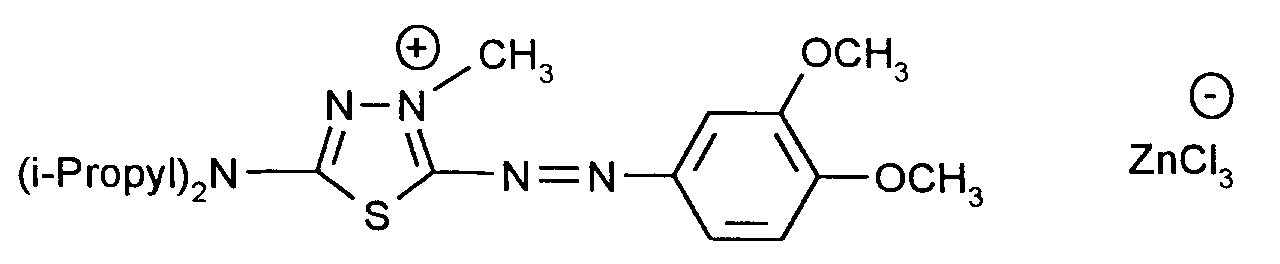
Es wurde ca. 2 % des chinoiden Nebenproduktes der Formel
gebildet (bestimmt durch DC). - 11,8 g des Farbstoffs der Formel (VIII) wurden wie unter a) beschrieben mit Dimethylsulfat umgesetzt (nach 17 Stunden war auch hier der Farbstoff der Formel (VIII) vollständig verbraucht) und aufgearbeitet. Man erhielt 12,2 g (58 % der Theorie) eines Farbstoffgemischs, das gemäß Dünnschichtchromatogramm ca. 45 % des gewünschten Farbstoffs der Formel (X)

und ca. 45 % des chinoiden Nebenprodukts der Formel (XI)
sowie in geringerem Maße weitere 3 Nebenprodukte enthielt, deren Strukturen jedoch nicht aufgeklärt wurden. Die Ausbeute des Farbstoffs der Formel (X) betrug also nur ca. 26 % der Theorie. - 11,8 g des obigen Farbstoffs der Formel (II) wurden in 100 ml Methanol mit 0,5 ml Eisessig und 3,9 g Piperidin versetzt. Es wurde 18 Stunden bei Raumtemperatur und 4 Stunden bei 40°C gerührt und dann abgekühlt. Der Farbstoff der Formel (II) war fast vollständig verbraucht. 100 ml konzentrierter Natriumchloridlösung und 120 ml einer 2-molaren Zinkchloridlösung wurden zugesetzt. Der Farbstoff schied sich dabei als Öl ab. Das Öl wurde abgetrennt, in 50 ml Eisessig und 100 ml Wasser gelöst und mit 120 ml einer 2-molaren Zinkchloridlösung gefällt. Man erhielt erneut ein Öl, das abgetrennt und getrocknet wurde. Man erhielt 5,9 g (49 % der Theorie) des Farbstoffs der Formel (I)

- 10,5 des obigen Farbstoffgemisches der Formeln (X) und (XI) wurden wie unter a) beschrieben umgesetzt. Der Farbstoff der Formel (X) war vollständig verbraucht. Die Aufarbeitung wie unter a) beschrieben ergab anfangs ein schmieriges Produkt, dann ein festes Pulver, das getrocknet wurde. Man erhielt 5,7 g eines Farbstoffgemischs, das neben ca. 2 % des Azofarbstoffs der Formel (VIII) und einer geringen Verunreinigung ausschließlich aus dem chinoiden Farbstoff der Formel (XI) bestand. Die Ausbeute des Ziel-Farbstoffs der Formel (XII)

der einem Farbstoff der Tabelle zu Beispiel 2 der DE-AS 1 151 612 entspricht, betrug demnach 0 %. Nach Dünnschichtchromatographie hatte sich dieser Farbstoff der Formel (XII) während der Reaktion in geringfügigem Maße gebildet, zersetzte sich aber rasch wieder.


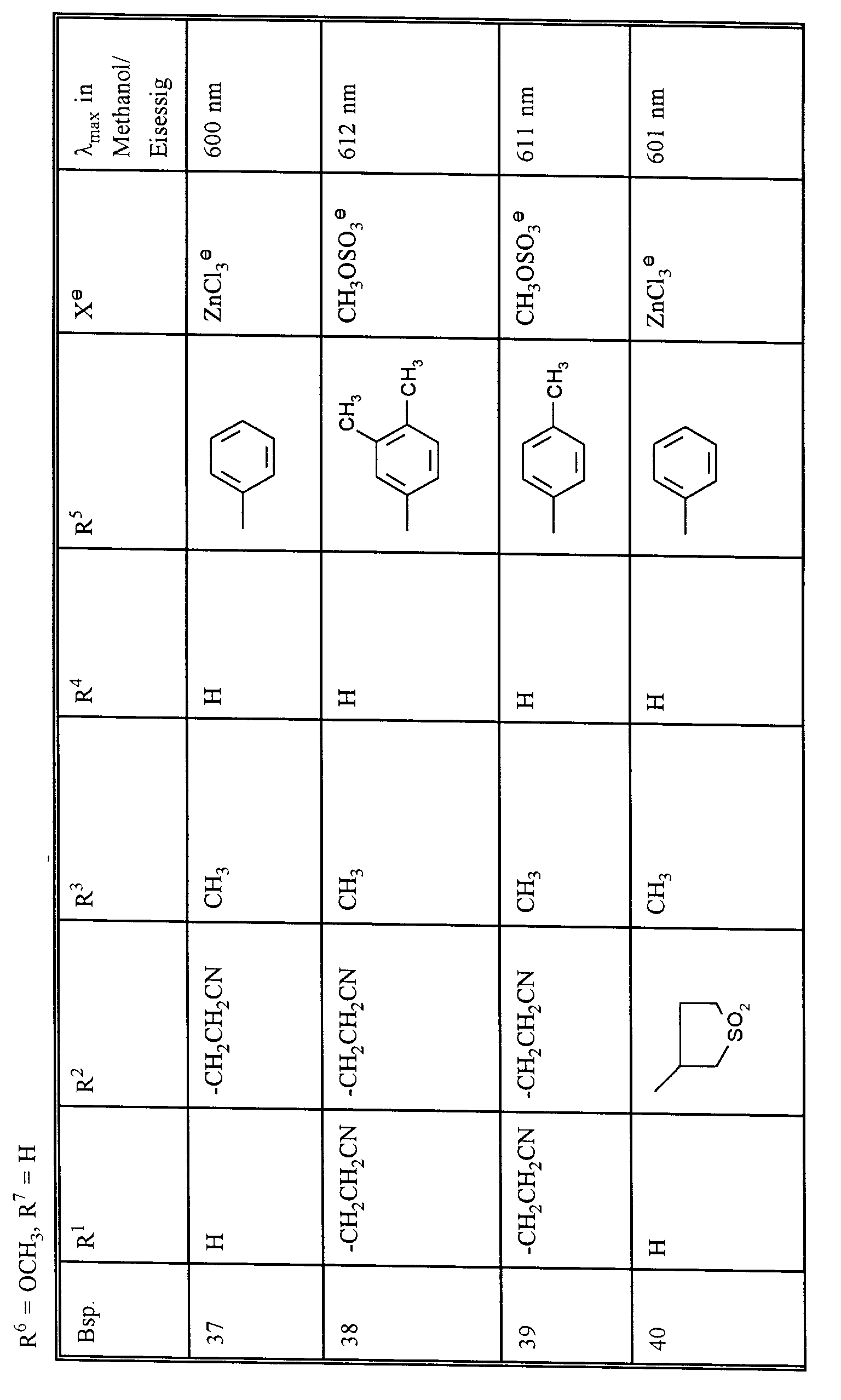
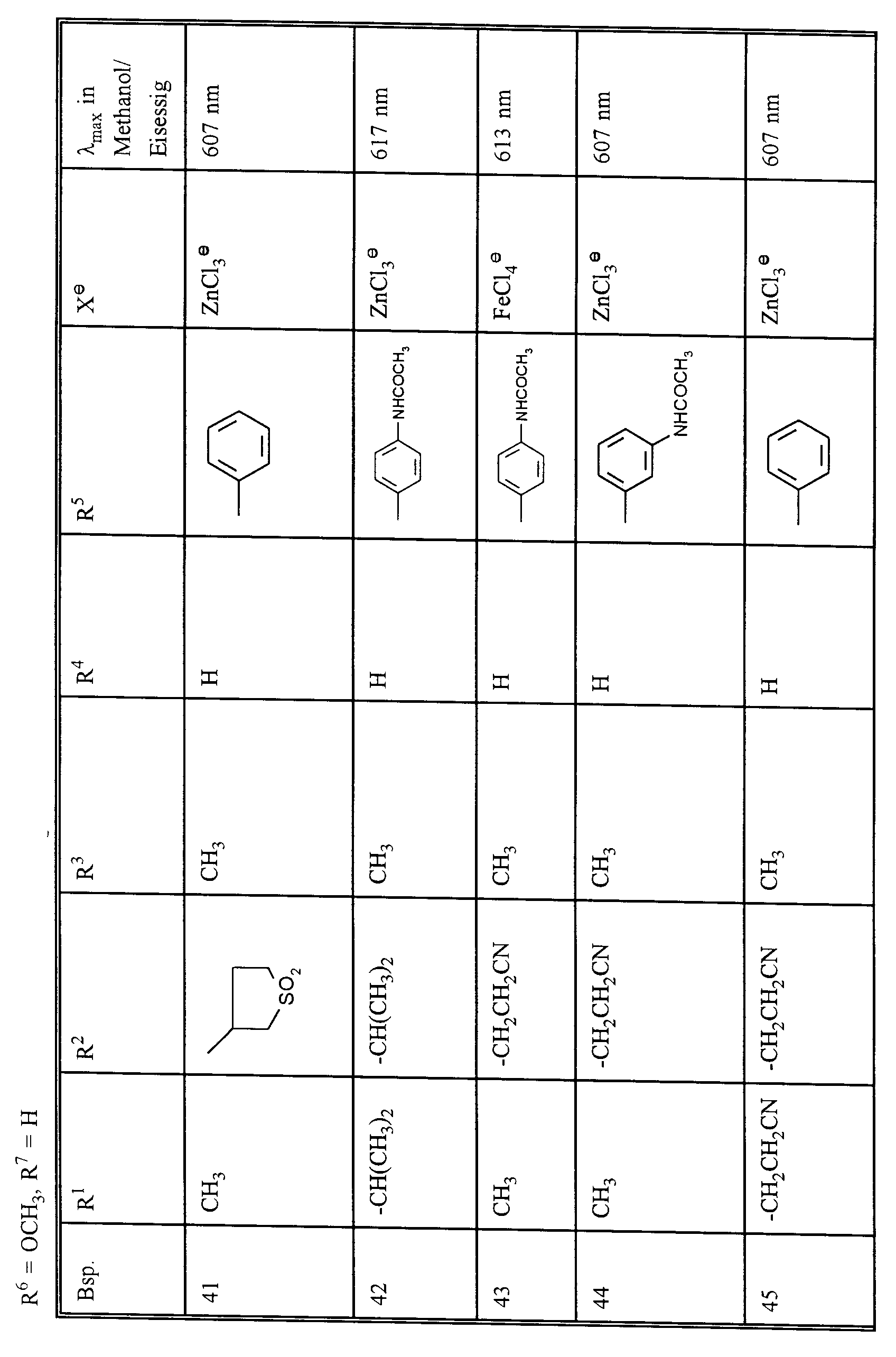
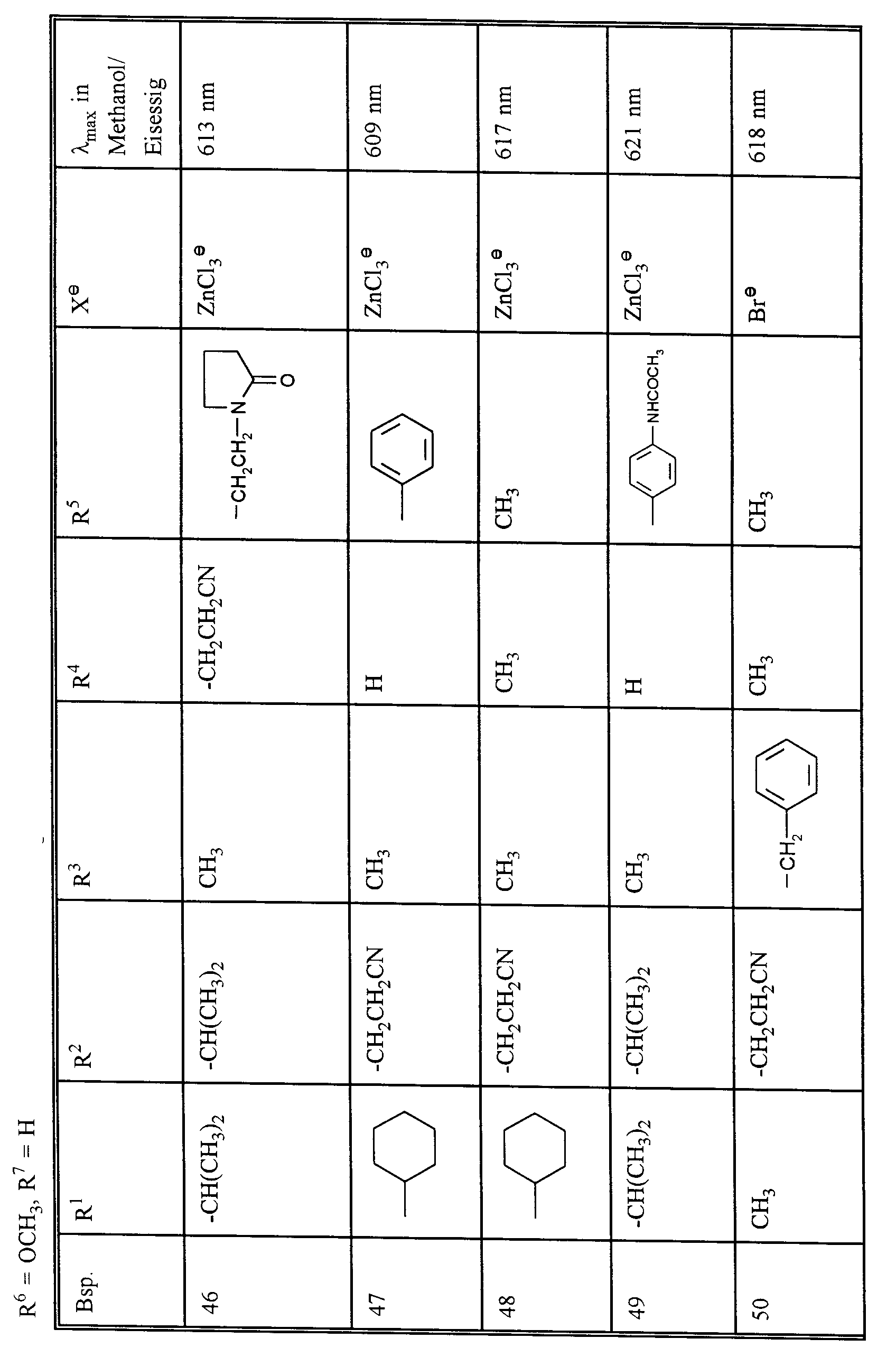




worin
R¹, R², R³, R⁶, R⁷ und X⊖ die oben angegebene Bedeutung besitzen, mit Aminen der Formel (III)

worin R⁴ und R⁵ die oben angegebene Bedeutung besitzen, umsetzt.
Claims (10)
- Verfahren zur Herstellung kationischer 1,3,4-Thiadiazol-Farbstoffe der Formel (I)
 R¹ und R² unabhängig voneinander Wasserstoff, Alkyl, Alkenyl, Cycloalkyl, Aralkyl, Aryl oder einen gegebenenfalls über Methylen oder Ethylen gebundenen heterocyclischen Rest bedeuten oderNR¹R² Pyrrolidino, Piperidino, Morpholino oder Piperazino bedeutet,R³ Alkyl, Alkenyl, Cycloalkyl, Aralkyl oder einen gegebenenfalls über Methylen oder Ethylen gebundenen heterocyclischen Rest bedeutet,R⁴ und R⁵ unabhängig voneinander Wasserstoff, Alkyl, Alkenyl, Aralkyl, Aryl oder einen gegebenenfalls über Methylen oder Ethylen gebundenen heterocyclischen Ring bedeuten oderNR⁴R⁵ Pyrrolidino, Piperidino, Morpholino oder gegebenenfalls durch Alkyl substituiertes Piperazino bedeutet undR⁶ und R⁷ unabhängig voneinander Wasserstoff, C₁-C₄-Alkyl oder C₁-C₄-Alkoxy bedeuten,X⊖ ein Anion bedeutet,das dadurch gekennzeichnet ist, daß man kationische Farbstoffe der Formel (II)
R¹, R², R³, R⁶, R⁷und X⊖ die oben angegebene Bedeutung besitzen, mit Aminen der Formel (III)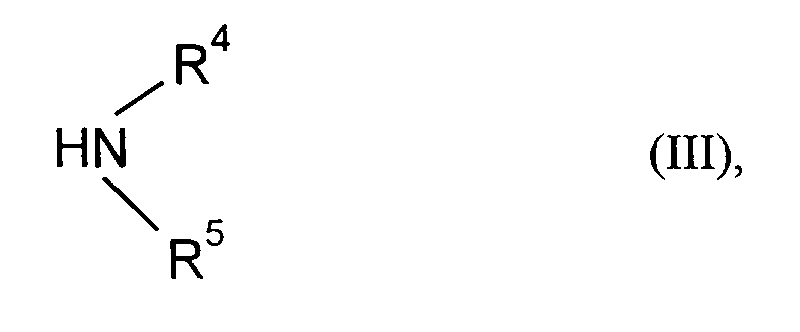
- Verfahren zur Herstellung von 1,3,4-Thiadiazol-Farbstoffen der Formel (I) nach Anspruch 1, worinR¹ und R² unabhängig voneinander Wasserstoff, unsubstituiertes oder durch Halogen, C₁-C₄-Alkoxy, Hydroxy, Cyano, Hydroxycarbonyl, C₁-C₄-Alkoxycarbonyl oder Phenyl substituiertes C₁-C₈-Alkyl oder C₂-C₆-Alkenyl, das jeweils unverzweigt oder verzweigt ist, C₄-C₇-Cycloalkyl oder unsubstituiertes oder durch bis zu drei Resten aus der Reihe Halogen, C₁-C₄-Alkyl, C₁-C₄-Alkoxy, Cyano oder Nitro substituiertes Phenyl, Tetramethylensulfonyl, Pyridylmethyl oder Pyridylethyl bedeuten oderNR¹R² Pyrrolidino, Piperidino, Morpholino, Piperazino oder N-C₁-C₄-Alkylpiperazino, wobei der Alkylrest unsubstituiert oder durch Halogen, Hydroxy oder Cyano substituiert ist, bedeutet,R³ unsubstituiertes oder durch Halogen, C₁-C₄-Alkoxy, Hydroxy, Cyano, C₁-C₄-Alkoxycarbonyl oder Phenyl substituiertes C₁-C₈-Alkyl oder C₂-C₆-Alkenyl bedeutet, das jeweils unverzweigt oder verzweigt ist, C₄-C₇-Cycloalkyl, Pyridylmethyl oder Pyridylethyl bedeutet,R⁴ und R⁵ unabhängig voneinander Wasserstoff, unsubstituiertes oder durch Halogen, C₁-C₄-Alkoxy, Hydroxy, Cyano, C₁-C₄-Alkoxycarbonyl oder Phenyl substituiertes C₁-C₈-Alkyl oder C₂-C₆-Alkenyl bedeutet, das jeweils unverzweigt oder verweigt ist oder unsubstituiertes oder durch bis zu drei Resten aus der Reihe Halogen, C₁-C₄-Alkyl, C₁-C₄-Alkoxy, Cyano oder Nitro substituiertes Phenyl, Tetramethylensulfonyl, Pyridylmethyl oder Pyridylethyl bedeuten, oderNR⁴R⁵ Pyrrolidino, Piperidino, Morpholino, Piperazino oder N-C₁-C₄-Alkylpiperazino, wobei der Alkylrest unsubstituiert oder durch Halogen, Hydroxy oder Cyano substituiet bedeutet,R⁶ Wasserstoff, Methyl oder Methoxy bedeutet,R⁷ Wasserstoff oder Methyl bedeutet, undX⊖ ein Anion bedeutet.
- Verfahren nach Anspruch 1, dadurch gekennzeichnet, daß man die zur Herstellung der Farbstoffe der Formel (I) eingesetzten kationischen Farbstoffe der Formel (II) dadurch erhält, daß man Verbindungen der Formel (IV)
 a) diazotiert,b) auf Methoxybenzole der Formel (V) kuppelt und
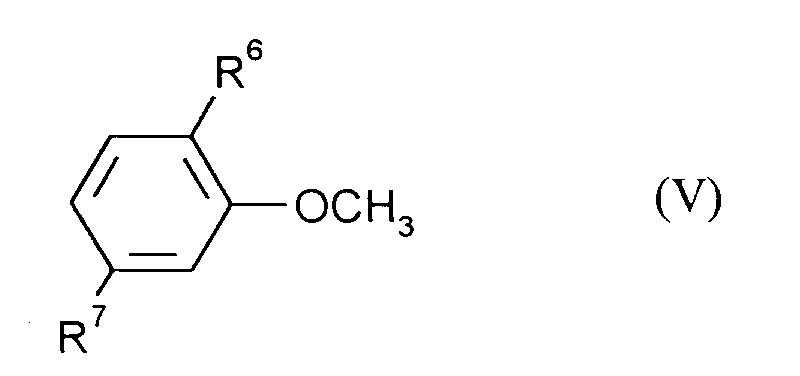 c) den so erhaltenen Farbstoff der Formel (VI)
R³X (VII)
oder solchen Quaternierungsmitteln, die unter Reaktionsbedingungen Verbindungen der Formel (VII) bilden, worin R³ und X die in Anspruch 1 angegebene Bedeutung besitzen, umsetzt. - Verfahren nach Anspruch 1, dadurch gekennzeichnet, daß die Verbindungen der Formeln (II) und/oder (VI) nicht zwischenisoliert werden.
- Verfahren nach Anspruch 1, dadurch gekennzeichnet, daß man die Umsetzung der kationischen Farbstoffe der Formel (II) mit Aminen der Formel (III) in Wasser und/oder einem polaren, mit Wasser mischbaren Lösungsmittel bei einer Temperatur zwischen 0°C und der Siedetemperatur des Reaktionsmediums durchführt.
- Verfahren nach Anspruch 1, das dadurch gekennzeichnet ist, daß die kationischen Farbstoffe der Formel (II) mit 1 bis 3 Mol-Äquivalenten eines Amins der Formel (III) umgesetzt werden.
- Kationische 1,3,4-Thiadiazol-Farbstoffe der Formel (I),
 R¹ und R² unabhängig voneinander Wasserstoff, Alkyl, Alkenyl, Cycloalkyl, Aralkyl oder einen gegebenenfalls über Methylen oder Ethylen gebundenen heterocyclischen Rest bedeuten oderNR¹R² Pyrrolidino, Piperidino, Morpholino oder Piperazino bedeutet,R³ Alkyl, Alkenyl, Cycloalkyl, Aralkyl oder einen gegebenenfalls über Methylen oder Ethylen gebundenen heterocyclischen Rest bedeutet,R⁴ Wasserstoff, C₁-C₄-Alkyl, Cyanethyl, Hydroxyethyl oder Hydroxypropyl bedeutet,R⁵ Cyanethyl, C₁-C₄-Alkoxycarbonylethyl, Hydroxycarbonylmethyl oder Tetramethylensulfonyl bedeutet oderNR⁴R⁵ Pyrrolidino, Piperidino, Morpholino oder Piperazino bedeutet undR⁶ Methoxy und R⁷ Wasserstoff bedeuten oder R⁶ Wasserstoff und R⁷ Methyl bedeuten, R¹ oder R² aber nicht für Aryl stehen und R⁵ nicht für Cyanethyl steht, wenn R⁷ für Methyl und R⁴ für Wasserstoff oder C₁-C₄-Alkyl stehen undX⊖ ein Anion bedeutet.
 - Kationische 1,3,4-Thiadiazol-Farbstoffe gemäß Anspruch 7,
worinR¹ und R² unabhängig voneinander Wasserstoff, Methyl, Ethyl, Propyl, 2-Propyl, Cyanethyl, Hydroxyethyl, Hydroxypropyl, Methoxyethyl, Benzyl, Allyl, Cyclopentyl, Cyclohexyl oder Tetramethylensulfonyl bedeuten oderNR¹R² Pyrrolidino, Piperidino oder Morpholino bedeutet,R³ Methyl, Ethyl, Cyanethyl, Hydroxyethyl, Hydroxypropyl oder Benzyl bedeutet,R⁴ Wasserstoff, Methyl, Ethyl, Cyanethyl oder Hydroxyethyl bedeutet,R⁵ Cyanethyl oder Tetramethylensulfonyl bedeutet oderNR⁴R⁵ Pyrrolidino, Piperidino oder Morpholino bedeutet,R⁶ Methoxy und R⁷ Wasserstoff bedeuten undX⊖ ein Anion bedeutet. - Verwendung der Farbstoffe nach Anspruch 7 zum Färben und Bedrucken von Polymerisaten und Mischpolymerisaten des Acrylnitrils und Dicyanoethylens, sauer modifizierten Fasern aus Polyamid und Polyester, tannierten Zellulosematerialien, Papier, Seide und Leder, zur Herstellung von Schreibflüssigkeiten, Stempelflüssigkeiten, Kugelschreiberpasten und ink-jet-Tinten sowie im Gummidruck.
- Polymerisate und Mischpolymerisate des Acrylnitrils und Dicyanoethylens, sauer modifiziertes Polyamid und Polyester, tannierte Zellulosematerialien, Papier, Seide, Leder, Kugelschreiberpasten, Schreibflüssigkeiten, Stempelflüssigkeiten und ink-jet-Tinten, die dadurch gekennzeichnet sind, daß sie mindestens einen erfindungsgemäßen kationischen 1,3,4-Thiadiazolfarbstoff nach Anspruch 7 enthalten.
Applications Claiming Priority (2)
| Application Number | Priority Date | Filing Date | Title |
|---|---|---|---|
| DE4444861 | 1994-12-16 | ||
| DE4444861A DE4444861A1 (de) | 1994-12-16 | 1994-12-16 | Verfahren zur Herstellung von kationischen 1,3,4-Thiadiazolfarbstoffe |
Publications (1)
| Publication Number | Publication Date |
|---|---|
| EP0717082A1 true EP0717082A1 (de) | 1996-06-19 |
Family
ID=6535986
Family Applications (1)
| Application Number | Title | Priority Date | Filing Date |
|---|---|---|---|
| EP95119062A Withdrawn EP0717082A1 (de) | 1994-12-16 | 1995-12-04 | Verfahren zur Herstellung von kationischen 1,3,4-Thiadiazolfarbstoffen |
Country Status (4)
| Country | Link |
|---|---|
| EP (1) | EP0717082A1 (de) |
| JP (1) | JPH08239586A (de) |
| DE (1) | DE4444861A1 (de) |
| MX (1) | MX9504739A (de) |
Cited By (1)
| Publication number | Priority date | Publication date | Assignee | Title |
|---|---|---|---|---|
| EP0884367A3 (de) * | 1997-06-11 | 2000-05-17 | Bayer Ag | Kationische Diphenylaminfarbstoffe und deren Anhydrobasen |
Citations (7)
| Publication number | Priority date | Publication date | Assignee | Title |
|---|---|---|---|---|
| DE1137815B (de) * | 1958-09-30 | 1962-10-11 | Basf Ag | Verfahren zur Herstellung basischer Azofarbstoffe |
| DE1151612B (de) | 1959-04-17 | 1963-07-18 | Basf Ag | Verfahren zur Herstellung basischer Farbstoffe |
| DE2811258A1 (de) | 1978-03-15 | 1979-09-27 | Bayer Ag | Kationische 1,3,4-thiadiazol-farbstoffe |
| DE2908135A1 (de) * | 1979-03-02 | 1980-09-11 | Bayer Ag | Kationische farbstoffe |
| EP0237910A2 (de) * | 1986-03-20 | 1987-09-23 | Bayer Ag | Verfahren zur Herstellung von Azofarbstoffen |
| EP0495250A1 (de) * | 1991-01-12 | 1992-07-22 | Bayer Ag | Kationische 1,3,4-Thiadiazolfarbstoffe |
| DE4222257A1 (de) | 1992-07-07 | 1994-01-13 | Bayer Ag | Kationische Thiadiazoldiphenylaminfarbstoffe |
-
1994
- 1994-12-16 DE DE4444861A patent/DE4444861A1/de not_active Withdrawn
-
1995
- 1995-11-13 MX MX9504739A patent/MX9504739A/es unknown
- 1995-12-04 EP EP95119062A patent/EP0717082A1/de not_active Withdrawn
- 1995-12-11 JP JP7345422A patent/JPH08239586A/ja active Pending
Patent Citations (9)
| Publication number | Priority date | Publication date | Assignee | Title |
|---|---|---|---|---|
| DE1137815B (de) * | 1958-09-30 | 1962-10-11 | Basf Ag | Verfahren zur Herstellung basischer Azofarbstoffe |
| DE1151612B (de) | 1959-04-17 | 1963-07-18 | Basf Ag | Verfahren zur Herstellung basischer Farbstoffe |
| DE2811258A1 (de) | 1978-03-15 | 1979-09-27 | Bayer Ag | Kationische 1,3,4-thiadiazol-farbstoffe |
| GB2017134A (en) * | 1978-03-15 | 1979-10-03 | Bayer Ag | 1 2 3 thiadiazole dyesuffs |
| DE2908135A1 (de) * | 1979-03-02 | 1980-09-11 | Bayer Ag | Kationische farbstoffe |
| EP0237910A2 (de) * | 1986-03-20 | 1987-09-23 | Bayer Ag | Verfahren zur Herstellung von Azofarbstoffen |
| EP0495250A1 (de) * | 1991-01-12 | 1992-07-22 | Bayer Ag | Kationische 1,3,4-Thiadiazolfarbstoffe |
| DE4222257A1 (de) | 1992-07-07 | 1994-01-13 | Bayer Ag | Kationische Thiadiazoldiphenylaminfarbstoffe |
| EP0579011A1 (de) * | 1992-07-07 | 1994-01-19 | Bayer Ag | Kationische Thiadiazoldiphenylaminfarbstoffe |
Cited By (1)
| Publication number | Priority date | Publication date | Assignee | Title |
|---|---|---|---|---|
| EP0884367A3 (de) * | 1997-06-11 | 2000-05-17 | Bayer Ag | Kationische Diphenylaminfarbstoffe und deren Anhydrobasen |
Also Published As
| Publication number | Publication date |
|---|---|
| JPH08239586A (ja) | 1996-09-17 |
| MX9504739A (es) | 1997-03-29 |
| DE4444861A1 (de) | 1996-06-20 |
Similar Documents
| Publication | Publication Date | Title |
|---|---|---|
| EP0495250B1 (de) | Kationische 1,3,4-Thiadiazolfarbstoffe | |
| EP0029136B1 (de) | Quartäre und basische Azamethinverbindungen, Verfahren zu ihrer Herstellung und ihre Verwendung als Farbmittel | |
| EP0579011B1 (de) | Kationische Thiadiazoldiphenylaminfarbstoffe | |
| EP0675169B1 (de) | Kationische Thiadiazolfarbstoffe | |
| EP0752451B1 (de) | Die Verwendung von kationischen 4,5-Dihydro-1H-1,2,3-triazoliumverbindungen als Farbstoffe | |
| DE2255058B2 (de) | Basische Benzthiazolazofarbstoffe, Verfahren zu deren Herstellung und ihre Verwendung zum Färben und Bedrucken von Polymerisaten und Mischpolymerisaten des Acrylnitrils und Dicyanäthylens, sowie sauer modifizierten Synthesefasern | |
| EP0717082A1 (de) | Verfahren zur Herstellung von kationischen 1,3,4-Thiadiazolfarbstoffen | |
| DE2222099A1 (de) | Basische azofarbstoffe, ihre herstellung und verwendung | |
| DE2013791C3 (de) | Basische Farbstoffe, Verfahren zu deren Herstellung und ihre Verwendung zum Färben und Bedrucken von TextilmateriHlien und Leder, sowie zur Herstellung von Druckpasten und Schreibflüssigkeiten | |
| EP0247970B1 (de) | Benzanthronlactone, Verfahren zu ihrer Herstellung und ihre Verwendung | |
| DE1644175C3 (de) | Sulfonsäure- und carbonsäurefreie Azofarbstoffe, Verfahren zu deren Herstellung und ihre Verwendung | |
| EP0717081A1 (de) | Kationische 1,3,4-Thiadiazolfarbstoffe | |
| DE2039492A1 (de) | Kationische Farbstoffe | |
| EP0434609B1 (de) | Verfahren zum Färben von Polyacrylnitrilmaterialien | |
| DE1137815B (de) | Verfahren zur Herstellung basischer Azofarbstoffe | |
| EP0015872B1 (de) | Kationische Azofarbstoffe, deren Herstellung und Verwendung beim Färben und Bedrucken von Textilmaterial | |
| DE2744655A1 (de) | Kationische azofarbstoffe, verfahren zu ihrer herstellung und ihre verwendung | |
| EP0037374B1 (de) | Methinverbindungen | |
| EP0023652B1 (de) | Verfahren zur Herstellung kationischer Farbstoffe | |
| DE2360986A1 (de) | Polycyclische farbstoffe, verfahren zu ihrer herstellung und ihre verwendung | |
| DE1248192B (de) | Verfahren zur Herstellung von Methinfarbstoffen | |
| EP0698641A1 (de) | Kationische 1,3,4-Thiadiazolfarbstoffe | |
| DE3009267A1 (de) | Verfahren zur herstellung kationischer farbstoffe sowie ihre verwendung | |
| DE2202300A1 (de) | Basische farbstoffe, ihre herstellung und verwendung | |
| EP0210139A2 (de) | Kationische 1,2,3-Thiadiazolazoverbindungen |
Legal Events
| Date | Code | Title | Description |
|---|---|---|---|
| PUAI | Public reference made under article 153(3) epc to a published international application that has entered the european phase |
Free format text: ORIGINAL CODE: 0009012 |
|
| AK | Designated contracting states |
Kind code of ref document: A1 Designated state(s): CH DE FR GB LI |
|
| STAA | Information on the status of an ep patent application or granted ep patent |
Free format text: STATUS: THE APPLICATION HAS BEEN WITHDRAWN |
|
| 18W | Application withdrawn |
Withdrawal date: 19960627 |