EP0717576A2 - Appareil radiotéléphonique - Google Patents
Appareil radiotéléphonique Download PDFInfo
- Publication number
- EP0717576A2 EP0717576A2 EP95308451A EP95308451A EP0717576A2 EP 0717576 A2 EP0717576 A2 EP 0717576A2 EP 95308451 A EP95308451 A EP 95308451A EP 95308451 A EP95308451 A EP 95308451A EP 0717576 A2 EP0717576 A2 EP 0717576A2
- Authority
- EP
- European Patent Office
- Prior art keywords
- nam
- radio telephone
- predetermined
- data
- stored
- Prior art date
- Legal status (The legal status is an assumption and is not a legal conclusion. Google has not performed a legal analysis and makes no representation as to the accuracy of the status listed.)
- Granted
Links
- 238000000034 method Methods 0.000 claims abstract description 24
- 238000012795 verification Methods 0.000 claims description 11
- 230000006870 function Effects 0.000 description 8
- 238000013479 data entry Methods 0.000 description 4
- 230000003750 conditioning effect Effects 0.000 description 3
- 230000000694 effects Effects 0.000 description 2
- 230000001143 conditioned effect Effects 0.000 description 1
- 238000012986 modification Methods 0.000 description 1
- 230000004048 modification Effects 0.000 description 1
Images


Classifications
-
- H—ELECTRICITY
- H04—ELECTRIC COMMUNICATION TECHNIQUE
- H04W—WIRELESS COMMUNICATION NETWORKS
- H04W8/00—Network data management
- H04W8/26—Network addressing or numbering for mobility support
- H04W8/265—Network addressing or numbering for mobility support for initial activation of new user
-
- H—ELECTRICITY
- H04—ELECTRIC COMMUNICATION TECHNIQUE
- H04W—WIRELESS COMMUNICATION NETWORKS
- H04W8/00—Network data management
- H04W8/18—Processing of user or subscriber data, e.g. subscribed services, user preferences or user profiles; Transfer of user or subscriber data
Definitions
- the invention relates to conditioning a radio telephone with unique identification information.
- a radio telephone bought off-the-shelf Before a radio telephone bought off-the-shelf is fully functional it is necessary for the purchaser to sign up with a service provider.
- a telephone is manufactured with a unique Electronic Serial Number ESN, in order to connect to a radio telephone system of the purchasers choice (eg Cellnet or Vodaphone in the UK), the radio telephone must be provided with sufficient information to identify the radio telephone user and the system to which it is connected. This information is provided in the Number Assignment Module (NAM) information.
- NAM Number Assignment Module
- 'Number Assignment Module' and 'NAM' as used herein encompass any memory means, not necessarily modular in form, nor dedicated to the NAM function, in which information pertaining to the identity of the telephone, specifically the telephone number, is stored.
- the NAM information includes a Mobile Identification Number (MIN) which is basically the telephone number of the radio telephone. This number also indicates the Access Overload Class (ACOL).
- MIN Mobile Identification Number
- ACOL Access Overload Class
- the NAM includes security data used during registration to confirm the identity of the radio telephone and System Identification Data (SID) providing details of a 'Home Traffic Area' and 'System Control Channels'.
- SID System Identification Data
- the radio telephone uses the NAM information along with its ESN to gain access to the chosen radio telephone system.
- the process of conditioning a radio telephone with its own unique identifying information is highly desirable for the process of conditioning a radio telephone with its own unique identifying information to be as simple as possible so that there is as little delay in the sales process as possible.
- the sales assistant is required to enter the relevant data into the telephone. It is not generally possible for the purchaser to enter the NAM information as a password, ideally not widely available, is needed to access the NAM.
- the process is relatively complicated. The data is obtained from the chosen service provider by telephone and is usually entered through the key pad of the radio telephone. If the password is correctly entered the assistant must input each of the fields of the NAM data in a predetermined sequence.
- a method for conditioning a Number Assignment Module (NAM) for a radio telephone with identification data comprising the steps: storing a predetermined code at a predetermined location in the NAM; determining if the predetermined code is stored at the predetermined NAM location; and replacing the predetermined code with identification data conditional on the result of the determination.
- NAM Number Assignment Module
- a radio telephone comprising: a Number Assignment Module (NAM) in which is stored a predetermined code at a predetermined location; means for determining if the predetermined code is stored at the predetermined location; and replacing means responsive to the means for determining for replacing the predetermined code with identification data.
- NAM Number Assignment Module
- a factory default NAM is provided.
- the factory default NAM typically the MIN
- the factory default MIN provides the password that allows the telephone to be conditioned with user specific NAM data.
- the number of key presses required by the sales assistant or other person entering the NAM data is reduced. There is no need to enter a password or other code correctly and the person entering the NAM information need only enter that information directly relevant to the NAM.
- the reduced number of keystrokes both speeds up the process and reduces the likelihood of error.
- the simplicity of the process makes it feasible for purchasers themselves to be able to store the identification information in the NAM particularly as no password is necessary.
- the replacing means comprises means for determining if a sequence of key presses provides data indicative of NAM data.
- the replacement of the predetermined code with NAM data is additionally conditional on the sequence of key presses entered corresponding with the sequence of key presses for entering NAM data.
- the telephone can be used for other purposes before the identification information is stored in the NAM. If, for example, the identification data is to be stored in the NAM by the purchasers themselves it is preferable for the phone to be usable for specific purposes, eg. entering automatic dialling information, accessing menu functions and dialling emergency numbers before the individual NAM information has been obtained. It may also be desirable for the phone to be able to make a call to the service provider in order to obtain the NAM data in the first instance.
- the NAM data is entered in two parts and a non-numeric key, suitably the asterisk key, is pressed to separate the two parts.
- a non-numeric key suitably the asterisk key
- Other suitable protocols for the entry of NAM data could, however, be used instead.
- the telephone preferably provides means for verifying the accuracy of the entered NAM data. This may take the form of means for generating a check derived from digits entered in the sequence of key presses. The check may be a number. This may be displayed on the LCD of the radio telephone or could be sent over the air for remote verification.
- an over-the-air signal received by the radio telephone may be used to trigger replacement of the default NAM with the identification data entered.
- the key presses are preferably used to provide data for the two most important fields in the NAM ie the Mobile Identification Number (MIN) and the System Identification Number (SID).
- MIN Mobile Identification Number
- SID System Identification Number
- Other fields of the NAM can be derived from the data in the MIN and SID fields and/or set as defaults.
- the unverified data is preferably held prior to verification and only replaces the code stored in the NAM once verification has been obtained.
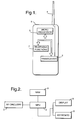
- FIGS 1 and 2 are schematic representations of a radio telephone 1.
- the radio telephone 1 includes a transceiver 2 including R.F. circuitry 3 ( Figure 1 ) connected to an external antenna 4 and coupled to a microprocessor unit (MPU) 5 that receives signals from a keyboard 6, controls telephone functions 7 and displays information on a display 8.
- MPU microprocessor unit
- the telephone 1 has its own inherent telephone number by virtue of a NAM 9 contained within the main unit of the radio telephone.
- the information held in the NAM 9 is interrogated by the MPU 5 each time the radio telephone is powered up to determine the phone's unique identity.
- This embodiment of the present invention introduces a simple check during the start-up sequence to determine whether or not the presently held NAM data corresponds to the factory default NAM.
- Figure 3 is a schematic showing the process undertaken by the radio telephone when it is powered up and subsequently utilised.
- the key stroke sequence is then interrogated to see if it meets the protocol for entering the NAM data.
- the NAM is entered in two parts the MIN and the SID separated by an asterisk. Other protocols could, however, be adopted. If the NAM is still in its original condition checked at block 15 the incident key stroke sequence is checked to see if it complies with the protocol (block 16).
- NAM data the identification information
- block 15 the factory default setting
- block 16 the data input through the keyboard is assumed to be NAM data.
- the NAM data is held for verification before replacing the default NAM setting (block 17).
- To verify the NAM data a check sum based on the numbers entered is generated (block 18).
- the manner in which the check sum is generated is not critical. Any function of the input numbers will provide an identifier that can be checked verbally with the service provider or perhaps verified over the air.
- the identifier may be a simple single digit number or could perhaps be some other identifying character or characters.
- the identifier is checked against a corresponding check sum provided by the service provider which has been derived using the same functional relationship from the numbers that should have been entered. If the two numbers correspond the likelihood is that the NAM data entry has been performed correctly and the data entered is verified (block 19). If there is a discrepancy between the two check sums, a mistake has been made and the data entry is not verified. This results in no action being taken (block 20) and the radio telephone reverts to normal operation (block 14).
- the factory default NAM is replaced with the entered data (block 21), the NAM no longer contains the factory default and the phone reverts to normal operation at (block 14).
- the NAM data entered is not correct, the incorrect NAM data can still be replaced by entering a specific password that gives access to the NAM. As under these circumstances the factory default NAM will have been replaced and on entering the specific password the 'no' branch will be taken at block 15.
- the key stroke sequence will be compared to the specific password at block 23 and, if it complies, the user can, or perhaps is prompted to, enter the NAM data (block 24). The process then returns to block 16 to check that the correct protocol has been followed for NAM data entry. The process then continues with blocks 17 to 19 until the correct information is stored in the NAM .
- the process will always pass from block 15 to block 23. If a key stroke sequence is not the password (block 23), the key stroke sequence is investigated to determine if the user is requesting a function to be performed (block 25). If so the phone operates as it would when performing a function (block 26), otherwise, the phone operates as it would when making a telephone call (block 27).
- the user will power up the telephone (block 30) for the first time and either use a landline telephone to call the service provider (block 31) or perhaps use the default NAM to make a call using the radio telephone.
- the service provider could, however, be contacted in other ways, for example, via computer.
- the service provider provides the MIN and SID to the user (block 32) who inputs the figures provided (block 33) divided, in this specific embodiment, with an asterisk. This sequence is displayed on the LCD.
- the send key is then pressed (block 34).
- the MIN is ten digits and the SID five although the preceding zeros of the SID can be omitted in this embodiment. This arrangement ie ten digits followed by an asterisk is checked for at block 35.
- a check sum is calculated (block 36) based on the digits input at block 33.
- the check sum is displayed on the LCD.
- the user can then verify with the service provider that the check sum is correct. This can be achieved simply by repeating the check sum and having it confirmed verbally (block 37).
- Other options are, however, envisaged.
- the send key is perhaps pressed once again and the check sum is sent over the air to the service provider and a verification signal is returned in the same fashion.
- Another option may be for the user to enter a check sum at the time of entering the NAM data. The check sum generated based on the entered digits could then be immediately compared to the entered check sum and the verification process and replacement automated.
- the user or sales assistant can have confidence that the NAM data has been entered correctly and the send, or other suitable key or key sequence is pressed again (block 38).
- data for other areas of the NAM is generated from the MIN and SID (block 39).
- This information is stored in the NAM along with the MIN and SID entered through the keyboard and possibly other default settings (block 40).
- the information generated may include, for example, the access overload class or the system control channel.
- the manner in which the entered NAM data replaces the existing data or code in the NAM is open to choice. One possibility is for it to take place as soon as verification occurs. As another option, however, the verified NAM data could be stored at a specified location, for instance 00 of the abbreviated dialling memory and only transferred to the NAM on the next occasion the phone is powered up.
- the user can press the end key and return to normal operation of the phone at which point the NAM data can be reentered or some other function performed.
- a check is made to see whether or not the end key has been pressed. If it has, the phone returns to normal operation. Otherwise the key stroke sequence is checked at block 42 to see if it performs another operation of the phone.
- the end key can be pressed to return to normal operation at block 42 or the desired operation of the phone is performed.
- the radio telephone now has its own individual identity and can be used to make calls.
- the embodiment described in effect provides a phone preconditioned to accept NAM data entered in accordance with a specific protocol.
- the embodiment described requires minimal key strokes for entering the NAM data and as such requires some degree of knowledge on the part of the user before the NAM information can be stored in the NAM.
- the phone could prompt the user to input NAM data on detecting the factory default NAM each time the phone is powered up. This prompt would not be necessary once the factory default NAM had been replaced and could then be abandoned. Additional messages could be provided on the phone's display to prompt the next stage of the procedure.
- the present invention includes any novel feature or combination of features disclosed herein either explicitly or any generalisation thereof irrespective of whether or not it relates to the claimed invention or mitigates any or all of the problems addressed.
Landscapes
- Engineering & Computer Science (AREA)
- Databases & Information Systems (AREA)
- Computer Networks & Wireless Communication (AREA)
- Signal Processing (AREA)
- Mobile Radio Communication Systems (AREA)
Applications Claiming Priority (2)
| Application Number | Priority Date | Filing Date | Title |
|---|---|---|---|
| GB9425185 | 1994-12-12 | ||
| GB9425185A GB2296160B (en) | 1994-12-12 | 1994-12-12 | Radio telephone |
Publications (3)
| Publication Number | Publication Date |
|---|---|
| EP0717576A2 true EP0717576A2 (fr) | 1996-06-19 |
| EP0717576A3 EP0717576A3 (fr) | 1996-10-02 |
| EP0717576B1 EP0717576B1 (fr) | 2001-07-18 |
Family
ID=10765906
Family Applications (1)
| Application Number | Title | Priority Date | Filing Date |
|---|---|---|---|
| EP95308451A Expired - Lifetime EP0717576B1 (fr) | 1994-12-12 | 1995-11-24 | Appareil radiotéléphonique |
Country Status (4)
| Country | Link |
|---|---|
| US (1) | US5848360A (fr) |
| EP (1) | EP0717576B1 (fr) |
| DE (1) | DE69521774T2 (fr) |
| GB (1) | GB2296160B (fr) |
Families Citing this family (12)
| Publication number | Priority date | Publication date | Assignee | Title |
|---|---|---|---|---|
| US6018656A (en) * | 1994-12-30 | 2000-01-25 | Sony Corporation | Programmable cellular telephone and system |
| US5828956A (en) * | 1994-12-30 | 1998-10-27 | Sony Electronics, Inc. | Programmable cellular telephone and system |
| US6324592B1 (en) | 1997-02-25 | 2001-11-27 | Keystone Aerospace | Apparatus and method for a mobile computer architecture and input/output management system |
| US6374122B1 (en) * | 1998-05-11 | 2002-04-16 | Qualcomm Inc. | Method and apparatus for supporting expanded electronic serial number (EESN) format |
| US7274928B2 (en) * | 1998-10-02 | 2007-09-25 | Telespree Communications | Portable cellular phone system having automatic initialization |
| WO2001017298A1 (fr) | 1999-09-02 | 2001-03-08 | Automated Business Companies | Systemes de communications et d'autorisations de proximite |
| US6591098B1 (en) * | 2000-11-07 | 2003-07-08 | At&T Wireless Services, Inc. | System and method for using a temporary electronic serial number for over-the-air activation of a mobile device |
| JP2002290546A (ja) * | 2001-03-28 | 2002-10-04 | Toshiba Corp | 移動通信端末とその設定データ変更方法 |
| US8046581B2 (en) | 2002-03-04 | 2011-10-25 | Telespree Communications | Method and apparatus for secure immediate wireless access in a telecommunications network |
| US7197301B2 (en) | 2002-03-04 | 2007-03-27 | Telespree Communications | Method and apparatus for secure immediate wireless access in a telecommunications network |
| US20100204747A1 (en) * | 2007-06-26 | 2010-08-12 | Zurlin Technologies Holdings, Llc | Intra-oral electronic therapy devices for treatment of sleep-breathing disorders, bruxing disorders, and tmj disorders, and associated methods |
| US8553849B2 (en) * | 2009-06-17 | 2013-10-08 | Avaya Inc. | Personal identification and interactive device for internet-based text and video communication services |
Family Cites Families (13)
| Publication number | Priority date | Publication date | Assignee | Title |
|---|---|---|---|---|
| US4817190A (en) * | 1985-08-27 | 1989-03-28 | Motorola, Inc. | Method for dynamically regrouping subscribers on a communications system |
| CA2045057C (fr) * | 1990-07-12 | 1995-05-09 | Gregory P. Wilson | Teleprogrammation d'un radiotelephone |
| CA2047871C (fr) * | 1990-07-25 | 1996-05-14 | Ikio Yoshida | Emetteur-recepteur portatif et systeme de transfert connexe |
| US5297192A (en) * | 1990-09-28 | 1994-03-22 | At&T Bell Laboratories | Method and apparatus for remotely programming a mobile data telephone set |
| CA2059845C (fr) * | 1991-01-30 | 1997-05-06 | Stefan G. Littig | Appareil radio universel a memoire adaptative |
| FI89993C (fi) * | 1991-05-31 | 1993-12-10 | Nokia Mobile Phones Ltd | Programmering av installationsdata i en mobiltelefon |
| FI96564C (fi) * | 1991-07-08 | 1996-07-10 | Nokia Mobile Phones Ltd | Yksityispuhelinnumero solukkopuhelinjärjestelmässä |
| JPH05167496A (ja) * | 1991-12-16 | 1993-07-02 | Matsushita Electric Ind Co Ltd | 自動車電話装置 |
| FI98183C (fi) * | 1992-02-14 | 1997-04-25 | Nokia Mobile Phones Ltd | Järjestely data-adapterin kytkemiseksi GSM-solukkopuhelimeen |
| US5551073A (en) * | 1993-02-25 | 1996-08-27 | Ericsson Inc. | Authentication key entry in cellular radio system |
| US5943614A (en) * | 1993-08-11 | 1999-08-24 | Kabushiki Kaisha Toshiba | Mobile radio communication device using plurals authentication parameters |
| TW249877B (fr) * | 1993-11-23 | 1995-06-21 | Bellsouth Int Inc | |
| US5581803A (en) * | 1994-04-21 | 1996-12-03 | Motorola, Inc. | Method of programming a radio identification code in a communication unit |
-
1994
- 1994-12-12 GB GB9425185A patent/GB2296160B/en not_active Revoked
-
1995
- 1995-11-24 EP EP95308451A patent/EP0717576B1/fr not_active Expired - Lifetime
- 1995-11-24 DE DE69521774T patent/DE69521774T2/de not_active Expired - Fee Related
- 1995-12-04 US US08/566,789 patent/US5848360A/en not_active Expired - Lifetime
Non-Patent Citations (1)
| Title |
|---|
| None |
Also Published As
| Publication number | Publication date |
|---|---|
| DE69521774T2 (de) | 2002-05-23 |
| GB9425185D0 (en) | 1995-02-08 |
| GB2296160B (en) | 1999-05-19 |
| DE69521774D1 (de) | 2001-08-23 |
| US5848360A (en) | 1998-12-08 |
| EP0717576A3 (fr) | 1996-10-02 |
| GB2296160A (en) | 1996-06-19 |
| EP0717576B1 (fr) | 2001-07-18 |
Similar Documents
| Publication | Publication Date | Title |
|---|---|---|
| US7076240B2 (en) | Customer activation system for cellular network | |
| US5974311A (en) | Method and apparatus for storing activation data in a cellular telephone | |
| US6748209B2 (en) | Method and apparatus for storing activation data in a cellular telephone | |
| US6094573A (en) | System and a method for selective data retrieval from a remote database on basis of caller line identification and user specific access codes | |
| EP0717576B1 (fr) | Appareil radiotéléphonique | |
| US5414418A (en) | Method and apparatus for pre-programming and subsequently designating a response characteristic of a selective call receiver | |
| US6775559B1 (en) | Method and apparatus for configuring the settings of a communication terminal device from a remote location | |
| US6577857B1 (en) | Portable communication unit with discrete allocable blocks of airtime | |
| US5835858A (en) | Easy activation of a cellular phone | |
| RU2346408C2 (ru) | Способ и устройство для загрузки настроек для приложения | |
| EP0938828A2 (fr) | Systeme et methode de programmation par l'utilisateur de services de telephonie cellulaire | |
| EP1653753A1 (fr) | Méthode pour gérer les renseignements d'identification personnels d'une carte de module d'identité d'abonné dans un terminal de communication mobile | |
| US20020002612A1 (en) | Portable terminal apparatus and communication method thereof | |
| JPH09107582A (ja) | セルラー電話機及びセルラー電話機の機能設定方法 | |
| US20060248167A1 (en) | Wireless devices as guard tour data collection and transmission devices | |
| US6741872B1 (en) | Method of authorizing access to a cellular mobile radio network from a simplified telephone and an associated mobile radio system and simplified telephone | |
| US20050070330A1 (en) | Method of matching between a mobile phone and a personal card | |
| JP2002342288A (ja) | 認証装置、認証システム、認証方法、認証プログラム及び記録媒体 | |
| EP0601659B2 (fr) | Méthode pour la protection d'un système à carte à circuit intégré | |
| EP0951193A2 (fr) | Procédé d'identification d'un utilisateur d'un téléphone portable dans un système de communication mobile | |
| US7574197B1 (en) | Communication device | |
| WO2001074101A1 (fr) | Systeme servant a localiser un employe et a superviser des taches | |
| CN110830982B (zh) | 虚拟sim卡账户管理方法及设备 | |
| JP2003152895A (ja) | 個人情報公開システムと情報の公開方法 | |
| KR20010095371A (ko) | 단문메시지 서비스를 이용한 신용카드 거래 시스템 및 방법 |
Legal Events
| Date | Code | Title | Description |
|---|---|---|---|
| PUAI | Public reference made under article 153(3) epc to a published international application that has entered the european phase |
Free format text: ORIGINAL CODE: 0009012 |
|
| AK | Designated contracting states |
Kind code of ref document: A2 Designated state(s): DE FR GB SE |
|
| PUAL | Search report despatched |
Free format text: ORIGINAL CODE: 0009013 |
|
| AK | Designated contracting states |
Kind code of ref document: A3 Designated state(s): DE FR GB SE |
|
| 17P | Request for examination filed |
Effective date: 19970402 |
|
| 17Q | First examination report despatched |
Effective date: 19990906 |
|
| GRAG | Despatch of communication of intention to grant |
Free format text: ORIGINAL CODE: EPIDOS AGRA |
|
| GRAG | Despatch of communication of intention to grant |
Free format text: ORIGINAL CODE: EPIDOS AGRA |
|
| GRAH | Despatch of communication of intention to grant a patent |
Free format text: ORIGINAL CODE: EPIDOS IGRA |
|
| GRAH | Despatch of communication of intention to grant a patent |
Free format text: ORIGINAL CODE: EPIDOS IGRA |
|
| GRAA | (expected) grant |
Free format text: ORIGINAL CODE: 0009210 |
|
| AK | Designated contracting states |
Kind code of ref document: B1 Designated state(s): DE FR GB SE |
|
| REF | Corresponds to: |
Ref document number: 69521774 Country of ref document: DE Date of ref document: 20010823 |
|
| ET | Fr: translation filed | ||
| REG | Reference to a national code |
Ref country code: GB Ref legal event code: IF02 |
|
| RAP2 | Party data changed (patent owner data changed or rights of a patent transferred) |
Owner name: NOKIA CORPORATION |
|
| REG | Reference to a national code |
Ref country code: GB Ref legal event code: 732E |
|
| PLBE | No opposition filed within time limit |
Free format text: ORIGINAL CODE: 0009261 |
|
| STAA | Information on the status of an ep patent application or granted ep patent |
Free format text: STATUS: NO OPPOSITION FILED WITHIN TIME LIMIT |
|
| 26N | No opposition filed | ||
| PGFP | Annual fee paid to national office [announced via postgrant information from national office to epo] |
Ref country code: SE Payment date: 20021106 Year of fee payment: 8 |
|
| PGFP | Annual fee paid to national office [announced via postgrant information from national office to epo] |
Ref country code: FR Payment date: 20021108 Year of fee payment: 8 |
|
| PGFP | Annual fee paid to national office [announced via postgrant information from national office to epo] |
Ref country code: GB Payment date: 20021120 Year of fee payment: 8 |
|
| PGFP | Annual fee paid to national office [announced via postgrant information from national office to epo] |
Ref country code: DE Payment date: 20021212 Year of fee payment: 8 |
|
| PG25 | Lapsed in a contracting state [announced via postgrant information from national office to epo] |
Ref country code: GB Free format text: LAPSE BECAUSE OF NON-PAYMENT OF DUE FEES Effective date: 20031124 |
|
| PG25 | Lapsed in a contracting state [announced via postgrant information from national office to epo] |
Ref country code: SE Free format text: LAPSE BECAUSE OF NON-PAYMENT OF DUE FEES Effective date: 20031125 |
|
| PG25 | Lapsed in a contracting state [announced via postgrant information from national office to epo] |
Ref country code: DE Free format text: LAPSE BECAUSE OF NON-PAYMENT OF DUE FEES Effective date: 20040602 |
|
| EUG | Se: european patent has lapsed | ||
| GBPC | Gb: european patent ceased through non-payment of renewal fee |
Effective date: 20031124 |
|
| PG25 | Lapsed in a contracting state [announced via postgrant information from national office to epo] |
Ref country code: FR Free format text: LAPSE BECAUSE OF NON-PAYMENT OF DUE FEES Effective date: 20040730 |
|
| REG | Reference to a national code |
Ref country code: FR Ref legal event code: ST |