EP0717639B1 - Phosphonate- und nicht-phosphonate einheiten enthaltende polyamino-paramagnetische-chelate fuer anwendung in mri - Google Patents
Phosphonate- und nicht-phosphonate einheiten enthaltende polyamino-paramagnetische-chelate fuer anwendung in mri Download PDFInfo
- Publication number
- EP0717639B1 EP0717639B1 EP94922745A EP94922745A EP0717639B1 EP 0717639 B1 EP0717639 B1 EP 0717639B1 EP 94922745 A EP94922745 A EP 94922745A EP 94922745 A EP94922745 A EP 94922745A EP 0717639 B1 EP0717639 B1 EP 0717639B1
- Authority
- EP
- European Patent Office
- Prior art keywords
- moieties
- alkyl
- phenyl
- benzyl
- independently selected
- Prior art date
- Legal status (The legal status is an assumption and is not a legal conclusion. Google has not performed a legal analysis and makes no representation as to the accuracy of the status listed.)
- Expired - Lifetime
Links
- 0 CC(*)(*(*)C(*)(C1*C1)C(*)(*)C=C(C*)C(*)(*)C1(*)*)C(*)(*)N(*)C(*)C(*)(*)C1=C* Chemical compound CC(*)(*(*)C(*)(C1*C1)C(*)(*)C=C(C*)C(*)(*)C1(*)*)C(*)(*)N(*)C(*)C(*)(*)C1=C* 0.000 description 1
Classifications
-
- A—HUMAN NECESSITIES
- A61—MEDICAL OR VETERINARY SCIENCE; HYGIENE
- A61K—PREPARATIONS FOR MEDICAL, DENTAL OR TOILETRY PURPOSES
- A61K49/00—Preparations for testing in vivo
- A61K49/06—Nuclear magnetic resonance [NMR] contrast preparations; Magnetic resonance imaging [MRI] contrast preparations
-
- C—CHEMISTRY; METALLURGY
- C07—ORGANIC CHEMISTRY
- C07F—ACYCLIC, CARBOCYCLIC OR HETEROCYCLIC COMPOUNDS CONTAINING ELEMENTS OTHER THAN CARBON, HYDROGEN, HALOGEN, OXYGEN, NITROGEN, SULFUR, SELENIUM OR TELLURIUM
- C07F9/00—Compounds containing elements of Groups 5 or 15 of the Periodic Table
- C07F9/02—Phosphorus compounds
- C07F9/547—Heterocyclic compounds, e.g. containing phosphorus as a ring hetero atom
- C07F9/6515—Heterocyclic compounds, e.g. containing phosphorus as a ring hetero atom having three nitrogen atoms as the only ring hetero atoms
-
- C—CHEMISTRY; METALLURGY
- C07—ORGANIC CHEMISTRY
- C07F—ACYCLIC, CARBOCYCLIC OR HETEROCYCLIC COMPOUNDS CONTAINING ELEMENTS OTHER THAN CARBON, HYDROGEN, HALOGEN, OXYGEN, NITROGEN, SULFUR, SELENIUM OR TELLURIUM
- C07F9/00—Compounds containing elements of Groups 5 or 15 of the Periodic Table
- C07F9/02—Phosphorus compounds
- C07F9/547—Heterocyclic compounds, e.g. containing phosphorus as a ring hetero atom
- C07F9/6524—Heterocyclic compounds, e.g. containing phosphorus as a ring hetero atom having four or more nitrogen atoms as the only ring hetero atoms
-
- Y—GENERAL TAGGING OF NEW TECHNOLOGICAL DEVELOPMENTS; GENERAL TAGGING OF CROSS-SECTIONAL TECHNOLOGIES SPANNING OVER SEVERAL SECTIONS OF THE IPC; TECHNICAL SUBJECTS COVERED BY FORMER USPC CROSS-REFERENCE ART COLLECTIONS [XRACs] AND DIGESTS
- Y10—TECHNICAL SUBJECTS COVERED BY FORMER USPC
- Y10T—TECHNICAL SUBJECTS COVERED BY FORMER US CLASSIFICATION
- Y10T436/00—Chemistry: analytical and immunological testing
- Y10T436/24—Nuclear magnetic resonance, electron spin resonance or other spin effects or mass spectrometry
Definitions
- This invention lies in the field of magnetic resonance imaging, and is relevant to the art of contrast enhancement agents used in connection with magnetic resonance imaging in medical diagnostics.
- MRI magnetic resonance imaging
- pharmaceutical agents capable of altering MRI images in diagnostically useful ways.
- Pharmaceutical agents which are currently favored by researchers in the field are suitably complexed paramagnetic metal cations.
- the use of pharmaceuticals in MRI imaging offers major opportunities for improving the value of the diagnostic information which can be obtained.
- Radiopharmaceuticals which are used in radioisotopic imaging in a manner analogous to MRI pharmaceuticals, are a well developed field. The knowledge existing in this field thus provides a starting point for the development of MRI pharmaceuticals.
- MRI pharmaceuticals must meet certain characteristics, however, which are either not required or are considerably less critical in the case of radiopharmaceuticals.
- MRI pharmaceuticals must be used in greater quantities than radiopharmaceuticals. As a result, they must not only produce detectable changes in proton relaxation rates but they must also be (a) substantially less toxic, thereby permitting the use of greater amounts, (b) more water soluble to permit the administration of a higher dosage in physiologically acceptable volumes of solution, and (c) more stable in vivo than their radiopharmaceutical counterparts.
- In vivo stability is important in preventing the release of free paramagnetic metals and free ligand in the body of the patient, and is likewise more critical due to the higher quantities used.
- MRI pharmaceuticals which exhibit whole body clearance within relatively short time periods are particularly desirable.
- radiopharmaceuticals are administered in very small dosages, there has been little need to minimize the toxicity of these agents while maximizing water solubility, in vivo stability and whole body clearance. It is not surprising therefore that few of the ligands developed for use as components in radiopharmaceutical preparations are suitable for use in preparation of MRI pharmaceuticals.
- a notable exception is the well known ligand diethylene triamine pentaacetic acid (DTPA), which has proved useful in forming complexes with both radiocations, pharmacologically suitable salts of which provided useful radiopharmaceuticals, and paramagnetic cations such as gadolinium, whose pharmacologically suitable salts have proved useful as MRI pharmaceuticals.
- DTPA ligand diethylene triamine pentaacetic acid
- radiopharmaceuticals tend to localize in bone tissue, and are thus of use in providing diagnostic information concerning bone disorders.
- the properties of these agents which lead to their localization in bone also allow for them to localize in soft tissues bearing recognitions features in common with bone.
- many radiopharmaceuticals which localize in bone are known, or believed, to localize in soft tissues which are found to have gross, microscopic or chemical evidence for deposition of calcium salts ( e.g ., metastatic calcification), such as might occur in association with tissue injury.
- calcium salts e.g ., metastatic calcification
- radiopharmaceuticals have shown localization in rhabdomyolysis of various origins, in collagen disorders and in other injured tissues. Localization of such agents in areas of myocardial infarction is an example of one application which has proven diagnostically useful.
- Radiopharmaceuticals which localize in bone have also been shown to localize in normal and malignant breast tissue, in pleural effusions, in infarctions of the spleen and bowel, inflammatory bowel disease, radiation injury, metastatic calcification, and in a variety of malignant tumors. Regardless of the mechanism of such localization we herein refer to the soft tissues which concentrate agents which localize in bone as "bearing recognition features in common with bone.” Exclusive of their localization in bone and tissues bearing recognition features in common with bone, these agents generally are distributed in the extracellular fluid spaces of the body and therefore can be used to provide information concerning the content and kinetics of the extracellular fluid of normal and abnormal tissues.
- Another example of the clinical utility of this behavior is the detection of disruption of the blood brain barrier wherein extracellularly distributed agents abnormally localize in the region of such disruption.
- Most of the presently known agents which localize in bone are excreted from the body by the kidneys and therefore can be used to evaluate the renal excretory system. It is possible that such agents could be made more lipophilic such that they would be excreted by the liver, and therefore could be used to evaluate the hepatobiliary excretory system.
- Agents which localize in bone and which provide MRI contrast enhancement could be used to perform similar diagnostic procedures employing radiopharmaceuticals which localize in bone.
- fixation of MRI contrast enhancement agents in such tissue would be expected to increase the relaxivity of the agent by decreasing the molecular rotation rate thereby increasing signal intensity.
- known radiopharmaceutical agents which localize in bone are retained in the region of their deposition for very prolonged periods of time making them unsuitable for use as MRI contrast agents.
- these "bone seeking" pharmaceuticals which contain phosphonate groups are also known to be relatively strong chelators of calcium ions and their administration at the dose and dose rate levels associated with the use of MRI contrast agents can be associated with induction of acute hypocalcemia and attendant cardiac arrest.
- MRI pharmaceuticals when administered in vivo do not by themselves localize in specific tissues, but instead generally distribute in extracellular fluid space in a nonspecific manner.
- One means of achieving localization of these inherently nonspecific pharmaceuticals in selected tissues is by conjugation with biomolecules which localize in the region of interest.
- Another means is by incorporating the complexes into bodies which localize in the region of interest. Hormones, albumins, liposomes, and antibodies have been mentioned in such attachments or incorporation. See Gries, H., et al ., U.S. Patent No. 4,647,447, March 3, 1987.
- ligands containing amine groups plus a combination of phosphonate and non-phosphonate pendant arms offer preferential MRI image enhancement in bone tissue and other tissue bearing biospecific recognition features in common with bone.
- These complexes are fully suitable for use as MRI contrast enhancement agents, and tend to localize in bone tissue without either being conjugated to bone-specific biomolecules or being incorporated into bone localizing bodies. These agents further show near quantitative whole body clearance and possess all of the requirements of MRI contrast enhancement agents.
- the ligands contain a minimum of two phosphonate groups, preferably bonded through alkyl bridges to nitrogen atoms.
- Cyclic groups are still further preferred, notably polyazacycloalkanes.
- Particularly preferred ligands are triazacyclononanes and tetraazacyclododecanes, with dihydroxyphosphorylmethyl or dihydroxyphosphorylethyl groups attached to some, but not all, of the nitrogen atoms, these groups optionally substituted at the methyl or ethyl bridges with alkyl, aryl, hydroxyl or amino groups.
- paramagnetic complexes of amine ligands containing a combination of phosphonate groups and other groups joined to the nitrogen atoms represent a heretofore unrecognized group of contrast agents fully suitable for use as general contrast enhancement agents.
- R 1 , R 11 , R 21 arid R 31 groups in these formulas are defined such that at least two of these groups on any single molecule are phosphonate groups which may be the same or different on any particular species, and R 4 and any remaining R 1 , R 11 , R 21 or R 31 groups are nonphosphonate groups, which may likewise be the same or different on any particular species.
- the phosphonate groups are represented by in which:
- nonphosphonate groups are either H, or alkyl or aryl groups which do not interfere with complexation, or are groups represented by the formula in which:
- R 1 , R 4 , R 11 , R 21 , and R 31 certain classes of compounds are preferred.
- n 1, one preferred class is that in which R a , R b and R c are each H; and R d is H, OH, NH 2 , C 1 -C 8 alkyl, phenyl or benzyl.
- R a , R b and R c are each H; and R d is H, OH, NH 2 , C 1 -C 4 alkyl or benzyl.
- a preferred class is that in which R a and R b are independently H, C 1 -C 4 alkyl or benzyl, while another preferred class is that in which R a and R b are independently H, C 1 -C 4 alkyl or benzyl, and still another preferred class is that in which R a is H and R b is H, C 1 -C 4 alkyl or benzyl.
- the two R 4 groups in Formula I may alternatively be joined together as a single divalent group bridging the two end nitrogen atoms and having the formula in which R 2 and R 3 are as defined below, and s is at least 2, preferably 2 or 3.
- R 2 , R 12 , R 22 and R 32 groups in these formulas may also be the same or different on any single species, and are each independently H or alkyl, aryl or mixed alkyl aryl groups (such as alkyl aryl ethers) which do not interfere with complexation.
- R 3 , R 13 , R 23 and R 33 groups in these formulas may also be the same or different on any single species, and are each independently H or alkyl, aryl or mixed alkyl aryl groups (such as alkyl aryl ethers) which do not interfere with complexation.
- the R 12 moieties are each H and the R 13 moieties are each independently selected from H and C 1 -C 4 alkyl.
- the R 32 moieties are each H and the R 33 moieties are each H.
- R a , R b and R c are each H
- R d is H
- n is 0 or 1
- the R 2 and R 3 moieties are each H.
- the subscripts p and q may be the same or different, and are each either 2 or 3.
- the subscript r is 1, 2 or 3, preferably 1 or 2.
- t, u and v may be the same or different, and are each either 2 or 3.
- the value of w is at least 1, more preferably 1 to 4 inclusive, still more preferably 1 to 3 inclusive, and most preferably either 1 or 2.
- the complexation referred to in the descriptions of the alkyl and aryl groups is the complexation of the ligand with a paramagnetic metal cation to form a chelate.
- Alkyl and aryl groups which do not interfere with such complexation extend to a wide range in terms of size and configuration.
- the alkyl groups are those having 1 to 8 carbon atoms, with 1 to 4 carbon atom alkyls more preferred, and methyl and ethyl the most preferred. Both straight-chain and branched-chain alkyls are included.
- the aryl groups are benzyl and phenyl, particularly benzyl.
- Paramagnetic metals of a wide range are suitable for complexation with these ligands in the formation of the contrast enhancement agents of the present invention. These metals tend to focus in elements having atomic numbers of 22-29 (inclusive), 42, 44 and 58-70 (inclusive), and have oxidations states of 2 or 3. Of these, the ones having and atomic number of 22-29 (inclusive) and 58-70 (inclusive) are preferred, and those having atomic numbers of 24-29 (inclusive) and 64-68 (inclusive) are more preferred.
- Examples of such metals are chromium (III), manganese (II), manganese (III), iron (II), iron (III), cobalt (II), nickel (II), copper (II), praseodymium (III), neodymium (III), samarium (III), gadolinium (III), terbium (III), dysprosium (III), holmium (III), erbium (III) and ytterbium (III). Chromium (III), manganese (II), iron (III) and gadolinium (III) are particularly preferred, with iron (III) the most preferred.
- Physiologically or pharmacologically compatible salts of the chelates are formed by neutralizing acidic moieties on the chelate with physiologically or pharmacologically compatible cations from corresponding inorganic and organic bases and amino acids.
- examples include alkali and alkaline earth metal cations, notably sodium.
- Further examples are primary, secondary and tertiary amines, notably, ethanolamine, diethanolamine, morpholine, glucamine, N,N-dimethylglucamine, and N-methylglucamine (commonly referred to as "meglumine").
- Examples of amino acid cations are lysines, arginines and ornithines. As bases, these cations may be used in the form of oxides, hydroxides, carbonates, bicarbonates or any other base forms which will release the cations.
- the compounds of the present invention are capable of preparation by known procedures, some of which are described herein.
- the phosphonic acid referred to herein as the "ligand,” is first formed, followed by the formation of the chelate complex and then the physiologically compatible salt.
- the pH is slowly elevated by slow addition of base in an amount of equivalents equal to the charge of the metal cation.
- the metal cation is Fe(III)
- three equivalents are added.
- the neutral form of the complex can then usually be crystallized as a solid from the solvent. While heating, the crystallized solid can be added to water and sufficient base to neutralize all remaining labile protonated sites of the complex. Following formation of the chromatographically distinct complex, the neutral form of the complex can then typically be recrystallized following reacidification. The optimum temperature and base addition rate will vary from one metal ion to the next, and is readily determined by routine experimentation.
- chromatographically distinct is used herein to denote species which do not indicate separation into components when subjected to suitable chromatography.
- Any water soluble form of the metal may be used. Notable examples are halide salts. Chlorides are particularly preferred. Sparingly water soluble oxides or salts may also be used. When oxides are used, addition of base is not needed to form the neutral form of the complex.
- Physiological salts are prepared from the neutral forms of the complexes by conventional procedures.
- the desired salt of the complex is formed from the neutral form of the complex by addition of the required equivalent of the desired base. Heating until the pH stabilizes may be required.
- a solid form of the salt of the complex can be obtained by conventional procedures, such as, for example, lyophilization, and the solid can be reconstituted with pharmacologically suitable aqueous solutions prior to administration to patients.
- the number of physiological cations present in the final product is equal to the equivalents added during the step of base addition, and is readily confirmed by independent means such as elemental analysis or potentiometric titrations.
- MRI contrast agents of the present invention administered to a patient or subject on whom magnetic resonance imaging is to be performed is achieved by conventional procedures known in this art and disclosed in the literature.
- Aqueous solutions of the agents are most conveniently used.
- concentrations of the agents in these solutions and the amounts administered may vary widely, the optimum in each case varying with the strength of the magnetic moment of the paramagnetic metal in the agent, the contrast enhancement strength of the chelate as a whole, the method of administration, the degree of contrast enhancement desired or needed, and the age, weight and condition of the patient or subject to whom administration is made. In most cases, best results are obtained with solutions at concentrations of 0.05 to 2.0 moles of the paramagnetic complex per liter, preferably 0.1 to 1.0 mole per liter.
- dosages ranging from 0.01 to 1.0 millimole of agent per kilogram of whole body weight (mM/kg), preferably from 0.05 to 0.5 mM/kg.
- Administration may be achieved by any parenteral route and method, most notably by intravenous administration.
- the rate of administration may likewise vary, best results generally being obtained at rates ranging from 0.1 mM/min/kg to 1.0 mM/sec/kg.
- This example illustrates the preparation of compounds where two or more, but not all, of the pendant arms of the ligands are phosphonate groups and typically the remaining pendant arms are nonphosphonate oxygen donor groups.
- Species based on both 1,4,7-triazacyclononane and 1,4,7,10-tetraazacyclododecane are illustrated in parallel fashion.
- reaction was then repeated employing larger quantities of reactants. Seven millimoles of the product thus obtained was placed in a mixture consisting of 32 mL of 40% HBr and 18 mL of acetic acid, and the reaction refluxed for 24 hours. The reaction mixture was then evaporated to dryness, and the residue was dissolved in water which was extracted twice with ether to remove contaminants. The water fraction was clarified with charcoal, and its pH was elevated to 2.0 to 4.5 by addition of NaOH. A white solid precipitated from the solution. The identity of the solid after filtration was confirmed by NMR as N',N''-bis(dihydroxyphosphorylmethyl)-1,4,7-triazacyclononane.
- N,N',N''-Tris(diethylphosphorylmethyl)-1,4,7,10-tetraazacyclododecane was synthesized in a fashion identical to that used in the synthesis of N,N'-bis(diethylphosphorylmethyl)-1,4,7,10-tetraazacyclododecane in Part C of this example, but with the use of 15 millimoles of formaldehyde and 15 millimoles of diethylphosphite.
- the ligand N,N'-bis(dihydroxyphosphorylmethyl)-1,4,7-triazacyclononane was added to an excess of FeCl 3 in water.
- the pH was adjusted to neutrality employing sodium hydroxide.
- the ligand N-carboxymethyl-N',N''-bis(dihydroxyphosphorylmethyl)-1,4,7-triazacyclononane was reacted with excess FeCl 3 in water.
- the pH was adjusted to neutrality employing sodium hydroxide.
- a radioisotopically labeled analogue of the complex described in Part B of Example II was prepared by use of Fe(III) (iron-59) and N-carboxymethyl-N',N"-bis(dihydroxyphosphorylmethyl)-1,4,7-trazacyclononane, employing the procedure described in Part B of Example II.
- the purified radiolabeled complex was qualified employing radiochromatography to insure acceptable radiopurity and identity with the complex.
- the radioisotopically labeled complex was then administered intravenously to mice in order to measure the in vivo distribution and whole body clearance.
- the location of the test species in the mice's bodies and the rate at which the test species were cleared from the mice's bodies after administration were determined by radioassay of tissues obtained at necropsy and whole body counting, both performed using conventional gamma ray counting techniques. These measurements indicated that, within one hour following administration of the radiolabeled complex, the concentration of the complex in bone was substantially greater than that in whole blood and the concentration in bone which had previously been fractured was substantially higher than that in normal bone. The measurements further indicated that, within 24 hours following administration of the complex, over 95 % of the complex had been excreted from the body.
Landscapes
- Chemical & Material Sciences (AREA)
- Health & Medical Sciences (AREA)
- Organic Chemistry (AREA)
- Life Sciences & Earth Sciences (AREA)
- General Health & Medical Sciences (AREA)
- Biochemistry (AREA)
- Molecular Biology (AREA)
- Nuclear Medicine, Radiotherapy & Molecular Imaging (AREA)
- Radiology & Medical Imaging (AREA)
- Epidemiology (AREA)
- Animal Behavior & Ethology (AREA)
- Public Health (AREA)
- Veterinary Medicine (AREA)
- Medicines Containing Antibodies Or Antigens For Use As Internal Diagnostic Agents (AREA)
- Magnetic Resonance Imaging Apparatus (AREA)
Claims (10)
- Verwendung eines physiologisch verträglichen Salzes aus einem Komplex, hergestellt durch Addition eines geeigneten paramagnetischen Metallkations an einen Komplexbildner, zur Herstellung eines Mittels zur Verbesserung des Magnetresonanzbildkontrastes in einem Patienten, dadurch gekennzeichnet, daß der Komplexbildner die Formelhat, worin:
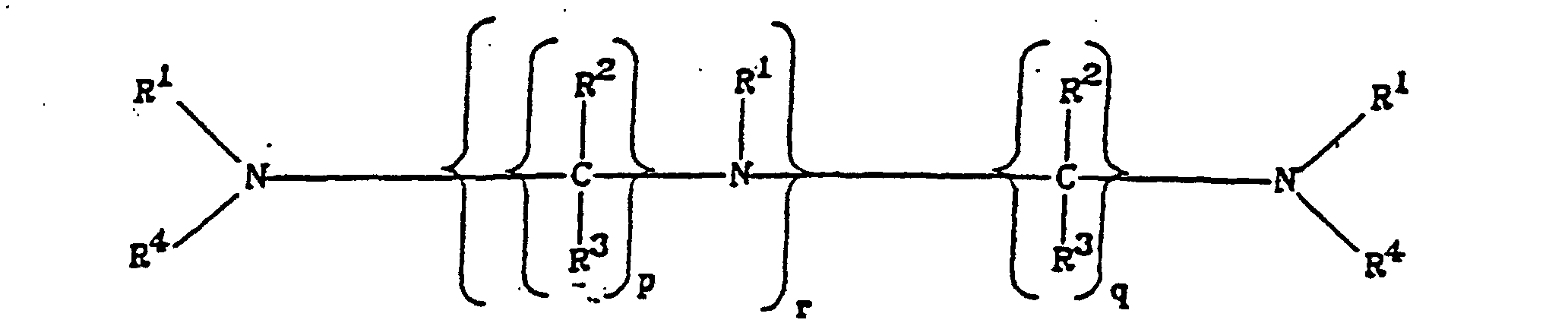 mindestens zwei, aber nicht alle der R1-Reste unabhängig voneinander Phosphonat tragende Gruppen der Formelp 2 oder 3 ist;q 2 oder 3 ist;r 1, 2 oder 3 ist;sind, worin R5, R6 und R7 unabhängig voneinander aus H, C1-C8-Alkyl, Phenyl und Benzyl ausgewählt sind; R8 aus H, OH, NH2, C1-C8-Alkyl, Phenyl und Benzyl ausgewählt ist; und m 0 oder 1 ist;
die R1-Reste, welche keine Phosphonat tragenden Gruppen sind, Mitglieder sind, die unabhängig voneinander aus H, C1-C8-Alkyl, Phenyl und Benzyl und aus Gruppen der Formelausgewählt sind,
worin R5, R6, R7, R8 und m wie oben definiert sind und R9 ein unter Carboxyl, 2-Hydroxyphenyl undausgewähltes Mitglied ist;
die R2-Reste jeweils unabhängig voneinander unter H, C1-C8-Alkyl, Phenyl und Benzyl ausgewählt sind;
die R3-Reste jeweils unabhängig voneinander unter H, C1-C8-Alkyl, Phenyl und Benzyl ausgewählt sind; und
die R4-Reste entweder unabhängig voneinander aus der Definition der nicht Phosphonat enthaltenden R1-Reste ausgewählt sind oder zusammen eine einwertige Gruppe der Formelbilden, worin R2 und R3 wie oben definiert sind und s mindestens 2 ist.
- Verwendung eines physiologisch verträglichen Salzes aus einem Komplex, hergestellt durch Addition eines geeigneten paramagnetischen Metallkations an einen Komplexbildner, zur Herstellung eines Mittels zur Verbesserung des Magnetresonanzbildkontrastes in Knochengewebe und in anderem Gewebe eines Patienten, welches ähnliche Erkennungsmerkmale wie Knochengewebe in dem Patienten hat, dadurch gekennzeichnet, daß der Komplexbildner die Formelhat, worin:
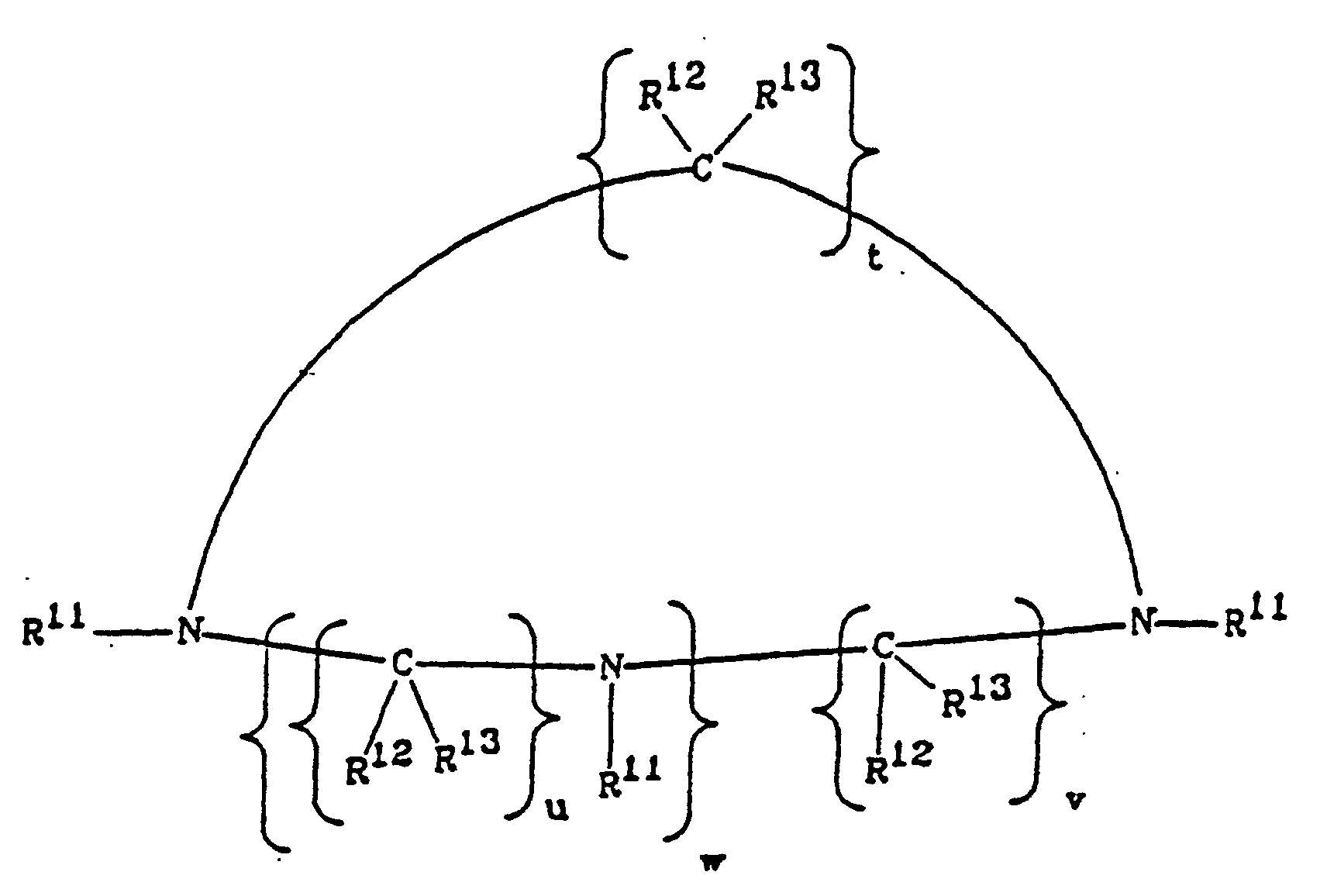 mindestens zwei, aber nicht alle der R11-Reste unabhängig voneinander Phosphonat tragende Gruppen der Formelt 2 oder 3 ist;u 2 oder 3 ist;v 2 oder 3 ist;w mindestens 1 ist;sind, worin
R14, R15 und R16 unabhängig voneinander unter H, C1-C8-Alkyl, Phenyl und Benzyl ausgewählt sind; R17 unter H, OH, NH2, C1-C8-Alkyl, Phenyl und Benzyl ausgewählt ist; und n 0 oder 1 ist;
die R11-Reste, welche keine Phosphonat tragenden Gruppen sind, Mitglieder sind, die unabhängig voneinander unter H, C1-C8-Alkyl, Phenyl und Benzyl, und Gruppen der Formelausgewählt sind, worin R14, R15, R16 und R17 und n wie oben definiert sind und R18 ein Mitglied ist, ausgewählt unter Carboxyl, 2-Hydroxyphenyl und die R12-Reste jeweils unabhängig voneinander unter H, C1-C8-Alkyl, Phenyl und Benzyl ausgewählt sind; und
die R13-Reste jeweils unabhängig voneinander unter H, C1-C8-Alkyl, Phenyl und Benzyl ausgewählt sind. - Verwendung nach Anspruch 2, worin die R12-Reste jeweils H sind und die R13-Reste jeweils unabhängig voneinander unter H und C1-C4-Alkyl ausgewählt sind.
- Verwendung nach Anspruch 2, worin das paramagnetische Metallkation ein Kation eines unter Chrom, Mangan, Eisen und Gadolinium ausgewählten Elements ist und das physiologisch verträgliche Salz den Komplex in Kombination mit mindestens einem unter Natrium und N-Methylglucamin ausgewählten Kation umfaßt.
- Verwendung eines physiologisch verträglichen Salzes eines Komplexes, hergestellt durch Addition eines geeigneten paramagnetischen Metallkations an einem Komplexbildner, zur Herstellung eines Mittels zur Verbesserung des Magnetresonanzbildkontrastes in einem Patienten, dadurch gekennzeichnet, daß der Komplexbildner die Formelhat, worin

mindestens zwei, aber nicht alle der R31-Reste unabhängig voneinander Phosphonat tragende Gruppen der Formelsind, worin R34, R35 und R36 unabhängig voneinander unter H, C1-C8-Alkyl, Phenyl und Benzyl ausgewählt sind; R37 unter H, OH, NH2, C1-C8-Alkyl, Phenyl und Benzyl ausgewählt ist; und y 0 oder 1 ist;
die R31-Reste, welche keine Phosphonat tragenden Gruppen sind, Mitglieder sind, die unabhängig voneinander unter H, C1-C8-Alkyl, Phenyl und Benzyl und Gruppen der Formelausgewählt sind, worin R34, R35, R36, R37 und y wie oben definiert sind, und R38 ein unter Carboxyl, 2-Hydroxyphenyl und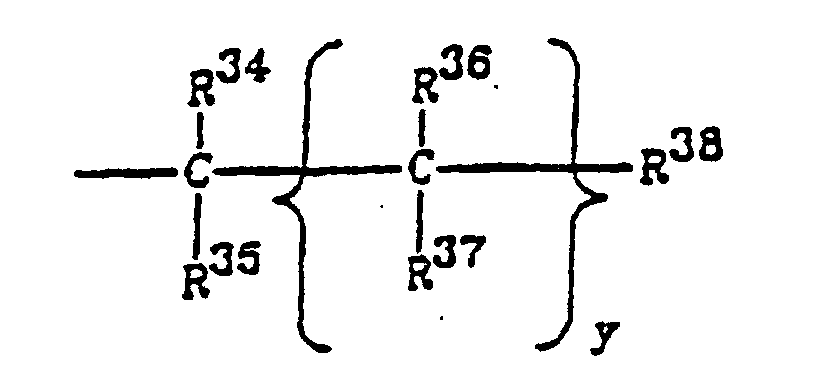 ausgewähltes Mitglied ist, die R32-Reste jeweils unabhängig voneinander unter H, C1-C8-Alkyl, Phenyl und Benzyl ausgewählt sind; und
die R33-Reste jeweils unabhängig voneinander unter H, C1-C8-Alkyl, Phenyl und Benzyl ausgewählt sind. - Verwendung nach Anspruch 5, worin die R32-Reste jeweils H sind und die R33-Reste jeweils H sind.
- Verwendung nach Anspruch 5, worin R34, R35 und R36 jeweils H sind; R37 H, OH, oder NH2 ist; y 0 oder 1 ist; die R32-Reste jeweils H sind; und die R33-Reste jeweils H sind.
- Verwendung nach Anspruch 5, worin das paramagnetische Metallkation ein Kation eines unter Chrom, Mangan, Eisen und Gadolinium ausgewählten Elements ist und das physiologisch verträgliche Salz den Komplex in Kombination mit mindestes einem unter Natrium und n-Methylglucamin ausgewählten Kation umfaßt.
- Arzneimittel, welches ein physiologisch verträgliches Salz eines Chelatkomplexes eines paramagnetischen Metallkation enthält, dadurch gekennzeichnet, dass der Komplexbildner die Formelhat, worin:
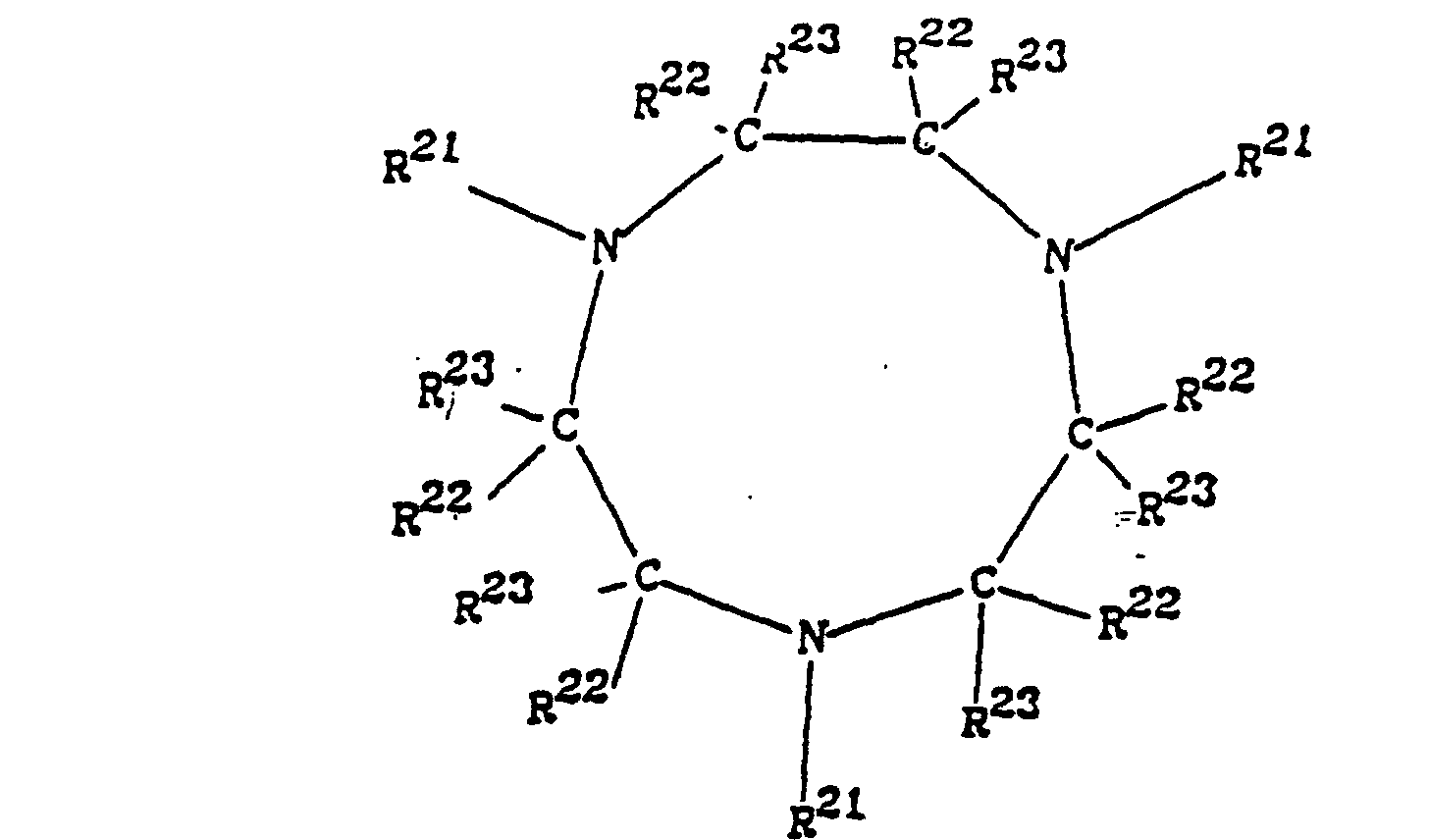
mindestens zwei, aber nicht alle der R21-Reste unabhängig voneinander Phosphonat tragende Gruppen der Formelsind, worin R24, R25 und R26 unabhängig voneinander unter H, C1-C8-Alkyl, Phenyl und Benzyl ausgewählt sind; R27 unter H, OH, NH2, C1-C8-Alkyl, Phenyl und Benzyl ausgewählt ist; und x 0 oder 1 ist;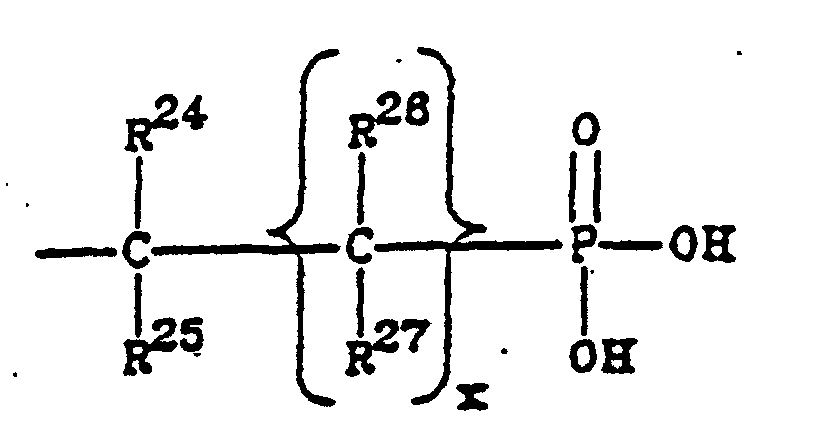
die R21-Reste, welche keine Phosphonat tragenden Gruppen sind, Mitglieder sind, die unabhängig voneinander unter H, C1-C8-Alkyl, Phenyl und Benzyl und Gruppen der Formelausgewählt sind, worin R24, R25, R26, R27 und x jeweils wie oben definiert sind, und R28 ein unter Carboxyl, 2-Hydroxyphenyl und ausgewähltes Mitglied ist, die R22-Reste jeweils unabhängig voneinander unter H, C1-C8-Alkyl, Phenyl und Benzyl ausgewählt sind; und
die R23-Reste jeweils unabhängig voneinander unter H, C1-C8-Alkyl, Phenyl und Benzyl ausgewählt sind. - Arzneimittel, welches ein physiologisch verträgliches Salz eines Chelatkomplexes eines paramagnetischen Metallkations enthält, dadurch gekennzeichnet, daß der Komplexbilder die Formelhat, worin

mindestens zwei, aber nicht alle der R13-Reste unabhängig voneinander Phosphonat tragende Gruppen der Formelsind, worin R34, R35 und R36 unabhängig voneinander unter H, C1-C8-Alkyl, Phenyl und Benzyl ausgewählt sind; R37 unter H, OH, NH2, C1-C8-Alkyl, Phenyl und Benzyl ausgewählt ist; und y 0 oder 1 ist;
die R31-Reste, welche keine Phosphonat tragenden Gruppen sind, Mitglieder sind, die unabhängig voneinander unter H, C1-C8-Alkyl, Phenyl und Benzyl und Gruppen der Formelausgewählt sind, worin R34, R35, R36, R37 und y wie oben definiert sind, und R38 ein unter Carboxyl, 2-Hydroxyphenyl, und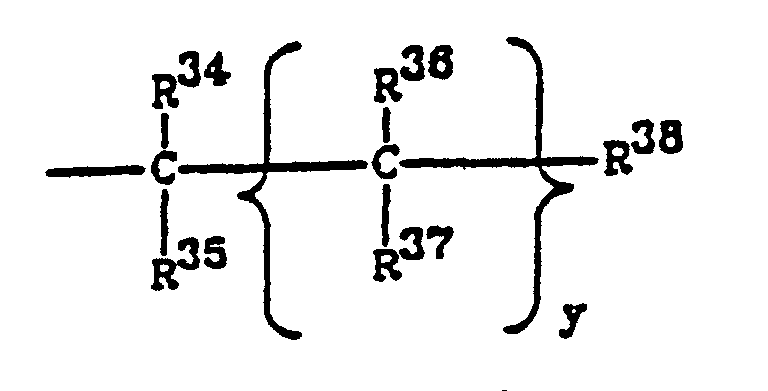 ausgewähltes Mitglied ist, die R32-Reste jeweils unabhängig voneinander unter H, C1-C8-Alkyl, Phenyl und Benzyl ausgewählt sind; und
die R33-Reste jeweils unabhängig voneinander unter H, C1-C8-Alkyl, Phenyl und Benzyl ausgewählt sind.
Applications Claiming Priority (3)
| Application Number | Priority Date | Filing Date | Title |
|---|---|---|---|
| US08/106,764 US5409689A (en) | 1993-08-13 | 1993-08-13 | MRI image enhancement using complexes of paramagnetic cations and amine ligands containing a mixture of phosphonate and non-phosphonate pendant arms |
| US106764 | 1993-08-13 | ||
| PCT/US1994/008459 WO1995005118A1 (en) | 1993-08-13 | 1994-07-28 | Polyamino paramagnetic chelates which contain both phosphonate and non-phosphonate moieties for mri |
Publications (3)
| Publication Number | Publication Date |
|---|---|
| EP0717639A1 EP0717639A1 (de) | 1996-06-26 |
| EP0717639A4 EP0717639A4 (de) | 1998-04-01 |
| EP0717639B1 true EP0717639B1 (de) | 2003-04-02 |
Family
ID=22313124
Family Applications (1)
| Application Number | Title | Priority Date | Filing Date |
|---|---|---|---|
| EP94922745A Expired - Lifetime EP0717639B1 (de) | 1993-08-13 | 1994-07-28 | Phosphonate- und nicht-phosphonate einheiten enthaltende polyamino-paramagnetische-chelate fuer anwendung in mri |
Country Status (7)
| Country | Link |
|---|---|
| US (1) | US5409689A (de) |
| EP (1) | EP0717639B1 (de) |
| JP (1) | JP3007415B2 (de) |
| AT (1) | ATE235921T1 (de) |
| AU (1) | AU7374194A (de) |
| DE (1) | DE69432418T2 (de) |
| WO (1) | WO1995005118A1 (de) |
Families Citing this family (19)
| Publication number | Priority date | Publication date | Assignee | Title |
|---|---|---|---|---|
| WO1997001360A2 (en) * | 1995-06-26 | 1997-01-16 | Concat, Ltd. | Compounds with chelation affinity and selectivity for first transition series elements and their use in medical therapy and diagnosis |
| IT1297035B1 (it) * | 1997-12-30 | 1999-08-03 | Bracco Spa | Derivati dell'acido 1,4,7,10-tetraazaciclododecan-1,4-diacetico |
| US6264966B1 (en) | 2000-02-22 | 2001-07-24 | Concat, Ltd. | Compounds with chelation affinity and selectivity for first transition elements and their use in cosmetics and personal care products, inhibition of metalloenzymes, and inhibition of reperfusion injury |
| US6565828B2 (en) * | 2000-04-07 | 2003-05-20 | Bristol-Myers Squibb Company | Macrocyclic chelants for metallopharmaceuticals |
| JP2004509967A (ja) | 2000-09-25 | 2004-04-02 | ザ、プロクター、エンド、ギャンブル、カンパニー | 医学及び治療法の適用に使用するための金属錯体 |
| US6776977B2 (en) | 2001-01-09 | 2004-08-17 | Bristol-Myers Squibb Pharma Company | Polypodal chelants for metallopharmaceuticals |
| US6576760B2 (en) * | 2001-01-11 | 2003-06-10 | Chelator Llc | Processes for synthesis of cyclic and linear polyamine chelators containing N-monosubstituted coordinating arms |
| US20050112066A1 (en) * | 2003-11-26 | 2005-05-26 | Concat Lp, A California Limited Partnership | Complexes of cyclic polyaza chelators with cations of alkaline earth metals for enhanced biological activity |
| WO2006020779A2 (en) * | 2004-08-10 | 2006-02-23 | Dow Global Technologies Inc. | Targeting chelants and chelates |
| EP2097438B1 (de) | 2006-12-11 | 2015-08-26 | Bracco Imaging S.p.A | Fibrinbindende peptidkonjugate für diagnostische und therapeutische anwendungen |
| EP2476703A1 (de) | 2011-01-14 | 2012-07-18 | Bracco Imaging S.p.A | Mit einem Bakterium kreuzreagierende menschliche Antikörper und ein Autoantigen aus atherosklerotischen Plaques |
| EP2147684A1 (de) | 2008-07-22 | 2010-01-27 | Bracco Imaging S.p.A | Selektiv gegen Metallproteasen wirkende Diagnosemittel |
| US8362281B2 (en) | 2010-03-31 | 2013-01-29 | General Electric Company | Intermediates for hydroxylated contrast enhancement agents |
| US8765977B2 (en) | 2010-03-31 | 2014-07-01 | General Electric Company | Hydroxylated contrast enhancement agents and imaging method |
| US8722020B2 (en) | 2010-03-31 | 2014-05-13 | General Electric Company | Hydroxylated contrast enhancement agents |
| WO2012095516A1 (en) | 2011-01-14 | 2012-07-19 | Bracco Imaging Spa | Human antibodies cross-reacting with a bacterial and a self antigen from atherosclerotic plaques |
| BR112018015143A2 (en) | 2016-02-09 | 2018-12-18 | Bracco Suisse Sa | recombinant chimeric protein for selectin targeting |
| WO2017178301A1 (en) | 2016-04-13 | 2017-10-19 | Bracco Imaging Spa | Contrast agents |
| WO2020102820A1 (en) * | 2018-11-16 | 2020-05-22 | The Research Foundation For The State University Of New York | Compounds for use as iron (iii) mri contrast agents containing anionic pendents and ancillary groups |
Family Cites Families (21)
| Publication number | Priority date | Publication date | Assignee | Title |
|---|---|---|---|---|
| US4515766A (en) * | 1980-06-23 | 1985-05-07 | The Massachusetts General Hospital | Labeled phosphonic acid compositions for investigations of in vivo deposits of calcium |
| US4647447A (en) * | 1981-07-24 | 1987-03-03 | Schering Aktiengesellschaft | Diagnostic media |
| US4429124A (en) * | 1982-08-23 | 1984-01-31 | Stauffer Chemical Company | Method for preparation of N-phosphonomethylglycine |
| US4444693A (en) * | 1982-09-07 | 1984-04-24 | Stauffer Chemical Company | Method for preparation of N-phosphonomethylglycine |
| DE3237573A1 (de) * | 1982-10-09 | 1984-04-12 | Hoechst Ag, 6230 Frankfurt | Technetium-99m-tri- und tetraphosphonate zur szintigraphischen dastellung res-haltiger organe und der lymphgefaesse und verfahren zu deren herstellung |
| SU1081169A1 (ru) * | 1982-12-13 | 1984-03-23 | Ордена Ленина институт элементоорганических соединений им.А.Н.Несмеянова | @ , @ , @ -Трис(диоксифосфорилметил)-1,4,7-триазациклононан в качестве комплексона дл селективного св зывани катионов магни ,цинка,меди,никел |
| SU1098937A1 (ru) * | 1983-03-25 | 1984-06-23 | Ордена Ленина институт элементоорганических соединений им.А.Н.Несмеянова | 1,4,7,10-Тетра/диоксифосфорилметил/-1,4,7,10-тетраазациклододекан в качестве комплексона дл св зывани катионов меди /п/,кобальта /п/,кадми /п/,свинца /п/ и лантана /ш/ |
| FR2550449B1 (fr) * | 1983-08-12 | 1986-01-31 | Commissariat Energie Atomique | Agents de relaxation specifiques d'organes ou de pathologies, utilisables pour modifier les contrastes en imagerie medicale par resonance magnetique nucleaire |
| US4749560A (en) * | 1984-08-13 | 1988-06-07 | Research Corporation | Metal organo phosphorous compounds for NMR analysis |
| CA1317937C (en) * | 1984-10-18 | 1993-05-18 | A. Dean Sherry | Gadolinium chelates with carboxymethyl derivatives of polyazamacrocycles as nmr contrast agents |
| US5316757A (en) * | 1984-10-18 | 1994-05-31 | Board Of Regents, The University Of Texas System | Synthesis of polyazamacrocycles with more than one type of side-chain chelating groups |
| GB8518300D0 (en) * | 1985-07-19 | 1985-08-29 | Amersham Int Plc | Contrast agent |
| US4885363A (en) * | 1987-04-24 | 1989-12-05 | E. R. Squibb & Sons, Inc. | 1-substituted-1,4,7-triscarboxymethyl-1,4,7,10-tetraazacyclododecane and analogs |
| AU608759B2 (en) * | 1986-08-04 | 1991-04-18 | Amersham Health Salutar Inc | NMR imaging with paramagnetic polyvalents metal salts of poly-(acid-alkylene-amido)-alkanes |
| GB8701054D0 (en) * | 1987-01-16 | 1987-02-18 | Amersham Int Plc | Contrast agent for nmr scanning |
| GB8903023D0 (en) * | 1989-02-10 | 1989-03-30 | Parker David | Chemical compounds |
| GB8914543D0 (en) * | 1989-06-23 | 1989-08-09 | Parker David | Chemical compounds |
| AU649001B2 (en) * | 1989-11-27 | 1994-05-12 | Chelator Llc | MRI image enhancement of bone and related tissue using complexes of paramagnetic cations and polyphosphonate ligands |
| GB2250198B (en) * | 1990-04-18 | 1994-06-22 | Celltech Ltd | Tetra-aza macrocycles,processes for their preparation and their use in magnetic resonance imaging |
| BR9102490A (pt) * | 1990-06-18 | 1992-01-21 | Dow Chemical Co | Metodo para uso diagnostico na formacao de imagens e composicao |
| US5462725A (en) * | 1993-05-06 | 1995-10-31 | The Dow Chemical Company | 2-pyridylmethylenepolyazamacrocyclophosphonic acids, complexes and derivatives thereof, for use as contrast agents |
-
1993
- 1993-08-13 US US08/106,764 patent/US5409689A/en not_active Expired - Fee Related
-
1994
- 1994-07-28 AU AU73741/94A patent/AU7374194A/en not_active Abandoned
- 1994-07-28 DE DE69432418T patent/DE69432418T2/de not_active Expired - Fee Related
- 1994-07-28 WO PCT/US1994/008459 patent/WO1995005118A1/en not_active Ceased
- 1994-07-28 JP JP7506976A patent/JP3007415B2/ja not_active Expired - Fee Related
- 1994-07-28 EP EP94922745A patent/EP0717639B1/de not_active Expired - Lifetime
- 1994-07-28 AT AT94922745T patent/ATE235921T1/de not_active IP Right Cessation
Also Published As
| Publication number | Publication date |
|---|---|
| DE69432418D1 (de) | 2003-05-08 |
| ATE235921T1 (de) | 2003-04-15 |
| DE69432418T2 (de) | 2003-10-30 |
| US5409689A (en) | 1995-04-25 |
| JP3007415B2 (ja) | 2000-02-07 |
| EP0717639A4 (de) | 1998-04-01 |
| JPH09501919A (ja) | 1997-02-25 |
| AU7374194A (en) | 1995-03-14 |
| WO1995005118A1 (en) | 1995-02-23 |
| EP0717639A1 (de) | 1996-06-26 |
Similar Documents
| Publication | Publication Date | Title |
|---|---|---|
| US5236695A (en) | MRI image enhancement of bone and related tissue using complexes of paramagnetic cations and polyphosphonate ligands | |
| US5409689A (en) | MRI image enhancement using complexes of paramagnetic cations and amine ligands containing a mixture of phosphonate and non-phosphonate pendant arms | |
| EP0292689B1 (de) | Substituiertes 1,4,7-Triscarboxymethyl-1,4,7,10-tetraazacyclododecan und Analoga | |
| CA1321346C (en) | Nmr imaging with paramagnetic polyvalent metal salts of poly-(acid-alkylene-amino)-alkanes | |
| RU2073005C1 (ru) | Хелатное соединение металла | |
| EP0711300B1 (de) | 2-pyridylmethylen-polyazamacrocyclophosphonsäuren, ihre komplexe und derivate zur verwendung als kontrastmittel | |
| KR100890471B1 (ko) | 금속 이온을 배위할 수 있는 여러자리 아자 리간드 및진단 및 치료에 있어서의 그의 용도 | |
| SK177997A3 (en) | Cascade polymer complexes | |
| AU2002331348A1 (en) | Multidentate aza ligands able to complex metal ions and the use thereof in diagnostics and therapy | |
| EP0325762A1 (de) | Makrocyclische Chelatisierungsmittel und daraus hergestellte Chelate | |
| EP0565930A1 (de) | Tetracyclododecan-Tetraessigsäurederivate und ihre Verwendung als diagnostische Mittel | |
| EP0513000B1 (de) | Qualitätssteigerung von mr-bildern von knochen und ähnlichem gewebe mittels paramagnetischer kationenkomplexe und polyphosphonatliganden | |
| EP0481420B1 (de) | Mittel zur magnetischen Resonanzabbildung | |
| EP0755385B1 (de) | Chelatverbindungen | |
| IE904319A1 (en) | 10-(2'-Hydroxy-3'POLYOXAALKYL)-1,4,7-TRISCARBOXYMETHYL-¹1,4,7,10-TETRAAZACYCLODODECANE | |
| AU620841B2 (en) | Macrocyclic chelating agents and chelates thereof | |
| WO1994026313A1 (en) | Bicyclopolyazamacrocyclocarboxylic acid complexes, their conjugates, processes for their preparation, and use as contrast agents | |
| JP3404787B2 (ja) | 新規ジエチレントリアミンペンタ酢酸誘導体、該誘導体と金属原子との錯化合物、及び該錯化合物を含む診断剤 | |
| WO1990008134A1 (en) | Chelating agent derivatives | |
| AU4237993A (en) | Bicyclopolyazamacrocyclocarboxylic acid complexes, their conjugates, processes for their preparation, and use as contrast agents |
Legal Events
| Date | Code | Title | Description |
|---|---|---|---|
| PUAI | Public reference made under article 153(3) epc to a published international application that has entered the european phase |
Free format text: ORIGINAL CODE: 0009012 |
|
| 17P | Request for examination filed |
Effective date: 19960308 |
|
| AK | Designated contracting states |
Kind code of ref document: A1 Designated state(s): AT BE CH DE DK ES FR GB GR IE IT LI LU MC NL PT SE |
|
| A4 | Supplementary search report drawn up and despatched |
Effective date: 19980216 |
|
| AK | Designated contracting states |
Kind code of ref document: A4 Designated state(s): AT BE CH DE DK ES FR GB GR IE IT LI LU MC NL PT SE |
|
| 17Q | First examination report despatched |
Effective date: 19980826 |
|
| GRAG | Despatch of communication of intention to grant |
Free format text: ORIGINAL CODE: EPIDOS AGRA |
|
| GRAG | Despatch of communication of intention to grant |
Free format text: ORIGINAL CODE: EPIDOS AGRA |
|
| GRAH | Despatch of communication of intention to grant a patent |
Free format text: ORIGINAL CODE: EPIDOS IGRA |
|
| GRAH | Despatch of communication of intention to grant a patent |
Free format text: ORIGINAL CODE: EPIDOS IGRA |
|
| RAP1 | Party data changed (applicant data changed or rights of an application transferred) |
Owner name: CHELATOR LLC |
|
| GRAA | (expected) grant |
Free format text: ORIGINAL CODE: 0009210 |
|
| AK | Designated contracting states |
Designated state(s): AT BE CH DE DK ES FR GB GR IE IT LI LU MC NL PT SE |
|
| PG25 | Lapsed in a contracting state [announced via postgrant information from national office to epo] |
Ref country code: NL Free format text: LAPSE BECAUSE OF FAILURE TO SUBMIT A TRANSLATION OF THE DESCRIPTION OR TO PAY THE FEE WITHIN THE PRESCRIBED TIME-LIMIT Effective date: 20030402 Ref country code: LI Free format text: LAPSE BECAUSE OF FAILURE TO SUBMIT A TRANSLATION OF THE DESCRIPTION OR TO PAY THE FEE WITHIN THE PRESCRIBED TIME-LIMIT Effective date: 20030402 Ref country code: IT Free format text: LAPSE BECAUSE OF FAILURE TO SUBMIT A TRANSLATION OF THE DESCRIPTION OR TO PAY THE FEE WITHIN THE PRE;WARNING: LAPSES OF ITALIAN PATENTS WITH EFFECTIVE DATE BEFORE 2007 MAY HAVE OCCURRED AT ANY TIME BEFORE 2007. THE CORRECT EFFECTIVE DATE MAY BE DIFFERENT FROM THE ONE RECORDED.SCRIBED TIME-LIMIT Effective date: 20030402 Ref country code: CH Free format text: LAPSE BECAUSE OF FAILURE TO SUBMIT A TRANSLATION OF THE DESCRIPTION OR TO PAY THE FEE WITHIN THE PRESCRIBED TIME-LIMIT Effective date: 20030402 Ref country code: BE Free format text: LAPSE BECAUSE OF FAILURE TO SUBMIT A TRANSLATION OF THE DESCRIPTION OR TO PAY THE FEE WITHIN THE PRESCRIBED TIME-LIMIT Effective date: 20030402 Ref country code: AT Free format text: LAPSE BECAUSE OF FAILURE TO SUBMIT A TRANSLATION OF THE DESCRIPTION OR TO PAY THE FEE WITHIN THE PRESCRIBED TIME-LIMIT Effective date: 20030402 |
|
| REG | Reference to a national code |
Ref country code: GB Ref legal event code: FG4D |
|
| REG | Reference to a national code |
Ref country code: CH Ref legal event code: EP |
|
| REG | Reference to a national code |
Ref country code: IE Ref legal event code: FG4D |
|
| REF | Corresponds to: |
Ref document number: 69432418 Country of ref document: DE Date of ref document: 20030508 Kind code of ref document: P |
|
| PG25 | Lapsed in a contracting state [announced via postgrant information from national office to epo] |
Ref country code: SE Free format text: LAPSE BECAUSE OF FAILURE TO SUBMIT A TRANSLATION OF THE DESCRIPTION OR TO PAY THE FEE WITHIN THE PRESCRIBED TIME-LIMIT Effective date: 20030702 Ref country code: PT Free format text: LAPSE BECAUSE OF FAILURE TO SUBMIT A TRANSLATION OF THE DESCRIPTION OR TO PAY THE FEE WITHIN THE PRESCRIBED TIME-LIMIT Effective date: 20030702 Ref country code: GR Free format text: LAPSE BECAUSE OF FAILURE TO SUBMIT A TRANSLATION OF THE DESCRIPTION OR TO PAY THE FEE WITHIN THE PRESCRIBED TIME-LIMIT Effective date: 20030702 Ref country code: DK Free format text: LAPSE BECAUSE OF FAILURE TO SUBMIT A TRANSLATION OF THE DESCRIPTION OR TO PAY THE FEE WITHIN THE PRESCRIBED TIME-LIMIT Effective date: 20030702 |
|
| PG25 | Lapsed in a contracting state [announced via postgrant information from national office to epo] |
Ref country code: LU Free format text: LAPSE BECAUSE OF NON-PAYMENT OF DUE FEES Effective date: 20030728 Ref country code: IE Free format text: LAPSE BECAUSE OF NON-PAYMENT OF DUE FEES Effective date: 20030728 |
|
| PG25 | Lapsed in a contracting state [announced via postgrant information from national office to epo] |
Ref country code: MC Free format text: LAPSE BECAUSE OF NON-PAYMENT OF DUE FEES Effective date: 20030731 |
|
| NLV1 | Nl: lapsed or annulled due to failure to fulfill the requirements of art. 29p and 29m of the patents act | ||
| REG | Reference to a national code |
Ref country code: CH Ref legal event code: PL |
|
| PG25 | Lapsed in a contracting state [announced via postgrant information from national office to epo] |
Ref country code: ES Free format text: LAPSE BECAUSE OF FAILURE TO SUBMIT A TRANSLATION OF THE DESCRIPTION OR TO PAY THE FEE WITHIN THE PRESCRIBED TIME-LIMIT Effective date: 20031030 |
|
| ET | Fr: translation filed | ||
| PLBE | No opposition filed within time limit |
Free format text: ORIGINAL CODE: 0009261 |
|
| STAA | Information on the status of an ep patent application or granted ep patent |
Free format text: STATUS: NO OPPOSITION FILED WITHIN TIME LIMIT |
|
| 26N | No opposition filed |
Effective date: 20040105 |
|
| REG | Reference to a national code |
Ref country code: IE Ref legal event code: MM4A |
|
| PGFP | Annual fee paid to national office [announced via postgrant information from national office to epo] |
Ref country code: FR Payment date: 20040720 Year of fee payment: 11 |
|
| PGFP | Annual fee paid to national office [announced via postgrant information from national office to epo] |
Ref country code: GB Payment date: 20040721 Year of fee payment: 11 |
|
| PGFP | Annual fee paid to national office [announced via postgrant information from national office to epo] |
Ref country code: DE Payment date: 20040831 Year of fee payment: 11 |
|
| PG25 | Lapsed in a contracting state [announced via postgrant information from national office to epo] |
Ref country code: GB Free format text: LAPSE BECAUSE OF NON-PAYMENT OF DUE FEES Effective date: 20050728 |
|
| PG25 | Lapsed in a contracting state [announced via postgrant information from national office to epo] |
Ref country code: DE Free format text: LAPSE BECAUSE OF NON-PAYMENT OF DUE FEES Effective date: 20060201 |
|
| GBPC | Gb: european patent ceased through non-payment of renewal fee |
Effective date: 20050728 |
|
| PG25 | Lapsed in a contracting state [announced via postgrant information from national office to epo] |
Ref country code: FR Free format text: LAPSE BECAUSE OF NON-PAYMENT OF DUE FEES Effective date: 20060331 |
|
| REG | Reference to a national code |
Ref country code: FR Ref legal event code: ST Effective date: 20060331 |