EP0718822A2 - Mit niedriger Übertragungsrate und Rückwarts-Prädiktion arbeitendes Mehrmoden-CELP-Codec - Google Patents
Mit niedriger Übertragungsrate und Rückwarts-Prädiktion arbeitendes Mehrmoden-CELP-Codec Download PDFInfo
- Publication number
- EP0718822A2 EP0718822A2 EP95850233A EP95850233A EP0718822A2 EP 0718822 A2 EP0718822 A2 EP 0718822A2 EP 95850233 A EP95850233 A EP 95850233A EP 95850233 A EP95850233 A EP 95850233A EP 0718822 A2 EP0718822 A2 EP 0718822A2
- Authority
- EP
- European Patent Office
- Prior art keywords
- speech signal
- vector
- digitized speech
- mode
- line spectral
- Prior art date
- Legal status (The legal status is an assumption and is not a legal conclusion. Google has not performed a legal analysis and makes no representation as to the accuracy of the status listed.)
- Withdrawn
Links
Images


Classifications
-
- G—PHYSICS
- G10—MUSICAL INSTRUMENTS; ACOUSTICS
- G10L—SPEECH ANALYSIS TECHNIQUES OR SPEECH SYNTHESIS; SPEECH RECOGNITION; SPEECH OR VOICE PROCESSING TECHNIQUES; SPEECH OR AUDIO CODING OR DECODING
- G10L19/00—Speech or audio signals analysis-synthesis techniques for redundancy reduction, e.g. in vocoders; Coding or decoding of speech or audio signals, using source filter models or psychoacoustic analysis
- G10L19/04—Speech or audio signals analysis-synthesis techniques for redundancy reduction, e.g. in vocoders; Coding or decoding of speech or audio signals, using source filter models or psychoacoustic analysis using predictive techniques
- G10L19/06—Determination or coding of the spectral characteristics, e.g. of the short-term prediction coefficients
-
- G—PHYSICS
- G10—MUSICAL INSTRUMENTS; ACOUSTICS
- G10L—SPEECH ANALYSIS TECHNIQUES OR SPEECH SYNTHESIS; SPEECH RECOGNITION; SPEECH OR VOICE PROCESSING TECHNIQUES; SPEECH OR AUDIO CODING OR DECODING
- G10L19/00—Speech or audio signals analysis-synthesis techniques for redundancy reduction, e.g. in vocoders; Coding or decoding of speech or audio signals, using source filter models or psychoacoustic analysis
- G10L19/04—Speech or audio signals analysis-synthesis techniques for redundancy reduction, e.g. in vocoders; Coding or decoding of speech or audio signals, using source filter models or psychoacoustic analysis using predictive techniques
- G10L19/16—Vocoder architecture
- G10L19/18—Vocoders using multiple modes
-
- G—PHYSICS
- G10—MUSICAL INSTRUMENTS; ACOUSTICS
- G10L—SPEECH ANALYSIS TECHNIQUES OR SPEECH SYNTHESIS; SPEECH RECOGNITION; SPEECH OR VOICE PROCESSING TECHNIQUES; SPEECH OR AUDIO CODING OR DECODING
- G10L19/00—Speech or audio signals analysis-synthesis techniques for redundancy reduction, e.g. in vocoders; Coding or decoding of speech or audio signals, using source filter models or psychoacoustic analysis
- G10L2019/0001—Codebooks
- G10L2019/0013—Codebook search algorithms
-
- G—PHYSICS
- G10—MUSICAL INSTRUMENTS; ACOUSTICS
- G10L—SPEECH ANALYSIS TECHNIQUES OR SPEECH SYNTHESIS; SPEECH RECOGNITION; SPEECH OR VOICE PROCESSING TECHNIQUES; SPEECH OR AUDIO CODING OR DECODING
- G10L25/00—Speech or voice analysis techniques not restricted to a single one of groups G10L15/00 - G10L21/00
- G10L25/03—Speech or voice analysis techniques not restricted to a single one of groups G10L15/00 - G10L21/00 characterised by the type of extracted parameters
- G10L25/24—Speech or voice analysis techniques not restricted to a single one of groups G10L15/00 - G10L21/00 characterised by the type of extracted parameters the extracted parameters being the cepstrum
-
- G—PHYSICS
- G10—MUSICAL INSTRUMENTS; ACOUSTICS
- G10L—SPEECH ANALYSIS TECHNIQUES OR SPEECH SYNTHESIS; SPEECH RECOGNITION; SPEECH OR VOICE PROCESSING TECHNIQUES; SPEECH OR AUDIO CODING OR DECODING
- G10L25/00—Speech or voice analysis techniques not restricted to a single one of groups G10L15/00 - G10L21/00
- G10L25/93—Discriminating between voiced and unvoiced parts of speech signals
Definitions
- CELP Code Excited Linear Predictive coding
- the short-term predictor parameters refer to a filter which models the frequency shaping effects of the vocal tract for the analyzed signal.
- the excitation parameters concern the excitation of the signal.
- Typical CELP systems represent the excitation of an input speech signal with vectors from two codebooks: an adaptive codebook contains the history of the excitation measured for earlier segments of the input signal, while a fixed codebook contains prestored waveform shapes capable of modeling a broad range of excitation signals.
- the adaptive codebook is what is sometimes referred to as the long-term predictor, and these parameters model the long-term periodicity of the input speech, if voiced, by reproducing the fundamental oscillating frequencies of the vocal chords.
- a modified CELP system using backward prediction enabling an input signal to be reconstructed in part by predicting the signal based on the received parameters and the reconstructed signal of the previously decoded frame.
- backward prediction can greatly enhance the efficiency of speech transmission by reducing the amount of information that must be encoded for each transmitted signal without significantly affecting the accuracy of the signal reconstruction.
- CELP speech coding and decoding
- the present invention improves the results of prior art codecs and meets the standards mentioned above by providing an improved speech codec that provides high-quality performance at a low bit rate by selective use of backward prediction.
- the present invention provides a more efficient coding method by deriving signal parameters through backward prediction, comprising the steps of: (1) classifying a segment of the digitized speech signal in one of a plurality of predetermined modes; (2) determining a set of unquantized line spectral frequencies to represent the vocal tract parameters for the segment; and (3) quantizing the determined set of unquantized line spectral frequencies in a mode-specific manner, using a combination of scalar quantization and vector quantization, wherein the quantization process varies depending on the mode in which the segment is classified.
- the invention also provides a method for decoding the encoded signal through an analogous process.
- the encoding/decoding method and device of the present invention utilizes at least one vector quantization table having entries of vectors for quantizing a subset of the determined set of unquantized line spectral frequencies, in which a vector entry is accessed as a series of bits representing an index to the vector quantization table, and wherein the vector entries are arranged in the vector quantization table such that a change in the nth least significant bit of an index i 1 corresponding to a vector v 1 results in an index i 2 corresponding to a vector v 2 that is one of the 2 n vectors closest to the vector v 1 , where closeness is measured by the norm distance metric between the vectors v 1 and v 2 .
- the scalar quantization step further comprises the steps of: (1) predicting a quantized line spectral frequency for each unquantized line spectral frequency to be scalar quantized as a weighted sum of neighboring line spectral frequencies quantized in a previous digitized speech signal segment; and (2) encoding each of the unquantized line spectral frequencies as an offset from its corresponding predicted quantized line spectral frequency.
- the vector quantization step further comprises the steps of: (1) determining a range of indices for possible vectors in the vector quantization table for vector quantizing the subset of unquantized line spectral frequencies to be vector quantized, on the basis of the vector quantized line spectral frequencies of a previous digitized speech signal segment; (2) selecting a vector having an index within the determined range of indices for vector quantizing the subset of unquantized line spectral frequencies to be vector quantized; and (3) encoding the selected vector as an offset within the determined range of indices.
- the inventive method and device encodes the excitation of a digitized speech signal by (1) partitioning the digitized speech signal into discrete segments; (2) classifying a segment of the digitized speech signal in one of a plurality of predetermined modes, wherein the plurality of predetermined modes includes at least one non-transient mode for classifying a digitized speech signal segment not containing transients; (3) further partitioning the digitized speech signal segment into subframes for analyzing the excitation of the digitized speech signal segment, wherein the number of subframes depends on the mode in which the digitized speech signal segment is classified; and (4) modeling the excitation of each digitized speech signal subframe as a vector sum of an adaptive codebook vector scaled by an adaptive codebook gain, and a fixed codebook vector scaled by a
- the encoding/decoding method and device of the present invention provide the important advantage over the prior art of efficiently providing high-quality speech coding and decoding taking advantage of the selective use of backward prediction to achieve these results at a low bit rate.
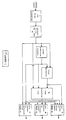
- Figure 1 is a block diagram of the operation of an embodiment of a low rate multi-mode CELP encoder as provided by the present invention.
- Figure 2 is a block diagram of the operation of an embodiment of a low rate multi-mode CELP decoder as provided by the present invention.
- Figure 3 is a timing diagram of a preferred embodiment.
- Figure 4 is a flow chart illustrating the scalar quantization process for signals classified in Mode B or Mode C, as provided by the present invention.
- Figure 5 is a flow chart illustrating the vector quantization process for signals classified in Mode B or Mode C, as provided by the present invention.
- Figure 6 is a flow chart illustrating the process of selecting either the IRS-filtered quantizers or the flat unfiltered quantizers for signals classified in Mode B or Mode C, as provided by the present invention.
- Figure 7 illustrates the process of backward prediction for the LSFs in a Mode A frame, as provided by the present invention.
- Figure 8 illustrates the process of updating the weighting factors used in the backward prediction for the LSFs in a Mode A frame, as provided by the present invention.
- Figure 9 illustrates the differential scalar quantization of the previously scalar quantized LSFs in a Mode A frame, as provided by the present invention.
- Figure 10 illustrates the differential vector quantization of the previously vector quantized LSFs in a Mode A frame, as provided by the present invention.
- Figure 11 illustrates the mode selection process as provided by the present invention.
- Figure 12 illustrates the fixed codebook search and gain quantization using backward prediction in Mode A, as provided by the present invention.
- Figure 13 illustrates the fixed codebook search and gain quantization using backward prediction in Mode C, as provided by the present invention.
- Figure 14 illustrates the bit allocation for encoding all the parameters in a Mode A frame, as provided in a preferred embodiment of the present invention.
- Figure 15 illustrates the bit allocation for encoding all the parameters in a Mode B frame, as provided in a preferred embodiment of the present invention.
- Figure 16 illustrates the bit allocation for encoding all the parameters in a Mode C frame, as provided in a preferred embodiment of the present invention.
- the preferred embodiment comprises a digital signal processor TI 320C31, which executes a set of prestored instructions on a digitized speech signal, which has been sampled at 8 Khz and high-pass filtered.
- TI 320C31 digital signal processor
- the present invention may also be readily embodied in hardware, that the preferred embodiment takes the form of program statements should not be construed as limiting the scope of the present invention.
- an input speech signal is digitized and filtered to attenuate dc, hum, or other low frequency contamination, and is buffered into frames to enable linear predictive analysis, which models the frequency shaping effects of the vocal tract.
- the frames are further partitioned into subframes for purposes of excitation analysis, which utilizes the two codebooks described above to model the excitation of each subframe of the input speech signal.
- a vocal tract filter generates speech by filtering a sum of vectors, scaled by gain parameters, selected from the two codebooks.
- the vectors ultimately used to model the excitation are selected by comparing the differences between the input signal and the speech signal synthesized from the vector sum, taking into account the noise masking properties of the human ear. Specifically, the differences at frequencies at which the error is less important to the human auditory perception are attenuated, while differences at frequencies at which the error is more important are amplified.
- the vectors producing the minimal perceptually weighted error energy are selected to model the input speech.
- a bitstream of data encoding the selected vectors -- i.e., their codebook indices and their codebook gains -- is multiplexed with the short-term predictor or vocal tract filter parameters, and transmitted to the decoder.
- the decoder receives the bitstream from the encoder and reconstructs the excitation vectors represented by the codebook indices, multiplies the vectors by the appropriate gain parameters, and computes the vector sum representing the excitation of the signal, which is then passed through a vocal tract filter to synthesize the speech.
- a multi-mode CELP codec is able to achieve high quality performance at low bit rates by labelling every input speech frame as being in one of a plurality of modes and using CELP in a mode-specific fashion.
- Figures 1 and 2 respectively illustrate possible embodiments of a multi-mode CELP encoder and decoder, as provided by the present invention.
- an analog speech signal is sampled by an A/D Converter 1 and high-pass filtered to attenuate any dc, hum, or other low frequency contamination before the encoder shown in Figure 1 performs linear predictive analysis.
- the Mode Classification module 2 of the multi-mode CELP encoder provided by the present invention classifies the input signal into one of three modes: 1) voiced speech ("Mode A”); 2) unvoiced speech (“Mode B”); or 3) non-speech background noise ("Mode C").
- this classification enables the present invention to provide an enhanced quality of performance in spite of the low bit rate.
- the exemplary decoder illustrated in Figure 2 operates in a fashion analogous to that of the encoder of Figure 1.
- the Mode Decoder 6 determines the mode of the speech signal from the received bitstream of compressed speech before the decoder reconstructs the signal, in order to benefit from the improvements achieved by the mode-specific coding techniques of the present invention.
- the signal is then decoded in a manner depending on its mode 7,8,9, and is filtered and passed through a D/A Converter 10 to reconstruct the analog speech signal 11.
- the present invention concentrates on improving the steps of encoding and decoding the short-term predictor parameters and the fixed codebook gain of a speech signal in a multi-mode CELP codec. In order to achieve these improvements, the present invention selectively utilizes backward prediction for both of these parameters to achieve better performance at lower bit rates.
- the line spectral frequencies (LSFs) and fixed codebook gain are distinct parameters: the LSFs are a specific representation of parameters for the short-term predictor modeling the frequency shaping effects of the vocal tract, while the fixed codebook gain is a measure of the residual excitation level. Consequently, the values of one are not dependent on the values of the other, and the improved coding method and format for these parameters provided by the present invention will be discussed separately below.
- the encoding process begins by performing linear predictive analysis on a signal frame of 22.5 msec, which is further partitioned into a number of subframes depending on the mode of the signal frame, and is analyzed on the basis of a 30 msec speech window centered at the end of each frame.
- Figure 3 is a timing diagram that illustrates the relationship between the frame, subframes, and the linear predictive analysis window (which is also used for open loop pitch analysis) in all three modes.
- the preferred embodiment utilizes the Burg lattice method, which is known in the art and further described in J. Makhoul, "Stable and Efficient Lattice Methods for Linear Prediction," IEEE Transactions on ASSP, Vol. ASSP-25, No. 5, Oct. 1977.
- the linear predictive analysis derives reflection and filter coefficients, the latter of which are bandwidth broadened by 30 Hz in the preferred embodiment to avoid sharp spectral peaks. These bandwidth broadened filter coefficients are then converted to line spectral frequencies through a process described by F.K. Soong and B.H. Juang in their article "Line Spectrum Pair (LSP) and Speech Data Compression,” which was presented at a 1984 ICASSP Conference. LSFs are particularly well suited for quantization because of their well-behaved dynamic range and ability to preserve filter stability after quantization.
- the LSFs are found, they are arranged in increasing order to form the set of line spectral frequencies for that frame. In the preferred embodiment, ten LSFs are determined for each signal frame.
- Mode A indicating voiced speech
- Mode B indicating unvoiced or transient speech
- Mode C indicating background noise
- mode classification is based on analysis of the following factors of the signal frame: 1) spectral stationarity (indicative of voiced speech); 2) pitch stationarity (indicative of voiced speech); 3) zero crossing rate (indicative of a high frequency content); 4) short term level gradient (indicative of the presence of transients); and 5) short term energy (indicative of the presence of speech rather than non-speech background noise).
- Mode A is indicated by an indication of spectral stationarity, pitch stationarity, low zero crossing rate, lack of transients, and an indication of the presence of speech throughout the frame.
- Mode C is suggested by an absence of pitch, high zero crossing rate, the absence of transients, or a low short term energy relative to the estimated background noise energy.
- Mode B is indicated by a lack of strong indication of Mode A or Mode C.
- the determined mode of the signal frame is indicated by setting allocated bits.
- the coding format for the LSFs that is used for non-stationary speech and for background noise (Mode B and Mode C) will first be explained.
- a combination of scalar and vector quantization is used to code and decode the ten LSFs used to represent each signal frame -- scalar quantization for the first six LSFs, and vector quantization for the last four.
- the six/four breakdown is merely exemplary, as various combinations of scalar and vector quantization can be used.
- the codec of the preferred embodiment achieves high quality performance by using two distinct sets of scalar quantizers on the first six LSFs: one trained on IRS-filtered speech and the other trained on unfiltered flat speech.
- IRS refers to the intermediate reference system filter specified by the International Telegraph and Telephone Consultative Committee (“CCITT”), an international communications standards organization, and reflects the frequency shaping effects of carbon microphones used in some telephone handsets. Both sets include a variety of speakers, recording conditions and dialects in order to provide consistent high quality performance on signals from different speakers and in different environments.
- the scalar quantization process is the same with both the IRS-filtered set and the flat set.
- the flow chart of Figure 4 explains the steps of the scalar quantization of the first six LSFs in the preferred embodiment:
- VQ Table vector quantization table
- Each VQ Table of the preferred embodiment has 512 (2 9 ) entries of 4-dimensional vectors, thus requiring the index to be comprised of 9 bits.
- the vectors are arranged in the VQ Table such that a change in the nth least significant bit of a 9-bit VQ index i 1 corresponding to a vector V 1 results in an index i 2 corresponding to a vector V 2 that is one of the 2 n vectors closest to the vector V 1 where "closeness" is measured by the L 2 norm distance metric between the two vectors. For example, a change in the least significant bit results in one of the two closest vectors, a change in the second least significant bit results in one of the four closest vectors, a change in the third least significant bit results in one of the eight closest vectors, and so on.
- Figure 5 illustrates the process of vector quantization as provided in the preferred embodiment of the present invention.
- the process is the same for the IRS-filtered VQ Table and the flat unfiltered VQ Table.
- vector quantization attempts to quantize unquantized LSFs ⁇ f x ⁇ of the input signal with a vector v(i,j) from the VQ Table having the minimum distance metric ⁇ min , where i is the VQ Table index and j is the dimension of the vector.
- the VQ Table of the preferred embodiment of the present invention has 512 entries.
- i ranges from 0 to 511 and is initialized at 0 (21).
- i min is the VQ Table index whose corresponding vector v(i min , j) has the minimum distance metric of the vectors already tested, and ⁇ min is the minimum distance metric of the table entries previously calculated.
- i min is initialized at 0 and ⁇ min is initialized at " ⁇ ,” which may be any number higher than the possible range of distance metrics 21.
- the distance metric ⁇ i is calculated for entry i of the VQ table, and is saved as ⁇ min if it is the minimum distance metric value thus far calculated 24.
- the four LSFs are quantized by the VQ Table vector v(i min , j), with each having a parameter j indicating the appropriate vector dimension 27.
- the multi-mode CELP codec provided by the present invention must determine which of the two sets will more accurately represent the LSFs.
- This selection process in the preferred embodiment, as shown in Figure 6, selects the set having the lower cepstral distortion measure between the filter coefficients of the quantized LSFs ⁇ F i , IRS ⁇ 0 ⁇ i ⁇ 9 ⁇ , ⁇ F i.flat ⁇ 0 ⁇ i ⁇ 9 ⁇ and the corresponding unquantized filter coefficients ⁇ f i ⁇ 0 ⁇ i ⁇ 9 ⁇ .
- the set selected to represent the LSFs is then converted to a set of 4-bit indices for the first six LSFs, and a 9-bit VQ index for the last four LSFs.
- One bit is used to indicate whether the selected set is the IRS-filtered set or the flat set, making a total of 34 bits used for encoding the ten LSFs of a Mode B or a Mode C signal frame.
- Bit allocation for a Mode B or a Mode C signal frame for the short term predictor parameters is illustratively shown in Figures 15 and 16 respectively.
- the quantized set of LSFs is examined to see if adjacent quantized LSFs are closer than a predetermined minimum acceptable threshold F T 35, as excessively close proximity results in a tonal distortion in the synthesized speech. If the adjacent quantized LSFs are closer than F T , the filter coefficients corresponding to the quantized LSFs are bandwidth broadened to mitigate or eliminate this distortion 36.
- Mode B and Mode C signals can be made more efficient by eliminating the step of testing over the VQ Table trained on IRS-filtered speech. It has been our experience that the voice quality of the reconstructed speech is not greatly affected if only the VQ Table corresponding to the unfiltered flat set of vectors is used. This eliminates the need to store the second VQ Table of 2048 (512 4-dimensional) entries corresponding to the IRS-filtered set, and simplifies the vector quantization process by requiring a search of only one VQ Table. For this reason, the vector quantization performed by the preferred embodiment uses only a VQ Table trained on unfiltered flat speech.
- voiced speech is characterized by spectral stationarity which indicates a degree of regularity in the spectral parameters, enabling the use of backward prediction.
- the present invention takes advantage of this property to reduce the number of bits required to encode the quantized LSFs, enabling encoding of Mode A signals at low bit rates with a high degree of fidelity.
- the backward predictive differential quantization scheme by which the present invention reduces the number of bits required to represent the quantized LSFs will now be explained with reference to Figures 7 - 10.
- the flow charts shown in Figures 7, 8 and 9 illustrate the process of backward prediction of the scalar quantized LSFs in a Mode A frame, as provided in a preferred embodiment of the present invention.
- the codec of the preferred embodiment first estimates each of the first six LSFs of a particular frame n as a weighted sum of the neighboring scalar quantized LSFs of the previous frame n-1, as shown in Figure 7.
- the estimated LSFs for frame n are quantized using the same set of quantizers (either the IRS-filtered or the unfiltered flat set) that was used to encode the previous frame n-1.
- Each estimated quantized value for an LSF of frame n is then compared with its corresponding, unquantized LSF for the same frame, and encoded as a 2-bit offset from the estimate, a process shown in Figure 9.
- M represents the number of scalar quantized LSFs
- ⁇ i , n+1 At the end of frame n, ⁇ i , n+1 must be determined for use in frame n+1.
- ⁇ n is a "forgetting factor" updated to determine ⁇ n+1 at the end of frame n, and is used for determining the weight to attach to the previous estimate of x.
- Figure 8 which illustrates the process of updating the weighting factors used in the backward prediction for the LSFs in a Mode A frame, in signals other than voiced speech (specifically, signals classified in Mode B or C), there is spectral nonstationarity, and therefore, past estimates of x are irrelevant to predicting the current value. Accordingly, forgetting factor ⁇ n+1 is set to 0 (45).
- ⁇ n+1 min( ⁇ n + 0.25, 0.60)
- the determined weighting factors must be in the range from 0 to 1 (49). Accordingly, a negative value for any a indicates that the weighting will not be accurate, and in this situation, weighting will not be used at all.
- the ith LSF estimate for frame n+1 would simply default to the ith quantized LSF value for the previous frame n.
- FIG. 10 illustrates differential quantization used for the vector quantized LSFs in a Mode A signal frame.
- the VQ Table entries are specially arranged such that a change in the nth least significant bit of a VQ Table index i 1 corresponding to a vector V 1 results in an index i 2 of a vector V 2 that is one of the 2 n closest vectors to the vector V 1 .
- the vector of a frame is unlikely to be significantly different from that of the prior frame.
- it is represented as an offset from the index of the vector used in the preceding frame.
- the VQ index of the last frame is I (52)
- B bits are allocated for the current frame's VQ index offset
- the 2 B vectors closest to the vector of the prior frame have possible indices ranges from: [I/2 B ]. 2 B through ([I/2 B ]. 2 B ) + (2 B -1), where [x] is the integer obtained by truncating x (53).
- B 5
- the vector quantization of the last 4 LSFs of a frame n is represented as one of the 32 vectors closest to the vector quantization of the last 4 LSFs of the previous frame.
- the process used for vector quantization of the last four LSFs is the same as that shown in Figure 5, except that only the VQ table entries having indices in the determined range need be tested.
- One way of doing this is to let i range from 0 to 31 and represent the index by x+i, where x is set to the lower bound of the determined range ([I/2 B ] ⁇ 2 B ).
- the codec of the present invention provides a more efficient format and method to encode and decode the short-term predictors of speech signals for filter coefficients as well as fixed codebook gain.
- the advantages with respect to filter coefficients have been described above.
- Mode A voiced stationary speech
- Mode B unvoiced or transient speech
- Mode C background noise
- open loop pitch estimation is used and one skilled in the art will recognize that there are a variety of pitch estimation methods.
- mode classification in the preferred embodiment is based on analysis of the characteristics of a signal frame.
- the multi-mode codec provided by the present invention analyzes the current and the immediately preceding frames to determine spectral stationarity (indicative of voiced speech) and pitch stationarity (indicative of voiced speech). It further analyzes the current frame to determine the zero crossing rate (indicative of a high frequency content), short term level gradient (indicative of the presence of transients), and short term energy (indicative of the presence of speech throughout the frame).
- the preferred embodiment generates bit flags indicative of a particular feature.
- the preferred embodiment analyzes the flags and sets allocated bits for the frame to indicate the determined mode (62).
- the mode determination procedure first classifies the input as background noise or speech.
- Background noise (Mode C) is declared either on the basis of the strongest short term energy flag alone or by combining weaker short term energy flags with the flags indicating high zero crossing rate, absence of pitch, or absence of transients.
- speech is indicated, further classification as voiced and stationary (Mode A) is made by combining the spectral stationarity flags, pitch stationarity flags, flags indicating absence of transients, short term energy flags indicating presence of speech throughout the frame, and low zero crossing rate flags.
- Mode B is indicated if neither Mode C nor Mode A is declared.
- the mode determination algorithm prohibits any mode change from Mode C to Mode A or from Mode A to Mode C -- either of these changes must take place via the default Mode B.
- the excitation of the frame is analyzed in five equal subframes, each having a duration of 4.5 msec, as shown in Figure 3.
- the parameters used in the preferred embodiment to measure the excitation include the adaptive codebook index and gain, the fixed codebook index and gain, and the sign of the fixed codebook gain, which are all derived and updated for each subframe.
- the parameters are determined by using a closed loop analysis by synthesis procedure using an interpolated set of short term predictor parameters. In the preferred embodiment, the interpolation is done in the autocorrelation lag domain.
- the adaptive codebook which is a collection of past excitation samples, is searched using a target vector derived from the speech samples of that subframe.
- the search range is restricted to a six-bit range derived from the quantized open loop pitch estimates for the Mode A signal.
- a trade off between pitch resolution and dynamic range is carried out in much the same way as described in the earlier cited paper of K. Swaminathan et al., "Speech and Channel Codec Candidate for the Half Rate Digital Cellular Channel.”
- the search is carried out in the same way as is prescribed by the U.S. Federal Standard 1016 4800 bps codec, as explained in J.P. Campbell, Jr.
- the selected adaptive codebook index is encoded with six bits and its gain is quantized using three bits.
- the quantized optimum adaptive codebook gain and the optimum adaptive codebook vector are used to derive the target vector for the fixed codebook search.
- Figure 12 illustrates a flowchart of fixed codebook search and gain quantization.
- the preferred embodiment of the present invention provides a multi-innovation codebook as the fixed codebook for Mode A, which is comprised of a total of 128 vectors.
- the fixed codebook is divided into three sections: two correspond to zinc pulse sections are each comprised of 36 vectors 65,66; a third corresponds to a random section and is comprised of 56 vectors 67.
- Such sections are known in the prior art: Zinc pulse codebooks and corresponding codebook searches are described in D. Lin, "Ultra-fast CELP Coding Using Deterministic Multi-Codebook Innovations," presented at an IEEE workshop on speech coding held in Whistler, Canada in 1991. Random codebooks and corresponding codebook searches are used in the U.S. Federal Standard 1016 4800 bps codec.
- the fixed codebook search used in the preferred embodiment takes advantage of the sparsity and overlapping nature that are common attributes of all three sections. Using techniques introduced in the prior art cited above and as briefly summarized in Figure 12, the optimum fixed codebook vector is determined for each section 68.
- the optimum fixed codebook gain is quantized in the present invention in a novel and efficient manner through selective use of backward prediction.
- the first step in the gain magnitude quantization for each fixed codebook section is its prediction based on the root mean square ("rms") value of the optimum fixed codebook vectors selected in the previous subframes 69. This prediction process is carried out in exactly the same manner as in the CCITT G.728 16 kbps standard codec.
- the predicted rms value is then used to derive a predicted fixed codebook magnitude gain for each section by normalizing it by the rms value of its optimum codebook vector.
- the predicted fixed codebook gain magnitude for each section is then quantized 70 by selecting from a 5-bit quantization table provided for each section, a 4-bit range determined such that the predicted gain is approximately at its center.
- the overall distortion in the form of a perceptually weighted mean square error energy is determined for each section 71.
- the optimum section is chosen as the one which produces the least distortion 72, and the corresponding codebook vector and gain associated with that section are selected as the fixed codebook vector and the fixed codebook gain for that subframe 73.
- the fixed codebook index is encoded using seven bits
- the fixed codebook gain is encoded using four bits
- one bit is used to encode the sign of the gain.
- the preferred embodiment analyzes the excitation of the frame in four equal subframes, each having a duration of 5.625 msec, as shown in Figure 3.
- the excitation parameters include the adaptive codebook index, the adaptive codebook gain, the fixed codebook index, and the fixed codebook gain, and each of these parameters are determined in each subframe by a closed loop analysis by synthesis procedure using an interpolated set of short term predictor parameters. The interpolation is again done in the autocorrelation lag domain, but with different interpolation weights.
- Mode B the adaptive codebook search is carried out for all integer pitch delays that span a 7-bit range from 20 to 147.
- the search procedure is the same as in the U.S. Federal Standard 1016 4800 bps codec: no restricted search range or fine pitch resolution are employed, as they are in Mode A, and the open loop pitch estimates are thus not used.
- the adaptive codebook index is encoded using seven bits and its gain using three bits, as indicated in Figure 15.
- the fixed codebook in Mode B is similar to that used in Mode A, although it contains more vectors: the two zinc pulse sections each contain 64 vectors and the random section contains 128 vectors. Once the optimum vectors in each section are determined, it is possible to employ backward prediction to estimate the fixed codebook gain magnitude in the same manner as in Mode A. However, because Mode B frames are often nonstationary and can potentially contain transient speech segments such as plosive sounds, the gain magnitude predicted by backward prediction is often inaccurate. Thus, backward prediction can lead to serious errors unless employed in a considerably restricted manner, which would consequently restrict its benefits. For this reason, in the preferred embodiment of the present invention, backward prediction of gain magnitude is not used.
- the gain magnitude for each section is quantized using a 4-bit quantizer for that section.
- the section producing the least distortion is the one selected as the optimum section, and the corresponding vector index is selected as the fixed codebook index and encoded using eight bits, its gain magnitude is encoded using four bits, and the gain sign is encoded using one bit, as shown in Figure 15.
- the preferred embodiment of the present invention analyzes the excitation of signal frames classified as background noise (Mode C) in four equal subframes, as with Mode B subframes, each having a duration of 5.625 msec as shown in Figure 3.
- Mode C background noise
- an interpolated set of short term predictor parameters are used for the closed loop excitation analysis.
- the interpolation again takes place in the autocorrelation lag domain, but with interpolating weights unique to this mode.
- the adaptive codebook search is the same as in Mode B, but both positive and negative correlations are searched. This is because for background noise (Mode C), the adaptive codebook is treated much like the fixed codebook. As a result, the adaptive codebook gain can be either negative or positive.
- seven bits are used to encode the adaptive codebook index, three for the adaptive codebook gain magnitude, and one for its sign, as is shown in Figure 16.
- the fixed codebook used to model a Mode C signal consists only of a random section.
- the gain magnitude can be obtained by backward prediction by the same process described above with respect to Mode A signals.
- Figure 13 shows a flowchart of this process.
- the fixed codebook index is encoded using seven bits
- the gain magnitude is encoded using four bits
- its sign using one bit, also shown in Figure 16.
- bit allocations for all the parameters in Modes A, B and C are illustrated in Figures 14, 15 and 16 respectively. Although the allocations for specific parameters may differ between the different modes, the total number of bits to represent a 22.5 msec frame is 128, resulting in a total bit rate of 5.69 kbps.
Landscapes
- Engineering & Computer Science (AREA)
- Physics & Mathematics (AREA)
- Computational Linguistics (AREA)
- Signal Processing (AREA)
- Health & Medical Sciences (AREA)
- Audiology, Speech & Language Pathology (AREA)
- Human Computer Interaction (AREA)
- Acoustics & Sound (AREA)
- Multimedia (AREA)
- Spectroscopy & Molecular Physics (AREA)
- Compression, Expansion, Code Conversion, And Decoders (AREA)
Applications Claiming Priority (2)
| Application Number | Priority Date | Filing Date | Title |
|---|---|---|---|
| US359116 | 1994-12-19 | ||
| US08/359,116 US5751903A (en) | 1994-12-19 | 1994-12-19 | Low rate multi-mode CELP codec that encodes line SPECTRAL frequencies utilizing an offset |
Publications (2)
| Publication Number | Publication Date |
|---|---|
| EP0718822A2 true EP0718822A2 (de) | 1996-06-26 |
| EP0718822A3 EP0718822A3 (de) | 1998-09-23 |
Family
ID=23412383
Family Applications (1)
| Application Number | Title | Priority Date | Filing Date |
|---|---|---|---|
| EP95850233A Withdrawn EP0718822A3 (de) | 1994-12-19 | 1995-12-18 | Mit niedriger Übertragungsrate und Rückwarts-Prädiktion arbeitendes Mehrmoden-CELP-Codec |
Country Status (4)
| Country | Link |
|---|---|
| US (1) | US5751903A (de) |
| EP (1) | EP0718822A3 (de) |
| CA (1) | CA2165484C (de) |
| FI (1) | FI956106A7 (de) |
Cited By (9)
| Publication number | Priority date | Publication date | Assignee | Title |
|---|---|---|---|---|
| EP0852376A3 (de) * | 1997-01-02 | 1999-02-03 | Texas Instruments Incorporated | Multimodaler CELP Kodierer und Verfahren |
| EP0849724A3 (de) * | 1996-12-18 | 1999-03-03 | Nec Corporation | Vorrichtung und Verfahren hoher Qualität zur Kodierung von Sprache |
| EP0944038A1 (de) * | 1995-01-17 | 1999-09-22 | Nec Corporation | Sprachkodierer mit aus aktuellen und vorhergehenden Rahmen extrahierten Merkmalen |
| WO1999059137A1 (en) * | 1998-05-09 | 1999-11-18 | The Victoria University Of Manchester | Speech encoding |
| EP0890943A3 (de) * | 1997-07-11 | 1999-12-22 | Nec Corporation | Einrichtung zur Sprachkodierung und -dekodierung |
| EP0932141A3 (de) * | 1998-01-22 | 1999-12-29 | Deutsche Telekom AG | Verfahren zur signalgesteuerten Schaltung zwischen verschiedenen Audiokodierungssystemen |
| WO2000038179A3 (en) * | 1998-12-21 | 2000-11-09 | Qualcomm Inc | Variable rate speech coding |
| US6583040B1 (en) | 2000-10-13 | 2003-06-24 | Bridge Semiconductor Corporation | Method of making a pillar in a laminated structure for a semiconductor chip assembly |
| EP1091495A4 (de) * | 1999-04-20 | 2005-08-10 | Mitsubishi Electric Corp | Stimmenkodiervorrichtung |
Families Citing this family (72)
| Publication number | Priority date | Publication date | Assignee | Title |
|---|---|---|---|---|
| FR2729246A1 (fr) * | 1995-01-06 | 1996-07-12 | Matra Communication | Procede de codage de parole a analyse par synthese |
| FR2729247A1 (fr) * | 1995-01-06 | 1996-07-12 | Matra Communication | Procede de codage de parole a analyse par synthese |
| US5835495A (en) * | 1995-10-11 | 1998-11-10 | Microsoft Corporation | System and method for scaleable streamed audio transmission over a network |
| DE69629485T2 (de) * | 1995-10-20 | 2004-06-09 | America Online, Inc. | Kompressionsystem für sich wiederholende töne |
| GB9603582D0 (en) | 1996-02-20 | 1996-04-17 | Hewlett Packard Co | Method of accessing service resource items that are for use in a telecommunications system |
| JP3092652B2 (ja) * | 1996-06-10 | 2000-09-25 | 日本電気株式会社 | 音声再生装置 |
| CA2213909C (en) * | 1996-08-26 | 2002-01-22 | Nec Corporation | High quality speech coder at low bit rates |
| US6111870A (en) | 1996-11-07 | 2000-08-29 | Interdigital Technology Corporation | Method and apparatus for compressing and transmitting high speed data |
| DE69710505T2 (de) | 1996-11-07 | 2002-06-27 | Matsushita Electric Industrial Co., Ltd. | Verfahren und Vorrichtung zur Erzeugung eines Vektorquantisierungs-Codebuchs |
| FR2762464B1 (fr) * | 1997-04-16 | 1999-06-25 | France Telecom | Procede et dispositif de codage d'un signal audiofrequence par analyse lpc "avant" et "arriere" |
| US6108624A (en) * | 1997-09-10 | 2000-08-22 | Samsung Electronics Co., Ltd. | Method for improving performance of a voice coder |
| US5966688A (en) * | 1997-10-28 | 1999-10-12 | Hughes Electronics Corporation | Speech mode based multi-stage vector quantizer |
| JP3357829B2 (ja) * | 1997-12-24 | 2002-12-16 | 株式会社東芝 | 音声符号化/復号化方法 |
| US6311155B1 (en) | 2000-02-04 | 2001-10-30 | Hearing Enhancement Company Llc | Use of voice-to-remaining audio (VRA) in consumer applications |
| US7415120B1 (en) | 1998-04-14 | 2008-08-19 | Akiba Electronics Institute Llc | User adjustable volume control that accommodates hearing |
| DE69942784D1 (de) * | 1998-04-14 | 2010-10-28 | Hearing Enhancement Co Llc | Verfahren und Vorrichtung, die es einem End-Benutzer ermöglichen, Hörer-Präferenzen für Hörbehinderte und Nicht-Hörbehinderte einzustellen |
| JP3180762B2 (ja) * | 1998-05-11 | 2001-06-25 | 日本電気株式会社 | 音声符号化装置及び音声復号化装置 |
| US6249758B1 (en) * | 1998-06-30 | 2001-06-19 | Nortel Networks Limited | Apparatus and method for coding speech signals by making use of voice/unvoiced characteristics of the speech signals |
| US7072832B1 (en) * | 1998-08-24 | 2006-07-04 | Mindspeed Technologies, Inc. | System for speech encoding having an adaptive encoding arrangement |
| US6240386B1 (en) * | 1998-08-24 | 2001-05-29 | Conexant Systems, Inc. | Speech codec employing noise classification for noise compensation |
| US7117146B2 (en) * | 1998-08-24 | 2006-10-03 | Mindspeed Technologies, Inc. | System for improved use of pitch enhancement with subcodebooks |
| US6260010B1 (en) * | 1998-08-24 | 2001-07-10 | Conexant Systems, Inc. | Speech encoder using gain normalization that combines open and closed loop gains |
| AU1445100A (en) | 1998-10-13 | 2000-05-01 | Hadasit Medical Research Services & Development Company Ltd | Method and system for determining a vector index to represent a plurality of speech parameters in signal processing for identifying an utterance |
| US6311154B1 (en) | 1998-12-30 | 2001-10-30 | Nokia Mobile Phones Limited | Adaptive windows for analysis-by-synthesis CELP-type speech coding |
| DE19911179C1 (de) | 1999-03-12 | 2000-11-02 | Deutsche Telekom Mobil | Verfahren zur Adaption der Betriebsart eines Multi-Mode-Codecs an sich verändernde Funkbedingungen in einem CDMA-Mobilfunknetz |
| AR024353A1 (es) | 1999-06-15 | 2002-10-02 | He Chunhong | Audifono y equipo auxiliar interactivo con relacion de voz a audio remanente |
| US6442278B1 (en) | 1999-06-15 | 2002-08-27 | Hearing Enhancement Company, Llc | Voice-to-remaining audio (VRA) interactive center channel downmix |
| JP2001109489A (ja) * | 1999-08-03 | 2001-04-20 | Canon Inc | 音声情報処理方法、装置および記憶媒体 |
| US6604070B1 (en) * | 1999-09-22 | 2003-08-05 | Conexant Systems, Inc. | System of encoding and decoding speech signals |
| US7315815B1 (en) | 1999-09-22 | 2008-01-01 | Microsoft Corporation | LPC-harmonic vocoder with superframe structure |
| US6959274B1 (en) * | 1999-09-22 | 2005-10-25 | Mindspeed Technologies, Inc. | Fixed rate speech compression system and method |
| US6782360B1 (en) * | 1999-09-22 | 2004-08-24 | Mindspeed Technologies, Inc. | Gain quantization for a CELP speech coder |
| US6370500B1 (en) * | 1999-09-30 | 2002-04-09 | Motorola, Inc. | Method and apparatus for non-speech activity reduction of a low bit rate digital voice message |
| US6418405B1 (en) * | 1999-09-30 | 2002-07-09 | Motorola, Inc. | Method and apparatus for dynamic segmentation of a low bit rate digital voice message |
| US7016835B2 (en) * | 1999-10-29 | 2006-03-21 | International Business Machines Corporation | Speech and signal digitization by using recognition metrics to select from multiple techniques |
| US7167828B2 (en) * | 2000-01-11 | 2007-01-23 | Matsushita Electric Industrial Co., Ltd. | Multimode speech coding apparatus and decoding apparatus |
| US7266501B2 (en) | 2000-03-02 | 2007-09-04 | Akiba Electronics Institute Llc | Method and apparatus for accommodating primary content audio and secondary content remaining audio capability in the digital audio production process |
| US6351733B1 (en) | 2000-03-02 | 2002-02-26 | Hearing Enhancement Company, Llc | Method and apparatus for accommodating primary content audio and secondary content remaining audio capability in the digital audio production process |
| US20040096065A1 (en) * | 2000-05-26 | 2004-05-20 | Vaudrey Michael A. | Voice-to-remaining audio (VRA) interactive center channel downmix |
| CA2327041A1 (en) * | 2000-11-22 | 2002-05-22 | Voiceage Corporation | A method for indexing pulse positions and signs in algebraic codebooks for efficient coding of wideband signals |
| AU2002218520A1 (en) * | 2000-11-30 | 2002-06-11 | Matsushita Electric Industrial Co., Ltd. | Audio decoder and audio decoding method |
| DE10063079A1 (de) * | 2000-12-18 | 2002-07-11 | Infineon Technologies Ag | Verfahren zum Erkennen von Identifikationsmustern |
| US6633839B2 (en) * | 2001-02-02 | 2003-10-14 | Motorola, Inc. | Method and apparatus for speech reconstruction in a distributed speech recognition system |
| US6658383B2 (en) | 2001-06-26 | 2003-12-02 | Microsoft Corporation | Method for coding speech and music signals |
| US6725191B2 (en) * | 2001-07-19 | 2004-04-20 | Vocaltec Communications Limited | Method and apparatus for transmitting voice over internet |
| KR100434275B1 (ko) * | 2001-07-23 | 2004-06-05 | 엘지전자 주식회사 | 패킷 변환 장치 및 그를 이용한 패킷 변환 방법 |
| US6999928B2 (en) * | 2001-08-21 | 2006-02-14 | International Business Machines Corporation | Method and apparatus for speaker identification using cepstral covariance matrices and distance metrics |
| US7453936B2 (en) * | 2001-11-09 | 2008-11-18 | Sony Corporation | Transmitting apparatus and method, receiving apparatus and method, program and recording medium, and transmitting/receiving system |
| US6785645B2 (en) | 2001-11-29 | 2004-08-31 | Microsoft Corporation | Real-time speech and music classifier |
| US6647366B2 (en) * | 2001-12-28 | 2003-11-11 | Microsoft Corporation | Rate control strategies for speech and music coding |
| US7363218B2 (en) | 2002-10-25 | 2008-04-22 | Dilithium Networks Pty. Ltd. | Method and apparatus for fast CELP parameter mapping |
| EP1579427A4 (de) * | 2003-01-09 | 2007-05-16 | Dilithium Networks Pty Ltd | Verfahren und vorrichtung zur sprachtranscodierung mit verbesserter qualität |
| KR100527002B1 (ko) * | 2003-02-26 | 2005-11-08 | 한국전자통신연구원 | 음성 신호의 에너지 분포 특성을 고려한 쉐이핑 장치 및 방법 |
| US7596488B2 (en) * | 2003-09-15 | 2009-09-29 | Microsoft Corporation | System and method for real-time jitter control and packet-loss concealment in an audio signal |
| US7412376B2 (en) * | 2003-09-10 | 2008-08-12 | Microsoft Corporation | System and method for real-time detection and preservation of speech onset in a signal |
| US7668712B2 (en) * | 2004-03-31 | 2010-02-23 | Microsoft Corporation | Audio encoding and decoding with intra frames and adaptive forward error correction |
| AU2004319555A1 (en) * | 2004-05-17 | 2005-11-24 | Nokia Corporation | Audio encoding with different coding models |
| US7707034B2 (en) * | 2005-05-31 | 2010-04-27 | Microsoft Corporation | Audio codec post-filter |
| US7177804B2 (en) * | 2005-05-31 | 2007-02-13 | Microsoft Corporation | Sub-band voice codec with multi-stage codebooks and redundant coding |
| US7831421B2 (en) * | 2005-05-31 | 2010-11-09 | Microsoft Corporation | Robust decoder |
| US8032240B2 (en) * | 2005-07-11 | 2011-10-04 | Lg Electronics Inc. | Apparatus and method of processing an audio signal |
| KR20080101872A (ko) * | 2006-01-18 | 2008-11-21 | 연세대학교 산학협력단 | 부호화/복호화 장치 및 방법 |
| KR100883656B1 (ko) * | 2006-12-28 | 2009-02-18 | 삼성전자주식회사 | 오디오 신호의 분류 방법 및 장치와 이를 이용한 오디오신호의 부호화/복호화 방법 및 장치 |
| CN101971251B (zh) * | 2008-03-14 | 2012-08-08 | 杜比实验室特许公司 | 像言语的信号和不像言语的信号的多模式编解码方法及装置 |
| US8238538B2 (en) | 2009-05-28 | 2012-08-07 | Comcast Cable Communications, Llc | Stateful home phone service |
| RU2419169C1 (ru) * | 2009-12-01 | 2011-05-20 | Государственное образовательное учреждение высшего профессионального образования Академия Федеральной службы охраны Российской Федерации (Академия ФСО России) | Способ кодирования широкополосного речевого сигнала |
| CA2908625C (en) | 2013-04-05 | 2017-10-03 | Dolby International Ab | Audio encoder and decoder |
| US9418671B2 (en) * | 2013-08-15 | 2016-08-16 | Huawei Technologies Co., Ltd. | Adaptive high-pass post-filter |
| US9997172B2 (en) * | 2013-12-02 | 2018-06-12 | Nuance Communications, Inc. | Voice activity detection (VAD) for a coded speech bitstream without decoding |
| CN108922565B (zh) * | 2018-07-30 | 2021-07-13 | 四川大学 | 基于ftsl谱线的腭裂语音咽擦音自动检测方法 |
| WO2020086623A1 (en) * | 2018-10-22 | 2020-04-30 | Zeev Neumeier | Hearing aid |
| FR3112015A1 (fr) * | 2020-06-30 | 2021-12-31 | Orange | Codage optimisé d’une information représentative d’une image spatiale d’un signal audio multicanal |
Family Cites Families (12)
| Publication number | Priority date | Publication date | Assignee | Title |
|---|---|---|---|---|
| CA1333420C (en) * | 1988-02-29 | 1994-12-06 | Tokumichi Murakami | Vector quantizer |
| JPH0636156B2 (ja) * | 1989-03-13 | 1994-05-11 | インターナショナル・ビジネス・マシーンズ・コーポレーション | 音声認識装置 |
| JPH0451199A (ja) * | 1990-06-18 | 1992-02-19 | Fujitsu Ltd | 音声符号化・復号化方式 |
| US5293449A (en) * | 1990-11-23 | 1994-03-08 | Comsat Corporation | Analysis-by-synthesis 2,4 kbps linear predictive speech codec |
| JP3151874B2 (ja) * | 1991-02-26 | 2001-04-03 | 日本電気株式会社 | 音声パラメータ符号化方式および装置 |
| US5255339A (en) * | 1991-07-19 | 1993-10-19 | Motorola, Inc. | Low bit rate vocoder means and method |
| US5233660A (en) * | 1991-09-10 | 1993-08-03 | At&T Bell Laboratories | Method and apparatus for low-delay celp speech coding and decoding |
| US5448680A (en) * | 1992-02-12 | 1995-09-05 | The United States Of America As Represented By The Secretary Of The Navy | Voice communication processing system |
| US5495555A (en) * | 1992-06-01 | 1996-02-27 | Hughes Aircraft Company | High quality low bit rate celp-based speech codec |
| DE69309557T2 (de) * | 1992-06-29 | 1997-10-09 | Nippon Telegraph & Telephone | Verfahren und Vorrichtung zur Sprachkodierung |
| US5513297A (en) * | 1992-07-10 | 1996-04-30 | At&T Corp. | Selective application of speech coding techniques to input signal segments |
| JP2746039B2 (ja) * | 1993-01-22 | 1998-04-28 | 日本電気株式会社 | 音声符号化方式 |
-
1994
- 1994-12-19 US US08/359,116 patent/US5751903A/en not_active Expired - Fee Related
-
1995
- 1995-12-18 EP EP95850233A patent/EP0718822A3/de not_active Withdrawn
- 1995-12-18 CA CA002165484A patent/CA2165484C/en not_active Expired - Fee Related
- 1995-12-19 FI FI956106A patent/FI956106A7/fi not_active Application Discontinuation
Cited By (14)
| Publication number | Priority date | Publication date | Assignee | Title |
|---|---|---|---|---|
| EP0944038A1 (de) * | 1995-01-17 | 1999-09-22 | Nec Corporation | Sprachkodierer mit aus aktuellen und vorhergehenden Rahmen extrahierten Merkmalen |
| EP0849724A3 (de) * | 1996-12-18 | 1999-03-03 | Nec Corporation | Vorrichtung und Verfahren hoher Qualität zur Kodierung von Sprache |
| US6009388A (en) * | 1996-12-18 | 1999-12-28 | Nec Corporation | High quality speech code and coding method |
| US6148282A (en) * | 1997-01-02 | 2000-11-14 | Texas Instruments Incorporated | Multimodal code-excited linear prediction (CELP) coder and method using peakiness measure |
| EP0852376A3 (de) * | 1997-01-02 | 1999-02-03 | Texas Instruments Incorporated | Multimodaler CELP Kodierer und Verfahren |
| US6208957B1 (en) | 1997-07-11 | 2001-03-27 | Nec Corporation | Voice coding and decoding system |
| EP0890943A3 (de) * | 1997-07-11 | 1999-12-22 | Nec Corporation | Einrichtung zur Sprachkodierung und -dekodierung |
| EP0932141A3 (de) * | 1998-01-22 | 1999-12-29 | Deutsche Telekom AG | Verfahren zur signalgesteuerten Schaltung zwischen verschiedenen Audiokodierungssystemen |
| WO1999059137A1 (en) * | 1998-05-09 | 1999-11-18 | The Victoria University Of Manchester | Speech encoding |
| WO2000038179A3 (en) * | 1998-12-21 | 2000-11-09 | Qualcomm Inc | Variable rate speech coding |
| US7496505B2 (en) | 1998-12-21 | 2009-02-24 | Qualcomm Incorporated | Variable rate speech coding |
| EP2085965A1 (de) * | 1998-12-21 | 2009-08-05 | Qualcomm Incorporated | Sprachkodierung mit variabler Bitrate |
| EP1091495A4 (de) * | 1999-04-20 | 2005-08-10 | Mitsubishi Electric Corp | Stimmenkodiervorrichtung |
| US6583040B1 (en) | 2000-10-13 | 2003-06-24 | Bridge Semiconductor Corporation | Method of making a pillar in a laminated structure for a semiconductor chip assembly |
Also Published As
| Publication number | Publication date |
|---|---|
| FI956106A0 (fi) | 1995-12-19 |
| US5751903A (en) | 1998-05-12 |
| EP0718822A3 (de) | 1998-09-23 |
| CA2165484A1 (en) | 1996-06-20 |
| CA2165484C (en) | 2001-02-13 |
| FI956106A7 (fi) | 1996-06-20 |
Similar Documents
| Publication | Publication Date | Title |
|---|---|---|
| US5751903A (en) | Low rate multi-mode CELP codec that encodes line SPECTRAL frequencies utilizing an offset | |
| US5781880A (en) | Pitch lag estimation using frequency-domain lowpass filtering of the linear predictive coding (LPC) residual | |
| US5734789A (en) | Voiced, unvoiced or noise modes in a CELP vocoder | |
| EP1796083B1 (de) | Verfahren und Vorrichtung zur prädiktiven Quantisierung von stimmhaften Sprachsignalen | |
| US6073092A (en) | Method for speech coding based on a code excited linear prediction (CELP) model | |
| JP2971266B2 (ja) | 低遅延celp符号化方法 | |
| KR100908219B1 (ko) | 로버스트한 음성 분류를 위한 방법 및 장치 | |
| EP1313091B1 (de) | Verfahren und Computersystem zur Analyse, Synthese und Quantisierung von Sprache | |
| KR19980070294A (ko) | 개선된 멀티모달 코드-여기된 선형 예측(celp)코더 및 방법 | |
| Paksoy et al. | A variable rate multimodal speech coder with gain-matched analysis-by-synthesis | |
| Özaydın et al. | Matrix quantization and mixed excitation based linear predictive speech coding at very low bit rates | |
| Paulus | Variable bitrate wideband speech coding using perceptually motivated thresholds | |
| EP0745972B1 (de) | Verfahren und Vorrichtung zur Sprachkodierung | |
| US20030055633A1 (en) | Method and device for coding speech in analysis-by-synthesis speech coders | |
| KR100550003B1 (ko) | 상호부호화기에서 개회로 피치 추정 방법 및 그 장치 | |
| KR100711040B1 (ko) | 유사주기 신호의 위상을 추적하는 방법 및 장치 | |
| EP0713208B1 (de) | System zur Schätzung der Grundfrequenz | |
| Ojala | Toll quality variable-rate speech codec | |
| KR101377667B1 (ko) | 오디오/스피치 신호의 시간 도메인에서의 부호화 방법 | |
| Laurent et al. | A robust 2400 bps subband LPC vocoder | |
| Haagen et al. | Waveform interpolation | |
| Yu et al. | Variable bit rate MBELP speech coding via v/uv distribution dependent spectral quantization | |
| Ojala et al. | Variable model order LPC quantization | |
| Kondoz et al. | The Turkish narrow band voice coding and noise pre-processing Nato Candidate | |
| Ekudden et al. | ITU-t g. 729 extension at 6.4 kbps. |
Legal Events
| Date | Code | Title | Description |
|---|---|---|---|
| PUAI | Public reference made under article 153(3) epc to a published international application that has entered the european phase |
Free format text: ORIGINAL CODE: 0009012 |
|
| AK | Designated contracting states |
Kind code of ref document: A2 Designated state(s): AT BE CH DE DK ES FR GB IT LI NL SE |
|
| PUAL | Search report despatched |
Free format text: ORIGINAL CODE: 0009013 |
|
| AK | Designated contracting states |
Kind code of ref document: A3 Designated state(s): AT BE CH DE DK ES FR GB IT LI NL SE |
|
| RAP1 | Party data changed (applicant data changed or rights of an application transferred) |
Owner name: HUGHES ELECTRONICS CORPORATION |
|
| 17P | Request for examination filed |
Effective date: 19990323 |
|
| 17Q | First examination report despatched |
Effective date: 20000526 |
|
| STAA | Information on the status of an ep patent application or granted ep patent |
Free format text: STATUS: THE APPLICATION IS DEEMED TO BE WITHDRAWN |
|
| 18D | Application deemed to be withdrawn |
Effective date: 20010803 |